The data scienceprocess
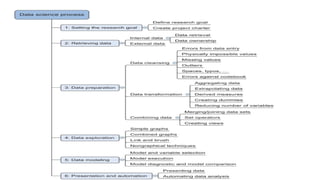
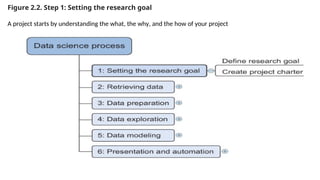
• The typical data science process consists of six steps
1. The first step of this process is setting a research goal. The main purpose here is
making sure all the stakeholders understand the what, how, and why of the project.
In every serious project this will result in a project charter.
2. The second phase is data retrieval. You want to have data available for analysis, so
this step includes finding suitable data and getting access to the data from the data
owner. The result is data in its raw form, which probably needs polishing and
transformation before it becomes usable.
3. Now that you have the raw data, it’s time to prepare it. This includes transforming
the data from a raw form into data that’s directly usable in your models. To achieve
this, you’ll detect and correct different kinds of errors in the data, combine data frm
different data sources, and transform it. If you have successfully completed this
step, you can progress to data visualization and modeling.
3.
4. The fourthstep is data exploration. The goal of this step is to gain a deep understanding of the data. You’ll
look for patterns, correlations, and deviations based on visual and descriptive techniques. The insights you
gain from this phase will enable you to start modeling.
5. Finally, we get to the sexiest part: model building (often referred to as “data modeling” throughout this
book). It is now that you attempt to gain the insights or make the predictions stated in your project charter.
Now is the time to bring out the heavy guns, but remember research has taught us that often (but not always)
a combination of simple models tends to outperform one complicated model. If you’ve done this phase right,
you’re almost done.
6. The last step of the data science model is presenting your results and automating the analysis, if needed.
One goal of a project is to change a process and/or make better decisions. You may still need to convince the
business that your findings will indeed change the business process as expected. This is where you can shine in
your influencer role. The importance of this step is more apparent in projects on a strategic and tactical level.
Certain projects require you to perform the business process over and over again, so automating the project
will save time process as expected. This is where you can shine in your influencer role. The importance of this
step is more apparent in projects on a strategic and tactical level. Certain projects require you to perform the
business process over and over again, so automating the project will save time.
4.
Setting the researchgoal
Defining Research Goals
• To understand the project, three concept must understand: what, why and how.
a) What is expectation of company or organization?
b) Why does a company's higher authority define such research value?
c) How is it part of a bigger strategic picture?
• Goal of first phase will be the answer of these three questions.
• In this phase, the data science team must learn and investigate the problem, develop
context and understanding and learn about the data sources needed and available for the
project.
5.
Figure 2.2. Step1: Setting the research goal
A project starts by understanding the what, the why, and the how of your project
6.
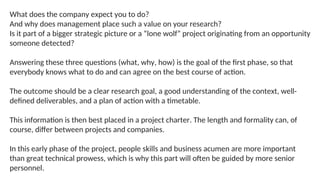
What does thecompany expect you to do?
And why does management place such a value on your research?
Is it part of a bigger strategic picture or a “lone wolf” project originating from an opportunity
someone detected?
Answering these three questions (what, why, how) is the goal of the first phase, so that
everybody knows what to do and can agree on the best course of action.
The outcome should be a clear research goal, a good understanding of the context, well-
defined deliverables, and a plan of action with a timetable.
This information is then best placed in a project charter. The length and formality can, of
course, differ between projects and companies.
In this early phase of the project, people skills and business acumen are more important
than great technical prowess, which is why this part will often be guided by more senior
personnel.
7.
1. Spend timeunderstanding the goals and context of your research
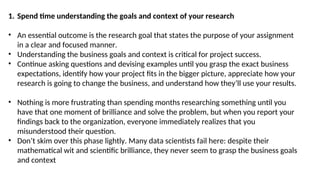
• An essential outcome is the research goal that states the purpose of your assignment
in a clear and focused manner.
• Understanding the business goals and context is critical for project success.
• Continue asking questions and devising examples until you grasp the exact business
expectations, identify how your project fits in the bigger picture, appreciate how your
research is going to change the business, and understand how they’ll use your results.
• Nothing is more frustrating than spending months researching something until you
have that one moment of brilliance and solve the problem, but when you report your
findings back to the organization, everyone immediately realizes that you
misunderstood their question.
• Don’t skim over this phase lightly. Many data scientists fail here: despite their
mathematical wit and scientific brilliance, they never seem to grasp the business goals
and context
8.
2. Create AProject Charter
Clients like to know upfront what they’re paying for, so after you have a good
understanding of the business problem, try to get a formal agreement on the deliverables.
All this information is best collected in a project charter. For any significant project this
would be mandatory.
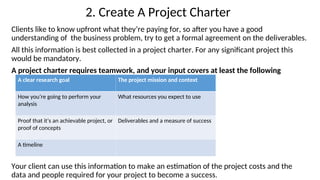
A project charter requires teamwork, and your input covers at least the following
Your client can use this information to make an estimation of the project costs and the
data and people required for your project to become a success.
A clear research goal The project mission and context
How you’re going to perform your
analysis
What resources you expect to use
Proof that it’s an achievable project, or
proof of concepts
Deliverables and a measure of success
A timeline
9.
Retrieving Data
• Retrievingrequired data is second phase of data science project. Sometimes Data scientists
need to go into the field and design a data collection process. Many companies will have
already collected and stored the data and what they don't have can often be bought from third
parties.
• Most of the high quality data is freely available for public and commercial use. Data can be
stored in various format. It is in text file format and tables in database. Data may be internal or
external.
1. Start working on internal data, i.e. data stored within the company
• First step of data scientists is to verify the internal data. Assess the relevance and quality of
the data that's readily in company. Most companies have a program for maintaining key data,
so much of the cleaning work may already be done. This data can be stored in official data
repositories such as databases, data marts, data warehouses and data lakes maintained by a
team of IT professionals.
• Data repository is also known as a data library or data archive. This is a general term to refer
to a data set isolated to be mined for data reporting and analysis. The data repository is a large
database infrastructure, several databases that collect, manage and store data sets for data
analysis, sharing and reporting.
10.
• Data repositorycan be used to describe several ways to collect and store data:
a) Data warehouse is a large data repository that aggregates data usually from multiple
sources or segments of a business, without the data being necessarily related.
b) Data lake is a large data repository that stores unstructured data that is classified and
tagged with metadata.
c) Data marts are subsets of the data repository. These data marts are more targeted to what
the data user needs and easier to use.
d) Metadata repositories store data about data and databases. The metadata explains where
the data source, how it was captured and what it represents.
e) Data cubes are lists of data with three or more dimensions stored as a table.
Advantages of data repositories:
i. Data is preserved and archived.
ii. Data isolation allows for easier and faster data reporting.
iii. Database administrators have easier time tracking problems.
iv. There is value to storing and analyzing data.
11.
Disadvantages of datarepositories :
i. Growing data sets could slow down systems.
ii. A system crash could affect all the data.
iii. Unauthorized users can access all sensitive data more easily than if it was distributed
across several locations.
2. Do not be afraid to shop around
• If required data is not available within the company, take the help of other company,
which provides such types of database. For example, Nielsen and GFK are provides data for
retail industry. Data scientists also take help of Twitter, LinkedIn and Facebook.
• Government's organizations share their data for free with the world. This data can be of
excellent quality; it depends on the institution that creates and manages it. The
information they share covers a broad range of topics such as the number of accidents or
amount of drug abuse in a certain region and its demographics.
12.
3. Perform dataquality checks to avoid later problem
• Allocate or spend some time for data correction and data cleaning. Collecting suitable,
error free data is success of the data science project.
• Most of the errors encounter during the data gathering phase are easy to spot, but being
too careless will make data scientists spend many hours solving data issues that could have
been prevented during data import.
• Data scientists must investigate the data during the import, data preparation and
exploratory phases. The difference is in the goal and the depth of the investigation.
• In data retrieval process, verify whether the data is right data type and data is same as in
the source document.
• With data preparation process, more elaborate checks performed. Check any shortcut
method is used. For example, check time and data format.
• During the exploratory phase, Data scientists focus shifts to what he/she can learn from
the data. Now Data scientists assume the data to be clean and look at the statistical
properties such as distributions, correlations and outliers.


![[DSC Europe 25] Ivan Lukovic & Marija Djukic - From Data to Value: Why Maturi...](https://cdn.slidesharecdn.com/ss_thumbnails/ahrfps8xr6knowwhacxh-1-ivan-marija-dsc-2025-ld-v1-presentation-260115093812-be21adfc-thumbnail.jpg?width=640&height=640&fit=bounds)


![[DSC Europe 25] Slobodan Dolinic - Smart and Intelligent Green Region.pptx](https://cdn.slidesharecdn.com/ss_thumbnails/0bribinjsp6ghwtvsvor-2-sigre-slobodan-dolinic-260115093812-c9c10e90-thumbnail.jpg?width=640&height=640&fit=bounds)


