The Chief Data Officer -
The Third Musketeer of the Digital Age
The digital paradigm is delivering an insurmountable amount of
data that organisations are able to exploit to define new customer
experiences and drive business growth. For companies to realise
the full value of this corporate asset, there needs to be executive
ownership and direction in the boardroom.
The digital disruption and trends such as
mobility, Bring Your Own Device (BYOD), cloud
and the Internet of Things (IoT) are converging
to create an always connected and
switched-on world. This new playing field is
enabling a consumer journey that is no longer
confined to the online or offline world, but
defining one that shifts seamlessly across
these two paradigms.
For organisations, this provides an explosion of
data that can be utilised to drive new revenue
streams and uncover innovative market
opportunities. Within this landscape, the role of
the CDO is increasingly being recognised as a
critical position within an organisation’s
executive boardroom. Sitting at the cross-
section of the traditional CMO and CIO roles,
the CDO is instrumental in guiding the
utilisation of data as a corporate asset to
enhance the customer experience and forge
new frontiers, pushing beyond the traditional
view of technology as a cost lever.
With vast opportunities for growth and cost
optimisation, organisations operating in the
digital world, from telecommunications and
banking to e-commerce, will increasingly see a
clear path being paved for the rise of the third
musketeer, the CDO.
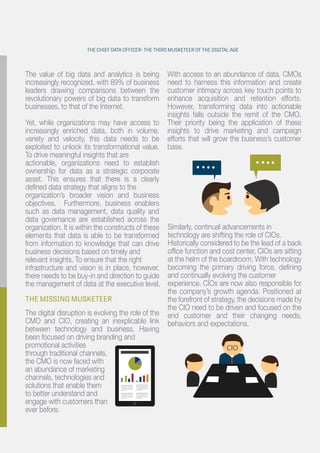
2014 2019
$7.04 b
GLOBAL ADAVANCED
ANALYTICS MARKET GROWTH
$29.53 b
THE POWER OF DATA
The global advanced analytics market is
forecast to grow to $29.53 billion in 2019 at a
CAGR of 33.2%1
.
With more than 40 zettabytes of data expected
to be generated by 2020 , organizations today
are faced with an explosion of both structured
and unstructured data.
40ZETTABYTES
OF DATA EXPECTED TO
BE GENERATED BY 2020 2
The value of big data and analytics is being
increasingly recognized, with 89% of business
leaders drawing comparisons between the
revolutionary powers of big data to transform
businesses, to that of the Internet.
Yet, while organizations may have access to
increasingly enriched data, both in volume,
variety and velocity, this data needs to be
exploited to unlock its transformational value.
To drive meaningful insights that are
actionable, organizations need to establish
ownership for data as a strategic corporate
asset. This ensures that there is a clearly
defined data strategy that aligns to the
organization’s broader vision and business
objectives. Furthermore, business enablers
such as data management, data quality and
data governance are established across the
organization. It is within the constructs of these
elements that data is able to be transformed
from information to knowledge that can drive
business decisions based on timely and
relevant insights. To ensure that the right
infrastructure and vision is in place, however,
there needs to be buy-in and direction to guide
the management of data at the executive level.
THE MISSING MUSKETEER
The digital disruption is evolving the role of the
CMO and CIO, creating an inexplicable link
between technology and business. Having
been focused on driving branding and
promotional activities
through traditional channels,
the CMO is now faced with
an abundance of marketing
channels, technologies and
solutions that enable them
to better understand and
engage with customers than
ever before.
With access to an abundance of data, CMOs
need to harness this information and create
customer intimacy across key touch points to
enhance acquisition and retention efforts.
However, transforming data into actionable
insights falls outside the remit of the CMO.
Their priority being the application of these
insights to drive marketing and campaign
efforts that will grow the business’s customer
base.
Similarly, continual advancements in
technology are shifting the role of CIOs.
Historically considered to be the lead of a back
office function and cost center, CIOs are sitting
at the helm of the boardroom. With technology
becoming the primary driving force, defining
and continually evolving the customer
experience, CIOs are now also responsible for
the company’s growth agenda. Positioned at
the forefront of strategy, the decisions made by
the CIO need to be driven and focused on the
end customer and their changing needs,
behaviors and expectations.
CIO
THE CHIEF DATA OFFICER- THE THIRD MUSKETEER OF THE DIGITAL AGE
Amidst the shifting landscape of the role of the
CMO and CIO, is an emerging need for
executive ownership of data. As a strategic
asset, data needs to be managed and owned
across the organization. Both CMOs and CIOs
do not have the requisite knowledge to guide
decisions surrounding data and are unable to
push forward an agenda that cuts across the
enterprise, beyond their individual silos.
Without such ownership and expertise at an
enterprise wide level, the full value potential of
transforming data into actionable insights that
drive business value is immediately
compromised.
By appointing a CDO, organisations create a
point of accountability and ownership for one
of the company’s most strategically valuable
assets. CDOs will be responsible for
establishing the organisation’s data strategy,
the required governance structures, policies
and guidelines to ensure data quality and
management as well as the use of new and
existing data and information assets.
It is forecast that 50% of all organisations in
regulated industries will have appointed CDOs
by 2017 .
As new technologies emerge to create and
define new digital experiences, the volume,
variety and velocity of available data will contin-
ue to multiply. More data means more opportu-
nities for organisations to better understand
their customers and identify new opportunities
for business growth. To enable the arrival of the
new CMO and CIO roles and a company’s
growth agenda in a digital world, businesses
need to appoint a CDO. Responsible for data
management and exploitation, the CDO is the
missing musketeer in the executive boardroom
with the ability, authority and knowledge to
transform enterprise data into valuable insights
and drive tangible outcomes.
50%OF ALL ORGANISATIONS IN
REGULATED INDUSTRIES WILL HAVE
APPOINTED CDOS BY 2017 3
.
ABOUT DHR INTERNATIONAL
Established in 1989, DHR International is one
of the largest retained executive search firms in
the world, with more than 50 offices around
the globe. We conduct search assignments at
the board of directors, C-level and functional
vice president levels. DHR's renowned
consultants specialize in all industries and
functions in order to provide unparalleled
senior-level executive search, management
assessment and succession planning services
tailored to the unique qualities and
specifications of our select client base.
THE CHIEF DATA OFFICER- THE THIRD MUSKETEER OF THE DIGITAL AGE

THE CHIEF DATA OFFICER

  • 1.
    The Chief DataOfficer - The Third Musketeer of the Digital Age The digital paradigm is delivering an insurmountable amount of data that organisations are able to exploit to define new customer experiences and drive business growth. For companies to realise the full value of this corporate asset, there needs to be executive ownership and direction in the boardroom. The digital disruption and trends such as mobility, Bring Your Own Device (BYOD), cloud and the Internet of Things (IoT) are converging to create an always connected and switched-on world. This new playing field is enabling a consumer journey that is no longer confined to the online or offline world, but defining one that shifts seamlessly across these two paradigms. For organisations, this provides an explosion of data that can be utilised to drive new revenue streams and uncover innovative market opportunities. Within this landscape, the role of the CDO is increasingly being recognised as a critical position within an organisation’s executive boardroom. Sitting at the cross- section of the traditional CMO and CIO roles, the CDO is instrumental in guiding the utilisation of data as a corporate asset to enhance the customer experience and forge new frontiers, pushing beyond the traditional view of technology as a cost lever. With vast opportunities for growth and cost optimisation, organisations operating in the digital world, from telecommunications and banking to e-commerce, will increasingly see a clear path being paved for the rise of the third musketeer, the CDO. 2014 2019 $7.04 b GLOBAL ADAVANCED ANALYTICS MARKET GROWTH $29.53 b THE POWER OF DATA The global advanced analytics market is forecast to grow to $29.53 billion in 2019 at a CAGR of 33.2%1 . With more than 40 zettabytes of data expected to be generated by 2020 , organizations today are faced with an explosion of both structured and unstructured data. 40ZETTABYTES OF DATA EXPECTED TO BE GENERATED BY 2020 2
  • 2.
    The value ofbig data and analytics is being increasingly recognized, with 89% of business leaders drawing comparisons between the revolutionary powers of big data to transform businesses, to that of the Internet. Yet, while organizations may have access to increasingly enriched data, both in volume, variety and velocity, this data needs to be exploited to unlock its transformational value. To drive meaningful insights that are actionable, organizations need to establish ownership for data as a strategic corporate asset. This ensures that there is a clearly defined data strategy that aligns to the organization’s broader vision and business objectives. Furthermore, business enablers such as data management, data quality and data governance are established across the organization. It is within the constructs of these elements that data is able to be transformed from information to knowledge that can drive business decisions based on timely and relevant insights. To ensure that the right infrastructure and vision is in place, however, there needs to be buy-in and direction to guide the management of data at the executive level. THE MISSING MUSKETEER The digital disruption is evolving the role of the CMO and CIO, creating an inexplicable link between technology and business. Having been focused on driving branding and promotional activities through traditional channels, the CMO is now faced with an abundance of marketing channels, technologies and solutions that enable them to better understand and engage with customers than ever before. With access to an abundance of data, CMOs need to harness this information and create customer intimacy across key touch points to enhance acquisition and retention efforts. However, transforming data into actionable insights falls outside the remit of the CMO. Their priority being the application of these insights to drive marketing and campaign efforts that will grow the business’s customer base. Similarly, continual advancements in technology are shifting the role of CIOs. Historically considered to be the lead of a back office function and cost center, CIOs are sitting at the helm of the boardroom. With technology becoming the primary driving force, defining and continually evolving the customer experience, CIOs are now also responsible for the company’s growth agenda. Positioned at the forefront of strategy, the decisions made by the CIO need to be driven and focused on the end customer and their changing needs, behaviors and expectations. CIO THE CHIEF DATA OFFICER- THE THIRD MUSKETEER OF THE DIGITAL AGE
  • 3.
    Amidst the shiftinglandscape of the role of the CMO and CIO, is an emerging need for executive ownership of data. As a strategic asset, data needs to be managed and owned across the organization. Both CMOs and CIOs do not have the requisite knowledge to guide decisions surrounding data and are unable to push forward an agenda that cuts across the enterprise, beyond their individual silos. Without such ownership and expertise at an enterprise wide level, the full value potential of transforming data into actionable insights that drive business value is immediately compromised. By appointing a CDO, organisations create a point of accountability and ownership for one of the company’s most strategically valuable assets. CDOs will be responsible for establishing the organisation’s data strategy, the required governance structures, policies and guidelines to ensure data quality and management as well as the use of new and existing data and information assets. It is forecast that 50% of all organisations in regulated industries will have appointed CDOs by 2017 . As new technologies emerge to create and define new digital experiences, the volume, variety and velocity of available data will contin- ue to multiply. More data means more opportu- nities for organisations to better understand their customers and identify new opportunities for business growth. To enable the arrival of the new CMO and CIO roles and a company’s growth agenda in a digital world, businesses need to appoint a CDO. Responsible for data management and exploitation, the CDO is the missing musketeer in the executive boardroom with the ability, authority and knowledge to transform enterprise data into valuable insights and drive tangible outcomes. 50%OF ALL ORGANISATIONS IN REGULATED INDUSTRIES WILL HAVE APPOINTED CDOS BY 2017 3 . ABOUT DHR INTERNATIONAL Established in 1989, DHR International is one of the largest retained executive search firms in the world, with more than 50 offices around the globe. We conduct search assignments at the board of directors, C-level and functional vice president levels. DHR's renowned consultants specialize in all industries and functions in order to provide unparalleled senior-level executive search, management assessment and succession planning services tailored to the unique qualities and specifications of our select client base. THE CHIEF DATA OFFICER- THE THIRD MUSKETEER OF THE DIGITAL AGE