THE CHERNOBYL REPORT
A PBL Case Study of ”The Chernobyl Incident” for
CHY1002 (Environmental Sciences)
- Sumit Saha
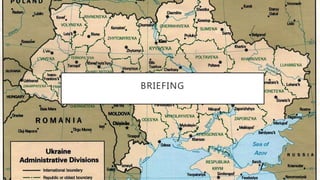
BRIEFING
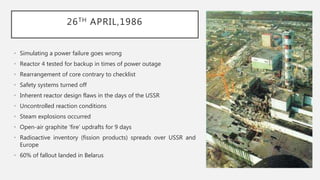
26TH APRIL,1986
• Simulating a power failure goes wrong
• Reactor 4 tested for backup in times of power outage
• Rearrangement of core contrary to checklist
• Safety systems turned off
• Inherent reactor design flaws in the days of the USSR
• Uncontrolled reaction conditions
• Steam explosions occurred
• Open-air graphite ‘fire’ updrafts for 9 days
• Radioactive inventory (fission products) spreads over USSR and
Europe
• 60% of fallout landed in Belarus
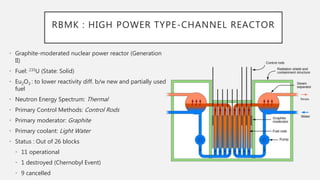
RBMK : HIGH POWER TYPE-CHANNEL REACTOR
• Graphite-moderated nuclear power reactor (Generation
II)
• Fuel: 235U (State: Solid)
• Eu2O3 : to lower reactivity diff. b/w new and partially used
fuel
• Neutron Energy Spectrum: Thermal
• Primary Control Methods: Control Rods
• Primary moderator: Graphite
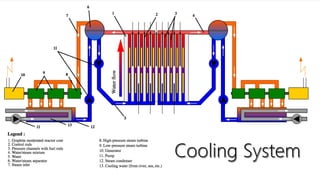
• Primary coolant: Light Water
• Status : Out of 26 blocks
• 11 operational
• 1 destroyed (Chernobyl Event)
• 9 cancelled
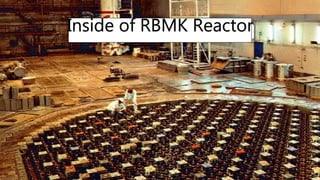
Inside of RBMK Reactor
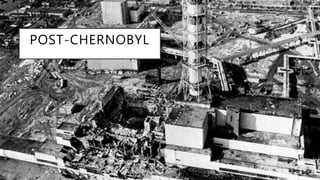
POST-CHERNOBYL
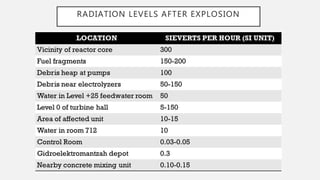
RADIATION LEVELS AFTER EXPLOSION
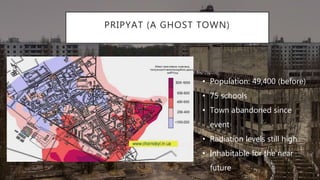
PRIPYAT (A GHOST TOWN)
• Population: 49,400 (before)
• 75 schools
• Town abandoned since
event
• Radiation levels still high
• Inhabitable for the near
future
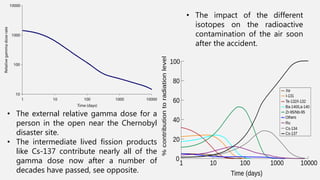
• The external relative gamma dose for a
person in the open near the Chernobyl
disaster site.
• The intermediate lived fission products
like Cs-137 contribute nearly all of the
gamma dose now after a number of
decades have passed, see opposite.
• The impact of the different
isotopes on the radioactive
contamination of the air soon
after the accident.
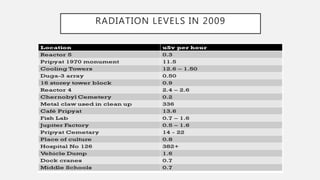
RADIATION LEVELS IN 2009
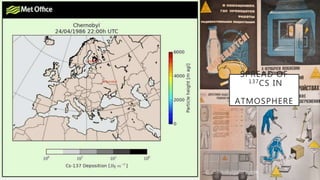
SPREAD OF
137CS IN
ATMOSPHERE
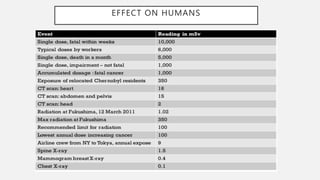
EFFECT ON HUMANS
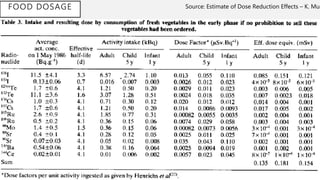
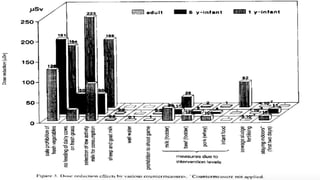
FOOD DOSAGE Source: Estimate of Dose Reduction Effects – K. Muc
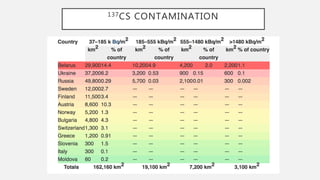
137CS CONTAMINATION
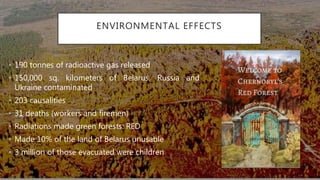
ENVIRONMENTAL EFFECTS
• 190 tonnes of radioactive gas released
• 150,000 sq. kilometers of Belarus, Russia and
Ukraine contaminated
• 203 causalities
• 31 deaths (workers and firemen)
• Radiations made green forests: RED
• Made 10% of the land of Belarus unusable
• 3 million of those evacuated were children
HEALTH IMPACTS
• 270,000 cancers which are mostly thyroid till date
• 93,000 fatal cases
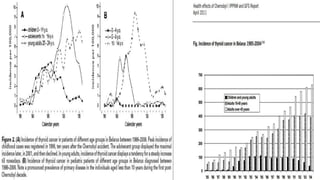
• 1800+ registered cases of thyroid cancer in children
• Leukaemia increased 50% in children and adults
• Cataract studies shows it occurred at 250msv
• Cardiovascular diseases occurred to emergency workers
• Leukaemia cases doubled after people been exposed
• Reproductive and hereditary effects were also seen
• Mental and psychological effects were also seen.
PRECAUTIONS TAKEN
• Locals must change their clothes twice a day, and may not
walk in the woods for more than two hours a month
• Levels of radiation are printed in the newspapers and it
informs whether children could be allowed out to play
• To wash food at least five times in clean water
• Cattle are not supposed to graze in areas where the grass is
less than 10cm high so their mouths will not touch the earth
ECONOMIES OF THE EFFECTED
COUNTRIES
• Belarus will have spent a total of 235 billion dollars on
dealing with the radiation
• Budget goes towards the medical facilities
• Ukraine’s 5–7 % of government spending still for
Chernobyl programs
• Belarus government spending on Chernobyl is 22.3% of
the national budget
• But in present time it declined to 6.1%.
• Total spending by Belarus on Chernobyl between 1991
and 2003 was more than 13 billion dollars
INTERNATIONAL
ATOMIC ENERGY
AGENCY
THE IAEA
• Established in 1957
• Formed to promote peaceful use of nuclear energy
• To inhibit use for military purposes (nuclear weapons)
• Reports to United Nations General Assembly and Security Council
• An intergovernmental forum for scientific and technical cooperation in the
peaceful use of nuclear technology and nuclear power worldwide
• Came into the broader picture post Fukushima Daiichi and Chernobyl Incidents
• 3 pillars:
• Safety and Security
• Science and Technology
• Safeguards and Verification
SAFETY OF RESEARCH REACTORS
• Site evaluation
• Design
• Construction
• Commissioning
• Operation, including utilization and
modification
• Decommissioning
• Release from regulatory control.
DESIGN OF INSTRUMENTATION
• The management system for Instrumentation and
Control Design
• Design basis for Instrumentation and Control Systems
• Instrumentation and Control Architecture
• Safety classification of Instrumentation and Control
Functions, Systems and Equipment
• Design guidelines for specific Instrumentation and
Control Systems and Equipment
• Considerations relating to the Human-Machine
Interface
• Software
MANAGEMENT FOR SAFETY
• Responsibility for Safety
• Leadership for Safety
• Management for Safety
• Culture for Safety
• Measurement, Assessment and
Improvement
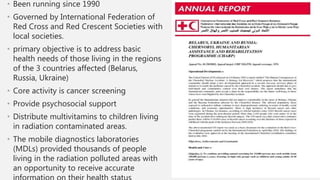
• Been running since 1990
• Governed by International Federation of
Red Cross and Red Crescent Societies with
local societies.
• primary objective is to address basic
health needs of those living in the regions
of the 3 countries affected (Belarus,
Russia, Ukraine)
• Core activity is cancer screening
• Provide psychosocial support
• Distribute multivitamins to children living
in radiation contaminated areas.
• The mobile diagnostics laboratories
(MDLs) provided thousands of people
living in the radiation polluted areas with
an opportunity to receive accurate
GLOBAL AGENDA GOALS
• Reduce the numbers of deaths, injuries and impact from disasters.
• Reduce the number of deaths, illnesses and impact from diseases
and public health emergencies.
• Increase local community, civil society and Red Cross
• Red Crescent capacity to address the most urgent situations of
vulnerability.
• Reduce intolerance, discrimination and social exclusion and promote
respect for diversity and human dignity.
CRDP-CHERNOBYL RECOVERY AND
DEVELOPMENT PROGRAMME
• Was developed by the United Nations Development
Program and was initiated in 2002
• Aim is to return the affected to normal life by
providing support to the government of Ukraine
• Ukraine for elaboration and implementation of
development-oriented solutions for the regions
• Mitigate long-term social, economic and
environmental consequences
• Creates more favorable living conditions and to
promote sustainable human development in
affected regions
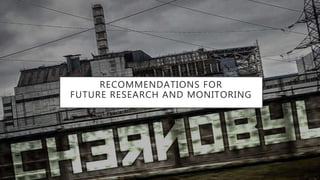
RECOMMENDATIONS FOR
FUTURE RESEARCH AND MONITORING
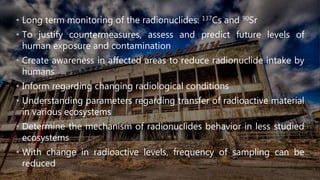
• Long term monitoring of the radionuclides: 137Cs and 90Sr
• To justify countermeasures, assess and predict future levels of
human exposure and contamination
• Create awareness in affected areas to reduce radionuclide intake by
humans
• Inform regarding changing radiological conditions
• Understanding parameters regarding transfer of radioactive material
in various ecosystems
• Determine the mechanism of radionuclides behavior in less studied
ecosystems
• With change in radioactive levels, frequency of sampling can be
reduced
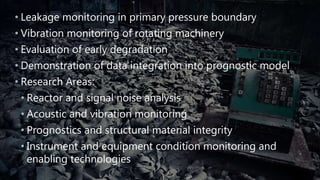
• Leakage monitoring in primary pressure boundary
• Vibration monitoring of rotating machinery
• Evaluation of early degradation
• Demonstration of data integration into prognostic model
• Research Areas:
• Reactor and signal noise analysis
• Acoustic and vibration monitoring
• Prognostics and structural material integrity
• Instrument and equipment condition monitoring and
enabling technologies
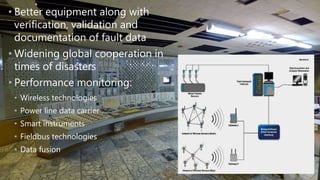
• Better equipment along with
verification, validation and
documentation of fault data
• Widening global cooperation in
times of disasters
• Performance monitoring:
• Wireless technologies
• Power line data carrier
• Smart instruments
• Fieldbus technologies
• Data fusion
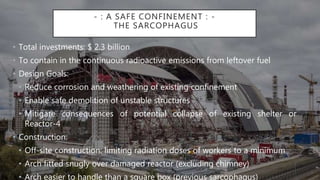
- : A SAFE CONFINEMENT : -
THE SARCOPHAGUS
• Total investments: $ 2.3 billion
• To contain in the continuous radioactive emissions from leftover fuel
• Design Goals:
• Reduce corrosion and weathering of existing confinement
• Enable safe demolition of unstable structures
• Mitigate consequences of potential collapse of existing shelter or
Reactor-4
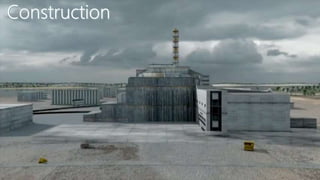
• Construction:
• Off-site construction: limiting radiation doses of workers to a minimum
• Arch fitted snugly over damaged reactor (excluding chimney)
• Arch easier to handle than a square box (previous sarcophagus)
THANK YOU

The Chernobyl Report

  • 1.
    THE CHERNOBYL REPORT APBL Case Study of ”The Chernobyl Incident” for CHY1002 (Environmental Sciences) - Sumit Saha
  • 2.
  • 3.
    26TH APRIL,1986 • Simulatinga power failure goes wrong • Reactor 4 tested for backup in times of power outage • Rearrangement of core contrary to checklist • Safety systems turned off • Inherent reactor design flaws in the days of the USSR • Uncontrolled reaction conditions • Steam explosions occurred • Open-air graphite ‘fire’ updrafts for 9 days • Radioactive inventory (fission products) spreads over USSR and Europe • 60% of fallout landed in Belarus
  • 4.
    RBMK : HIGHPOWER TYPE-CHANNEL REACTOR • Graphite-moderated nuclear power reactor (Generation II) • Fuel: 235U (State: Solid) • Eu2O3 : to lower reactivity diff. b/w new and partially used fuel • Neutron Energy Spectrum: Thermal • Primary Control Methods: Control Rods • Primary moderator: Graphite • Primary coolant: Light Water • Status : Out of 26 blocks • 11 operational • 1 destroyed (Chernobyl Event) • 9 cancelled
  • 6.
  • 7.
  • 8.
  • 9.
    PRIPYAT (A GHOSTTOWN) • Population: 49,400 (before) • 75 schools • Town abandoned since event • Radiation levels still high • Inhabitable for the near future
  • 10.
    • The externalrelative gamma dose for a person in the open near the Chernobyl disaster site. • The intermediate lived fission products like Cs-137 contribute nearly all of the gamma dose now after a number of decades have passed, see opposite. • The impact of the different isotopes on the radioactive contamination of the air soon after the accident.
  • 11.
  • 12.
  • 13.
  • 14.
    FOOD DOSAGE Source:Estimate of Dose Reduction Effects – K. Muc
  • 16.
  • 17.
    ENVIRONMENTAL EFFECTS • 190tonnes of radioactive gas released • 150,000 sq. kilometers of Belarus, Russia and Ukraine contaminated • 203 causalities • 31 deaths (workers and firemen) • Radiations made green forests: RED • Made 10% of the land of Belarus unusable • 3 million of those evacuated were children
  • 18.
    HEALTH IMPACTS • 270,000cancers which are mostly thyroid till date • 93,000 fatal cases • 1800+ registered cases of thyroid cancer in children • Leukaemia increased 50% in children and adults • Cataract studies shows it occurred at 250msv • Cardiovascular diseases occurred to emergency workers • Leukaemia cases doubled after people been exposed • Reproductive and hereditary effects were also seen • Mental and psychological effects were also seen.
  • 20.
    PRECAUTIONS TAKEN • Localsmust change their clothes twice a day, and may not walk in the woods for more than two hours a month • Levels of radiation are printed in the newspapers and it informs whether children could be allowed out to play • To wash food at least five times in clean water • Cattle are not supposed to graze in areas where the grass is less than 10cm high so their mouths will not touch the earth
  • 21.
    ECONOMIES OF THEEFFECTED COUNTRIES • Belarus will have spent a total of 235 billion dollars on dealing with the radiation • Budget goes towards the medical facilities • Ukraine’s 5–7 % of government spending still for Chernobyl programs • Belarus government spending on Chernobyl is 22.3% of the national budget • But in present time it declined to 6.1%. • Total spending by Belarus on Chernobyl between 1991 and 2003 was more than 13 billion dollars
  • 22.
  • 23.
    THE IAEA • Establishedin 1957 • Formed to promote peaceful use of nuclear energy • To inhibit use for military purposes (nuclear weapons) • Reports to United Nations General Assembly and Security Council • An intergovernmental forum for scientific and technical cooperation in the peaceful use of nuclear technology and nuclear power worldwide • Came into the broader picture post Fukushima Daiichi and Chernobyl Incidents • 3 pillars: • Safety and Security • Science and Technology • Safeguards and Verification
  • 25.
    SAFETY OF RESEARCHREACTORS • Site evaluation • Design • Construction • Commissioning • Operation, including utilization and modification • Decommissioning • Release from regulatory control.
  • 26.
    DESIGN OF INSTRUMENTATION •The management system for Instrumentation and Control Design • Design basis for Instrumentation and Control Systems • Instrumentation and Control Architecture • Safety classification of Instrumentation and Control Functions, Systems and Equipment • Design guidelines for specific Instrumentation and Control Systems and Equipment • Considerations relating to the Human-Machine Interface • Software
  • 27.
    MANAGEMENT FOR SAFETY •Responsibility for Safety • Leadership for Safety • Management for Safety • Culture for Safety • Measurement, Assessment and Improvement
  • 29.
    • Been runningsince 1990 • Governed by International Federation of Red Cross and Red Crescent Societies with local societies. • primary objective is to address basic health needs of those living in the regions of the 3 countries affected (Belarus, Russia, Ukraine) • Core activity is cancer screening • Provide psychosocial support • Distribute multivitamins to children living in radiation contaminated areas. • The mobile diagnostics laboratories (MDLs) provided thousands of people living in the radiation polluted areas with an opportunity to receive accurate
  • 30.
    GLOBAL AGENDA GOALS •Reduce the numbers of deaths, injuries and impact from disasters. • Reduce the number of deaths, illnesses and impact from diseases and public health emergencies. • Increase local community, civil society and Red Cross • Red Crescent capacity to address the most urgent situations of vulnerability. • Reduce intolerance, discrimination and social exclusion and promote respect for diversity and human dignity.
  • 31.
    CRDP-CHERNOBYL RECOVERY AND DEVELOPMENTPROGRAMME • Was developed by the United Nations Development Program and was initiated in 2002 • Aim is to return the affected to normal life by providing support to the government of Ukraine • Ukraine for elaboration and implementation of development-oriented solutions for the regions • Mitigate long-term social, economic and environmental consequences • Creates more favorable living conditions and to promote sustainable human development in affected regions
  • 32.
  • 33.
    • Long termmonitoring of the radionuclides: 137Cs and 90Sr • To justify countermeasures, assess and predict future levels of human exposure and contamination • Create awareness in affected areas to reduce radionuclide intake by humans • Inform regarding changing radiological conditions • Understanding parameters regarding transfer of radioactive material in various ecosystems • Determine the mechanism of radionuclides behavior in less studied ecosystems • With change in radioactive levels, frequency of sampling can be reduced
  • 34.
    • Leakage monitoringin primary pressure boundary • Vibration monitoring of rotating machinery • Evaluation of early degradation • Demonstration of data integration into prognostic model • Research Areas: • Reactor and signal noise analysis • Acoustic and vibration monitoring • Prognostics and structural material integrity • Instrument and equipment condition monitoring and enabling technologies
  • 35.
    • Better equipmentalong with verification, validation and documentation of fault data • Widening global cooperation in times of disasters • Performance monitoring: • Wireless technologies • Power line data carrier • Smart instruments • Fieldbus technologies • Data fusion
  • 37.
    - : ASAFE CONFINEMENT : - THE SARCOPHAGUS • Total investments: $ 2.3 billion • To contain in the continuous radioactive emissions from leftover fuel • Design Goals: • Reduce corrosion and weathering of existing confinement • Enable safe demolition of unstable structures • Mitigate consequences of potential collapse of existing shelter or Reactor-4 • Construction: • Off-site construction: limiting radiation doses of workers to a minimum • Arch fitted snugly over damaged reactor (excluding chimney) • Arch easier to handle than a square box (previous sarcophagus)
  • 39.