The challenges facing
industrious email marketers
Blair Cooke
Database Marketing Director
Fairfax Digital
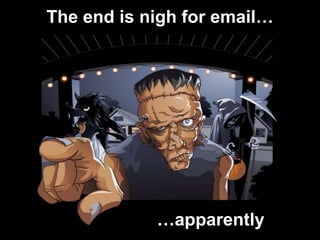
The end is nigh for email…
…apparently
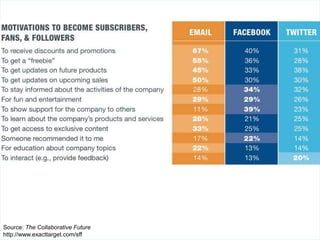
Source: The Collaborative Future
http://www.exacttarget.com/sff
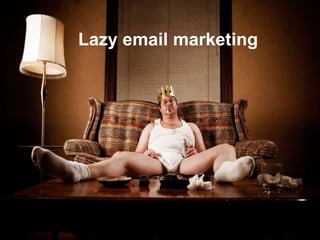
Lazy email marketing
Batch and blast approach
Little interest in
relevance
Not much thought given to engagement
Meaning bigger lists are required
Instead we should
be inquisitive
and engage our
subscribers
Add value to their experience
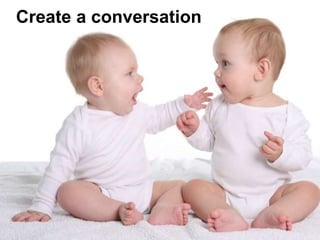
Create a conversation
Trust
Engender loyalty
You are not as sexy
as you think you are
The hidden cost of email
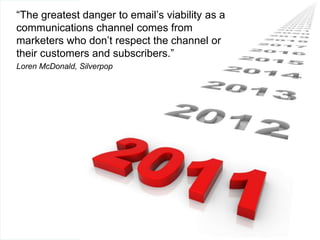
“The greatest danger to email’s viability as a
communications channel comes from
marketers who don’t respect the channel or
their customers and subscribers.”
Loren McDonald, Silverpop
Blair Cooke
Database Marketing Director
Fairfax Digital
LinkedIn: http://www.linkedin.com/in/blaircooke
Twitter: @WiseMouth

The challenges facing industrious email marketers

Editor's Notes

  • #2 Over the last few years there has been a rising chorus of voices predicting the death of email. In 2004 an article written for PC magazine asked the question if email had peaked and become useless. In 2006 USA Today claimed that “E-mail has become the new snail mail' as the younger set goes with text messaging” Last year the WSJ wrote that “Email has had a good run as king of communications. But its reign is over. “ And earlier this year the COO of Facebook stated that since most teens are not using email, email is probably going away.”
  • #3 So in case you hadn’t heard, the end is nigh for email….well apparently anyway. The contributing factors to the death of email include Spam Social Technologies (FB/Twitter/SMS/IM) Now there are a lot of people out there far smarter than me who do research in this area but I don’t know if email is going to “go away”. My observation is that generally these statements are intended to be inflammatory to grab headlines or progress an agenda. And I find it very difficult to conclude that simply because teenagers are not doing something now means the future of that activity is in doubt. A Twitter stream popped up shortly after those Facebook comments pointing out that there are plenty of things that most teenagers do not do and which are therefore also at risk Drinking red wine Voting Having children Paying taxes And from my own experience, although I use social media more for my personal messages, email is still a vital component in my communication toolbox. I recently bought a property and I’ve been liaising with real estate agents, builders, strata managers, mortgage brokers, and my wife via email. Social media isn’t an appropriate channel for all these exchanges. And in case the younger members of the audience think I’m a bit of a dinosaur, I’d just like to clarify that I do in fact use more than just email. I’m no Justin Bieber but I have RSS feeds set up so I can keep in touch with the content I don’t want to have come to my inbox. I am on Facebook throughout the day. I tweet. I Skype. I instant message. And I email. I also use email to receive communications from businesses or companies. And guess what, I’m not alone in this.
  • #4 This is a chart from a research series put together by ExactTarget called Subscribers, Fans and Followers and which looks at the way people use email, Facebook and Twitter. What is interesting about this chart is that email is the most popular channel for receiving marketing material. 67% of people who signed up for an email said they did so in order to receive discounts and promotions, compared with 40% on FB and 31% on Twitter. Email is also more popular than the other channels for receiving product updates, entertainment, education and for exclusive content. What that tells us is that many people want marketers to communicate with them via email. But here’s the rub. If they invite you into their inbox, they have high expectations. They expect you to treat that invitation with respect, to provide them with value and to enrich their experience. And this is where we tend to get it wrong. And “if” email is dying, I believe as email marketers we have to take a big chunk of the responsibility for this.
  • #5 One of the problems with email marketing is that too often we are lazy. I’m not saying that the people sending the campaigns are lazy but that our strategies are lazy. And I believe that often this comes from the misconception that email is easy and anyone can do it. After all, I know how to send an email, how hard can it be! How many of you have had your MDs or CEOs tell you just to send the offer to the entire base, regardless of its relevance. Email marketing is a science. Just like direct marketing is a science. The rigour you apply to a DM campaign should also be applied to an email marketing campaign. You wouldn’t conduct a $100,000 direct mail campaign on a whim without any due diligence and so why do we allow ourselves to do this for email campaigns? The answer is because the cost of an email campaign is virtually nil. It is nigh on impossible to do an email campaign that doesn’t deliver a positive ROI. And this is why we have spam…because you can deliver a profitable campaign despite achieving a conversion rate of 0.0002%.
  • #6 As a result, we take a batch and blast approach. We send to anyone and everyone foolish enough to give us their email address. Who cares about segments, profiles, behaviours, preferences? Why bother finding out the interests of our subscribers? It’s all too hard anyway, and doesn’t improve the ROI, if anything it might actually decrease the ROI by decreasing the size of the audience you send to.
  • #7 We’re not that interested in improving the relevance of our messages. We know it makes sense but it’s just too difficult to be relevant to everyone. Instead we convince ourselves that as long as it’s broadly relevant then it’s fine. And so we either send out email that is so generic that it loses its impact. Or we send an offer that we know isn’t relevant to everyone receiving it.
  • #8 The trickle-down effect of this is that we start to lose engagement. That subscriber who willingly provided us with his email address because he thought we’d respect it becomes disillusioned as we continually send him irrelevant content or offers, or we show our hand by constantly talking at him and demonstrating that we only see him as a potential sale, nothing more. So he unsubscribes OR he stays subscribed but stops clicking, stops opening and becomes inactive.
  • #9 As more and more subscribers tire of being sold to the responsiveness of the list falls which means we need to send to more people. So we undertake campaigns to grow our list, to get it bigger. We’re still not interested in relevance or engagement but at least we have a big list!
  • #10 We need to find out more about our subscribers...
  • #11 And find out more about them in order to engage them better. Having more engaged subscribers means improved responsiveness, more referrals, and better deliverability. Andy Sernovitz says that a brand is the sum of what others are saying about you. If you believe this you need to be mindful of your interactions with your customers and plan for how to build engagement This isn’t easy. It’s a lot of work. It gets met with resistance within the business because it means more resources are required. It’s much easier to send one message to 100,000 than to try to tailor it. Tailoring requires databases and campaigns that capture the information necessary to tailor. It means figuring out what information you need and how to get it. It means watching what people do on your site so you can improve their experience. And then having the systems in place to store this information. It means creating multiple versions of creative that you can draw on to create dynamically generated emails. When you take a purely ROI perspective on email marketing then it becomes difficult to justify all this additional effort. And so what we need to do is to stop thinking purely about ROI and look at the bigger picture. Start thinking about tenure, life time value, engagement, WOM
  • #12 When you expand your metrics beyond just ROI then you become more interested in finding ways of adding value to your subscribers’ experience.
  • #13 When someone gives you their email address it is the start of a conversation – it’s a new relationship What do you do to nurture this relationship? Do you take it slowly, find out a bit about them, tell them a bit about you, buy them flowers, ease into the relationship. Or do you start flogging product to them straight away? Generally speaking we all do this pretty badly. We’re so focused on the end-game we forget about the journey. We may not need the journey for our benefit, but chances our our new subscriber expects us to take things slowly. What welcome strategy do you have in place for your new subscribers? Is it tailored according the information the subscriber gives you? Does it set their expectations around what they will receive from you? These are all important things to build the foundation for creating an engaged subscriber. And like all relationships, the relationship with your subscribers is built on…
  • #14 Trust that you won’t abuse their decision to provide you with access to their inbox
  • #15 And respect - Of their preferences and their individuality
  • #16 If you do this well you will build loyalty amongst your subscribers and they will reward you by sticking around, remaining engaged, buying more, and telling their friends about you. Doing all this requires a change in our mindset (…)
  • #17 You are not as sexy as you think you are. The reason I have included this slide is because as marketers we tend to live under this misconception that everyone thinks anything to do with our company is the single most fascinating thing in the world. And so we feel the need to share it. With everyone. So what I’d like you to do, is take a copy of this slide, blow it up, put in on the wall next to your desk and look at it before you do any email campaign. What it should do is cause you to ask yourself, “Is this message really relevant for the subscribers I’m about to send it to?” Are you sending it to the right segments? Do you even have the right data to segment – if not, how are you going to start collecting it? Have you personalised it effectively…and I don’t just mean you’ve entered my name. What other information do you have about me that is relevant and that would engage me more. If it’s a newsletter, how about suggesting an article that you think I’d be interested in based on what you know about me Is the timing right? If not, can you use trigger-based rules to do this better?
  • #18 Okay, so it’s really easy to get up and say stop the batch and blast approach but it’s difficult to put this into practice. I have conversations with senior people in my own company that regularly ask me to send an offer “to everyone” and who don’t understand when I push back. The key message for you is this: We need to think of subscribers as a long term asset instead of a short term opportunity. And as such, we need to be single-minded about engaging our subscribers. And the reason for that is because there is not an infinite number of people in your market. If you continue to batch and blast, your subscribers will disengage or unsubscribe and you will eventually run out of new people to attract. You will then be faced with the situation when you are trying to re-engage or win back people who trusted you once but who now view you with suspicion. What’s more, the subscribers that we burn through our bad email marketing habits can do much more damage than just affect our open rate. For starters they can report you as a spammer which is easier than unsubscribing and also affects your sender reputation with that ISP. The worse your reputation, the less likely your email is to be delivered in the inbox. What’s more, as ISPs try to filter out spam, they are introducing more and more sophisticated systems to make sure that their users are only receiving messages they want to receive. Hotmail and Gmail are two that have made changes in the last few months which have massive ramifications for marketers. These filters look for things like engagement to see whether a message should be delivered and if your email is received by a lot of people on Hotmail who don’t open it or don’t click on it, you’re that much more likely to have future emails delivered to the Junk folder. There’s not much point in having big lists if the messages you’re sending are never received by the people you send them to. The bottom line is that bad email marketing practices kill your engagement…which then affects your deliverability. Eventually the cost you pay to acquire your subscribers will start to increase and your guaranteed ROI-positive channel will be in trouble. We need to think of subscribers as a long term asset instead of a short term opportunity.
  • #19 I said at the start that it’s become a bit of a sport lately to claim the death of email is fast approaching. In all honesty I don’t know what will happen. Maybe email will become redundant, maybe it won’t. But one thing is certain, how people use email is changing. It’s less about personal communication now and is instead an effective channel for receiving messages from people or sources that they trust. This is great news for marketers but we need to make sure we don’t abuse that trust. Because if the death of email is nigh, then “the greatest danger to email’s viability as a communications channel comes from marketers who don’t respect the channel or their customers and subscribers.”