T he Brook is an autobiography of Alferd Lord Tennyson. The poet portrays himself as the Brook. The poem gives the thoughts and impressions of the brook as it twists and turns and flows and falls through the changing landscape. The poet has realistically drawn a parallelism between the journey of the brook with the life of a man. The poet says as in the childhood the a child is very agile, energetic and lively , like that only the brook in the beginning stage of its life is very powerful, enhancing and it keeps on flowing with a great rush and enthusiasm through out its life . It falls from great heights and menders around the wavy path, and when it approaches on plain it becomes very slow and continues to flow eternally.  Like the brook a man toward the end of his life he becomes slow in his moves and ultimately dies and also emerges with its final destination but it never ends to flow.
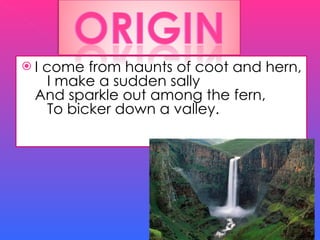
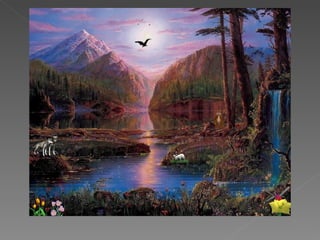
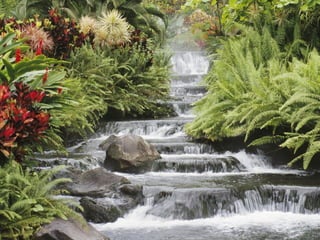
I come from haunts of coot and hern,    I make a sudden sally And sparkle out among the fern,    To bicker down a valley.
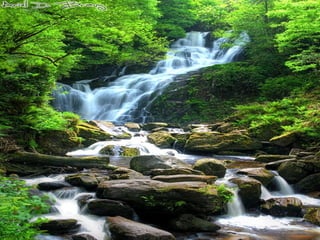
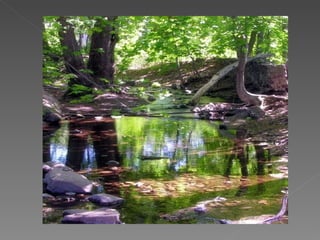
The brook starts from a very beautiful place consisting of the coots(kind of duck) & herns (commonly known as herons) who spend most of their times near it. The man is also born from a very beautiful place i.e. the woomb of the mother The brook suddenly rushes down. The brooks way gets stopped  by the ferns but it doesn’t get depressed  and rather tries to overcome the obstacles. As the brook flows it sparkles because of sun rays, and it flows through a ground which mostly have grasses and flowerless plants(fern) . The brook flows down a valley making noisy sounds.


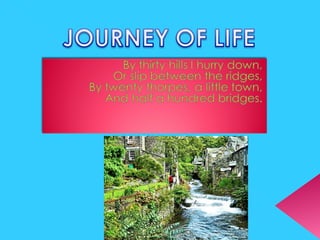
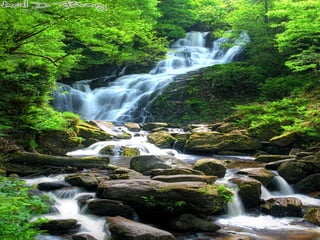
The brook swiftly flows down many hills. There are not literally 'Thirty hills' but the poet make's the line creative by using 'Thirty' and not 'many'. The brook slips (quickly moves) between long narrow hilltops. The brook flows down by many villages, again the poet tries to make the line creative by using 'Twenty'-not literally 'Twenty villages' , and it flows down a little town as well. The brook flows and passes by/through many bridges.


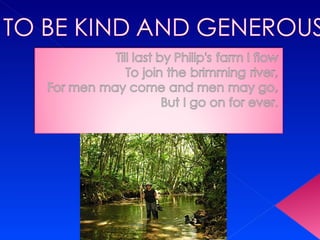
The brook flows by a farm probably owned by a man named Philip. After the farm it  flows to join a overflowing river. Here the poet tries to show the kindness of the Brook that even if the river is full upto the top and doesn't need more water but the Brook gives it more and more water. The Men/people have a short life spam but the Brook is immortal and so it has a longer life spam and hence goes on 'forever'.
 
 
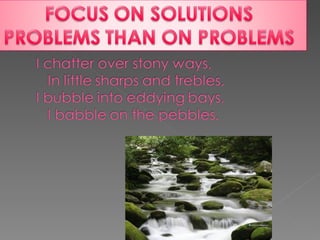
As the Brook flows it chatters ( i.e. makes an interesting and musical sound) over stony ways. When the brook flows it 'pushes' the air and makes bubbles. The brook’s way is full of stones and pebbles which try to stop it but the Brook crosses over the pebbles laughing on it that they were trying to stop the brook. So we should focus on solutions than on problems.
 
 
The brook flows curvedly because at one point it is wide and at another point it is narrow. It decorates the banks with its own beautiness. The brook flows by many fields and bare places (fallows), where probably the soil is infertile which is why the land is bare and no plants grow. There are many pieces of land sticking out in the brook (called foreland)which have some fruitful plants .Where colourful & bright birds, insects & butterflies come which look like fairies from far away. The brook gives water to both of them without discriminating.


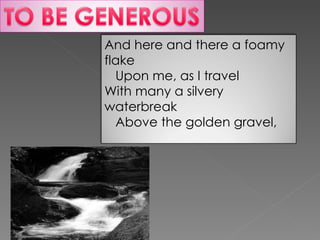
And here and there a foamy flake    Upon me, as I travel With many a silvery waterbreak    Above the golden gravel,


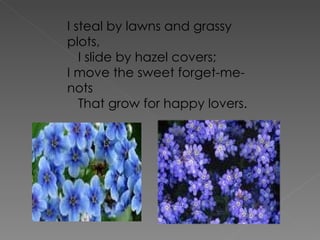
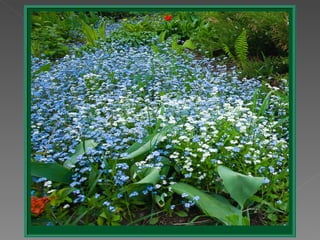
I steal by lawns and grassy plots,    I slide by hazel covers; I move the sweet forget-me-nots    That grow for happy lovers.
 
 
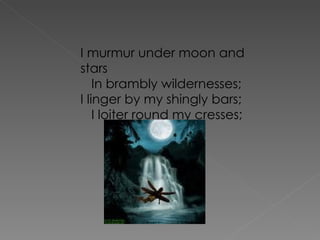
I murmur under moon and stars    In brambly wildernesses; I linger by my shingly bars;    I loiter round my cresses;
 
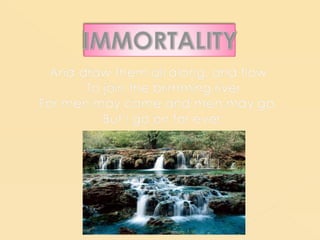
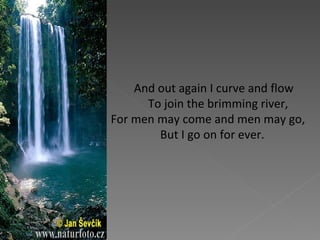
And out again I curve and flow    To join the brimming river, For men may come and men may go,     But I go on for ever.
 
 
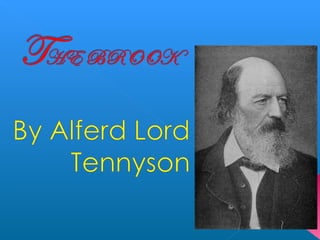
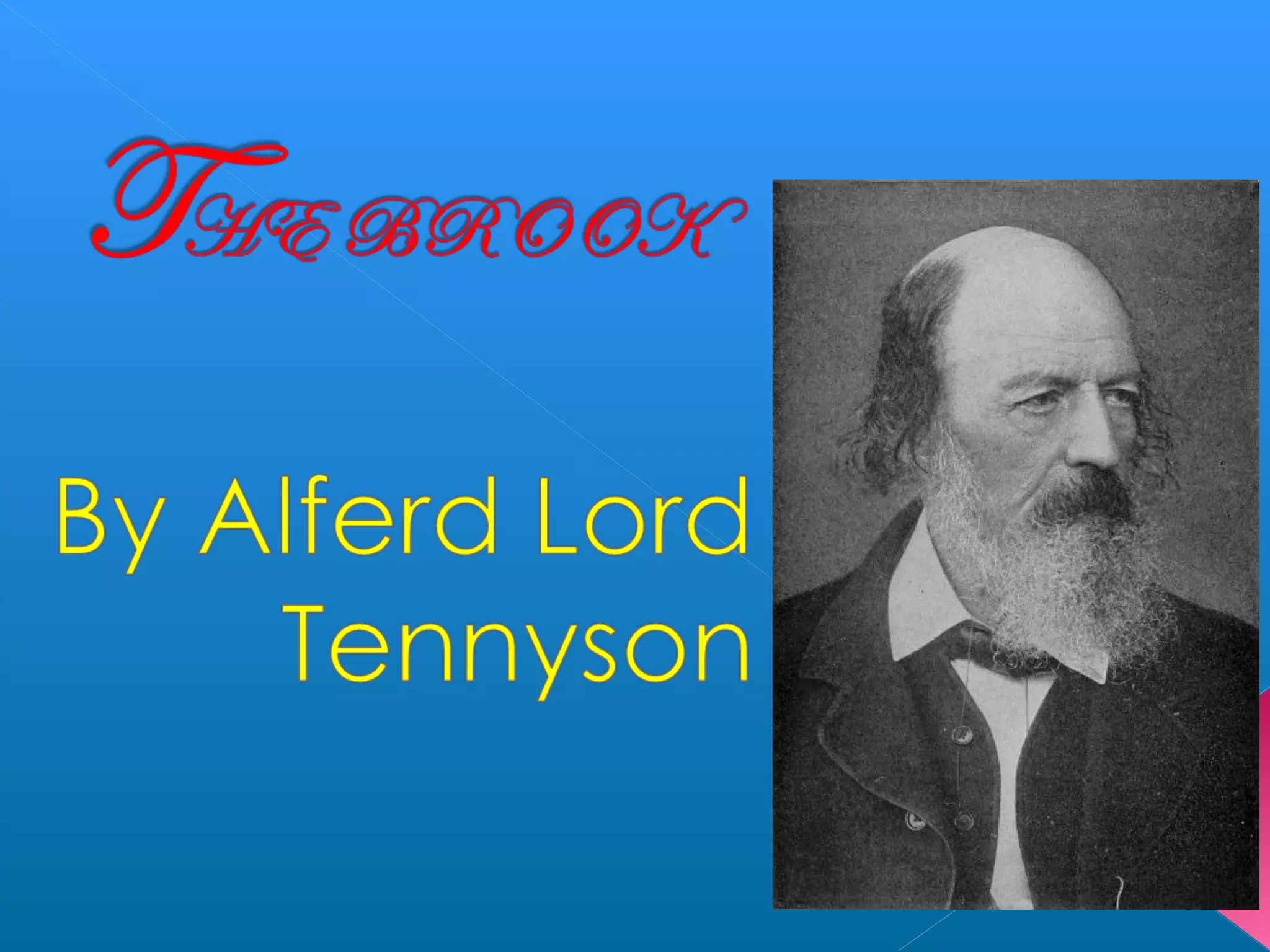
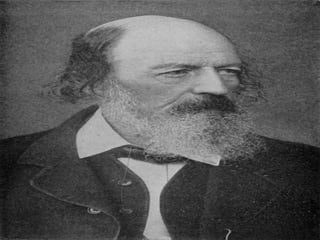
Alfred Tennyson (1809-1892), English poet often regarded as the chief representative of the Victorian age in poetry. Tennyson succeeded  Wordsworth  as Poet Laureate in 1850. Alfred, Lord Tennyson was born on August 5, 1809 in Somersby,Lincolnshire.  His father, George Clayton Tennyson, a clergyman and rector, suffered from depression and was notoriously absentminded.  Alfred began to write poetry at an early age in the style of  Lord  Byron .  After spending four unhappy years in school he was tutored at home. Tennyson then studied at Trinity College, Cambridge, where he joined the literary club  'The Apostles' and met Arthur Hallam, who became his closest friend.  Tennyson published  Poems, Chiefly Lyrical , in 1830, which included the  popular "Mariana".
 
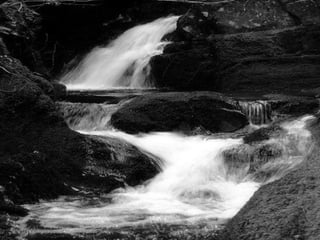
The Brook is a poem about a simple stream that flows through the countryside. The poem has such exquisite imagery, and such perfect metaphor that one can easily visualize the stream flowing past. The poet has captured not only the beauty of the stream but the sounds and the connected landscape too. The poet portrays himself as the brook. The poem gives the thoughts and impressions of the brook as it twists and turns and flows and falls through the changing landscape.  The brook begins at a shallow place frequented by the coot and the hern. It makes a lot of noise as it flows down the valley. The brook covers a large distance crossing hills, ridges (place between two hills), villages, towns and flows under a few bridges (50). Though the counting of bridges etc. is totally imagery The stream flows over stones and therefore make a loud noise which he says are in trebles and sharps (pitch of the song). When the water flows into a deep bay, the water forms a small spiral and as a result bubbles are formed.
It flows in a winding path passing through fields, fallow lands and causes the growth of weeds and flowers.  The stream carries along with its water, flowers that have fallen into it, fishes, foam, flakes, and takes them all into the river. The swiftness of the stream depends on the slope of the land. This image of the changing speed of the river is well depicted by the many words used to show movement like Steal, slide, move, slip, glide, gloom, glance, murmur, linger, loiter, curve and flow are the many expressions used to convey the various 'moods' of the stream.  The idea that stands out is the permanence of the river.
The poet has compared the mortal nature of man with the immortal nature of the brook. The poet has drawn a parallel between the two and has tried to depict the similarities between the two in the various stages of the journey of their lives. The brook keeps flowing on forever and is eternal. But man has a certain lifespan and man's journey of life has to end when he meets the horns of death. The poet, through this poem has tried to emphasize on this point by using the refrain-'For men may come, And men may go, But I go on forever.'
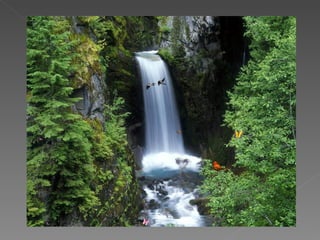
The brook makes a sudden appearance by emerging from the mountains, the dwelling place of water birds (coot and hern). It sparkles and shines among the fern (flowerless plants) because the sun's rays are reflected off by it. The brook flows down a valley quickly in a very noisy manner. The poet depicts the pace of the brook, as it quickly flows through hills, ridges, villages, a town and bridges. Finally, the brook joins the overflowing river after it flows by a farm (Philip's farm). As the brook flows by stony ways, it creates a whirlpool (eddying bay) and sounds (chatters) because of the stones and pebbles in its path. As the brook flows further, it erodes its banks. The brook then flows by fields, infertile barren lands and a foreland filled with flowers (willow-weed and mallow). The brook then meanders in and out, and carries along with it blossoms, silt, fish(grayling and trout) and gravel. There are some changes in the terrain and the water of the brook hits many hard objects, causing the water to split in various directions and foam formation.
When the brook comes closer towards the river, in the plains, its movement becomes slower, gentle, calm, quiet and soft. It flows smoothly by the lawns and grassy plots; and the hazel covers and the forget-me-nots flowers. The sunlight falls on the brook after it penetrates through the canopy covers. Water becomes shallower on its sandy banks. At night, the brook flows through thorny forests. It flows by eroded pebbles and stones slowly and by the pungent leaf plants(cresses).The brook continues its journey to join the brimming river as it makes its way out of the vegetation.
When the brook emerges from the mountains , its movement is very noisy and quick and it is very energetic. It is in a rush to achieve its goal of joining the overflowing river. Similarly, man in his youth is very lively, agile, energetic and active.  The brook in its early stages is very fast and overcomes all the hurdles, hard objects, stones and pebbles in its journey. This can be compared to man in his youth who is enthusiastic and can strive and accept all the challenges that come in his way.  During the journey, the brook takes along with it silt, gravel, blossoms and fish. Similarly man also takes away different people he comes across along with him, in some way, to accompany him ahead in the journey of life.  When the brook comes closer to the river, its movement becomes slow and smooth, which can be compared to man in his old age, who becomes very calm, gentle, soft and lethargic.  The brook is originated from a very beautiful place which is frequently visited by the birds of coot and herns and the man takes birth from the woomb of the mother.
ALLITERATION :  s udden  s ally,  H alf a  h undred,  s kimming  s wallows,  g olden  g ravel,  w illow- w eeds,  f airy  f oreland,  f ield and  f allow.  ONOMATOPOIEA : bicker, babble, chatter, murmur  REFRAIN : For men may come and may go, but I go on forever.  REPETITION :  And here and there  a lusty trout,  And here and there  a grayling. I  chatter, chatter  . PERSONIFICATION : The brook has been personified as a human being. SYMBOLISM : Fish-source of life, forget-me-nots -eternal love.
Question 1 Question:      Where does the brook begin Question 2 Question:      Which is the last place to be visited by the brook? Question 3 Question:      When is the brook specially noisy? Question 4 Question:      What are the two things the brook is always doing?. Question 5 Question:      Name some things that float down all stream Question 6 Question:      Why is the water described as silvery?   Question 7 Question:      Why is gravel said to be golden?
Answer:      Place frequented by coots and herns. Answer:      Philip's farm is the last place to be visited by the brook. Answer:      When it flows over stones. Answer:      Moving and making sounds are the two things the brook is always doing. Answer:      Flowers, leaves, twigs, insects, fishes. Answer:      The sun shines on the water making it sparkle like white silver. Answer:      It is yellow and brown in colour .
Question 8 Question:      Read the extracts given below and answer the Questions that follow I come from haunts of coot and tern, I make a sudden sally, And sparkle out among the fern, To bicker down a valley. a) What is the birth place of the Brook? b) How does the Brook emerge after its birth? c) Why does it 'bicker down a valley'? Answer:      a)The birth place of the Brook is actually the haunt of water birds like the coot and the tern. b)The Brook gushes out in a sudden sally after its birth. c) It (the Brook) seems to bicker down a valley because it flows down a hilly terrain. When the water flows over such a terrain, it creates a lot of noise. This noise is described as 'bicker'.
Question 9 Question:      Read the extracts given below and answer the Questions that follow By thirty hills I hurry down, Or ship between the ridges By twenty thropes, a little town, And half a hundred bridges. a) How does the Brook seem to move? b) What are the things that the Brook passes by before it joins the brimming river? Answer:      a) The Brook seems to move very hurriedly by hills and seems to slip between the ridges as it flows. b) It passes hills, thropes, a little town, several bridges and Philip's farm before it joins the brimming river. Question 10 Question:    Read the extracts given below and answer the Questions that follow     I chatter over stony ways, In little sharps and trebles, I bubble into eddying bays, I babble on the pebbles.
a)  How does the brook flow on a stony path? b) What is the figure of speech used in the last two lines? Answer:    a) The Brook creates a chattering sound when it flows on a stony path. Question 11 Question:     Read the extracts given below and answer the Questions that follow      With many a curve my banks I fret, By many a field and fallow, And many a fairy foreland set, With willow- weed and mallow. a) How does the brook behave when it has curves on its banks? b) What is the figure of speech need in the last two lines of the above stanza? Answer:     a) The brook behaves 'angrily' when it faces curves on its banks. It is clear because the poet has used the work 'fret' to explain the brook's feeling. b) The figure of speech used in 'Alliteration" using the consonant sounds "f" and "w". this creates a musical sound.
Question 12 Question:     Read the extracts given below and answer the Questions that follow  I chatter, chatter as I flow, To join the brimming river, For men may come and men may go, But I go on for ever. a) What does the poet want to say in "I chatter, chatter as I flow"? b) What are the important aspects of land which have been covered by the Brook? c) Explain the last two lines "men many come and men may go, But I go on forever". Answer:      a) The poet wants to say that the brook flows creating short repeated high pitched noises while flowing. It is a continuous rapid talk and it appears to be communicating something to all the things that it passes by. b) The important aspects of land covered by the Brook till now are the hilly range and the plains comprising Philip's farm, field and fallow as it goes on its journey. c) This constitutes a refrain. These strike the keynote of the poem - the brook's eternity and man's mortality.
Question 13 Question:      Read the extracts given below and answer the Questions that follow  I wind about, and in and out With here a blossom sailing, And here and there, a busty trout, And here and there a grayling. a) Explain "I wind about and in and out". b) Name the different things that are carried by the brook? c) Where does the brook carry all, these things? Answer:      a) The picture imagined here is of rivulet flowing in a zig-zag manner. Sometimes this enters underground and then it bubbles out into the open. b) The different things that are carried by the brook are flowers that have fallen into it, fishes, foam and flakes. c) The Brook carries all these things to the brimming river which it joins.
Question 14 Question:      Read the extracts given below and answer the Questions that follow  And here and there a foamy flake, Upon me, as I travel, With many a silvery water break, Above the golden gravel. a) What occurs when the brook flows over "the golden gravel" b) What unique quality of the brook can be imagined in it carrying so many things to the brimming river? Answer:      a) When the brook flows over "the golden gravel" there is a break in the flow of water which appears silvery. b) The unique quality of the brook that can be imagined is its parental nature, that is, the brook is the home of fishes, flowers that get carried by it which grows close to its banks. In a way, it is a life sustaining agent of nature. Question 15 Question:      Read the extracts given below and answer the Questions that follow  I steal by lawns and grassy plots, I slide by hazel covers I move the sweet forget-me-nots, That grow for happy lovers.
a) What does the poet want to convey by using the words "steal" and "slide"? b) Identify the rhyme scheme in the above stanza. Answer:      a) The poet wants to convey the brook's movements in the use of these words. It moves silently without being seen when it passes by lawns and grassy plots. b) The rhyme scheme is abab. Question 16 Question:      How is the poem a symbol of life? Pick out examples of parallelism between man's life and the brook. Answer:      The Poem is a symbol of life. The brook's journey from its origin till its joining the brimming river is man's journey of life from birth to death. Whatever happens to it on the way is similar to what man encounters through his life. The brook's noisy flow is similar to mans struggling and fretting and fuming against the odds of life. The brook slips, slides, glooms and glances. So does man. It makes its way forcefully against odds, so does man as he struggles through many problems. The brook carries many things with it as it flows. So does man-he meets people - builds relationships - carries memories, collects materialistic things as he goes through life. The only difference between man and the brook is that man's life comes to an end. Where as the brook lives on and on forever.
Answer:      4 Question 2 Question:      The poem is written in the style of a Question 1 Question:    The poem is written by  Answer:      2 1. W.B. Yeats 2. William Wordsworth 3. William Shakespeare 4. Alfred Lord Tennyson 1. Narrative 2. Personification 3. Dialogue 4. Report
Question 3 Question:      "By many a field and fallow" is an example of Answer:      3 Question 4 Question:      The rhyming scheme of the poem is Answer:      2 Question 5 Question:      The message of the poem is that the life of a brook is Answer:      3 1. a simile 2. a metaphor 3. an alliteration 4. a refrain 1. aabb 2. abab 3. abcd 4. abcb 1. Temporary 2. short – lived 3. Eternal 4. momentary

The Brook

  • 1.
  • 2.
    T he Brookis an autobiography of Alferd Lord Tennyson. The poet portrays himself as the Brook. The poem gives the thoughts and impressions of the brook as it twists and turns and flows and falls through the changing landscape. The poet has realistically drawn a parallelism between the journey of the brook with the life of a man. The poet says as in the childhood the a child is very agile, energetic and lively , like that only the brook in the beginning stage of its life is very powerful, enhancing and it keeps on flowing with a great rush and enthusiasm through out its life . It falls from great heights and menders around the wavy path, and when it approaches on plain it becomes very slow and continues to flow eternally. Like the brook a man toward the end of his life he becomes slow in his moves and ultimately dies and also emerges with its final destination but it never ends to flow.
  • 3.
    I come fromhaunts of coot and hern,    I make a sudden sally And sparkle out among the fern,    To bicker down a valley.
  • 4.
    The brook startsfrom a very beautiful place consisting of the coots(kind of duck) & herns (commonly known as herons) who spend most of their times near it. The man is also born from a very beautiful place i.e. the woomb of the mother The brook suddenly rushes down. The brooks way gets stopped by the ferns but it doesn’t get depressed and rather tries to overcome the obstacles. As the brook flows it sparkles because of sun rays, and it flows through a ground which mostly have grasses and flowerless plants(fern) . The brook flows down a valley making noisy sounds.
  • 5.
  • 6.
  • 7.
  • 8.
    The brook swiftlyflows down many hills. There are not literally 'Thirty hills' but the poet make's the line creative by using 'Thirty' and not 'many'. The brook slips (quickly moves) between long narrow hilltops. The brook flows down by many villages, again the poet tries to make the line creative by using 'Twenty'-not literally 'Twenty villages' , and it flows down a little town as well. The brook flows and passes by/through many bridges.
  • 9.
  • 10.
  • 11.
  • 12.
    The brook flowsby a farm probably owned by a man named Philip. After the farm it flows to join a overflowing river. Here the poet tries to show the kindness of the Brook that even if the river is full upto the top and doesn't need more water but the Brook gives it more and more water. The Men/people have a short life spam but the Brook is immortal and so it has a longer life spam and hence goes on 'forever'.
  • 13.
  • 14.
  • 15.
    As the Brookflows it chatters ( i.e. makes an interesting and musical sound) over stony ways. When the brook flows it 'pushes' the air and makes bubbles. The brook’s way is full of stones and pebbles which try to stop it but the Brook crosses over the pebbles laughing on it that they were trying to stop the brook. So we should focus on solutions than on problems.
  • 16.
  • 17.
  • 18.
    The brook flowscurvedly because at one point it is wide and at another point it is narrow. It decorates the banks with its own beautiness. The brook flows by many fields and bare places (fallows), where probably the soil is infertile which is why the land is bare and no plants grow. There are many pieces of land sticking out in the brook (called foreland)which have some fruitful plants .Where colourful & bright birds, insects & butterflies come which look like fairies from far away. The brook gives water to both of them without discriminating.
  • 19.
  • 20.
  • 21.
  • 22.
  • 23.
  • 24.
    And here andthere a foamy flake    Upon me, as I travel With many a silvery waterbreak    Above the golden gravel,
  • 25.
  • 26.
  • 27.
  • 28.
  • 29.
    I steal bylawns and grassy plots,    I slide by hazel covers; I move the sweet forget-me-nots    That grow for happy lovers.
  • 30.
  • 31.
  • 32.
    I murmur undermoon and stars    In brambly wildernesses; I linger by my shingly bars;    I loiter round my cresses;
  • 33.
  • 34.
    And out againI curve and flow    To join the brimming river, For men may come and men may go,     But I go on for ever.
  • 35.
  • 36.
  • 37.
    Alfred Tennyson (1809-1892),English poet often regarded as the chief representative of the Victorian age in poetry. Tennyson succeeded Wordsworth as Poet Laureate in 1850. Alfred, Lord Tennyson was born on August 5, 1809 in Somersby,Lincolnshire. His father, George Clayton Tennyson, a clergyman and rector, suffered from depression and was notoriously absentminded. Alfred began to write poetry at an early age in the style of Lord Byron . After spending four unhappy years in school he was tutored at home. Tennyson then studied at Trinity College, Cambridge, where he joined the literary club 'The Apostles' and met Arthur Hallam, who became his closest friend. Tennyson published Poems, Chiefly Lyrical , in 1830, which included the popular "Mariana".
  • 38.
  • 39.
    The Brook isa poem about a simple stream that flows through the countryside. The poem has such exquisite imagery, and such perfect metaphor that one can easily visualize the stream flowing past. The poet has captured not only the beauty of the stream but the sounds and the connected landscape too. The poet portrays himself as the brook. The poem gives the thoughts and impressions of the brook as it twists and turns and flows and falls through the changing landscape. The brook begins at a shallow place frequented by the coot and the hern. It makes a lot of noise as it flows down the valley. The brook covers a large distance crossing hills, ridges (place between two hills), villages, towns and flows under a few bridges (50). Though the counting of bridges etc. is totally imagery The stream flows over stones and therefore make a loud noise which he says are in trebles and sharps (pitch of the song). When the water flows into a deep bay, the water forms a small spiral and as a result bubbles are formed.
  • 40.
    It flows ina winding path passing through fields, fallow lands and causes the growth of weeds and flowers. The stream carries along with its water, flowers that have fallen into it, fishes, foam, flakes, and takes them all into the river. The swiftness of the stream depends on the slope of the land. This image of the changing speed of the river is well depicted by the many words used to show movement like Steal, slide, move, slip, glide, gloom, glance, murmur, linger, loiter, curve and flow are the many expressions used to convey the various 'moods' of the stream. The idea that stands out is the permanence of the river.
  • 41.
    The poet hascompared the mortal nature of man with the immortal nature of the brook. The poet has drawn a parallel between the two and has tried to depict the similarities between the two in the various stages of the journey of their lives. The brook keeps flowing on forever and is eternal. But man has a certain lifespan and man's journey of life has to end when he meets the horns of death. The poet, through this poem has tried to emphasize on this point by using the refrain-'For men may come, And men may go, But I go on forever.'
  • 42.
    The brook makesa sudden appearance by emerging from the mountains, the dwelling place of water birds (coot and hern). It sparkles and shines among the fern (flowerless plants) because the sun's rays are reflected off by it. The brook flows down a valley quickly in a very noisy manner. The poet depicts the pace of the brook, as it quickly flows through hills, ridges, villages, a town and bridges. Finally, the brook joins the overflowing river after it flows by a farm (Philip's farm). As the brook flows by stony ways, it creates a whirlpool (eddying bay) and sounds (chatters) because of the stones and pebbles in its path. As the brook flows further, it erodes its banks. The brook then flows by fields, infertile barren lands and a foreland filled with flowers (willow-weed and mallow). The brook then meanders in and out, and carries along with it blossoms, silt, fish(grayling and trout) and gravel. There are some changes in the terrain and the water of the brook hits many hard objects, causing the water to split in various directions and foam formation.
  • 43.
    When the brookcomes closer towards the river, in the plains, its movement becomes slower, gentle, calm, quiet and soft. It flows smoothly by the lawns and grassy plots; and the hazel covers and the forget-me-nots flowers. The sunlight falls on the brook after it penetrates through the canopy covers. Water becomes shallower on its sandy banks. At night, the brook flows through thorny forests. It flows by eroded pebbles and stones slowly and by the pungent leaf plants(cresses).The brook continues its journey to join the brimming river as it makes its way out of the vegetation.
  • 44.
    When the brookemerges from the mountains , its movement is very noisy and quick and it is very energetic. It is in a rush to achieve its goal of joining the overflowing river. Similarly, man in his youth is very lively, agile, energetic and active. The brook in its early stages is very fast and overcomes all the hurdles, hard objects, stones and pebbles in its journey. This can be compared to man in his youth who is enthusiastic and can strive and accept all the challenges that come in his way. During the journey, the brook takes along with it silt, gravel, blossoms and fish. Similarly man also takes away different people he comes across along with him, in some way, to accompany him ahead in the journey of life. When the brook comes closer to the river, its movement becomes slow and smooth, which can be compared to man in his old age, who becomes very calm, gentle, soft and lethargic. The brook is originated from a very beautiful place which is frequently visited by the birds of coot and herns and the man takes birth from the woomb of the mother.
  • 45.
    ALLITERATION : s udden s ally, H alf a h undred, s kimming s wallows, g olden g ravel, w illow- w eeds, f airy f oreland, f ield and f allow. ONOMATOPOIEA : bicker, babble, chatter, murmur REFRAIN : For men may come and may go, but I go on forever. REPETITION : And here and there a lusty trout, And here and there a grayling. I chatter, chatter . PERSONIFICATION : The brook has been personified as a human being. SYMBOLISM : Fish-source of life, forget-me-nots -eternal love.
  • 46.
    Question 1 Question:    Where does the brook begin Question 2 Question:     Which is the last place to be visited by the brook? Question 3 Question:     When is the brook specially noisy? Question 4 Question:     What are the two things the brook is always doing?. Question 5 Question:     Name some things that float down all stream Question 6 Question:     Why is the water described as silvery? Question 7 Question:     Why is gravel said to be golden?
  • 47.
    Answer:     Place frequented by coots and herns. Answer:     Philip's farm is the last place to be visited by the brook. Answer:     When it flows over stones. Answer:     Moving and making sounds are the two things the brook is always doing. Answer:     Flowers, leaves, twigs, insects, fishes. Answer:     The sun shines on the water making it sparkle like white silver. Answer:     It is yellow and brown in colour .
  • 48.
    Question 8 Question:    Read the extracts given below and answer the Questions that follow I come from haunts of coot and tern, I make a sudden sally, And sparkle out among the fern, To bicker down a valley. a) What is the birth place of the Brook? b) How does the Brook emerge after its birth? c) Why does it 'bicker down a valley'? Answer:     a)The birth place of the Brook is actually the haunt of water birds like the coot and the tern. b)The Brook gushes out in a sudden sally after its birth. c) It (the Brook) seems to bicker down a valley because it flows down a hilly terrain. When the water flows over such a terrain, it creates a lot of noise. This noise is described as 'bicker'.
  • 49.
    Question 9 Question:    Read the extracts given below and answer the Questions that follow By thirty hills I hurry down, Or ship between the ridges By twenty thropes, a little town, And half a hundred bridges. a) How does the Brook seem to move? b) What are the things that the Brook passes by before it joins the brimming river? Answer:     a) The Brook seems to move very hurriedly by hills and seems to slip between the ridges as it flows. b) It passes hills, thropes, a little town, several bridges and Philip's farm before it joins the brimming river. Question 10 Question:    Read the extracts given below and answer the Questions that follow   I chatter over stony ways, In little sharps and trebles, I bubble into eddying bays, I babble on the pebbles.
  • 50.
    a) Howdoes the brook flow on a stony path? b) What is the figure of speech used in the last two lines? Answer:    a) The Brook creates a chattering sound when it flows on a stony path. Question 11 Question:    Read the extracts given below and answer the Questions that follow   With many a curve my banks I fret, By many a field and fallow, And many a fairy foreland set, With willow- weed and mallow. a) How does the brook behave when it has curves on its banks? b) What is the figure of speech need in the last two lines of the above stanza? Answer:     a) The brook behaves 'angrily' when it faces curves on its banks. It is clear because the poet has used the work 'fret' to explain the brook's feeling. b) The figure of speech used in 'Alliteration" using the consonant sounds "f" and "w". this creates a musical sound.
  • 51.
    Question 12 Question:   Read the extracts given below and answer the Questions that follow I chatter, chatter as I flow, To join the brimming river, For men may come and men may go, But I go on for ever. a) What does the poet want to say in "I chatter, chatter as I flow"? b) What are the important aspects of land which have been covered by the Brook? c) Explain the last two lines "men many come and men may go, But I go on forever". Answer:     a) The poet wants to say that the brook flows creating short repeated high pitched noises while flowing. It is a continuous rapid talk and it appears to be communicating something to all the things that it passes by. b) The important aspects of land covered by the Brook till now are the hilly range and the plains comprising Philip's farm, field and fallow as it goes on its journey. c) This constitutes a refrain. These strike the keynote of the poem - the brook's eternity and man's mortality.
  • 52.
    Question 13 Question:    Read the extracts given below and answer the Questions that follow I wind about, and in and out With here a blossom sailing, And here and there, a busty trout, And here and there a grayling. a) Explain "I wind about and in and out". b) Name the different things that are carried by the brook? c) Where does the brook carry all, these things? Answer:     a) The picture imagined here is of rivulet flowing in a zig-zag manner. Sometimes this enters underground and then it bubbles out into the open. b) The different things that are carried by the brook are flowers that have fallen into it, fishes, foam and flakes. c) The Brook carries all these things to the brimming river which it joins.
  • 53.
    Question 14 Question:    Read the extracts given below and answer the Questions that follow And here and there a foamy flake, Upon me, as I travel, With many a silvery water break, Above the golden gravel. a) What occurs when the brook flows over "the golden gravel" b) What unique quality of the brook can be imagined in it carrying so many things to the brimming river? Answer:     a) When the brook flows over "the golden gravel" there is a break in the flow of water which appears silvery. b) The unique quality of the brook that can be imagined is its parental nature, that is, the brook is the home of fishes, flowers that get carried by it which grows close to its banks. In a way, it is a life sustaining agent of nature. Question 15 Question:     Read the extracts given below and answer the Questions that follow I steal by lawns and grassy plots, I slide by hazel covers I move the sweet forget-me-nots, That grow for happy lovers.
  • 54.
    a) What doesthe poet want to convey by using the words "steal" and "slide"? b) Identify the rhyme scheme in the above stanza. Answer:     a) The poet wants to convey the brook's movements in the use of these words. It moves silently without being seen when it passes by lawns and grassy plots. b) The rhyme scheme is abab. Question 16 Question:     How is the poem a symbol of life? Pick out examples of parallelism between man's life and the brook. Answer:     The Poem is a symbol of life. The brook's journey from its origin till its joining the brimming river is man's journey of life from birth to death. Whatever happens to it on the way is similar to what man encounters through his life. The brook's noisy flow is similar to mans struggling and fretting and fuming against the odds of life. The brook slips, slides, glooms and glances. So does man. It makes its way forcefully against odds, so does man as he struggles through many problems. The brook carries many things with it as it flows. So does man-he meets people - builds relationships - carries memories, collects materialistic things as he goes through life. The only difference between man and the brook is that man's life comes to an end. Where as the brook lives on and on forever.
  • 55.
    Answer:     4 Question 2 Question:     The poem is written in the style of a Question 1 Question:   The poem is written by  Answer:     2 1. W.B. Yeats 2. William Wordsworth 3. William Shakespeare 4. Alfred Lord Tennyson 1. Narrative 2. Personification 3. Dialogue 4. Report
  • 56.
    Question 3 Question:    "By many a field and fallow" is an example of Answer:     3 Question 4 Question:     The rhyming scheme of the poem is Answer:     2 Question 5 Question:     The message of the poem is that the life of a brook is Answer:     3 1. a simile 2. a metaphor 3. an alliteration 4. a refrain 1. aabb 2. abab 3. abcd 4. abcb 1. Temporary 2. short – lived 3. Eternal 4. momentary