The Big O with Python
Learn how to analyze code for efficiency
1
Presented by: Dennis Wainaina
Position: Senior Software Engineer
What’s Big O?
2
What’s Big O?
- How your code performs as you process more data
3
What’s Big O?
- How your code performs as you process more data
- It’s NOT running time
4
What’s Big O?
- How your code performs as you process more data
- It’s NOT running time
- General trend of performance over time
5
What’s Big O?
- How your code performs as you process more data
- It’s NOT running time
- General trend of performance over time
- A way of ranking the efficiency of an algorithm
6
Why Care?
7
Why Care?
- Provides a formal way to talk about how your code
performs in comparison to your data
8
Why Care?
- Provides a formal way to talk about how your code
performs in comparison to your data
- Discussing trade-offs between different approaches
9
Why Care?
- Provides a formal way to talk about how your code
performs in comparison to your data
- Discussing trade-offs between different approaches
- When you notice your code is slowing down and want
to find the bottlenecks
10
Why Care?
- Provides a formal way to talk about how your code
performs in comparison to your data
- Discussing trade-offs between different approaches
- When you notice your code is slowing down and want
to find the bottlenecks
- INTERVIEWS 😂
11
Terminology
- O stands for “Order of”
12
Terminology
- O stands for “Order of”
- N represents how much data you got
13
Some Examples
14
Some Examples
Write a function that calculates the sum of integers from 1
to n
15
Some Examples
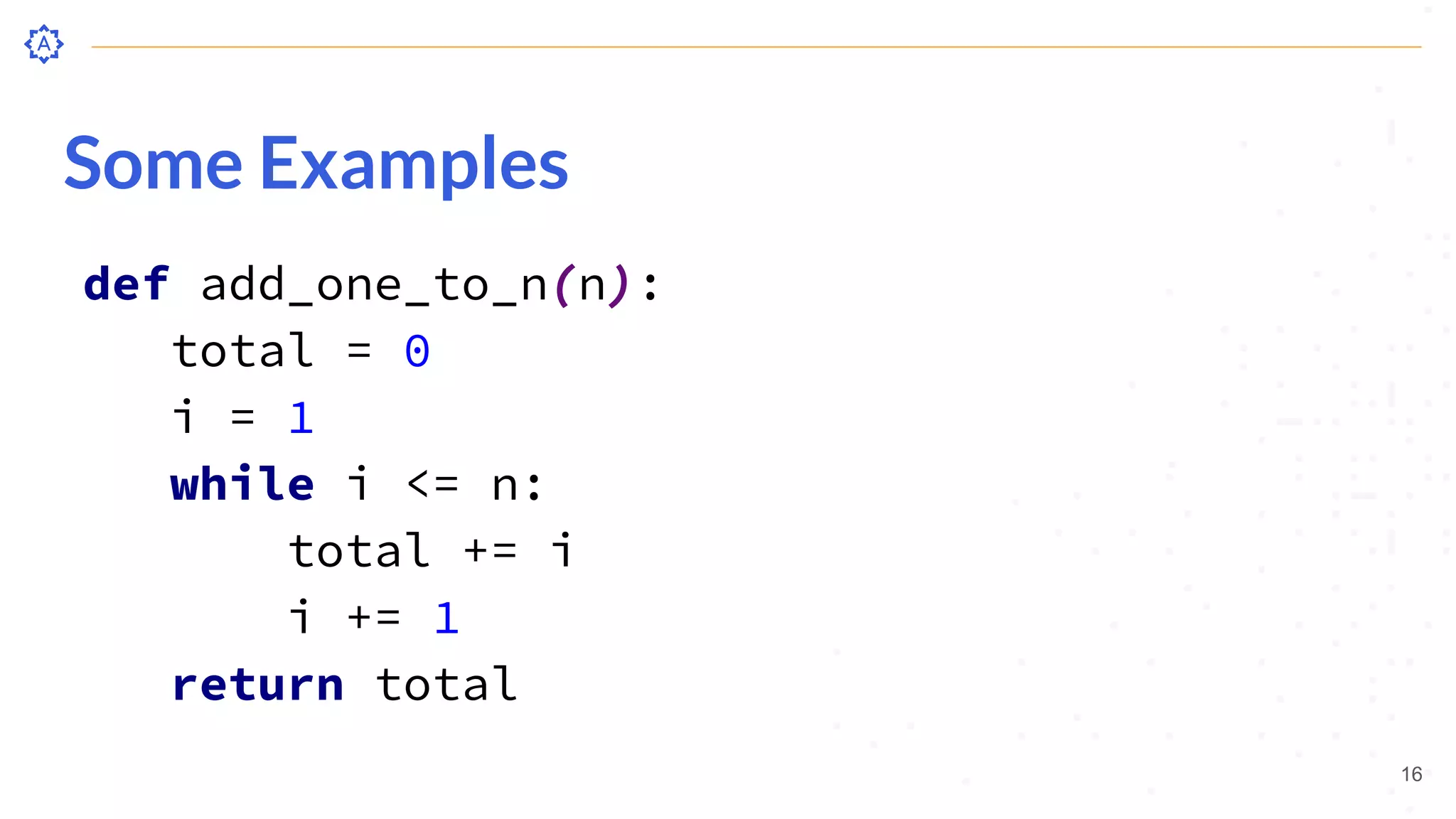
def add_one_to_n(n):
total = 0
i = 1
while i <= n:
total += i
i += 1
return total
16
Some Examples
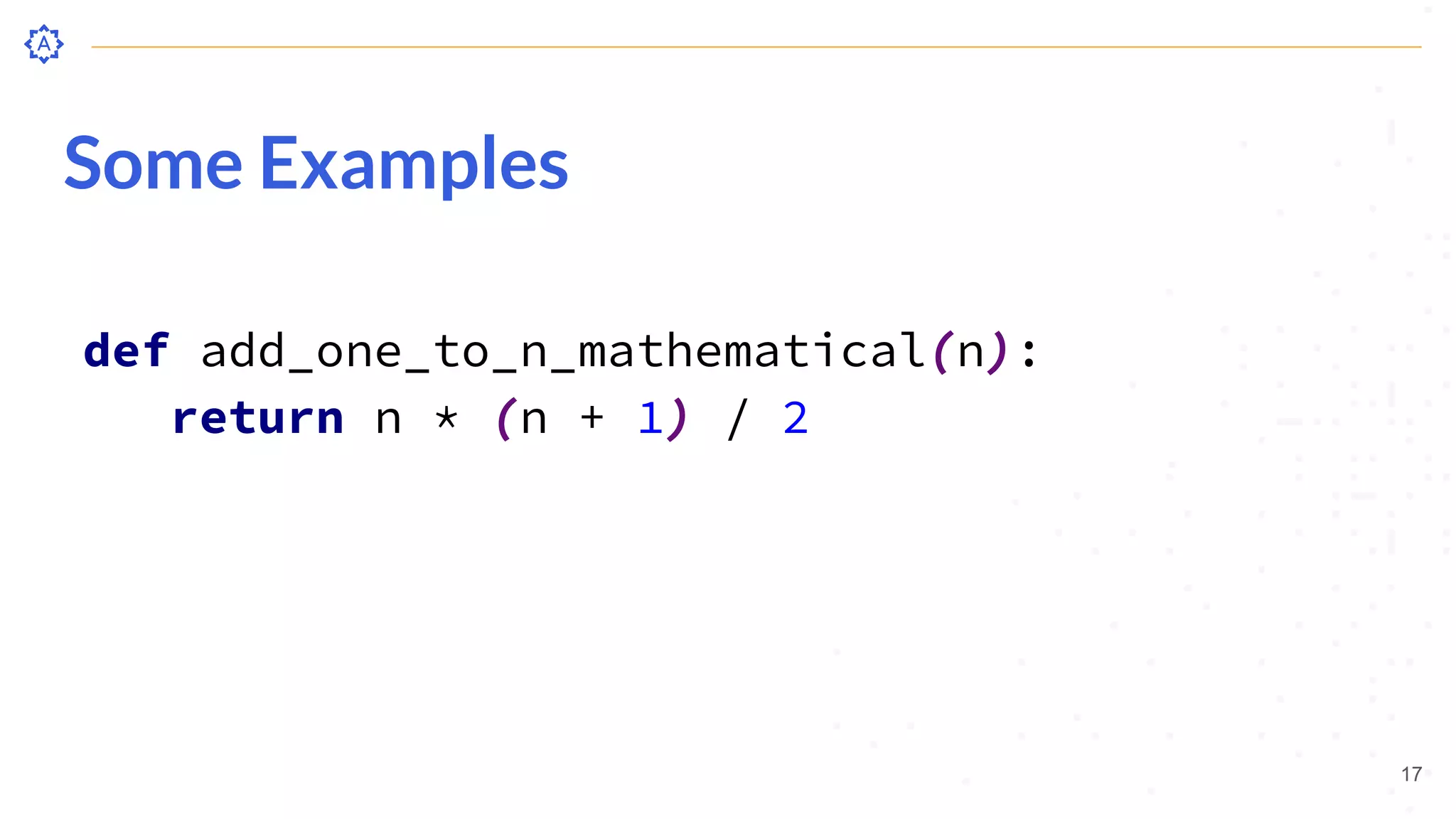
def add_one_to_n_mathematical(n):
return n * (n + 1) / 2
17
So, which one is better?
18
Instead of timing, we can count the number of operations
performed by each piece of code
Let’s count the steps
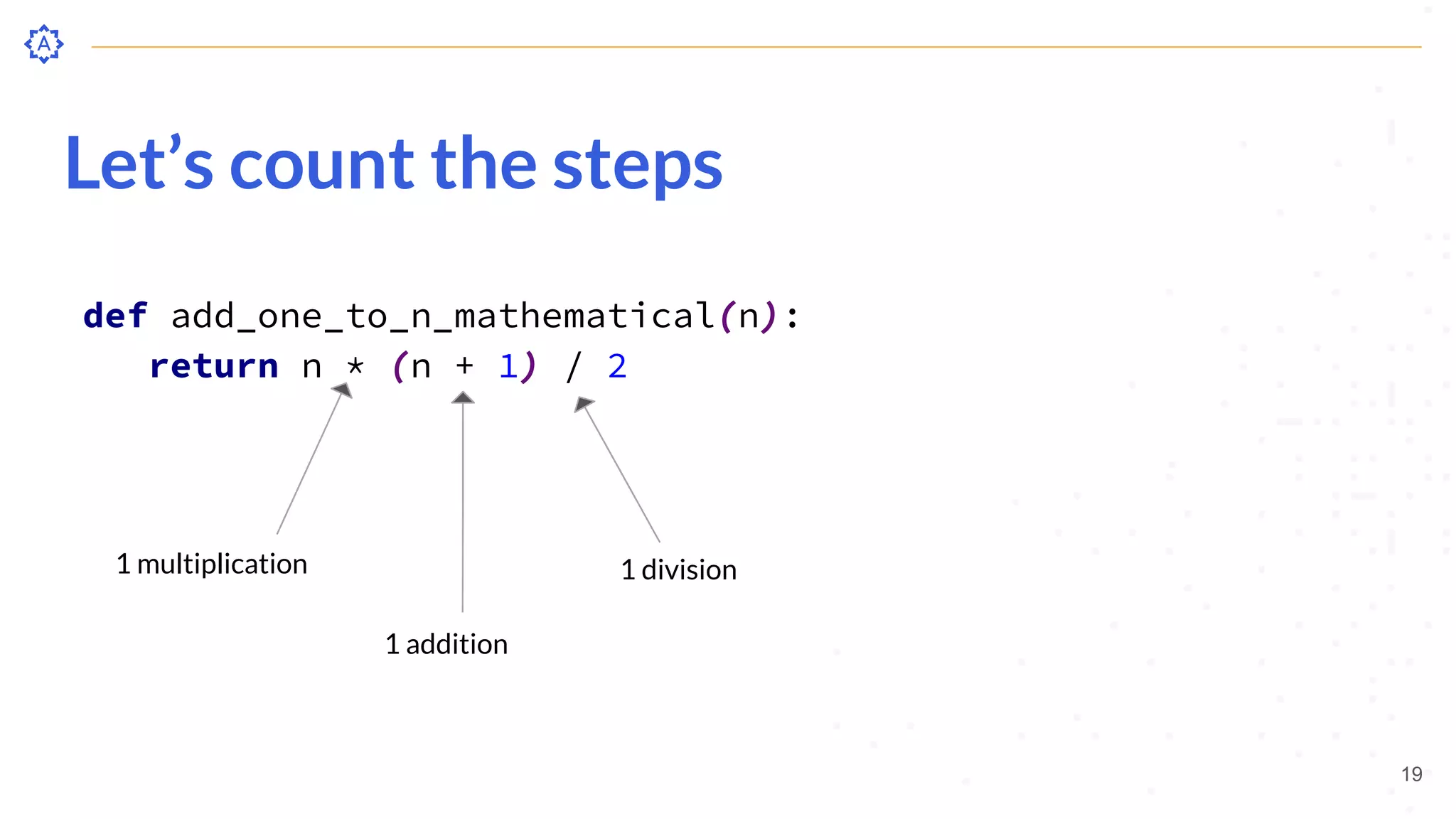
def add_one_to_n_mathematical(n):
return n * (n + 1) / 2
19
1 multiplication
1 addition
1 division
Let’s count the steps
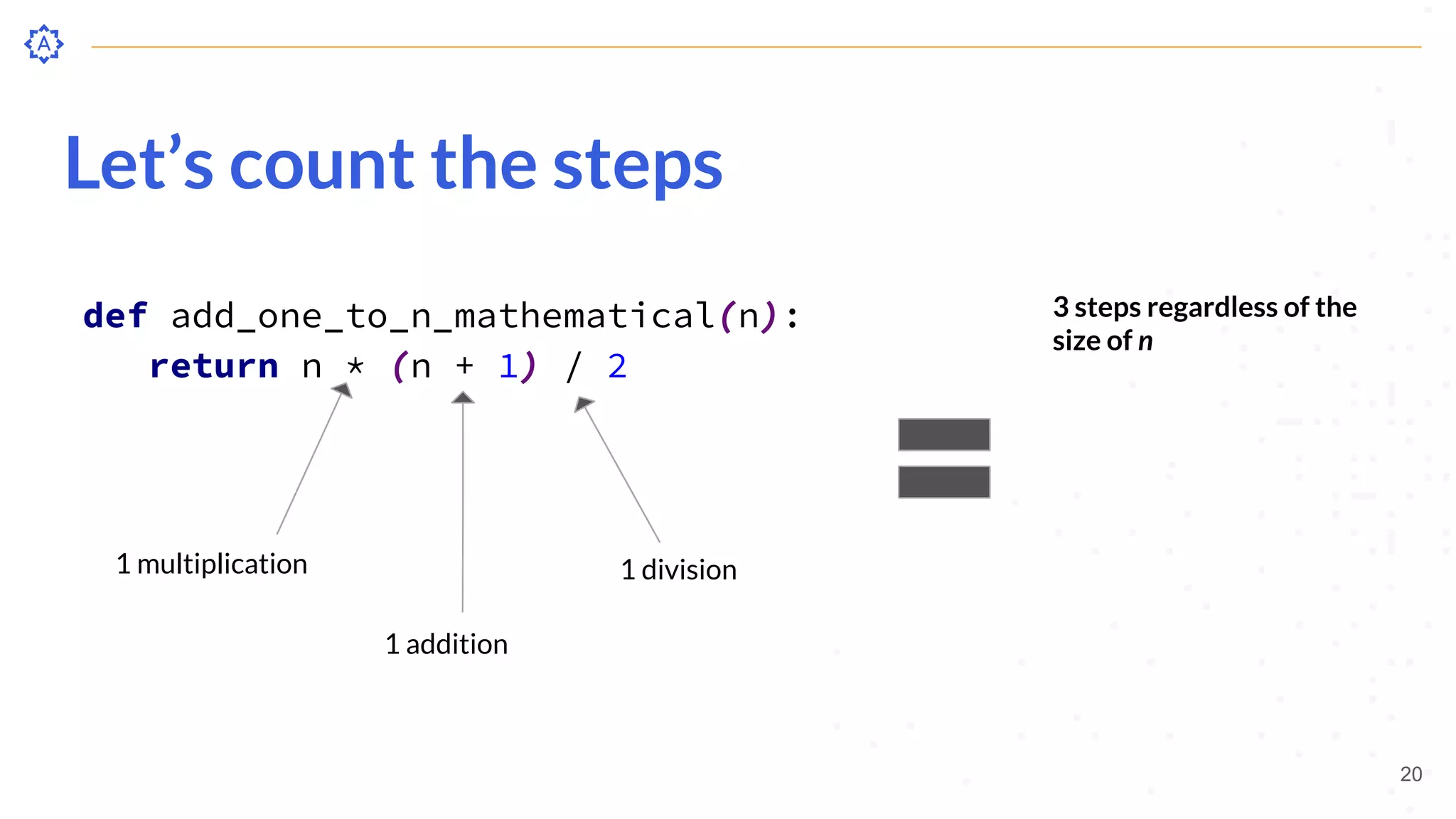
def add_one_to_n_mathematical(n):
return n * (n + 1) / 2
20
1 multiplication
1 addition
1 division
3 steps regardless of the
size of n
Let’s count the steps
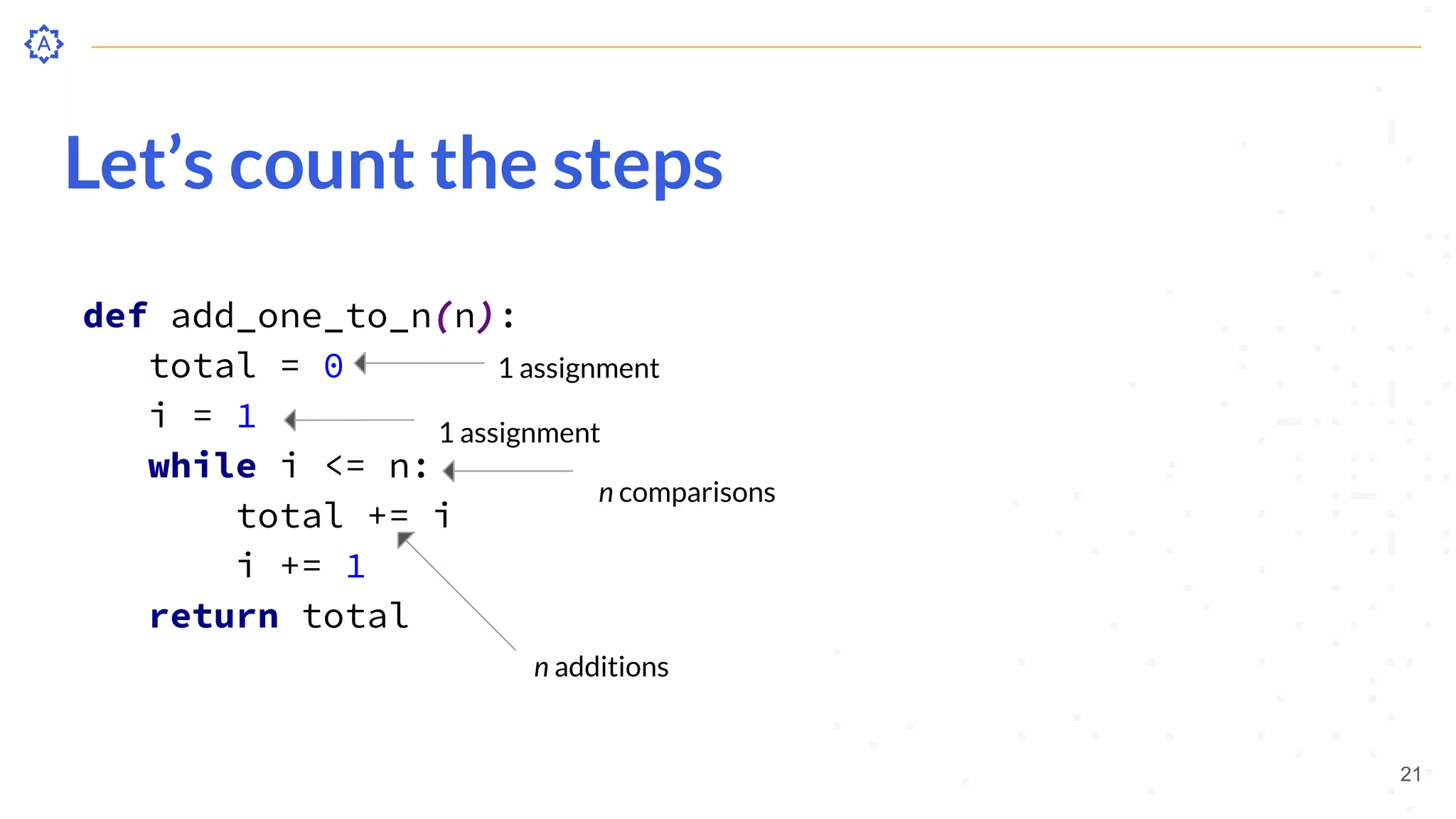
def add_one_to_n(n):
total = 0
i = 1
while i <= n:
total += i
i += 1
return total
21
n additions
1 assignment
1 assignment
n comparisons
Let’s count the steps
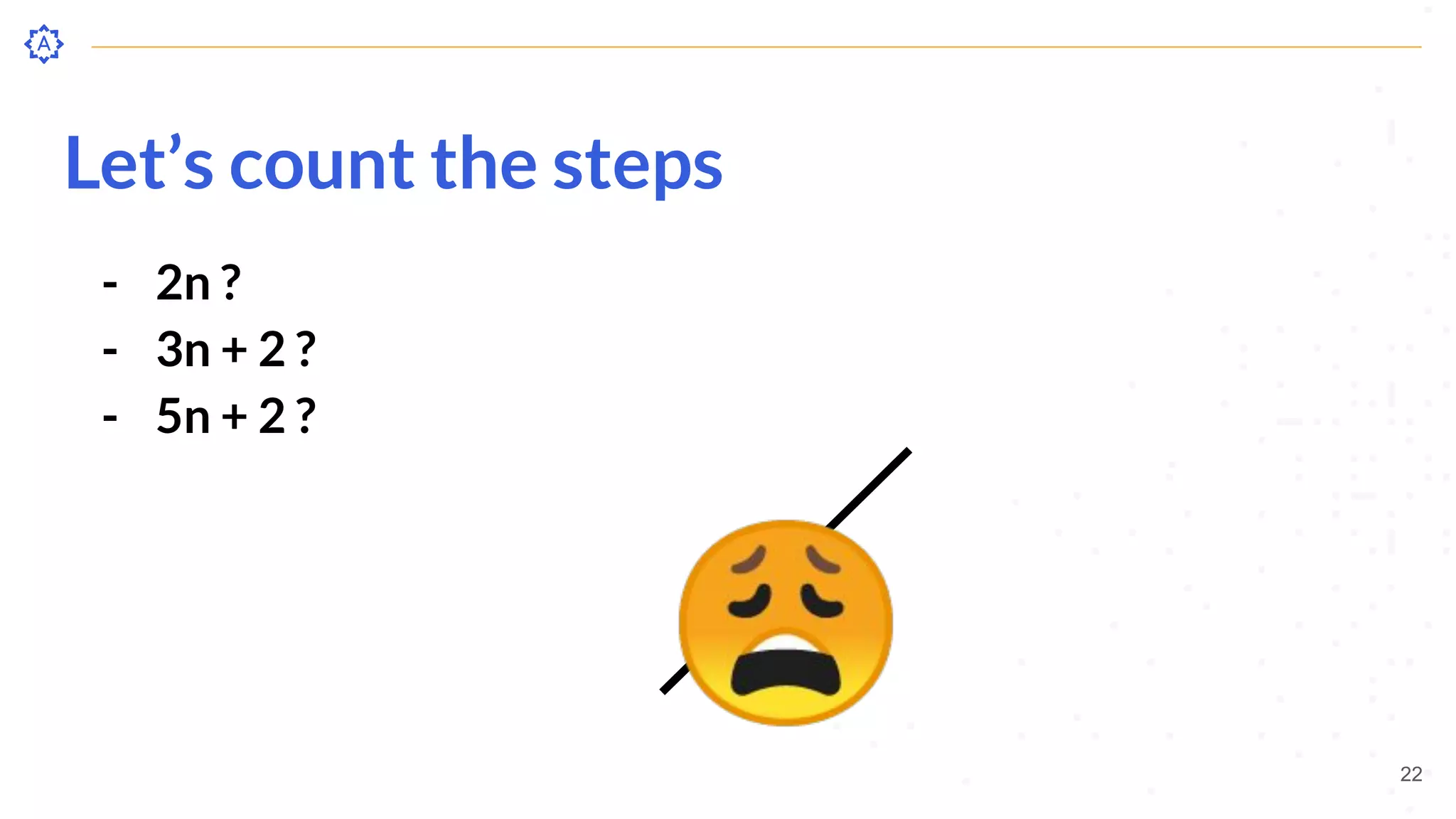
- 2n ?
- 3n + 2 ?
- 5n + 2 ?
😩 22
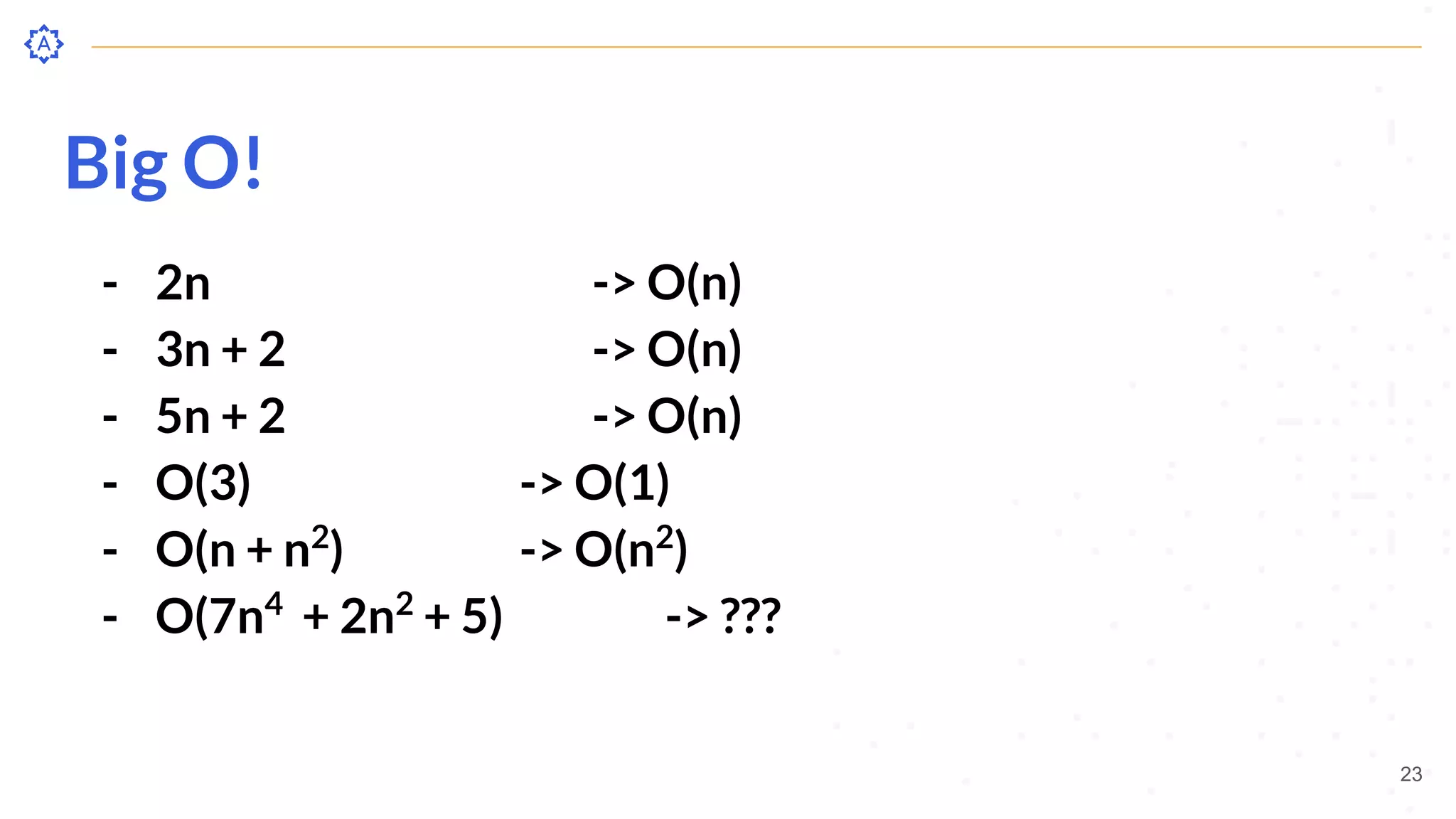
Big O!
- 2n -> O(n)
- 3n + 2 -> O(n)
- 5n + 2 -> O(n)
- O(3) -> O(1)
- O(n + n2
) -> O(n2
)
- O(7n4
+ 2n2
+ 5) -> ???
23
Big O!
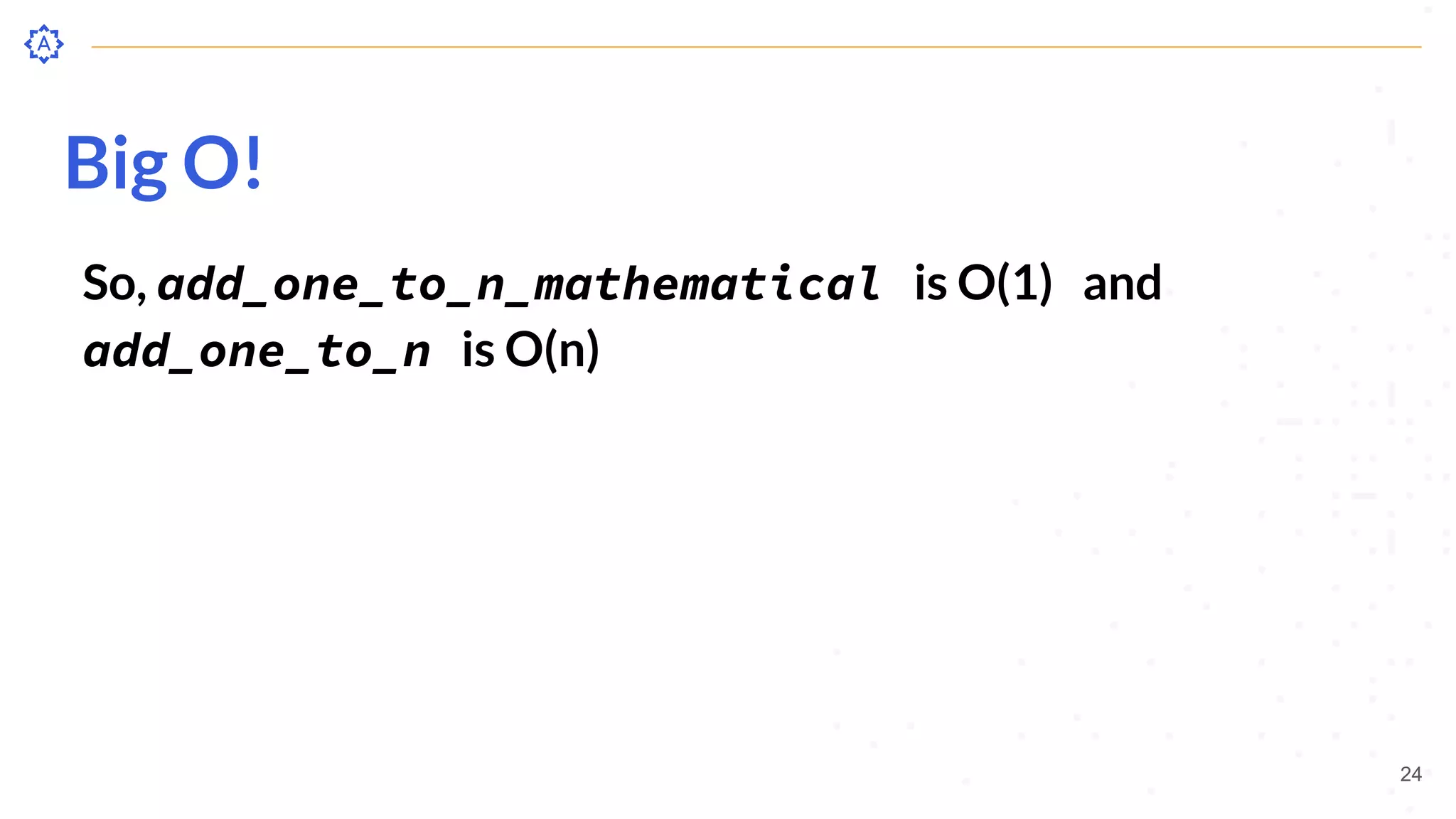
So, add_one_to_n_mathematical is O(1) and
add_one_to_n is O(n)
24
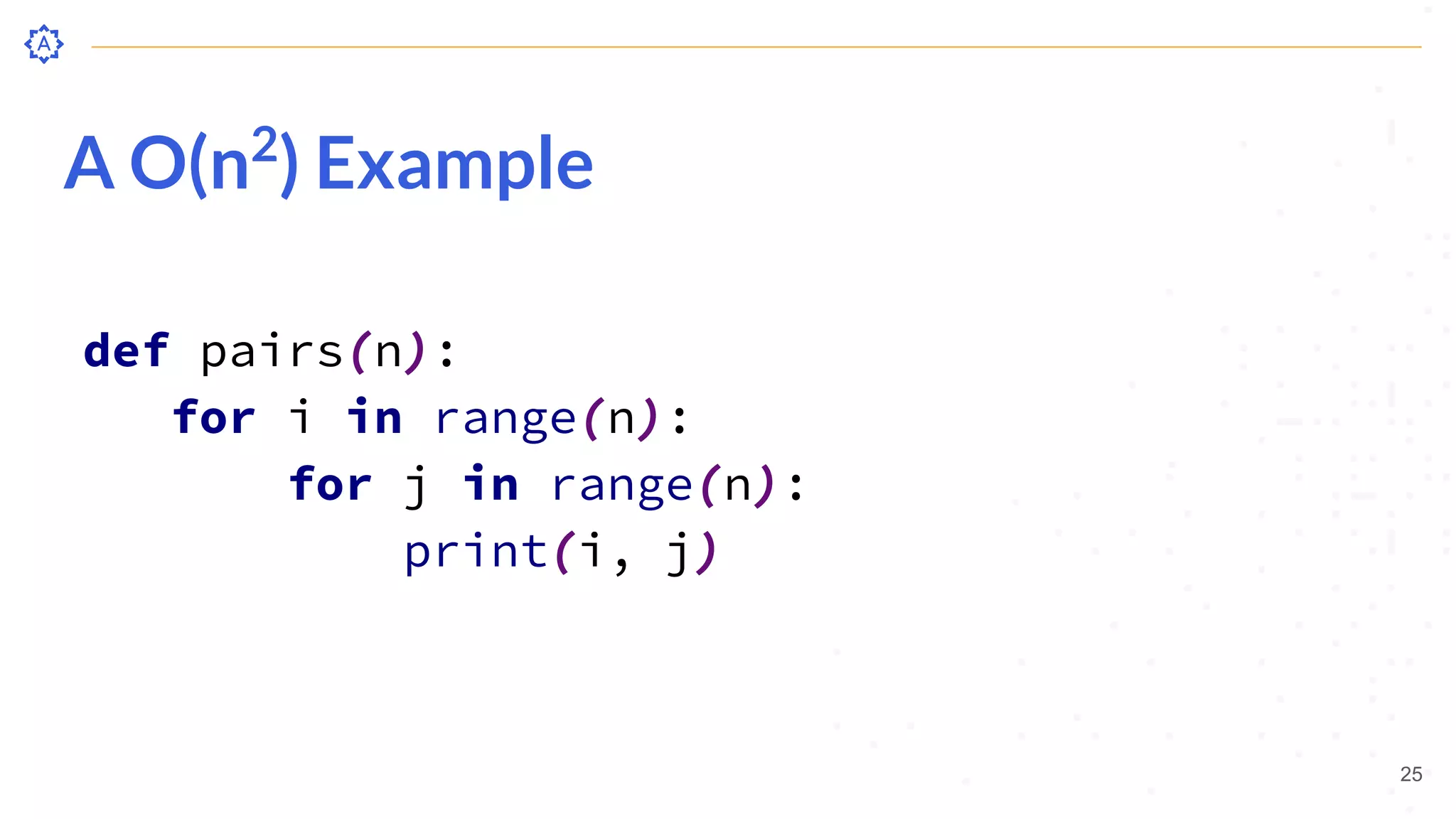
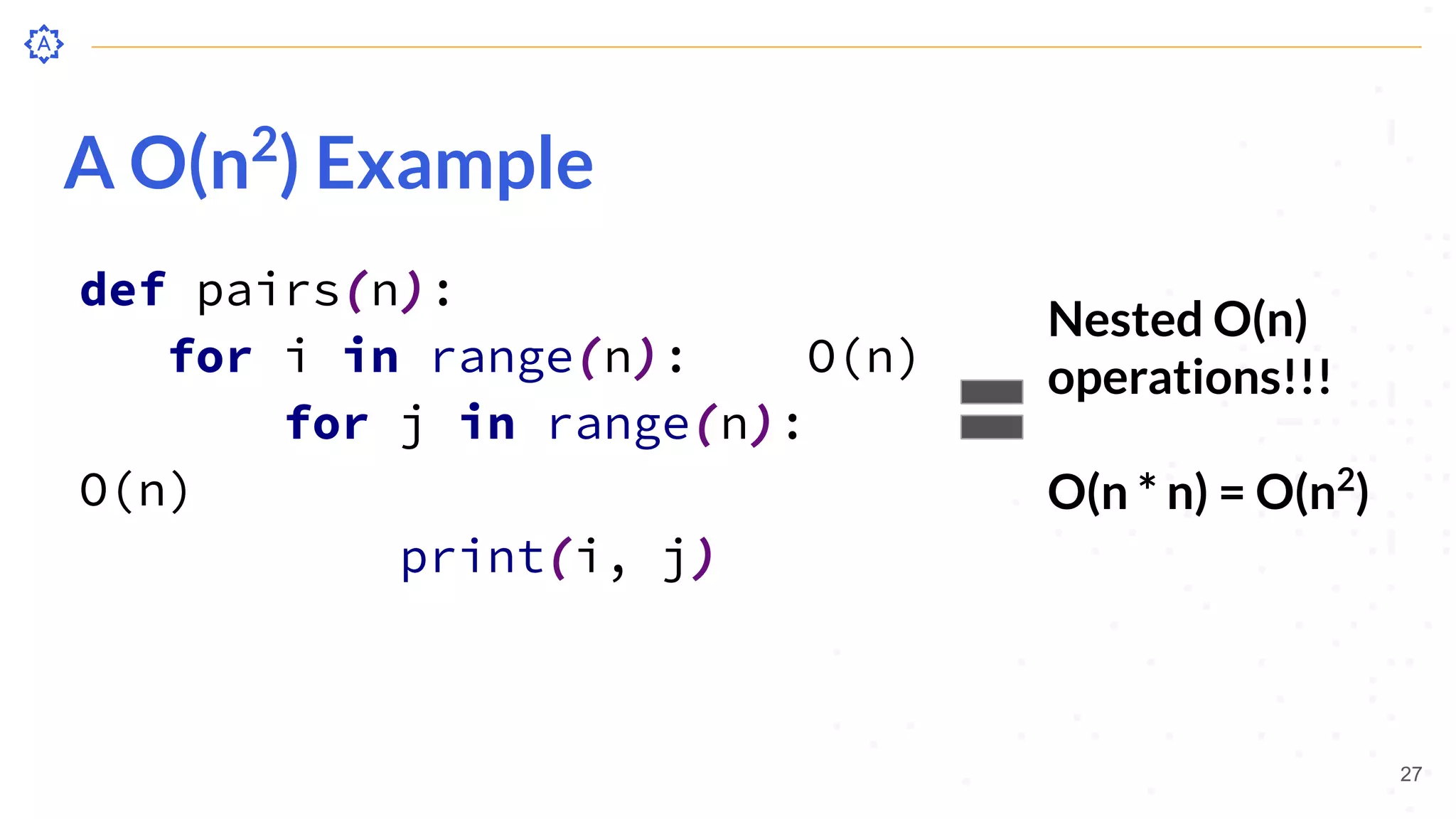
A O(n2
) Example
def pairs(n):
for i in range(n):
for j in range(n):
print(i, j)
25
A O(n2
) Example
26
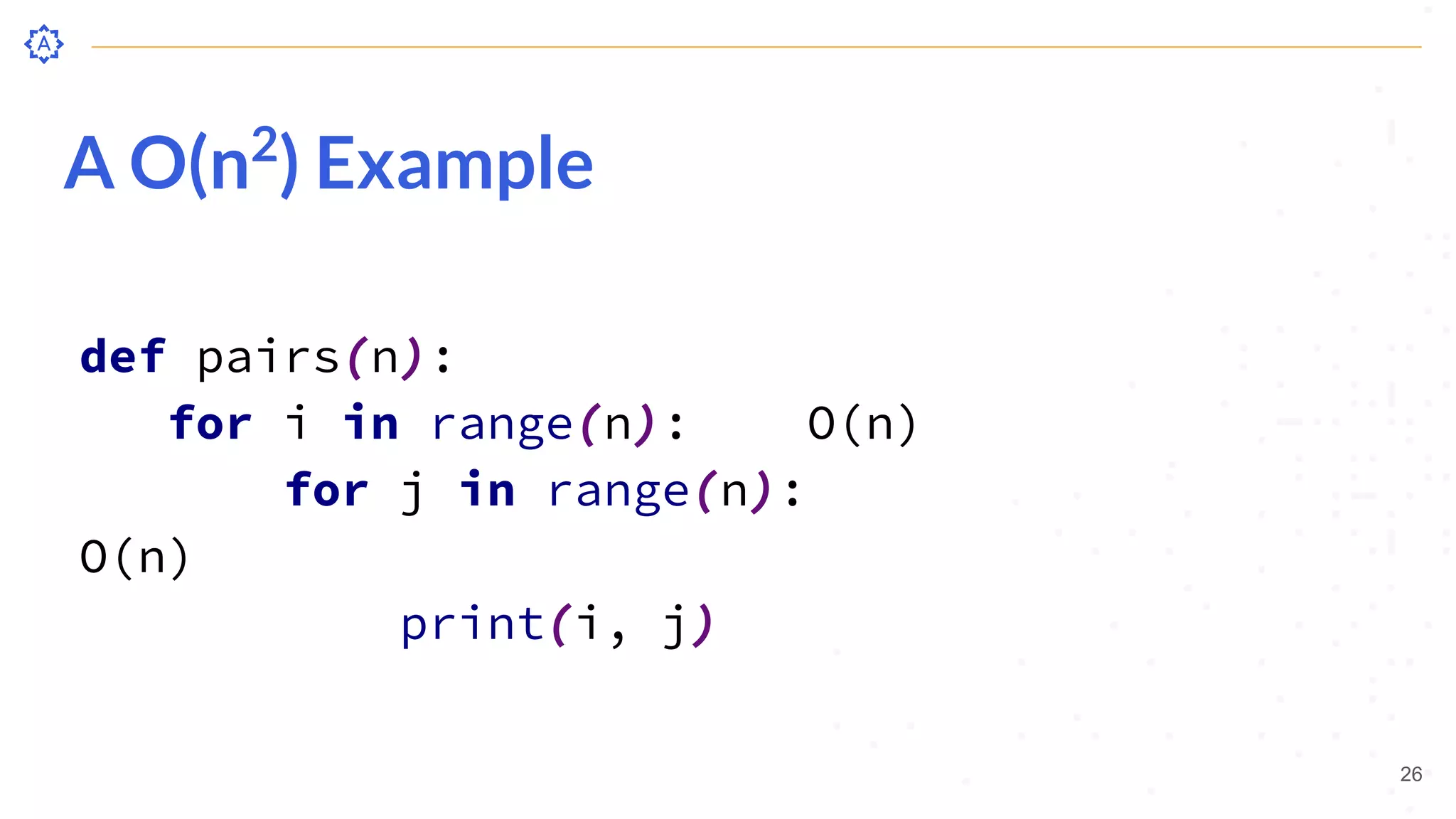
def pairs(n):
for i in range(n): O(n)
for j in range(n):
O(n)
print(i, j)
A O(n2
) Example
def pairs(n):
for i in range(n): O(n)
for j in range(n):
O(n)
print(i, j)
27
Nested O(n)
operations!!!
O(n * n) = O(n2
)
A O(log n) Example
def binary_search(arr, elem):
start = 0
end = len(arr) - 1
middle = math.floor((start + end) / 2)
while arr[middle] != elem:
if elem < arr[middle]:
end = middle - 1
else:
start = middle + 1
if start >= end:
return -1
middle = math.floor((start + end) / 2)
return middle
28
Common Python Operations
29
Lists
my_list.appen
d(a)
O(1)
my_list[i] O(1)
val in my_list O(1)
for val in
my_list
O(n)
my_list.sort() O(nlogn)
Sets
my_set.add(va
l)
O(1)
For val in
my_set
O(n)
val in my_set O(1)
Common Python Operations
30
Dicts
my_dict[key] = val O(1)
my_dict[key] O(1)
key in my_dict O(1)
for key in my_dict O(n)
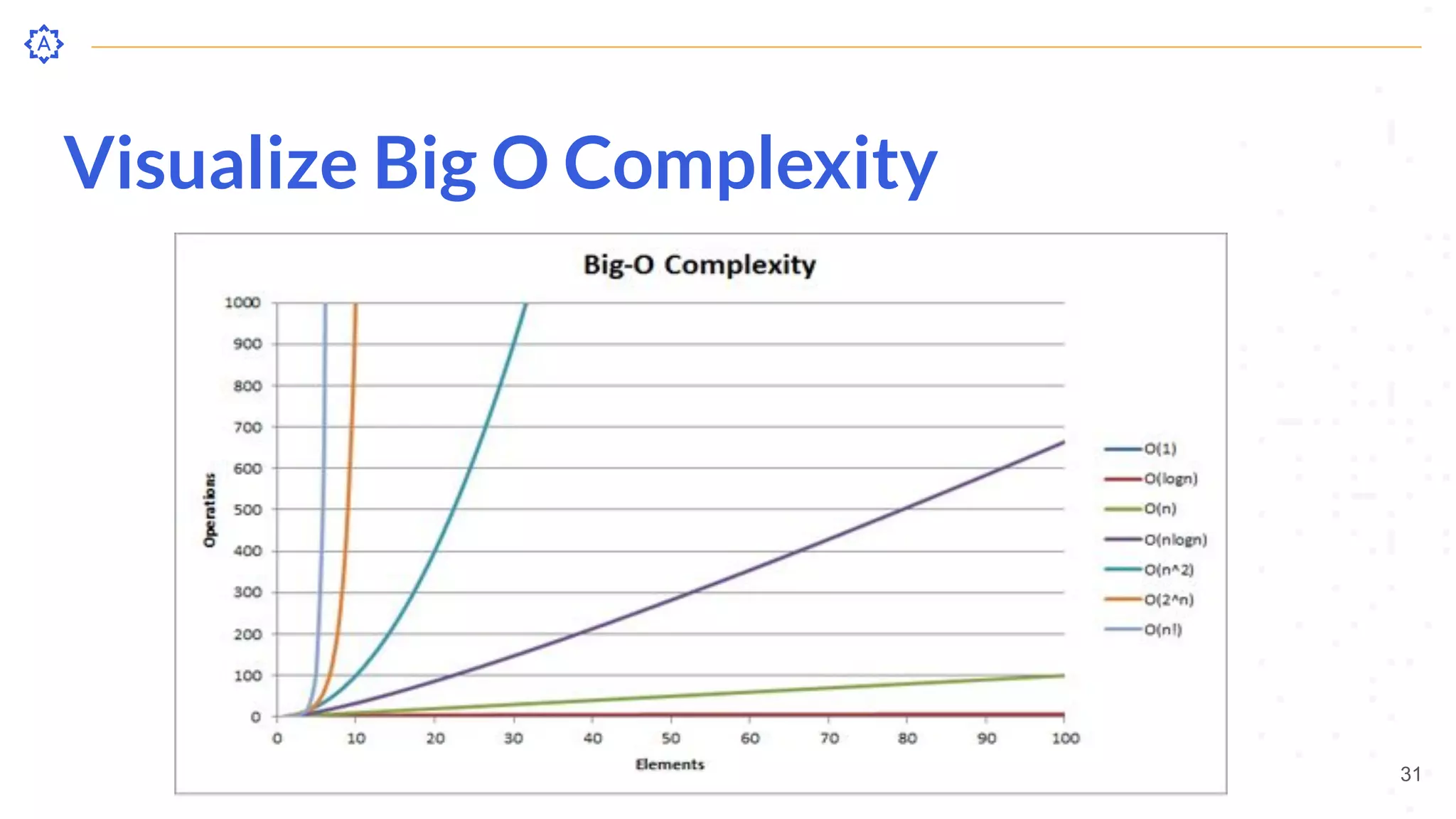
Visualize Big O Complexity
31
<Thanks>
32

The Big O with Python

  • 1.
    The Big Owith Python Learn how to analyze code for efficiency 1 Presented by: Dennis Wainaina Position: Senior Software Engineer
  • 2.
  • 3.
    What’s Big O? -How your code performs as you process more data 3
  • 4.
    What’s Big O? -How your code performs as you process more data - It’s NOT running time 4
  • 5.
    What’s Big O? -How your code performs as you process more data - It’s NOT running time - General trend of performance over time 5
  • 6.
    What’s Big O? -How your code performs as you process more data - It’s NOT running time - General trend of performance over time - A way of ranking the efficiency of an algorithm 6
  • 7.
  • 8.
    Why Care? - Providesa formal way to talk about how your code performs in comparison to your data 8
  • 9.
    Why Care? - Providesa formal way to talk about how your code performs in comparison to your data - Discussing trade-offs between different approaches 9
  • 10.
    Why Care? - Providesa formal way to talk about how your code performs in comparison to your data - Discussing trade-offs between different approaches - When you notice your code is slowing down and want to find the bottlenecks 10
  • 11.
    Why Care? - Providesa formal way to talk about how your code performs in comparison to your data - Discussing trade-offs between different approaches - When you notice your code is slowing down and want to find the bottlenecks - INTERVIEWS 😂 11
  • 12.
    Terminology - O standsfor “Order of” 12
  • 13.
    Terminology - O standsfor “Order of” - N represents how much data you got 13
  • 14.
  • 15.
    Some Examples Write afunction that calculates the sum of integers from 1 to n 15
  • 16.
    Some Examples def add_one_to_n(n): total= 0 i = 1 while i <= n: total += i i += 1 return total 16
  • 17.
  • 18.
    So, which oneis better? 18 Instead of timing, we can count the number of operations performed by each piece of code
  • 19.
    Let’s count thesteps def add_one_to_n_mathematical(n): return n * (n + 1) / 2 19 1 multiplication 1 addition 1 division
  • 20.
    Let’s count thesteps def add_one_to_n_mathematical(n): return n * (n + 1) / 2 20 1 multiplication 1 addition 1 division 3 steps regardless of the size of n
  • 21.
    Let’s count thesteps def add_one_to_n(n): total = 0 i = 1 while i <= n: total += i i += 1 return total 21 n additions 1 assignment 1 assignment n comparisons
  • 22.
    Let’s count thesteps - 2n ? - 3n + 2 ? - 5n + 2 ? 😩 22
  • 23.
    Big O! - 2n-> O(n) - 3n + 2 -> O(n) - 5n + 2 -> O(n) - O(3) -> O(1) - O(n + n2 ) -> O(n2 ) - O(7n4 + 2n2 + 5) -> ??? 23
  • 24.
    Big O! So, add_one_to_n_mathematicalis O(1) and add_one_to_n is O(n) 24
  • 25.
    A O(n2 ) Example defpairs(n): for i in range(n): for j in range(n): print(i, j) 25
  • 26.
    A O(n2 ) Example 26 defpairs(n): for i in range(n): O(n) for j in range(n): O(n) print(i, j)
  • 27.
    A O(n2 ) Example defpairs(n): for i in range(n): O(n) for j in range(n): O(n) print(i, j) 27 Nested O(n) operations!!! O(n * n) = O(n2 )
  • 28.
    A O(log n)Example def binary_search(arr, elem): start = 0 end = len(arr) - 1 middle = math.floor((start + end) / 2) while arr[middle] != elem: if elem < arr[middle]: end = middle - 1 else: start = middle + 1 if start >= end: return -1 middle = math.floor((start + end) / 2) return middle 28
  • 29.
    Common Python Operations 29 Lists my_list.appen d(a) O(1) my_list[i]O(1) val in my_list O(1) for val in my_list O(n) my_list.sort() O(nlogn) Sets my_set.add(va l) O(1) For val in my_set O(n) val in my_set O(1)
  • 30.
    Common Python Operations 30 Dicts my_dict[key]= val O(1) my_dict[key] O(1) key in my_dict O(1) for key in my_dict O(n)
  • 31.
    Visualize Big OComplexity 31
  • 32.