contentbestbusinessbooks
69
THE Best
Business Books
of THE
Millennium
contentbestbusinessbooks
70
strategy+businessissue25
t takes only one powerful idea to change
your life, bring light into darkness, and —
most importantly to strategy+business
readers — breathe new life into your
organization. As long as printed words have been bound
by covers, books have been a source of fresh thinking that
regularly and impressively inspires business leaders to
build leading businesses. Whatever physical form books
take in the future, their power will remain paramount.
Still, finding the big ideas isn’t easy, especially in a
business-book market that has seen roughly 10,000 new
titles in the last three years, according to the New York
Times. As a service to our readers, s+b invited 12 opin-
ionated, acclaimed strategists, scholars, and writers to
look beyond the best-seller lists to identify and assess the
most important business books in strategy, management,
and their subcategories. We also asked our contributors
to explore the realms of fiction, history, economics, sci-
ence, and more. Some were published in this millennium
(2000 and 2001); many are from the rather important
century that recently ended.
Read on to find out which 12 books the manage-
ment philosopher Charles Handy recommends for a
year’s worth of challenging reading, what leadership
scholar James O’Toole has to say about CEO memoirs,
and which capitalist characters novelist Kate Jennings
finds most important in fiction. Join us in our celebra-
tion of the books for business leaders that inspired us
during this millennium and the last.
71Strategy
by David K. Hurst
75Leadership
by Bruce A. Pasternack
78Global Management
by Charles
Hampden-Turner
83Business Novels
by Kate Jennings
88Economic History
by Louis Uchitelle
92Corporate Governance
by Jay A. Conger and
Edward E. Lawler III
97CEO Memoirs
by James O’Toole
102Beyond Business
by Charles Handy
106Knowledge
by Jan Dyer and
Chuck Lucier
110Internet
by David S. Bennahum
114Best Books Index
BEST
BOOKS
I
contentbestbusinessbooks
71
today. He and others like him came to prominence in
China as war changed from small-scale family feuds to
battles between states. Bands of itinerant scholars — Sun
Tzu may have been the first consultant to write a book
— peddled practical solutions, promising wealth and
power to any who would adopt their complex schemes.
Those whose clients prospered could do very well. A
variety of unpleasant fates awaited those whose advice
failed. They were liable to be pickled alive, boiled in oil,
or torn apart by chariots — courses of action that some
managers might wish were still available to them today!
The Art of Generals
In Europe at the dawn of the Enlightenment, however,
scholars of strategy had other objectives. Flush with their
success at explaining physical phenomena using scientif-
ic principles, theorists started to examine the art of suc-
cessful generals using similar frameworks. Their first
great exponent of strategy was Frederick the Great of
Prussia (1712–1786), whose small, well-drilled armies
dominated Central Europe. Under King Frederick, mil-
itary strategy took on a chesslike quality that allowed the
early writers to bolster their arguments with mathemat-
ical formulas and elaborate geometrical designs. It must
have been a huge shock to them when, at the end of the
18th century, armies built on the Prussian model were
crushed by Napoleon’s massed columns. New scholars
scrambled to explain this phenomenon and to revise
their principles.
Two of these interpreters of Napoleon were hugely
influential in the development of the concept of strate-
gy. The name of the first, the Prussian general Karl von
Clausewitz (1780–1831), is still well known in military
circles; the name of the second, the Swiss-French gener-
al Antoine-Henri de Jomini (1779–1869), is scarcely
remembered. It is a tribute to the durability of von
Clausewitz’s ideas that his famous work On War has
recently been excerpted for business readers. In
Clausewitz on Strategy: Inspiration and Insight from a
Master Strategist (2001), consultants
Tiha von Ghyczy, Bolko von Oetinger,
BEST
BOOKS
Sun Tzu,
von Clausewitz,
Drucker,and
OTHER Master
Warriors
by David K. Hurst
n a memorable scene in the movie Patton,
George C. Scott, in the title role, having
successfully anticipated a German attack,
shakes his fist at the advancing panzers and
yells, “Rommel, you SOB, I’ve read your book!” Patton
was a voracious reader, but the film’s producers were
exercising a good deal of artistic license. The incident
never happened, and there is no evidence that Rommel’s
actions were predictable from his writings. In fact,
Patton himself believed that all that could be learned
from such works were “the eternal verities of leadership,
morale, psychological effects and the difficulties and
confusion which battle entails,” as he was quoted in
Roger H. Nye’s The Patton Mind: The Professional
Development of an Extraordinary Leader (1992).
Our modern concept of strategy emerged in Europe
during the 18th century. Prior to that era, few writings
on strategy existed other than those of the Chinese schol-
ar Sun Tzu and the Italian philosopher Niccolò
Machiavelli (1469-1527). Sun Tzu lived in the fourth
century B.C., and his book The Art of War, which first
appeared in Europe in the 1770s, is widely available
I
contentbestbusinessbooks
72
strategy+businessissue25
and Christopher Bassford have done a
fine job of condensing von Clausewitz’s
massive, unfinished book and have coupled it with an
excellent commentary.
Von Clausewitz’s greatest value to business readers is
probably his philosophical attitude to the relationship
between theory and practice. For him, “real” war was a
dynamic process. Every situation was unique, and no
theoretical system could possibly tell a commander what
to do: “Theory should ... guide [the future commander]
in his process of self-education, but it should not accom-
pany him to the battlefield.” Von Clausewitz argues that
theory can help us focus on and summarize a topic —
to understand history — but theory is inherently
descriptive rather than prescriptive. The editors of this
book suggest that he regarded principles as rungs on the
ladder of imagination — aids to judgment and intuition
in what was fundamentally a creative activity. In von
Clausewitz’s view, principles could not be foundational
pillars for action.
Von Clausewitz’s contemporary and rival Antoine-
Henri de Jomini, on the other hand, saw actionable
principles as central to any science of strategy. Regarded
as the founder of the modern concept of strategy (as
opposed to politics and tactics), de Jomini was the most
widely read interpreter of Napoleon’s genius. He had a
Platonist’s faith that behind the confusion and chaos of
war were a few immutable scientific principles. The use
of prescriptive principles appealed strongly to military
educators, and de Jomini wrote for a wide audience that
was eager to understand the “secret” of Napoleon’s suc-
cess. Military ties between France and the fledgling
United States had grown close during the War of
Independence, and generations of West Point engineers
had been trained by the “principles” approach. De
Jomini’s influence remained strong in the military acad-
emies outside Germany until his reputation collapsed in
the bloodbaths of the First World War. He had always
insisted that his principles were independent of technol-
ogy. In the American Civil War, when defenders had
rifles instead of muskets, the Napoleonic principle of
massed attack had proved merely expensive for the
attacker. During the 1914–1918 war, against machine
guns, it proved to be suicidal.
Schools of Strategy
The use of principles that simplify, reduce, and prescribe
is an enduring feature of writings on business strategy.
The writings of von Clausewitz and de Jomini outline a
BEST
BOOKS
continuum between descriptive and prescriptive
approaches to strategy. The Canadian management
scholar Henry Mintzberg uses this distinction in
Strategy Safari: A Guided Tour Through the Wilds of
Strategic Management (1998), written with Bruce
Ahlstrand and Joseph Lampel.
Mintzberg and his colleagues classify the volumi-
nous writings on management strategy into 10 different
“schools.” The first three of these, in order of their emer-
gence, include the design school (mainly associated with
Professor Ken Andrews and the Harvard Business
School), the planning school, and the position school (of
which Harvard’s Michael Porter is the best-known expo-
nent). These schools are analytical and prescriptive. For
example, H. Igor Ansoff’s Corporate Strategy: An Analytic
Approach to Business Policy for Growth and Expansion
(1965), the classic planning text, is full of complex flow
diagrams. For those with the planning mind-set, strategy
is formulated through a controlled, conscious, explicit
process conducted by the CEO (and a group of planners)
in a top-down, formal fashion and emerges fully formed
from this process ready for implementation.
However, this classic planning approach to strategy
suffered a deathblow in the 1970s when corporate icons
like General Electric redeployed most of their specialist
planning staffs. Ever since then, the rational, prescriptive
views of the first three schools of strategy have been steadi-
ly augmented and supplanted by a number of descriptive
approaches. Mintzberg sorts these into seven other
schools, ranging from the entrepreneurial and the cogni-
tive, to the learning, power, and cultural, to the environ-
mental and configurational schools.The objective of these
schools of strategy is not to instruct like de Jomini but to
inspire the imagination like von Clausewitz.
An excellent example of the inspirational use of
principles is Jim Collins’s Good to Great: Why Some
Companies Make the Leap ... and Others Don’t (2001),
the follow-up to his highly successful Built to Last:
Successful Habits of Visionary Companies (1994), coau-
thored with Jerry I. Porras. For Good to Great, Collins
and his research team studied the financial records of
1,435 firms that belonged to the Fortune 500 from
1965 to 1995. They searched for firms that had pro-
duced mediocre (or worse) returns for 15 years and then
had outperformed the market by a factor of three times
or more for 15 years. They found only 11 such compa-
nies and labeled them “good to great.” This elite group
consisted of Abbott Laboratories, Circuit City, Fannie
Mae, Gillette, Kimberly-Clark, Kroger, Nucor, Philip
contentbestbusinessbooks
73
Professor Robert S. Kaplan and consultant David P.
Norton. The Balanced Scorecard began its life as an
attempt to help corporations escape the short-term
tyranny of financial measurement. It has now expanded
into a strategic management system. “We do not claim to
have made a science of strategy,” write the authors. “The
formulation of strategy is an art and will always remain so.
The description of strategy, however, should not be an art”
(authors’ emphasis). The authors may be too modest,
however, for it’s clear that when vision and strategy are
communicated so that people throughout a firm can
grasp them, it creates a favorable context that often leads
to the emergence of new and unsuspected strategies.
And, as we shall see, those contexts can be constructed
systematically.
Kaplan and Norton describe in detail how organiza-
tions in both the private and the public sectors have used
the BSC to translate strategy into operational terms,
align the organization with it, make strategy
everyone’s everyday job, turn strategy into a
continual process, and mobilize change
through executive leadership. The authors’
criteria for success are far less stringent than
those in Good to Great, but their list of firms
is impressive (Fannie Mae is the only organi-
zation that appears in both books), and the
stories are compelling. It’s refreshing to find a
chapter on the pitfalls of introducing the
Balanced Scorecard technique, supported by
cases of where and how it went wrong. An
obvious danger is that a BSC project can degenerate
into a bureaucratic form-filling exercise, a fate experi-
enced by so many management-by-objectives programs.
The authors were at first surprised to learn that two
of their most successful adopters were ex-Marine offi-
cers, considering that the military are often stereotyped
as command-and-control freaks. But the best soldiers,
like the most effective managers, understand that the
purpose of measurement is not control over others but
communication that leads to a decentralized self-control
focused on a common cause — the implementation and,
where necessary, the modification of strategy.
This theme of management by self-control has, of
course, long been central to the writings of Peter F.
Drucker. He stated it best nearly 30 years ago in his mas-
sive Management: Tasks, Responsibilities, Practices (1974).
The ultimate objective of management, he argued, is to
produce a “self-governing work commu-
nity,” which requires productive work,
Morris, Pitney Bowes, Walgreens, and Wells Fargo.
Collins’s team then identified two comparison groups: a
direct comparison group of companies in the same
industries that had not improved their performance, and
another group that had produced superior returns for a
while, but had been unable to sustain that improve-
ment. Collins and his team then studied the differences
among the groups. Their findings are fascinating.
They found that good-to-great companies had lead-
ers who combined a self-effacing humility with a fierce
professional will to succeed rather than larger-than-life
celebrity leaders, a feature of the comparison groups. In
the good-to-great companies, these leaders first assem-
bled a team of disciplined people and then, through dis-
ciplined thought and action, decided what should be
done (as well as what they should stop doing) and how
to do it (or stop it). “Who” came before “what” or
“how.” The good-to-great group did not spend more
time strategizing than did the others (all the
firms had well-defined strategies), and they paid
scant attention to managing change, motivating
people, or creating alignment. With the right
people, these issues seemed to just melt away.
A central finding of the study is that the
good-to-great firms disciplined their thought
with what Collins calls a Hedgehog Concept,
named after writings by the Greek poet
Archilochus about the hedgehog, who knows
one big thing (as opposed to the fox, who
knows many small things.) A Hedgehog
Concept is a deep understanding that flows
from the intersection of three circles:
1. What you can (and cannot) be the best in the
world at
2. What drives your economic engine
3. What you care passionately about
Collins suggests that this understanding is not a
one-time achievement, but an evolving product of an
iterative process best conducted in leadership councils of
the right people, who engage in dialogue and debate
guided by the three factors.
Unsuspected Strategies
Iterative processes, discipline, and focus are also central
features in The Strategy-Focused Organization: How
Balanced Scorecard Companies Thrive in the New Business
Environment (2001), the latest in the Balanced Scorecard
(BSC) series of books from Harvard Business School
BEST
BOOKS
contentbestbusinessbooks
74
strategy+businessissue25
feedback for self-control, and continu-
ous learning. Perhaps this is why so
much writing on management during the past decades
reads like footnotes to Drucker.
The Myth of Excellence
Creative Destruction (2001), by consultants Richard N.
Foster and Sarah Kaplan, casts new light on the organi-
zational environments that produce superior perform-
ance. The subtitle of the book, Why Companies That Are
Built to Last Underperform the Market — and How to
Successfully Transform Them, summarizes their message.
They use a custom-built database to track 1,008 com-
panies in 15 industries from 1962 to 1998 and show
that long-lived corporations typically underperform
market averages as represented by the S&P 500. Thus
the notion of excellence, of a corporation surviving
indefinitely while producing superior returns, is revealed
to be a myth. It’s the new entrants into an industry that
produce superior returns and then usually go through an
aging process accompanied by declining performance as
they enter “cultural lock-in.” Thus markets produce bet-
ter returns than corporations.
The authors suggest that creative destruction is nec-
essary within corporations if they are to mimic the scale
and pace of change of a marketplace. They cite the ven-
ture-capital firm Kleiner Perkins Caufield & Byers and
buyout specialists Kohlberg Kravis Roberts & Co. as
examples of organizations that create, operate, and trade
in ways that encourage creative destruction. The exam-
ple of the process within a single firm is drawn from the
authors’ work with Johnson & Johnson, where they ran
a series of corporate dialogues that resemble in spirit, if
not in mechanical detail, the councils espoused by Jim
Collins in Good to Great.
Foster and Kaplan’s significant contribution is the
analysis that shows the existence of the process of cre-
ative destruction in the American economy and, in fact,
shows that its pace is increasing. In the 1920s, a corpo-
ration on the S&P 500 could expect to be there for 60
years or more. Today that expectation is down to 20
years, and if the acceleration continues, it could be as lit-
tle as 10 years by 2025. Such knowledge should con-
centrate the minds of senior managers wonderfully!
Foster and Kaplan’s recommendations for how compa-
nies can avoid dropping from the S&P 500 are less
detailed and compelling than those offered in Good to
Great and The Strategy-Focused Organization, but one
wonders whether any of them can do anything other
than stave off the inevitable decline.
Harvard Business School Professor Clayton M.
Christensen, in The Innovator’s Dilemma: When New
Technologies Cause Great Firms to Fail (1997), has exam-
ined in detail why organizations seem incapable of rein-
venting themselves. He was fascinated by the experience
of the computer disk-drive industry, where the leaders in
one generation of drives seemed incapable of staying
atop the market in the next generation. Smaller entrants
who attacked from “underneath,” using what
Christensen called “disruptive technology,” displaced
the older players. Christensen has since regretted using
the term and now prefers to talk about “disruptive busi-
ness models,” for often the new technology was not rad-
ically different from the old. Rather, the differences lay
in the resources, processes, and values required to exploit
the new technology. Thus Christensen has outlined
what is effectively a corporate process of maturation and
aging whereby the strengths and relationships developed
to exploit one situation turn out to be weaknesses and
constraints in other contexts. Capability and disability
are two sides of the same coin, and one is replaced by the
other as contexts change.
All the current books cited above emphasize the
implementation of strategy rather than its formulation,
the topic that so preoccupied the early business writers
on strategy. The separation between formulation and
implementation always was an artificial one, done for
pedagogic purposes only, or so its proponents claimed.
Now practitioners are bringing the two together again.
One feels that Napoleon would have approved of that.
The great general disliked the word plan because of its
connotations of fixed, unchanging design. Instead, he
liked to talk about strategic “preparations.” And he
believed to the end of his life that “The art of war is sim-
ple, everything is a matter of execution.” +
BEST
BOOKS
David K. Hurst (dhurst1046@aol.com) is a speaker, consultant, and
writer on management and strategy. He is a regular contributor to
strategy+business and has written for the Financial Times, Harvard
Business Review, and other publications. He is currently writing a
book on golf and management that will be published by Free Press
in 2002.
contentbestbusinessbooks
75
Dreamers
with Deadlines
by Bruce A. Pasternack
he last time I checked, there were 393
current books with the words leader or
leadership in their titles. Although that’s
evidence of an almost insatiable appetite
for information on the subject, it doesn’t tell us what, if
anything, can be gained from reading about leadership.
Indeed, a scan of the hundreds of leadership titles
listed on the Internet is more amusing than edifying:
Some are laughably over-prescriptive (The 21 Irrefutable
Laws of Leadership) and many promise the world (How
You Can Create Growth and High Performance in Your
Company). When one peeks between the covers of such
texts, disappointment soon sets in. The sad fact is that
leadership manuals deliver mainly truisms, pap, and
gross generalizations. There are exceptions, of course,
and the reader’s challenge is to find the few grains of true
sustenance among the tons of dispensable roughage. But
where to start?
Several years ago, when my colleagues and I at Booz
Allen Hamilton formed the firm’s Organization and
Strategic Leadership Competency Center, we began by
reviewing the extensive literature on leadership — both
current books and classics. Being practical sorts, we
wanted to know if there was data that explained why
some leaders succeed and others fail; why some leaders
move successfully between organizations and others
don’t; and why a few organizations enjoy a seamless suc-
cession of great leaders, in contrast to the majority of
companies, where selection and succession processes are
uneven at best.
Over a two-year period, my partners and I read and
discussed hundreds of cases, articles, and books on lead-
ership. Putting each to the test of experience, we asked,
“Does the theory advanced square with what we observe
in real organizations?” Only a smattering of the books
we reviewed withstood the tough-minded scrutiny of
the few hundred professionals who spend their careers
observing and counseling leaders in business and gov-
ernment. The few books that resonated
with our collective experience also
BEST
BOOKS
SHIP
T
contentbestbusinessbooks
76
strategy+businessissue25
improved our understanding of why
some leaders we observed were more
effective than others. We distilled these lessons into a
practical framework that we have shared with global
leaders at the last two World Economic Forum meetings
in Davos, Switzerland, as well as readers of strategy+
business (see “Beyond the Cult of the CEO: Building
Institutional Leadership,” by Bruce A. Pasternack,
Thomas D. Willams, and Paul F. Anderson, s+b, First
Quarter 2001).
Here’s what we learned from all our reading and
analysis: Organizational performance is the result of
individual actions and behaviors. That is, in successful
companies, people up and down the line do the “right
things.” Those companies have effective leaders who cre-
ate conditions under which their people have the infor-
mation, authority, and incentives to make the
right decisions. When leadership is effec-
tive, behavior at all levels of the organiza-
tion is both aligned and adaptable, and,
thus, the organization performs to its
potential. We call this an institutional
capacity for leadership.
What Leaders Do
Obviously, the trick is for leaders to learn to
create the conditions under which this
behavior can occur. In our extensive survey
of the leadership literature, we found a few
good books that helped to define precisely
what leaders do to create those conditions.
Here are some of my favorites from Booz
Allen Hamilton’s list of useful books on leadership,
together with a few of the important lessons we’ve taken
from each.
Many leadership books focus on the characteristics
of individual leaders, and to my mind the best in this
category is Warren Bennis’s On Becoming a Leader
(1989). Bennis writes that leaders “dream with a dead-
line.” By focusing on what’s important, they help their
followers to realize goals that they couldn’t achieve on
their own. In the process, leaders and followers become
“intimate allies.” In Bennis’s view, leaders have a guiding
vision, a passion that allows them to communicate a
sense of hope to followers. The key to this communica-
tion is not charisma (as many experts have maintained);
what is required is integrity. Leaders with integrity have
a heightened sense of self-awareness and an unshakable
understanding of what they believe in and what they
stand for. According to Bennis, leaders with integrity are
palpably at ease with themselves, and this self-confi-
dence, sensed by their followers, forms the basis of a
bond of trust between them.
In The Leadership Challenge: How to Keep Getting
Extraordinary Things Done in Organizations (1987),
James M. Kouzes and Barry Z. Posner also conclude that
trustworthiness is the key to leadership. Using a database
of more than 60,000 leaders, they conclude that the
most important individual trait of leaders is honesty.
They identify five fundamentals of leadership: challeng-
ing the status quo, inspiring a shared vision, enabling
others to act, modeling through personal example, and
“encouraging the hearts” of followers. Leaders, they say,
live their lives backward by imagining a future state and
then creating the path to get there. Their followers then
adopt both that goal and the process for
achieving it because they trust the leader’s
motivations.
The insights of Bennis, Kouzes, and
Posner resonate with our experience at
Booz Allen. We have witnessed the unrav-
eling of promising leaders when they have
betrayed the trust of followers. These aspi-
rant leaders had many flaws, but almost
always the path to ruin was the betrayal of
trust. This betrayal took several forms, such
as telling their followers one thing and then
doing another; putting their personal agen-
das ahead of those of their organizations;
and failing to hold themselves — and their follow-
ers — accountable for promises made. Invariably, the
result of this duplicity was that leaders became unable to
enlist followers in the activities needed for organization-
al success. We have seen leaders succeed against over-
whelming odds, however, when they have put aside their
egos and understood that the purpose of leadership is to
enable others to achieve their goals and the goals of their
organizations. Thus, the most successful leaders we have
observed are dedicated to creating other leaders. That is
why even the best books that deal with the “character”
of the individual at the top fail to tell the whole story of
leadership.
An Institution’s Capacity for Leadership
On this score, James O’Toole, in Leadership A to Z: A
Guide for the Appropriately Ambitious (1999), draws a
useful distinction between who leaders are and what
leaders do. Through case studies and historical vignettes,
BEST
BOOKS
contentbestbusinessbooks
77
he demonstrates that leadership is, in the end, an insti-
tutional capacity. O’Toole doesn’t ignore the obvious
fact that the character of individual leaders is important,
but he shows that great leaders throughout history have
also inspired others to lead.
These leaders achieved more than anyone thought
possible at the time because they didn’t try to do it all
themselves. Instead, they were able to transcend their
individual limitations by sharing the power and respon-
sibility of leadership.
O’Toole’s argument that an organization’s capacity
for leadership can be both measured and enhanced
through conscious effort meshes so closely with our
experience that it has come to inform our entire
approach to leadership. Instead of trying to change the
basic styles and personalities of individuals, we have con-
cluded it is almost invariably more fruitful to help com-
panies create systems and practices that enhance their
overall leadership capabilities.
Sumantra Ghoshal and Christopher A. Bartlett, in
The Individualized Corporation: A Fundamentally New
Approach to Management (1997), focus on how to build
that leadership capacity. They argue that corporations
need to move from a philosophy of “contract, compli-
ance, control, and constraint” to one of “stretch, sup-
port, discipline, and trust.” Ghoshal and Bartlett argue
that even a casual observer can tell the difference
between organizations by the “smell” of the place. The
poorly led organization reeks like Calcutta on a steamy
summer day; the well-led company smells like spring-
time in the forest of Fontainebleau! When organizations
are “fresh,” they are more likely to adapt successfully to
a fast-changing environment. The authors contend that
as companies are transformed from “foul” to “fresh,”
they engender learning, initiative, commitment, collab-
oration, confidence, and successful execution.
Failure to Adapt
It is now well established that all corporations go
through an aging process as they progressively fail to
adapt to new circumstances. Sadly, in our business, we
have seen many bastions of the Fortune 500 show symp-
toms of rigor mortis … and then vanish from the list. In
Leadership without Easy Answers (1994), Ronald A.
Heifetz describes three forms of such failures to adapt:
when organizations misperceive threats; when they see
threats, but don’t have the resources and/or capabilities
to do anything about them; and when they feel that it is
too painful to adapt.
Heifetz argues that the role of leaders is to encour-
age their people to face up to such challenges — to
adjust their values and beliefs, to change perspectives,
and to develop new habits of behavior. In Heifetz’s
framework, the task of adaptive leaders is to let follow-
ers “feel the external pressure for change” and to main-
tain their disciplined attention to the problem at hand.
Leaders are “responsible for direction, orientation, man-
aging conflict and shaping norms.” But they delegate
the work itself to followers because “it does no good to
be swept up in the field of action.”
In our experience, the toughest part of leadership to
master is that very ability to stand back and not be swept
up in the field of action. As O’Toole, Ghoshal, Bartlett,
and Heifetz all show, the greatest leaders are fundamen-
tally teachers who spend their time building leadership
bench strength in their organizations, creating a cadre of
other leaders willing to assume the responsibility for get-
ting directly into the fray.
The acknowledged master at building such leader-
ship capacity is Jack Welch. His approach to developing
others to create organizational adaptability is chronicled
by Noel M. Tichy in The Leadership Engine: How
Winning Companies Build Leaders at Every Level (1997).
Perhaps the most important leadership lesson to be
learned from Welch (and from the likes of Roger Enrico
of PepsiCo and Andy Grove of Intel) is that true leaders
are not just teachers — they also have teachable points
of view. That is, they help the leaders they mentor to see
the world more clearly, to articulate vision and values
simply, and to motivate their own followers to confront
reality and make tough decisions. Thus,
the most important concept in Tichy’s
BEST
BOOKS
The authors of Hidden Value take
issue with the conventional
wisdom that companies need
to win the war for talent.
contentbestbusinessbooks
78
strategy+businessissue25
book is that the difference between a
winning organization and a losing
organization is that the former has a leader who creates
other leaders at all levels.
Everyone Can Lead
For my money, the most inspirational recent leadership
book is Hidden Value: How Great Companies Achieve
Extraordinary Results with Ordinary People (2000), by
Charles A. O’Reilly III and Jeffrey Pfeffer. The authors’
willingness to take issue with the conventional wisdom
that companies need to win the war for talent is partic-
ularly on target.
We’ve heard that old refrain before: Our schools
would be better if only we had better teachers, and gov-
ernment would be better if only there were more com-
petent civil servants. In fact, such conventional wisdom
is more often than not a rationalization for poor leader-
ship. Because the top 10 percent of any group is a finite
number, it is incumbent on leaders to create conditions
that produce extraordinary results from ordinary people.
From that perspective, a company that creates talent and
uses it well is better led than one that expends all its
energy on the futile task of hiring only great people. The
authors illustrate that point with examples from AES,
Southwest Airlines, NUMMI, and the SAS Institute,
which show that leaders who create the environment
in which all their people can do their best are those
whose organizations are most successful.
And so we come full circle with leadership books.
As Tolstoy wrote, “Happy families are all alike; every
unhappy family is unhappy in its own way.” Clearly,
there are numerous ways leaders can cause companies to
fail, but all effective leaders must create the conditions
under which the efforts of their people are aligned
and under which each follower can become a leader. The
latter dynamic is essential because successful organiza-
tional adaptation occurs only when every person in the
organization is attuned to meeting the challenges of an
ever-changing competitive arena.
In the final analysis, not many books can teach you
to be a great leader. But it would be foolish to ignore the
wisdom contained in this selection. +
THE Cobra and
THE Treasure
Chest: Four
Perspectives
on Globalism
by Charles Hampden-Turner
s a small boy I remember being vastly
impressed by a swashbuckling movie, The
Thief of Baghdad. One scene has stayed
with me for 60 years or so. There was a
treasure chest full of gold coins and sparkling jewels, and
curled around it was a giant cobra, moving to and fro in
a mesmerizing and threatening sway. There are some
similarities between that scene and our attitudes toward
globalism — on the one hand, the lure of great wealth;
on the other, the fear of a variety of menaces. This
dichotomy is reflected in books on globalization: Some
BEST
BOOKS
A
Bruce A. Pasternack (pasternack_bruce@bah.com) is a senior
vice president with Booz Allen Hamilton in San Francisco.
He is the coauthor, with Albert J. Viscio, of The Centerless
Corporation: A New Model for Transforming Your Organization for
Growth and Profit (Simon & Shuster, 1998).
contentbestbusinessbooks
79
writers see just the gold and jewels, others see only the
cobra, and a few deal with both the dazzle and the men-
ace — and with the complexities of their interaction.
Mostly Snakes
In The Silent Takeover: Global Capitalism and the Death
of Democracy (2001), Noreena Hertz notes
that of the world’s 100 largest economies, 51
are now corporations, and only 49 are nation-
states. She argues that, silently and stealthily,
corporations are taking over world affairs. In
her view, the riots in London, Melbourne,
Seattle, and elsewhere are desperate attempts
by scattered, often disparate, groups to draw
our attention to this danger. We ignore them
at our peril.
Hertz builds a compelling case that the
cobras in globalization are real. And she dis-
plays considerable personal courage in expos-
ing them, since her thesis is unlikely to delight
the Judge Institute of Management Studies at
Cambridge University, with which she is affiliated. Her
passion makes her partisan, however, making the reader
cautious to trust her judgment.
She writes that it is not simply the politicians who
are powerless against world market trends. With wars
now effectively banished to the fringes of affluent eco-
nomic systems, nations rise and fall in world esteem not
by carrying out successful military adventures, but by
gaining market share and generating growth rates in
excess of rival nations. This has reduced politicians to
mere referees of the rules of global capitalism and cheer-
leaders for private enterprise’s initiatives.
Hertz’s strongest case is that there are real dangers in
the corporation’s expanding global influence, but she is
a polemicist at heart and tends to ignore the
cases where corporations have been brought
to task. Some of these events are quite sig-
nificant. Monsanto’s development of genet-
ically modified (GM) crops prompted
protests in Europe that have virtually halted
the company’s GM tests. Indeed, multina-
tional corporations do not win all these
conflicts, but Hertz does not adequately
explain why. Although she does not allege a
worldwide corporate conspiracy, one is left
with the impression of a concerted push by
“bad people,” and she is very much on the
side of demonstrators, with whom she has min-
gled and whom she defends on television.
She is also a trifle weak on remedies, on how to
challenge and control the corporations. She recom-
mends that the Internet be used to organize critics and
boycott the products of those who misbehave. Wal-Mart
and Nike have both been gored in this way by the “elec-
tronic herd.” She has some faith in ethical investing, but
the idea that markets might organize to reward corpora-
tions who train employees, promote women, sustain
stakeholders, employ minorities, diver-
sify out of tobacco, etc., seems to have
BEST
BOOKS
contentbestbusinessbooks
80
strategy+businessissue25
passed her by. Yet corporations might be
motivated to do much of social and
environmental value if they were rewarded in the mar-
ketplace for doing so and received credit ratings for their
social performance. The problem is, the author is too
indignant to contemplate making peace with her corpo-
rate enemies.
All Treasure
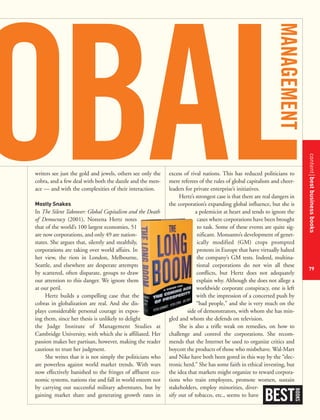
The Long Boom: A Vision for the Coming Age of Prosperity
(1999) is the well-known thesis of Peter Schwartz,
founder of the Global Business Network and pioneer of
the scenario method of planning. Here he is helped by
Peter Leyden, former managing editor of Wired, and
Joel Hyatt, of the California Public Utilities Commission.
In his youth, Schwartz was a student radical. His
enthusiasm and idealism have metamorphosed into
advocating certain key technologies and arguing the fol-
lowing: a) these technologies are responsible for the pres-
ent and future success of the Long Boom, which we
have been enjoying (and which is now a trifle shaky);
and b) these key technologies can serve society well only
if we apply them with the appropriate values. Together,
it is argued, emerging technologies have the power to
create global prosperity, save the environment, emanci-
pate women, eradicate want. Even if we do not share the
authors’ upbeat assessments, the fine details of their
argument are full of gems and gold pieces. Only the
cobra is missing.
The authors are inevitably most bullish about the
Internet, which they call “The Great Enabler.” When
PCs were joined together in a World Wide Web, a “new
paradigm,” long emergent, took its most influential
form. Schwartz has been an advocate of new paradigms
since his early work at SRI International in the late
1970s. Indeed, scenario planning, with its coherent
visions of alternative futures in place of the traditional
forecast and attempts by corporations to predict and
control specific outcomes, is one of the manifestations
of the new paradigm.
The Internet is only one form of “benign technolo-
gy” in which the authors have faith and which they see
as leading to a positive aspect of globalization. They pre-
dict the fuel cell will, in less than a decade, halve auto-
mobile emissions and soon thereafter eliminate them
altogether, when the hydrogen-gasoline fusion system
gives way to the hydrogen cell. Automobiles will be
much lighter and less noisy. Economics will shift to local
manufacture in far smaller runs, and customized brands
will proliferate.
The fuel cell, already in research laboratories in a
dozen advanced economies, is not the only eco-friendly
technology the authors acclaim. They have high hopes
for nanotechnology. Its tiny engines promise an eco-
friendly form of biological wealth and life creation. They
have attracted the attention of the Japanese, whose love
of miniaturization has deep roots. Indeed, one of the
pleasures of this book is its readiness to utilize cultural
diversity in a global system. In the authors’ vision, every
country specializes in what it loves and makes it available
to the world. Such technologies swim in a new ideolog-
ical infrastructure suspended between left and right
wings of the political spectrum and transcend both,
through a kind of “ethic of originality” that stems from
a common quest for a richer and more diverse globe.
If all this seems too utopian, too like the Age of
Aquarius on which several Global Business Network
members were weaned, some skepticism is in order. The
authors do not consider the spread of lethal technologies
or of technologies with predatory values attached to
them, although the United States government sponsors
these selectively.
The problem with their thesis is that it strengthens
the notion that technology will somehow save us from
earlier mistakes, from those technologies that spurred
global warming and unsustainable economic develop-
ment and condemned sizable sectors of our global citi-
zenry to employment at very low wages. Nevertheless,
very few books tackle the interdependence of values and
technology as well as this one, even if values are too
often regarded as dependent variables or “enablers” of
high tech.
Economics 101
Economics fundamentally concerns choice and how
people make decisions, so it’s not surprising that it
BEST
BOOKS
Very few books tackle the
interdependence of technology and
values as well as The Long Boom does.
contentbestbusinessbooks
81
should serve as a framework for balancing the promises
and perils of globalism. A Future Perfect: The Challenge
and Hidden Promise of Globalization (2000) is an engag-
ing book by two journalists for The Economist, John
Micklethwait and Adrian Wooldridge, and it is a primer
on neoclassical economics as the only discipline of gen-
uinely global application.
This perspective is close to being the “official
future,” expected to happen based on conventional eco-
nomic wisdom, and it is generally dismissive of danger
and compassion. When any issue clashes with econom-
ic orthodoxy, Micklethwait and Wooldridge brush it
deftly aside. For example, on the subject of child labor,
they stigmatize all attempts at “fair trade” as protection-
ist. What those who object to six-year-olds working in
Pakistan’s sweatshops “really” want is to protect
American textile industries, they argue. Interestingly,
they approve of protesting these practices if the protest
takes economic forms — labeling textiles as free of child
labor, for example. Where they found the moral radar to
examine the child-labor critics’ “real” motives they do
not say.
I regard child labor as both morally abhorrent and
stupid, saddling nations with unschooled adults for the
rest of their natural lives. An economy like Singapore’s,
which has risen from a gross domestic product per per-
son of $450 in 1967 to $28,000 today, has educated
every citizen to the hilt and punished companies paying
low wages to its citizens with an education tax. We do
not hear of these kinds of regional adaptations.
The authors’ reluctance to let go of their purely eco-
nomic perspective and even consider what the informa-
tion revolution might be doing to economic “science”
limits the book’s value. Not surprisingly, they criticize
Schwartz’s new paradigm and anyone who suggests that
19th-century economic metaphors of great machines
might need revision.
This book is at its best in exploding myths. These
include “size trumps all.” The authors relate cases of
smaller players running rings around lumbering giants.
McDonald’s is often thought of as an example of the
universal product; in fact, the company has survived via
its international division and its infinite variations across
the globe. Another myth is that globalization is a zero-
sum game. The authors argue convincingly that addi-
tional value is created, even if some players lose.
The Precarious Balance
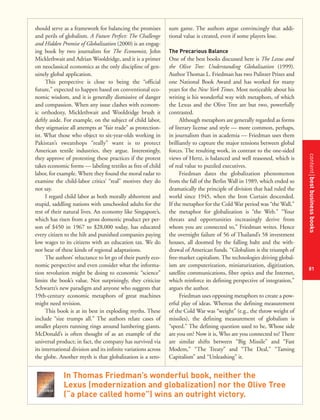
One of the best books discussed here is The Lexus and
the Olive Tree: Understanding Globalization (1999).
Author Thomas L. Friedman has two Pulitzer Prizes and
one National Book Award and has worked for many
years for the New York Times. Most noticeable about his
writing is his wonderful way with metaphors, of which
the Lexus and the Olive Tree are but two, powerfully
contrasted.
Although metaphors are generally regarded as forms
of literary license and style — more common, perhaps,
in journalism than in academia — Friedman uses them
brilliantly to capture the major tensions between global
forces. The resulting work, in contrast to the one-sided
views of Hertz, is balanced and well reasoned, which is
of real value to puzzled executives.
Friedman dates the globalization phenomenon
from the fall of the Berlin Wall in 1989, which ended so
dramatically the principle of division that had ruled the
world since 1945, when the Iron Curtain descended.
If the metaphor for the Cold War period was “the Wall,”
the metaphor for globalization is “the Web.” “Your
threats and opportunities increasingly derive from
whom you are connected to,” Friedman writes. Hence
the overnight failure of 56 of Thailand’s 58 investment
houses, all doomed by the falling baht and the with-
drawal of American funds. “Globalism is the triumph of
free-market capitalism. The technologies driving global-
ism are computerization, miniaturization, digitization,
satellite communications, fiber optics and the Internet,
which reinforce its defining perspective of integration,”
argues the author.
Friedman uses opposing metaphors to create a pow-
erful play of ideas. Whereas the defining measurement
of the Cold War was “weight” (e.g., the throw weight of
missiles), the defining measurement of globalism is
“speed.” The defining question used to be, Whose side
are you on? Now it is, Who are you connected to? There
are similar shifts between “Big Missile” and “Fast
Modem,” “The Treaty” and “The Deal,” “Taming
Capitalism” and “Unleashing” it.
In Thomas Friedman’s wonderful book, neither the
Lexus (modernization and globalization) nor the Olive Tree
(“a place called home”) wins an outright victory.
contentbestbusinessbooks
82
strategy+businessissue25
Friedman does not just use
metaphors, but also recounts many sto-
ries. Stories tell of a clash, conflict, or contradiction that
reaches a crisis point and is then resolved. The structure
is of two opposites and their struggle to reconcile.
Which brings us to the central metaphor and plot line
of this book.
The Lexus stands for speed, modernization, move-
ment, luxury, and globalization. The Olive Tree “stands
for everything that roots us, anchors us, identifies us,
and locates us in this world — whether it be belonging
to a family, a community, a tribe, a nation, a religion, or,
most of all, a place called home.” Friedman sees the
world, the nation, the town, and even the person as
divided between building the Lexus and disputing who
owns the Olive Tree. If the Lexus is driven too heedless-
ly, the Olive Tree will block its path. Those who down-
load for a living will find themselves confronted by those
who upload.
It is the virtue of this book that it clearly dramatiz-
es through stories that neither the Lexus nor the Olive
Tree wins an outright victory; rather, both reach intri-
cate and creative accommodations. For example, the
Kayapo Indian village in the Amazon rain forest, which
has for years been trying to resist the encroachment of
modernization, has found a common cause with the
environmental group Conservation International,
whose biological research station is dedicated to the bio-
diversity of this unspoiled region.
Sometimes the Lexus acts as a moderating force on
the violent nationalism of the Olive Tree. Friedman was
in India at the time the BJP nationalist party took power
and began testing nuclear weapons. Almost unnoticed,
two officials from Moody’s slipped into town and low-
ered India’s government securities to “speculative grade.”
The BJP promptly switched its priorities to the economy.
On other occasions, the Lexus can actively assist the
Olive Tree. On Gulf Air planes, an onboard compass
indicates the position of Mecca so that five-times-a-day
Muslim worshipers know in which direction to kneel.
On other occasions, the Olive Tree disables the Lexus.
The author left his briefcase on a sidewalk in Israel for a
couple of minutes and got it back from the police later
with a bullet hole through its center — the standard
treatment for all suspect packages.
Of course, so-called free markets have their rules.
Friedman calls this “the Golden Straitjacket,” a one-size-
fits-all requirement that squeezes and pinches some, but
accelerates growth while shrinking politics and dimin-
ishing left–right polarities. The author ends up as a tra-
ditional liberal type. He wants to unleash the creative
chaos of capitalism on a global scale, but create a safety
net to catch those mangled by the Lexus careening
through the Olive Tree grove.
The Trade Gap
What none of our books addresses is that not one single
affluent economy has reached the top by way of free
trade. Obviously, once you are at the apex of economic
power you want all markets open to you, but neither the
U.S. nor Britain, Japan, Korea, or Singapore “made it”
in the manner idealized. Britain invented mercantilism
and crown colonies and sold its merchandise to captive
markets in its empire. The United States used the
Monroe Doctrine to keep European trade away from its
shores while it built up domestic industries. Thus, the
highway to successful globalization is not clearly
defined: “We build the road as we travel,” as Spanish
poet Antonio Machado put it.
There may well be a treasure chest at the end of our
journey toward a globalized economy, but this pathway
has not been trodden before, and no doubt we will
encounter many snakes along the way. +
BEST
BOOKS
Charles Hampden-Turner (ChuckHT@aol.com) is one of the
business world’s most prominent thinkers on cultural diversity and
is a partner, with Fons Trompenaars, of the corporate consulting
firm Trompenaars Hampden-Turner. Their two most recent books,
Building Cross-Cultural Competence: How to Create Wealth from
Conflicting Values (Yale University Press, 2000) and 21 Leaders for
the 21st Century: How Innovative Leaders Manage in the Digital Age
(McGraw-Hill, 2001), attempt to unravel globalization issues.
Globalization is not a zero-sum game,
argue the authors of A Future Perfect. Value
is created, even if some players lose.
contentbestbusinessbooks
83
Free-Market
Fiction: Three
Centuriesof
Capitalist
Characters
by Kate Jennings
curious collection of essays was published
last year under the auspices of the Institute
of Economic Affairs, a London-based
organization dedicated to broadening the
public understanding of a free economy. Titled The
Representation of Business in English
Literature, the collection contains a foreword
by John Blundell lamenting that capitalism
has received “three centuries of bad press”
from writers of fiction. To demonstrate this
negative bias, he works his way through the
dictionary for adjectives to describe how he
believes writers portray businesspeople:
“…abnormal and antagonistic; corrupt, cun-
ning and cynical; dishonest, disorderly,
doltish, dumb and duplicitous; inhumane,
insensitive and irresponsible; ruthless, unethi-
cal and unprincipled; and villainous to boot.”
To temper such antibusiness characteriza-
tions, Blundell proposes sending emerging writers to “a
factory or similar capitalist institution” and offering
financial incentives for novelists who treat business as
“an honourable, creative, moral and personally satisfying
way of life.” He even entertains the idea of endowing an
Oxbridge Chair of Literary Capitalism.
Poor Mr. Blundell. Someone should tell him that
character and conflict are the stuff of stories, and
polemic is second only to unalloyed virtue in sinking a
novel. Next he will be asking novelists to write about
happy families!
Blundell’s free-market viewpoint is as simplistic and
skewed as that of the extreme anticapitalist populists
who see making money solely as a dirty game and busi-
nesspeople as ripe for vilification in fiction. In truth,
beginning with Daniel Defoe, novelists have served up
treatments of businesspeople and commerce that are as
varied, nuanced, and complex as they are in life, result-
ing in an engrossing, invigorating literary genre.
Unfortunately, these days, with modern readers prefer-
ring the narrowly personal or entertainingly exotic, the
business-novel genre has fallen on hard times, to the
detriment of not just literature but all social discourse.
Portraits of Moneymen
Novelists worth their salt have always been drawn to
human behavior in all its glory and inadequacy. Take,
for example, Anthony Trollope. In The Way We Live
Now (1875), he created Augustus Melmotte, the best-
known of all fictional businesspeople. A financier ped-
dling shares in an American railroad scheme, Melmotte
bursts on 19th-century London society with the radi-
ance of a comet, and, as comets do, burns out.
Melmotte, who eventually commits suicide, is a study in
overreaching ambition, in greatness gone
awry, but Trollope doesn’t make him a
figure of contempt. Melmotte, as his faith-
ful servant Croll says, was “passionate, and
did lose his ’ead; and vas blow’d up vid
bigness.… ’E bursted himself.” In this
story, the real villains are the amoral, gorm-
less, prejudiced, blue-blooded fops who
sneer at Melmotte while taking advantage
of his prosperity. Trollope wanted to
illustrate venality in all its venues, not just in
the City.
If Melmotte is a comet, then Theodore
Dreiser’s nonconformist magnate Frank
Algernon Cowperwood is a sun that shines steadily
through an entire sequence of novels: The Financier
(1912), The Titan (1914), and The Stoic (1947).
Cowperwood is a corner cutter and opportunist in the
Melmotte mold, but Dreiser, a journalist by training,
wasn’t interested in passing judgment, or in being arch
or satirical. He admired his hero, he
understood his faults, and although he
A
BEST
BOOKS
BUSINESS
NOVELS
contentbestbusinessbooks
84
strategy+businessissue25
contentbestbusinessbooks
85
was awake to the social injustices of Cowperwood’s era
— post–Civil War America — he couldn’t resist the cav-
alcade, either. His detached but vigorous reportorial
style, particularly in The Financier, where the writing is
the sharpest, results in an adamantine portrait of a mon-
eyman. In no other book is the truth of Calvin
Coolidge’s remark “The business of America is business”
so well brought to life.
Rivaling Melmotte and Cowperwood in double-or-
nothing risk taking is Octave Mouret, the pioneer
department-store merchant in Emile Zola’s The Ladies’
Paradise (Au Bonheur des Dames) (1883). A marketing
and public relations genius, Mouret sees himself as being
in the business of creating desire. Not for him anything
as plebeian, as dull, as satisfying customer needs; he
wants Parisian women to swoon with covetousness.
In achieving his goal, Mouret is forcing small neigh-
borhood businesses into bankruptcy, but Zola, while
sensitive to their misfortune, doesn’t wallow in it.
Instead, he uses lush, lyrical prose that mimics the daz-
zle of Mouret’s window displays and the sumptuousness
of the piles of merchandise in his emporium. The de-
scriptions of the sales themselves border on the orgiastic.
Mouret is a triumphant creation: the ultimate seducer.
Zola strives to write “the poem of modern activi-
ty.… Don’t conclude with the stupidity and sadness of
life. Instead, conclude with its continual labor, the
power and gaiety that comes from its productivity.” A
sample of that “poem” describes, of all things, the chute
down which trucks discharge their goods in the store’s
receiving department:
[The goods] were weighed and then tipped down a
steep chute; the oak and ironwork of this shone,
polished by the friction of bales and cases.
Everything entered through this yawning trap;
things were being swallowed up all the time …
falling with the roar of a river. During big sales espe-
cially, the chute would discharge an endless flow
into the basement, silks from Lyon, woolens from
England, linens from Flanders, calicoes from
Alsace, prints from Rouen.… The parcels, as they
flowed down, made a dull sound at the bottom of
the hole, like a stone thrown into deep water.
As he was passing, Mouret stopped for a moment in
front of the chute. It was in full activity: rows of
packing cases were going down on their own, the
men whose hands were pushing them from above
invisible; and they seemed to be rushing along by
themselves, streaming like rain from some spring
higher up. Then some bales appeared, turning
round and round like rolled pebbles.… Never had
[Mouret] been so clearly aware of the battle he was
engaged in. His task was to launch this deluge of
goods all over Paris.
At the turn of the century, in Tono-Bungay (1908),
H.G. Wells limned another master marketer: a roly-poly
chemist named Uncle Ponderevo. He concocts a quack
medicine, names it Tono-Bungay, adroitly advertises it
— “Are you bored with your Business? Are you bored
with your Dinner? Are you bored with your Wife?” —
and makes a fortune. His nephew, George, joins him in
the enterprise and discovers the satisfaction that can be
found in making a business “hum.” Muses George, “It
sounds wild, I know, but I believe I was the first man in
the city of London to pack patent medicines through
the side of packing cases [to prevent breakages], to dis-
cover there was a better way in than by the lid.”
A dabbler in socialist politics, George is not without
his qualms and tells his uncle that Tono-Bungay is “a
damned swindle … selling the cheapest thing possible in
the dearest bottle.” Uncle Ponderevo rebuts him: “I’d
like to know what sort of trading isn’t a swindle in its
way. Everyone who does a large advertised trade is sell-
ing something on the strength of saying it’s uncom-
mon.… It’s the modern way! … The point is, George, it
makes trade. And the world lives on trade. Commerce! A
romantic exchange of commodities and property.
Romance. ’Magination. See?” As he prospers, Uncle
Ponderevo makes the transition from commerce to
finance, from humble abodes to ever-bigger mansions,
and in such excesses lies his downfall. Like Melmotte, he
“bursted himself.”
Flawed though they might be, Melmotte,
Cowperwood, Mouret, and Uncle
Ponderevo have reserves of energy and
BEST
BOOKS
Beginning with Daniel Defoe, novelists
have served up treatments of commerce as
nuanced and complex as they are in real life.
PhotographybyBradWilson
contentbestbusinessbooks
86
strategy+businessissue25
drive, a capacity for self-invention and
outsized dreams, an ability to cut to the
chase and gauge the future. Uncle Ponderevo puts it best
when, early in Tono-Bungay, he says of the inhabitants of
the sleepy village where he has a pharmacy, “But Lord!
They’ve no capacity for ideas, they don’t catch on; no
Jump about the place, no Life. Live! — they trickle.…
It doesn’t suit me.… I’m the cascading sort.”
One could continue in this vein through the 20th
century. Some outstanding novels containing business-
people who spill over with an abundance of ambition:
Sinclair Lewis’s Babbitt (1922); Upton Sinclair’s Oil!
(1927); Christina Stead’s House of All Nations (1938);
Frederic Wakeman’s The Hucksters (1946); Sloan
Wilson’s The Man in the Gray Flannel Suit (1955); John
Braine’s Room at the Top (1957); and Louis Auchincloss’s
The Embezzler (1966). These writers might have been
making larger statements about avarice, conformity,
social class, boosterism, the rat race, yes-
men, and so on, but their businesspeople
are not straw men or cartoon characters;
even Babbitt is portrayed with warmth and
psychological acuity.
The Proper Stuff
Gradually, though, as the century pro-
gressed, the fecund field of business fiction
was all but abandoned by serious novelists.
In fact, the problem in the last 25 years is not
one of novelistic “bad press” but hardly any
press at all. To be sure, there have been a
number of satires, some of them brilliant, that
fall under the business-novel rubric: Martin Amis’s
Money: A Suicide Note (1984); Tom Wolfe’s The Bonfire
of the Vanities (1987) and A Man in Full (1998); David
Lodge’s Nice Work (1988); Bill Morris’s Biography of a
Buick (1992); Po Bronson’s Bombardiers (1995); Douglas
Coupland’s Microserfs (1995); Julian Barnes’s England,
England (1998); and Kurt Andersen’s Turn of the
Century (1999). Nothing wrong with satire, but when it
gets too broad, too silly, played only for yuks, it loses res-
onance. If we set aside these works, sober fictional treat-
ments of business, such as Philip Roth’s American
Pastoral (1997) and Richard Powers’s Gain (1998), are
scarcer than Republicans who are proregulation.
Why has this genre all but dried up? First, around
the turn of the previous century, aesthetic tastes in fic-
tion began to change, which was best illustrated by a
long-running argument between H.G. Wells and Henry
James over what constituted “the proper stuff” of nov-
els: Wells championed discursive novels about the larger
world, and James, “the intensified rendering of feeling
and characterization.” Wells, commenting on Tono-
Bungay, said that it was “extensive not intensive. That is
to say, it presented characters only as part of a scene.”
James won, you might say. As did Virginia Woolf. She
labeled Wells a “materialist,” concerned with “the body
and not the spirit”: “…the sooner English fiction turns
its back upon [the materialists] and marches, if only into
the desert, the better for its soul.” Legions of novelists
obeyed her call — and James’s call — and marched into
the desert. They rejected “scene” and focused instead on
dysfunctional families, psychological malaise, affairs of
the heart, eccentricity, freaks.
Compounding the situation, universities in the lat-
ter part of the century discovered the profit in teaching
creative writing. Droves of budding novelists
still head for these writing schools, and then
turn to teaching to support themselves until
the lucky day when they have a breakthrough
book; their familiarity with the wider world
and the means of production is necessarily
limited. This is an altogether different path
from that taken by earlier generations of nov-
elists, who learned trades, entered professions,
took to the road or the sea, became journalists
or magazine editors. For example, Trollope was
a post-office administrator; Wells, a draper’s
apprentice and then a science teacher. To revive
business fiction, the dictum “write about what you
know” should perhaps be amended to “get out into the
world and then write about what you know.”
The interest in stories about business hasn’t disap-
peared. If anything, it has increased, with nonfiction
writers using fiction-writing techniques stepping into
the breach. Business is now “covered” by magazine and
newspaper writers like Connie Bruck, Michael Lewis,
Joseph Nocera, Ken Auletta, and Roger Lowenstein. As
good as these journalists are, their books about Wall
Street and Silicon Valley are no substitute for unflinch-
ing works of fiction that engage our public and private
selves, our intellect and emotions. More able to inhabit
the skins of its characters, fiction can capture the ambi-
guity and caprice inherent in human behavior and then
give it context and causality in ways that nonfiction
rarely can. As Norman Mailer is fond of saying, “A novel
is a big lie to get at the big truth.”
In American Pastoral, Philip Roth gets inside the life
BEST
BOOKS
contentbestbusinessbooks
87
and mind of a Newark glove manufacturer, with unset-
tling and provocative effect, creating a far wider reader-
ship than a nonfiction book on the decline of manufac-
turing in New Jersey could achieve. Here is Roth’s hero,
Swede Levov, railing unforgettably against the self-satis-
fied intellectuals who make assumptions about his work:
These deep thinkers were the only people he could
not stand to be around for long, these people who’d
never manufactured anything or seen anything
manufactured, who didn’t know what things were
made of or how a company worked, who, aside
from a house or a car, had never sold anything and
didn’t know how to sell anything, who’d never hired
a worker, fired a worker, trained a worker, been
fleeced by a worker — people who knew nothing of
the intricacies or the risks of building a business or
running a factory but who nonetheless imagined
they knew everything worth knowing.
American Pastoral is the blistering story
of an American family that makes good in
three generations. But with the fourth gener-
ation, the worm turns with a vengeance, as it
did to the utter incomprehension of so many
well-meaning strivers in the 1960s:
For [Merry, Swede’s daughter], being an
American was loathing America.… How
could a child of his be so blind as to revile
the “rotten system” that had given her
family every opportunity to succeed? To
revile her “capitalist” parents as though their wealth
was anything other than the unstinting industry of
three generations. The men of three generations,
including even himself, slogging through the slime
and stink of a tannery.… There wasn’t much differ-
ence, and she knew it, between hating America and
hating them.
The Embodiment of Nothing
This private tragedy is mirrored by the decline of
Newark, New Jersey, as an industrial center. “It’s the
worst city in the world.… Used to be the city where they
manufactured everything. Now it’s the car-theft capital
of the world,” Swede tells Nathan Zuckerman, the
author’s alter ego and narrator, who has made the mis-
take of thinking that Swede, an old classmate, is “a
human platitude … the embodiment of nothing,” be-
cause he is, well, a good guy and a glove manufacturer.
The English satirist David Lodge has resurrected
the term “Condition-of-England Novels” to describe
books like Tono-Bungay in which the narrative is shaped
by social and economic issues. American Pastoral, then,
could properly be called a “Condition-of-the-United-
States Novel,” as could Richard Powers’s Gain, in which
two stories are juxtaposed, one relating the rise of the
Clare Soap & Chemical Company from its humble ori-
gins as a chandler, the other about Laura Bodey, a real-
estate agent in a Clare company town, who develops
ovarian cancer, which might or might not have been
caused by using Clare products or living near a Clare
plant. An elegant writer of formidable intelligence,
Powers creates from the two stories a novel of consider-
able impact. (Incidentally, the dull cover and blurb on
the U.S. edition don’t begin to hint at the imaginative
energy in Gain, a paradox for a book revolving on the
kind of business that lives or dies by marketing.)
A vast conglomerate, Clare Soap &
Chemical was founded by three brothers
whose father, Jephthah Clare, was a mer-
chant trader: “That family flocked to com-
merce like finches to morning. They clung to
the watery edge of existence: ports, always
ports. They thrived in tidal pools, half-sweet,
half-brackish. They lived less in cities than on
the sea routes between them.”The Clare fam-
ily fortunes rise and fall, too, with tides pulled
by war, taxation, and competition, for “no
blooded aristocracy matched the economic meri-
tocracy for harshness.”
Chance leads the brothers to chandlery and also to
a medicinal herb that gives their soap its marketing
advantage. Persistence causes the firm to shoot up “like
a backwoods boy fed on bear meat.” However, unlike
Trollope’s Augustus Melmotte and Wells’s Uncle
Ponderevo, the Clares are a cautious lot: “Our wives
know us. Our children will answer to us. And we’ll never
get mixed up in social caprices.” Even more important,
they distrust “extreme profit. Too fat a margin meant
something was wrong. Today’s excess spelled tomorrow’s
liability. Profit bred complacency, and complacency
bred the death of endeavor. Advantage existed only to be
reinvested.” Guided by this business philosophy, they
prosper nicely, weathering economic downturns, to the
point that Powers says of one Clare that his death cer-
tificate might have indicated natural causes, but “he
died, in fact, of fulfillment.”
Eventually, Clare Soap & Chemical
adopts a charted management structure
BEST
BOOKS
contentbestbusinessbooks
88
strategy+businessissue25
and incorporates. For the first time, the
Clares have leisure at their disposal, and
one of them uses it to read. He comes across the follow-
ing definition of a corporation in Ambrose Bierce’s The
Devil’s Dictionary: “An ingenious device for obtaining
individual profit without individual responsibility.”
And there we have it: a family-owned company one
century, a corporate colossus the next, paralleled by
characters dying of fulfillment, and then environmental-
ly caused cancer. Powers, though, like Dreiser, is not
judgmental; he is inclined to wistfulness, not anger. If
only it didn’t have to end this way, he seems to be say-
ing, with the Clare brothers’ legacy of prodigious mer-
cantilism marred by the murky issue of corporate
accountability.
Timely Issues
In their wide-armed embrace of economic history and
their narrow-bore focus on feeling and motive,
American Pastoral and Gain are extensive and intensive
in execution, combining the best qualities of Wells and
James. In this respect, these works differ from early busi-
ness novels. At their core, however, is the theme that has
always driven business narratives: the effect of econom-
ic upheaval on social fabric. This is no small attribute
because it gives readers nuanced ways to think about
forces of change and encourages understanding of the
motives of movers and shakers.
If only more novelists would follow the example of
Roth and Powers and engage in the major economic
issues of our time. Instead, subjects of tremendous
importance — globalization, technology, multinational
corporations — and riveting (and riven) personalities —
Bill Gates, George Soros, John Malone, Phil Knight —
go begging. To be sure, Michael Crichton ventures into
this territory, but he leans toward caricature and sensa-
tion. All the same, he is at least alert to another over-
looked aspect of the genre: the pure storytelling pleasure
to be had from the extraordinary business dramas
unfolding around us. As Uncle Ponderevo says,
“Commerce! A romantic exchange of commodities and
property. Romance. ’Magination. See?” +
Insights from
Hindsight:
What THE Past
Teaches about
THE Future
by Louis Uchitelle
y grandmother’s brother Abraham
Lowenhaupt — Uncle Abe, we called him
— got his education when human capital
really flourished in America. Raised in a
rural Indiana town, he migrated to St. Louis as a young
man and read about law as an apprentice at a law firm.
He had a knack for math, and when the 16th
Amendment to the Constitution authorized the income
tax in 1913, Uncle Abe, putting math and law together,
soon became the city’s most successful, most erudite
corporate tax lawyer. The firm he established survives to
this day, taken over in turn by his son and grandson.
Neither achieved Uncle Abe’s prominence, despite their
Ivy League schooling.
Alfred D. Chandler, Jr., an economic historian,
would have loved my Uncle Abe. He would have been a
wonderful example for Chandler’s classic history The
Visible Hand: The Managerial Revolution in American
M
Kate Jennings (kjennings@worldnet.att.net) is the author of the
critically acclaimed novel Snake (Back Bay Books, 1999). Her new
novel, Moral Hazard (Washington Square Press in the U.S., Fourth
Estate in the U.K., Pan Picador in Australia), based loosely on her
experiences as a speechwriter on Wall Street in the 1990s, is
scheduled for publication in early 2002. She has written for
numerous publications, including the New York Times Book Review.
BEST
BOOKS
ECO
contentbestbusinessbooks
89
Business (1977). The book is filled with achievers, most
of whom, without the benefit of higher education,
responded resourcefully to the circumstances of their
time. The modern corporation is essentially the inven-
tion of tens of thousands of Uncle Abes who exploited
the business opportunities that materialized in America
between 1880 and 1925, railroads and the telegraph
having finally tied the nation together, creating the
world’s first mass market.
The new companies that arose — DuPont, GE, and
Sears Roebuck, to cite several examples — were true pio-
neers. They invented mass production, mass distribu-
tion, and mass marketing. How could they resist? How
could Anheuser-Busch, a local brewer in Uncle Abe’s
hometown, refrain from multiplying production many
times over when the railroad and refrigerator car allowed
the brewer to ship its beer to distant markets?
A unique hierarchy of managers, distributors, and
outside experts, like my Uncle Abe, developed to operate
these increasingly complicated companies. It was expen-
sive to hire all these managers, but the economies of scale
that came out of mass production and mass marketing
generated more than enough in revenues and profits.
They still do. The paradigm has not changed.
Despite all the alternatives that the New Economy
seems to offer, today’s most successful companies thrive
by achieving economies of scale. Chandler continues the
story of the modern corporation in Inventing the
Electronic Century: The Epic Story of the Consumer
Electronics and Computer Industries (2001), a sequel to
The Visible Hand. “Talk about economies of scale,”
Chandler told me in a telephone interview. “IBM’s first
PC had 200 clones. But everyone [who bought a PC]
had to purchase an Intel chip and a Microsoft operating
system. That is real scale.”
How can a corporate manager protect himself or
herself from the beguiling idea that the New Economy
or any marvelous new technology represents a radical
departure from the past?
Well, start by throwing out the countless books
published in recent years heralding the everything-is-
different-and-better nature of the Information Age, then
take a look at the past. History is rarely on the curricu-
lum at the graduate business schools that prepare execu-
tives for their futures, and in this do-it-yourself exercise,
Chandler’s two books are a good starting point for the
otherwise well-schooled corporate manager. Two more
books round out your crash course in history: Robert L.
Heilbroner’s The Worldly Philosophers: The Lives, Times,
and Ideas of the Great Economic Thinkers (1953) and
Jared Diamond’s Pulitzer Prize–winning Guns, Germs,
and Steel: The Fates of Human Societies (1997). They will
illuminate your slot in history and sharpen your intu-
ition and skepticism as a top executive.
Reading the Terrain
If only The Visible Hand had been available in the 1960s
to David Sarnoff and his son Robert, RCA might still be
the king of consumer electronics, replicating its great
successes in radio and color television. Instead, the
Sarnoffs, particularly Robert, converted RCA into a dif-
ferent paradigm — a paradigm out of sync with its time,
Chandler argues in Inventing the Electronic Century. RCA
became a conglomerate, wasting resources to acquire the
car rental company Hertz and other alien operations.
From the late 1930s into the 1960s, no company
matched RCA’s prowess in bringing new consumer elec-
tronics products to the mass market. Color television
was a spectacular technological breakthrough and a very
profitable commercial success for the company. But in
the mid-1960s, RCA tried to get into
computers, going up against the corpo-
BEST
BOOKS
NOMIC
HISTORY
contentbestbusinessbooks
90
strategy+businessissue25
rate establishment in that field, above all
IBM. This new push came at the
expense of consumer electronics, which got less funding
just as Japanese companies were achieving break-
throughs in the field, particularly in video recording.
By the 1970s, the Sarnoffs had lost sight of their
place in history. As innovators in consumer electronics,
they had reaped huge profits from economies of scale in
marketing these products. They then put the profits
back into research and more innovation. But, “as Robert
Sarnoff took command [in 1968], he was persuaded by
Andre Meyer, a member of the RCA board of directors
and senior partner at Lazard Frères and one of the most
respected investment bankers of his day, to embark on a
second strategy of growth. That was one of product
diversification through acquisition of companies whose
businesses were only distantly related, if related at all, to
[RCA’s] learned technical, functional, and
managerial capabilities,’’ as Chandler tells
the story in his new book.
How could the Sarnoffs have known
that becoming a conglomerate, for all its
dazzle, was a doomed route for them to take,
and that RCA would disintegrate? They
could not have known, of course. But a
greater acquaintance with history would
have made them more aware of RCA’s poten-
tial problems. Plow through Chandler’s
sometimes dense and often anecdotal prose,
and you come away with a sophisticated
appreciation of the historical forces that
shape outcomes. Not answers, but an awareness that, in
the Sarnoffs’ case, might have saved them from the
advice they got on Wall Street.
As Peter Cappelli, a management expert at the
University of Pennsylvania’s Wharton School of
Business, put it in an interview: “What you are trying to
develop in a manager is a kind of inductive skill in read-
ing the terrain; of knowing intuitively when the para-
digms are about to change or bust up — or endure.”
Insights of History
Like Chandler, Robert Heilbroner is an economic histori-
an, but a far better writer. He offers wonderful anecdotal
biographies of the great economists, starting with Adam
Smith, and in the process takes the reader almost pain-
lessly through Western economic thought. His message is
blunt: The seminal economic theories sprang from the
times in which they were conceived. When circumstances
changed, every generation or two, so did economic theo-
ry. But not entirely. Each new worldly philosopher built
on the theories of his predecessors.
Adam Smith, of course, described the dynamics of
the Industrial Revolution starting all around him. Karl
Marx, building on Smith, witnessed the unfolding
plight of the new industrial work force and tried to give
workers as important a role as capital in the new market
system. As a byproduct, Marx was the first economist to
describe a business cycle and to perceive that business
cycles were inherent in capitalism. And so the evolution
of economic theory continued. John Maynard Keynes
explained the Great Depression to our parents, and
Joseph Schumpeter became known for his descriptions
of “creative destruction” in a market system — a bit of
consolation for the bankrupt.
“The worldly philosophers,” Heilbroner writes,
“taught us to see the evolution of society as
a drama whose meaning could be grasped
by individuals who would otherwise have
felt themselves merely swept along by over-
mastering and incomprehensible forces.
The ultimate objective of their economic
thinking was social understanding.”
That, in the end, is Chandler’s value to
America’s corporate managers, and Jared
Diamond’s, too. Although he earned a
Ph.D. in physiology, Diamond is a poly-
math, and his book draws on many fields of
scholarship in telling the story of humankind’s
innumerable responses to innumerable changing cir-
cumstances over the past 13,000 years.
Almost always the responses are optimal, given the
circumstances. Or certainly they seemed so at the time.
Indeed, with the benefit of hindsight, Diamond suggests
that the Chinese might have colonized Africa and the
Americas before the Europeans did, and even Europe
itself. The Chinese had the technology. By the early 15th
century, they had built hundreds of ships up to 400-feet
long, and they had sent them “across the Indian Ocean,
as far as the east coast of Africa, decades before
Columbus’s three puny ships crossed the narrow
Atlantic Ocean to America’s east coast,” writes
Diamond. Those ships could have crossed the Pacific to
colonize America, or they could have proceeded “around
Africa’s southern cape westward and colonize[d] Europe,
before Vasco da Gama’s own three puny ships rounded
the Cape of Good Hope eastward and launched
Europe’s colonization of East Asia.”
BEST
BOOKS
contentbestbusinessbooks
91
Why did China fail to capitalize on its technologi-
cal superiority? As Diamond explains it, a power strug-
gle erupted between two factions at the Chinese court;
the one that opposed oceangoing ventures won. In
China’s top-down, rigidly unified political and social
structure, the voyages were stopped, and shipbuilding
ceased. This outcome was probably inevitable: Given
the power of political and cultural forces, China missed
its empire-building opportunity.
In contrast to the Chinese, the Europeans emerged
from the Middle Ages independent, adventuresome,
and competitive, particularly the merchants in the grow-
ing cities. Embracing technologies born in China and
the Middle East, the Europeans gave birth to the
Industrial Revolution, improvising as they went and
dominating commerce until the late 19th century. From
England, in particular, came the concept of the factory
and the first high-speed industrial machinery.
All this industrial activity quickly crossed the ocean
to America, and then the Americans added the missing
ingredient: people. The Europeans had the technology,
the same unifying railroads and telegraph as the
Americans. But Europe’s numerous national borders and
tariffs meant there could be no single mass market. In
America, in contrast, a huge, energetic consumer popu-
lation, swollen with immigrants and spreading westward,
was ripe for the picking by the end of the Civil War.
In response, the modern corporation and its man-
agement techniques came to life, first in the railroad
industry, then in the fields that new technologies made
possible, particularly the telephone, electric motor, and
gasoline combustion engine. Only after World War II
did Japan and Western Europe become mass-production
powerhouses. Increasing world trade, falling tariffs,
instantaneous communication, and rapid, inexpensive
transportation gave their corporations access to a global
marketplace. America finally had to share its windfall.
Today, the United States struggles to regain its glob-
al economic preeminence and, ignoring the insights that
history offers, focuses on minor shortcomings. For
example, policymakers wring their hands over the poor
reading and math skills of so many young Americans, as
if that were somehow the problem. We insist that if only
we could hit on the right formula for repairing the
schools and sending more children to college, enhanced
human capital would revive the golden days.
That is not the way education has worked for
America. For Uncle Abe and his generation, education
was not a cause; it kicked into gear as a natural and
enthusiastic response to the new circumstances that
arose in the late 19th century. The first mechanical engi-
neers did not think of themselves as educated men.
Forced to build new machines and to constantly modi-
fy older ones for the ever-evolving factories, they wrote
about their achievements in new professional journals
with such names as American Machinist and Engineering
News. Colleges and universities then trained subsequent
generations in the accumulated engineering knowledge,
“although many mechanical engineers continued to
preach that the shop apprenticeship was of more value
than formal book learning,” writes Chandler in The
Invisible Hand. American capitalism in its formative
years, particularly with the rise of the giant corporation,
forced education on the populace. So, for that matter,
did the electronic age. The modern computer engineer
evolved (from the garage) much as Uncle Abe and the
mechanical engineers evolved: opportunistically, in
response to the prevailing circumstances. While colleges
trained engineers, an expanding secondary-school sys-
tem provided a necessary basic education for millions of
production workers. By 1950 a high school education
had become nearly universal.
After the war, the GI Bill met the training needs of
a surging peacetime economy. Scientific research also
flourished, in response to the Cold War and the Soviet
Union’s launching of the first Sputnik in 1957. E-mail
and the Internet had their beginnings in this research.
But today why should Americans push themselves to
become engineers or skilled workers when corporations
are relocating operations to Asia or Mexico, where these
workers are abundant and inexpensive? American-owned
auto and engine plants in northern Mexico, for example,
are state of the art, staffed by thousands of engineers and
skilled workers trained in the colleges and vocational
schools that have multiplied in that country in response
to new circumstances, particularly that mass production
and mass marketing now belong to the world.
We cannot know the next link in history’s chain of
events. But from Chandler, Heilbroner, and Diamond
come insights that will bring corporate managers’ deci-
sions and reactions closer to the mark. +
Louis Uchitelle (louisu@nytimes.com) has covered economics for the
New York Times since 1987. He has written on a wide range of
economic issues, with emphasis on national trends, business and
labor, technology and productivity, and Federal Reserve policy. In the
early 1990s, he spent more than 20 weeks in Russia and Ukraine,
reporting on the former Soviet Union’s plunge into capitalism. In the
late 1990s, he was the Times’s lead writer for a seven-part series on
downsizing. He has taught journalism at Columbia University.
contentbestbusinessbooks
92
strategy+businessissue25
From Meek
to Mighty:
Reforming
THE Boardroom
by Jay A. Conger and Edward E. Lawler III
ou might remember the old story of Charles
Atlas, a weak runt who grew tired of having
sand kicked in his face by muscle-bound
men on the beach. Through determination
and hard work, he transformed himself first into a body-
builder and then into a muscle-marketing powerhouse.
This may seem like an odd place to start a discus-
sion of recent books on the state of corporate boards,
but there are some striking parallels. For one, it was not
long ago that corporate directors were relative weaklings
sitting on the equivalent of a tropical beach while receiv-
ing high pay and numerous perquisites. Although the
muscle-bound CEO did not kick sand in the faces of
board members, he used his insider knowledge and his
personal relationships to control them. The press did the
sand tossing, along with a few big institutional investors
dissatisfied with their returns.
After several decades of weak boards being bullied,
and a recent spate of books about making boards more
effective, it seems timely to ask whether boards have got-
ten out of their beach chairs and begun to build some
muscle. Certainly all the buzz about new governance
initiatives suggests that behind those closed boardroom
doors may be a group of corporate Charles Atlases who
are powerful contributors to corporate performance.
Ram Charan’s Boards at Work: How Corporate Boards
Create Competitive Advantage (1998) optimistically
shows good examples of boards that are becoming more
powerful and effective.
But, as with bodybuilding, it has taken time for
boards to build their strength, and motivation often
waxes and wanes in the process. Moreover, the hunk in
most boardrooms may still be the CEO.
Waves of Reform
The waves of reform began regularly breaking in corpo-
rate boardrooms in the 1980s. Three muscle men
appeared on the beach: foreign competitors, corporate
takeover artists, and institutional investors. Foreign
competition exposed the flawed and outdated strategies
of many major American corporations. Blame was laid
squarely on the shoulders of senior managers, and ulti-
mately on the board. The takeover movement, with sig-
nificant help from leveraged-buyout firms, forced
Y
contentbestbusinessbooks
93
boards to choose their allegiances — were they behold-
en to management, or to shareholders? In most cases,
the shareholders won.
The third muscle man was the institutional investor
pressuring CEOs and boards to sustain performance
improvements — especially the pension funds that
tended to take long-term positions in firms.
These investors supported initiatives to
enhance board authority and make CEOs
more accountable. The most popular gover-
nance initiatives included having a majority of
directors be outsiders rather than insiders (a
majority of insiders had been the norm), a sep-
arate compensation committee composed of
independent directors, and formal performance
evaluations of the CEO.
During this time of turmoil in the board-
room appeared a research-based book by
Harvard professor Jay W. Lorsch and his col-
league Elizabeth MacIver titled Pawns or
Potentates: The Reality of America’s Corporate
Boards (1989). It raised the timely question: Were the
overseers of corporations doing their duty? From inten-
sive interviews with executives and directors, the authors
concluded that most boards were relatively powerless.
Lorsch and MacIver’s data revealed that boards were
hindered by several critical weaknesses. First, the norms
of polite boardroom behavior and the pervasive presence
of insiders discouraged most directors from openly chal-
lenging or questioning the CEO’s performance.
Boardroom meetings were more akin to Japanese tea
ceremonies than strategic debates and critical reviews of
performance. Second, directors had a strong depend-
ence on the CEO. After all, the CEO had far greater
information and knowledge about the business than any
director could possess. The CEO usually controlled the
meeting agenda and the discussion process. He or she
played a pivotal role in selecting each of the directors. In
many cases, directors were also providing consulting serv-
ices to the company or were subordinates to the CEO.
Finally, formal leadership of the board almost
always rested in the hands of the CEO, since most held
the title of board chairman. These factors gave the CEO
enormous influence in the boardroom, which prevented
boards from acting against the desires of the CEO.
Directors found it difficult to leverage their one
strength, sheer numbers. Although the outside directors
often outnumbered the CEO and insiders, there were
few, if any, formal mechanisms for collective action.
Outside directors were seldom a cohesive group; they
met infrequently and were only casually acquainted with
one another. Their strongest relationship was usually
with the CEO: He or she was the hub to which the
directors connected.
To make matters worse, directors had busy lives
outside the boardroom, with little time to
spare, so few objected to the boardroom
norm discouraging contact other than at
the regular meeting. Inevitably, there was
no process for tapping a leader from the
pool of directors in times of crisis, and
boards were often ill-prepared to take
quick, decisive action when it was needed.
The Lorsch and MacIver findings
exposed these problems and sounded a
loud alarm. Lorsch and MacIver them-
selves proposed several important changes.
These included establishing nominating
committees chaired by outside directors; limiting
the number of board memberships a director could
have; adding more retired CEOs as directors (they were
to have more time to spend on company issues as direc-
tors); tying director pay to stock options or annual
grants of stock; increasing the use of committees to gov-
ern; performing formal CEO reviews; and designating a
lead or presiding director. Their most radical proposal
was to choose a chairman from the ranks of outside
directors who would play a strong role
in setting the board’s agenda, conduct-
BEST
BOOKS
contentbestbusinessbooks
94
strategy+businessissue25
ing meetings, and selecting directors.
The groundwork laid by the chal-
lenges of the three muscle men of the 1980s did produce
some boardroom empowerment in the 1990s. Formal
CEO reviews, greater use of committees, and equity
compensation for directors became popular practices
among boards of the Fortune 1000. Boards showed their
muscle by sacking some CEOs of well-known compa-
nies in the early 1990s — James Robinson of American
Express, Rod Canion of Compaq, Ken Olsen of Digital
Equipment, John Akers of IBM, and Robert Stempel of
General Motors were all ousted by their boards. Lists of
governance best practices emerged and were used by the
press and investors to rate boards. In 1996, Business
Week published its first report card on the best and the
worst corporate boards.
The Long Shadow of Shareholder Value
By the mid- to late 1990s, a single metric of corporate
performance, shareholder value, overshadowed all the
others and became the focus of most CEOs and their
boards. Judging solely by this metric, many boards were
apparently doing their job well. An exuberant stock mar-
ket and a few corporate stars reinforced this focus on
shareholder value. There were the General Electrics, the
Cisco Systems, and the Microsofts, along with the sky-
rocketing and then crashing stars of e-commerce like
Amazon and Yahoo.
With his myth-building best-selling book Mean
Business: How I Save Bad Companies and Make Good
Companies Great (1996), turnaround artist Albert
Dunlap, better known as Chainsaw Al, became the
poster boy for shareholder value. Wherever Al worked
his downsizing magic, shareholder returns skyrocketed.
He also became one of the loudest advocates for paying
board members purely in stock.
From the vantage point of Charles Atlas’s beach, the
new muscle man on the block is now the shareholder.
Indeed, research reported in our new book, Corporate
Boards: New Strategies for Adding Value at the Top
(2001), written with David L. Finegold, shows that
today most directors see their primary role as enhancing
shareholder value.
However, as we enter a new century, it is a good
time to question whether the ’90s fascination with
shareholder value was misplaced or perhaps overdone,
and whether it has actually led to more effective boards.
Al Dunlap’s star has fallen, exposing a checkered man-
agement past, because he stumbled badly at Sunbeam. A
slowing economy has also raised the question of whether
continuing annual eye-popping jumps in a company’s
share value are feasible. Meanwhile, board intervention
is often late — serious red ink or major crises have to
surface before boards mobilize for action, as the example
of Xerox highlights. Moreover, the formal leadership of
most boards remains vested in the hands of CEOs;
nonexecutive chairmen and lead directors are still rare.
Muscle-Building Ideas
Allan A. Kennedy, in The End of Shareholder Value:
Corporations at the Crossroads (2000), argues that the
board’s preoccupation with shareholder value has led
companies to mortgage their futures for today’s higher
stock price. It also has created a class of entrepreneurs
who, for a brief time, were able to sell companies to a
gullible investing public at unsupportable stock prices.
From Kennedy’s perspective, the CEOs of large public
companies deserved most of the blame.
But the story is more complicated, and here is
where the boardroom enters into it. Kennedy says that
the world of corporate boards has changed little in the
years since Lorsch and MacIver’s book. He points out
that CEOs of large companies still belong to an exclu-
sive club, since almost two-thirds of the board members
of most companies are current or former CEOs of
another company. Within this snug club, favors are
often exchanged. The lucrative stock-option program
supported in the confines of one CEO’s boardroom is
promoted at another CEO’s board meeting. And a
board’s capacity to be vigilant, in Kennedy’s view, is seri-
ously compromised by the nature of its relationship to
the CEO.
BEST
BOOKS
A handful of boards have proven
themselves to be Charles Atlases, argues
Ram Charan in Boards at Work. From
these role models, the rest can learn.
contentbestbusinessbooks
95
Today’s boardroom, he argues, is just a more insidi-
ous version of earlier ones, because rising share values
have provided opportunities for CEOs and boards
seemingly to collude in order to create outrageously gen-
erous compensation packages. According to Kennedy,
those puny fellows on the corporate beach are really
muscle men in disguise, helping one another kick sand
in the face of everyone else who has a stake in today’s
corporations. While some might question the extent of
purposeful collusion, CEO pay packages have, in many
cases, gone through the roof. It is also clear that boards
sign off on these pay packages, and, as we point out in
our book, board members are dramatically improving
their own compensation.
Are board members weaklings in need of muscle
building, or are they wheeling-and-dealing muscle men
in need of policing? Kennedy says policing is the answer.
He would start by changing the membership require-
ments for the clubhouse. Specifically, he would ban all
CEOs of large public companies from serving as direc-
tors of other large public companies. In addition, under
Kennedy’s plan, board members would be selected to
represent the interests of customers, suppliers, commu-
nities, and employees — not just shareholders. Any
board insiders would be nonvoting members. Finally, a
respected outside agency would conduct regular audits
of the effectiveness of board members and the board’s
overall performance. This agency, or another independ-
ent body, would also develop tough standards for boards
and mandate that all new board members attend an
intensive orientation program.
Ram Charan’s Boards at Work provides a dramatic
contrast to Kennedy’s views. Charan starts by arguing
that a handful of boards have proven themselves to be
the Charles Atlases. From these role models, the rest can
learn. Unlike those who see boards as either 97-pound
weaklings or colluding muscle men, Charan sees board
members largely as critical untapped strategic resources,
potential stars who must perform. From his perspective,
boards need CEOs and processes to recruit, train, and
harness talented, wise strategists who can help the senior
management of companies be successful.
He believes it all starts with the CEO, one who
wants board members’ help and then is prepared to
engage them in productive dialogues. From there,
Charan argues for a simple regime. Keep committees to
a minimum, have fewer but longer board meetings, and
get rid of executive committees along with lead directors
and nonexecutive chairmen.
Pawns and Potentates
In Corporate Boards, we say directors are potentates and
pawns. The potentate role stems from the fact that
board members are likely to be CEOs or retired CEOs
who have a deep appreciation for the chief executive’s
leadership challenges in a turbulent and complex world.
Board members who are experienced CEOs are also
acutely aware that micromanagement by a board can be
as detrimental as a completely hands-off approach. They
much prefer playing the occasional
coach to playing the watchful judge.
BEST
BOOKS
Eight Elements of an Effective Board
1 Independent directors (with no formal business or fam-
ily ties to the firm prior to joining the board) constitute a
clear majority (at least two-thirds) of all board members.
2 Each director’s knowledge and abilities are assessed
regularly against the firm’s changing market and techno-
logical demands.
3 Independent directors chair and control key commit-
tees (compensation, audit, and nominating/corporate
governance). The compensation committee consists sole-
ly of outside directors.
4 Chairman and CEO roles are separate; there is a lead
director, and regular executive sessions are held without
inside directors present. This helps outside directors
bond and establishes clear leadership of the board itself.
5 Employees, customers, suppliers, and investors have
direct communication channels to the board, independ-
ent of management.
6 The board’s staff and/or resources allow it to conduct
its own analysis of issues (e.g., in benchmarking execu-
tive compensation); individual directors who perform sig-
nificant extra duties are recognized and rewarded by the
board, not by company management.
7 The CEO has specific performance targets relative to
key competitors; a formal annual evaluation of the CEO
includes clear written and oral feedback.
8 Succession planning reaches down several levels of
management.
Source: Adapted from Corporate Boards: New Strategies for Adding Value at the Top
contentbestbusinessbooks
96
strategy+businessissue25
This very capacity to empathize, howev-
er, can turn them into pawns.
As Charan and Kennedy’s contrasting views show,
boards must deal with the conflict between the two
main roles they’re asked to play: strategic partner with
top management in formulating strategy and independ-
ent overseer of management. The best way for boards to
succeed in their multiple, sometimes conflict-
ing, missions is to put structures and prac-
tices in place that make the board strong and
independent. With structures to ensure care-
ful ongoing oversight, individual directors
and the board as a whole can work closely
with top management to enhance strategy and
organizational effectiveness. Our research sug-
gests eight key elements to make boards more
effective in their oversight roles. (See “Eight
Elements of an Effective Board,” page 95.)
Independent and Accountable
Our corporate board muscle-building practices are less
radical than those proposed by Kennedy, but they
increase the likelihood that boards will have the knowl-
edge, information, power, and time to provide effective
oversight that serves multiple stakeholder interests. But
we don’t answer the question, To whom should the
board itself answer?
Corporate boards are in the relatively unusual posi-
tion of assessing their own performance and setting their
own rewards. Relying heavily on the firm’s top managers
to hold the board accountable — the de facto solution
in many companies — is, as Kennedy points out,
fraught with problems, because it compromises the
independence the board needs to establish.
Our research suggests boards should consider sever-
al steps to ensure that they will respond to the firm’s
multiple stakeholders:
• Link a significant percentage of board members’
rewards to long-term firm performance through the use
of stock grants and options.
• Conduct a regular evaluation of the board and its
individual members that includes input from directors
themselves, key stakeholder groups, and the firm’s man-
agers.
• Use the results of the evaluation and benchmark-
ing of other firms to review corporate governance pro-
cedures on a regular basis.
• Require directors to resign when they change their
primary job or take on additional board memberships.
This can help the board’s membership mix remain
appropriate and independent.
• Have board members who can speak for stake-
holders other than shareholders (e.g., employees, cus-
tomers, and communities).
Once these fundamentals for an independent and
accountable board are in place, directors can, as Charan
suggests, concentrate their efforts on help-
ing to identify potential threats to and
opportunities for the organization, and on
shaping the firm’s strategy to fit its changing
environment. They can also build effective
external relationships that extend the orga-
nization’s capabilities. Indeed, with the right
safeguards in place, a board that is more
actively involved in the strategy process and
the formulation of strategic alliances can,
potentially, provide more effective oversight
of the organization than one that is not.
Without this involvement and the additional
knowledge and information it provides to directors,
boards are effectively confined to reacting to top man-
agers’ decisions well after they have been made. In
today’s rapidly changing global economy, such delays,
even with the most independent and well-intended
stewardship, may have dire consequences — far worse
than a little sand in the face. +
BEST
BOOKS
Edward E. Lawler III (elawler@marshall.usc.edu) is the director
of the University of Southern California’s Center for Effective
Organizations and a professor of management and organization
at USC’s Marshall School of Business. Business Week has named
Dr. Lawler one of the United States’s leading management experts.
He specializes in the study of human resources management,
compensation, and organizational development.
Jay A. Conger (jconger@marshall.usc.edu) is a professor of
organizational behavior at the London Business School and a
research scientist at the University of Southern California’s Center
for Effective Organizations. He is the author of many books and is
recognized throughout the world as an expert on leadership,
organizational change, and boards of directors.
contentbestbusinessbooks
97
Ernest
Hemingway,
CEO: WHEN
Executives
Become Authors
by James O’Toole
ould it make sense for Hewlett-Packard’s
board to appoint Tom Peters as its CEO, or
for General Motors to install Peter Drucker
at its helm, or for IBM to give Stephen
Covey a shot at running its shop?
If management gurus and best-selling authors seem
miscast for those executive roles, that’s probably because
there’s little correlation between having the ability to
write clearly on the subject of corporate leadership and
being a successful CEO. Yet, over the years, when the
CEOs of such companies as HP, GM, and IBM have
dipped their pens in ink, enthusiastic book buyers have
made their scribblings bestsellers. Apparently, many
readers believe top executives are as capable of writing
useful books about management as they are at running
big businesses.
That may explain why a first-time author like Jack
Welch got a publisher to fork over a $7.1 million advance
for his new memoirs (working the back of an envelope,
that’s some 20 times the heftiest advance Peter Drucker
ever pulled down). But it’s harder to fathom the shared
belief of both publishers and book buyers that CEOs
have something new or valuable to say — and, if they do,
that they can communicate it effectively.
Having recently plowed through more than a dozen
CEO memoirs, I’ve concluded that the publishing and
purchasing of such books represents the triumph of
hope over experience. With precious few exceptions,
books by top executives are ego trips, at worst, and thin
gruel, at best. Presumably, we turn to executive memoirs
because we want to learn to be better leaders ourselves.
There’s the rub. The art of becoming a leader has more
to do with insight than with mastering a set of how-tos,
and writing a good book requires more understanding
than it does experience. Most executive authors are long
on experience but short on insight (and draw blanks
when it comes to the introspection that makes for great
autobiography). Thus, the only value we should expect
from executive memoirs is a little practical advice based
on experience. Oddly, most books in
the genre fall short within this dimen-
BEST
BOOKS
W
contentbestbusinessbooks
98
strategy+businessissue25
sion, as well. So what we get for our
money is platitudes and self-serving war
stories. Below, I review a few exceptions to these rules.
But, sadly, these are among the few diamonds to be
found in a vast pit of coal.
Doers, Not Thinkers
That few CEOs are insightful about their craft should
not be surprising. After all, they are paid to be doers and
not thinkers. This isn’t an antibusiness rap: The same
holds true for politicians, actors, artists, and athletes
who write books. In general, people who are extremely
talented at doing something are seldom as adept at the-
orizing about it or at teaching their skills to others.
Consider an unintentionally hilarious interview
with the late sculptor Alexander Calder, which is occa-
sionally replayed on public television. The artist is asked
to explain the thought process that went into
the creation of his famous mobiles, those fan-
tastic works composed of pieces of brightly
colored metal Calder dangled magically on
thin pieces of wire, one under the other, in
precarious balance. “Sure,” Calder growled,
“you take a hunk of metal and some shears,
and then you keep cuttin’ the metal ’til the
damn thing ain’t tippy when you hang it.”
Like many creative geniuses, Calder could
innovate, but he couldn’t articulate.
The same was true for the late David
Packard, cofounder of Hewlett-Packard.
Packard was as much an innovator in his field
as Calder was in his. Packard created a marvelous cor-
poration that he led brilliantly over some three decades,
during which he introduced numerous managerial tech-
niques — Management By Walking Around (MBWA),
for example — that have become standard operating
procedure in many businesses. In light of his manifest
accomplishments, Packard’s 1995 memoir, The HP
Way: How Bill Hewlett and I Built Our Company, is par-
adoxically unsatisfying. We go to the book expecting to
learn more about the reasoning behind MBWA, why he
adopted it, how he practiced it, and its pitfalls and
appropriate applications. But we don’t find answers
there. Not only does Packard fail to offer a clear exposi-
tion of his influential leadership practices, he doesn’t
provide practical advice. To gain both insight and useful
information about the “HP Way,” we are better off read-
ing one of the many accounts of the corporation prof-
fered by management gurus over the last two decades.
The Packard paradox has been endemic to executive
memoirs, starting with the first example of the genre, A
New View of Society, written in 1813 by a visionary tex-
tile entrepreneur, Robert Owen. In an era when “dark,
satanic mills” were the norm, Owen took young chil-
dren out of his Scottish factory and put them in a school
he funded. He invented day care, unemployment insur-
ance, contributory sickness and retirement plans, and a
credit union. He reduced his employees’ workdays from
13 to 10 hours, gave them job security during reces-
sions, and established their right to appeal supervisors’
ratings of their performance. Most radical of all, he pro-
vided a clean, safe working environment. As a result,
Owen became fabulously rich — and he shared the
wealth with his employees.
Had Owen also been able to explain effectively the
rationale behind his practices to his fellow leaders of the
Industrial Revolution, the world might have
been spared the trauma of Marxism. But,
alas, Owen was no storyteller. Not only was
his prose style overblown and his presenta-
tion of subject matter quirky, he was inca-
pable of putting forth a rational argument
that other businessmen found convincing.
Sloan’s Value System
It turns out that writing is a core incompe-
tence of many a great executive. A century
after Owen’s death, GM’s fabled CEO, Alfred
P. Sloan, Jr., addressed that all-too-common
shortcoming with a generic solution: the ghostwriter.
Sloan’s “as told to” 1963 opus, My Years with General
Motors, stands today as the clearest expression of the
managerial philosophy that dominated American corpo-
rations for most of the 20th century. Sloan (and his
ghostwriter) got it right: Sloan documents in insightful,
authoritative, and useful detail how, under his leader-
ship, General Motors grew from a nearly bankrupt
enterprise in the early part of the century to the world’s
greatest industrial corporation when he retired in 1956.
To the contemporary reader, what is particularly
striking about Sloan’s book is its unintentional expres-
sion of a value system. Only in the writings of F.W.
Taylor is there such a relentless commitment to the engi-
neering world view. Profit and growth are stars in his fir-
mament of values, but efficiency is his Polaris. Sloan’s
language is that of the calculating engineer working with
calipers and a slide rule, his words as cold as the steel he
bends to form cars: “economizing,” “utility,” “facts,”
BEST
BOOKS
contentbestbusinessbooks
99
“objectivity,” “rationality,” and “maximizing” constitute
his working vocabulary. He writes:
And since, therefore, no one knew, or could prove,
where the efficiencies and inefficiencies lay, there
was no objective basis for the allocation of new
investment.… [So we developed] statistics correctly
reflecting the relation between the net return and
the invested capital of each operating division —
the true measure of efficiency.
Sloan’s bugbear is the human element that threatens
to gum up the efficient operation of his intricately
organized and smoothly functioning corporate machine.
In the book’s one acknowledgment of his family life,
Sloan makes a passing reference to his wife (he abandons
her on the first day of a European vacation in order to
return to business in Detroit). And only two individuals
at GM are portrayed in human terms. The first is Billy
Durant, the entrepreneur who masterminded the cre-
ation of the company, who is dismissed by Sloan as a
relic of outmoded thinking: “Mr. Durant was a great
man with a great weakness — he could create but not
administer.”
The second is the researcher Charles F. Kettering,
who is treated with gentle disdain for his failed attempts
to develop an air-cooled engine. Sloan details at painful
length how Kettering’s attempt at creativity was simply
bad business, concluding that “it was not necessary to
lead in design or run the risks of untried experiment.”
And true to his word, GM was never again a technolog-
ical leader. Instead, it became the domain of the engineer
and not the creative scientist, the arena of the marketer
and financier and not the innovator, and, especially, the
world of the administrator and not the entrepreneur.
To this day, My Years with General Motors remains
the definitive text on how, in the early 1920s, Sloan
solved the problem of how to organize a giant corpora-
tion by decentralizing manufacturing and, at the same
time, centralizing corporate policy and financial con-
trols. With this stroke of genius he laid the groundwork
for an organizational model that dominated American
industry for more than half a century. More important,
he advanced a managerial mind-set — and set of values
— that has pervaded the world of big business over the
four decades following World War II.
Up the Humanist
It wasn’t until 1970 that a successful corporate leader
would write a bestseller that offered a philosophy of
management contrary to Sloan’s. That iconoclast was
Robert Townsend, whose Up the Organization: How to
Stop the Corporation from Stifling People and Strangling
Profits turned Sloan upside down by advocating “the
human side of enterprise,” a concept put forward in
1960 by the scholar Douglas McGregor. Townsend also
embraced Peter Drucker’s dictum that effectiveness was
a more appropriate managerial metric than efficiency.
Although Townsend gave due credit to McGregor and
Drucker, more remarkable than the granting of gener-
ous acknowledgments was the fact that here, at last, was
a CEO who wrote his own book.
Bob Townsend (confession: he was my mentor) was
also the funniest CEO who ever made big bucks in big
business; at least, he wrote the funniest executive mem-
oir (“Reorganizing should be undergone about as often
as major surgery. And should be as well planned and as
swiftly executed.”). It was Townsend who, in the 1960s,
made Avis “Try Harder,” and in the book he distills the
essence of that corporate transformation to help other
executives stop their corporations “from stifling people
and strangling profits.”
Prior to Townsend, Fortune 500 companies had
been headed by Sloan clones in gray flannel suits or
would-be Harold Geneens steeped in finance, strategy,
and dictatorial habits. Townsend’s greatest accomplish-
ment was to turn the focus of executive attention away
from administration and toward leadership.
The publishing world actually was surprised when
Townsend’s easy-to-digest bits of advice were accepted as
a breath of fresh air by young leaders of that time who
were persuaded by his argument that it makes sense for
leaders to treat their people the way they would want
to be treated themselves. Moreover,
Townsend’s mocking of bureaucracy
BEST
BOOKS
Writing is a core incompetence of many a
great executive. Katharine Graham’s
Personal History is a masterful exception.
Continental CEO Gordon Bethune’s From Worst to First
is noteworthy for its practicality and sound advice.
contentbestbusinessbooks
100
strategy+businessissue25
struck a positive chord, particularly
because, when it came to bashing it, he
practiced what he preached: “Fire the PR Department,”
he wrote, famously, and ditto the law, purchasing, per-
sonnel, and other staffs headed by “VPs of.” And at Avis
he did!
The New Leadership
To Bob Townsend, a leader is one who manifests vision,
integrity, and courage in a consistent pattern of behavior
that inspires trust, motivation, and responsibility on the
part of followers, who, in turn, become leaders them-
selves. And that’s the kind of leader he was. Over the fol-
lowing decades, it became clear that Townsend had been
the first of a new breed of corporate leaders: men and
women who evaluated the success of their leadership not
only in terms of efficiency, but also by humanistic met-
rics. These new leaders considered themselves successful
when they were developing their followers, and their
measure was the extent to which those followers were
becoming leaders themselves.
The most personal statement of this new philosophy
was made by the former CEO of Herman Miller, Max
DePree, in 1989. His contribution to our knowledge
about corporate leadership was his insight that CEOs
have a responsibility to develop other leaders in their
organizations. In his remarkable little book Leadership Is
an Art, DePree argues that one can’t accurately assess the
quality of leaders by looking right at them; instead, one
must examine the behavior of their followers:
The measure of leadership is not the quality of the
head, but the tone of the body. The signs of out-
standing leadership appear primarily among the fol-
lowers. Are the followers reaching their potential?
Are they learning? Serving? Do they achieve the
required results? Do they change with grace?
Manage conflict?
DePree believed that employees have a right to be
treated with respect, a right that is theirs by virtue of
their humanity, and, therefore, not one that can be
either granted or rescinded by management. In essence,
that was the point that Robert Owen tried to convey
nearly 200 years earlier.
Over the last two decades, several CEOs have writ-
ten about leadership from the same perspective as
Townsend and DePree, but few have been as original,
and only one (that I am aware of) has been written by
the leader’s own hand. Two recent ghostwritten memoirs
are noteworthy for their practicality and sound advice.
Gordon Bethune’s From Worst to First: Behind the Scenes
of Continental’s Remarkable Comeback (1998) describes
in useful detail what he and his colleagues at Continental
did to bring that airline back from the brink of extinc-
tion. Bethune destroys the myth of the CEO as a grand
strategist who single-handedly devises a brilliant plan to
save a company. Instead, he argues that leadership is
about execution and implementation. What leaders actu-
ally do is reframe the thinking of followers, focus their
attention on doing what counts, and reward them when
they do it. Bethune shows that leadership is not about
power or charisma. Instead, it comes down to creating
conditions under which all employees routinely do what
is needed to create and retain customers.
The ghostwriter did an admirable job of capturing
Bethune’s attractive wit and informality, but did the
CEO a disservice by failing to acknowledge that most of
Bethune’s practices had been pioneered by other execu-
tives. Perhaps we can’t expect CEOs to be as generous as
Bob Townsend in acknowledging their debt to scholars,
but shouldn’t they recognize other leaders, especially
those in their own industry, who paved the way for them?
Bethune could have easily tipped his hat to SAS’s Jan
Carlzon, whose Moments of Truth: New Strategies for
Today’s Customer-Driven Economy (1987) brilliantly doc-
uments the process by which he changed the culture of
his airline. Indeed, Bethune might have gained credibili-
ty by mentioning Carlzon because, although he did basi-
cally the same things as the Swedish CEO, Bethune
appears to have done so with greater, and certainly more
lasting, effect. (Incidentally, Carlzon’s book was better
edited than Bethune’s annoyingly repetitious text.)
What Bethune accomplished in a glamorous service
industry, Nucor Steel CEO Ken Iverson equaled, if not
surpassed, in a dirty “old economy” industry. In his
ghostwritten 1997 memoir, Plain Talk: Lessons from a
Business Maverick, Iverson explains how he and his col-
leagues created the most productive American steel
BEST
BOOKS
contentbestbusinessbooks
101
company and, more impressively, figured out how to
compete against low-cost foreign producers. In essence,
they did it the old-fashioned way, as pioneered by
Robert Owen and made contemporary by the likes of
Townsend and DePree: In Iverson’s words, “What we
did was push aside the notion that managers and
employees have inherently separate interests. We’ve
joined with our employees to pursue a goal we can all
believe in: long-term survival.”
Nucor’s methods are twofold: participation by
everyone in decision making, and concomitant partici-
pation in the financial gains (and losses) that result from
the joint efforts of all employees. Although there is noth-
ing new in that, what is unusual — and invaluable — is
Iverson’s warning that, once leaders have adopted the
course of participation, they must discipline themselves
to stay on it. He warns managers who deviate from the
path they have set that they risk creating mistrust. In the
current business environment, Iverson is a managerial
maverick in that he constantly thinks long term: “Can
we expect employees to be loyal and motivated if we lay
them off at every dip in the economy, while we go on
padding our own pockets?”
Because Iverson practiced what he preached, he
earned the right to boast that Nucor had the lowest labor
cost per ton of steel and the highest-paid workers in the
industry (and that, during Nucor’s only bad year, he was
the lowest-paid Fortune 500 CEO). Although admirably
concise, Plain Talk leaves the reader wanting more
details about how Iverson handled the inevitable con-
flicts and complexities entailed in worker participation.
Almost as Hard as Learning
I have saved the best-written book for last. Katharine
Graham’s 1997 Personal History, produced by her own
hand, is the only book authored by a woman CEO of a
then–Fortune 500 company. (In 2001, the Washington
Post Company ranked 610.) It is also the only CEO
memoir that treats readers as intelligent beings (rather
than illiterates who need everything spelled out for them
in the imbecilic style that publishers dictate as appropri-
ate for business books). She tells her story masterfully
and engagingly, and leaves it to readers to decide what,
if anything, is applicable to their own careers and busi-
nesses. And, as the leader of the Washington Post
Company during the Watergate era, she has a fascinat-
ing story to tell.
In contrast to other (male) executives, Graham is
insightful about herself and others, introspective, willing
to admit mistakes, and ready to own up to her fears and
insecurities. Why is it that the men who write executive
memoirs never make mistakes, never have doubts, and
are unfailingly certain they are right? In my view, almost
every business leader, male or female, would profit from
Graham’s wise interpretations of her experiences as head
of the Washington Post Company.
The only thing unique about her situation was the
way Graham found herself in that job: She was thrust
into the position in her 40s when her husband, the com-
pany’s CEO, committed suicide. Working from that
tragic beginning, Graham documents how she set out to
learn what corporate leaders must know and do in order
to succeed. We are taken along as she seeks advice, lis-
tens to her people, and reflects honestly on the relative
effectiveness of her own (initially halting) efforts to lead.
We see how, through her willingness to change herself,
she quickly grows into one of the most respected CEOs
in her industry. As she becomes a leader, Graham belies
the myth that one must be a testosterone-charged
ex–hockey player like Jack Welch to be a strong, suc-
cessful CEO.
As Maureen Dowd of the New York Times wrote in
a tribute to Katharine Graham when she passed away
last July at the age of 84, “she was The Man in the quin-
tessential man’s town. She was so imposing and respect-
ed that even though she told people to call her Kay, they
always ended up calling her Mrs. Graham. But the real-
ly cool thing about America’s most powerful woman was
that she was a girl [who] loved to flirt with men and seek
their counsel and chat about clothes and perfume with
women.”
Parenthetically, she also caused me to question the
rationale so often put forward by CEOs to justify their
exorbitant salaries — to wit, that they are “indispensa-
ble.” Her ability to learn and to grow on the job should
demonstrate to would-be leaders that, with the will to
lead, almost anyone with integrity, humility, and respect
for his or her followers can learn to be an effective leader.
If nothing else, Katharine Graham shows us that with
the investment of a little practice and self-discipline,
running a successful company may not be much harder
than writing a great book. +
James O’Toole (otoole_jim@bah.com) is Research Professor in the
Center for Effective Organizations at the University of Southern
California. Dr. O’Toole’s research and writings have been in the areas
of political philosophy, planning, corporate culture, and leadership.
He has written 13 books, including Leadership A to Z: A Guide for the
Appropriately Ambitious (Jossey-Bass Inc., 1999).
contentbestbusinessbooks
102
strategy+businessissue25
contentbestbusinessbooks
103
THE Well-Read
Executive’s 12
Steps to Better
Thinking
by Charles Handy
ome 20 years ago, the Department of Extra-
Mural Studies of Cambridge University in
England decided to investigate the possibil-
ity of offering a management course for sen-
ior executives during the summer vacation. Cambridge
at the time had no business school within the universi-
ty. The organizers asked me for a list of possible speak-
ers and teachers, expecting, I imagine, a catalog of the
currently fashionable globe-trotting gurus.
I suggested an alternative approach: The last things
these already successful executives needed were yet more
formulae for managing money and people. Rather, now
that they were moving to the top of their organizations,
they needed to focus on the trends and the domains out-
side their immediate world of business that could affect
their company in the future. Executives needed to meet
scientists, political theorists, cultural anthropologists,
philosophers, creative thinkers, poets, and dramatists —
people who could talk to them about emerging issues in
their fields and expose them to different ways of think-
ing about the human experience. Cambridge, I pointed
out, already had an abundance of teachers from a vari-
ety of disciplines. It needed no outside resources to offer
the course I proposed.
Nonetheless, Cambridge rejected my suggestion
and eventually created its own more conventional insti-
tute of management studies. Last year, however, the oil
multinational BP, as part of its executive development
program, arranged a seminar series at Cambridge for a
select few future leaders that was much like the course I
had envisioned.
Power, Responsibility, and Ethics
You do not, however, need to go to these lengths to meet
such thinkers. You can read their books, even after they
are long dead and gone! As an integral part of the year-
long Sloan course for executives I was responsible for
starting at the London Business School, we structured
an ongoing seminar based on books and readings on
power, responsibility, and ethics. The perplexed execu-
tives were confronted on their first day in the classroom
with two books: The Meaning of Company Accounts
(1971), and Antigone, the Greek tragedy by Sophocles.
Antigone, I pointed out to them, was faced with the
choice of obeying the law passed by her uncle, the ruler
of Thebes, or the religious laws of her gods. It was a
choice between authority and conscience, and between
two conflicting obligations, the kind of choice that con-
fronts many executives at one time or another. Antigone
went with her conscience and would pay for it with her
life, but felt her choice was right. Should executives sac-
rifice career to family, or vice versa? Or is there a better
path between two often conflicting duties?
Antigone, fascinating though it is, can be heavy
going for those not accustomed to reading plays, partic-
ularly plays written in another age, language, and tradi-
tion. In looking for a selection of books to provide an
alternative to the Cambridge experience, I avoided the
temptation to recommend a list of Great Books, a mix
of, for instance, Shakespeare, Plato, Aristotle, and
Stephen Hawking. Some people may believe these
books encompass much of what we need to think about
in troubled times. I looked, instead, to books that could
be comfortably read over a free weekend.
Likewise, the books I chose to discuss in this essay
are accessible yet thought provoking, enjoyable yet chal-
lenging — books that have forced me, in my own life,
to look again at some of my assumptions and stereo-
types. In total, I propose a selection of 12 books, enough
for a year, perhaps.
Periscopes into Other Worlds
To enlarge my horizons, I started, as I now always do,
with novels. Great novels act as periscopes into other
worlds. No one, for example, can understand Europe
today without appreciating what two devastating wars in
the last century did to the minds and
attitudes of its peoples. Sebastian
BEST
BOOKS
S
BUSINESSBEYOND
PhotographybyBradWilson
contentbestbusinessbooks
104
strategy+businessissue25
Faulks’s riveting love story Birdsong: A
Novel of Love and War (1993), set amid
the traumas of the first of those wars, makes the huge
statistics come alive in all their horror. It makes one
aware, too, of how easy it is for those at the top of things
to reduce humanity to numbers, and so to ease their
consciences. Wars, of course, are not the only occasion
when it becomes uncomfortable to put names and faces
to those “human resources.”
If you prefer biographies, try Nelson Mandela’s
autobiography LongWalk to Freedom (1994). It is an elo-
quent and personal evocation of the long decades of
apartheid in South Africa, essential for any visitor or
businessperson to understand before going there. It is
also, of course, an example of courage and endurance in
pursuit of a dream, a story to humble all lesser mortals.
It is also an example of how one deeply car-
ing person can influence enough people to
change an entire nation.
A biography of another sort, of a city,
Antony Beevor’s wonderful Stalingrad: The
Fateful Siege, 1942–1943 (1998) tells the
story of that city’s fight for survival against
the Nazi armies in the Second World War, of
the staggering loss of life among the
Russians, and of their amazing fortitude. It is
an engrossing read, one that helps to explain
why Russia, having lost 20 million people
overall in that war, will never want another
one and has always overspent its resources to
arm itself, surely not for attack but for defense. The
book also stands as a case study of a strategy gone awry.
It went wrong on the German side because they forgot
that wars, whether of nations or of organizations, are
ultimately fought by humans rather than machines, and
humans, uncared for, die or give up.
Science or Science Fiction
Science or science fiction can help executives gain entry
to a world that might be, if we don’t shape it ourselves.
Kurt Vonnegut, Jr.’s Player Piano (1952), published
almost 50 years ago, is still a spine-chilling forecast of a
world where top scientists and technocrats run society,
while those with redundant or nonexistent skills are
forced into the Reconstruction and Reclamation Corps.
Underneath the surface, however, revolution seethes.
Proclaimed an instant classic of satirical, prophetic sci-
ence fiction when it first appeared, Player Piano still
rings uncomfortably true today.
Science has always been a missing part of my edu-
cational jigsaw puzzle. Luckily there are now some gift-
ed writers, often journalists, who can help to fill that
gap. The most fluent of them, perhaps, is Richard
Dawkins. His book The Blind Watchmaker: Why the
Evidence of Evolution Reveals a Universe without Design
(1986) is a compelling description of a revolutionary
theory. By the middle of it you begin to wonder why
you bother getting up in the morning if everything is so
preordered by our genetic inheritance. But Dawkins is at
pains to emphasize that we are still masters of our
actions, even if we are not masters of our inheritance.
Knowing which is which becomes the real issue, and
understanding of evolutionary theory is key.
Evolution is an old science, albeit still developing.
Complexity theory, with its mix of physics, mathemat-
ics, economics, and, inevitably, computers,
is a new and exciting area of science, and
one that is increasingly relevant for people
in business. I am hard put to understand
complexity theory, but M. Mitchell
Waldrop’s Complexity: The Emerging
Science at the Edge of Order and Chaos
(1992) does an excellent job of explaining
it, largely via stories of the people from the
Santa Fe Institute. By so doing he gives this
science a human touch, and also shows
how the intellectual ideas of a few individ-
uals can change the world. Ideas, we need to
remember, last longer and can be more powerful than
any regime or organization.
The Political Philosophers
Back in the world of human interactions, of political
and economic ideas and ideologies, we often need to
jerk ourselves out of our familiar ruts in order to see the
world as some others see it, or have seen it. It is eye-
opening to read Karl Marx’s first attempt to describe the
reasons for Communism in The Communist Manifesto
(1848), written in collaboration with his businessman
friend Friedrich Engels. This 38-page pamphlet glows
with indignation and helps one to understand some of
the passions that the socialist creed can unloose. It is
arguably the most influential political call to arms ever
written, and the world has been shaken repeatedly by
those who sought to make its declamations a reality. Too
many of Communism’s enemies never read it, so never
understood it.
Alexis de Tocqueville’s Democracy in America (1835)
BEST
BOOKS
contentbestbusinessbooks
105
is another book that is much quoted and seldom read,
although it should be. Choose from its many provoca-
tive chapter headings, such as “What Causes Almost All
Americans to Follow Industrial Callings” or “Peculiar
Effects of the Law of Physical Gratifications in
Democratic Times,” because this is too big a book, in
every sense, to be read in a single weekend. Fluently and
eloquently written by a young Frenchman, it is an
insightful picture of America’s democratic strengths as
opposed to what he saw as the corrupted regimes of
Europe. There were flaws in America, too. The author
worried that corruption in political circles meant that
“the ablest men in the United States are rarely placed at
the head of affairs,” and he worried about the growing
numbers of the “rabble” in America’s cities. Much of
what he saw back in 1835 still rings true today, but some
of the strengths he celebrated, the social
cohesion that bonded communities, may be
eroding. The book is a reminder of all that
America stood for and promised — and
must not abandon.
Marx and de Tocqueville were writing
160 years ago. Naomi Klein, a young
Canadian, is writing today. Her book No
Logo: Taking Aim at the Brand Bullies (1999)
could be called a business book were it not
for the fact that she is delivering a blistering
attack on global capitalism, its exploitative
corporations, its all-enveloping brands, its
cultivation of desire and envy, and its over-
tones of greed. Most businesspeople won’t want to read
it, but they miss an important perspective by avoiding it.
Apart from anything else, it is a riveting read, leading
you around the world from vivid image via personal
story to staggering statistics. Whether you agree with her
or not, Klein is the voice of many of the people who
protested in Seattle, Prague, and Nice. Anyone interest-
ed in the future of capitalism needs to listen to this artic-
ulate child of capitalism who has come to scorn the
world she was born into.
If, however, you are looking for some solutions to
the deeper problems of capitalism, particularly the
endemic poverty of the developing world, you should
turn to Hernando de Soto’s The Mystery of Capital: Why
CapitalismTriumphs in theWest and Fails Everywhere Else
(2000). De Soto is a Peruvian economist who puzzled
over the paradox that you have to be truly entrepreneur-
ial to survive in the slums of Lima and other cities in the
developing world — yet this entrepreneurial energy
doesn’t flow into economic growth.
The explanation, he suggests, lies in the difficulty
the poor have in turning their assets into usable capital
because they often have no legal claim to their homes
and shops. They have homes but no titles, businesses
but no statutes of incorporation. They cannot borrow
against assets that have no legal form. The advanced
nations discovered in the Industrial Revolution how to
leverage their property assets to create new capital, but it
is one lesson that has, thus far, not reached people in
poverty in the developing world. De Soto shows that in
Egypt, for example, the unrecorded assets of the poor are
worth 45 times as much as all the foreign investment
ever sent to that country.
Some traditional economists have criticized
de Soto’s work, but he resonates with many others.
Margaret Thatcher said that this book
should be compulsory reading for all in
charge of the wealth of nations. It is exciting
because, unusually, it links analysis of a prob-
lem with obvious things that can be done.
It might even happen that de Soto’s ideas
could provide a benevolent alternative
purpose for the profusion of lawyers in
affluent nations. Executives of multination-
als, too, might be encouraged to look afresh
at the entrepreneurial energies that de Soto
suggests lie hidden in the emerging markets
of developing countries.
Poetry and Drama
Capitalism and its future is serious stuff, but not neces-
sarily the most important. For that I turn to poetry and
drama. These both play on the perennial chords of our
lives. They confront our human predicaments, our mix-
ture of hope and despair; they offer us no solutions but
give us images we can ponder late into the night, images
that sink into our subconscious. Great poetry and great
drama remain relevant across time. Keats and Yeats still
tingle our senses; Shakespeare and Sophocles continue
to be performed today.
We each have our favorites. My own chosen poet
would be John Donne, the 16th-century poet priest
who wrote some of the loveliest love poems ever. For a
sampling of his work, try John Donne: A Selection of
His Poetry (1950). I first fell in thrall to his language as
a college lad, but, unlike most youthful infatuations, this
one has lasted all my life. On change
Donne writes:
BEST
BOOKS
contentbestbusinessbooks
106
strategy+businessissue25
To live in one land is captivity,
To run all countries, a wild roguery;
Waters stink soon, if in one place they bide,
And in the vast sea are more putrified:
But when they kiss one bank, and leaving this,
Never look back, but the next bank do kiss,
Then are they purest; Change is the nursery
Of music, joy, life and eternity.
I love his mix of the earthy and the spiritual, his
struggle between his desires and his aspirations, his hon-
esty with himself and the way he is always arguing and
thinking aloud in his poems, even when he is distressed.
Donne’s doubts and conflicts mirror mine, while his lan-
guage turns them into music for a troubled heart. We
all, I think, need comforters like these to turn to.
As for drama, I have been profoundly affected by
Arthur Miller’s Death of a Salesman (1949). It is better
to see this performed in the flesh than just to read it if
the opportunity is there. Watching it, you are forced to
realize that to make your life into a sort of lie is cata-
strophic, both for yourself and for those who love you,
or once did. It is also a reminder of how heartless organ-
izations can be, or sometimes have to be. It is the sort of
play that leaves the audience so drained at the end that
they almost forget to applaud. This is the gutsy reality of
life, laid out before you, not entertainment as most peo-
ple understand it, or escapism.
In a busy life it is easy to bury oneself in one’s work
and ignore the wider world. At a peak moment of my
professional career my wife commented that I had
become the most boring man she knew. I realized then
that I was in danger of focusing too narrowly on the
immediate rather than the possibly more important.
Preparing this essay has made me realize even more how
much these particular books have shaped my own view
of the world, enlarged my horizons, and, with luck,
made me a less boring companion. +
Searching for
Giants of
Theory and
Practice
by Jan Dyer and Chuck Lucier
attle lines are often drawn in the space
between two truths — in life, in war, and
certainly in the ongoing debate about
knowledge in business. True, “knowledge”
has become a cliché, a fad. Also true, as Peter Drucker
argued: Our world is becoming “not labor intensive, not
materials intensive, not energy intensive, but knowledge
intensive.” The challenge is to find the truth within the
cliché by asking, What should business do differently in
a knowledge-intensive world?
Isaac Newton once said, “If I have seen further, it is
by standing on the shoulders of giants.” Today’s business
community needs a Newton — to fashion a unified the-
ory of knowledge in business; to point out any giants
lurking in our midst; to get us beyond the hype of the
past decade. But no Newton — or giant’s shoulders, for
that matter — has emerged. Without help in sight, we
sifted through the hundreds of books published about
knowledge in business over the past decade. Here we
offer four that together provide the practitioner a sound
basis for beginning to understand the knowledge-inten-
sive world Drucker foresaw.
B
Charles Handy (CandEHandy@compuserve.com) lives in London.
He is the author of many books on the changing shape of work, life,
and organizations, including The Age of Unreason (Harvard Business
School Press, 1989), The Hungry Spirit: Beyond Capitalism: A Quest
for Purpose in the Modern World (Broadway Books, 1999), and The
New Alchemists: How Visionary People Make Something out of Nothing
(Trafalgar Square, 2001), with photography by his wife, Elizabeth
Handy.
KNOW
contentbestbusinessbooks
107
First, from 1989, is Charles Handy’s The Age of
Unreason, a “guidebook to the new country” of knowl-
edge-intensive business. Handy’s power — then and
now — is his comprehensive vision of the interrelated
changes in business, work, and society. In 2000, John
Seely Brown and Paul Duguid bridged the gap between
Handy’s vision and today’s cynicism with The Social Life
of Information. Consistent with Handy’s vision, detailed
and pragmatic, it gives a clear-eyed assessment of the
1990s — the hollow hype, the lessons learned, and the
near-term opportunities. With those two books framing
the question, Ikujiro Nonaka and Hirotaka Takeuchi’s
1995 The Knowledge-Creating Company: How Japanese
Companies Create the Dynamics of Innovation gives us a
deep view into innovation and a different organization-
al vision, that of the Japanese. Finally, in 1998, from
Gary Klein, a cognitive psychologist, we have Sources of
Power: How People Make Decisions, the results of 10 years
of research in how experts in a variety of professions
learn and use knowledge to make critical decisions.
The Voice of Reason
In 1989, Handy wrote, “Increasingly, organizations con-
sist of clever people doing clever things.” They are places
where “fewer people, thinking better, helped by clever
machines and computers, add more value than gangs or
lines of unthinking human resources.” According to
Handy, the source of superior organizational perform-
ance has shifted; it is no longer scale, business processes,
or knowledge per se, but people, thinking and acting.
People are especially advantaged during periods of
rapid change because they can learn. “Those who are
always learning are those who can ride the waves of
change and who can see a changing world as full of
opportunities rather than of damages.” Humankind,
Handy tells us, “is born to learn.” More than the simple
transfer of answers from teacher to student, true learn-
ing is discovery. When we learn something, it changes
us. Real learning, according to Handy, is a continually
turning wheel. It starts with a question or problem,
however immense or trivial. Why does the sun rise in
the east every day? How much should a policyholder
claim for a demolished car? How can I make a culinary
miracle out of the leftovers in the fridge?
From the question we move to theories or possible
answers, using the knowledge and information at hand.
Common knowledge is that the sun moves around the
earth. My company’s models suggest the car is worth
$3,000. My sister is a good cook, I’ll call her.
Next, the theories or answers have to be tested, tried
out, and reshaped. If the sun is moving around the
earth, why does it rise on a different point on the hori-
zon each day? Maybe the earth goes around the sun. My
client can’t replace her car for $3,000; the claim should
be for $3,500. My expert sister says make meatloaf and
salad. Finally, we reflect — why did that work or not
work? This is where learning takes hold. The meatloaf
was dry. We won’t forget the eggs next time.
Since the friction of human nature slows the wheel
of learning, Handy offers three “lubricants.” First, be
“properly selfish”: focus learning on your own talents
and abilities. Next, continually reframe questions and
propose trial answers; embrace new perspectives; don’t
get stuck in the box of your past ideas and approaches.
Finally, get comfortable with uncertainty and change:
Dealing with rapid change and discontinuity is where
your added value is greatest.
All this learning demands a new organizational
model. “Clever people have to be managed rather more
sensitively than were the hired hands of the old factory
days,” Handy tells us. People need to participate in
decisions, both to improve the business’s results and to
motivate individual learning. Senior managers have to
delegate decision making. Building on the Roman
Catholic concept of subsidiarity, Handy
admonishes, “to steal people’s decisions
BEST
BOOKS
WLEDGE
contentbestbusinessbooks
108
strategy+businessissue25
is wrong.” For business units to be agile,
they need to be smaller and more
focused. Smart machines support smart people, helping
improve the quality of decisions. The manager’s role is
increasingly to set collective goals, to define who gets to
make what decisions, to coach individuals, to ensure
that individual objectives are aligned with the organiza-
tion’s goals, and, ideally, to shape and share a vision that
gives purpose to the work of others.
Since organizations are being challenged to raise
their performance, companies will, in turn, demand
more and more from their knowledge workers. Not
everyone will desire to — or be able to — keep up. Long
before the Web redefined the world of work, Handy
described many of the changes we see today: the end of
lifelong employment, the rise of part-time work, differ-
entiation between core players and fringe players, multiple
careers, outsourcing of specialized knowledge work.
Handy’s comprehensive vision of the
knowledge economy was prescient. But The
Age of Unreason is only an insightful sketch.
No one yet has offered an actionable blueprint.
The Bright Light of Hindsight
The impractical knowledge management advo-
cates of the 1990s make an easy target for crit-
icism: learning organization theorists focusing
on individual enrichment and group dynamics
while neglecting business results; information
technologists trying to “manage knowledge” through
knowledge repositories that ignored the dynamics of
learning and decision making; the majority of the world’s
largest corporations pursuing knowledge and learning
initiatives and only a tiny fraction achieving any mean-
ingful bottom-line impact. But, in The Social Life of
Information, authors Brown and Duguid go beyond
mere criticism to explain what really went wrong.
“The way forward is paradoxically to look not
ahead, but to look around,” Brown and Duguid tell us.
The authors argue that knowledge and information can’t
be separated from context — from the details and sub-
tleties of how people communicate; how they learn; how
they use and understand both what they know and the
information they have; how they use the tools they have;
how knowledge moves across regions; and how relation-
ships between people and companies work and don’t
work. Disregard for the realities of how people interact
individually and together with information and knowl-
edge explains why the breathless predictions by techno/
info/knowledge enthusiasts have fallen flat.
Brown and Duguid provide powerful stories of
learning and improved results grounded in context and
actual work practice. Knowledge, they argue, finds value
only in practice, in use. For example, Xerox’s field serv-
ice reps relied on informal collaboration and individual
expertise to fix machines in the field, ignoring the
explicit knowledge-based tools and processes provided
by the company. Ultimately Xerox helped the reps
improve performance by embracing how they already
learned: The company provided mobile telephones so
reps could discuss problems with each other while on
the job, and also provided more opportunities for them
to socialize and exchange stories about work.
Through theory and practical examples, Brown and
Duguid breathe life into Handy’s sketch of the knowl-
edge-intensive world. They give us a theory that adeptly
links knowledge, information, and learning,
while keeping humans squarely in the middle.
They show us the pitfalls of unraveling the
theory. Realism. No hype.
Knowledge Creation and Innovation
In The Knowledge-Creating Company, Nonaka
and Takeuchi give us an in-depth view into
organizational knowledge creation in innova-
tion. Organizational knowledge creation, the
authors explain, occurs in a spiral, moving
between tacit and explicit knowledge, “starting at the
individual level and moving up through expanding
communities of interaction that cross sectional, depart-
mental, divisional, and organizational boundaries.”
Matsushita’s development of a bread machine in
1987 illustrates the spiral. First, a team of people knowl-
edgeable about bread making and technology created a
prototype machine based on their tacit and their explic-
it knowledge about markets, technologies, and baking.
The first output, the authors relate, didn’t pass as bread;
it was raw on the inside and hard on the outside. After
an unsuccessful attempt to learn from a master baker,
one team member worked in a bakery to develop tacit
understanding about kneading dough. The next proto-
type incorporated this understanding and delivered a
good loaf. Finally, the team reflected on ways to enhance
the consumer value proposition, ultimately reducing the
machine’s cost by eliminating an expensive yeast cooler.
The Knowledge-Creating Company complements
Brown and Duguid’s arguments for context and work
practice with an understanding of innovation that is
BEST
BOOKS
contentbestbusinessbooks
109
consistent with Handy’s wheel of learning. However, the
organizational vision offered by Nonaka and Takeuchi
differs significantly from that of the other authors; it is
much more institutional, less focused on individual
learning and decisions. “The role of the organization is
to provide the proper context for facilitating group
activities as well as the creation and accumulation of
knowledge at the individual level,” they tell us. It is a
model especially suited to Japanese companies. Together
with Nonaka’s subsequent research about ba (the con-
text or place for creation, available in working papers
through the University of California, Berkeley), The
Knowledge-Creating Company provides a cross-cultural
leavening of our thinking about knowledge.
Real-Time Decision Makers
In a knowledge-intensive world, clever people deliver
better results by making better decisions. In Sources of
Power, Klein challenges conventional decision theory by
concentrating “not on the limits of decision makers, but
on the human strengths and capabilities that have typi-
cally been downplayed or ignored.” Klein studies high-
pressure “naturalistic decision-making settings” where
information is inadequate, time is of the essence, and
change is constant: firefighters battling flames; doctors
saving babies’ lives; chess masters staying cool.
Skilled decision makers are experts who recognize
patterns and run rapid mental simulations to test alter-
natives and make judgments, Klein tells us. For example,
a doctor, unable to find an air passage through a new-
born’s tumor-choked throat, remembers another doctor’s
story of locating a passage in an adult’s crushed chest by
looking for bubbles. As the child turns blue, the doctor
looks for bubbles. He finds the passage. The baby lives.
People become experts through the experience of
successfully confronting difficult situations. “Skilled
problem solvers and decision makers are themselves sci-
entists and experimenters,” writes Klein. “They are
actively searching for and using stories and analogs, per-
sonal as well as borrowed from others, to learn about
important causal factors.”
Klein offers two paths to better decision making:
Develop experts and get them in front of important
problems, or equip people with tools that enable them
to make expert-quality decisions (like Handy’s vision of
smart people using smart tools). For example, in a proj-
ect for the U.S. Air Force, Klein and his team developed
a decision-support tool that improved the performance
of weapons directors who fly in the AWACS (Airborne
Warning And Control System) airplane, achieving a 36
percent decrease in missiles fired that missed their target;
9 percent increase in the overall kill ratio; and 15 percent
reduction in friendly aircraft shot down.
Building on both the literature in his field and his
experience with clients, Klein provides a practical,
empirically sound theory for how to make good deci-
sions in fast-paced environments. Like the other
authors’ theories, Klein’s theory is built on an integrated
view of learning, knowledge, and people. Klein is
unique, however, in unlocking the psychology of indi-
viduals and groups to show us the expert way. For exam-
ple, he explains the importance of communicating
intent in team decisions; of trust; of stories, metaphors,
and analogies. He warns that although great decision
makers are creative, exercises in creativity won’t yield
great, insightful decisions. Neither will rational plan-
ning. In pointing us to experts — to how they use
knowledge to make decisions — Klein helps us avoid
the trap of trying to understand knowledge on its own,
distinct from its use. From Klein, we learn how to start
with the question, the decision, the objective — we
learn how to operationalize Handy’s wheel of learning.
In Search of…
Newton? Giants? A practical grand unified theory of
knowledge in business? None found yet. However, for
practitioners, these four books together provide a pow-
erful foundation: high-level vision and practical advice,
business case studies and deep empirical research,
Western and Japanese perspectives — all sharing
remarkably consistent frameworks about learning,
knowledge, technology, decision making, and people.
Instead of an Isaac Newton, perhaps we should be
in search of a businessperson — an Alfred Sloan or an
Akio Morita — who will create a dominant company
using a new organizational model. A company that wins
because its clever people do clever things, because they
make better decisions, and because the organization
itself learns. A knowledge-intensive company that others
emulate and that changes the way we live and work. We
haven’t seen one yet. Have you? +
Jan Dyer (dyer_jan@bah.com) spent the last 11 years at Booz Allen
Hamilton, where she served as the firm’s director of intellectual
capital and worked with corporations in a variety of industries. She
specializes in the strategic application of knowledge and learning.
Chuck Lucier (lucier_charles@bah.com) is a senior vice president
and the chief growth officer of Booz Allen Hamilton. His client work
focuses on strategy and knowledge issues for consumer products
and health companies.
contentbestbusinessbooks
110
strategy+businessissue25
OF Bits and
Books and THE
New Economy
by David S. Bennahum
he financial Internet “bubble” was inflated
on August 5, 1995, when a company
called the Netscape Communications
Corporation held its initial public offer-
ing. On that day, Netscape’s stock rose 107 percent.
Netscape ended the trading day with a market capital-
ization of $1.03 billion on quarterly pre-IPO revenues
of $11.9 million and losses of $1.6 million. At the time,
that made Netscape’s IPO the most successful in histo-
ry. Over the next five years, hundreds of Internet-
related companies went public, raising billions from the
public markets.
Netscape is an apt symbol for how quickly the
Internet raged into public consciousness. After all, it was
only two years earlier, in the summer of 1993, that
Netscape’s cofounder, Marc Andreessen, an undergradu-
ate computer science major at the University of Illinois,
had released Mosaic, the free beta version of the first
Internet browser. A simple piece of software, it instanta-
neously mutated the Internet’s look and feel, from
arcane Unix commands to the point-and-click world of
WYSIWYG (What You See Is What You Get). Two
years later, as the bell closed on Netscape’s first Nasdaq
trading day, Andreessen’s stock was worth $58 million.
Just as it was easy to justify the wild valuations and
IPOs of the period from August 1995 to the Nasdaq
crash in April 2000, today it is equally easy — and naive
— to claim that the whole Internet phenomenon was
merely some sort of bubble economy, fueled entirely by
greed and the willful naiveté of investors looking for one
sure bet after another. Anyone involved in the New
Economy, be it journalists like myself (at the time, and
still, a contributing editor to Wired ), new Internet start-
ups, or divisions of “old economy” companies hoping to
profit from moving into the dot-com side of business,
had an interest in claiming that an economic revolution
was at hand. Implicit in this notion of a historic transi-
T
contentbestbusinessbooks
111
tion to a new economic era was the premise that the
Internet was not merely a technology, but rather the
next step in human, and social, evolution.
Analysis by Analogy
Today, many of the same cast of characters have an inter-
est in seeming sagacious and prudent: After the orgy,
probity rules.
Nonetheless, something happened from 1995 to
2000; it wasn’t just a case of one confidence game after
another. Forget the social impact of the Internet for a
moment, which is real and ongoing, regardless of what
the Nasdaq might have us believe. What, if any, new
business lessons were learned from this period? What, if
anything, was new in the New Economy? With this in
mind, it is time to revisit some of the New Economy
books that came out toward the end of the 1990s, when
enough publishers, trailing the investment
bankers, had figured out that there was
something to cash in on.
Where to begin? On Barnes & Noble’s
Web site I found 49 titles that matched the
criterion of “economic aspects of informa-
tion technology of information society,”
which is a search engine’s way of saying
“books about the New Economy.” Even
more can be found if you search by “digital”
and “business” — 200 titles match that com-
bination. The titles were peppered with the
requisite “big change” buzzwords: Practical
Strategies for Competitiveness in the New
Economy, Succeeding in the Digital Culture of
Tomorrow, Unchained Value: The New Logic of Digital
Business, and so on.
It all seems a bit suspect by today’s standards; most
of these books are embarrassing to carry around. I was
seen on the beach reading Evolve! Succeeding in the
Digital Culture of Tomorrow (2001), and my compan-
ion, whose dot-com went bankrupt, laughed at me,
rolled over, and continued reading Vanity Fair.
If there’s a fundamental critique to many of these
New Economy books, it’s the precept that there ever
really was such a thing as a “new” economy between
1994 and 2000. More realistically, there was a complex
financial Ponzi scheme, the U.S. version of the schemes
that brought Albania and Russia to their knees in the
early 1990s. Whereas tricksters in those countries will-
fully defrauded the public by promising astronomical
rates of returns on deposits while embezzling the
deposited funds, Internet IPOs were more rational.
After all, these IPOs had been filtered through the hands
of seasoned investors, starting with venture-capital
funds, ending with blue-chip investment banks. If these
people put their money into TheGlobe.com, why
shouldn’t you?
Implicit in the New Economy was the idea that no
one over the age of 30 could understand the Internet,
and that the economic precepts that had guided finance
were no longer valid. There were new rules, and just
because an investor didn’t understand them didn’t mean
he shouldn’t invest in Internet-related companies.
As the house of cards collapsed in 2000, leaving
persistent rumblings that the U.S. Attorney’s office in
the Southern District of Manhattan was preparing to let
loose a hard rain of indictments on some of the best-
known investment banks on Wall Street for
collusion and price fixing between analysts
and underwriters, publishers disgorged one
last flow of New Economy books to book-
stores across America. It’s no wonder they
haven’t sold.
In general, the majority suffer from a
single flaw — analysis by analogy. Because
there’s so little quantitative information on
the New Economy, so little evidence of suc-
cessful companies, writers are often left to
string together case studies: first-person
descriptions of working at somedotcom.com
and how the under-30 management relates
to their over-30 colleagues.
Better Takeaways
So, which, if any, New Economy books are worth buy-
ing? We could dissect the bad, but it’s more relevant to
examine the good, and at least two books stand out as
taking a more rigorous approach than many.
Unchained Value: The New Logic of Digital Business
(2000), by Mary J. Cronin, is one. Cronin, a professor
of management at Boston College, breaks out the “new
value system” of the “digital economy” into a set of dis-
cernible processes that are still valid today. According to
her model, the New Economy is really a new value chain
grounded in information management and relationships
with vendors and customers. Cronin’s central thesis is
that monolithic, centralized enterprise resource plan-
ning (ERP) systems are giving way to disaggregated,
modular information systems, with
aspects of the information flow con-
BEST
BOOKS
contentbestbusinessbooks
112
strategy+businessissue25
trolled by various players (both com-
petitors and partners) that all have to
share information to maximize the value of the network.
Where her thesis gets wobbly, in hindsight, is the
conclusion that this will level the playing field between
large and small corporations. Where once large corpora-
tions enjoyed an economy of scale from their IT infra-
structure, Cronin writes, this “is well on the way to
being commoditized as high-powered vertical market-
places provide end-to-end online trading, distribution,
and supply chain management services that are open to
all.” The prime example she cites of this phenomenon is
a company called OpenSite Technologies, which was
acquired by Siebel Systems Inc. in May 2000 for $542
million in Siebel stock. Siebel’s primary line of business
is selling ERP software, albeit software that now runs on
Web servers as opposed to mainframes.
The open, dynamic trading networks forecast in
Unchained Value are looking more and more like the old
model of ERP systems, with companies making tremen-
dous capital expenditures expecting to get proprietary
information, thereby increasing their competitiveness
and raising barriers to entry against new players. With
this in mind, it’s hardly worthwhile to study Cronin’s
rules for launching a “digital value system,” when the
rules for networked systems are the same ones that
shaped ERP in the 1980s. Just because enterprise data is
in XML (the flexible computer language used to create
common information formats and enable sharing of
both the format and the data using Internet technolo-
gy), as opposed to an arcane COBOL format, doesn’t
mean it’s open to the world. It just means it’s easier to
import and export information. Whether one chooses to
make a system open, regardless of the standard it’s coded
in, is a business issue, and it seems that, by and large,
closed COBOL systems have merely been replaced by
closed XML systems.
Given the healthy cynicism that the reader, circa fall
2001, now feels toward New Economy books, it’s
refreshing to pick up a volume from 1999 that opens
with a hearty dose of curmudgeonry. The authors of
Information Rules: A Strategic Guide to the Network
Economy, Carl Shapiro and Hal R. Varian, are both pro-
fessors at Berkeley, and together they’ve written a sur-
prisingly age-free book that holds up admirably in
today’s bruised times: “The thesis of this book is that
durable economic principles can guide you in today’s
frenetic business environment. Technology changes.
Economic laws do not.”
What distinguishes Information Rules is a rigorous
attempt at quantifying change through economic mod-
els, as opposed to models-by-analogy. Since no one, cer-
tainly not New Economy business managers, has time to
read books anymore, it’s best to cut to the chase, and get
to the “takeaway,” as PowerPoint jockeys put it.
The takeaway in Information Rules is that what
makes the New Economy new is the confluence of two
powerful forces — supply-side economics and demand-
side economics. The first, and older, force, supply-side
economics, is the traditional effect of economies of scale.
It simply states that larger companies tend to have lower
unit costs. General Motors is a classic example of tradi-
tional economies of scale at work. What complicates
things, however, is that companies have a natural “ceil-
ing,” a point at which the complexity of running and
maintaining the organization starts to undercut whatever
economies of scale exist (again, General Motors is an
example). Or, as the authors of Information Rules put it:
Positive feedback based on supply-side economies of
scale ran into natural limits, at which point negative
feedback took over. These limits often arose out of
the difficulties of managing enormous organiza-
tions. Owing to the managerial genius of Alfred
Sloan, General Motors was able to push back those
limits, but even Sloan could not eliminate negative
feedback completely.
Enter a new force: “network economics.” This
force, a creature of the Information Age, is driven by
demand-side economics, as opposed to the supply-side
economics inherent in the economies-of-scale theory. In
the economy of networks, demand creates efficiency.
The authors cite Microsoft as a classic example:
Microsoft’s dominance is based on demand-side
economies of scale. Microsoft’s customers value its
operating systems because they are widely used, the
BEST
BOOKS
Boston College management professor
Mary J. Cronin turns the “digital economy”
into processes that remain valid.
contentbestbusinessbooks
113
de facto industry standard. Rival operating systems
just don’t have the critical mass to pose much of a
threat. Unlike the supply-side economies of scale,
demand-side economies of scale don’t dissipate
when the market gets large enough: if everybody
else uses Microsoft Word, that’s even more reason
for you to use it too.
It’s just not much more difficult to sell 10 million
copies of MS Word than 1 million, especially when it
comes bundled and preinstalled on other companies’
computers, such as those sold by Dell and Compaq.
The kicker here is not demand-side economies of
scale in action. They’ve been around for a while, as evi-
denced by earlier standards wars, such as Betamax versus
VHS (where the “better” technology lost out to the
more “open” technology; consumer demand preferred
the openness of VHS to the picture quality of Betamax).
What really makes the New Economy new is the
convergence of supply-side and demand-side economics
into one powerful force. The trick is finding an industry
that is naturally subject to this convergence of effects.
Most are not, and probably never will be. Either they
move too many atoms (General Motors, for instance),
so the complexity of supply-side management will
always stalk them and constrain growth, or they’re just
too “virtual” and can’t function by being “closed.” This
is the plague of so many dot-coms — in the attempt to
get eyeballs, they never charged for anything, and thus,
while enjoying certain demand-side effects, couldn’t
monetize everyone’s attention. Examples of a company
that enjoyed the “double whammy,” as Shapiro and
Varian put it, are rare. They cite Nintendo (more than
100 million Game Boys sold to date). Others I would
add: eBay, ICQ (now AOL Instant Messenger), AOL
itself, Microsoft, and possibly Palm.
To Have and to Hold
It’s revealing that all of these examples, with the excep-
tion of eBay, are tied into physical, real-world products.
Windows ships on a physical PC. AOL either ships on a
PC or, rarely now, comes on CD-ROM or diskette. The
Palm OS comes on a PDA, built by Palm, Handspring,
or companies like Kyocera, which makes hybrid
PDA/cell phones. ICQ, if it hadn’t been for its acquisi-
tion by AOL, was probably doomed to a death spiral, as
it had no sources of revenues other than rapidly falling
banner ad CPMs.
What’s new in the New Economy is the ability to
combine a proprietary standard that serves as a barrier to
entry (be it the Nintendo operating system or the AOL
application) with easy economies of scale and a proven
revenue source from a physical object (Game Boy units
and cartridges; Dell laptops with Windows on them;
Visors with the Palm OS). People like to pay for atoms.
They’ll pay for bits, but those bits are best tied to a phys-
ical object, as the audio CD versus MP3 battle demon-
strates: A kid will pay $16.99 for Madonna’s new CD,
but won’t pay anything close to that for its MP3 equiva-
lent. Why? Because with an MP3, there’s nothing to hold.
Ultimately, eBay is the most interesting phenome-
non of all. If there is one true New Economy company
that only the Internet could have created, it is eBay. It
embodies all the elements that every business student
has ever aspired to: minimal production costs that stay
effectively flat in proportion to escalating demand; no
inventory or distribution costs; inherent word-of-mouth
marketing; pricing decisions managed entirely by its
customers. What is there to do at eBay? I’m sure man-
agers there would tell me that they have lots to do. But
compared with Microsoft or General Motors, or just
about any other profitable company on the planet, it
seems that aliens could swoop down and kidnap all of
eBay’s work force, and the place could just run itself on
auto-pilot for a long while, until someone noticed the
return of guns and human organs for sale. Other than
that, we’d never be the wiser.
How do we make more successful companies like
that? For some reason it’s very hard. Information Rules
doesn’t have the secret formula for success, but it comes
closest to giving us a primer on how to think about these
issues. Especially today, as emphasis has shifted from the
completely virtual company to hybrid atoms-and-bits
companies that sell something tangible, Information
Rules’s emphasis on linking traditional business models
to the opportunities and challenges of a networked
economy remain insightful. If there is one New
Economy business book that has the shelf life to make it
through these economic times, that’s the one. Of course,
if you’re looking for the magic potion that will solve all
your Internet problems, there isn’t a book out there with
the recipe. If there were, one thing is certain: The author
wouldn’t be in the book business. +
David S. Bennahum (Davidb@newthingsvc.com) is a partner at New
Things LLC, a New York–based venture-capital group that finances
mobile telecommunications infrastructure and software. He is the
author of Extra Life: Coming of Age in Cyberspace (Basic Books, 1998)
and a contributing editor to Wired. His article “The Biggest Myth of the
New Economy” appeared in the First Quarter 2000 issue of s+b.
contentbestbusinessbooks
114
strategy+businessissue25
The Art of War, by Sun Tzu, translated
by Samuel B. Griffith (Oxford University
Press, 1963). Page 71.
Built to Last: Successful Habits of
Visionary Companies, by James C.
Collins and Jerry I. Porras (HarperCollins
Publishers, HarperBusiness, 1994).
Page 72.
Clausewitz on Strategy: Inspiration
and Insight from a Master Strategist,
edited by Tiha von Ghyczy, Bolko von
Oetinger, and Christopher Bassford
(John Wiley & Sons Inc., 2001). Page 71.
Corporate Strategy: An Analytic
Approach to Business Policy for
Growth and Expansion, by H. Igor Ansoff
(McGraw-Hill Publishing Company, 1965;
out of print). Page 72.
Creative Destruction: Why Companies
That Are Built to Last Underperform
the Market — and How to Successfully
Transform Them, by Richard N. Foster
and Sarah Kaplan (Random House Inc.,
Currency, 2001). Page 74.
Good to Great: Why Some Companies
Make the Leap ... and Others Don’t,
by Jim Collins (HarperCollins Publishers,
HarperBusiness, 2001). Page 72.
The Innovator’s Dilemma: When New
Technologies Cause Great Firms to
Fail, by Clayton M. Christensen (Harvard
Business School Press,1997). Page 74.
Management: Tasks, Responsibilities,
Practices, by Peter F. Drucker (Harper &
Row, 1974). Page 73.
The Patton Mind: The Professional
Development of an Extraordinary
Leader, by Roger H. Nye (Avery
Publishing Group, 1992). Page 71.
The Strategy-Focused Organization:
How Balanced Scorecard Companies
Thrive in the New Business
Environment, by Robert S. Kaplan and
David P. Norton (Harvard Business
School Press, 2001). Page 73.
Strategy Safari: A Guided Tour Through
the Wilds of Strategic Management,
by Henry Mintzberg, Bruce Ahlstrand,
and Joseph Lampel (Simon & Schuster
Inc., Free Press, 1998). Page 72.
Hidden Value: How Great Companies
Achieve Extraordinary Results with
Ordinary People, by Charles A. O’Reilly
III and Jeffrey Pfeffer (Harvard Business
School Press, 2000). Page 78.
The Individualized Corporation:
A Fundamentally New Approach to
Management, by Sumantra Ghoshal and
Christopher A. Bartlett (HarperCollins
Publishers, HarperBusiness, 1997).
Page 77.
Leadership A to Z: A Guide for the
Appropriately Ambitious, by James
O’Toole (Jossey-Bass Inc. Publishers,
1999). Page 76.
The Leadership Challenge: How to
Keep Getting Extraordinary Things
Done in Organizations, by James M.
Kouzes and Barry Z. Posner (Jossey-
Bass Inc. Publishers, 1987). Page 76.
The Leadership Engine: How Winning
Companies Build Leaders at Every
Level, by Noel M. Tichy with Eli Cohen
(HarperCollins Publishers,
HarperBusiness, 1997). Page 77.
Leadership without Easy Answers,
by Ronald A. Heifetz (Harvard University
Press, 1994). Page 77.
On Becoming a Leader, by Warren
Bennis (Addison-Wesley Publishing Co.,
1989). Page 76.
A Future Perfect: The Challenge and
Hidden Promise of Globalization, by
John Micklethwait and Adrian Wooldridge
(Crown Business, 2000). Page 81.
The Lexus and the Olive Tree:
Understanding Globalization,
by Thomas L. Friedman (Farrar, Straus
and Giroux, 1999). Page 81.
The Long Boom: A Vision for the
Coming Age of Prosperity, by Peter
Schwartz, Peter Leyden, and Joel Hyatt
(Perseus Publishing, 1999). Page 80.
The Silent Takeover: Global Capitalism
and the Death of Democracy,
by Noreena Hertz (Heinemann
Publishing, 2001). Page 79.
American Pastoral, by Philip Roth
(Houghton Mifflin Co., 1997). Page 86.
Babbitt, by Sinclair Lewis (Harcourt
Brace & Company, 1922). Page 86.
Biography of a Buick (aka Motor City),
by Bill Morris (Granta Books, 1992).
Page 86.
Bombardiers, by Po Bronson (Random
House Inc., 1995). Page 86.
The Bonfire of the Vanities, by Tom
Wolfe (Farrar, Straus and Giroux,1987).
Page 86.
The Embezzler, by Louis Auchincloss
(Houghton Mifflin Co., 1966). Page 86.
England, England, by Julian Barnes
(Random House U.K., Ltd., Cape, 1998).
Page 86.
The Financier, by Theodore Dreiser
(Harper & Brothers, 1912). Page 83.
Gain, by Richard Powers (Farrar, Straus
and Giroux, 1998). Page 86.
House of All Nations, by Christina Stead
(Simon & Schuster Inc., 1938; out of
print). Page 86.
The Hucksters, by Frederic Wakeman
(Rinehart & Co., 1946; out of print).
Page 86.
The Ladies’ Paradise (Au Bonheur des
Dames), by Emile Zola, translated by
Brian Nelson (Librairie Charpentier,
1883). Page 85.
A Man in Full, by Tom Wolfe (Farrar,
Straus and Giroux, 1998). Page 86.
The Man in the Gray Flannel Suit,
by Sloan Wilson (Simon & Schuster Inc.,
1955). Page 86.
Microserfs, by Douglas Coupland
(ReganBooks, 1995). Page 86.
Money: A Suicide Note, by Martin Amis
(Penguin Books Ltd., 1984). Page 86.
Nice Work, by David Lodge
(Penguin Books Ltd., 1988). Page 86.
Oil!, by Upton Sinclair (Albert and
Charles Boni, 1927). Page 86.
The Representation of Business in
English Literature, edited by Arthur
Pollard (Institute of Economic Affairs,
2000). Page 83.
Room at the Top, by John Braine
(Houghton Mifflin Co., 1957). Page 86.
The Stoic, by Theodore Dreiser
(Crowell, 1947; out of print). Page 83.
The Titan, by Theodore Dreiser
(John Lane Co., 1914). Page 83.
Tono-Bungay, by H.G. Wells
(Duffield & Co., 1908). Page 85.
SHIP
BUSINESS
NOVELS
x
x
x
x Books published in 2000 or 2001
BEST INDEX
BOOKS
x
x
x
x x
contentbestbusinessbooks
115
Turn of the Century, by Kurt Andersen
(Random House Inc., 1999). Page 86.
The Way We Live Now, by Anthony
Trollope (Chapman and Hall, 1875).
Page 83.
Guns, Germs, and Steel: The Fates of
Human Societies, by Jared Diamond
(W.W. Norton & Co., 1997). Page 89.
Inventing the Electronic Century: The
Epic Story of the Consumer Electronics
and Computer Industries, by Alfred D.
Chandler, Jr. (Simon & Schuster Inc.,
Free Press, 2001). Page 89.
The Visible Hand: The Managerial
Revolution in American Business,
by Alfred D. Chandler, Jr. (P.B. Belknap
Press, 1977). Page 88.
The Worldly Philosophers: The Lives,
Times, and Ideas of the Great
Economic Thinkers, by Robert L.
Heilbroner (Simon & Schuster Inc., 1953).
Page 89.
Boards at Work: How Corporate
Boards Create Competitive Advantage,
by Ram Charan (Jossey-Bass Inc.
Publishers, 1998). Page 92.
Corporate Boards: New Strategies for
Adding Value at the Top, by Jay A.
Conger, Edward E. Lawler III, and David
L. Finegold (John Wiley & Sons Inc.,
Jossey-Bass, 2001). Page 94.
The End of Shareholder Value:
Corporations at the Crossroads,
by Allan A. Kennedy (Perseus Publishing,
2000). Page 94.
Pawns or Potentates: The Reality of
America’s Corporate Boards, by Jay W.
Lorsch with Elizabeth MacIver (Harvard
Business School Press, 1989). Page 93.
From Worst to First: Behind the
Scenes of Continental’s Remarkable
Comeback, by Gordon Bethune with
Scott Huler (John Wiley & Sons Inc.,
1998). Page 100.
The HP Way: How Bill Hewlett and I
Built Our Company, by David Packard,
edited by David Kirby with Karen Lewis
(HarperCollins Publishers
HarperBusiness, 1995). Page 98.
Leadership Is an Art, by Max DePree
(Doubleday & Co., 1989). Page 100.
Moments of Truth: New Strategies for
Today’s Customer-Driven Economy, by
Jan Carlzon (Ballinger Publishing Co.,
1987). Page 100.
My Years with General Motors, by
Alfred P. Sloan, Jr., edited by John
McDonald with Catharine Stevens
(Macfadden-Bartell Books, 1963).
Page 98.
A New View of Society, by Robert Owen
(Longman, Hurst, Rees, Orme, and
Brown, 1813). Page 98.
Personal History, by Katharine Graham
(Alfred A. Knopf Inc., 1997). Page 101.
Plain Talk: Lessons from a Business
Maverick, by Ken Iverson with Tom
Varian (John Wiley & Sons Inc., 1997).
Page 100.
Up the Organization: How to Stop the
Corporation from Stifling People and
Strangling Profits, by Robert Townsend
(Alfred A. Knopf Inc., 1970; out of print).
Page 99.
Birdsong: A Novel of Love and War,
by Sebastian Faulks (Hutchinson, 1993).
Page 104.
The Blind Watchmaker: Why the
Evidence of Evolution Reveals a
Universe without Design, by Richard
Dawkins (W.W. Norton & Co., 1986).
Page 104.
The Communist Manifesto, by Karl Marx
and Friedrich Engels (The Communist
League, 1848). Page 104.
Complexity: The Emerging Science at
the Edge of Order and Chaos, by
M. Mitchell Waldrop (Touchstone Books,
1992). Page 104.
Death of a Salesman, by Arthur Miller
(The Viking Press, 1949). Page 106.
Democracy in America, by Alexis de
Tocqueville (Saunders and Otley, 1835).
Page 104.
John Donne: A Selection of His Poetry,
edited by John Hayward (Penguin Books
Ltd., 1950). Page 105.
Long Walk to Freedom: The
Autobiography of Nelson Mandela,
by Nelson Mandela (Little, Brown & Co.,
1994). Page 104.
The Mystery of Capital: Why Capitalism
Triumphs in the West and Fails
Everywhere Else, by Hernando de Soto
(Basic Books, 2000). Page 105.
No Logo: Taking Aim at the Brand
Bullies, by Naomi Klein (Picador USA,
1999). Page 105.
Player Piano, by Kurt Vonnegut, Jr.
(Delacorte Press, 1952). Page 104.
Stalingrad: The Fateful Siege,
1942–1943, by Antony Beevor (Penguin
Putnam Inc., Viking Adult, 1998).
Page 104.
The Age of Unreason, by Charles Handy
(Harvard Business School Press, 1989).
Page 107.
The Knowledge-Creating Company:
How Japanese Companies Create the
Dynamics of Innovation, by Ikujiro
Nonaka and Hirotaka Takeuchi (Oxford
University Press, 1995). Page 107.
The Social Life of Information, by John
Seely Brown and Paul Duguid (Harvard
Business School Press, 2000). Page 107.
Sources of Power: How People Make
Decisions, by Gary Klein (MIT Press,
1998). Page 107.
Information Rules: A Strategic Guide to
the Network Economy, by Carl Shapiro
and Hal R. Varian (Harvard Business
School Press, 1999). Page 112.
Unchained Value: The New Logic of
Digital Business, by Mary J. Cronin
(Harvard Business School Press, 2000).
Page 111.
ECONOMIC
HISTORY
BUSINESS
BEYOND
Reprint No. 01407
KNOWLEDGE
x Books published in 2000 or 2001
x
x
x
x
x
x

The Best Business Book

  • 1.
  • 2.
    contentbestbusinessbooks 70 strategy+businessissue25 t takes onlyone powerful idea to change your life, bring light into darkness, and — most importantly to strategy+business readers — breathe new life into your organization. As long as printed words have been bound by covers, books have been a source of fresh thinking that regularly and impressively inspires business leaders to build leading businesses. Whatever physical form books take in the future, their power will remain paramount. Still, finding the big ideas isn’t easy, especially in a business-book market that has seen roughly 10,000 new titles in the last three years, according to the New York Times. As a service to our readers, s+b invited 12 opin- ionated, acclaimed strategists, scholars, and writers to look beyond the best-seller lists to identify and assess the most important business books in strategy, management, and their subcategories. We also asked our contributors to explore the realms of fiction, history, economics, sci- ence, and more. Some were published in this millennium (2000 and 2001); many are from the rather important century that recently ended. Read on to find out which 12 books the manage- ment philosopher Charles Handy recommends for a year’s worth of challenging reading, what leadership scholar James O’Toole has to say about CEO memoirs, and which capitalist characters novelist Kate Jennings finds most important in fiction. Join us in our celebra- tion of the books for business leaders that inspired us during this millennium and the last. 71Strategy by David K. Hurst 75Leadership by Bruce A. Pasternack 78Global Management by Charles Hampden-Turner 83Business Novels by Kate Jennings 88Economic History by Louis Uchitelle 92Corporate Governance by Jay A. Conger and Edward E. Lawler III 97CEO Memoirs by James O’Toole 102Beyond Business by Charles Handy 106Knowledge by Jan Dyer and Chuck Lucier 110Internet by David S. Bennahum 114Best Books Index BEST BOOKS I
  • 3.
    contentbestbusinessbooks 71 today. He andothers like him came to prominence in China as war changed from small-scale family feuds to battles between states. Bands of itinerant scholars — Sun Tzu may have been the first consultant to write a book — peddled practical solutions, promising wealth and power to any who would adopt their complex schemes. Those whose clients prospered could do very well. A variety of unpleasant fates awaited those whose advice failed. They were liable to be pickled alive, boiled in oil, or torn apart by chariots — courses of action that some managers might wish were still available to them today! The Art of Generals In Europe at the dawn of the Enlightenment, however, scholars of strategy had other objectives. Flush with their success at explaining physical phenomena using scientif- ic principles, theorists started to examine the art of suc- cessful generals using similar frameworks. Their first great exponent of strategy was Frederick the Great of Prussia (1712–1786), whose small, well-drilled armies dominated Central Europe. Under King Frederick, mil- itary strategy took on a chesslike quality that allowed the early writers to bolster their arguments with mathemat- ical formulas and elaborate geometrical designs. It must have been a huge shock to them when, at the end of the 18th century, armies built on the Prussian model were crushed by Napoleon’s massed columns. New scholars scrambled to explain this phenomenon and to revise their principles. Two of these interpreters of Napoleon were hugely influential in the development of the concept of strate- gy. The name of the first, the Prussian general Karl von Clausewitz (1780–1831), is still well known in military circles; the name of the second, the Swiss-French gener- al Antoine-Henri de Jomini (1779–1869), is scarcely remembered. It is a tribute to the durability of von Clausewitz’s ideas that his famous work On War has recently been excerpted for business readers. In Clausewitz on Strategy: Inspiration and Insight from a Master Strategist (2001), consultants Tiha von Ghyczy, Bolko von Oetinger, BEST BOOKS Sun Tzu, von Clausewitz, Drucker,and OTHER Master Warriors by David K. Hurst n a memorable scene in the movie Patton, George C. Scott, in the title role, having successfully anticipated a German attack, shakes his fist at the advancing panzers and yells, “Rommel, you SOB, I’ve read your book!” Patton was a voracious reader, but the film’s producers were exercising a good deal of artistic license. The incident never happened, and there is no evidence that Rommel’s actions were predictable from his writings. In fact, Patton himself believed that all that could be learned from such works were “the eternal verities of leadership, morale, psychological effects and the difficulties and confusion which battle entails,” as he was quoted in Roger H. Nye’s The Patton Mind: The Professional Development of an Extraordinary Leader (1992). Our modern concept of strategy emerged in Europe during the 18th century. Prior to that era, few writings on strategy existed other than those of the Chinese schol- ar Sun Tzu and the Italian philosopher Niccolò Machiavelli (1469-1527). Sun Tzu lived in the fourth century B.C., and his book The Art of War, which first appeared in Europe in the 1770s, is widely available I
  • 4.
    contentbestbusinessbooks 72 strategy+businessissue25 and Christopher Bassfordhave done a fine job of condensing von Clausewitz’s massive, unfinished book and have coupled it with an excellent commentary. Von Clausewitz’s greatest value to business readers is probably his philosophical attitude to the relationship between theory and practice. For him, “real” war was a dynamic process. Every situation was unique, and no theoretical system could possibly tell a commander what to do: “Theory should ... guide [the future commander] in his process of self-education, but it should not accom- pany him to the battlefield.” Von Clausewitz argues that theory can help us focus on and summarize a topic — to understand history — but theory is inherently descriptive rather than prescriptive. The editors of this book suggest that he regarded principles as rungs on the ladder of imagination — aids to judgment and intuition in what was fundamentally a creative activity. In von Clausewitz’s view, principles could not be foundational pillars for action. Von Clausewitz’s contemporary and rival Antoine- Henri de Jomini, on the other hand, saw actionable principles as central to any science of strategy. Regarded as the founder of the modern concept of strategy (as opposed to politics and tactics), de Jomini was the most widely read interpreter of Napoleon’s genius. He had a Platonist’s faith that behind the confusion and chaos of war were a few immutable scientific principles. The use of prescriptive principles appealed strongly to military educators, and de Jomini wrote for a wide audience that was eager to understand the “secret” of Napoleon’s suc- cess. Military ties between France and the fledgling United States had grown close during the War of Independence, and generations of West Point engineers had been trained by the “principles” approach. De Jomini’s influence remained strong in the military acad- emies outside Germany until his reputation collapsed in the bloodbaths of the First World War. He had always insisted that his principles were independent of technol- ogy. In the American Civil War, when defenders had rifles instead of muskets, the Napoleonic principle of massed attack had proved merely expensive for the attacker. During the 1914–1918 war, against machine guns, it proved to be suicidal. Schools of Strategy The use of principles that simplify, reduce, and prescribe is an enduring feature of writings on business strategy. The writings of von Clausewitz and de Jomini outline a BEST BOOKS continuum between descriptive and prescriptive approaches to strategy. The Canadian management scholar Henry Mintzberg uses this distinction in Strategy Safari: A Guided Tour Through the Wilds of Strategic Management (1998), written with Bruce Ahlstrand and Joseph Lampel. Mintzberg and his colleagues classify the volumi- nous writings on management strategy into 10 different “schools.” The first three of these, in order of their emer- gence, include the design school (mainly associated with Professor Ken Andrews and the Harvard Business School), the planning school, and the position school (of which Harvard’s Michael Porter is the best-known expo- nent). These schools are analytical and prescriptive. For example, H. Igor Ansoff’s Corporate Strategy: An Analytic Approach to Business Policy for Growth and Expansion (1965), the classic planning text, is full of complex flow diagrams. For those with the planning mind-set, strategy is formulated through a controlled, conscious, explicit process conducted by the CEO (and a group of planners) in a top-down, formal fashion and emerges fully formed from this process ready for implementation. However, this classic planning approach to strategy suffered a deathblow in the 1970s when corporate icons like General Electric redeployed most of their specialist planning staffs. Ever since then, the rational, prescriptive views of the first three schools of strategy have been steadi- ly augmented and supplanted by a number of descriptive approaches. Mintzberg sorts these into seven other schools, ranging from the entrepreneurial and the cogni- tive, to the learning, power, and cultural, to the environ- mental and configurational schools.The objective of these schools of strategy is not to instruct like de Jomini but to inspire the imagination like von Clausewitz. An excellent example of the inspirational use of principles is Jim Collins’s Good to Great: Why Some Companies Make the Leap ... and Others Don’t (2001), the follow-up to his highly successful Built to Last: Successful Habits of Visionary Companies (1994), coau- thored with Jerry I. Porras. For Good to Great, Collins and his research team studied the financial records of 1,435 firms that belonged to the Fortune 500 from 1965 to 1995. They searched for firms that had pro- duced mediocre (or worse) returns for 15 years and then had outperformed the market by a factor of three times or more for 15 years. They found only 11 such compa- nies and labeled them “good to great.” This elite group consisted of Abbott Laboratories, Circuit City, Fannie Mae, Gillette, Kimberly-Clark, Kroger, Nucor, Philip
  • 5.
    contentbestbusinessbooks 73 Professor Robert S.Kaplan and consultant David P. Norton. The Balanced Scorecard began its life as an attempt to help corporations escape the short-term tyranny of financial measurement. It has now expanded into a strategic management system. “We do not claim to have made a science of strategy,” write the authors. “The formulation of strategy is an art and will always remain so. The description of strategy, however, should not be an art” (authors’ emphasis). The authors may be too modest, however, for it’s clear that when vision and strategy are communicated so that people throughout a firm can grasp them, it creates a favorable context that often leads to the emergence of new and unsuspected strategies. And, as we shall see, those contexts can be constructed systematically. Kaplan and Norton describe in detail how organiza- tions in both the private and the public sectors have used the BSC to translate strategy into operational terms, align the organization with it, make strategy everyone’s everyday job, turn strategy into a continual process, and mobilize change through executive leadership. The authors’ criteria for success are far less stringent than those in Good to Great, but their list of firms is impressive (Fannie Mae is the only organi- zation that appears in both books), and the stories are compelling. It’s refreshing to find a chapter on the pitfalls of introducing the Balanced Scorecard technique, supported by cases of where and how it went wrong. An obvious danger is that a BSC project can degenerate into a bureaucratic form-filling exercise, a fate experi- enced by so many management-by-objectives programs. The authors were at first surprised to learn that two of their most successful adopters were ex-Marine offi- cers, considering that the military are often stereotyped as command-and-control freaks. But the best soldiers, like the most effective managers, understand that the purpose of measurement is not control over others but communication that leads to a decentralized self-control focused on a common cause — the implementation and, where necessary, the modification of strategy. This theme of management by self-control has, of course, long been central to the writings of Peter F. Drucker. He stated it best nearly 30 years ago in his mas- sive Management: Tasks, Responsibilities, Practices (1974). The ultimate objective of management, he argued, is to produce a “self-governing work commu- nity,” which requires productive work, Morris, Pitney Bowes, Walgreens, and Wells Fargo. Collins’s team then identified two comparison groups: a direct comparison group of companies in the same industries that had not improved their performance, and another group that had produced superior returns for a while, but had been unable to sustain that improve- ment. Collins and his team then studied the differences among the groups. Their findings are fascinating. They found that good-to-great companies had lead- ers who combined a self-effacing humility with a fierce professional will to succeed rather than larger-than-life celebrity leaders, a feature of the comparison groups. In the good-to-great companies, these leaders first assem- bled a team of disciplined people and then, through dis- ciplined thought and action, decided what should be done (as well as what they should stop doing) and how to do it (or stop it). “Who” came before “what” or “how.” The good-to-great group did not spend more time strategizing than did the others (all the firms had well-defined strategies), and they paid scant attention to managing change, motivating people, or creating alignment. With the right people, these issues seemed to just melt away. A central finding of the study is that the good-to-great firms disciplined their thought with what Collins calls a Hedgehog Concept, named after writings by the Greek poet Archilochus about the hedgehog, who knows one big thing (as opposed to the fox, who knows many small things.) A Hedgehog Concept is a deep understanding that flows from the intersection of three circles: 1. What you can (and cannot) be the best in the world at 2. What drives your economic engine 3. What you care passionately about Collins suggests that this understanding is not a one-time achievement, but an evolving product of an iterative process best conducted in leadership councils of the right people, who engage in dialogue and debate guided by the three factors. Unsuspected Strategies Iterative processes, discipline, and focus are also central features in The Strategy-Focused Organization: How Balanced Scorecard Companies Thrive in the New Business Environment (2001), the latest in the Balanced Scorecard (BSC) series of books from Harvard Business School BEST BOOKS
  • 6.
    contentbestbusinessbooks 74 strategy+businessissue25 feedback for self-control,and continu- ous learning. Perhaps this is why so much writing on management during the past decades reads like footnotes to Drucker. The Myth of Excellence Creative Destruction (2001), by consultants Richard N. Foster and Sarah Kaplan, casts new light on the organi- zational environments that produce superior perform- ance. The subtitle of the book, Why Companies That Are Built to Last Underperform the Market — and How to Successfully Transform Them, summarizes their message. They use a custom-built database to track 1,008 com- panies in 15 industries from 1962 to 1998 and show that long-lived corporations typically underperform market averages as represented by the S&P 500. Thus the notion of excellence, of a corporation surviving indefinitely while producing superior returns, is revealed to be a myth. It’s the new entrants into an industry that produce superior returns and then usually go through an aging process accompanied by declining performance as they enter “cultural lock-in.” Thus markets produce bet- ter returns than corporations. The authors suggest that creative destruction is nec- essary within corporations if they are to mimic the scale and pace of change of a marketplace. They cite the ven- ture-capital firm Kleiner Perkins Caufield & Byers and buyout specialists Kohlberg Kravis Roberts & Co. as examples of organizations that create, operate, and trade in ways that encourage creative destruction. The exam- ple of the process within a single firm is drawn from the authors’ work with Johnson & Johnson, where they ran a series of corporate dialogues that resemble in spirit, if not in mechanical detail, the councils espoused by Jim Collins in Good to Great. Foster and Kaplan’s significant contribution is the analysis that shows the existence of the process of cre- ative destruction in the American economy and, in fact, shows that its pace is increasing. In the 1920s, a corpo- ration on the S&P 500 could expect to be there for 60 years or more. Today that expectation is down to 20 years, and if the acceleration continues, it could be as lit- tle as 10 years by 2025. Such knowledge should con- centrate the minds of senior managers wonderfully! Foster and Kaplan’s recommendations for how compa- nies can avoid dropping from the S&P 500 are less detailed and compelling than those offered in Good to Great and The Strategy-Focused Organization, but one wonders whether any of them can do anything other than stave off the inevitable decline. Harvard Business School Professor Clayton M. Christensen, in The Innovator’s Dilemma: When New Technologies Cause Great Firms to Fail (1997), has exam- ined in detail why organizations seem incapable of rein- venting themselves. He was fascinated by the experience of the computer disk-drive industry, where the leaders in one generation of drives seemed incapable of staying atop the market in the next generation. Smaller entrants who attacked from “underneath,” using what Christensen called “disruptive technology,” displaced the older players. Christensen has since regretted using the term and now prefers to talk about “disruptive busi- ness models,” for often the new technology was not rad- ically different from the old. Rather, the differences lay in the resources, processes, and values required to exploit the new technology. Thus Christensen has outlined what is effectively a corporate process of maturation and aging whereby the strengths and relationships developed to exploit one situation turn out to be weaknesses and constraints in other contexts. Capability and disability are two sides of the same coin, and one is replaced by the other as contexts change. All the current books cited above emphasize the implementation of strategy rather than its formulation, the topic that so preoccupied the early business writers on strategy. The separation between formulation and implementation always was an artificial one, done for pedagogic purposes only, or so its proponents claimed. Now practitioners are bringing the two together again. One feels that Napoleon would have approved of that. The great general disliked the word plan because of its connotations of fixed, unchanging design. Instead, he liked to talk about strategic “preparations.” And he believed to the end of his life that “The art of war is sim- ple, everything is a matter of execution.” + BEST BOOKS David K. Hurst (dhurst1046@aol.com) is a speaker, consultant, and writer on management and strategy. He is a regular contributor to strategy+business and has written for the Financial Times, Harvard Business Review, and other publications. He is currently writing a book on golf and management that will be published by Free Press in 2002.
  • 7.
    contentbestbusinessbooks 75 Dreamers with Deadlines by BruceA. Pasternack he last time I checked, there were 393 current books with the words leader or leadership in their titles. Although that’s evidence of an almost insatiable appetite for information on the subject, it doesn’t tell us what, if anything, can be gained from reading about leadership. Indeed, a scan of the hundreds of leadership titles listed on the Internet is more amusing than edifying: Some are laughably over-prescriptive (The 21 Irrefutable Laws of Leadership) and many promise the world (How You Can Create Growth and High Performance in Your Company). When one peeks between the covers of such texts, disappointment soon sets in. The sad fact is that leadership manuals deliver mainly truisms, pap, and gross generalizations. There are exceptions, of course, and the reader’s challenge is to find the few grains of true sustenance among the tons of dispensable roughage. But where to start? Several years ago, when my colleagues and I at Booz Allen Hamilton formed the firm’s Organization and Strategic Leadership Competency Center, we began by reviewing the extensive literature on leadership — both current books and classics. Being practical sorts, we wanted to know if there was data that explained why some leaders succeed and others fail; why some leaders move successfully between organizations and others don’t; and why a few organizations enjoy a seamless suc- cession of great leaders, in contrast to the majority of companies, where selection and succession processes are uneven at best. Over a two-year period, my partners and I read and discussed hundreds of cases, articles, and books on lead- ership. Putting each to the test of experience, we asked, “Does the theory advanced square with what we observe in real organizations?” Only a smattering of the books we reviewed withstood the tough-minded scrutiny of the few hundred professionals who spend their careers observing and counseling leaders in business and gov- ernment. The few books that resonated with our collective experience also BEST BOOKS SHIP T
  • 8.
    contentbestbusinessbooks 76 strategy+businessissue25 improved our understandingof why some leaders we observed were more effective than others. We distilled these lessons into a practical framework that we have shared with global leaders at the last two World Economic Forum meetings in Davos, Switzerland, as well as readers of strategy+ business (see “Beyond the Cult of the CEO: Building Institutional Leadership,” by Bruce A. Pasternack, Thomas D. Willams, and Paul F. Anderson, s+b, First Quarter 2001). Here’s what we learned from all our reading and analysis: Organizational performance is the result of individual actions and behaviors. That is, in successful companies, people up and down the line do the “right things.” Those companies have effective leaders who cre- ate conditions under which their people have the infor- mation, authority, and incentives to make the right decisions. When leadership is effec- tive, behavior at all levels of the organiza- tion is both aligned and adaptable, and, thus, the organization performs to its potential. We call this an institutional capacity for leadership. What Leaders Do Obviously, the trick is for leaders to learn to create the conditions under which this behavior can occur. In our extensive survey of the leadership literature, we found a few good books that helped to define precisely what leaders do to create those conditions. Here are some of my favorites from Booz Allen Hamilton’s list of useful books on leadership, together with a few of the important lessons we’ve taken from each. Many leadership books focus on the characteristics of individual leaders, and to my mind the best in this category is Warren Bennis’s On Becoming a Leader (1989). Bennis writes that leaders “dream with a dead- line.” By focusing on what’s important, they help their followers to realize goals that they couldn’t achieve on their own. In the process, leaders and followers become “intimate allies.” In Bennis’s view, leaders have a guiding vision, a passion that allows them to communicate a sense of hope to followers. The key to this communica- tion is not charisma (as many experts have maintained); what is required is integrity. Leaders with integrity have a heightened sense of self-awareness and an unshakable understanding of what they believe in and what they stand for. According to Bennis, leaders with integrity are palpably at ease with themselves, and this self-confi- dence, sensed by their followers, forms the basis of a bond of trust between them. In The Leadership Challenge: How to Keep Getting Extraordinary Things Done in Organizations (1987), James M. Kouzes and Barry Z. Posner also conclude that trustworthiness is the key to leadership. Using a database of more than 60,000 leaders, they conclude that the most important individual trait of leaders is honesty. They identify five fundamentals of leadership: challeng- ing the status quo, inspiring a shared vision, enabling others to act, modeling through personal example, and “encouraging the hearts” of followers. Leaders, they say, live their lives backward by imagining a future state and then creating the path to get there. Their followers then adopt both that goal and the process for achieving it because they trust the leader’s motivations. The insights of Bennis, Kouzes, and Posner resonate with our experience at Booz Allen. We have witnessed the unrav- eling of promising leaders when they have betrayed the trust of followers. These aspi- rant leaders had many flaws, but almost always the path to ruin was the betrayal of trust. This betrayal took several forms, such as telling their followers one thing and then doing another; putting their personal agen- das ahead of those of their organizations; and failing to hold themselves — and their follow- ers — accountable for promises made. Invariably, the result of this duplicity was that leaders became unable to enlist followers in the activities needed for organization- al success. We have seen leaders succeed against over- whelming odds, however, when they have put aside their egos and understood that the purpose of leadership is to enable others to achieve their goals and the goals of their organizations. Thus, the most successful leaders we have observed are dedicated to creating other leaders. That is why even the best books that deal with the “character” of the individual at the top fail to tell the whole story of leadership. An Institution’s Capacity for Leadership On this score, James O’Toole, in Leadership A to Z: A Guide for the Appropriately Ambitious (1999), draws a useful distinction between who leaders are and what leaders do. Through case studies and historical vignettes, BEST BOOKS
  • 9.
    contentbestbusinessbooks 77 he demonstrates thatleadership is, in the end, an insti- tutional capacity. O’Toole doesn’t ignore the obvious fact that the character of individual leaders is important, but he shows that great leaders throughout history have also inspired others to lead. These leaders achieved more than anyone thought possible at the time because they didn’t try to do it all themselves. Instead, they were able to transcend their individual limitations by sharing the power and respon- sibility of leadership. O’Toole’s argument that an organization’s capacity for leadership can be both measured and enhanced through conscious effort meshes so closely with our experience that it has come to inform our entire approach to leadership. Instead of trying to change the basic styles and personalities of individuals, we have con- cluded it is almost invariably more fruitful to help com- panies create systems and practices that enhance their overall leadership capabilities. Sumantra Ghoshal and Christopher A. Bartlett, in The Individualized Corporation: A Fundamentally New Approach to Management (1997), focus on how to build that leadership capacity. They argue that corporations need to move from a philosophy of “contract, compli- ance, control, and constraint” to one of “stretch, sup- port, discipline, and trust.” Ghoshal and Bartlett argue that even a casual observer can tell the difference between organizations by the “smell” of the place. The poorly led organization reeks like Calcutta on a steamy summer day; the well-led company smells like spring- time in the forest of Fontainebleau! When organizations are “fresh,” they are more likely to adapt successfully to a fast-changing environment. The authors contend that as companies are transformed from “foul” to “fresh,” they engender learning, initiative, commitment, collab- oration, confidence, and successful execution. Failure to Adapt It is now well established that all corporations go through an aging process as they progressively fail to adapt to new circumstances. Sadly, in our business, we have seen many bastions of the Fortune 500 show symp- toms of rigor mortis … and then vanish from the list. In Leadership without Easy Answers (1994), Ronald A. Heifetz describes three forms of such failures to adapt: when organizations misperceive threats; when they see threats, but don’t have the resources and/or capabilities to do anything about them; and when they feel that it is too painful to adapt. Heifetz argues that the role of leaders is to encour- age their people to face up to such challenges — to adjust their values and beliefs, to change perspectives, and to develop new habits of behavior. In Heifetz’s framework, the task of adaptive leaders is to let follow- ers “feel the external pressure for change” and to main- tain their disciplined attention to the problem at hand. Leaders are “responsible for direction, orientation, man- aging conflict and shaping norms.” But they delegate the work itself to followers because “it does no good to be swept up in the field of action.” In our experience, the toughest part of leadership to master is that very ability to stand back and not be swept up in the field of action. As O’Toole, Ghoshal, Bartlett, and Heifetz all show, the greatest leaders are fundamen- tally teachers who spend their time building leadership bench strength in their organizations, creating a cadre of other leaders willing to assume the responsibility for get- ting directly into the fray. The acknowledged master at building such leader- ship capacity is Jack Welch. His approach to developing others to create organizational adaptability is chronicled by Noel M. Tichy in The Leadership Engine: How Winning Companies Build Leaders at Every Level (1997). Perhaps the most important leadership lesson to be learned from Welch (and from the likes of Roger Enrico of PepsiCo and Andy Grove of Intel) is that true leaders are not just teachers — they also have teachable points of view. That is, they help the leaders they mentor to see the world more clearly, to articulate vision and values simply, and to motivate their own followers to confront reality and make tough decisions. Thus, the most important concept in Tichy’s BEST BOOKS The authors of Hidden Value take issue with the conventional wisdom that companies need to win the war for talent.
  • 10.
    contentbestbusinessbooks 78 strategy+businessissue25 book is thatthe difference between a winning organization and a losing organization is that the former has a leader who creates other leaders at all levels. Everyone Can Lead For my money, the most inspirational recent leadership book is Hidden Value: How Great Companies Achieve Extraordinary Results with Ordinary People (2000), by Charles A. O’Reilly III and Jeffrey Pfeffer. The authors’ willingness to take issue with the conventional wisdom that companies need to win the war for talent is partic- ularly on target. We’ve heard that old refrain before: Our schools would be better if only we had better teachers, and gov- ernment would be better if only there were more com- petent civil servants. In fact, such conventional wisdom is more often than not a rationalization for poor leader- ship. Because the top 10 percent of any group is a finite number, it is incumbent on leaders to create conditions that produce extraordinary results from ordinary people. From that perspective, a company that creates talent and uses it well is better led than one that expends all its energy on the futile task of hiring only great people. The authors illustrate that point with examples from AES, Southwest Airlines, NUMMI, and the SAS Institute, which show that leaders who create the environment in which all their people can do their best are those whose organizations are most successful. And so we come full circle with leadership books. As Tolstoy wrote, “Happy families are all alike; every unhappy family is unhappy in its own way.” Clearly, there are numerous ways leaders can cause companies to fail, but all effective leaders must create the conditions under which the efforts of their people are aligned and under which each follower can become a leader. The latter dynamic is essential because successful organiza- tional adaptation occurs only when every person in the organization is attuned to meeting the challenges of an ever-changing competitive arena. In the final analysis, not many books can teach you to be a great leader. But it would be foolish to ignore the wisdom contained in this selection. + THE Cobra and THE Treasure Chest: Four Perspectives on Globalism by Charles Hampden-Turner s a small boy I remember being vastly impressed by a swashbuckling movie, The Thief of Baghdad. One scene has stayed with me for 60 years or so. There was a treasure chest full of gold coins and sparkling jewels, and curled around it was a giant cobra, moving to and fro in a mesmerizing and threatening sway. There are some similarities between that scene and our attitudes toward globalism — on the one hand, the lure of great wealth; on the other, the fear of a variety of menaces. This dichotomy is reflected in books on globalization: Some BEST BOOKS A Bruce A. Pasternack (pasternack_bruce@bah.com) is a senior vice president with Booz Allen Hamilton in San Francisco. He is the coauthor, with Albert J. Viscio, of The Centerless Corporation: A New Model for Transforming Your Organization for Growth and Profit (Simon & Shuster, 1998).
  • 11.
    contentbestbusinessbooks 79 writers see justthe gold and jewels, others see only the cobra, and a few deal with both the dazzle and the men- ace — and with the complexities of their interaction. Mostly Snakes In The Silent Takeover: Global Capitalism and the Death of Democracy (2001), Noreena Hertz notes that of the world’s 100 largest economies, 51 are now corporations, and only 49 are nation- states. She argues that, silently and stealthily, corporations are taking over world affairs. In her view, the riots in London, Melbourne, Seattle, and elsewhere are desperate attempts by scattered, often disparate, groups to draw our attention to this danger. We ignore them at our peril. Hertz builds a compelling case that the cobras in globalization are real. And she dis- plays considerable personal courage in expos- ing them, since her thesis is unlikely to delight the Judge Institute of Management Studies at Cambridge University, with which she is affiliated. Her passion makes her partisan, however, making the reader cautious to trust her judgment. She writes that it is not simply the politicians who are powerless against world market trends. With wars now effectively banished to the fringes of affluent eco- nomic systems, nations rise and fall in world esteem not by carrying out successful military adventures, but by gaining market share and generating growth rates in excess of rival nations. This has reduced politicians to mere referees of the rules of global capitalism and cheer- leaders for private enterprise’s initiatives. Hertz’s strongest case is that there are real dangers in the corporation’s expanding global influence, but she is a polemicist at heart and tends to ignore the cases where corporations have been brought to task. Some of these events are quite sig- nificant. Monsanto’s development of genet- ically modified (GM) crops prompted protests in Europe that have virtually halted the company’s GM tests. Indeed, multina- tional corporations do not win all these conflicts, but Hertz does not adequately explain why. Although she does not allege a worldwide corporate conspiracy, one is left with the impression of a concerted push by “bad people,” and she is very much on the side of demonstrators, with whom she has min- gled and whom she defends on television. She is also a trifle weak on remedies, on how to challenge and control the corporations. She recom- mends that the Internet be used to organize critics and boycott the products of those who misbehave. Wal-Mart and Nike have both been gored in this way by the “elec- tronic herd.” She has some faith in ethical investing, but the idea that markets might organize to reward corpora- tions who train employees, promote women, sustain stakeholders, employ minorities, diver- sify out of tobacco, etc., seems to have BEST BOOKS
  • 12.
    contentbestbusinessbooks 80 strategy+businessissue25 passed her by.Yet corporations might be motivated to do much of social and environmental value if they were rewarded in the mar- ketplace for doing so and received credit ratings for their social performance. The problem is, the author is too indignant to contemplate making peace with her corpo- rate enemies. All Treasure The Long Boom: A Vision for the Coming Age of Prosperity (1999) is the well-known thesis of Peter Schwartz, founder of the Global Business Network and pioneer of the scenario method of planning. Here he is helped by Peter Leyden, former managing editor of Wired, and Joel Hyatt, of the California Public Utilities Commission. In his youth, Schwartz was a student radical. His enthusiasm and idealism have metamorphosed into advocating certain key technologies and arguing the fol- lowing: a) these technologies are responsible for the pres- ent and future success of the Long Boom, which we have been enjoying (and which is now a trifle shaky); and b) these key technologies can serve society well only if we apply them with the appropriate values. Together, it is argued, emerging technologies have the power to create global prosperity, save the environment, emanci- pate women, eradicate want. Even if we do not share the authors’ upbeat assessments, the fine details of their argument are full of gems and gold pieces. Only the cobra is missing. The authors are inevitably most bullish about the Internet, which they call “The Great Enabler.” When PCs were joined together in a World Wide Web, a “new paradigm,” long emergent, took its most influential form. Schwartz has been an advocate of new paradigms since his early work at SRI International in the late 1970s. Indeed, scenario planning, with its coherent visions of alternative futures in place of the traditional forecast and attempts by corporations to predict and control specific outcomes, is one of the manifestations of the new paradigm. The Internet is only one form of “benign technolo- gy” in which the authors have faith and which they see as leading to a positive aspect of globalization. They pre- dict the fuel cell will, in less than a decade, halve auto- mobile emissions and soon thereafter eliminate them altogether, when the hydrogen-gasoline fusion system gives way to the hydrogen cell. Automobiles will be much lighter and less noisy. Economics will shift to local manufacture in far smaller runs, and customized brands will proliferate. The fuel cell, already in research laboratories in a dozen advanced economies, is not the only eco-friendly technology the authors acclaim. They have high hopes for nanotechnology. Its tiny engines promise an eco- friendly form of biological wealth and life creation. They have attracted the attention of the Japanese, whose love of miniaturization has deep roots. Indeed, one of the pleasures of this book is its readiness to utilize cultural diversity in a global system. In the authors’ vision, every country specializes in what it loves and makes it available to the world. Such technologies swim in a new ideolog- ical infrastructure suspended between left and right wings of the political spectrum and transcend both, through a kind of “ethic of originality” that stems from a common quest for a richer and more diverse globe. If all this seems too utopian, too like the Age of Aquarius on which several Global Business Network members were weaned, some skepticism is in order. The authors do not consider the spread of lethal technologies or of technologies with predatory values attached to them, although the United States government sponsors these selectively. The problem with their thesis is that it strengthens the notion that technology will somehow save us from earlier mistakes, from those technologies that spurred global warming and unsustainable economic develop- ment and condemned sizable sectors of our global citi- zenry to employment at very low wages. Nevertheless, very few books tackle the interdependence of values and technology as well as this one, even if values are too often regarded as dependent variables or “enablers” of high tech. Economics 101 Economics fundamentally concerns choice and how people make decisions, so it’s not surprising that it BEST BOOKS Very few books tackle the interdependence of technology and values as well as The Long Boom does.
  • 13.
    contentbestbusinessbooks 81 should serve asa framework for balancing the promises and perils of globalism. A Future Perfect: The Challenge and Hidden Promise of Globalization (2000) is an engag- ing book by two journalists for The Economist, John Micklethwait and Adrian Wooldridge, and it is a primer on neoclassical economics as the only discipline of gen- uinely global application. This perspective is close to being the “official future,” expected to happen based on conventional eco- nomic wisdom, and it is generally dismissive of danger and compassion. When any issue clashes with econom- ic orthodoxy, Micklethwait and Wooldridge brush it deftly aside. For example, on the subject of child labor, they stigmatize all attempts at “fair trade” as protection- ist. What those who object to six-year-olds working in Pakistan’s sweatshops “really” want is to protect American textile industries, they argue. Interestingly, they approve of protesting these practices if the protest takes economic forms — labeling textiles as free of child labor, for example. Where they found the moral radar to examine the child-labor critics’ “real” motives they do not say. I regard child labor as both morally abhorrent and stupid, saddling nations with unschooled adults for the rest of their natural lives. An economy like Singapore’s, which has risen from a gross domestic product per per- son of $450 in 1967 to $28,000 today, has educated every citizen to the hilt and punished companies paying low wages to its citizens with an education tax. We do not hear of these kinds of regional adaptations. The authors’ reluctance to let go of their purely eco- nomic perspective and even consider what the informa- tion revolution might be doing to economic “science” limits the book’s value. Not surprisingly, they criticize Schwartz’s new paradigm and anyone who suggests that 19th-century economic metaphors of great machines might need revision. This book is at its best in exploding myths. These include “size trumps all.” The authors relate cases of smaller players running rings around lumbering giants. McDonald’s is often thought of as an example of the universal product; in fact, the company has survived via its international division and its infinite variations across the globe. Another myth is that globalization is a zero- sum game. The authors argue convincingly that addi- tional value is created, even if some players lose. The Precarious Balance One of the best books discussed here is The Lexus and the Olive Tree: Understanding Globalization (1999). Author Thomas L. Friedman has two Pulitzer Prizes and one National Book Award and has worked for many years for the New York Times. Most noticeable about his writing is his wonderful way with metaphors, of which the Lexus and the Olive Tree are but two, powerfully contrasted. Although metaphors are generally regarded as forms of literary license and style — more common, perhaps, in journalism than in academia — Friedman uses them brilliantly to capture the major tensions between global forces. The resulting work, in contrast to the one-sided views of Hertz, is balanced and well reasoned, which is of real value to puzzled executives. Friedman dates the globalization phenomenon from the fall of the Berlin Wall in 1989, which ended so dramatically the principle of division that had ruled the world since 1945, when the Iron Curtain descended. If the metaphor for the Cold War period was “the Wall,” the metaphor for globalization is “the Web.” “Your threats and opportunities increasingly derive from whom you are connected to,” Friedman writes. Hence the overnight failure of 56 of Thailand’s 58 investment houses, all doomed by the falling baht and the with- drawal of American funds. “Globalism is the triumph of free-market capitalism. The technologies driving global- ism are computerization, miniaturization, digitization, satellite communications, fiber optics and the Internet, which reinforce its defining perspective of integration,” argues the author. Friedman uses opposing metaphors to create a pow- erful play of ideas. Whereas the defining measurement of the Cold War was “weight” (e.g., the throw weight of missiles), the defining measurement of globalism is “speed.” The defining question used to be, Whose side are you on? Now it is, Who are you connected to? There are similar shifts between “Big Missile” and “Fast Modem,” “The Treaty” and “The Deal,” “Taming Capitalism” and “Unleashing” it. In Thomas Friedman’s wonderful book, neither the Lexus (modernization and globalization) nor the Olive Tree (“a place called home”) wins an outright victory.
  • 14.
    contentbestbusinessbooks 82 strategy+businessissue25 Friedman does notjust use metaphors, but also recounts many sto- ries. Stories tell of a clash, conflict, or contradiction that reaches a crisis point and is then resolved. The structure is of two opposites and their struggle to reconcile. Which brings us to the central metaphor and plot line of this book. The Lexus stands for speed, modernization, move- ment, luxury, and globalization. The Olive Tree “stands for everything that roots us, anchors us, identifies us, and locates us in this world — whether it be belonging to a family, a community, a tribe, a nation, a religion, or, most of all, a place called home.” Friedman sees the world, the nation, the town, and even the person as divided between building the Lexus and disputing who owns the Olive Tree. If the Lexus is driven too heedless- ly, the Olive Tree will block its path. Those who down- load for a living will find themselves confronted by those who upload. It is the virtue of this book that it clearly dramatiz- es through stories that neither the Lexus nor the Olive Tree wins an outright victory; rather, both reach intri- cate and creative accommodations. For example, the Kayapo Indian village in the Amazon rain forest, which has for years been trying to resist the encroachment of modernization, has found a common cause with the environmental group Conservation International, whose biological research station is dedicated to the bio- diversity of this unspoiled region. Sometimes the Lexus acts as a moderating force on the violent nationalism of the Olive Tree. Friedman was in India at the time the BJP nationalist party took power and began testing nuclear weapons. Almost unnoticed, two officials from Moody’s slipped into town and low- ered India’s government securities to “speculative grade.” The BJP promptly switched its priorities to the economy. On other occasions, the Lexus can actively assist the Olive Tree. On Gulf Air planes, an onboard compass indicates the position of Mecca so that five-times-a-day Muslim worshipers know in which direction to kneel. On other occasions, the Olive Tree disables the Lexus. The author left his briefcase on a sidewalk in Israel for a couple of minutes and got it back from the police later with a bullet hole through its center — the standard treatment for all suspect packages. Of course, so-called free markets have their rules. Friedman calls this “the Golden Straitjacket,” a one-size- fits-all requirement that squeezes and pinches some, but accelerates growth while shrinking politics and dimin- ishing left–right polarities. The author ends up as a tra- ditional liberal type. He wants to unleash the creative chaos of capitalism on a global scale, but create a safety net to catch those mangled by the Lexus careening through the Olive Tree grove. The Trade Gap What none of our books addresses is that not one single affluent economy has reached the top by way of free trade. Obviously, once you are at the apex of economic power you want all markets open to you, but neither the U.S. nor Britain, Japan, Korea, or Singapore “made it” in the manner idealized. Britain invented mercantilism and crown colonies and sold its merchandise to captive markets in its empire. The United States used the Monroe Doctrine to keep European trade away from its shores while it built up domestic industries. Thus, the highway to successful globalization is not clearly defined: “We build the road as we travel,” as Spanish poet Antonio Machado put it. There may well be a treasure chest at the end of our journey toward a globalized economy, but this pathway has not been trodden before, and no doubt we will encounter many snakes along the way. + BEST BOOKS Charles Hampden-Turner (ChuckHT@aol.com) is one of the business world’s most prominent thinkers on cultural diversity and is a partner, with Fons Trompenaars, of the corporate consulting firm Trompenaars Hampden-Turner. Their two most recent books, Building Cross-Cultural Competence: How to Create Wealth from Conflicting Values (Yale University Press, 2000) and 21 Leaders for the 21st Century: How Innovative Leaders Manage in the Digital Age (McGraw-Hill, 2001), attempt to unravel globalization issues. Globalization is not a zero-sum game, argue the authors of A Future Perfect. Value is created, even if some players lose.
  • 15.
    contentbestbusinessbooks 83 Free-Market Fiction: Three Centuriesof Capitalist Characters by KateJennings curious collection of essays was published last year under the auspices of the Institute of Economic Affairs, a London-based organization dedicated to broadening the public understanding of a free economy. Titled The Representation of Business in English Literature, the collection contains a foreword by John Blundell lamenting that capitalism has received “three centuries of bad press” from writers of fiction. To demonstrate this negative bias, he works his way through the dictionary for adjectives to describe how he believes writers portray businesspeople: “…abnormal and antagonistic; corrupt, cun- ning and cynical; dishonest, disorderly, doltish, dumb and duplicitous; inhumane, insensitive and irresponsible; ruthless, unethi- cal and unprincipled; and villainous to boot.” To temper such antibusiness characteriza- tions, Blundell proposes sending emerging writers to “a factory or similar capitalist institution” and offering financial incentives for novelists who treat business as “an honourable, creative, moral and personally satisfying way of life.” He even entertains the idea of endowing an Oxbridge Chair of Literary Capitalism. Poor Mr. Blundell. Someone should tell him that character and conflict are the stuff of stories, and polemic is second only to unalloyed virtue in sinking a novel. Next he will be asking novelists to write about happy families! Blundell’s free-market viewpoint is as simplistic and skewed as that of the extreme anticapitalist populists who see making money solely as a dirty game and busi- nesspeople as ripe for vilification in fiction. In truth, beginning with Daniel Defoe, novelists have served up treatments of businesspeople and commerce that are as varied, nuanced, and complex as they are in life, result- ing in an engrossing, invigorating literary genre. Unfortunately, these days, with modern readers prefer- ring the narrowly personal or entertainingly exotic, the business-novel genre has fallen on hard times, to the detriment of not just literature but all social discourse. Portraits of Moneymen Novelists worth their salt have always been drawn to human behavior in all its glory and inadequacy. Take, for example, Anthony Trollope. In The Way We Live Now (1875), he created Augustus Melmotte, the best- known of all fictional businesspeople. A financier ped- dling shares in an American railroad scheme, Melmotte bursts on 19th-century London society with the radi- ance of a comet, and, as comets do, burns out. Melmotte, who eventually commits suicide, is a study in overreaching ambition, in greatness gone awry, but Trollope doesn’t make him a figure of contempt. Melmotte, as his faith- ful servant Croll says, was “passionate, and did lose his ’ead; and vas blow’d up vid bigness.… ’E bursted himself.” In this story, the real villains are the amoral, gorm- less, prejudiced, blue-blooded fops who sneer at Melmotte while taking advantage of his prosperity. Trollope wanted to illustrate venality in all its venues, not just in the City. If Melmotte is a comet, then Theodore Dreiser’s nonconformist magnate Frank Algernon Cowperwood is a sun that shines steadily through an entire sequence of novels: The Financier (1912), The Titan (1914), and The Stoic (1947). Cowperwood is a corner cutter and opportunist in the Melmotte mold, but Dreiser, a journalist by training, wasn’t interested in passing judgment, or in being arch or satirical. He admired his hero, he understood his faults, and although he A BEST BOOKS BUSINESS NOVELS
  • 16.
  • 17.
    contentbestbusinessbooks 85 was awake tothe social injustices of Cowperwood’s era — post–Civil War America — he couldn’t resist the cav- alcade, either. His detached but vigorous reportorial style, particularly in The Financier, where the writing is the sharpest, results in an adamantine portrait of a mon- eyman. In no other book is the truth of Calvin Coolidge’s remark “The business of America is business” so well brought to life. Rivaling Melmotte and Cowperwood in double-or- nothing risk taking is Octave Mouret, the pioneer department-store merchant in Emile Zola’s The Ladies’ Paradise (Au Bonheur des Dames) (1883). A marketing and public relations genius, Mouret sees himself as being in the business of creating desire. Not for him anything as plebeian, as dull, as satisfying customer needs; he wants Parisian women to swoon with covetousness. In achieving his goal, Mouret is forcing small neigh- borhood businesses into bankruptcy, but Zola, while sensitive to their misfortune, doesn’t wallow in it. Instead, he uses lush, lyrical prose that mimics the daz- zle of Mouret’s window displays and the sumptuousness of the piles of merchandise in his emporium. The de- scriptions of the sales themselves border on the orgiastic. Mouret is a triumphant creation: the ultimate seducer. Zola strives to write “the poem of modern activi- ty.… Don’t conclude with the stupidity and sadness of life. Instead, conclude with its continual labor, the power and gaiety that comes from its productivity.” A sample of that “poem” describes, of all things, the chute down which trucks discharge their goods in the store’s receiving department: [The goods] were weighed and then tipped down a steep chute; the oak and ironwork of this shone, polished by the friction of bales and cases. Everything entered through this yawning trap; things were being swallowed up all the time … falling with the roar of a river. During big sales espe- cially, the chute would discharge an endless flow into the basement, silks from Lyon, woolens from England, linens from Flanders, calicoes from Alsace, prints from Rouen.… The parcels, as they flowed down, made a dull sound at the bottom of the hole, like a stone thrown into deep water. As he was passing, Mouret stopped for a moment in front of the chute. It was in full activity: rows of packing cases were going down on their own, the men whose hands were pushing them from above invisible; and they seemed to be rushing along by themselves, streaming like rain from some spring higher up. Then some bales appeared, turning round and round like rolled pebbles.… Never had [Mouret] been so clearly aware of the battle he was engaged in. His task was to launch this deluge of goods all over Paris. At the turn of the century, in Tono-Bungay (1908), H.G. Wells limned another master marketer: a roly-poly chemist named Uncle Ponderevo. He concocts a quack medicine, names it Tono-Bungay, adroitly advertises it — “Are you bored with your Business? Are you bored with your Dinner? Are you bored with your Wife?” — and makes a fortune. His nephew, George, joins him in the enterprise and discovers the satisfaction that can be found in making a business “hum.” Muses George, “It sounds wild, I know, but I believe I was the first man in the city of London to pack patent medicines through the side of packing cases [to prevent breakages], to dis- cover there was a better way in than by the lid.” A dabbler in socialist politics, George is not without his qualms and tells his uncle that Tono-Bungay is “a damned swindle … selling the cheapest thing possible in the dearest bottle.” Uncle Ponderevo rebuts him: “I’d like to know what sort of trading isn’t a swindle in its way. Everyone who does a large advertised trade is sell- ing something on the strength of saying it’s uncom- mon.… It’s the modern way! … The point is, George, it makes trade. And the world lives on trade. Commerce! A romantic exchange of commodities and property. Romance. ’Magination. See?” As he prospers, Uncle Ponderevo makes the transition from commerce to finance, from humble abodes to ever-bigger mansions, and in such excesses lies his downfall. Like Melmotte, he “bursted himself.” Flawed though they might be, Melmotte, Cowperwood, Mouret, and Uncle Ponderevo have reserves of energy and BEST BOOKS Beginning with Daniel Defoe, novelists have served up treatments of commerce as nuanced and complex as they are in real life. PhotographybyBradWilson
  • 18.
    contentbestbusinessbooks 86 strategy+businessissue25 drive, a capacityfor self-invention and outsized dreams, an ability to cut to the chase and gauge the future. Uncle Ponderevo puts it best when, early in Tono-Bungay, he says of the inhabitants of the sleepy village where he has a pharmacy, “But Lord! They’ve no capacity for ideas, they don’t catch on; no Jump about the place, no Life. Live! — they trickle.… It doesn’t suit me.… I’m the cascading sort.” One could continue in this vein through the 20th century. Some outstanding novels containing business- people who spill over with an abundance of ambition: Sinclair Lewis’s Babbitt (1922); Upton Sinclair’s Oil! (1927); Christina Stead’s House of All Nations (1938); Frederic Wakeman’s The Hucksters (1946); Sloan Wilson’s The Man in the Gray Flannel Suit (1955); John Braine’s Room at the Top (1957); and Louis Auchincloss’s The Embezzler (1966). These writers might have been making larger statements about avarice, conformity, social class, boosterism, the rat race, yes- men, and so on, but their businesspeople are not straw men or cartoon characters; even Babbitt is portrayed with warmth and psychological acuity. The Proper Stuff Gradually, though, as the century pro- gressed, the fecund field of business fiction was all but abandoned by serious novelists. In fact, the problem in the last 25 years is not one of novelistic “bad press” but hardly any press at all. To be sure, there have been a number of satires, some of them brilliant, that fall under the business-novel rubric: Martin Amis’s Money: A Suicide Note (1984); Tom Wolfe’s The Bonfire of the Vanities (1987) and A Man in Full (1998); David Lodge’s Nice Work (1988); Bill Morris’s Biography of a Buick (1992); Po Bronson’s Bombardiers (1995); Douglas Coupland’s Microserfs (1995); Julian Barnes’s England, England (1998); and Kurt Andersen’s Turn of the Century (1999). Nothing wrong with satire, but when it gets too broad, too silly, played only for yuks, it loses res- onance. If we set aside these works, sober fictional treat- ments of business, such as Philip Roth’s American Pastoral (1997) and Richard Powers’s Gain (1998), are scarcer than Republicans who are proregulation. Why has this genre all but dried up? First, around the turn of the previous century, aesthetic tastes in fic- tion began to change, which was best illustrated by a long-running argument between H.G. Wells and Henry James over what constituted “the proper stuff” of nov- els: Wells championed discursive novels about the larger world, and James, “the intensified rendering of feeling and characterization.” Wells, commenting on Tono- Bungay, said that it was “extensive not intensive. That is to say, it presented characters only as part of a scene.” James won, you might say. As did Virginia Woolf. She labeled Wells a “materialist,” concerned with “the body and not the spirit”: “…the sooner English fiction turns its back upon [the materialists] and marches, if only into the desert, the better for its soul.” Legions of novelists obeyed her call — and James’s call — and marched into the desert. They rejected “scene” and focused instead on dysfunctional families, psychological malaise, affairs of the heart, eccentricity, freaks. Compounding the situation, universities in the lat- ter part of the century discovered the profit in teaching creative writing. Droves of budding novelists still head for these writing schools, and then turn to teaching to support themselves until the lucky day when they have a breakthrough book; their familiarity with the wider world and the means of production is necessarily limited. This is an altogether different path from that taken by earlier generations of nov- elists, who learned trades, entered professions, took to the road or the sea, became journalists or magazine editors. For example, Trollope was a post-office administrator; Wells, a draper’s apprentice and then a science teacher. To revive business fiction, the dictum “write about what you know” should perhaps be amended to “get out into the world and then write about what you know.” The interest in stories about business hasn’t disap- peared. If anything, it has increased, with nonfiction writers using fiction-writing techniques stepping into the breach. Business is now “covered” by magazine and newspaper writers like Connie Bruck, Michael Lewis, Joseph Nocera, Ken Auletta, and Roger Lowenstein. As good as these journalists are, their books about Wall Street and Silicon Valley are no substitute for unflinch- ing works of fiction that engage our public and private selves, our intellect and emotions. More able to inhabit the skins of its characters, fiction can capture the ambi- guity and caprice inherent in human behavior and then give it context and causality in ways that nonfiction rarely can. As Norman Mailer is fond of saying, “A novel is a big lie to get at the big truth.” In American Pastoral, Philip Roth gets inside the life BEST BOOKS
  • 19.
    contentbestbusinessbooks 87 and mind ofa Newark glove manufacturer, with unset- tling and provocative effect, creating a far wider reader- ship than a nonfiction book on the decline of manufac- turing in New Jersey could achieve. Here is Roth’s hero, Swede Levov, railing unforgettably against the self-satis- fied intellectuals who make assumptions about his work: These deep thinkers were the only people he could not stand to be around for long, these people who’d never manufactured anything or seen anything manufactured, who didn’t know what things were made of or how a company worked, who, aside from a house or a car, had never sold anything and didn’t know how to sell anything, who’d never hired a worker, fired a worker, trained a worker, been fleeced by a worker — people who knew nothing of the intricacies or the risks of building a business or running a factory but who nonetheless imagined they knew everything worth knowing. American Pastoral is the blistering story of an American family that makes good in three generations. But with the fourth gener- ation, the worm turns with a vengeance, as it did to the utter incomprehension of so many well-meaning strivers in the 1960s: For [Merry, Swede’s daughter], being an American was loathing America.… How could a child of his be so blind as to revile the “rotten system” that had given her family every opportunity to succeed? To revile her “capitalist” parents as though their wealth was anything other than the unstinting industry of three generations. The men of three generations, including even himself, slogging through the slime and stink of a tannery.… There wasn’t much differ- ence, and she knew it, between hating America and hating them. The Embodiment of Nothing This private tragedy is mirrored by the decline of Newark, New Jersey, as an industrial center. “It’s the worst city in the world.… Used to be the city where they manufactured everything. Now it’s the car-theft capital of the world,” Swede tells Nathan Zuckerman, the author’s alter ego and narrator, who has made the mis- take of thinking that Swede, an old classmate, is “a human platitude … the embodiment of nothing,” be- cause he is, well, a good guy and a glove manufacturer. The English satirist David Lodge has resurrected the term “Condition-of-England Novels” to describe books like Tono-Bungay in which the narrative is shaped by social and economic issues. American Pastoral, then, could properly be called a “Condition-of-the-United- States Novel,” as could Richard Powers’s Gain, in which two stories are juxtaposed, one relating the rise of the Clare Soap & Chemical Company from its humble ori- gins as a chandler, the other about Laura Bodey, a real- estate agent in a Clare company town, who develops ovarian cancer, which might or might not have been caused by using Clare products or living near a Clare plant. An elegant writer of formidable intelligence, Powers creates from the two stories a novel of consider- able impact. (Incidentally, the dull cover and blurb on the U.S. edition don’t begin to hint at the imaginative energy in Gain, a paradox for a book revolving on the kind of business that lives or dies by marketing.) A vast conglomerate, Clare Soap & Chemical was founded by three brothers whose father, Jephthah Clare, was a mer- chant trader: “That family flocked to com- merce like finches to morning. They clung to the watery edge of existence: ports, always ports. They thrived in tidal pools, half-sweet, half-brackish. They lived less in cities than on the sea routes between them.”The Clare fam- ily fortunes rise and fall, too, with tides pulled by war, taxation, and competition, for “no blooded aristocracy matched the economic meri- tocracy for harshness.” Chance leads the brothers to chandlery and also to a medicinal herb that gives their soap its marketing advantage. Persistence causes the firm to shoot up “like a backwoods boy fed on bear meat.” However, unlike Trollope’s Augustus Melmotte and Wells’s Uncle Ponderevo, the Clares are a cautious lot: “Our wives know us. Our children will answer to us. And we’ll never get mixed up in social caprices.” Even more important, they distrust “extreme profit. Too fat a margin meant something was wrong. Today’s excess spelled tomorrow’s liability. Profit bred complacency, and complacency bred the death of endeavor. Advantage existed only to be reinvested.” Guided by this business philosophy, they prosper nicely, weathering economic downturns, to the point that Powers says of one Clare that his death cer- tificate might have indicated natural causes, but “he died, in fact, of fulfillment.” Eventually, Clare Soap & Chemical adopts a charted management structure BEST BOOKS
  • 20.
    contentbestbusinessbooks 88 strategy+businessissue25 and incorporates. Forthe first time, the Clares have leisure at their disposal, and one of them uses it to read. He comes across the follow- ing definition of a corporation in Ambrose Bierce’s The Devil’s Dictionary: “An ingenious device for obtaining individual profit without individual responsibility.” And there we have it: a family-owned company one century, a corporate colossus the next, paralleled by characters dying of fulfillment, and then environmental- ly caused cancer. Powers, though, like Dreiser, is not judgmental; he is inclined to wistfulness, not anger. If only it didn’t have to end this way, he seems to be say- ing, with the Clare brothers’ legacy of prodigious mer- cantilism marred by the murky issue of corporate accountability. Timely Issues In their wide-armed embrace of economic history and their narrow-bore focus on feeling and motive, American Pastoral and Gain are extensive and intensive in execution, combining the best qualities of Wells and James. In this respect, these works differ from early busi- ness novels. At their core, however, is the theme that has always driven business narratives: the effect of econom- ic upheaval on social fabric. This is no small attribute because it gives readers nuanced ways to think about forces of change and encourages understanding of the motives of movers and shakers. If only more novelists would follow the example of Roth and Powers and engage in the major economic issues of our time. Instead, subjects of tremendous importance — globalization, technology, multinational corporations — and riveting (and riven) personalities — Bill Gates, George Soros, John Malone, Phil Knight — go begging. To be sure, Michael Crichton ventures into this territory, but he leans toward caricature and sensa- tion. All the same, he is at least alert to another over- looked aspect of the genre: the pure storytelling pleasure to be had from the extraordinary business dramas unfolding around us. As Uncle Ponderevo says, “Commerce! A romantic exchange of commodities and property. Romance. ’Magination. See?” + Insights from Hindsight: What THE Past Teaches about THE Future by Louis Uchitelle y grandmother’s brother Abraham Lowenhaupt — Uncle Abe, we called him — got his education when human capital really flourished in America. Raised in a rural Indiana town, he migrated to St. Louis as a young man and read about law as an apprentice at a law firm. He had a knack for math, and when the 16th Amendment to the Constitution authorized the income tax in 1913, Uncle Abe, putting math and law together, soon became the city’s most successful, most erudite corporate tax lawyer. The firm he established survives to this day, taken over in turn by his son and grandson. Neither achieved Uncle Abe’s prominence, despite their Ivy League schooling. Alfred D. Chandler, Jr., an economic historian, would have loved my Uncle Abe. He would have been a wonderful example for Chandler’s classic history The Visible Hand: The Managerial Revolution in American M Kate Jennings (kjennings@worldnet.att.net) is the author of the critically acclaimed novel Snake (Back Bay Books, 1999). Her new novel, Moral Hazard (Washington Square Press in the U.S., Fourth Estate in the U.K., Pan Picador in Australia), based loosely on her experiences as a speechwriter on Wall Street in the 1990s, is scheduled for publication in early 2002. She has written for numerous publications, including the New York Times Book Review. BEST BOOKS ECO
  • 21.
    contentbestbusinessbooks 89 Business (1977). Thebook is filled with achievers, most of whom, without the benefit of higher education, responded resourcefully to the circumstances of their time. The modern corporation is essentially the inven- tion of tens of thousands of Uncle Abes who exploited the business opportunities that materialized in America between 1880 and 1925, railroads and the telegraph having finally tied the nation together, creating the world’s first mass market. The new companies that arose — DuPont, GE, and Sears Roebuck, to cite several examples — were true pio- neers. They invented mass production, mass distribu- tion, and mass marketing. How could they resist? How could Anheuser-Busch, a local brewer in Uncle Abe’s hometown, refrain from multiplying production many times over when the railroad and refrigerator car allowed the brewer to ship its beer to distant markets? A unique hierarchy of managers, distributors, and outside experts, like my Uncle Abe, developed to operate these increasingly complicated companies. It was expen- sive to hire all these managers, but the economies of scale that came out of mass production and mass marketing generated more than enough in revenues and profits. They still do. The paradigm has not changed. Despite all the alternatives that the New Economy seems to offer, today’s most successful companies thrive by achieving economies of scale. Chandler continues the story of the modern corporation in Inventing the Electronic Century: The Epic Story of the Consumer Electronics and Computer Industries (2001), a sequel to The Visible Hand. “Talk about economies of scale,” Chandler told me in a telephone interview. “IBM’s first PC had 200 clones. But everyone [who bought a PC] had to purchase an Intel chip and a Microsoft operating system. That is real scale.” How can a corporate manager protect himself or herself from the beguiling idea that the New Economy or any marvelous new technology represents a radical departure from the past? Well, start by throwing out the countless books published in recent years heralding the everything-is- different-and-better nature of the Information Age, then take a look at the past. History is rarely on the curricu- lum at the graduate business schools that prepare execu- tives for their futures, and in this do-it-yourself exercise, Chandler’s two books are a good starting point for the otherwise well-schooled corporate manager. Two more books round out your crash course in history: Robert L. Heilbroner’s The Worldly Philosophers: The Lives, Times, and Ideas of the Great Economic Thinkers (1953) and Jared Diamond’s Pulitzer Prize–winning Guns, Germs, and Steel: The Fates of Human Societies (1997). They will illuminate your slot in history and sharpen your intu- ition and skepticism as a top executive. Reading the Terrain If only The Visible Hand had been available in the 1960s to David Sarnoff and his son Robert, RCA might still be the king of consumer electronics, replicating its great successes in radio and color television. Instead, the Sarnoffs, particularly Robert, converted RCA into a dif- ferent paradigm — a paradigm out of sync with its time, Chandler argues in Inventing the Electronic Century. RCA became a conglomerate, wasting resources to acquire the car rental company Hertz and other alien operations. From the late 1930s into the 1960s, no company matched RCA’s prowess in bringing new consumer elec- tronics products to the mass market. Color television was a spectacular technological breakthrough and a very profitable commercial success for the company. But in the mid-1960s, RCA tried to get into computers, going up against the corpo- BEST BOOKS NOMIC HISTORY
  • 22.
    contentbestbusinessbooks 90 strategy+businessissue25 rate establishment inthat field, above all IBM. This new push came at the expense of consumer electronics, which got less funding just as Japanese companies were achieving break- throughs in the field, particularly in video recording. By the 1970s, the Sarnoffs had lost sight of their place in history. As innovators in consumer electronics, they had reaped huge profits from economies of scale in marketing these products. They then put the profits back into research and more innovation. But, “as Robert Sarnoff took command [in 1968], he was persuaded by Andre Meyer, a member of the RCA board of directors and senior partner at Lazard Frères and one of the most respected investment bankers of his day, to embark on a second strategy of growth. That was one of product diversification through acquisition of companies whose businesses were only distantly related, if related at all, to [RCA’s] learned technical, functional, and managerial capabilities,’’ as Chandler tells the story in his new book. How could the Sarnoffs have known that becoming a conglomerate, for all its dazzle, was a doomed route for them to take, and that RCA would disintegrate? They could not have known, of course. But a greater acquaintance with history would have made them more aware of RCA’s poten- tial problems. Plow through Chandler’s sometimes dense and often anecdotal prose, and you come away with a sophisticated appreciation of the historical forces that shape outcomes. Not answers, but an awareness that, in the Sarnoffs’ case, might have saved them from the advice they got on Wall Street. As Peter Cappelli, a management expert at the University of Pennsylvania’s Wharton School of Business, put it in an interview: “What you are trying to develop in a manager is a kind of inductive skill in read- ing the terrain; of knowing intuitively when the para- digms are about to change or bust up — or endure.” Insights of History Like Chandler, Robert Heilbroner is an economic histori- an, but a far better writer. He offers wonderful anecdotal biographies of the great economists, starting with Adam Smith, and in the process takes the reader almost pain- lessly through Western economic thought. His message is blunt: The seminal economic theories sprang from the times in which they were conceived. When circumstances changed, every generation or two, so did economic theo- ry. But not entirely. Each new worldly philosopher built on the theories of his predecessors. Adam Smith, of course, described the dynamics of the Industrial Revolution starting all around him. Karl Marx, building on Smith, witnessed the unfolding plight of the new industrial work force and tried to give workers as important a role as capital in the new market system. As a byproduct, Marx was the first economist to describe a business cycle and to perceive that business cycles were inherent in capitalism. And so the evolution of economic theory continued. John Maynard Keynes explained the Great Depression to our parents, and Joseph Schumpeter became known for his descriptions of “creative destruction” in a market system — a bit of consolation for the bankrupt. “The worldly philosophers,” Heilbroner writes, “taught us to see the evolution of society as a drama whose meaning could be grasped by individuals who would otherwise have felt themselves merely swept along by over- mastering and incomprehensible forces. The ultimate objective of their economic thinking was social understanding.” That, in the end, is Chandler’s value to America’s corporate managers, and Jared Diamond’s, too. Although he earned a Ph.D. in physiology, Diamond is a poly- math, and his book draws on many fields of scholarship in telling the story of humankind’s innumerable responses to innumerable changing cir- cumstances over the past 13,000 years. Almost always the responses are optimal, given the circumstances. Or certainly they seemed so at the time. Indeed, with the benefit of hindsight, Diamond suggests that the Chinese might have colonized Africa and the Americas before the Europeans did, and even Europe itself. The Chinese had the technology. By the early 15th century, they had built hundreds of ships up to 400-feet long, and they had sent them “across the Indian Ocean, as far as the east coast of Africa, decades before Columbus’s three puny ships crossed the narrow Atlantic Ocean to America’s east coast,” writes Diamond. Those ships could have crossed the Pacific to colonize America, or they could have proceeded “around Africa’s southern cape westward and colonize[d] Europe, before Vasco da Gama’s own three puny ships rounded the Cape of Good Hope eastward and launched Europe’s colonization of East Asia.” BEST BOOKS
  • 23.
    contentbestbusinessbooks 91 Why did Chinafail to capitalize on its technologi- cal superiority? As Diamond explains it, a power strug- gle erupted between two factions at the Chinese court; the one that opposed oceangoing ventures won. In China’s top-down, rigidly unified political and social structure, the voyages were stopped, and shipbuilding ceased. This outcome was probably inevitable: Given the power of political and cultural forces, China missed its empire-building opportunity. In contrast to the Chinese, the Europeans emerged from the Middle Ages independent, adventuresome, and competitive, particularly the merchants in the grow- ing cities. Embracing technologies born in China and the Middle East, the Europeans gave birth to the Industrial Revolution, improvising as they went and dominating commerce until the late 19th century. From England, in particular, came the concept of the factory and the first high-speed industrial machinery. All this industrial activity quickly crossed the ocean to America, and then the Americans added the missing ingredient: people. The Europeans had the technology, the same unifying railroads and telegraph as the Americans. But Europe’s numerous national borders and tariffs meant there could be no single mass market. In America, in contrast, a huge, energetic consumer popu- lation, swollen with immigrants and spreading westward, was ripe for the picking by the end of the Civil War. In response, the modern corporation and its man- agement techniques came to life, first in the railroad industry, then in the fields that new technologies made possible, particularly the telephone, electric motor, and gasoline combustion engine. Only after World War II did Japan and Western Europe become mass-production powerhouses. Increasing world trade, falling tariffs, instantaneous communication, and rapid, inexpensive transportation gave their corporations access to a global marketplace. America finally had to share its windfall. Today, the United States struggles to regain its glob- al economic preeminence and, ignoring the insights that history offers, focuses on minor shortcomings. For example, policymakers wring their hands over the poor reading and math skills of so many young Americans, as if that were somehow the problem. We insist that if only we could hit on the right formula for repairing the schools and sending more children to college, enhanced human capital would revive the golden days. That is not the way education has worked for America. For Uncle Abe and his generation, education was not a cause; it kicked into gear as a natural and enthusiastic response to the new circumstances that arose in the late 19th century. The first mechanical engi- neers did not think of themselves as educated men. Forced to build new machines and to constantly modi- fy older ones for the ever-evolving factories, they wrote about their achievements in new professional journals with such names as American Machinist and Engineering News. Colleges and universities then trained subsequent generations in the accumulated engineering knowledge, “although many mechanical engineers continued to preach that the shop apprenticeship was of more value than formal book learning,” writes Chandler in The Invisible Hand. American capitalism in its formative years, particularly with the rise of the giant corporation, forced education on the populace. So, for that matter, did the electronic age. The modern computer engineer evolved (from the garage) much as Uncle Abe and the mechanical engineers evolved: opportunistically, in response to the prevailing circumstances. While colleges trained engineers, an expanding secondary-school sys- tem provided a necessary basic education for millions of production workers. By 1950 a high school education had become nearly universal. After the war, the GI Bill met the training needs of a surging peacetime economy. Scientific research also flourished, in response to the Cold War and the Soviet Union’s launching of the first Sputnik in 1957. E-mail and the Internet had their beginnings in this research. But today why should Americans push themselves to become engineers or skilled workers when corporations are relocating operations to Asia or Mexico, where these workers are abundant and inexpensive? American-owned auto and engine plants in northern Mexico, for example, are state of the art, staffed by thousands of engineers and skilled workers trained in the colleges and vocational schools that have multiplied in that country in response to new circumstances, particularly that mass production and mass marketing now belong to the world. We cannot know the next link in history’s chain of events. But from Chandler, Heilbroner, and Diamond come insights that will bring corporate managers’ deci- sions and reactions closer to the mark. + Louis Uchitelle (louisu@nytimes.com) has covered economics for the New York Times since 1987. He has written on a wide range of economic issues, with emphasis on national trends, business and labor, technology and productivity, and Federal Reserve policy. In the early 1990s, he spent more than 20 weeks in Russia and Ukraine, reporting on the former Soviet Union’s plunge into capitalism. In the late 1990s, he was the Times’s lead writer for a seven-part series on downsizing. He has taught journalism at Columbia University.
  • 24.
    contentbestbusinessbooks 92 strategy+businessissue25 From Meek to Mighty: Reforming THEBoardroom by Jay A. Conger and Edward E. Lawler III ou might remember the old story of Charles Atlas, a weak runt who grew tired of having sand kicked in his face by muscle-bound men on the beach. Through determination and hard work, he transformed himself first into a body- builder and then into a muscle-marketing powerhouse. This may seem like an odd place to start a discus- sion of recent books on the state of corporate boards, but there are some striking parallels. For one, it was not long ago that corporate directors were relative weaklings sitting on the equivalent of a tropical beach while receiv- ing high pay and numerous perquisites. Although the muscle-bound CEO did not kick sand in the faces of board members, he used his insider knowledge and his personal relationships to control them. The press did the sand tossing, along with a few big institutional investors dissatisfied with their returns. After several decades of weak boards being bullied, and a recent spate of books about making boards more effective, it seems timely to ask whether boards have got- ten out of their beach chairs and begun to build some muscle. Certainly all the buzz about new governance initiatives suggests that behind those closed boardroom doors may be a group of corporate Charles Atlases who are powerful contributors to corporate performance. Ram Charan’s Boards at Work: How Corporate Boards Create Competitive Advantage (1998) optimistically shows good examples of boards that are becoming more powerful and effective. But, as with bodybuilding, it has taken time for boards to build their strength, and motivation often waxes and wanes in the process. Moreover, the hunk in most boardrooms may still be the CEO. Waves of Reform The waves of reform began regularly breaking in corpo- rate boardrooms in the 1980s. Three muscle men appeared on the beach: foreign competitors, corporate takeover artists, and institutional investors. Foreign competition exposed the flawed and outdated strategies of many major American corporations. Blame was laid squarely on the shoulders of senior managers, and ulti- mately on the board. The takeover movement, with sig- nificant help from leveraged-buyout firms, forced Y
  • 25.
    contentbestbusinessbooks 93 boards to choosetheir allegiances — were they behold- en to management, or to shareholders? In most cases, the shareholders won. The third muscle man was the institutional investor pressuring CEOs and boards to sustain performance improvements — especially the pension funds that tended to take long-term positions in firms. These investors supported initiatives to enhance board authority and make CEOs more accountable. The most popular gover- nance initiatives included having a majority of directors be outsiders rather than insiders (a majority of insiders had been the norm), a sep- arate compensation committee composed of independent directors, and formal performance evaluations of the CEO. During this time of turmoil in the board- room appeared a research-based book by Harvard professor Jay W. Lorsch and his col- league Elizabeth MacIver titled Pawns or Potentates: The Reality of America’s Corporate Boards (1989). It raised the timely question: Were the overseers of corporations doing their duty? From inten- sive interviews with executives and directors, the authors concluded that most boards were relatively powerless. Lorsch and MacIver’s data revealed that boards were hindered by several critical weaknesses. First, the norms of polite boardroom behavior and the pervasive presence of insiders discouraged most directors from openly chal- lenging or questioning the CEO’s performance. Boardroom meetings were more akin to Japanese tea ceremonies than strategic debates and critical reviews of performance. Second, directors had a strong depend- ence on the CEO. After all, the CEO had far greater information and knowledge about the business than any director could possess. The CEO usually controlled the meeting agenda and the discussion process. He or she played a pivotal role in selecting each of the directors. In many cases, directors were also providing consulting serv- ices to the company or were subordinates to the CEO. Finally, formal leadership of the board almost always rested in the hands of the CEO, since most held the title of board chairman. These factors gave the CEO enormous influence in the boardroom, which prevented boards from acting against the desires of the CEO. Directors found it difficult to leverage their one strength, sheer numbers. Although the outside directors often outnumbered the CEO and insiders, there were few, if any, formal mechanisms for collective action. Outside directors were seldom a cohesive group; they met infrequently and were only casually acquainted with one another. Their strongest relationship was usually with the CEO: He or she was the hub to which the directors connected. To make matters worse, directors had busy lives outside the boardroom, with little time to spare, so few objected to the boardroom norm discouraging contact other than at the regular meeting. Inevitably, there was no process for tapping a leader from the pool of directors in times of crisis, and boards were often ill-prepared to take quick, decisive action when it was needed. The Lorsch and MacIver findings exposed these problems and sounded a loud alarm. Lorsch and MacIver them- selves proposed several important changes. These included establishing nominating committees chaired by outside directors; limiting the number of board memberships a director could have; adding more retired CEOs as directors (they were to have more time to spend on company issues as direc- tors); tying director pay to stock options or annual grants of stock; increasing the use of committees to gov- ern; performing formal CEO reviews; and designating a lead or presiding director. Their most radical proposal was to choose a chairman from the ranks of outside directors who would play a strong role in setting the board’s agenda, conduct- BEST BOOKS
  • 26.
    contentbestbusinessbooks 94 strategy+businessissue25 ing meetings, andselecting directors. The groundwork laid by the chal- lenges of the three muscle men of the 1980s did produce some boardroom empowerment in the 1990s. Formal CEO reviews, greater use of committees, and equity compensation for directors became popular practices among boards of the Fortune 1000. Boards showed their muscle by sacking some CEOs of well-known compa- nies in the early 1990s — James Robinson of American Express, Rod Canion of Compaq, Ken Olsen of Digital Equipment, John Akers of IBM, and Robert Stempel of General Motors were all ousted by their boards. Lists of governance best practices emerged and were used by the press and investors to rate boards. In 1996, Business Week published its first report card on the best and the worst corporate boards. The Long Shadow of Shareholder Value By the mid- to late 1990s, a single metric of corporate performance, shareholder value, overshadowed all the others and became the focus of most CEOs and their boards. Judging solely by this metric, many boards were apparently doing their job well. An exuberant stock mar- ket and a few corporate stars reinforced this focus on shareholder value. There were the General Electrics, the Cisco Systems, and the Microsofts, along with the sky- rocketing and then crashing stars of e-commerce like Amazon and Yahoo. With his myth-building best-selling book Mean Business: How I Save Bad Companies and Make Good Companies Great (1996), turnaround artist Albert Dunlap, better known as Chainsaw Al, became the poster boy for shareholder value. Wherever Al worked his downsizing magic, shareholder returns skyrocketed. He also became one of the loudest advocates for paying board members purely in stock. From the vantage point of Charles Atlas’s beach, the new muscle man on the block is now the shareholder. Indeed, research reported in our new book, Corporate Boards: New Strategies for Adding Value at the Top (2001), written with David L. Finegold, shows that today most directors see their primary role as enhancing shareholder value. However, as we enter a new century, it is a good time to question whether the ’90s fascination with shareholder value was misplaced or perhaps overdone, and whether it has actually led to more effective boards. Al Dunlap’s star has fallen, exposing a checkered man- agement past, because he stumbled badly at Sunbeam. A slowing economy has also raised the question of whether continuing annual eye-popping jumps in a company’s share value are feasible. Meanwhile, board intervention is often late — serious red ink or major crises have to surface before boards mobilize for action, as the example of Xerox highlights. Moreover, the formal leadership of most boards remains vested in the hands of CEOs; nonexecutive chairmen and lead directors are still rare. Muscle-Building Ideas Allan A. Kennedy, in The End of Shareholder Value: Corporations at the Crossroads (2000), argues that the board’s preoccupation with shareholder value has led companies to mortgage their futures for today’s higher stock price. It also has created a class of entrepreneurs who, for a brief time, were able to sell companies to a gullible investing public at unsupportable stock prices. From Kennedy’s perspective, the CEOs of large public companies deserved most of the blame. But the story is more complicated, and here is where the boardroom enters into it. Kennedy says that the world of corporate boards has changed little in the years since Lorsch and MacIver’s book. He points out that CEOs of large companies still belong to an exclu- sive club, since almost two-thirds of the board members of most companies are current or former CEOs of another company. Within this snug club, favors are often exchanged. The lucrative stock-option program supported in the confines of one CEO’s boardroom is promoted at another CEO’s board meeting. And a board’s capacity to be vigilant, in Kennedy’s view, is seri- ously compromised by the nature of its relationship to the CEO. BEST BOOKS A handful of boards have proven themselves to be Charles Atlases, argues Ram Charan in Boards at Work. From these role models, the rest can learn.
  • 27.
    contentbestbusinessbooks 95 Today’s boardroom, heargues, is just a more insidi- ous version of earlier ones, because rising share values have provided opportunities for CEOs and boards seemingly to collude in order to create outrageously gen- erous compensation packages. According to Kennedy, those puny fellows on the corporate beach are really muscle men in disguise, helping one another kick sand in the face of everyone else who has a stake in today’s corporations. While some might question the extent of purposeful collusion, CEO pay packages have, in many cases, gone through the roof. It is also clear that boards sign off on these pay packages, and, as we point out in our book, board members are dramatically improving their own compensation. Are board members weaklings in need of muscle building, or are they wheeling-and-dealing muscle men in need of policing? Kennedy says policing is the answer. He would start by changing the membership require- ments for the clubhouse. Specifically, he would ban all CEOs of large public companies from serving as direc- tors of other large public companies. In addition, under Kennedy’s plan, board members would be selected to represent the interests of customers, suppliers, commu- nities, and employees — not just shareholders. Any board insiders would be nonvoting members. Finally, a respected outside agency would conduct regular audits of the effectiveness of board members and the board’s overall performance. This agency, or another independ- ent body, would also develop tough standards for boards and mandate that all new board members attend an intensive orientation program. Ram Charan’s Boards at Work provides a dramatic contrast to Kennedy’s views. Charan starts by arguing that a handful of boards have proven themselves to be the Charles Atlases. From these role models, the rest can learn. Unlike those who see boards as either 97-pound weaklings or colluding muscle men, Charan sees board members largely as critical untapped strategic resources, potential stars who must perform. From his perspective, boards need CEOs and processes to recruit, train, and harness talented, wise strategists who can help the senior management of companies be successful. He believes it all starts with the CEO, one who wants board members’ help and then is prepared to engage them in productive dialogues. From there, Charan argues for a simple regime. Keep committees to a minimum, have fewer but longer board meetings, and get rid of executive committees along with lead directors and nonexecutive chairmen. Pawns and Potentates In Corporate Boards, we say directors are potentates and pawns. The potentate role stems from the fact that board members are likely to be CEOs or retired CEOs who have a deep appreciation for the chief executive’s leadership challenges in a turbulent and complex world. Board members who are experienced CEOs are also acutely aware that micromanagement by a board can be as detrimental as a completely hands-off approach. They much prefer playing the occasional coach to playing the watchful judge. BEST BOOKS Eight Elements of an Effective Board 1 Independent directors (with no formal business or fam- ily ties to the firm prior to joining the board) constitute a clear majority (at least two-thirds) of all board members. 2 Each director’s knowledge and abilities are assessed regularly against the firm’s changing market and techno- logical demands. 3 Independent directors chair and control key commit- tees (compensation, audit, and nominating/corporate governance). The compensation committee consists sole- ly of outside directors. 4 Chairman and CEO roles are separate; there is a lead director, and regular executive sessions are held without inside directors present. This helps outside directors bond and establishes clear leadership of the board itself. 5 Employees, customers, suppliers, and investors have direct communication channels to the board, independ- ent of management. 6 The board’s staff and/or resources allow it to conduct its own analysis of issues (e.g., in benchmarking execu- tive compensation); individual directors who perform sig- nificant extra duties are recognized and rewarded by the board, not by company management. 7 The CEO has specific performance targets relative to key competitors; a formal annual evaluation of the CEO includes clear written and oral feedback. 8 Succession planning reaches down several levels of management. Source: Adapted from Corporate Boards: New Strategies for Adding Value at the Top
  • 28.
    contentbestbusinessbooks 96 strategy+businessissue25 This very capacityto empathize, howev- er, can turn them into pawns. As Charan and Kennedy’s contrasting views show, boards must deal with the conflict between the two main roles they’re asked to play: strategic partner with top management in formulating strategy and independ- ent overseer of management. The best way for boards to succeed in their multiple, sometimes conflict- ing, missions is to put structures and prac- tices in place that make the board strong and independent. With structures to ensure care- ful ongoing oversight, individual directors and the board as a whole can work closely with top management to enhance strategy and organizational effectiveness. Our research sug- gests eight key elements to make boards more effective in their oversight roles. (See “Eight Elements of an Effective Board,” page 95.) Independent and Accountable Our corporate board muscle-building practices are less radical than those proposed by Kennedy, but they increase the likelihood that boards will have the knowl- edge, information, power, and time to provide effective oversight that serves multiple stakeholder interests. But we don’t answer the question, To whom should the board itself answer? Corporate boards are in the relatively unusual posi- tion of assessing their own performance and setting their own rewards. Relying heavily on the firm’s top managers to hold the board accountable — the de facto solution in many companies — is, as Kennedy points out, fraught with problems, because it compromises the independence the board needs to establish. Our research suggests boards should consider sever- al steps to ensure that they will respond to the firm’s multiple stakeholders: • Link a significant percentage of board members’ rewards to long-term firm performance through the use of stock grants and options. • Conduct a regular evaluation of the board and its individual members that includes input from directors themselves, key stakeholder groups, and the firm’s man- agers. • Use the results of the evaluation and benchmark- ing of other firms to review corporate governance pro- cedures on a regular basis. • Require directors to resign when they change their primary job or take on additional board memberships. This can help the board’s membership mix remain appropriate and independent. • Have board members who can speak for stake- holders other than shareholders (e.g., employees, cus- tomers, and communities). Once these fundamentals for an independent and accountable board are in place, directors can, as Charan suggests, concentrate their efforts on help- ing to identify potential threats to and opportunities for the organization, and on shaping the firm’s strategy to fit its changing environment. They can also build effective external relationships that extend the orga- nization’s capabilities. Indeed, with the right safeguards in place, a board that is more actively involved in the strategy process and the formulation of strategic alliances can, potentially, provide more effective oversight of the organization than one that is not. Without this involvement and the additional knowledge and information it provides to directors, boards are effectively confined to reacting to top man- agers’ decisions well after they have been made. In today’s rapidly changing global economy, such delays, even with the most independent and well-intended stewardship, may have dire consequences — far worse than a little sand in the face. + BEST BOOKS Edward E. Lawler III (elawler@marshall.usc.edu) is the director of the University of Southern California’s Center for Effective Organizations and a professor of management and organization at USC’s Marshall School of Business. Business Week has named Dr. Lawler one of the United States’s leading management experts. He specializes in the study of human resources management, compensation, and organizational development. Jay A. Conger (jconger@marshall.usc.edu) is a professor of organizational behavior at the London Business School and a research scientist at the University of Southern California’s Center for Effective Organizations. He is the author of many books and is recognized throughout the world as an expert on leadership, organizational change, and boards of directors.
  • 29.
    contentbestbusinessbooks 97 Ernest Hemingway, CEO: WHEN Executives Become Authors byJames O’Toole ould it make sense for Hewlett-Packard’s board to appoint Tom Peters as its CEO, or for General Motors to install Peter Drucker at its helm, or for IBM to give Stephen Covey a shot at running its shop? If management gurus and best-selling authors seem miscast for those executive roles, that’s probably because there’s little correlation between having the ability to write clearly on the subject of corporate leadership and being a successful CEO. Yet, over the years, when the CEOs of such companies as HP, GM, and IBM have dipped their pens in ink, enthusiastic book buyers have made their scribblings bestsellers. Apparently, many readers believe top executives are as capable of writing useful books about management as they are at running big businesses. That may explain why a first-time author like Jack Welch got a publisher to fork over a $7.1 million advance for his new memoirs (working the back of an envelope, that’s some 20 times the heftiest advance Peter Drucker ever pulled down). But it’s harder to fathom the shared belief of both publishers and book buyers that CEOs have something new or valuable to say — and, if they do, that they can communicate it effectively. Having recently plowed through more than a dozen CEO memoirs, I’ve concluded that the publishing and purchasing of such books represents the triumph of hope over experience. With precious few exceptions, books by top executives are ego trips, at worst, and thin gruel, at best. Presumably, we turn to executive memoirs because we want to learn to be better leaders ourselves. There’s the rub. The art of becoming a leader has more to do with insight than with mastering a set of how-tos, and writing a good book requires more understanding than it does experience. Most executive authors are long on experience but short on insight (and draw blanks when it comes to the introspection that makes for great autobiography). Thus, the only value we should expect from executive memoirs is a little practical advice based on experience. Oddly, most books in the genre fall short within this dimen- BEST BOOKS W
  • 30.
    contentbestbusinessbooks 98 strategy+businessissue25 sion, as well.So what we get for our money is platitudes and self-serving war stories. Below, I review a few exceptions to these rules. But, sadly, these are among the few diamonds to be found in a vast pit of coal. Doers, Not Thinkers That few CEOs are insightful about their craft should not be surprising. After all, they are paid to be doers and not thinkers. This isn’t an antibusiness rap: The same holds true for politicians, actors, artists, and athletes who write books. In general, people who are extremely talented at doing something are seldom as adept at the- orizing about it or at teaching their skills to others. Consider an unintentionally hilarious interview with the late sculptor Alexander Calder, which is occa- sionally replayed on public television. The artist is asked to explain the thought process that went into the creation of his famous mobiles, those fan- tastic works composed of pieces of brightly colored metal Calder dangled magically on thin pieces of wire, one under the other, in precarious balance. “Sure,” Calder growled, “you take a hunk of metal and some shears, and then you keep cuttin’ the metal ’til the damn thing ain’t tippy when you hang it.” Like many creative geniuses, Calder could innovate, but he couldn’t articulate. The same was true for the late David Packard, cofounder of Hewlett-Packard. Packard was as much an innovator in his field as Calder was in his. Packard created a marvelous cor- poration that he led brilliantly over some three decades, during which he introduced numerous managerial tech- niques — Management By Walking Around (MBWA), for example — that have become standard operating procedure in many businesses. In light of his manifest accomplishments, Packard’s 1995 memoir, The HP Way: How Bill Hewlett and I Built Our Company, is par- adoxically unsatisfying. We go to the book expecting to learn more about the reasoning behind MBWA, why he adopted it, how he practiced it, and its pitfalls and appropriate applications. But we don’t find answers there. Not only does Packard fail to offer a clear exposi- tion of his influential leadership practices, he doesn’t provide practical advice. To gain both insight and useful information about the “HP Way,” we are better off read- ing one of the many accounts of the corporation prof- fered by management gurus over the last two decades. The Packard paradox has been endemic to executive memoirs, starting with the first example of the genre, A New View of Society, written in 1813 by a visionary tex- tile entrepreneur, Robert Owen. In an era when “dark, satanic mills” were the norm, Owen took young chil- dren out of his Scottish factory and put them in a school he funded. He invented day care, unemployment insur- ance, contributory sickness and retirement plans, and a credit union. He reduced his employees’ workdays from 13 to 10 hours, gave them job security during reces- sions, and established their right to appeal supervisors’ ratings of their performance. Most radical of all, he pro- vided a clean, safe working environment. As a result, Owen became fabulously rich — and he shared the wealth with his employees. Had Owen also been able to explain effectively the rationale behind his practices to his fellow leaders of the Industrial Revolution, the world might have been spared the trauma of Marxism. But, alas, Owen was no storyteller. Not only was his prose style overblown and his presenta- tion of subject matter quirky, he was inca- pable of putting forth a rational argument that other businessmen found convincing. Sloan’s Value System It turns out that writing is a core incompe- tence of many a great executive. A century after Owen’s death, GM’s fabled CEO, Alfred P. Sloan, Jr., addressed that all-too-common shortcoming with a generic solution: the ghostwriter. Sloan’s “as told to” 1963 opus, My Years with General Motors, stands today as the clearest expression of the managerial philosophy that dominated American corpo- rations for most of the 20th century. Sloan (and his ghostwriter) got it right: Sloan documents in insightful, authoritative, and useful detail how, under his leader- ship, General Motors grew from a nearly bankrupt enterprise in the early part of the century to the world’s greatest industrial corporation when he retired in 1956. To the contemporary reader, what is particularly striking about Sloan’s book is its unintentional expres- sion of a value system. Only in the writings of F.W. Taylor is there such a relentless commitment to the engi- neering world view. Profit and growth are stars in his fir- mament of values, but efficiency is his Polaris. Sloan’s language is that of the calculating engineer working with calipers and a slide rule, his words as cold as the steel he bends to form cars: “economizing,” “utility,” “facts,” BEST BOOKS
  • 31.
    contentbestbusinessbooks 99 “objectivity,” “rationality,” and“maximizing” constitute his working vocabulary. He writes: And since, therefore, no one knew, or could prove, where the efficiencies and inefficiencies lay, there was no objective basis for the allocation of new investment.… [So we developed] statistics correctly reflecting the relation between the net return and the invested capital of each operating division — the true measure of efficiency. Sloan’s bugbear is the human element that threatens to gum up the efficient operation of his intricately organized and smoothly functioning corporate machine. In the book’s one acknowledgment of his family life, Sloan makes a passing reference to his wife (he abandons her on the first day of a European vacation in order to return to business in Detroit). And only two individuals at GM are portrayed in human terms. The first is Billy Durant, the entrepreneur who masterminded the cre- ation of the company, who is dismissed by Sloan as a relic of outmoded thinking: “Mr. Durant was a great man with a great weakness — he could create but not administer.” The second is the researcher Charles F. Kettering, who is treated with gentle disdain for his failed attempts to develop an air-cooled engine. Sloan details at painful length how Kettering’s attempt at creativity was simply bad business, concluding that “it was not necessary to lead in design or run the risks of untried experiment.” And true to his word, GM was never again a technolog- ical leader. Instead, it became the domain of the engineer and not the creative scientist, the arena of the marketer and financier and not the innovator, and, especially, the world of the administrator and not the entrepreneur. To this day, My Years with General Motors remains the definitive text on how, in the early 1920s, Sloan solved the problem of how to organize a giant corpora- tion by decentralizing manufacturing and, at the same time, centralizing corporate policy and financial con- trols. With this stroke of genius he laid the groundwork for an organizational model that dominated American industry for more than half a century. More important, he advanced a managerial mind-set — and set of values — that has pervaded the world of big business over the four decades following World War II. Up the Humanist It wasn’t until 1970 that a successful corporate leader would write a bestseller that offered a philosophy of management contrary to Sloan’s. That iconoclast was Robert Townsend, whose Up the Organization: How to Stop the Corporation from Stifling People and Strangling Profits turned Sloan upside down by advocating “the human side of enterprise,” a concept put forward in 1960 by the scholar Douglas McGregor. Townsend also embraced Peter Drucker’s dictum that effectiveness was a more appropriate managerial metric than efficiency. Although Townsend gave due credit to McGregor and Drucker, more remarkable than the granting of gener- ous acknowledgments was the fact that here, at last, was a CEO who wrote his own book. Bob Townsend (confession: he was my mentor) was also the funniest CEO who ever made big bucks in big business; at least, he wrote the funniest executive mem- oir (“Reorganizing should be undergone about as often as major surgery. And should be as well planned and as swiftly executed.”). It was Townsend who, in the 1960s, made Avis “Try Harder,” and in the book he distills the essence of that corporate transformation to help other executives stop their corporations “from stifling people and strangling profits.” Prior to Townsend, Fortune 500 companies had been headed by Sloan clones in gray flannel suits or would-be Harold Geneens steeped in finance, strategy, and dictatorial habits. Townsend’s greatest accomplish- ment was to turn the focus of executive attention away from administration and toward leadership. The publishing world actually was surprised when Townsend’s easy-to-digest bits of advice were accepted as a breath of fresh air by young leaders of that time who were persuaded by his argument that it makes sense for leaders to treat their people the way they would want to be treated themselves. Moreover, Townsend’s mocking of bureaucracy BEST BOOKS Writing is a core incompetence of many a great executive. Katharine Graham’s Personal History is a masterful exception.
  • 32.
    Continental CEO GordonBethune’s From Worst to First is noteworthy for its practicality and sound advice. contentbestbusinessbooks 100 strategy+businessissue25 struck a positive chord, particularly because, when it came to bashing it, he practiced what he preached: “Fire the PR Department,” he wrote, famously, and ditto the law, purchasing, per- sonnel, and other staffs headed by “VPs of.” And at Avis he did! The New Leadership To Bob Townsend, a leader is one who manifests vision, integrity, and courage in a consistent pattern of behavior that inspires trust, motivation, and responsibility on the part of followers, who, in turn, become leaders them- selves. And that’s the kind of leader he was. Over the fol- lowing decades, it became clear that Townsend had been the first of a new breed of corporate leaders: men and women who evaluated the success of their leadership not only in terms of efficiency, but also by humanistic met- rics. These new leaders considered themselves successful when they were developing their followers, and their measure was the extent to which those followers were becoming leaders themselves. The most personal statement of this new philosophy was made by the former CEO of Herman Miller, Max DePree, in 1989. His contribution to our knowledge about corporate leadership was his insight that CEOs have a responsibility to develop other leaders in their organizations. In his remarkable little book Leadership Is an Art, DePree argues that one can’t accurately assess the quality of leaders by looking right at them; instead, one must examine the behavior of their followers: The measure of leadership is not the quality of the head, but the tone of the body. The signs of out- standing leadership appear primarily among the fol- lowers. Are the followers reaching their potential? Are they learning? Serving? Do they achieve the required results? Do they change with grace? Manage conflict? DePree believed that employees have a right to be treated with respect, a right that is theirs by virtue of their humanity, and, therefore, not one that can be either granted or rescinded by management. In essence, that was the point that Robert Owen tried to convey nearly 200 years earlier. Over the last two decades, several CEOs have writ- ten about leadership from the same perspective as Townsend and DePree, but few have been as original, and only one (that I am aware of) has been written by the leader’s own hand. Two recent ghostwritten memoirs are noteworthy for their practicality and sound advice. Gordon Bethune’s From Worst to First: Behind the Scenes of Continental’s Remarkable Comeback (1998) describes in useful detail what he and his colleagues at Continental did to bring that airline back from the brink of extinc- tion. Bethune destroys the myth of the CEO as a grand strategist who single-handedly devises a brilliant plan to save a company. Instead, he argues that leadership is about execution and implementation. What leaders actu- ally do is reframe the thinking of followers, focus their attention on doing what counts, and reward them when they do it. Bethune shows that leadership is not about power or charisma. Instead, it comes down to creating conditions under which all employees routinely do what is needed to create and retain customers. The ghostwriter did an admirable job of capturing Bethune’s attractive wit and informality, but did the CEO a disservice by failing to acknowledge that most of Bethune’s practices had been pioneered by other execu- tives. Perhaps we can’t expect CEOs to be as generous as Bob Townsend in acknowledging their debt to scholars, but shouldn’t they recognize other leaders, especially those in their own industry, who paved the way for them? Bethune could have easily tipped his hat to SAS’s Jan Carlzon, whose Moments of Truth: New Strategies for Today’s Customer-Driven Economy (1987) brilliantly doc- uments the process by which he changed the culture of his airline. Indeed, Bethune might have gained credibili- ty by mentioning Carlzon because, although he did basi- cally the same things as the Swedish CEO, Bethune appears to have done so with greater, and certainly more lasting, effect. (Incidentally, Carlzon’s book was better edited than Bethune’s annoyingly repetitious text.) What Bethune accomplished in a glamorous service industry, Nucor Steel CEO Ken Iverson equaled, if not surpassed, in a dirty “old economy” industry. In his ghostwritten 1997 memoir, Plain Talk: Lessons from a Business Maverick, Iverson explains how he and his col- leagues created the most productive American steel BEST BOOKS
  • 33.
    contentbestbusinessbooks 101 company and, moreimpressively, figured out how to compete against low-cost foreign producers. In essence, they did it the old-fashioned way, as pioneered by Robert Owen and made contemporary by the likes of Townsend and DePree: In Iverson’s words, “What we did was push aside the notion that managers and employees have inherently separate interests. We’ve joined with our employees to pursue a goal we can all believe in: long-term survival.” Nucor’s methods are twofold: participation by everyone in decision making, and concomitant partici- pation in the financial gains (and losses) that result from the joint efforts of all employees. Although there is noth- ing new in that, what is unusual — and invaluable — is Iverson’s warning that, once leaders have adopted the course of participation, they must discipline themselves to stay on it. He warns managers who deviate from the path they have set that they risk creating mistrust. In the current business environment, Iverson is a managerial maverick in that he constantly thinks long term: “Can we expect employees to be loyal and motivated if we lay them off at every dip in the economy, while we go on padding our own pockets?” Because Iverson practiced what he preached, he earned the right to boast that Nucor had the lowest labor cost per ton of steel and the highest-paid workers in the industry (and that, during Nucor’s only bad year, he was the lowest-paid Fortune 500 CEO). Although admirably concise, Plain Talk leaves the reader wanting more details about how Iverson handled the inevitable con- flicts and complexities entailed in worker participation. Almost as Hard as Learning I have saved the best-written book for last. Katharine Graham’s 1997 Personal History, produced by her own hand, is the only book authored by a woman CEO of a then–Fortune 500 company. (In 2001, the Washington Post Company ranked 610.) It is also the only CEO memoir that treats readers as intelligent beings (rather than illiterates who need everything spelled out for them in the imbecilic style that publishers dictate as appropri- ate for business books). She tells her story masterfully and engagingly, and leaves it to readers to decide what, if anything, is applicable to their own careers and busi- nesses. And, as the leader of the Washington Post Company during the Watergate era, she has a fascinat- ing story to tell. In contrast to other (male) executives, Graham is insightful about herself and others, introspective, willing to admit mistakes, and ready to own up to her fears and insecurities. Why is it that the men who write executive memoirs never make mistakes, never have doubts, and are unfailingly certain they are right? In my view, almost every business leader, male or female, would profit from Graham’s wise interpretations of her experiences as head of the Washington Post Company. The only thing unique about her situation was the way Graham found herself in that job: She was thrust into the position in her 40s when her husband, the com- pany’s CEO, committed suicide. Working from that tragic beginning, Graham documents how she set out to learn what corporate leaders must know and do in order to succeed. We are taken along as she seeks advice, lis- tens to her people, and reflects honestly on the relative effectiveness of her own (initially halting) efforts to lead. We see how, through her willingness to change herself, she quickly grows into one of the most respected CEOs in her industry. As she becomes a leader, Graham belies the myth that one must be a testosterone-charged ex–hockey player like Jack Welch to be a strong, suc- cessful CEO. As Maureen Dowd of the New York Times wrote in a tribute to Katharine Graham when she passed away last July at the age of 84, “she was The Man in the quin- tessential man’s town. She was so imposing and respect- ed that even though she told people to call her Kay, they always ended up calling her Mrs. Graham. But the real- ly cool thing about America’s most powerful woman was that she was a girl [who] loved to flirt with men and seek their counsel and chat about clothes and perfume with women.” Parenthetically, she also caused me to question the rationale so often put forward by CEOs to justify their exorbitant salaries — to wit, that they are “indispensa- ble.” Her ability to learn and to grow on the job should demonstrate to would-be leaders that, with the will to lead, almost anyone with integrity, humility, and respect for his or her followers can learn to be an effective leader. If nothing else, Katharine Graham shows us that with the investment of a little practice and self-discipline, running a successful company may not be much harder than writing a great book. + James O’Toole (otoole_jim@bah.com) is Research Professor in the Center for Effective Organizations at the University of Southern California. Dr. O’Toole’s research and writings have been in the areas of political philosophy, planning, corporate culture, and leadership. He has written 13 books, including Leadership A to Z: A Guide for the Appropriately Ambitious (Jossey-Bass Inc., 1999).
  • 34.
  • 35.
    contentbestbusinessbooks 103 THE Well-Read Executive’s 12 Stepsto Better Thinking by Charles Handy ome 20 years ago, the Department of Extra- Mural Studies of Cambridge University in England decided to investigate the possibil- ity of offering a management course for sen- ior executives during the summer vacation. Cambridge at the time had no business school within the universi- ty. The organizers asked me for a list of possible speak- ers and teachers, expecting, I imagine, a catalog of the currently fashionable globe-trotting gurus. I suggested an alternative approach: The last things these already successful executives needed were yet more formulae for managing money and people. Rather, now that they were moving to the top of their organizations, they needed to focus on the trends and the domains out- side their immediate world of business that could affect their company in the future. Executives needed to meet scientists, political theorists, cultural anthropologists, philosophers, creative thinkers, poets, and dramatists — people who could talk to them about emerging issues in their fields and expose them to different ways of think- ing about the human experience. Cambridge, I pointed out, already had an abundance of teachers from a vari- ety of disciplines. It needed no outside resources to offer the course I proposed. Nonetheless, Cambridge rejected my suggestion and eventually created its own more conventional insti- tute of management studies. Last year, however, the oil multinational BP, as part of its executive development program, arranged a seminar series at Cambridge for a select few future leaders that was much like the course I had envisioned. Power, Responsibility, and Ethics You do not, however, need to go to these lengths to meet such thinkers. You can read their books, even after they are long dead and gone! As an integral part of the year- long Sloan course for executives I was responsible for starting at the London Business School, we structured an ongoing seminar based on books and readings on power, responsibility, and ethics. The perplexed execu- tives were confronted on their first day in the classroom with two books: The Meaning of Company Accounts (1971), and Antigone, the Greek tragedy by Sophocles. Antigone, I pointed out to them, was faced with the choice of obeying the law passed by her uncle, the ruler of Thebes, or the religious laws of her gods. It was a choice between authority and conscience, and between two conflicting obligations, the kind of choice that con- fronts many executives at one time or another. Antigone went with her conscience and would pay for it with her life, but felt her choice was right. Should executives sac- rifice career to family, or vice versa? Or is there a better path between two often conflicting duties? Antigone, fascinating though it is, can be heavy going for those not accustomed to reading plays, partic- ularly plays written in another age, language, and tradi- tion. In looking for a selection of books to provide an alternative to the Cambridge experience, I avoided the temptation to recommend a list of Great Books, a mix of, for instance, Shakespeare, Plato, Aristotle, and Stephen Hawking. Some people may believe these books encompass much of what we need to think about in troubled times. I looked, instead, to books that could be comfortably read over a free weekend. Likewise, the books I chose to discuss in this essay are accessible yet thought provoking, enjoyable yet chal- lenging — books that have forced me, in my own life, to look again at some of my assumptions and stereo- types. In total, I propose a selection of 12 books, enough for a year, perhaps. Periscopes into Other Worlds To enlarge my horizons, I started, as I now always do, with novels. Great novels act as periscopes into other worlds. No one, for example, can understand Europe today without appreciating what two devastating wars in the last century did to the minds and attitudes of its peoples. Sebastian BEST BOOKS S BUSINESSBEYOND PhotographybyBradWilson
  • 36.
    contentbestbusinessbooks 104 strategy+businessissue25 Faulks’s riveting lovestory Birdsong: A Novel of Love and War (1993), set amid the traumas of the first of those wars, makes the huge statistics come alive in all their horror. It makes one aware, too, of how easy it is for those at the top of things to reduce humanity to numbers, and so to ease their consciences. Wars, of course, are not the only occasion when it becomes uncomfortable to put names and faces to those “human resources.” If you prefer biographies, try Nelson Mandela’s autobiography LongWalk to Freedom (1994). It is an elo- quent and personal evocation of the long decades of apartheid in South Africa, essential for any visitor or businessperson to understand before going there. It is also, of course, an example of courage and endurance in pursuit of a dream, a story to humble all lesser mortals. It is also an example of how one deeply car- ing person can influence enough people to change an entire nation. A biography of another sort, of a city, Antony Beevor’s wonderful Stalingrad: The Fateful Siege, 1942–1943 (1998) tells the story of that city’s fight for survival against the Nazi armies in the Second World War, of the staggering loss of life among the Russians, and of their amazing fortitude. It is an engrossing read, one that helps to explain why Russia, having lost 20 million people overall in that war, will never want another one and has always overspent its resources to arm itself, surely not for attack but for defense. The book also stands as a case study of a strategy gone awry. It went wrong on the German side because they forgot that wars, whether of nations or of organizations, are ultimately fought by humans rather than machines, and humans, uncared for, die or give up. Science or Science Fiction Science or science fiction can help executives gain entry to a world that might be, if we don’t shape it ourselves. Kurt Vonnegut, Jr.’s Player Piano (1952), published almost 50 years ago, is still a spine-chilling forecast of a world where top scientists and technocrats run society, while those with redundant or nonexistent skills are forced into the Reconstruction and Reclamation Corps. Underneath the surface, however, revolution seethes. Proclaimed an instant classic of satirical, prophetic sci- ence fiction when it first appeared, Player Piano still rings uncomfortably true today. Science has always been a missing part of my edu- cational jigsaw puzzle. Luckily there are now some gift- ed writers, often journalists, who can help to fill that gap. The most fluent of them, perhaps, is Richard Dawkins. His book The Blind Watchmaker: Why the Evidence of Evolution Reveals a Universe without Design (1986) is a compelling description of a revolutionary theory. By the middle of it you begin to wonder why you bother getting up in the morning if everything is so preordered by our genetic inheritance. But Dawkins is at pains to emphasize that we are still masters of our actions, even if we are not masters of our inheritance. Knowing which is which becomes the real issue, and understanding of evolutionary theory is key. Evolution is an old science, albeit still developing. Complexity theory, with its mix of physics, mathemat- ics, economics, and, inevitably, computers, is a new and exciting area of science, and one that is increasingly relevant for people in business. I am hard put to understand complexity theory, but M. Mitchell Waldrop’s Complexity: The Emerging Science at the Edge of Order and Chaos (1992) does an excellent job of explaining it, largely via stories of the people from the Santa Fe Institute. By so doing he gives this science a human touch, and also shows how the intellectual ideas of a few individ- uals can change the world. Ideas, we need to remember, last longer and can be more powerful than any regime or organization. The Political Philosophers Back in the world of human interactions, of political and economic ideas and ideologies, we often need to jerk ourselves out of our familiar ruts in order to see the world as some others see it, or have seen it. It is eye- opening to read Karl Marx’s first attempt to describe the reasons for Communism in The Communist Manifesto (1848), written in collaboration with his businessman friend Friedrich Engels. This 38-page pamphlet glows with indignation and helps one to understand some of the passions that the socialist creed can unloose. It is arguably the most influential political call to arms ever written, and the world has been shaken repeatedly by those who sought to make its declamations a reality. Too many of Communism’s enemies never read it, so never understood it. Alexis de Tocqueville’s Democracy in America (1835) BEST BOOKS
  • 37.
    contentbestbusinessbooks 105 is another bookthat is much quoted and seldom read, although it should be. Choose from its many provoca- tive chapter headings, such as “What Causes Almost All Americans to Follow Industrial Callings” or “Peculiar Effects of the Law of Physical Gratifications in Democratic Times,” because this is too big a book, in every sense, to be read in a single weekend. Fluently and eloquently written by a young Frenchman, it is an insightful picture of America’s democratic strengths as opposed to what he saw as the corrupted regimes of Europe. There were flaws in America, too. The author worried that corruption in political circles meant that “the ablest men in the United States are rarely placed at the head of affairs,” and he worried about the growing numbers of the “rabble” in America’s cities. Much of what he saw back in 1835 still rings true today, but some of the strengths he celebrated, the social cohesion that bonded communities, may be eroding. The book is a reminder of all that America stood for and promised — and must not abandon. Marx and de Tocqueville were writing 160 years ago. Naomi Klein, a young Canadian, is writing today. Her book No Logo: Taking Aim at the Brand Bullies (1999) could be called a business book were it not for the fact that she is delivering a blistering attack on global capitalism, its exploitative corporations, its all-enveloping brands, its cultivation of desire and envy, and its over- tones of greed. Most businesspeople won’t want to read it, but they miss an important perspective by avoiding it. Apart from anything else, it is a riveting read, leading you around the world from vivid image via personal story to staggering statistics. Whether you agree with her or not, Klein is the voice of many of the people who protested in Seattle, Prague, and Nice. Anyone interest- ed in the future of capitalism needs to listen to this artic- ulate child of capitalism who has come to scorn the world she was born into. If, however, you are looking for some solutions to the deeper problems of capitalism, particularly the endemic poverty of the developing world, you should turn to Hernando de Soto’s The Mystery of Capital: Why CapitalismTriumphs in theWest and Fails Everywhere Else (2000). De Soto is a Peruvian economist who puzzled over the paradox that you have to be truly entrepreneur- ial to survive in the slums of Lima and other cities in the developing world — yet this entrepreneurial energy doesn’t flow into economic growth. The explanation, he suggests, lies in the difficulty the poor have in turning their assets into usable capital because they often have no legal claim to their homes and shops. They have homes but no titles, businesses but no statutes of incorporation. They cannot borrow against assets that have no legal form. The advanced nations discovered in the Industrial Revolution how to leverage their property assets to create new capital, but it is one lesson that has, thus far, not reached people in poverty in the developing world. De Soto shows that in Egypt, for example, the unrecorded assets of the poor are worth 45 times as much as all the foreign investment ever sent to that country. Some traditional economists have criticized de Soto’s work, but he resonates with many others. Margaret Thatcher said that this book should be compulsory reading for all in charge of the wealth of nations. It is exciting because, unusually, it links analysis of a prob- lem with obvious things that can be done. It might even happen that de Soto’s ideas could provide a benevolent alternative purpose for the profusion of lawyers in affluent nations. Executives of multination- als, too, might be encouraged to look afresh at the entrepreneurial energies that de Soto suggests lie hidden in the emerging markets of developing countries. Poetry and Drama Capitalism and its future is serious stuff, but not neces- sarily the most important. For that I turn to poetry and drama. These both play on the perennial chords of our lives. They confront our human predicaments, our mix- ture of hope and despair; they offer us no solutions but give us images we can ponder late into the night, images that sink into our subconscious. Great poetry and great drama remain relevant across time. Keats and Yeats still tingle our senses; Shakespeare and Sophocles continue to be performed today. We each have our favorites. My own chosen poet would be John Donne, the 16th-century poet priest who wrote some of the loveliest love poems ever. For a sampling of his work, try John Donne: A Selection of His Poetry (1950). I first fell in thrall to his language as a college lad, but, unlike most youthful infatuations, this one has lasted all my life. On change Donne writes: BEST BOOKS
  • 38.
    contentbestbusinessbooks 106 strategy+businessissue25 To live inone land is captivity, To run all countries, a wild roguery; Waters stink soon, if in one place they bide, And in the vast sea are more putrified: But when they kiss one bank, and leaving this, Never look back, but the next bank do kiss, Then are they purest; Change is the nursery Of music, joy, life and eternity. I love his mix of the earthy and the spiritual, his struggle between his desires and his aspirations, his hon- esty with himself and the way he is always arguing and thinking aloud in his poems, even when he is distressed. Donne’s doubts and conflicts mirror mine, while his lan- guage turns them into music for a troubled heart. We all, I think, need comforters like these to turn to. As for drama, I have been profoundly affected by Arthur Miller’s Death of a Salesman (1949). It is better to see this performed in the flesh than just to read it if the opportunity is there. Watching it, you are forced to realize that to make your life into a sort of lie is cata- strophic, both for yourself and for those who love you, or once did. It is also a reminder of how heartless organ- izations can be, or sometimes have to be. It is the sort of play that leaves the audience so drained at the end that they almost forget to applaud. This is the gutsy reality of life, laid out before you, not entertainment as most peo- ple understand it, or escapism. In a busy life it is easy to bury oneself in one’s work and ignore the wider world. At a peak moment of my professional career my wife commented that I had become the most boring man she knew. I realized then that I was in danger of focusing too narrowly on the immediate rather than the possibly more important. Preparing this essay has made me realize even more how much these particular books have shaped my own view of the world, enlarged my horizons, and, with luck, made me a less boring companion. + Searching for Giants of Theory and Practice by Jan Dyer and Chuck Lucier attle lines are often drawn in the space between two truths — in life, in war, and certainly in the ongoing debate about knowledge in business. True, “knowledge” has become a cliché, a fad. Also true, as Peter Drucker argued: Our world is becoming “not labor intensive, not materials intensive, not energy intensive, but knowledge intensive.” The challenge is to find the truth within the cliché by asking, What should business do differently in a knowledge-intensive world? Isaac Newton once said, “If I have seen further, it is by standing on the shoulders of giants.” Today’s business community needs a Newton — to fashion a unified the- ory of knowledge in business; to point out any giants lurking in our midst; to get us beyond the hype of the past decade. But no Newton — or giant’s shoulders, for that matter — has emerged. Without help in sight, we sifted through the hundreds of books published about knowledge in business over the past decade. Here we offer four that together provide the practitioner a sound basis for beginning to understand the knowledge-inten- sive world Drucker foresaw. B Charles Handy (CandEHandy@compuserve.com) lives in London. He is the author of many books on the changing shape of work, life, and organizations, including The Age of Unreason (Harvard Business School Press, 1989), The Hungry Spirit: Beyond Capitalism: A Quest for Purpose in the Modern World (Broadway Books, 1999), and The New Alchemists: How Visionary People Make Something out of Nothing (Trafalgar Square, 2001), with photography by his wife, Elizabeth Handy. KNOW
  • 39.
    contentbestbusinessbooks 107 First, from 1989,is Charles Handy’s The Age of Unreason, a “guidebook to the new country” of knowl- edge-intensive business. Handy’s power — then and now — is his comprehensive vision of the interrelated changes in business, work, and society. In 2000, John Seely Brown and Paul Duguid bridged the gap between Handy’s vision and today’s cynicism with The Social Life of Information. Consistent with Handy’s vision, detailed and pragmatic, it gives a clear-eyed assessment of the 1990s — the hollow hype, the lessons learned, and the near-term opportunities. With those two books framing the question, Ikujiro Nonaka and Hirotaka Takeuchi’s 1995 The Knowledge-Creating Company: How Japanese Companies Create the Dynamics of Innovation gives us a deep view into innovation and a different organization- al vision, that of the Japanese. Finally, in 1998, from Gary Klein, a cognitive psychologist, we have Sources of Power: How People Make Decisions, the results of 10 years of research in how experts in a variety of professions learn and use knowledge to make critical decisions. The Voice of Reason In 1989, Handy wrote, “Increasingly, organizations con- sist of clever people doing clever things.” They are places where “fewer people, thinking better, helped by clever machines and computers, add more value than gangs or lines of unthinking human resources.” According to Handy, the source of superior organizational perform- ance has shifted; it is no longer scale, business processes, or knowledge per se, but people, thinking and acting. People are especially advantaged during periods of rapid change because they can learn. “Those who are always learning are those who can ride the waves of change and who can see a changing world as full of opportunities rather than of damages.” Humankind, Handy tells us, “is born to learn.” More than the simple transfer of answers from teacher to student, true learn- ing is discovery. When we learn something, it changes us. Real learning, according to Handy, is a continually turning wheel. It starts with a question or problem, however immense or trivial. Why does the sun rise in the east every day? How much should a policyholder claim for a demolished car? How can I make a culinary miracle out of the leftovers in the fridge? From the question we move to theories or possible answers, using the knowledge and information at hand. Common knowledge is that the sun moves around the earth. My company’s models suggest the car is worth $3,000. My sister is a good cook, I’ll call her. Next, the theories or answers have to be tested, tried out, and reshaped. If the sun is moving around the earth, why does it rise on a different point on the hori- zon each day? Maybe the earth goes around the sun. My client can’t replace her car for $3,000; the claim should be for $3,500. My expert sister says make meatloaf and salad. Finally, we reflect — why did that work or not work? This is where learning takes hold. The meatloaf was dry. We won’t forget the eggs next time. Since the friction of human nature slows the wheel of learning, Handy offers three “lubricants.” First, be “properly selfish”: focus learning on your own talents and abilities. Next, continually reframe questions and propose trial answers; embrace new perspectives; don’t get stuck in the box of your past ideas and approaches. Finally, get comfortable with uncertainty and change: Dealing with rapid change and discontinuity is where your added value is greatest. All this learning demands a new organizational model. “Clever people have to be managed rather more sensitively than were the hired hands of the old factory days,” Handy tells us. People need to participate in decisions, both to improve the business’s results and to motivate individual learning. Senior managers have to delegate decision making. Building on the Roman Catholic concept of subsidiarity, Handy admonishes, “to steal people’s decisions BEST BOOKS WLEDGE
  • 40.
    contentbestbusinessbooks 108 strategy+businessissue25 is wrong.” Forbusiness units to be agile, they need to be smaller and more focused. Smart machines support smart people, helping improve the quality of decisions. The manager’s role is increasingly to set collective goals, to define who gets to make what decisions, to coach individuals, to ensure that individual objectives are aligned with the organiza- tion’s goals, and, ideally, to shape and share a vision that gives purpose to the work of others. Since organizations are being challenged to raise their performance, companies will, in turn, demand more and more from their knowledge workers. Not everyone will desire to — or be able to — keep up. Long before the Web redefined the world of work, Handy described many of the changes we see today: the end of lifelong employment, the rise of part-time work, differ- entiation between core players and fringe players, multiple careers, outsourcing of specialized knowledge work. Handy’s comprehensive vision of the knowledge economy was prescient. But The Age of Unreason is only an insightful sketch. No one yet has offered an actionable blueprint. The Bright Light of Hindsight The impractical knowledge management advo- cates of the 1990s make an easy target for crit- icism: learning organization theorists focusing on individual enrichment and group dynamics while neglecting business results; information technologists trying to “manage knowledge” through knowledge repositories that ignored the dynamics of learning and decision making; the majority of the world’s largest corporations pursuing knowledge and learning initiatives and only a tiny fraction achieving any mean- ingful bottom-line impact. But, in The Social Life of Information, authors Brown and Duguid go beyond mere criticism to explain what really went wrong. “The way forward is paradoxically to look not ahead, but to look around,” Brown and Duguid tell us. The authors argue that knowledge and information can’t be separated from context — from the details and sub- tleties of how people communicate; how they learn; how they use and understand both what they know and the information they have; how they use the tools they have; how knowledge moves across regions; and how relation- ships between people and companies work and don’t work. Disregard for the realities of how people interact individually and together with information and knowl- edge explains why the breathless predictions by techno/ info/knowledge enthusiasts have fallen flat. Brown and Duguid provide powerful stories of learning and improved results grounded in context and actual work practice. Knowledge, they argue, finds value only in practice, in use. For example, Xerox’s field serv- ice reps relied on informal collaboration and individual expertise to fix machines in the field, ignoring the explicit knowledge-based tools and processes provided by the company. Ultimately Xerox helped the reps improve performance by embracing how they already learned: The company provided mobile telephones so reps could discuss problems with each other while on the job, and also provided more opportunities for them to socialize and exchange stories about work. Through theory and practical examples, Brown and Duguid breathe life into Handy’s sketch of the knowl- edge-intensive world. They give us a theory that adeptly links knowledge, information, and learning, while keeping humans squarely in the middle. They show us the pitfalls of unraveling the theory. Realism. No hype. Knowledge Creation and Innovation In The Knowledge-Creating Company, Nonaka and Takeuchi give us an in-depth view into organizational knowledge creation in innova- tion. Organizational knowledge creation, the authors explain, occurs in a spiral, moving between tacit and explicit knowledge, “starting at the individual level and moving up through expanding communities of interaction that cross sectional, depart- mental, divisional, and organizational boundaries.” Matsushita’s development of a bread machine in 1987 illustrates the spiral. First, a team of people knowl- edgeable about bread making and technology created a prototype machine based on their tacit and their explic- it knowledge about markets, technologies, and baking. The first output, the authors relate, didn’t pass as bread; it was raw on the inside and hard on the outside. After an unsuccessful attempt to learn from a master baker, one team member worked in a bakery to develop tacit understanding about kneading dough. The next proto- type incorporated this understanding and delivered a good loaf. Finally, the team reflected on ways to enhance the consumer value proposition, ultimately reducing the machine’s cost by eliminating an expensive yeast cooler. The Knowledge-Creating Company complements Brown and Duguid’s arguments for context and work practice with an understanding of innovation that is BEST BOOKS
  • 41.
    contentbestbusinessbooks 109 consistent with Handy’swheel of learning. However, the organizational vision offered by Nonaka and Takeuchi differs significantly from that of the other authors; it is much more institutional, less focused on individual learning and decisions. “The role of the organization is to provide the proper context for facilitating group activities as well as the creation and accumulation of knowledge at the individual level,” they tell us. It is a model especially suited to Japanese companies. Together with Nonaka’s subsequent research about ba (the con- text or place for creation, available in working papers through the University of California, Berkeley), The Knowledge-Creating Company provides a cross-cultural leavening of our thinking about knowledge. Real-Time Decision Makers In a knowledge-intensive world, clever people deliver better results by making better decisions. In Sources of Power, Klein challenges conventional decision theory by concentrating “not on the limits of decision makers, but on the human strengths and capabilities that have typi- cally been downplayed or ignored.” Klein studies high- pressure “naturalistic decision-making settings” where information is inadequate, time is of the essence, and change is constant: firefighters battling flames; doctors saving babies’ lives; chess masters staying cool. Skilled decision makers are experts who recognize patterns and run rapid mental simulations to test alter- natives and make judgments, Klein tells us. For example, a doctor, unable to find an air passage through a new- born’s tumor-choked throat, remembers another doctor’s story of locating a passage in an adult’s crushed chest by looking for bubbles. As the child turns blue, the doctor looks for bubbles. He finds the passage. The baby lives. People become experts through the experience of successfully confronting difficult situations. “Skilled problem solvers and decision makers are themselves sci- entists and experimenters,” writes Klein. “They are actively searching for and using stories and analogs, per- sonal as well as borrowed from others, to learn about important causal factors.” Klein offers two paths to better decision making: Develop experts and get them in front of important problems, or equip people with tools that enable them to make expert-quality decisions (like Handy’s vision of smart people using smart tools). For example, in a proj- ect for the U.S. Air Force, Klein and his team developed a decision-support tool that improved the performance of weapons directors who fly in the AWACS (Airborne Warning And Control System) airplane, achieving a 36 percent decrease in missiles fired that missed their target; 9 percent increase in the overall kill ratio; and 15 percent reduction in friendly aircraft shot down. Building on both the literature in his field and his experience with clients, Klein provides a practical, empirically sound theory for how to make good deci- sions in fast-paced environments. Like the other authors’ theories, Klein’s theory is built on an integrated view of learning, knowledge, and people. Klein is unique, however, in unlocking the psychology of indi- viduals and groups to show us the expert way. For exam- ple, he explains the importance of communicating intent in team decisions; of trust; of stories, metaphors, and analogies. He warns that although great decision makers are creative, exercises in creativity won’t yield great, insightful decisions. Neither will rational plan- ning. In pointing us to experts — to how they use knowledge to make decisions — Klein helps us avoid the trap of trying to understand knowledge on its own, distinct from its use. From Klein, we learn how to start with the question, the decision, the objective — we learn how to operationalize Handy’s wheel of learning. In Search of… Newton? Giants? A practical grand unified theory of knowledge in business? None found yet. However, for practitioners, these four books together provide a pow- erful foundation: high-level vision and practical advice, business case studies and deep empirical research, Western and Japanese perspectives — all sharing remarkably consistent frameworks about learning, knowledge, technology, decision making, and people. Instead of an Isaac Newton, perhaps we should be in search of a businessperson — an Alfred Sloan or an Akio Morita — who will create a dominant company using a new organizational model. A company that wins because its clever people do clever things, because they make better decisions, and because the organization itself learns. A knowledge-intensive company that others emulate and that changes the way we live and work. We haven’t seen one yet. Have you? + Jan Dyer (dyer_jan@bah.com) spent the last 11 years at Booz Allen Hamilton, where she served as the firm’s director of intellectual capital and worked with corporations in a variety of industries. She specializes in the strategic application of knowledge and learning. Chuck Lucier (lucier_charles@bah.com) is a senior vice president and the chief growth officer of Booz Allen Hamilton. His client work focuses on strategy and knowledge issues for consumer products and health companies.
  • 42.
    contentbestbusinessbooks 110 strategy+businessissue25 OF Bits and Booksand THE New Economy by David S. Bennahum he financial Internet “bubble” was inflated on August 5, 1995, when a company called the Netscape Communications Corporation held its initial public offer- ing. On that day, Netscape’s stock rose 107 percent. Netscape ended the trading day with a market capital- ization of $1.03 billion on quarterly pre-IPO revenues of $11.9 million and losses of $1.6 million. At the time, that made Netscape’s IPO the most successful in histo- ry. Over the next five years, hundreds of Internet- related companies went public, raising billions from the public markets. Netscape is an apt symbol for how quickly the Internet raged into public consciousness. After all, it was only two years earlier, in the summer of 1993, that Netscape’s cofounder, Marc Andreessen, an undergradu- ate computer science major at the University of Illinois, had released Mosaic, the free beta version of the first Internet browser. A simple piece of software, it instanta- neously mutated the Internet’s look and feel, from arcane Unix commands to the point-and-click world of WYSIWYG (What You See Is What You Get). Two years later, as the bell closed on Netscape’s first Nasdaq trading day, Andreessen’s stock was worth $58 million. Just as it was easy to justify the wild valuations and IPOs of the period from August 1995 to the Nasdaq crash in April 2000, today it is equally easy — and naive — to claim that the whole Internet phenomenon was merely some sort of bubble economy, fueled entirely by greed and the willful naiveté of investors looking for one sure bet after another. Anyone involved in the New Economy, be it journalists like myself (at the time, and still, a contributing editor to Wired ), new Internet start- ups, or divisions of “old economy” companies hoping to profit from moving into the dot-com side of business, had an interest in claiming that an economic revolution was at hand. Implicit in this notion of a historic transi- T
  • 43.
    contentbestbusinessbooks 111 tion to anew economic era was the premise that the Internet was not merely a technology, but rather the next step in human, and social, evolution. Analysis by Analogy Today, many of the same cast of characters have an inter- est in seeming sagacious and prudent: After the orgy, probity rules. Nonetheless, something happened from 1995 to 2000; it wasn’t just a case of one confidence game after another. Forget the social impact of the Internet for a moment, which is real and ongoing, regardless of what the Nasdaq might have us believe. What, if any, new business lessons were learned from this period? What, if anything, was new in the New Economy? With this in mind, it is time to revisit some of the New Economy books that came out toward the end of the 1990s, when enough publishers, trailing the investment bankers, had figured out that there was something to cash in on. Where to begin? On Barnes & Noble’s Web site I found 49 titles that matched the criterion of “economic aspects of informa- tion technology of information society,” which is a search engine’s way of saying “books about the New Economy.” Even more can be found if you search by “digital” and “business” — 200 titles match that com- bination. The titles were peppered with the requisite “big change” buzzwords: Practical Strategies for Competitiveness in the New Economy, Succeeding in the Digital Culture of Tomorrow, Unchained Value: The New Logic of Digital Business, and so on. It all seems a bit suspect by today’s standards; most of these books are embarrassing to carry around. I was seen on the beach reading Evolve! Succeeding in the Digital Culture of Tomorrow (2001), and my compan- ion, whose dot-com went bankrupt, laughed at me, rolled over, and continued reading Vanity Fair. If there’s a fundamental critique to many of these New Economy books, it’s the precept that there ever really was such a thing as a “new” economy between 1994 and 2000. More realistically, there was a complex financial Ponzi scheme, the U.S. version of the schemes that brought Albania and Russia to their knees in the early 1990s. Whereas tricksters in those countries will- fully defrauded the public by promising astronomical rates of returns on deposits while embezzling the deposited funds, Internet IPOs were more rational. After all, these IPOs had been filtered through the hands of seasoned investors, starting with venture-capital funds, ending with blue-chip investment banks. If these people put their money into TheGlobe.com, why shouldn’t you? Implicit in the New Economy was the idea that no one over the age of 30 could understand the Internet, and that the economic precepts that had guided finance were no longer valid. There were new rules, and just because an investor didn’t understand them didn’t mean he shouldn’t invest in Internet-related companies. As the house of cards collapsed in 2000, leaving persistent rumblings that the U.S. Attorney’s office in the Southern District of Manhattan was preparing to let loose a hard rain of indictments on some of the best- known investment banks on Wall Street for collusion and price fixing between analysts and underwriters, publishers disgorged one last flow of New Economy books to book- stores across America. It’s no wonder they haven’t sold. In general, the majority suffer from a single flaw — analysis by analogy. Because there’s so little quantitative information on the New Economy, so little evidence of suc- cessful companies, writers are often left to string together case studies: first-person descriptions of working at somedotcom.com and how the under-30 management relates to their over-30 colleagues. Better Takeaways So, which, if any, New Economy books are worth buy- ing? We could dissect the bad, but it’s more relevant to examine the good, and at least two books stand out as taking a more rigorous approach than many. Unchained Value: The New Logic of Digital Business (2000), by Mary J. Cronin, is one. Cronin, a professor of management at Boston College, breaks out the “new value system” of the “digital economy” into a set of dis- cernible processes that are still valid today. According to her model, the New Economy is really a new value chain grounded in information management and relationships with vendors and customers. Cronin’s central thesis is that monolithic, centralized enterprise resource plan- ning (ERP) systems are giving way to disaggregated, modular information systems, with aspects of the information flow con- BEST BOOKS
  • 44.
    contentbestbusinessbooks 112 strategy+businessissue25 trolled by variousplayers (both com- petitors and partners) that all have to share information to maximize the value of the network. Where her thesis gets wobbly, in hindsight, is the conclusion that this will level the playing field between large and small corporations. Where once large corpora- tions enjoyed an economy of scale from their IT infra- structure, Cronin writes, this “is well on the way to being commoditized as high-powered vertical market- places provide end-to-end online trading, distribution, and supply chain management services that are open to all.” The prime example she cites of this phenomenon is a company called OpenSite Technologies, which was acquired by Siebel Systems Inc. in May 2000 for $542 million in Siebel stock. Siebel’s primary line of business is selling ERP software, albeit software that now runs on Web servers as opposed to mainframes. The open, dynamic trading networks forecast in Unchained Value are looking more and more like the old model of ERP systems, with companies making tremen- dous capital expenditures expecting to get proprietary information, thereby increasing their competitiveness and raising barriers to entry against new players. With this in mind, it’s hardly worthwhile to study Cronin’s rules for launching a “digital value system,” when the rules for networked systems are the same ones that shaped ERP in the 1980s. Just because enterprise data is in XML (the flexible computer language used to create common information formats and enable sharing of both the format and the data using Internet technolo- gy), as opposed to an arcane COBOL format, doesn’t mean it’s open to the world. It just means it’s easier to import and export information. Whether one chooses to make a system open, regardless of the standard it’s coded in, is a business issue, and it seems that, by and large, closed COBOL systems have merely been replaced by closed XML systems. Given the healthy cynicism that the reader, circa fall 2001, now feels toward New Economy books, it’s refreshing to pick up a volume from 1999 that opens with a hearty dose of curmudgeonry. The authors of Information Rules: A Strategic Guide to the Network Economy, Carl Shapiro and Hal R. Varian, are both pro- fessors at Berkeley, and together they’ve written a sur- prisingly age-free book that holds up admirably in today’s bruised times: “The thesis of this book is that durable economic principles can guide you in today’s frenetic business environment. Technology changes. Economic laws do not.” What distinguishes Information Rules is a rigorous attempt at quantifying change through economic mod- els, as opposed to models-by-analogy. Since no one, cer- tainly not New Economy business managers, has time to read books anymore, it’s best to cut to the chase, and get to the “takeaway,” as PowerPoint jockeys put it. The takeaway in Information Rules is that what makes the New Economy new is the confluence of two powerful forces — supply-side economics and demand- side economics. The first, and older, force, supply-side economics, is the traditional effect of economies of scale. It simply states that larger companies tend to have lower unit costs. General Motors is a classic example of tradi- tional economies of scale at work. What complicates things, however, is that companies have a natural “ceil- ing,” a point at which the complexity of running and maintaining the organization starts to undercut whatever economies of scale exist (again, General Motors is an example). Or, as the authors of Information Rules put it: Positive feedback based on supply-side economies of scale ran into natural limits, at which point negative feedback took over. These limits often arose out of the difficulties of managing enormous organiza- tions. Owing to the managerial genius of Alfred Sloan, General Motors was able to push back those limits, but even Sloan could not eliminate negative feedback completely. Enter a new force: “network economics.” This force, a creature of the Information Age, is driven by demand-side economics, as opposed to the supply-side economics inherent in the economies-of-scale theory. In the economy of networks, demand creates efficiency. The authors cite Microsoft as a classic example: Microsoft’s dominance is based on demand-side economies of scale. Microsoft’s customers value its operating systems because they are widely used, the BEST BOOKS Boston College management professor Mary J. Cronin turns the “digital economy” into processes that remain valid.
  • 45.
    contentbestbusinessbooks 113 de facto industrystandard. Rival operating systems just don’t have the critical mass to pose much of a threat. Unlike the supply-side economies of scale, demand-side economies of scale don’t dissipate when the market gets large enough: if everybody else uses Microsoft Word, that’s even more reason for you to use it too. It’s just not much more difficult to sell 10 million copies of MS Word than 1 million, especially when it comes bundled and preinstalled on other companies’ computers, such as those sold by Dell and Compaq. The kicker here is not demand-side economies of scale in action. They’ve been around for a while, as evi- denced by earlier standards wars, such as Betamax versus VHS (where the “better” technology lost out to the more “open” technology; consumer demand preferred the openness of VHS to the picture quality of Betamax). What really makes the New Economy new is the convergence of supply-side and demand-side economics into one powerful force. The trick is finding an industry that is naturally subject to this convergence of effects. Most are not, and probably never will be. Either they move too many atoms (General Motors, for instance), so the complexity of supply-side management will always stalk them and constrain growth, or they’re just too “virtual” and can’t function by being “closed.” This is the plague of so many dot-coms — in the attempt to get eyeballs, they never charged for anything, and thus, while enjoying certain demand-side effects, couldn’t monetize everyone’s attention. Examples of a company that enjoyed the “double whammy,” as Shapiro and Varian put it, are rare. They cite Nintendo (more than 100 million Game Boys sold to date). Others I would add: eBay, ICQ (now AOL Instant Messenger), AOL itself, Microsoft, and possibly Palm. To Have and to Hold It’s revealing that all of these examples, with the excep- tion of eBay, are tied into physical, real-world products. Windows ships on a physical PC. AOL either ships on a PC or, rarely now, comes on CD-ROM or diskette. The Palm OS comes on a PDA, built by Palm, Handspring, or companies like Kyocera, which makes hybrid PDA/cell phones. ICQ, if it hadn’t been for its acquisi- tion by AOL, was probably doomed to a death spiral, as it had no sources of revenues other than rapidly falling banner ad CPMs. What’s new in the New Economy is the ability to combine a proprietary standard that serves as a barrier to entry (be it the Nintendo operating system or the AOL application) with easy economies of scale and a proven revenue source from a physical object (Game Boy units and cartridges; Dell laptops with Windows on them; Visors with the Palm OS). People like to pay for atoms. They’ll pay for bits, but those bits are best tied to a phys- ical object, as the audio CD versus MP3 battle demon- strates: A kid will pay $16.99 for Madonna’s new CD, but won’t pay anything close to that for its MP3 equiva- lent. Why? Because with an MP3, there’s nothing to hold. Ultimately, eBay is the most interesting phenome- non of all. If there is one true New Economy company that only the Internet could have created, it is eBay. It embodies all the elements that every business student has ever aspired to: minimal production costs that stay effectively flat in proportion to escalating demand; no inventory or distribution costs; inherent word-of-mouth marketing; pricing decisions managed entirely by its customers. What is there to do at eBay? I’m sure man- agers there would tell me that they have lots to do. But compared with Microsoft or General Motors, or just about any other profitable company on the planet, it seems that aliens could swoop down and kidnap all of eBay’s work force, and the place could just run itself on auto-pilot for a long while, until someone noticed the return of guns and human organs for sale. Other than that, we’d never be the wiser. How do we make more successful companies like that? For some reason it’s very hard. Information Rules doesn’t have the secret formula for success, but it comes closest to giving us a primer on how to think about these issues. Especially today, as emphasis has shifted from the completely virtual company to hybrid atoms-and-bits companies that sell something tangible, Information Rules’s emphasis on linking traditional business models to the opportunities and challenges of a networked economy remain insightful. If there is one New Economy business book that has the shelf life to make it through these economic times, that’s the one. Of course, if you’re looking for the magic potion that will solve all your Internet problems, there isn’t a book out there with the recipe. If there were, one thing is certain: The author wouldn’t be in the book business. + David S. Bennahum (Davidb@newthingsvc.com) is a partner at New Things LLC, a New York–based venture-capital group that finances mobile telecommunications infrastructure and software. He is the author of Extra Life: Coming of Age in Cyberspace (Basic Books, 1998) and a contributing editor to Wired. His article “The Biggest Myth of the New Economy” appeared in the First Quarter 2000 issue of s+b.
  • 46.
    contentbestbusinessbooks 114 strategy+businessissue25 The Art ofWar, by Sun Tzu, translated by Samuel B. Griffith (Oxford University Press, 1963). Page 71. Built to Last: Successful Habits of Visionary Companies, by James C. Collins and Jerry I. Porras (HarperCollins Publishers, HarperBusiness, 1994). Page 72. Clausewitz on Strategy: Inspiration and Insight from a Master Strategist, edited by Tiha von Ghyczy, Bolko von Oetinger, and Christopher Bassford (John Wiley & Sons Inc., 2001). Page 71. Corporate Strategy: An Analytic Approach to Business Policy for Growth and Expansion, by H. Igor Ansoff (McGraw-Hill Publishing Company, 1965; out of print). Page 72. Creative Destruction: Why Companies That Are Built to Last Underperform the Market — and How to Successfully Transform Them, by Richard N. Foster and Sarah Kaplan (Random House Inc., Currency, 2001). Page 74. Good to Great: Why Some Companies Make the Leap ... and Others Don’t, by Jim Collins (HarperCollins Publishers, HarperBusiness, 2001). Page 72. The Innovator’s Dilemma: When New Technologies Cause Great Firms to Fail, by Clayton M. Christensen (Harvard Business School Press,1997). Page 74. Management: Tasks, Responsibilities, Practices, by Peter F. Drucker (Harper & Row, 1974). Page 73. The Patton Mind: The Professional Development of an Extraordinary Leader, by Roger H. Nye (Avery Publishing Group, 1992). Page 71. The Strategy-Focused Organization: How Balanced Scorecard Companies Thrive in the New Business Environment, by Robert S. Kaplan and David P. Norton (Harvard Business School Press, 2001). Page 73. Strategy Safari: A Guided Tour Through the Wilds of Strategic Management, by Henry Mintzberg, Bruce Ahlstrand, and Joseph Lampel (Simon & Schuster Inc., Free Press, 1998). Page 72. Hidden Value: How Great Companies Achieve Extraordinary Results with Ordinary People, by Charles A. O’Reilly III and Jeffrey Pfeffer (Harvard Business School Press, 2000). Page 78. The Individualized Corporation: A Fundamentally New Approach to Management, by Sumantra Ghoshal and Christopher A. Bartlett (HarperCollins Publishers, HarperBusiness, 1997). Page 77. Leadership A to Z: A Guide for the Appropriately Ambitious, by James O’Toole (Jossey-Bass Inc. Publishers, 1999). Page 76. The Leadership Challenge: How to Keep Getting Extraordinary Things Done in Organizations, by James M. Kouzes and Barry Z. Posner (Jossey- Bass Inc. Publishers, 1987). Page 76. The Leadership Engine: How Winning Companies Build Leaders at Every Level, by Noel M. Tichy with Eli Cohen (HarperCollins Publishers, HarperBusiness, 1997). Page 77. Leadership without Easy Answers, by Ronald A. Heifetz (Harvard University Press, 1994). Page 77. On Becoming a Leader, by Warren Bennis (Addison-Wesley Publishing Co., 1989). Page 76. A Future Perfect: The Challenge and Hidden Promise of Globalization, by John Micklethwait and Adrian Wooldridge (Crown Business, 2000). Page 81. The Lexus and the Olive Tree: Understanding Globalization, by Thomas L. Friedman (Farrar, Straus and Giroux, 1999). Page 81. The Long Boom: A Vision for the Coming Age of Prosperity, by Peter Schwartz, Peter Leyden, and Joel Hyatt (Perseus Publishing, 1999). Page 80. The Silent Takeover: Global Capitalism and the Death of Democracy, by Noreena Hertz (Heinemann Publishing, 2001). Page 79. American Pastoral, by Philip Roth (Houghton Mifflin Co., 1997). Page 86. Babbitt, by Sinclair Lewis (Harcourt Brace & Company, 1922). Page 86. Biography of a Buick (aka Motor City), by Bill Morris (Granta Books, 1992). Page 86. Bombardiers, by Po Bronson (Random House Inc., 1995). Page 86. The Bonfire of the Vanities, by Tom Wolfe (Farrar, Straus and Giroux,1987). Page 86. The Embezzler, by Louis Auchincloss (Houghton Mifflin Co., 1966). Page 86. England, England, by Julian Barnes (Random House U.K., Ltd., Cape, 1998). Page 86. The Financier, by Theodore Dreiser (Harper & Brothers, 1912). Page 83. Gain, by Richard Powers (Farrar, Straus and Giroux, 1998). Page 86. House of All Nations, by Christina Stead (Simon & Schuster Inc., 1938; out of print). Page 86. The Hucksters, by Frederic Wakeman (Rinehart & Co., 1946; out of print). Page 86. The Ladies’ Paradise (Au Bonheur des Dames), by Emile Zola, translated by Brian Nelson (Librairie Charpentier, 1883). Page 85. A Man in Full, by Tom Wolfe (Farrar, Straus and Giroux, 1998). Page 86. The Man in the Gray Flannel Suit, by Sloan Wilson (Simon & Schuster Inc., 1955). Page 86. Microserfs, by Douglas Coupland (ReganBooks, 1995). Page 86. Money: A Suicide Note, by Martin Amis (Penguin Books Ltd., 1984). Page 86. Nice Work, by David Lodge (Penguin Books Ltd., 1988). Page 86. Oil!, by Upton Sinclair (Albert and Charles Boni, 1927). Page 86. The Representation of Business in English Literature, edited by Arthur Pollard (Institute of Economic Affairs, 2000). Page 83. Room at the Top, by John Braine (Houghton Mifflin Co., 1957). Page 86. The Stoic, by Theodore Dreiser (Crowell, 1947; out of print). Page 83. The Titan, by Theodore Dreiser (John Lane Co., 1914). Page 83. Tono-Bungay, by H.G. Wells (Duffield & Co., 1908). Page 85. SHIP BUSINESS NOVELS x x x x Books published in 2000 or 2001 BEST INDEX BOOKS x x x x x
  • 47.
    contentbestbusinessbooks 115 Turn of theCentury, by Kurt Andersen (Random House Inc., 1999). Page 86. The Way We Live Now, by Anthony Trollope (Chapman and Hall, 1875). Page 83. Guns, Germs, and Steel: The Fates of Human Societies, by Jared Diamond (W.W. Norton & Co., 1997). Page 89. Inventing the Electronic Century: The Epic Story of the Consumer Electronics and Computer Industries, by Alfred D. Chandler, Jr. (Simon & Schuster Inc., Free Press, 2001). Page 89. The Visible Hand: The Managerial Revolution in American Business, by Alfred D. Chandler, Jr. (P.B. Belknap Press, 1977). Page 88. The Worldly Philosophers: The Lives, Times, and Ideas of the Great Economic Thinkers, by Robert L. Heilbroner (Simon & Schuster Inc., 1953). Page 89. Boards at Work: How Corporate Boards Create Competitive Advantage, by Ram Charan (Jossey-Bass Inc. Publishers, 1998). Page 92. Corporate Boards: New Strategies for Adding Value at the Top, by Jay A. Conger, Edward E. Lawler III, and David L. Finegold (John Wiley & Sons Inc., Jossey-Bass, 2001). Page 94. The End of Shareholder Value: Corporations at the Crossroads, by Allan A. Kennedy (Perseus Publishing, 2000). Page 94. Pawns or Potentates: The Reality of America’s Corporate Boards, by Jay W. Lorsch with Elizabeth MacIver (Harvard Business School Press, 1989). Page 93. From Worst to First: Behind the Scenes of Continental’s Remarkable Comeback, by Gordon Bethune with Scott Huler (John Wiley & Sons Inc., 1998). Page 100. The HP Way: How Bill Hewlett and I Built Our Company, by David Packard, edited by David Kirby with Karen Lewis (HarperCollins Publishers HarperBusiness, 1995). Page 98. Leadership Is an Art, by Max DePree (Doubleday & Co., 1989). Page 100. Moments of Truth: New Strategies for Today’s Customer-Driven Economy, by Jan Carlzon (Ballinger Publishing Co., 1987). Page 100. My Years with General Motors, by Alfred P. Sloan, Jr., edited by John McDonald with Catharine Stevens (Macfadden-Bartell Books, 1963). Page 98. A New View of Society, by Robert Owen (Longman, Hurst, Rees, Orme, and Brown, 1813). Page 98. Personal History, by Katharine Graham (Alfred A. Knopf Inc., 1997). Page 101. Plain Talk: Lessons from a Business Maverick, by Ken Iverson with Tom Varian (John Wiley & Sons Inc., 1997). Page 100. Up the Organization: How to Stop the Corporation from Stifling People and Strangling Profits, by Robert Townsend (Alfred A. Knopf Inc., 1970; out of print). Page 99. Birdsong: A Novel of Love and War, by Sebastian Faulks (Hutchinson, 1993). Page 104. The Blind Watchmaker: Why the Evidence of Evolution Reveals a Universe without Design, by Richard Dawkins (W.W. Norton & Co., 1986). Page 104. The Communist Manifesto, by Karl Marx and Friedrich Engels (The Communist League, 1848). Page 104. Complexity: The Emerging Science at the Edge of Order and Chaos, by M. Mitchell Waldrop (Touchstone Books, 1992). Page 104. Death of a Salesman, by Arthur Miller (The Viking Press, 1949). Page 106. Democracy in America, by Alexis de Tocqueville (Saunders and Otley, 1835). Page 104. John Donne: A Selection of His Poetry, edited by John Hayward (Penguin Books Ltd., 1950). Page 105. Long Walk to Freedom: The Autobiography of Nelson Mandela, by Nelson Mandela (Little, Brown & Co., 1994). Page 104. The Mystery of Capital: Why Capitalism Triumphs in the West and Fails Everywhere Else, by Hernando de Soto (Basic Books, 2000). Page 105. No Logo: Taking Aim at the Brand Bullies, by Naomi Klein (Picador USA, 1999). Page 105. Player Piano, by Kurt Vonnegut, Jr. (Delacorte Press, 1952). Page 104. Stalingrad: The Fateful Siege, 1942–1943, by Antony Beevor (Penguin Putnam Inc., Viking Adult, 1998). Page 104. The Age of Unreason, by Charles Handy (Harvard Business School Press, 1989). Page 107. The Knowledge-Creating Company: How Japanese Companies Create the Dynamics of Innovation, by Ikujiro Nonaka and Hirotaka Takeuchi (Oxford University Press, 1995). Page 107. The Social Life of Information, by John Seely Brown and Paul Duguid (Harvard Business School Press, 2000). Page 107. Sources of Power: How People Make Decisions, by Gary Klein (MIT Press, 1998). Page 107. Information Rules: A Strategic Guide to the Network Economy, by Carl Shapiro and Hal R. Varian (Harvard Business School Press, 1999). Page 112. Unchained Value: The New Logic of Digital Business, by Mary J. Cronin (Harvard Business School Press, 2000). Page 111. ECONOMIC HISTORY BUSINESS BEYOND Reprint No. 01407 KNOWLEDGE x Books published in 2000 or 2001 x x x x x x