No.0328-001243 ICWES16, October 24 at Los Angels, USA 
The Arrow and The Song, 
of Diversity in Japan 
Kayoko Sugahara 
INWES Board Member and INWES Japan President, APNN Chair 
Visiting Professor of Tokyo University of Agriculture and Technology 
Japan Aerospace Exploration Agency(JAXA) Gender Equality Office, Advisor 
Former IBM Distinguished Engineer and Member of IBM Academy of Technology
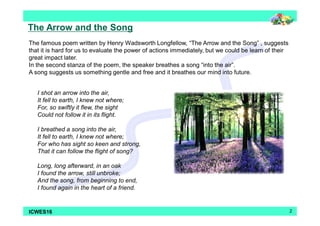
The Arrow and the Song 
The famous poem written by Henry Wadsworth Longfellow, “The Arrow and the Song” , suggests 
that it is hard for us to evaluate the power of actions immediately, but we could be learn of their 
great impact later. 
In the second stanza of the poem, the speaker breathes a song “into the air”. 
A song suggests us something gentle and free and it breathes our mind into future. 
I shot an arrow into the air, 
It fell to earth, I knew not where; 
For, so swiftly it flew, the sight 
Could not follow it in its flight. 
I breathed a song into the air, 
It fell to earth, I knew not where; 
For who has sight so keen and strong, 
That it can follow the flight of song? 
Long, long afterward, in an oak 
I found the arrow, still unbroke; 
And the song, from beginning to end, 
I found again in the heart of a friend. 
ICWES16 2
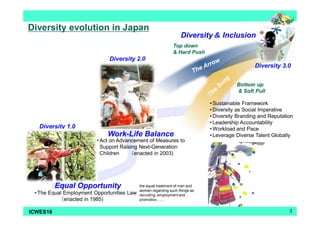
Diversity evolution in Japan 
Diversity 2.0 
Diversity& Inclusion 
Top down 
& Hard Push 
Work-Life Balance 
• Act on Advancement of Measures to 
Support Raising Next-Generation 
Children (enacted in 2003) 
the equal treatment of men and 
women regarding such things as 
recruiting, employment and 
promotion, ….. 
Diversity 1.0 
Diversity 3.0 
Bottom up 
& Soft Pull 
Equal Opportunity 
• The Equal Employment Opportunities Law 
(enacted in 1985) 
• Sustainable Framework 
• Diversity as Social Imperative 
• Diversity Branding and Reputation 
• Leadership Accountability 
• Workload and Pace 
• Leverage Diverse Talent Globally 
ICWES16 3
The third arrow 
Since 2013 
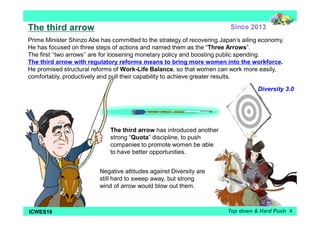
Prime Minister Shinzo Abe has committed to the strategy of recovering Japan’s ailing economy. 
He has focused on three steps of actions and named them as the “Three Arrows”. 
The first ‘‘two arrows’’ are for loosening monetary policy and boosting public spending. 
The third arrow with regulatory reforms means to bring more women into the workforce. 
He promised structural reforms of Work-Life Balance, so that women can work more easily, 
comfortably, productively and pull their capability to achieve greater results. 
Diversity 3.0 
The third arrow has introduced another 
strong “Quota” discipline, to push 
companies to promote women be able 
to have better opportunities. 
Top down & Hard Push 
Negative attitudes against Diversity are 
still hard to sweep away, but strong 
wind of arrow would blow out them. 
ICWES16 4
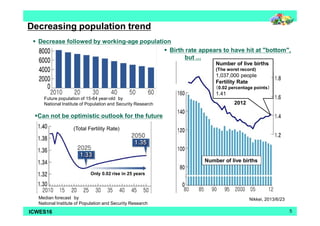
Decreasing population trend 
 Decrease followed by working-age population 
Future population of 15-64 year-old by 
National Institute of Population and Security Research 
Can not be optimistic outlook for the future 
 Birth rate appears to have hit at "bottom", 
but ... 
Number of live births 
(The worst record) 
1,037,000 people 
Fertility Rate 
(0.02 percentage points) 
1.41 
2012 
Number of live births 
(Total Fertility Rate) 
Only 0.02 rise in 25 years 
Median forecast by 
National Institute of Population and Security Research 
Nikkei, 2013/6/23 
ICWES16 5
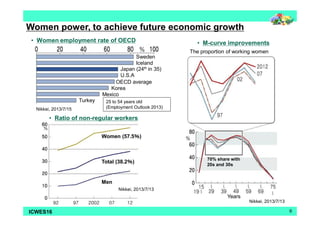
Women power, to achieve future economic growth 
• Women employment rate of OECD 
countries 
Nikkei, 2013/7/15 
Sweden 
Iceland 
Japan (24th in 35) 
U.S.A 
OECD average 
Korea 
Mexico 
Turkey 25 to 54 years old 
(Employment Outlook 2013) 
• Ratio of non-regular workers 
Women (57.5%) 
Total (38.2%) 
Men 
• M-curve improvements 
The proportion of working women 
70% share with 
20s and 30s 
Years 
Nikkei, 2013/7/13 
Nikkei, 2013/7/13 
ICWES16 6
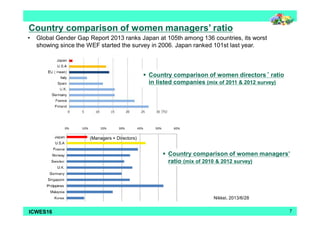
Country comparison of women managers’ ratio 
• Global Gender Gap Report 2013 ranks Japan at 105th among 136 countries, its worst 
showing since the WEF started the survey in 2006. Japan ranked 101st last year. 
(Managers + Directors) 
 Country comparison of women directors‘ ratio 
in listed companies (mix of 2011 & 2012 survey) 
 Country comparison of women managers’ 
ratio (mix of 2010 & 2012 survey) 
Nikkei, 2013/6/28 
ICWES16 7
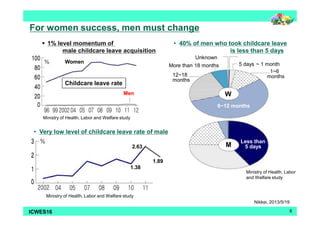
For women success, men must change 
 1% level momentum of 
male childcare leave acquisition 
Women 
Men 
Childcare leave rate 
Ministry of Health, Labor and Welfare study 
• Very low level of childcare leave rate of male 
2.63 
1.38 
Ministry of Health, Labor and Welfare study 
1.89 
• 40% of men who took childcare leave 
Unknown 
More than 18 months 
12~18 
months 
is less than 5 days 
5 days ~ 1 month 
1~6 
months 
W 
6~12 months 
Less than 
5 days 
M 
Ministry of Health, Labor 
and Welfare study 
Nikkei, 2013/5/19 
ICWES16 8
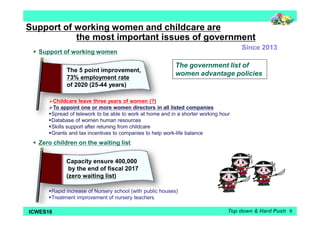
Support of working women and childcare are 
the most important issues of government 
Since 2013 
The government list of 
women advantage policies 
 Support of working women 
The 5 point improvement, 
73% employment rate 
of 2020 (25-44 years) 
Childcare leave three years of women (?) 
To appoint one or more women directors in all listed companies 
Spread of telework to be able to work at home and in a shorter working hour 
Database of women human resources 
Skills support after retuning from childcare 
Grants and tax incentives to companies to help work-life balance 
 Zero children on the waiting list 
Capacity ensure 400,000 
by the end of fiscal 2017 
(zero waiting list) 
Rapid increase of Nursery school (with public houses) 
Treatment improvement of nursery teachers 
Top down & Hard Push 
ICWES16 9
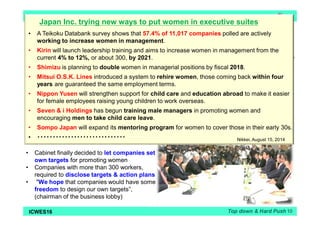
Japan Inc. trying new ways to put women in executive suites 
“Creating a society where all women can shine" 
Since 2014 • A Teikoku Databank survey shows that 57.4% of 11,017 companies polled are actively 
working to increase women in management. 
• Kirin will launch leadership training and aims to increase women in management from the 
current 4% to 12%, or about 300, by 2021. 
• Shimizu is planning to double women in managerial positions by fiscal 2018. 
• Mitsui O.S.K. Lines introduced a system to rehire women, those coming back within four 
years are guaranteed the same employment terms. 
• Nippon Yusen will strengthen support for child care and education abroad to make it easier 
for female employees raising young children to work overseas. 
• Seven & i Holdings has begun training male managers in promoting women and 
encouraging men to take child care leave. 
• Sompo Japan will expand its mentoring program for women to cover those in their early 30s. 
• ・・・・・・・・・・・・・・・・・・・・・・・・・・・・・ 
Trying to take the lead 
• In an effort, to reach the goal of having women 
in 30% of leadership positions by 2020. 
• Will seek to address the root causes of inhibitors, 
• Appointed 5 women to Cabinet posts, 
• Asked to business lobby to set a bar for its 
• Considering rewarding companies that actively 
in breaking Japan's glass ceiling 
including the difficulty of managing work and 
child care 
matching the record for the most female 
target of female division directors: 1% 
employ women with subsidies or extra points 
toward public works contracts. 
Nikkei, August 15, 2014 
Top down & Hard Push 
• Cabinet finally decided to let companies set 
own targets for promoting women 
• Companies with more than 300 workers, 
required to disclose targets & action plans 
• "We hope that companies would have some 
freedom to design our own targets”, 
(chairman of the business lobby) 
ICWES16 10
Songs into the air., support models for Life-Event 
 There must be commitment at all levels of society 
“As President Obama often says, “Change comes from the 
bottom up, not the top down.” ・・・・ 
Women need to reach out to each other, to ask for help from 
their husbands and partners, co-workers or other family members. 
We can demonstrate to managers that doing a good job need 
not mean staying until 9 o'clock at night. “. (U.S. Ambassador 
Caroline Kennedy told The Nikkei in an exclusive interview, 2014/9/1) 
 Women researchers support model development, “support of Life-Event” 
The "Life-Event" intended for public universities and research institutes to develop own models. 
1) Establishment of support systems of research activities 
2) Improvement of research environment 
3) Promotion of awareness 
4) Promotion of positive action 
5) Development of the next generation women 
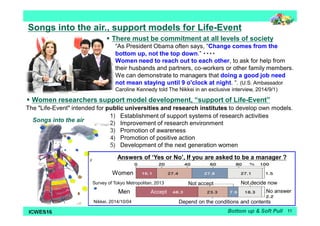
Answers of ‘Yes or No’, If you are asked to be a manager ? 
Not accept Not decide now 
No answer 
Depend on the conditions and contents 
Bottom up & Soft Pull 
Women 
Survey of Tokyo Metropolitan, 2013 
Men Accept 
Nikkei, 2014/10/04 
Songs into the air 
ICWES16 11
A. Development of support models for women researchers 
Positive actions of women researchers 
• Program: 2006 ~ 2010 (science, technology, engineering, math, and medicine) 
• 2006:10 institutions, 2007:10, 2008:13, 2009:12, 2010:10 
in the applicable institutions 
A 
B. Rapid increase of women researchers and leaders 
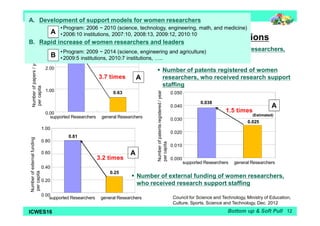
 Number of papers presented of women researchers, 
• Program: 2009 ~ 2014 (science, engineering and agriculture) 
• 2009:5 institutions, 2010:7 institutions, ….. 
2.31 who received research support staffing 
3.7 times 
0.63 
3.00 
B 
2.00 
1.00 
0.00 
A 
supported Researchers general Researchers 
Number of papers / year 
per capita 
1.00 
0.80 
0.60 
0.40 
0.20 
0.00 
Number of external funding 
per capita 
3.2 times 
0.81 
0.25 
 Number of patents registered of women 
researchers, who received research support 
staffing 
1.5 times 
A 
(Estimated) 
0.025 
0.038 
0.050 
0.040 
0.030 
0.020 
0.010 
0.000 
Number of patents registered / year 
per capita 
supported Researchers general Researchers 
A 
 Number of external funding of women researchers, 
who received research support staffing 
Council for Science and Technology, Ministry of Education, 
Culture, Sports, Science and Technology, Dec. 2012 
Bottom up & Soft Pull 
supported Researchers general Researchers 
ICWES16 12
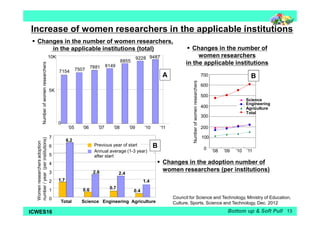
Increase of women researchers in the applicable institutions 
 Changes in the number of women researchers, 
in the applicable institutions (total) 
Number of women researchers 
10K 9487 
7154 7507 7881 8149 
8855 9228 
5K 
0 
A 
‘05 ’06 ’07 ’08 ’09 ’10 ‘11 
B 
 Changes in the number of 
in the applicable institutions 
Number of women researchers 
women researchers 
B 
Science 
Agriculture 
Total 
理学工 
学農学 
理工農 
700 
600 
500 
400 
300 
200 
100 
0 
Engineering 
’08 ’09 ’10 ’11 
 Changes in the adoption number of 
women researchers (per institutions) 
Council for Science and Technology, Ministry of Education, 
Culture, Sports, Science and Technology, Dec. 2012 
Bottom up & Soft Pull 
1.7 
Previous year of start 
Annual average (1-3 year) 
after start 
2.6 2.4 
0.6 0.7 0.4 
6.2 
1.4 
7 
6 
5 
4 
3 
2 
1 
0 
Total Science Engineering Agriculture 
Women researchers adoption 
number / year (per institutions) 
ICWES16 13
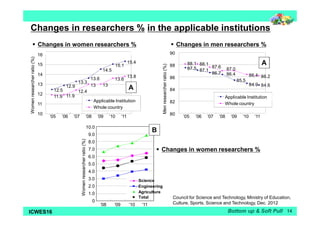
Changes in researchers % in the applicable institutions 
 Changes in men researchers % 
87.0 
86.4 
85.5 
A 
86.4 86.2 
84.9 84.6 
Applicable Institution 
Whole country 
’05 ’06 ’07 ’08 ’09 ’10 ‘11 
B 
 Changes in women researchers % 
Council for Science and Technology, Ministry of Education, 
Culture, Sports, Science and Technology, Dec. 2012 
Bottom up & Soft Pull 
 Changes in women researchers % 
12.5 
11.9 
12.9 
13.3 
13.6 
13 
14.5 
15.1 
15.4 
11.9 
12.4 
13 
13.6 13.8 
16 
15 
14 
13 
12 
11 
10 
Women researcher ratio (%) 
A 
Applicable Institution 
Whole country 
’05 ’06 ’07 ’08 ’09 ’10 ‘11 
88.1 88.1 
87.5 87.1 
87.6 
86.7 
90 
88 
86 
84 
82 
80 
Men researcher ratio (%) 
10.0 
9.0 
8.0 
7.0 
6.0 
5.0 
4.0 
3.0 
2.0 
1.0 
Women researcher ratio (%) 
Science 
Agriculture 
Total 
•理学工学農学理工農 
Engineering 
0 
’08 ’09 ’10 ’11 
ICWES16 14
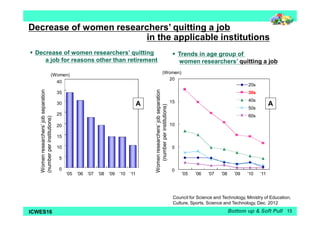
Decrease of women researchers’ quitting a job 
in the applicable institutions 
 Decrease of women researchers’ quitting 
a job for reasons other than retirement 
(Women) 
‘05 ’06 ’07 ’08 ’09 ’10 ‘11 
40 
35 
30 
25 
20 
15 
10 
5 
0 
Women researchers’ job separation 
(number per institutions) 
 Trends in age group of 
women researchers’ quitting a job 
20s 
30s 
40s 
50s 
60s 
(Women) 
20 
A 15 
A 
10 
5 
0 
‘05 ’06 ’07 ’08 ’09 ’10 ‘11 
Women researchers’ job separation 
(number per institutions) 
Council for Science and Technology, Ministry of Education, 
Culture, Sports, Science and Technology, Dec. 2012 
Bottom up & Soft Pull 
ICWES16 15
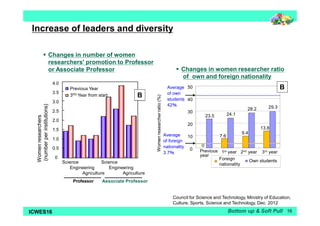
Increase of leaders and diversity 
 Changes in number of women 
researchers' promotion to Professor 
or Associate Professor 
Previous Year 
3RD Year from start 
4.0 
3.5 
3.0 
2.5 
2.0 
1.5 
1.0 
0.5 
0 
Science 
Engineering 
Science 
Agriculture 
Engineering 
B 
Agriculture 
Professor Associate Professor 
(number per institutions) 
Women researchers 
 Changes in women researcher ratio 
of own and foreign nationality 
0 
23.5 24.1 
7.6 
28.2 29.3 
9.4 
13.8 
50 
40 
30 
20 
10 
0 
Previous 3rd year 
year 
1st year 2nd year 
Foreign 
nationality 
Own students 
Average 
of own 
students 
42% 
Average 
of foreign 
nationality 
3.7% 
Women researcher ratio (%) 
B 
Council for Science and Technology, Ministry of Education, 
Culture, Sports, Science and Technology, Dec. 2012 
ICWES16 Bottom up & Soft Pull 16
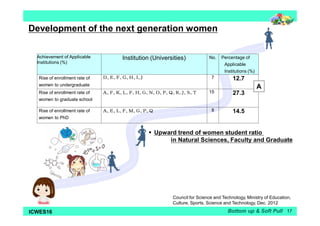
Development of the next generation women 
Achievement of Applicable 
Institutions (%) 
Institution (Universities) No. Percentage of 
Applicable 
Institutions (%) 
Rise of enrollment rate of 
women to undergraduate 
D、E、F、G、H、I、J 7 12.7 
Rise of enrollment rate of 
women to graduate school 
A、F、K、L、F、H、G、N、O、P、Q、R、J、S、T 15 27.3 
Rise of enrollment rate of 
women to PhD 
A、E、L、F、M、G、P、Q 8 14.5 
A 
 Upward trend of women student ratio 
in Natural Sciences, Faculty and Graduate 
Council for Science and Technology, Ministry of Education, 
Culture, Sports, Science and Technology, Dec. 2012 
Bottom up & Soft Pull 
ICWES16 17
TThhaannkk YYoouu !! 
ICWES16 18

The Arrow and The Song, of Diversity in Japan

  • 1.
    No.0328-001243 ICWES16, October24 at Los Angels, USA The Arrow and The Song, of Diversity in Japan Kayoko Sugahara INWES Board Member and INWES Japan President, APNN Chair Visiting Professor of Tokyo University of Agriculture and Technology Japan Aerospace Exploration Agency(JAXA) Gender Equality Office, Advisor Former IBM Distinguished Engineer and Member of IBM Academy of Technology
  • 2.
    The Arrow andthe Song The famous poem written by Henry Wadsworth Longfellow, “The Arrow and the Song” , suggests that it is hard for us to evaluate the power of actions immediately, but we could be learn of their great impact later. In the second stanza of the poem, the speaker breathes a song “into the air”. A song suggests us something gentle and free and it breathes our mind into future. I shot an arrow into the air, It fell to earth, I knew not where; For, so swiftly it flew, the sight Could not follow it in its flight. I breathed a song into the air, It fell to earth, I knew not where; For who has sight so keen and strong, That it can follow the flight of song? Long, long afterward, in an oak I found the arrow, still unbroke; And the song, from beginning to end, I found again in the heart of a friend. ICWES16 2
  • 3.
    Diversity evolution inJapan Diversity 2.0 Diversity& Inclusion Top down & Hard Push Work-Life Balance • Act on Advancement of Measures to Support Raising Next-Generation Children (enacted in 2003) the equal treatment of men and women regarding such things as recruiting, employment and promotion, ….. Diversity 1.0 Diversity 3.0 Bottom up & Soft Pull Equal Opportunity • The Equal Employment Opportunities Law (enacted in 1985) • Sustainable Framework • Diversity as Social Imperative • Diversity Branding and Reputation • Leadership Accountability • Workload and Pace • Leverage Diverse Talent Globally ICWES16 3
  • 4.
    The third arrow Since 2013 Prime Minister Shinzo Abe has committed to the strategy of recovering Japan’s ailing economy. He has focused on three steps of actions and named them as the “Three Arrows”. The first ‘‘two arrows’’ are for loosening monetary policy and boosting public spending. The third arrow with regulatory reforms means to bring more women into the workforce. He promised structural reforms of Work-Life Balance, so that women can work more easily, comfortably, productively and pull their capability to achieve greater results. Diversity 3.0 The third arrow has introduced another strong “Quota” discipline, to push companies to promote women be able to have better opportunities. Top down & Hard Push Negative attitudes against Diversity are still hard to sweep away, but strong wind of arrow would blow out them. ICWES16 4
  • 5.
    Decreasing population trend  Decrease followed by working-age population Future population of 15-64 year-old by National Institute of Population and Security Research Can not be optimistic outlook for the future  Birth rate appears to have hit at "bottom", but ... Number of live births (The worst record) 1,037,000 people Fertility Rate (0.02 percentage points) 1.41 2012 Number of live births (Total Fertility Rate) Only 0.02 rise in 25 years Median forecast by National Institute of Population and Security Research Nikkei, 2013/6/23 ICWES16 5
  • 6.
    Women power, toachieve future economic growth • Women employment rate of OECD countries Nikkei, 2013/7/15 Sweden Iceland Japan (24th in 35) U.S.A OECD average Korea Mexico Turkey 25 to 54 years old (Employment Outlook 2013) • Ratio of non-regular workers Women (57.5%) Total (38.2%) Men • M-curve improvements The proportion of working women 70% share with 20s and 30s Years Nikkei, 2013/7/13 Nikkei, 2013/7/13 ICWES16 6
  • 7.
    Country comparison ofwomen managers’ ratio • Global Gender Gap Report 2013 ranks Japan at 105th among 136 countries, its worst showing since the WEF started the survey in 2006. Japan ranked 101st last year. (Managers + Directors)  Country comparison of women directors‘ ratio in listed companies (mix of 2011 & 2012 survey)  Country comparison of women managers’ ratio (mix of 2010 & 2012 survey) Nikkei, 2013/6/28 ICWES16 7
  • 8.
    For women success,men must change  1% level momentum of male childcare leave acquisition Women Men Childcare leave rate Ministry of Health, Labor and Welfare study • Very low level of childcare leave rate of male 2.63 1.38 Ministry of Health, Labor and Welfare study 1.89 • 40% of men who took childcare leave Unknown More than 18 months 12~18 months is less than 5 days 5 days ~ 1 month 1~6 months W 6~12 months Less than 5 days M Ministry of Health, Labor and Welfare study Nikkei, 2013/5/19 ICWES16 8
  • 9.
    Support of workingwomen and childcare are the most important issues of government Since 2013 The government list of women advantage policies  Support of working women The 5 point improvement, 73% employment rate of 2020 (25-44 years) Childcare leave three years of women (?) To appoint one or more women directors in all listed companies Spread of telework to be able to work at home and in a shorter working hour Database of women human resources Skills support after retuning from childcare Grants and tax incentives to companies to help work-life balance  Zero children on the waiting list Capacity ensure 400,000 by the end of fiscal 2017 (zero waiting list) Rapid increase of Nursery school (with public houses) Treatment improvement of nursery teachers Top down & Hard Push ICWES16 9
  • 10.
    Japan Inc. tryingnew ways to put women in executive suites “Creating a society where all women can shine" Since 2014 • A Teikoku Databank survey shows that 57.4% of 11,017 companies polled are actively working to increase women in management. • Kirin will launch leadership training and aims to increase women in management from the current 4% to 12%, or about 300, by 2021. • Shimizu is planning to double women in managerial positions by fiscal 2018. • Mitsui O.S.K. Lines introduced a system to rehire women, those coming back within four years are guaranteed the same employment terms. • Nippon Yusen will strengthen support for child care and education abroad to make it easier for female employees raising young children to work overseas. • Seven & i Holdings has begun training male managers in promoting women and encouraging men to take child care leave. • Sompo Japan will expand its mentoring program for women to cover those in their early 30s. • ・・・・・・・・・・・・・・・・・・・・・・・・・・・・・ Trying to take the lead • In an effort, to reach the goal of having women in 30% of leadership positions by 2020. • Will seek to address the root causes of inhibitors, • Appointed 5 women to Cabinet posts, • Asked to business lobby to set a bar for its • Considering rewarding companies that actively in breaking Japan's glass ceiling including the difficulty of managing work and child care matching the record for the most female target of female division directors: 1% employ women with subsidies or extra points toward public works contracts. Nikkei, August 15, 2014 Top down & Hard Push • Cabinet finally decided to let companies set own targets for promoting women • Companies with more than 300 workers, required to disclose targets & action plans • "We hope that companies would have some freedom to design our own targets”, (chairman of the business lobby) ICWES16 10
  • 11.
    Songs into theair., support models for Life-Event  There must be commitment at all levels of society “As President Obama often says, “Change comes from the bottom up, not the top down.” ・・・・ Women need to reach out to each other, to ask for help from their husbands and partners, co-workers or other family members. We can demonstrate to managers that doing a good job need not mean staying until 9 o'clock at night. “. (U.S. Ambassador Caroline Kennedy told The Nikkei in an exclusive interview, 2014/9/1)  Women researchers support model development, “support of Life-Event” The "Life-Event" intended for public universities and research institutes to develop own models. 1) Establishment of support systems of research activities 2) Improvement of research environment 3) Promotion of awareness 4) Promotion of positive action 5) Development of the next generation women Answers of ‘Yes or No’, If you are asked to be a manager ? Not accept Not decide now No answer Depend on the conditions and contents Bottom up & Soft Pull Women Survey of Tokyo Metropolitan, 2013 Men Accept Nikkei, 2014/10/04 Songs into the air ICWES16 11
  • 12.
    A. Development ofsupport models for women researchers Positive actions of women researchers • Program: 2006 ~ 2010 (science, technology, engineering, math, and medicine) • 2006:10 institutions, 2007:10, 2008:13, 2009:12, 2010:10 in the applicable institutions A B. Rapid increase of women researchers and leaders  Number of papers presented of women researchers, • Program: 2009 ~ 2014 (science, engineering and agriculture) • 2009:5 institutions, 2010:7 institutions, ….. 2.31 who received research support staffing 3.7 times 0.63 3.00 B 2.00 1.00 0.00 A supported Researchers general Researchers Number of papers / year per capita 1.00 0.80 0.60 0.40 0.20 0.00 Number of external funding per capita 3.2 times 0.81 0.25  Number of patents registered of women researchers, who received research support staffing 1.5 times A (Estimated) 0.025 0.038 0.050 0.040 0.030 0.020 0.010 0.000 Number of patents registered / year per capita supported Researchers general Researchers A  Number of external funding of women researchers, who received research support staffing Council for Science and Technology, Ministry of Education, Culture, Sports, Science and Technology, Dec. 2012 Bottom up & Soft Pull supported Researchers general Researchers ICWES16 12
  • 13.
    Increase of womenresearchers in the applicable institutions  Changes in the number of women researchers, in the applicable institutions (total) Number of women researchers 10K 9487 7154 7507 7881 8149 8855 9228 5K 0 A ‘05 ’06 ’07 ’08 ’09 ’10 ‘11 B  Changes in the number of in the applicable institutions Number of women researchers women researchers B Science Agriculture Total 理学工 学農学 理工農 700 600 500 400 300 200 100 0 Engineering ’08 ’09 ’10 ’11  Changes in the adoption number of women researchers (per institutions) Council for Science and Technology, Ministry of Education, Culture, Sports, Science and Technology, Dec. 2012 Bottom up & Soft Pull 1.7 Previous year of start Annual average (1-3 year) after start 2.6 2.4 0.6 0.7 0.4 6.2 1.4 7 6 5 4 3 2 1 0 Total Science Engineering Agriculture Women researchers adoption number / year (per institutions) ICWES16 13
  • 14.
    Changes in researchers% in the applicable institutions  Changes in men researchers % 87.0 86.4 85.5 A 86.4 86.2 84.9 84.6 Applicable Institution Whole country ’05 ’06 ’07 ’08 ’09 ’10 ‘11 B  Changes in women researchers % Council for Science and Technology, Ministry of Education, Culture, Sports, Science and Technology, Dec. 2012 Bottom up & Soft Pull  Changes in women researchers % 12.5 11.9 12.9 13.3 13.6 13 14.5 15.1 15.4 11.9 12.4 13 13.6 13.8 16 15 14 13 12 11 10 Women researcher ratio (%) A Applicable Institution Whole country ’05 ’06 ’07 ’08 ’09 ’10 ‘11 88.1 88.1 87.5 87.1 87.6 86.7 90 88 86 84 82 80 Men researcher ratio (%) 10.0 9.0 8.0 7.0 6.0 5.0 4.0 3.0 2.0 1.0 Women researcher ratio (%) Science Agriculture Total •理学工学農学理工農 Engineering 0 ’08 ’09 ’10 ’11 ICWES16 14
  • 15.
    Decrease of womenresearchers’ quitting a job in the applicable institutions  Decrease of women researchers’ quitting a job for reasons other than retirement (Women) ‘05 ’06 ’07 ’08 ’09 ’10 ‘11 40 35 30 25 20 15 10 5 0 Women researchers’ job separation (number per institutions)  Trends in age group of women researchers’ quitting a job 20s 30s 40s 50s 60s (Women) 20 A 15 A 10 5 0 ‘05 ’06 ’07 ’08 ’09 ’10 ‘11 Women researchers’ job separation (number per institutions) Council for Science and Technology, Ministry of Education, Culture, Sports, Science and Technology, Dec. 2012 Bottom up & Soft Pull ICWES16 15
  • 16.
    Increase of leadersand diversity  Changes in number of women researchers' promotion to Professor or Associate Professor Previous Year 3RD Year from start 4.0 3.5 3.0 2.5 2.0 1.5 1.0 0.5 0 Science Engineering Science Agriculture Engineering B Agriculture Professor Associate Professor (number per institutions) Women researchers  Changes in women researcher ratio of own and foreign nationality 0 23.5 24.1 7.6 28.2 29.3 9.4 13.8 50 40 30 20 10 0 Previous 3rd year year 1st year 2nd year Foreign nationality Own students Average of own students 42% Average of foreign nationality 3.7% Women researcher ratio (%) B Council for Science and Technology, Ministry of Education, Culture, Sports, Science and Technology, Dec. 2012 ICWES16 Bottom up & Soft Pull 16
  • 17.
    Development of thenext generation women Achievement of Applicable Institutions (%) Institution (Universities) No. Percentage of Applicable Institutions (%) Rise of enrollment rate of women to undergraduate D、E、F、G、H、I、J 7 12.7 Rise of enrollment rate of women to graduate school A、F、K、L、F、H、G、N、O、P、Q、R、J、S、T 15 27.3 Rise of enrollment rate of women to PhD A、E、L、F、M、G、P、Q 8 14.5 A  Upward trend of women student ratio in Natural Sciences, Faculty and Graduate Council for Science and Technology, Ministry of Education, Culture, Sports, Science and Technology, Dec. 2012 Bottom up & Soft Pull ICWES16 17
  • 18.