The appositive
Using noun phrases
to rename a previous noun
Definition of the appositive
“An appositive is a noun that follows another noun and refers to the same thing. For example,
in the sentence “The car, a new Porsche, ran out of gas,” the words car and Porsche refer to
the same thing. The second noun (Porsche) is usually more specific and designated as the
appositive. Having a second noun often allows the writer to add more detail and emotion.”
from Harry Noden, Image Grammar: Teaching Grammar as Part of the
Writing Process
Look at this sentence
E. B White, Stuart Little
Nobody was around but Snowball, the white cat belonging to Mrs Little.
Main part of the sentence Appositive phrase - renames
the noun Snowball
An appositive often begins with the words a, an or the
Write a short simple sentence
For this sentence you might write:
The lion snarled a growled a warning.
The lion bared its teeth.
This file is licensed under the Creative Commons Attribution-Share Alike
3.0 Unported https://commons.wikimedia.org/wiki/File:Snarling_lion.jpg
Write a short simple sentence
Now think of labels for the main noun
(lion) you wish to zoom in on.
The lion snarled and growled a warning.
The lion bared its teeth.
- the king of the plains
- the apex predator
- a merciless hunter
Look for a noun that fits the
characterisation of the animal.
This file is licensed under the Creative Commons Attribution-Share Alike
3.0 Unported https://commons.wikimedia.org/wiki/File:Snarling_lion.jpg
Write a short simple sentence
Add your appositive to your sentence.
The lion, the king of the plains, snarled
and growled a warning.
The lion, a merciless hunter, bared its
teeth.
- the king of the plains
- the apex predator
- a merciless hunter
This file is licensed under the Creative Commons Attribution-Share Alike
3.0 Unported https://commons.wikimedia.org/wiki/File:Snarling_lion.jpg
Let’s practice
Let’s practice identifying the appositive. Look at each example, discuss with a partner and
then share your answer.
1. Cotton, the kitten, went up the tree but could not come down.
2. Every year Harry was left behind with Mrs Figg, a mad old lady who lived two streets
away.
3. The Trunchbull, this mighty female giant, stood there in her green breeches, quivering
like a blancmange
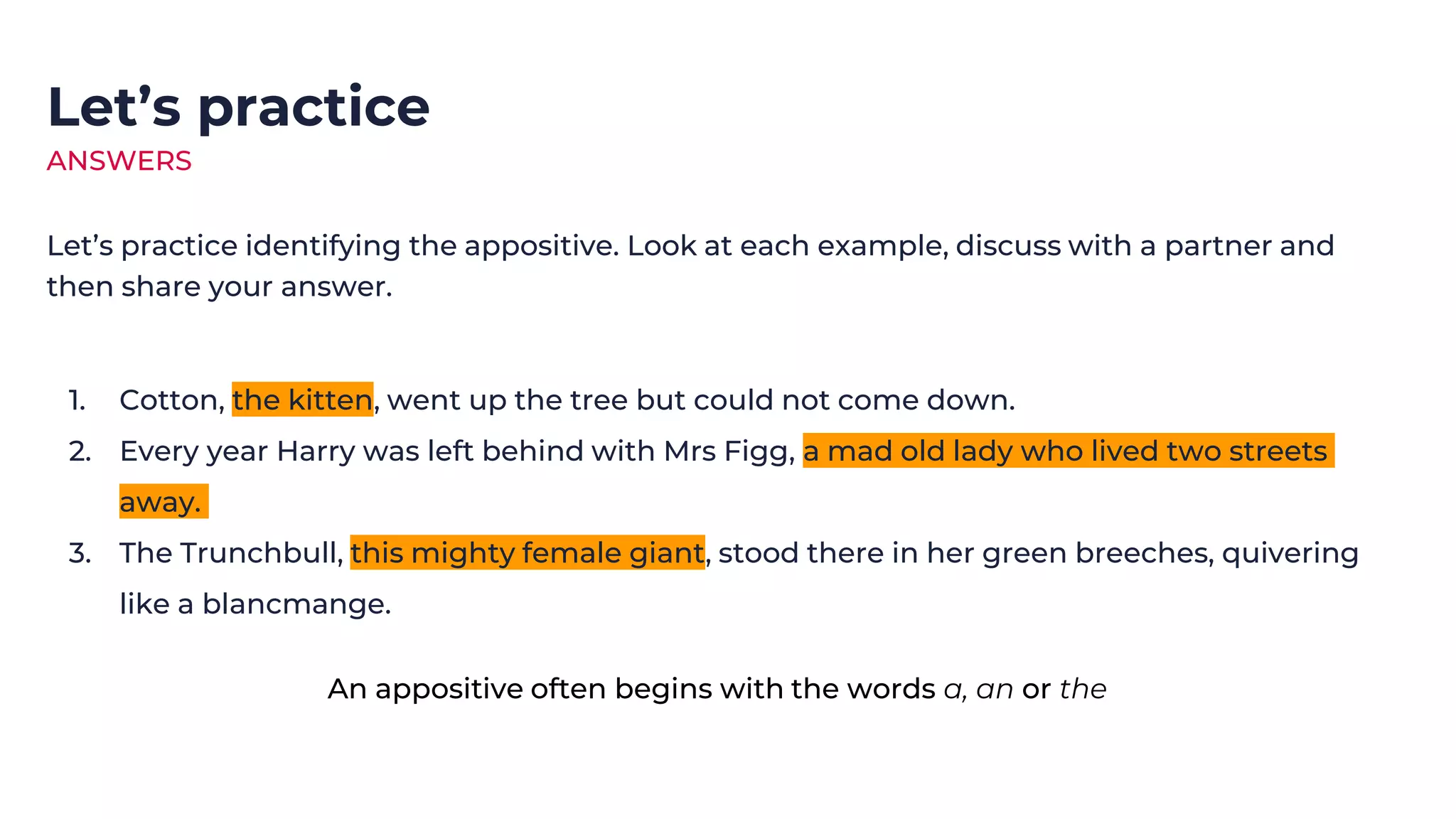
Let’s practice
ANSWERS
Let’s practice identifying the appositive. Look at each example, discuss with a partner and
then share your answer.
1. Cotton, the kitten, went up the tree but could not come down.
2. Every year Harry was left behind with Mrs Figg, a mad old lady who lived two streets
away.
3. The Trunchbull, this mighty female giant, stood there in her green breeches, quivering
like a blancmange.
An appositive often begins with the words a, an or the
Your turn
Write a simple sentence for each of the following images, then identify the main noun and
add an appositive phrase.
Imitate
Sentence models from books
Imitate the following sentences. The appositive is underlined. When you
have finished, share your imitations with the class.
1. Fudge, a portly little man in a long pin striped cloak, looked cold and
exhausted. [Harry Potter and the
Prisoner of Azkaban]
2. Professor Severus Snape, master of this school, commands you to
yield the information you conceal!
3. It was a runt, a piglet born far smaller and weaker than its siblings
Extension
Extension
Appositives can occur at the beginning of a sentence (opener):
The guidepost of her ancestors, the North Star would soon be visible and point the way the birds had gone.
between a subject and a verb (interrupter)
Cotton, the kitten, went up the tree but could not come down
or at the end of a sentence (closer)
Nobody was around but Snowball, the white cat belonging to Mrs Little.
Suggested activities: Review a piece of writing and use each position - opener, interrupter, closer
Extension
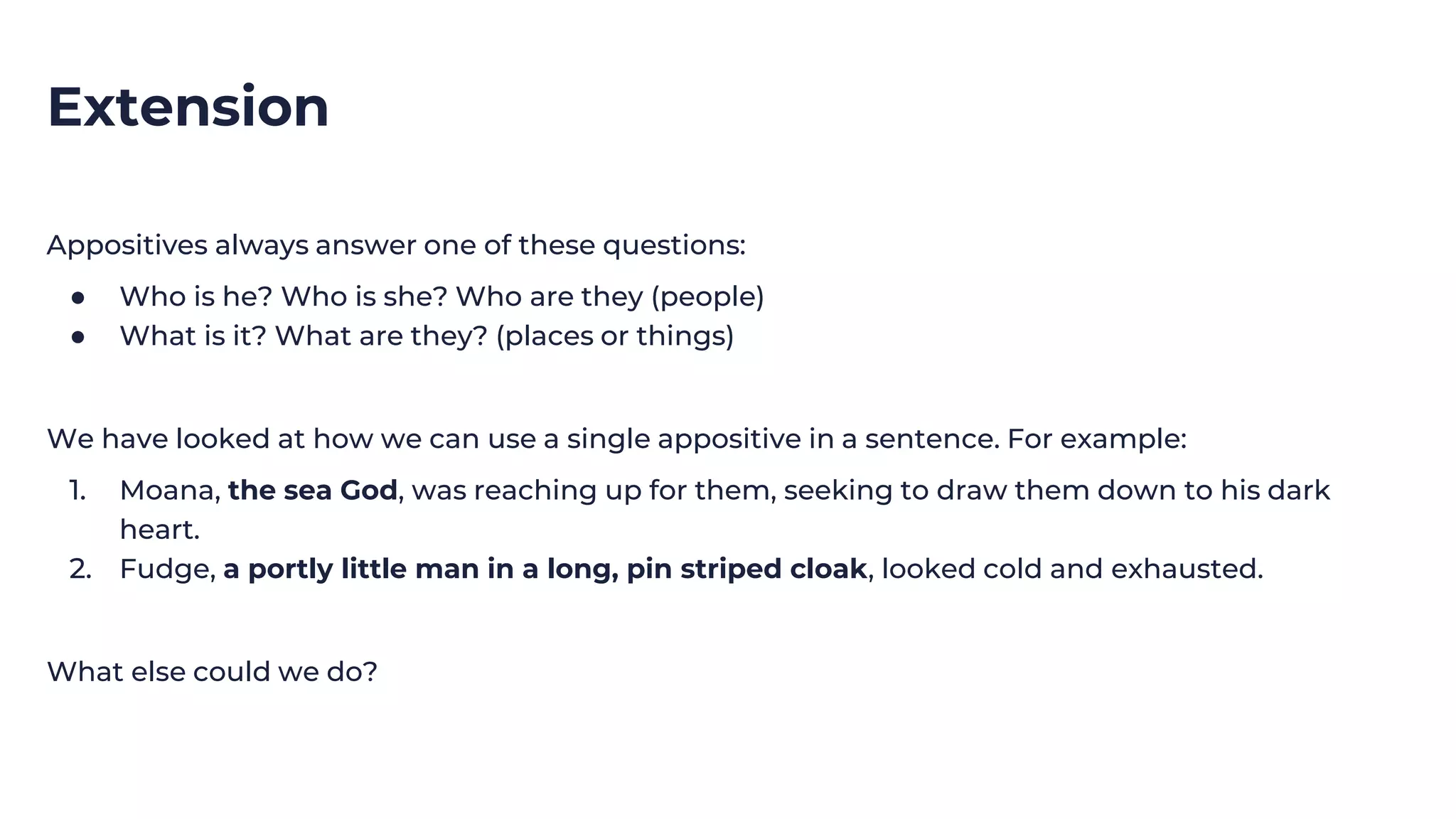
Appositives always answer one of these questions:
● Who is he? Who is she? Who are they (people)
● What is it? What are they? (places or things)
We have looked at how we can use a single appositive in a sentence. For example:
1. Moana, the sea God, was reaching up for them, seeking to draw them down to his dark
heart.
2. Fudge, a portly little man in a long, pin striped cloak, looked cold and exhausted.
What else could we do?
Extension
Using multiple appositives
You can rename the noun more than once.
For example:
1. What I wasn’t used to was having his smell back, the smoke from his Camel cigarettes, the
shoe polish he used on his boots.
The two appositives rename with greater specificity the smell. It is:
1. the smoke from his cigarettes
2. the show polish he used on his boots.
Extension
Using multiple appositives
A series of appositives is often identified by the word all
1. He tried to use the flagging power of his memory to recreate meals, and managed brief, tantalizing fragments:
banquets with huge roasted meats; birthday parties with thick frosted cakes; and lush fruits picked and eaten, sun
warmed and dripping from trees.
2. Adults, shops, magazines, newspapers, window signs - all the world had agreed that a blue-eyed, yellow haired, pink
skinned doll was what every child treasured.
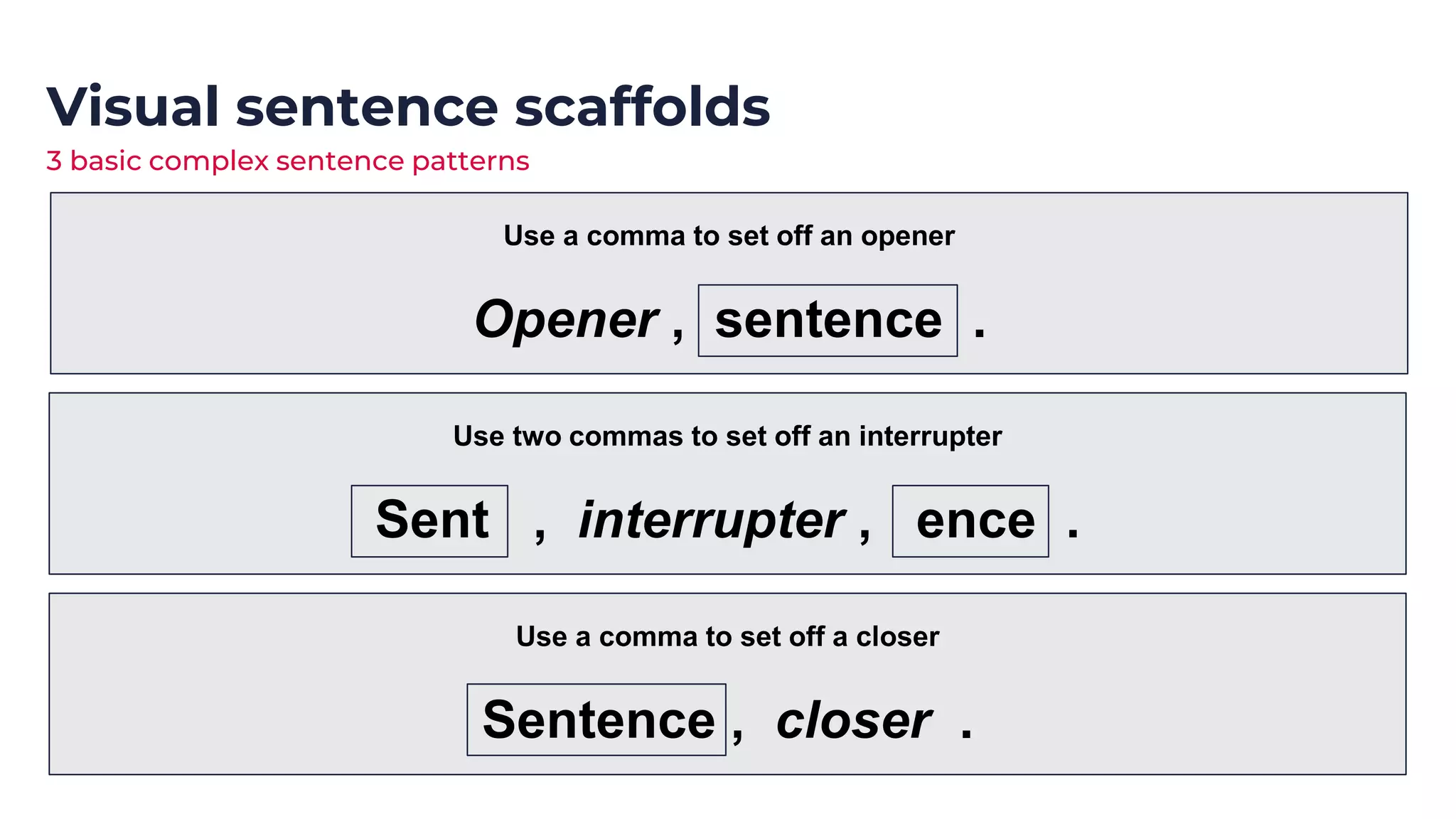
Visual sentence scaffolds
3 basic complex sentence patterns
Use a comma to set off an opener
Opener , sentence .
Use two commas to set off an interrupter
Sent , interrupter , ence .
Use a comma to set off a closer
Sentence , closer .

The appositive

  • 1.
    The appositive Using nounphrases to rename a previous noun
  • 2.
    Definition of theappositive “An appositive is a noun that follows another noun and refers to the same thing. For example, in the sentence “The car, a new Porsche, ran out of gas,” the words car and Porsche refer to the same thing. The second noun (Porsche) is usually more specific and designated as the appositive. Having a second noun often allows the writer to add more detail and emotion.” from Harry Noden, Image Grammar: Teaching Grammar as Part of the Writing Process
  • 3.
    Look at thissentence E. B White, Stuart Little Nobody was around but Snowball, the white cat belonging to Mrs Little. Main part of the sentence Appositive phrase - renames the noun Snowball An appositive often begins with the words a, an or the
  • 4.
    Write a shortsimple sentence For this sentence you might write: The lion snarled a growled a warning. The lion bared its teeth. This file is licensed under the Creative Commons Attribution-Share Alike 3.0 Unported https://commons.wikimedia.org/wiki/File:Snarling_lion.jpg
  • 5.
    Write a shortsimple sentence Now think of labels for the main noun (lion) you wish to zoom in on. The lion snarled and growled a warning. The lion bared its teeth. - the king of the plains - the apex predator - a merciless hunter Look for a noun that fits the characterisation of the animal. This file is licensed under the Creative Commons Attribution-Share Alike 3.0 Unported https://commons.wikimedia.org/wiki/File:Snarling_lion.jpg
  • 6.
    Write a shortsimple sentence Add your appositive to your sentence. The lion, the king of the plains, snarled and growled a warning. The lion, a merciless hunter, bared its teeth. - the king of the plains - the apex predator - a merciless hunter This file is licensed under the Creative Commons Attribution-Share Alike 3.0 Unported https://commons.wikimedia.org/wiki/File:Snarling_lion.jpg
  • 7.
    Let’s practice Let’s practiceidentifying the appositive. Look at each example, discuss with a partner and then share your answer. 1. Cotton, the kitten, went up the tree but could not come down. 2. Every year Harry was left behind with Mrs Figg, a mad old lady who lived two streets away. 3. The Trunchbull, this mighty female giant, stood there in her green breeches, quivering like a blancmange
  • 8.
    Let’s practice ANSWERS Let’s practiceidentifying the appositive. Look at each example, discuss with a partner and then share your answer. 1. Cotton, the kitten, went up the tree but could not come down. 2. Every year Harry was left behind with Mrs Figg, a mad old lady who lived two streets away. 3. The Trunchbull, this mighty female giant, stood there in her green breeches, quivering like a blancmange. An appositive often begins with the words a, an or the
  • 9.
    Your turn Write asimple sentence for each of the following images, then identify the main noun and add an appositive phrase.
  • 10.
    Imitate Sentence models frombooks Imitate the following sentences. The appositive is underlined. When you have finished, share your imitations with the class. 1. Fudge, a portly little man in a long pin striped cloak, looked cold and exhausted. [Harry Potter and the Prisoner of Azkaban] 2. Professor Severus Snape, master of this school, commands you to yield the information you conceal! 3. It was a runt, a piglet born far smaller and weaker than its siblings
  • 11.
  • 12.
    Extension Appositives can occurat the beginning of a sentence (opener): The guidepost of her ancestors, the North Star would soon be visible and point the way the birds had gone. between a subject and a verb (interrupter) Cotton, the kitten, went up the tree but could not come down or at the end of a sentence (closer) Nobody was around but Snowball, the white cat belonging to Mrs Little. Suggested activities: Review a piece of writing and use each position - opener, interrupter, closer
  • 13.
    Extension Appositives always answerone of these questions: ● Who is he? Who is she? Who are they (people) ● What is it? What are they? (places or things) We have looked at how we can use a single appositive in a sentence. For example: 1. Moana, the sea God, was reaching up for them, seeking to draw them down to his dark heart. 2. Fudge, a portly little man in a long, pin striped cloak, looked cold and exhausted. What else could we do?
  • 14.
    Extension Using multiple appositives Youcan rename the noun more than once. For example: 1. What I wasn’t used to was having his smell back, the smoke from his Camel cigarettes, the shoe polish he used on his boots. The two appositives rename with greater specificity the smell. It is: 1. the smoke from his cigarettes 2. the show polish he used on his boots.
  • 15.
    Extension Using multiple appositives Aseries of appositives is often identified by the word all 1. He tried to use the flagging power of his memory to recreate meals, and managed brief, tantalizing fragments: banquets with huge roasted meats; birthday parties with thick frosted cakes; and lush fruits picked and eaten, sun warmed and dripping from trees. 2. Adults, shops, magazines, newspapers, window signs - all the world had agreed that a blue-eyed, yellow haired, pink skinned doll was what every child treasured.
  • 16.
    Visual sentence scaffolds 3basic complex sentence patterns Use a comma to set off an opener Opener , sentence . Use two commas to set off an interrupter Sent , interrupter , ence . Use a comma to set off a closer Sentence , closer .