The Accountant and the Law
Cooper Levenson, Attorneys at Law
Randolph C. Lafferty, Esquire
Lindsay T. Byrne, Esquire
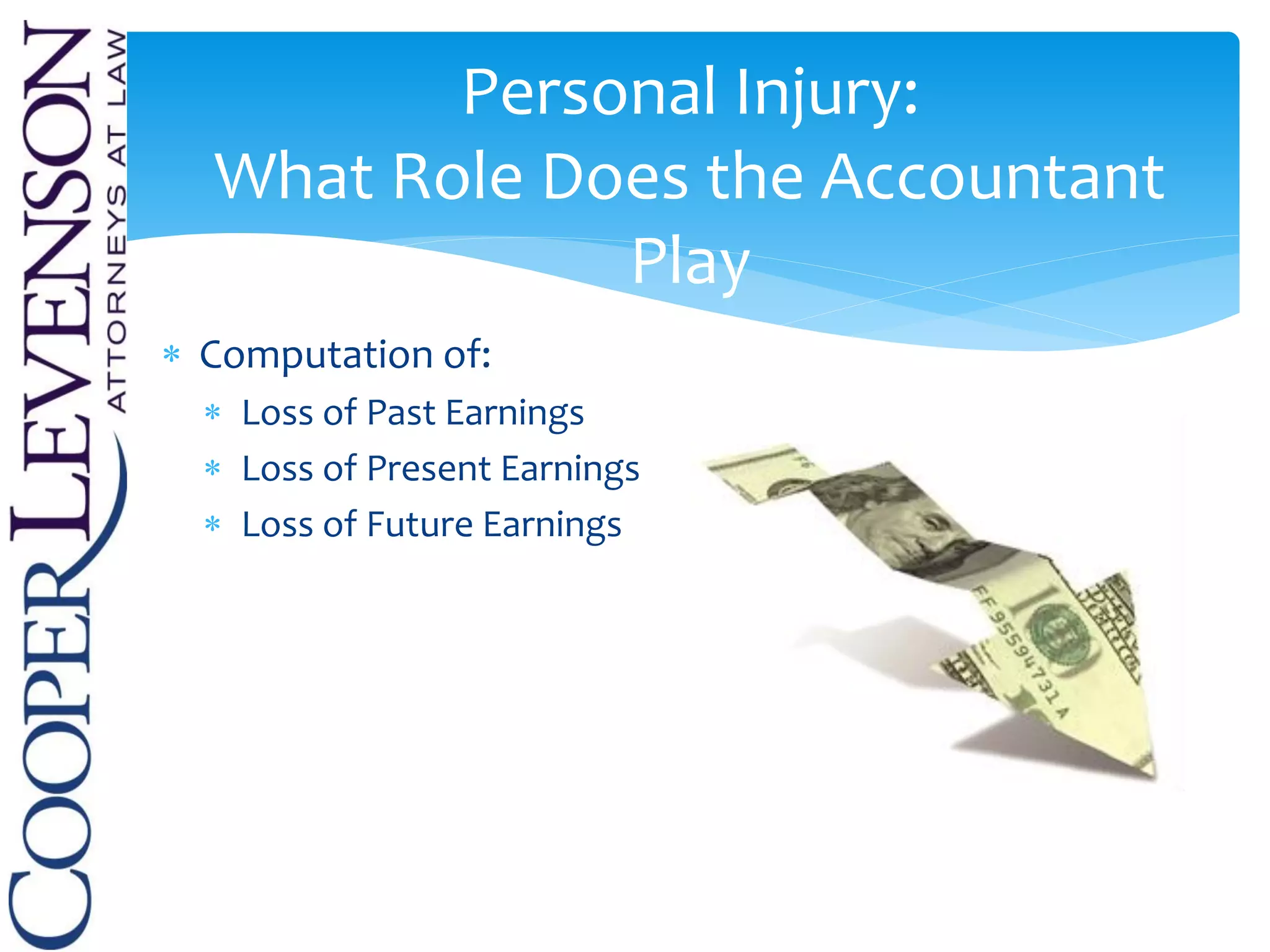
 Computation of:
 Loss of Past Earnings
 Loss of Present Earnings
 Loss of Future Earnings
Personal Injury:
What Role Does the Accountant
Play
 The trial attorney has two choices:
 Utilize the accountant to present gross amount of lost
wages and HOPE the jury understands the complex, four
page, jury charge on how to discount future losses to
present value; or
 Use a CPA to discount future losses to present value.
(Preferred Method)
Future Loss of Earnings
 Specialized and often overlooked cause of action!
 MILLIONS of dollars have been recovered utilizing this
recognized cause of action!
 Most attorneys are oblivious to this type of claim!
 Rarely utilized in New Jersey
Loss of a Key Employee
 New Jersey Rule: An employer is entitled
to damages against a third party for the
loss of services of a key employee injured
by that third party.
Loss of a Key Employee
 Inquire as to the character of the business
 Personal services?
 Personal relationships?
 Special attention?
 Is the value of services worth substantially more than the
cost of replacement?
How Can I Tell If My Client Has A
Key Employee?
 Injured employee has personal relationships
that have a value in the commercial world
recognized by “any business man”
 Special knowledge/skills not easily acquired by
others
 Employment based on personal attention,
characteristics, and/or labor
How Can I Tell If My Client Has A
Key Employee? (Cont’d)
 Lost profits are not dispositive
 Easier to prove with smaller businesses
 Must differentiate profits from personal
endeavors, skills, and attention versus
investment of capital and labor
How Can I Tell If My Client Has A
Key Employee? (Cont’d)
 Similar to New Jersey
 Loss of profits alone are not sufficient to state a
cause of action
 However, if lost profits are due to personal
management and endeavor, they are an
accurate measure of earning capacity and
losses
How Does Pennsylvania Handle the
Loss of a Key Employee?
 Employers cannot recover!
 Generally, you cannot bring suit for the loss you
suffer from another's death/injury unless the
third party owed a specific duty to the
employer.
Key Employee: National Trend
 Lost profits are not dispositive on their own.
 Woschenko rule and exception
 Attorneys and accountants must work closely
to be successful with this cause of action.
Helping Your Client to Prove They
Have (or Are) Key Employees
 Role of the accountant
 Extrapolate future lost profits
 Prior/current lost profits
 Costs of replacing the injured employee
 Tracing business income to injured
employee’s efforts
 Role of the attorney: Focus on factual inquiries
Loss of a Key Employee
Commercial, Criminal & Business
Litigation
 Comes into play with either anticipated or actual
business disputes
 Partner with an attorney in a myriad of circumstances
 Economic damages calculations whether suffered
through tort or breach of contract
 Post-acquisition disputes
 Earnouts
 Breaches of Warranties
Forensic Accounting
 Bankruptcy, insolvency, and reorganization
 Securities Fraud
 Tax Fraud
 Money Laundering
 Business Valuation
 Computer forensics/e-Discovery
Forensic Accounting (Cont’d)
 Trial attorney is presented with a small window
 Once the compensatory damage verdict is entered, the
jury determines punitive damages are warranted, now
what?
 Net worth and ability to pay suddenly become relevant!
Forensic Accounting in Punitive
Damages Litigation
• Judge orders the tax returns and financial
statements be produced and tells the parties to
be prepared to proceed tomorrow!
• The accountant is key: he/she analyzes the
financials overnight, testifies in the morning,
and explains to the jury, in a manner
understandable to the lay man, the financial
composition of a multi-tiered corporation.
Forensic Accounting in Punitive
Damages Litigation (Cont’d)
Accounting Consequences in
Litigation Recoveries
 General Rule: Monies received for personal injury,
including pain and suffering, are not taxable.
Internal Revenue Code, Section
104
Internal Revenue Code, Section
104 Exceptions
 Punitive Damages – Exempted by the Small Business
Job Protection Act of 1966
 Damages attributable to back pay, front pay, lost
earnings, and future loss of income are included as
gross income.
 Employment litigation claims generally taxable
 Section 104(a): “emotional distress shall not be treated as
a physical injury or physical sickness.”
Internal Revenue Code
Section 104 Exceptions
The Rodman Rule
 A settlement was reached in the amount of
$200,000.00
 Settlement agreement included a confidentiality clause
 A liquidated damages clause was included which
provided that if there was a material breach of the
Confidentiality Clause, Rodman would get his
$200,000.00 back
The Rodman Rule (Cont’d)
 The dispute between Amos and the IRS was over the
interpretation of IRC Section 104(a)(2) regarding the
interpretation of “physical injury”
 The Test: What was the dominant reason for the
settlement?
 Amos claimed the dominant reason was “physical
injury” and the IRS claimed it was confidentiality
The Rodman Rule (Cont’d)
 The Result: Apportionment by the Tax Court
 $120,000 for physical injury (non-taxable)
 $80,000 for the confidentiality clause (taxable)
The Rodman Rule (Cont’d)
 Do not agree to a confidentiality clause
 Make a specific allocation within the Settlement
Agreement
 Include reciprocal promises of confidentiality
 Include an indemnity provision that the settling party
must reimburse the recovering party for tax
consequences
 Seek a private IRS ruling in advance of the settlement
How to Avoid the Rodman Rule
 Burden is on the recipient of
damages/settlements for personal injury
to establish that they are nontaxable
The Burden of Proof
 The Test: Is the settlement compensatory rather than
purely economic in function
 Critical Factors
 Intent of the parties is controlling
 Is the payment on account of “personal physical injuries or
physical sickness”
 The parties, with the advice of their accountants
generate these documents
The Burden of Proof (Cont’d)
Generally Accepted Accounting Principles
(GAAP)
The Standard
Questions?
Thank You!

The Accountant & the Law rl-lb

  • 1.
    The Accountant andthe Law Cooper Levenson, Attorneys at Law Randolph C. Lafferty, Esquire Lindsay T. Byrne, Esquire
  • 2.
     Computation of: Loss of Past Earnings  Loss of Present Earnings  Loss of Future Earnings Personal Injury: What Role Does the Accountant Play
  • 3.
     The trialattorney has two choices:  Utilize the accountant to present gross amount of lost wages and HOPE the jury understands the complex, four page, jury charge on how to discount future losses to present value; or  Use a CPA to discount future losses to present value. (Preferred Method) Future Loss of Earnings
  • 5.
     Specialized andoften overlooked cause of action!  MILLIONS of dollars have been recovered utilizing this recognized cause of action!  Most attorneys are oblivious to this type of claim!  Rarely utilized in New Jersey Loss of a Key Employee
  • 6.
     New JerseyRule: An employer is entitled to damages against a third party for the loss of services of a key employee injured by that third party. Loss of a Key Employee
  • 7.
     Inquire asto the character of the business  Personal services?  Personal relationships?  Special attention?  Is the value of services worth substantially more than the cost of replacement? How Can I Tell If My Client Has A Key Employee?
  • 8.
     Injured employeehas personal relationships that have a value in the commercial world recognized by “any business man”  Special knowledge/skills not easily acquired by others  Employment based on personal attention, characteristics, and/or labor How Can I Tell If My Client Has A Key Employee? (Cont’d)
  • 9.
     Lost profitsare not dispositive  Easier to prove with smaller businesses  Must differentiate profits from personal endeavors, skills, and attention versus investment of capital and labor How Can I Tell If My Client Has A Key Employee? (Cont’d)
  • 10.
     Similar toNew Jersey  Loss of profits alone are not sufficient to state a cause of action  However, if lost profits are due to personal management and endeavor, they are an accurate measure of earning capacity and losses How Does Pennsylvania Handle the Loss of a Key Employee?
  • 11.
     Employers cannotrecover!  Generally, you cannot bring suit for the loss you suffer from another's death/injury unless the third party owed a specific duty to the employer. Key Employee: National Trend
  • 12.
     Lost profitsare not dispositive on their own.  Woschenko rule and exception  Attorneys and accountants must work closely to be successful with this cause of action. Helping Your Client to Prove They Have (or Are) Key Employees
  • 13.
     Role ofthe accountant  Extrapolate future lost profits  Prior/current lost profits  Costs of replacing the injured employee  Tracing business income to injured employee’s efforts  Role of the attorney: Focus on factual inquiries Loss of a Key Employee
  • 14.
    Commercial, Criminal &Business Litigation
  • 15.
     Comes intoplay with either anticipated or actual business disputes  Partner with an attorney in a myriad of circumstances  Economic damages calculations whether suffered through tort or breach of contract  Post-acquisition disputes  Earnouts  Breaches of Warranties Forensic Accounting
  • 16.
     Bankruptcy, insolvency,and reorganization  Securities Fraud  Tax Fraud  Money Laundering  Business Valuation  Computer forensics/e-Discovery Forensic Accounting (Cont’d)
  • 17.
     Trial attorneyis presented with a small window  Once the compensatory damage verdict is entered, the jury determines punitive damages are warranted, now what?  Net worth and ability to pay suddenly become relevant! Forensic Accounting in Punitive Damages Litigation
  • 18.
    • Judge ordersthe tax returns and financial statements be produced and tells the parties to be prepared to proceed tomorrow! • The accountant is key: he/she analyzes the financials overnight, testifies in the morning, and explains to the jury, in a manner understandable to the lay man, the financial composition of a multi-tiered corporation. Forensic Accounting in Punitive Damages Litigation (Cont’d)
  • 19.
  • 20.
     General Rule:Monies received for personal injury, including pain and suffering, are not taxable. Internal Revenue Code, Section 104
  • 21.
    Internal Revenue Code,Section 104 Exceptions
  • 22.
     Punitive Damages– Exempted by the Small Business Job Protection Act of 1966  Damages attributable to back pay, front pay, lost earnings, and future loss of income are included as gross income.  Employment litigation claims generally taxable  Section 104(a): “emotional distress shall not be treated as a physical injury or physical sickness.” Internal Revenue Code Section 104 Exceptions
  • 23.
  • 24.
     A settlementwas reached in the amount of $200,000.00  Settlement agreement included a confidentiality clause  A liquidated damages clause was included which provided that if there was a material breach of the Confidentiality Clause, Rodman would get his $200,000.00 back The Rodman Rule (Cont’d)
  • 25.
     The disputebetween Amos and the IRS was over the interpretation of IRC Section 104(a)(2) regarding the interpretation of “physical injury”  The Test: What was the dominant reason for the settlement?  Amos claimed the dominant reason was “physical injury” and the IRS claimed it was confidentiality The Rodman Rule (Cont’d)
  • 26.
     The Result:Apportionment by the Tax Court  $120,000 for physical injury (non-taxable)  $80,000 for the confidentiality clause (taxable) The Rodman Rule (Cont’d)
  • 27.
     Do notagree to a confidentiality clause  Make a specific allocation within the Settlement Agreement  Include reciprocal promises of confidentiality  Include an indemnity provision that the settling party must reimburse the recovering party for tax consequences  Seek a private IRS ruling in advance of the settlement How to Avoid the Rodman Rule
  • 28.
     Burden ison the recipient of damages/settlements for personal injury to establish that they are nontaxable The Burden of Proof
  • 29.
     The Test:Is the settlement compensatory rather than purely economic in function  Critical Factors  Intent of the parties is controlling  Is the payment on account of “personal physical injuries or physical sickness”  The parties, with the advice of their accountants generate these documents The Burden of Proof (Cont’d)
  • 30.
    Generally Accepted AccountingPrinciples (GAAP) The Standard
  • 31.
  • 32.