The ABLE Act
Disclaimer
  The following information is provided to our
members from the best resources/information
   we had available and for their benefit, but
 without warranty on the information provided
   herein. UAF encourages each everyone
viewing this information to learn examine other
publicly available resources and information. If
 you find anything within this document that is
 inaccurate or misleading, please email us at
       info@unitedangelsfoundation.org
The ABLE Account Act of 2009 H.R
        1205 and S.493

        Achieving a
        Better
        Life
        Experience
What is an ABLE
   Account?
Overview of ABLE Accounts
• An ABLE Account is an account established by or
  on behalf of an individual with a disability for the
  purpose of saving for life’s necessities, many of
  which Medicaid does not cover.
• The assets in an ABLE Account can only be used to pay
  for qualified expenses, such as
  education, housing, employment
  support, health, transportation, and other life necessities.
• The income earned on amounts contributed to an ABLE
  Account is tax exempt, so ABLE Accounts grow tax free.
• The assets held in an ABLE Account are not counted for
  purposes of determining the individual’s eligibility to
  qualify for Medicaid and Supplemental Security Income.
The Need for Able
    Accounts
Various Programs Encourage
         Americans to Save
• The federal government encourages Americans to
  save with a variety of tax-advantaged savings
  accounts.
  – Individual Retirement Accounts: including
    traditional, Roth, and nondeductible IRAs
  – Education Savings Accounts: Section 529 Qualified
    Tuition Plans, Coverdell Education Savings Accounts
  – Medical Savings Accounts: Archer Medical Savings
    Accounts, Health Savings Accounts
  – Employer Savings Accounts: 401(k) plans, SIMPLE
    401(k) plans, Thrift plans, charitable 403(b) plans,
    governmental 457 plans
Case Studies
• The following slides show how individuals
  with disabilities would benefit from ABLE
  Accounts.
Amy and Jack
What would YOU do with an ABLE
           Account?
• Amy and Jack are brother and sister. They live
  outside of Boston with their parents.
• When Amy was born, her parents opened a
  §529 account to save for her college education.
• Three years later, when Jack was born they
  opened a §529 account for him as well.
• Jack is eventually diagnosed with autism
  spectrum disorder. His disability requires
  intensive support at home and in the community.
What would YOU do with an ABLE
       Account? (cont.)
• How would Amy and Jack’s family utilize an
  ABLE Account?
  – Money that Jack’s parents have been saving in his §529 plan
    can be transferred to his ABLE account.
  – Because of the severity of his disability, Jack will need support
    for the remainder of his life. Funds set aside in the ABLE
    account will provide financial support to Jack for housing,
    transportation, general living expenses and medical care. Just
    like his sister Amy’s §529 plan, the growth on his ABLE account
    funds will not be taxed.
  – Jack’s sister Amy can go to college, live her life, enjoy her
    brother and not worry about being his sole source of private
    financial support after their parents are gone.
Aaron and Julia
What would YOU Do with an ABLE
           Account?
• Aaron and Julia both have down syndrome. Aaron is 37,
  and Julia is 35 years old. They are engaged.
• Aaron and Julia live in Santa Rosa, CA, in an apartment
  building for individuals with special needs.
• Aaron and Julia have worked in a variety of sheltered
  environments for individuals with special needs,
  including a local coffee shop, a recycling plant, and a
  workshop where they help assemble American flags.
• Medicaid/SSI provide Aaron and Julia with in home care
  support assistants who help them get to work, go to the
  doctor, cook and clean, and attend educational and
  social activities.
What would YOU do with an ABLE
        Account? (cont.)
• How would Aaron and Julia use the money in an ABLE
  Account? [Note: each state’s Medicaid program varies
  as to what expenses it covers.]
   – Go to the dentist. California’s Medicaid program covers one
     teeth cleaning a year, but dentists recommend getting two
     cleanings. CA Medicaid also doesn’t pay for dental crowns.
   – Join a health club. CA Medicaid doesn’t cover exercise or
     other preventative health programs.
   – Get a hearing aid. CA Medicaid doesn’t cover hearing aids for
     the partially hearing impaired.
   – Replace a pair of lost glasses. CA Medicaid’s vision benefits
     are very limited.
   – Go on a honeymoon. CA Medicaid/SSI does not allow
     individuals with disabilities to save enough money to take a
     vacation.
Technical
Specifications of
ABLE Accounts
ABLE Account Eligibility
• An ABLE Account may be established for or
  by any individual with a disability, including:
  – An individual who has received a determination
    that he or she is eligible to receive SSI or OASDI
    disability benefits due to blindness or disability
    under Titles XVI or II of the Social Security Act.
  – An individual who would be eligible under the
    above test, notwithstanding:
     • The fact that no determination has been made with
       respect to his or her eligibility to receive these benefits;
       and
     • The fact that the individual would otherwise fail the
       income and assets test or the substantial gainful activity
       test.
Establishing Eligibility
• Unlike the cumbersome process for establishing eligibility for
  SSI or OASDI disability benefits with the Social Security
  Administration, an ABLE Account would be established by
  filling out a tax form.
• The U.S. income tax is a self-enforcement system. Taxpayers
  routinely certify their income, deductions, credits and tax
  status under penalties of perjury.
    – For example, to obtain the disabled tax credit, taxpayers
       file Schedule 3 of the Form 1040-A and file a doctor’s
       certification. The same procedure could be used to
       establish an ABLE Account.
• To establish eligibility for an ABLE Account, the tax form would
  include a statement certified by a doctor that the individual
  has a disability at a level that would make him or her eligible
  under the SSI or OASDI disability programs notwithstanding
  the means tests or substantial gainful activity test.
Opening an ABLE Account
• An ABLE Account is a custodial account or trust created or
  organized in the United States whose beneficiary is an
  individual meeting the eligibility requirements.
   – Typically, ABLE Accounts would be custodial accounts held at
     national banks and would be as easy to open as an ordinary
     savings account.
       • A custodial account is a contract in which a bank agrees to hold and
         invest funds on behalf of a third party, such as a minor or individual with
         a disability. The custodian of a custodial account is authorized to make
         decisions about the account if the beneficiary of the account is unable
   – If the ABLE Account is a trust rather than a custodial account, the
     trustee can be a bank, a parent or guardian of the designated
     beneficiary, the beneficiary him- or herself (provided the
     beneficiary is capable of fulfilling that role), or a third-party
     appointed by the beneficiary (or his or her parents).
Qualified Expenses
• ―Qualified disability expenses‖ are any expenses that are
  made for the benefit of the beneficiary of the ABLE
  Account, to the extent provided under Treasury
  Regulations. Such expenses will include:
   – Education—including tuition for preschool thru post-
     secondary education, books, supplies, and educational
     materials related to such education, tutors, and special
     education services.
   – Housing—including rent, mortgage payments, home
     improvements and modifications, maintenance and
     repairs, real property taxes, and utility charges.
   – Employment Support—including expenses related to
     obtaining and maintaining employment, including job-related
     training, assistive technology, and personal assistance
     supports.
Qualified Expenses (cont.)
– Health—including premiums for health insurance, medical,
  vision, and dental expenses, habilitation and rehabilitation
  services, durable medical equipment, therapy, respite care,
  long term services and supports, and nutritional management.
– Transportation—including the use of mass transit, the
  purchase or modification of vehicles, and moving expenses.
– Other Life Necessities—including clothing, activities which
  are religious, cultural, or recreational, supplies and equipment
  for personal care, community-based supports, communication
  services and devices, adaptive equipment, assistive
  technology, personal assistance supports, financial
  management and administrative services, expenses for
  oversight, monitoring, or advocacy, funeral and burial
  expenses.
Contributions to ABLE Accounts
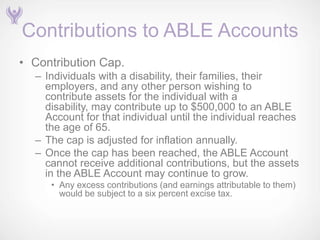
• Contribution Cap.
  – Individuals with a disability, their families, their
    employers, and any other person wishing to
    contribute assets for the individual with a
    disability, may contribute up to $500,000 to an ABLE
    Account for that individual until the individual reaches
    the age of 65.
  – The cap is adjusted for inflation annually.
  – Once the cap has been reached, the ABLE Account
    cannot receive additional contributions, but the assets
    in the ABLE Account may continue to grow.
     • Any excess contributions (and earnings attributable to them)
       would be subject to a six percent excise tax.
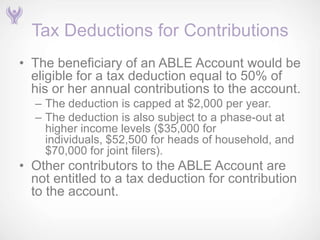
Tax Deductions for Contributions
• The beneficiary of an ABLE Account would be
  eligible for a tax deduction equal to 50% of
  his or her annual contributions to the account.
  – The deduction is capped at $2,000 per year.
  – The deduction is also subject to a phase-out at
    higher income levels ($35,000 for
    individuals, $52,500 for heads of household, and
    $70,000 for joint filers).
• Other contributors to the ABLE Account are
  not entitled to a tax deduction for contribution
  to the account.
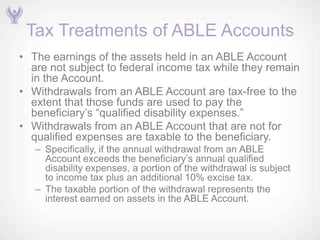
Tax Treatments of ABLE Accounts
• The earnings of the assets held in an ABLE Account
  are not subject to federal income tax while they remain
  in the Account.
• Withdrawals from an ABLE Account are tax-free to the
  extent that those funds are used to pay the
  beneficiary’s ―qualified disability expenses.‖
• Withdrawals from an ABLE Account that are not for
  qualified expenses are taxable to the beneficiary.
   – Specifically, if the annual withdrawal from an ABLE
     Account exceeds the beneficiary’s annual qualified
     disability expenses, a portion of the withdrawal is subject
     to income tax plus an additional 10% excise tax.
   – The taxable portion of the withdrawal represents the
     interest earned on assets in the ABLE Account.
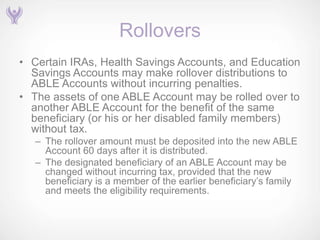
Rollovers
• Certain IRAs, Health Savings Accounts, and Education
  Savings Accounts may make rollover distributions to
  ABLE Accounts without incurring penalties.
• The assets of one ABLE Account may be rolled over to
  another ABLE Account for the benefit of the same
  beneficiary (or his or her disabled family members)
  without tax.
   – The rollover amount must be deposited into the new ABLE
     Account 60 days after it is distributed.
   – The designated beneficiary of an ABLE Account may be
     changed without incurring tax, provided that the new
     beneficiary is a member of the earlier beneficiary’s family
     and meets the eligibility requirements.
Gift Tax Treatment of Contributions
• A contribution made to an ABLE Account
  on behalf of a designated beneficiary is
  considered to be a completed gift, which is
  eligible for the annual gift tax exclusion.
• If the donor’s contributions in a particular
  year exceed the amount of the gift tax
  annual exclusion, the donor may elect to
  spread the contribution over a five-year
  period for gift tax purposes.
Medicaid Payback
• In the event the qualified beneficiary dies (or
  ceases to be an individual with a disability):
   – The assets in the ABLE Account are first distributed to
     any State Medicaid plan that provided medical
     assistance to the designated beneficiary.
   – The amount of any such Medicaid payback is
     calculated based on amounts paid by Medicaid after
     the creation of the ABLE Account.
• After the Medicaid payback, any remaining assets
  in the ABLE Account would be distributed pursuant
  to the beneficiary’s estate and a portion of such
  amounts would be subject to tax.
Other Financial Planning Vehicles
• ABLE Accounts are not intended to replace special
  needs trusts (individual or pooled) as an option for
  financial planning. ABLE Accounts provide an
  alternative to special needs trusts and could be
  utilized by a lower-income demographic.
• Like ABLE Accounts, the assets held in individual
  or pooled special needs trusts can be exempt from
  the Medicaid/SSI means tests.
• Unlike ABLE Accounts, individual or pooled special
  needs trusts are not subject to a contribution
  cap, so they can be unlimited in size.
Other Financial Planning Vehicles
              (cont.)
• Unlike ABLE Accounts, which are tax-exempt,
  individual or pooled special needs trusts are taxable
  trusts.
   – Special needs trusts pay tax at the highest marginal
     tax rate (e.g., 35%). They also can be expensive to
     set up and to administer, and they are not easily
     portable to states outside the state of their creation.
   – Unlike ABLE Accounts, those individual or pooled
     special needs trusts that are ―third party‖ trusts,
     meaning the assets of the trust do not belong to the
     disabled beneficiary, and therefore are not subject
     to Medicaid payback provisions.
Sponsors
ABLE Accounts:
   A Bipartisan, Bicameral Initiative
• The following Representatives introduced H.R. 1205 in the
  House of Representatives:
   –   Crenshaw (R-FL),
   –   Meek (D-FL),
   –   Kennedy (D-RI), and
   –   McMorris Rodgers (R-WA)
• The following Senators introduced S. 493 in the Senate:
   –   Casey (D-PA),
   –   Hatch (R-UT),
   –   Dodd (D-CT),
   –   Brownback (R-KS),
   –   Burr (R-NC), and
   –   Kennedy (D-MA).
Organizations Supporting
                 the ABLE Act
•   APSE                                 •   Easter Seals
•   The Arc of the United States         •   National Association of Councils on
•   Association of University Centers on     Developmental Disabilities
    Disabilities (AUCD)                  •   National Association of State
•   Autism Society of America                Directors of Developmental
•   Autism Speaks                            Disabilities Services (NASDDDS)
•   Center for Outcome Analysis          •   National Fragile X Foundation
•   Center for Self-Determination        •   National Disability Institute
•   Consortium for Citizens with         •   National Down Syndrome Congress
    Disabilities Asset Development Task •    National Down Syndrome Society
    Force                                •   TASH
•   Collaboration to Promote Self-       •   TecAccess
    Determination                        •   United Cerebral Palsy
•   Down Syndrome Association of         •   World Institute on Disability
    Northern Virginia
Contact Information
• For more information, please contact:
  – Senator Casey’s office: Bryn McDonough, 202-224-6324
  – Congressman Crenshaw’s office: Dustin Krasny, 202-225-2501

The ABLE Act

  • 1.
  • 2.
    Disclaimer Thefollowing information is provided to our members from the best resources/information we had available and for their benefit, but without warranty on the information provided herein. UAF encourages each everyone viewing this information to learn examine other publicly available resources and information. If you find anything within this document that is inaccurate or misleading, please email us at info@unitedangelsfoundation.org
  • 3.
    The ABLE AccountAct of 2009 H.R 1205 and S.493 Achieving a Better Life Experience
  • 4.
    What is anABLE Account?
  • 5.
    Overview of ABLEAccounts • An ABLE Account is an account established by or on behalf of an individual with a disability for the purpose of saving for life’s necessities, many of which Medicaid does not cover. • The assets in an ABLE Account can only be used to pay for qualified expenses, such as education, housing, employment support, health, transportation, and other life necessities. • The income earned on amounts contributed to an ABLE Account is tax exempt, so ABLE Accounts grow tax free. • The assets held in an ABLE Account are not counted for purposes of determining the individual’s eligibility to qualify for Medicaid and Supplemental Security Income.
  • 6.
    The Need forAble Accounts
  • 7.
    Various Programs Encourage Americans to Save • The federal government encourages Americans to save with a variety of tax-advantaged savings accounts. – Individual Retirement Accounts: including traditional, Roth, and nondeductible IRAs – Education Savings Accounts: Section 529 Qualified Tuition Plans, Coverdell Education Savings Accounts – Medical Savings Accounts: Archer Medical Savings Accounts, Health Savings Accounts – Employer Savings Accounts: 401(k) plans, SIMPLE 401(k) plans, Thrift plans, charitable 403(b) plans, governmental 457 plans
  • 8.
    Case Studies • Thefollowing slides show how individuals with disabilities would benefit from ABLE Accounts.
  • 9.
  • 10.
    What would YOUdo with an ABLE Account? • Amy and Jack are brother and sister. They live outside of Boston with their parents. • When Amy was born, her parents opened a §529 account to save for her college education. • Three years later, when Jack was born they opened a §529 account for him as well. • Jack is eventually diagnosed with autism spectrum disorder. His disability requires intensive support at home and in the community.
  • 11.
    What would YOUdo with an ABLE Account? (cont.) • How would Amy and Jack’s family utilize an ABLE Account? – Money that Jack’s parents have been saving in his §529 plan can be transferred to his ABLE account. – Because of the severity of his disability, Jack will need support for the remainder of his life. Funds set aside in the ABLE account will provide financial support to Jack for housing, transportation, general living expenses and medical care. Just like his sister Amy’s §529 plan, the growth on his ABLE account funds will not be taxed. – Jack’s sister Amy can go to college, live her life, enjoy her brother and not worry about being his sole source of private financial support after their parents are gone.
  • 12.
  • 13.
    What would YOUDo with an ABLE Account? • Aaron and Julia both have down syndrome. Aaron is 37, and Julia is 35 years old. They are engaged. • Aaron and Julia live in Santa Rosa, CA, in an apartment building for individuals with special needs. • Aaron and Julia have worked in a variety of sheltered environments for individuals with special needs, including a local coffee shop, a recycling plant, and a workshop where they help assemble American flags. • Medicaid/SSI provide Aaron and Julia with in home care support assistants who help them get to work, go to the doctor, cook and clean, and attend educational and social activities.
  • 14.
    What would YOUdo with an ABLE Account? (cont.) • How would Aaron and Julia use the money in an ABLE Account? [Note: each state’s Medicaid program varies as to what expenses it covers.] – Go to the dentist. California’s Medicaid program covers one teeth cleaning a year, but dentists recommend getting two cleanings. CA Medicaid also doesn’t pay for dental crowns. – Join a health club. CA Medicaid doesn’t cover exercise or other preventative health programs. – Get a hearing aid. CA Medicaid doesn’t cover hearing aids for the partially hearing impaired. – Replace a pair of lost glasses. CA Medicaid’s vision benefits are very limited. – Go on a honeymoon. CA Medicaid/SSI does not allow individuals with disabilities to save enough money to take a vacation.
  • 15.
  • 16.
    ABLE Account Eligibility •An ABLE Account may be established for or by any individual with a disability, including: – An individual who has received a determination that he or she is eligible to receive SSI or OASDI disability benefits due to blindness or disability under Titles XVI or II of the Social Security Act. – An individual who would be eligible under the above test, notwithstanding: • The fact that no determination has been made with respect to his or her eligibility to receive these benefits; and • The fact that the individual would otherwise fail the income and assets test or the substantial gainful activity test.
  • 17.
    Establishing Eligibility • Unlikethe cumbersome process for establishing eligibility for SSI or OASDI disability benefits with the Social Security Administration, an ABLE Account would be established by filling out a tax form. • The U.S. income tax is a self-enforcement system. Taxpayers routinely certify their income, deductions, credits and tax status under penalties of perjury. – For example, to obtain the disabled tax credit, taxpayers file Schedule 3 of the Form 1040-A and file a doctor’s certification. The same procedure could be used to establish an ABLE Account. • To establish eligibility for an ABLE Account, the tax form would include a statement certified by a doctor that the individual has a disability at a level that would make him or her eligible under the SSI or OASDI disability programs notwithstanding the means tests or substantial gainful activity test.
  • 18.
    Opening an ABLEAccount • An ABLE Account is a custodial account or trust created or organized in the United States whose beneficiary is an individual meeting the eligibility requirements. – Typically, ABLE Accounts would be custodial accounts held at national banks and would be as easy to open as an ordinary savings account. • A custodial account is a contract in which a bank agrees to hold and invest funds on behalf of a third party, such as a minor or individual with a disability. The custodian of a custodial account is authorized to make decisions about the account if the beneficiary of the account is unable – If the ABLE Account is a trust rather than a custodial account, the trustee can be a bank, a parent or guardian of the designated beneficiary, the beneficiary him- or herself (provided the beneficiary is capable of fulfilling that role), or a third-party appointed by the beneficiary (or his or her parents).
  • 19.
    Qualified Expenses • ―Qualifieddisability expenses‖ are any expenses that are made for the benefit of the beneficiary of the ABLE Account, to the extent provided under Treasury Regulations. Such expenses will include: – Education—including tuition for preschool thru post- secondary education, books, supplies, and educational materials related to such education, tutors, and special education services. – Housing—including rent, mortgage payments, home improvements and modifications, maintenance and repairs, real property taxes, and utility charges. – Employment Support—including expenses related to obtaining and maintaining employment, including job-related training, assistive technology, and personal assistance supports.
  • 20.
    Qualified Expenses (cont.) –Health—including premiums for health insurance, medical, vision, and dental expenses, habilitation and rehabilitation services, durable medical equipment, therapy, respite care, long term services and supports, and nutritional management. – Transportation—including the use of mass transit, the purchase or modification of vehicles, and moving expenses. – Other Life Necessities—including clothing, activities which are religious, cultural, or recreational, supplies and equipment for personal care, community-based supports, communication services and devices, adaptive equipment, assistive technology, personal assistance supports, financial management and administrative services, expenses for oversight, monitoring, or advocacy, funeral and burial expenses.
  • 21.
    Contributions to ABLEAccounts • Contribution Cap. – Individuals with a disability, their families, their employers, and any other person wishing to contribute assets for the individual with a disability, may contribute up to $500,000 to an ABLE Account for that individual until the individual reaches the age of 65. – The cap is adjusted for inflation annually. – Once the cap has been reached, the ABLE Account cannot receive additional contributions, but the assets in the ABLE Account may continue to grow. • Any excess contributions (and earnings attributable to them) would be subject to a six percent excise tax.
  • 22.
    Tax Deductions forContributions • The beneficiary of an ABLE Account would be eligible for a tax deduction equal to 50% of his or her annual contributions to the account. – The deduction is capped at $2,000 per year. – The deduction is also subject to a phase-out at higher income levels ($35,000 for individuals, $52,500 for heads of household, and $70,000 for joint filers). • Other contributors to the ABLE Account are not entitled to a tax deduction for contribution to the account.
  • 23.
    Tax Treatments ofABLE Accounts • The earnings of the assets held in an ABLE Account are not subject to federal income tax while they remain in the Account. • Withdrawals from an ABLE Account are tax-free to the extent that those funds are used to pay the beneficiary’s ―qualified disability expenses.‖ • Withdrawals from an ABLE Account that are not for qualified expenses are taxable to the beneficiary. – Specifically, if the annual withdrawal from an ABLE Account exceeds the beneficiary’s annual qualified disability expenses, a portion of the withdrawal is subject to income tax plus an additional 10% excise tax. – The taxable portion of the withdrawal represents the interest earned on assets in the ABLE Account.
  • 24.
    Rollovers • Certain IRAs,Health Savings Accounts, and Education Savings Accounts may make rollover distributions to ABLE Accounts without incurring penalties. • The assets of one ABLE Account may be rolled over to another ABLE Account for the benefit of the same beneficiary (or his or her disabled family members) without tax. – The rollover amount must be deposited into the new ABLE Account 60 days after it is distributed. – The designated beneficiary of an ABLE Account may be changed without incurring tax, provided that the new beneficiary is a member of the earlier beneficiary’s family and meets the eligibility requirements.
  • 25.
    Gift Tax Treatmentof Contributions • A contribution made to an ABLE Account on behalf of a designated beneficiary is considered to be a completed gift, which is eligible for the annual gift tax exclusion. • If the donor’s contributions in a particular year exceed the amount of the gift tax annual exclusion, the donor may elect to spread the contribution over a five-year period for gift tax purposes.
  • 26.
    Medicaid Payback • Inthe event the qualified beneficiary dies (or ceases to be an individual with a disability): – The assets in the ABLE Account are first distributed to any State Medicaid plan that provided medical assistance to the designated beneficiary. – The amount of any such Medicaid payback is calculated based on amounts paid by Medicaid after the creation of the ABLE Account. • After the Medicaid payback, any remaining assets in the ABLE Account would be distributed pursuant to the beneficiary’s estate and a portion of such amounts would be subject to tax.
  • 27.
    Other Financial PlanningVehicles • ABLE Accounts are not intended to replace special needs trusts (individual or pooled) as an option for financial planning. ABLE Accounts provide an alternative to special needs trusts and could be utilized by a lower-income demographic. • Like ABLE Accounts, the assets held in individual or pooled special needs trusts can be exempt from the Medicaid/SSI means tests. • Unlike ABLE Accounts, individual or pooled special needs trusts are not subject to a contribution cap, so they can be unlimited in size.
  • 28.
    Other Financial PlanningVehicles (cont.) • Unlike ABLE Accounts, which are tax-exempt, individual or pooled special needs trusts are taxable trusts. – Special needs trusts pay tax at the highest marginal tax rate (e.g., 35%). They also can be expensive to set up and to administer, and they are not easily portable to states outside the state of their creation. – Unlike ABLE Accounts, those individual or pooled special needs trusts that are ―third party‖ trusts, meaning the assets of the trust do not belong to the disabled beneficiary, and therefore are not subject to Medicaid payback provisions.
  • 29.
  • 30.
    ABLE Accounts: A Bipartisan, Bicameral Initiative • The following Representatives introduced H.R. 1205 in the House of Representatives: – Crenshaw (R-FL), – Meek (D-FL), – Kennedy (D-RI), and – McMorris Rodgers (R-WA) • The following Senators introduced S. 493 in the Senate: – Casey (D-PA), – Hatch (R-UT), – Dodd (D-CT), – Brownback (R-KS), – Burr (R-NC), and – Kennedy (D-MA).
  • 31.
    Organizations Supporting the ABLE Act • APSE • Easter Seals • The Arc of the United States • National Association of Councils on • Association of University Centers on Developmental Disabilities Disabilities (AUCD) • National Association of State • Autism Society of America Directors of Developmental • Autism Speaks Disabilities Services (NASDDDS) • Center for Outcome Analysis • National Fragile X Foundation • Center for Self-Determination • National Disability Institute • Consortium for Citizens with • National Down Syndrome Congress Disabilities Asset Development Task • National Down Syndrome Society Force • TASH • Collaboration to Promote Self- • TecAccess Determination • United Cerebral Palsy • Down Syndrome Association of • World Institute on Disability Northern Virginia
  • 32.
    Contact Information • Formore information, please contact: – Senator Casey’s office: Bryn McDonough, 202-224-6324 – Congressman Crenshaw’s office: Dustin Krasny, 202-225-2501