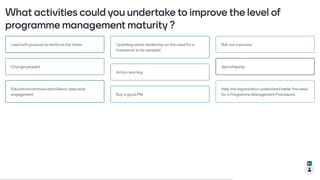
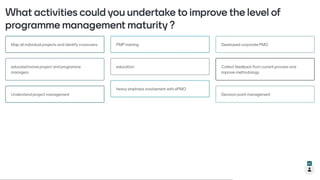
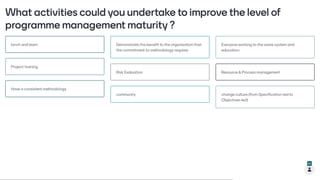
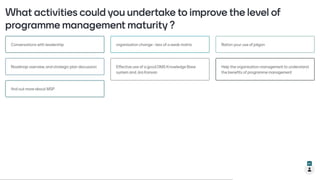
The 4 key elements of best practice
programme design
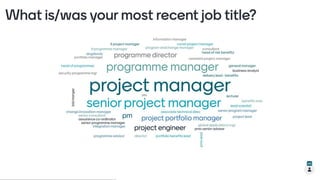
Mentimeter Question 1:
What is your job title?
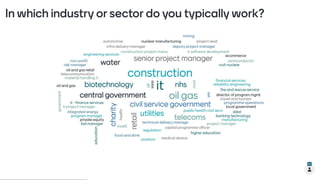
Mentimeter Question 2:
What industry do you work in?
PROGRAMME DESIGN
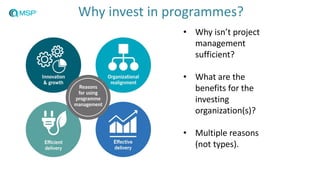
Why invest in programmes?
• Why isn’t project
management
sufficient?
• What are the
benefits for the
investing
organization(s)?
• Multiple reasons
(not types).
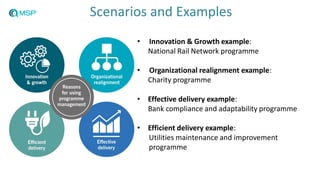
Scenarios and Examples
• Innovation & Growth example:
National Rail Network programme
• Organizational realignment example:
Charity programme
• Effective delivery example:
Bank compliance and adaptability programme
• Efficient delivery example:
Utilities maintenance and improvement
programme
DESIGN APPROACH
The design approach in the programme strategy answers
the following questions:
• How will the vision for the programme be agreed and approved?
• How will the benefits for the programme be agreed and approved?
• How will the target operating model be defined and approved?
• How will the risks to achievement of the benefits be captured and
prioritized?
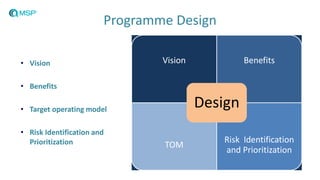
Programme Design
• Vision
• Benefits
• Target operating model
• Risk Identification and
Prioritization
Vision Benefits
TOM
Risk Identification
and Prioritization
Design
Definition of a programme Vision
Definition: Vision
The desired future state of the investing organization(s) after the programme
is completed.
Vision
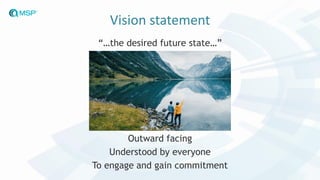
“…the desired future state…”
Vision statement
Outward facing
Understood by everyone
To engage and gain commitment
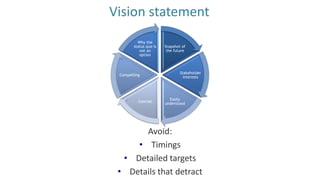
Vision statement
Snapshot of
the future
Stakeholder
interests
Easily
understood
Concise
Compelling
Why the
status quo is
not an
option
Avoid:
• Timings
• Detailed targets
• Details that detract
Mentimeter Question 4:
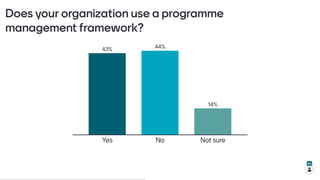
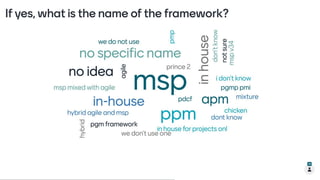
Does your organization use a programme management framework?
If yes what is it?
Mentimeter Question 3:
What programme role do you perform?
Definition: Target Operating Model
A detailed description of the future state of the investing organization(s) after
the programme has finished, including roles and responsibilities, culture,
processes, technology, infrastructure, information and data, and knowledge
and learning.
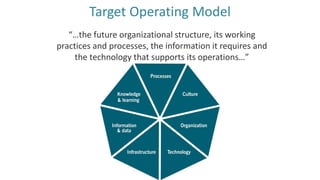
Target Operating Model
“…the future organizational structure, its working
practices and processes, the information it requires and
the technology that supports its operations…”
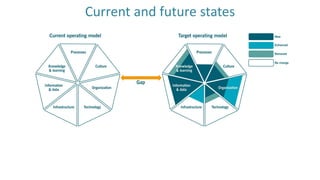
Current and future states
Linking
The Vision
to
The Target
Operating Model
Definitions: Benefits
Benefit
The measurable improvement resulting from an outcome perceived as an advantage by the
investing organization(s) and which contributes towards one or more organizational
objectives.
Dis-benefit
The measurable decline resulting from an outcome perceived as negative by the investing
organization(s) and which detracts from one or more organizational objectives.
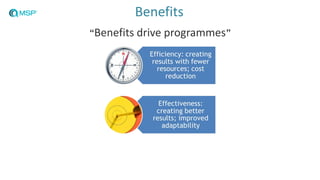
Benefits
“Benefits drive programmes”
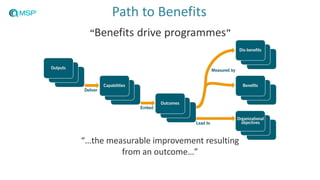
Path to Benefits
“…the measurable improvement resulting
from an outcome…”
Understanding Benefits
• Stakeholder Impact
• Timing
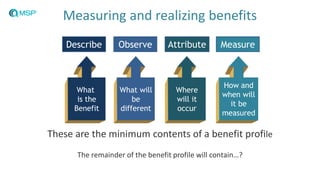
Measuring and realizing benefits
Describe Observe Attribute Measure
What
is the
Benefit
What will
be
different
Where
will it
occur
How and
when will
it be
measured
These are the minimum contents of a benefit profile
The remainder of the benefit profile will contain…?
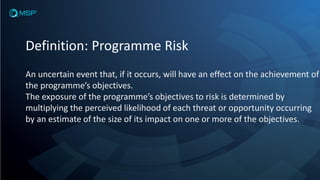
Definition: Programme Risk
An uncertain event that, if it occurs, will have an effect on the achievement of
the programme’s objectives.
The exposure of the programme’s objectives to risk is determined by
multiplying the perceived likelihood of each threat or opportunity occurring
by an estimate of the size of its impact on one or more of the objectives.
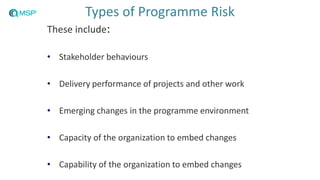
These include:
• Stakeholder behaviours
• Delivery performance of projects and other work
• Emerging changes in the programme environment
• Capacity of the organization to embed changes
• Capability of the organization to embed changes
Types of Programme Risk
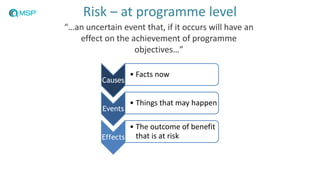
Risk – at programme level
“…an uncertain event that, if it occurs will have an
effect on the achievement of programme
objectives…”
Causes
• Facts now
Events
• Things that may happen
Effects
• The outcome of benefit
that is at risk
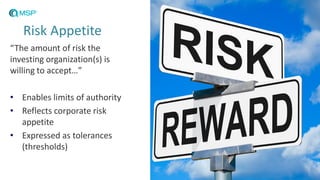
Risk Appetite
“The amount of risk the
investing organization(s) is
willing to accept…”
• Enables limits of authority
• Reflects corporate risk
appetite
• Expressed as tolerances
(thresholds)
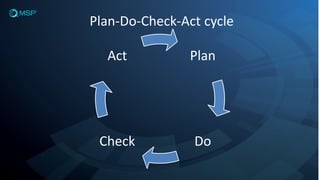
Plan-Do-Check-Act cycle
Plan
Do
Check
Act
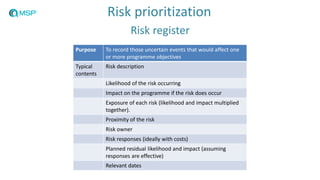
Purpose To record those uncertain events that would affect one
or more programme objectives
Typical
contents
Risk description
Likelihood of the risk occurring
Impact on the programme if the risk does occur
Exposure of each risk (likelihood and impact multiplied
together).
Proximity of the risk
Risk owner
Risk responses (ideally with costs)
Planned residual likelihood and impact (assuming
responses are effective)
Relevant dates
Risk prioritization
Risk register
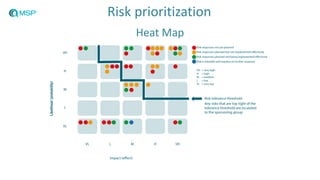
Risk prioritization
Heat Map
32
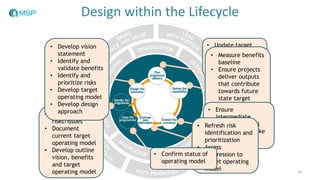
Design within the Lifecycle
• Identify initial
risks/issues
• Document
current target
operating model
• Develop outline
vision, benefits
and target
operating model
• Develop vision
statement
• Identify and
validate benefits
• Identify and
prioritize risks
• Develop target
operating model
• Develop design
approach
• Update target
operating model
• Refine and
validate benefits
• Measure benefits
baseline
• Ensure projects
deliver outputs
that contribute
towards future
state target
operating model
• Ensure
intermediate
operating model
reached and make
necessary
adjustments
• Refresh risk
identification and
prioritization
• Assess
progression to
target operating
model
• Confirm status of
operating model
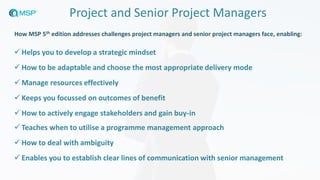
Project and Senior Project Managers
✓ Helps you to develop a strategic mindset
✓ How to be adaptable and choose the most appropriate delivery mode
✓ Manage resources effectively
✓ Keeps you focussed on outcomes of benefit
✓ How to actively engage stakeholders and gain buy-in
✓ Teaches when to utilise a programme management approach
✓ How to deal with ambiguity
✓ Enables you to establish clear lines of communication with senior management
How MSP 5th edition addresses challenges project managers and senior project managers face, enabling:
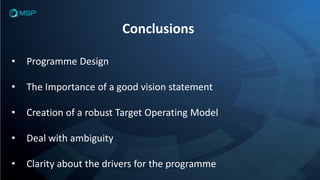
Conclusions
• Programme Design
• The Importance of a good vision statement
• Creation of a robust Target Operating Model
• Deal with ambiguity
• Clarity about the drivers for the programme
Mentimeter Question 3:
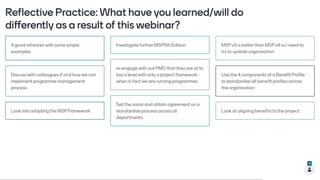
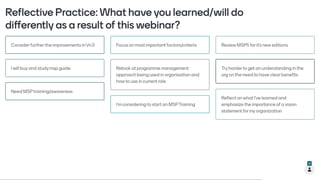
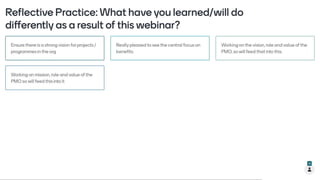
What have you learned or will do differently?
Mentimeter Question 3:
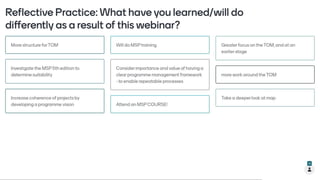
What have you learned or will do differently?
Mentimeter Question 3:
What have you learned or will do differently?
Mentimeter Question 3:
What have you learned or will do differently?
Public
Continued Professional
Development (CPD)
• CPD is enormously important to respondents, but
less so for the wider organization.
• Employers appear to offer little information on
CPD.
• Almost all project and programme managers see
CPD as highly important to them.
• Investing in CPD commonly involves taking up
training courses, reading literature, and gaining
formal qualifications.

The 4 key elements of best practice programme design.

  • 1.
    The 4 keyelements of best practice programme design
  • 3.
    Mentimeter Question 1: Whatis your job title?
  • 4.
    Mentimeter Question 2: Whatindustry do you work in?
  • 5.
  • 6.
    Why invest inprogrammes? • Why isn’t project management sufficient? • What are the benefits for the investing organization(s)? • Multiple reasons (not types).
  • 7.
    Scenarios and Examples •Innovation & Growth example: National Rail Network programme • Organizational realignment example: Charity programme • Effective delivery example: Bank compliance and adaptability programme • Efficient delivery example: Utilities maintenance and improvement programme
  • 8.
    DESIGN APPROACH The designapproach in the programme strategy answers the following questions: • How will the vision for the programme be agreed and approved? • How will the benefits for the programme be agreed and approved? • How will the target operating model be defined and approved? • How will the risks to achievement of the benefits be captured and prioritized?
  • 9.
    Programme Design • Vision •Benefits • Target operating model • Risk Identification and Prioritization Vision Benefits TOM Risk Identification and Prioritization Design
  • 10.
    Definition of aprogramme Vision Definition: Vision The desired future state of the investing organization(s) after the programme is completed.
  • 11.
  • 12.
    “…the desired futurestate…” Vision statement Outward facing Understood by everyone To engage and gain commitment
  • 13.
    Vision statement Snapshot of thefuture Stakeholder interests Easily understood Concise Compelling Why the status quo is not an option Avoid: • Timings • Detailed targets • Details that detract
  • 14.
    Mentimeter Question 4: Doesyour organization use a programme management framework? If yes what is it?
  • 15.
    Mentimeter Question 3: Whatprogramme role do you perform?
  • 16.
    Definition: Target OperatingModel A detailed description of the future state of the investing organization(s) after the programme has finished, including roles and responsibilities, culture, processes, technology, infrastructure, information and data, and knowledge and learning.
  • 17.
    Target Operating Model “…thefuture organizational structure, its working practices and processes, the information it requires and the technology that supports its operations…”
  • 18.
  • 19.
  • 20.
    Definitions: Benefits Benefit The measurableimprovement resulting from an outcome perceived as an advantage by the investing organization(s) and which contributes towards one or more organizational objectives. Dis-benefit The measurable decline resulting from an outcome perceived as negative by the investing organization(s) and which detracts from one or more organizational objectives.
  • 21.
  • 22.
    Path to Benefits “…themeasurable improvement resulting from an outcome…”
  • 23.
  • 24.
    Measuring and realizingbenefits Describe Observe Attribute Measure What is the Benefit What will be different Where will it occur How and when will it be measured These are the minimum contents of a benefit profile The remainder of the benefit profile will contain…?
  • 25.
    Definition: Programme Risk Anuncertain event that, if it occurs, will have an effect on the achievement of the programme’s objectives. The exposure of the programme’s objectives to risk is determined by multiplying the perceived likelihood of each threat or opportunity occurring by an estimate of the size of its impact on one or more of the objectives.
  • 26.
    These include: • Stakeholderbehaviours • Delivery performance of projects and other work • Emerging changes in the programme environment • Capacity of the organization to embed changes • Capability of the organization to embed changes Types of Programme Risk
  • 27.
    Risk – atprogramme level “…an uncertain event that, if it occurs will have an effect on the achievement of programme objectives…” Causes • Facts now Events • Things that may happen Effects • The outcome of benefit that is at risk
  • 28.
    Risk Appetite “The amountof risk the investing organization(s) is willing to accept…” • Enables limits of authority • Reflects corporate risk appetite • Expressed as tolerances (thresholds)
  • 29.
  • 30.
    Purpose To recordthose uncertain events that would affect one or more programme objectives Typical contents Risk description Likelihood of the risk occurring Impact on the programme if the risk does occur Exposure of each risk (likelihood and impact multiplied together). Proximity of the risk Risk owner Risk responses (ideally with costs) Planned residual likelihood and impact (assuming responses are effective) Relevant dates Risk prioritization Risk register
  • 31.
  • 32.
    32 Design within theLifecycle • Identify initial risks/issues • Document current target operating model • Develop outline vision, benefits and target operating model • Develop vision statement • Identify and validate benefits • Identify and prioritize risks • Develop target operating model • Develop design approach • Update target operating model • Refine and validate benefits • Measure benefits baseline • Ensure projects deliver outputs that contribute towards future state target operating model • Ensure intermediate operating model reached and make necessary adjustments • Refresh risk identification and prioritization • Assess progression to target operating model • Confirm status of operating model
  • 41.
    Project and SeniorProject Managers ✓ Helps you to develop a strategic mindset ✓ How to be adaptable and choose the most appropriate delivery mode ✓ Manage resources effectively ✓ Keeps you focussed on outcomes of benefit ✓ How to actively engage stakeholders and gain buy-in ✓ Teaches when to utilise a programme management approach ✓ How to deal with ambiguity ✓ Enables you to establish clear lines of communication with senior management How MSP 5th edition addresses challenges project managers and senior project managers face, enabling:
  • 42.
    Conclusions • Programme Design •The Importance of a good vision statement • Creation of a robust Target Operating Model • Deal with ambiguity • Clarity about the drivers for the programme
  • 43.
    Mentimeter Question 3: Whathave you learned or will do differently?
  • 44.
    Mentimeter Question 3: Whathave you learned or will do differently?
  • 45.
    Mentimeter Question 3: Whathave you learned or will do differently?
  • 46.
    Mentimeter Question 3: Whathave you learned or will do differently?
  • 47.
    Public Continued Professional Development (CPD) •CPD is enormously important to respondents, but less so for the wider organization. • Employers appear to offer little information on CPD. • Almost all project and programme managers see CPD as highly important to them. • Investing in CPD commonly involves taking up training courses, reading literature, and gaining formal qualifications.