1
THCON23
The Android Security Model
THCON 2023
2023/04/21
2
2
THCON23
Agenda
 Introduction
 Security Model
 Android Permissions
 Hardening and Mitigations
 Conclusion
3
3
THCON23
Presentation
 Jean-Baptiste Cayrou
 Security researcher @Synacktiv
 Vulnerability research & exploitation
 Synacktiv
 Offensive security company
 Based in France
 ~140 Ninjas
 We are hiring!!!
4
4
THCON23
Introduction
 Android is an open-source project led by Google
 Lastest version is Android 13
 ~70% mobile devices worldwide use Android
 It is based on a Linux kernel with the “binder” driver enabled
for process interactions
 In userland, applications are Java packages that run in a
specific JVM
5
5
THCON23
Introduction
 Our smartphones contain a lot of sensitive data
 Emails and conversations
 Photos and videos
 And they have many sensors
 Camera
 Microphone
 GPS
 Access to this data and sensors must be protected against
compromised or malicious applications
6
6
THCON23
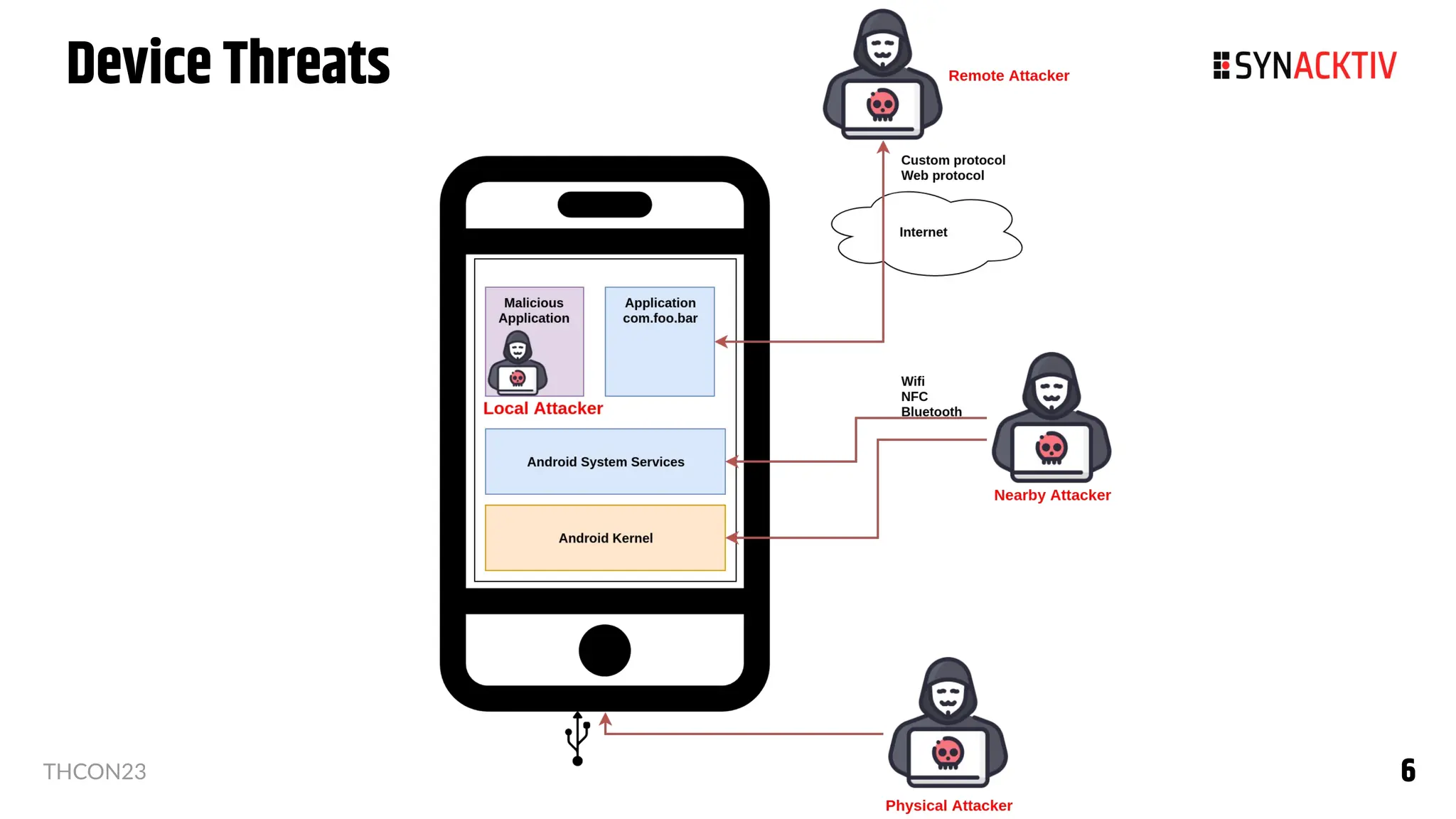
Device Threats
7
7
THCON23
Device Threats
 Applications may be malicious or compromised
 For instance, by exploiting browser vulnerabilities
 It is essential to prevent attackers from accessing:
 Data
 Sensors
 Attackers might bypass restrictions by exploiting other
system vulnerabilities
 Perform a LPE (Local Privileged Escalation)
→ Reduce the risks and make LPE as difficult as possible
8
8
THCON23
Security Model
9
9
THCON23
Security Model
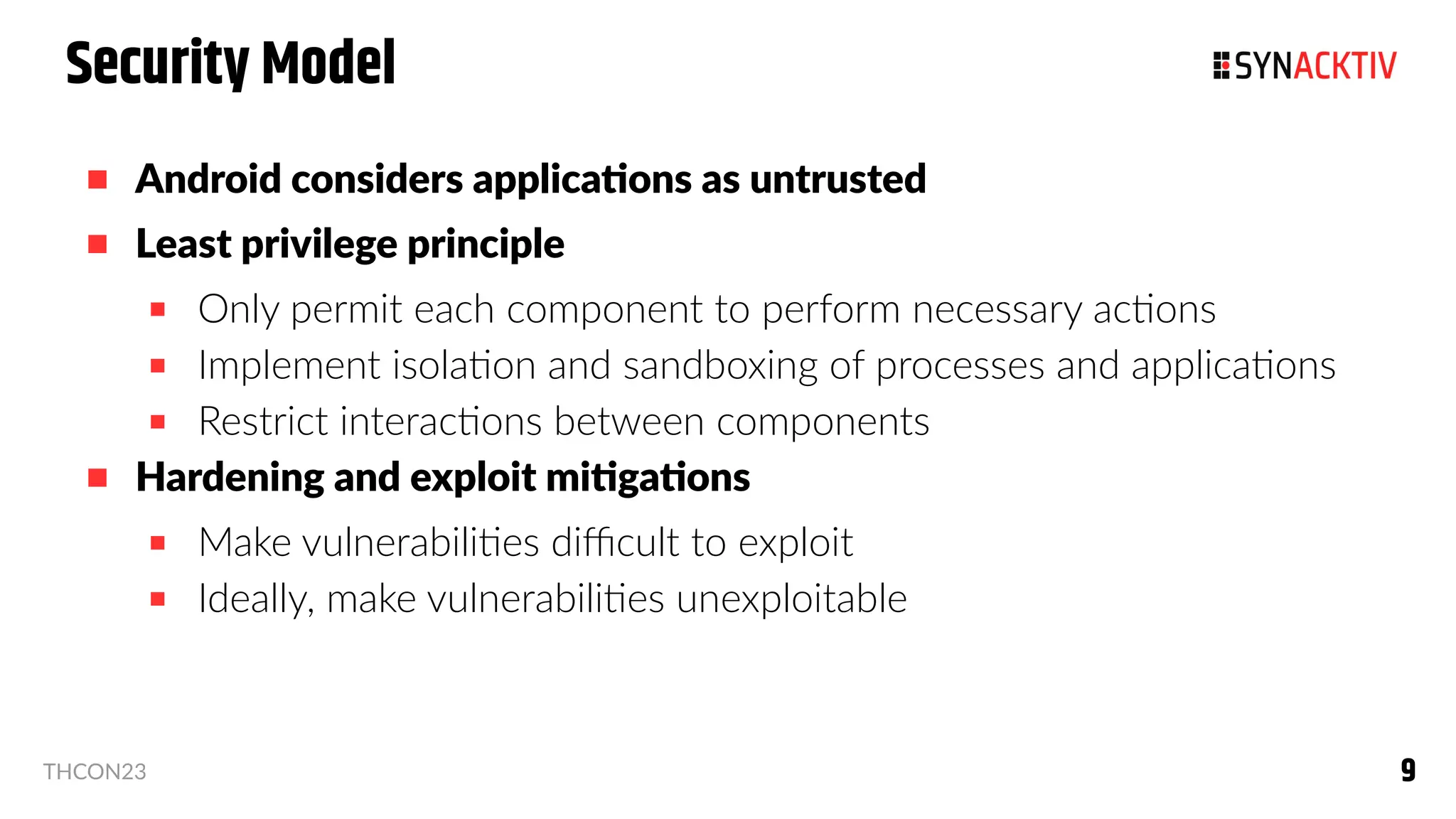
 Android considers applications as untrusted
 Least privilege principle
 Only permit each component to perform necessary actions
 Implement isolation and sandboxing of processes and applications
 Restrict interactions between components
 Hardening and exploit mitigations
 Make vulnerabilities difficult to exploit
 Ideally, make vulnerabilities unexploitable
10
10
THCON23
Isolation and sandboxing
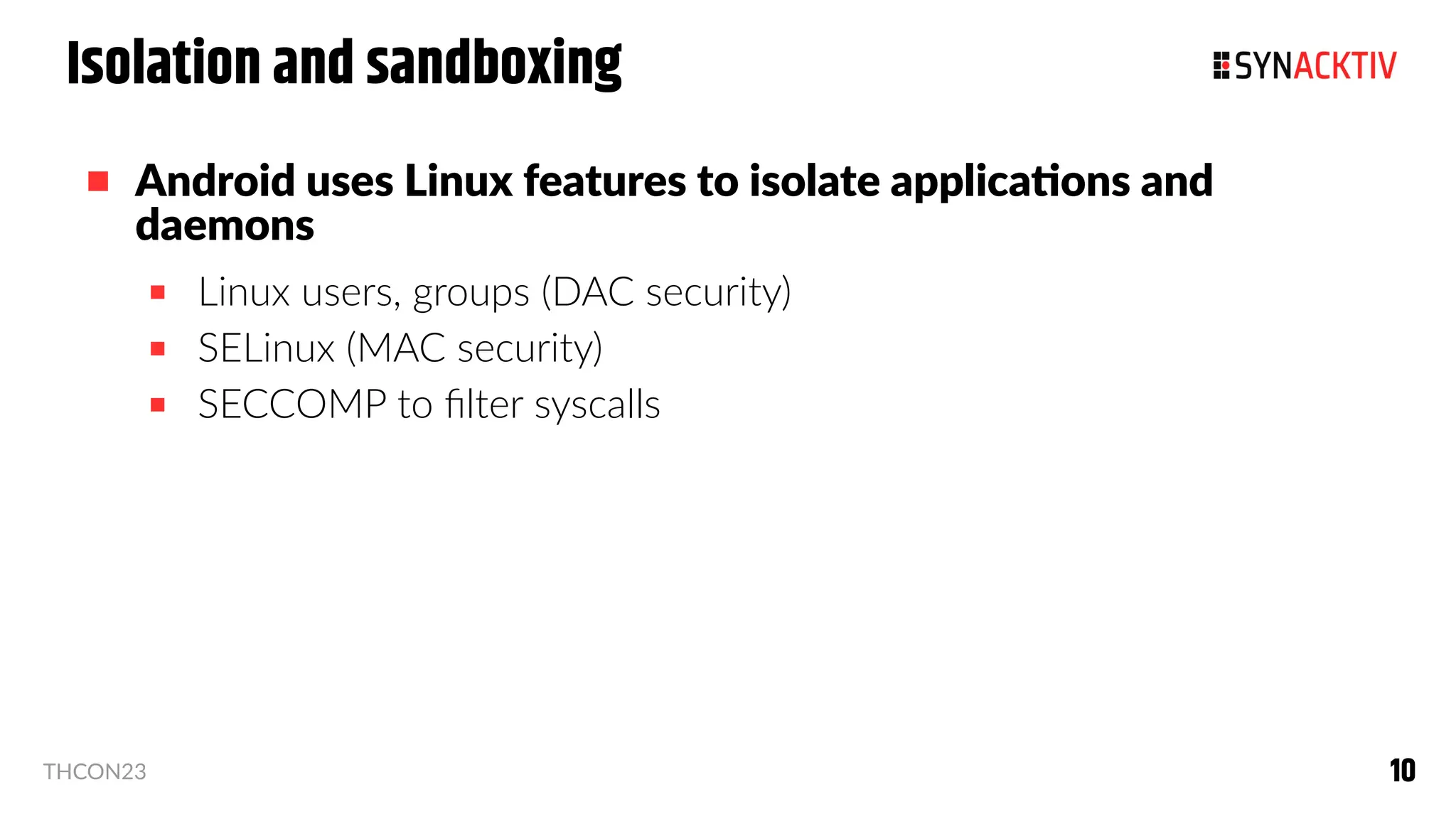
 Android uses Linux features to isolate applications and
daemons
 Linux users, groups (DAC security)
 SELinux (MAC security)
 SECCOMP to filter syscalls
11
11
THCON23
Isolation and sandboxing - Linux users
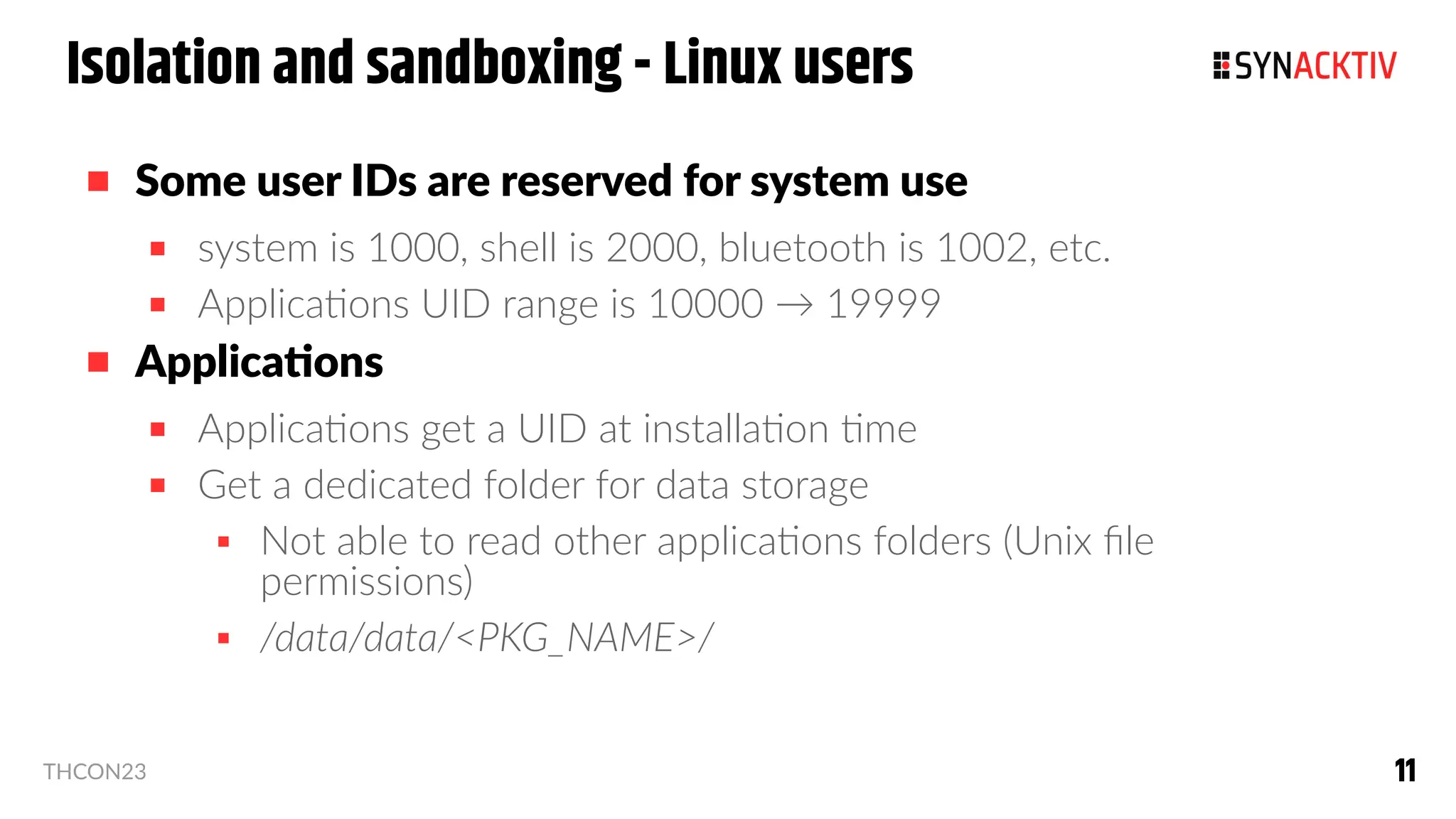
 Some user IDs are reserved for system use
 system is 1000, shell is 2000, bluetooth is 1002, etc.
 Applications UID range is 10000 → 19999
 Applications
 Applications get a UID at installation time
 Get a dedicated folder for data storage
 Not able to read other applications folders (Unix file
permissions)
 /data/data/<PKG_NAME>/
12
12
THCON23
Isolation and sandboxing - SELinux
 SELinux: Security Enhanced Linux
 Enforced starting with Android 4.4 (2013)
 Implemented as a Linux Security Module (LSM)
 Implements security filtering hooks which are called inside the kernel
// Extract of fs/ioctl.c
SYSCALL_DEFINE3(ioctl, unsigned int, fd, unsigned int, cmd, unsigned long, arg)
{
struct fd f = fdget(fd);
int error;
if (!f.file)
return -EBADF;
error = security_file_ioctl(f.file, cmd, arg);
if (error)
goto out;
error = do_vfs_ioctl(f.file, fd, cmd, arg);
// [...]
13
13
THCON23
Isolation and sandboxing - SELinux
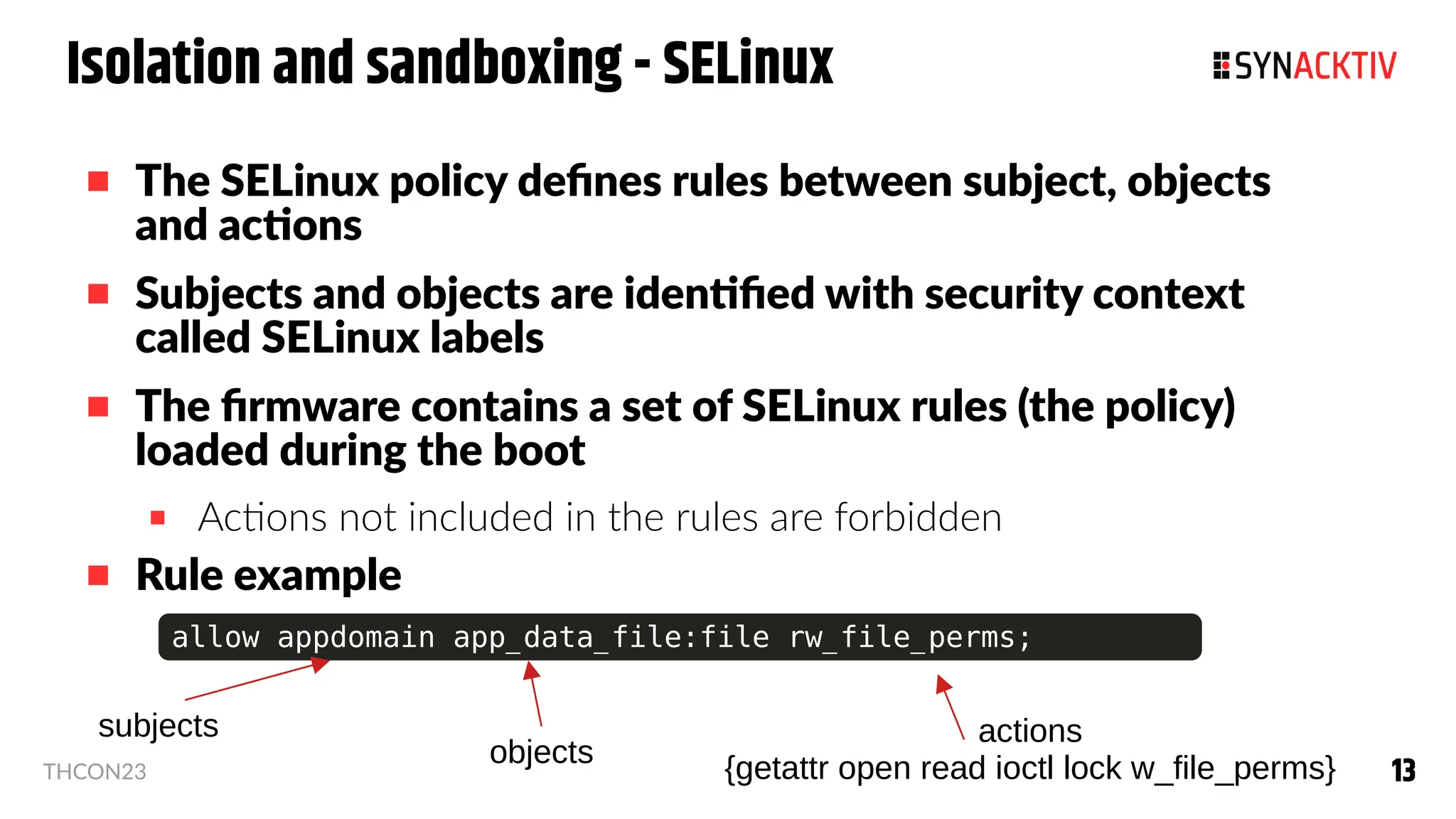
 The SELinux policy defines rules between subject, objects
and actions
 Subjects and objects are identified with security context
called SELinux labels
 The firmware contains a set of SELinux rules (the policy)
loaded during the boot
 Actions not included in the rules are forbidden
 Rule example
allow appdomain app_data_file:file rw_file_perms;
actions
{getattr open read ioctl lock w_file_perms}
subjects
objects
14
14
THCON23
Isolation and sandboxing - SECCOMP
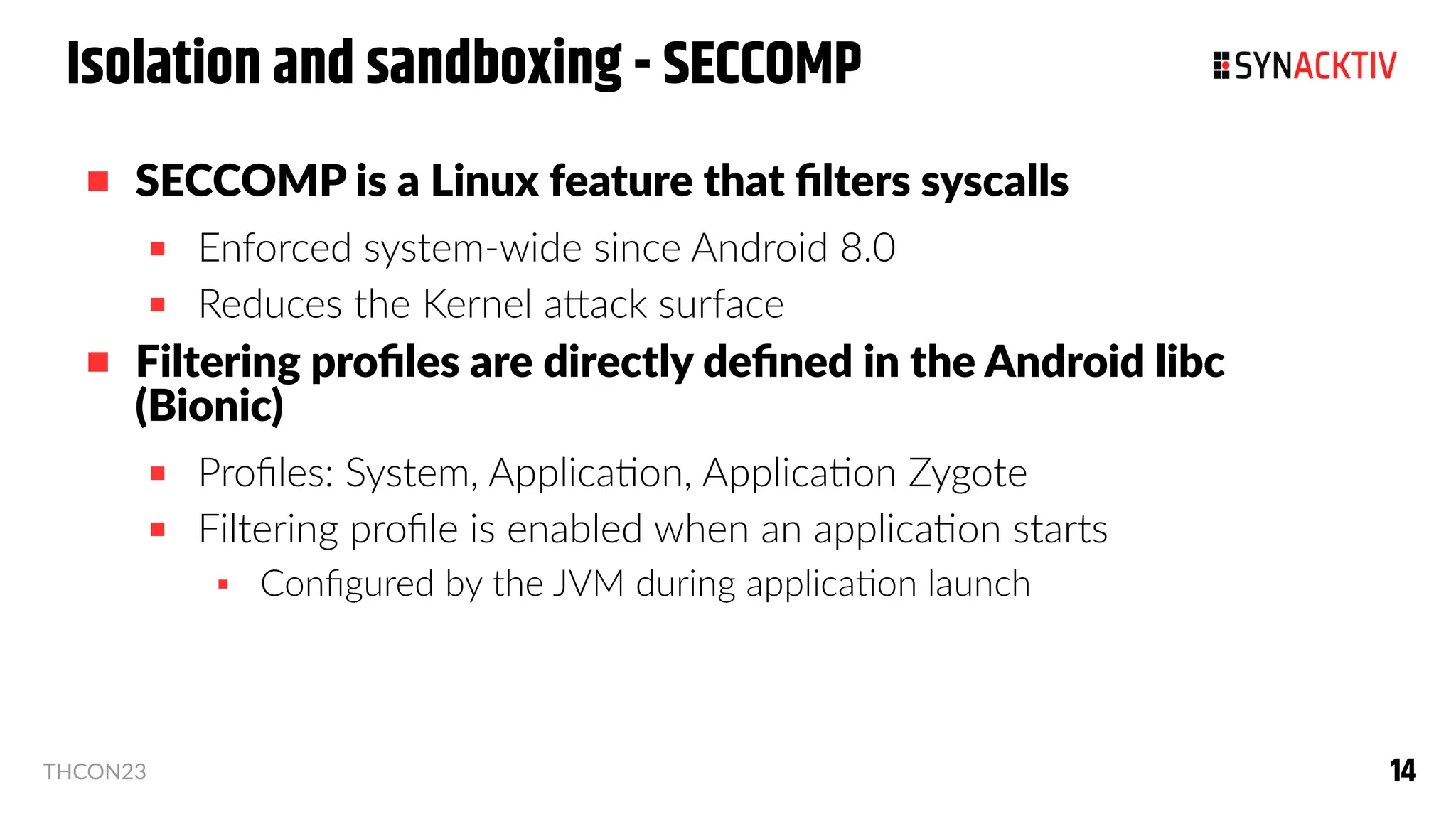
 SECCOMP is a Linux feature that filters syscalls
 Enforced system-wide since Android 8.0
 Reduces the Kernel attack surface
 Filtering profiles are directly defined in the Android libc
(Bionic)
 Profiles: System, Application, Application Zygote
 Filtering profile is enabled when an application starts
 Configured by the JVM during application launch
15
15
THCON23
Isolation and sandboxing - SECCOMP
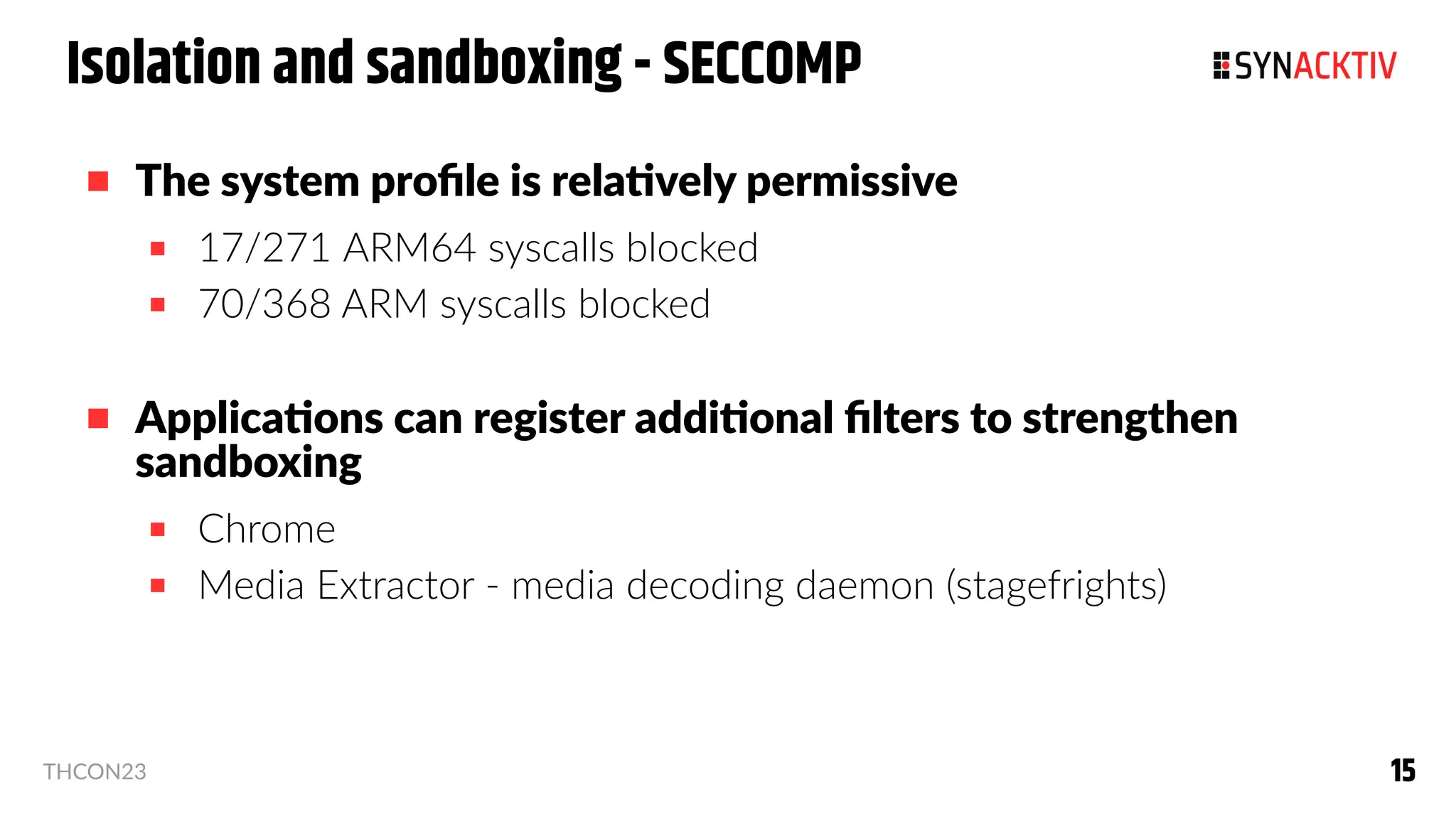
 The system profile is relatively permissive
 17/271 ARM64 syscalls blocked
 70/368 ARM syscalls blocked
 Applications can register additional filters to strengthen
sandboxing
 Chrome
 Media Extractor - media decoding daemon (stagefrights)
16
16
THCON23
Kinds of Applications
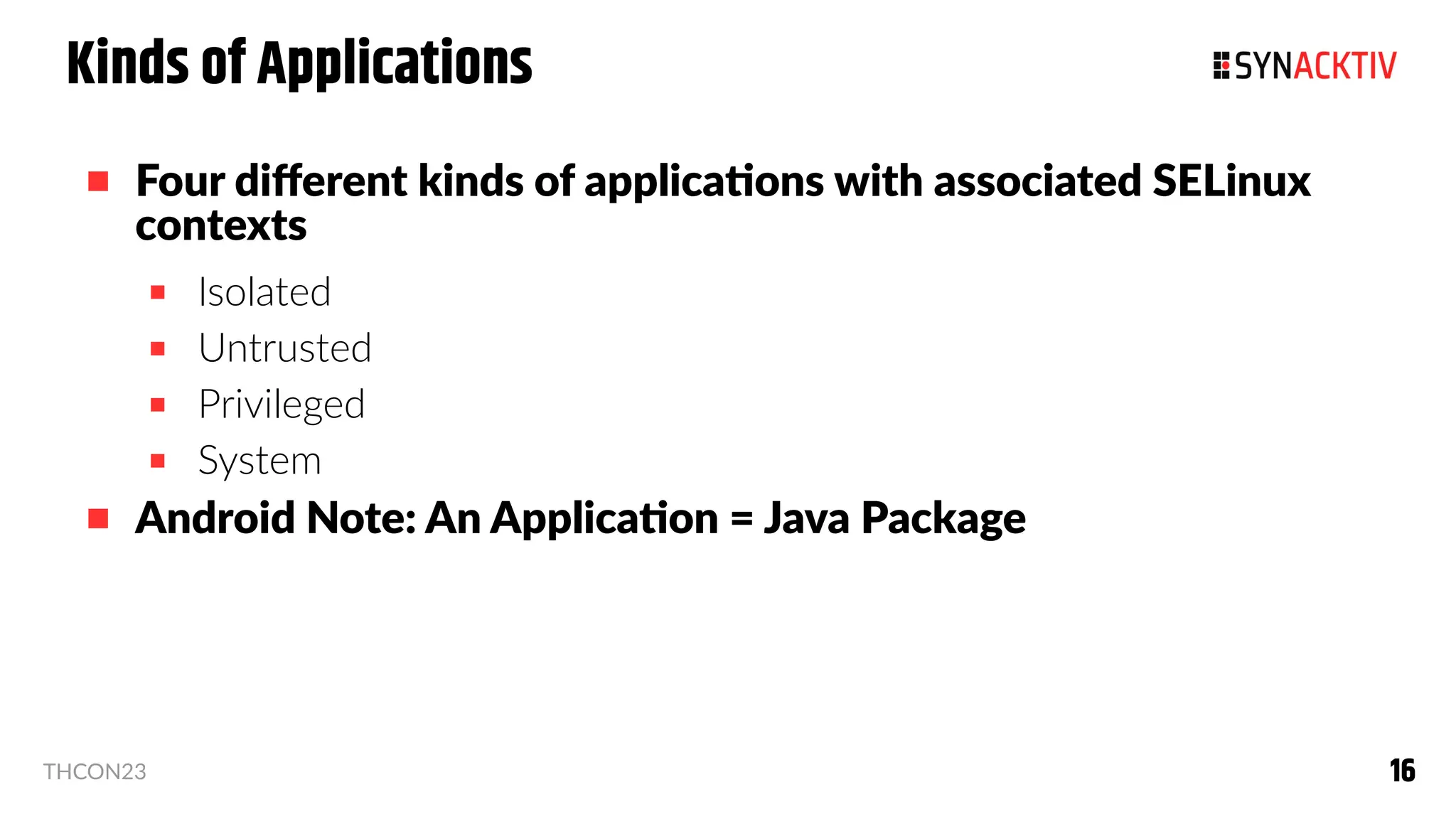
 Four different kinds of applications with associated SELinux
contexts
 Isolated
 Untrusted
 Privileged
 System
 Android Note: An Application = Java Package
17
17
THCON23
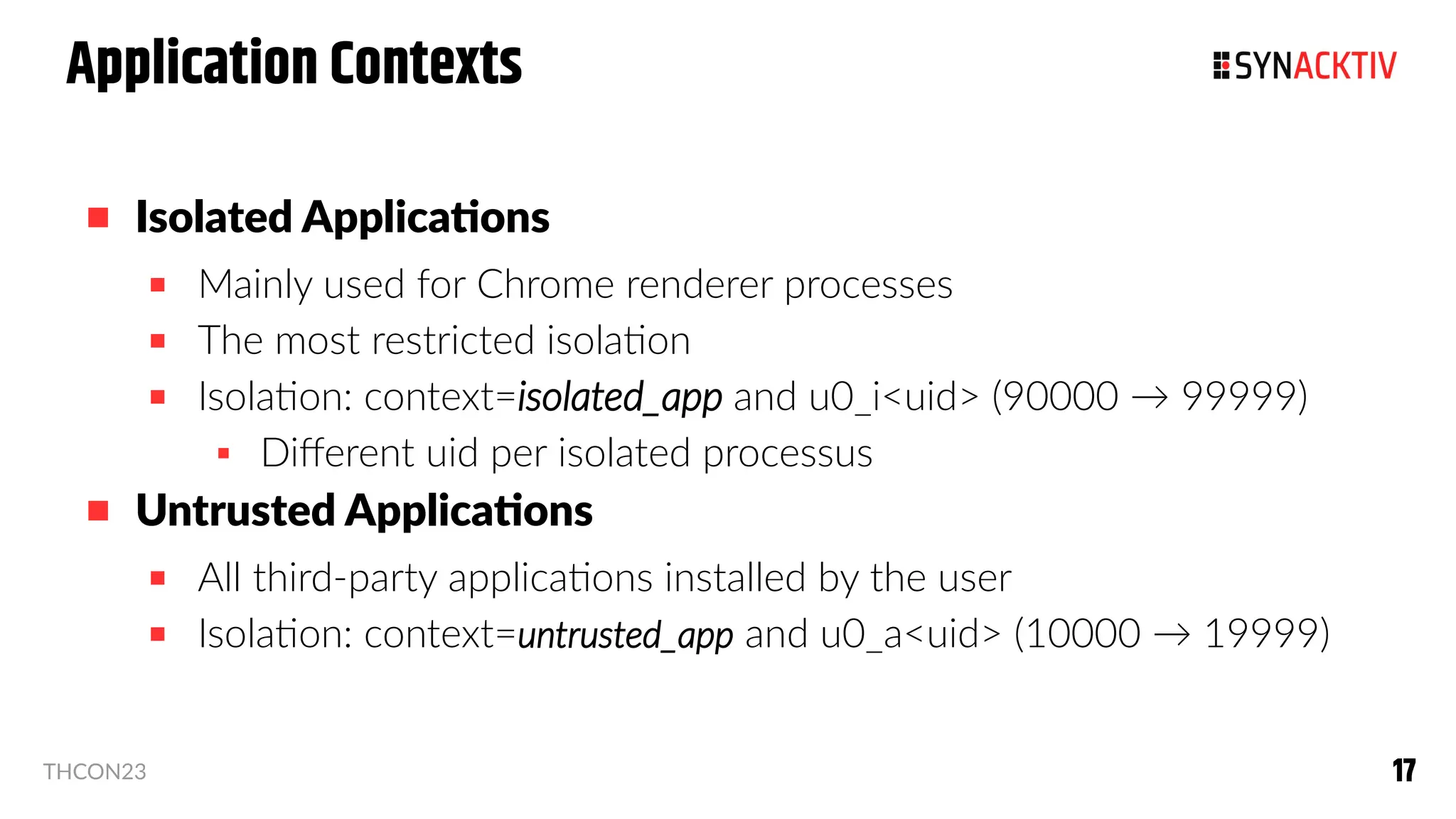
 Isolated Applications
 Mainly used for Chrome renderer processes
 The most restricted isolation
 Isolation: context=isolated_app and u0_i<uid> (90000 → 99999)
 Different uid per isolated processus
 Untrusted Applications
 All third-party applications installed by the user
 Isolation: context=untrusted_app and u0_a<uid> (10000 → 19999)
Application Contexts
18
18
THCON23
Application Contexts
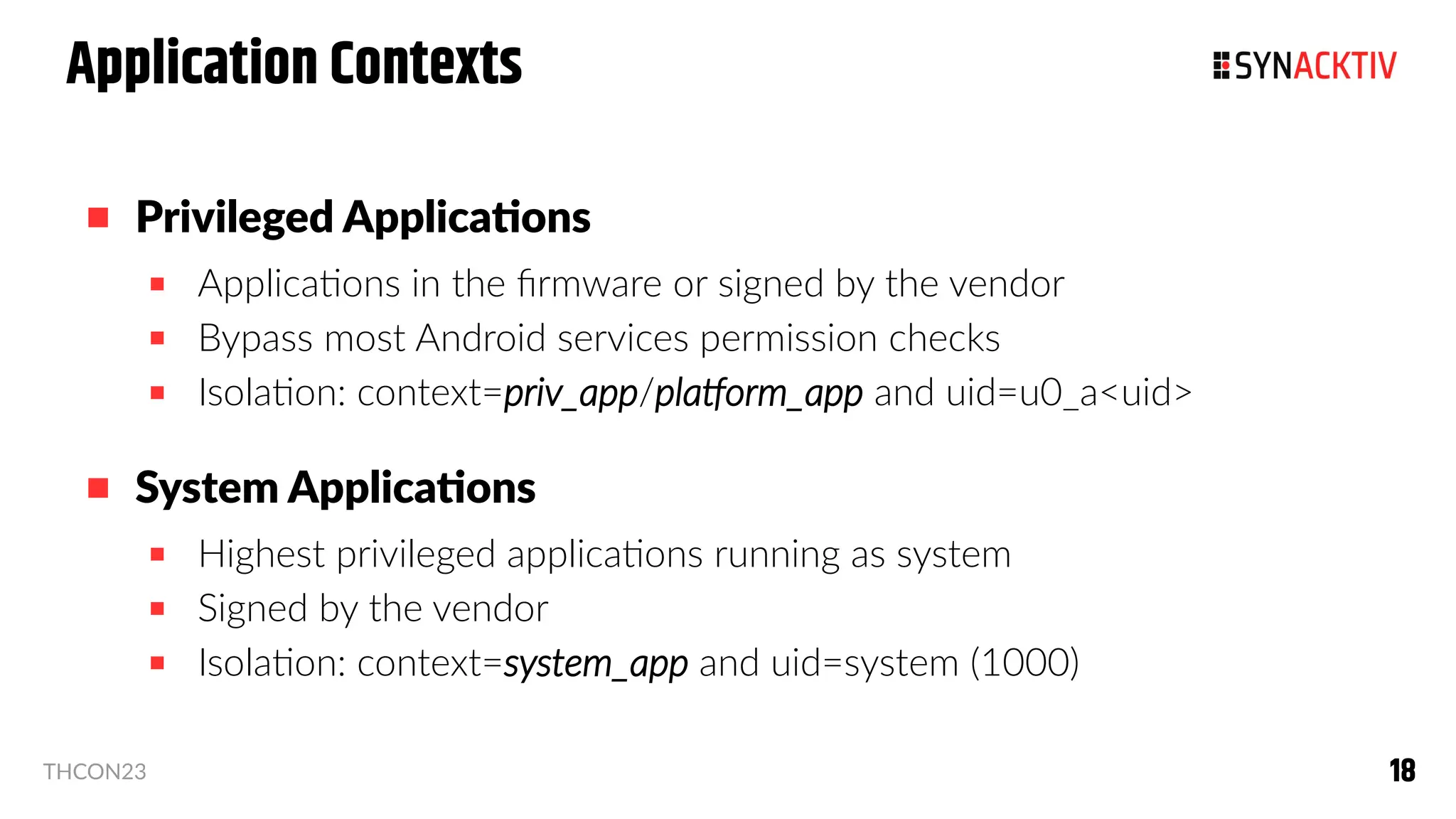
 Privileged Applications
 Applications in the firmware or signed by the vendor
 Bypass most Android services permission checks
 Isolation: context=priv_app/platform_app and uid=u0_a<uid>
 System Applications
 Highest privileged applications running as system
 Signed by the vendor
 Isolation: context=system_app and uid=system (1000)
19
19
THCON23
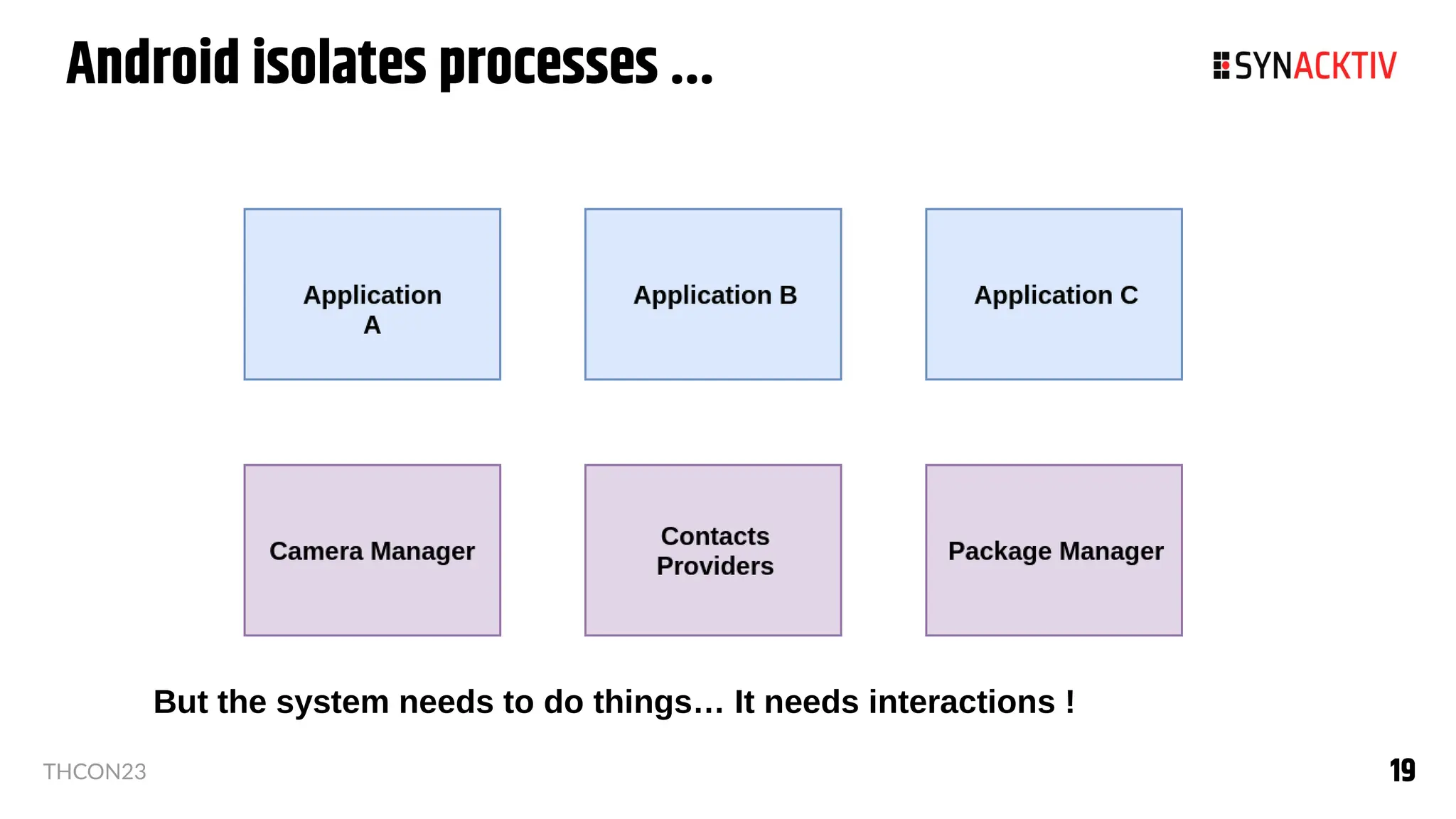
Android isolates processes ...
But the system needs to do things… It needs interactions !
20
20
Android Permissions
Security Model
21
21
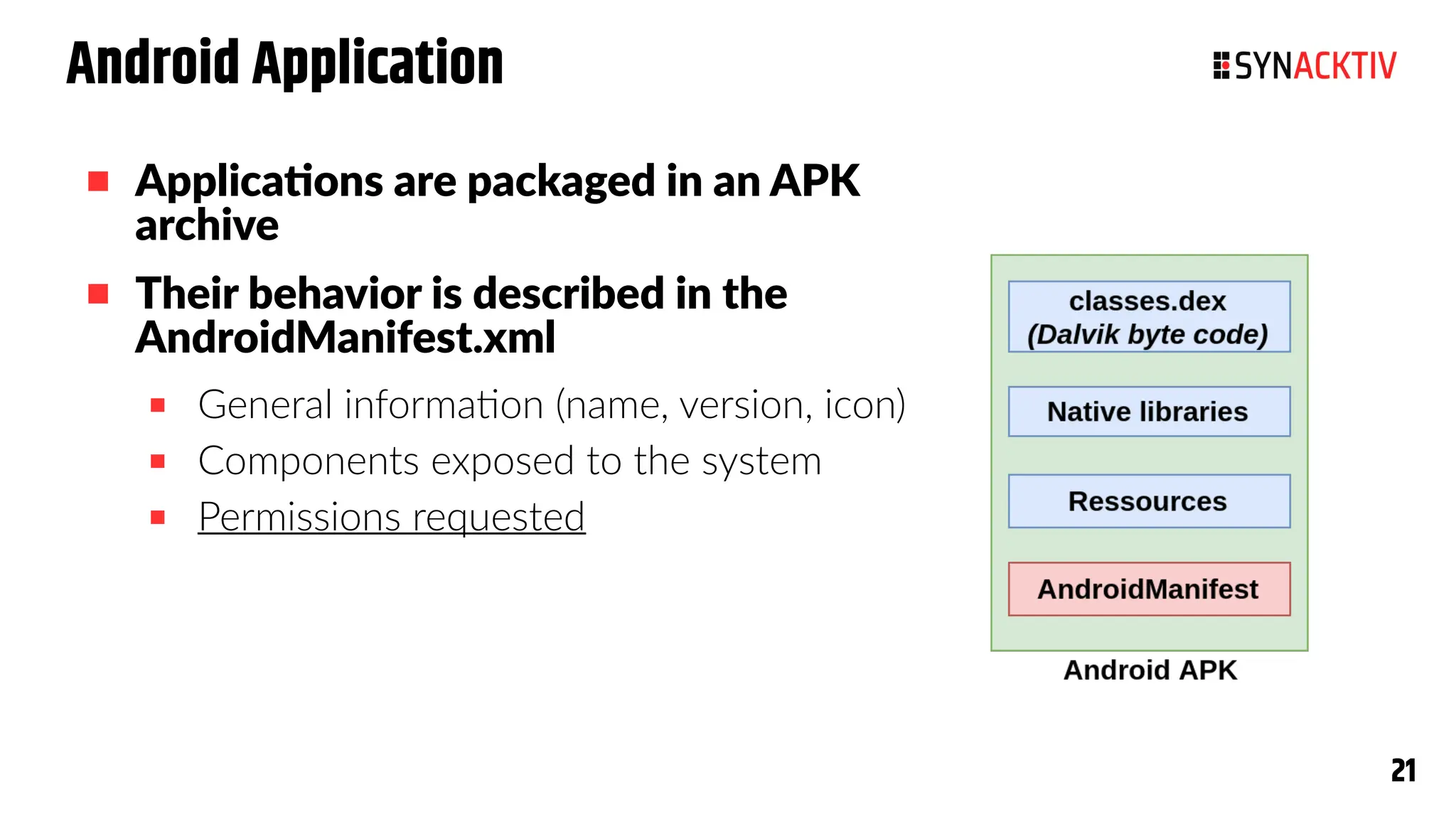
Android Application
 Applications are packaged in an APK
archive
 Their behavior is described in the
AndroidManifest.xml
 General information (name, version, icon)
 Components exposed to the system
 Permissions requested
22
22
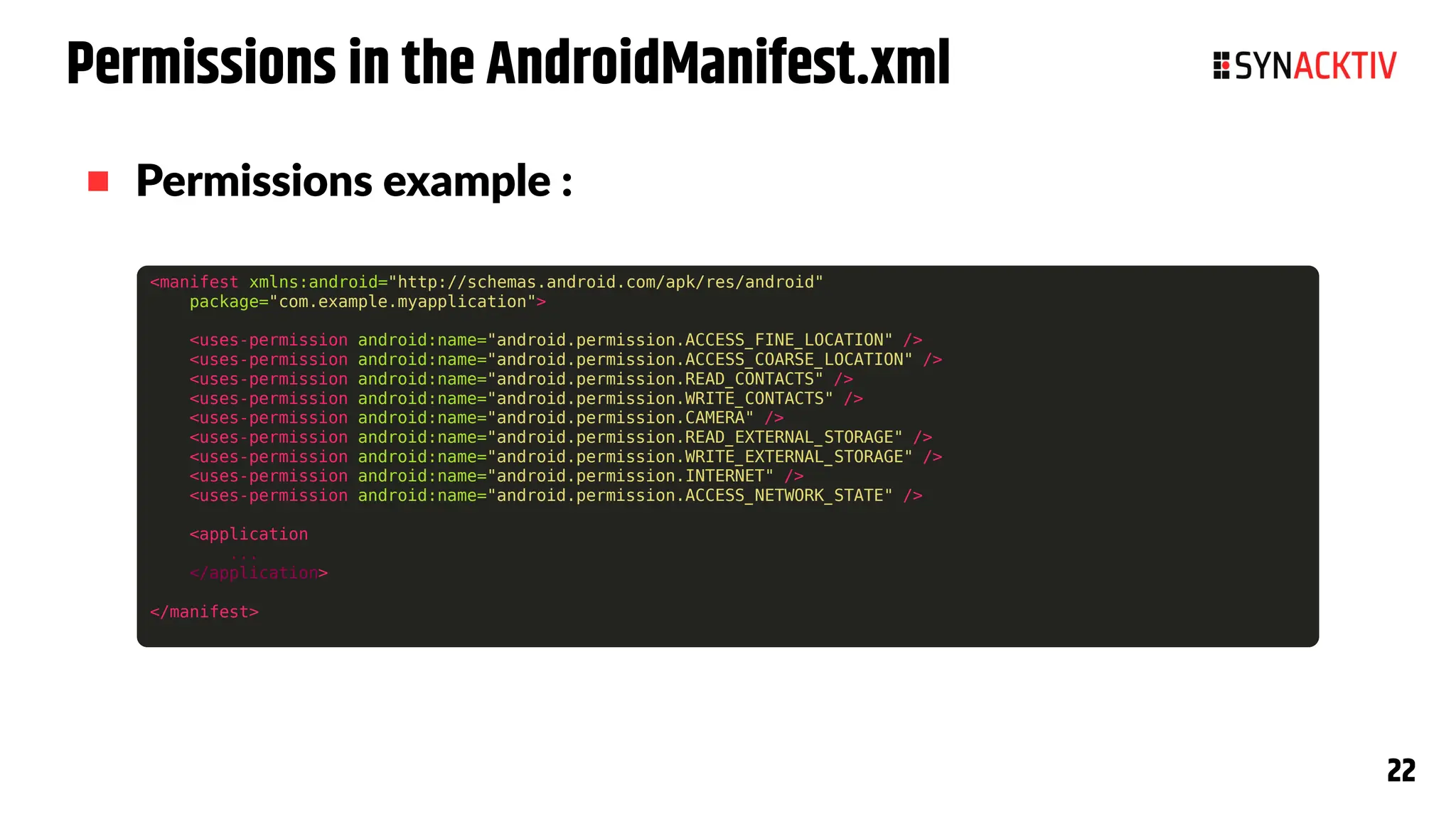
Permissions in the AndroidManifest.xml
 Permissions example :
<manifest xmlns:android="http://schemas.android.com/apk/res/android"
package="com.example.myapplication">
<uses-permission android:name="android.permission.ACCESS_FINE_LOCATION" />
<uses-permission android:name="android.permission.ACCESS_COARSE_LOCATION" />
<uses-permission android:name="android.permission.READ_CONTACTS" />
<uses-permission android:name="android.permission.WRITE_CONTACTS" />
<uses-permission android:name="android.permission.CAMERA" />
<uses-permission android:name="android.permission.READ_EXTERNAL_STORAGE" />
<uses-permission android:name="android.permission.WRITE_EXTERNAL_STORAGE" />
<uses-permission android:name="android.permission.INTERNET" />
<uses-permission android:name="android.permission.ACCESS_NETWORK_STATE" />
<application
...
</application>
</manifest>
23
23
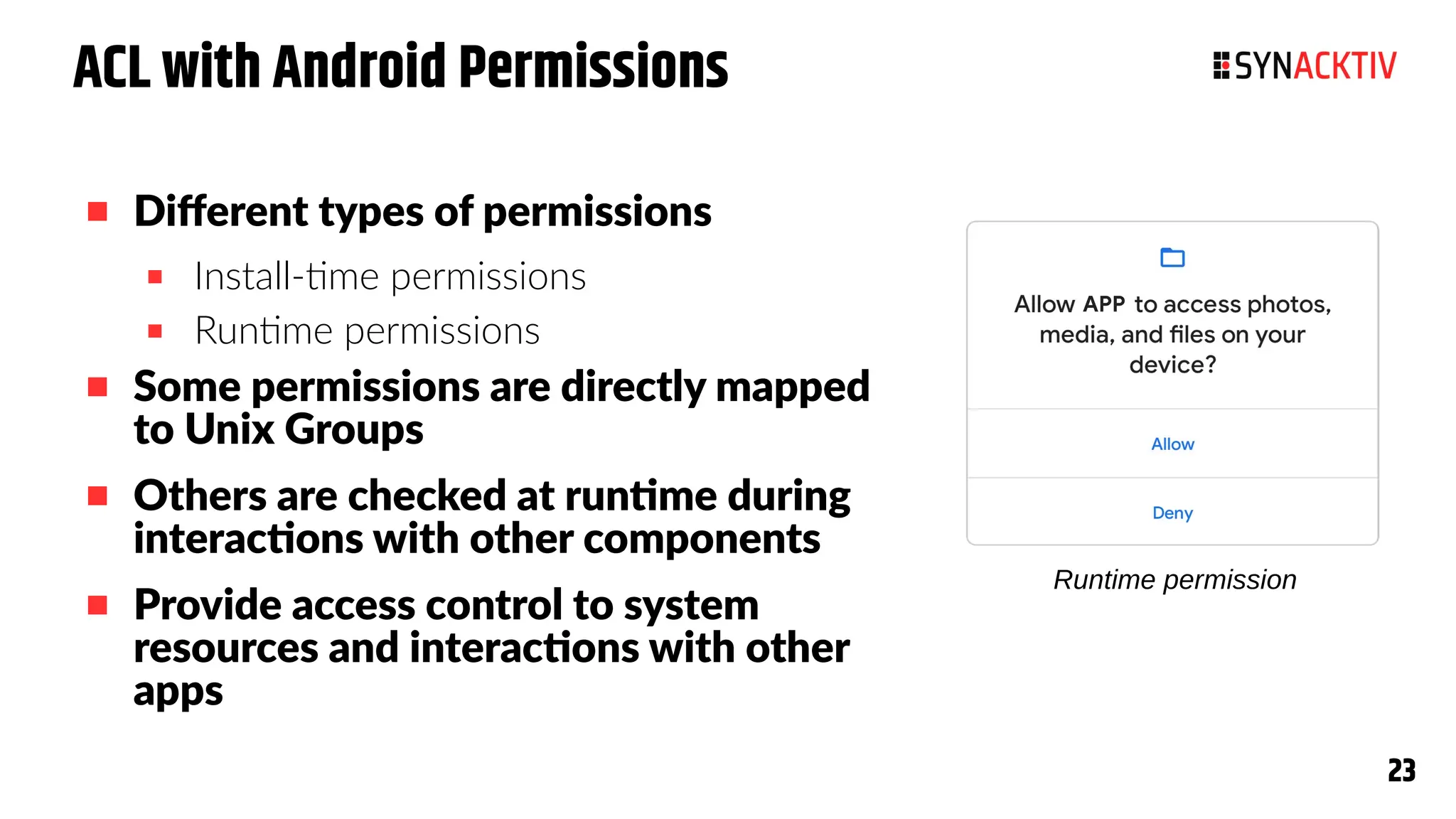
ACL with Android Permissions
 Different types of permissions
 Install-time permissions
 Runtime permissions
 Some permissions are directly mapped
to Unix Groups
 Others are checked at runtime during
interactions with other components
 Provide access control to system
resources and interactions with other
apps
Runtime permission
24
24
THCON23
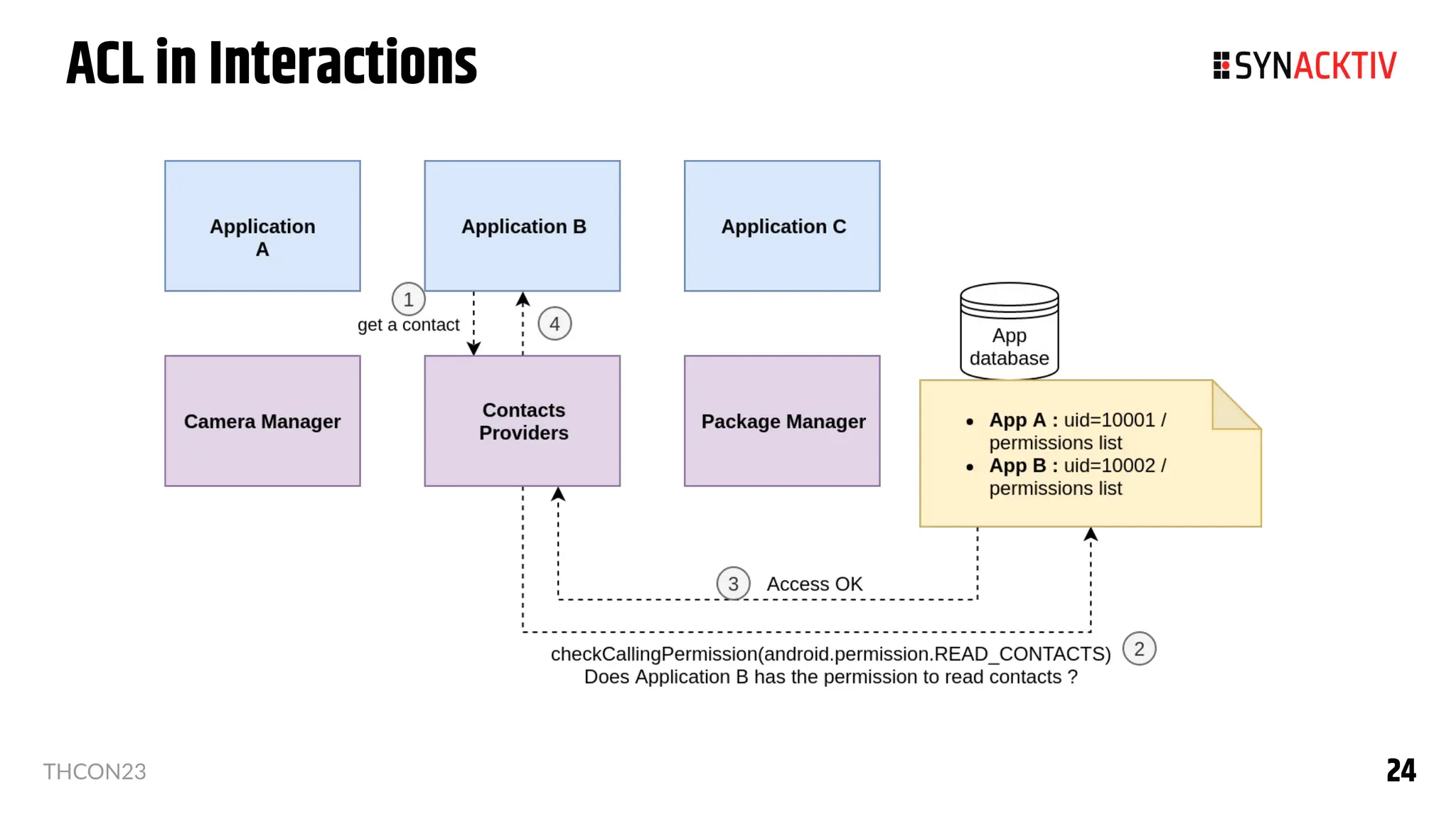
ACL in Interactions
25
25
THCON23
Hardening and Mitigations
26
26
THCON23
Hardening and Mitigations
 Even with robust isolation, there is still some attack surface
 This surface must be hardened to limit and make LPE more
difficult
27
27
THCON23
Hardened components
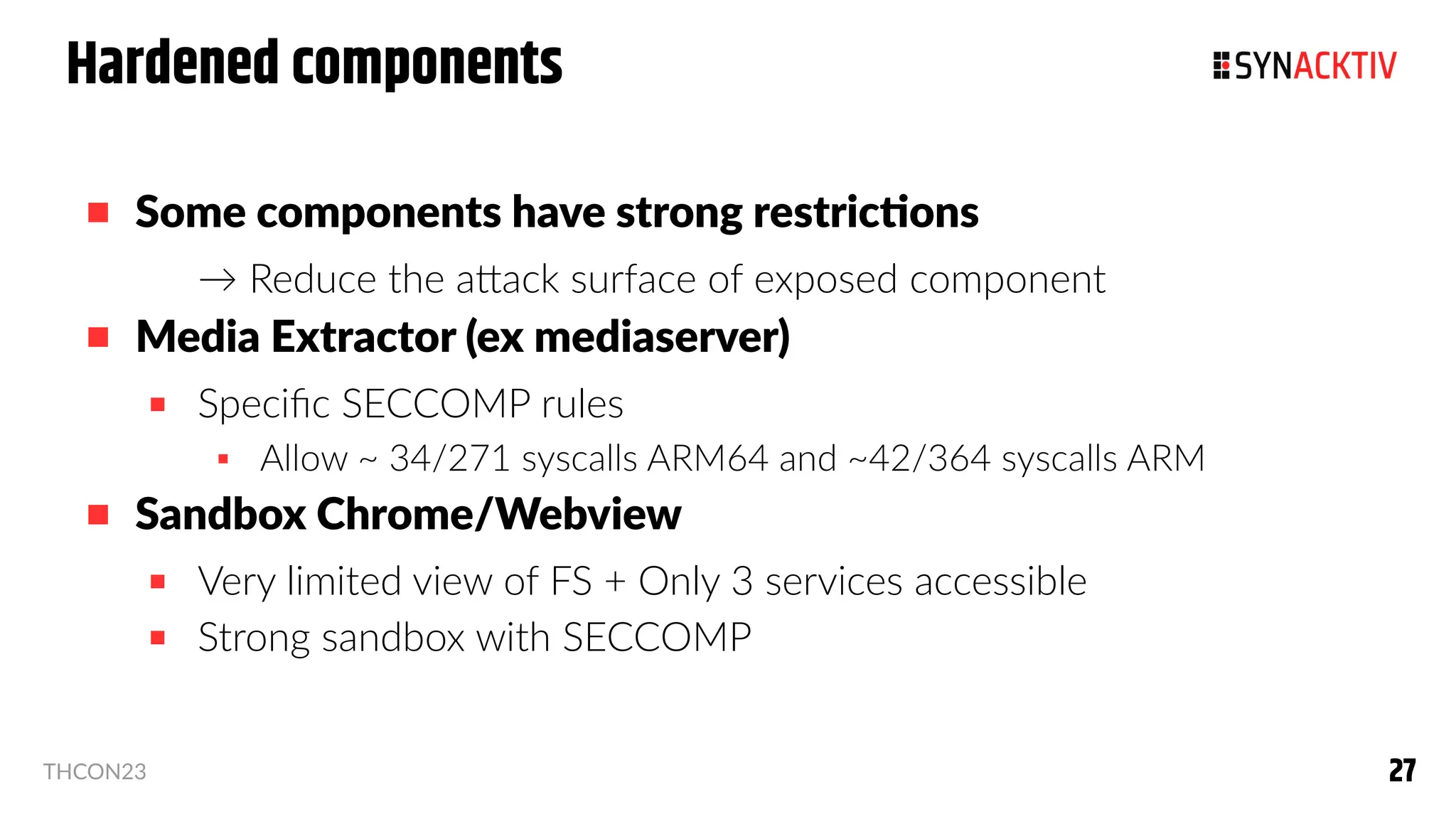
 Some components have strong restrictions
→ Reduce the attack surface of exposed component
 Media Extractor (ex mediaserver)
 Specific SECCOMP rules
 Allow ~ 34/271 syscalls ARM64 and ~42/364 syscalls ARM
 Sandbox Chrome/Webview
 Very limited view of FS + Only 3 services accessible
 Strong sandbox with SECCOMP
28
28
THCON23
Hardened components
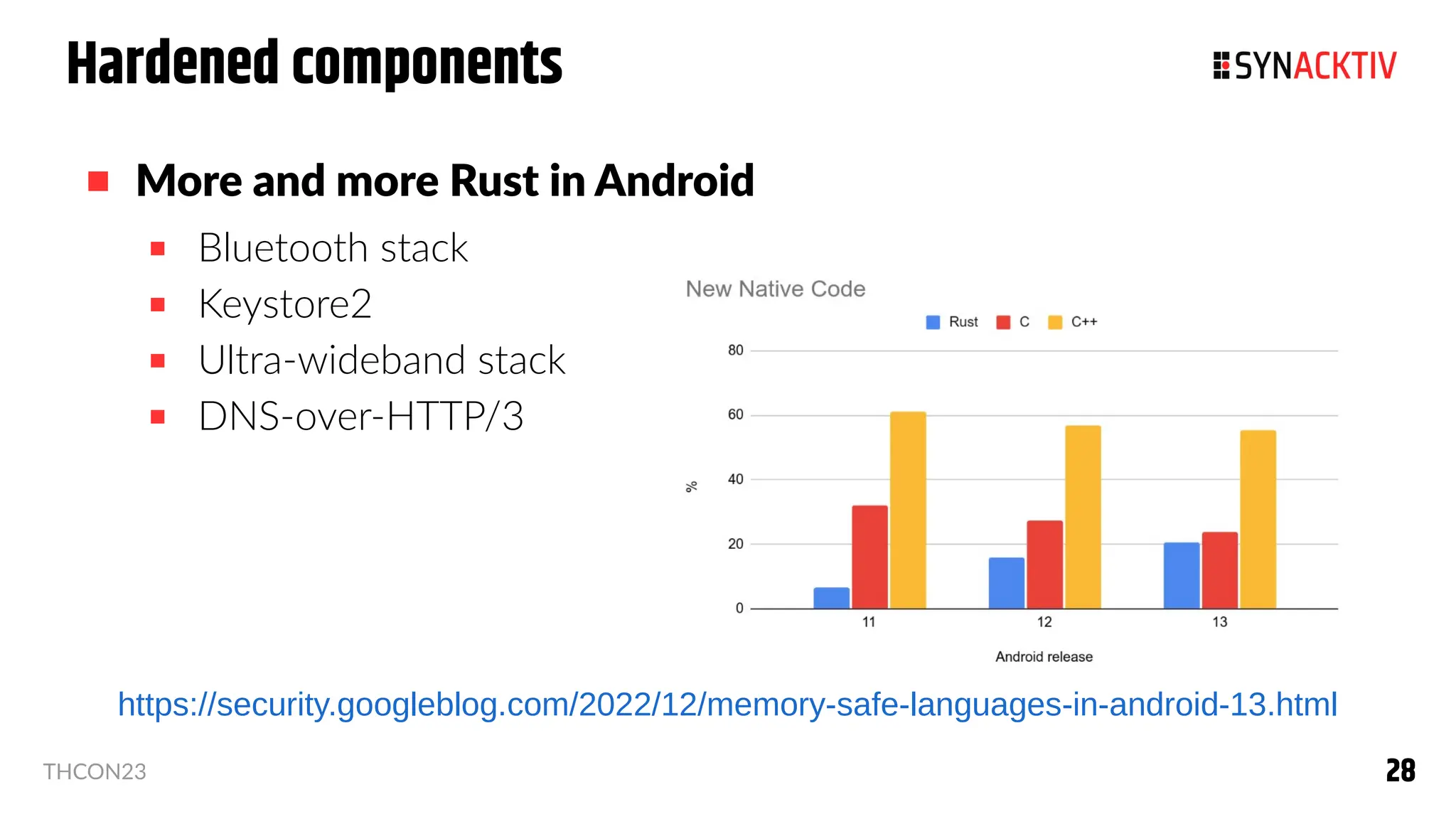
 More and more Rust in Android
 Bluetooth stack
 Keystore2
 Ultra-wideband stack
 DNS-over-HTTP/3
https://security.googleblog.com/2022/12/memory-safe-languages-in-android-13.html
29
29
THCON23
Mitigations
 Against remote exploitation
 ASLR - Address Space Layout Randomization
 PIE - Position Independent Executable
 Scudo Heap allocator (Android 11)
 Designed for security
 Detects allocation corruptions
 Detects double-free
30
30
THCON23
Mitigations
 CFI - Control Flow Integrity
 Prevents an attacker from altering the execution flow
 Added at built time for specific binaries
 Enabled in all media parsers since Android 8.1
 Enabled in the Kernel since Android 9
31
31
THCON23
Mitigations
 Compiler added checks:
 UndefinedBehaviorSanitizer: integer overflow, misaligned
addresses
 BoundsSanitizer: check array access
 ShadowCallStack: protect the return address
 Process aborts if a sanitizer check is triggered
 Prevent attackers from exploiting vulnerabilities
32
32
THCON23
Conclusion
 Each Android release improves the OS security
 Enhanced isolation
 Improved mitigation
 Even if there are vulnerabilities
 Difficult to exploit them
 Some bugs are now non-exploitable
 Highly privileged components remain constrained
33
THCON23
https://www.linkedin.com/company/synacktiv
https://twitter.com/synacktiv
https://synacktiv.com

thcon23_The_Android_Security_Model.pdf

  • 1.
    1 THCON23 The Android SecurityModel THCON 2023 2023/04/21
  • 2.
    2 2 THCON23 Agenda  Introduction  SecurityModel  Android Permissions  Hardening and Mitigations  Conclusion
  • 3.
    3 3 THCON23 Presentation  Jean-Baptiste Cayrou Security researcher @Synacktiv  Vulnerability research & exploitation  Synacktiv  Offensive security company  Based in France  ~140 Ninjas  We are hiring!!!
  • 4.
    4 4 THCON23 Introduction  Android isan open-source project led by Google  Lastest version is Android 13  ~70% mobile devices worldwide use Android  It is based on a Linux kernel with the “binder” driver enabled for process interactions  In userland, applications are Java packages that run in a specific JVM
  • 5.
    5 5 THCON23 Introduction  Our smartphonescontain a lot of sensitive data  Emails and conversations  Photos and videos  And they have many sensors  Camera  Microphone  GPS  Access to this data and sensors must be protected against compromised or malicious applications
  • 6.
  • 7.
    7 7 THCON23 Device Threats  Applicationsmay be malicious or compromised  For instance, by exploiting browser vulnerabilities  It is essential to prevent attackers from accessing:  Data  Sensors  Attackers might bypass restrictions by exploiting other system vulnerabilities  Perform a LPE (Local Privileged Escalation) → Reduce the risks and make LPE as difficult as possible
  • 8.
  • 9.
    9 9 THCON23 Security Model  Androidconsiders applications as untrusted  Least privilege principle  Only permit each component to perform necessary actions  Implement isolation and sandboxing of processes and applications  Restrict interactions between components  Hardening and exploit mitigations  Make vulnerabilities difficult to exploit  Ideally, make vulnerabilities unexploitable
  • 10.
    10 10 THCON23 Isolation and sandboxing Android uses Linux features to isolate applications and daemons  Linux users, groups (DAC security)  SELinux (MAC security)  SECCOMP to filter syscalls
  • 11.
    11 11 THCON23 Isolation and sandboxing- Linux users  Some user IDs are reserved for system use  system is 1000, shell is 2000, bluetooth is 1002, etc.  Applications UID range is 10000 → 19999  Applications  Applications get a UID at installation time  Get a dedicated folder for data storage  Not able to read other applications folders (Unix file permissions)  /data/data/<PKG_NAME>/
  • 12.
    12 12 THCON23 Isolation and sandboxing- SELinux  SELinux: Security Enhanced Linux  Enforced starting with Android 4.4 (2013)  Implemented as a Linux Security Module (LSM)  Implements security filtering hooks which are called inside the kernel // Extract of fs/ioctl.c SYSCALL_DEFINE3(ioctl, unsigned int, fd, unsigned int, cmd, unsigned long, arg) { struct fd f = fdget(fd); int error; if (!f.file) return -EBADF; error = security_file_ioctl(f.file, cmd, arg); if (error) goto out; error = do_vfs_ioctl(f.file, fd, cmd, arg); // [...]
  • 13.
    13 13 THCON23 Isolation and sandboxing- SELinux  The SELinux policy defines rules between subject, objects and actions  Subjects and objects are identified with security context called SELinux labels  The firmware contains a set of SELinux rules (the policy) loaded during the boot  Actions not included in the rules are forbidden  Rule example allow appdomain app_data_file:file rw_file_perms; actions {getattr open read ioctl lock w_file_perms} subjects objects
  • 14.
    14 14 THCON23 Isolation and sandboxing- SECCOMP  SECCOMP is a Linux feature that filters syscalls  Enforced system-wide since Android 8.0  Reduces the Kernel attack surface  Filtering profiles are directly defined in the Android libc (Bionic)  Profiles: System, Application, Application Zygote  Filtering profile is enabled when an application starts  Configured by the JVM during application launch
  • 15.
    15 15 THCON23 Isolation and sandboxing- SECCOMP  The system profile is relatively permissive  17/271 ARM64 syscalls blocked  70/368 ARM syscalls blocked  Applications can register additional filters to strengthen sandboxing  Chrome  Media Extractor - media decoding daemon (stagefrights)
  • 16.
    16 16 THCON23 Kinds of Applications Four different kinds of applications with associated SELinux contexts  Isolated  Untrusted  Privileged  System  Android Note: An Application = Java Package
  • 17.
    17 17 THCON23  Isolated Applications Mainly used for Chrome renderer processes  The most restricted isolation  Isolation: context=isolated_app and u0_i<uid> (90000 → 99999)  Different uid per isolated processus  Untrusted Applications  All third-party applications installed by the user  Isolation: context=untrusted_app and u0_a<uid> (10000 → 19999) Application Contexts
  • 18.
    18 18 THCON23 Application Contexts  PrivilegedApplications  Applications in the firmware or signed by the vendor  Bypass most Android services permission checks  Isolation: context=priv_app/platform_app and uid=u0_a<uid>  System Applications  Highest privileged applications running as system  Signed by the vendor  Isolation: context=system_app and uid=system (1000)
  • 19.
    19 19 THCON23 Android isolates processes... But the system needs to do things… It needs interactions !
  • 20.
  • 21.
    21 21 Android Application  Applicationsare packaged in an APK archive  Their behavior is described in the AndroidManifest.xml  General information (name, version, icon)  Components exposed to the system  Permissions requested
  • 22.
    22 22 Permissions in theAndroidManifest.xml  Permissions example : <manifest xmlns:android="http://schemas.android.com/apk/res/android" package="com.example.myapplication"> <uses-permission android:name="android.permission.ACCESS_FINE_LOCATION" /> <uses-permission android:name="android.permission.ACCESS_COARSE_LOCATION" /> <uses-permission android:name="android.permission.READ_CONTACTS" /> <uses-permission android:name="android.permission.WRITE_CONTACTS" /> <uses-permission android:name="android.permission.CAMERA" /> <uses-permission android:name="android.permission.READ_EXTERNAL_STORAGE" /> <uses-permission android:name="android.permission.WRITE_EXTERNAL_STORAGE" /> <uses-permission android:name="android.permission.INTERNET" /> <uses-permission android:name="android.permission.ACCESS_NETWORK_STATE" /> <application ... </application> </manifest>
  • 23.
    23 23 ACL with AndroidPermissions  Different types of permissions  Install-time permissions  Runtime permissions  Some permissions are directly mapped to Unix Groups  Others are checked at runtime during interactions with other components  Provide access control to system resources and interactions with other apps Runtime permission
  • 24.
  • 25.
  • 26.
    26 26 THCON23 Hardening and Mitigations Even with robust isolation, there is still some attack surface  This surface must be hardened to limit and make LPE more difficult
  • 27.
    27 27 THCON23 Hardened components  Somecomponents have strong restrictions → Reduce the attack surface of exposed component  Media Extractor (ex mediaserver)  Specific SECCOMP rules  Allow ~ 34/271 syscalls ARM64 and ~42/364 syscalls ARM  Sandbox Chrome/Webview  Very limited view of FS + Only 3 services accessible  Strong sandbox with SECCOMP
  • 28.
    28 28 THCON23 Hardened components  Moreand more Rust in Android  Bluetooth stack  Keystore2  Ultra-wideband stack  DNS-over-HTTP/3 https://security.googleblog.com/2022/12/memory-safe-languages-in-android-13.html
  • 29.
    29 29 THCON23 Mitigations  Against remoteexploitation  ASLR - Address Space Layout Randomization  PIE - Position Independent Executable  Scudo Heap allocator (Android 11)  Designed for security  Detects allocation corruptions  Detects double-free
  • 30.
    30 30 THCON23 Mitigations  CFI -Control Flow Integrity  Prevents an attacker from altering the execution flow  Added at built time for specific binaries  Enabled in all media parsers since Android 8.1  Enabled in the Kernel since Android 9
  • 31.
    31 31 THCON23 Mitigations  Compiler addedchecks:  UndefinedBehaviorSanitizer: integer overflow, misaligned addresses  BoundsSanitizer: check array access  ShadowCallStack: protect the return address  Process aborts if a sanitizer check is triggered  Prevent attackers from exploiting vulnerabilities
  • 32.
    32 32 THCON23 Conclusion  Each Androidrelease improves the OS security  Enhanced isolation  Improved mitigation  Even if there are vulnerabilities  Difficult to exploit them  Some bugs are now non-exploitable  Highly privileged components remain constrained
  • 33.