What is Data
Science?
bit.ly/tf-what-is-ds
Introductions
➔ What's your name?
➔ What brought you here today?
➔ What is your programming experience?
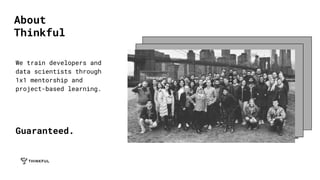
We train developers and
data scientists through
1x1 mentorship and
project-based learning.
Guaranteed.
About
Thinkful
There is more data available than ever
before. But just how much more…?
Why
is
Data
Science
a Thing?
➔ 90% of the data in the world today has been created
in the last two years alone [IBM, May 2013]
➔ Google, on average, processes more the 40,000
searched PER SECOND [Forbes, May 2018]
➔ Every minute: [Forbes, May 2018]
◆ Users watch 4,146,600 YouTube videos
◆ We send 16 million text messages
◆ There are 990,000 Tinder swipes
◆ Venmo processes $51,892 peer-to-peer transactions
BIG
Data
➔ Data science is the process of taking all
that information and turns it into
something valuable.
➔ What can that be?
◆ Anything that helps improve the
function or knowledge of a company,
individual, or other entity
● Data Wrangling
● Analytics
● Predictions
What
is
Data
Science?
Data
Wrangling
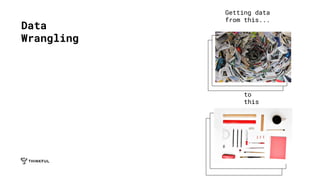
Getting data
from this...
to
this
➔ It’s really about making data
organized and workable
➔ Data’s often things like:
◆ Web pages
◆ Text
◆ Pictures
◆ ‘Event Streams’
➔ You need it to be
◆ A table
Data
Wrangling
Who? What? When? Where?
➔ Essential questions for ‘What’s
going on?’
➔ After the fact analysis
➔ Involves a lot of
◆ Statistics
◆ Summaries
◆ Visualization
➔ This is an essential step for
almost every data science
project
Analytics
How? What will happen next?
➔ Modeling and Machine Learning
➔ Algorithms
➔ Artificial Intelligence
This is the fun stuff… But it only
works if you do the other things well.
Modeling
+
Prediction
➔ The Researcher
➔ The AI or Automation Guru
➔ The Statistician
➔ The Super Analyst
These are just general types. In
reality a lot of people mix these
skills together, but these are
four of the strongest ‘archetypes’
The
Four
Types
of
Data
Scientist
➔ The Researcher
➔ The AI or Automation Guru
➔ The Statistician
➔ The Super Analyst
These are just general types. In
reality a lot of people mix these
skills together, but these are
four of the strongest ‘archetypes’
The
Researcher:
Who
Are
They?
➔ Research at big companies
◆ Google, Microsoft, etc
all have research
departments
➔ Still in academia
➔ Government agencies
➔ Very specific startups or
consultancies
The
Researcher:
Where
Are
They?
➔ Building highly specialized
products on the cutting edge
◆ The first facial
recognition software
◆ Self driving cars
The
Researcher:
What Do
They Do?
➔ Get a PhD or other graduate
degree (but probably a PhD)
➔ Then learn to code
The
Researcher:
How Can
I Do It?
➔ They love to code
◆ Not just how to use the package
◆ Build from scratch
➔ Know multiple programming languages
◆ Python and R
➔ Say things like: ‘Let me automate
that for you…’
The
AI
Guru:
Who
Are
They?
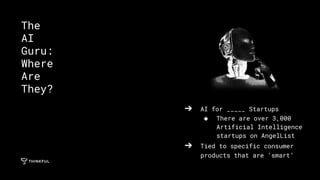
➔ AI for _____ Startups
◆ There are over 3,000
Artificial Intelligence
startups on AngelList
➔ Tied to specific consumer
products that are ‘smart’
The
AI
Guru:
Where
Are
They?
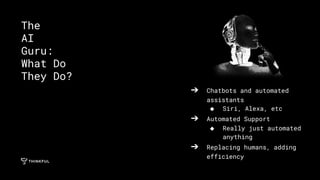
➔ Chatbots and automated
assistants
◆ Siri, Alexa, etc
➔ Automated Support
◆ Really just automated
anything
➔ Replacing humans, adding
efficiency
The
AI
Guru:
What Do
They Do?
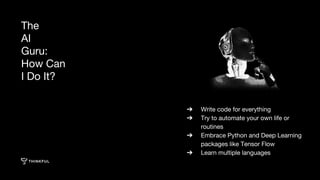
➔ Write code for everything
➔ Try to automate your own life or
routines
➔ Embrace Python and Deep Learning
packages like Tensor Flow
➔ Learn multiple languages
The
AI
Guru:
How Can
I Do It?
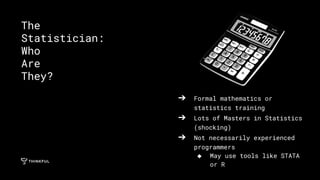
➔ Formal mathematics or
statistics training
➔ Lots of Masters in Statistics
(shocking)
➔ Not necessarily experienced
programmers
◆ May use tools like STATA
or R
The
Statistician:
Who
Are
They?
➔ Statistical consultants
◆ Political polling as an
example
➔ Experimentation experts
◆ A/B testing and far, far
beyond
◆ Optimizely’s development
team
The
Statistician:
Where
Are
They?
➔ Easy experimental frameworks
for marketing
➔ Statistical testing for
growth
➔ Answer statistical questions
◆ Are these things
different?
◆ Which is best?
➔ Usually don’t build products
The
Statistician:
What Do
They Do?
➔ Study the math
◆ Elements of Statistical Learning is
a great place to start
➔ Maybe go get a Master’s
The
Statistician:
How Can
I Do It?
➔ This is the fastest growing section
of data science
➔ Bachelor’s degrees, some Master's
➔ Love number and products, and want
to put the two together
➔ Expert problem solvers
◆ and can communicate those
solutions
The footsoldiers of the data science
revolution...
The
Super
Analyst:
Who
Are
They?
➔ Every company that generates data
◆ Every app and website records
enormous amounts of data
◆ These are the data scientists
that work with those places to
find out what can be learned
from that data
➔ So basically everywhere...
The
Super
Analyst:
Where
Are
They?
➔ Learn to code
➔ Immerse yourself in data
➔ Learn some basic Machine Learning
➔ Get building!
The
Super
Analyst:
How
Can I
Do It?
➔ Biology and the sciences use a
lot of these skills
◆ But it’s not quite as big of
a field
◆ And it almost always requires
some background in the field
➔ That said, Data Science tools are
super valuable for them too
BioStats
and
Data
Science
➔ No one is just one of these things
➔ But… Data Scientists are often
T-Shaped
➔ That means they can do a little of
everything, but they are more like
one of these types than the others
The
Truth
Yes!
But you want to be smart about what
kind of data scientist you want to
be...
Can I
Be a
Data
Scientist?
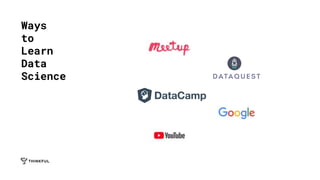
Ways
to
Learn
Data
Science
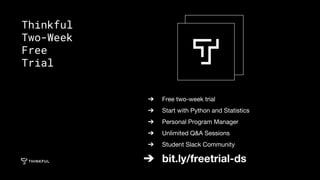
➔ Free two-week trial
➔ Start with Python and Statistics
➔ Personal Program Manager
➔ Unlimited Q&A Sessions
➔ Student Slack Community
➔
Thinkful
Two-Week
Free
Trial
The
Student
Experience
Marnie Boyer, Thinkful Graduate
Capstone
Wolfgang Hall, Thinkful Graduate
Capstone

Tf wiads

  • 1.
  • 2.
    Introductions ➔ What's yourname? ➔ What brought you here today? ➔ What is your programming experience?
  • 3.
    We train developersand data scientists through 1x1 mentorship and project-based learning. Guaranteed. About Thinkful
  • 4.
    There is moredata available than ever before. But just how much more…? Why is Data Science a Thing?
  • 5.
    ➔ 90% ofthe data in the world today has been created in the last two years alone [IBM, May 2013] ➔ Google, on average, processes more the 40,000 searched PER SECOND [Forbes, May 2018] ➔ Every minute: [Forbes, May 2018] ◆ Users watch 4,146,600 YouTube videos ◆ We send 16 million text messages ◆ There are 990,000 Tinder swipes ◆ Venmo processes $51,892 peer-to-peer transactions BIG Data
  • 6.
    ➔ Data scienceis the process of taking all that information and turns it into something valuable. ➔ What can that be? ◆ Anything that helps improve the function or knowledge of a company, individual, or other entity ● Data Wrangling ● Analytics ● Predictions What is Data Science?
  • 7.
  • 8.
    ➔ It’s reallyabout making data organized and workable ➔ Data’s often things like: ◆ Web pages ◆ Text ◆ Pictures ◆ ‘Event Streams’ ➔ You need it to be ◆ A table Data Wrangling
  • 9.
    Who? What? When?Where? ➔ Essential questions for ‘What’s going on?’ ➔ After the fact analysis ➔ Involves a lot of ◆ Statistics ◆ Summaries ◆ Visualization ➔ This is an essential step for almost every data science project Analytics
  • 10.
    How? What willhappen next? ➔ Modeling and Machine Learning ➔ Algorithms ➔ Artificial Intelligence This is the fun stuff… But it only works if you do the other things well. Modeling + Prediction
  • 11.
    ➔ The Researcher ➔The AI or Automation Guru ➔ The Statistician ➔ The Super Analyst These are just general types. In reality a lot of people mix these skills together, but these are four of the strongest ‘archetypes’ The Four Types of Data Scientist
  • 12.
    ➔ The Researcher ➔The AI or Automation Guru ➔ The Statistician ➔ The Super Analyst These are just general types. In reality a lot of people mix these skills together, but these are four of the strongest ‘archetypes’ The Researcher: Who Are They?
  • 13.
    ➔ Research atbig companies ◆ Google, Microsoft, etc all have research departments ➔ Still in academia ➔ Government agencies ➔ Very specific startups or consultancies The Researcher: Where Are They?
  • 14.
    ➔ Building highlyspecialized products on the cutting edge ◆ The first facial recognition software ◆ Self driving cars The Researcher: What Do They Do?
  • 15.
    ➔ Get aPhD or other graduate degree (but probably a PhD) ➔ Then learn to code The Researcher: How Can I Do It?
  • 16.
    ➔ They loveto code ◆ Not just how to use the package ◆ Build from scratch ➔ Know multiple programming languages ◆ Python and R ➔ Say things like: ‘Let me automate that for you…’ The AI Guru: Who Are They?
  • 17.
    ➔ AI for_____ Startups ◆ There are over 3,000 Artificial Intelligence startups on AngelList ➔ Tied to specific consumer products that are ‘smart’ The AI Guru: Where Are They?
  • 18.
    ➔ Chatbots andautomated assistants ◆ Siri, Alexa, etc ➔ Automated Support ◆ Really just automated anything ➔ Replacing humans, adding efficiency The AI Guru: What Do They Do?
  • 19.
    ➔ Write codefor everything ➔ Try to automate your own life or routines ➔ Embrace Python and Deep Learning packages like Tensor Flow ➔ Learn multiple languages The AI Guru: How Can I Do It?
  • 20.
    ➔ Formal mathematicsor statistics training ➔ Lots of Masters in Statistics (shocking) ➔ Not necessarily experienced programmers ◆ May use tools like STATA or R The Statistician: Who Are They?
  • 21.
    ➔ Statistical consultants ◆Political polling as an example ➔ Experimentation experts ◆ A/B testing and far, far beyond ◆ Optimizely’s development team The Statistician: Where Are They?
  • 22.
    ➔ Easy experimentalframeworks for marketing ➔ Statistical testing for growth ➔ Answer statistical questions ◆ Are these things different? ◆ Which is best? ➔ Usually don’t build products The Statistician: What Do They Do?
  • 23.
    ➔ Study themath ◆ Elements of Statistical Learning is a great place to start ➔ Maybe go get a Master’s The Statistician: How Can I Do It?
  • 24.
    ➔ This isthe fastest growing section of data science ➔ Bachelor’s degrees, some Master's ➔ Love number and products, and want to put the two together ➔ Expert problem solvers ◆ and can communicate those solutions The footsoldiers of the data science revolution... The Super Analyst: Who Are They?
  • 25.
    ➔ Every companythat generates data ◆ Every app and website records enormous amounts of data ◆ These are the data scientists that work with those places to find out what can be learned from that data ➔ So basically everywhere... The Super Analyst: Where Are They?
  • 26.
    ➔ Learn tocode ➔ Immerse yourself in data ➔ Learn some basic Machine Learning ➔ Get building! The Super Analyst: How Can I Do It?
  • 27.
    ➔ Biology andthe sciences use a lot of these skills ◆ But it’s not quite as big of a field ◆ And it almost always requires some background in the field ➔ That said, Data Science tools are super valuable for them too BioStats and Data Science
  • 28.
    ➔ No oneis just one of these things ➔ But… Data Scientists are often T-Shaped ➔ That means they can do a little of everything, but they are more like one of these types than the others The Truth
  • 29.
    Yes! But you wantto be smart about what kind of data scientist you want to be... Can I Be a Data Scientist?
  • 30.
  • 31.
    ➔ Free two-weektrial ➔ Start with Python and Statistics ➔ Personal Program Manager ➔ Unlimited Q&A Sessions ➔ Student Slack Community ➔ Thinkful Two-Week Free Trial
  • 32.
    The Student Experience Marnie Boyer, ThinkfulGraduate Capstone Wolfgang Hall, Thinkful Graduate Capstone