Landing a
Career in Data
Science
By: Parul Pandey
When choosing a career in
Data Science , there are safe
routes to pursue, and there
are risky ones.
However, no matter which path
we choose, there are ample
career opportunities out there for
anyone interested in data.
But, how do we actually get started?
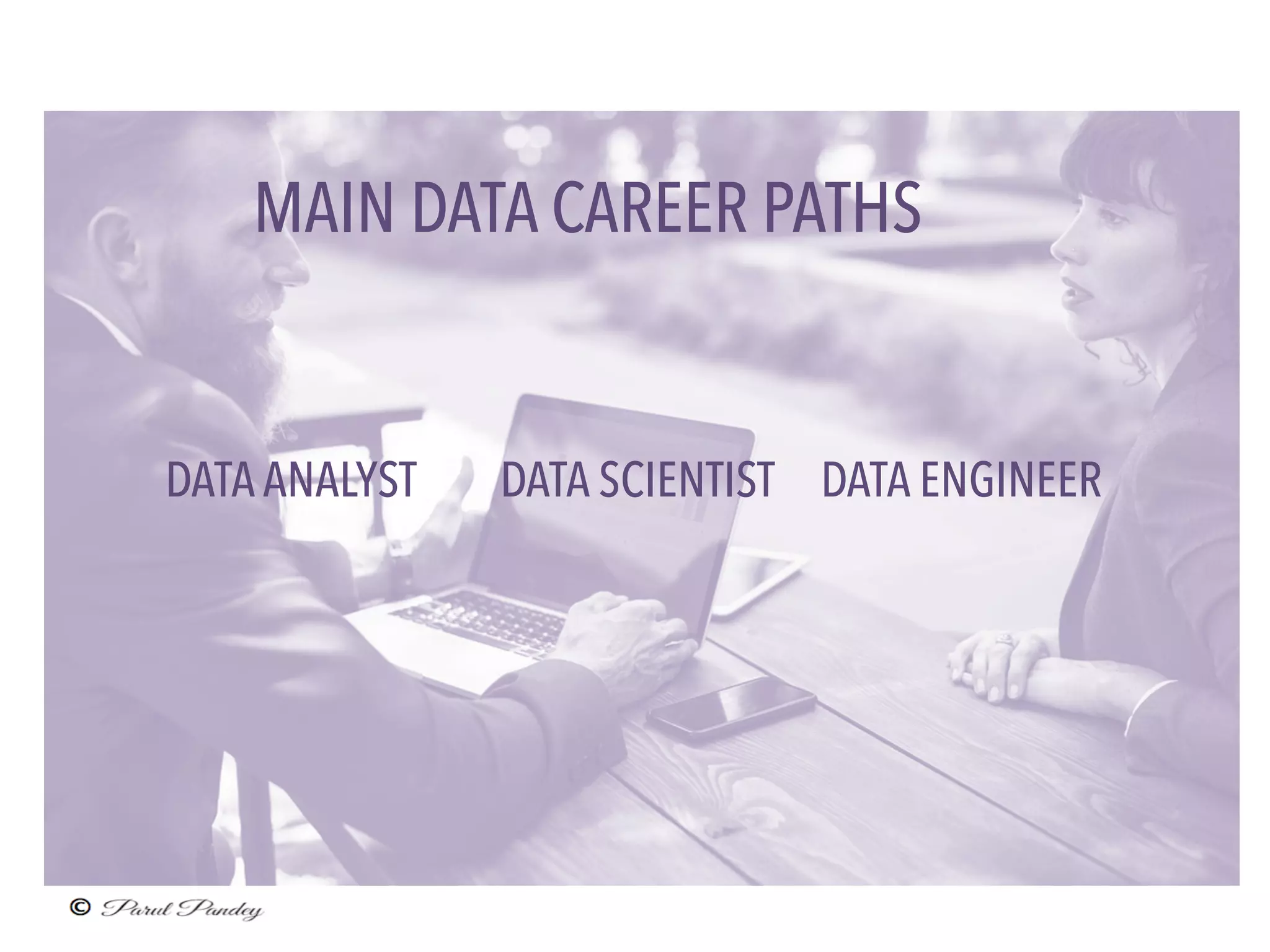
MAIN DATA CAREER PATHS
DATA ANALYST DATA SCIENTIST DATA ENGINEER
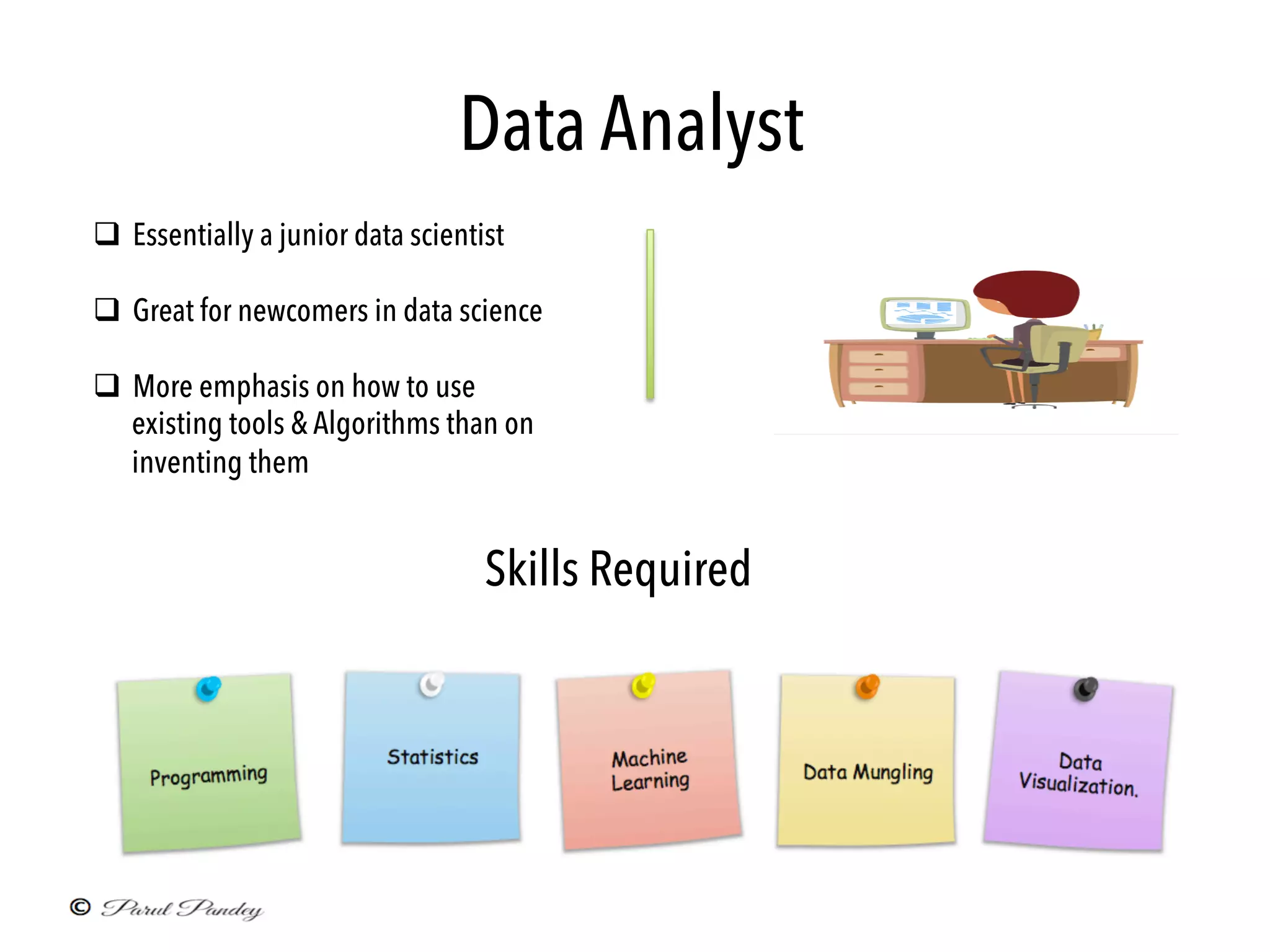
Data Analyst
q  Essentially a junior data scientist
q  Great for newcomers in data science
q  More emphasis on how to use
existing tools & Algorithms than on
inventing them
	
Skills Required
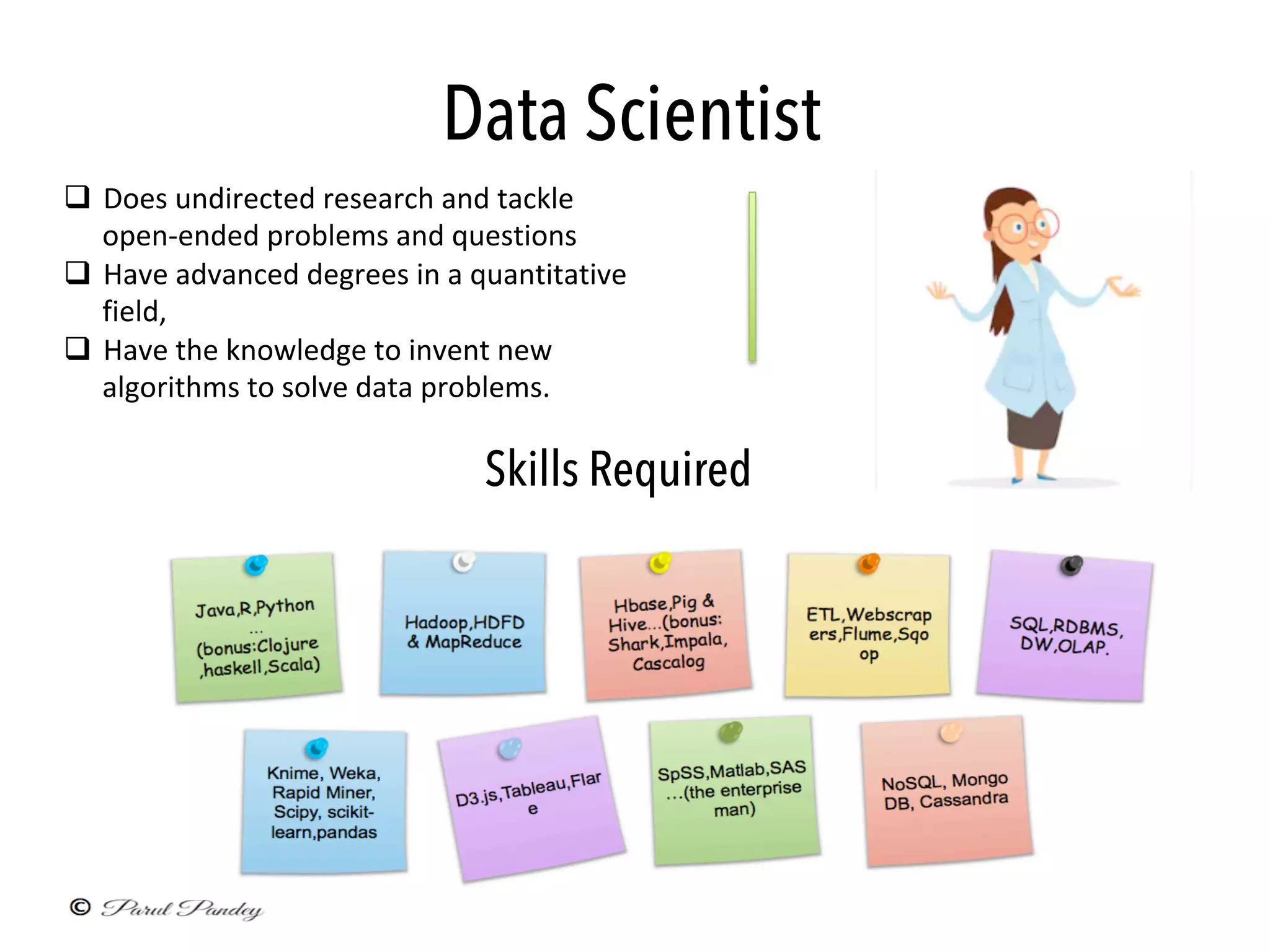
Data Scientist
q  Does	undirected	research	and	tackle	
open-ended	problems	and	questions	
q  Have	advanced	degrees	in	a	quantitative	
field,	
q  Have	the	knowledge	to	invent	new	
algorithms	to	solve	data	problems.		
	
Skills Required
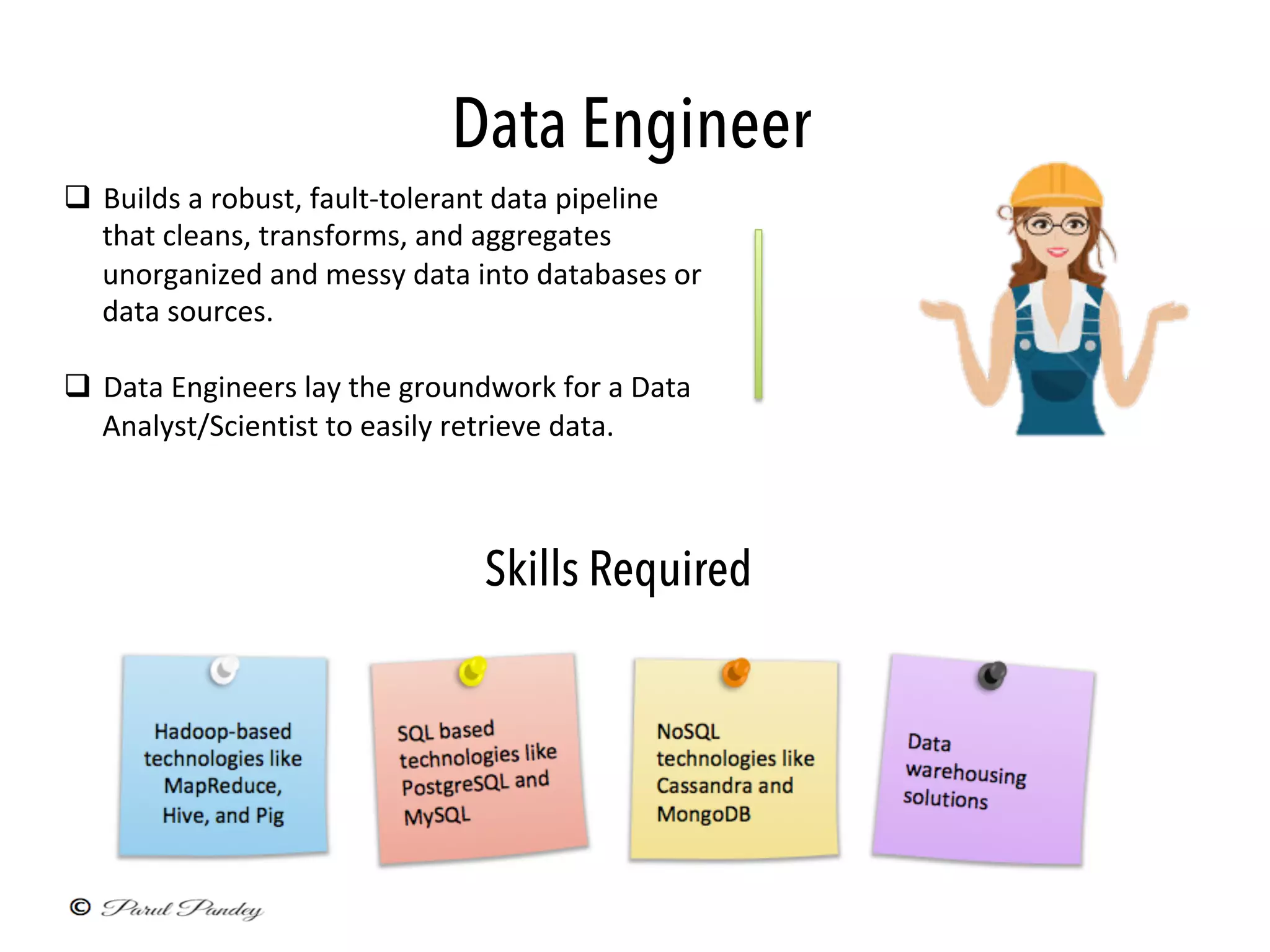
Data Engineer
q  Builds	a	robust,	fault-tolerant	data	pipeline	
that	cleans,	transforms,	and	aggregates	
unorganized	and	messy	data	into	databases	or	
data	sources.	
q  Data	Engineers	lay	the	groundwork	for	a	Data	
Analyst/Scientist	to	easily	retrieve	data.	
Skills Required
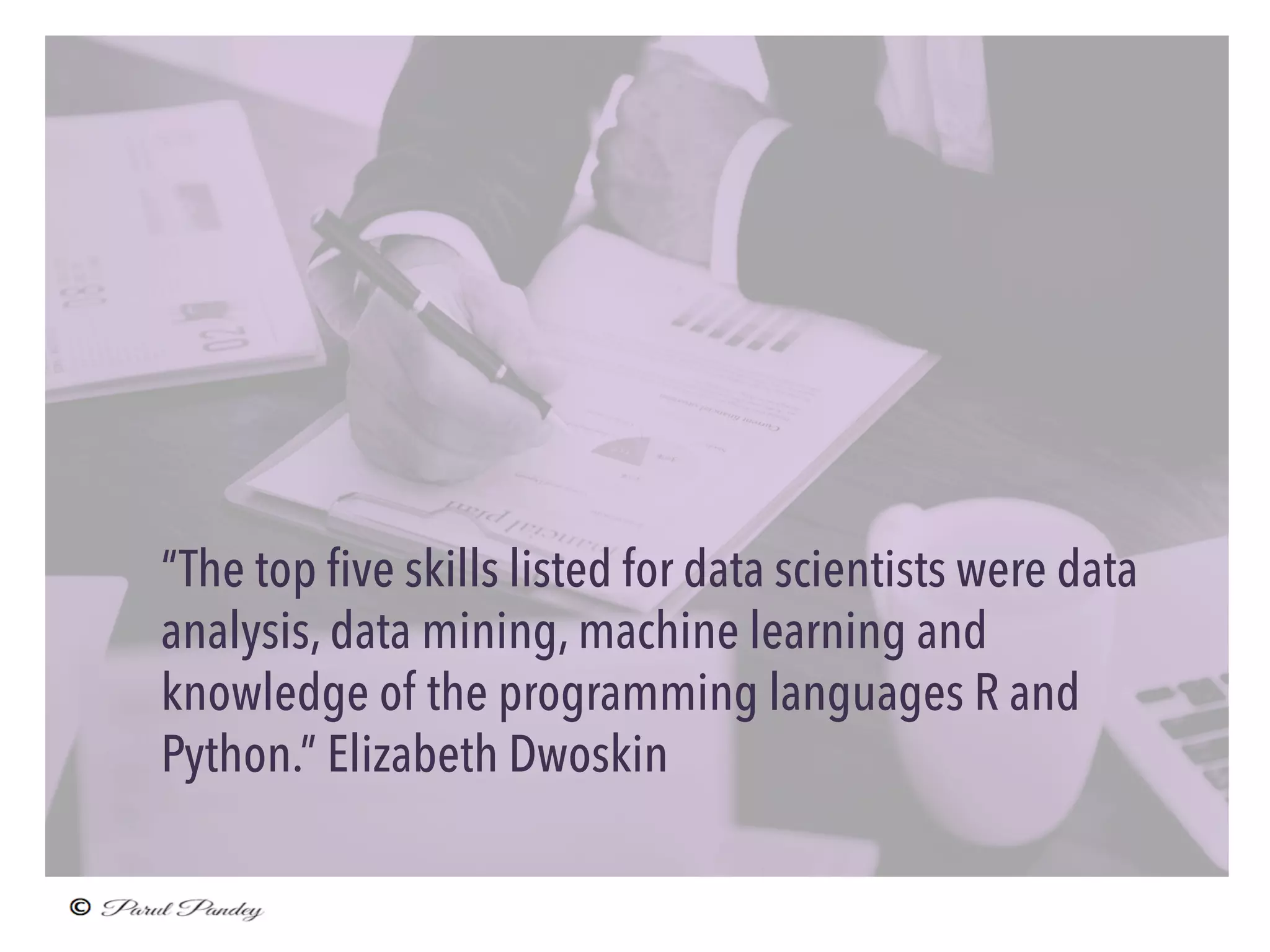
“The top five skills listed for data scientists were data
analysis, data mining, machine learning and
knowledge of the programming languages R and
Python.” Elizabeth Dwoskin
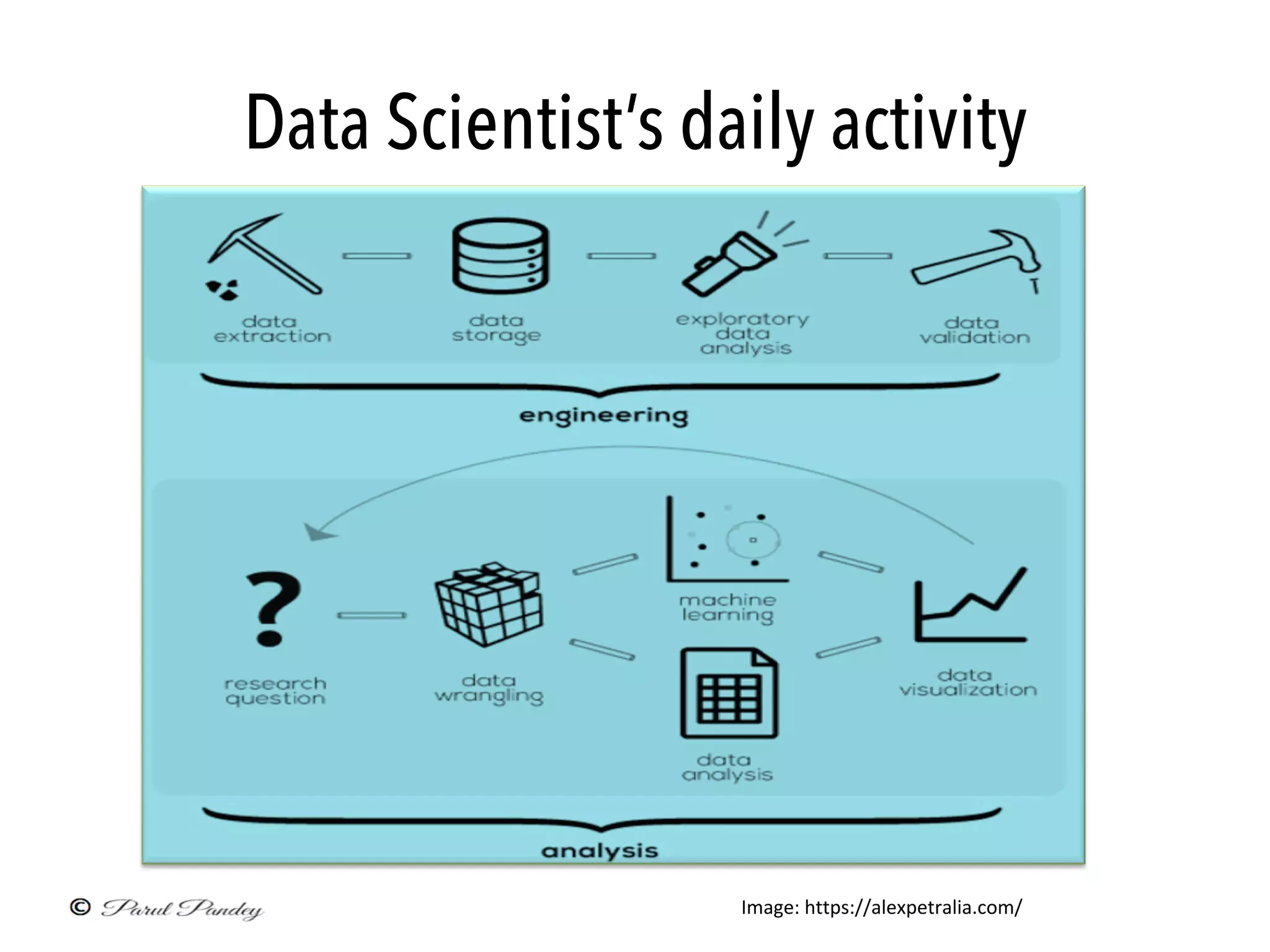
Data Scientist’s daily activity
Image:	https://alexpetralia.com/
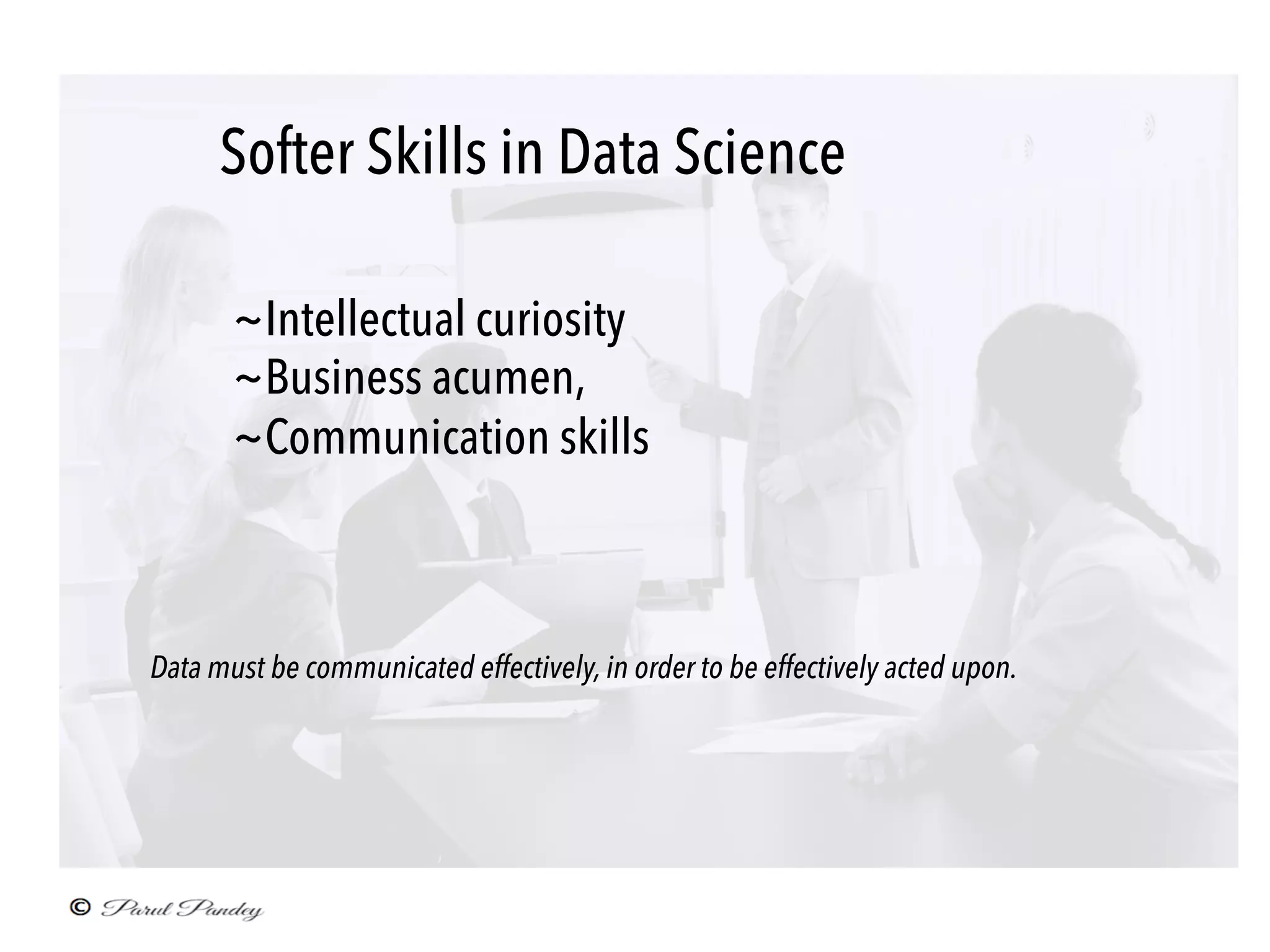
Softer Skills in Data Science	
~Intellectual curiosity
~Business acumen,
~Communication skills
	
Data must be communicated effectively, in order to be effectively acted upon.
ACING THE INTERVIEW
SHOW EVERYONE THATYOU’RE A GREAT FIT FOR THE JOB.
Some important topics and questions for interviews
+  What are the most important skills for a data scientist to have?
+  What types of data are important for business needs?
+  What data [at the company] would you go after and start working on?
+  Discuss various numerical optimization techniques.
+  Show understanding of training, testing, and validation of results.
+  Explain tradeoffs between different types of regression models and different types of classification
models.
+  What are the assumptions required for linear regression?
+  When you get a new data set, what do you do with it to see if it will suit your needs for a given project?
+  How do you handle big data sets?
+  How do you detect outliers?
+  How do you control model complexity?
+  How do you model a quantity you can’t observe?
12
BUILDING A PORTFOLIO
PRESENTING YOUR WORK AND PROJECTS
Tips for building a great Portfolio
+  Jupyter notebooks are an excellent tool for combining text, code, and images.
+  Notebooks can be converted to Markdown files for use with web frameworks, such as Pelican
+  Host your blog for free on GitHub.
+  Start with small Data Projects sourcing data from Kaggle, subreddit etc.
+  Kaggle also hosts ​data science competitions​ that are a great place to start
+  You can also go ​web scraping​ to collect data
Working on small data projects and putting them online can really support your career
objectives, especially since it shows employers that you love working with data and want to
continue improving yourself.
14
CONCLUSION
The most important thing
is to find data you are
interested in that creates
questions you want to
answer. So get out
there ,get your hands dirty
and have fun learning.
REFERENCES
https://blog.udacity.com/2017/06/data-career-guide.html

Landing a career in data science

  • 1.
    Landing a Career inData Science By: Parul Pandey
  • 2.
    When choosing acareer in Data Science , there are safe routes to pursue, and there are risky ones. However, no matter which path we choose, there are ample career opportunities out there for anyone interested in data.
  • 3.
    But, how dowe actually get started?
  • 4.
    MAIN DATA CAREERPATHS DATA ANALYST DATA SCIENTIST DATA ENGINEER
  • 5.
    Data Analyst q  Essentiallya junior data scientist q  Great for newcomers in data science q  More emphasis on how to use existing tools & Algorithms than on inventing them Skills Required
  • 6.
    Data Scientist q  Does undirected research and tackle open-ended problems and questions q Have advanced degrees in a quantitative field, q  Have the knowledge to invent new algorithms to solve data problems. Skills Required
  • 7.
  • 8.
    “The top fiveskills listed for data scientists were data analysis, data mining, machine learning and knowledge of the programming languages R and Python.” Elizabeth Dwoskin
  • 9.
    Data Scientist’s dailyactivity Image: https://alexpetralia.com/
  • 10.
    Softer Skills inData Science ~Intellectual curiosity ~Business acumen, ~Communication skills Data must be communicated effectively, in order to be effectively acted upon.
  • 11.
    ACING THE INTERVIEW SHOWEVERYONE THATYOU’RE A GREAT FIT FOR THE JOB.
  • 12.
    Some important topicsand questions for interviews +  What are the most important skills for a data scientist to have? +  What types of data are important for business needs? +  What data [at the company] would you go after and start working on? +  Discuss various numerical optimization techniques. +  Show understanding of training, testing, and validation of results. +  Explain tradeoffs between different types of regression models and different types of classification models. +  What are the assumptions required for linear regression? +  When you get a new data set, what do you do with it to see if it will suit your needs for a given project? +  How do you handle big data sets? +  How do you detect outliers? +  How do you control model complexity? +  How do you model a quantity you can’t observe? 12
  • 13.
    BUILDING A PORTFOLIO PRESENTINGYOUR WORK AND PROJECTS
  • 14.
    Tips for buildinga great Portfolio +  Jupyter notebooks are an excellent tool for combining text, code, and images. +  Notebooks can be converted to Markdown files for use with web frameworks, such as Pelican +  Host your blog for free on GitHub. +  Start with small Data Projects sourcing data from Kaggle, subreddit etc. +  Kaggle also hosts ​data science competitions​ that are a great place to start +  You can also go ​web scraping​ to collect data Working on small data projects and putting them online can really support your career objectives, especially since it shows employers that you love working with data and want to continue improving yourself. 14
  • 15.
    CONCLUSION The most importantthing is to find data you are interested in that creates questions you want to answer. So get out there ,get your hands dirty and have fun learning.
  • 16.