LESSON 1
TEXT AS CONNECTED
DISCOURSE
MS. MARIA RUFFA IRINCO
•A text is generally considered
as written material, especially
longer pieces of writing as in a
book, a letter or a newspaper.
Discourse is generally
regarded as spoken. Jorgensen
and Phillips put forth the
qualities of a text as:
• 1. Cohesion. The parts are connected.
• 2. Coherence. The overall text has
meaning.
• 3. Intentionality. The writer’s attitude
and purpose can be discerned.
• 4. Acceptability. The text is recognized.
•5. Informativity. There is a
quantity of new or expected info.
•6. Situationality. The text’s topic is
situationally and culturally
appropriate.
•7. Intertextuality. The text can be
linked to preceeding discourse.
Written text is also
described as written
discourse, especially
when a simple analysis
of it reveals that is
connected discourse.
Written text acquires the characteristics of
connected discourse when:
• 1. Its ideas are linked logically.
Here are some steps to make a logical division of idea
paragraph:
a. Begin a logical division paragraph with a topic
sentence.
b. In the supporting sentences, discuss each point one
after the other.
c. Introduce each new point with a signal word or
phrase.
d. In addition, support each point with a convincing
detail such as an example or statistic (numbers,
amounts, percentages, etc).
e. Finally, end a logical division paragraph with a
concluding sentence.
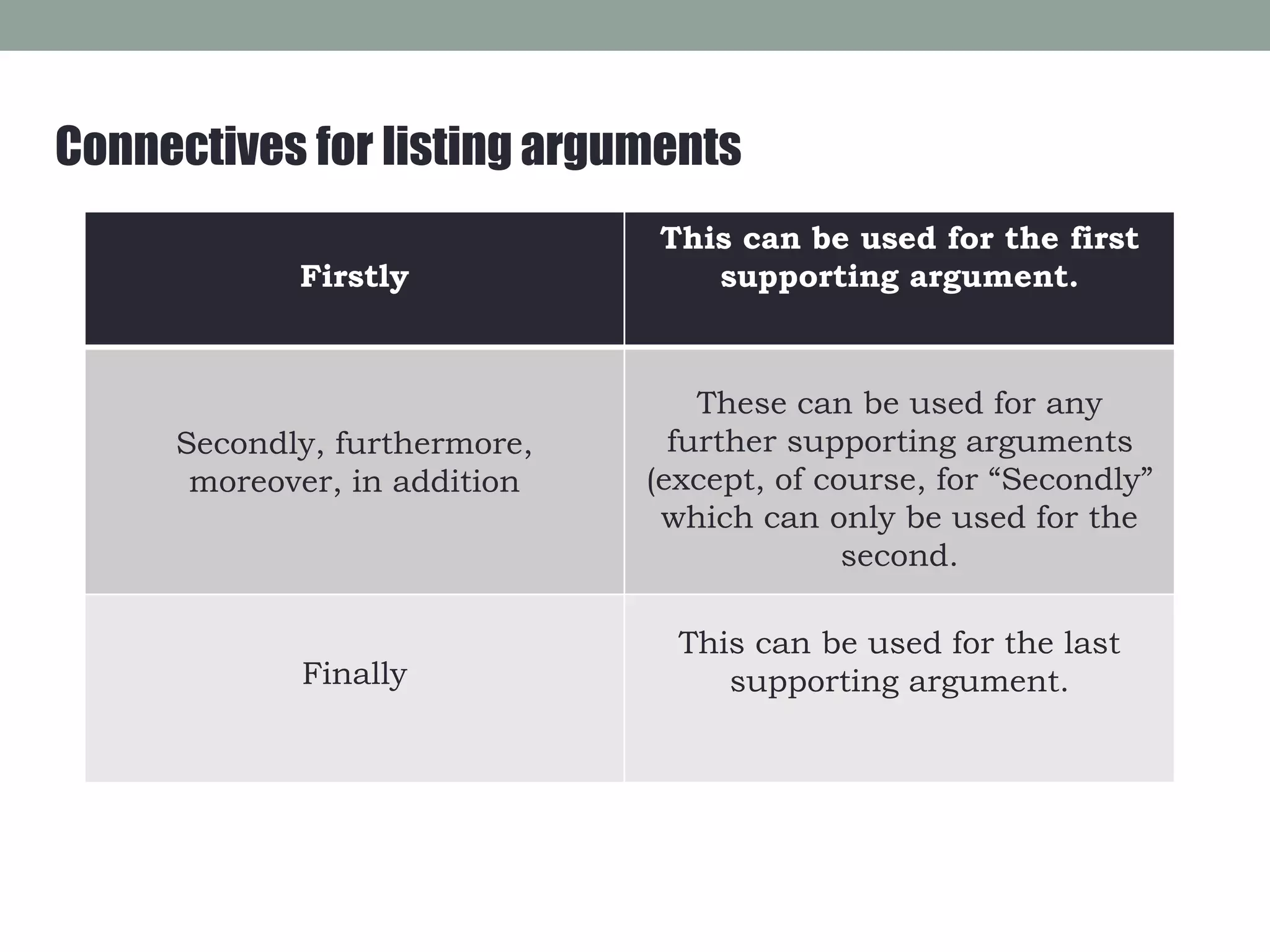
Connectives for listing arguments
Firstly
This can be used for the first
supporting argument.
Secondly, furthermore,
moreover, in addition
These can be used for any
further supporting arguments
(except, of course, for “Secondly”
which can only be used for the
second.
Finally
This can be used for the last
supporting argument.
Concluding Connectives
Three common concluding connectives are:
In conclusion
These all carry roughly the same
meaning. They should be used to
indicate that you are making final
statements that cover all the
supporting arguments in a very
general way.
In summary
Thus
In fact/Indeed
These two connectives have almost the
same meaning and both can be used in
the following situations:
1.To connect a more detailed
statement with a preceding general
statement
Example: Today is very warm. In fact (or
Indeed) it is 35 degrees Celsius.
2. To connect a statement which is
more factual and exact with a
preceding statement that is more
debatable and general.
Example: The internet is very popular
in Australia. Indeed (or In fact),
Australia has the highest proportion
of Internet users per head of
population of any country in the
world.

Text_as_a_Connected_Discourse.pptx

  • 1.
    LESSON 1 TEXT ASCONNECTED DISCOURSE MS. MARIA RUFFA IRINCO
  • 2.
    •A text isgenerally considered as written material, especially longer pieces of writing as in a book, a letter or a newspaper. Discourse is generally regarded as spoken. Jorgensen and Phillips put forth the qualities of a text as:
  • 3.
    • 1. Cohesion.The parts are connected. • 2. Coherence. The overall text has meaning. • 3. Intentionality. The writer’s attitude and purpose can be discerned. • 4. Acceptability. The text is recognized.
  • 4.
    •5. Informativity. Thereis a quantity of new or expected info. •6. Situationality. The text’s topic is situationally and culturally appropriate. •7. Intertextuality. The text can be linked to preceeding discourse.
  • 5.
    Written text isalso described as written discourse, especially when a simple analysis of it reveals that is connected discourse.
  • 6.
    Written text acquiresthe characteristics of connected discourse when: • 1. Its ideas are linked logically. Here are some steps to make a logical division of idea paragraph: a. Begin a logical division paragraph with a topic sentence. b. In the supporting sentences, discuss each point one after the other. c. Introduce each new point with a signal word or phrase. d. In addition, support each point with a convincing detail such as an example or statistic (numbers, amounts, percentages, etc). e. Finally, end a logical division paragraph with a concluding sentence.
  • 7.
    Connectives for listingarguments Firstly This can be used for the first supporting argument. Secondly, furthermore, moreover, in addition These can be used for any further supporting arguments (except, of course, for “Secondly” which can only be used for the second. Finally This can be used for the last supporting argument.
  • 8.
    Concluding Connectives Three commonconcluding connectives are: In conclusion These all carry roughly the same meaning. They should be used to indicate that you are making final statements that cover all the supporting arguments in a very general way. In summary Thus
  • 9.
    In fact/Indeed These twoconnectives have almost the same meaning and both can be used in the following situations: 1.To connect a more detailed statement with a preceding general statement Example: Today is very warm. In fact (or Indeed) it is 35 degrees Celsius.
  • 10.
    2. To connecta statement which is more factual and exact with a preceding statement that is more debatable and general. Example: The internet is very popular in Australia. Indeed (or In fact), Australia has the highest proportion of Internet users per head of population of any country in the world.