Text as Connected Discourse
How will you
put the
elephant in the
fridge in three
(3) easy steps?
How will you
put the giraffe
in the fridge in
four (4) easy
steps?
The King of the
jungle calls for a
meeting, who
do you think will
not be able to
attend?
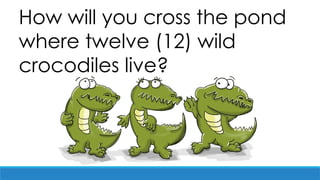
How will you cross the pond
where twelve (12) wild
crocodiles live?
Anton: There’s a Roman guy
who goes to a bar, holds up
his two fingers and says
“five beers please!”
Anton: What did the fish say
when he was cooked?
“I’m daing!”
(I’m dying)
Anton: How about when he
was torn in two?
“I’m two-na!”
(I’m already 2)
Were you able to
understand the jokes
cracked by Anton?
How were you able to
understand the
jokes?
It is our knowledge on
how sentences are formed as
well as our knowledge about
the topic enable us to
understand such discourse.
Text
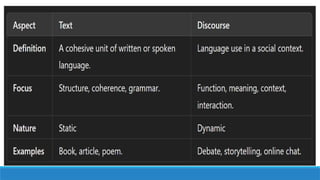
•A text refers to any written or spoken piece
of language that forms a cohesive whole. It
can be as short as a single sentence or as
long as a book.
•Texts are static; they exist as tangible
entities (e.g., a letter, a story, a poem, an
email, a report).
•They are focused on structure and
content, often analyzed in terms of
grammar, syntax, and coherence.
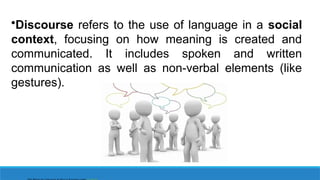
•Discourse refers to the use of language in a social
context, focusing on how meaning is created and
communicated. It includes spoken and written
communication as well as non-verbal elements (like
gestures).
•Discourse is dynamic, as it involves
interaction and interpretation. It is concerned
with the function of language rather than
just its structure.
•Analyzing discourse often involves
examining the purpose, audience, and
cultural context of the communication.
A text is called a connected discourse
because it’s made up of sentences or
ideas that are linked together to create
meaning. Think of it like a puzzle where
every piece fits and helps tell a story,
explain something, or share a message.
1.Everything fits together
The sentences are connected so
they make sense as a whole.
Words like and, because, or then
help tie ideas together.
2. It makes sense:
•The ideas flow in a logical way,
like steps in a recipe or scenes in
a story.
3.It has a purpose:
•A text always has a goal, like
informing you, making you laugh,
or convincing you to agree with
something.
1. Can we talk about random
things all at the same time
and expect to understand
each other? If yes, why? If
no, why not?
A text should always
have unity, coherence,
and emphasis.
2. How will you achieve
unity, coherence, and
emphasis in writing a
text?
3. Can you separate the
text from context?
Explain.
Context refers to the
situation giving rise to
the discourse and within
which the discourse is
embedded.
YOUR Turn
Think of 3 knock knock or
pick up lines in English
and present it to the
class.

READING AND WRITING-Text as connected discourse.pptx

  • 1.
  • 2.
    How will you putthe elephant in the fridge in three (3) easy steps?
  • 3.
    How will you putthe giraffe in the fridge in four (4) easy steps?
  • 4.
    The King ofthe jungle calls for a meeting, who do you think will not be able to attend?
  • 5.
    How will youcross the pond where twelve (12) wild crocodiles live?
  • 7.
    Anton: There’s aRoman guy who goes to a bar, holds up his two fingers and says “five beers please!”
  • 8.
    Anton: What didthe fish say when he was cooked? “I’m daing!” (I’m dying)
  • 9.
    Anton: How aboutwhen he was torn in two? “I’m two-na!” (I’m already 2)
  • 10.
    Were you ableto understand the jokes cracked by Anton?
  • 11.
    How were youable to understand the jokes?
  • 12.
    It is ourknowledge on how sentences are formed as well as our knowledge about the topic enable us to understand such discourse.
  • 13.
    Text •A text refersto any written or spoken piece of language that forms a cohesive whole. It can be as short as a single sentence or as long as a book. •Texts are static; they exist as tangible entities (e.g., a letter, a story, a poem, an email, a report).
  • 14.
    •They are focusedon structure and content, often analyzed in terms of grammar, syntax, and coherence.
  • 15.
    •Discourse refers tothe use of language in a social context, focusing on how meaning is created and communicated. It includes spoken and written communication as well as non-verbal elements (like gestures).
  • 16.
    •Discourse is dynamic,as it involves interaction and interpretation. It is concerned with the function of language rather than just its structure. •Analyzing discourse often involves examining the purpose, audience, and cultural context of the communication.
  • 18.
    A text iscalled a connected discourse because it’s made up of sentences or ideas that are linked together to create meaning. Think of it like a puzzle where every piece fits and helps tell a story, explain something, or share a message.
  • 19.
    1.Everything fits together Thesentences are connected so they make sense as a whole. Words like and, because, or then help tie ideas together.
  • 20.
    2. It makessense: •The ideas flow in a logical way, like steps in a recipe or scenes in a story.
  • 21.
    3.It has apurpose: •A text always has a goal, like informing you, making you laugh, or convincing you to agree with something.
  • 22.
    1. Can wetalk about random things all at the same time and expect to understand each other? If yes, why? If no, why not?
  • 23.
    A text shouldalways have unity, coherence, and emphasis.
  • 24.
    2. How willyou achieve unity, coherence, and emphasis in writing a text?
  • 25.
    3. Can youseparate the text from context? Explain.
  • 26.
    Context refers tothe situation giving rise to the discourse and within which the discourse is embedded.
  • 27.
    YOUR Turn Think of3 knock knock or pick up lines in English and present it to the class.

Editor's Notes

  • #5 How were you able to figure out the answers without any context provided? How do you validate your answers?
  • #24 By having one main idea and utilizing text forming devices.
  • #25 No. A context is always embedded in a text that makes is all connected. It could be linguistic context where one uses his/her knowledge about the use of language (e.g. grammar/tenses). Situational Context refers to ones knowledge or awareness of the setting.