CHAPTER 1 :
STIMULUS AND RESPONSE
SCIENCE FORM 3
BY TEACHER HAYATI, SIGS JB
1.1 HUMAN NERVOUS SYSTEM
HUMAN NERVOUS SYSTEM
• The human nervous system is an
important control system in body
coordination.
• Other than sight, thinking and body
movement, the human nervous system
also controls and coordinates organ
functions in the body and maintains a
balanced internal environment through a
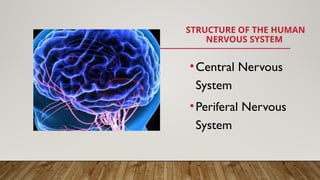
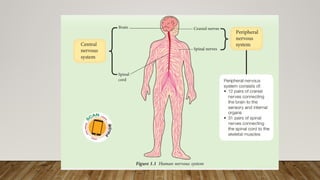
STRUCTURE OF THE HUMAN
NERVOUS SYSTEM
•Central Nervous
System
•Periferal Nervous
System
FUNCTIONS
OF THE
HUMAN
NERVOUS
SYSTEM
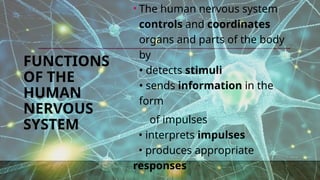
• The human nervous system
controls and coordinates
organs and parts of the body
by
• detects stimuli
• sends information in the
form
of impulses
• interprets impulses
• produces appropriate
responses
VOLUNTARY AND
INVOLUNTARY ACTIONS
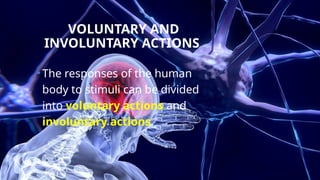
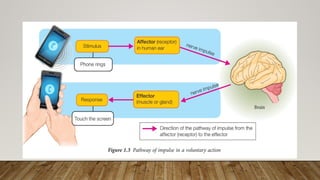
•The responses of the human
body to stimuli can be divided
into voluntary actions and
involuntary actions.
VOLUNTARY ACTIONS
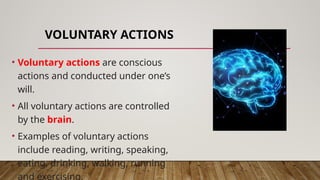
• Voluntary actions are conscious
actions and conducted under one’s
will.
• All voluntary actions are controlled
by the brain.
• Examples of voluntary actions
include reading, writing, speaking,
eating, drinking, walking, running
and exercising.
VOLUNTARY ACTIONS
INVOLUNTARY
ACTIONS
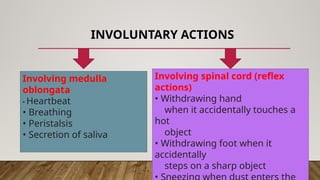
•Involuntary actions are
actions that occur
immediately
without conscious
control or prior
thoughts.
•Involuntary actions can be
classified into two.
INVOLUNTARY ACTIONS
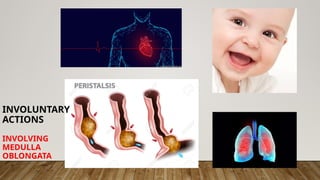
Involving medulla
oblongata
• Heartbeat
• Breathing
• Peristalsis
• Secretion of saliva
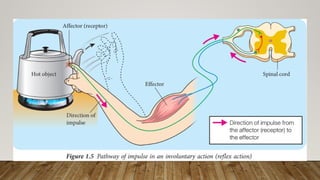
Involving spinal cord (reflex
actions)
• Withdrawing hand
when it accidentally touches a
hot
object
• Withdrawing foot when it
accidentally
steps on a sharp object
INVOLUNTARY
ACTIONS
INVOLVING
MEDULLA
OBLONGATA
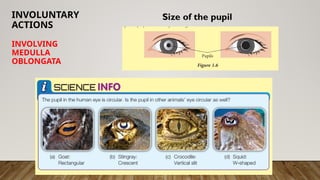
INVOLUNTARY
ACTIONS
INVOLVING
MEDULLA
OBLONGATA
Size of the pupil
INVOLUNTARY ACTIONS
INVOLVING SPINAL CORD
(REFLEX ACTIONS)
IMPORTANCE OF THE NETWORK OF
HUMAN NERVOUS SYSTEM IN DAILY
LIFE
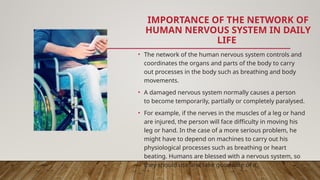
• The network of the human nervous system controls and
coordinates the organs and parts of the body to carry
out processes in the body such as breathing and body
movements.
• A damaged nervous system normally causes a person
to become temporarily, partially or completely paralysed.
• For example, if the nerves in the muscles of a leg or hand
are injured, the person will face difficulty in moving his
leg or hand. In the case of a more serious problem, he
might have to depend on machines to carry out his
physiological processes such as breathing or heart
beating. Humans are blessed with a nervous system, so
they should use and take good care of it.
1.2 STIMULI AND
RESPONSES IN HUMANS
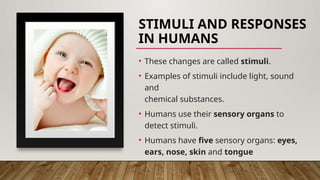
STIMULI AND RESPONSES
IN HUMANS
• These changes are called stimuli.
• Examples of stimuli include light, sound
and
chemical substances.
• Humans use their sensory organs to
detect stimuli.
• Humans have five sensory organs: eyes,
ears, nose, skin and tongue
EYES
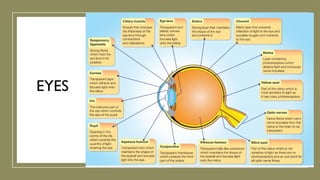
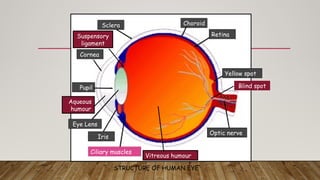
STRUCTURE OF HUMAN EYE
Ciliary muscles
Eye Lens
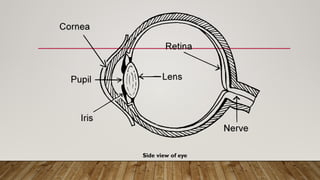
Iris
Pupil
Cornea
Sclera Choroid
Retina
Yellow spot
Optic nerve
Blind spot
Vitreous humour
Aqueous
humour
Suspensory
ligament
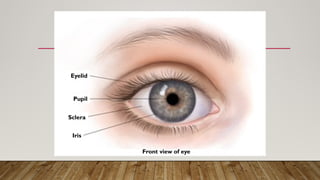
Front view of eye
Eyelid
Pupil
Sclera
Iris
Side view of eye
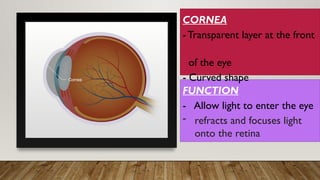
FUNCTION
- Allow light to enter the eye
- refracts and focuses light
onto the retina
CORNEA
-Transparent layer at the front
of the eye
- Curved shape
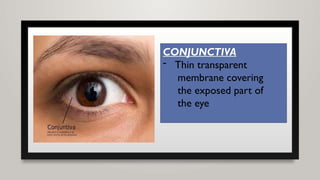
CONJUNCTIVA
- Thin transparent
membrane covering
the exposed part of
the eye
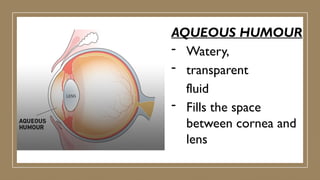
AQUEOUS HUMOUR
- Watery,
- transparent
fluid
- Fills the space
between cornea and
lens
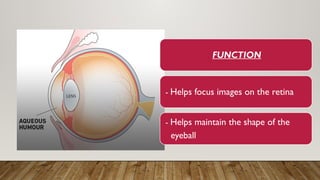
FUNCTION
- Helps focus images on the retina
- Helps maintain the shape of the
eyeball
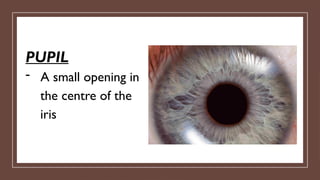
PUPIL
- A small opening in
the centre of the
iris
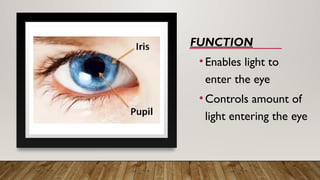
FUNCTION
•Enables light to
enter the eye
•Controls amount of
light entering the eye
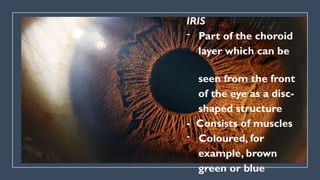
IRIS
- Part of the choroid
layer which can be
seen from the front
of the eye as a disc-
shaped structure
- Consists of muscles
- Coloured, for
example, brown
green or blue
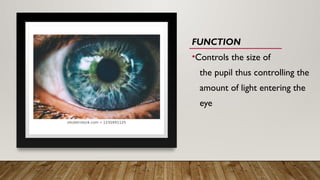
FUNCTION
•Controls the size of
the pupil thus controlling the
amount of light entering the
eye
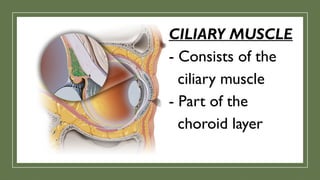
CILIARY MUSCLE
- Consists of the
ciliary muscle
- Part of the
choroid layer
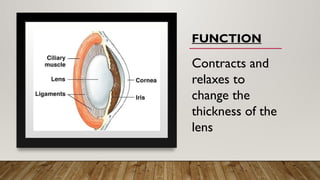
Contracts and
relaxes to
change the
thickness of the
lens
FUNCTION
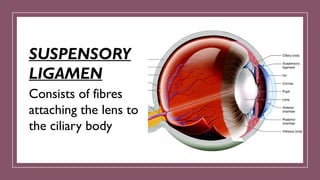
SUSPENSORY
LIGAMEN
Consists of fibres
attaching the lens to
the ciliary body
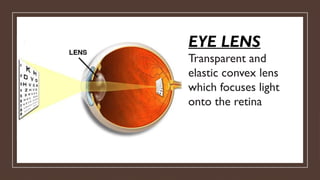
EYE LENS
Transparent and
elastic convex lens
which focuses light
onto the retina
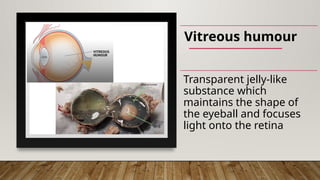
Vitreous humour
Transparent jelly-like
substance which
maintains the shape of
the eyeball and focuses
light onto the retina
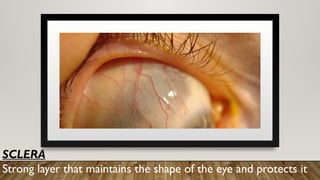
SCLERA
Strong layer that maintains the shape of the eye and protects it
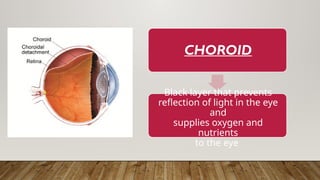
CHOROID
Black layer that prevents
reflection of light in the eye
and
supplies oxygen and
nutrients
to the eye
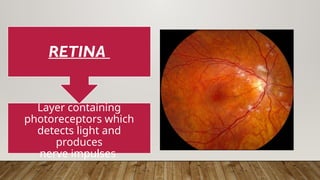
Layer containing
photoreceptors which
detects light and
produces
nerve impulses
RETINA
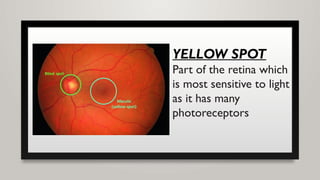
YELLOW SPOT
Part of the retina which
is most sensitive to light
as it has many
photoreceptors
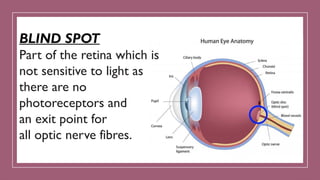
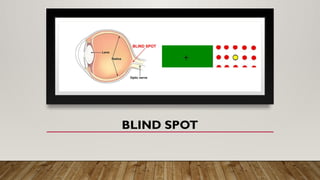
BLIND SPOT
Part of the retina which is
not sensitive to light as
there are no
photoreceptors and
an exit point for
all optic nerve fibres.
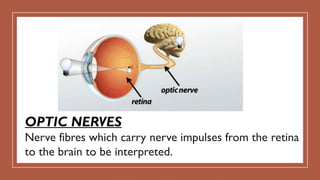
OPTIC NERVES
Nerve fibres which carry nerve impulses from the retina
to the brain to be interpreted.
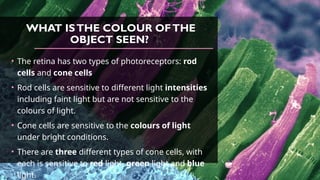
WHAT ISTHE COLOUR OFTHE
OBJECT SEEN?
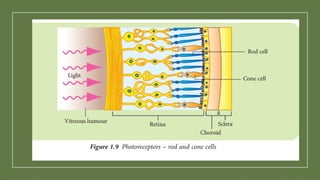
• The retina has two types of photoreceptors: rod
cells and cone cells
• Rod cells are sensitive to different light intensities
including faint light but are not sensitive to the
colours of light.
• Cone cells are sensitive to the colours of light
under bright conditions.
• There are three different types of cone cells, with
each is sensitive to red light, green light and blue
light.
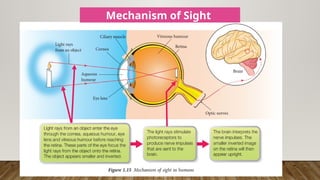
Mechanism of Sight
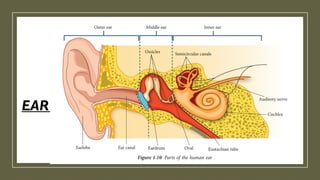
EAR
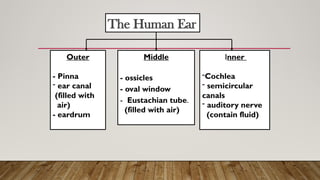
The Human Ear
Outer
- Pinna
- ear canal
(filled with
air)
- eardrum
Middle
- ossicles
- oval window
- Eustachian tube.
(filled with air)
Inner
-Cochlea
- semicircular
canals
- auditory nerve
(contain fluid)
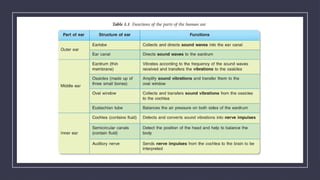
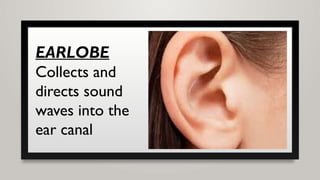
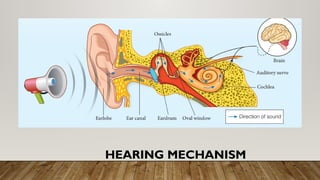
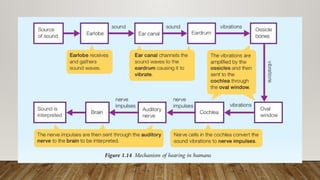
EARLOBE
Collects and
directs sound
waves into the
ear canal
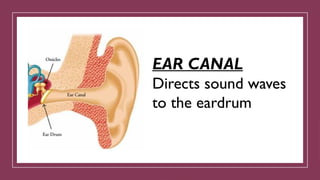
EAR CANAL
Directs sound waves
to the eardrum
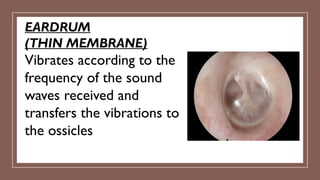
EARDRUM
(THIN MEMBRANE)
Vibrates according to the
frequency of the sound
waves received and
transfers the vibrations to
the ossicles
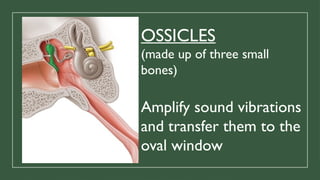
OSSICLES
(made up of three small
bones)
Amplify sound vibrations
and transfer them to the
oval window
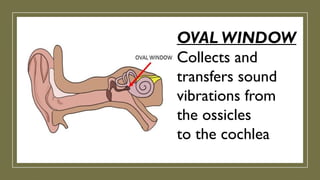
OVAL WINDOW
Collects and
transfers sound
vibrations from
the ossicles
to the cochlea
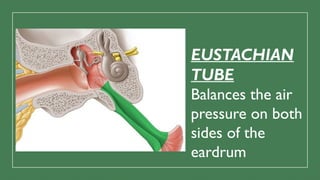
EUSTACHIAN
TUBE
Balances the air
pressure on both
sides of the
eardrum
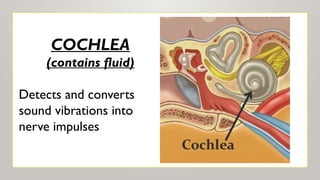
COCHLEA
(contains fluid)
Detects and converts
sound vibrations into
nerve impulses
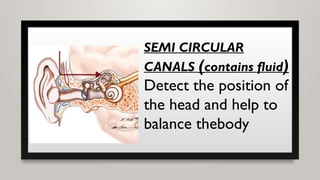
SEMI CIRCULAR
CANALS (contains fluid)
Detect the position of
the head and help to
balance thebody
HEARING MECHANISM
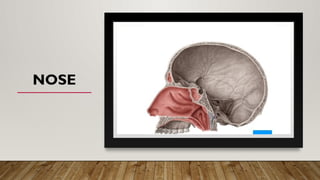
NOSE
STRUCTURE
OFTHE NOSE
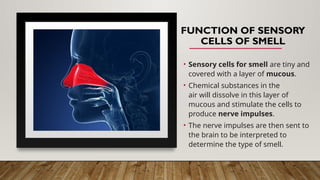
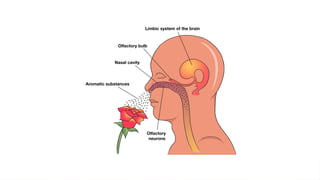
• The nose is the sensory organ of
smell.
• Smells are chemical
substances present in the air.
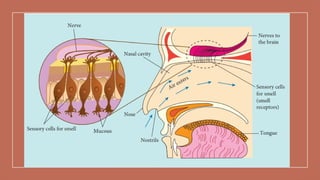
• About 10 million sensory
cells for smell are located at the
roof of the nasal cavity
FUNCTION OF SENSORY
CELLS OF SMELL
• Sensory cells for smell are tiny and
covered with a layer of mucous.
• Chemical substances in the
air will dissolve in this layer of
mucous and stimulate the cells to
produce nerve impulses.
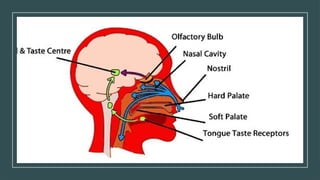
• The nerve impulses are then sent to
the brain to be interpreted to
determine the type of smell.
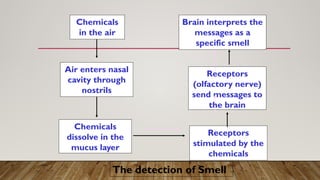
Chemicals
in the air
Air enters nasal
cavity through
nostrils
Chemicals
dissolve in the
mucus layer
Receptors
stimulated by the
chemicals
Receptors
(olfactory nerve)
send messages to
the brain
Brain interprets the
messages as a
specific smell
The detection of Smell
TONGUE
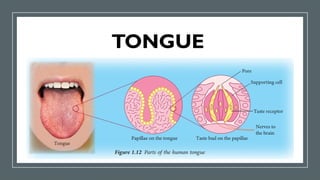
STRUCTURE OFTHETONGUE
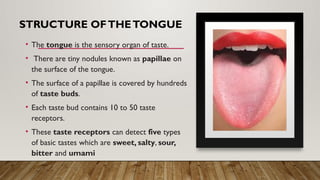
• The tongue is the sensory organ of taste.
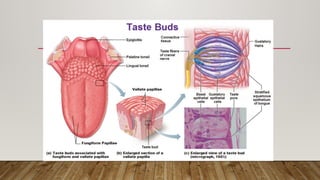
• There are tiny nodules known as papillae on
the surface of the tongue.
• The surface of a papillae is covered by hundreds
of taste buds.
• Each taste bud contains 10 to 50 taste
receptors.
• These taste receptors can detect five types
of basic tastes which are sweet, salty, sour,
bitter and umami
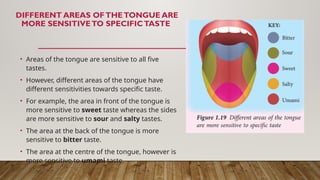
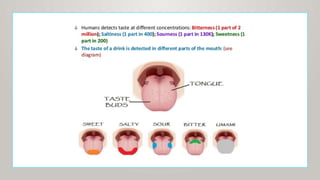
DIFFERENT AREAS OFTHETONGUE ARE
MORE SENSITIVETO SPECIFICTASTE
• Areas of the tongue are sensitive to all five
tastes.
• However, different areas of the tongue have
different sensitivities towards specific taste.
• For example, the area in front of the tongue is
more sensitive to sweet taste whereas the sides
are more sensitive to sour and salty tastes.
• The area at the back of the tongue is more
sensitive to bitter taste.
• The area at the centre of the tongue, however is
more sensitive to umami taste.
UMAMI
• Umami is classified as a basic taste because
there are taste receptors that can only detect
umami taste.
• This is the same as other basic tastes such as
sweet, salty, sour and bitter.
• Umami taste is related to delicious tastes such
as the taste of meat in soups or the taste of
fermented foods such as cheese and
mushrooms or monosodium glutamate (MSG).
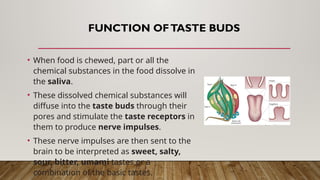
FUNCTION OFTASTE BUDS
• When food is chewed, part or all the
chemical substances in the food dissolve in
the saliva.
• These dissolved chemical substances will
diffuse into the taste buds through their
pores and stimulate the taste receptors in
them to produce nerve impulses.
• These nerve impulses are then sent to the
brain to be interpreted as sweet, salty,
sour, bitter, umami tastes or a
combination of the basic tastes.
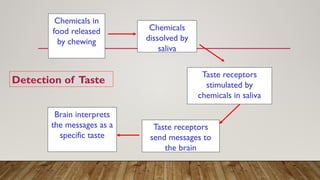
Chemicals in
food released
by chewing
Chemicals
dissolved by
saliva
Taste receptors
stimulated by
chemicals in saliva
Taste receptors
send messages to
the brain
Brain interprets
the messages as a
specific taste
Detection of Taste
SKIN
SKIN
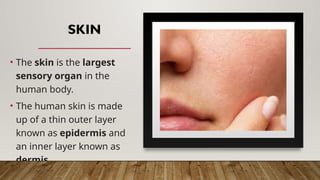
• The skin is the largest
sensory organ in the
human body.
• The human skin is made
up of a thin outer layer
known as epidermis and
an inner layer known as
dermis.
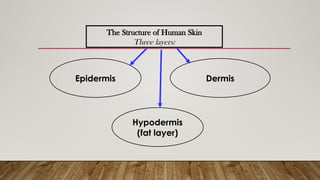
The Structure of Human Skin
Three layers:
Epidermis Dermis
Hypodermis
(fat layer)
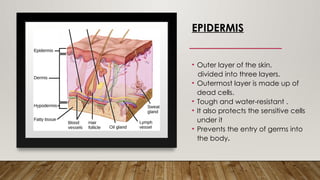
EPIDERMIS
• Outer layer of the skin.
divided into three layers.
• Outermost layer is made up of
dead cells.
• Tough and water-resistant .
• It also protects the sensitive cells
under it
• Prevents the entry of germs into
the body.
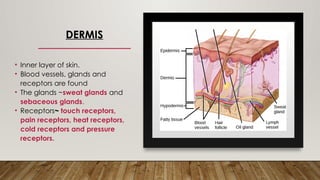
DERMIS
• Inner layer of skin.
• Blood vessels, glands and
receptors are found
• The glands ~sweat glands and
sebaceous glands.
• Receptors~ touch receptors,
pain receptors, heat receptors,
cold receptors and pressure
receptors.
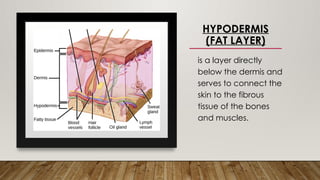
HYPODERMIS
(FAT LAYER)
is a layer directly
below the dermis and
serves to connect the
skin to the fibrous
tissue of the bones
and muscles.
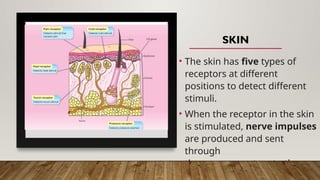
SKIN
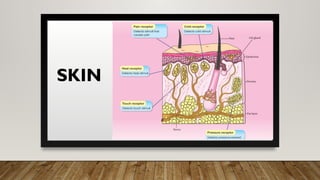
• The skin has five types of
receptors at different
positions to detect different
stimuli.
• When the receptor in the skin
is stimulated, nerve impulses
are produced and sent
through
the nervous system to the
brain to be interpreted and to
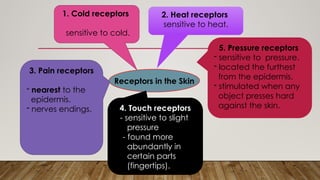
Receptors in the Skin
1. Cold receptors
sensitive to cold.
2. Heat receptors
sensitive to heat.
3. Pain receptors
- nearest to the
epidermis.
- nerves endings. 4. Touch receptors
- sensitive to slight
pressure
- found more
abundantly in
certain parts
(fingertips).
5. Pressure receptors
- sensitive to pressure.
- located the furthest
from the epidermis.
- stimulated when any
object presses hard
against the skin.
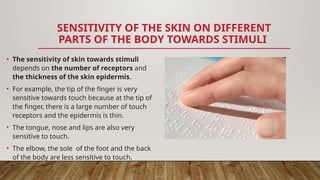
SENSITIVITY OF THE SKIN ON DIFFERENT
PARTS OF THE BODY TOWARDS STIMULI
• The sensitivity of skin towards stimuli
depends on the number of receptors and
the thickness of the skin epidermis.
• For example, the tip of the finger is very
sensitive towards touch because at the tip of
the finger, there is a large number of touch
receptors and the epidermis is thin.
• The tongue, nose and lips are also very
sensitive to touch.
• The elbow, the sole of the foot and the back
of the body are less sensitive to touch.
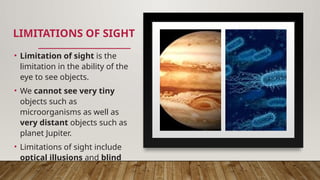
LIMITATIONS OF SIGHT
• Limitation of sight is the
limitation in the ability of the
eye to see objects.
• We cannot see very tiny
objects such as
microorganisms as well as
very distant objects such as
planet Jupiter.
• Limitations of sight include
optical illusions and blind
spot.
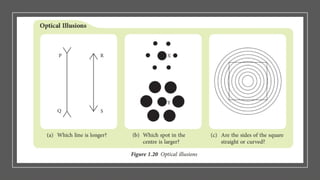
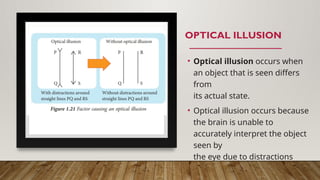
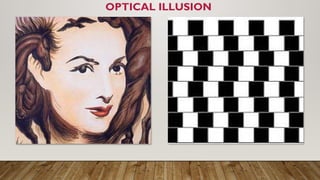
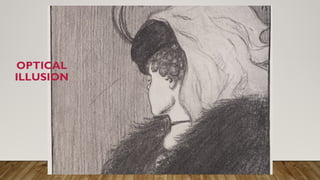
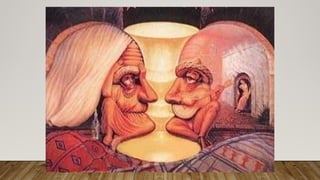
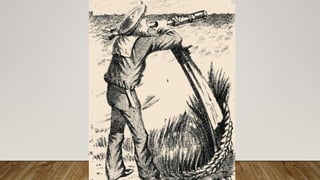
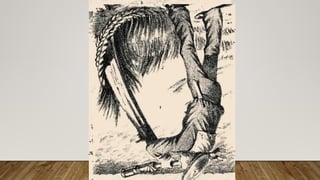
OPTICAL ILLUSION
• Optical illusion occurs when
an object that is seen differs
from
its actual state.
• Optical illusion occurs because
the brain is unable to
accurately interpret the object
seen by
the eye due to distractions
around theobject.
OPTICAL ILLUSION
OPTICAL ILLUSION
OPTICAL ILLUSION
OPTICAL
ILLUSION
OPTICAL
ILLUSION
OPTICAL
ILLUSION
BLIND SPOT
BLIND SPOT
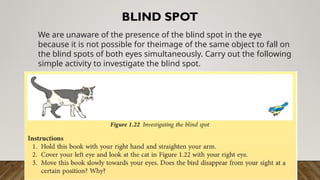
We are unaware of the presence of the blind spot in the eye
because it is not possible for theimage of the same object to fall on
the blind spots of both eyes simultaneously. Carry out the following
simple activity to investigate the blind spot.
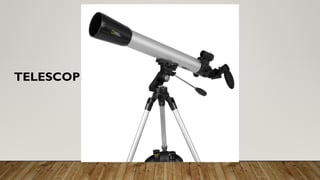
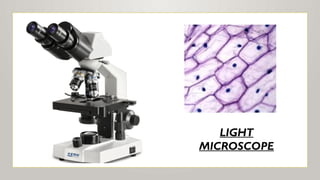
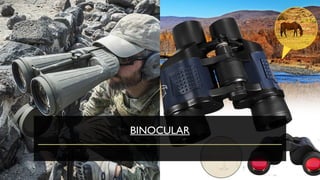
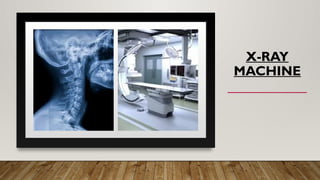
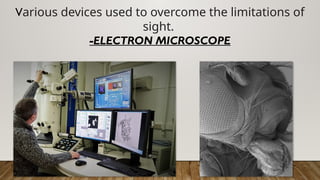
Various devices used to overcome the limitations of
sight.
-ELECTRON MICROSCOPE
TELESCOPE
LIGHT
MICROSCOPE
BINOCULAR
X-RAY
MACHINE
ULTRA SOUND
MACHINE
TASK
Gather information on the use
of these devices from the
Internet, magazines, books,
newspapers and other sources.
Present the findings using
multimedia presentation.
EYE DEFECTS
Defects of vision:
(a) short
sightedness.
(b) long
sightedness.
(c)
astigmatism.
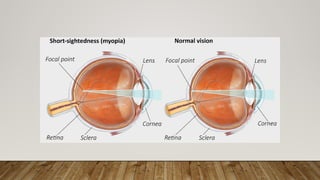
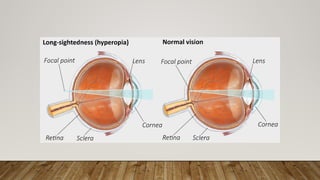
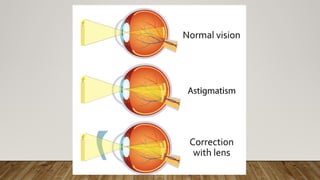
In normal vision, light is focused accurately on the
retina to form an image on the retina.This will
produce a clear and sharp image on the retina.
A SHORT
-SIGHTED PERSON
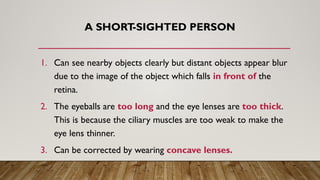
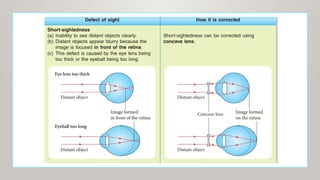
1. Can see nearby objects clearly but distant objects appear blur
due to the image of the object which falls in front of the
retina.
2. The eyeballs are too long and the eye lenses are too thick.
This is because the ciliary muscles are too weak to make the
eye lens thinner.
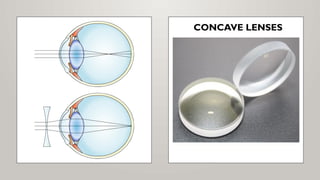
3. Can be corrected by wearing concave lenses.
CONCAVE LENSES
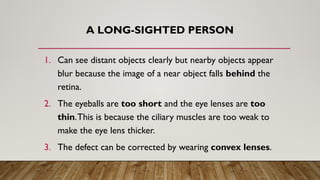
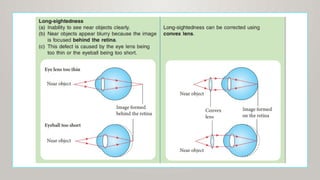
A LONG-SIGHTED PERSON
1. Can see distant objects clearly but nearby objects appear
blur because the image of a near object falls behind the
retina.
2. The eyeballs are too short and the eye lenses are too
thin.This is because the ciliary muscles are too weak to
make the eye lens thicker.
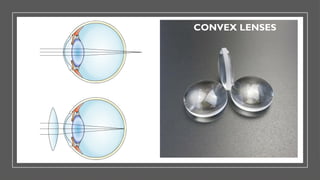
3. The defect can be corrected by wearing convex lenses.
CONVEX LENSES
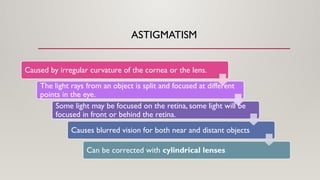
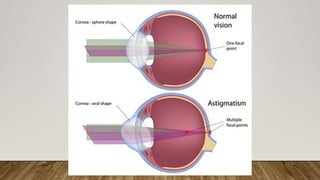
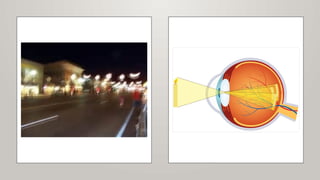
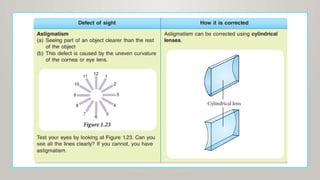
ASTIGMATISM
Caused by irregular curvature of the cornea or the lens.
The light rays from an object is split and focused at different
points in the eye.
Some light may be focused on the retina, some light will be
focused in front or behind the retina.
Causes blurred vision for both near and distant objects
Can be corrected with cylindrical lenses
LIMITATIONS
OF HEARING
• Limitations of hearing are limitations in
the ability of the ear to hear sound.
• We can only hear sounds of frequencies
between the range of 20 Hz to 20 000 Hz.
• The ears are unable to detect sounds
which lie outside this frequency range.
• The frequency range of hearing of every
individual is different.
• When a person gets older, the frequency
range
of his hearing gets narrower as his
eardrum becomes less elastic.
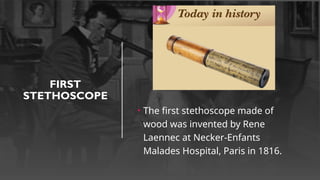
FIRST
STETHOSCOPE
• The first stethoscope made of
wood was invented by Rene
Laennec at Necker-Enfants
Malades Hospital, Paris in 1816.
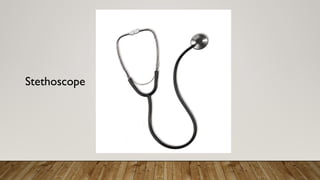
Stethoscope helps us to
listen to the
heartbeats.
Stethoscope
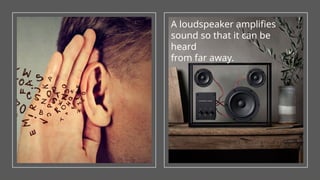
A loudspeaker amplifies
sound so that it can be
heard
from far away.
LOUD SPEAKER
MICROPHONE
DEFECTS OF
HEARING
• Defects of hearing occur when the
sense of hearing of a person does
not function well.
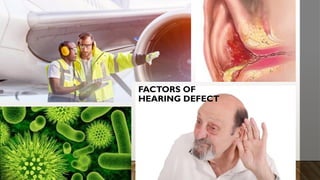
• Defects of hearing are normally
caused by damage to the ear due
to infection by microorganisms,
injury, ageing process or
continuous exposure to loud
sounds.
FACTORS OF
HEARING DEFECT
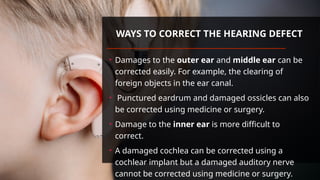
WAYS TO CORRECT THE HEARING DEFECT
• Damages to the outer ear and middle ear can be
corrected easily. For example, the clearing of
foreign objects in the ear canal.
• Punctured eardrum and damaged ossicles can also
be corrected using medicine or surgery.
• Damage to the inner ear is more difficult to
correct.
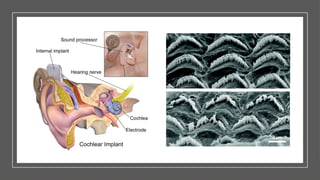
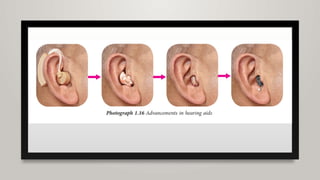
• A damaged cochlea can be corrected using a
cochlear implant but a damaged auditory nerve
cannot be corrected using medicine or surgery.
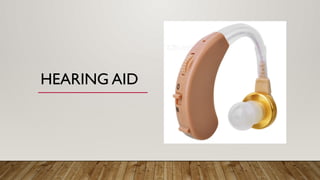
HEARING AID
1.3 STIMULI AND RESPONSES IN
PLANTS
STIMULI AND
RESPONSES IN
PLANTS
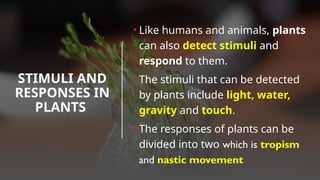
• Like humans and animals, plants
can also detect stimuli and
respond to them.
• The stimuli that can be detected
by plants include light, water,
gravity and touch.
• The responses of plants can be
divided into two which is tropism
and nastic movement
TROPISME
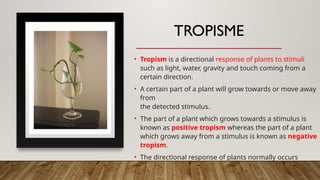
• Tropism is a directional response of plants to stimuli
such as light, water, gravity and touch coming from a
certain direction.
• A certain part of a plant will grow towards or move away
from
the detected stimulus.
• The part of a plant which grows towards a stimulus is
known as positive tropism whereas the part of a plant
which grows away from a stimulus is known as negative
tropism.
• The directional response of plants normally occurs
slowly and less significantly.
PHOTOTROPISM
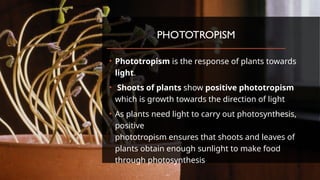
• Phototropism is the response of plants towards
light.
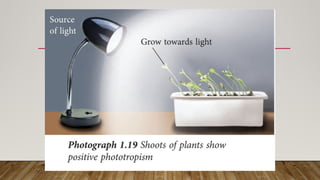
• Shoots of plants show positive phototropism
which is growth towards the direction of light
• As plants need light to carry out photosynthesis,
positive
phototropism ensures that shoots and leaves of
plants obtain enough sunlight to make food
through photosynthesis
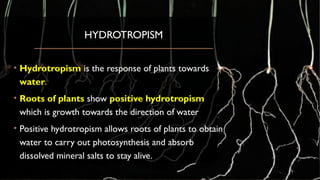
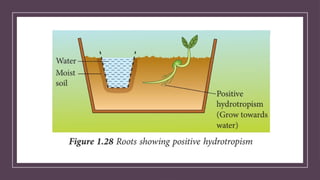
HYDROTROPISM
• Hydrotropism is the response of plants towards
water.
• Roots of plants show positive hydrotropism
which is growth towards the direction of water
• Positive hydrotropism allows roots of plants to obtain
water to carry out photosynthesis and absorb
dissolved mineral salts to stay alive.
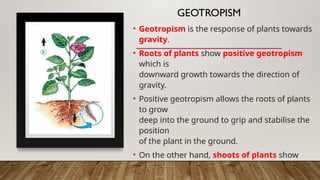
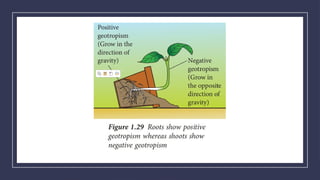
GEOTROPISM
• Geotropism is the response of plants towards
gravity.
• Roots of plants show positive geotropism
which is
downward growth towards the direction of
gravity.
• Positive geotropism allows the roots of plants
to grow
deep into the ground to grip and stabilise the
position
of the plant in the ground.
• On the other hand, shoots of plants show
negative geotropism which is upward growth
in the opposite direction of gravity.
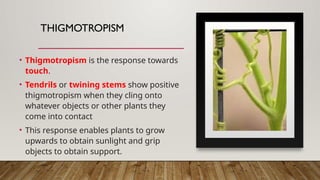
THIGMOTROPISM
• Thigmotropism is the response towards
touch.
• Tendrils or twining stems show positive
thigmotropism when they cling onto
whatever objects or other plants they
come into contact
• This response enables plants to grow
upwards to obtain sunlight and grip
objects to obtain support.
• Roots show negative thigmotropism
since they avoid any object that obstructs
THIGMOTROPISME
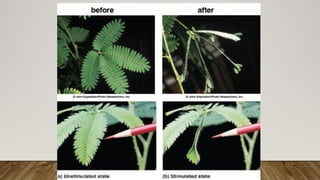
NASTIC
MOVEMENT
• Nastic movement is the response
towards a stimulus such as touch
but does not depend on the direction
of the stimulus.
• Nastic movement occurs more
rapidly than tropism. For example,
the Mimosa sp. responds to touch by
folding its leaves inwards when
touched as shown in Photograph
1.21.
• This nastic movement serves as a
defence of the Mimosa sp. against its
enemies and strong wind.
NASTIC MOVEMENT
1.4 IMPORTANCE OF RESPONSES
TO STIMULI IN ANIMALS
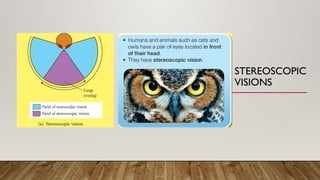
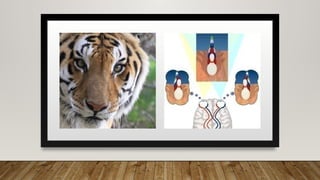
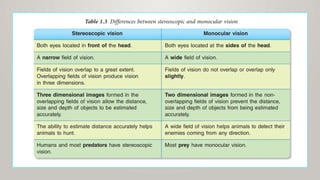
STEREOSCOPIC
VISIONS
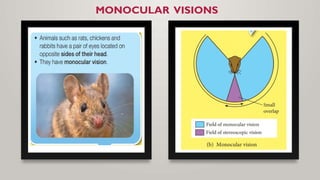
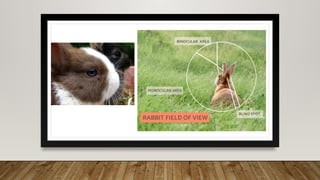
MONOCULAR VISIONS
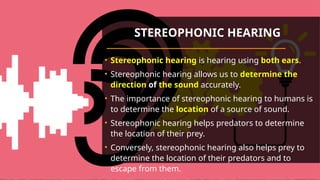
STEREOPHONIC HEARING
• Stereophonic hearing is hearing using both ears.
• Stereophonic hearing allows us to determine the
direction of the sound accurately.
• The importance of stereophonic hearing to humans is
to determine the location of a source of sound.
• Stereophonic hearing helps predators to determine
the location of their prey.
• Conversely, stereophonic hearing also helps prey to
determine the location of their predators and to
escape from them.
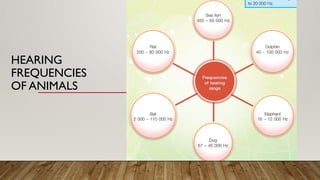
HEARING
FREQUENCIES
OF ANIMALS
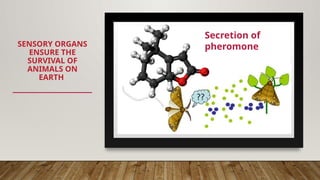
SENSORY ORGANS
ENSURE THE
SURVIVAL OF
ANIMALS ON
EARTH
Secretion of
pheromone
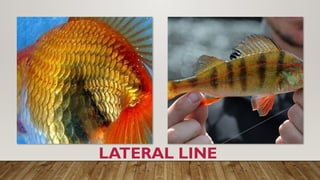
LATERAL LINE
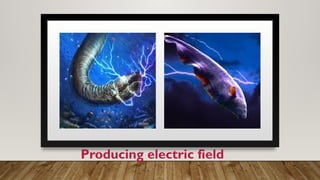
Producing electric field
TASK
Text ook science slide F3 CHAPTER 1.pptx

Text ook science slide F3 CHAPTER 1.pptx

  • 1.
    CHAPTER 1 : STIMULUSAND RESPONSE SCIENCE FORM 3 BY TEACHER HAYATI, SIGS JB
  • 2.
  • 3.
    HUMAN NERVOUS SYSTEM •The human nervous system is an important control system in body coordination. • Other than sight, thinking and body movement, the human nervous system also controls and coordinates organ functions in the body and maintains a balanced internal environment through a
  • 4.
    STRUCTURE OF THEHUMAN NERVOUS SYSTEM •Central Nervous System •Periferal Nervous System
  • 6.
    FUNCTIONS OF THE HUMAN NERVOUS SYSTEM • Thehuman nervous system controls and coordinates organs and parts of the body by • detects stimuli • sends information in the form of impulses • interprets impulses • produces appropriate responses
  • 7.
    VOLUNTARY AND INVOLUNTARY ACTIONS •Theresponses of the human body to stimuli can be divided into voluntary actions and involuntary actions.
  • 8.
    VOLUNTARY ACTIONS • Voluntaryactions are conscious actions and conducted under one’s will. • All voluntary actions are controlled by the brain. • Examples of voluntary actions include reading, writing, speaking, eating, drinking, walking, running and exercising.
  • 9.
  • 11.
    INVOLUNTARY ACTIONS •Involuntary actions are actionsthat occur immediately without conscious control or prior thoughts. •Involuntary actions can be classified into two.
  • 12.
    INVOLUNTARY ACTIONS Involving medulla oblongata •Heartbeat • Breathing • Peristalsis • Secretion of saliva Involving spinal cord (reflex actions) • Withdrawing hand when it accidentally touches a hot object • Withdrawing foot when it accidentally steps on a sharp object
  • 13.
  • 14.
  • 15.
  • 17.
    IMPORTANCE OF THENETWORK OF HUMAN NERVOUS SYSTEM IN DAILY LIFE • The network of the human nervous system controls and coordinates the organs and parts of the body to carry out processes in the body such as breathing and body movements. • A damaged nervous system normally causes a person to become temporarily, partially or completely paralysed. • For example, if the nerves in the muscles of a leg or hand are injured, the person will face difficulty in moving his leg or hand. In the case of a more serious problem, he might have to depend on machines to carry out his physiological processes such as breathing or heart beating. Humans are blessed with a nervous system, so they should use and take good care of it.
  • 18.
  • 19.
    STIMULI AND RESPONSES INHUMANS • These changes are called stimuli. • Examples of stimuli include light, sound and chemical substances. • Humans use their sensory organs to detect stimuli. • Humans have five sensory organs: eyes, ears, nose, skin and tongue
  • 20.
  • 21.
    STRUCTURE OF HUMANEYE Ciliary muscles Eye Lens Iris Pupil Cornea Sclera Choroid Retina Yellow spot Optic nerve Blind spot Vitreous humour Aqueous humour Suspensory ligament
  • 22.
    Front view ofeye Eyelid Pupil Sclera Iris
  • 23.
  • 24.
    FUNCTION - Allow lightto enter the eye - refracts and focuses light onto the retina CORNEA -Transparent layer at the front of the eye - Curved shape
  • 25.
    CONJUNCTIVA - Thin transparent membranecovering the exposed part of the eye
  • 26.
    AQUEOUS HUMOUR - Watery, -transparent fluid - Fills the space between cornea and lens
  • 27.
    FUNCTION - Helps focusimages on the retina - Helps maintain the shape of the eyeball
  • 28.
    PUPIL - A smallopening in the centre of the iris
  • 29.
    FUNCTION •Enables light to enterthe eye •Controls amount of light entering the eye
  • 30.
    IRIS - Part ofthe choroid layer which can be seen from the front of the eye as a disc- shaped structure - Consists of muscles - Coloured, for example, brown green or blue
  • 31.
    FUNCTION •Controls the sizeof the pupil thus controlling the amount of light entering the eye
  • 32.
    CILIARY MUSCLE - Consistsof the ciliary muscle - Part of the choroid layer
  • 33.
    Contracts and relaxes to changethe thickness of the lens FUNCTION
  • 34.
  • 35.
    EYE LENS Transparent and elasticconvex lens which focuses light onto the retina
  • 36.
    Vitreous humour Transparent jelly-like substancewhich maintains the shape of the eyeball and focuses light onto the retina
  • 37.
    SCLERA Strong layer thatmaintains the shape of the eye and protects it
  • 38.
    CHOROID Black layer thatprevents reflection of light in the eye and supplies oxygen and nutrients to the eye
  • 39.
    Layer containing photoreceptors which detectslight and produces nerve impulses RETINA
  • 40.
    YELLOW SPOT Part ofthe retina which is most sensitive to light as it has many photoreceptors
  • 41.
    BLIND SPOT Part ofthe retina which is not sensitive to light as there are no photoreceptors and an exit point for all optic nerve fibres.
  • 42.
    OPTIC NERVES Nerve fibreswhich carry nerve impulses from the retina to the brain to be interpreted.
  • 43.
    WHAT ISTHE COLOUROFTHE OBJECT SEEN? • The retina has two types of photoreceptors: rod cells and cone cells • Rod cells are sensitive to different light intensities including faint light but are not sensitive to the colours of light. • Cone cells are sensitive to the colours of light under bright conditions. • There are three different types of cone cells, with each is sensitive to red light, green light and blue light.
  • 45.
  • 46.
  • 47.
    The Human Ear Outer -Pinna - ear canal (filled with air) - eardrum Middle - ossicles - oval window - Eustachian tube. (filled with air) Inner -Cochlea - semicircular canals - auditory nerve (contain fluid)
  • 49.
  • 50.
    EAR CANAL Directs soundwaves to the eardrum
  • 51.
    EARDRUM (THIN MEMBRANE) Vibrates accordingto the frequency of the sound waves received and transfers the vibrations to the ossicles
  • 52.
    OSSICLES (made up ofthree small bones) Amplify sound vibrations and transfer them to the oval window
  • 53.
    OVAL WINDOW Collects and transferssound vibrations from the ossicles to the cochlea
  • 54.
    EUSTACHIAN TUBE Balances the air pressureon both sides of the eardrum
  • 55.
    COCHLEA (contains fluid) Detects andconverts sound vibrations into nerve impulses
  • 56.
    SEMI CIRCULAR CANALS (containsfluid) Detect the position of the head and help to balance thebody
  • 57.
  • 59.
  • 62.
    STRUCTURE OFTHE NOSE • Thenose is the sensory organ of smell. • Smells are chemical substances present in the air. • About 10 million sensory cells for smell are located at the roof of the nasal cavity
  • 63.
    FUNCTION OF SENSORY CELLSOF SMELL • Sensory cells for smell are tiny and covered with a layer of mucous. • Chemical substances in the air will dissolve in this layer of mucous and stimulate the cells to produce nerve impulses. • The nerve impulses are then sent to the brain to be interpreted to determine the type of smell.
  • 65.
    Chemicals in the air Airenters nasal cavity through nostrils Chemicals dissolve in the mucus layer Receptors stimulated by the chemicals Receptors (olfactory nerve) send messages to the brain Brain interprets the messages as a specific smell The detection of Smell
  • 66.
  • 67.
    STRUCTURE OFTHETONGUE • Thetongue is the sensory organ of taste. • There are tiny nodules known as papillae on the surface of the tongue. • The surface of a papillae is covered by hundreds of taste buds. • Each taste bud contains 10 to 50 taste receptors. • These taste receptors can detect five types of basic tastes which are sweet, salty, sour, bitter and umami
  • 69.
    DIFFERENT AREAS OFTHETONGUEARE MORE SENSITIVETO SPECIFICTASTE • Areas of the tongue are sensitive to all five tastes. • However, different areas of the tongue have different sensitivities towards specific taste. • For example, the area in front of the tongue is more sensitive to sweet taste whereas the sides are more sensitive to sour and salty tastes. • The area at the back of the tongue is more sensitive to bitter taste. • The area at the centre of the tongue, however is more sensitive to umami taste.
  • 71.
    UMAMI • Umami isclassified as a basic taste because there are taste receptors that can only detect umami taste. • This is the same as other basic tastes such as sweet, salty, sour and bitter. • Umami taste is related to delicious tastes such as the taste of meat in soups or the taste of fermented foods such as cheese and mushrooms or monosodium glutamate (MSG).
  • 72.
    FUNCTION OFTASTE BUDS •When food is chewed, part or all the chemical substances in the food dissolve in the saliva. • These dissolved chemical substances will diffuse into the taste buds through their pores and stimulate the taste receptors in them to produce nerve impulses. • These nerve impulses are then sent to the brain to be interpreted as sweet, salty, sour, bitter, umami tastes or a combination of the basic tastes.
  • 73.
    Chemicals in food released bychewing Chemicals dissolved by saliva Taste receptors stimulated by chemicals in saliva Taste receptors send messages to the brain Brain interprets the messages as a specific taste Detection of Taste
  • 74.
  • 75.
    SKIN • The skinis the largest sensory organ in the human body. • The human skin is made up of a thin outer layer known as epidermis and an inner layer known as dermis.
  • 76.
    The Structure ofHuman Skin Three layers: Epidermis Dermis Hypodermis (fat layer)
  • 77.
    EPIDERMIS • Outer layerof the skin. divided into three layers. • Outermost layer is made up of dead cells. • Tough and water-resistant . • It also protects the sensitive cells under it • Prevents the entry of germs into the body.
  • 78.
    DERMIS • Inner layerof skin. • Blood vessels, glands and receptors are found • The glands ~sweat glands and sebaceous glands. • Receptors~ touch receptors, pain receptors, heat receptors, cold receptors and pressure receptors.
  • 79.
    HYPODERMIS (FAT LAYER) is alayer directly below the dermis and serves to connect the skin to the fibrous tissue of the bones and muscles.
  • 80.
    SKIN • The skinhas five types of receptors at different positions to detect different stimuli. • When the receptor in the skin is stimulated, nerve impulses are produced and sent through the nervous system to the brain to be interpreted and to
  • 81.
    Receptors in theSkin 1. Cold receptors sensitive to cold. 2. Heat receptors sensitive to heat. 3. Pain receptors - nearest to the epidermis. - nerves endings. 4. Touch receptors - sensitive to slight pressure - found more abundantly in certain parts (fingertips). 5. Pressure receptors - sensitive to pressure. - located the furthest from the epidermis. - stimulated when any object presses hard against the skin.
  • 82.
    SENSITIVITY OF THESKIN ON DIFFERENT PARTS OF THE BODY TOWARDS STIMULI • The sensitivity of skin towards stimuli depends on the number of receptors and the thickness of the skin epidermis. • For example, the tip of the finger is very sensitive towards touch because at the tip of the finger, there is a large number of touch receptors and the epidermis is thin. • The tongue, nose and lips are also very sensitive to touch. • The elbow, the sole of the foot and the back of the body are less sensitive to touch.
  • 84.
    LIMITATIONS OF SIGHT •Limitation of sight is the limitation in the ability of the eye to see objects. • We cannot see very tiny objects such as microorganisms as well as very distant objects such as planet Jupiter. • Limitations of sight include optical illusions and blind spot.
  • 86.
    OPTICAL ILLUSION • Opticalillusion occurs when an object that is seen differs from its actual state. • Optical illusion occurs because the brain is unable to accurately interpret the object seen by the eye due to distractions around theobject.
  • 87.
  • 88.
  • 89.
  • 90.
  • 91.
  • 92.
  • 96.
  • 97.
    BLIND SPOT We areunaware of the presence of the blind spot in the eye because it is not possible for theimage of the same object to fall on the blind spots of both eyes simultaneously. Carry out the following simple activity to investigate the blind spot.
  • 98.
    Various devices usedto overcome the limitations of sight. -ELECTRON MICROSCOPE
  • 99.
  • 100.
  • 101.
  • 102.
  • 103.
  • 104.
    TASK Gather information onthe use of these devices from the Internet, magazines, books, newspapers and other sources. Present the findings using multimedia presentation.
  • 105.
    EYE DEFECTS Defects ofvision: (a) short sightedness. (b) long sightedness. (c) astigmatism. In normal vision, light is focused accurately on the retina to form an image on the retina.This will produce a clear and sharp image on the retina.
  • 106.
    A SHORT -SIGHTED PERSON 1.Can see nearby objects clearly but distant objects appear blur due to the image of the object which falls in front of the retina. 2. The eyeballs are too long and the eye lenses are too thick. This is because the ciliary muscles are too weak to make the eye lens thinner. 3. Can be corrected by wearing concave lenses.
  • 109.
  • 110.
    A LONG-SIGHTED PERSON 1.Can see distant objects clearly but nearby objects appear blur because the image of a near object falls behind the retina. 2. The eyeballs are too short and the eye lenses are too thin.This is because the ciliary muscles are too weak to make the eye lens thicker. 3. The defect can be corrected by wearing convex lenses.
  • 113.
  • 114.
    ASTIGMATISM Caused by irregularcurvature of the cornea or the lens. The light rays from an object is split and focused at different points in the eye. Some light may be focused on the retina, some light will be focused in front or behind the retina. Causes blurred vision for both near and distant objects Can be corrected with cylindrical lenses
  • 119.
    LIMITATIONS OF HEARING • Limitationsof hearing are limitations in the ability of the ear to hear sound. • We can only hear sounds of frequencies between the range of 20 Hz to 20 000 Hz. • The ears are unable to detect sounds which lie outside this frequency range. • The frequency range of hearing of every individual is different. • When a person gets older, the frequency range of his hearing gets narrower as his eardrum becomes less elastic.
  • 120.
    FIRST STETHOSCOPE • The firststethoscope made of wood was invented by Rene Laennec at Necker-Enfants Malades Hospital, Paris in 1816.
  • 121.
    Stethoscope helps usto listen to the heartbeats.
  • 122.
  • 123.
    A loudspeaker amplifies soundso that it can be heard from far away.
  • 124.
  • 125.
  • 126.
    DEFECTS OF HEARING • Defectsof hearing occur when the sense of hearing of a person does not function well. • Defects of hearing are normally caused by damage to the ear due to infection by microorganisms, injury, ageing process or continuous exposure to loud sounds.
  • 127.
  • 128.
    WAYS TO CORRECTTHE HEARING DEFECT • Damages to the outer ear and middle ear can be corrected easily. For example, the clearing of foreign objects in the ear canal. • Punctured eardrum and damaged ossicles can also be corrected using medicine or surgery. • Damage to the inner ear is more difficult to correct. • A damaged cochlea can be corrected using a cochlear implant but a damaged auditory nerve cannot be corrected using medicine or surgery.
  • 131.
  • 132.
    1.3 STIMULI ANDRESPONSES IN PLANTS
  • 133.
    STIMULI AND RESPONSES IN PLANTS •Like humans and animals, plants can also detect stimuli and respond to them. • The stimuli that can be detected by plants include light, water, gravity and touch. • The responses of plants can be divided into two which is tropism and nastic movement
  • 134.
    TROPISME • Tropism isa directional response of plants to stimuli such as light, water, gravity and touch coming from a certain direction. • A certain part of a plant will grow towards or move away from the detected stimulus. • The part of a plant which grows towards a stimulus is known as positive tropism whereas the part of a plant which grows away from a stimulus is known as negative tropism. • The directional response of plants normally occurs slowly and less significantly.
  • 135.
    PHOTOTROPISM • Phototropism isthe response of plants towards light. • Shoots of plants show positive phototropism which is growth towards the direction of light • As plants need light to carry out photosynthesis, positive phototropism ensures that shoots and leaves of plants obtain enough sunlight to make food through photosynthesis
  • 137.
    HYDROTROPISM • Hydrotropism isthe response of plants towards water. • Roots of plants show positive hydrotropism which is growth towards the direction of water • Positive hydrotropism allows roots of plants to obtain water to carry out photosynthesis and absorb dissolved mineral salts to stay alive.
  • 139.
    GEOTROPISM • Geotropism isthe response of plants towards gravity. • Roots of plants show positive geotropism which is downward growth towards the direction of gravity. • Positive geotropism allows the roots of plants to grow deep into the ground to grip and stabilise the position of the plant in the ground. • On the other hand, shoots of plants show negative geotropism which is upward growth in the opposite direction of gravity.
  • 141.
    THIGMOTROPISM • Thigmotropism isthe response towards touch. • Tendrils or twining stems show positive thigmotropism when they cling onto whatever objects or other plants they come into contact • This response enables plants to grow upwards to obtain sunlight and grip objects to obtain support. • Roots show negative thigmotropism since they avoid any object that obstructs
  • 142.
  • 143.
    NASTIC MOVEMENT • Nastic movementis the response towards a stimulus such as touch but does not depend on the direction of the stimulus. • Nastic movement occurs more rapidly than tropism. For example, the Mimosa sp. responds to touch by folding its leaves inwards when touched as shown in Photograph 1.21. • This nastic movement serves as a defence of the Mimosa sp. against its enemies and strong wind.
  • 144.
  • 146.
    1.4 IMPORTANCE OFRESPONSES TO STIMULI IN ANIMALS
  • 147.
  • 149.
  • 152.
    STEREOPHONIC HEARING • Stereophonichearing is hearing using both ears. • Stereophonic hearing allows us to determine the direction of the sound accurately. • The importance of stereophonic hearing to humans is to determine the location of a source of sound. • Stereophonic hearing helps predators to determine the location of their prey. • Conversely, stereophonic hearing also helps prey to determine the location of their predators and to escape from them.
  • 153.
  • 154.
    SENSORY ORGANS ENSURE THE SURVIVALOF ANIMALS ON EARTH Secretion of pheromone
  • 155.
  • 156.
  • 157.