Software Engineering
1
SOFTWARE TESTING STRATEGIES
2
A STRATEGIC APPROACH TO
SOFTWARE TESTING
3
Verification and Validation
 Software testing is one element of a broader topic that is often referred to as
verification and validation (V&V).
 Verification refers to the set of tasks that ensure that software correctly
implements a specific function.
 Validation refers to a different set of tasks that ensure that the software that has
been built is traceable to customer requirements.
Cont’d
 Verification: “Are we building the product right?”
 Validation: “Are we building the right product?”
Cont’d
 Verification and validation includes a wide array of SQA activities:
 technical reviews, quality and configuration audits, performance monitoring,
simulation, feasibility study, documentation review, database review, algorithm
analysis, development testing, usability testing, qualification testing, acceptance
testing, and installation testing.
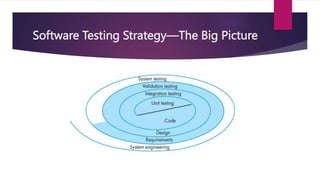
Software Testing Strategy—The Big Picture
Criteria for Completion of Testing
 You're never done testing; the burden simply shifts from you (the software
engineer) to the end user
TEST STRATEGIES FOR
CONVENTIONAL SOFTWARE
9
Cont’d
 At one extreme, you can wait until the system is fully constructed and then
conduct tests on the overall system in the hope of finding errors.
 This approach, although appealing, simply does not work. It will result in buggy
software that disappoints all stakeholders.
 At the other extreme, you could conduct tests on a daily basis, whenever any part
of the system is constructed.
 A testing strategy that is chosen by many software teams falls between the two
extremes.
Unit Testing
 Unit testing focuses verification effort on the smallest unit of software design—the
software component or module.
 The unit test focuses on the internal processing logic and data structures within
the boundaries of a component.
 This type of testing can be conducted in parallel for multiple components.
Cont’d
 The design of unit tests can occur before coding begins or after
 source code has been generated.
Integration Testing
 Top-Down Integration
 depth-first integration
 Bottom-up integration
 Bottom-Up Integration.
 Regression Testing
 Smoke Testing
VALIDATION TESTING
14
Cont’d
 Validation can be defined in many ways, but a simple (albeit harsh) definition is
that validation succeeds when software functions in a manner that can be
reasonably expected by the customer.
 Alpha and Beta Testing
Cont’d
 When custom software is built for one customer, a series of acceptance tests
 are conducted to enable the customer to validate all requirements.
 Conducted by
 the end user rather than software engineers, an acceptance test can range from
 an informal “test drive” to a planned and systematically executed series of tests.
 can be conducted over a period of weeks or months,
Alpha Testing
 The alpha test is conducted at the developer’s site by a representative group
 of end users. The software is used in a natural setting with the developer “looking
 over the shoulder” of the users and recording errors and usage problems. Alpha
 tests are conducted in a controlled environment.
Beta Testing
 The beta test is conducted at one or more end-user sites. Unlike alpha testing,
 the developer generally is not present. Therefore, the beta test is a “live”
application
 of the software in an environment that cannot be controlled by the developer.
 The customer records all problems (real or imagined) that are encountered
 during beta testing and reports these to the developer at regular intervals
Acceptance testing
 variation on beta testing, called customer acceptance testing , is sometimes
 performed when custom software is delivered to a customer under contract.
 The customer performs a series of specific tests in an attempt to uncover errors
 before accepting the software from the developer.
SYSTEM TESTING
20
Security testing
 Security testing attempts to verify that protection mechanisms built into a system
will, in fact, protect it from improper penetration.
Stress testing
 Stress testing executes a system in a manner that demands resources in abnormal
quantity, frequency, or volume. For example,
 (1) special tests may be designed that generate 10 interrupts per second, when
one or two is the average rate,
 (2) input data rates may be increased by an order of magnitude to determine how
input functions will respond,
Performance testing
 Performance testing is designed to test the run-time performance of software
within the context of an integrated system.
 Performance testing occurs throughout all steps in the testing process.
 Even at the unit level, the performance of an individual module may be assessed
as tests are conducted.
 However, it is not until all system elements are fully integrated that the true
performance of a system can be ascertained.
Deployment testing
 In many cases, software must execute on a variety of platforms and under more
than one operating system environment.
 Deployment testing, sometimes called configuration testing, exercises the
software in each environment in which it is to operate.
Reference
 Software Engineeing: A Practitioner’s Approach by Pressman chapter#22

13 Software Testing Chapter 22.pptx

  • 1.
  • 2.
  • 3.
    A STRATEGIC APPROACHTO SOFTWARE TESTING 3
  • 4.
    Verification and Validation Software testing is one element of a broader topic that is often referred to as verification and validation (V&V).  Verification refers to the set of tasks that ensure that software correctly implements a specific function.  Validation refers to a different set of tasks that ensure that the software that has been built is traceable to customer requirements.
  • 5.
    Cont’d  Verification: “Arewe building the product right?”  Validation: “Are we building the right product?”
  • 6.
    Cont’d  Verification andvalidation includes a wide array of SQA activities:  technical reviews, quality and configuration audits, performance monitoring, simulation, feasibility study, documentation review, database review, algorithm analysis, development testing, usability testing, qualification testing, acceptance testing, and installation testing.
  • 7.
  • 8.
    Criteria for Completionof Testing  You're never done testing; the burden simply shifts from you (the software engineer) to the end user
  • 9.
  • 10.
    Cont’d  At oneextreme, you can wait until the system is fully constructed and then conduct tests on the overall system in the hope of finding errors.  This approach, although appealing, simply does not work. It will result in buggy software that disappoints all stakeholders.  At the other extreme, you could conduct tests on a daily basis, whenever any part of the system is constructed.  A testing strategy that is chosen by many software teams falls between the two extremes.
  • 11.
    Unit Testing  Unittesting focuses verification effort on the smallest unit of software design—the software component or module.  The unit test focuses on the internal processing logic and data structures within the boundaries of a component.  This type of testing can be conducted in parallel for multiple components.
  • 12.
    Cont’d  The designof unit tests can occur before coding begins or after  source code has been generated.
  • 13.
    Integration Testing  Top-DownIntegration  depth-first integration  Bottom-up integration  Bottom-Up Integration.  Regression Testing  Smoke Testing
  • 14.
  • 15.
    Cont’d  Validation canbe defined in many ways, but a simple (albeit harsh) definition is that validation succeeds when software functions in a manner that can be reasonably expected by the customer.  Alpha and Beta Testing
  • 16.
    Cont’d  When customsoftware is built for one customer, a series of acceptance tests  are conducted to enable the customer to validate all requirements.  Conducted by  the end user rather than software engineers, an acceptance test can range from  an informal “test drive” to a planned and systematically executed series of tests.  can be conducted over a period of weeks or months,
  • 17.
    Alpha Testing  Thealpha test is conducted at the developer’s site by a representative group  of end users. The software is used in a natural setting with the developer “looking  over the shoulder” of the users and recording errors and usage problems. Alpha  tests are conducted in a controlled environment.
  • 18.
    Beta Testing  Thebeta test is conducted at one or more end-user sites. Unlike alpha testing,  the developer generally is not present. Therefore, the beta test is a “live” application  of the software in an environment that cannot be controlled by the developer.  The customer records all problems (real or imagined) that are encountered  during beta testing and reports these to the developer at regular intervals
  • 19.
    Acceptance testing  variationon beta testing, called customer acceptance testing , is sometimes  performed when custom software is delivered to a customer under contract.  The customer performs a series of specific tests in an attempt to uncover errors  before accepting the software from the developer.
  • 20.
  • 21.
    Security testing  Securitytesting attempts to verify that protection mechanisms built into a system will, in fact, protect it from improper penetration.
  • 22.
    Stress testing  Stresstesting executes a system in a manner that demands resources in abnormal quantity, frequency, or volume. For example,  (1) special tests may be designed that generate 10 interrupts per second, when one or two is the average rate,  (2) input data rates may be increased by an order of magnitude to determine how input functions will respond,
  • 23.
    Performance testing  Performancetesting is designed to test the run-time performance of software within the context of an integrated system.  Performance testing occurs throughout all steps in the testing process.  Even at the unit level, the performance of an individual module may be assessed as tests are conducted.  However, it is not until all system elements are fully integrated that the true performance of a system can be ascertained.
  • 24.
    Deployment testing  Inmany cases, software must execute on a variety of platforms and under more than one operating system environment.  Deployment testing, sometimes called configuration testing, exercises the software in each environment in which it is to operate.
  • 25.
    Reference  Software Engineeing:A Practitioner’s Approach by Pressman chapter#22