Congressional Budget OfficePresentation to the National Association for Business EconomicsFiscal Policy ChoicesMarch 8, 2010Douglas W. ElmendorfDirector
2Fiscal Policy ChoicesReview the estimates done by the Congressional Budget Office (CBO) and the staff of the Joint Committee on Taxation (JCT).
Discuss a number of challenges to those estimates.
Nothing I’m going to say is new: Everything is drawn from the letters that CBO has released. But probably you have not been following everything we’ve written as closely as I have, so some or all of this may be new to you.3Forecast for a Slow RecoverySevere economic downturns often sow the seeds of robust recoveries:
During a slump in economic activity, consumers defer purchases, and businesses postpone capital spending.
Once demand picks up, spending and employment can accelerate rapidly.
The current recovery will be dampened by several factors:
Continuing fragility of some financial markets and institutions.
Restrained increase in household spending.
Declining support from monetary and fiscal policy.4Real Federal Funds RatePercentNote: The real federal funds rate is defined as the nominal rate less the year-over-year change in the core PCE price index.
5Estimated Budgetary Effects of ARRABillions of Dollars
6Effect of ARRA on the Output GapGap Between Actual and Potential GDP as Percentage of Potential GDPWithout Stimulus Legislation
7The Budget Deficit or SurplusPercentage of GDP
Unemployment RatePercent8
Budget Deficit or SurplusPercentage of GDPWith Tax Cuts Extended and AMT Indexed9
10CBO’s Estimate of the President’s Budget, 2011-2020Note: * = Less than $0.05 trillion.
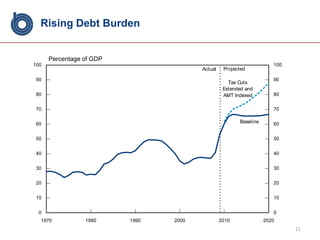
Rising Debt BurdenPercentage of GDP11
12Why Does Rising Federal Debt Matter?Tax revenues are used to pay interest rather than finance current programs.
Crowdingout of saving and investment lowers future output and income relative to what would otherwise occur.
The ability of the government to respond to future needs is reduced.

Test Today