Serena Lorenzini, PhD (www.biodec.com)
serena@biodec.com
PloneConf2019
serena@biodec.com Serena Lorenzini, PhD (www.biodec.com) PloneConf2019 1 / 38
Test-driven infrastructure development with Ansible & Molecule
Test-driven infrastructure development with Ansible &
Molecule
serena@biodec.com Serena Lorenzini, PhD (www.biodec.com) PloneConf2019 2 / 38
Test-driven infrastructure development with Ansible & Molecule
What is Ansible?
“Working in IT, you’re likely doing the same tasks over and over. What if
you could solve problems once and then automate your solutions going
forward? Ansible is here to help.”
Ansible is a simple provisioning tool that allows to automate tasks like:
server provisioning
software deployment
serena@biodec.com Serena Lorenzini, PhD (www.biodec.com) PloneConf2019 3 / 38
Test-driven infrastructure development with Ansible & Molecule
Why Ansible?
It is agentless. Everything is done via ssh.
Its YAML configuration files use structure and syntax that will be
familiar to Python programmers.
Ansible’s documentation is vast.
Ansible is easily extended by roles. Roles are Ansibles’ reusable code.
Many roles are available and evaluated by the community (stars,
downloads, comments)
It encourages to discipline yourself to never changing configuration
on your target machines via login.
serena@biodec.com Serena Lorenzini, PhD (www.biodec.com) PloneConf2019 4 / 38
Test-driven infrastructure development with Ansible & Molecule
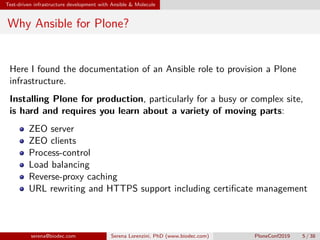
Why Ansible for Plone?
Here I found the documentation of an Ansible role to provision a Plone
infrastructure.
Installing Plone for production, particularly for a busy or complex site,
is hard and requires you learn about a variety of moving parts:
ZEO server
ZEO clients
Process-control
Load balancing
Reverse-proxy caching
URL rewriting and HTTPS support including certificate management
serena@biodec.com Serena Lorenzini, PhD (www.biodec.com) PloneConf2019 5 / 38
Test-driven infrastructure development with Ansible & Molecule
Provisioning a Plone server
HUGE disclaimer: I don’t know Plone and I have never installed one.
But I like to jump into new things using Ansible when possible.
So, let’s pretend that I had to provision a Plone infrastructure. What
would I do and how would I test my deploy strategy?
serena@biodec.com Serena Lorenzini, PhD (www.biodec.com) PloneConf2019 6 / 38
Test-driven infrastructure development with Ansible & Molecule
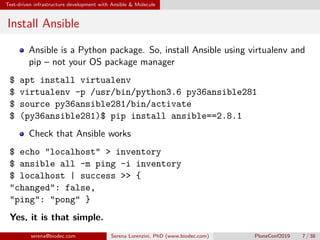
Install Ansible
Ansible is a Python package. So, install Ansible using virtualenv and
pip – not your OS package manager
$ apt install virtualenv
$ virtualenv -p /usr/bin/python3.6 py36ansible281
$ source py36ansible281/bin/activate
$ (py36ansible281)$ pip install ansible==2.8.1
Check that Ansible works
$ echo "localhost" > inventory
$ ansible all -m ping -i inventory
$ localhost | success >> {
"changed": false,
"ping": "pong" }
Yes, it is that simple.
serena@biodec.com Serena Lorenzini, PhD (www.biodec.com) PloneConf2019 7 / 38
Test-driven infrastructure development with Ansible & Molecule
The ansible-playbook command
Ping your instance using the ansible-playbook command.
A playbook.yml file:
hosts: all
tasks:
- name: Ping your instance
action: ping
ansible-playbook -i inventory playbook.yml
TASK [Ping] *****************************************
ok: [localhost] => {"changed": false, "ping": "pong"}
serena@biodec.com Serena Lorenzini, PhD (www.biodec.com) PloneConf2019 8 / 38
Test-driven infrastructure development with Ansible & Molecule
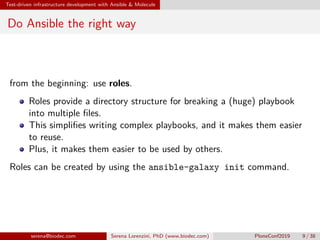
Do Ansible the right way
from the beginning: use roles.
Roles provide a directory structure for breaking a (huge) playbook
into multiple files.
This simplifies writing complex playbooks, and it makes them easier
to reuse.
Plus, it makes them easier to be used by others.
Roles can be created by using the ansible-galaxy init command.
serena@biodec.com Serena Lorenzini, PhD (www.biodec.com) PloneConf2019 9 / 38
Test-driven infrastructure development with Ansible & Molecule
Molecule
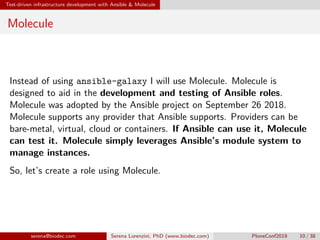
Instead of using ansible-galaxy I will use Molecule. Molecule is
designed to aid in the development and testing of Ansible roles.
Molecule was adopted by the Ansible project on September 26 2018.
Molecule supports any provider that Ansible supports. Providers can be
bare-metal, virtual, cloud or containers. If Ansible can use it, Molecule
can test it. Molecule simply leverages Ansible’s module system to
manage instances.
So, let’s create a role using Molecule.
serena@biodec.com Serena Lorenzini, PhD (www.biodec.com) PloneConf2019 10 / 38
Test-driven infrastructure development with Ansible & Molecule
Install Molecule
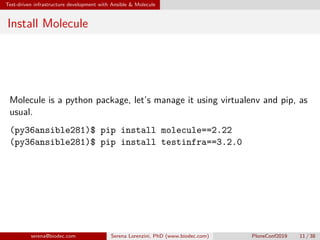
Molecule is a python package, let’s manage it using virtualenv and pip, as
usual.
(py36ansible281)$ pip install molecule==2.22
(py36ansible281)$ pip install testinfra==3.2.0
serena@biodec.com Serena Lorenzini, PhD (www.biodec.com) PloneConf2019 11 / 38
Test-driven infrastructure development with Ansible & Molecule
Develop a role with Molecule
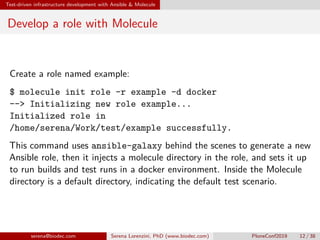
Create a role named example:
$ molecule init role -r example -d docker
--> Initializing new role example...
Initialized role in
/home/serena/Work/test/example successfully.
This command uses ansible-galaxy behind the scenes to generate a new
Ansible role, then it injects a molecule directory in the role, and sets it up
to run builds and test runs in a docker environment. Inside the Molecule
directory is a default directory, indicating the default test scenario.
serena@biodec.com Serena Lorenzini, PhD (www.biodec.com) PloneConf2019 12 / 38
Test-driven infrastructure development with Ansible & Molecule
Develop a role with Molecule
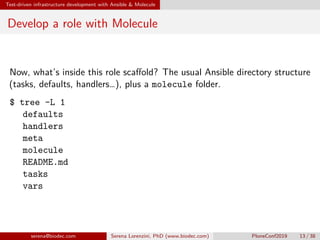
Now, what’s inside this role scaffold? The usual Ansible directory structure
(tasks, defaults, handlers…), plus a molecule folder.
$ tree -L 1
 defaults
 handlers
 meta
 molecule
 README.md
 tasks
 vars
serena@biodec.com Serena Lorenzini, PhD (www.biodec.com) PloneConf2019 13 / 38
Test-driven infrastructure development with Ansible  Molecule
Develop a role with Molecule
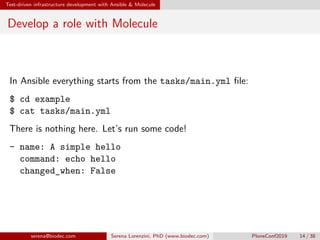
In Ansible everything starts from the tasks/main.yml file:
$ cd example
$ cat tasks/main.yml
There is nothing here. Let’s run some code!
- name: A simple hello
command: echo hello
changed_when: False
serena@biodec.com Serena Lorenzini, PhD (www.biodec.com) PloneConf2019 14 / 38
Test-driven infrastructure development with Ansible  Molecule
Develop a role with Molecule
Molecule has also created a playbook to run the role,
molecule/default/playbook.yml:
$ ansible-playbook molecule/default/playbook.yml -v
TASK [/home/serena/Work/test/example : A simple hello] ***
ok: [localhost] = {
changed: false,
cmd: [echo hello]],
}
STDOUT: hello
serena@biodec.com Serena Lorenzini, PhD (www.biodec.com) PloneConf2019 15 / 38
Test-driven infrastructure development with Ansible  Molecule
What about tests?
So far we have seen how to:
install Ansible
install Molecule
create the simplest Ansible role following the best practices.
Now, what about tests?
serena@biodec.com Serena Lorenzini, PhD (www.biodec.com) PloneConf2019 16 / 38
Test-driven infrastructure development with Ansible  Molecule
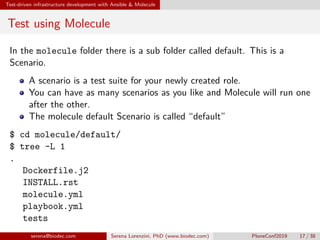
Test using Molecule
In the molecule folder there is a sub folder called default. This is a
Scenario.
A scenario is a test suite for your newly created role.
You can have as many scenarios as you like and Molecule will run one
after the other.
The molecule default Scenario is called “default”
$ cd molecule/default/
$ tree -L 1
.
 Dockerfile.j2
 INSTALL.rst
 molecule.yml
 playbook.yml
 tests
serena@biodec.com Serena Lorenzini, PhD (www.biodec.com) PloneConf2019 17 / 38
Test-driven infrastructure development with Ansible  Molecule
Test using Molecule
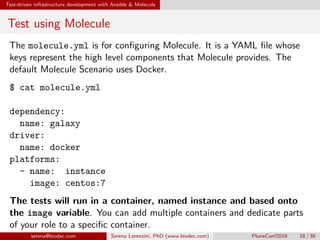
The molecule.yml is for configuring Molecule. It is a YAML file whose
keys represent the high level components that Molecule provides. The
default Molecule Scenario uses Docker.
$ cat molecule.yml
dependency:
name: galaxy
driver:
name: docker
platforms:
- name: instance
image: centos:7
The tests will run in a container, named instance and based onto
the image variable. You can add multiple containers and dedicate parts
of your role to a specific container.
serena@biodec.com Serena Lorenzini, PhD (www.biodec.com) PloneConf2019 18 / 38
Test-driven infrastructure development with Ansible  Molecule
A Molecule test
molecule test --help
Usage: molecule test [OPTIONS]
Test (lint, cleanup, destroy, dependency,
syntax, create, prepare, converge, idempotence,
side_effect, verify, cleanup, destroy).
The linting phases are quite difficult to pass, so, honestly, I usually disable
them. I can re-apply the linting rules once the development phase is
concluded.
serena@biodec.com Serena Lorenzini, PhD (www.biodec.com) PloneConf2019 19 / 38
Test-driven infrastructure development with Ansible  Molecule
A Molecule test
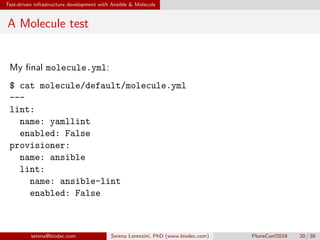
My final molecule.yml:
$ cat molecule/default/molecule.yml
---
lint:
name: yamllint
enabled: False
provisioner:
name: ansible
lint:
name: ansible-lint
enabled: False
serena@biodec.com Serena Lorenzini, PhD (www.biodec.com) PloneConf2019 20 / 38
Test-driven infrastructure development with Ansible  Molecule
A simple Molecule test
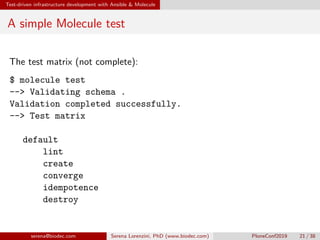
The test matrix (not complete):
$ molecule test
-- Validating schema .
Validation completed successfully.
-- Test matrix
 default
 lint
 create
 converge
 idempotence
 destroy
serena@biodec.com Serena Lorenzini, PhD (www.biodec.com) PloneConf2019 21 / 38
Test-driven infrastructure development with Ansible  Molecule
A simple Molecule test
Converge:
-- Scenario: 'default'
-- Action: 'converge'
PLAY [Converge] ************************
TASK [Gathering Facts] ****************
ok: [instance]
TASK [example : A simple hello] *******
ok: [instance]
PLAY RECAP ****************************
instance : ok=2 changed=0
serena@biodec.com Serena Lorenzini, PhD (www.biodec.com) PloneConf2019 22 / 38
Test-driven infrastructure development with Ansible  Molecule
A simple Molecule test
Idempotence:
-- Action: 'idempotence'
Idempotence completed successfully.
Destroy:
-- Action: 'destroy'
PLAY [Destroy] ************************************
TASK [Destroy molecule instance(s)] ****************
changed: [localhost] = (item=instance)
TASK [Delete docker network(s)] ****************
PLAY RECAP *********************************
localhost : ok=2 changed=2serena@biodec.com Serena Lorenzini, PhD (www.biodec.com) PloneConf2019 23 / 38
Test-driven infrastructure development with Ansible  Molecule
The Plone Ansible role
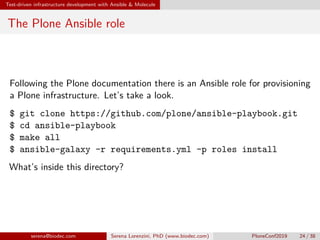
Following the Plone documentation there is an Ansible role for provisioning
a Plone infrastructure. Let’s take a look.
$ git clone https://github.com/plone/ansible-playbook.git
$ cd ansible-playbook
$ make all
$ ansible-galaxy -r requirements.yml -p roles install
What’s inside this directory?
serena@biodec.com Serena Lorenzini, PhD (www.biodec.com) PloneConf2019 24 / 38
Test-driven infrastructure development with Ansible  Molecule
The Plone Ansible role
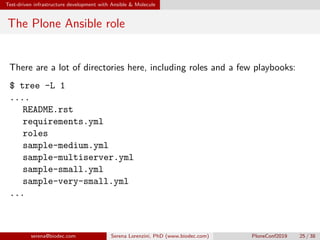
There are a lot of directories here, including roles and a few playbooks:
$ tree -L 1
....
 README.rst
 requirements.yml
 roles
 sample-medium.yml
 sample-multiserver.yml
 sample-small.yml
 sample-very-small.yml
...
serena@biodec.com Serena Lorenzini, PhD (www.biodec.com) PloneConf2019 25 / 38
Test-driven infrastructure development with Ansible  Molecule
The Plone Ansible role
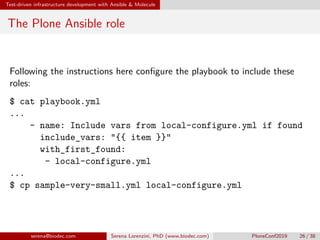
Following the instructions here configure the playbook to include these
roles:
$ cat playbook.yml
...
- name: Include vars from local-configure.yml if found
include_vars: {{ item }}
with_first_found:
- local-configure.yml
...
$ cp sample-very-small.yml local-configure.yml
serena@biodec.com Serena Lorenzini, PhD (www.biodec.com) PloneConf2019 26 / 38
Test-driven infrastructure development with Ansible  Molecule
The Plone Ansible role
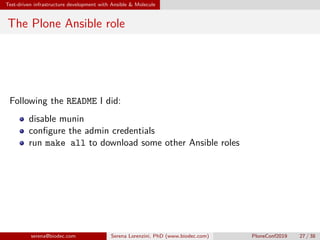
Following the README I did:
disable munin
configure the admin credentials
run make all to download some other Ansible roles
serena@biodec.com Serena Lorenzini, PhD (www.biodec.com) PloneConf2019 27 / 38
Test-driven infrastructure development with Ansible  Molecule
Test the Plone Ansible role
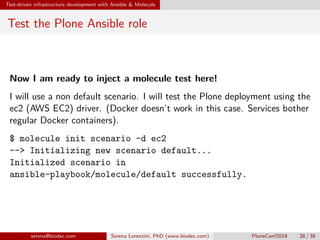
Now I am ready to inject a molecule test here!
I will use a non default scenario. I will test the Plone deployment using the
ec2 (AWS EC2) driver. (Docker doesn’t work in this case. Services bother
regular Docker containers).
$ molecule init scenario -d ec2
-- Initializing new scenario default...
Initialized scenario in
ansible-playbook/molecule/default successfully.
serena@biodec.com Serena Lorenzini, PhD (www.biodec.com) PloneConf2019 28 / 38
Test-driven infrastructure development with Ansible  Molecule
Test the Plone Ansible role
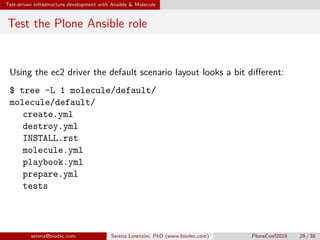
Using the ec2 driver the default scenario layout looks a bit different:
$ tree -L 1 molecule/default/
molecule/default/
 create.yml
 destroy.yml
 INSTALL.rst
 molecule.yml
 playbook.yml
 prepare.yml
 tests
serena@biodec.com Serena Lorenzini, PhD (www.biodec.com) PloneConf2019 29 / 38
Test-driven infrastructure development with Ansible  Molecule
Test the Plone Ansible role
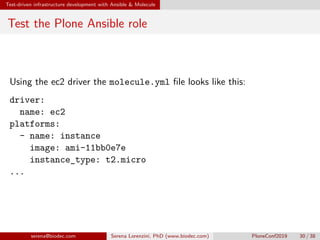
Using the ec2 driver the molecule.yml file looks like this:
driver:
name: ec2
platforms:
- name: instance
image: ami-11bb0e7e
instance_type: t2.micro
...
serena@biodec.com Serena Lorenzini, PhD (www.biodec.com) PloneConf2019 30 / 38
Test-driven infrastructure development with Ansible  Molecule
Test the Plone Ansible role
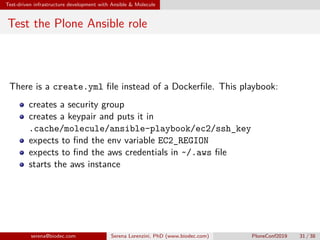
There is a create.yml file instead of a Dockerfile. This playbook:
creates a security group
creates a keypair and puts it in
.cache/molecule/ansible-playbook/ec2/ssh_key
expects to find the env variable EC2_REGION
expects to find the aws credentials in ~/.aws file
starts the aws instance
serena@biodec.com Serena Lorenzini, PhD (www.biodec.com) PloneConf2019 31 / 38
Test-driven infrastructure development with Ansible  Molecule
Test the Plone Ansible role
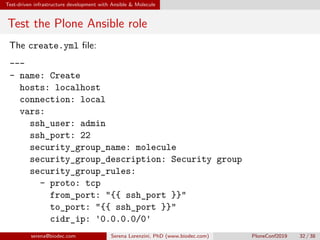
The create.yml file:
---
- name: Create
hosts: localhost
connection: local
vars:
ssh_user: admin
ssh_port: 22
security_group_name: molecule
security_group_description: Security group
security_group_rules:
- proto: tcp
from_port: {{ ssh_port }}
to_port: {{ ssh_port }}
cidr_ip: '0.0.0.0/0'
....serena@biodec.com Serena Lorenzini, PhD (www.biodec.com) PloneConf2019 32 / 38
Test-driven infrastructure development with Ansible  Molecule
Test the Plone Ansible role
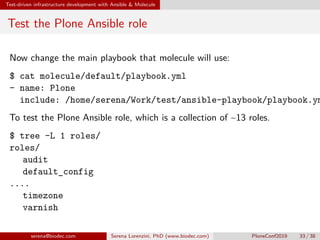
Now change the main playbook that molecule will use:
$ cat molecule/default/playbook.yml
- name: Plone
include: /home/serena/Work/test/ansible-playbook/playbook.ym
To test the Plone Ansible role, which is a collection of ~13 roles.
$ tree -L 1 roles/
roles/
 audit
 default_config
....
 timezone
 varnish
serena@biodec.com Serena Lorenzini, PhD (www.biodec.com) PloneConf2019 33 / 38
Test-driven infrastructure development with Ansible  Molecule
Test the Plone Ansible role
I will dare to say that this is becoming a test-driven cloud deployment
with Molecule and Ansible.
Now, that’s a statement!
However, we are getting close to it. Let’s do this.
$ molecule converge
And about ~15 minutes of Ansible later …
serena@biodec.com Serena Lorenzini, PhD (www.biodec.com) PloneConf2019 34 / 38
Test-driven infrastructure development with Ansible  Molecule
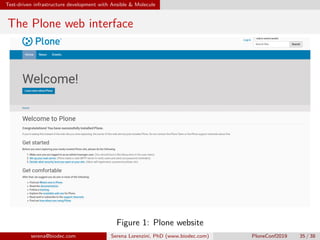
The Plone web interface
Figure 1: Plone website
serena@biodec.com Serena Lorenzini, PhD (www.biodec.com) PloneConf2019 35 / 38
Test-driven infrastructure development with Ansible  Molecule
Test the Plone Ansible role
Remeber to destroy this instance:
$ molecule destroy
The molecule test command does the full
converge/idempotence/destroy workflow, but, for keeping things alive for a
bit, I run the molecule converge and molecule destroy commands
one after the other.
serena@biodec.com Serena Lorenzini, PhD (www.biodec.com) PloneConf2019 36 / 38
Test-driven infrastructure development with Ansible  Molecule
Summary
Ansible is easy
Molecule really helps in developing roles and
allows to have many pre-configured test scenarios
serena@biodec.com Serena Lorenzini, PhD (www.biodec.com) PloneConf2019 37 / 38
Test-driven infrastructure development with Ansible  Molecule
The end
Thank you for your attention.
serena@biodec.com Serena Lorenzini, PhD (www.biodec.com) PloneConf2019 38 / 38

Test driven Infrastructure development with Ansible and Molecule

  • 1.
    Serena Lorenzini, PhD(www.biodec.com) serena@biodec.com PloneConf2019 serena@biodec.com Serena Lorenzini, PhD (www.biodec.com) PloneConf2019 1 / 38
  • 2.
    Test-driven infrastructure developmentwith Ansible & Molecule Test-driven infrastructure development with Ansible & Molecule serena@biodec.com Serena Lorenzini, PhD (www.biodec.com) PloneConf2019 2 / 38
  • 3.
    Test-driven infrastructure developmentwith Ansible & Molecule What is Ansible? “Working in IT, you’re likely doing the same tasks over and over. What if you could solve problems once and then automate your solutions going forward? Ansible is here to help.” Ansible is a simple provisioning tool that allows to automate tasks like: server provisioning software deployment serena@biodec.com Serena Lorenzini, PhD (www.biodec.com) PloneConf2019 3 / 38
  • 4.
    Test-driven infrastructure developmentwith Ansible & Molecule Why Ansible? It is agentless. Everything is done via ssh. Its YAML configuration files use structure and syntax that will be familiar to Python programmers. Ansible’s documentation is vast. Ansible is easily extended by roles. Roles are Ansibles’ reusable code. Many roles are available and evaluated by the community (stars, downloads, comments) It encourages to discipline yourself to never changing configuration on your target machines via login. serena@biodec.com Serena Lorenzini, PhD (www.biodec.com) PloneConf2019 4 / 38
  • 5.
    Test-driven infrastructure developmentwith Ansible & Molecule Why Ansible for Plone? Here I found the documentation of an Ansible role to provision a Plone infrastructure. Installing Plone for production, particularly for a busy or complex site, is hard and requires you learn about a variety of moving parts: ZEO server ZEO clients Process-control Load balancing Reverse-proxy caching URL rewriting and HTTPS support including certificate management serena@biodec.com Serena Lorenzini, PhD (www.biodec.com) PloneConf2019 5 / 38
  • 6.
    Test-driven infrastructure developmentwith Ansible & Molecule Provisioning a Plone server HUGE disclaimer: I don’t know Plone and I have never installed one. But I like to jump into new things using Ansible when possible. So, let’s pretend that I had to provision a Plone infrastructure. What would I do and how would I test my deploy strategy? serena@biodec.com Serena Lorenzini, PhD (www.biodec.com) PloneConf2019 6 / 38
  • 7.
    Test-driven infrastructure developmentwith Ansible & Molecule Install Ansible Ansible is a Python package. So, install Ansible using virtualenv and pip – not your OS package manager $ apt install virtualenv $ virtualenv -p /usr/bin/python3.6 py36ansible281 $ source py36ansible281/bin/activate $ (py36ansible281)$ pip install ansible==2.8.1 Check that Ansible works $ echo "localhost" > inventory $ ansible all -m ping -i inventory $ localhost | success >> { "changed": false, "ping": "pong" } Yes, it is that simple. serena@biodec.com Serena Lorenzini, PhD (www.biodec.com) PloneConf2019 7 / 38
  • 8.
    Test-driven infrastructure developmentwith Ansible & Molecule The ansible-playbook command Ping your instance using the ansible-playbook command. A playbook.yml file: hosts: all tasks: - name: Ping your instance action: ping ansible-playbook -i inventory playbook.yml TASK [Ping] ***************************************** ok: [localhost] => {"changed": false, "ping": "pong"} serena@biodec.com Serena Lorenzini, PhD (www.biodec.com) PloneConf2019 8 / 38
  • 9.
    Test-driven infrastructure developmentwith Ansible & Molecule Do Ansible the right way from the beginning: use roles. Roles provide a directory structure for breaking a (huge) playbook into multiple files. This simplifies writing complex playbooks, and it makes them easier to reuse. Plus, it makes them easier to be used by others. Roles can be created by using the ansible-galaxy init command. serena@biodec.com Serena Lorenzini, PhD (www.biodec.com) PloneConf2019 9 / 38
  • 10.
    Test-driven infrastructure developmentwith Ansible & Molecule Molecule Instead of using ansible-galaxy I will use Molecule. Molecule is designed to aid in the development and testing of Ansible roles. Molecule was adopted by the Ansible project on September 26 2018. Molecule supports any provider that Ansible supports. Providers can be bare-metal, virtual, cloud or containers. If Ansible can use it, Molecule can test it. Molecule simply leverages Ansible’s module system to manage instances. So, let’s create a role using Molecule. serena@biodec.com Serena Lorenzini, PhD (www.biodec.com) PloneConf2019 10 / 38
  • 11.
    Test-driven infrastructure developmentwith Ansible & Molecule Install Molecule Molecule is a python package, let’s manage it using virtualenv and pip, as usual. (py36ansible281)$ pip install molecule==2.22 (py36ansible281)$ pip install testinfra==3.2.0 serena@biodec.com Serena Lorenzini, PhD (www.biodec.com) PloneConf2019 11 / 38
  • 12.
    Test-driven infrastructure developmentwith Ansible & Molecule Develop a role with Molecule Create a role named example: $ molecule init role -r example -d docker --> Initializing new role example... Initialized role in /home/serena/Work/test/example successfully. This command uses ansible-galaxy behind the scenes to generate a new Ansible role, then it injects a molecule directory in the role, and sets it up to run builds and test runs in a docker environment. Inside the Molecule directory is a default directory, indicating the default test scenario. serena@biodec.com Serena Lorenzini, PhD (www.biodec.com) PloneConf2019 12 / 38
  • 13.
    Test-driven infrastructure developmentwith Ansible & Molecule Develop a role with Molecule Now, what’s inside this role scaffold? The usual Ansible directory structure (tasks, defaults, handlers…), plus a molecule folder. $ tree -L 1 defaults handlers meta molecule README.md tasks vars serena@biodec.com Serena Lorenzini, PhD (www.biodec.com) PloneConf2019 13 / 38
  • 14.
    Test-driven infrastructure developmentwith Ansible Molecule Develop a role with Molecule In Ansible everything starts from the tasks/main.yml file: $ cd example $ cat tasks/main.yml There is nothing here. Let’s run some code! - name: A simple hello command: echo hello changed_when: False serena@biodec.com Serena Lorenzini, PhD (www.biodec.com) PloneConf2019 14 / 38
  • 15.
    Test-driven infrastructure developmentwith Ansible Molecule Develop a role with Molecule Molecule has also created a playbook to run the role, molecule/default/playbook.yml: $ ansible-playbook molecule/default/playbook.yml -v TASK [/home/serena/Work/test/example : A simple hello] *** ok: [localhost] = { changed: false, cmd: [echo hello]], } STDOUT: hello serena@biodec.com Serena Lorenzini, PhD (www.biodec.com) PloneConf2019 15 / 38
  • 16.
    Test-driven infrastructure developmentwith Ansible Molecule What about tests? So far we have seen how to: install Ansible install Molecule create the simplest Ansible role following the best practices. Now, what about tests? serena@biodec.com Serena Lorenzini, PhD (www.biodec.com) PloneConf2019 16 / 38
  • 17.
    Test-driven infrastructure developmentwith Ansible Molecule Test using Molecule In the molecule folder there is a sub folder called default. This is a Scenario. A scenario is a test suite for your newly created role. You can have as many scenarios as you like and Molecule will run one after the other. The molecule default Scenario is called “default” $ cd molecule/default/ $ tree -L 1 . Dockerfile.j2 INSTALL.rst molecule.yml playbook.yml tests serena@biodec.com Serena Lorenzini, PhD (www.biodec.com) PloneConf2019 17 / 38
  • 18.
    Test-driven infrastructure developmentwith Ansible Molecule Test using Molecule The molecule.yml is for configuring Molecule. It is a YAML file whose keys represent the high level components that Molecule provides. The default Molecule Scenario uses Docker. $ cat molecule.yml dependency: name: galaxy driver: name: docker platforms: - name: instance image: centos:7 The tests will run in a container, named instance and based onto the image variable. You can add multiple containers and dedicate parts of your role to a specific container. serena@biodec.com Serena Lorenzini, PhD (www.biodec.com) PloneConf2019 18 / 38
  • 19.
    Test-driven infrastructure developmentwith Ansible Molecule A Molecule test molecule test --help Usage: molecule test [OPTIONS] Test (lint, cleanup, destroy, dependency, syntax, create, prepare, converge, idempotence, side_effect, verify, cleanup, destroy). The linting phases are quite difficult to pass, so, honestly, I usually disable them. I can re-apply the linting rules once the development phase is concluded. serena@biodec.com Serena Lorenzini, PhD (www.biodec.com) PloneConf2019 19 / 38
  • 20.
    Test-driven infrastructure developmentwith Ansible Molecule A Molecule test My final molecule.yml: $ cat molecule/default/molecule.yml --- lint: name: yamllint enabled: False provisioner: name: ansible lint: name: ansible-lint enabled: False serena@biodec.com Serena Lorenzini, PhD (www.biodec.com) PloneConf2019 20 / 38
  • 21.
    Test-driven infrastructure developmentwith Ansible Molecule A simple Molecule test The test matrix (not complete): $ molecule test -- Validating schema . Validation completed successfully. -- Test matrix default lint create converge idempotence destroy serena@biodec.com Serena Lorenzini, PhD (www.biodec.com) PloneConf2019 21 / 38
  • 22.
    Test-driven infrastructure developmentwith Ansible Molecule A simple Molecule test Converge: -- Scenario: 'default' -- Action: 'converge' PLAY [Converge] ************************ TASK [Gathering Facts] **************** ok: [instance] TASK [example : A simple hello] ******* ok: [instance] PLAY RECAP **************************** instance : ok=2 changed=0 serena@biodec.com Serena Lorenzini, PhD (www.biodec.com) PloneConf2019 22 / 38
  • 23.
    Test-driven infrastructure developmentwith Ansible Molecule A simple Molecule test Idempotence: -- Action: 'idempotence' Idempotence completed successfully. Destroy: -- Action: 'destroy' PLAY [Destroy] ************************************ TASK [Destroy molecule instance(s)] **************** changed: [localhost] = (item=instance) TASK [Delete docker network(s)] **************** PLAY RECAP ********************************* localhost : ok=2 changed=2serena@biodec.com Serena Lorenzini, PhD (www.biodec.com) PloneConf2019 23 / 38
  • 24.
    Test-driven infrastructure developmentwith Ansible Molecule The Plone Ansible role Following the Plone documentation there is an Ansible role for provisioning a Plone infrastructure. Let’s take a look. $ git clone https://github.com/plone/ansible-playbook.git $ cd ansible-playbook $ make all $ ansible-galaxy -r requirements.yml -p roles install What’s inside this directory? serena@biodec.com Serena Lorenzini, PhD (www.biodec.com) PloneConf2019 24 / 38
  • 25.
    Test-driven infrastructure developmentwith Ansible Molecule The Plone Ansible role There are a lot of directories here, including roles and a few playbooks: $ tree -L 1 .... README.rst requirements.yml roles sample-medium.yml sample-multiserver.yml sample-small.yml sample-very-small.yml ... serena@biodec.com Serena Lorenzini, PhD (www.biodec.com) PloneConf2019 25 / 38
  • 26.
    Test-driven infrastructure developmentwith Ansible Molecule The Plone Ansible role Following the instructions here configure the playbook to include these roles: $ cat playbook.yml ... - name: Include vars from local-configure.yml if found include_vars: {{ item }} with_first_found: - local-configure.yml ... $ cp sample-very-small.yml local-configure.yml serena@biodec.com Serena Lorenzini, PhD (www.biodec.com) PloneConf2019 26 / 38
  • 27.
    Test-driven infrastructure developmentwith Ansible Molecule The Plone Ansible role Following the README I did: disable munin configure the admin credentials run make all to download some other Ansible roles serena@biodec.com Serena Lorenzini, PhD (www.biodec.com) PloneConf2019 27 / 38
  • 28.
    Test-driven infrastructure developmentwith Ansible Molecule Test the Plone Ansible role Now I am ready to inject a molecule test here! I will use a non default scenario. I will test the Plone deployment using the ec2 (AWS EC2) driver. (Docker doesn’t work in this case. Services bother regular Docker containers). $ molecule init scenario -d ec2 -- Initializing new scenario default... Initialized scenario in ansible-playbook/molecule/default successfully. serena@biodec.com Serena Lorenzini, PhD (www.biodec.com) PloneConf2019 28 / 38
  • 29.
    Test-driven infrastructure developmentwith Ansible Molecule Test the Plone Ansible role Using the ec2 driver the default scenario layout looks a bit different: $ tree -L 1 molecule/default/ molecule/default/ create.yml destroy.yml INSTALL.rst molecule.yml playbook.yml prepare.yml tests serena@biodec.com Serena Lorenzini, PhD (www.biodec.com) PloneConf2019 29 / 38
  • 30.
    Test-driven infrastructure developmentwith Ansible Molecule Test the Plone Ansible role Using the ec2 driver the molecule.yml file looks like this: driver: name: ec2 platforms: - name: instance image: ami-11bb0e7e instance_type: t2.micro ... serena@biodec.com Serena Lorenzini, PhD (www.biodec.com) PloneConf2019 30 / 38
  • 31.
    Test-driven infrastructure developmentwith Ansible Molecule Test the Plone Ansible role There is a create.yml file instead of a Dockerfile. This playbook: creates a security group creates a keypair and puts it in .cache/molecule/ansible-playbook/ec2/ssh_key expects to find the env variable EC2_REGION expects to find the aws credentials in ~/.aws file starts the aws instance serena@biodec.com Serena Lorenzini, PhD (www.biodec.com) PloneConf2019 31 / 38
  • 32.
    Test-driven infrastructure developmentwith Ansible Molecule Test the Plone Ansible role The create.yml file: --- - name: Create hosts: localhost connection: local vars: ssh_user: admin ssh_port: 22 security_group_name: molecule security_group_description: Security group security_group_rules: - proto: tcp from_port: {{ ssh_port }} to_port: {{ ssh_port }} cidr_ip: '0.0.0.0/0' ....serena@biodec.com Serena Lorenzini, PhD (www.biodec.com) PloneConf2019 32 / 38
  • 33.
    Test-driven infrastructure developmentwith Ansible Molecule Test the Plone Ansible role Now change the main playbook that molecule will use: $ cat molecule/default/playbook.yml - name: Plone include: /home/serena/Work/test/ansible-playbook/playbook.ym To test the Plone Ansible role, which is a collection of ~13 roles. $ tree -L 1 roles/ roles/ audit default_config .... timezone varnish serena@biodec.com Serena Lorenzini, PhD (www.biodec.com) PloneConf2019 33 / 38
  • 34.
    Test-driven infrastructure developmentwith Ansible Molecule Test the Plone Ansible role I will dare to say that this is becoming a test-driven cloud deployment with Molecule and Ansible. Now, that’s a statement! However, we are getting close to it. Let’s do this. $ molecule converge And about ~15 minutes of Ansible later … serena@biodec.com Serena Lorenzini, PhD (www.biodec.com) PloneConf2019 34 / 38
  • 35.
    Test-driven infrastructure developmentwith Ansible Molecule The Plone web interface Figure 1: Plone website serena@biodec.com Serena Lorenzini, PhD (www.biodec.com) PloneConf2019 35 / 38
  • 36.
    Test-driven infrastructure developmentwith Ansible Molecule Test the Plone Ansible role Remeber to destroy this instance: $ molecule destroy The molecule test command does the full converge/idempotence/destroy workflow, but, for keeping things alive for a bit, I run the molecule converge and molecule destroy commands one after the other. serena@biodec.com Serena Lorenzini, PhD (www.biodec.com) PloneConf2019 36 / 38
  • 37.
    Test-driven infrastructure developmentwith Ansible Molecule Summary Ansible is easy Molecule really helps in developing roles and allows to have many pre-configured test scenarios serena@biodec.com Serena Lorenzini, PhD (www.biodec.com) PloneConf2019 37 / 38
  • 38.
    Test-driven infrastructure developmentwith Ansible Molecule The end Thank you for your attention. serena@biodec.com Serena Lorenzini, PhD (www.biodec.com) PloneConf2019 38 / 38