











Test it! 
Unit, mocking and in-container 
Meet Arquillian! 
Ivan St. Ivanov
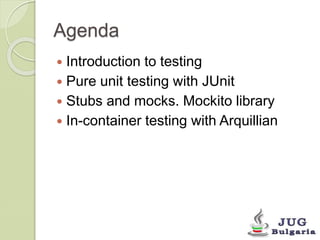
Agenda 
Introduction to testing 
Pure unit testing with JUnit 
Stubs and mocks. Mockito library 
In-container testing with Arquillian
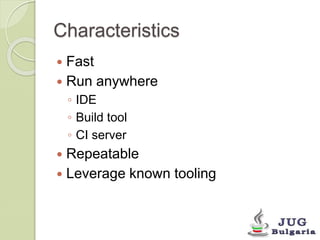
Characteristics 
Fast 
Run anywhere 
◦ IDE 
◦ Build tool 
◦ CI server 
Repeatable 
Leverage known tooling
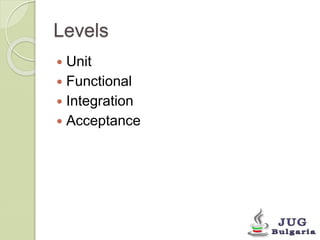
Levels 
Unit 
Functional 
Integration 
Acceptance
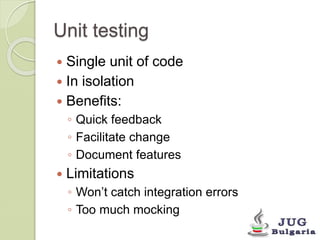
Unit testing 
Single unit of code 
In isolation 
Benefits: 
◦ Quick feedback 
◦ Facilitate change 
◦ Document features 
Limitations 
◦ Won’t catch integration errors 
◦ Too much mocking
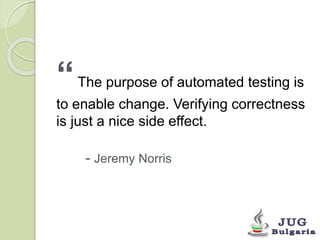
“ The purpose of automated testing is 
to enable change. Verifying correctness 
is just a nice side effect. 
- Jeremy Norris
Test frameworks
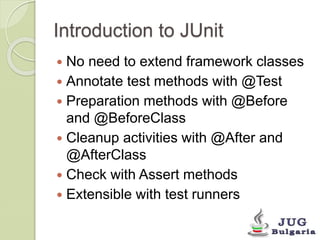
Introduction to JUnit 
No need to extend framework classes 
Annotate test methods with @Test 
Preparation methods with @Before 
and @BeforeClass 
Cleanup activities with @After and 
@AfterClass 
Check with Assert methods 
Extensible with test runners
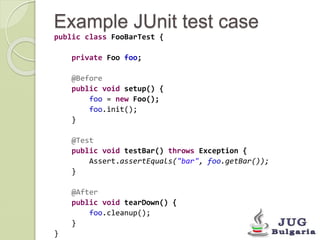
Example JUnit test case 
public class FooBarTest { 
private Foo foo; 
@Before 
public void setup() { 
foo = new Foo(); 
foo.init(); 
} 
@Test 
public void testBar() throws Exception { 
Assert.assertEquals("bar", foo.getBar()); 
} 
@After 
public void tearDown() { 
foo.cleanup(); 
} 
}
Stubs and mocks 
Units are not isolated 
Stubs 
◦ Test doubles 
◦ Predetermined behavior 
Mocks 
◦ Validate behavior as well 
Unit under test implies dependency 
injection
Dependency injectability 
Sample usecase 
◦ Conference manager 
◦ Cache 
Wrong: 
◦ Create Cache inside Conference 
manager 
◦ Lookup Cache 
Correct 
◦ Constructor or setter injection
Mocking libraries
Greeting earthlings
Core principles 
Tests should be portable to any 
container 
Tests should be executable from both 
IDE and build tool 
The platform should extend existing 
test frameworks
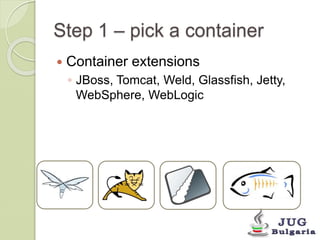
Step 1 – pick a container 
Container extensions 
◦ JBoss, Tomcat, Weld, Glassfish, Jetty, 
WebSphere, WebLogic
Step 2 – connect the 
container 
Container types 
◦ Embedded 
◦ Remote 
◦ Managed
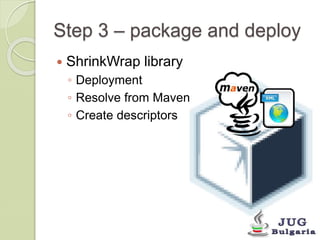
Step 3 – package and deploy 
ShrinkWrap library 
◦ Deployment 
◦ Resolve from Maven 
◦ Create descriptors
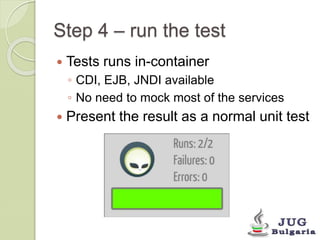
Step 4 – run the test 
Tests runs in-container 
◦ CDI, EJB, JNDI available 
◦ No need to mock most of the services 
Present the result as a normal unit test
Step 5 – undeploy the test 
Undeploy the test archive 
Disconnect or stop the container
That’s not all 
Persistence extension 
Warp 
Drone 
Graphene 
AngularJS, Android, OSGi 
…
Resources 
Testing 
http://en.wikipedia.org/wiki/Software_testing 
Unit testing 
http://en.wikipedia.org/wiki/Unit_testing 
Mocks and stubs 
http://martinfowler.com/articles/mocksArentStubs.html 
Arquillian 
http://aslakknutsen.github.io/presentations/ 
https://rpestano.wordpress.com/2014/06/08/arquillian/ 
https://rpestano.wordpress.com/2014/10/25/arquillian-and-mocks/
About this demo 
Slides 
http://bit.ly/bgjug-testing-slides 
Showcase – initial 
http://bit.ly/bgjug-testing 
Showcase – final 
http://bit.ly/bgjug-testing-final

Test it! Unit, mocking and in-container Meet Arquillian!

  • 1.
    Test it! Unit,mocking and in-container Meet Arquillian! Ivan St. Ivanov
  • 2.
    Agenda Introduction totesting Pure unit testing with JUnit Stubs and mocks. Mockito library In-container testing with Arquillian
  • 8.
    Characteristics Fast Runanywhere ◦ IDE ◦ Build tool ◦ CI server Repeatable Leverage known tooling
  • 9.
    Levels Unit Functional Integration Acceptance
  • 10.
    Unit testing Singleunit of code In isolation Benefits: ◦ Quick feedback ◦ Facilitate change ◦ Document features Limitations ◦ Won’t catch integration errors ◦ Too much mocking
  • 11.
    “ The purposeof automated testing is to enable change. Verifying correctness is just a nice side effect. - Jeremy Norris
  • 12.
  • 13.
    Introduction to JUnit No need to extend framework classes Annotate test methods with @Test Preparation methods with @Before and @BeforeClass Cleanup activities with @After and @AfterClass Check with Assert methods Extensible with test runners
  • 14.
    Example JUnit testcase public class FooBarTest { private Foo foo; @Before public void setup() { foo = new Foo(); foo.init(); } @Test public void testBar() throws Exception { Assert.assertEquals("bar", foo.getBar()); } @After public void tearDown() { foo.cleanup(); } }
  • 16.
    Stubs and mocks Units are not isolated Stubs ◦ Test doubles ◦ Predetermined behavior Mocks ◦ Validate behavior as well Unit under test implies dependency injection
  • 17.
    Dependency injectability Sampleusecase ◦ Conference manager ◦ Cache Wrong: ◦ Create Cache inside Conference manager ◦ Lookup Cache Correct ◦ Constructor or setter injection
  • 18.
  • 20.
  • 21.
    Core principles Testsshould be portable to any container Tests should be executable from both IDE and build tool The platform should extend existing test frameworks
  • 22.
    Step 1 –pick a container Container extensions ◦ JBoss, Tomcat, Weld, Glassfish, Jetty, WebSphere, WebLogic
  • 23.
    Step 2 –connect the container Container types ◦ Embedded ◦ Remote ◦ Managed
  • 24.
    Step 3 –package and deploy ShrinkWrap library ◦ Deployment ◦ Resolve from Maven ◦ Create descriptors
  • 25.
    Step 4 –run the test Tests runs in-container ◦ CDI, EJB, JNDI available ◦ No need to mock most of the services Present the result as a normal unit test
  • 26.
    Step 5 –undeploy the test Undeploy the test archive Disconnect or stop the container
  • 28.
    That’s not all Persistence extension Warp Drone Graphene AngularJS, Android, OSGi …
  • 30.
    Resources Testing http://en.wikipedia.org/wiki/Software_testing Unit testing http://en.wikipedia.org/wiki/Unit_testing Mocks and stubs http://martinfowler.com/articles/mocksArentStubs.html Arquillian http://aslakknutsen.github.io/presentations/ https://rpestano.wordpress.com/2014/06/08/arquillian/ https://rpestano.wordpress.com/2014/10/25/arquillian-and-mocks/
  • 31.
    About this demo Slides http://bit.ly/bgjug-testing-slides Showcase – initial http://bit.ly/bgjug-testing Showcase – final http://bit.ly/bgjug-testing-final