Test & Behavior
Driven
Development
or how to work with tests
March 27 2015
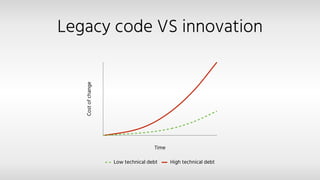
Legacy code VS innovation
Costofchange
Time
Low technical debt High technical debt
Test-Driven Development
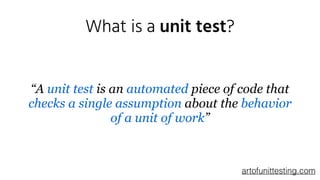
What is a unit test?
“A unit test is an automated piece of code that
checks a single assumption about the behavior
of a unit of work”
artofunittesting.com
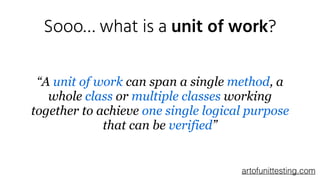
Sooo… what is a unit of work?
“A unit of work can span a single method, a
whole class or multiple classes working
together to achieve one single logical purpose
that can be verified”
artofunittesting.com
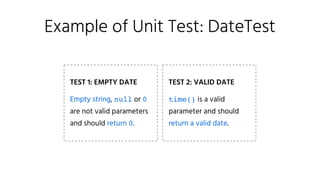
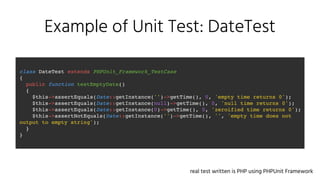
Example of Unit Test: DateTest
TEST 1: EMPTY DATE
Empty string, null or 0
are not valid parameters
and should return 0.
TEST 2: VALID DATE
time() is a valid
parameter and should
return a valid date.
Example of Unit Test: DateTest
class DateTest extends PHPUnit_Framework_TestCase
{
public function testEmptyDate()
{
$this->assertEquals(Date::getInstance('')->getTime(), 0, 'empty time returns 0');
$this->assertEquals(Date::getInstance(null)->getTime(), 0, 'null time returns 0');
$this->assertEquals(Date::getInstance(0)->getTime(), 0, 'zeroified time returns 0');
$this->assertNotEquals(Date::getInstance('')->getTime(), '', 'empty time does not
output to empty string');
}
}
real test written is PHP using PHPUnit Framework
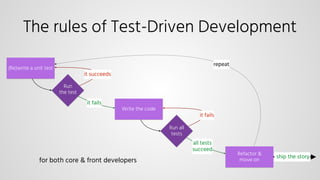
The rules of Test-Driven Development
(Re)write a unit test
Run
the test
Write the code
Run all
tests
Refactor &
move on
it succeeds
all tests
succeed
it fails
it fails
repeat
for both core & front developers
ship the story
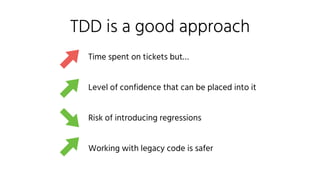
TDD is a good approach
Time spent on tickets but…
Level of confidence that can be placed into it
Risk of introducing regressions
Working with legacy code is safer
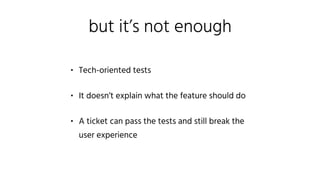
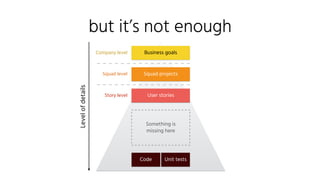
but it’s not enough
• Tech-oriented tests
• It doesn’t explain what the feature should do
• A ticket can pass the tests and still break the
user experience
but it’s not enough
Business goals
Squad projects
User stories
Something is
missing here
Code
Levelofdetails
Unit tests
Company level
Squad level
Story level
Behavior-Driven Development
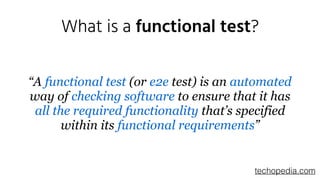
What is a functional test?
“A functional test (or e2e test) is an automated
way of checking software to ensure that it has
all the required functionality that’s specified
within its functional requirements”
techopedia.com
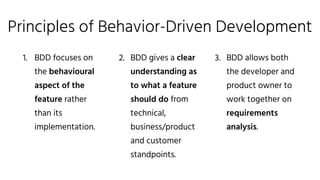
Principles of Behavior-Driven Development
1. BDD focuses on
the behavioural
aspect of the
feature rather
than its
implementation.
2. BDD gives a clear
understanding as
to what a feature
should do from
technical,
business/product
and customer
standpoints.
3. BDD allows both
the developer and
product owner to
work together on
requirements
analysis.
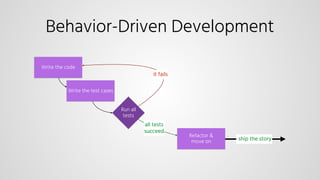
Behavior-Driven Development
Write the test cases
Run all
tests
Refactor &
move on
all tests
succeed
it fails
Write the code
ship the story
“A [role] can [do something] 

(so that [benefits]).”
But… what does it do exactly?
User story
“(If [given state],) when [event], 

then it should [do something].”
Acceptance criteria and scenarii
Continue with scenario 2…
new
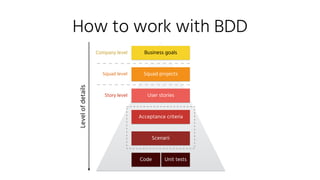
How to work with BDD
Business goals
Squad projects
User stories
Acceptance criteria
Scenarii
Code
Levelofdetails
Unit tests
Company level
Squad level
Story level
How to work with BDD
User Story:
A [role]

can [do something] 

so that [benefits]
Acceptance criteria:
Scenario 1:
If [given state]
and [other state]

when [event] 

then it should [do something]
and [another thing]
Scenario 2
Scenario 3
Other tests:
Scenario 4
Scenario 5
(Unit tests)
User stories remain the same
Acceptance criteria are the mandatory tests to validate the
story.
They should be written by both the product owner and the
developer before they start working on the ticket
Other tests are not here to validate the feature but to avoid
regressions and should test specific parts of the experience
Unit tests should not be described in the story, but present in
the code
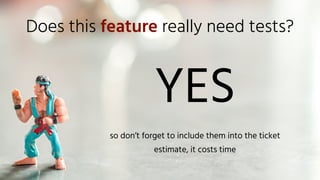
Does this feature really need tests?
YES
so don’t forget to include them into the ticket
estimate, it costs time
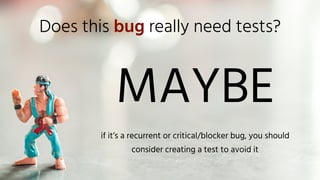
Does this bug really need tests?
MAYBE
if it’s a recurrent or critical/blocker bug, you should
consider creating a test to avoid it
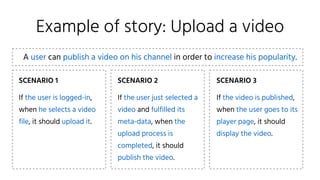
Example of story: Upload a video
A user can publish a video on his channel in order to increase his popularity.
SCENARIO 1
If the user is logged-in,
when he selects a video
file, it should upload it.
SCENARIO 2
If the user just selected a
video and fulfilled its
meta-data, when the
upload process is
completed, it should
publish the video.
SCENARIO 3
If the video is published,
when the user goes to its
player page, it should
display the video.
Upload a video: scenario 1
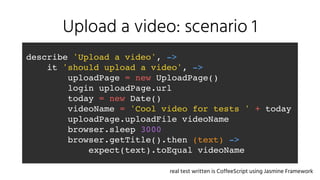
describe 'Upload a video', ->
it 'should upload a video', ->
uploadPage = new UploadPage()
login uploadPage.url
today = new Date()
videoName = 'Cool video for tests ' + today
uploadPage.uploadFile videoName
browser.sleep 3000
browser.getTitle().then (text) ->
expect(text).toEqual videoName
real test written is CoffeeScript using Jasmine Framework
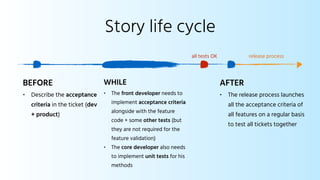
Story life cycle
BEFORE
• Describe the acceptance
criteria in the ticket (dev
+ product)
WHILE
• The front developer needs to
implement acceptance criteria
alongside with the feature
code + some other tests (but
they are not required for the
feature validation)
• The core developer also needs
to implement unit tests for his
methods
AFTER
• The release process launches
all the acceptance criteria of
all features on a regular basis
to test all tickets together
release processall tests OK
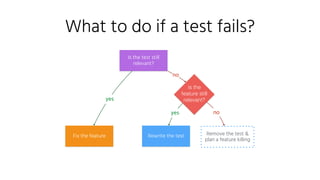
What to do if a test fails?
Fix the feature
yes
no
Is the test still
relevant?
Rewrite the test Remove the test &
plan a feature killing
is the
feature still
relevant?
yes no
Thank you

Test & behavior driven development

  • 1.
    Test & Behavior Driven Development orhow to work with tests March 27 2015
  • 2.
    Legacy code VSinnovation Costofchange Time Low technical debt High technical debt
  • 3.
  • 4.
    What is aunit test? “A unit test is an automated piece of code that checks a single assumption about the behavior of a unit of work” artofunittesting.com
  • 5.
    Sooo… what isa unit of work? “A unit of work can span a single method, a whole class or multiple classes working together to achieve one single logical purpose that can be verified” artofunittesting.com
  • 6.
    Example of UnitTest: DateTest TEST 1: EMPTY DATE Empty string, null or 0 are not valid parameters and should return 0. TEST 2: VALID DATE time() is a valid parameter and should return a valid date.
  • 7.
    Example of UnitTest: DateTest class DateTest extends PHPUnit_Framework_TestCase { public function testEmptyDate() { $this->assertEquals(Date::getInstance('')->getTime(), 0, 'empty time returns 0'); $this->assertEquals(Date::getInstance(null)->getTime(), 0, 'null time returns 0'); $this->assertEquals(Date::getInstance(0)->getTime(), 0, 'zeroified time returns 0'); $this->assertNotEquals(Date::getInstance('')->getTime(), '', 'empty time does not output to empty string'); } } real test written is PHP using PHPUnit Framework
  • 8.
    The rules ofTest-Driven Development (Re)write a unit test Run the test Write the code Run all tests Refactor & move on it succeeds all tests succeed it fails it fails repeat for both core & front developers ship the story
  • 9.
    TDD is agood approach Time spent on tickets but… Level of confidence that can be placed into it Risk of introducing regressions Working with legacy code is safer
  • 10.
    but it’s notenough • Tech-oriented tests • It doesn’t explain what the feature should do • A ticket can pass the tests and still break the user experience
  • 11.
    but it’s notenough Business goals Squad projects User stories Something is missing here Code Levelofdetails Unit tests Company level Squad level Story level
  • 12.
  • 13.
    What is afunctional test? “A functional test (or e2e test) is an automated way of checking software to ensure that it has all the required functionality that’s specified within its functional requirements” techopedia.com
  • 14.
    Principles of Behavior-DrivenDevelopment 1. BDD focuses on the behavioural aspect of the feature rather than its implementation. 2. BDD gives a clear understanding as to what a feature should do from technical, business/product and customer standpoints. 3. BDD allows both the developer and product owner to work together on requirements analysis.
  • 15.
    Behavior-Driven Development Write thetest cases Run all tests Refactor & move on all tests succeed it fails Write the code ship the story
  • 16.
    “A [role] can[do something] 
 (so that [benefits]).” But… what does it do exactly? User story
  • 17.
    “(If [given state],)when [event], 
 then it should [do something].” Acceptance criteria and scenarii Continue with scenario 2… new
  • 18.
    How to workwith BDD Business goals Squad projects User stories Acceptance criteria Scenarii Code Levelofdetails Unit tests Company level Squad level Story level
  • 19.
    How to workwith BDD User Story: A [role]
 can [do something] 
 so that [benefits] Acceptance criteria: Scenario 1: If [given state] and [other state]
 when [event] 
 then it should [do something] and [another thing] Scenario 2 Scenario 3 Other tests: Scenario 4 Scenario 5 (Unit tests) User stories remain the same Acceptance criteria are the mandatory tests to validate the story. They should be written by both the product owner and the developer before they start working on the ticket Other tests are not here to validate the feature but to avoid regressions and should test specific parts of the experience Unit tests should not be described in the story, but present in the code
  • 20.
    Does this featurereally need tests? YES so don’t forget to include them into the ticket estimate, it costs time
  • 21.
    Does this bugreally need tests? MAYBE if it’s a recurrent or critical/blocker bug, you should consider creating a test to avoid it
  • 22.
    Example of story:Upload a video A user can publish a video on his channel in order to increase his popularity. SCENARIO 1 If the user is logged-in, when he selects a video file, it should upload it. SCENARIO 2 If the user just selected a video and fulfilled its meta-data, when the upload process is completed, it should publish the video. SCENARIO 3 If the video is published, when the user goes to its player page, it should display the video.
  • 23.
    Upload a video:scenario 1 describe 'Upload a video', -> it 'should upload a video', -> uploadPage = new UploadPage() login uploadPage.url today = new Date() videoName = 'Cool video for tests ' + today uploadPage.uploadFile videoName browser.sleep 3000 browser.getTitle().then (text) -> expect(text).toEqual videoName real test written is CoffeeScript using Jasmine Framework
  • 24.
    Story life cycle BEFORE •Describe the acceptance criteria in the ticket (dev + product) WHILE • The front developer needs to implement acceptance criteria alongside with the feature code + some other tests (but they are not required for the feature validation) • The core developer also needs to implement unit tests for his methods AFTER • The release process launches all the acceptance criteria of all features on a regular basis to test all tickets together release processall tests OK
  • 25.
    What to doif a test fails? Fix the feature yes no Is the test still relevant? Rewrite the test Remove the test & plan a feature killing is the feature still relevant? yes no
  • 26.