Test bank GouldPathophysiology 5th edition
download
https://testbankmall.com/product/test-bank-gould-
pathophysiology-5th-edition/
Find test banks or solution manuals at testbankmall.com today!
2.
We believe theseproducts will be a great fit for you. Click
the link to download now, or visit testbankmall.com
to discover even more!
Pathophysiology for the Health Professions 4th Edition by
Gould Test Bank
https://testbankmall.com/product/pathophysiology-for-the-health-
professions-4th-edition-by-gould-test-bank/
Understanding Pathophysiology Huether 5th Edition Test
Bank
https://testbankmall.com/product/understanding-pathophysiology-
huether-5th-edition-test-bank/
Test Bank for Pathophysiology, 5th Edition: Copstead
Kirkhorn
https://testbankmall.com/product/test-bank-for-pathophysiology-5th-
edition-copstead-kirkhorn/
Test Bank for ¡Anda! Curso elemental, 2/E 2nd Edition
https://testbankmall.com/product/test-bank-for-anda-curso-
elemental-2-e-2nd-edition/
3.
Information Systems WhatEvery Business Student Needs to
Know 1st Mallach Solution Manual
https://testbankmall.com/product/information-systems-what-every-
business-student-needs-to-know-1st-mallach-solution-manual/
Test Bank for Effective Leadership and Management in
Nursing, 9th Edition, Eleanor J. Sullivan
https://testbankmall.com/product/test-bank-for-effective-leadership-
and-management-in-nursing-9th-edition-eleanor-j-sullivan/
Test Bank for The Real World (Sixth Edition) Sixth Edition
https://testbankmall.com/product/test-bank-for-the-real-world-sixth-
edition-sixth-edition/
Test Bank for Abnormal Child and Adolescent Psychology,
8th Edition : Wicks-Nelson
https://testbankmall.com/product/test-bank-for-abnormal-child-and-
adolescent-psychology-8th-edition-wicks-nelson/
Solution Manual for Child Development 9th Edition Laura E.
Berk
https://testbankmall.com/product/solution-manual-for-child-
development-9th-edition-laura-e-berk/
4.
Essentials of ContemporaryBusiness 1st Edition Boone Test
Bank
https://testbankmall.com/product/essentials-of-contemporary-
business-1st-edition-boone-test-bank/
5.
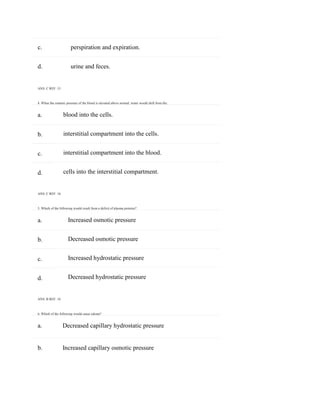
c. perspiration andexpiration.
b. Increased capillary osmotic pressure
a.
b.
c.
d.
a.
b.
c.
d.
d. urine and feces.
ANS: C REF: 15
4. When the osmotic pressure of the blood is elevated above normal, water would shift from the:
blood into the cells.
interstitial compartment into the cells.
interstitial compartment into the blood.
cells into the interstitial compartment.
ANS: C REF: 16
5. Which of the following would result from a deficit of plasma proteins?
Increased osmotic pressure
Decreased osmotic pressure
Increased hydrostatic pressure
Decreased hydrostatic pressure
ANS: B REF: 16
6. Which of the following would cause edema?
a. Decreased capillary hydrostatic pressure
6.
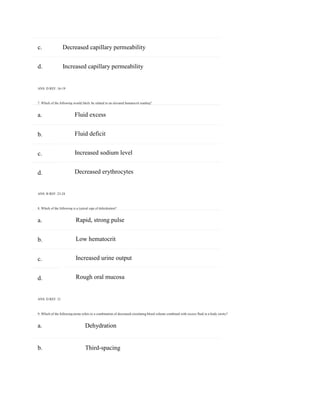
c. Decreased capillarypermeability
b. Third-spacing
a.
b.
c.
d.
a.
b.
c.
d.
d. Increased capillary permeability
ANS: D REF: 16-19
7. Which of the following would likely be related to an elevated hematocrit reading?
Fluid excess
Fluid deficit
Increased sodium level
Decreased erythrocytes
ANS: B REF: 23-24
8. Which of the following is a typical sign of dehydration?
Rapid, strong pulse
Low hematocrit
Increased urine output
Rough oral mucosa
ANS: D REF: 21
9. Which of the following terms refers to a combination of decreased circulating blood volume combined with excess fluid in a body cavity?
a. Dehydration
7.
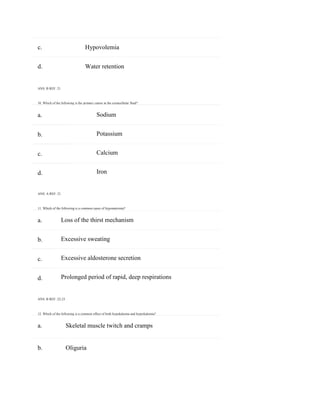
c. Hypovolemia
b. Oliguria
a.
b.
c.
d.
a.
b.
c.
d.
d.Water retention
ANS: B REF: 21
10. Which of the following is the primary cation in the extracellular fluid?
Sodium
Potassium
Calcium
Iron
ANS: A REF: 21
11. Which of the following is a common cause of hyponatremia?
Loss of the thirst mechanism
Excessive sweating
Excessive aldosterone secretion
Prolonged period of rapid, deep respirations
ANS: B REF: 22-23
12. Which of the following is a common effect of both hypokalemia and hyperkalemia?
a. Skeletal muscle twitch and cramps
8.
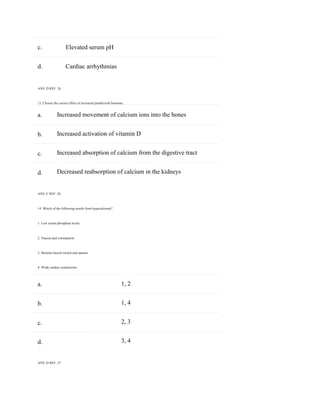
c. Elevated serumpH
a.
b.
c.
d.
a.
b.
c.
d.
d. Cardiac arrhythmias
ANS: D REF: 26
13. Choose the correct effect of increased parathyroid hormone.
Increased movement of calcium ions into the bones
Increased activation of vitamin D
Increased absorption of calcium from the digestive tract
Decreased reabsorption of calcium in the kidneys
ANS: C REF: 26
14. Which of the following results from hypocalcemia?
1. Low serum phosphate levels
2. Nausea and constipation
3. Skeletal muscle twitch and spasms
4. Weak cardiac contractions
1, 2
1, 4
2, 3
3, 4
ANS: D REF: 27
9.
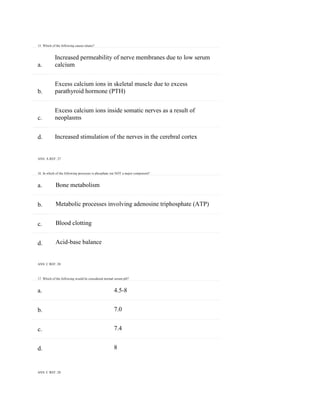
15. Which ofthe following causes tetany?
ANS: C REF: 28
a.
b.
c.
d.
a.
b.
c.
d.
a.
b.
c.
d.
Increased permeability of nerve membranes due to low serum
calcium
Excess calcium ions in skeletal muscle due to excess
parathyroid hormone (PTH)
Excess calcium ions inside somatic nerves as a result of
neoplasms
Increased stimulation of the nerves in the cerebral cortex
ANS: A REF: 27
16. In which of the following processes is phosphate ion NOT a major component?
Bone metabolism
Metabolic processes involving adenosine triphosphate (ATP)
Blood clotting
Acid-base balance
ANS: C REF: 28
17. Which of the following would be considered normal serum pH?
4.5-8
7.0
7.4
8
10.
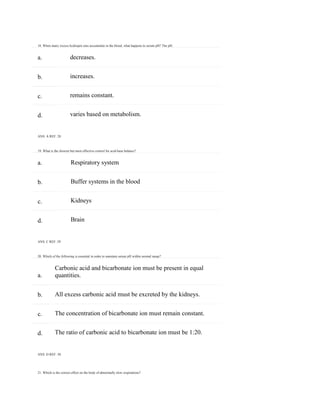
18. When manyexcess hydrogen ions accumulate in the blood, what happens to serum pH? The pH:
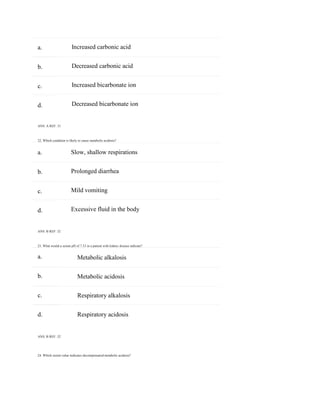
21. Which is the correct effect on the body of abnormally slow respirations?
a.
b.
c.
d.
a.
b.
c.
d.
a.
b.
c.
d.
decreases.
increases.
remains constant.
varies based on metabolism.
ANS: A REF: 28
19. What is the slowest but most effective control for acid-base balance?
Respiratory system
Buffer systems in the blood
Kidneys
Brain
ANS: C REF: 29
20. Which of the following is essential in order to maintain serum pH within normal range?
Carbonic acid and bicarbonate ion must be present in equal
quantities.
All excess carbonic acid must be excreted by the kidneys.
The concentration of bicarbonate ion must remain constant.
The ratio of carbonic acid to bicarbonate ion must be 1:20.
ANS: D REF: 30
11.
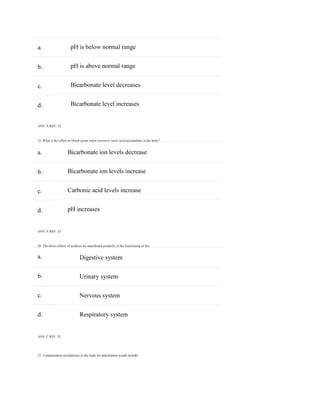
24. Which serumvalue indicates decompensated metabolic acidosis?
a.
b.
c.
d.
a.
b.
c.
d.
a.
b.
c.
d.
Increased carbonic acid
Decreased carbonic acid
Increased bicarbonate ion
Decreased bicarbonate ion
ANS: A REF: 31
22. Which condition is likely to cause metabolic acidosis?
Slow, shallow respirations
Prolonged diarrhea
Mild vomiting
Excessive fluid in the body
ANS: B REF: 32
23. What would a serum pH of 7.33 in a patient with kidney disease indicate?
Metabolic alkalosis
Metabolic acidosis
Respiratory alkalosis
Respiratory acidosis
ANS: B REF: 32
12.
27. Compensation mechanismsin the body for dehydration would include:
a.
b.
c.
d.
a.
b.
c.
d.
a.
b.
c.
d.
pH is below normal range
pH is above normal range
Bicarbonate level decreases
Bicarbonate level increases
ANS: A REF: 32
25. What is the effect on blood serum when excessive lactic acid accumulates in the body?
Bicarbonate ion levels decrease
Bicarbonate ion levels increase
Carbonic acid levels increase
pH increases
ANS: A REF: 32
26. The direct effects of acidosis are manifested primarily in the functioning of the:
Digestive system
Urinary system
Nervous system
Respiratory system
ANS: C REF: 32
13.
30. An anxietyattack often causes hyperventilation leading to:
a.
b.
c.
d.
a.
b.
c.
d.
a.
b.
c.
d.
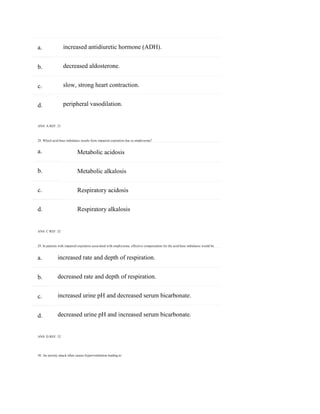
increased antidiuretic hormone (ADH).
decreased aldosterone.
slow, strong heart contraction.
peripheral vasodilation.
ANS: A REF: 21
28. Which acid-base imbalance results from impaired expiration due to emphysema?
Metabolic acidosis
Metabolic alkalosis
Respiratory acidosis
Respiratory alkalosis
ANS: C REF: 32
29. In patients with impaired expiration associated with emphysema, effective compensation for the acid-base imbalance would be:
increased rate and depth of respiration.
decreased rate and depth of respiration.
increased urine pH and decreased serum bicarbonate.
decreased urine pH and increased serum bicarbonate.
ANS: D REF: 32
14.
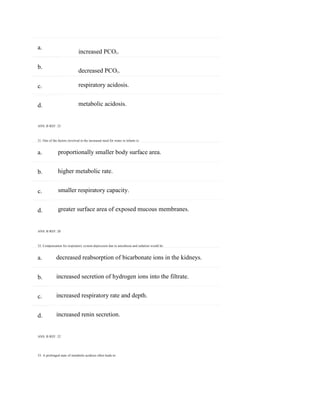
33. A prolongedstate of metabolic acidosis often leads to:
a.
b.
c.
d.
a.
b.
c.
d.
a.
b.
c.
d.
increased PCO2.
decreased PCO2.
respiratory acidosis.
metabolic acidosis.
ANS: B REF: 32
31. One of the factors involved in the increased need for water in infants is:
proportionally smaller body surface area.
higher metabolic rate.
smaller respiratory capacity.
greater surface area of exposed mucous membranes.
ANS: B REF: 20
32. Compensation for respiratory system depression due to anesthesia and sedation would be:
decreased reabsorption of bicarbonate ions in the kidneys.
increased secretion of hydrogen ions into the filtrate.
increased respiratory rate and depth.
increased renin secretion.
ANS: B REF: 32
15.
a.
b.
c.
d.
a.
b.
c.
d.
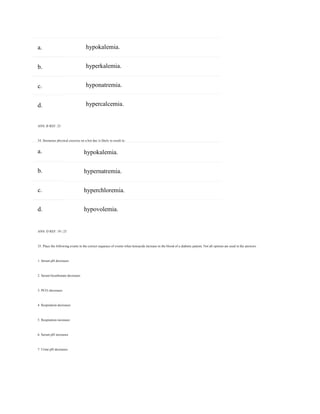
hypokalemia.
hyperkalemia.
hyponatremia.
hypercalcemia.
ANS: B REF:25
34. Strenuous physical exercise on a hot day is likely to result in:
hypokalemia.
hypernatremia.
hyperchloremia.
hypovolemia.
ANS: D REF: 19 | 23
35. Place the following events in the correct sequence of events when ketoacids increase in the blood of a diabetic patient. Not all options are used in the answers.
1. Serum pH decreases
2. Serum bicarbonate decreases
3. PCO2 decreases
4. Respiration decreases
5. Respiration increases
6. Serum pH increases
7. Urine pH decreases
16.
a.
b.
c.
d.
a.
b.
c.
d.
a.
b.
c.
d.
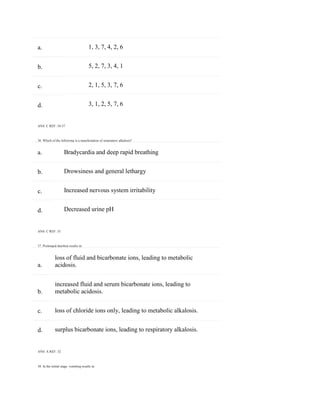
1, 3, 7,4, 2, 6
5, 2, 7, 3, 4, 1
2, 1, 5, 3, 7, 6
3, 1, 2, 5, 7, 6
ANS: C REF: 34-37
36. Which of the following is a manifestation of respiratory alkalosis?
Bradycardia and deep rapid breathing
Drowsiness and general lethargy
Increased nervous system irritability
Decreased urine pH
ANS: C REF: 33
37. Prolonged diarrhea results in:
loss of fluid and bicarbonate ions, leading to metabolic
acidosis.
increased fluid and serum bicarbonate ions, leading to
metabolic acidosis.
loss of chloride ions only, leading to metabolic alkalosis.
surplus bicarbonate ions, leading to respiratory alkalosis.
ANS: A REF: 32
38. In the initial stage, vomiting results in:
17.
a.
b.
c.
d.
a.
b.
c.
d.
a.
b.
c.
d.
metabolic acidosis.
metabolic alkalosis.
respiratoryalkalosis.
None of the above
ANS: B REF: 32
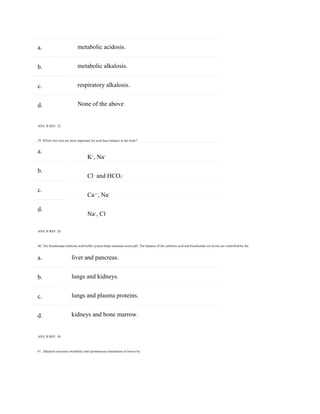
39. Which two ions are most important for acid-base balance in the body?
K+
, Na+
Cl–
and HCO3
–
Ca++
, Na+
Na+
, Cl–
ANS: B REF: 28
40. The bicarbonate-carbonic acid buffer system helps maintain serum pH. The balance of the carbonic acid and bicarbonate ion levels are controlled by the:
liver and pancreas.
lungs and kidneys.
lungs and plasma proteins.
kidneys and bone marrow.
ANS: B REF: 30
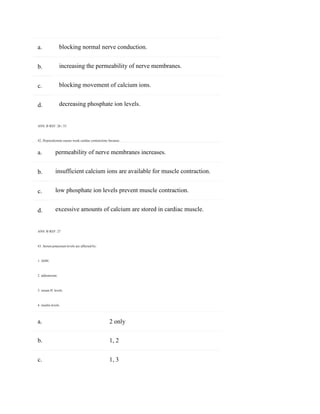
41. Alkalosis increases irritability and spontaneous stimulation of nerves by:
18.
a.
b.
c.
d.
a.
b.
c.
d.
blocking normal nerveconduction.
increasing the permeability of nerve membranes.
blocking movement of calcium ions.
decreasing phosphate ion levels.
ANS: B REF: 26 | 33
42. Hypocalcemia causes weak cardiac contractions because:
permeability of nerve membranes increases.
insufficient calcium ions are available for muscle contraction.
low phosphate ion levels prevent muscle contraction.
excessive amounts of calcium are stored in cardiac muscle.
ANS: B REF: 27
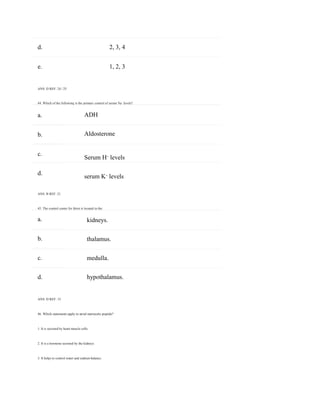
43. Serum potassium levels are affected by:
1. ADH.
2. aldosterone.
3. serum H+
levels.
4. insulin levels.
a. 2 only
b. 1, 2
c. 1, 3
19.
a.
b.
c.
d.
a.
b.
c.
d.
d. 2, 3,4
e.
ANS: D REF: 24 | 25
1, 2, 3
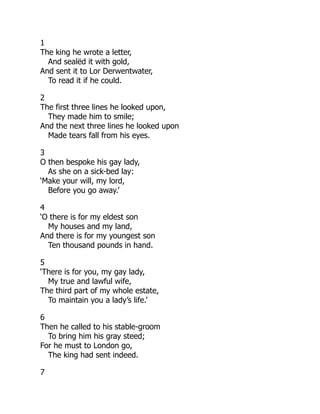
44. Which of the following is the primary control of serum Na+
levels?
ADH
Aldosterone
Serum H+
levels
serum K+
levels
ANS: B REF: 21
45. The control center for thirst is located in the:
kidneys.
thalamus.
medulla.
hypothalamus.
ANS: D REF: 15
46. Which statements apply to atrial natriuretic peptide?
1. It is secreted by heart muscle cells.
2. It is a hormone secreted by the kidneys.
3. It helps to control water and sodium balance.
1
The king hewrote a letter,
And sealëd it with gold,
And sent it to Lor Derwentwater,
To read it if he could.
2
The first three lines he looked upon,
They made him to smile;
And the next three lines he looked upon
Made tears fall from his eyes.
3
O then bespoke his gay lady,
As she on a sick-bed lay:
‘Make your will, my lord,
Before you go away.’
4
‘O there is for my eldest son
My houses and my land,
And there is for my youngest son
Ten thousand pounds in hand.
5
‘There is for you, my gay lady,
My true and lawful wife,
The third part of my whole estate,
To maintain you a lady’s life.’
6
Then he called to his stable-groom
To bring him his gray steed;
For he must to London go,
The king had sent indeed.
7
23.
When he puthis foot in the stirrup,
To mount his grey steed,
His gold ring from his finger burst,
And his nose began to bleed.
8
He had not gone but half a mile
When it began to rain;
‘Now this is a token,’ his lordship said,
‘That I shall not return again.’
9
When he unto London came,
A mob did at him rise,
And they callëd him a traitor,
Made the tears fall from his eyes.
10
‘A traitor, a traitor!’ his lordship said,
. . . . . . .
Is it for keeping eight score men
To fight for pretty Jimmee?’
11
O then bespoke a grave man,
With a broad axe in his hand:
‘Hold your tongue, Lord Derwentwater,
Your life lies at my command.’
12
‘My life, my life,’ his lordship said,
‘My life I will give to thee,
And the black velvet coat upon my back,
Take it for thy fee.’
13
Then he laid his head upon the block,
24.
He did suchcourage show,
And asked the executioner
To cut it off at one blow.
25.
I
The Gentleman’s Magazine,1825, vol. xcv, Part First, p. 489, taken
down by G. H., apparently in Westmoreland, from the dictation of an
old person who had learned it from her father; restored “to
something like poetical propriety” by the assistance of “a poetical
friend.”
26.
1
King George hedid a letter write,
And sealed it up with gold,
And sent it to Lord Derwentwater,
To read it if he could.
2
He sent his letter by no post,
He sent it by no page,
But sent it by a gallant knight
As eer did combat wage.
3
The first line that my lord lookd on
Struck him with strong surprise;
The second, more alarming still,
Made tears fall from his eyes.
4
He called up his stable-groom,
Saying, Saddle me well my steed,
For I must up to London go,
Of me there seems great need.
5
His lady, hearing what he said,
As she in child-bed lay,
Cry’d, My dear lord, pray make your will
Before you go away.
6
‘I’ll leave to thee, my eldest son,
My houses and my land;
I’ll leave to thee, my younger son,
Ten thousand pounds in hand.
7
27.
‘I’ll leave tothee, my lady gay,
My lawful married wife,
A third part of my whole estate,
To keep thee a lady’s life.’
8
He knelt him down by her bed-side,
And kissed her lips so sweet;
The words that passd, alas! presaged
They never more should meet.
9
Again he calld his stable-groom,
Saying, Bring me out my steed,
For I must up to London go,
With instant haste and speed.
10
He took the reins into his hand,
Which shook with fear and dread;
The rings from off his fingers dropt,
His nose gushd out and bled.
11
He had but ridden miles two or three
When stumbling fell his steed;
‘Ill omens these,’ Derwentwater said,
‘That I for James must bleed.’
12
As he rode up Westminster street,
In sight of the White Hall,
The lords and ladies of London town
A traitor they did him call.
13
‘A traitor!’ Lord Derwentwater said,
28.
‘A traitor howcan I be,
Unless for keeping five hundred men
Fighting for King Jemmy?’
14
Then started forth a grave old man,
With a broad-mouthd axe in hand:
‘Thy head, thy head, Lord Derwentwater,
Thy head’s at my command.’
15
‘My head, my head, thou grave old man,
My head I will give thee;
Here’s a coat of velvet on my back
Will surely pay thy fee.
16
‘But give me leave,’ Derwentwater said,
‘To speak words two or three;
Ye lords and ladies of London town,
Be kind to my lady.
17
‘Here’s a purse of fifty sterling pounds,
Pray give it to the poor;
Here’s one of forty-five beside
You may dole from door to door.’
18
He laid his head upon the block,
The axe was sharp and strong,
. . . . . . .
. . . . . . .
A.
29.
2
4
. Ere.
7
3
. the3rd.
Motherwell has made a few changes in his
printed copy.
12. This stanza is given in Notes and Queries,
First Series, I, 318, by a scholar of Christ’s
Hospital, who informs us that the ballad was
there current about 1785–1800:
There’s fifty pounds in my right pocket,
To be given to the poor;
There’s fifty pounds in my left pocket,
To be given from door to door.
E.
1
2
. And sealëd it with gold in Mr J. P. Morris’s
communication to Notes and Queries, the same
volume, p. 333.
F.
2
1
. by and by: cf. E 2.
2
2
. No one, no not a slave: cf. E 2.
I.
18. The remainder of four stanzas appended by
G. H. is omitted.
30.
209
GEORDIE
A. ‘Geordie,’ Johnson’sMusical Museum, No. 346,
p. 357, 1792.
B. “Scotch Ballads, Materials for Border Minstrelsy,”
Abbotsford, 1802.
C. a. ‘The Laird of Geight, or Gae.’ b. ‘The Laird of
Geight.’ “Scotch Ballads, Materials for Border
Minstrelsy,” Abbotsford, 1813–15.
D. ‘The Laird of Gigh, or Gae,’ “Scotch Ballads,
Materials for Border Minstrelsy,” Abbotsford,
1813–15.
E. a. Kinloch MSS, V, 130. b. ‘Geordie,’ Kinloch’s
Ancient Scottish Ballads, p. 192.
F. ‘Geordie Lukely,’ Motherwell’s MS., p. 367.
31.
G. ‘Geordie,’ ‘GeordieLukelie,’ Motherwell’s Note-
Book, p. 17, p. 10.
H. ‘Will ye go to the Hielans, Geordie?’ Christie,
Traditional Ballad Airs, II, 44.
I. a. ‘Gight’s Lady,’ Buchan’s MSS, II, 143. b. ‘Laird
(Lord?) of Gight,’ Kinloch MSS, VI, 1.
J. ‘Gight’s Lady,’ Buchan’s Ballads of the North of
Scotland, I, 133.
K. Motherwell’s MS., p. 400, two stanzas.
L. ‘Geordie,’ Cunningham’s Songs of Scotland, II,
186, two stanzas.
M. ‘Geordie,’ ‘Geordie Lukely,’ Motherwell’s Note-
Book, p. 2, one stanza.
N. ‘Geordie,’ Motherwell’s Note-Book, p. 20, one
stanza.
“Of this,” says Motherwell, “many variations exist
among reciters,” and his remark is borne out by what
is here given.
The copy in Cunningham’s Songs of Scotland, II,
186, is A retouched, with st. 5 dropped and two
stanzas (L) inserted from recitation. The texts of
Christie, I, 52, 84, are J abridged and E b. Of J
Christie says that he heard in 1848 a version sung by
32.
a native ofBuchan, Aberdeenshire, who had it
through her grandmother and great-grandmother,
which differed only in being more condensed and
wanting the catastrophe, and in having Badenoch’s
lady for Bignet’s, and Keith-Hall and Gartly for Black
Riggs and Kincraigie.
Geordie Gordon, A, of Gight (Gigh), B b, C, D, I,
of the Bog o Gight, H, is in prison, on a charge
endangering his life. He sends a message to his wife
to come to Edinburgh. She rides thither with the
utmost haste, and finds Geordie in extremity. She is
told that his life may be redeemed by the payment of
a large sum of money. She raises a contribution on
the spot, pays the ransom, and rides off with her
husband.
Kinloch and others incline to take Geordie to be
George Gordon, fourth earl of Huntly, who incurred
the Queen Regent’s displeasure for failing to execute
a commission against a Highland robber in 1554.
Huntly was committed to Edinburgh Castle, and
some of his many enemies urged that he should be
banished to France, others that he should be put to
death. The Earl of Cassilis, though a foe to Huntly,
resisted these measures on grounds of patriotism,
and proposed that he should be deprived of certain
honors and offices and fined. A fine was exacted,
33.
and the placeswhich had been taken from him were
restored.
[88]
With regard to this hypothesis, it may at
least be said that, if it should be accepted, the ballad
would be quite as faithful to history as many others.
A-E are the purer forms of the ballad; F-J are
corrupted by admixture.
Geordie is Geordie Lukely of Stirling in F. In G, he
is the Earl of Cassilis, ‘of Hye,’ as if some singer of
the Gordons had turned the tables on Huntly’s
enemy. In H, Geordie lives at the Bog o Gight, and
should be the Earl, or Marquis, of Huntly; but writers
of peerages will consult st. 17.
There has been a battle in the North in A-E. Sir
Charles Hay
[89]
has been killed, and Geordie is in
custody for this, A, B. Geordie has killed a man and
is to die, C; the man is his wife’s brother, D. In E,
Geordie is a rebel.
F begins with two stanzas from a vulgar last-dying-
speech, of which more by and by: otherwise the
story is not essentially injured, though the style is
lowered. Geordie (in the first two stanzas) has done
many an ill deed, but no murder or slaughter; he has
stolen fifteen of the king’s horse and sold them in
Bohemia. Earl Cassilis, likewise, in G, could not keep
his hand off horses; he has stolen three geldings out
of a park and sold them to Balleny (Balveny). Huntly,
if it be he, in H, has only made free with the king’s
34.
deer. In I,J, Geordie has had an intrigue with
Bignet’s (Pilbagnet’s, Badenoch’s) lady, for which the
husband has thrown him into prison, and he is to
die. But he owns to more than this in J. Beginning
with an acknowledgment of one of the king’s best
steeds stolen and sold in ‘Bevany,’ upon being
pressed, he confesses to a woman abused and five
orphan babes killed for their money.
Geordie points his message to his wife in C 2, D 4,
by begging her to sew him or bring him his linen
shirt (shirts), a good side shirt, which will be the last
he shall need, and a lang side sark is equally
prominent in the lady’s thoughts in I 8.
The lady stops for nothing in her ride to
Edinburgh. She will not, and does not, eat or drink all
the way, A 4, 5. When she comes to the water-side,
finding no boat ready, she swims the Queen’s Ferry,
B 7, C 5, D 9, J 13, L 1; or pays a boatman
prodigally to take her over, H 9, I 9, J 14.
When the lady gaes oer the pier of Leith, comes to
Edinburgh, to the West Port, the Canongate, the
Parliament Close, the tolbooth-stair, the prison-door,
she deals out crowns and ducatoons, makes the
handfus o red gold fly, among the numerous poor,
and bids them pray for Geordie. She has the
prudence, in G 5, to do the same among the nobles
35.
many at thetolbooth-gate, that they may plead for
Geordie.
The block and axe are in sight, and Geordie, in
chains, is coming down the stair, A; the napkin is laid
over his face, and the gallows is making ready, B (so
F, but put further on), his head is to go, C; the rest
of the nobles sit (stand) hat on head, but hat in hand
stands Geordie, D, E, H, I, J, L.
The lady makes a plea for her husband’s life. She
is the mother of many children (the tale ranges from
six to eleven) and is going with yet another, B, C, K,
N. She would bear them all over again for the life of
Geordie, C, D, or see them all streekit before her
eyes, B; and for his life she will part with all that she
owns, A 10, B 11, 16, D 14.
The king in A is moved by neither of these
appeals. The number of her children is so far from
affecting him that he orders the heading-man to
make haste. But the Gordons collect and pass the
word to be ready. There would have been bloody
bouks upon the green.
[90]
The lady is told that by paying a good round sum,
5,000 (500) pounds, 10,000 (1000) crowns, she can
redeem Geordie’s life. An aged lord prompts the king
to offer these terms in A; in the other versions, they
are proposed directly; by the king himself, F, G, I; by
the queen, B, I; by the good Argyle, D; by an
36.
English lord, H.The bystanders contribute
handsomely; she pays the ransom down, and wins
the life of Geordie, A-D, G-J.
In E, which is a mere fragment, there is no fine or
collection: a bold baron says, such true lovers shall
not be parted, and she gets her Geordie forthwith. In
F, no contribution is required, because the lady, after
scattering the red gold among the poor, is still in a
condition to produce the five thousand pound from
her own pocket. For this she receives a ‘remit,’ with
which she hies to the gallows and stops the
impending execution. In I b, which is defective, the
money collected is to pay the jailer’s fee. After the
discharge has been secured (in two or three copies
earlier), Lord Corstorph, B a, the Laird o Logie, B b,
an Irish lord, C, H, an English lord, D, the gleid
Argyle, I, Lord Montague, J, expresses a wish that
Geordie’s head were off, because he might have
succeeded to the lady. The lady checks this
aspiration, sometimes in very abusive language.
The pair now ride off together, and when she is set
in her saddle, no bird in bush or on briar ever sang
so sweet as she, B, C, E, F, H, I. If we were to trust
some of those who recite her story, the lady who has
shown so much spirit and devotion was not one of
those who blush to find good deeds fame. ‘Gar print
me ballants that I am a worthy lady,’ B 30 makes her
37.
say; ‘Hae meto some writer’s house, that I may
write down Gight’s lament and how I borrowed
Geordie,’ I a 25; ‘Call for one of the best clerks, that
he may write all this I’ve done for Geordie,’ J 36.
What she really did say is perhaps faithfully given in
D 18: ‘Where is there a writer’s house, that I may
write to the north that I have won the life of
Geordie?’
I and J are probably from stall-prints, and it has
not been thought necessary to notice some things
which may have been put into these to eke them out
to a convenient length. J has an entirely spurious
supplement. When the pair are riding away, and
even as the wife is protesting her affection, Geordie
turns round and says, A finger of Bignet’s lady’s hand
is worth a’ your fair body. A dispute ensues, and
Geordie pulls out a dagger and stabs his lady; he
then takes to flight, and never is found. Another set,
mentioned by Motherwell, makes Geordie drown his
deliverer in the sea, in a fit of jealousy (Minstrelsy, p.
lxxvi, 46).
There is an English broadside ballad, on the death
of “George Stoole” which seemed to Motherwell
“evidently imitated from the Scottish song.” This was
printed by H. Gosson, whose time is put at 1607–41.
[91]
This ballad was to be sung “to a delicate Scottish
tune;” Georgy comes in as a rhyme at the end of
38.
stanzas not seldom;Georgy writes to his lady,
bewailing his folly; he never stole no oxe nor cow,
nor ever murdered any, but fifty horse he did receive
of a merchant’s man of Gory, for which he was
condemned to die, and did die. These are the data
for determining the question of imitation.
There is a later ‘Georgy’ ballad, of the same
general cast, on the life and death of “George of
Oxford,” a professed and confessed highwayman, a
broadside printed in the last quarter of the
seventeenth century. In this, Lady Gray hastens to
Newcastle to beg Georgy’s life of the judge, and
offers gold and land to save him, after the fashion of
Lady Ward in ‘Hughie Graham;’ to no purpose, as in
‘Hughie Graham.’ This Georgy owns and boasts
himself a thief, but with limitations much the same as
those which are made a point of by the other; he
never stole horse, mare, or cloven-foot, with one
exception—the king’s white steeds, which he sold to
Bohemia.
Both of these ballads are given in an appendix.
Whether the writers of these English ballads knew
of the Scottish ‘Geordie,’ I would not undertake to
affirm or deny; it is clear that some far-back reciter
of the Scottish ballad had knowledge of the later
English broadside. The English ballads, however, are
mere “goodnights.” The Scottish ballads have a
39.
proper story, witha beginning, middle, and end, and
(save one late copy), a good end, and they are most
certainly original and substantially independent of
the English. The Scottish Geordie is no thief, nor
even a Johnie Armstrong. There are certain passages
in certain versions which give that impression, it is
true, but these are incongruous with the story, and
have been adopted from some copy of the
broadside, the later rather than the earlier. These
are, the first two stanzas of F, utterly out of place,
where we have the king’s horses stolen and sold in
Bohemia, almost exactly as in the ballad of ‘George
of Oxford,’ 15; G 7, where the Earl of Cassilis is made
to steal geldings and sell them in Balleny; and J 23,
in which the Laird of Gight steals one of the king’s
steeds (precisely as in ‘George of Oxford’) and sells it
in Bevany. That is to say, we have the very familiar
case of the introduction (generally accidental and
often infelicitous) of a portion of one ballad into
another; which, if accidental in the present instance,
would easily be accounted for by a George being the
hero in each. Further; the burden of E, embodied in
the ballad in two versions, I 27, J 35, has a general
resemblance to that of ‘George Stoole,’ and could
hardly have been original with the Scottish ballad.
There was probably a ‘Geordie Luklie,’ a Scottish
variety of one of the English broadsides.
40.
G is translatedby Gerhard, p. 56; A, in part, by
Knortz, Schottische Balladen, p. 101.
1
There was abattle in the north,
And nobles there was many,
And they hae killd Sir Charlie Hay,
And they laid the wyte on Geordie.
2
O he has written a lang letter,
He sent it to his lady:
‘Ye maun cum up to Enbrugh town,
To see what word’s o Geordie.’
3
When first she lookd the letter on,
She was baith red and rosy;
But she had na read a word but twa
Till she wallowt like a lily.
4
‘Gar get to me my gude grey steed,
My menyie a’ gae wi me,
For I shall neither eat nor drink
Till Enbrugh town shall see me.’
5
And she has mountit her gude grey steed,
Her menyie a’ gaed wi her,
And she did neither eat nor drink
Till Enbrugh town did see her.
6
And first appeard the fatal block,
And syne the aix to head him,
And Geordie cumin down the stair,
And bands o airn upon him.
7
43.
But tho hewas chaind in fetters strang,
O airn and steel sae heavy,
There was na ane in a’ the court
Sae bra a man as Geordie.
8
O she’s down on her bended knee,
I wat she’s pale and weary:
‘O pardon, pardon, noble king,
And gie me back my dearie!
9
‘I hae born seven sons to my Geordie dear,
The seventh neer saw his daddie;
O pardon, pardon, noble king,
Pity a waefu lady!’
10
‘Gar bid the headin-man mak haste,’
Our king reply’d fu lordly:
‘O noble king, tak a’ that’s mine,
But gie me back my Geordie!’
11
The Gordons cam, and the Gordons ran,
And they were stark and steady,
And ay the word amang them a’
Was, Gordons, keep you ready!
12
An aged lord at the king’s right hand
Says, Noble king, but hear me;
Gar her tell down five thousand pound,
And gie her back her dearie.
13
Some gae her marks, some gae her crowns,
44.
Some gae herdollars many,
And she’s telld down five thousand pound,
And she’s gotten again her dearie.
14
She blinkit blythe in her Geordie’s face,
Says, Dear I’ve bought thee, Geordie;
But there sud been bluidy bouks on the green
Or I had tint my laddie.
15
He claspit her by the middle sma,
And he kist her lips sae rosy:
‘The fairest flower o woman-kind
Is my sweet, bonie lady!’
45.
B
a. “Scotch Ballads,Materials for Border Minstrelsy,” No 13,
Abbotsford. Sent to Scott by William Laidlaw, September 11, 1802
(Letters, vol. i, No 73), as written down by Laidlaw from the
recitation of Mr Bartram of Biggar. b. Variations received by Laidlaw
from J. Scott.
46.
1
‘There was abattle i the north
Amang our nobles many,
And they have killed Sir Charles Hay,
And they’ve taen thrae me my Geordie.’
2
‘O where’ll I gett a wi bit boy,
A bonnie boy that’s ready,
That will gae in to my biggin
With a letter to my ladie?’
3
Then up and startit a wi bit boy,
An a bonnie boy was ready:
‘It’s I’ll gae in to your biggin
Wi a letter to your ladie.’
4
When the day was fair an the way was clear,
An the wi bit boy was ready,
An he’s gane in to his biggin,
Wi a letter to his ladie.
5
When she lookd the letter on,
She was no a wearit ladie;
But when she lookit the other side,
She mourned for her Geordie.
6
‘Gar sadle to me the black,’ she says,
‘For the brown rade neer sey bonnie,
An I’ll gae down to Enbro town,
An see my true-love Geordie.’
7
47.
When she camto the water-side,
The cobles war na ready;
She’s turnd her horse’s head about,
An in by the Queen’s Ferry.
8
When she cam to the West Port,
There war poor folks many;
She dealt crowns an the ducatdowns,
And bade them pray for Geordie.
9
When she cam to the Parliament Closs,
There amang our nobles many,
Cravats an caps war standing there,
But low, low lay her Geordie.
10
When she gaed up the tolbooth-stairs,
Amang our nobles manie,
The napkin’s tyed oer Geordie’s face,
And the gallows makin ready.
11
‘O wad ye hae his lands or rents?
Or wad ye hae his monie?
Take a’, a’ frae him but his sark alone,
Leave me my true-love Geordie.’
12
The captain pu’d her on his knee,
An ca’d her heart an honey:
‘An ye wad wait se’en years for me,
Ye wad never jump for Geordie.’
13
‘O hold your tongue, you foolish man,
48.
Welcome to ourwebsite – the perfect destination for book lovers and
knowledge seekers. We believe that every book holds a new world,
offering opportunities for learning, discovery, and personal growth.
That’s why we are dedicated to bringing you a diverse collection of
books, ranging from classic literature and specialized publications to
self-development guides and children's books.
More than just a book-buying platform, we strive to be a bridge
connecting you with timeless cultural and intellectual values. With an
elegant, user-friendly interface and a smart search system, you can
quickly find the books that best suit your interests. Additionally,
our special promotions and home delivery services help you save time
and fully enjoy the joy of reading.
Join us on a journey of knowledge exploration, passion nurturing, and
personal growth every day!
testbankmall.com








![and the places which had been taken from him were
restored.
[88]
With regard to this hypothesis, it may at
least be said that, if it should be accepted, the ballad
would be quite as faithful to history as many others.
A-E are the purer forms of the ballad; F-J are
corrupted by admixture.
Geordie is Geordie Lukely of Stirling in F. In G, he
is the Earl of Cassilis, ‘of Hye,’ as if some singer of
the Gordons had turned the tables on Huntly’s
enemy. In H, Geordie lives at the Bog o Gight, and
should be the Earl, or Marquis, of Huntly; but writers
of peerages will consult st. 17.
There has been a battle in the North in A-E. Sir
Charles Hay
[89]
has been killed, and Geordie is in
custody for this, A, B. Geordie has killed a man and
is to die, C; the man is his wife’s brother, D. In E,
Geordie is a rebel.
F begins with two stanzas from a vulgar last-dying-
speech, of which more by and by: otherwise the
story is not essentially injured, though the style is
lowered. Geordie (in the first two stanzas) has done
many an ill deed, but no murder or slaughter; he has
stolen fifteen of the king’s horse and sold them in
Bohemia. Earl Cassilis, likewise, in G, could not keep
his hand off horses; he has stolen three geldings out
of a park and sold them to Balleny (Balveny). Huntly,
if it be he, in H, has only made free with the king’s](https://image.slidesharecdn.com/864-250504224504-3ccaeacf/85/Test-bank-Gould-Pathophysiology-5th-edition-33-320.jpg)
![many at the tolbooth-gate, that they may plead for
Geordie.
The block and axe are in sight, and Geordie, in
chains, is coming down the stair, A; the napkin is laid
over his face, and the gallows is making ready, B (so
F, but put further on), his head is to go, C; the rest
of the nobles sit (stand) hat on head, but hat in hand
stands Geordie, D, E, H, I, J, L.
The lady makes a plea for her husband’s life. She
is the mother of many children (the tale ranges from
six to eleven) and is going with yet another, B, C, K,
N. She would bear them all over again for the life of
Geordie, C, D, or see them all streekit before her
eyes, B; and for his life she will part with all that she
owns, A 10, B 11, 16, D 14.
The king in A is moved by neither of these
appeals. The number of her children is so far from
affecting him that he orders the heading-man to
make haste. But the Gordons collect and pass the
word to be ready. There would have been bloody
bouks upon the green.
[90]
The lady is told that by paying a good round sum,
5,000 (500) pounds, 10,000 (1000) crowns, she can
redeem Geordie’s life. An aged lord prompts the king
to offer these terms in A; in the other versions, they
are proposed directly; by the king himself, F, G, I; by
the queen, B, I; by the good Argyle, D; by an](https://image.slidesharecdn.com/864-250504224504-3ccaeacf/85/Test-bank-Gould-Pathophysiology-5th-edition-35-320.jpg)
![say; ‘Hae me to some writer’s house, that I may
write down Gight’s lament and how I borrowed
Geordie,’ I a 25; ‘Call for one of the best clerks, that
he may write all this I’ve done for Geordie,’ J 36.
What she really did say is perhaps faithfully given in
D 18: ‘Where is there a writer’s house, that I may
write to the north that I have won the life of
Geordie?’
I and J are probably from stall-prints, and it has
not been thought necessary to notice some things
which may have been put into these to eke them out
to a convenient length. J has an entirely spurious
supplement. When the pair are riding away, and
even as the wife is protesting her affection, Geordie
turns round and says, A finger of Bignet’s lady’s hand
is worth a’ your fair body. A dispute ensues, and
Geordie pulls out a dagger and stabs his lady; he
then takes to flight, and never is found. Another set,
mentioned by Motherwell, makes Geordie drown his
deliverer in the sea, in a fit of jealousy (Minstrelsy, p.
lxxvi, 46).
There is an English broadside ballad, on the death
of “George Stoole” which seemed to Motherwell
“evidently imitated from the Scottish song.” This was
printed by H. Gosson, whose time is put at 1607–41.
[91]
This ballad was to be sung “to a delicate Scottish
tune;” Georgy comes in as a rhyme at the end of](https://image.slidesharecdn.com/864-250504224504-3ccaeacf/85/Test-bank-Gould-Pathophysiology-5th-edition-37-320.jpg)