Visit https://testbankpack.com to download the full version and
explore more testbank or solution manual
Test Bank for Java How to Program Late Objects
10th Edition Deitel 0132575655 9780132575652

_____ Click the link below to download _____
http://testbankpack.com/download/test-bank-for-java-
how-to-program-late-objects-10th-edition-
deitel-0132575655-9780132575652/
Explore and download more testbank at testbankpack.com
Here are some suggested products you might be interested in.
Click the link to download
Solution Manual for Java How to Program Late Objects 10th
Edition Deitel 0132575655 9780132575652

https://testbankpack.com/download/solution-manual-for-java-how-to-
program-late-objects-10th-edition-deitel-0132575655-9780132575652/
Test Bank for Java How to Program Early Objects 10th
Edition Deitel 0133807800 9780133807806
https://testbankpack.com/download/test-bank-for-java-how-to-program-
early-objects-10th-edition-deitel-0133807800-9780133807806/
Solution Manual for Java How to Program Early Objects 10th
Edition Deitel 0133807800 9780133807806
https://testbankpack.com/download/solution-manual-for-java-how-to-
program-early-objects-10th-edition-deitel-0133807800-9780133807806/
Test Bank for C++ How to Program Early Objects Version 9th
Edition by Deitel ISBN 0133378713 9780133378719
https://testbankpack.com/download/test-bank-for-c-how-to-program-
early-objects-version-9th-edition-by-deitel-
isbn-0133378713-9780133378719/
Solution Manual for C++ How to Program Early Objects
Version 9th Edition by Deitel ISBN 0133378713
9780133378719
https://testbankpack.com/download/solution-manual-for-c-how-to-
program-early-objects-version-9th-edition-by-deitel-
isbn-0133378713-9780133378719/
Test bank for Android How to Program 3rd Edition Deitel
0134444302 9780134444307
https://testbankpack.com/download/test-bank-for-android-how-to-
program-3rd-edition-deitel-0134444302-9780134444307/
Test Bank for C How to Program 7th Edition by Deitel ISBN
9789332555310 9780132990448
https://testbankpack.com/download/test-bank-for-c-how-to-program-7th-
edition-by-deitel-isbn-9789332555310-9780132990448/
Solution Manual for Android How to Program 3rd Edition
Deitel 0134444302 9780134444307
https://testbankpack.com/download/solution-manual-for-android-how-to-
program-3rd-edition-deitel-0134444302-9780134444307/
Solution Manual for C How to Program 7th Edition by Deitel
ISBN 9789332555310 9780132990448
https://testbankpack.com/download/solution-manual-for-c-how-to-
program-7th-edition-by-deitel-isbn-9789332555310-9780132990448/
Test Bank for Java How to Program Late Objects 10th
Edition Deitel 0132575655 9780132575652

Full Link Download:
Test Bank:
https://testbankpack.com/p/test-bank-for-java-how-to-program-late-objects-10th-
edition-deitel-0132575655-9780132575652/
Solution Manual:
https://testbankpack.com/p/solution-manual-for-java-how-to-program-late-
objects-10th-edition-deitel-0132575655-9780132575652/
© Copyright 1992-2015 by Deitel & Associates, Inc. and Prentice Hall. All Rights Reserved.
Chapter 2
Welcome App
2.1 Introduction
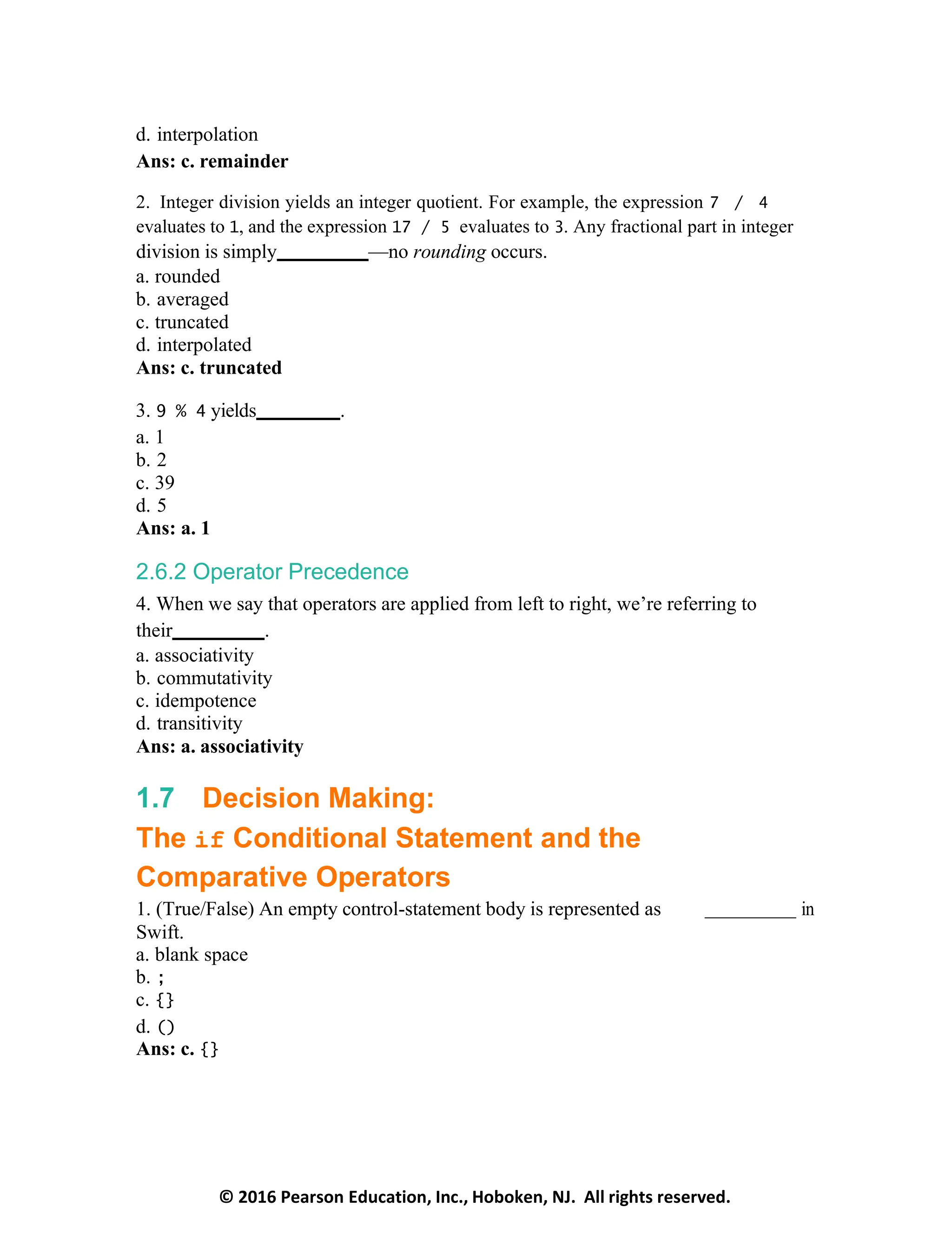
1. A app is an app that can run on iPhones, iPod touches and iPads.
a. multi-purpose
b. global
c. unrestricted
d. universal
Ans: d. universal
2. You can your apps so that they can display strings in different spoken
languages based on the user’s device settings.
a. limit b.
restrict c.
confine d.
localize
Ans: d. localize
2.2 Technologies Overview
2.2.2 Labels and Image Views
1. Which of the following statements is false?
a. Text can be displayed in a Label (an object of class UILabel from the Cocoa
Touch’s UIKit framework) and a picture can be displayed in an Image View (an object
of class UIImageView).
b. Using Cocoa Touch, you can (without programming) drag and drop a Label and an
Image View onto the UI.
c. iOS’s auto layout capabilities can maintain various relationships among GUI ele-
ments when the user rotates the device.
d. You can edit UI component attributes (e.g., the Text attribute of a Label and the
Image attribute of an Image View) to customize them for your apps.
© Copyright 1992-2015 by Deitel & Associates, Inc. and Prentice Hall. All Rights Reserved.
Ans: b. Using Cocoa Touch, you can (without programming) drag and drop a
Label and an Image View onto the UI. [Actually, using Interface Builder, you can
(without programming) drag and drop a Label and an Image View onto the UI.]
2.2.3 Asset Catalogs and Image Sets
2. Which of the following statements is false?
a. When your app is installed on a device, its icon and name appear with all other
installed apps in the iOS home screen.
b. You specify the icon for your app as part of the app’s settings-.
c. iOS supports asset catalogs, which manage image resources that require different
resolutions for different devices-. An asset catalog contains image sets from which iOS
automatically chooses the appropriate image based only on the device running the app.
d. Your app’s icon will appear in different sizes and resolutions based on the device
and context in which it’s displayed.
Ans: c. iOS supports asset catalogs, which manage image resources that require
different resolutions for different devices-. An asset catalog contains image sets
from which iOS automatically chooses the appropriate image based only on the
device running the app. Actually, an asset catalog contains image sets from which
iOS automatically chooses the appropriate image based on the device running the
app and the context in which the icon is used—such as in the iOS Settings app, in
Spotlight search or as the app’s icon on the home screen.
2.3 Creating a Universal App Project with Xcode
2.3.2 Projects and App Templates
1. Which of the following statements is false?
a. A project is a group of related files, such as the Swift code files and any media
files (e.g., images, video, audio) that compose an app. b. Select File > New > Project…
to create a new project.
c. Selecting File > New > Project… displays a sheet containing the design patterns that
you can use as your new project’s foundation. Design patterns save you time by
providing preconfigured starting points for commonly used app designs. d. A sheet is
a type of dialog that slides down from the top of a window.
Ans: c. Selecting File > New > Project… displays a sheet containing the design pat-
terns that you can use as your new project’s foundation. Design patterns save you
time by providing preconfigured starting points for commonly used app designs.
[Actually, this sheet contains templates, not design patterns.]
© Copyright 1992-2015 by Deitel & Associates, Inc. and Prentice Hall. All Rights Reserved.
2.4 Xcode Workspace Window
1. A new project’s window is known as a window, which is divided into
four main areas below the toolbar: the Navigator area, Editor area, Utilities area and the
Debug area.
a. workplace
b. workbench
c. workspace
d. workdesk
Ans: c. workspace
2.4.5 Xcode Toolbar
2. Clicking the Xcode 6 toolbar’s Run button builds then runs the project on the cur-
rently selected simulator or device as specified in the Scheme selector. Clicking and
holding on this button displays Run, Test, Profile and Analyze options. The Test op- tion
allows you to run unit tests on your app. The Profile option collects information about
your running code to help you locate performance issues, memory leaks and more. The
Analyze option checks your source code for .
a. syntax errors
b. current programming
idiom c. compilation errors
d. potential logic errors
Ans: d. potential logic errors
2.5 Storyboarding the Welcome App’s UI
2.5.2 Providing an App Icon
1. The manages image resources that require different sizes and resolu-
tions for different devices and contexts.
a. asset catalog b.
image catalog c.
device manager d.
context manager
Ans: asset catalog
2.5.4 Overview of the Storyboard and the Xcode Utilities Area
2. Which of the following statements about size classes and auto layout tools is false?
a. Size classes help you design scenes for different screen sizes and orientations.
b. By default, the scene is configured for Any width and Any height, meaning that the
scene is designed for any iOS device and any device orientation.
© Copyright 1992-2015 by Deitel & Associates, Inc. and Prentice Hall. All Rights Reserved.
c. The Any/Any scene is 256-by-256 pixels.
d. The auto layout tools enable you to specify how UI components adjust their sizes
and positions based on a device’s size and orientation.
Ans: c. The Any/Any scene is 256-by-256 pixels. Actually, The Any/Any scene is
600-by-600 pixels.
2.5.8 Using Auto Layout to Support Different Screen Sizes and
Orientations
3. You use constraints to specify how UI components are positioned rela-
tive to other components and how components should resize and reposition based on
the device and device orientation.
a. relative layout
b. auto layout
c. position layout
d. device-based layout
Ans: b. auto layout
2.6 Running the Welcome App
No questions
2.7 Making Your App Accessible
1. Which of the following statements is false?
a. For people with visual and physical disabilities, iOS’s VoiceOver can speak the
screen text (such as the text on a Label or Button) or text that you provide to help the
user understand the purpose of a UI component.
b. When VoiceOver is enabled and the user touches an accessible UI component,
VoiceOver speaks the accessibility text associated with the component.
c. All UIKit framework components support accessibility and many have it enabled
by default. For example, when the user touches a Label, VoiceOver speaks the La- bel’s
text.
d. VoiceOver is supported in the iOS simulator.
Ans: d. VoiceOver is supported in the iOS simulator. Actually, VoiceOver is not
currently supported in the iOS simulator, so you must run this app on a device
to hear VoiceOver speak the text. However, in the simulator you can use the
Accessibility Inspector to view the text that VoiceOver will speak.
© Copyright 1992-2015 by Deitel & Associates, Inc. and Prentice Hall. All Rights Reserved.
2.8 Internationalizing Your App
1. Using layout to design your UI is a key part of internationaliza-tion—
when used correctly, it enables iOS to present your UI in a manner appropriate for each
locale. For example, a UI arranged left-to-right for some languages (e.g., English,
French, Spanish, etc.) would typically be arranged right-to-left for others (e.g., Arabic,
Hebrew, etc.).
a. adjusting
b. customizing
c. regulating
d. auto
Ans: auto
2.8.1 Locking Your UI During Translation
2. If you’re still developing your app and want to have your string resources trans-
lated in parallel, you can your UI components for an entire storyboard or
individually so they cannot be modified accidentally.
a. load
b. lock
c. parallelize
d. freeze
Ans: b. lock
© 2016 Pearson Education, Inc., Hoboken, NJ. All rights reserved.
Chapter 2 Introduction to
Java Applications; Input/Output
and Operators
1.1 Introduction
No questions
1.2 A First Swift Program: Printing a Line of Text
1. Any scoped statements in main.swift—that is, statements that are
not written inside function, method or type definitions—serve as the app’s entry
point.
a. locally
b. outer
c. generically
d. globally
Ans: globally
2. String literals cannot span multiple lines of code, but you may concatenate mul-
tiple Strings into a longer String by using the operator.
a. @
b. -
c. ^
d. +
Ans: d. +
3. As you type code in the source-code editor, Xcode displays con-text-
sensitive, suggestions that help you write code quickly and correct-ly.
a. code-anticipation
b. code-fill
c. code-fulfillment
d. code-completion
Ans: code-completion
© 2016 Pearson Education, Inc., Hoboken, NJ. All rights reserved.
4. Where the standard output appears depends on the type of program and where you
execute it. Which of the following statements is false?
a. If you execute a println in a playground, the result displays in playground’s
Console window.
b. If you execute any app from an Xcode project, the output appears in the Debug
area at the bottom of the Xcode window.
c. If the statement is part of a Command Line Tool application, when you execute the
application in a Terminal window, the output appears in that window.
d. If you execute an iOS app on a device, the result is sent to a log file that you can
view in Xcode’s Devices window.
Ans: a. If you execute a println in a playground, the result displays in play-
ground’s Console window. Actually, if you execute a println in a playground, the
result displays in playground’s Assistant- Editor window.
1.3 Modifying Your First Program
1. How many lines of readable text does the following statement print?
println("WelcomentonSwiftnProgramming!")
a. 1
b. 2
c. 3
d. 4
Ans: d. 4
2. The backslash () is a(n) character, which has special meaning in a
String literal—n, for example, represents the line-feed special character.
a. outbreak
b. escape
c. release
d. break
Ans: b. escape
1.4 Composing Larger Strings with String
Interpolation
1. Swift uses type to determine a constant’s or variable’s type from its
initializer value.
a. interpolation
b. conjecture
c. inference
d. interpretation
Ans: c. inference
© 2016 Pearson Education, Inc., Hoboken, NJ. All rights reserved.
2. Constants and variables of the type are limited to the range –32,768 to
32767.
a. Int8
b. Int16
c. Int32
d. Int64
Ans: Int16
3. Constants and variables of the type are limited to the range 0 to
4,294,967,295.
a. UInt8
b. UIntnt16
c. UIntnt32
d. UIntnt64
Ans: c. UInt32
1.5 Another Application: Adding Integers
1. Which of the following statements is false? a.
Whole-number values are treated as type Int.
b. Use constants rather than variables when you know a value will not change after
it’s initialized.
c. Compilers can perform optimizations on variables that cannot be performed on
constants.
d. Constants also eliminate accidental modifications of data that should remain con-
stant.
Ans: c. Compilers can perform optimizations on variables that cannot be per-
formed on constants. [Actually, compilers can perform optimizations on con-
stants that cannot be performed on variables.]
2. An expression is any portion of a statement that has a(n) associated
with it.
a. name
b. constant
c. variable
d. value
Ans: d. value
1.6 Arithmetic
1. Among the arithmetic operators, the asterisk (*) indicates multiplication, and the
percent sign (%) is the operator.
a. division
b. integer division
c. remainder
© 2016 Pearson Education, Inc., Hoboken, NJ. All rights reserved.
d. interpolation
Ans: c. remainder
2. Integer division yields an integer quotient. For example, the expression 7 / 4
evaluates to 1, and the expression 17 / 5 evaluates to 3. Any fractional part in integer
division is simply —no rounding occurs.
a. rounded
b. averaged
c. truncated
d. interpolated
Ans: c. truncated
3. 9 % 4 yields .
a. 1
b. 2
c. 39
d. 5
Ans: a. 1
2.6.2 Operator Precedence
4. When we say that operators are applied from left to right, we’re referring to
their .
a. associativity
b. commutativity
c. idempotence
d. transitivity
Ans: a. associativity
1.7 Decision Making:
The if Conditional Statement and the
Comparative Operators
1. (True/False) An empty control-statement body is represented as in
Swift.
a. blank space
b. ;
c. {}
d. ()
Ans: c. {}
Discovering Diverse Content Through
Random Scribd Documents
these short extracts:
“Thursday, August 9th.
“The Great Eastern and Medway left Heart’s Content at noon.”
“Sunday, August 12th, at 3 P.M.
“Great Eastern and Medway joined the Terrible and Albany.”
“Monday, August 13th.
“At 1 P.M. commenced to lower grapnel from Great Eastern; at 2 P.M.
grapnel down; at 8.30 P.M. commenced to heave up grapnel, as Great
Eastern would not drift over cable.”
“Wednesday, August 15th.
“At 2 P.M. commenced lowering grapnel; at 8.30 P.M. grapnel hooked
cable. Hove up 100 fathoms and paid out again to wait until morning.”
“Friday, August 17th.
“At 4.30 A.M. commenced heaving up cable; at 10.45 A.M. cable above
water; at 10.50 A.M. cable parted about ten feet above the water.”
“Monday, August 27th.
“At 2.30 P.M. got cable from buoy in over the bow and found, by tests, it
to be only a short length of a few miles which must have been cut from the
main cable by grapnel.”
“Saturday, September 1st.
“At 4.50 A.M. cable up to 800 fathoms from the surface.
“At 5 P.M. commenced heaving up; found the cable to be hooked.”
“Sunday, September 2d.
“12.50 A.M.—Cable above the surface.
“2.16.—Bight of 1865 cable on board.
“3.11.—End brought into testing-room.
“3.50.—Message received. ‘Cable of 1866 and Gulf cable both O. K.’
“3.52.—Cable taken from test-room to make splice.
“6.50.—Shipped from bow to stern.
“7.01.—Commenced paying out cable.
“At 9.28 A.M. I sent the following telegram 720 miles east of
Newfoundland:
“ ‘Mrs. Cyrus W. Field, Newburg, New York:
“ ‘The cable of 1865 was recovered early this morning, and we are now
in perfect telegraphic communication with Valentia, and on our way back to
Heart’s Content, where we expect to arrive next Saturday. God be praised.
Please telegraph me in full at Heart’s Content. I am in good health and
spirits. Captain Anderson wishes to be kindly remembered to you.
Cyrus W. Field.’ ”
“Saturday, September 8th.
“Landed cable at Heart’s Content.
“Position of ships entering Trinity Bay:
Lily,
Medway,
Great Eastern,
Terrible,
Margaretta Stevenson.”
Of his own feeling, as he stood waiting on the Great Eastern at dawn on
Sunday morning, September 2d, Mr. Field told in a speech made in London
on March 10, 1868:
“One of the most interesting scenes that I ever witnessed ... was the
moment when, after the cable had been recovered on the Great Eastern, it
had been brought into the electrician’s room, and the test was applied to see
whether it was alive or dead. Never shall I forget that eventful moment
when, in answer to our question to Valentia, whether the cable of 1866,
which we had a few weeks previously laid, was in good working order, and
the cable across the Gulf of St. Lawrence had been repaired, in an instant
came back those six memorable letters, ‘Both O. K.’ I left the room, I went
to my cabin, I locked the door; I could no longer restrain my tears—crying
like a child, and full of gratitude to God that I had been permitted to live to
witness the recovery of the cable we had lost from the Great Eastern just
thirteen mouths previous.”
(From the London Times of Wednesday, September 5th.)
“The recovery of the cable of 1865 from the very lowest depths of the
Atlantic seems to have taken the world by surprise. It is not, however, too
much to say that no class of the community has felt more astonishment than
those who are best acquainted with the difficulties of the task—the
electricians....
“Night and day for a whole year an electrician has always been on duty
watching the tiny ray of light through which signals are given, and twice
every day the whole length of wire—1240 miles—has been tested for
conductivity and insulation.... Suddenly last Sunday morning at a quarter to
six, while the light was being watched by Mr. May, he observed a peculiar
indication about the light, which showed at once to his experienced eye that
a message was near at hand. In a few minutes afterwards the unsteady
flickering was changed to coherency, if we may use such a term, and at once
the cable began to speak:
“ ‘Canning to Glass.—I have much pleasure in speaking to you through
the 1865 cable. Just going to make splice.’ ”
(From Harper’s Magazine, October, 1866.)
“A great historical event has occurred since our last talk, and it has been
received almost as a matter of course. The distance between Europe and
America has been practically annihilated; the Atlantic Ocean has been
abolished; steam as an agent of communication has been antiquated. We
read every morning the previous day’s news from London or Paris, and
there is no excitement whatever. Scarcely a bell has rung or a cannon
roared. Not even a dinner has been eaten in honor of the great event, except
by the gentlemen immediately concerned; and the salvo of speeches which
usually resounds upon much inferior occasions from end to end of the
country has been omitted.... The steamers bring the cream no longer. That is
shot electrically under the sea, and the ships suddenly convey only skim-
milk. They are yet young men who remember the arrival of the Sirius and
the Liverpool and the Great Western. Their coming was the occasion of a
thousandfold greater excitement than the laying of the cable. Yet if some
visionary enthusiast had said to his friend as they watched with awe the
steaming in or out of those huge ships, ‘Before we are bald or gray we shall
look upon these vessels as we now look from the express train upon the
slow old stage-coaches,’ he would have been tolerated only as a harmless
maniac.... The name which will be always associated with this historical
event is that of the man who has so patiently and unweariedly persisted in
the project, Cyrus W. Field. With an undaunted cheerfulness, which often
seemed exasperating and unreasonable and fanatical, he has steadily and
zealously persevered, no more dismayed or baffled by apparent failure than
a good ship by a head wind. We remember meeting him one pleasant day
during the last spring in the street by the Astor House in New York. He said
that he was going out to England by the next steamer.
“ ‘And how many times have you crossed the ocean?’
“ ‘Oh,’ he replied, with the fresh enthusiasm of a boy going home for
vacation, ‘this will be the twenty-second voyage I have made upon this
business.’ And his eyes twinkled as we merrily said good-bye. We heard of
him no more until we saw his name signed to the despatch announcing the
triumph of his blithe faith and long labor.”
The number of voyages is understated here. That made on May 30th, he
writes, was his thirty-seventh.
In his lecture on “The Masters of the Situation” Mr. James T. Fields has
said:
“There is a faith so expansive and a hope so elastic that a man having
them will keep on believing and hoping till all danger is past and victory
sure. When I talk across an ocean of three thousand miles with my friends
on the other side of it, and feel that I may know any hour of the day if all
goes well with them, I think with gratitude of the immense energy and
perseverance of that one man, Cyrus W. Field, who spent so many years of
his life in perfecting a communication second only in importance to the
discovery of this country. The story of his patient striving during all that
stormy period is one of the noblest records of American enterprise, and only
his own family know the whole of it. It was a long, hard struggle.”
After a painful experience was past he never cared to recall it, and for
that reason the world never knew to what straits he and his family were
often pushed. Not a luxury was allowed, and during those twelve years any
wish that might be expressed could only be gratified “when the cable was
laid.” All waited for that day, but not always patiently, for one or another
was often heard to explain, “Oh, if that old cable was only at the bottom of
the ocean!” and to this he would invariably answer, “That is just where I
wish it to be.”
Neither does the world know what his books tell, that at this very time
his hand was stretched out to both his relations and friends. The surrogate
was so impressed with his management of a trust estate that he could not
believe his statement, and said that he must take the papers home and verify
them, for he had never before known that such an increase was possible.
It was in London, in March, 1868, that he told of the strange fluctuations
he had seen in the stock of the two telegraph companies in which he had so
long been interested.
“It is within the last six months only that we have received the first
return from the money we had put at the bottom of the Atlantic. I do not
believe that any enterprise has ever been undertaken that has had such
fortune: that has been so low, and, one might almost say, so high. I have
known the time when a thousand pounds of Atlantic telegraph stock sold in
London at a high premium. I have known the time when a thousand pounds
of the same stock was purchased by my worthy friend, the Right Honorable
Mr. Wortley, for thirty guineas. At one time when I was in London trying to
raise money to carry forward this great enterprise, a certificate for ten
thousand dollars (£2000 sterling) in the New York, Newfoundland, and
London Telegraph Company sold at the Merchants’ Exchange in New York
by public auction for a ten-dollar bill (£2). On my return home the
gentleman handed the certificate to me and asked me if it was worth
anything. I said to him, ‘My dear sir, what did you pay for it?’ and to my
mortification he showed to me the auctioneer’s bill for ten dollars. I said to
him, ‘I shall be happy to pay you a good profit on your investment.’ He
replied, ‘No; what do you advise me to do with it?’ I rejoined, “Lock it up
in your safe. Do not even think about or look at it until you receive a notice
to collect your dividends.’ The holder now receives a dividend of eight
hundred dollars per annum or (£160) in gold for his investment. If any
gentleman here has ever possessed a more fluctuating investment I should
like to hear it.”
Later in the evening the Right Honorable Mr. Wortley said:
“I have been a shareholder from the first, and I am somewhat proud of
my original £1000 shares, and of those shares to which you have alluded,
which I truly bought at £30 each. I am anxious, however, that those
gentlemen who heard that statement should understand that I have not yet
made a fortune out of the cable. The vicissitudes we have gone through
have prevented us from doing much financially, and, indeed, we have had
difficulty at times in keeping the enterprise afloat.”
The following telegram and letters are among those received at this time:
“21 Regent Street, Londres.
“Envoyez télégramme suivant à Field, Great Eastern:
“Félicitations pour persévérance et grand succès.
“Lesseps.”
“11 Carlton House Terrace. S.W.,
“August 28, ’66.
“My dear Sir,—The message which you did me the honor to send me
from Newfoundland at the commencement of this month, embodying in
part the contents of a speech delivered by me in the House of Commons a
few hours before, was a signal illustration of the great triumph which
energy and intelligence in your person, and in those of your coadjutors,
have achieved over difficulties that might well have been deemed
insurmountable by weaker men. I offer you my cordial congratulations, and
I trust that the electric line may powerfully contribute to binding our two
countries together in perfect harmony.
“The message reached me among friends interested in America and
produced a very lively sensation.
“We live in times of great events. Europe has not often of late seen
greater than those of the present year, which apparently go far to complete
the glorious work of the reconstruction of Italy, and which seem in
substance both to begin and complete another hardly less needed work in
the reconstruction of Germany. But I must say that few political phenomena
have ever struck me more than the recent conduct of American finance. I
admire beyond expression the courage which has carried through the
threefold operation of cutting down in earnest your war establishments,
maintaining for the time your war taxes, and paying off in your first year of
peace twenty-five millions sterling of your debt. There are nations that
could lay an electric telegraph under the Atlantic and yet could not do this. I
wish my humble congratulations might be conveyed to your finance
minister. This scale can hardly be kept up, but I do not doubt the future will
be worthy of the past, and I hope he will shame us and the Continent into at
least a distant and humble imitation.”
“I remain very faithfully yours,
“W. E. Gladstone.
“Cyrus W. Field, Esq.”
Captain Anderson’s letter of September 9th is to Mrs. Field, and was
written on board the Great Eastern:
“I cannot tell you how I have felt since our new success. It is only
seventeen months since I first walked up to the top of the paddle-box of this
ship at Sheerness upon a dark, rainy night, reviewed my past career in my
mind, and tried to look into the future, to see what I had undertaken, and
realize, if possible, what the new step in my career would develop. I cannot
say I believed much in cables; I rather think I did not; but I did believe your
husband was an earnest man of great force of character, and working under
a strong conviction that what he was attempting was thoroughly practicable;
and I knew enough of the names with which he had associated himself in
the enterprise to feel that it was a real, true, honest effort, worthy of all the
energy and application of one’s manhood, and, come what might of the
future, I resolved to do my very utmost and do nothing else until it was
over. More completely, however, than my resolve foreshadowed, I dropped,
inch by inch, or step by step, into the work, until I had no mind, no soul, no
sleep, that was not tinged with cable. I am fortunate that my duties were
such that I might well ask a blessing upon it, or I had better never have gone
to church or bent a knee—in a word, I accuse your husband of having
pulled me into a vortex that I could not get out of, and did not wish to try.
And only fancy that the sum total of all this is to lay a thread across an
ocean! Dr. Russell compared it to an elephant stretching a cobweb. And
there lay its very danger. The more you multiply the mechanism the more
you increase the risk. With all the vigilance and honesty of purpose of
chosen men, exigencies must arise and may occur. When the nights are dark
and stormy there comes the torture that may ruin all if not successfully met.
And so that task has been a series of high hopes and blank, dark hours of
disappointments, when it seemed as if the difficulties were legion and we
were beating the air. Mr. Field, at least, never gave out. He never ceased to
say, ‘It would all come right,’ even when his looks hardly bore out the
assertion. But at last it did. We came through it all, and I feel as if I had said
good-bye and God bless you to a wayward child who had cost me great
thought and was at last happily settled for life just where I wished her. I do
not think, though, that I could or would have nursed the wretch for twelve
years, as your husband has done, to the destruction of the repose of himself
and all the rest of his family. I should have discarded her and adopted some
other. He has persevered, however, and to him belongs all the credit your
country can bestow.”
Professor Wheatstone wrote:
“According to my promise I enclose a copy of my letter of September,
1866, to the Secretary of the Privy Council, in answer to his inquiry
respecting the persons most deserving of honor in connection with the
successful completion of the Atlantic telegraph.
“ ‘19 Park Crescent,
“ ‘Portland Place, N.W., September 22, 1866.
“ ‘My dear Sir,—The following is my opinion respecting the principal
co-operators in the establishment of the Atlantic telegraph:
“ ‘The person to whose indomitable perseverance we are indebted for the
commencement, carrying on, and completion of the enterprise is
undoubtedly Mr. Cyrus Field. Through good and through evil report he has
pursued his single object undaunted by repeated failures, keeping up the
flagging interest of the public and the desponding hopes of capitalists, and
employing his energies to combine all the means which might lead towards
a successful issue. This gentleman is a citizen of the United States, and
there would perhaps be a difficulty in conferring on him any honorary
distinction.
“ ‘From the staff of officials by whose practical skill and unwearied
attention the great project has been at last achieved, it appears to me there
are four gentlemen who might, in addition to special merits of their own, be
taken as the representatives of all those who have labored under or with
them in their respective departments.
“ ‘Public opinion, I think, would ratify the selection.
“ ‘These are:
“ ‘Mr. Glass, the manager of the Telegraph Maintenance Company,
under whose superintendence the great connecting link has been
manufactured, and to whose former firm is mainly owing the high
perfection which the construction of submarine cables has now attained.
“ ‘Mr. Canning, the able engineer of the same company, to whose
experience and skill we are chiefly indebted for the successful laying down
of the new cable and the restoration of the old.
“ ‘Captain Anderson, the commander of the Great Eastern steamship,
who under new and untried circumstances brought this leviathan of the
waters to work in subjection to the requirements of the great operation. An
honorary distinction to this gentleman would no doubt be received as a
compliment by the mercantile marine.
“ ‘Dr. W. Thomson, who, distinguished already in the highest fields of
science, has devoted his talents to improvements in the methods of
signalizing, and whose contrivances specially appropriated to the conditions
of submarine lines have resulted in the attainment of greater speed than was
at first expected.
“ ‘In naming these gentlemen I have limited myself to those actually
engaged in the great enterprise which at present occupies so much public
attention. I have left out of consideration the claims of others, however
great, who have preceded them in similar undertakings of less importance,
or who have either in thought or deed worked out results which have
rendered the present great work practicable or even possible.
“ ‘I remain, my dear sir,
“ ‘Yours very truly,
“ ‘C. Wheatstone.
“ ‘Arthur Helps, Esq.’ ”
At the banquet given at Liverpool on October 1st, the chairman read this
letter:
“Balmoral, 29th September, 1866.
“Dear Sir Stafford,—As I understand you are to have the honor of taking
the chair at the entertainment which is to be given on Monday next in
Liverpool to celebrate the double success which has attended the great
undertaking of laying the cable of 1866 and recovering that of 1865, by
which the two continents of Europe and America are happily connected, I
am commanded by the Queen to make known to you, and through you to
those over whom you are to preside, the deep interest with which Her
Majesty has regarded the progress of this noble work, and to tender Her
Majesty’s cordial congratulations to all of those whose energy and
perseverance, whose skill and science, have triumphed over all difficulties,
and accomplished a success alike honorable to themselves and to their
country, and beneficial to the world at large.
“Her Majesty, desirous of testifying her sense of the various merits
which have been displayed in this great enterprise, has commanded me to
submit to her for special marks of her royal favor the names of those who,
having had assigned to them prominent positions, may be considered as
representing the different departments whose united labors have contributed
to the final result.
“Her Majesty has accordingly been pleased to direct that the honor of
knighthood be conferred on Captain Anderson, the able and zealous
commander of the Great Eastern; on Professor Thomson, whose
distinguished science has been brought to bear with eminent success upon
the improvement of submarine telegraphy, and on Messrs. Glass and
Canning, the manager and engineer respectively of the Telegraph
Maintenance Company, whose skill and experience have mainly contributed
to the admirable construction and successful laying of the cable.
“Her Majesty is further pleased to mark her approval of the public spirit
and energy of the two companies who have had successively the conduct of
the undertaking by offering the dignity of a baronetcy of the United
Kingdom to Mr. Lampson, the deputy chairman of the original company, to
whose resolute support of the project, in spite of all discouragements, it was
in great measure owing that it was not at one time abandoned in despair;
and to Mr. Gooch, M.P., the chairman of the company which has finally
accomplished the great design.
“If among the names thus submitted to and approved by Her Majesty
that of Mr. Cyrus Field does not appear, the omission must not be attributed
to any disregard of the eminent services which from the first he has
rendered to the cause of transatlantic telegraphy, and the zeal and resolution
with which he has adhered to the prosecution of his object, but to an
apprehension lest it might appear to encroach on the province of his own
government if Her Majesty were advised to offer to a citizen of the United
States, for a service rendered alike to both countries, British marks of honor
which, following the example of another highly distinguished citizen, he
might feel himself unable to accept.
“I will only add, on my own part, how cordially I concur in the object of
the meeting over which you are about to preside, and how much I should
have been gratified had circumstances permitted me to have attended in
person.
“I am, dear Sir Stafford,
“Very sincerely yours,
“Derby.”
The celebration on the western shore of the Atlantic was not less general
and cordial. We quote from the report of a New York newspaper:
“A dinner was given in this city on the evening of the 16th instant by the
New York, Newfoundland, and London Telegraph Company to Cyrus W.
Field, who has recently returned to this country, after assisting in the
successful laying of the Atlantic telegraph cable, with which movement Mr.
Field has been more prominently identified from the beginning than any
other of its advocates and supporters. A considerable number of our first
citizens were present, including the honorary directors of the Atlantic
Telegraph Company.... Mr. Peter Cooper told of the formation of the New
York, Newfoundland, and London Telegraph Company, and then said: ‘On
those eventful evenings we became fully magnetized and infatuated with a
most magnificent idea. We pictured to ourselves that in a short time we
should plant a line of telegraph across the vast and mighty ocean. We as
little dreamed of the difficulties at that time that we were destined to
encounter as did the Jews of old dream of the difficulties that they were
doomed to meet in their passage to the promised land. We, like the Jews of
old, saw the hills green afar off, and, like them, we had but a faint idea of
the bare spots, the tangled thickets, and rugged cliffs over and through
which we have been compelled to pass in order to gain possession of our
land of promise. We have, however, been more fortunate than the Jews of
old; we have had a Moses who was able to lead on his associates, and when
he found them cast down and discouraged, he did not call manna from
heaven nor smite the rock, but just got us to look through his telescope at
the pleasant fields that lay so temptingly in the distance before us, and in
that way he was able to inspirit his associates with courage to go on until,
with the help of the Great Eastern, and the means and influence of the
noble band of men that Mr. Field has been able to enlist in the mother
country, we have at last accomplished a work that is now the wonder of the
world.
“In the accomplishment of this work it is our privilege to regard it as a
great and glorious means for diffusing useful knowledge throughout the
world.... I trust our united efforts will hasten the glorious time when nations
will have war no more; when they will beat their swords into ploughshares
and their spears into pruning-hooks. I trust our own country and
government will always stand as a bright and shining light in the pathway
of nations to cheer on with hope the suffering millions of mankind who are
now struggling for life, liberty, and happiness—a happiness that is possible
to men and nations who will cultivate the arts of peace instead of wasting
their energies in wars of mutual destruction.
“Let us hope that the day will soon come that will secure peace and
good-will among the nations of the earth.”
Mr. Cooper concluded with a toast to “The health and happiness of our
Moses, Mr. Cyrus W. Field.”
The Common Council of New York passed these resolutions on the 8th
of October:
“Whereas, The recent arrival at his home in this city of Cyrus W. Field,
Esq., seems peculiarly appropriate for testifying to him the gratification felt
by the authorities and people of the city of New York at the success
attending his unexampled perseverance in the face of almost insuperable
difficulties, and his fortitude and faith in the successful termination of the
herculean labor to which he has devoted his rare business capacity, his
indomitable will, and his undaunted courage for a series of years—that of
uniting the two hemispheres by telegraphy;
“Resolved, That the municipal authorities of the city of New York, for
themselves and speaking in behalf of their constituents, the people, do
hereby cordially tender their congratulations to Cyrus W. Field, Esq., on the
successful consummation of the work of uniting the two hemispheres by
electric telegraph—a work to which he has devoted himself for many years,
and to whom, under Divine Providence, the world is indebted for this great
triumph of skill, perseverance, and energy over the seemingly
insurmountable difficulties that were encountered in the progress of the
work; and we beg to assure him that we hope that the benefits and
advantages thus secured to the people of the two nations directly united
may be shared by him to an extent commensurate with the energy and
ability that have characterized his connection with the undertaking.
“Resolved, That a copy of the foregoing preamble and resolution be
properly engrossed, duly authenticated, and presented to Cyrus W. Field,
Esq., as a slight evidence of the appreciation by the people of this city of the
service he has rendered in uniting the old and new worlds in the electric
bands of fraternity and peace.”
The invitation to a banquet to be given by the New York Chamber of
Commerce is dated October 15th, and in it “the members request that they
may hear from your lips the story of this great undertaking;” and the
evening of November 15th was the one chosen.
The toast to which he replied was:
“Cyrus W. Field, the projector and mainspring of the Atlantic telegraph:
while the British government justly honors those who have taken part with
him in this great work of the age, his fame belongs to us, and will be
cherished and guarded by his countrymen.”
“The story of this great undertaking” has been told, and as far as possible
in his own words, in these chapters; but there are two or three further
extracts from his speech that it seems expedient to give, for they explain the
pages just read; they refer to the voyage, grappling, and manner of working
the cable.
“Yet this was not a ‘lucky hit’—a fine run across the ocean in calm
weather. It was the worst weather I ever knew at that season of the year. In
the despatch which appeared in the New York papers you may have read,
‘The weather has been most pleasant.’ I wrote it ‘unpleasant.’ We had fogs
and storms almost the whole way. Our success was the result of the highest
science combined with practical experience. Everything was perfectly
organized to the minutest detail. We had on board an admirable staff of
officers, such men as Halpin and Beckwith; and engineers long used to this
business, such as Canning and Clifford and Temple, the first of whom has
been knighted for his part in this great achievement; and electricians, such
as Professor Thomson, of Glasgow, and Willoughby Smith, and Laws;
while Mr. C. F. Varley, our companion of the year before, who stands
among the first in knowledge and practical skill, remained with Sir Richard
Glass at Valentia, to keep watch at that end of the line, and Mr. Latimer
Clark, who was to test the cable when done. We had four ships, and on
board of them some of the best seamen in England, men who knew the
ocean as a hunter knows every trail in the forest. Captain Moriarty had, with
Captain Anderson, taken most exact observations at the spot where the
cable broke in 1865, and they were so exact that they could go right to the
spot. After finding it they marked the line of the cable by a row of buoys,
for fogs would come down and shut out sun and stars, so that no man could
take an observation. These buoys were anchored a few miles apart. They
were numbered, and each had a flag-staff on it, so that it could be seen by
day, and a lantern by night. Thus having taken our bearings, we stood off
three or four miles, so as to come broadside on, and then casting over the
grapnel, drifted slowly down upon it, dragging the bottom of the ocean as
we went. At first it was a little awkward to fish in such deep water, but our
men got used to it, and soon could cast a grapnel almost as straight as an old
whaler throws a harpoon. Our fishing-line was of formidable size. It was
made of rope, twisted with wires of steel, so as to bear a strain of thirty
tons. It took about two hours for the grapnel to reach bottom, but we could
tell when it struck. I often went to the bow and sat on the rope, and could
feel by the quiver that the grapnel was dragging on the bottom two miles
under us. But it was a very slow business. We had storms and calms and
fogs and squalls. Still we worked on day after day. Once, on the 17th of
August, we got the cable up, and had it in full sight for five minutes—a
long slimy monster, fresh from the ooze of the ocean’s bed—but our men
began to cheer so wildly that it seemed to be frightened, and suddenly broke
away and went down into the sea.
“This accident kept us at work two weeks longer; but finally, on the last
night of August, we caught it. We had cast the grapnel thirty times. It was a
little before midnight on Friday night that we hooked the cable, and it was a
little after midnight Sunday morning that we got it on board. What was the
anxiety of those twenty-six hours? The strain on every man’s life was like
the strain on the cable itself. When finally it appeared it was midnight; the
lights of the ship, and in the boats around our bows, as they flashed in the
faces of the men, showed them eagerly watching for the cable to appear on
the water. At length it was brought to the surface. All who were allowed to
approach crowded forward to see it; yet not a word was spoken; only the
voices of the officers in command were heard giving orders. All felt as if
life and death hung on the issue. It was only when it was brought over the
bow and on to the deck that men dared to breathe. Even then they hardly
believed their eyes. Some crept towards it to feel of it—to be sure it was
there. Then we carried it along to the electrician’s room to see if our long-
sought treasure was alive or dead. A few minutes of suspense and a flash
told of the lightning current again set free. Then did the feeling, long pent
up, burst forth. Some turned away their heads and wept. Others broke into
cheers, and the cry ran from man to man and was heard down in the engine-
rooms, deck below deck, and from the boats on the water and the other
ships, while rockets lighted up the darkness of the sea. Then with thankful
hearts we turned our faces again to the west. But soon the wind arose, and
for thirty-six hours we were exposed to all the dangers of a storm on the
Atlantic. Yet in the very height and fury of the gale, as I sat in the
electrician’s room, a flash of light came up from the deep which, having
crossed to Ireland, came back to me in mid-ocean telling that those so dear
to me were well.
“When the first cable was laid in 1858 electricians thought that to send a
current two thousand miles it must be almost like a stroke of lightning. But
God was not in the earthquake, but in the still, small voice. The other day
Mr. Latimer Clark telegraphed from Ireland across the ocean and back
again with a battery formed in a lady’s thimble! And now Mr. Collett writes
me from Heart’s Content: ‘I have just sent my compliments to Dr. Gould, of
Cambridge, who is at Valentia, with a battery composed of a gun cap, with a
strip of zinc, excited by a drop of water, the simple bulk of a tear!’ ”
These were among the toasts given on the same evening:
“Captain Anderson and the officers of the Great Eastern and the other
ships engaged in the late expedition: they deserve the thanks not only of
their own country, but of the civilized world.”
“The capitalists of England and America who use their wealth to achieve
great enterprises, and leave behind them enduring monuments of their wise
munificence.”
And this sentiment was read:
“While expressing our grateful appreciation of the energy and sagacity
that practically achieved the spanning of the Atlantic by the electric current,
let us not fail to do honor to those whose genius and patient investigation of
the laws of nature furnished the scientific knowledge requisite to success.”
A reception was given to Mr. Field by the Century Club on Saturday
evening, November 17th.
It was in a speech made at Leeds early in October that Mr. John Bright
had said:
“To-morrow is the greatest day in the United States, when perhaps
millions of men will go to the polls, and they will give their votes on the
great question whether justice shall or shall not be done to the liberated
African; and in a day or two we shall hear the result, and I shall be greatly
surprised if that result does not add one more proof to those already given
of the solidity, intelligence, and public spirit of the great body of the people
of the United States. I have mentioned the North American continent. I refer
to the colonies which are still part of this empire, as well as to those other
colonies which now form this great and free republic, founded by the old
Genoese captain at the end of the fifteenth century. A friend of mine, Cyrus
Field, of New York, is the Columbus of our time, for after no less than forty
passages across the Atlantic in pursuit of the great aim of his life, he has at
length by his cable moved the New World close alongside the Old. To speak
from the United Kingdom to the North American continent, and from North
America to the United Kingdom, now is but the work of a moment of time,
and it does not require the utterance even of a whisper. The English nations
are brought together, and they must march on together.”
And Mr. Bright also wrote:
“Rochdale, November 23, 1866.
“My dear Mr. Field,—I sent a short message to Sir James Anderson, that
he might send it on to the chairman of the banquet. I have not heard from
him since, but I hope it reached you in proper time. The words were as
follows: ‘It is fitting you should honor the man to whom the whole world is
debtor. He brought capital and science together to do his bidding, and
Europe and America are forever united. I cannot sit at your table, but I can
join in doing honor to Cyrus W. Field. My hearty thanks to him may mingle
with yours.’
“This is but a faint expression of my estimation of your wonderful
energy and persistency and faith in the great work to which so many years
of your life have been devoted.
“The world as yet does not know how much it owes to you, and this
generation will never know it. I regard what has been done as the most
marvellous thing in human history. I think it more marvellous than the
invention of printing, or, I am almost ready to say, than the voyage of the
Genoese. But we will not compare these things, which are all great. Let us
rather rejoice at what has been done, and I will rejoice that you mainly have
done it.
“I wish I could have been at the dinner, for my reluctance to make a
speech would have given way to my desire to say something about you and
about the cable, and its grand significance to our Old World and your New
one.
“I need not tell you how much I am glad to believe that in a sense that is
very useful in this world you will profit largely by the success of the great
enterprise, and how fervently I hope your prosperity may increase....
“Your elections have turned out well. I hope you will yet be
‘reconstructed’ on sound principles, and not on the unhappy doctrines of the
President.
“If I were with you I could talk a good deal, but I cannot write more, so
farewell.
“With every good wish for you,
“I am always sincerely your friend,
“John Bright.”
A joint resolution presenting the thanks of Congress to Cyrus W. Field
was introduced in the Senate of the United States on December 12th, and it
was reported by Mr. Sumner without amendment on December 18th.
“Resolved. By the Senate and House of Representatives of the United
States of America, in Congress assembled,
“That the thanks of Congress be, and they hereby are, presented to Cyrus
W. Field, of New York, for his foresight, courage, and determination in
establishing telegraphic communication by means of the Atlantic cable,
traversing mid-ocean and connecting the Old World with the New; and that
the President of the United States be requested to cause a gold medal to be
struck, with suitable emblems, devices, and inscription, to be presented to
Mr. Field. And be it further
“Resolved, That when the medal shall have been struck, the President
shall cause a copy of this joint resolution to be engrossed on parchment, and
shall transmit the same, together with the medal, to Mr. Field, to be
presented to him in the name of the people of the United States of America.
And be it further
“Resolved, That a sufficient sum of money to carry this resolution into
effect is hereby appropriated out of any money in the Treasury not
otherwise appropriated.
“Approved March 2, 1867.”
Immediately on his return to New York Mr. Field sold enough of his
cable stock to enable him early in November to write to those who had
compromised with him in 1860 and enclose to each the full amount of his
indebtedness, with seven per cent. interest to date. One check was for $68
60, another was for $16,666 67; in all he paid $170,897 62.
The New York Evening Post wrote of this act:
“We hope we do not violate confidence in stating a fact to the honor of a
New York merchant, which, though a private transaction, ought to be
known. Our fellow-citizen, Mr. Cyrus W. Field, whose name will always be
connected with the Atlantic telegraph, has twice nearly ruined himself by
his devotion to that enterprise. Though a man of independent fortune when
he began, he embarked in it so large a portion of his capital as nearly to
make shipwreck of the whole. While in England engaged in the expedition
of 1857 a financial storm swept over this country and his house suspended;
but on his return he asked only for time, and paid all in full with interest.
But the stoppage was a heavy blow, and being followed by a fire, in 1859,
which burned his store to the ground, and by the panic of December, 1860,
just before the breaking out of the war, he was finally obliged to
compromise with his creditors. Thus released, he devoted himself to the
work of his life, which he has at last carried through. The success of the
Atlantic telegraph, we are happy to learn, has brought back a portion of his
lost wealth, and his first care has been to make good all losses to others. He
has addressed a letter to every creditor who suffered by the failure of his
house in 1860, requesting him to send a statement of the amount
compromised, adding the interest for nearly six years, and as fast as
presented returns a check in full. The whole amount will be about $200,000.
Such a fact, however he may wish to keep it a secret, ought to be known, to
his honor and to the honor of the merchants of New York.”
It was at this time that Mr. George Peabody gave him a service of silver,
and asked that this inscription should be engraved on each piece:
GEORGE PEABODY
TO
CYRUS W. FIELD,
In testimony and commemoration
of an act of very high
Commercial integrity and honor.
New York, 10th November, 1866.
Welcome to our website – the ideal destination for book lovers and
knowledge seekers. With a mission to inspire endlessly, we offer a
vast collection of books, ranging from classic literary works to
specialized publications, self-development books, and children's
literature. Each book is a new journey of discovery, expanding
knowledge and enriching the soul of the reade
Our website is not just a platform for buying books, but a bridge
connecting readers to the timeless values of culture and wisdom. With
an elegant, user-friendly interface and an intelligent search system,
we are committed to providing a quick and convenient shopping
experience. Additionally, our special promotions and home delivery
services ensure that you save time and fully enjoy the joy of reading.
Let us accompany you on the journey of exploring knowledge and
personal growth!
testbankpack.com

Test Bank for Java How to Program Late Objects 10th Edition Deitel 0132575655 9780132575652

  • 1.
    Visit https://testbankpack.com todownload the full version and explore more testbank or solution manual Test Bank for Java How to Program Late Objects 10th Edition Deitel 0132575655 9780132575652 _____ Click the link below to download _____ http://testbankpack.com/download/test-bank-for-java- how-to-program-late-objects-10th-edition- deitel-0132575655-9780132575652/ Explore and download more testbank at testbankpack.com

  • 2.
    Here are somesuggested products you might be interested in. Click the link to download Solution Manual for Java How to Program Late Objects 10th Edition Deitel 0132575655 9780132575652 https://testbankpack.com/download/solution-manual-for-java-how-to- program-late-objects-10th-edition-deitel-0132575655-9780132575652/ Test Bank for Java How to Program Early Objects 10th Edition Deitel 0133807800 9780133807806 https://testbankpack.com/download/test-bank-for-java-how-to-program- early-objects-10th-edition-deitel-0133807800-9780133807806/ Solution Manual for Java How to Program Early Objects 10th Edition Deitel 0133807800 9780133807806 https://testbankpack.com/download/solution-manual-for-java-how-to- program-early-objects-10th-edition-deitel-0133807800-9780133807806/ Test Bank for C++ How to Program Early Objects Version 9th Edition by Deitel ISBN 0133378713 9780133378719 https://testbankpack.com/download/test-bank-for-c-how-to-program- early-objects-version-9th-edition-by-deitel- isbn-0133378713-9780133378719/
  • 3.
    Solution Manual forC++ How to Program Early Objects Version 9th Edition by Deitel ISBN 0133378713 9780133378719 https://testbankpack.com/download/solution-manual-for-c-how-to- program-early-objects-version-9th-edition-by-deitel- isbn-0133378713-9780133378719/ Test bank for Android How to Program 3rd Edition Deitel 0134444302 9780134444307 https://testbankpack.com/download/test-bank-for-android-how-to- program-3rd-edition-deitel-0134444302-9780134444307/ Test Bank for C How to Program 7th Edition by Deitel ISBN 9789332555310 9780132990448 https://testbankpack.com/download/test-bank-for-c-how-to-program-7th- edition-by-deitel-isbn-9789332555310-9780132990448/ Solution Manual for Android How to Program 3rd Edition Deitel 0134444302 9780134444307 https://testbankpack.com/download/solution-manual-for-android-how-to- program-3rd-edition-deitel-0134444302-9780134444307/ Solution Manual for C How to Program 7th Edition by Deitel ISBN 9789332555310 9780132990448 https://testbankpack.com/download/solution-manual-for-c-how-to- program-7th-edition-by-deitel-isbn-9789332555310-9780132990448/
  • 5.
    Test Bank forJava How to Program Late Objects 10th Edition Deitel 0132575655 9780132575652 Full Link Download: Test Bank: https://testbankpack.com/p/test-bank-for-java-how-to-program-late-objects-10th- edition-deitel-0132575655-9780132575652/ Solution Manual: https://testbankpack.com/p/solution-manual-for-java-how-to-program-late- objects-10th-edition-deitel-0132575655-9780132575652/
  • 6.
    © Copyright 1992-2015by Deitel & Associates, Inc. and Prentice Hall. All Rights Reserved. Chapter 2 Welcome App 2.1 Introduction 1. A app is an app that can run on iPhones, iPod touches and iPads. a. multi-purpose b. global c. unrestricted d. universal Ans: d. universal 2. You can your apps so that they can display strings in different spoken languages based on the user’s device settings. a. limit b. restrict c. confine d. localize Ans: d. localize 2.2 Technologies Overview 2.2.2 Labels and Image Views 1. Which of the following statements is false? a. Text can be displayed in a Label (an object of class UILabel from the Cocoa Touch’s UIKit framework) and a picture can be displayed in an Image View (an object of class UIImageView). b. Using Cocoa Touch, you can (without programming) drag and drop a Label and an Image View onto the UI. c. iOS’s auto layout capabilities can maintain various relationships among GUI ele- ments when the user rotates the device. d. You can edit UI component attributes (e.g., the Text attribute of a Label and the Image attribute of an Image View) to customize them for your apps.
  • 7.
    © Copyright 1992-2015by Deitel & Associates, Inc. and Prentice Hall. All Rights Reserved. Ans: b. Using Cocoa Touch, you can (without programming) drag and drop a Label and an Image View onto the UI. [Actually, using Interface Builder, you can (without programming) drag and drop a Label and an Image View onto the UI.] 2.2.3 Asset Catalogs and Image Sets 2. Which of the following statements is false? a. When your app is installed on a device, its icon and name appear with all other installed apps in the iOS home screen. b. You specify the icon for your app as part of the app’s settings-. c. iOS supports asset catalogs, which manage image resources that require different resolutions for different devices-. An asset catalog contains image sets from which iOS automatically chooses the appropriate image based only on the device running the app. d. Your app’s icon will appear in different sizes and resolutions based on the device and context in which it’s displayed. Ans: c. iOS supports asset catalogs, which manage image resources that require different resolutions for different devices-. An asset catalog contains image sets from which iOS automatically chooses the appropriate image based only on the device running the app. Actually, an asset catalog contains image sets from which iOS automatically chooses the appropriate image based on the device running the app and the context in which the icon is used—such as in the iOS Settings app, in Spotlight search or as the app’s icon on the home screen. 2.3 Creating a Universal App Project with Xcode 2.3.2 Projects and App Templates 1. Which of the following statements is false? a. A project is a group of related files, such as the Swift code files and any media files (e.g., images, video, audio) that compose an app. b. Select File > New > Project… to create a new project. c. Selecting File > New > Project… displays a sheet containing the design patterns that you can use as your new project’s foundation. Design patterns save you time by providing preconfigured starting points for commonly used app designs. d. A sheet is a type of dialog that slides down from the top of a window. Ans: c. Selecting File > New > Project… displays a sheet containing the design pat- terns that you can use as your new project’s foundation. Design patterns save you time by providing preconfigured starting points for commonly used app designs. [Actually, this sheet contains templates, not design patterns.]
  • 8.
    © Copyright 1992-2015by Deitel & Associates, Inc. and Prentice Hall. All Rights Reserved. 2.4 Xcode Workspace Window 1. A new project’s window is known as a window, which is divided into four main areas below the toolbar: the Navigator area, Editor area, Utilities area and the Debug area. a. workplace b. workbench c. workspace d. workdesk Ans: c. workspace 2.4.5 Xcode Toolbar 2. Clicking the Xcode 6 toolbar’s Run button builds then runs the project on the cur- rently selected simulator or device as specified in the Scheme selector. Clicking and holding on this button displays Run, Test, Profile and Analyze options. The Test op- tion allows you to run unit tests on your app. The Profile option collects information about your running code to help you locate performance issues, memory leaks and more. The Analyze option checks your source code for . a. syntax errors b. current programming idiom c. compilation errors d. potential logic errors Ans: d. potential logic errors 2.5 Storyboarding the Welcome App’s UI 2.5.2 Providing an App Icon 1. The manages image resources that require different sizes and resolu- tions for different devices and contexts. a. asset catalog b. image catalog c. device manager d. context manager Ans: asset catalog 2.5.4 Overview of the Storyboard and the Xcode Utilities Area 2. Which of the following statements about size classes and auto layout tools is false? a. Size classes help you design scenes for different screen sizes and orientations. b. By default, the scene is configured for Any width and Any height, meaning that the scene is designed for any iOS device and any device orientation.
  • 9.
    © Copyright 1992-2015by Deitel & Associates, Inc. and Prentice Hall. All Rights Reserved. c. The Any/Any scene is 256-by-256 pixels. d. The auto layout tools enable you to specify how UI components adjust their sizes and positions based on a device’s size and orientation. Ans: c. The Any/Any scene is 256-by-256 pixels. Actually, The Any/Any scene is 600-by-600 pixels. 2.5.8 Using Auto Layout to Support Different Screen Sizes and Orientations 3. You use constraints to specify how UI components are positioned rela- tive to other components and how components should resize and reposition based on the device and device orientation. a. relative layout b. auto layout c. position layout d. device-based layout Ans: b. auto layout 2.6 Running the Welcome App No questions 2.7 Making Your App Accessible 1. Which of the following statements is false? a. For people with visual and physical disabilities, iOS’s VoiceOver can speak the screen text (such as the text on a Label or Button) or text that you provide to help the user understand the purpose of a UI component. b. When VoiceOver is enabled and the user touches an accessible UI component, VoiceOver speaks the accessibility text associated with the component. c. All UIKit framework components support accessibility and many have it enabled by default. For example, when the user touches a Label, VoiceOver speaks the La- bel’s text. d. VoiceOver is supported in the iOS simulator. Ans: d. VoiceOver is supported in the iOS simulator. Actually, VoiceOver is not currently supported in the iOS simulator, so you must run this app on a device to hear VoiceOver speak the text. However, in the simulator you can use the Accessibility Inspector to view the text that VoiceOver will speak.
  • 10.
    © Copyright 1992-2015by Deitel & Associates, Inc. and Prentice Hall. All Rights Reserved. 2.8 Internationalizing Your App 1. Using layout to design your UI is a key part of internationaliza-tion— when used correctly, it enables iOS to present your UI in a manner appropriate for each locale. For example, a UI arranged left-to-right for some languages (e.g., English, French, Spanish, etc.) would typically be arranged right-to-left for others (e.g., Arabic, Hebrew, etc.). a. adjusting b. customizing c. regulating d. auto Ans: auto 2.8.1 Locking Your UI During Translation 2. If you’re still developing your app and want to have your string resources trans- lated in parallel, you can your UI components for an entire storyboard or individually so they cannot be modified accidentally. a. load b. lock c. parallelize d. freeze Ans: b. lock
  • 11.
    © 2016 PearsonEducation, Inc., Hoboken, NJ. All rights reserved. Chapter 2 Introduction to Java Applications; Input/Output and Operators 1.1 Introduction No questions 1.2 A First Swift Program: Printing a Line of Text 1. Any scoped statements in main.swift—that is, statements that are not written inside function, method or type definitions—serve as the app’s entry point. a. locally b. outer c. generically d. globally Ans: globally 2. String literals cannot span multiple lines of code, but you may concatenate mul- tiple Strings into a longer String by using the operator. a. @ b. - c. ^ d. + Ans: d. + 3. As you type code in the source-code editor, Xcode displays con-text- sensitive, suggestions that help you write code quickly and correct-ly. a. code-anticipation b. code-fill c. code-fulfillment d. code-completion Ans: code-completion
  • 12.
    © 2016 PearsonEducation, Inc., Hoboken, NJ. All rights reserved. 4. Where the standard output appears depends on the type of program and where you execute it. Which of the following statements is false? a. If you execute a println in a playground, the result displays in playground’s Console window. b. If you execute any app from an Xcode project, the output appears in the Debug area at the bottom of the Xcode window. c. If the statement is part of a Command Line Tool application, when you execute the application in a Terminal window, the output appears in that window. d. If you execute an iOS app on a device, the result is sent to a log file that you can view in Xcode’s Devices window. Ans: a. If you execute a println in a playground, the result displays in play- ground’s Console window. Actually, if you execute a println in a playground, the result displays in playground’s Assistant- Editor window. 1.3 Modifying Your First Program 1. How many lines of readable text does the following statement print? println("WelcomentonSwiftnProgramming!") a. 1 b. 2 c. 3 d. 4 Ans: d. 4 2. The backslash () is a(n) character, which has special meaning in a String literal—n, for example, represents the line-feed special character. a. outbreak b. escape c. release d. break Ans: b. escape 1.4 Composing Larger Strings with String Interpolation 1. Swift uses type to determine a constant’s or variable’s type from its initializer value. a. interpolation b. conjecture c. inference d. interpretation Ans: c. inference
  • 13.
    © 2016 PearsonEducation, Inc., Hoboken, NJ. All rights reserved. 2. Constants and variables of the type are limited to the range –32,768 to 32767. a. Int8 b. Int16 c. Int32 d. Int64 Ans: Int16 3. Constants and variables of the type are limited to the range 0 to 4,294,967,295. a. UInt8 b. UIntnt16 c. UIntnt32 d. UIntnt64 Ans: c. UInt32 1.5 Another Application: Adding Integers 1. Which of the following statements is false? a. Whole-number values are treated as type Int. b. Use constants rather than variables when you know a value will not change after it’s initialized. c. Compilers can perform optimizations on variables that cannot be performed on constants. d. Constants also eliminate accidental modifications of data that should remain con- stant. Ans: c. Compilers can perform optimizations on variables that cannot be per- formed on constants. [Actually, compilers can perform optimizations on con- stants that cannot be performed on variables.] 2. An expression is any portion of a statement that has a(n) associated with it. a. name b. constant c. variable d. value Ans: d. value 1.6 Arithmetic 1. Among the arithmetic operators, the asterisk (*) indicates multiplication, and the percent sign (%) is the operator. a. division b. integer division c. remainder
  • 14.
    © 2016 PearsonEducation, Inc., Hoboken, NJ. All rights reserved. d. interpolation Ans: c. remainder 2. Integer division yields an integer quotient. For example, the expression 7 / 4 evaluates to 1, and the expression 17 / 5 evaluates to 3. Any fractional part in integer division is simply —no rounding occurs. a. rounded b. averaged c. truncated d. interpolated Ans: c. truncated 3. 9 % 4 yields . a. 1 b. 2 c. 39 d. 5 Ans: a. 1 2.6.2 Operator Precedence 4. When we say that operators are applied from left to right, we’re referring to their . a. associativity b. commutativity c. idempotence d. transitivity Ans: a. associativity 1.7 Decision Making: The if Conditional Statement and the Comparative Operators 1. (True/False) An empty control-statement body is represented as in Swift. a. blank space b. ; c. {} d. () Ans: c. {}
  • 15.
    Discovering Diverse ContentThrough Random Scribd Documents
  • 16.
    these short extracts: “Thursday,August 9th. “The Great Eastern and Medway left Heart’s Content at noon.” “Sunday, August 12th, at 3 P.M. “Great Eastern and Medway joined the Terrible and Albany.” “Monday, August 13th. “At 1 P.M. commenced to lower grapnel from Great Eastern; at 2 P.M. grapnel down; at 8.30 P.M. commenced to heave up grapnel, as Great Eastern would not drift over cable.” “Wednesday, August 15th. “At 2 P.M. commenced lowering grapnel; at 8.30 P.M. grapnel hooked cable. Hove up 100 fathoms and paid out again to wait until morning.” “Friday, August 17th. “At 4.30 A.M. commenced heaving up cable; at 10.45 A.M. cable above water; at 10.50 A.M. cable parted about ten feet above the water.” “Monday, August 27th. “At 2.30 P.M. got cable from buoy in over the bow and found, by tests, it to be only a short length of a few miles which must have been cut from the main cable by grapnel.” “Saturday, September 1st. “At 4.50 A.M. cable up to 800 fathoms from the surface. “At 5 P.M. commenced heaving up; found the cable to be hooked.” “Sunday, September 2d. “12.50 A.M.—Cable above the surface. “2.16.—Bight of 1865 cable on board. “3.11.—End brought into testing-room.
  • 17.
    “3.50.—Message received. ‘Cableof 1866 and Gulf cable both O. K.’ “3.52.—Cable taken from test-room to make splice. “6.50.—Shipped from bow to stern. “7.01.—Commenced paying out cable. “At 9.28 A.M. I sent the following telegram 720 miles east of Newfoundland: “ ‘Mrs. Cyrus W. Field, Newburg, New York: “ ‘The cable of 1865 was recovered early this morning, and we are now in perfect telegraphic communication with Valentia, and on our way back to Heart’s Content, where we expect to arrive next Saturday. God be praised. Please telegraph me in full at Heart’s Content. I am in good health and spirits. Captain Anderson wishes to be kindly remembered to you. Cyrus W. Field.’ ” “Saturday, September 8th. “Landed cable at Heart’s Content. “Position of ships entering Trinity Bay: Lily, Medway, Great Eastern, Terrible, Margaretta Stevenson.” Of his own feeling, as he stood waiting on the Great Eastern at dawn on Sunday morning, September 2d, Mr. Field told in a speech made in London on March 10, 1868: “One of the most interesting scenes that I ever witnessed ... was the moment when, after the cable had been recovered on the Great Eastern, it had been brought into the electrician’s room, and the test was applied to see whether it was alive or dead. Never shall I forget that eventful moment when, in answer to our question to Valentia, whether the cable of 1866, which we had a few weeks previously laid, was in good working order, and the cable across the Gulf of St. Lawrence had been repaired, in an instant came back those six memorable letters, ‘Both O. K.’ I left the room, I went to my cabin, I locked the door; I could no longer restrain my tears—crying like a child, and full of gratitude to God that I had been permitted to live to witness the recovery of the cable we had lost from the Great Eastern just thirteen mouths previous.”
  • 18.
    (From the LondonTimes of Wednesday, September 5th.) “The recovery of the cable of 1865 from the very lowest depths of the Atlantic seems to have taken the world by surprise. It is not, however, too much to say that no class of the community has felt more astonishment than those who are best acquainted with the difficulties of the task—the electricians.... “Night and day for a whole year an electrician has always been on duty watching the tiny ray of light through which signals are given, and twice every day the whole length of wire—1240 miles—has been tested for conductivity and insulation.... Suddenly last Sunday morning at a quarter to six, while the light was being watched by Mr. May, he observed a peculiar indication about the light, which showed at once to his experienced eye that a message was near at hand. In a few minutes afterwards the unsteady flickering was changed to coherency, if we may use such a term, and at once the cable began to speak: “ ‘Canning to Glass.—I have much pleasure in speaking to you through the 1865 cable. Just going to make splice.’ ”
  • 19.
    (From Harper’s Magazine,October, 1866.) “A great historical event has occurred since our last talk, and it has been received almost as a matter of course. The distance between Europe and America has been practically annihilated; the Atlantic Ocean has been abolished; steam as an agent of communication has been antiquated. We read every morning the previous day’s news from London or Paris, and there is no excitement whatever. Scarcely a bell has rung or a cannon roared. Not even a dinner has been eaten in honor of the great event, except by the gentlemen immediately concerned; and the salvo of speeches which usually resounds upon much inferior occasions from end to end of the country has been omitted.... The steamers bring the cream no longer. That is shot electrically under the sea, and the ships suddenly convey only skim- milk. They are yet young men who remember the arrival of the Sirius and the Liverpool and the Great Western. Their coming was the occasion of a thousandfold greater excitement than the laying of the cable. Yet if some visionary enthusiast had said to his friend as they watched with awe the steaming in or out of those huge ships, ‘Before we are bald or gray we shall look upon these vessels as we now look from the express train upon the slow old stage-coaches,’ he would have been tolerated only as a harmless maniac.... The name which will be always associated with this historical event is that of the man who has so patiently and unweariedly persisted in the project, Cyrus W. Field. With an undaunted cheerfulness, which often seemed exasperating and unreasonable and fanatical, he has steadily and zealously persevered, no more dismayed or baffled by apparent failure than a good ship by a head wind. We remember meeting him one pleasant day during the last spring in the street by the Astor House in New York. He said that he was going out to England by the next steamer. “ ‘And how many times have you crossed the ocean?’ “ ‘Oh,’ he replied, with the fresh enthusiasm of a boy going home for vacation, ‘this will be the twenty-second voyage I have made upon this business.’ And his eyes twinkled as we merrily said good-bye. We heard of him no more until we saw his name signed to the despatch announcing the triumph of his blithe faith and long labor.” The number of voyages is understated here. That made on May 30th, he writes, was his thirty-seventh.
  • 20.
    In his lectureon “The Masters of the Situation” Mr. James T. Fields has said: “There is a faith so expansive and a hope so elastic that a man having them will keep on believing and hoping till all danger is past and victory sure. When I talk across an ocean of three thousand miles with my friends on the other side of it, and feel that I may know any hour of the day if all goes well with them, I think with gratitude of the immense energy and perseverance of that one man, Cyrus W. Field, who spent so many years of his life in perfecting a communication second only in importance to the discovery of this country. The story of his patient striving during all that stormy period is one of the noblest records of American enterprise, and only his own family know the whole of it. It was a long, hard struggle.” After a painful experience was past he never cared to recall it, and for that reason the world never knew to what straits he and his family were often pushed. Not a luxury was allowed, and during those twelve years any wish that might be expressed could only be gratified “when the cable was laid.” All waited for that day, but not always patiently, for one or another was often heard to explain, “Oh, if that old cable was only at the bottom of the ocean!” and to this he would invariably answer, “That is just where I wish it to be.” Neither does the world know what his books tell, that at this very time his hand was stretched out to both his relations and friends. The surrogate was so impressed with his management of a trust estate that he could not believe his statement, and said that he must take the papers home and verify them, for he had never before known that such an increase was possible. It was in London, in March, 1868, that he told of the strange fluctuations he had seen in the stock of the two telegraph companies in which he had so long been interested. “It is within the last six months only that we have received the first return from the money we had put at the bottom of the Atlantic. I do not believe that any enterprise has ever been undertaken that has had such fortune: that has been so low, and, one might almost say, so high. I have known the time when a thousand pounds of Atlantic telegraph stock sold in London at a high premium. I have known the time when a thousand pounds of the same stock was purchased by my worthy friend, the Right Honorable
  • 21.
    Mr. Wortley, forthirty guineas. At one time when I was in London trying to raise money to carry forward this great enterprise, a certificate for ten thousand dollars (£2000 sterling) in the New York, Newfoundland, and London Telegraph Company sold at the Merchants’ Exchange in New York by public auction for a ten-dollar bill (£2). On my return home the gentleman handed the certificate to me and asked me if it was worth anything. I said to him, ‘My dear sir, what did you pay for it?’ and to my mortification he showed to me the auctioneer’s bill for ten dollars. I said to him, ‘I shall be happy to pay you a good profit on your investment.’ He replied, ‘No; what do you advise me to do with it?’ I rejoined, “Lock it up in your safe. Do not even think about or look at it until you receive a notice to collect your dividends.’ The holder now receives a dividend of eight hundred dollars per annum or (£160) in gold for his investment. If any gentleman here has ever possessed a more fluctuating investment I should like to hear it.” Later in the evening the Right Honorable Mr. Wortley said: “I have been a shareholder from the first, and I am somewhat proud of my original £1000 shares, and of those shares to which you have alluded, which I truly bought at £30 each. I am anxious, however, that those gentlemen who heard that statement should understand that I have not yet made a fortune out of the cable. The vicissitudes we have gone through have prevented us from doing much financially, and, indeed, we have had difficulty at times in keeping the enterprise afloat.” The following telegram and letters are among those received at this time: “21 Regent Street, Londres. “Envoyez télégramme suivant à Field, Great Eastern: “Félicitations pour persévérance et grand succès. “Lesseps.” “11 Carlton House Terrace. S.W., “August 28, ’66. “My dear Sir,—The message which you did me the honor to send me from Newfoundland at the commencement of this month, embodying in part the contents of a speech delivered by me in the House of Commons a
  • 22.
    few hours before,was a signal illustration of the great triumph which energy and intelligence in your person, and in those of your coadjutors, have achieved over difficulties that might well have been deemed insurmountable by weaker men. I offer you my cordial congratulations, and I trust that the electric line may powerfully contribute to binding our two countries together in perfect harmony. “The message reached me among friends interested in America and produced a very lively sensation. “We live in times of great events. Europe has not often of late seen greater than those of the present year, which apparently go far to complete the glorious work of the reconstruction of Italy, and which seem in substance both to begin and complete another hardly less needed work in the reconstruction of Germany. But I must say that few political phenomena have ever struck me more than the recent conduct of American finance. I admire beyond expression the courage which has carried through the threefold operation of cutting down in earnest your war establishments, maintaining for the time your war taxes, and paying off in your first year of peace twenty-five millions sterling of your debt. There are nations that could lay an electric telegraph under the Atlantic and yet could not do this. I wish my humble congratulations might be conveyed to your finance minister. This scale can hardly be kept up, but I do not doubt the future will be worthy of the past, and I hope he will shame us and the Continent into at least a distant and humble imitation.” “I remain very faithfully yours, “W. E. Gladstone. “Cyrus W. Field, Esq.” Captain Anderson’s letter of September 9th is to Mrs. Field, and was written on board the Great Eastern: “I cannot tell you how I have felt since our new success. It is only seventeen months since I first walked up to the top of the paddle-box of this ship at Sheerness upon a dark, rainy night, reviewed my past career in my mind, and tried to look into the future, to see what I had undertaken, and realize, if possible, what the new step in my career would develop. I cannot say I believed much in cables; I rather think I did not; but I did believe your husband was an earnest man of great force of character, and working under
  • 23.
    a strong convictionthat what he was attempting was thoroughly practicable; and I knew enough of the names with which he had associated himself in the enterprise to feel that it was a real, true, honest effort, worthy of all the energy and application of one’s manhood, and, come what might of the future, I resolved to do my very utmost and do nothing else until it was over. More completely, however, than my resolve foreshadowed, I dropped, inch by inch, or step by step, into the work, until I had no mind, no soul, no sleep, that was not tinged with cable. I am fortunate that my duties were such that I might well ask a blessing upon it, or I had better never have gone to church or bent a knee—in a word, I accuse your husband of having pulled me into a vortex that I could not get out of, and did not wish to try. And only fancy that the sum total of all this is to lay a thread across an ocean! Dr. Russell compared it to an elephant stretching a cobweb. And there lay its very danger. The more you multiply the mechanism the more you increase the risk. With all the vigilance and honesty of purpose of chosen men, exigencies must arise and may occur. When the nights are dark and stormy there comes the torture that may ruin all if not successfully met. And so that task has been a series of high hopes and blank, dark hours of disappointments, when it seemed as if the difficulties were legion and we were beating the air. Mr. Field, at least, never gave out. He never ceased to say, ‘It would all come right,’ even when his looks hardly bore out the assertion. But at last it did. We came through it all, and I feel as if I had said good-bye and God bless you to a wayward child who had cost me great thought and was at last happily settled for life just where I wished her. I do not think, though, that I could or would have nursed the wretch for twelve years, as your husband has done, to the destruction of the repose of himself and all the rest of his family. I should have discarded her and adopted some other. He has persevered, however, and to him belongs all the credit your country can bestow.” Professor Wheatstone wrote: “According to my promise I enclose a copy of my letter of September, 1866, to the Secretary of the Privy Council, in answer to his inquiry respecting the persons most deserving of honor in connection with the successful completion of the Atlantic telegraph.
  • 24.
    “ ‘19 ParkCrescent, “ ‘Portland Place, N.W., September 22, 1866. “ ‘My dear Sir,—The following is my opinion respecting the principal co-operators in the establishment of the Atlantic telegraph: “ ‘The person to whose indomitable perseverance we are indebted for the commencement, carrying on, and completion of the enterprise is undoubtedly Mr. Cyrus Field. Through good and through evil report he has pursued his single object undaunted by repeated failures, keeping up the flagging interest of the public and the desponding hopes of capitalists, and employing his energies to combine all the means which might lead towards a successful issue. This gentleman is a citizen of the United States, and there would perhaps be a difficulty in conferring on him any honorary distinction. “ ‘From the staff of officials by whose practical skill and unwearied attention the great project has been at last achieved, it appears to me there are four gentlemen who might, in addition to special merits of their own, be taken as the representatives of all those who have labored under or with them in their respective departments. “ ‘Public opinion, I think, would ratify the selection. “ ‘These are: “ ‘Mr. Glass, the manager of the Telegraph Maintenance Company, under whose superintendence the great connecting link has been manufactured, and to whose former firm is mainly owing the high perfection which the construction of submarine cables has now attained. “ ‘Mr. Canning, the able engineer of the same company, to whose experience and skill we are chiefly indebted for the successful laying down of the new cable and the restoration of the old. “ ‘Captain Anderson, the commander of the Great Eastern steamship, who under new and untried circumstances brought this leviathan of the waters to work in subjection to the requirements of the great operation. An honorary distinction to this gentleman would no doubt be received as a compliment by the mercantile marine. “ ‘Dr. W. Thomson, who, distinguished already in the highest fields of science, has devoted his talents to improvements in the methods of signalizing, and whose contrivances specially appropriated to the conditions
  • 25.
    of submarine lineshave resulted in the attainment of greater speed than was at first expected. “ ‘In naming these gentlemen I have limited myself to those actually engaged in the great enterprise which at present occupies so much public attention. I have left out of consideration the claims of others, however great, who have preceded them in similar undertakings of less importance, or who have either in thought or deed worked out results which have rendered the present great work practicable or even possible. “ ‘I remain, my dear sir, “ ‘Yours very truly, “ ‘C. Wheatstone. “ ‘Arthur Helps, Esq.’ ” At the banquet given at Liverpool on October 1st, the chairman read this letter: “Balmoral, 29th September, 1866. “Dear Sir Stafford,—As I understand you are to have the honor of taking the chair at the entertainment which is to be given on Monday next in Liverpool to celebrate the double success which has attended the great undertaking of laying the cable of 1866 and recovering that of 1865, by which the two continents of Europe and America are happily connected, I am commanded by the Queen to make known to you, and through you to those over whom you are to preside, the deep interest with which Her Majesty has regarded the progress of this noble work, and to tender Her Majesty’s cordial congratulations to all of those whose energy and perseverance, whose skill and science, have triumphed over all difficulties, and accomplished a success alike honorable to themselves and to their country, and beneficial to the world at large. “Her Majesty, desirous of testifying her sense of the various merits which have been displayed in this great enterprise, has commanded me to submit to her for special marks of her royal favor the names of those who, having had assigned to them prominent positions, may be considered as representing the different departments whose united labors have contributed to the final result. “Her Majesty has accordingly been pleased to direct that the honor of knighthood be conferred on Captain Anderson, the able and zealous
  • 26.
    commander of theGreat Eastern; on Professor Thomson, whose distinguished science has been brought to bear with eminent success upon the improvement of submarine telegraphy, and on Messrs. Glass and Canning, the manager and engineer respectively of the Telegraph Maintenance Company, whose skill and experience have mainly contributed to the admirable construction and successful laying of the cable. “Her Majesty is further pleased to mark her approval of the public spirit and energy of the two companies who have had successively the conduct of the undertaking by offering the dignity of a baronetcy of the United Kingdom to Mr. Lampson, the deputy chairman of the original company, to whose resolute support of the project, in spite of all discouragements, it was in great measure owing that it was not at one time abandoned in despair; and to Mr. Gooch, M.P., the chairman of the company which has finally accomplished the great design. “If among the names thus submitted to and approved by Her Majesty that of Mr. Cyrus Field does not appear, the omission must not be attributed to any disregard of the eminent services which from the first he has rendered to the cause of transatlantic telegraphy, and the zeal and resolution with which he has adhered to the prosecution of his object, but to an apprehension lest it might appear to encroach on the province of his own government if Her Majesty were advised to offer to a citizen of the United States, for a service rendered alike to both countries, British marks of honor which, following the example of another highly distinguished citizen, he might feel himself unable to accept. “I will only add, on my own part, how cordially I concur in the object of the meeting over which you are about to preside, and how much I should have been gratified had circumstances permitted me to have attended in person. “I am, dear Sir Stafford, “Very sincerely yours, “Derby.” The celebration on the western shore of the Atlantic was not less general and cordial. We quote from the report of a New York newspaper: “A dinner was given in this city on the evening of the 16th instant by the New York, Newfoundland, and London Telegraph Company to Cyrus W.
  • 27.
    Field, who hasrecently returned to this country, after assisting in the successful laying of the Atlantic telegraph cable, with which movement Mr. Field has been more prominently identified from the beginning than any other of its advocates and supporters. A considerable number of our first citizens were present, including the honorary directors of the Atlantic Telegraph Company.... Mr. Peter Cooper told of the formation of the New York, Newfoundland, and London Telegraph Company, and then said: ‘On those eventful evenings we became fully magnetized and infatuated with a most magnificent idea. We pictured to ourselves that in a short time we should plant a line of telegraph across the vast and mighty ocean. We as little dreamed of the difficulties at that time that we were destined to encounter as did the Jews of old dream of the difficulties that they were doomed to meet in their passage to the promised land. We, like the Jews of old, saw the hills green afar off, and, like them, we had but a faint idea of the bare spots, the tangled thickets, and rugged cliffs over and through which we have been compelled to pass in order to gain possession of our land of promise. We have, however, been more fortunate than the Jews of old; we have had a Moses who was able to lead on his associates, and when he found them cast down and discouraged, he did not call manna from heaven nor smite the rock, but just got us to look through his telescope at the pleasant fields that lay so temptingly in the distance before us, and in that way he was able to inspirit his associates with courage to go on until, with the help of the Great Eastern, and the means and influence of the noble band of men that Mr. Field has been able to enlist in the mother country, we have at last accomplished a work that is now the wonder of the world. “In the accomplishment of this work it is our privilege to regard it as a great and glorious means for diffusing useful knowledge throughout the world.... I trust our united efforts will hasten the glorious time when nations will have war no more; when they will beat their swords into ploughshares and their spears into pruning-hooks. I trust our own country and government will always stand as a bright and shining light in the pathway of nations to cheer on with hope the suffering millions of mankind who are now struggling for life, liberty, and happiness—a happiness that is possible to men and nations who will cultivate the arts of peace instead of wasting their energies in wars of mutual destruction.
  • 28.
    “Let us hopethat the day will soon come that will secure peace and good-will among the nations of the earth.” Mr. Cooper concluded with a toast to “The health and happiness of our Moses, Mr. Cyrus W. Field.” The Common Council of New York passed these resolutions on the 8th of October: “Whereas, The recent arrival at his home in this city of Cyrus W. Field, Esq., seems peculiarly appropriate for testifying to him the gratification felt by the authorities and people of the city of New York at the success attending his unexampled perseverance in the face of almost insuperable difficulties, and his fortitude and faith in the successful termination of the herculean labor to which he has devoted his rare business capacity, his indomitable will, and his undaunted courage for a series of years—that of uniting the two hemispheres by telegraphy; “Resolved, That the municipal authorities of the city of New York, for themselves and speaking in behalf of their constituents, the people, do hereby cordially tender their congratulations to Cyrus W. Field, Esq., on the successful consummation of the work of uniting the two hemispheres by electric telegraph—a work to which he has devoted himself for many years, and to whom, under Divine Providence, the world is indebted for this great triumph of skill, perseverance, and energy over the seemingly insurmountable difficulties that were encountered in the progress of the work; and we beg to assure him that we hope that the benefits and advantages thus secured to the people of the two nations directly united may be shared by him to an extent commensurate with the energy and ability that have characterized his connection with the undertaking. “Resolved, That a copy of the foregoing preamble and resolution be properly engrossed, duly authenticated, and presented to Cyrus W. Field, Esq., as a slight evidence of the appreciation by the people of this city of the service he has rendered in uniting the old and new worlds in the electric bands of fraternity and peace.” The invitation to a banquet to be given by the New York Chamber of Commerce is dated October 15th, and in it “the members request that they may hear from your lips the story of this great undertaking;” and the evening of November 15th was the one chosen.
  • 29.
    The toast towhich he replied was: “Cyrus W. Field, the projector and mainspring of the Atlantic telegraph: while the British government justly honors those who have taken part with him in this great work of the age, his fame belongs to us, and will be cherished and guarded by his countrymen.” “The story of this great undertaking” has been told, and as far as possible in his own words, in these chapters; but there are two or three further extracts from his speech that it seems expedient to give, for they explain the pages just read; they refer to the voyage, grappling, and manner of working the cable. “Yet this was not a ‘lucky hit’—a fine run across the ocean in calm weather. It was the worst weather I ever knew at that season of the year. In the despatch which appeared in the New York papers you may have read, ‘The weather has been most pleasant.’ I wrote it ‘unpleasant.’ We had fogs and storms almost the whole way. Our success was the result of the highest science combined with practical experience. Everything was perfectly organized to the minutest detail. We had on board an admirable staff of officers, such men as Halpin and Beckwith; and engineers long used to this business, such as Canning and Clifford and Temple, the first of whom has been knighted for his part in this great achievement; and electricians, such as Professor Thomson, of Glasgow, and Willoughby Smith, and Laws; while Mr. C. F. Varley, our companion of the year before, who stands among the first in knowledge and practical skill, remained with Sir Richard Glass at Valentia, to keep watch at that end of the line, and Mr. Latimer Clark, who was to test the cable when done. We had four ships, and on board of them some of the best seamen in England, men who knew the ocean as a hunter knows every trail in the forest. Captain Moriarty had, with Captain Anderson, taken most exact observations at the spot where the cable broke in 1865, and they were so exact that they could go right to the spot. After finding it they marked the line of the cable by a row of buoys, for fogs would come down and shut out sun and stars, so that no man could take an observation. These buoys were anchored a few miles apart. They were numbered, and each had a flag-staff on it, so that it could be seen by day, and a lantern by night. Thus having taken our bearings, we stood off three or four miles, so as to come broadside on, and then casting over the
  • 30.
    grapnel, drifted slowlydown upon it, dragging the bottom of the ocean as we went. At first it was a little awkward to fish in such deep water, but our men got used to it, and soon could cast a grapnel almost as straight as an old whaler throws a harpoon. Our fishing-line was of formidable size. It was made of rope, twisted with wires of steel, so as to bear a strain of thirty tons. It took about two hours for the grapnel to reach bottom, but we could tell when it struck. I often went to the bow and sat on the rope, and could feel by the quiver that the grapnel was dragging on the bottom two miles under us. But it was a very slow business. We had storms and calms and fogs and squalls. Still we worked on day after day. Once, on the 17th of August, we got the cable up, and had it in full sight for five minutes—a long slimy monster, fresh from the ooze of the ocean’s bed—but our men began to cheer so wildly that it seemed to be frightened, and suddenly broke away and went down into the sea. “This accident kept us at work two weeks longer; but finally, on the last night of August, we caught it. We had cast the grapnel thirty times. It was a little before midnight on Friday night that we hooked the cable, and it was a little after midnight Sunday morning that we got it on board. What was the anxiety of those twenty-six hours? The strain on every man’s life was like the strain on the cable itself. When finally it appeared it was midnight; the lights of the ship, and in the boats around our bows, as they flashed in the faces of the men, showed them eagerly watching for the cable to appear on the water. At length it was brought to the surface. All who were allowed to approach crowded forward to see it; yet not a word was spoken; only the voices of the officers in command were heard giving orders. All felt as if life and death hung on the issue. It was only when it was brought over the bow and on to the deck that men dared to breathe. Even then they hardly believed their eyes. Some crept towards it to feel of it—to be sure it was there. Then we carried it along to the electrician’s room to see if our long- sought treasure was alive or dead. A few minutes of suspense and a flash told of the lightning current again set free. Then did the feeling, long pent up, burst forth. Some turned away their heads and wept. Others broke into cheers, and the cry ran from man to man and was heard down in the engine- rooms, deck below deck, and from the boats on the water and the other ships, while rockets lighted up the darkness of the sea. Then with thankful hearts we turned our faces again to the west. But soon the wind arose, and for thirty-six hours we were exposed to all the dangers of a storm on the
  • 31.
    Atlantic. Yet inthe very height and fury of the gale, as I sat in the electrician’s room, a flash of light came up from the deep which, having crossed to Ireland, came back to me in mid-ocean telling that those so dear to me were well. “When the first cable was laid in 1858 electricians thought that to send a current two thousand miles it must be almost like a stroke of lightning. But God was not in the earthquake, but in the still, small voice. The other day Mr. Latimer Clark telegraphed from Ireland across the ocean and back again with a battery formed in a lady’s thimble! And now Mr. Collett writes me from Heart’s Content: ‘I have just sent my compliments to Dr. Gould, of Cambridge, who is at Valentia, with a battery composed of a gun cap, with a strip of zinc, excited by a drop of water, the simple bulk of a tear!’ ” These were among the toasts given on the same evening: “Captain Anderson and the officers of the Great Eastern and the other ships engaged in the late expedition: they deserve the thanks not only of their own country, but of the civilized world.” “The capitalists of England and America who use their wealth to achieve great enterprises, and leave behind them enduring monuments of their wise munificence.” And this sentiment was read: “While expressing our grateful appreciation of the energy and sagacity that practically achieved the spanning of the Atlantic by the electric current, let us not fail to do honor to those whose genius and patient investigation of the laws of nature furnished the scientific knowledge requisite to success.” A reception was given to Mr. Field by the Century Club on Saturday evening, November 17th. It was in a speech made at Leeds early in October that Mr. John Bright had said: “To-morrow is the greatest day in the United States, when perhaps millions of men will go to the polls, and they will give their votes on the great question whether justice shall or shall not be done to the liberated African; and in a day or two we shall hear the result, and I shall be greatly surprised if that result does not add one more proof to those already given
  • 32.
    of the solidity,intelligence, and public spirit of the great body of the people of the United States. I have mentioned the North American continent. I refer to the colonies which are still part of this empire, as well as to those other colonies which now form this great and free republic, founded by the old Genoese captain at the end of the fifteenth century. A friend of mine, Cyrus Field, of New York, is the Columbus of our time, for after no less than forty passages across the Atlantic in pursuit of the great aim of his life, he has at length by his cable moved the New World close alongside the Old. To speak from the United Kingdom to the North American continent, and from North America to the United Kingdom, now is but the work of a moment of time, and it does not require the utterance even of a whisper. The English nations are brought together, and they must march on together.” And Mr. Bright also wrote: “Rochdale, November 23, 1866. “My dear Mr. Field,—I sent a short message to Sir James Anderson, that he might send it on to the chairman of the banquet. I have not heard from him since, but I hope it reached you in proper time. The words were as follows: ‘It is fitting you should honor the man to whom the whole world is debtor. He brought capital and science together to do his bidding, and Europe and America are forever united. I cannot sit at your table, but I can join in doing honor to Cyrus W. Field. My hearty thanks to him may mingle with yours.’ “This is but a faint expression of my estimation of your wonderful energy and persistency and faith in the great work to which so many years of your life have been devoted. “The world as yet does not know how much it owes to you, and this generation will never know it. I regard what has been done as the most marvellous thing in human history. I think it more marvellous than the invention of printing, or, I am almost ready to say, than the voyage of the Genoese. But we will not compare these things, which are all great. Let us rather rejoice at what has been done, and I will rejoice that you mainly have done it. “I wish I could have been at the dinner, for my reluctance to make a speech would have given way to my desire to say something about you and
  • 33.
    about the cable,and its grand significance to our Old World and your New one. “I need not tell you how much I am glad to believe that in a sense that is very useful in this world you will profit largely by the success of the great enterprise, and how fervently I hope your prosperity may increase.... “Your elections have turned out well. I hope you will yet be ‘reconstructed’ on sound principles, and not on the unhappy doctrines of the President. “If I were with you I could talk a good deal, but I cannot write more, so farewell. “With every good wish for you, “I am always sincerely your friend, “John Bright.” A joint resolution presenting the thanks of Congress to Cyrus W. Field was introduced in the Senate of the United States on December 12th, and it was reported by Mr. Sumner without amendment on December 18th. “Resolved. By the Senate and House of Representatives of the United States of America, in Congress assembled, “That the thanks of Congress be, and they hereby are, presented to Cyrus W. Field, of New York, for his foresight, courage, and determination in establishing telegraphic communication by means of the Atlantic cable, traversing mid-ocean and connecting the Old World with the New; and that the President of the United States be requested to cause a gold medal to be struck, with suitable emblems, devices, and inscription, to be presented to Mr. Field. And be it further “Resolved, That when the medal shall have been struck, the President shall cause a copy of this joint resolution to be engrossed on parchment, and shall transmit the same, together with the medal, to Mr. Field, to be presented to him in the name of the people of the United States of America. And be it further “Resolved, That a sufficient sum of money to carry this resolution into effect is hereby appropriated out of any money in the Treasury not otherwise appropriated. “Approved March 2, 1867.”
  • 34.
    Immediately on hisreturn to New York Mr. Field sold enough of his cable stock to enable him early in November to write to those who had compromised with him in 1860 and enclose to each the full amount of his indebtedness, with seven per cent. interest to date. One check was for $68 60, another was for $16,666 67; in all he paid $170,897 62. The New York Evening Post wrote of this act: “We hope we do not violate confidence in stating a fact to the honor of a New York merchant, which, though a private transaction, ought to be known. Our fellow-citizen, Mr. Cyrus W. Field, whose name will always be connected with the Atlantic telegraph, has twice nearly ruined himself by his devotion to that enterprise. Though a man of independent fortune when he began, he embarked in it so large a portion of his capital as nearly to make shipwreck of the whole. While in England engaged in the expedition of 1857 a financial storm swept over this country and his house suspended; but on his return he asked only for time, and paid all in full with interest. But the stoppage was a heavy blow, and being followed by a fire, in 1859, which burned his store to the ground, and by the panic of December, 1860, just before the breaking out of the war, he was finally obliged to compromise with his creditors. Thus released, he devoted himself to the work of his life, which he has at last carried through. The success of the Atlantic telegraph, we are happy to learn, has brought back a portion of his lost wealth, and his first care has been to make good all losses to others. He has addressed a letter to every creditor who suffered by the failure of his house in 1860, requesting him to send a statement of the amount compromised, adding the interest for nearly six years, and as fast as presented returns a check in full. The whole amount will be about $200,000. Such a fact, however he may wish to keep it a secret, ought to be known, to his honor and to the honor of the merchants of New York.” It was at this time that Mr. George Peabody gave him a service of silver, and asked that this inscription should be engraved on each piece: GEORGE PEABODY TO CYRUS W. FIELD, In testimony and commemoration of an act of very high
  • 35.
    Commercial integrity andhonor. New York, 10th November, 1866.
  • 36.
    Welcome to ourwebsite – the ideal destination for book lovers and knowledge seekers. With a mission to inspire endlessly, we offer a vast collection of books, ranging from classic literary works to specialized publications, self-development books, and children's literature. Each book is a new journey of discovery, expanding knowledge and enriching the soul of the reade Our website is not just a platform for buying books, but a bridge connecting readers to the timeless values of culture and wisdom. With an elegant, user-friendly interface and an intelligent search system, we are committed to providing a quick and convenient shopping experience. Additionally, our special promotions and home delivery services ensure that you save time and fully enjoy the joy of reading. Let us accompany you on the journey of exploring knowledge and personal growth! testbankpack.com