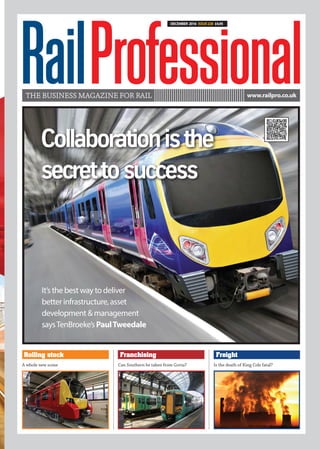
THE BUSINESS MAGAZINE FOR RAIL www.railpro.co.uk
A whole new scene Can Southern be taken from Govia? Is the death of King Cole fatal?
DECEMBER 2016 Issue228 £4.95
Rolling stock Franchising Freight
Collaborationisthe
secrettosuccess
It’s the best way to deliver
better infrastructure, asset
development & management
saysTenBroeke’s PaulTweedale
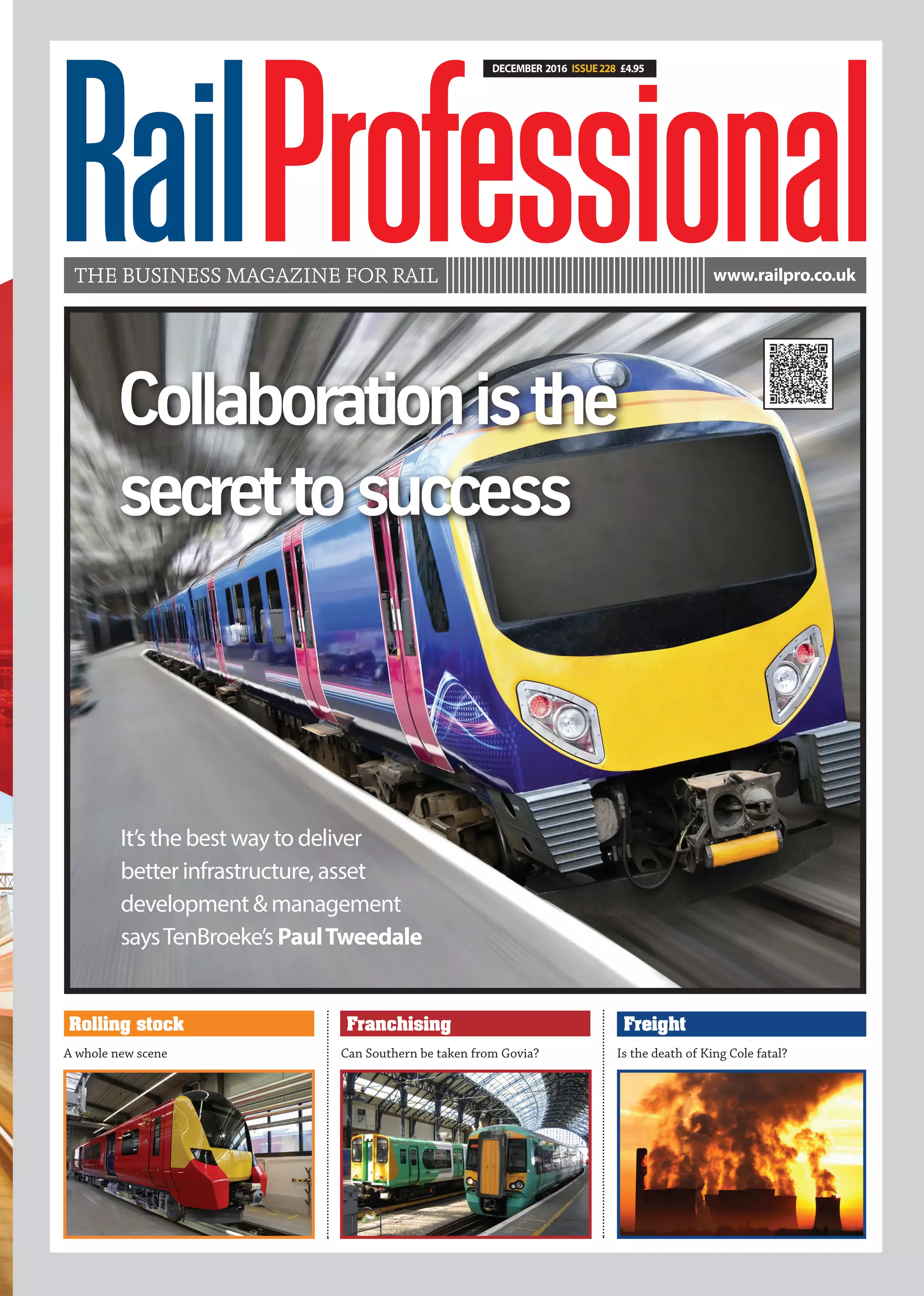
It’s the best way to deliver better infrastructure asset development and management,
says PaulTweedale
Collaborationisthesecret
tosuccess
2 | BUSINESS PROFILE
M
ajor infrastructure
projects seem to become
more complex every year
with new technologies,
equipment and regulations,
numerous stakeholders and suppliers and
agendas. The opportunities for something to
go wrong are numerous.
	 When things get complicated, human
nature being what it is we all tend to revert
to looking inward and protecting our own
position. Everyone is anxious to make sure
they do their part and, by default, won’t be
blamed if something goes wrong, so they
start with a defensive, protectionist attitude
to working with other companies.
	 Ask most senior managers what is
the best way to achieve an outstanding
project result, and the answer is consistent:
collaboration. It is well known that the team
is stronger than the individual. Yet, time
after time, companies retreat from taking
a collaborative approach when procuring
supplier services in the belief that by doing
so they can drive down prices and have
greater distance and protection if something
goes wrong. Ironically of course the odds of
something going awry increase with poor
communication chains.
	 The economic pressures of the last few
years and tighter budgets have led to the
people elements of projects getting lost.
Organisations need to remember team
collaboration is the best way to save time
and money and deliver the best possible
outcome.
More than just a sound-bite
TenBroeke’s approach has been built
on collaboration right from the start.
Experience working on major infrastructure
projects had shown time and again that
expensive mistakes happen when people
don’t work as a team, across functions and
companies.
	 The upside is significant. Better value
for money, greater certainty of programme
delivery and outcome and improved
whole life costs can all be realised through
collaboration. That might sound idealistic,
so here’s the company’s definition of best
practice.
Principles of collaboration
•	 vision	
•	 leadership	
•	 knowledge	
•	 behaviour 	 	
•	 processes.
	 The foundations of successful
collaboration are simple and essential.
First, the project must have a clear vision,
the end benefit it will deliver to the people
who work/use the infrastructure asset and
the benefits it will contribute to the local
community and wider economy. The internal
part of the vision is to identify key values by
which everyone will work. This is where the
second key element, leadership, comes in.
BUSINESS PROFILE | 3
The leader and immediate team must define
and agree key principles such as honesty,
integrity, reliability by which everyone will
work.
	 The leadership team should now
demonstrate their knowledge and
commitment to working collaboratively by
teaming up to develop a clear definition of
the project requirement so that everyone can
work to the same overall brief. This moves
naturally into the third aspect – behavior
– through identifying that courtesy,
openness and prompt communication are
all important. It is here that the leadership
team sets an example which can be extended
into a partnership culture that is supported
by behaviour, i.e. what you do, how you
communicate, respecting each party and
treating other people how you want to be
treated.
	 Last, and not least, is having common
processes and tools across the entire project
to facilitate easy communication and
help remove barriers and excuses for not
collaborating.
Critical success factors
There are a number of actions that can be
used to help ensure that everyone on the
extended team is working towards the same
outcome.
•	 agreeing objectives up-front that are
SMART
•	 simple, measurable, affordable, realistic,
timetable
•	 design in detail
•	 ensure that detailed design is undertaken
early on so that opportunities to improve
efficiency and save money are identified
•	 ensuring suppliers can do what they say
they can do
•	 honesty about capability and resource is
vital
•	 pro-active engagement with suppliers
throughout the life-span of the project
•	 understand their concerns, what they can
and will not do in order to protect their
position.
	 Having knowledgeable people in the
procurement team who understand the
project aims and value over price. Identify
when they should become involved, ideally
very early on to ensure aligned commercial
arrangements.
Detailed risk management
Identify ways to mitigate risk during the
project life-cycle by obtaining a continuous
measurement of performance. Agree how
each supplier is going to be measured and in
conjunction with the suppliers with which
they need to interact.
Only as good as your suppliers
Supplier relationships make or break
projects. Understand each supplier’s true
capabilities, what they are good at and what
they are not good at identify how best to
work together and build an integrated team
with well-defined common objectives that
are clearly and consistently communicated.
Create an environment where good ideas
and innovations can be put forward without
fear and concerns can be raised.
	 Build trust by quickly addressing
counter-productive attitudes such as ‘they
don’t know what they are procuring so when
they come to us for variations that is where
we will make our money.’
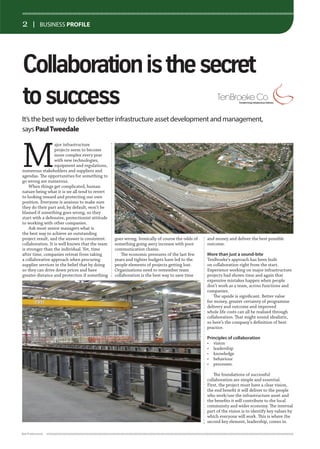
Case Study: DepCo
TenBroeke’s experience of delivering depots
at Ramsgate, Ashford, Bedford and Northam
placed it in a good position to work on the
Thameslink Crossrail projects. Working with
its trusted partners, the company brought
expertise, insight and project controls
across project definition, finance, design and
construction.
	 At the next level, the project required
multi-disciplinary collaboration in a
consortium of like-minded businesses
to undertake: definition of outcomes,
negotiation, legal process, procurement,
interface management and procure the
finance package.
	 Standard stuff in any major
infrastructure project, so what made this
one so successful?
	 Simple: teamwork and collaboration.
At the start, the various players met and
discussed what each party could bring to
the project. Everyone was aware of the
requirement to build depots to look after
new fleets and the refurbishment of existing
fleets, the joint aim was to agree how best to
achieve this objective.
Core principles
Recognising that the shared interest in
delivering the project and understanding
what success looked like for each party.
Schedule regular meetings to deal with
issues, big and small, and work towards
agreements. Avoid using variations as an
excuse to extend time or increase costs,
instead look at how these changes could be
turned into a positive. It’s also important
to never lose focus on delivering value for
money whilst learning lessons from other
industries who do it better. The benefit
of collaborative working is the delivery
of the defined depot requirement – on
specification, on time and on budget.
	 ‘Collaboration is core to the way we work
and we’re finding more and more companies
who appreciate and respect this approach.
It’s the future and we’re excited by all the
projects in which we’re being invited to
contribute’ according to Paul Tweedale,
managing director, TenBroeke.
Final thoughts
TenBroeke Co is a multi-disciplinary
independent expert advisers on
infrastructure. It nurtures relationships
built on cooperation, communication,
collaboration and capability, which together
help to provide its clients with greater
certainty. Over the last few years, the
company has successfully delivered on major
infrastructure projects including Canary
Wharf Crossrail Station in the UK and
are currently working in Turkey, Nigeria,
Bangladesh and India.
Email: paul.tweedale@tenbroekeco.com
Visit: www.tenbroekeco.com
Transforming Infrastructure Delivery
Creating a better future
through first-class
infrastructure delivery
worldwide
Specialist
knowledge
Collaborative
working
Get in touch
Call us on +44 7738 54470 for an informal discussion
about how we can help you meet the challenges of
your project.
tenbroekeco.com

TenBroekeCo_Rail Professional article_Dec 2016

  • 1.
    THE BUSINESS MAGAZINEFOR RAIL www.railpro.co.uk A whole new scene Can Southern be taken from Govia? Is the death of King Cole fatal? DECEMBER 2016 Issue228 £4.95 Rolling stock Franchising Freight Collaborationisthe secrettosuccess It’s the best way to deliver better infrastructure, asset development & management saysTenBroeke’s PaulTweedale
  • 2.
    It’s the bestway to deliver better infrastructure asset development and management, says PaulTweedale Collaborationisthesecret tosuccess 2 | BUSINESS PROFILE M ajor infrastructure projects seem to become more complex every year with new technologies, equipment and regulations, numerous stakeholders and suppliers and agendas. The opportunities for something to go wrong are numerous. When things get complicated, human nature being what it is we all tend to revert to looking inward and protecting our own position. Everyone is anxious to make sure they do their part and, by default, won’t be blamed if something goes wrong, so they start with a defensive, protectionist attitude to working with other companies. Ask most senior managers what is the best way to achieve an outstanding project result, and the answer is consistent: collaboration. It is well known that the team is stronger than the individual. Yet, time after time, companies retreat from taking a collaborative approach when procuring supplier services in the belief that by doing so they can drive down prices and have greater distance and protection if something goes wrong. Ironically of course the odds of something going awry increase with poor communication chains. The economic pressures of the last few years and tighter budgets have led to the people elements of projects getting lost. Organisations need to remember team collaboration is the best way to save time and money and deliver the best possible outcome. More than just a sound-bite TenBroeke’s approach has been built on collaboration right from the start. Experience working on major infrastructure projects had shown time and again that expensive mistakes happen when people don’t work as a team, across functions and companies. The upside is significant. Better value for money, greater certainty of programme delivery and outcome and improved whole life costs can all be realised through collaboration. That might sound idealistic, so here’s the company’s definition of best practice. Principles of collaboration • vision • leadership • knowledge • behaviour • processes. The foundations of successful collaboration are simple and essential. First, the project must have a clear vision, the end benefit it will deliver to the people who work/use the infrastructure asset and the benefits it will contribute to the local community and wider economy. The internal part of the vision is to identify key values by which everyone will work. This is where the second key element, leadership, comes in.
  • 3.
    BUSINESS PROFILE |3 The leader and immediate team must define and agree key principles such as honesty, integrity, reliability by which everyone will work. The leadership team should now demonstrate their knowledge and commitment to working collaboratively by teaming up to develop a clear definition of the project requirement so that everyone can work to the same overall brief. This moves naturally into the third aspect – behavior – through identifying that courtesy, openness and prompt communication are all important. It is here that the leadership team sets an example which can be extended into a partnership culture that is supported by behaviour, i.e. what you do, how you communicate, respecting each party and treating other people how you want to be treated. Last, and not least, is having common processes and tools across the entire project to facilitate easy communication and help remove barriers and excuses for not collaborating. Critical success factors There are a number of actions that can be used to help ensure that everyone on the extended team is working towards the same outcome. • agreeing objectives up-front that are SMART • simple, measurable, affordable, realistic, timetable • design in detail • ensure that detailed design is undertaken early on so that opportunities to improve efficiency and save money are identified • ensuring suppliers can do what they say they can do • honesty about capability and resource is vital • pro-active engagement with suppliers throughout the life-span of the project • understand their concerns, what they can and will not do in order to protect their position. Having knowledgeable people in the procurement team who understand the project aims and value over price. Identify when they should become involved, ideally very early on to ensure aligned commercial arrangements. Detailed risk management Identify ways to mitigate risk during the project life-cycle by obtaining a continuous measurement of performance. Agree how each supplier is going to be measured and in conjunction with the suppliers with which they need to interact. Only as good as your suppliers Supplier relationships make or break projects. Understand each supplier’s true capabilities, what they are good at and what they are not good at identify how best to work together and build an integrated team with well-defined common objectives that are clearly and consistently communicated. Create an environment where good ideas and innovations can be put forward without fear and concerns can be raised. Build trust by quickly addressing counter-productive attitudes such as ‘they don’t know what they are procuring so when they come to us for variations that is where we will make our money.’ Case Study: DepCo TenBroeke’s experience of delivering depots at Ramsgate, Ashford, Bedford and Northam placed it in a good position to work on the Thameslink Crossrail projects. Working with its trusted partners, the company brought expertise, insight and project controls across project definition, finance, design and construction. At the next level, the project required multi-disciplinary collaboration in a consortium of like-minded businesses to undertake: definition of outcomes, negotiation, legal process, procurement, interface management and procure the finance package. Standard stuff in any major infrastructure project, so what made this one so successful? Simple: teamwork and collaboration. At the start, the various players met and discussed what each party could bring to the project. Everyone was aware of the requirement to build depots to look after new fleets and the refurbishment of existing fleets, the joint aim was to agree how best to achieve this objective. Core principles Recognising that the shared interest in delivering the project and understanding what success looked like for each party. Schedule regular meetings to deal with issues, big and small, and work towards agreements. Avoid using variations as an excuse to extend time or increase costs, instead look at how these changes could be turned into a positive. It’s also important to never lose focus on delivering value for money whilst learning lessons from other industries who do it better. The benefit of collaborative working is the delivery of the defined depot requirement – on specification, on time and on budget. ‘Collaboration is core to the way we work and we’re finding more and more companies who appreciate and respect this approach. It’s the future and we’re excited by all the projects in which we’re being invited to contribute’ according to Paul Tweedale, managing director, TenBroeke. Final thoughts TenBroeke Co is a multi-disciplinary independent expert advisers on infrastructure. It nurtures relationships built on cooperation, communication, collaboration and capability, which together help to provide its clients with greater certainty. Over the last few years, the company has successfully delivered on major infrastructure projects including Canary Wharf Crossrail Station in the UK and are currently working in Turkey, Nigeria, Bangladesh and India. Email: paul.tweedale@tenbroekeco.com Visit: www.tenbroekeco.com
  • 4.
    Transforming Infrastructure Delivery Creatinga better future through first-class infrastructure delivery worldwide Specialist knowledge Collaborative working Get in touch Call us on +44 7738 54470 for an informal discussion about how we can help you meet the challenges of your project. tenbroekeco.com