© Jensen Group, 2015 Simplicity Project
Simplicity Toolkit
Ten Simple
Truths
SAP has partnered with The Jensen Group,
the premier expert on organizational simplicity
to provide you with some of their tools and insights
These documents are segmented into one of three areas of focus...
About Simplicity in Organizations
Research Organizational
and
Leadership
Simplicity
Personal and
Team
Simplicity
Ten
Simple
Truths
about simplicity,
doing less,
and still
accomplishing more
from Bill Jensen’s Simplicity Survival Handbook
The Jensen Group
1 Franklin Place
Morristown, NJ 07960 USA
1 (973) 539-5070
bill@simplerwork.com
www.simplerwork.com
Why these ten truths
are so damned important
Much of what you’ve been told and sold about
simplicity is a lie — or at best, misinformed.
Making things simple isn’t about KISS
or dumbing things down or even staying focused
on just one or two things.
Making things simple is about power.
The simpler something is to understand,
the easier it is to push back when things just don’t
make sense.
The simpler something is to apply, the less someone
needs to be managed or needs a manager.
The simpler something is to measure at line-level,
the more line people can track their own success.
Making things simpler is about making it easier for
each individual to make informed, independent,
empowered decisions.
Making things simpler is about making implementa-
tion easier, not just making it easier to manage and
control things. (Which is how most senior execs
currently define simplicity.)
Making things simpler is about empathy —
always looking at everything from the other person’s
perspective.
The Jensen Group
1 (973) 539-5070
bill@simplerwork.com
www.simplerwork.com
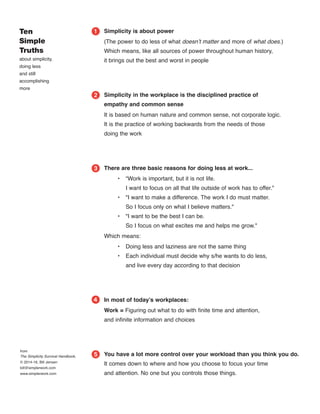
Simplicity is about power
(The power to do less of what doesn’t matter and more of what does.)
Which means, like all sources of power throughout human history,
it brings out the best and worst in people
Simplicity in the workplace is the disciplined practice of
empathy and common sense
It is based on human nature and common sense, not corporate logic.
It is the practice of working backwards from the needs of those
doing the work
There are three basic reasons for doing less at work...
• “Work is important, but it is not life.
I want to focus on all that life outside of work has to offer."
• "I want to make a difference. The work I do must matter.
So I focus only on what I believe matters."
• "I want to be the best I can be.
So I focus on what excites me and helps me grow."
Which means:
• Doing less and laziness are not the same thing
• Each individual must decide why s/he wants to do less,
and live every day according to that decision
In most of today’s workplaces:
Work = Figuring out what to do with finite time and attention,
and infinite information and choices
You have a lot more control over your workload than you think you do.
It comes down to where and how you choose to focus your time
and attention. No one but you controls those things.
Ten
Simple
Truths
about simplicity,
doing less
and still
accomplishing
more
ᕡ
ᕢ
ᕣ
ᕤ
ᕥfrom
The Simplicity Survival Handbook,
© 2014-16, Bill Jensen
bill@simplerwork.com
www.simplerwork.com
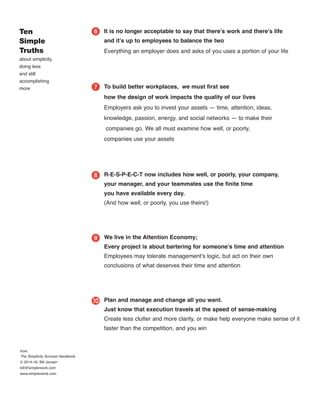
It is no longer acceptable to say that there’s work and there’s life
and it’s up to employees to balance the two
Everything an employer does and asks of you uses a portion of your life
To build better workplaces, we must first see
how the design of work impacts the quality of our lives
Employers ask you to invest your assets — time, attention, ideas,
knowledge, passion, energy, and social networks — to make their
companies go. We all must examine how well, or poorly,
companies use your assets
R-E-S-P-E-C-T now includes how well, or poorly, your company,
your manager, and your teammates use the finite time
you have available every day.
(And how well, or poorly, you use theirs!)
We live in the Attention Economy;
Every project is about bartering for someone’s time and attention
Employees may tolerate management’s logic, but act on their own
conclusions of what deserves their time and attention
Plan and manage and change all you want.
Just know that execution travels at the speed of sense-making
Create less clutter and more clarity, or make help everyone make sense of it
faster than the competition, and you win
Ten
Simple
Truths
about simplicity,
doing less
and still
accomplishing
more
ᕦ
ᕧ
ᕨ
ᕩ
µ
from
The Simplicity Survival Handbook,
© 2014-16, Bill Jensen
bill@simplerwork.com
www.simplerwork.com
ABOUT
Mr. Simplicity
THE BIO OF A SIMPLETON
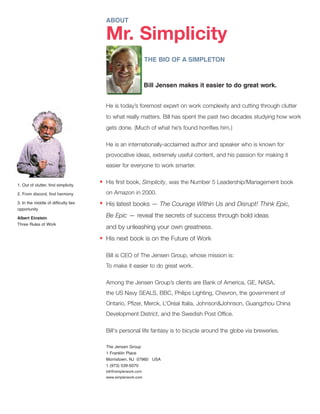
Bill Jensen makes it easier to do great work.
He is today’s foremost expert on work complexity and cutting through clutter
to what really matters. Bill has spent the past two decades studying how work
gets done. (Much of what he’s found horrifies him.)
He is an internationally-acclaimed author and speaker who is known for
provocative ideas, extremely useful content, and his passion for making it
easier for everyone to work smarter.
His first book, Simplicity, was the Number 5 Leadership/Management book
on Amazon in 2000.
His latest books — The Courage Within Us and Disrupt! Think Epic,
Be Epic — reveal the secrets of success through bold ideas
and by unleashing your own greatness.
His next book is on the Future of Work
Bill is CEO of The Jensen Group, whose mission is:
To make it easier to do great work.
Among the Jensen Group’s clients are Bank of America, GE, NASA,
the US Navy SEALS, BBC, Philips Lighting, Chevron, the government of
Ontario, Pfizer, Merck, L’Oréal Italia, Johnson&Johnson, Guangzhou China
Development District, and the Swedish Post Office.
Bill's personal life fantasy is to bicycle around the globe via breweries.
The Jensen Group
1 Franklin Place
Morristown, NJ 07960 USA
1 (973) 539-5070
bill@simplerwork.com
www.simplerwork.com
•
•
•
1. Out of clutter, find simplicity
2. From discord, find harmony
3. In the middle of difficulty lies
opportunity
Albert Einstein
Three Rules of Work

Ten Simple Truths

  • 1.
    © Jensen Group,2015 Simplicity Project Simplicity Toolkit Ten Simple Truths SAP has partnered with The Jensen Group, the premier expert on organizational simplicity to provide you with some of their tools and insights These documents are segmented into one of three areas of focus... About Simplicity in Organizations Research Organizational and Leadership Simplicity Personal and Team Simplicity
  • 2.
    Ten Simple Truths about simplicity, doing less, andstill accomplishing more from Bill Jensen’s Simplicity Survival Handbook The Jensen Group 1 Franklin Place Morristown, NJ 07960 USA 1 (973) 539-5070 bill@simplerwork.com www.simplerwork.com
  • 3.
    Why these tentruths are so damned important Much of what you’ve been told and sold about simplicity is a lie — or at best, misinformed. Making things simple isn’t about KISS or dumbing things down or even staying focused on just one or two things. Making things simple is about power. The simpler something is to understand, the easier it is to push back when things just don’t make sense. The simpler something is to apply, the less someone needs to be managed or needs a manager. The simpler something is to measure at line-level, the more line people can track their own success. Making things simpler is about making it easier for each individual to make informed, independent, empowered decisions. Making things simpler is about making implementa- tion easier, not just making it easier to manage and control things. (Which is how most senior execs currently define simplicity.) Making things simpler is about empathy — always looking at everything from the other person’s perspective. The Jensen Group 1 (973) 539-5070 bill@simplerwork.com www.simplerwork.com
  • 4.
    Simplicity is aboutpower (The power to do less of what doesn’t matter and more of what does.) Which means, like all sources of power throughout human history, it brings out the best and worst in people Simplicity in the workplace is the disciplined practice of empathy and common sense It is based on human nature and common sense, not corporate logic. It is the practice of working backwards from the needs of those doing the work There are three basic reasons for doing less at work... • “Work is important, but it is not life. I want to focus on all that life outside of work has to offer." • "I want to make a difference. The work I do must matter. So I focus only on what I believe matters." • "I want to be the best I can be. So I focus on what excites me and helps me grow." Which means: • Doing less and laziness are not the same thing • Each individual must decide why s/he wants to do less, and live every day according to that decision In most of today’s workplaces: Work = Figuring out what to do with finite time and attention, and infinite information and choices You have a lot more control over your workload than you think you do. It comes down to where and how you choose to focus your time and attention. No one but you controls those things. Ten Simple Truths about simplicity, doing less and still accomplishing more ᕡ ᕢ ᕣ ᕤ ᕥfrom The Simplicity Survival Handbook, © 2014-16, Bill Jensen bill@simplerwork.com www.simplerwork.com
  • 5.
    It is nolonger acceptable to say that there’s work and there’s life and it’s up to employees to balance the two Everything an employer does and asks of you uses a portion of your life To build better workplaces, we must first see how the design of work impacts the quality of our lives Employers ask you to invest your assets — time, attention, ideas, knowledge, passion, energy, and social networks — to make their companies go. We all must examine how well, or poorly, companies use your assets R-E-S-P-E-C-T now includes how well, or poorly, your company, your manager, and your teammates use the finite time you have available every day. (And how well, or poorly, you use theirs!) We live in the Attention Economy; Every project is about bartering for someone’s time and attention Employees may tolerate management’s logic, but act on their own conclusions of what deserves their time and attention Plan and manage and change all you want. Just know that execution travels at the speed of sense-making Create less clutter and more clarity, or make help everyone make sense of it faster than the competition, and you win Ten Simple Truths about simplicity, doing less and still accomplishing more ᕦ ᕧ ᕨ ᕩ µ from The Simplicity Survival Handbook, © 2014-16, Bill Jensen bill@simplerwork.com www.simplerwork.com
  • 6.
    ABOUT Mr. Simplicity THE BIOOF A SIMPLETON Bill Jensen makes it easier to do great work. He is today’s foremost expert on work complexity and cutting through clutter to what really matters. Bill has spent the past two decades studying how work gets done. (Much of what he’s found horrifies him.) He is an internationally-acclaimed author and speaker who is known for provocative ideas, extremely useful content, and his passion for making it easier for everyone to work smarter. His first book, Simplicity, was the Number 5 Leadership/Management book on Amazon in 2000. His latest books — The Courage Within Us and Disrupt! Think Epic, Be Epic — reveal the secrets of success through bold ideas and by unleashing your own greatness. His next book is on the Future of Work Bill is CEO of The Jensen Group, whose mission is: To make it easier to do great work. Among the Jensen Group’s clients are Bank of America, GE, NASA, the US Navy SEALS, BBC, Philips Lighting, Chevron, the government of Ontario, Pfizer, Merck, L’Oréal Italia, Johnson&Johnson, Guangzhou China Development District, and the Swedish Post Office. Bill's personal life fantasy is to bicycle around the globe via breweries. The Jensen Group 1 Franklin Place Morristown, NJ 07960 USA 1 (973) 539-5070 bill@simplerwork.com www.simplerwork.com • • • 1. Out of clutter, find simplicity 2. From discord, find harmony 3. In the middle of difficulty lies opportunity Albert Einstein Three Rules of Work