Temporal Databases
S. Srinivasa Rao
April 12, 2007
[Part 1 based on Ch23 of C.J. Date (slides by Prof. Ghafoor, EE 562)]
[Part 2 based on slides by Prof. Arge, I/O-algorithms]
2
Outline
• Part 1: Introduction to temporal databases
• Part 2: Temporal index: Persistent B-tree and its applications
3
Introduction
• Temporal database: a database that contains historical data as well
as current data.
– Note: ‘historical’ is a misleading term – temporal databases may contain
data regarding the future as well as the past.
• Extreme case: data is only inserted, never deleted from a temporal
database (eg. vehicle position data in the ‘project’).
• So far, we have studied the other extreme - i.e. ‘snapshot’ databases.
• Distinguishing feature: the element of time.
4
Introduction
• Temporal data: encoded representation of timestamped facts.
– Each tuple must include at least one timestamp.
– Problem:What about queries that produce results that are not
temporal? i.e. result of query is outside the domain of (temporal)
database.
– eg. Get names of all people who have supplied something in the
past.
• Redefine temporal database: database that includes, but is not
limited to, temporal data.
5
Motivation
• Queries on time-varying data are difficult to express in SQL.
• Temporal databases provide build-in support for recording and
querying such information.
• It is possible to use SQL to evaluate these queries, but performance
is poor.
6
Motivation
• Most applications manage temporal data.
• If a temporal database is used for such data:
– Schemas, including integrity constraints are simpler.
– Queries are simpler
• Application code is less complex
– easier to understand
– easier to produce
– easier to maintain
7
Applications
Most applications of database technology are temporal in nature:
• Financial apps.: portfolio management, accounting & banking, stock
market analysis, audit analysis
• Record-keeping apps.: personnel, medical records, inventory management,
legal records (commercial laws change frequently)
• Data Warehousing: historical trends for analysis
• Scheduling apps.: airline, car, hotel reservations and project management
• Scientific apps.: weather monitoring, chemical process monitoring
8
Intervals
• An interval [s,e] is a set of times from time s to time e.
– Does interval [s,e] represent an infinite set?
– Assumption: Timeline is a finite sequence of discrete, indivisible
time quanta.
• Time Quanta: smallest unit of time system can represent.
• Timepoints/point: time unit considered indivisible for our purpose.
• An interval is treated as a single type, not as pair of separate values.
• Interval can be open/closed w.r.t. start point/end point.
– eg. [d04,d10],[d04,d11),(d03,d10],(d03,d11)
all represent the sequence of days from day4 to day10 inclusive.
9
Operators on Intervals
• Temporal predicate operators:
i1 = [s1,e1]; i2 = [s2,e2]
– i1 BEFORE i2
(e1<s2)
– i1 MEETS i2
(s2 = e1)
– i1 EQUALS i2
(s1 = s2 AND e1 = e2)
– i1 OVERLAPS i2
(s2 < s1 < e2 OR s1 < s2 < e1)
i1
i1
i1
i1
i2
i2
i2
i2
10
Operators on Intervals
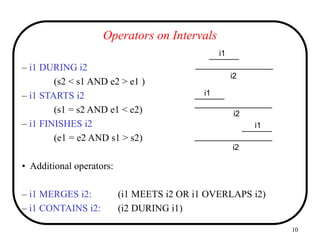
– i1 DURING i2
(s2 < s1 AND e2 > e1 )
– i1 STARTS i2
(s1 = s2 AND e1 < e2)
– i1 FINISHES i2
(e1 = e2 AND s1 > s2)
• Additional operators:
– i1 MERGES i2: (i1 MEETS i2 OR i1 OVERLAPS i2)
– i1 CONTAINS i2: (i2 DURING i1)
i1
i2
i1
i1
i2
i2
11
Scalar and Relational Operators
• DURATION(i) - returns the number of time points in i
– eg. DURATION ([d03,d07]) returns 5
• i1 UNION i2
– returns [MIN(s1,s2),MAX(e1,e2) ]
if (i1 MERGES i2)
otherwise undefined
• i1 INTERSECT i2
– returns [MAX(s1,s2),MIN(e1,e2)]
if (i1 OVERLAPS i2)
otherwise undefined
12
Aggregate Operators
• EXPAND(X):
Where X is a set. The output is also a set.
Used to generate time quantum intervals.
– The expanded form of X is the set of all intervals of the form [p,p]
where p is a time point in some interval in X.
• e.g.:
– X1 = { [d01,d01],[d03,d05],[d04,d06] }
– X2 = { [d01,dp1],[d03,d04],[d05,d05],[d05,d06] }
– X3 = { [d01,d01],[d03,d03],[d04,d04],[d05,d05],[d06,d06] }
– Then EXPAND(X1) = EXPAND(X2) = X3
13
Aggregate Operators
• COLLAPSE(X):
The collapsed form of X is the set Y of intervals of the same type
such that
– (a) X & Y have the same unfolded form.
– (b) no two distinct members i1 and i2 of Y are such that (i1
MERGES i2) is true.
• e.g.:
– X1 = { [d01,d01],[d03,d05],[d04,d06] }
– X2 = { [d01,d01],[d03,d04],[d05,d05],[d05,d06] }
– X3 = { [d01,d01],[d03,d06] }
– Then COLLAPSE (X1) = COLLAPSE (X2) = X3
14
Relation Operators Involving
Intervals
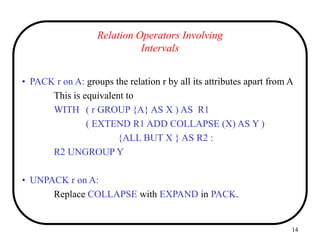
• PACK r on A: groups the relation r by all its attributes apart from A
This is equivalent to
WITH ( r GROUP {A} AS X ) AS R1
( EXTEND R1 ADD COLLAPSE (X) AS Y )
{ALL BUT X } AS R2 :
R2 UNGROUP Y
• UNPACK r on A:
Replace COLLAPSE with EXPAND in PACK.
15
Example
S# P# During
S1 P1 [d04,d10]
S1 P7 [d05,d10]
S1 P3 [d09,d10]
S1 P5 [d06,d10]
S2 P1 [d02,d04]
S2 P9 [d03,d03]
S2 P1 [d08,d10]
S2 P5 [d09,d10]
S3 P1 [d08,d10]
S4 P2 [d06,d09]
S4 P5 [d04,d08]
S4 P7 [d05,d10]
SP
S# During
S1 [d04,d10]
S2 [d02,d04]
S2 [d07,d10]
S3 [d03,d10]
S4 [d04,d10]
S5 [d02,d10]
S
Given two temporal relations:
S: Supplier S# was under contract
during the interval During
SP: Supplier S# was able to supply
part P# during the interval During
16
Example 1
• Active supplier intervals: Get S#-DURING pairs for
suppliers who have been able to supply at least one
part during at least one interval of time, where
DURING designates such an interval.
• PACK SP {S#,DURING} ON DURING
S# P# During
S1 P1 [d04,d10]
S1 P7 [d05,d10]
S1 P3 [d09,d10]
S1 P5 [d06,d10]
S2 P1 [d02,d04]
S2 P9 [d03,d03]
S2 P1 [d08,d10]
S2 P5 [d09,d10]
S3 P1 [d08,d10]
S4 P2 [d06,d09]
S4 P5 [d04,d08]
S4 P7 [d05,d10]
SP
S# During
S1 [d04,d10]
S2 [d02,d04]
S2 [d08,d10]
S3 [d08,d10]
S4 [d04,d10]
RESULT
17
Example 2
• Inactive (passive) supplier intervals: Get S#-DURING pairs for
suppliers who have been unable to supply any parts at all during at
least one interval of time, where DURING designates such an
interval.
• PACK
( ( UNPACK S {S#,DURING} ON DURING )
MINUS
( UNPACK SP {S#,DURING} ON DURING ) )
ON DURING
• Shorthand: U_MINUS
S# During
S2 [d07,d07]
S3 [d03,d07]
S5 [d02,d10]
RESULT
18
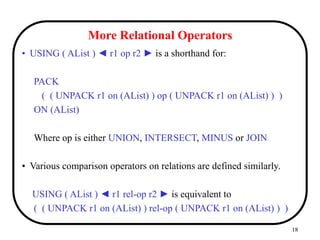
More Relational Operators
• USING ( AList ) ◄ r1 op r2 ► is a shorthand for:
PACK
( ( UNPACK r1 on (AList) ) op ( UNPACK r1 on (AList) ) )
ON (AList)
Where op is either UNION, INTERSECT, MINUS or JOIN
• Various comparison operators on relations are defined similarly.
USING ( AList ) ◄ r1 rel-op r2 ► is equivalent to
( ( UNPACK r1 on (AList) ) rel-op ( UNPACK r1 on (AList) ) )
19
Part 2
Persistent B-trees
and applications
20
Persistent B-tree
• In some applications we are interested in being able to access
previous versions of data structure
– Databases
– Geometric data structures
• Partial persistence:
– Update the current version (getting a new version)
– Query all versions
• We would like to have partial persistent B-tree with
– O(N/B) space – N is number of updates performed
– update
– query in any version
)
(log B
T
B N
O 
)
(log N
O B
21
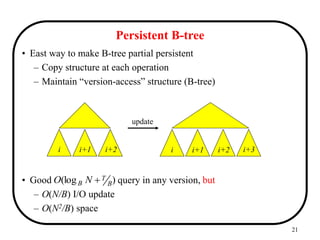
Persistent B-tree
• East way to make B-tree partial persistent
– Copy structure at each operation
– Maintain “version-access” structure (B-tree)
• Good query in any version, but
– O(N/B) I/O update
– O(N2/B) space
)
(log B
T
B N
O 
i i+2
i+1
update
i+3
i i+2
i+1
22
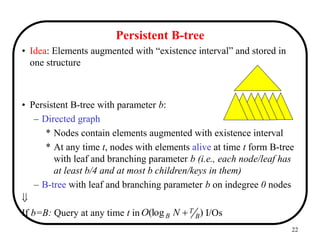
Persistent B-tree
• Idea: Elements augmented with “existence interval” and stored in
one structure
• Persistent B-tree with parameter b:
– Directed graph
* Nodes contain elements augmented with existence interval
* At any time t, nodes with elements alive at time t form B-tree
with leaf and branching parameter b (i.e., each node/leaf has
at least b/4 and at most b children/keys in them)
– B-tree with leaf and branching parameter b on indegree 0 nodes

If b=B: Query at any time t in I/Os
)
(log B
T
B N
O 
23
Persistent B-tree: Updates
• Updates performed as in B-tree
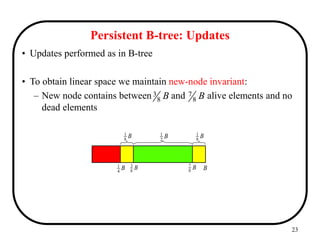
• To obtain linear space we maintain new-node invariant:
– New node contains between and alive elements and no
dead elements
B
8
3 B
8
7
B
4
1 B
8
7
B
8
3
B
B
8
1
B
8
1
B
2
1
24
B
4
1 B
8
7
B
8
3
B
Persistent B-tree Insert
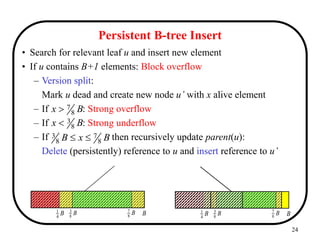
• Search for relevant leaf u and insert new element
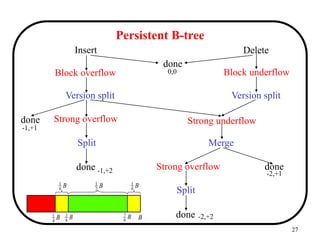
• If u contains B+1 elements: Block overflow
– Version split:
Mark u dead and create new node u’ with x alive element
– If : Strong overflow
– If : Strong underflow
– If then recursively update parent(u):
Delete (persistently) reference to u and insert reference to u’
B
4
1 B
8
7
B
8
3
B
B
x 8
7

B
x 8
3

B
x
B 8
7
8
3 

25
Persistent B-tree Insert
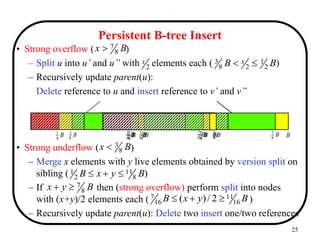
• Strong overflow ( )
– Split u into u’ and u’’ with elements each ( )
– Recursively update parent(u):
Delete reference to u and insert reference to v’ and v’’
• Strong underflow ( )
– Merge x elements with y live elements obtained by version split on
sibling ( )
– If then (strong overflow) perform split into nodes
with (x+y)/2 elements each ( )
– Recursively update parent(u): Delete two insert one/two references
B
4
1 B
8
7
B
8
3
B
B
4
1 B
8
7
B
8
3
B
B
4
1 B
8
7
B
8
3
B
2
x
B
4
1 B
8
7
B
8
3
B
B
B x
2
1
2
8
3 

B
x 8
7

B
y
x
B 8
11
2
1 


B
y
x 8
7


B
x 8
3

B
y
x
B 16
11
16
7 2
/
)
( 


26
Persistent B-tree Delete
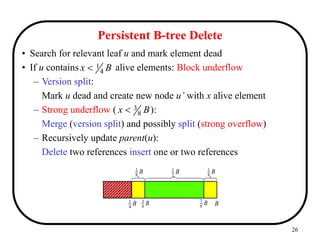
• Search for relevant leaf u and mark element dead
• If u contains alive elements: Block underflow
– Version split:
Mark u dead and create new node u’ with x alive element
– Strong underflow ( ):
Merge (version split) and possibly split (strong overflow)
– Recursively update parent(u):
Delete two references insert one or two references
B
x 4
1

B
4
1 B
8
7
B
8
3
B
B
8
1
B
8
1
B
2
1
B
x 8
3

27
Persistent B-tree
B
4
1 B
8
7
B
8
3
B
B
8
1
B
8
1
B
2
1
Insert Delete
done
Block overflow Block underflow
done
Version split Version split
Strong overflow Strong underflow
Merge
Split
done
done
Strong overflow
Split
done
-1,+1
-1,+2
-2,+2
-2,+1
0,0
28
Persistent B-tree Analysis
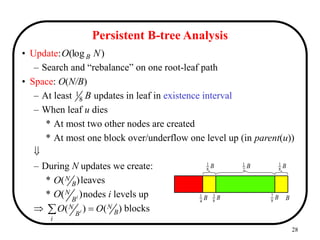
• Update:
– Search and “rebalance” on one root-leaf path
• Space: O(N/B)
– At least updates in leaf in existence interval
– When leaf u dies
* At most two other nodes are created
* At most one block over/underflow one level up (in parent(u))

– During N updates we create:
* leaves
* nodes i levels up
 blocks
B
4
1 B
8
7
B
8
3
B
B
8
1
B
8
1
B
2
1
)
(log N
O B
B
8
1
)
(
)
( B
N
i
B
N O
O i 

)
( i
B
N
O
)
( B
N
O
29
Summary/Conclusion: Persistent B-tree
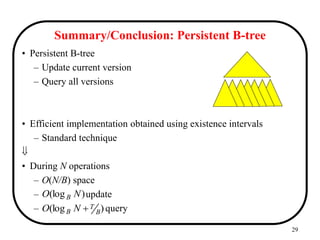
• Persistent B-tree
– Update current version
– Query all versions
• Efficient implementation obtained using existence intervals
– Standard technique

• During N operations
– O(N/B) space
– update
– query
)
(log B
T
B N
O 
)
(log N
O B
30
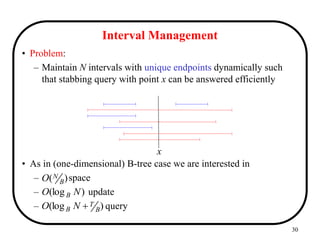
• Problem:
– Maintain N intervals with unique endpoints dynamically such
that stabbing query with point x can be answered efficiently
• As in (one-dimensional) B-tree case we are interested in
– space
– update
– query
Interval Management
)
(log B
T
B N
O 
)
(log N
O B
)
( B
N
O
x
31
Interval Management: Static Solution
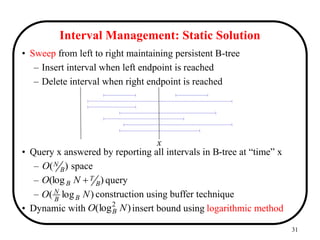
• Sweep from left to right maintaining persistent B-tree
– Insert interval when left endpoint is reached
– Delete interval when right endpoint is reached
• Query x answered by reporting all intervals in B-tree at “time” x
– space
– query
– construction using buffer technique
• Dynamic with insert bound using logarithmic method
x
)
(log B
T
B N
O 
)
( B
N
O
)
(log2
N
O B
)
log
( N
O B
B
N
32
Internal Memory Logarithmic Method Idea
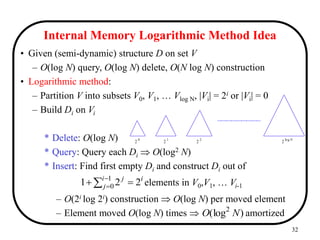
• Given (semi-dynamic) structure D on set V
– O(log N) query, O(log N) delete, O(N log N) construction
• Logarithmic method:
– Partition V into subsets V0, V1, … Vlog N, |Vi| = 2i or |Vi| = 0
– Build Di on Vi
* Delete: O(log N)
* Query: Query each Di  O(log2 N)
* Insert: Find first empty Di and construct Di out of
elements in V0,V1, … Vi-1
– O(2i log 2i) construction  O(log N) per moved element
– Element moved O(log N) times  amortized
..................................
0
2
2
2
2 1 2 log N
i
i
j
j
2
2
1 1
0 
 


)
(log2
N
O
33
i
i
j
j
B
B 
 


1
0
1
External Logarithmic Method Idea
)
(log2
N
O B ..................................
0
B
B
B
B 1 2 log N
B
  
i
j
i
j B
V
0





1
0
1
i
j
i
j B
V
)
(log2
N
O B
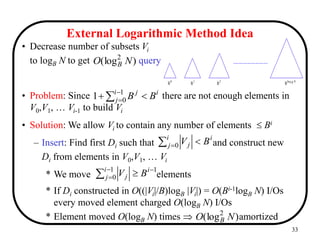
• Decrease number of subsets Vi
to logB N to get query
• Problem: Since there are not enough elements in
V0,V1, … Vi-1 to build Vi
• Solution: We allow Vi to contain any number of elements  Bi
– Insert: Find first Di such that and construct new
Di from elements in V0,V1, … Vi
* We move elements
* If Di constructed in O((|Vi|/B)logB |Vi|) = O(Bi-1logB N) I/Os
every moved element charged O(logB N) I/Os
* Element moved O(logB N) times  amortized
34
External Logarithmic Method Idea
• Given (semi-dynamic) linear space external data structure with
– I/O query
– I/O construction
(– I/O delete)

• Linear space dynamic data structure with
– I/O query
– I/O insert amortized
(– I/O delete)
• Dynamic interval management
– I/O query
– I/O insert amortized
)
(log B
T
B N
O 
)
log
( N
O B
B
N
)
(log N
O B
)
(log2
B
T
B N
O 
)
(log2
N
O B
)
(log N
O B
)
(log2
B
T
B N
O 
)
(log2
N
O B x
35
Planar Point Location
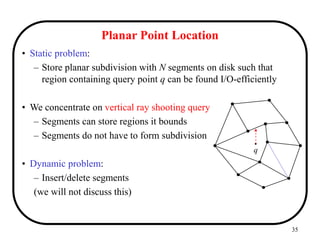
• Static problem:
– Store planar subdivision with N segments on disk such that
region containing query point q can be found I/O-efficiently
• We concentrate on vertical ray shooting query
– Segments can store regions it bounds
– Segments do not have to form subdivision
• Dynamic problem:
– Insert/delete segments
(we will not discuss this)
q
36
Static Solution
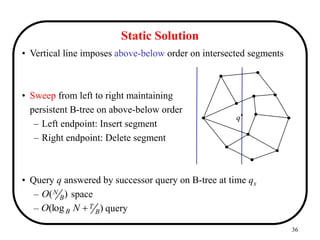
• Vertical line imposes above-below order on intersected segments
• Sweep from left to right maintaining
persistent B-tree on above-below order
– Left endpoint: Insert segment
– Right endpoint: Delete segment
• Query q answered by successor query on B-tree at time qx
– space
– query
)
(log B
T
B N
O 
)
( B
N
O
q
37
Static Solution
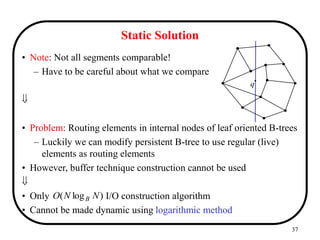
• Note: Not all segments comparable!
– Have to be careful about what we compare

• Problem: Routing elements in internal nodes of leaf oriented B-trees
– Luckily we can modify persistent B-tree to use regular (live)
elements as routing elements
• However, buffer technique construction cannot be used

• Only I/O construction algorithm
• Cannot be made dynamic using logarithmic method
q
)
log
( N
N
O B
38
References
• External Memory Geometric Data Structures
Lecture notes by Lars Arge.
– Section 1-4
• I/O-efficient Point Location using Persistent B-trees
– Lars Arge, Andrew Danner and Sha-Mayn Teh

Temporal PPT details about the platform and its uses

  • 1.
    Temporal Databases S. SrinivasaRao April 12, 2007 [Part 1 based on Ch23 of C.J. Date (slides by Prof. Ghafoor, EE 562)] [Part 2 based on slides by Prof. Arge, I/O-algorithms]
  • 2.
    2 Outline • Part 1:Introduction to temporal databases • Part 2: Temporal index: Persistent B-tree and its applications
  • 3.
    3 Introduction • Temporal database:a database that contains historical data as well as current data. – Note: ‘historical’ is a misleading term – temporal databases may contain data regarding the future as well as the past. • Extreme case: data is only inserted, never deleted from a temporal database (eg. vehicle position data in the ‘project’). • So far, we have studied the other extreme - i.e. ‘snapshot’ databases. • Distinguishing feature: the element of time.
  • 4.
    4 Introduction • Temporal data:encoded representation of timestamped facts. – Each tuple must include at least one timestamp. – Problem:What about queries that produce results that are not temporal? i.e. result of query is outside the domain of (temporal) database. – eg. Get names of all people who have supplied something in the past. • Redefine temporal database: database that includes, but is not limited to, temporal data.
  • 5.
    5 Motivation • Queries ontime-varying data are difficult to express in SQL. • Temporal databases provide build-in support for recording and querying such information. • It is possible to use SQL to evaluate these queries, but performance is poor.
  • 6.
    6 Motivation • Most applicationsmanage temporal data. • If a temporal database is used for such data: – Schemas, including integrity constraints are simpler. – Queries are simpler • Application code is less complex – easier to understand – easier to produce – easier to maintain
  • 7.
    7 Applications Most applications ofdatabase technology are temporal in nature: • Financial apps.: portfolio management, accounting & banking, stock market analysis, audit analysis • Record-keeping apps.: personnel, medical records, inventory management, legal records (commercial laws change frequently) • Data Warehousing: historical trends for analysis • Scheduling apps.: airline, car, hotel reservations and project management • Scientific apps.: weather monitoring, chemical process monitoring
  • 8.
    8 Intervals • An interval[s,e] is a set of times from time s to time e. – Does interval [s,e] represent an infinite set? – Assumption: Timeline is a finite sequence of discrete, indivisible time quanta. • Time Quanta: smallest unit of time system can represent. • Timepoints/point: time unit considered indivisible for our purpose. • An interval is treated as a single type, not as pair of separate values. • Interval can be open/closed w.r.t. start point/end point. – eg. [d04,d10],[d04,d11),(d03,d10],(d03,d11) all represent the sequence of days from day4 to day10 inclusive.
  • 9.
    9 Operators on Intervals •Temporal predicate operators: i1 = [s1,e1]; i2 = [s2,e2] – i1 BEFORE i2 (e1<s2) – i1 MEETS i2 (s2 = e1) – i1 EQUALS i2 (s1 = s2 AND e1 = e2) – i1 OVERLAPS i2 (s2 < s1 < e2 OR s1 < s2 < e1) i1 i1 i1 i1 i2 i2 i2 i2
  • 10.
    10 Operators on Intervals –i1 DURING i2 (s2 < s1 AND e2 > e1 ) – i1 STARTS i2 (s1 = s2 AND e1 < e2) – i1 FINISHES i2 (e1 = e2 AND s1 > s2) • Additional operators: – i1 MERGES i2: (i1 MEETS i2 OR i1 OVERLAPS i2) – i1 CONTAINS i2: (i2 DURING i1) i1 i2 i1 i1 i2 i2
  • 11.
    11 Scalar and RelationalOperators • DURATION(i) - returns the number of time points in i – eg. DURATION ([d03,d07]) returns 5 • i1 UNION i2 – returns [MIN(s1,s2),MAX(e1,e2) ] if (i1 MERGES i2) otherwise undefined • i1 INTERSECT i2 – returns [MAX(s1,s2),MIN(e1,e2)] if (i1 OVERLAPS i2) otherwise undefined
  • 12.
    12 Aggregate Operators • EXPAND(X): WhereX is a set. The output is also a set. Used to generate time quantum intervals. – The expanded form of X is the set of all intervals of the form [p,p] where p is a time point in some interval in X. • e.g.: – X1 = { [d01,d01],[d03,d05],[d04,d06] } – X2 = { [d01,dp1],[d03,d04],[d05,d05],[d05,d06] } – X3 = { [d01,d01],[d03,d03],[d04,d04],[d05,d05],[d06,d06] } – Then EXPAND(X1) = EXPAND(X2) = X3
  • 13.
    13 Aggregate Operators • COLLAPSE(X): Thecollapsed form of X is the set Y of intervals of the same type such that – (a) X & Y have the same unfolded form. – (b) no two distinct members i1 and i2 of Y are such that (i1 MERGES i2) is true. • e.g.: – X1 = { [d01,d01],[d03,d05],[d04,d06] } – X2 = { [d01,d01],[d03,d04],[d05,d05],[d05,d06] } – X3 = { [d01,d01],[d03,d06] } – Then COLLAPSE (X1) = COLLAPSE (X2) = X3
  • 14.
    14 Relation Operators Involving Intervals •PACK r on A: groups the relation r by all its attributes apart from A This is equivalent to WITH ( r GROUP {A} AS X ) AS R1 ( EXTEND R1 ADD COLLAPSE (X) AS Y ) {ALL BUT X } AS R2 : R2 UNGROUP Y • UNPACK r on A: Replace COLLAPSE with EXPAND in PACK.
  • 15.
    15 Example S# P# During S1P1 [d04,d10] S1 P7 [d05,d10] S1 P3 [d09,d10] S1 P5 [d06,d10] S2 P1 [d02,d04] S2 P9 [d03,d03] S2 P1 [d08,d10] S2 P5 [d09,d10] S3 P1 [d08,d10] S4 P2 [d06,d09] S4 P5 [d04,d08] S4 P7 [d05,d10] SP S# During S1 [d04,d10] S2 [d02,d04] S2 [d07,d10] S3 [d03,d10] S4 [d04,d10] S5 [d02,d10] S Given two temporal relations: S: Supplier S# was under contract during the interval During SP: Supplier S# was able to supply part P# during the interval During
  • 16.
    16 Example 1 • Activesupplier intervals: Get S#-DURING pairs for suppliers who have been able to supply at least one part during at least one interval of time, where DURING designates such an interval. • PACK SP {S#,DURING} ON DURING S# P# During S1 P1 [d04,d10] S1 P7 [d05,d10] S1 P3 [d09,d10] S1 P5 [d06,d10] S2 P1 [d02,d04] S2 P9 [d03,d03] S2 P1 [d08,d10] S2 P5 [d09,d10] S3 P1 [d08,d10] S4 P2 [d06,d09] S4 P5 [d04,d08] S4 P7 [d05,d10] SP S# During S1 [d04,d10] S2 [d02,d04] S2 [d08,d10] S3 [d08,d10] S4 [d04,d10] RESULT
  • 17.
    17 Example 2 • Inactive(passive) supplier intervals: Get S#-DURING pairs for suppliers who have been unable to supply any parts at all during at least one interval of time, where DURING designates such an interval. • PACK ( ( UNPACK S {S#,DURING} ON DURING ) MINUS ( UNPACK SP {S#,DURING} ON DURING ) ) ON DURING • Shorthand: U_MINUS S# During S2 [d07,d07] S3 [d03,d07] S5 [d02,d10] RESULT
  • 18.
    18 More Relational Operators •USING ( AList ) ◄ r1 op r2 ► is a shorthand for: PACK ( ( UNPACK r1 on (AList) ) op ( UNPACK r1 on (AList) ) ) ON (AList) Where op is either UNION, INTERSECT, MINUS or JOIN • Various comparison operators on relations are defined similarly. USING ( AList ) ◄ r1 rel-op r2 ► is equivalent to ( ( UNPACK r1 on (AList) ) rel-op ( UNPACK r1 on (AList) ) )
  • 19.
  • 20.
    20 Persistent B-tree • Insome applications we are interested in being able to access previous versions of data structure – Databases – Geometric data structures • Partial persistence: – Update the current version (getting a new version) – Query all versions • We would like to have partial persistent B-tree with – O(N/B) space – N is number of updates performed – update – query in any version ) (log B T B N O  ) (log N O B
  • 21.
    21 Persistent B-tree • Eastway to make B-tree partial persistent – Copy structure at each operation – Maintain “version-access” structure (B-tree) • Good query in any version, but – O(N/B) I/O update – O(N2/B) space ) (log B T B N O  i i+2 i+1 update i+3 i i+2 i+1
  • 22.
    22 Persistent B-tree • Idea:Elements augmented with “existence interval” and stored in one structure • Persistent B-tree with parameter b: – Directed graph * Nodes contain elements augmented with existence interval * At any time t, nodes with elements alive at time t form B-tree with leaf and branching parameter b (i.e., each node/leaf has at least b/4 and at most b children/keys in them) – B-tree with leaf and branching parameter b on indegree 0 nodes  If b=B: Query at any time t in I/Os ) (log B T B N O 
  • 23.
    23 Persistent B-tree: Updates •Updates performed as in B-tree • To obtain linear space we maintain new-node invariant: – New node contains between and alive elements and no dead elements B 8 3 B 8 7 B 4 1 B 8 7 B 8 3 B B 8 1 B 8 1 B 2 1
  • 24.
    24 B 4 1 B 8 7 B 8 3 B Persistent B-treeInsert • Search for relevant leaf u and insert new element • If u contains B+1 elements: Block overflow – Version split: Mark u dead and create new node u’ with x alive element – If : Strong overflow – If : Strong underflow – If then recursively update parent(u): Delete (persistently) reference to u and insert reference to u’ B 4 1 B 8 7 B 8 3 B B x 8 7  B x 8 3  B x B 8 7 8 3  
  • 25.
    25 Persistent B-tree Insert •Strong overflow ( ) – Split u into u’ and u’’ with elements each ( ) – Recursively update parent(u): Delete reference to u and insert reference to v’ and v’’ • Strong underflow ( ) – Merge x elements with y live elements obtained by version split on sibling ( ) – If then (strong overflow) perform split into nodes with (x+y)/2 elements each ( ) – Recursively update parent(u): Delete two insert one/two references B 4 1 B 8 7 B 8 3 B B 4 1 B 8 7 B 8 3 B B 4 1 B 8 7 B 8 3 B 2 x B 4 1 B 8 7 B 8 3 B B B x 2 1 2 8 3   B x 8 7  B y x B 8 11 2 1    B y x 8 7   B x 8 3  B y x B 16 11 16 7 2 / ) (   
  • 26.
    26 Persistent B-tree Delete •Search for relevant leaf u and mark element dead • If u contains alive elements: Block underflow – Version split: Mark u dead and create new node u’ with x alive element – Strong underflow ( ): Merge (version split) and possibly split (strong overflow) – Recursively update parent(u): Delete two references insert one or two references B x 4 1  B 4 1 B 8 7 B 8 3 B B 8 1 B 8 1 B 2 1 B x 8 3 
  • 27.
    27 Persistent B-tree B 4 1 B 8 7 B 8 3 B B 8 1 B 8 1 B 2 1 InsertDelete done Block overflow Block underflow done Version split Version split Strong overflow Strong underflow Merge Split done done Strong overflow Split done -1,+1 -1,+2 -2,+2 -2,+1 0,0
  • 28.
    28 Persistent B-tree Analysis •Update: – Search and “rebalance” on one root-leaf path • Space: O(N/B) – At least updates in leaf in existence interval – When leaf u dies * At most two other nodes are created * At most one block over/underflow one level up (in parent(u))  – During N updates we create: * leaves * nodes i levels up  blocks B 4 1 B 8 7 B 8 3 B B 8 1 B 8 1 B 2 1 ) (log N O B B 8 1 ) ( ) ( B N i B N O O i   ) ( i B N O ) ( B N O
  • 29.
    29 Summary/Conclusion: Persistent B-tree •Persistent B-tree – Update current version – Query all versions • Efficient implementation obtained using existence intervals – Standard technique  • During N operations – O(N/B) space – update – query ) (log B T B N O  ) (log N O B
  • 30.
    30 • Problem: – MaintainN intervals with unique endpoints dynamically such that stabbing query with point x can be answered efficiently • As in (one-dimensional) B-tree case we are interested in – space – update – query Interval Management ) (log B T B N O  ) (log N O B ) ( B N O x
  • 31.
    31 Interval Management: StaticSolution • Sweep from left to right maintaining persistent B-tree – Insert interval when left endpoint is reached – Delete interval when right endpoint is reached • Query x answered by reporting all intervals in B-tree at “time” x – space – query – construction using buffer technique • Dynamic with insert bound using logarithmic method x ) (log B T B N O  ) ( B N O ) (log2 N O B ) log ( N O B B N
  • 32.
    32 Internal Memory LogarithmicMethod Idea • Given (semi-dynamic) structure D on set V – O(log N) query, O(log N) delete, O(N log N) construction • Logarithmic method: – Partition V into subsets V0, V1, … Vlog N, |Vi| = 2i or |Vi| = 0 – Build Di on Vi * Delete: O(log N) * Query: Query each Di  O(log2 N) * Insert: Find first empty Di and construct Di out of elements in V0,V1, … Vi-1 – O(2i log 2i) construction  O(log N) per moved element – Element moved O(log N) times  amortized .................................. 0 2 2 2 2 1 2 log N i i j j 2 2 1 1 0      ) (log2 N O
  • 33.
    33 i i j j B B      1 0 1 ExternalLogarithmic Method Idea ) (log2 N O B .................................. 0 B B B B 1 2 log N B    i j i j B V 0      1 0 1 i j i j B V ) (log2 N O B • Decrease number of subsets Vi to logB N to get query • Problem: Since there are not enough elements in V0,V1, … Vi-1 to build Vi • Solution: We allow Vi to contain any number of elements  Bi – Insert: Find first Di such that and construct new Di from elements in V0,V1, … Vi * We move elements * If Di constructed in O((|Vi|/B)logB |Vi|) = O(Bi-1logB N) I/Os every moved element charged O(logB N) I/Os * Element moved O(logB N) times  amortized
  • 34.
    34 External Logarithmic MethodIdea • Given (semi-dynamic) linear space external data structure with – I/O query – I/O construction (– I/O delete)  • Linear space dynamic data structure with – I/O query – I/O insert amortized (– I/O delete) • Dynamic interval management – I/O query – I/O insert amortized ) (log B T B N O  ) log ( N O B B N ) (log N O B ) (log2 B T B N O  ) (log2 N O B ) (log N O B ) (log2 B T B N O  ) (log2 N O B x
  • 35.
    35 Planar Point Location •Static problem: – Store planar subdivision with N segments on disk such that region containing query point q can be found I/O-efficiently • We concentrate on vertical ray shooting query – Segments can store regions it bounds – Segments do not have to form subdivision • Dynamic problem: – Insert/delete segments (we will not discuss this) q
  • 36.
    36 Static Solution • Verticalline imposes above-below order on intersected segments • Sweep from left to right maintaining persistent B-tree on above-below order – Left endpoint: Insert segment – Right endpoint: Delete segment • Query q answered by successor query on B-tree at time qx – space – query ) (log B T B N O  ) ( B N O q
  • 37.
    37 Static Solution • Note:Not all segments comparable! – Have to be careful about what we compare  • Problem: Routing elements in internal nodes of leaf oriented B-trees – Luckily we can modify persistent B-tree to use regular (live) elements as routing elements • However, buffer technique construction cannot be used  • Only I/O construction algorithm • Cannot be made dynamic using logarithmic method q ) log ( N N O B
  • 38.
    38 References • External MemoryGeometric Data Structures Lecture notes by Lars Arge. – Section 1-4 • I/O-efficient Point Location using Persistent B-trees – Lars Arge, Andrew Danner and Sha-Mayn Teh