Impactof ICTsonlearningandAchievement
TEMPO JENNIFER
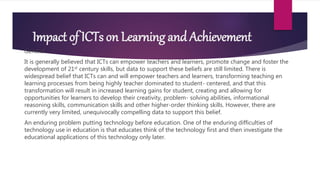
Impact of ICTs on Learning and Achievement
General
It is generally believed that ICTs can empower teachers and learners, promote change and foster the
development of 21st century skills, but data to support these beliefs are still limited. There is
widespread belief that ICTs can and will empower teachers and learners, transforming teaching en
learning processes from being highly teacher dominated to student- centered, and that this
transformation will result in increased learning gains for student, creating and allowing for
opportunities for learners to develop their creativity, problem- solving abilities, informational
reasoning skills, communication skills and other higher-order thinking skills. However, there are
currently very limited, unequivocally compelling data to support this belief.
An enduring problem putting technology before education. One of the enduring difficulties of
technology use in education is that educates think of the technology first and then investigate the
educational applications of this technology only later.
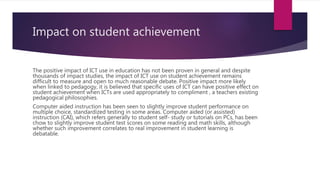
Impact on student achievement
The positive impact of ICT use in education has not been proven in general and despite
thousands of impact studies, the impact of ICT use on student achievement remains
difficult to measure and open to much reasonable debate. Positive impact more likely
when linked to pedagogy, it is believed that specific uses of ICT can have positive effect on
student achievement when ICTs are used appropriately to compliment , a teachers existing
pedagogical philosophies.
Computer aided instruction has been seen to slightly improve student performance on
multiple choice, standardized testing in some areas. Computer aided (or assisted)
instruction (CAI), which refers generally to student self- study or tutorials on PCs, has been
chow to slightly improve student test scores on some reading and math skills, although
whether such improvement correlates to real improvement in student learning is
debatable.
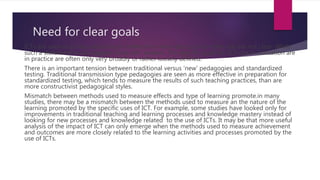
Need for clear goals
ICTs are seen to be less effective (or ineffective) when the coals for their use are not clear. While
such a statement would appear to be self- evident. The specific goals for ICT use in education are
in practice are often only very broadly or rather loosely defined.
There is an important tension between traditional versus ‘new’ pedagogies and standardized
testing. Traditional transmission type pedagogies are seen as more effective in preparation for
standardized testing, which tends to measure the results of such teaching practices, than are
more constructivist pedagogical styles.
Mismatch between methods used to measure effects and type of learning promote.in many
studies, there may be a mismatch between the methods used to measure an the nature of the
learning promoted by the specific uses of ICT. For example, some studies have looked only for
improvements in traditional teaching and learning processes and knowledge mastery instead of
looking for new processes and knowledge related to the use of ICTs. It may be that more useful
analysis of the impact of ICT can only emerge when the methods used to measure achievement
and outcomes are more closely related to the learning activities and processes promoted by the
use of ICTs.
ICTs are used differently in different school
subjects
Uses of ICTs for simulations and modelling in science and math, have been shown to be
effective, as have word processing and communication software (email) in the
development of student language and communication skills.
Access outside of school affects impact. The relationships between in-class student
computer use, out of class computer student computer use and student achievement are
unclear. However, students in OECD countries reporting the greatest amount of computer
use outside school are seen in some studies to have lower than average achievement (the
presumption is that high computer use outside of school is disproportionately devoted to
computer gaming).
Users believes that ICTs make a positive difference. In studies that rely largely on self
reporting, most users feel that using ICTs make them more effective learning.
Impact on student motivation
ICTs motivate teachers and students. There appears to be a general consensus that both teachers and
students feel ICT use greatly contributes to student feel ICT use greatly contributes to student motivation for
learning.
Access outside of school affects user confidence. (not surprisingly) Students who use a computer at home
also use them in school more frequently and with more confidence than pupils who have no home access.
Where to place computers has an impact. Placing computers in classroom enables much greater use of ICTs
for higher order skills than placing computers in separate computer laboratories. Related to this is an
increasing attention given to the use of laptops by both teachers and student ,as well as, to a much lesser
extent, to the use of personal digital assistants and other mobile device. Models for successfully integrating
ICT use in school hours are still emerging. There are few successful models for the integration of student
computer use at home or in other “informal settings” outside of school facilities with use in school.
The appropriate ages for introducing computers to students are hotly debated. On a general level,
appropriate age for student ICT use, in general are unclear. However, it is clear that certain uses are more or
less appropriate, given student ages and abilities. Emerging research caution against widespread use at
younger ages.

Tempo jennifer

  • 1.
  • 2.
    Impact of ICTson Learning and Achievement General It is generally believed that ICTs can empower teachers and learners, promote change and foster the development of 21st century skills, but data to support these beliefs are still limited. There is widespread belief that ICTs can and will empower teachers and learners, transforming teaching en learning processes from being highly teacher dominated to student- centered, and that this transformation will result in increased learning gains for student, creating and allowing for opportunities for learners to develop their creativity, problem- solving abilities, informational reasoning skills, communication skills and other higher-order thinking skills. However, there are currently very limited, unequivocally compelling data to support this belief. An enduring problem putting technology before education. One of the enduring difficulties of technology use in education is that educates think of the technology first and then investigate the educational applications of this technology only later.
  • 3.
    Impact on studentachievement The positive impact of ICT use in education has not been proven in general and despite thousands of impact studies, the impact of ICT use on student achievement remains difficult to measure and open to much reasonable debate. Positive impact more likely when linked to pedagogy, it is believed that specific uses of ICT can have positive effect on student achievement when ICTs are used appropriately to compliment , a teachers existing pedagogical philosophies. Computer aided instruction has been seen to slightly improve student performance on multiple choice, standardized testing in some areas. Computer aided (or assisted) instruction (CAI), which refers generally to student self- study or tutorials on PCs, has been chow to slightly improve student test scores on some reading and math skills, although whether such improvement correlates to real improvement in student learning is debatable.
  • 4.
    Need for cleargoals ICTs are seen to be less effective (or ineffective) when the coals for their use are not clear. While such a statement would appear to be self- evident. The specific goals for ICT use in education are in practice are often only very broadly or rather loosely defined. There is an important tension between traditional versus ‘new’ pedagogies and standardized testing. Traditional transmission type pedagogies are seen as more effective in preparation for standardized testing, which tends to measure the results of such teaching practices, than are more constructivist pedagogical styles. Mismatch between methods used to measure effects and type of learning promote.in many studies, there may be a mismatch between the methods used to measure an the nature of the learning promoted by the specific uses of ICT. For example, some studies have looked only for improvements in traditional teaching and learning processes and knowledge mastery instead of looking for new processes and knowledge related to the use of ICTs. It may be that more useful analysis of the impact of ICT can only emerge when the methods used to measure achievement and outcomes are more closely related to the learning activities and processes promoted by the use of ICTs.
  • 5.
    ICTs are useddifferently in different school subjects Uses of ICTs for simulations and modelling in science and math, have been shown to be effective, as have word processing and communication software (email) in the development of student language and communication skills. Access outside of school affects impact. The relationships between in-class student computer use, out of class computer student computer use and student achievement are unclear. However, students in OECD countries reporting the greatest amount of computer use outside school are seen in some studies to have lower than average achievement (the presumption is that high computer use outside of school is disproportionately devoted to computer gaming). Users believes that ICTs make a positive difference. In studies that rely largely on self reporting, most users feel that using ICTs make them more effective learning.
  • 6.
    Impact on studentmotivation ICTs motivate teachers and students. There appears to be a general consensus that both teachers and students feel ICT use greatly contributes to student feel ICT use greatly contributes to student motivation for learning. Access outside of school affects user confidence. (not surprisingly) Students who use a computer at home also use them in school more frequently and with more confidence than pupils who have no home access. Where to place computers has an impact. Placing computers in classroom enables much greater use of ICTs for higher order skills than placing computers in separate computer laboratories. Related to this is an increasing attention given to the use of laptops by both teachers and student ,as well as, to a much lesser extent, to the use of personal digital assistants and other mobile device. Models for successfully integrating ICT use in school hours are still emerging. There are few successful models for the integration of student computer use at home or in other “informal settings” outside of school facilities with use in school. The appropriate ages for introducing computers to students are hotly debated. On a general level, appropriate age for student ICT use, in general are unclear. However, it is clear that certain uses are more or less appropriate, given student ages and abilities. Emerging research caution against widespread use at younger ages.