ROYALITY REDEFINED
temple jewellerypendants collection
BY MADHURYA
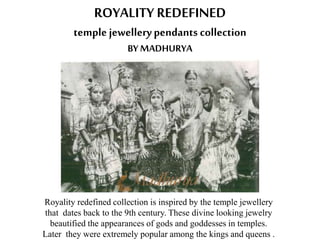
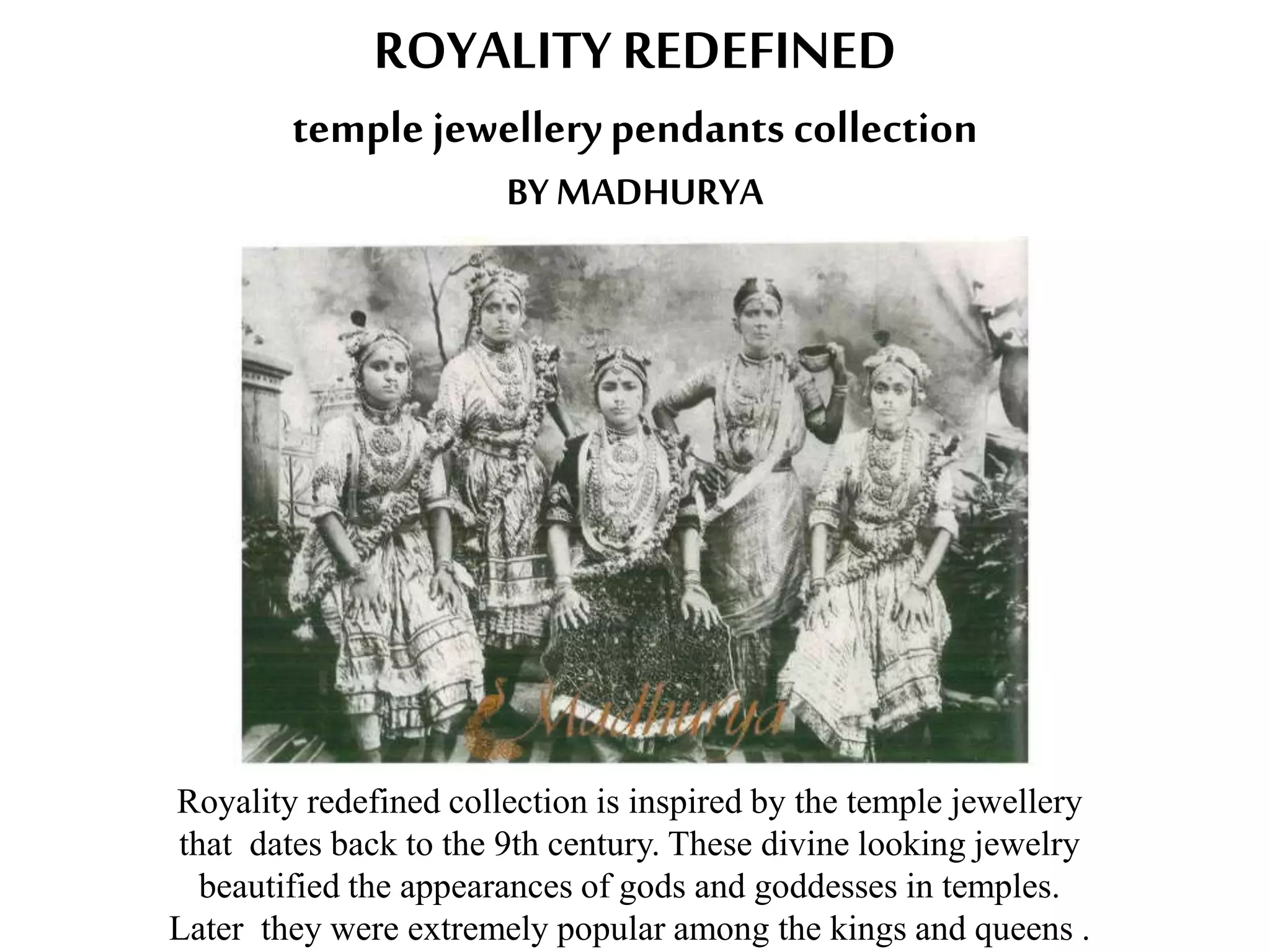
Royality redefined collection is inspired by the temple jewellery
that dates back to the 9th century. These divine looking jewelry
beautified the appearances of gods and goddesses in temples.
Later they were extremely popular among the kings and queens .
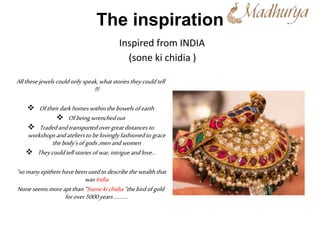
The inspiration
Inspired from INDIA
(sone ki chidia )
Allthesejewelscouldonlyspeak,whatstories theycould tell
!!!
 Of theirdarkhomeswithinthebowels ofearth
 Of beingwrenchedout
 Tradedandtransportedovergreatdistances to
workshopsandatelierstobelovinglyfashioned tograce
thebody’s ofgods,menandwomen
 Theycouldtell stories ofwar,intrigueandlove…
“so manyepithets havebeenusedto describethewealth that
was India
Noneseems moreapt than“Ssonekichidia “the birdofgold
forover5000years………..
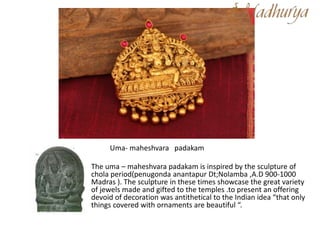
The uma – maheshvara padakam is inspired by the sculpture of
chola period(penugonda anantapur Dt;Nolamba ,A.D 900-1000
Madras ). The sculpture in these times showcase the great variety
of jewels made and gifted to the temples .to present an offering
devoid of decoration was antithetical to the Indian idea “that only
things covered with ornaments are beautiful “.
Uma- maheshvara padakam
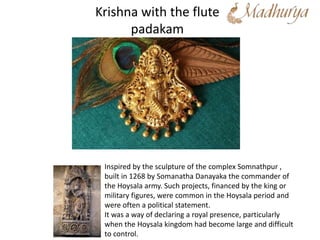
Krishna with the flute
padakam
Inspired by the sculpture of the complex Somnathpur ,
built in 1268 by Somanatha Danayaka the commander of
the Hoysala army. Such projects, financed by the king or
military figures, were common in the Hoysala period and
were often a political statement.
It was a way of declaring a royal presence, particularly
when the Hoysala kingdom had become large and difficult
to control.
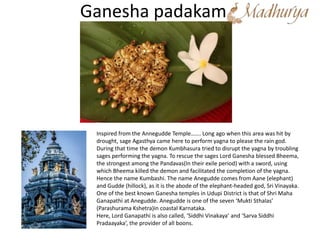
Ganesha padakam
Inspired from the Annegudde Temple……. Long ago when this area was hit by
drought, sage Agasthya came here to perform yagna to please the rain god.
During that time the demon Kumbhasura tried to disrupt the yagna by troubling
sages performing the yagna. To rescue the sages Lord Ganesha blessed Bheema,
the strongest among the Pandavas(In their exile period) with a sword, using
which Bheema killed the demon and facilitated the completion of the yagna.
Hence the name Kumbashi. The name Anegudde comes from Aane (elephant)
and Gudde (hillock), as it is the abode of the elephant-headed god, Sri Vinayaka.
One of the best known Ganesha temples in Udupi District is that of Shri Maha
Ganapathi at Anegudde. Anegudde is one of the seven ‘Mukti Sthalas’
(Parashurama Kshetra)in coastal Karnataka.
Here, Lord Ganapathi is also called, ‘Siddhi Vinakaya’ and ‘Sarva Siddhi
Pradaayaka’, the provider of all boons.
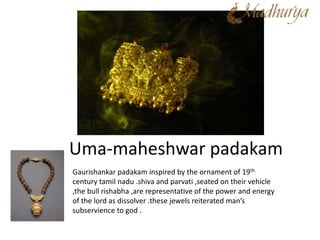
Uma-maheshwar padakam
Gaurishankar padakam inspired by the ornament of 19th
century tamil nadu .shiva and parvati ,seated on their vehicle
,the bull rishabha ,are representative of the power and energy
of the lord as dissolver .these jewels reiterated man’s
subservience to god .
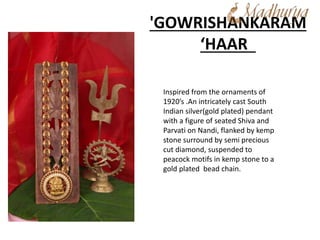
'GOWRISHANKARAM
‘HAAR
Inspired from the ornaments of
1920’s .An intricately cast South
Indian silver(gold plated) pendant
with a figure of seated Shiva and
Parvati on Nandi, flanked by kemp
stone surround by semi precious
cut diamond, suspended to
peacock motifs in kemp stone to a
gold plated bead chain.
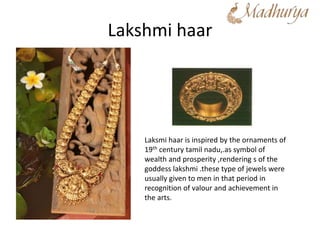
Lakshmi haar
Laksmi haar is inspired by the ornaments of
19th century tamil nadu,.as symbol of
wealth and prosperity ,rendering s of the
goddess lakshmi .these type of jewels were
usually given to men in that period in
recognition of valour and achievement in
the arts.
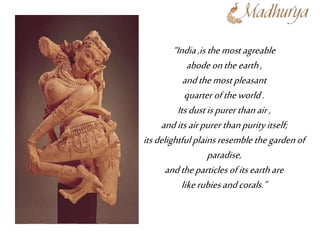
“India,isthemost agreable
abodeontheearth,
andthemost pleasant
quarter oftheworld.
Itsdustispurer thanair,
anditsairpurer thanpurityitself;
itsdelightfulplainsresemble thegardenof
paradise,
andtheparticlesofitsearthare
likerubiesandcorals.”
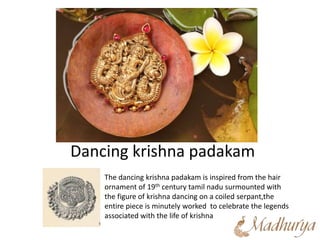
Dancing krishna padakam
The dancing krishna padakam is inspired from the hair
ornament of 19th century tamil nadu surmounted with
the figure of krishna dancing on a coiled serpant,the
entire piece is minutely worked to celebrate the legends
associated with the life of krishna
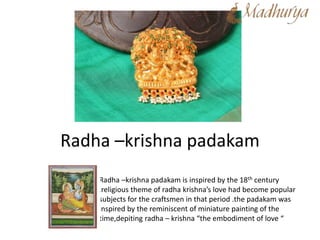
Radha –krishna padakam
Radha –krishna padakam is inspired by the 18th century
,religious theme of radha krishna’s love had become popular
subjects for the craftsmen in that period .the padakam was
inspired by the reminiscent of miniature painting of the
time,depiting radha – krishna “the embodiment of love “
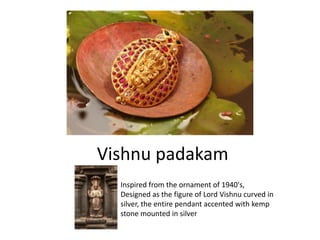
Vishnu padakam
Inspired from the ornament of 1940's,
Designed as the figure of Lord Vishnu curved in
silver, the entire pendant accented with kemp
stone mounted in silver
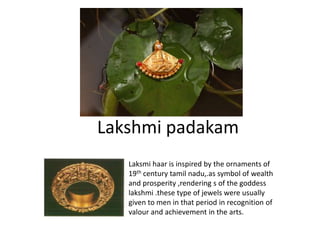
Lakshmi padakam
Laksmi haar is inspired by the ornaments of
19th century tamil nadu,.as symbol of wealth
and prosperity ,rendering s of the goddess
lakshmi .these type of jewels were usually
given to men in that period in recognition of
valour and achievement in the arts.
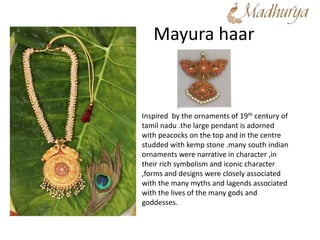
Mayura haar
Inspired by the ornaments of 19th century of
tamil nadu .the large pendant is adorned
with peacocks on the top and in the centre
studded with kemp stone .many south indian
ornaments were narrative in character ,in
their rich symbolism and iconic character
,forms and designs were closely associated
with the many myths and lagends associated
with the lives of the many gods and
goddesses.
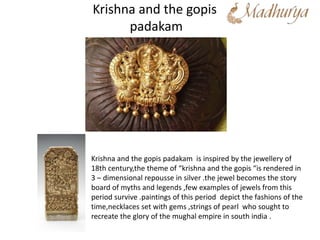
Krishna and the gopis
padakam
Krishna and the gopis padakam is inspired by the jewellery of
18th century,the theme of “krishna and the gopis “is rendered in
3 – dimensional repousse in silver .the jewel becomes the story
board of myths and legends ,few examples of jewels from this
period survive .paintings of this period depict the fashions of the
time,necklaces set with gems ,strings of pearl who sought to
recreate the glory of the mughal empire in south india .
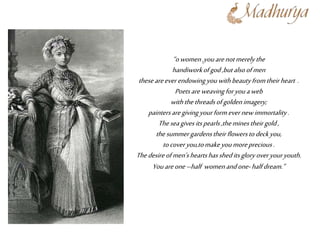
“owomen,youarenotmerelythe
handiworkofgod,butalsoofmen
theseareeverendowingyouwithbeautyfromtheirheart .
Poetsareweavingforyouaweb
withthethreadsofgoldenimagery;
paintersaregivingyourformevernewimmortality.
Theseagives itspearls,theminestheirgold,
thesummergardenstheirflowerstodeckyou,
tocoveryou,tomakeyoumoreprecious.
Thedesireofmen’sheartshassheditsgloryoveryouryouth.
Youareone–half womenandone-halfdream.”
Visit Madhurya for Temple jewellery
pendants collection.

Temple jewellery pendants collection

  • 1.
    ROYALITY REDEFINED temple jewellerypendantscollection BY MADHURYA Royality redefined collection is inspired by the temple jewellery that dates back to the 9th century. These divine looking jewelry beautified the appearances of gods and goddesses in temples. Later they were extremely popular among the kings and queens .
  • 2.
    The inspiration Inspired fromINDIA (sone ki chidia ) Allthesejewelscouldonlyspeak,whatstories theycould tell !!!  Of theirdarkhomeswithinthebowels ofearth  Of beingwrenchedout  Tradedandtransportedovergreatdistances to workshopsandatelierstobelovinglyfashioned tograce thebody’s ofgods,menandwomen  Theycouldtell stories ofwar,intrigueandlove… “so manyepithets havebeenusedto describethewealth that was India Noneseems moreapt than“Ssonekichidia “the birdofgold forover5000years………..
  • 3.
    The uma –maheshvara padakam is inspired by the sculpture of chola period(penugonda anantapur Dt;Nolamba ,A.D 900-1000 Madras ). The sculpture in these times showcase the great variety of jewels made and gifted to the temples .to present an offering devoid of decoration was antithetical to the Indian idea “that only things covered with ornaments are beautiful “. Uma- maheshvara padakam
  • 4.
    Krishna with theflute padakam Inspired by the sculpture of the complex Somnathpur , built in 1268 by Somanatha Danayaka the commander of the Hoysala army. Such projects, financed by the king or military figures, were common in the Hoysala period and were often a political statement. It was a way of declaring a royal presence, particularly when the Hoysala kingdom had become large and difficult to control.
  • 5.
    Ganesha padakam Inspired fromthe Annegudde Temple……. Long ago when this area was hit by drought, sage Agasthya came here to perform yagna to please the rain god. During that time the demon Kumbhasura tried to disrupt the yagna by troubling sages performing the yagna. To rescue the sages Lord Ganesha blessed Bheema, the strongest among the Pandavas(In their exile period) with a sword, using which Bheema killed the demon and facilitated the completion of the yagna. Hence the name Kumbashi. The name Anegudde comes from Aane (elephant) and Gudde (hillock), as it is the abode of the elephant-headed god, Sri Vinayaka. One of the best known Ganesha temples in Udupi District is that of Shri Maha Ganapathi at Anegudde. Anegudde is one of the seven ‘Mukti Sthalas’ (Parashurama Kshetra)in coastal Karnataka. Here, Lord Ganapathi is also called, ‘Siddhi Vinakaya’ and ‘Sarva Siddhi Pradaayaka’, the provider of all boons.
  • 6.
    Uma-maheshwar padakam Gaurishankar padakaminspired by the ornament of 19th century tamil nadu .shiva and parvati ,seated on their vehicle ,the bull rishabha ,are representative of the power and energy of the lord as dissolver .these jewels reiterated man’s subservience to god .
  • 7.
    'GOWRISHANKARAM ‘HAAR Inspired from theornaments of 1920’s .An intricately cast South Indian silver(gold plated) pendant with a figure of seated Shiva and Parvati on Nandi, flanked by kemp stone surround by semi precious cut diamond, suspended to peacock motifs in kemp stone to a gold plated bead chain.
  • 8.
    Lakshmi haar Laksmi haaris inspired by the ornaments of 19th century tamil nadu,.as symbol of wealth and prosperity ,rendering s of the goddess lakshmi .these type of jewels were usually given to men in that period in recognition of valour and achievement in the arts.
  • 9.
    “India,isthemost agreable abodeontheearth, andthemost pleasant quarteroftheworld. Itsdustispurer thanair, anditsairpurer thanpurityitself; itsdelightfulplainsresemble thegardenof paradise, andtheparticlesofitsearthare likerubiesandcorals.”
  • 10.
    Dancing krishna padakam Thedancing krishna padakam is inspired from the hair ornament of 19th century tamil nadu surmounted with the figure of krishna dancing on a coiled serpant,the entire piece is minutely worked to celebrate the legends associated with the life of krishna
  • 11.
    Radha –krishna padakam Radha–krishna padakam is inspired by the 18th century ,religious theme of radha krishna’s love had become popular subjects for the craftsmen in that period .the padakam was inspired by the reminiscent of miniature painting of the time,depiting radha – krishna “the embodiment of love “
  • 12.
    Vishnu padakam Inspired fromthe ornament of 1940's, Designed as the figure of Lord Vishnu curved in silver, the entire pendant accented with kemp stone mounted in silver
  • 13.
    Lakshmi padakam Laksmi haaris inspired by the ornaments of 19th century tamil nadu,.as symbol of wealth and prosperity ,rendering s of the goddess lakshmi .these type of jewels were usually given to men in that period in recognition of valour and achievement in the arts.
  • 14.
    Mayura haar Inspired bythe ornaments of 19th century of tamil nadu .the large pendant is adorned with peacocks on the top and in the centre studded with kemp stone .many south indian ornaments were narrative in character ,in their rich symbolism and iconic character ,forms and designs were closely associated with the many myths and lagends associated with the lives of the many gods and goddesses.
  • 15.
    Krishna and thegopis padakam Krishna and the gopis padakam is inspired by the jewellery of 18th century,the theme of “krishna and the gopis “is rendered in 3 – dimensional repousse in silver .the jewel becomes the story board of myths and legends ,few examples of jewels from this period survive .paintings of this period depict the fashions of the time,necklaces set with gems ,strings of pearl who sought to recreate the glory of the mughal empire in south india .
  • 16.
  • 17.
    Visit Madhurya forTemple jewellery pendants collection.