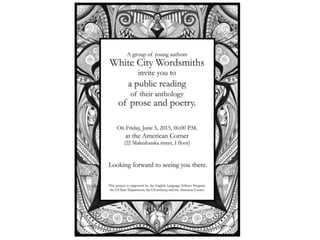
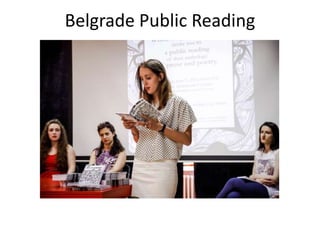
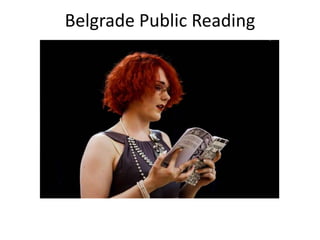
Belgrade Public Reading
Part 1: Creating the Workshop
Writing Workshop Project
Primary goal: To improve students’ skills in
creative writing
Secondary goal: To improve students’ speaking
and organizational skills
End Result: To produce a published anthology
of student writing and hold a public reading.
Writing Workshop Profile
Size: Between 10-15 participants per workshop
Language ability: All participants should be of a
similar level
Meeting Times: Workshop should meet once or
twice a week.
Beginners Workshop
• First several workshops focus on teaching and
practice using core literary concepts like:
– Plot
– Setting
– Description
– Characterization
– Dialog
– Conflict
– Resolution
Beginners Workshop
• Give writers short, specific writing
assignments like:
– Flash fiction
– Poems
– Poetography
– Personal narrative assignments
Advanced Writers Workshop
• Students sign up to workshop their writing on
a particular day.
• Students submit their short story or poems a
week in advance for others to critique
• Depending on time limits each student who
submitted that week should get approximately
30-40 minutes for feedback from the group
and teacher
The Art of Feedback
• Be sensitive
• Be specific
• Be Positive
• Be critical
• Give your impression
Giving Feedback: Plot
• Does it have a strong storyline?
• Is there too much or too little drama?
• Should the plot be developed with more
complexity and depth?
• Is the plot too complicated and would benefit
from being streamlined?
Giving Feedback: Pacing
• Does the story feel rushed?
• Does it feel too slow?
• Is the pacing inconsistent?
• Do the actions progress and create drama in
the most effective way?
Giving Feedback: Characters
• Are these characters fully realized three-
dimensional people?
• Do we know too much or two little about them?
• Do we care about them? Why/why not?
• Do they develop sufficiently from the beginning
to the end?
Giving Feedback: Literary Mechanics
• Themes and Imagery: Should some
words/images be highlighted more? Are some
words/images overused?
• Style: Is the writer’s voice consistent?
• Length: Would the story/poem benefit from
being expanded or condensed?
Giving Feedback: Literary Mechanics
• Mood: Is the intended mood achieved?
• Tone: Does the writer’s style effectively
compliment the plot/setting/mood?
• Point-of-view: Is the story told from the most
effective point of view either 1st/3rd person
or from the most effective character?
Giving Feedback: General Procedure
1. Plot
2. Pacing
3. Characters
4. Literary Mechanics
Part 2: Producing the Product
Form an Editing Committee
Workshop members take on certain roles with
real duties and responsibilities including:
– Proofreader/editor (prepares final text for pub.)
– Graphic designer (covers, photos, etc.)
– Format designer (formats the text in book form)
– Publication editor (coordinates print and
electronic publication)
Get it Out There
• Work with local printers to produce copies for
workshop members, family, and friends.
• Upload and electronic copy to smashwords.com,
amazon.com, nookpress.com, etc.
Part 3: Going Public
Organize a Public Reading
Find a venue partner to host a public reading. This
could be at a
– Local school or university
– American corner
– Library
– Bookstore
– Café or restaurant
Plan the Event
Workshop members take on certain roles with real duties and
responsibilities including:
Event coordinators:
• locate the venue
• arrange food/beverages
• plan the reading schedule
• print participation certificates
Publicize the Event
Media coordinators:
• Prepare press releases
• Contact local print, TV, and online media to cover the event
• Contact embassies/consulates for intercultural exchanges
• Contact local English teachers, professors, English language
fellows, English teacher assistants, etc.
• Hang posters/fliers in key locations (schools, libraries,
culture centers, literary cafes, etc.)
Hold the Event
Proposed Public Reading Model
1. Opening Speakers:
– Teachers/professors/cultural liaisons give opening
comments
– Project coordinator gives comments
2. Readings
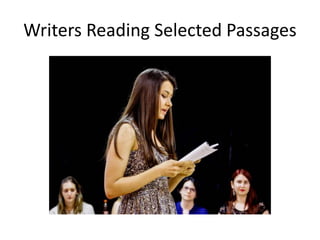
– Writers read poems or selected passages of their works
3. Conclusion
– Project coordinator awards certificates
– Closing comments
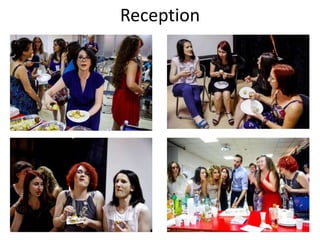
– Reception with refreshments and mingling with the writers
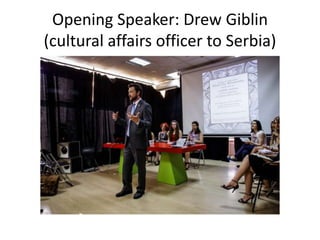
Opening Speaker: Drew Giblin
(cultural affairs officer to Serbia)
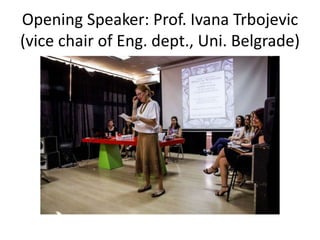
Opening Speaker: Prof. Ivana Trbojevic
(vice chair of Eng. dept., Uni. Belgrade)
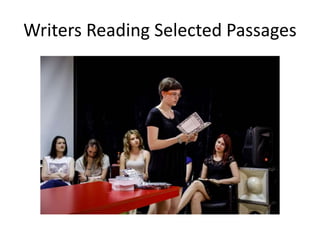
Writers Reading Selected Passages
Reception
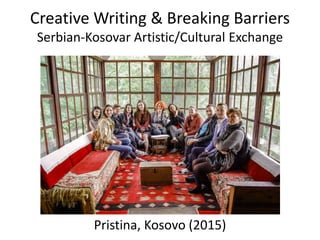
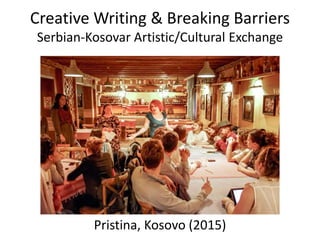
Creative Writing & Breaking Barriers
Serbian-Kosovar Artistic/Cultural Exchange
Pristina, Kosovo (2015)
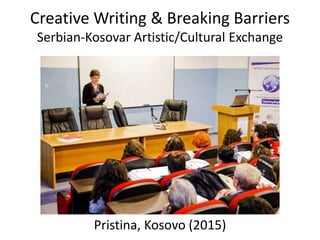
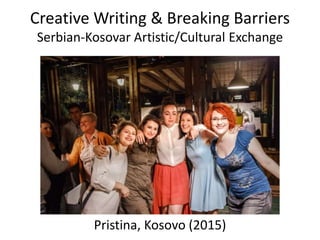
Creative Writing & Breaking Barriers
Serbian-Kosovar Artistic/Cultural Exchange
Pristina, Kosovo (2015)
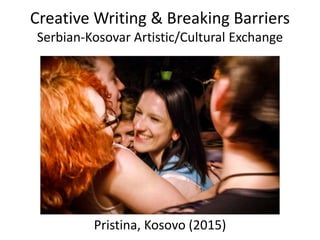
Creative Writing & Breaking Barriers
Serbian-Kosovar Artistic/Cultural Exchange
Pristina, Kosovo (2015)
Creative Writing & Breaking Barriers
Serbian-Kosovar Artistic/Cultural Exchange
Pristina, Kosovo (2015)
Creative Writing & Breaking Barriers
Serbian-Kosovar Artistic/Cultural Exchange
Pristina, Kosovo (2015)
Short Writing Activity
Character Description
1. Imagine the villain of a story and the crime or
bad thing they have committed.
2. Briefly describe that villain.
Short Writing Activity
3. Rewrite your character description in 1
sentence using as few words as possible.

Telts writing workshop presentation

  • 2.
  • 3.
  • 4.
    Part 1: Creatingthe Workshop
  • 5.
    Writing Workshop Project Primarygoal: To improve students’ skills in creative writing Secondary goal: To improve students’ speaking and organizational skills End Result: To produce a published anthology of student writing and hold a public reading.
  • 6.
    Writing Workshop Profile Size:Between 10-15 participants per workshop Language ability: All participants should be of a similar level Meeting Times: Workshop should meet once or twice a week.
  • 7.
    Beginners Workshop • Firstseveral workshops focus on teaching and practice using core literary concepts like: – Plot – Setting – Description – Characterization – Dialog – Conflict – Resolution
  • 8.
    Beginners Workshop • Givewriters short, specific writing assignments like: – Flash fiction – Poems – Poetography – Personal narrative assignments
  • 9.
    Advanced Writers Workshop •Students sign up to workshop their writing on a particular day. • Students submit their short story or poems a week in advance for others to critique • Depending on time limits each student who submitted that week should get approximately 30-40 minutes for feedback from the group and teacher
  • 10.
    The Art ofFeedback • Be sensitive • Be specific • Be Positive • Be critical • Give your impression
  • 11.
    Giving Feedback: Plot •Does it have a strong storyline? • Is there too much or too little drama? • Should the plot be developed with more complexity and depth? • Is the plot too complicated and would benefit from being streamlined?
  • 12.
    Giving Feedback: Pacing •Does the story feel rushed? • Does it feel too slow? • Is the pacing inconsistent? • Do the actions progress and create drama in the most effective way?
  • 13.
    Giving Feedback: Characters •Are these characters fully realized three- dimensional people? • Do we know too much or two little about them? • Do we care about them? Why/why not? • Do they develop sufficiently from the beginning to the end?
  • 14.
    Giving Feedback: LiteraryMechanics • Themes and Imagery: Should some words/images be highlighted more? Are some words/images overused? • Style: Is the writer’s voice consistent? • Length: Would the story/poem benefit from being expanded or condensed?
  • 15.
    Giving Feedback: LiteraryMechanics • Mood: Is the intended mood achieved? • Tone: Does the writer’s style effectively compliment the plot/setting/mood? • Point-of-view: Is the story told from the most effective point of view either 1st/3rd person or from the most effective character?
  • 16.
    Giving Feedback: GeneralProcedure 1. Plot 2. Pacing 3. Characters 4. Literary Mechanics
  • 17.
    Part 2: Producingthe Product
  • 18.
    Form an EditingCommittee Workshop members take on certain roles with real duties and responsibilities including: – Proofreader/editor (prepares final text for pub.) – Graphic designer (covers, photos, etc.) – Format designer (formats the text in book form) – Publication editor (coordinates print and electronic publication)
  • 19.
    Get it OutThere • Work with local printers to produce copies for workshop members, family, and friends. • Upload and electronic copy to smashwords.com, amazon.com, nookpress.com, etc.
  • 20.
  • 21.
    Organize a PublicReading Find a venue partner to host a public reading. This could be at a – Local school or university – American corner – Library – Bookstore – Café or restaurant
  • 22.
    Plan the Event Workshopmembers take on certain roles with real duties and responsibilities including: Event coordinators: • locate the venue • arrange food/beverages • plan the reading schedule • print participation certificates
  • 23.
    Publicize the Event Mediacoordinators: • Prepare press releases • Contact local print, TV, and online media to cover the event • Contact embassies/consulates for intercultural exchanges • Contact local English teachers, professors, English language fellows, English teacher assistants, etc. • Hang posters/fliers in key locations (schools, libraries, culture centers, literary cafes, etc.)
  • 24.
    Hold the Event ProposedPublic Reading Model 1. Opening Speakers: – Teachers/professors/cultural liaisons give opening comments – Project coordinator gives comments 2. Readings – Writers read poems or selected passages of their works 3. Conclusion – Project coordinator awards certificates – Closing comments – Reception with refreshments and mingling with the writers
  • 25.
    Opening Speaker: DrewGiblin (cultural affairs officer to Serbia)
  • 26.
    Opening Speaker: Prof.Ivana Trbojevic (vice chair of Eng. dept., Uni. Belgrade)
  • 27.
  • 28.
  • 29.
  • 30.
    Creative Writing &Breaking Barriers Serbian-Kosovar Artistic/Cultural Exchange Pristina, Kosovo (2015)
  • 31.
    Creative Writing &Breaking Barriers Serbian-Kosovar Artistic/Cultural Exchange Pristina, Kosovo (2015)
  • 32.
    Creative Writing &Breaking Barriers Serbian-Kosovar Artistic/Cultural Exchange Pristina, Kosovo (2015)
  • 33.
    Creative Writing &Breaking Barriers Serbian-Kosovar Artistic/Cultural Exchange Pristina, Kosovo (2015)
  • 34.
    Creative Writing &Breaking Barriers Serbian-Kosovar Artistic/Cultural Exchange Pristina, Kosovo (2015)
  • 35.
    Short Writing Activity CharacterDescription 1. Imagine the villain of a story and the crime or bad thing they have committed. 2. Briefly describe that villain.
  • 36.
    Short Writing Activity 3.Rewrite your character description in 1 sentence using as few words as possible.