DYNAMIC GROUNDWATER RESOURCES OF
TELANGANA STATE
(As on March, 2020)
Ground Water Department
Government of Telangana
Hyderabad
&
Central Ground Water Board,
Ministry of Jal Shakti, Govt of India
Hyderabad
November, 2021
Hyderabad
Ground Water Department, Telangana & Central Ground Water Board, MoJS
DYNAMIC GROUNDWATER RESOURCES OF
TELANGANA STATE
(As on March, 2020)
Prepared by
Ground Water Department,
Government of Telangana,
Hyderabad
&
Central Ground Water Board
Ministry of Jal Shakti, Govt of India
Southern Region
Hyderabad
Under the Overall Guidence of
Dr. Pandith Madhnure
Director, GWD, Telangana
&
Sri. J. Siddhardha Kumar
Regional Director (I/c)
CGWB, SR, Hyderabad
Dr. PANDITH MADHNURE
M.Sc., Ph.D
DIRECTOR
GROUND WATER DEPARTMENT
GOVERNMENT OF TELANGANA
#6-2-916/1, Opp. Govt. Degree College,
Chintal Basthi, Khairtabad,
Hyderabad - 500004, Telangana, India
Phone: 040-23314979 (O)
Email: director.tgsgwd@gmail.com
PREFACE
Ground Water Department, Government of Telangana in coordination
with Central Ground Water Board, Ministry of Jal Shakti, Govt of India has
taken up the re-assessment of “Dynamic Groundwater Resources of
Telangana-2020” based on the latest techniques and data. The National
Water Policy of India, regards groundwater as one of the most crucial
elements in development planning. Therefore, accurate assessment of
these vital resources is to be done at periodic interval by using the latest
data & technology and the earlier estimates were carried out for the year
2002, 2005, 2007, 2009, 2011, 2013 and 2017.
Presently about 60 % of state’s population is dependent on some form
or other on farm activity for their livelihood and agriculture contributes
13 % to its GDP. Demand on groundwater resources is further increasing
due to pace of industrial development which, often leading to unsustainable
drawl of groundwater resources. Groundwater development & management
in the state is regulated with help of Water, Land and Tree Act (WALTA-Act)
for which, Department is furnishing a list of Over Exploited villages for
notification and implementation of regulatory measures.
Out of states geographical area of ~1.12 lakh Km2, about 79 % area
falls under non-command and remaining falls under command area. The
state which receives a normal annual rainfall of 940 mm is underlain by
hard rock aquifers namely, gneisses, granite, basalt and quartzite and soft
rocks namely sandstone, limestone and river alluvium.
Ground Water Department, Telangana & Central Ground Water Board, MoJS
REPORT ON
DYNAMIC GROUNDWATER RESOURCES OF
TELANGANA STATE
(As on March, 2020)
CONTRIBUTORS’ FROM GROUND WATER DEPARTMENT, Govt of TELANGANA
DISTRICT OFFICES
S.No. District : Designation (Sri/Smt/Kum)
1 Adilabad : T. Pulla Rao, A.Hg
2 Bhadradri : B. Rajkumar, A.Hg
3 Bhupalpally : P. Ramakrishna, A.Hg
4 Hyderabad : Dr. G. Vamshi Krishna, A.Hg
5 Jagityal : G. Nagaraju, AH
6 Jangaon : Ch. Narsimhulu, AGp
7 Jogulamba gadwal : S. Paramesh Goud A.Hg
8 Kamareddy : K. Ravi Kumar, A.Hg
9 Karimnagar : P. Sujatha, A.Hg
10 Khammam : G. Vishnu, AH
11 Kumuram bheem : A. Navaneeth A.Gp
12 Mahabubabad : V.Suresh A.Hg
13 Mahabubnagar : R. Manasa, A.Hg
14 Mancherial : B. Ganesh, A.Hg
15 Medak : D. Divya Jyothi A.H
16 Medchal : P. Premalatha, A.Hg
17 Mulugu : A. Srikanth, A.Hg
18 Nagarkurnool : T. Mathews, AGp
19 Nalgonda : V.Ravi, AH.g
20 Narayanapet : V.Kumar, A.Hg
21 Nirmal : K. Suhasini, A.H
22 Nizamabad : E. Govardhan, A.H
23 Peddapally : B. Umadevi, A.Hg
24 Rangareddy : B. Sangeetha, A.H
25 Sangareddy : Dr. M. Santosh Kumar, A.Hg
26 Siddipet : E. Sathyanarayana, A.Hg
27 Sircilla : A. Abhilash, A.H
28 Suryapet : K. Rajini, AH.g
29 Vikarabad : K. Lavanya, A.Hg
30 Wanaparthy : Dr. P. Yugendar Reddy, A.Hg
31 Warangal (r) : B. Ravi, A.Hg
32 Warangal (u) : S. Shruthi, AH
33 Yadadri bhuvanagiri : V. Swathi Sri, A.Hg
S.No. Name : Designation
HEAD OFFICE
1 Sri P. Jyothi Kumar : Deputy Director (Hg)
2 Sri. M. Ramesh : Asst. Director (Hg)
3 Smt. Hafsa Sulthana : Asst. Hydrogeologist
4 Supervision : Sri K. Laxma, Joint Director
Under the Overall Supervision & Guidance
Dr. Pandith Madhnure
DIRECTOR
Ground Water Department, Telangana & Central Ground Water Board, MoJS
DYNAMIC GROUNDWATER RESOURCES OF
TELANGANA STATE
(As on March, 2020)
CONTENTS
EXECUTIVE SUMMARY
S.NO. CHAPTER
Page.
No.
1.0 INTRODUCTION 1-2
1.1 Background for Re-estimation 1
1.2 Constitution of State-Level Committee 1
2.0 HYDROGEOLOGICAL SET UP 3-23
2.1 Geographical and Administrative setup 3
2.2 Demography 4
2.3 Soils 4
2.4 Climate & Rainfall 5
2.5 Rivers of the State Vis-à-Vis Watersheds 9
2.6 Geological and Hydrogeological Characteristics 10
2.7 Groundwater levels 16
2.8 Groundwater Quality 19
3.0 GROUNDWATER RESOURCE ESTIMATION METHODOLOGY- 2015 24-38
3.1 Review of Groundwater Resource Estimation Methodologies 24
3.2 Groundwater Assessment unit 25
3.3 Groundwater Assessment Sub-Units 25
3.4 Assessment of Annual Replenishable Groundwater Resources 25
3.5 Rainfall Recharge 26
3.6 Percent Deviation 31
3.7 Recharge from Other Resources 31
3.8 Recharge during Monsoon Season 33
3.9 Recharge during Non-Monsoon Season 33
3.10 Total Annual Groundwater Recharge 33
3.11 Annual Extractable Groundwater Recharge 33
3.12 Estimation of Groundwater Extraction 33
3.13 Stage of Groundwater Extraction 35
3.14 Validation of Stage of Groundwater Extraction 35
3.15 Categorisation of Assessment Units 36
3.16 Categorization of Assessment Units Based on Quality 37
3.17 Allocation of Groundwater Resource for Utilisation 37
Ground Water Department, Telangana & Central Ground Water Board, MoJS
3.18 Net Annual Groundwater Availability for Future Use 37
3.19 Apportioning of Groundwater Assessment from Watershed to Mandal 38
4.0 PROCEDURE FOLLOWED IN PRESENT ASSESSMENT 39-41
4.1 Data Sources for Various Data Elements 39
4.2 Various Norms Used in the Computation 39
4.3 Constraints in the Database 41
5.0 COMPUTATION OF GROUNDWATER RESOURCES 42-57
5.1 Assessment Method Adopted 42
5.2 Dynamic Groundwater Resources 42
5.3 Salient Features of Groundwater resources 45
5.4 Comparison with the earlier Groundwater Resources Estimates 51
5.5 District wise Groundwater Resources 52
5.6 Groundwater Availability Kaleshwaram Project Command area 55
5.7 Impact of Mission Kakatiya on Groundwater Resources 56
6.0 CONCLUSION 58-59
FIGURES
2.1 Administrative map of Telangana state. 3
2.2 Soil Map of Telangana State. 4
2.3 Agroclimatic Zones, Telangana State. 6
2.4 Normal Annual rainfall, Telangana State. 7
2.5 Mandal wise rainfall deviation for water year 2019-20 (upto 31st
May, 2020). 7
2.6 District wise Normal & Actual Rainfall (WY-2019-20(Upto May-2020)). 8
2.7 River sub-basins and watershed map, Telangana State. 10
2.8 Geological map of Telangana State. 11
2.9 Growth in DW/BW in Telangana State. 15
2.10 Decadal water level trends. 17
2.11 Depth to water level pre-monsoon 2019. 17
2.12 Depth to water levels post-monsoon 2019. 18
2.13 Water levels Fluctuations during Nov-2019 w.r.t to May-2019 in Telangana. 19
2.14a&b EC Distribution during Pre and Post Monsoon Season, 2019. 23
2.15a&b Fluoride Distribution during Pre and Post Monsoon Season, 2019. 23
2.16a&b Nitrate Distribution during Pre and Post Monsoon Season, 2019. 23
5.1 GWR Availability Vs Usage over various GEC. 43
5.2 District Wise Categorization Map, Telangana State. 45
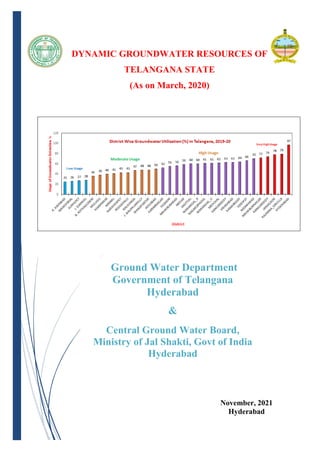
5.3a District Wise Groundwater Utilization (%) in Telangana (2016-17). 46
5.3b District Wise Groundwater Utilization(%) in Telangana (2019-20). 46
Ground Water Department, Telangana & Central Ground Water Board, MoJS
5.4 Categorization of Watersheds in Telangana (2019-20). 47
5.5 Categorization of Watersheds. 47
5.6 Categorization of Mandals in Telangana (2019-20). 48
5.7 Categorization of Mandals, Telangana State. 48
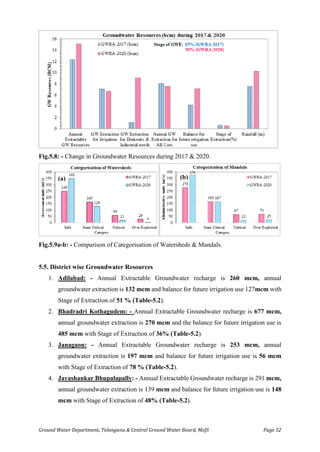
5.8 Change in Groundwater Resources during 2017 & 2020. 52
5.9a-b Comparison of Categorisation of Watersheds & Mandals. 52
5.10 Location of Kaleshwaram Project with command area. 56
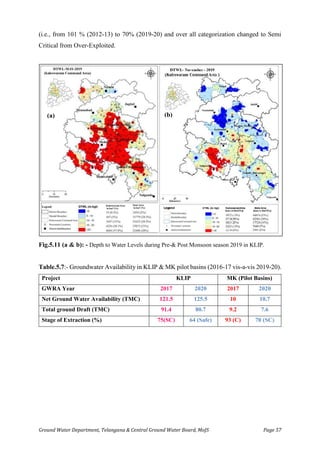
5.11 Depth to Water Levels during Pre-& Post Monsoon season 2019 in KLIP. 57
TABLES
2.1 Administrative Set Up. 3
2.2 Normal & Actual Monthly & Annual Rainfall of Telangana State, 2019-20. 8
2.3 Generalized Geological Succession, Telangana (after GSI, 2015). 12
2.4 Change in yield pattern & Well Density. 15
2.5 Minimum and Maximum values of major parameters during pre-monsoon (May-
2019).
21
2.6 Minimum and Maximum values of major parameters during post-monsoon (Nov-
2019).
22
3.1 Validation of Groundwater Extraction with comparison to Groundwater level
trend.
36
3.2 Categorisation based on Groundwater Extraction. 36
4.1 Data Sources Used in the Groundwater Resource Estimation. 40
5.1 Salient Features of Groundwater Resources Estimation 2019-20 (MCM). 43
5.2 District wise Groundwater Resources-2019-20. 44
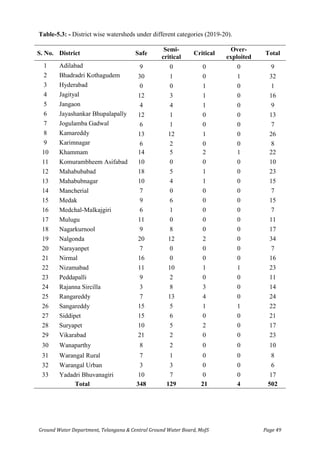
5.3 District wise number of Watersheds in Different Categories (2019-20). 49
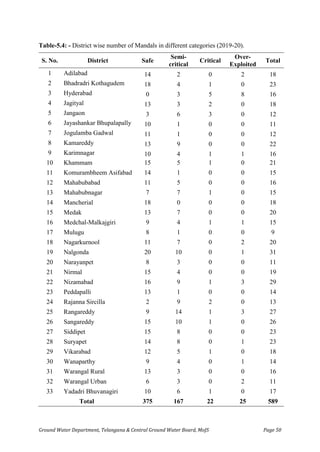
5.4 District wise number of Mandals in Different Categories (2019-20). 50
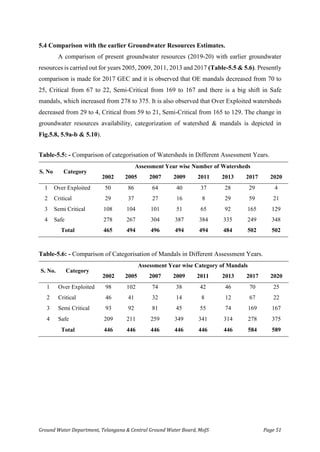
5.5 Comparison of categorisation of Watersheds in Different Assessment Years. 51
5.6 Comparison of categorisation of Mandals in Different Assessment Years. 51
5.7 Groundwater Availability in KLIP & MK pilot basins (2016-17 vis-a-vis
2019-20).
57
APPENDICES
I Instructions issued by the Government of Telangana for constituting the State Level Committee for re-
estimation of Dynamic Groundwater Resources as on March 2020.
II G.O. Ms.No.762, I & CAD (MIG.I), dated 1st
September, 2017.
III Minutes of the State Level Committee for re-estimation of Dynamic Groundwater Resources on 06th
June 2021.
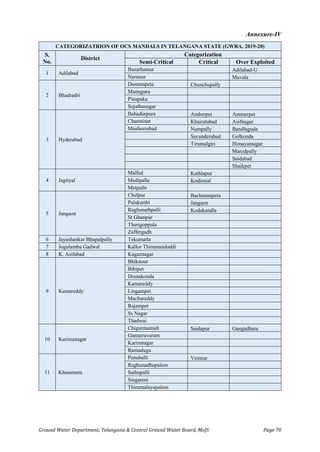
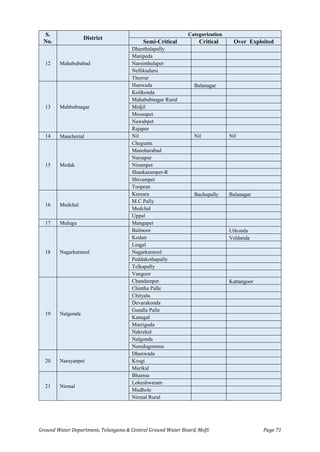
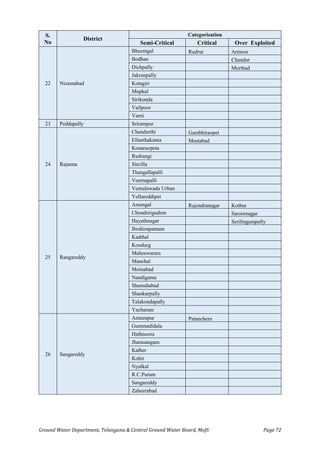
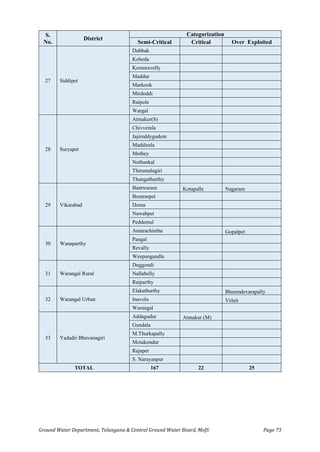
IV Categorization of OCS Mandals In Telangana State (GWRA 2019-20)
Ground Water Department, Telangana & Central Ground Water Board, MoJS
EXECUTIVE SUMMARY
The National Water Policy enunciates periodic assessment of groundwater resources for
quantification, sustainable development and management and as part of this exercise, the Ground
Water Department in coordination with Central Ground Water Board, Ministry of Jal Shakti,
DOWR, RD & GR Govt of India has taken up the precise estimation of dynamic or replenishable
groundwater resources as per the modified GEC guidelines of 2015. The Government of
Telangana is regulating groundwater resources with the help of Water, Land and Trees Act No. 10
of 2002 for which Ground Water Department is furnishing a list of Over Exploited villages for
notification and implementation of regulatory measures. Further, the planning of all groundwater
related projects is dependent upon groundwater extraction status.
Telangana State having an area of ~1.12 lakh Km2
and recharge worthy area of ~1.02 lakh
Km2
contributes 21 % command and 79 % non-command area. State receives a normal annual
rainfall of 940 mm of which 80 % is contributed by south-west monsoon and 13 % by north east
monsoon. The state with 3.5 crore population is predominantly (> 81%) occupied by hard rocks
namely, gneisses, granite, basalt and quartzite. Soft rocks namely sandstone, limestone and river
alluvium occupy rest of areas.
In present methodology, basic information like village wise cropped area, well census,
surface water bodies, various artificial recharge structures, rainfall pattern etc, were collected from
line departments considering the base line year of 2019-20 (as on March, 2020). Initially,
watershed wise village resources were computed and then apportioned to mandals, based on its
area coverage.
Prior to this resource estimations (2019-20), Ground Water Department has carried out
estimations during the year 2002, 2005, 2007, 2009, 2011, 2013 and 2017. The present
estimations are done as per the new guidelines formulated in GEC-2015. After bifurcation of State
and re-organization of districts, this is the first time that resources are taken up for all 33 districts,
covering 589 mandals and 502 watersheds.
With advent of drilling techniques in hard rock areas (DTH) well density has increased
from 5 wells/Km2
(1985-86) to 24 wells/Km2
(2019-20) in most of the districts. Comparatively
bore wells are more in numbers in Mahabubnagar, Medak, Nalgonda and Nizamabad districts and
dug wells in Karimnagar and Warangal districts.
Ground Water Department, Telangana & Central Ground Water Board, MoJS
In general, the quality of groundwater in Nalgonda, Warangal and Khammam districts in
hard rock formation is generally poor. The quality of groundwater from Gondwana formations is
generally good except in some local patches where it is alkaline and hard in nature. Groundwater
is often brackish to saline in black cotton soils associated with traps.
As per resource estimation for the year 2019-20, the total annual extractable groundwater
resources are 15128 million cubic meter (mcm) (command:6705 & non-command:8423), which is
22 % more in comparison to 2017 resources (12367 mcm), total groundwater extraction for all
uses is 7576 mcm (command: 2407 & non-command: 5169), 6 % less in comparison to 2017
resources (8094 mcm). Net groundwater availability for future irrigation use is 7139 mcm
(command: 4197 & non-command: 2942). Stage of groundwater extraction is ~50 % (36 % in
Command and 61 % in Non-Command), which is 15 % lesser than the previous assessment. There
is reduction in number of Over-Exploited mandals from 70 to 25 (64 % reduction) and villages
from 1745 to 721 (60 % reduction). The reasons for increase in ground water availability,
decrease in ground water extraction for all uses and stage of ground water extraction are attributed
due to the initiatives taken up by Govt. of Telangana through Mission Kakatiya (de-silting of
tanks), Mission Bhagiratha (providing safe surfacewater based drinking water supply to rural and
urban households), construction of KLIP, World’s largest surface water lift irrigation project and
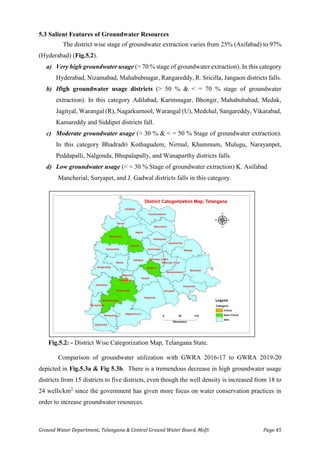
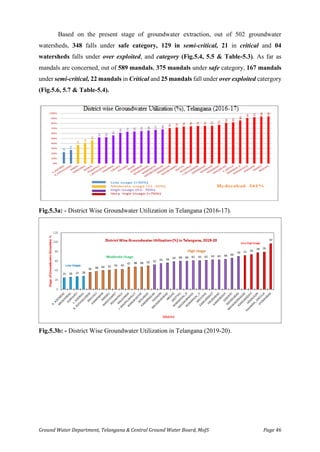
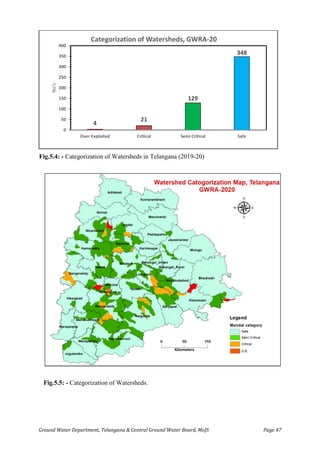
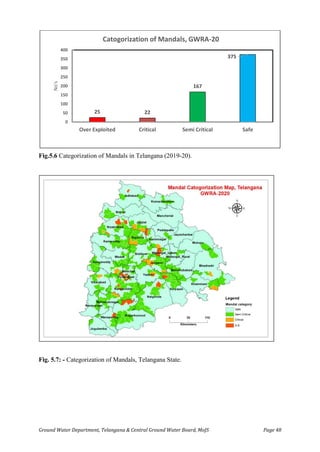
other groundwater conservation practices. District wise stage of groundwater extraction varies
from 25 % (Kumaram Bheem-Asifiabad) to 97 % (Hyderabad) with an average of 50 % in
Telangana State.
The net groundwater availability in the up-coming Kaleshwaram project command area
is 125 TMC (3439 mcm), Groundwater extraction is 81 TMC (2586 mcm) with 65 % of stage of
groundwater extraction.
In order to see impact of Mission Kakatiya on groundwater regime, comparison is made
with 2017 resources which shows positive impact on groundwater regime in 9 pilot study
watersheds. The stage of groundwater extraction decreased by 31% and Over Exploited
watersheds changed to Semi Critical category.
Ground Water Department, Telangana & Central Ground Water Board, MoJS Page 1
1.0 INTRODUCTION
1.1 Background for Re-estimation
The National Water Policy adopted by the Government of India in 1987 and revised in
2002 and 2012, regards water as one of the most crucial elements in developmental planning.
It also states that, there should be periodic reassessment of the groundwater resources on
scientific basis, taking into consideration the quality of water available and economic viability
of its extraction. Earlier, as on March, 2017, state wise assessment was done for the entire
country. In view of the substantial changes observed in groundwater scenario throughout the
country, the Ministry of Water Resources, River Development and Ganga Rejuvenation,
Government of India proposed states to re-estimate the groundwater resources with the
periodicity of every three years. The Government of Telangana is regulating groundwater
resources with the help of Water, Land and Tree Act (Act No. 10 of 2002) and for which Ground
Water Department is furnishing a list of Over Exploited areas for notification and
implementation of regulatory measures. Further, the planning of all groundwater related
projects is dependent upon groundwater extraction status.
The state is divided into two major river basins and 19 sub basins and are recognised as
accounting units for water. However, these sub basins which range in size from 390 to 15700
km2
and are generally not ideal for estimation of dynamic groundwater resources. The ideal
recommended size for groundwater estimation unit (catchment) is < 300 km2
. Hence, for the
purpose of groundwater estimation these basins are further sub-divided into 502 drainage basins
(watersheds) in consonance with the decision of the Groundwater Resource Estimation
Committee and recognised as accounting units for water assessment having an average area of
~200Km2
.
1.2 Constitution of State-Level Committee
The Ground Water Department, Government of Telangana in co-ordination with Central
Ground Water Board, Ministry of Jal Shakti, Govt of India has taken up re-estimation of
groundwater resources for the base year 2019-20, duly following the guidelines and protocols
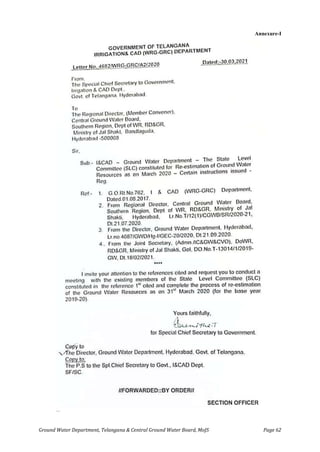
designed for the purpose. The Government of Telangana, vide letter No. 4682/WRG-
GRC/A2/2020 dated 30/03/2021 asked the Director to conduct meeting with the existing
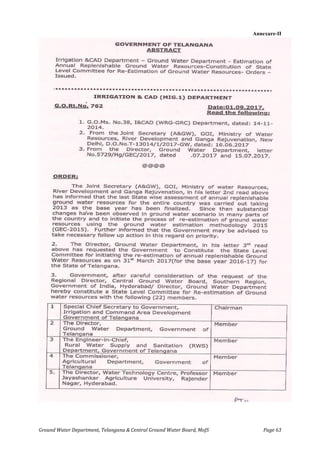
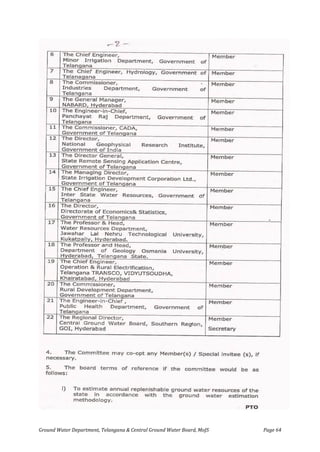
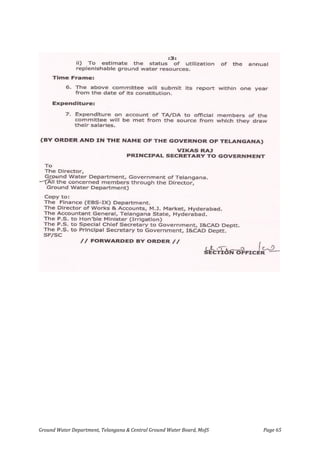
members of the State Level Committee (SLC) constituted vide G.O. Ms.No.762, dated 1st
Ground Water Department, Telangana & Central Ground Water Board, MoJS Page 2
September, 2017 (Annexure-I & II). The responsibility of Assessment of groundwater
resource for the state was vested on Ground Water Department, Government of Telangana.
The SLC meeting convened by Regional Director (the Convener) for re estimation of
Groundwater Resources as on March, 2020 was held on 8/6/2021 under the chairmanship of
Dr. Rajat Kumar, I.A.S., the Spl. Chief Secretary, I & CAD, Department, Govt of Telangana
approved the draft report on “Dynamic Groundwater Resources of Telangana State (as on
March-2020)” (Annexure-III).
Ground Water Department, Telangana & Central Ground Water Board, MoJS Page 3
2.0 HYDROGEOLOGICAL SET UP
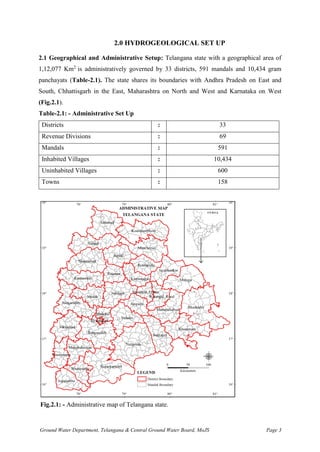
2.1 Geographical and Administrative Setup: Telangana state with a geographical area of
1,12,077 Km2
is administratively governed by 33 districts, 591 mandals and 10,434 gram
panchayats (Table-2.1). The state shares its boundaries with Andhra Pradesh on East and
South, Chhattisgarh in the East, Maharashtra on North and West and Karnataka on West
(Fig.2.1).
Table-2.1: - Administrative Set Up
Districts : 33
Revenue Divisions : 69
Mandals : 591
Inhabited Villages : 10,434
Uninhabited Villages : 600
Towns : 158
Fig.2.1: - Administrative map of Telangana state.
Ground Water Department, Telangana & Central Ground Water Board, MoJS Page 4
2.2 Demography
As per 2011 census, state is having a population of about 3.50 crores with a density of
312 person/Km2
of which ~ 61% lives in rural and 39 % in urban area. The male female ratio
is 988 females per 1000 males. The state has seen an overall growth of 13.58 % from previous
census. The population of Scheduled Caste and Scheduled Tribes is 15.45 % and 9.08 %
respectively in the state.
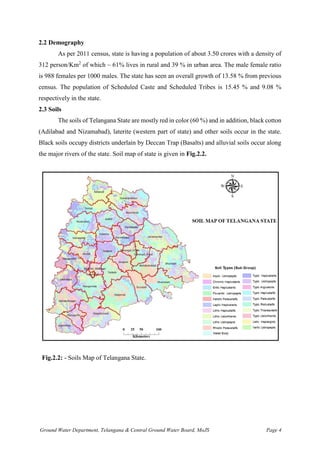
2.3 Soils
The soils of Telangana State are mostly red in color (60 %) and in addition, black cotton
(Adilabad and Nizamabad), laterite (western part of state) and other soils occur in the state.
Black soils occupy districts underlain by Deccan Trap (Basalts) and alluvial soils occur along
the major rivers of the state. Soil map of state is given in Fig.2.2.
Fig.2.2: - Soils Map of Telangana State.
Ground Water Department, Telangana & Central Ground Water Board, MoJS Page 5
2.4 Climate & Rainfall
Telangana, in general, experiences tropical climate and is geographically located in a
semi-arid area and has predominantly hot and dry climate.
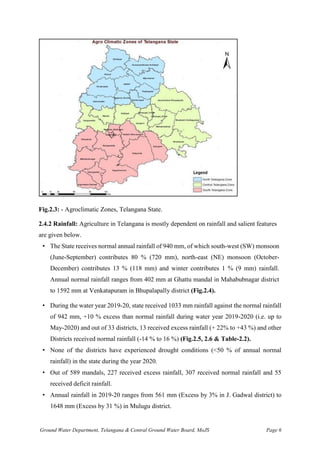
2.4.1 Agroclimatic Zones: Based on climatic parameters Telangana state is divided into 4
Agro-Climatic zones (Fig.2.3).
a) Northern Telangana Zone: This zone includes Adilabad, Mancherial, Nirmal,
Komarambheem Asifabad, Nizamabad, Kamareddy, Karimnagar, Jagityal, Peddapalli and
Rajanna Siricilla districts. Annual rainfall ranges from 900 to 1150 mm and is received mostly
from south west monsoon. Minimum and maximum temperatures during winter and summer
seasons range between 21°C-25°C and 32°C -37°C, respectively. Red soils are predominant
soils in this zone, which include chalks, red sands and deep red loams along with very deep
black cotton soils. Rice, maize, soya bean, cotton, red gram, and turmeric are important crops
etc, grown in this zone.
b) Central Telangana Zone:This zone includes Medak, Sangareddy, Siddipet, Warangal
Urban and Rural Jayashankar Bhupalpally, Mahabubabad, Khammam, Bhadradri Kothagudem
districts and receives an annual rainfall from 800 to 1150 mm. Minimum and maximum
temperatures during winter and summer ranges between 21°C- 25°C and 22°C-37°C,
respectively. Red soils are predominant which includes chalks, red sands and deep red loams
along with very deep black cotton soils. Important crops grown in this zone are cotton, rice,
maize, green gram, mango and chilies etc.
c) Southern Telangana Zone: This zone comprises the districts of Rangareddy, Vikarabad,
Medchal Malkajgiri, Yadadri Bhuvanagiri, Hyderabad, Mahbubnagar, Gadwal, Wanaparthy,
Nagarkurnool, Nalgonda, Suryapet and Jangaon. The annual rainfall ranges from 600 to 780
mm. Minimum and maximum temperatures during winter and summer ranges from20°C -
23°Cand 28°- 37°C respectively. This zone is predominantly underlain by red soil. Important
crops grown in the zone are cotton, paddy, red gram, maize, groundnut and green gram etc.
d) High Altitude and Tribal Zone: This zone consists of the areas along Northern and Eastern
borders of Adilabad, Bhupalpally and Kothagudem districts and is mostly inhabited by Tribal
population. The annual rainfall is around 1400mm. Important soils in this zone include red
sandy loams, red loams with clay base along with very small patches of alluvial soils. Minimum
and maximum temperatures during winter and summer ranges between 13°C-27°C and 29°C-
34°C, respectively. Important crops grown in this zone are chillies, paddy, cotton and
horticultural crops.
Ground Water Department, Telangana & Central Ground Water Board, MoJS Page 6
Fig.2.3: - Agroclimatic Zones, Telangana State.
2.4.2 Rainfall: Agriculture in Telangana is mostly dependent on rainfall and salient features
are given below.
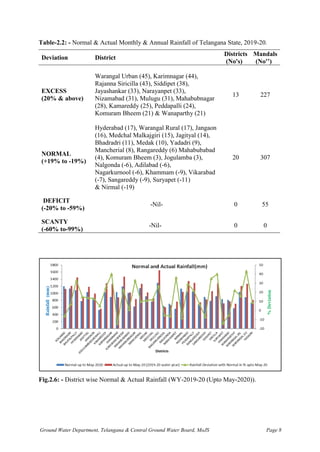
• The State receives normal annual rainfall of 940 mm, of which south-west (SW) monsoon
(June-September) contributes 80 % (720 mm), north-east (NE) monsoon (October-
December) contributes 13 % (118 mm) and winter contributes 1 % (9 mm) rainfall.
Annual normal rainfall ranges from 402 mm at Ghattu mandal in Mahabubnagar district
to 1592 mm at Venkatapuram in Bhupalapally district (Fig.2.4).
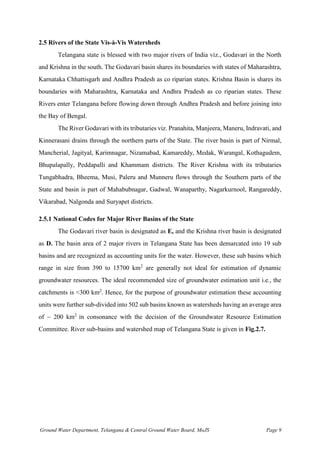
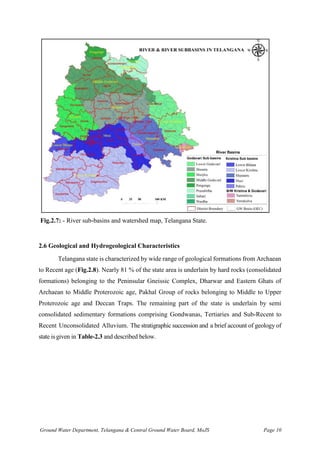
• During the water year 2019-20, state received 1033 mm rainfall against the normal rainfall
of 942 mm, +10 % excess than normal rainfall during water year 2019-2020 (i.e. up to
May-2020) and out of 33 districts, 13 received excess rainfall (+ 22% to +43 %) and other
Districts received normal rainfall (-14 % to 16 %) (Fig.2.5, 2.6 & Table-2.2).
• None of the districts have experienced drought conditions (<50 % of annual normal
rainfall) in the state during the year 2020.
• Out of 589 mandals, 227 received excess rainfall, 307 received normal rainfall and 55
received deficit rainfall.
• Annual rainfall in 2019-20 ranges from 561 mm (Excess by 3% in J. Gadwal district) to
1648 mm (Excess by 31 %) in Mulugu district.
Ground Water Department, Telangana & Central Ground Water Board, MoJS Page 7
• Annual Potential Evapotranspiration (PET) ranges from 1593 to 1790 mm in the state and
monthly PET ranges from 88 mm during December to 234 mm during May.
Fig.2.4: - Normal Annual rainfall, Telangana State.
Fig.2.5: - Mandal wise rainfall deviation for water year 2019-20 (upto 31st
May, 2020).
Ground Water Department, Telangana & Central Ground Water Board, MoJS Page 8
Table-2.2: - Normal & Actual Monthly & Annual Rainfall of Telangana State, 2019-20.
Deviation District
Districts
(No's)
Mandals
(No'’)
EXCESS
(20% & above)
Warangal Urban (45), Karimnagar (44),
Rajanna Siricilla (43), Siddipet (38),
Jayashankar (33), Narayanpet (33),
Nizamabad (31), Mulugu (31), Mahabubnagar
(28), Kamareddy (25), Peddapalli (24),
Komuram Bheem (21) & Wanaparthy (21)
13 227
NORMAL
(+19% to -19%)
Hyderabad (17), Warangal Rural (17), Jangaon
(16), Medchal Malkajgiri (15), Jagityal (14),
Bhadradri (11), Medak (10), Yadadri (9),
Mancherial (8), Rangareddy (6) Mahabubabad
(4), Komuram Bheem (3), Jogulamba (3),
Nalgonda (-6), Adilabad (-6),
Nagarkurnool (-6), Khammam (-9), Vikarabad
(-7), Sangareddy (-9), Suryapet (-11)
& Nirmal (-19)
20 307
DEFICIT
(-20% to -59%)
-Nil- 0 55
SCANTY
(-60% to-99%)
-Nil- 0 0
Fig.2.6: - District wise Normal & Actual Rainfall (WY-2019-20 (Upto May-2020)).
Ground Water Department, Telangana & Central Ground Water Board, MoJS Page 9
2.5 Rivers of the State Vis-à-Vis Watersheds
Telangana state is blessed with two major rivers of India viz., Godavari in the North
and Krishna in the south. The Godavari basin shares its boundaries with states of Maharashtra,
Karnataka Chhattisgarh and Andhra Pradesh as co riparian states. Krishna Basin is shares its
boundaries with Maharashtra, Karnataka and Andhra Pradesh as co riparian states. These
Rivers enter Telangana before flowing down through Andhra Pradesh and before joining into
the Bay of Bengal.
The River Godavari with its tributaries viz. Pranahita, Manjeera, Maneru, Indravati, and
Kinnerasani drains through the northern parts of the State. The river basin is part of Nirmal,
Mancherial, Jagityal, Karimnagar, Nizamabad, Kamareddy, Medak, Warangal, Kothagudem,
Bhupalapally, Peddapalli and Khammam districts. The River Krishna with its tributaries
Tungabhadra, Bheema, Musi, Paleru and Munneru flows through the Southern parts of the
State and basin is part of Mahabubnagar, Gadwal, Wanaparthy, Nagarkurnool, Rangareddy,
Vikarabad, Nalgonda and Suryapet districts.
2.5.1 National Codes for Major River Basins of the State
The Godavari river basin is designated as E, and the Krishna river basin is designated
as D. The basin area of 2 major rivers in Telangana State has been demarcated into 19 sub
basins and are recognized as accounting units for the water. However, these sub basins which
range in size from 390 to 15700 km2
are generally not ideal for estimation of dynamic
groundwater resources. The ideal recommended size of groundwater estimation unit i.e., the
catchments is <300 km2
. Hence, for the purpose of groundwater estimation these accounting
units were further sub-divided into 502 sub basins known as watersheds having an average area
of ~ 200 km2
in consonance with the decision of the Groundwater Resource Estimation
Committee. River sub-basins and watershed map of Telangana State is given in Fig.2.7.
Ground Water Department, Telangana & Central Ground Water Board, MoJS Page 10
Fig.2.7: - River sub-basins and watershed map, Telangana State.
2.6 Geological and Hydrogeological Characteristics
Telangana state is characterized by wide range of geological formations from Archaean
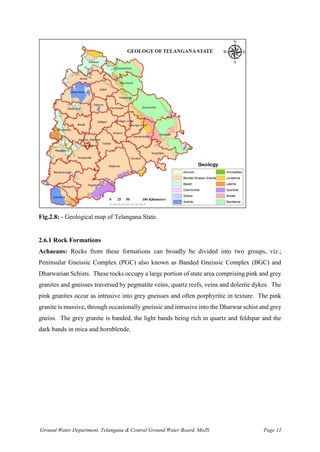
to Recent age (Fig.2.8). Nearly 81 % of the state area is underlain by hard rocks (consolidated
formations) belonging to the Peninsular Gneissic Complex, Dharwar and Eastern Ghats of
Archaean to Middle Proterozoic age, Pakhal Group of rocks belonging to Middle to Upper
Proterozoic age and Deccan Traps. The remaining part of the state is underlain by semi
consolidated sedimentary formations comprising Gondwanas, Tertiaries and Sub-Recent to
Recent Unconsolidated Alluvium. The stratigraphic succession and a brief account of geology of
state is given in Table-2.3 and described below.
Ground Water Department, Telangana & Central Ground Water Board, MoJS Page 11
Fig.2.8: - Geological map of Telangana State.
2.6.1 Rock Formations
Achaeans: Rocks from these formations can broadly be divided into two groups, viz.;
Peninsular Gneissic Complex (PGC) also known as Banded Gneissic Complex (BGC) and
Dharwarian Schists. These rocks occupy a large portion of state area comprising pink and grey
granites and gneisses traversed by pegmatite veins, quartz reefs, veins and dolerite dykes. The
pink granites occur as intrusive into grey gneisses and often porphyritic in texture. The pink
granite is massive, through occasionally gneissic and intrusive into the Dharwar schist and grey
gneiss. The grey granite is banded, the light bands being rich in quartz and feldspar and the
dark bands in mica and hornblende.
Ground Water Department, Telangana & Central Ground Water Board, MoJS Page 12
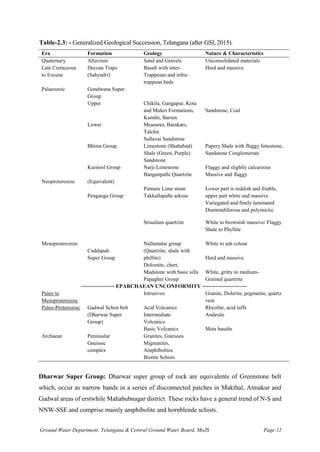
Table-2.3: - Generalized Geological Succession, Telangana (after GSI, 2015).
Era Formation Geology Nature & Characteristics
Quaternary Alluvium Sand and Gravels Unconsolidated materials
Late Cretaceous
to Eocene
Deccan Traps
(Sahyadri)
Basalt with inter-
Trappeans and infra-
trappean beds
Hard and massive
Palaeozoic Gondwana Super
Group
Upper
Lower
Chikila, Gangapur, Kota
and Maleri Formations,
Kamthi, Barren
Measures, Barakars,
Talchir
Sandstone, Coal
Neoproterozoic
Sullavai Sandstone
Bhima Group Limestone (Shahabad)
Shale (Green, Purple)
Sandstone
Papery Shale with flaggy limestone,
Sandstone Conglomerate
Kurnool Group
(Equivalent)
Penganga Group
Narji Limestone
Banganpalle Quartzite
Putnure Lime stone
Takkallapalle arkose
Flaggy and slightly calcareous
Massive and flaggy
Lower part is reddish and friable,
upper part white and massive
Variegated and finely laminated
Diamondiferous and polymictic
Mesoproterozoic
Cuddapah
Super Group
Srisailam quartzite
Nallamalai group
(Quartzite, shale with
phillite)
Dolomite, chert,
Mudstone with basic sills
Papaghni Group
White to brownish massive/ Flaggy
Shale to Phyllite
White to ash colour
Hard and massive
White, gritty to medium-
Grained quartzite
~~~~~~~~~~~~ EPARCHAEAN UNCONFORMITY ~~~~~~~~~~~~~~~~
Paleo to
Mesoproterozoic
Intrusives Granite, Dolerite, pegmatite, quartz
vein
Paleo-Proterozoic Gadwal Schist belt
(Dharwar Super
Group)
Acid Volcanics
Intermediate
Volcanics
Basic Volcanics
Rhyolite, acid tuffs
Andesite
Meta basalts
Archaean Peninsular
Gneissic
complex
Granites, Gneisses
Migmatites,
Amphibolites
Biotite Schists
Dharwar Super Group: Dharwar super group of rock are equivalents of Greenstone belt
which, occur as narrow bands in a series of disconnected patches in Makthal, Atmakur and
Gadwal areas of erstwhile Mahabubnagar district. These rocks have a general trend of N-S and
NNW-SSE and comprise mainly amphibolite and hornblende schists.
Ground Water Department, Telangana & Central Ground Water Board, MoJS Page 13
Intrusive: Granite/gneiss-greenstone terrain of Dharwar craton is intruded by mafic dykes
mainly dolerite, gabbro and pyroxene in composition, cut across the gneisses. They run for
long distances as conspicuous ridges and the general trend of dykes is E-W, NW-SE, N-S and
NE-SW and are dense in northern, southern and western margins of Cuddapah basins.
Cuddapah and Kurnool Formations: The Cuddapah Group of rocks extend from Kolhapur-
Somasila, eastward up to the eastern boundary of Achampet mandal. They comprise basal
conglomerates, quartzites and limestones associated with chert-jasper breccia, resting on
granites. Srisailam quartzites occurring above Vempalli limestones, occupy almost whole of
Amarabad plateau and extend eastward into Nalgonda district. The quartzites are massive and
consist of horizontal beds with a remarkable flat-topped appearance ending abrupt with scarped
edges. They attain a maximum thickness of about 60 m overlying granites.
The rocks of Kurnool group extend roughly from Kolhapur westwards to Alampur
tank. They are represented by Banaganapalli formation (10-50 m thick) (conglomerates and
sandstones) and Narji formation (limestones with intercalations of shale, quartzite,
conglomerates) and they are exposed along the southern boundary of state.
Pakhal Basin: The sediments of Godavari rift Valley are classified as Pakhal, Penganga and
Sullavai group of rocks which occur as two parallel NW-SE trending belts. The south-western
belt extends from Khammam in the south to Adilabad and beyond in the northwest and northern
belt from north of Bhadrachalam in the southeast to beyond Chanda in Maharashtra in the north
west with overall length of 350 km and width of 100 km including intervening Gondwana. The
other group of rocks are Mallampalli and Mulugu consisting of arkose rocks.
Penganga Group: Penganga Group of rocks are equivalent of Kurnool group of rocks
consisting of arkose and limestone and mainly occurs in Karimnagar and Adilabad districts.
The main difference in Pakhal and Penganga group of rocks is that Pakhal are represented by
dolomite and Penganga by limestone.
Gondwana Super Group: These rocks with thickness of ~3500 m is exposed along Pranahita-
Godavari valley having a width of ~55 km NW-SE trending and extending up to ~350 kms
between Antargaon in NW and Sattupalle in SE. This belt is rich source of coal in the state
(Barakar formations). The major rocks in these formations are sandstone (60%), conglomerate
(17%) and siltstone, clay, coal and limestone etc. (23 %).
Deccan Traps: The Deccan Traps covers ~10,000 Km2
area in the northern and north-western
part of state covering Adilabad, Nizamabad, Mahabubnagar, Rangareddy, Vikarabad, Medak
districts. Total 9 flows are encountered in Vikarabad-Pargi area and out of which, 2 flows are
lateritized. The thickness of each lava flows varies from < 1 m to 50 m. In Medak district flows
Ground Water Department, Telangana & Central Ground Water Board, MoJS Page 14
are “Aa” type and in Adilabad, Nizamabad it is both “Aa” and “Pahohoe” and simple types and
both infra trappean and intra trappean rocks occur in these areas.
Alluvium: The alluvial formations occur along the banks of major rivers and their tributaries
in the state. Volcanic ash deposits are recorded in Kinnerasani river basin (Munneru River)
near Kothagudem and Khammam districts
2.6.2 Hydrogeological Characteristics in Hard rocks
Archaeans, Pre-Cambrians, Pakhals, and Deccan traps are categorized as hard rocks
from groundwater point of view. These rocks lack primary porosity and groundwater
occurrence is controlled by extent of weathering and fracturing. These rocks cover nearly
~91000 Km2
area (81 %) with basaltic formations in the northern and western parts of the state
and quartzites in the south eastern parts along the Krishna river. The thickness of weathering
generally varies from 10 to 20 m and occasionally up to 40 m. These rocks have peculiar
geometries in case of gneisses, schist and phyllites based on their hydraulic properties making
groundwater behavior differently from place to place, e.g: wells constructed only a few meters
apart can have huge differences in their yields. It is a question of striking a fracture or not
striking it. Groundwater yield varies from 0.01 to 10 lps (litres/second) probability of striking
a fracture decreases with depth and away from the lineaments/topographic lows. However, in
recent times these top fracture zones are de-saturated, in some parts of the state drying up the
once successful wells or decreasing the chances of a successful new well. Results have shown
that majority of fractures (90%) occur within 100 m depth in the state.
Aquifer tests have shown that the aquifers have limited porosity due to compactness
and secondary porosity is developed due to weathering and fracturing. A 3rd or 4th order basin
can have distinct aquifers defined by adjacent catchments. But, the level at which this isolation
of aquifer occurs varies and can sometimes occur even within the same trunk of a catchment
and sometimes it can cut across a number of catchments. Many of the streamlets are fracture
controlled and are classed as lineaments implying structural control by a weak plane in the rock
that holds water. The transmissivity (T) in these rocks (Granite and Gneiss) varies from <1 to
630 m2
/day with general range of 5-80 m2
/day. Specific yield in weathered zone varies from
0.01 to 0.04 and storativity in fracture zone varies from 0.00001 to 0.001. Groundwater yield
in deccan traps varies from < 1 lps to > 3 lps and Transmissivity varies from <1 to 10 m2
/day
with specific yield of 0.01 to 0.02.
Ground Water Department, Telangana & Central Ground Water Board, MoJS Page 15
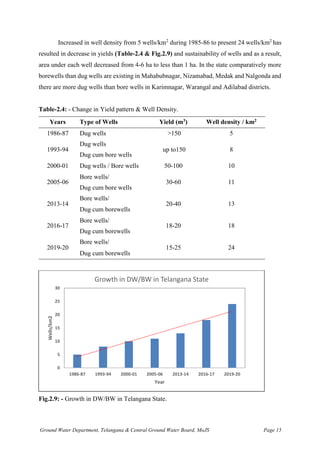
Increased in well density from 5 wells/km2
during 1985-86 to present 24 wells/km2
has
resulted in decrease in yields (Table-2.4 & Fig.2.9) and sustainability of wells and as a result,
area under each well decreased from 4-6 ha to less than 1 ha. In the state comparatively more
borewells than dug wells are existing in Mahabubnagar, Nizamabad, Medak and Nalgonda and
there are more dug wells than bore wells in Karimnagar, Warangal and Adilabad districts.
Table-2.4: - Change in Yield pattern & Well Density.
Years Type of Wells Yield (m3) Well density / km2
1986-87 Dug wells >150 5
1993-94
Dug wells
up to150 8
Dug cum bore wells
2000-01 Dug wells / Bore wells 50-100 10
2005-06
Bore wells/
30-60 11
Dug cum bore wells
2013-14
Bore wells/
20-40 13
Dug cum borewells
2016-17
Bore wells/
18-20 18
Dug cum borewells
2019-20
Bore wells/
15-25 24
Dug cum borewells
Fig.2.9: - Growth in DW/BW in Telangana State.
0
5
10
15
20
25
30
1986-87 1993-94 2000-01 2005-06 2013-14 2016-17 2019-20
Wells/km2
Year
Growth in DW/BW in Telangana State
Ground Water Department, Telangana & Central Ground Water Board, MoJS Page 16
2.6.3 Semi Consolidated and Unconsolidated Rocks
Semi consolidated formations include Purana and Gondwana group of rocks
comprising Sullavai sandstones, Penganga shales, limestones Talchirs, Barakars, Kamthis.
These formations occupy the Godavari valley covering Kothagudem, Bhupalpally, Mulugu,
Peddapalli, Mancherial, Asifabad and Adilabad districts. These forms important and multi
layered aquifers and maximum 12 granular zones have encountered between depth ranges of
25-297 m by CGWB with yield of 1 to 18 lps. Groundwater occurs under unconfined to semi
confined and confined conditions and the most promising aquifers among the Gondwana
formations in the state. In Maner basin, in Kamthi sandstones auto flow wells are encountered.
The transmissivity (T) in these rocks varies from 17 to 700 m2
/day and storage co-efficient
of0.2 x 10-4
to 7.9 x 10⁻⁴
.
The unconsolidated formations are represented by inland river alluvium. The alluvial
aquifers have high porosity and permeability. Filter points are most common in this formation.
Filter points drilled down to a depth of 5 to 15 meters below ground level (m bgl) yields
between 2.5 to 16 lps.
2.7 Groundwater levels:
2.7.1 Decadal Water Levels (2010-2020)
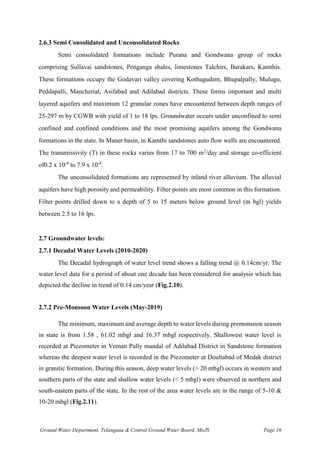
The Decadal hydrograph of water level trend shows a falling trend @ 0.14cm/yr. The
water level data for a period of about one decade has been considered for analysis which has
depicted the decline in trend of 0.14 cm/year (Fig.2.10).
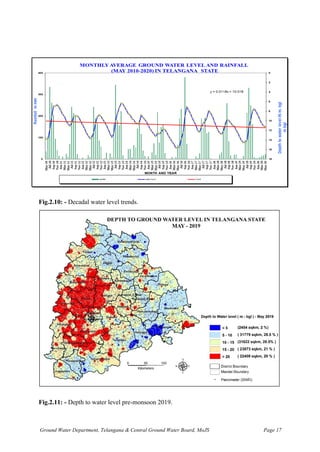
2.7.2 Pre-Monsoon Water Levels (May-2019)
The minimum, maximum and average depth to water levels during premonsoon season
in state is from 1.58 , 61.02 mbgl and 16.37 mbgl respectively. Shallowest water level is
recorded at Piezometer in Veman Pally mandal of Adilabad District in Sandstone formation
whereas the deepest water level is recorded in the Piezometer at Doultabad of Medak district
in granitic formation. During this season, deep water levels (> 20 mbgl) occurs in western and
southern parts of the state and shallow water levels (< 5 mbgl) were observed in northern and
south-eastern parts of the state. In the rest of the area water levels are in the range of 5-10 &
10-20 mbgl (Fig.2.11).
Ground Water Department, Telangana & Central Ground Water Board, MoJS Page 17
Fig.2.10: - Decadal water level trends.
Fig.2.11: - Depth to water level pre-monsoon 2019.
Ground Water Department, Telangana & Central Ground Water Board, MoJS Page 18
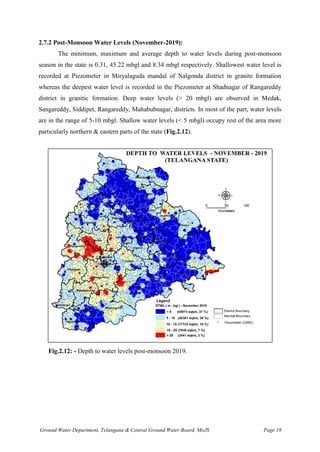
2.7.2 Post-Monsoon Water Levels (November-2019):
The minimum, maximum and average depth to water levels during post-monsoon
season in the state is 0.31, 45.22 mbgl and 8.34 mbgl respectively. Shallowest water level is
recorded at Piezometer in Miryalaguda mandal of Nalgonda district in granite formation
whereas the deepest water level is recorded in the Piezometer at Shadnagar of Rangareddy
district in granitic formation. Deep water levels (> 20 mbgl) are observed in Medak,
Sangareddy, Siddipet, Rangareddy, Mahabubnagar, districts. In most of the part, water levels
are in the range of 5-10 mbgl. Shallow water levels (< 5 mbgl) occupy rest of the area more
particularly northern & eastern parts of the state (Fig.2.12).
Fig.2.12: - Depth to water levels post-monsoon 2019.
Ground Water Department, Telangana & Central Ground Water Board, MoJS Page 19
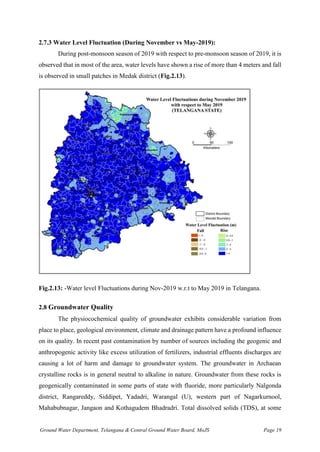
2.7.3 Water Level Fluctuation (During November vs May-2019):
During post-monsoon season of 2019 with respect to pre-monsoon season of 2019, it is
observed that in most of the area, water levels have shown a rise of more than 4 meters and fall
is observed in small patches in Medak district (Fig.2.13).
Fig.2.13: -Water level Fluctuations during Nov-2019 w.r.t to May 2019 in Telangana.
2.8 Groundwater Quality
The physiocochemical quality of groundwater exhibits considerable variation from
place to place, geological environment, climate and drainage pattern have a profound influence
on its quality. In recent past contamination by number of sources including the geogenic and
anthropogenic activity like excess utilization of fertilizers, industrial effluents discharges are
causing a lot of harm and damage to groundwater system. The groundwater in Archaean
crystalline rocks is in general neutral to alkaline in nature. Groundwater from these rocks is
geogenically contaminated in some parts of state with fluoride, more particularly Nalgonda
district, Rangareddy, Siddipet, Yadadri, Warangal (U), western part of Nagarkurnool,
Mahabubnagar, Jangaon and Kothagudem Bhadradri. Total dissolved solids (TDS), at some
Ground Water Department, Telangana & Central Ground Water Board, MoJS Page 20
places exceeds 8000 mg/L (Sangareddy). The quality of groundwater from Gondwana
formations is generally good except in some local pockets where it is alkaline and hard in
nature.
An attempt has been made to provide an insight into the quality aspect of groundwater
along with the present groundwater resource estimation. Since, this is an attempt to make such
an effort to linkup quality with quantity in groundwater resource estimation, it was decided to
collect as much data as available at village level wherever possible. 7368 number of samples
are collected during pre and post-monsoon season of 2019 from existing network of
observation wells in Telangana State.
The groundwater quality is studied primarily for drinking and irrigation suitability and
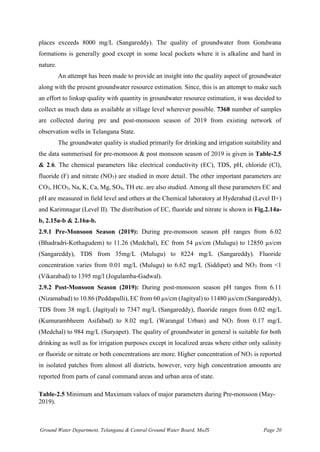
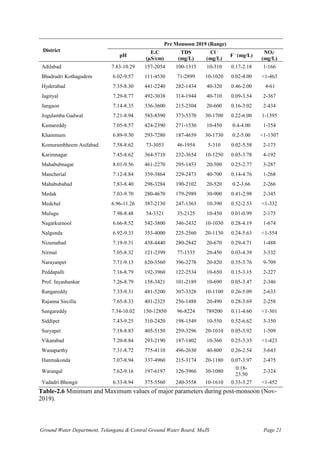
the data summerised for pre-monsoon & post monsoon season of 2019 is given in Table-2.5
& 2.6. The chemical parameters like electrical conductivity (EC), TDS, pH, chloride (Cl),
fluoride (F) and nitrate (NO3) are studied in more detail. The other important parameters are
CO3, HCO3, Na, K, Ca, Mg, SO4, TH etc. are also studied. Among all these parameters EC and
pH are measured in field level and others at the Chemical laboratory at Hyderabad (Level II+)
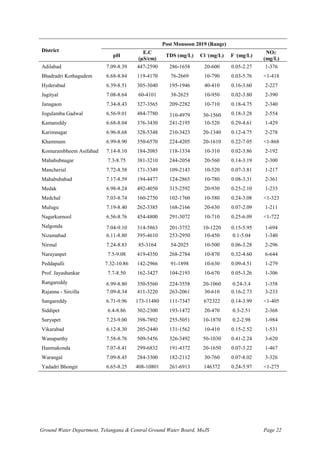
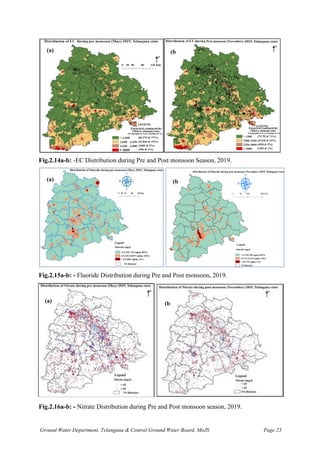
and Karimnagar (Level II). The distribution of EC, fluoride and nitrate is shown in Fig.2.14a-
b, 2.15a-b & 2.16a-b.
2.9.1 Pre-Monsoon Season (2019): During pre-monsoon season pH ranges from 6.02
(Bhadradri-Kothagudem) to 11.26 (Medchal), EC from 54 µs/cm (Mulugu) to 12850 µs/cm
(Sangareddy), TDS from 35mg/L (Mulugu) to 8224 mg/L (Sangareddy). Fluoride
concentration varies from 0.01 mg/L (Mulugu) to 6.62 mg/L (Siddipet) and NO3 from <1
(Vikarabad) to 1395 mg/l (Jogulamba-Gadwal).
2.9.2 Post-Monsoon Season (2019): During post-monsoon season pH ranges from 6.11
(Nizamabad) to 10.86 (Peddapalli), EC from 60 µs/cm (Jagityal) to 11480 µs/cm (Sangareddy),
TDS from 38 mg/L (Jagityal) to 7347 mg/L (Sangareddy), fluoride ranges from 0.02 mg/L
(Kumurambheem Asifabad) to 8.02 mg/L (Warangal Urban) and NO3 from 0.17 mg/L
(Medchal) to 984 mg/L (Suryapet). The quality of groundwater in general is suitable for both
drinking as well as for irrigation purposes except in localized areas where either only salinity
or fluoride or nitrate or both concentrations are more. Higher concentration of NO3 is reported
in isolated patches from almost all districts, however, very high concentration amounts are
reported from parts of canal command areas and urban area of state.
Table-2.5 Minimum and Maximum values of major parameters during Pre-monsoon (May-
2019).
Ground Water Department, Telangana & Central Ground Water Board, MoJS Page 21
District
Pre Monsoon 2019 (Range)
pH
E.C
(µS/cm)
TDS
(mg/L)
Cl -
(mg/L)
F -
(mg/L)
NO3
-
(mg/L)
Adilabad 7.83-10.29 157-2054 100-1315 10-310 0.17-2.18 1-166
Bhadradri Kothagudem 6.02-9.57 111-4530 71-2899 10-1020 0.02-4.00 <1-463
Hyderabad 7.35-8.30 441-2240 282-1434 40-320 0.46-2.00 4-61
Jagityal 7.29-8.77 492-3038 314-1944 40-710 0.09-3.54 2-367
Jangaon 7.14-8.35 336-3600 215-2304 20-600 0.16-3.02 2-434
Jogulamba Gadwal 7.21-8.94 583-8390 373-5370 30-1700 0.22-6.00 1-1395
Kamareddy 7.05-8.57 424-2390 271-1530 10-450 0.4-4.00 1-354
Khammam 6.89-9.30 293-7280 187-4659 30-1730 0.2-5.00 <1-1307
Komurambheem Asifabad 7.58-8.62 73-3053 46-1954 5-310 0.02-5.58 2-173
Karimnagar 7.45-8.62 364-5710 232-3654 10-1250 0.05-3.78 4-192
Mahabubnagar 8.01-9.56 461-2270 295-1453 20-500 0.25-2.77 3-287
Mancherial 7.12-8.84 359-3864 229-2473 40-700 0.14-4.76 1-268
Mahabubabad 7.83-8.40 298-3284 190-2102 20-520 0.2-3.66 2-266
Medak 7.03-9.70 280-4670 179-2989 30-900 0.41-2.98 2-345
Medchal 6.96-11.26 387-2130 247-1363 10-390 0.52-2.53 <1-332
Mulugu 7.98-8.48 54-3321 35-2125 10-450 0.01-0.99 2-175
Nagarkurnool 6.66-8.52 542-3800 346-2432 10-1030 0.28-4.19 1-674
Nalgonda 6.92-9.33 353-4000 225-2560 20-1130 0.24-5.63 <1-554
Nizamabad 7.19-9.31 438-4440 280-2842 20-670 0.29-4.71 1-488
Nirmal 7.05-8.32 121-2399 77-1535 20-450 0.03-4.39 3-332
Narayanpet 7.71-9.13 620-3560 396-2278 20-820 0.35-3.76 9-709
Peddapalli 7.16-8.79 192-3960 122-2534 10-650 0.15-3.15 2-227
Prof. Jayashankar 7.26-8.79 158-3421 101-2189 10-690 0.05-3.47 2-346
Rangareddy 7.33-9.31 481-5200 307-3328 10-1100 0.26-5.09 2-633
Rajanna Sircilla 7.65-8.33 401-2325 256-1488 20-490 0.28-3.69 2-258
Sangareddy 7.34-10.02 150-12850 96-8224 789200 0.11-4.60 <1-301
Siddipet 7.43-9.25 310-2420 198-1549 10-550 0.52-6.62 3-350
Suryapet 7.18-8.83 405-5150 259-3296 20-1010 0.05-3.92 1-509
Vikarabad 7.20-8.84 293-2190 187-1402 10-360 0.25-3.33 <1-423
Wanaparthy 7.31-8.72 775-4110 496-2630 40-800 0.26-2.54 3-643
Hanmakonda 7.07-8.94 337-4960 215-3174 20-1180 0.07-3.97 2-475
Warangal 7.62-9.16 197-6197 126-3966 30-1080
0.18-
23.50
2-324
Yadadri Bhongir 6.33-8.94 375-5560 240-3558 10-1610 0.33-3.27 <1-452
Table-2.6 Minimum and Maximum values of major parameters during post-monsoon (Nov-
2019).
Ground Water Department, Telangana & Central Ground Water Board, MoJS Page 22
District
Post Monsoon 2019 (Range)
pH
E.C
(µS/cm)
TDS (mg/L) Cl -
(mg/L) F -
(mg/L)
NO3
-
(mg/L)
Adilabad 7.09-8.39 447-2590 286-1658 20-600 0.05-2.27 1-376
Bhadradri Kothagudem 6.68-8.84 119-4170 76-2669 10-790 0.03-5.76 <1-418
Hyderabad 6.39-8.51 305-3040 195-1946 40-410 0.16-3.60 2-227
Jagityal 7.08-8.64 60-4101 38-2625 10-950 0.02-3.80 2-390
Janagaon 7.34-8.43 327-3565 209-2282 10-710 0.18-4.75 2-340
Jogulamba Gadwal 6.56-9.01 484-7780 310-4979 30-1560 0.18-3.28 2-554
Kamareddy 6.68-8.04 376-3430 241-2195 10-520 0.29-4.61 1-429
Karimnagar 6.96-8.68 328-5348 210-3423 20-1340 0.12-4.75 2-278
Khammam 6.99-8.90 350-6570 224-4205 20-1610 0.22-7.05 <1-868
Komurambheem Asifabad 7.14-8.10 184-2085 118-1334 10-310 0.02-3.86 2-192
Mahabubnagar 7.3-8.75 381-3210 244-2054 20-560 0.14-3.19 2-300
Mancherial 7.72-8.58 171-3349 109-2143 10-520 0.07-3.81 1-217
Mahabubabad 7.17-8.59 194-4477 124-2865 10-780 0.08-3.31 2-361
Medak 6.98-8.24 492-4050 315-2592 20-930 0.25-2.10 1-233
Medchal 7.03-8.74 160-2750 102-1760 10-580 0.24-3.08 <1-323
Mulugu 7.19-8.40 262-3385 168-2166 20-630 0.07-2.09 1-211
Nagarkurnool 6.56-8.76 454-4800 291-3072 10-710 0.25-6.09 <1-722
Nalgonda 7.04-9.10 314-5863 201-3752 10-1220 0.15-5.95 1-694
Nizamabad 6.11-8.80 395-4610 253-2950 10-450 0.1-5.04 1-340
Nirmal 7.24-8.83 85-3164 54-2025 10-500 0.06-3.28 2-296
Narayanpet 7.5-9.08 419-4350 268-2784 10-870 0.32-4.60 6-644
Peddapalli 7.32-10.86 142-2966 91-1898 10-630 0.09-4.51 1-279
Prof. Jayashankar 7.7-8.50 162-3427 104-2193 10-670 0.05-3.26 1-306
Rangareddy 6.99-8.80 350-5560 224-3558 20-1060 0.24-3.4 1-358
Rajanna - Sircilla 7.09-8.34 411-3220 263-2061 30-610 0.16-2.73 3-233
Sangareddy 6.71-9.96 173-11480 111-7347 672322 0.14-3.99 <1-405
Siddipet 6.4-8.86 302-2300 193-1472 20-470 0.3-2.51 2-368
Suryapet 7.23-9.00 398-7892 255-5051 10-1870 0.2-2.98 1-984
Vikarabad 6.12-8.30 205-2440 131-1562 10-410 0.15-2.52 1-531
Wanaparthy 7.58-8.76 509-5456 326-3492 50-1030 0.41-2.24 3-620
Hanmakonda 7.07-8.41 299-6832 191-4372 20-1650 0.07-3.22 1-467
Warangal 7.09-8.45 284-3300 182-2112 30-760 0.07-8.02 3-326
Yadadri Bhongir 6.65-8.25 408-10801 261-6913 146372 0.24-5.97 <1-275
Ground Water Department, Telangana & Central Ground Water Board, MoJS Page 23
Fig.2.14a-b: -EC Distribution during Pre and Post monsoon Season, 2019.
Fig.2.15a-b: - Fluoride Distribution during Pre and Post monsoon, 2019.
Fig.2.16a-b: - Nitrate Distribution during Pre and Post monsoon season, 2019.
(b
)
(a)
(a)
(a)
(b
)
(b
)
Ground Water Department, Telangana & Central Ground Water Board, MoJS Page 24
3.0 GROUNDWATER RESOURCE ESTIMATION METHODOLOGY- 2015
3.1 Review of Groundwater Resource Assessment Methodologies
Attempts have been made from time to time by various Working
Groups/Committees/Task Force, constituted by Government of India to estimate the
groundwater resources of the country based on status of available data and in response to
developmental needs. But, due to paucity of scientific data and incomplete understanding of
the parameters involved in recharge and discharge processes, all these early estimations were
tentative and at best approximation. In 1972, guidelines for an approximate evaluation of
groundwater potential was circulated by the Ministry of Agriculture, Government of India to
all the State Governments and financial institutions. The guidelines recommended norms for
groundwater recharge from rainfall and from other sources.
The first attempt to estimate the groundwater resources on a scientific basis was made
in 1979. A High-level Committee, known as Groundwater Over Exploitation Committee was
constituted by the Agriculture Refinance and Development Corporation (ARDC). The
committee was headed by the Chairman, CGWB and representatives from the State
groundwater organizations and financial institutions were included as its members. This
Committee recommended definite norms for groundwater resources computations.
In the year 1982, Government of India constituted “Groundwater Estimation
Committee” (GEC) with the members drawn from various organizations engaged in
hydrogeological studies and groundwater development. In 1984 this Committee, after
reviewing the data collected by Central and State agencies, Research Organisations,
universities, etc. recommended the methods for groundwater recharge estimation. This is
popularly known as GEC 1984 and this was the first proof which dealt with the subject
exhaustively and assessed the resources on a fool proof methodology. This methodology was
in practice for next 12 years.
In the year 1996, Government of India again constituted “Groundwater Estimation
Committee” (GEC) with the members taken from various organizations engaged in
hydrogeological studies and groundwater development. In 1997 this Committee, after
reviewing the data collected by central and state agencies, research organisations, universities,
etc. recommended the methods for groundwater recharge estimation. This methodology is
popularly known as GEC 1997.
Ground Water Department, Telangana & Central Ground Water Board, MoJS Page 25
The GEC - 1997 is further revised with technical inputs from Government, Non-
Government bodies, Scientific organizations and Universities with the modifications suggested
by GEC -1997, GEC-2004, and the R&D Advisory committee on the Groundwater Resources
Estimation from time to time and following the broad guidelines issued by the Central Ground
Water Board, Ministry of Water Resources, River Development and Ganga Rejuvenation,
Govt. of India.
The present groundwater resources estimation of the State of Telangana has been
carried out based on the recommendations of GEC-2015. As major part of the state is underlain
by hard rocks, watershed was taken as the assessment unit for the entire state. After excluding
the hilly areas where slope is > 20%, the groundwater resources estimation was carried out for
rest of the area. The resources were estimated separately for command and non- command and
poor- quality. The recommendations of this Committee are summarised below
3.2 Groundwater Assessment Unit
A watershed with well-defined hydrological boundaries is an appropriate unit for
groundwater resource estimation if the principal aquifer is other than alluvium. Groundwater
resources were worked out on watershed as a unit, and was apportioned and presented on
administrative units (block/taluka/mandal/ firka). This would facilitate local administration in
planning of groundwater management programmes.
3.3 Groundwater Assessment Sub-Units
As recommended, groundwater recharge was estimated for the entire assessment unit.
Out of the total geographical area of the unit, hilly areas (slope >20 %), are identified and
subtracted as these areas have more runoff than infiltration. The hilly areas were demarcated
using DEM data and geomorphological maps. As per the methodology, after assessment is
carried out for command and non-command areas, a quality tag was added to the assessment
unit for parameters like salinity and fluoride.
3.4 Assessment of Annual Replenishable Groundwater Resources
The methodology for groundwater resources estimation is based on the principle of water
balance as given below.
Inflow – Outflow = Change in Storage (of an aquifer) 1
Equation 1 can be further elaborated as -
Ground Water Department, Telangana & Central Ground Water Board, MoJS Page 26
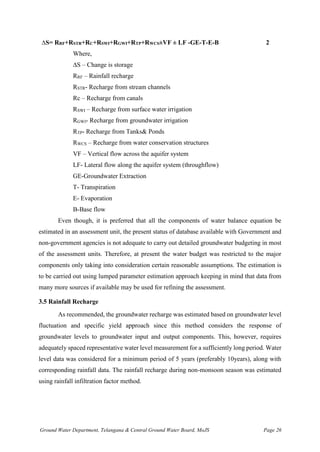
∆S= RRF+RSTR+RC+RSWI+RGWI+RTP+RWCS±VF ± LF -GE-T-E-B 2
Where,
∆S – Change is storage
RRF – Rainfall recharge
RSTR- Recharge from stream channels
Rc – Recharge from canals
RSWI – Recharge from surface water irrigation
RGWI- Recharge from groundwater irrigation
RTP- Recharge from Tanks& Ponds
RWCS – Recharge from water conservation structures
VF – Vertical flow across the aquifer system
LF- Lateral flow along the aquifer system (throughflow)
GE-Groundwater Extraction
T- Transpiration
E- Evaporation
B-Base flow
Even though, it is preferred that all the components of water balance equation be
estimated in an assessment unit, the present status of database available with Government and
non-government agencies is not adequate to carry out detailed groundwater budgeting in most
of the assessment units. Therefore, at present the water budget was restricted to the major
components only taking into consideration certain reasonable assumptions. The estimation is
to be carried out using lumped parameter estimation approach keeping in mind that data from
many more sources if available may be used for refining the assessment.
3.5 Rainfall Recharge
As recommended, the groundwater recharge was estimated based on groundwater level
fluctuation and specific yield approach since this method considers the response of
groundwater levels to groundwater input and output components. This, however, requires
adequately spaced representative water level measurement for a sufficiently long period. Water
level data was considered for a minimum period of 5 years (preferably 10years), along with
corresponding rainfall data. The rainfall recharge during non-monsoon season was estimated
using rainfall infiltration factor method.
Ground Water Department, Telangana & Central Ground Water Board, MoJS Page 27
3.5.1 Groundwater level fluctuation method
The groundwater level fluctuation method is used for assessment of rainfall recharge in
the monsoon season. The groundwater balance equation in non-command areas is given by
∆S= RRF+RSTR+RSWI+RGWI+RTP+RWCS±VF ± LF -GE-T-E-B 3
Where,
∆S –Change is storage
RRF – Rainfall recharge
RSTR- Recharge from stream channels
RSWI– Recharge from surface water irrigation (Lift Irrigation)
RGWI- Recharge from groundwater irrigation
RTP- Recharge from tank& ponds
RWCS – Recharge from water conservation structures
VF – Vertical flow across the aquifer system
LF- Lateral flow along the aquifer system (throughflow)
GE-Groundwater Extraction
T- Transpiration
E- Evaporation
B-Base flow
Whereas the water balance equation in command area will have another term Recharge due to
canals (RC) and the equation will be as follows:
∆S= RRF+RSTR+RC+RSWI+RGWI+RT+RWCS±VF ± LF -GE-T-E-B 4
The change in storage can be estimated using the following equation:
∆S= ∆h*A*SY 5
Where ∆S – Change is storage
∆h - rise in water level in the monsoon season
A - Area for computation of recharge
Sy - Specific Yield
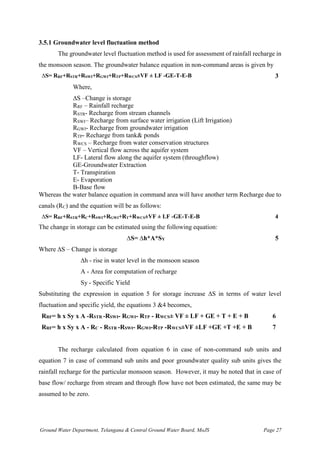
Substituting the expression in equation 5 for storage increase ∆S in terms of water level
fluctuation and specific yield, the equations 3 &4 becomes,
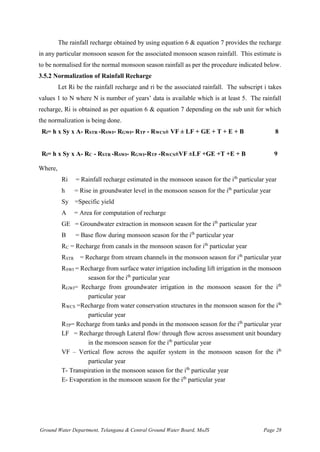
RRF= h x Sy x A -RSTR -RSWI- RGWI- RTP - RWCS± VF ± LF + GE + T + E + B 6
RRF= h x Sy x A - RC - RSTR -RSWI- RGWI-RTP -RWCS±VF ±LF +GE +T +E + B 7
The recharge calculated from equation 6 in case of non-command sub units and
equation 7 in case of command sub units and poor groundwater quality sub units gives the
rainfall recharge for the particular monsoon season. However, it may be noted that in case of
base flow/ recharge from stream and through flow have not been estimated, the same may be
assumed to be zero.
Ground Water Department, Telangana & Central Ground Water Board, MoJS Page 28
The rainfall recharge obtained by using equation 6 & equation 7 provides the recharge
in any particular monsoon season for the associated monsoon season rainfall. This estimate is
to be normalised for the normal monsoon season rainfall as per the procedure indicated below.
3.5.2 Normalization of Rainfall Recharge
Let Ri be the rainfall recharge and ri be the associated rainfall. The subscript i takes
values 1 to N where N is number of years’ data is available which is at least 5. The rainfall
recharge, Ri is obtained as per equation 6 & equation 7 depending on the sub unit for which
the normalization is being done.
Ri= h x Sy x A- RSTR -RSWI- RGWI- RTP - RWCS± VF ± LF + GE + T + E + B 8
Ri= h x Sy x A- RC - RSTR -RSWI- RGWI-RTP -RWCS±VF ±LF +GE +T +E + B 9
Where,
Ri = Rainfall recharge estimated in the monsoon season for the ith
particular year
h = Rise in groundwater level in the monsoon season for the ith
particular year
Sy =Specific yield
A = Area for computation of recharge
GE = Groundwater extraction in monsoon season for the ith
particular year
B = Base flow during monsoon season for the ith
particular year
RC = Recharge from canals in the monsoon season for ith
particular year
RSTR = Recharge from stream channels in the monsoon season for ith
particular year
RSWI = Recharge from surface water irrigation including lift irrigation in the monsoon
season for the ith
particular year
RGWI= Recharge from groundwater irrigation in the monsoon season for the ith
particular year
RWCS =Recharge from water conservation structures in the monsoon season for the ith
particular year
RTP= Recharge from tanks and ponds in the monsoon season for the ith
particular year
LF = Recharge through Lateral flow/ through flow across assessment unit boundary
in the monsoon season for the ith
particular year
VF – Vertical flow across the aquifer system in the monsoon season for the ith
particular year
T- Transpiration in the monsoon season for the ith
particular year
E- Evaporation in the monsoon season for the ith
particular year
Ground Water Department, Telangana & Central Ground Water Board, MoJS Page 29
After the pairs of data on Ri and ri have been obtained as described above, a
normalisation procedure is to be carried out for obtaining the rainfall recharge corresponding
to the normal monsoon season rainfall. Let r(normal) be the normal monsoon season rainfall
obtained on the basis of recent 30 to 50 years of monsoon season rainfall data. Two methods
are possible for the normalisation procedure.
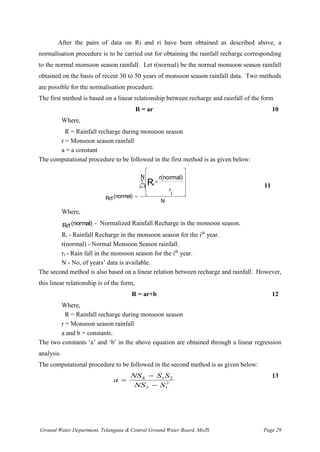
The first method is based on a linear relationship between recharge and rainfall of the form
R = ar 10
Where,
R = Rainfall recharge during monsoon season
r = Monsoon season rainfall
a = a constant
The computational procedure to be followed in the first method is as given below:
N
N
1
i
(normal)
Rrf
r(normal)
Ri

=
=











i
r
11
Where,
(normal)
Rrf - Normalized Rainfall Recharge in the monsoon season.
Ri - Rainfall Recharge in the monsoon season for the ith
year.
r(normal) - Normal Monsoon Season rainfall.
ri - Rain fall in the monsoon season for the ith
year.
N - No, of years’ data is available.
The second method is also based on a linear relation between recharge and rainfall. However,
this linear relationship is of the form,
R = ar+b 12
Where,
R = Rainfall recharge during monsoon season
r = Monsoon season rainfall
a and b = constants.
The two constants ‘a’ and ‘b’ in the above equation are obtained through a linear regression
analysis.
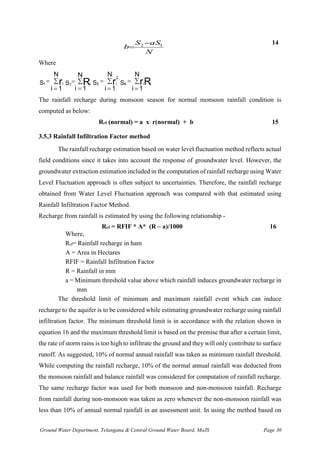
The computational procedure to be followed in the second method is as given below:
a
NS S S
NS S
=
−
−
4 1 2
3 1
2
13
Ground Water Department, Telangana & Central Ground Water Board, MoJS Page 30
N
aS
S
b 1
2 −
=
14
Where
1 i
S r
i 1
N
=
=
 
=
=
N
1
i
Ri
S2 3 i
2
S r
i 1
N
=
=
 4 i i
S rR
i 1
N
=
=

The rainfall recharge during monsoon season for normal monsoon rainfall condition is
computed as below:
Rrf (normal) = a x r(normal) + b 15
3.5.3 Rainfall Infiltration Factor method
The rainfall recharge estimation based on water level fluctuation method reflects actual
field conditions since it takes into account the response of groundwater level. However, the
groundwater extraction estimation included in the computation of rainfall recharge using Water
Level Fluctuation approach is often subject to uncertainties. Therefore, the rainfall recharge
obtained from Water Level Fluctuation approach was compared with that estimated using
Rainfall Infiltration Factor Method.
Recharge from rainfall is estimated by using the following relationship -
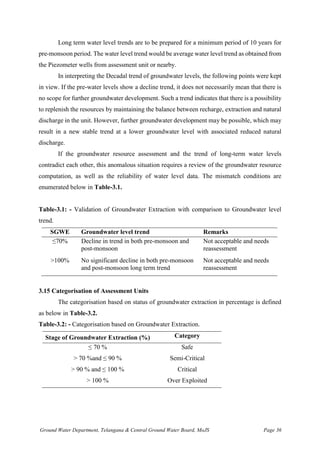
Rrf = RFIF * A* (R – a)/1000 16
Where,
Rrf= Rainfall recharge in ham
A = Area in Hectares
RFIF = Rainfall Infiltration Factor
R = Rainfall in mm
a = Minimum threshold value above which rainfall induces groundwater recharge in
mm
The threshold limit of minimum and maximum rainfall event which can induce
recharge to the aquifer is to be considered while estimating groundwater recharge using rainfall
infiltration factor. The minimum threshold limit is in accordance with the relation shown in
equation 16 and the maximum threshold limit is based on the premise that after a certain limit,
the rate of storm rains is too high to infiltrate the ground and they will only contribute to surface
runoff. As suggested, 10% of normal annual rainfall was taken as minimum rainfall threshold.
While computing the rainfall recharge, 10% of the normal annual rainfall was deducted from
the monsoon rainfall and balance rainfall was considered for computation of rainfall recharge.
The same recharge factor was used for both monsoon and non-monsoon rainfall. Recharge
from rainfall during non-monsoon was taken as zero whenever the non-monsoon rainfall was
less than 10% of annual normal rainfall in an assessment unit. In using the method based on
Ground Water Department, Telangana & Central Ground Water Board, MoJS Page 31
the specified norms, recharge due to both monsoon and non-monsoon rainfall was estimated
for normal rainfall, based on recent 30 to 50 years of data.
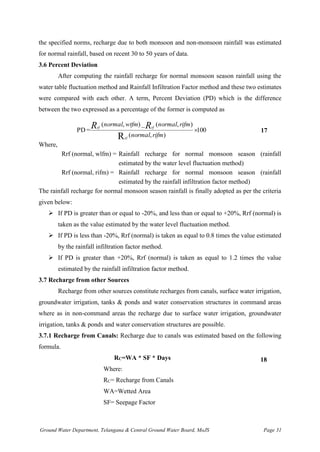
3.6 Percent Deviation
After computing the rainfall recharge for normal monsoon season rainfall using the
water table fluctuation method and Rainfall Infiltration Factor method and these two estimates
were compared with each other. A term, Percent Deviation (PD) which is the difference
between the two expressed as a percentage of the former is computed as
100
)
,
(
)
,
(
_
)
,
(
=
PD
Rrf

rifm
normal
rifm
normal
wtfm
normal R
R rf
rf
17
Where,
Rrf (normal, wlfm) = Rainfall recharge for normal monsoon season (rainfall
estimated by the water level fluctuation method)
Rrf (normal, rifm) = Rainfall recharge for normal monsoon season (rainfall
estimated by the rainfall infiltration factor method)
The rainfall recharge for normal monsoon season rainfall is finally adopted as per the criteria
given below:
➢ If PD is greater than or equal to -20%, and less than or equal to +20%, Rrf (normal) is
taken as the value estimated by the water level fluctuation method.
➢ If PD is less than -20%, Rrf (normal) is taken as equal to 0.8 times the value estimated
by the rainfall infiltration factor method.
➢ If PD is greater than +20%, Rrf (normal) is taken as equal to 1.2 times the value
estimated by the rainfall infiltration factor method.
3.7 Recharge from other Sources
Recharge from other sources constitute recharges from canals, surface water irrigation,
groundwater irrigation, tanks & ponds and water conservation structures in command areas
where as in non-command areas the recharge due to surface water irrigation, groundwater
irrigation, tanks & ponds and water conservation structures are possible.
3.7.1 Recharge from Canals: Recharge due to canals was estimated based on the following
formula.
RC=WA * SF * Days 18
Where:
RC= Recharge from Canals
WA=Wetted Area
SF= Seepage Factor
Ground Water Department, Telangana & Central Ground Water Board, MoJS Page 32
Days= Number of Canal Running Days.
3.7.2 Recharge from Surface Water Irrigation: Recharge due to applied surface water
irrigation, either by means of canal outlets or by lift irrigation schemes was estimated based on
the following formula:
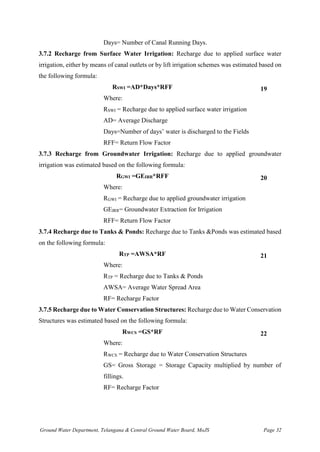
RSWI =AD*Days*RFF 19
Where:
RSWI = Recharge due to applied surface water irrigation
AD= Average Discharge
Days=Number of days’ water is discharged to the Fields
RFF= Return Flow Factor
3.7.3 Recharge from Groundwater Irrigation: Recharge due to applied groundwater
irrigation was estimated based on the following formula:
RGWI =GEIRR*RFF 20
Where:
RGWI = Recharge due to applied groundwater irrigation
GEIRR= Groundwater Extraction for Irrigation
RFF= Return Flow Factor
3.7.4 Recharge due to Tanks & Ponds: Recharge due to Tanks &Ponds was estimated based
on the following formula:
RTP =AWSA*RF 21
Where:
RTP = Recharge due to Tanks & Ponds
AWSA= Average Water Spread Area
RF= Recharge Factor
3.7.5 Recharge due to Water Conservation Structures: Recharge due to Water Conservation
Structures was estimated based on the following formula:
RWCS =GS*RF 22
Where:
RWCS = Recharge due to Water Conservation Structures
GS= Gross Storage = Storage Capacity multiplied by number of
fillings.
RF= Recharge Factor
Ground Water Department, Telangana & Central Ground Water Board, MoJS Page 33
3.8 Recharge during Monsoon Season
The sum of normalized monsoon rainfall recharge and the recharge from other sources
during the monsoon season is the total recharge during monsoon season for the sub units and
similarly this is computed for all the sub units available in the assessment unit.
3.9 Recharge during Non-Monsoon Season
The rainfall recharge during non-monsoon season is estimated using Rainfall
Infiltration Factor Method only when the non-monsoon season rainfall is more than 10% of
normal annual rainfall. The sum of non-monsoon rainfall recharge and the recharge from other
sources during non-monsoon season is the total recharge during non-monsoon season for the
sub unit. Similarly, this is computed for all the sub units available in the assessment unit.
3.10 Total Annual Groundwater Recharge
The sum of the recharge during monsoon and non-monsoon seasons is the total annual
groundwater recharge for the sub unit. Similarly, this is computed for all the sub units available
in the assessment unit.
3.11 Annual Extractable Groundwater Recharge
The total Annual Groundwater Recharge cannot be utilised for human consumption,
since ecological commitments need to be fulfilled, before the extractable resources is defined.
The National Water Policy, 2012 stresses that the ecological flow in rivers should be
maintained. As the base flow contribution to the ecological flow of rivers is not determined.
The following assumption are followed. In the water level fluctuation method, a
significant portion of base flow is already accounted for by taking the post monsoon water level
one month after the end of rainfall. The base flow in the remaining non-monsoon period was
too small, especially in hard rock areas. In the assessment units, where river stage data is not
available and neither the detailed data for quantitative assessment of the natural discharge are
available, present practice (GEC 1997) of allocation of unaccountable natural discharges to 5%
or 10% of annual recharge was used. If the rainfall recharge is assessed using water level
fluctuation method 5% of the annual recharge was used and if it is assessed using rainfall
infiltration factor method, 10% of the annual recharge was used. The balance will account for
Annual Extractable Groundwater Resources (EGR).
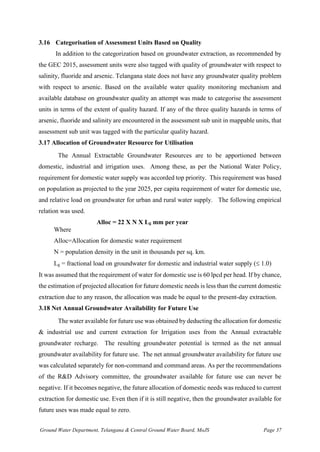
3.12 Estimation of Groundwater Extraction
Groundwater draft or extraction was assessed as follows.
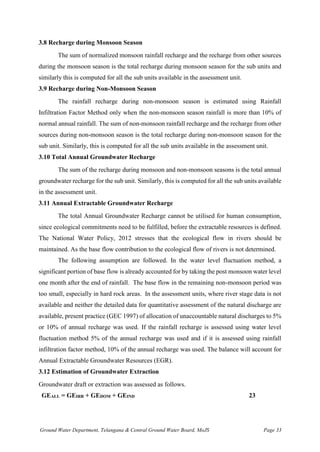
GEALL = GEIRR + GEDOM + GEIND 23
Ground Water Department, Telangana & Central Ground Water Board, MoJS Page 34
Where,
GEALL=Groundwater extraction for all uses
GEIRR=Groundwater extraction for irrigation
GEDOM =Groundwater extraction for domestic uses
GEIND = Groundwater extraction for industrial uses
3.12.1 Groundwater Extraction for Irrigation (GEIRR): This is the single largest component
of the groundwater balance equation in large regions of India as the agriculture is pre-
dominantly is based on groundwater. The precise estimation of groundwater extraction is
riddled with uncertainties. Therefore, as recommended, two methods for estimation of
groundwater extraction was employed in each assessment sub unit.
Unit Draft Method: – In this method, season-wise unit draft of each type of well in an
assessment unit is estimated. The unit draft of different types (e.g. Dug well, dug cum bore
well, shallow tube well, deep tube well, bore well etc.) is multiplied with the number of wells
of that particular type to obtain season-wise groundwater extraction by that particular structure.
There are several sources which maintain records on well census. These include Minor
Irrigation Census conducted by MoWR, RD, GR, Government of India, and data maintained
at the Block level by state govt. agencies and cross check randomly during the field checks.
Crop Water Requirement Method: – For each crop, the season-wise net irrigation water
requirement is determined. This is then multiplied with the area irrigated by groundwater
abstraction structures. The database on crop area is obtained from Revenue records in Mandal
office, Agriculture Census.
Power Consumption Method: –Groundwater extraction for unit power consumption (electric)
is determined. Extraction per unit power consumption is then multiplied with number of units
of power consumed for agricultural pump sets to obtain total groundwater extraction for
irrigation.
3.12.2 Groundwater Extraction for Domestic Use: There are several methods for estimation
of extraction for domestic use (GEDOM). Some of the commonly adopted methods are described
here.
Unit Draft Method: – In this method, unit draft of each type of well is multiplied by the number
of wells used for domestic purpose to obtain the domestic groundwater draft.
Consumptive Use Method: – In this method, population is multiplied with per capita
consumption usually expressed in litre per capita per day (lpcd). It can be expressed using
following equation.
Ground Water Department, Telangana & Central Ground Water Board, MoJS Page 35
Where,
Lg = Fractional Load on Groundwater for Domestic Water Supply
The Load on Groundwater was obtained from the Information based on Civic water supply
agencies in urban areas.
3.12.3 Groundwater Extraction for Industrial use (GEIND): The commonly adopted
methods for estimating the extraction for industrial use are as below:
Unit Draft Method: - In this method, unit draft of each type of well is multiplied by the number
of wells used for industrial purpose to obtain the industrial groundwater extraction.
Consumptive Use Pattern Method: – In this method, water consumption of different industrial
units is determined. Numbers of Industrial units which are dependent on groundwater are
multiplied with unit water consumption to obtain groundwater draft for industrial use.
GEIND= Number of industrial units X Unit Water Consumption X Lg 25
Where,
Lg = Fractional load on groundwater for industrial water supply
The load on Groundwater for Industrial water supply was obtained from water supply
agencies in the Industrial belt.
3.13 Stage of Groundwater Extraction
The stage of groundwater extraction is defined by,
100
uses
all
for
extraction
water
ground
gross
Existing

=
Resources
water
Ground
e
Extractabl
Annual
(%)
Extraction
Water
Ground
of
Stage
The existing gross groundwater extraction for all uses refers to the total of existing gross
groundwater extraction for irrigation and all other purposes. The stage of groundwater
extraction was obtained separately for command areas and non-command areas.
3.14 Validation of Stage of Groundwater Extraction
The assessment based on the stage of groundwater extraction has inherent uncertainties
as the estimation of groundwater extraction is likely to be associated with considerable
uncertainties as it is based on indirect assessment using factors such as electricity consumption,
well census and area irrigated from groundwater. Annual Extractable Groundwater Resources
also has uncertainties due to limitations in the assessment methodology, as well as uncertainties
in the data. In view of this, it was necessary to validate the ‘Stage of Groundwater Extraction’
with long term trend of groundwater levels.
GEDOM= Population X Consumptive Requirement X Lg 24
Ground Water Department, Telangana & Central Ground Water Board, MoJS Page 36
Long term water level trends are to be prepared for a minimum period of 10 years for
pre-monsoon period. The water level trend would be average water level trend as obtained from
the Piezometer wells from assessment unit or nearby.
In interpreting the Decadal trend of groundwater levels, the following points were kept
in view. If the pre-water levels show a decline trend, it does not necessarily mean that there is
no scope for further groundwater development. Such a trend indicates that there is a possibility
to replenish the resources by maintaining the balance between recharge, extraction and natural
discharge in the unit. However, further groundwater development may be possible, which may
result in a new stable trend at a lower groundwater level with associated reduced natural
discharge.
If the groundwater resource assessment and the trend of long-term water levels
contradict each other, this anomalous situation requires a review of the groundwater resource
computation, as well as the reliability of water level data. The mismatch conditions are
enumerated below in Table-3.1.
Table-3.1: - Validation of Groundwater Extraction with comparison to Groundwater level
trend.
SGWE Groundwater level trend Remarks
≤70% Decline in trend in both pre-monsoon and
post-monsoon
Not acceptable and needs
reassessment
>100% No significant decline in both pre-monsoon
and post-monsoon long term trend
Not acceptable and needs
reassessment
3.15 Categorisation of Assessment Units
The categorisation based on status of groundwater extraction in percentage is defined
as below in Table-3.2.
Table-3.2: - Categorisation based on Groundwater Extraction.
Stage of Groundwater Extraction (%) Category
≤ 70 % Safe
> 70 %and ≤ 90 % Semi-Critical
> 90 % and ≤ 100 % Critical
> 100 % Over Exploited
Ground Water Department, Telangana & Central Ground Water Board, MoJS Page 37
3.16 Categorisation of Assessment Units Based on Quality
In addition to the categorization based on groundwater extraction, as recommended by
the GEC 2015, assessment units were also tagged with quality of groundwater with respect to
salinity, fluoride and arsenic. Telangana state does not have any groundwater quality problem
with respect to arsenic. Based on the available water quality monitoring mechanism and
available database on groundwater quality an attempt was made to categorise the assessment
units in terms of the extent of quality hazard. If any of the three quality hazards in terms of
arsenic, fluoride and salinity are encountered in the assessment sub unit in mappable units, that
assessment sub unit was tagged with the particular quality hazard.
3.17 Allocation of Groundwater Resource for Utilisation
The Annual Extractable Groundwater Resources are to be apportioned between
domestic, industrial and irrigation uses. Among these, as per the National Water Policy,
requirement for domestic water supply was accorded top priority. This requirement was based
on population as projected to the year 2025, per capita requirement of water for domestic use,
and relative load on groundwater for urban and rural water supply. The following empirical
relation was used.
Alloc = 22 X N X Lg mm per year
Where
Alloc=Allocation for domestic water requirement
N = population density in the unit in thousands per sq. km.
Lg = fractional load on groundwater for domestic and industrial water supply ( 1.0)
It was assumed that the requirement of water for domestic use is 60 lpcd per head. If by chance,
the estimation of projected allocation for future domestic needs is less than the current domestic
extraction due to any reason, the allocation was made be equal to the present-day extraction.
3.18 Net Annual Groundwater Availability for Future Use
The water available for future use was obtained by deducting the allocation for domestic
& industrial use and current extraction for Irrigation uses from the Annual extractable
groundwater recharge. The resulting groundwater potential is termed as the net annual
groundwater availability for future use. The net annual groundwater availability for future use
was calculated separately for non-command and command areas. As per the recommendations
of the R&D Advisory committee, the groundwater available for future use can never be
negative. If it becomes negative, the future allocation of domestic needs was reduced to current
extraction for domestic use. Even then if it is still negative, then the groundwater available for
future uses was made equal to zero.
Ground Water Department, Telangana & Central Ground Water Board, MoJS Page 38
3.19 Apportioning of Groundwater Assessment from Watershed to Mandal:
Where the assessment unit is a watershed, there is a need to convert the groundwater
assessment in terms of an administrative unit such as block/taluka/mandal. A block may
comprise of one or more watersheds, in part or full. The apportionation was done as per
standard procedure as given below. First, the groundwater assessment in the sub-areas,
command and non-command areas of the watershed was converted into depth unit (mm), by
dividing the annual recharge by the respective area. The contribution of this sub-area of the
watershed to the block, is then calculated by multiplying this depth with the area in the block
occupied by this sub-area. This procedure was followed to calculate the contribution from the
sub-areas of all watersheds occurring in the block, to work out the total groundwater resource
of the block. The total groundwater resource of the block was presented separately for each
type of sub-area, namely for command areas and non-command areas.
Ground Water Department, Telangana & Central Ground Water Board, MoJS Page 39
4.0 PROCEDURE FOLLOWED IN PRESENT ASSESSMENT
The Groundwater Resources estimation of the State of Telangana for the year 2016-
2017 has been carried out based on the recommendations of GEC-2015 with the modifications
suggested by GEC-2004 and the R&D Advisory Committee on the Groundwater Resources
Estimation from time to time and by following the broad guidelines issued by the Central
Ground Water Board, Ministry of Water Resources, Govt. of India. The procedure followed in
the present assessment and the constraints are described below.
4.1 Data Sources for Various Data Elements
The data sources for the various data elements used in the present exercise are presented
in Table-4.1.
4.2 Various Norms Used in the Computation
4.2.1 Specific Yield and Rainfall Infiltration Factor: All the norms were used as per the
recommendations of GEC-2015 Methodology. Wherever the assessment sub unit is dominantly
occupied by a certain lithology the same norm was used for specific yield and rainfall
infiltration factor and wherever two or more lithologies occurs, weighted average norms were
used in the exercise.
4.2.2 Canal Seepage Factor: The norms were used as per the recommendations of GEC-2015
Methodology.
4.2.3 Return Flow Factor for Irrigation Waters: The norms were used as per the
recommendations of GEC-2015 Methodology.
4.2.4 Seepage Factor for Tanks & Ponds: The norms were used as per the recommendations
of GEC-2015 Methodology (1.4mm/day over the water spread area).
4.2.5 Seepage Factor for Water Conservation Structures: The norms were used as per the
recommendations of GEC-2015 Methodology, (50% of the Gross Storage out of which half
during monsoon period and half during non monsoon period).
4.2.6 Unit Draft: Depending on the hydrogeological conditions prevailing in the area and the
number of pumping hours obtained during surveys, availability of power in the area, unit draft
figures were arrived at each basin level.
4.2.7 Domestic and Industrial Water Requirement: The domestic & Industrial requirement
was considered as 60 lpcd as per the prevailing norms.
Ground Water Department, Telangana & Central Ground Water Board, MoJS Page 40
4.2.8 Load on Groundwater for Future Domestic and Industrial Requirement: Where ever
sufficient data is available the actual load was considered and in the sub units where sufficient
data is not available it was considered as 0.9.
4.2.9 Significant Level of Declining Groundwater Level Trend: A decline of 10 cm/year or
more was considered as significant for the purpose of categorizing a sub unit.
4.2.10 Bench Mark for Deciding Poor Groundwater Quality Area: The fluoride of more
than 1.5 ppm occurring as a continuous patch was considered as bench mark in delineating
poor groundwater quality areas with respect to fluoride.
4.2.11 Documented Field Studies: Norms arrived during the previous studies are also used
present methodology as well as in the day to day activities of the department.
4.2.12 Assessment in Urban Area (Hyderabad District): As per GEC Methodology – 2015,
unlike previous methodologies, groundwater assessment taken up separately in urban area of
Hyderabad district. Hyderabad district is the first and foremost city in entire country to assess
groundwater resources in as per GEC, 2015 methodology which recommended to use the
difference of the actual demand and the supply by surface water sources as the withdrawal from
the groundwater resources.
The urban areas are sometimes concrete jungles and rainfall infiltration is not equal to
that of rural areas unless and until special measures are taken in the construction of roads and
pavements. Hence, it is considered to use 30% of the rainfall infiltration factor for Hyderabad
urban area as an adhoc arrangement till field studies in these areas are done and documented
field studies are available.
Because of the water supply schemes in Hyderabad Urban area, the seepage from pipes
also considered in the recharge from other resources and the recharge is estimated. The percent
losses are collected from the Hyderabad Metro Water Supply, 50% of which has taken as
recharge to the groundwater system.
In urban area of Hyderabad, there is no separate channels either open or sub surface for
the drainage and flash floods. These channels also recharge to some extent the groundwater
reservoir. Therefore, the seepages from the sewerages, which normally contaminate the
groundwater resources with nitrate also contribute to the quantity of resources and hence same
percent as in the case of water supply pipes also taken as norm for the recharge on the quantity
of sewerage when there is sub surface drainage system.
Ground Water Department, Telangana & Central Ground Water Board, MoJS Page 41
Table-4.1: - Data Sources Used in the Groundwater Resource Estimation.
S.
No.
Data Element Used in the Computation of Data Source
1 Areas of Various sub
units
Rainfall recharge Chief Planning Office, Mandal
Revenue Office (MRO)
2 Irrigation Well Census Groundwater Draft for
Irrigation
MRO Offices and District level
CPO office.
3 Domestic and Industrial
Well Census
Groundwater Draft for
Domestic and Industrial Use
RWS Department, Chief
Planning Office, DES
4 Canal Details Recharge Due to Canals Irrigation Department
5 Cropping Pattern Recharge Due to Surface Water
irrigation and Groundwater
Irrigation.
Minor Irrigation Census,
Agriculture Department, CPO
6 Details of Tanks &
Ponds
Recharge Due to Tanks &
Ponds
Minor Irrigation Department
7 Details of Water
Conservation Structures
Recharge Due to Water
Conservation Structures
Rural Development Department,
Irrigation Department, RWS
Department and other State
Govt. Offices.
8 Rainfall Recharge Due to Rainfall Chief Planning Officer, DES
9 Water level Data Water Table trend and recharge
due to other sources
State Ground Water Department
& Central Ground Water Board
10 Population Details Provision for Future Domestic
and Industrial Requirement.
Population Census, 2011 and
Chief Planning Officer.
4.3 Constraints in the Database
Even though the constraints in the data base are very minimal, it is felt necessary to
mention that the availability of water spread areas in respect of tanks and ponds and storage
capacity of water conservation structures and outlet wise discharges and their operational days
are not uniform. Where ever available, those data elements were collected and used and where
ever not available, these data were generated by approximate methods like remote sensing
techniques, by fitting a relationship with the existing data elements and the required data
elements where ever both are available and used the equation for rest of the area. In water
conservation structures when the storage capacity was not available for certain type of
structures norms were used based on the field knowledge and field conditions.
Ground Water Department, Telangana & Central Ground Water Board, MoJS Page 42
5.0 COMPUTATION OF GROUNDWATER RESOURCES
As per the recommendations of the Groundwater Resources Estimation Committee, the
State is divided into 502 watersheds. The Groundwater resources of these watersheds were
estimated separately for command & non-command areas for the base year 2019-20. The total
area considered for groundwater recharge is 1, 02,179 km2
(Command: 21,289 km2
non-
command 80,890 km2
), and remaining 10,591 km2
area having >20% slope (hilly area) was
excluded.
5.1 Assessment Method Adopted
As per the recommendations of the Groundwater Resources Estimation Committee, the
recharge due to rainfall was computed using both rainfall infiltration factor and water level
fluctuation methods and depending on the percent difference, the final recharge due to rainfall
was computed. In the present exercise, the norms recommended by GEC 2015 were used and
wherever the percent difference (PD) is within 20%, water level fluctuation method was used.
In other sub units depending on the percent difference either 80% or 120% of the recharge
computed using rainfall infiltration factor method was used. This situation is common in
command areas where water levels are shallow and the aquifer is already saturated and hence
the aquifer cannot accept the recharge and will go as rejected recharge. But the rainfall
infiltration factor will not take into account this phenomenon of rejected recharge.
5.2 Dynamic Groundwater Resources
As per the present resource estimations, the net annual groundwater availability is about
15128 MCM (534 TMC) (Command Area: 6705 MCM and Non-Command area: 8423 MCM)
(Fig.5.1 and Table-5.1). The current annual groundwater extraction for all uses is 7576 MCM
(268 TMC) (Domestic and Industrial extraction: 907 MCM (32.05 TMC) & Irrigation
extractions: 6668 MCM (235.5 TMC)). The Annual Extractable Groundwater Resource for
future irrigation needs is 7139 MCM (267 TMC). The overall Stage of Groundwater Extraction
is 50 % and district wise ranges are from 25 % to 97 % (Command - 36 % & and Non-
Command- 61 %). District wise groundwater resource availability and stage of Groundwater
Extraction is given in Table-5.2. Mandal wise categorization is given in Annexure-IV.
Ground Water Department, Telangana & Central Ground Water Board, MoJS Page 43
Table-5.1: - Salient Features of Groundwater Resources Estimation 2019-20 (MCM).
S.
No.
Description Command
Non-
command
Total
1 Net Annual groundwater extractable resources 6705 8423 15128
2 Current gross groundwater extraction for irrigation 2185 4483 6668
3
Current gross annual groundwater extraction for
Domestic and Industrial needs
222 686 907
4
Current gross annual groundwater extraction for all
uses
2407 5169 7576
5
Net annual groundwater extractable resource for
future irrigation use
4197 2942 7139
6 Stage of groundwater extraction (%) 36 61 50
6 Allocation for domestic and industrial needs 322 918 1240
Fig.5.1: - GWR Availability Vs Usage over various GEC.
Ground Water Department, Telangana & Central Ground Water Board, MoJS Page 44
Table-5.2: - District wise Groundwater resources, 2019-20.
S.No. District
Annual Replenishable GW Resources (hm)
Total
annual
GW
recharge
[3+4+5+6]
(hm)
Provision
for natural
discharge
(hm)
Annual
Extractable
GW
Resources
(hm)
Annual Groundwater Extraction (hm)
Provision for
domestic and
industrial
requirement
supply to
2025 (hm)
Net GW
availability for
future
irrigation
development
(hm)
Stage of
GW
Extraction
(%)
Category
Monsoon Non-Monsoon
GW
Extraction
for
Irrigation
GW
Extraction
for
Domestic &
Industrial
Needs
Total
Annual
Extraction
for All
Uses
Recharge
from
rainfall
Recharge
from
other
sources
Recharge
from
rainfall
Recharge
from
other
sources
1 2 3 4 5 6 7 8 9 10 11 12 13 14 15 16
1 K. Asifabad 31382 728 0 1236 33344 3334 30009 5551 2065 7616 2267 22191 25 Safe
2 Mancherial 37957 18619 0 14770 71345 3621 67724 16033 1651 17684 3568 48123 26 Safe
3 Suryapet 20483 52711 1369 52665 127228 6362 120865 30392 2578 32970 4093 86380 27 Safe
4 Jogulamba Gadwal 9334 18404 2684 9087 39509 2654 36855 9900 523 10424 1293 25662 28 Safe
5 B. Kothagudem 59054 9344 6114 8803 83315 7591 75724 18581 8464 27045 8608 48535 36 Safe
6 Mulugu 26842 6168 0 8348 41359 2068 39291 14797 243 15040 942 23552 38 Safe
7 Khammam 30076 34599 6058 43175 113907 10256 103651 37352 3887 41240 5363 60937 40 Safe
8 Nirmal 28982 8286 0 12840 50109 1616 48493 18079 1941 20020 2595 27819 41 Safe
9 Peddapally 16865 4648 0 26347 47860 2392 45468 17797 1676 19473 2855 24816 43 Safe
10 Narayanpet 10577 8990 2122 8577 30267 1513 28753 11937 398 12335 2602 14215 43 Safe
11 Wanaparthy 10768 4919 11005 8497 35189 3186 32002 13536 1264 14801 1945 16521 46 Safe
12 Nalgonda 32930 35010 8426 45303 121669 6519 115157 45032 8546 53577 9199 60926 47 Safe
13 J. Bhupalapally 19802 4865 161 6998 31825 2721 29106 12622 1257 13879 1691 14793 48 Safe
14 Adilabad 23403 1528 0 2891 27822 1863 25960 8118 5112 13230 5184 12659 51 Safe
15 Karimnagar 16341 6888 1620 30519 55369 4912 50457 24350 2054 26404 4246 21861 52 Safe
16 Yadadri 20146 10248 4460 13212 48065 2528 45541 22187 3044 25231 4398 18955 55 Safe
17 Mahabubabad 25803 7719 3007 14115 50644 2561 47863 23934 2908 26842 3922 20008 56 Safe
18 Medak 19982 9286 1931 11434 42633 4107 38524 21745 1011 22756 2797 13981 59 Safe
19 Warangal Rural 15658 11825 761 26446 54691 4229 50462 28574 1641 30215 2085 19998 60 Safe
20 Jagityal 19506 10212 149 16892 46745 3936 42822 24735 1020 25755 3208 15012 60 Safe
21 Nagarkurnool 26298 4630 7027 8732 46687 2334 44353 21946 5261 27207 5327 17080 61 Safe
22 Medchal 6365 814 1352 1337 9869 493 9376 3302 2480 5782 1725 4350 62 Safe
23 Warangal Urban 10659 4239 80 4984 19962 998 18915 10602 1210 11812 5279 4412 62 Safe
24 Sangareddy 21302 3868 4375 4579 34123 1903 32226 17685 2605 20290 5120 9420 63 Safe
25 Vikarabad 21233 1974 2697 5338 31242 1562 29680 15897 2797 18695 3562 10220 63 Safe
26 Kamareddy 28256 6733 1411 12782 49192 3110 46080 27460 2027 29487 3842 14778 64 Safe
27 Siddipet 23672 10366 4345 16176 54559 2728 51836 32866 1113 33979 3584 15386 66 Safe
28 Nizamabad 39047 14397 321 23720 77485 3874 73611 49961 1583 51544 4311 19339 70 Safe
29 Mahabubnagar 13533 3977 2614 7249 27373 1369 26005 17757 979 18736 3422 4826 72 Semi Critical
30 Rangareddy 25477 3579 5908 5210 40174 2009 38165 21755 6501 28256 6651 9759 74 Semi Critical
31 Jangaon 15964 2486 2452 5683 26584 1330 25255 16974 2681 19655 2683 5598 78 Semi Critical
32 Rajanna Siricilla 14301 6673 2066 11451 34491 1729 32843 25385 705 26090 5653 1805 79 Semi Critical
33 Hyderabad 2473 323 3870 4169 10835 1049 9786 0 9525 9525 0 0 97 Critical
Grand Total 724470 329055 88387 473566 1615470 102457 1512859 666842 90749 757590 124019 713920 50 Safe
Ground Water Department, Telangana & Central Ground Water Board, MoJS Page 45
5.3 Salient Features of Groundwater Resources
The district wise stage of groundwater extraction varies from 25% (Asifabad) to 97%
(Hyderabad) (Fig.5.2).
a) Very high groundwater usage (> 70 % stage of groundwater extraction). In this category
Hyderabad, Nizamabad, Mahabubnagar, Rangareddy, R. Sricilla, Jangaon districts falls.
b) High groundwater usage districts (> 50 % & < = 70 % stage of groundwater
extraction). In this category Adilabad, Karimnagar, Bhongir, Mahabubabad, Medak,
Jagityal, Warangal (R), Nagarkurnool, Warangal (U), Medchal, Sangareddy, Vikarabad,
Kamareddy and Siddipet districts fall.
c) Moderate groundwater usage (> 30 % & < = 50 % Stage of groundwater extraction).
In this category Bhadradri Kothagudem, Nirmal, Khammam, Mulugu, Narayanpet,
Peddapalli, Nalgonda, Bhupalapally, and Wanaparthy districts falls.
d) Low groundwater usage (< = 30 % Stage of groundwater extraction) K. Asifabad
Mancherial, Suryapet, and J. Gadwal districts falls in this category.
Fig.5.2: - District Wise Categorization Map, Telangana State.
Comparison of groundwater utilization with GWRA 2016-17 to GWRA 2019-20
depicted in Fig.5.3a & Fig 5.3b. There is a tremendous decrease in high groundwater usage
districts from 15 districts to five districts, even though the well density is increased from 18 to
24 wells/km2
since the government has given more focus on water conservation practices in
order to increase groundwater resources.
Ground Water Department, Telangana & Central Ground Water Board, MoJS Page 46
Based on the present stage of groundwater extraction, out of 502 groundwater
watersheds, 348 falls under safe category, 129 in semi-critical, 21 in critical and 04
watersheds falls under over exploited, and category (Fig.5.4, 5.5 & Table-5.3). As far as
mandals are concerned, out of 589 mandals, 375 mandals under safe category, 167 mandals
under semi-critical, 22 mandals in Critical and 25 mandals fall under over exploited catergory
(Fig.5.6, 5.7 & Table-5.4).
Fig.5.3a: - District Wise Groundwater Utilization in Telangana (2016-17).
Fig.5.3b: - District Wise Groundwater Utilization in Telangana (2019-20).
Ground Water Department, Telangana & Central Ground Water Board, MoJS Page 47
Fig.5.4: - Categorization of Watersheds in Telangana (2019-20)
Fig.5.5: - Categorization of Watersheds.
4
21
129
348
0
50
100
150
200
250
300
350
400
Over Exploited Critical Semi Critical Safe
No's
Categorization of Watersheds, GWRA-20
Ground Water Department, Telangana & Central Ground Water Board, MoJS Page 48
Fig.5.6 Categorization of Mandals in Telangana (2019-20).
Fig. 5.7: - Categorization of Mandals, Telangana State.
25 22
167
375
0
50
100
150
200
250
300
350
400
Over Exploited Critical Semi Critical Safe
No's
Catogorization of Mandals, GWRA-20
Ground Water Department, Telangana & Central Ground Water Board, MoJS Page 49
Table-5.3: - District wise watersheds under different categories (2019-20).
S. No. District Safe
Semi-
critical
Critical
Over-
exploited
Total
1 Adilabad 9 0 0 0 9
2 Bhadradri Kothagudem 30 1 0 1 32
3 Hyderabad 0 0 1 0 1
4 Jagityal 12 3 1 0 16
5 Jangaon 4 4 1 0 9
6 Jayashankar Bhupalapally 12 1 0 0 13
7 Jogulamba Gadwal 6 1 0 0 7
8 Kamareddy 13 12 1 0 26
9 Karimnagar 6 2 0 0 8
10 Khammam 14 5 2 1 22
11 Komurambheem Asifabad 10 0 0 0 10
12 Mahabubabad 18 5 1 0 23
13 Mahabubnagar 10 4 1 0 15
14 Mancherial 7 0 0 0 7
15 Medak 9 6 0 0 15
16 Medchal-Malkajgiri 6 1 0 0 7
17 Mulugu 11 0 0 0 11
18 Nagarkurnool 9 8 0 0 17
19 Nalgonda 20 12 2 0 34
20 Narayanpet 7 0 0 0 7
21 Nirmal 16 0 0 0 16
22 Nizamabad 11 10 1 1 23
23 Peddapalli 9 2 0 0 11
24 Rajanna Sircilla 3 8 3 0 14
25 Rangareddy 7 13 4 0 24
26 Sangareddy 15 5 1 1 22
27 Siddipet 15 6 0 0 21
28 Suryapet 10 5 2 0 17
29 Vikarabad 21 2 0 0 23
30 Wanaparthy 8 2 0 0 10
31 Warangal Rural 7 1 0 0 8
32 Warangal Urban 3 3 0 0 6
33 Yadadri Bhuvanagiri 10 7 0 0 17
Total 348 129 21 4 502
Ground Water Department, Telangana & Central Ground Water Board, MoJS Page 50
Table-5.4: - District wise number of Mandals in different categories (2019-20).
S. No. District Safe
Semi-
critical
Critical
Over-
Exploited
Total
1 Adilabad 14 2 0 2 18
2 Bhadradri Kothagudem 18 4 1 0 23
3 Hyderabad 0 3 5 8 16
4 Jagityal 13 3 2 0 18
5 Jangaon 3 6 3 0 12
6 Jayashankar Bhupalapally 10 1 0 0 11
7 Jogulamba Gadwal 11 1 0 0 12
8 Kamareddy 13 9 0 0 22
9 Karimnagar 10 4 1 1 16
10 Khammam 15 5 1 0 21
11 Komurambheem Asifabad 14 1 0 0 15
12 Mahabubabad 11 5 0 0 16
13 Mahabubnagar 7 7 1 0 15
14 Mancherial 18 0 0 0 18
15 Medak 13 7 0 0 20
16 Medchal-Malkajgiri 9 4 1 1 15
17 Mulugu 8 1 0 0 9
18 Nagarkurnool 11 7 0 2 20
19 Nalgonda 20 10 0 1 31
20 Narayanpet 8 3 0 0 11
21 Nirmal 15 4 0 0 19
22 Nizamabad 16 9 1 3 29
23 Peddapalli 13 1 0 0 14
24 Rajanna Sircilla 2 9 2 0 13
25 Rangareddy 9 14 1 3 27
26 Sangareddy 15 10 1 0 26
27 Siddipet 15 8 0 0 23
28 Suryapet 14 8 0 1 23
29 Vikarabad 12 5 1 0 18
30 Wanaparthy 9 4 0 1 14
31 Warangal Rural 13 3 0 0 16
32 Warangal Urban 6 3 0 2 11
33 Yadadri Bhuvanagiri 10 6 1 0 17
Total 375 167 22 25 589
Ground Water Department, Telangana & Central Ground Water Board, MoJS Page 51
5.4 Comparison with the earlier Groundwater Resources Estimates.
A comparison of present groundwater resources (2019-20) with earlier groundwater
resources is carried out for years 2005, 2009, 2011, 2013 and 2017 (Table-5.5 & 5.6). Presently
comparison is made for 2017 GEC and it is observed that OE mandals decreased from 70 to
25, Critical from 67 to 22, Semi-Critical from 169 to 167 and there is a big shift in Safe
mandals, which increased from 278 to 375. It is also observed that Over Exploited watersheds
decreased from 29 to 4, Critical from 59 to 21, Semi-Critical from 165 to 129. The change in
groundwater resources availability, categorization of watershed & mandals is depicted in
Fig.5.8, 5.9a-b & 5.10).
Table-5.5: - Comparison of categorisation of Watersheds in Different Assessment Years.
S. No Category
Assessment Year wise Number of Watersheds
2002 2005 2007 2009 2011 2013 2017 2020
1 Over Exploited 50 86 64 40 37 28 29 4
2 Critical 29 37 27 16 8 29 59 21
3 Semi Critical 108 104 101 51 65 92 165 129
4 Safe 278 267 304 387 384 335 249 348
Total 465 494 496 494 494 484 502 502
Table-5.6: - Comparison of Categorisation of Mandals in Different Assessment Years.
S. No. Category
Assessment Year wise Category of Mandals
2002 2005 2007 2009 2011 2013 2017 2020
1 Over Exploited 98 102 74 38 42 46 70 25
2 Critical 46 41 32 14 8 12 67 22
3 Semi Critical 93 92 81 45 55 74 169 167
4 Safe 209 211 259 349 341 314 278 375
Total 446 446 446 446 446 446 584 589
Ground Water Department, Telangana & Central Ground Water Board, MoJS Page 52
Fig.5.8: - Change in Groundwater Resources during 2017 & 2020.
Fig.5.9a-b: - Comparison of Categorisation of Watersheds & Mandals.
5.5. District wise Groundwater Resources
1. Adilabad: - Annual Extractable Groundwater recharge is 260 mcm, annual
groundwater extraction is 132 mcm and balance for future irrigation use 127mcm with
Stage of Extraction of 51 % (Table-5.2).
2. Bhadradri Kothagudem: - Annual Extractable Groundwater recharge is 677 mcm,
annual groundwater extraction is 270 mcm and the balance for future irrigation use is
485 mcm with Stage of Extraction of 36% (Table-5.2).
3. Janagaon: - Annual Extractable Groundwater recharge is 253 mcm, annual
groundwater extraction is 197 mcm and balance for future irrigation use is 56 mcm
with Stage of Extraction of 78 % (Table-5.2).
4. Jayashankar Bhupalapally: - Annual Extractable Groundwater recharge is 291 mcm,
annual groundwater extraction is 139 mcm and balance for future irrigation use is 148
mcm with Stage of Extraction of 48% (Table-5.2).
(a) (b)
Ground Water Department, Telangana & Central Ground Water Board, MoJS Page 53
5. Jogulamba Gadwal: - Annual Extractable Groundwater recharge is 369 mcm, annual
groundwater extraction is 104 mcm and balance for future irrigation use is 257 mcm
with Stage of Extraction of 28 % (Table-5.2).
6. Kamareddy: -Annual Extractable Groundwater recharge is 461 mcm, annual
groundwater Extraction is 295 mcm and balance for future irrigation use is 148 mcm
with Stage of Extraction of 64 % (Table-5.2).
7. Karimnagar: - Annual Extractable Groundwater recharge is 505 mcm, annual
groundwater extraction is264 mcm, balance for future irrigation use is 219mcm with
Stage of extraction of 52 % (Table-5.2).
8. Khammam: - Annual Extractable Groundwater recharge is 1037 mcm, annual
groundwater extraction is 412 mcm balance for future irrigation use is 609 mcm with
Stage of Extraction of 40% (Table-5.2).
9. Komurambheem_Asifabad: - Annual Extractable Groundwater recharge is 300 mcm,
annual groundwater extraction is 76 mcm, balance for future irrigation use is 222 mcm
with Stage of Extraction of 25 % (Table-5.2).
10. Mahabubnagar: -Annual Extractable Groundwater recharge is 260 mcm, annual
groundwater extraction is 187 mcm, balance for future irrigation use is 48 mcm with
Stage of Extraction of 72% (Table-5.2).
11. Mancherial: - Annual Extractable Groundwater recharge is 677 MCM, annual
groundwater extraction is 177 mcm balance for future irrigation use is 481 mcm with
Stage of Extraction of 26% (Table-5.2).
12. Medak: - Annual Extractable Groundwater recharge is 385 mcm, annual groundwater
extraction is 228 mcm balance for future irrigation use is 140 mcm with Stage of
Extraction of 59 % (Table-5.2).
13. Medchal-Malkajgiri: - Annual Extractable Groundwater recharge is 94 mcm, annual
groundwater extraction is 58 mcm, balance for future irrigation use is 43 mcm with
Stage of Extraction of 94% (Table-5.2).
14. Mulugu: - Annual Extractable Groundwater recharge is 393 mcm, annual groundwater
extraction is 150 mcm, balance for future irrigation use is 236 mcm with Stage of
Extraction of 38% (Table-5.2).
15. Nagarkurnool: -Annual Extractable Groundwater recharge is 444 mcm, annual
groundwater extraction is 272 mcm, balance for future irrigation use is 171 mcm with
Stage of Extraction of 61 % (Table-5.2)
Ground Water Department, Telangana & Central Ground Water Board, MoJS Page 54
16. Nalgonda: - Annual Extractable Groundwater recharge is 1152 mcm, annual
groundwater Extraction is 536 mcm, balance for future irrigation use is 609 mcm with
Stage of Extraction of 47% (Table-5.2).
17. Narayanpet: - Annual Extractable Groundwater recharge is 288 mcm, annual
groundwater Extraction is 123 mcm, balance for future irrigation use is 142 mcm with
Stage of Extraction of 43% (Table-5.2).
18. Nirmal: - Annual Extractable Groundwater recharge is 505 mcm, annual groundwater
extraction is 200 mcm, balance for future irrigation use is 278 mcm with Stage of
Extraction of 41 % (Table-5.2).
19. Nizamabad: - Annual Extractable Groundwater recharge is 736 mcm, annual
groundwater extraction is515 mcm, balance for future irrigation use is 193 mcm with
Stage of Extraction of 70 % (Table-5.2).
20. Peddapalli: - Annual Extractable Groundwater recharge is 455 mcm, annual
groundwater extraction is 195 mcm, balance for future irrigation use 67 mcm with
Stage of Extraction of 48% (Table-5.2).
21. Rajanna Siricilla: - Annual Extractable Groundwater recharge is 328 mcm, annual
groundwater extraction is 261 mcm, balance for future irrigation use is 67 mcm with
Stage of Extraction of 79% (Table-5.2).
22. Rangareddy: - Annual Extractable Groundwater recharge is 382 mcm, annual
groundwater extraction is 283 mcm balance for future irrigation use is99 mcm with
Stage of Extraction of 74% (Table-5.2)
23. Sangareddy: - Annual Extractable Groundwater recharge is 322 mcm, annual
groundwater extraction is 203 mcm, balance for future irrigation use is116 mcm with
Stage of Extraction of63% (Table-5.2).
24. Siddipet: - Annual Extractable Groundwater recharge is 518 mcm, annual groundwater
extraction is 340 mcm, balance for future irrigation use is179 mcm with Stage of
Extraction of66 % (Table-5.2)
25. Suryapet: - Annual Extractable Groundwater recharge is 1209 mcm, annual
groundwater extraction is330 mcm balance for future irrigation use is 879 mcm with
Stage of Extraction of 27% (Table-5.2)
26. Vikarabad: - Annual Extractable Groundwater recharge is 297 mcm, annual
groundwater extraction is187 mcm, balance for future irrigation use is110 mcm with
Stage of Extraction of63% (Table-5.2)
Ground Water Department, Telangana & Central Ground Water Board, MoJS Page 55
27. Wanaparthy: - Annual Extractable Groundwater recharge is 320 mcm, annual
groundwater extraction is148 mcm, balance for future irrigation use is172 mcm with
Stage of Extraction of46% (Table-5.2)
28. Warangal Rural: -Annual Extractable Groundwater recharge is 505 mcm, annual
groundwater extraction is302 mcm, balance for future irrigation use is202 mcm, with
Stage of Extraction of60% (Table-5.2).
29. Warangal Urban: - Annual Extractable Groundwater recharge is 189 mcm, annual
groundwater extraction is118 mcm balance for future irrigation use is71 mcm with
Stage of Extraction of62% (Table-5.2)
30. Hyderabad: - Annual Extractable Groundwater recharge is 41.48 mcm, annual
groundwater extraction is 141 mcm, balance for future irrigation use is NIL, with Stage
of Extraction of 341%(Table-5.2).
31. Jagityal: - Annual Extractable Groundwater recharge is 424 mcm, annual groundwater
extraction is312 mcm, balance for future irrigation use is134 mcm, with Stage of
Extraction of 74% (Table-5.2).
32. Yadadri Bhuvanagiri: - Annual Extractable Groundwater recharge is 455 mcm,
annual groundwater Extraction is252 mcm, balance for future irrigation use 203 mcm,
with Stage of Extraction of55% (Table-5.2)
33. Mahabubabad: -Annual Extractable Groundwater recharge is 479 mcm, annual
groundwater Extraction is 268 mcm, balance for future irrigation use is210 mcm, with
Stage of Extraction of56% (Table-5.2).
5.6. Groundwater Availability in Kaleshwaram Project Command area
In order to bring 18.25 lakh acres of land under assured irrigation with 180 TMC of surface
water, Govt of Telangana has modified the earlier formulated Dr. B.R. Ambedkar Pranahita-
Chevella Sujala Shravanthi scheme and named as Kaleshwaram Project (Fig.5.10). The
command area covers 9 districts with 98 mandals covering 1581 villages.
Objectives:
• Diversion of 180 TMC of Godavari water to Sripada Rao Yellampally Project
and subsequently to Mid Manair reservoir by lifting.
• To create an additional ayacut of 18.25 lakh acres of land.
• To provide 10 TMC of drinking water needs to villages en route.
• To provide 30 TMC of drinking water needs to twin cities of Hyderabad and
Secunderabad.
• To provide 16 TMC for industrial requirements.
Ground Water Department, Telangana & Central Ground Water Board, MoJS Page 56
• To stabilize shortfalls in planned utilization of SRSP Stage-I and Stage-II, Flood
Flow Canal, Singur Project and Nizam Sagar.
• To stabilize groundwater levels to its original state through conjunctive use.
Fig.5.10: - Location of Kaleshwaram Project with command area.
In the project area, the estimated net groundwater availability is 125 TMC, current
annual groundwater extraction for irrigation is 81 TMC with stage of groundwater extraction
of 65 %. Net groundwater extractable resources for future use is 45 TMC (Fig.5.11 & Table
5.7).
5.7. Impact of Mission Kakatiya on Groundwater Resources:
Telangana Government has taken up gigantic programme known as “Mission
Kakatiya” programme to revival and restore of > 46530 minor irrigation tanks in the state in
five phases. In order to see the impact of de-siltation programme on groundwater regime 9
groundwater basins each from erstwhile districts are selected as pilot study. During GWRA
2016-17 (Before Mission Kakatiya) available resources in 9 selected groundwater basins
estimated at 10 TMC, and during GWRA 2019-20 estimates (After Mission Kakatiya) these
resources increased to 11 TMC and in the same ground water draft decreased by 1.6 TMC
(Table 5.7). It is noticed that overall stage of groundwater extraction is decreased by 31 %
Ground Water Department, Telangana & Central Ground Water Board, MoJS Page 57
(i.e., from 101 % (2012-13) to 70% (2019-20) and over all categorization changed to Semi
Critical from Over-Exploited.
Fig.5.11 (a & b): - Depth to Water Levels during Pre-& Post Monsoon season 2019 in KLIP.
Table.5.7:- Groundwater Availability in KLIP & MK pilot basins (2016-17 vis-a-vis 2019-20).
Project KLIP MK (Pilot Basins)
GWRA Year 2017 2020 2017 2020
Net Ground Water Availability (TMC) 121.5 125.5 10 10.7
Total ground Draft (TMC) 91.4 80.7 9.2 7.6
Stage of Extraction (%) 75(SC) 64 (Safe) 93 (C) 70 (SC)
(a) (b)
Ground Water Department, Telangana & Central Ground Water Board, MoJS Page 58
6.0. CONCLUSION
Groundwater Resources Estimations are done as per the GEC-2015 Methodology based
on watershed as a unit and command & Non-Command area as a sub unit. Hilly area having
> 20 % slope is excluded from the net recharge area. Present resources are done for the 2nd
time
for 502 watersheds after formation of Telangana state, 589 mandals of 33 districts including
Hyderabad urban area (Mandal wise).
The basic components in resources estimations are Inflow – Out flow = Change in
Storage. The inflow components are recharge from rainfall, recharge from other sources (return
seepage from irrigation (both surface & groundwater) recharge from tanks, ponds, ARS, canals
etc., The out-flow components are extraction done for irrigation, domestic & industrial needs.
In the present methodology data is used from State Ground Water Department, Central
Ground Water Board, Irrigation, Revenue, Planning, Panchayat Raj, RWS etc., and other line
departments etc.
Annual extractable groundwater resources include sum of recharge during monsoon
and non-monsoon seasons from rainfall and other sources-ecological flows (non accounted
natural discharge) 5 to 10% of annual recharge etc.
Finally, groundwater resources are estimated for watershed as an assessment unit and
then apportioned to mandal (administrative unit) and village as administrative units. The
categorizations are made in to 4 categories based on stage of groundwater extraction i.e., Safe:
< = 70%, Semi Critical: > 70 % to < = 90 %, Critical: > 90 % to < = 100 %, and Over Exploited:
>100 % after validating water level trends.
In the present methodology quality tag is added if any 3 of quality hazards like Arsenic
(> 10 ppm) Fluoride (> 1.5 ppm) and Salinity (> 3000 micro siemens at 25ºc.)
As per GWRA 2020 assessment available extractable groundwater resources is 15128
MCM, Gross groundwater extraction is 7576 MCM with average stage of groundwater
extraction of 50 %. Balance available for future needs is 7139 MCM.
Among all districts Komarambheem Asifabad is having low stage of groundwater
extraction (25%) of Safe Category and Hyderabad having highest extraction (97%) with
Critical category. Among 33 districts, 7 districts clubbed in very high groundwater usage
district (>70%) 6 in high groundwater usage (60 % to < 70 %),7 in moderate groundwater usage
9 in low groundwater usage districts and 4 districts very low groundwater usage districts.
Out of 502 watersheds, 348 falls under Safe category (70%), 129 in Semi Critical, 21
in Critical and 4 falls in Over Exploited category. Among 589 mandals, 375 mandals falls in
safe category, 167 falls in Semi Critical, 22 falls in Critical and 25 falls in Over Exploited
category. Out of 10,834 villages, 93 % villages fall under safe category and only 7 % villages
Ground Water Department, Telangana & Central Ground Water Board, MoJS Page 59
i.e 721villages categorized as Over Exploited from Semi Critical, Critical and Over Exploited
(OCS) groundwater basins.
In upcoming Kaleshwaram Project area, net groundwater availability is 125 TMC (3439
mcm), Groundwater extraction is 81 TMC (2586 mcm) with 64% of stage of groundwater
extraction.
Positive impact on groundwater regime is observed in 9 pilot study watersheds under
Mission Kakatiya, where the stage of groundwater extraction decreased by 31% and Over
Exploited watersheds changed to Semi Critical category since inception.
Ground Water Department, Telangana & Central Ground Water Board, MoJS Page 60
“I often say that when you can measure what you are speaking about
and express it in numbers you know something about it; but when you
cannot measure it, when you cannot express it in numbers, your
knowledge is of a meagre and unsatisfactory kind: it may be the
beginning of knowledge, but you have scarcely, in your thoughts,
advanced to the stage of science, what-ever the matter may be”.
Sir William Thomson, 1891
(Later known as Lord Kelvin)
Ground Water Department, Telangana & Central Ground Water Board, MoJS Page 61
A P P E N D I X
Ground Water Department, Telangana & Central Ground Water Board, MoJS Page 62
Annexure-I
Ground Water Department, Telangana & Central Ground Water Board, MoJS Page 63
Annexure-II
Ground Water Department, Telangana & Central Ground Water Board, MoJS Page 64
Ground Water Department, Telangana & Central Ground Water Board, MoJS Page 65
Ground Water Department, Telangana & Central Ground Water Board, MoJS Page 66
Annexure-III
Ground Water Department, Telangana & Central Ground Water Board, MoJS Page 67
Ground Water Department, Telangana & Central Ground Water Board, MoJS Page 68
Ground Water Department, Telangana & Central Ground Water Board, MoJS Page 69
Ground Water Department, Telangana & Central Ground Water Board, MoJS Page 70
Annexure-IV
CATEGORIZATRION OF OCS MANDALS IN TELANGANA STATE (GWRA, 2019-20)
S.
No.
District
Categorization
Semi-Critical Critical Over Exploited
1 Adilabad
Bazarhatnur Adilabad-U
Narnoor Mavala
2 Bhadradri
Dammapeta Chunchupally
Manuguru
Pinapaka
Sujathanagar
3 Hyderabad
Bahadurpura Amberpet Ammerpet
Charminar Khairatabad Asifnagar
Musheerabad Nampally Bandlaguda
Secunderabad Golkonda
Tirumalgiri Himayatnagar
Maredpally
Saidabad
Shaikpet
4 Jagityal
Mallial Kathlapur
Medipalle Kodimial
Metpalle
5 Jangaon
Chelpur Bachannapeta
Palakurthi Jangaon
Raghunathpalli Kodakandla
St Ghanpur
Tharigoppula
Zaffergadh
6 Jayashankar Bhupalpally Tekumatla
7 Jogulamba Gadwal Kallor Thimmandoddi
8 K. Asifabad Kagaznagar
9 Kamareddy
Bhiknoor
Bibipet
Domakonda
Kamareddy
Lingampet
Machareddy
Rajampet
Ss Nagar
Thadwai
10 Karimanagar
Chigurmamidi Saidapur Gangadhara
Ganneruvaram
Karimnagar
Ramadugu
11 Khammam
Penuballi Vemsur
Raghunadhapalem
Sathupalli
Singareni
Thirumalayapalem
Ground Water Department, Telangana & Central Ground Water Board, MoJS Page 71
S.
No.
District
Categorization
Semi-Critical Critical Over Exploited
12 Mahabubabad
Dhanthalapally
Maripeda
Narsimhulapet
Nellikuduru
Thorrur
13 Mahbubnagar
Hanwada Balanagar
Koilkonda
Mahabubnagar Rural
Midjil
Moosapet
Nawabpet
Rajapur
14 Mancherial Nil Nil Nil
15 Medak
Chegunta
Manoharabad
Narsapur
Nizampet
Shankarampet-R
Shivampet
Toopran
16 Medchal
Keesara Bachupally Balanagar
M.C Pally
Medchal
Uppal
17 Mulugu Mangapet
18 Nagarkurnool
Balmoor Urkonda
Kodair Veldanda
Lingal
Nagarkurnool
Peddakothapally
Telkapally
Vangoor
19 Nalgonda
Chandampet Kattangoor
Chintha Palle
Chityala
Devarakonda
Gundla Palle
Kanagal
Marriguda
Nakrekal
Nalgonda
Neredugommu
20 Narayanpet
Dhanwada
Kosgi
Marikal
21 Nirmal
Bhainsa
Lokeshwaram
Mudhole
Nirmal Rural
Ground Water Department, Telangana & Central Ground Water Board, MoJS Page 72
S.
No
District
Categorization
Semi-Critical Critical Over Exploited
22 Nizamabad
Bheemgal Rudrur Armoor
Bodhan Chandur
Dichpally Morthad
Jakranpally
Kotagiri
Mupkal
Sirikonda
Vailpoor
Varni
23 Peddapally Srirampur
24 Rajanna
Chandurthi Gambhiraopet
Ellanthakunta Mustabad
Konaraopeta
Rudrangi
Sircilla
Thangallapalli
Veernapalli
Vemulawada Urban
Yellareddipet
25 Rangareddy
Amangal Rajendranagar Kothur
Chouderigudem Saroornagar
Hayathnagar Serilingampally
Ibrahimpatnam
Kadthal
Kondurg
Maheswaram
Manchal
Moinabad
Nandigama
Shamshabad
Shankarpally
Talakondapally
Yacharam
26 Sangareddy
Ameenpur Patancheru
Gummadidala
Hathnoora
Jharasangam
Kalher
Kohir
Nyalkal
R.C.Puram
Sangareddy
Zaheerabad
Ground Water Department, Telangana & Central Ground Water Board, MoJS Page 73
S.
No.
District
Categorization
Semi-Critical Critical Over Exploited
27 Siddipet
Dubbak
Koheda
Komuravelly
Maddur
Markook
Mirdoddi
Raipole
Wargal
28 Suryapet
Atmakur(S)
Chivvemla
Jajireddygudem
Maddirala
Mothey
Nuthankal
Thirumalagiri
Thungathurthy
29 Vikarabad
Bantwaram Kotapalle Nagaram
Bomraspet
Doma
Nawabpet
Peddemul
30 Wanaparthy
Amarachintha Gopalpet
Pangal
Revally
Weepangandla
31 Warangal Rural
Duggondi
Nallabelly
Raiparthy
32 Warangal Urban
Elakathurthy Bheemdevarapally
Inavolu Velair
Warangal
33 Yadadri Bhuvanagiri
Addagudur Atmakur (M)
Gundala
M.Thurkapally
Motakondur
Rajapet
S. Narayanpur
TOTAL 167 22 25

Telangana_State_Resource_Report_2020.pdf

  • 3.
    DYNAMIC GROUNDWATER RESOURCESOF TELANGANA STATE (As on March, 2020) Ground Water Department Government of Telangana Hyderabad & Central Ground Water Board, Ministry of Jal Shakti, Govt of India Hyderabad November, 2021 Hyderabad
  • 5.
    Ground Water Department,Telangana & Central Ground Water Board, MoJS DYNAMIC GROUNDWATER RESOURCES OF TELANGANA STATE (As on March, 2020) Prepared by Ground Water Department, Government of Telangana, Hyderabad & Central Ground Water Board Ministry of Jal Shakti, Govt of India Southern Region Hyderabad Under the Overall Guidence of Dr. Pandith Madhnure Director, GWD, Telangana & Sri. J. Siddhardha Kumar Regional Director (I/c) CGWB, SR, Hyderabad
  • 9.
    Dr. PANDITH MADHNURE M.Sc.,Ph.D DIRECTOR GROUND WATER DEPARTMENT GOVERNMENT OF TELANGANA #6-2-916/1, Opp. Govt. Degree College, Chintal Basthi, Khairtabad, Hyderabad - 500004, Telangana, India Phone: 040-23314979 (O) Email: director.tgsgwd@gmail.com PREFACE Ground Water Department, Government of Telangana in coordination with Central Ground Water Board, Ministry of Jal Shakti, Govt of India has taken up the re-assessment of “Dynamic Groundwater Resources of Telangana-2020” based on the latest techniques and data. The National Water Policy of India, regards groundwater as one of the most crucial elements in development planning. Therefore, accurate assessment of these vital resources is to be done at periodic interval by using the latest data & technology and the earlier estimates were carried out for the year 2002, 2005, 2007, 2009, 2011, 2013 and 2017. Presently about 60 % of state’s population is dependent on some form or other on farm activity for their livelihood and agriculture contributes 13 % to its GDP. Demand on groundwater resources is further increasing due to pace of industrial development which, often leading to unsustainable drawl of groundwater resources. Groundwater development & management in the state is regulated with help of Water, Land and Tree Act (WALTA-Act) for which, Department is furnishing a list of Over Exploited villages for notification and implementation of regulatory measures. Out of states geographical area of ~1.12 lakh Km2, about 79 % area falls under non-command and remaining falls under command area. The state which receives a normal annual rainfall of 940 mm is underlain by hard rock aquifers namely, gneisses, granite, basalt and quartzite and soft rocks namely sandstone, limestone and river alluvium.
  • 13.
    Ground Water Department,Telangana & Central Ground Water Board, MoJS REPORT ON DYNAMIC GROUNDWATER RESOURCES OF TELANGANA STATE (As on March, 2020) CONTRIBUTORS’ FROM GROUND WATER DEPARTMENT, Govt of TELANGANA DISTRICT OFFICES S.No. District : Designation (Sri/Smt/Kum) 1 Adilabad : T. Pulla Rao, A.Hg 2 Bhadradri : B. Rajkumar, A.Hg 3 Bhupalpally : P. Ramakrishna, A.Hg 4 Hyderabad : Dr. G. Vamshi Krishna, A.Hg 5 Jagityal : G. Nagaraju, AH 6 Jangaon : Ch. Narsimhulu, AGp 7 Jogulamba gadwal : S. Paramesh Goud A.Hg 8 Kamareddy : K. Ravi Kumar, A.Hg 9 Karimnagar : P. Sujatha, A.Hg 10 Khammam : G. Vishnu, AH 11 Kumuram bheem : A. Navaneeth A.Gp 12 Mahabubabad : V.Suresh A.Hg 13 Mahabubnagar : R. Manasa, A.Hg 14 Mancherial : B. Ganesh, A.Hg 15 Medak : D. Divya Jyothi A.H 16 Medchal : P. Premalatha, A.Hg 17 Mulugu : A. Srikanth, A.Hg 18 Nagarkurnool : T. Mathews, AGp 19 Nalgonda : V.Ravi, AH.g 20 Narayanapet : V.Kumar, A.Hg 21 Nirmal : K. Suhasini, A.H 22 Nizamabad : E. Govardhan, A.H 23 Peddapally : B. Umadevi, A.Hg 24 Rangareddy : B. Sangeetha, A.H 25 Sangareddy : Dr. M. Santosh Kumar, A.Hg 26 Siddipet : E. Sathyanarayana, A.Hg 27 Sircilla : A. Abhilash, A.H 28 Suryapet : K. Rajini, AH.g 29 Vikarabad : K. Lavanya, A.Hg 30 Wanaparthy : Dr. P. Yugendar Reddy, A.Hg 31 Warangal (r) : B. Ravi, A.Hg 32 Warangal (u) : S. Shruthi, AH 33 Yadadri bhuvanagiri : V. Swathi Sri, A.Hg S.No. Name : Designation HEAD OFFICE 1 Sri P. Jyothi Kumar : Deputy Director (Hg) 2 Sri. M. Ramesh : Asst. Director (Hg) 3 Smt. Hafsa Sulthana : Asst. Hydrogeologist 4 Supervision : Sri K. Laxma, Joint Director Under the Overall Supervision & Guidance Dr. Pandith Madhnure DIRECTOR
  • 15.
    Ground Water Department,Telangana & Central Ground Water Board, MoJS DYNAMIC GROUNDWATER RESOURCES OF TELANGANA STATE (As on March, 2020) CONTENTS EXECUTIVE SUMMARY S.NO. CHAPTER Page. No. 1.0 INTRODUCTION 1-2 1.1 Background for Re-estimation 1 1.2 Constitution of State-Level Committee 1 2.0 HYDROGEOLOGICAL SET UP 3-23 2.1 Geographical and Administrative setup 3 2.2 Demography 4 2.3 Soils 4 2.4 Climate & Rainfall 5 2.5 Rivers of the State Vis-à-Vis Watersheds 9 2.6 Geological and Hydrogeological Characteristics 10 2.7 Groundwater levels 16 2.8 Groundwater Quality 19 3.0 GROUNDWATER RESOURCE ESTIMATION METHODOLOGY- 2015 24-38 3.1 Review of Groundwater Resource Estimation Methodologies 24 3.2 Groundwater Assessment unit 25 3.3 Groundwater Assessment Sub-Units 25 3.4 Assessment of Annual Replenishable Groundwater Resources 25 3.5 Rainfall Recharge 26 3.6 Percent Deviation 31 3.7 Recharge from Other Resources 31 3.8 Recharge during Monsoon Season 33 3.9 Recharge during Non-Monsoon Season 33 3.10 Total Annual Groundwater Recharge 33 3.11 Annual Extractable Groundwater Recharge 33 3.12 Estimation of Groundwater Extraction 33 3.13 Stage of Groundwater Extraction 35 3.14 Validation of Stage of Groundwater Extraction 35 3.15 Categorisation of Assessment Units 36 3.16 Categorization of Assessment Units Based on Quality 37 3.17 Allocation of Groundwater Resource for Utilisation 37
  • 16.
    Ground Water Department,Telangana & Central Ground Water Board, MoJS 3.18 Net Annual Groundwater Availability for Future Use 37 3.19 Apportioning of Groundwater Assessment from Watershed to Mandal 38 4.0 PROCEDURE FOLLOWED IN PRESENT ASSESSMENT 39-41 4.1 Data Sources for Various Data Elements 39 4.2 Various Norms Used in the Computation 39 4.3 Constraints in the Database 41 5.0 COMPUTATION OF GROUNDWATER RESOURCES 42-57 5.1 Assessment Method Adopted 42 5.2 Dynamic Groundwater Resources 42 5.3 Salient Features of Groundwater resources 45 5.4 Comparison with the earlier Groundwater Resources Estimates 51 5.5 District wise Groundwater Resources 52 5.6 Groundwater Availability Kaleshwaram Project Command area 55 5.7 Impact of Mission Kakatiya on Groundwater Resources 56 6.0 CONCLUSION 58-59 FIGURES 2.1 Administrative map of Telangana state. 3 2.2 Soil Map of Telangana State. 4 2.3 Agroclimatic Zones, Telangana State. 6 2.4 Normal Annual rainfall, Telangana State. 7 2.5 Mandal wise rainfall deviation for water year 2019-20 (upto 31st May, 2020). 7 2.6 District wise Normal & Actual Rainfall (WY-2019-20(Upto May-2020)). 8 2.7 River sub-basins and watershed map, Telangana State. 10 2.8 Geological map of Telangana State. 11 2.9 Growth in DW/BW in Telangana State. 15 2.10 Decadal water level trends. 17 2.11 Depth to water level pre-monsoon 2019. 17 2.12 Depth to water levels post-monsoon 2019. 18 2.13 Water levels Fluctuations during Nov-2019 w.r.t to May-2019 in Telangana. 19 2.14a&b EC Distribution during Pre and Post Monsoon Season, 2019. 23 2.15a&b Fluoride Distribution during Pre and Post Monsoon Season, 2019. 23 2.16a&b Nitrate Distribution during Pre and Post Monsoon Season, 2019. 23 5.1 GWR Availability Vs Usage over various GEC. 43 5.2 District Wise Categorization Map, Telangana State. 45 5.3a District Wise Groundwater Utilization (%) in Telangana (2016-17). 46 5.3b District Wise Groundwater Utilization(%) in Telangana (2019-20). 46
  • 17.
    Ground Water Department,Telangana & Central Ground Water Board, MoJS 5.4 Categorization of Watersheds in Telangana (2019-20). 47 5.5 Categorization of Watersheds. 47 5.6 Categorization of Mandals in Telangana (2019-20). 48 5.7 Categorization of Mandals, Telangana State. 48 5.8 Change in Groundwater Resources during 2017 & 2020. 52 5.9a-b Comparison of Categorisation of Watersheds & Mandals. 52 5.10 Location of Kaleshwaram Project with command area. 56 5.11 Depth to Water Levels during Pre-& Post Monsoon season 2019 in KLIP. 57 TABLES 2.1 Administrative Set Up. 3 2.2 Normal & Actual Monthly & Annual Rainfall of Telangana State, 2019-20. 8 2.3 Generalized Geological Succession, Telangana (after GSI, 2015). 12 2.4 Change in yield pattern & Well Density. 15 2.5 Minimum and Maximum values of major parameters during pre-monsoon (May- 2019). 21 2.6 Minimum and Maximum values of major parameters during post-monsoon (Nov- 2019). 22 3.1 Validation of Groundwater Extraction with comparison to Groundwater level trend. 36 3.2 Categorisation based on Groundwater Extraction. 36 4.1 Data Sources Used in the Groundwater Resource Estimation. 40 5.1 Salient Features of Groundwater Resources Estimation 2019-20 (MCM). 43 5.2 District wise Groundwater Resources-2019-20. 44 5.3 District wise number of Watersheds in Different Categories (2019-20). 49 5.4 District wise number of Mandals in Different Categories (2019-20). 50 5.5 Comparison of categorisation of Watersheds in Different Assessment Years. 51 5.6 Comparison of categorisation of Mandals in Different Assessment Years. 51 5.7 Groundwater Availability in KLIP & MK pilot basins (2016-17 vis-a-vis 2019-20). 57 APPENDICES I Instructions issued by the Government of Telangana for constituting the State Level Committee for re- estimation of Dynamic Groundwater Resources as on March 2020. II G.O. Ms.No.762, I & CAD (MIG.I), dated 1st September, 2017. III Minutes of the State Level Committee for re-estimation of Dynamic Groundwater Resources on 06th June 2021. IV Categorization of OCS Mandals In Telangana State (GWRA 2019-20)
  • 19.
    Ground Water Department,Telangana & Central Ground Water Board, MoJS EXECUTIVE SUMMARY The National Water Policy enunciates periodic assessment of groundwater resources for quantification, sustainable development and management and as part of this exercise, the Ground Water Department in coordination with Central Ground Water Board, Ministry of Jal Shakti, DOWR, RD & GR Govt of India has taken up the precise estimation of dynamic or replenishable groundwater resources as per the modified GEC guidelines of 2015. The Government of Telangana is regulating groundwater resources with the help of Water, Land and Trees Act No. 10 of 2002 for which Ground Water Department is furnishing a list of Over Exploited villages for notification and implementation of regulatory measures. Further, the planning of all groundwater related projects is dependent upon groundwater extraction status. Telangana State having an area of ~1.12 lakh Km2 and recharge worthy area of ~1.02 lakh Km2 contributes 21 % command and 79 % non-command area. State receives a normal annual rainfall of 940 mm of which 80 % is contributed by south-west monsoon and 13 % by north east monsoon. The state with 3.5 crore population is predominantly (> 81%) occupied by hard rocks namely, gneisses, granite, basalt and quartzite. Soft rocks namely sandstone, limestone and river alluvium occupy rest of areas. In present methodology, basic information like village wise cropped area, well census, surface water bodies, various artificial recharge structures, rainfall pattern etc, were collected from line departments considering the base line year of 2019-20 (as on March, 2020). Initially, watershed wise village resources were computed and then apportioned to mandals, based on its area coverage. Prior to this resource estimations (2019-20), Ground Water Department has carried out estimations during the year 2002, 2005, 2007, 2009, 2011, 2013 and 2017. The present estimations are done as per the new guidelines formulated in GEC-2015. After bifurcation of State and re-organization of districts, this is the first time that resources are taken up for all 33 districts, covering 589 mandals and 502 watersheds. With advent of drilling techniques in hard rock areas (DTH) well density has increased from 5 wells/Km2 (1985-86) to 24 wells/Km2 (2019-20) in most of the districts. Comparatively bore wells are more in numbers in Mahabubnagar, Medak, Nalgonda and Nizamabad districts and dug wells in Karimnagar and Warangal districts.
  • 20.
    Ground Water Department,Telangana & Central Ground Water Board, MoJS In general, the quality of groundwater in Nalgonda, Warangal and Khammam districts in hard rock formation is generally poor. The quality of groundwater from Gondwana formations is generally good except in some local patches where it is alkaline and hard in nature. Groundwater is often brackish to saline in black cotton soils associated with traps. As per resource estimation for the year 2019-20, the total annual extractable groundwater resources are 15128 million cubic meter (mcm) (command:6705 & non-command:8423), which is 22 % more in comparison to 2017 resources (12367 mcm), total groundwater extraction for all uses is 7576 mcm (command: 2407 & non-command: 5169), 6 % less in comparison to 2017 resources (8094 mcm). Net groundwater availability for future irrigation use is 7139 mcm (command: 4197 & non-command: 2942). Stage of groundwater extraction is ~50 % (36 % in Command and 61 % in Non-Command), which is 15 % lesser than the previous assessment. There is reduction in number of Over-Exploited mandals from 70 to 25 (64 % reduction) and villages from 1745 to 721 (60 % reduction). The reasons for increase in ground water availability, decrease in ground water extraction for all uses and stage of ground water extraction are attributed due to the initiatives taken up by Govt. of Telangana through Mission Kakatiya (de-silting of tanks), Mission Bhagiratha (providing safe surfacewater based drinking water supply to rural and urban households), construction of KLIP, World’s largest surface water lift irrigation project and other groundwater conservation practices. District wise stage of groundwater extraction varies from 25 % (Kumaram Bheem-Asifiabad) to 97 % (Hyderabad) with an average of 50 % in Telangana State. The net groundwater availability in the up-coming Kaleshwaram project command area is 125 TMC (3439 mcm), Groundwater extraction is 81 TMC (2586 mcm) with 65 % of stage of groundwater extraction. In order to see impact of Mission Kakatiya on groundwater regime, comparison is made with 2017 resources which shows positive impact on groundwater regime in 9 pilot study watersheds. The stage of groundwater extraction decreased by 31% and Over Exploited watersheds changed to Semi Critical category.
  • 21.
    Ground Water Department,Telangana & Central Ground Water Board, MoJS Page 1 1.0 INTRODUCTION 1.1 Background for Re-estimation The National Water Policy adopted by the Government of India in 1987 and revised in 2002 and 2012, regards water as one of the most crucial elements in developmental planning. It also states that, there should be periodic reassessment of the groundwater resources on scientific basis, taking into consideration the quality of water available and economic viability of its extraction. Earlier, as on March, 2017, state wise assessment was done for the entire country. In view of the substantial changes observed in groundwater scenario throughout the country, the Ministry of Water Resources, River Development and Ganga Rejuvenation, Government of India proposed states to re-estimate the groundwater resources with the periodicity of every three years. The Government of Telangana is regulating groundwater resources with the help of Water, Land and Tree Act (Act No. 10 of 2002) and for which Ground Water Department is furnishing a list of Over Exploited areas for notification and implementation of regulatory measures. Further, the planning of all groundwater related projects is dependent upon groundwater extraction status. The state is divided into two major river basins and 19 sub basins and are recognised as accounting units for water. However, these sub basins which range in size from 390 to 15700 km2 and are generally not ideal for estimation of dynamic groundwater resources. The ideal recommended size for groundwater estimation unit (catchment) is < 300 km2 . Hence, for the purpose of groundwater estimation these basins are further sub-divided into 502 drainage basins (watersheds) in consonance with the decision of the Groundwater Resource Estimation Committee and recognised as accounting units for water assessment having an average area of ~200Km2 . 1.2 Constitution of State-Level Committee The Ground Water Department, Government of Telangana in co-ordination with Central Ground Water Board, Ministry of Jal Shakti, Govt of India has taken up re-estimation of groundwater resources for the base year 2019-20, duly following the guidelines and protocols designed for the purpose. The Government of Telangana, vide letter No. 4682/WRG- GRC/A2/2020 dated 30/03/2021 asked the Director to conduct meeting with the existing members of the State Level Committee (SLC) constituted vide G.O. Ms.No.762, dated 1st
  • 22.
    Ground Water Department,Telangana & Central Ground Water Board, MoJS Page 2 September, 2017 (Annexure-I & II). The responsibility of Assessment of groundwater resource for the state was vested on Ground Water Department, Government of Telangana. The SLC meeting convened by Regional Director (the Convener) for re estimation of Groundwater Resources as on March, 2020 was held on 8/6/2021 under the chairmanship of Dr. Rajat Kumar, I.A.S., the Spl. Chief Secretary, I & CAD, Department, Govt of Telangana approved the draft report on “Dynamic Groundwater Resources of Telangana State (as on March-2020)” (Annexure-III).
  • 23.
    Ground Water Department,Telangana & Central Ground Water Board, MoJS Page 3 2.0 HYDROGEOLOGICAL SET UP 2.1 Geographical and Administrative Setup: Telangana state with a geographical area of 1,12,077 Km2 is administratively governed by 33 districts, 591 mandals and 10,434 gram panchayats (Table-2.1). The state shares its boundaries with Andhra Pradesh on East and South, Chhattisgarh in the East, Maharashtra on North and West and Karnataka on West (Fig.2.1). Table-2.1: - Administrative Set Up Districts : 33 Revenue Divisions : 69 Mandals : 591 Inhabited Villages : 10,434 Uninhabited Villages : 600 Towns : 158 Fig.2.1: - Administrative map of Telangana state.
  • 24.
    Ground Water Department,Telangana & Central Ground Water Board, MoJS Page 4 2.2 Demography As per 2011 census, state is having a population of about 3.50 crores with a density of 312 person/Km2 of which ~ 61% lives in rural and 39 % in urban area. The male female ratio is 988 females per 1000 males. The state has seen an overall growth of 13.58 % from previous census. The population of Scheduled Caste and Scheduled Tribes is 15.45 % and 9.08 % respectively in the state. 2.3 Soils The soils of Telangana State are mostly red in color (60 %) and in addition, black cotton (Adilabad and Nizamabad), laterite (western part of state) and other soils occur in the state. Black soils occupy districts underlain by Deccan Trap (Basalts) and alluvial soils occur along the major rivers of the state. Soil map of state is given in Fig.2.2. Fig.2.2: - Soils Map of Telangana State.
  • 25.
    Ground Water Department,Telangana & Central Ground Water Board, MoJS Page 5 2.4 Climate & Rainfall Telangana, in general, experiences tropical climate and is geographically located in a semi-arid area and has predominantly hot and dry climate. 2.4.1 Agroclimatic Zones: Based on climatic parameters Telangana state is divided into 4 Agro-Climatic zones (Fig.2.3). a) Northern Telangana Zone: This zone includes Adilabad, Mancherial, Nirmal, Komarambheem Asifabad, Nizamabad, Kamareddy, Karimnagar, Jagityal, Peddapalli and Rajanna Siricilla districts. Annual rainfall ranges from 900 to 1150 mm and is received mostly from south west monsoon. Minimum and maximum temperatures during winter and summer seasons range between 21°C-25°C and 32°C -37°C, respectively. Red soils are predominant soils in this zone, which include chalks, red sands and deep red loams along with very deep black cotton soils. Rice, maize, soya bean, cotton, red gram, and turmeric are important crops etc, grown in this zone. b) Central Telangana Zone:This zone includes Medak, Sangareddy, Siddipet, Warangal Urban and Rural Jayashankar Bhupalpally, Mahabubabad, Khammam, Bhadradri Kothagudem districts and receives an annual rainfall from 800 to 1150 mm. Minimum and maximum temperatures during winter and summer ranges between 21°C- 25°C and 22°C-37°C, respectively. Red soils are predominant which includes chalks, red sands and deep red loams along with very deep black cotton soils. Important crops grown in this zone are cotton, rice, maize, green gram, mango and chilies etc. c) Southern Telangana Zone: This zone comprises the districts of Rangareddy, Vikarabad, Medchal Malkajgiri, Yadadri Bhuvanagiri, Hyderabad, Mahbubnagar, Gadwal, Wanaparthy, Nagarkurnool, Nalgonda, Suryapet and Jangaon. The annual rainfall ranges from 600 to 780 mm. Minimum and maximum temperatures during winter and summer ranges from20°C - 23°Cand 28°- 37°C respectively. This zone is predominantly underlain by red soil. Important crops grown in the zone are cotton, paddy, red gram, maize, groundnut and green gram etc. d) High Altitude and Tribal Zone: This zone consists of the areas along Northern and Eastern borders of Adilabad, Bhupalpally and Kothagudem districts and is mostly inhabited by Tribal population. The annual rainfall is around 1400mm. Important soils in this zone include red sandy loams, red loams with clay base along with very small patches of alluvial soils. Minimum and maximum temperatures during winter and summer ranges between 13°C-27°C and 29°C- 34°C, respectively. Important crops grown in this zone are chillies, paddy, cotton and horticultural crops.
  • 26.
    Ground Water Department,Telangana & Central Ground Water Board, MoJS Page 6 Fig.2.3: - Agroclimatic Zones, Telangana State. 2.4.2 Rainfall: Agriculture in Telangana is mostly dependent on rainfall and salient features are given below. • The State receives normal annual rainfall of 940 mm, of which south-west (SW) monsoon (June-September) contributes 80 % (720 mm), north-east (NE) monsoon (October- December) contributes 13 % (118 mm) and winter contributes 1 % (9 mm) rainfall. Annual normal rainfall ranges from 402 mm at Ghattu mandal in Mahabubnagar district to 1592 mm at Venkatapuram in Bhupalapally district (Fig.2.4). • During the water year 2019-20, state received 1033 mm rainfall against the normal rainfall of 942 mm, +10 % excess than normal rainfall during water year 2019-2020 (i.e. up to May-2020) and out of 33 districts, 13 received excess rainfall (+ 22% to +43 %) and other Districts received normal rainfall (-14 % to 16 %) (Fig.2.5, 2.6 & Table-2.2). • None of the districts have experienced drought conditions (<50 % of annual normal rainfall) in the state during the year 2020. • Out of 589 mandals, 227 received excess rainfall, 307 received normal rainfall and 55 received deficit rainfall. • Annual rainfall in 2019-20 ranges from 561 mm (Excess by 3% in J. Gadwal district) to 1648 mm (Excess by 31 %) in Mulugu district.
  • 27.
    Ground Water Department,Telangana & Central Ground Water Board, MoJS Page 7 • Annual Potential Evapotranspiration (PET) ranges from 1593 to 1790 mm in the state and monthly PET ranges from 88 mm during December to 234 mm during May. Fig.2.4: - Normal Annual rainfall, Telangana State. Fig.2.5: - Mandal wise rainfall deviation for water year 2019-20 (upto 31st May, 2020).
  • 28.
    Ground Water Department,Telangana & Central Ground Water Board, MoJS Page 8 Table-2.2: - Normal & Actual Monthly & Annual Rainfall of Telangana State, 2019-20. Deviation District Districts (No's) Mandals (No'’) EXCESS (20% & above) Warangal Urban (45), Karimnagar (44), Rajanna Siricilla (43), Siddipet (38), Jayashankar (33), Narayanpet (33), Nizamabad (31), Mulugu (31), Mahabubnagar (28), Kamareddy (25), Peddapalli (24), Komuram Bheem (21) & Wanaparthy (21) 13 227 NORMAL (+19% to -19%) Hyderabad (17), Warangal Rural (17), Jangaon (16), Medchal Malkajgiri (15), Jagityal (14), Bhadradri (11), Medak (10), Yadadri (9), Mancherial (8), Rangareddy (6) Mahabubabad (4), Komuram Bheem (3), Jogulamba (3), Nalgonda (-6), Adilabad (-6), Nagarkurnool (-6), Khammam (-9), Vikarabad (-7), Sangareddy (-9), Suryapet (-11) & Nirmal (-19) 20 307 DEFICIT (-20% to -59%) -Nil- 0 55 SCANTY (-60% to-99%) -Nil- 0 0 Fig.2.6: - District wise Normal & Actual Rainfall (WY-2019-20 (Upto May-2020)).
  • 29.
    Ground Water Department,Telangana & Central Ground Water Board, MoJS Page 9 2.5 Rivers of the State Vis-à-Vis Watersheds Telangana state is blessed with two major rivers of India viz., Godavari in the North and Krishna in the south. The Godavari basin shares its boundaries with states of Maharashtra, Karnataka Chhattisgarh and Andhra Pradesh as co riparian states. Krishna Basin is shares its boundaries with Maharashtra, Karnataka and Andhra Pradesh as co riparian states. These Rivers enter Telangana before flowing down through Andhra Pradesh and before joining into the Bay of Bengal. The River Godavari with its tributaries viz. Pranahita, Manjeera, Maneru, Indravati, and Kinnerasani drains through the northern parts of the State. The river basin is part of Nirmal, Mancherial, Jagityal, Karimnagar, Nizamabad, Kamareddy, Medak, Warangal, Kothagudem, Bhupalapally, Peddapalli and Khammam districts. The River Krishna with its tributaries Tungabhadra, Bheema, Musi, Paleru and Munneru flows through the Southern parts of the State and basin is part of Mahabubnagar, Gadwal, Wanaparthy, Nagarkurnool, Rangareddy, Vikarabad, Nalgonda and Suryapet districts. 2.5.1 National Codes for Major River Basins of the State The Godavari river basin is designated as E, and the Krishna river basin is designated as D. The basin area of 2 major rivers in Telangana State has been demarcated into 19 sub basins and are recognized as accounting units for the water. However, these sub basins which range in size from 390 to 15700 km2 are generally not ideal for estimation of dynamic groundwater resources. The ideal recommended size of groundwater estimation unit i.e., the catchments is <300 km2 . Hence, for the purpose of groundwater estimation these accounting units were further sub-divided into 502 sub basins known as watersheds having an average area of ~ 200 km2 in consonance with the decision of the Groundwater Resource Estimation Committee. River sub-basins and watershed map of Telangana State is given in Fig.2.7.
  • 30.
    Ground Water Department,Telangana & Central Ground Water Board, MoJS Page 10 Fig.2.7: - River sub-basins and watershed map, Telangana State. 2.6 Geological and Hydrogeological Characteristics Telangana state is characterized by wide range of geological formations from Archaean to Recent age (Fig.2.8). Nearly 81 % of the state area is underlain by hard rocks (consolidated formations) belonging to the Peninsular Gneissic Complex, Dharwar and Eastern Ghats of Archaean to Middle Proterozoic age, Pakhal Group of rocks belonging to Middle to Upper Proterozoic age and Deccan Traps. The remaining part of the state is underlain by semi consolidated sedimentary formations comprising Gondwanas, Tertiaries and Sub-Recent to Recent Unconsolidated Alluvium. The stratigraphic succession and a brief account of geology of state is given in Table-2.3 and described below.
  • 31.
    Ground Water Department,Telangana & Central Ground Water Board, MoJS Page 11 Fig.2.8: - Geological map of Telangana State. 2.6.1 Rock Formations Achaeans: Rocks from these formations can broadly be divided into two groups, viz.; Peninsular Gneissic Complex (PGC) also known as Banded Gneissic Complex (BGC) and Dharwarian Schists. These rocks occupy a large portion of state area comprising pink and grey granites and gneisses traversed by pegmatite veins, quartz reefs, veins and dolerite dykes. The pink granites occur as intrusive into grey gneisses and often porphyritic in texture. The pink granite is massive, through occasionally gneissic and intrusive into the Dharwar schist and grey gneiss. The grey granite is banded, the light bands being rich in quartz and feldspar and the dark bands in mica and hornblende.
  • 32.
    Ground Water Department,Telangana & Central Ground Water Board, MoJS Page 12 Table-2.3: - Generalized Geological Succession, Telangana (after GSI, 2015). Era Formation Geology Nature & Characteristics Quaternary Alluvium Sand and Gravels Unconsolidated materials Late Cretaceous to Eocene Deccan Traps (Sahyadri) Basalt with inter- Trappeans and infra- trappean beds Hard and massive Palaeozoic Gondwana Super Group Upper Lower Chikila, Gangapur, Kota and Maleri Formations, Kamthi, Barren Measures, Barakars, Talchir Sandstone, Coal Neoproterozoic Sullavai Sandstone Bhima Group Limestone (Shahabad) Shale (Green, Purple) Sandstone Papery Shale with flaggy limestone, Sandstone Conglomerate Kurnool Group (Equivalent) Penganga Group Narji Limestone Banganpalle Quartzite Putnure Lime stone Takkallapalle arkose Flaggy and slightly calcareous Massive and flaggy Lower part is reddish and friable, upper part white and massive Variegated and finely laminated Diamondiferous and polymictic Mesoproterozoic Cuddapah Super Group Srisailam quartzite Nallamalai group (Quartzite, shale with phillite) Dolomite, chert, Mudstone with basic sills Papaghni Group White to brownish massive/ Flaggy Shale to Phyllite White to ash colour Hard and massive White, gritty to medium- Grained quartzite ~~~~~~~~~~~~ EPARCHAEAN UNCONFORMITY ~~~~~~~~~~~~~~~~ Paleo to Mesoproterozoic Intrusives Granite, Dolerite, pegmatite, quartz vein Paleo-Proterozoic Gadwal Schist belt (Dharwar Super Group) Acid Volcanics Intermediate Volcanics Basic Volcanics Rhyolite, acid tuffs Andesite Meta basalts Archaean Peninsular Gneissic complex Granites, Gneisses Migmatites, Amphibolites Biotite Schists Dharwar Super Group: Dharwar super group of rock are equivalents of Greenstone belt which, occur as narrow bands in a series of disconnected patches in Makthal, Atmakur and Gadwal areas of erstwhile Mahabubnagar district. These rocks have a general trend of N-S and NNW-SSE and comprise mainly amphibolite and hornblende schists.
  • 33.
    Ground Water Department,Telangana & Central Ground Water Board, MoJS Page 13 Intrusive: Granite/gneiss-greenstone terrain of Dharwar craton is intruded by mafic dykes mainly dolerite, gabbro and pyroxene in composition, cut across the gneisses. They run for long distances as conspicuous ridges and the general trend of dykes is E-W, NW-SE, N-S and NE-SW and are dense in northern, southern and western margins of Cuddapah basins. Cuddapah and Kurnool Formations: The Cuddapah Group of rocks extend from Kolhapur- Somasila, eastward up to the eastern boundary of Achampet mandal. They comprise basal conglomerates, quartzites and limestones associated with chert-jasper breccia, resting on granites. Srisailam quartzites occurring above Vempalli limestones, occupy almost whole of Amarabad plateau and extend eastward into Nalgonda district. The quartzites are massive and consist of horizontal beds with a remarkable flat-topped appearance ending abrupt with scarped edges. They attain a maximum thickness of about 60 m overlying granites. The rocks of Kurnool group extend roughly from Kolhapur westwards to Alampur tank. They are represented by Banaganapalli formation (10-50 m thick) (conglomerates and sandstones) and Narji formation (limestones with intercalations of shale, quartzite, conglomerates) and they are exposed along the southern boundary of state. Pakhal Basin: The sediments of Godavari rift Valley are classified as Pakhal, Penganga and Sullavai group of rocks which occur as two parallel NW-SE trending belts. The south-western belt extends from Khammam in the south to Adilabad and beyond in the northwest and northern belt from north of Bhadrachalam in the southeast to beyond Chanda in Maharashtra in the north west with overall length of 350 km and width of 100 km including intervening Gondwana. The other group of rocks are Mallampalli and Mulugu consisting of arkose rocks. Penganga Group: Penganga Group of rocks are equivalent of Kurnool group of rocks consisting of arkose and limestone and mainly occurs in Karimnagar and Adilabad districts. The main difference in Pakhal and Penganga group of rocks is that Pakhal are represented by dolomite and Penganga by limestone. Gondwana Super Group: These rocks with thickness of ~3500 m is exposed along Pranahita- Godavari valley having a width of ~55 km NW-SE trending and extending up to ~350 kms between Antargaon in NW and Sattupalle in SE. This belt is rich source of coal in the state (Barakar formations). The major rocks in these formations are sandstone (60%), conglomerate (17%) and siltstone, clay, coal and limestone etc. (23 %). Deccan Traps: The Deccan Traps covers ~10,000 Km2 area in the northern and north-western part of state covering Adilabad, Nizamabad, Mahabubnagar, Rangareddy, Vikarabad, Medak districts. Total 9 flows are encountered in Vikarabad-Pargi area and out of which, 2 flows are lateritized. The thickness of each lava flows varies from < 1 m to 50 m. In Medak district flows
  • 34.
    Ground Water Department,Telangana & Central Ground Water Board, MoJS Page 14 are “Aa” type and in Adilabad, Nizamabad it is both “Aa” and “Pahohoe” and simple types and both infra trappean and intra trappean rocks occur in these areas. Alluvium: The alluvial formations occur along the banks of major rivers and their tributaries in the state. Volcanic ash deposits are recorded in Kinnerasani river basin (Munneru River) near Kothagudem and Khammam districts 2.6.2 Hydrogeological Characteristics in Hard rocks Archaeans, Pre-Cambrians, Pakhals, and Deccan traps are categorized as hard rocks from groundwater point of view. These rocks lack primary porosity and groundwater occurrence is controlled by extent of weathering and fracturing. These rocks cover nearly ~91000 Km2 area (81 %) with basaltic formations in the northern and western parts of the state and quartzites in the south eastern parts along the Krishna river. The thickness of weathering generally varies from 10 to 20 m and occasionally up to 40 m. These rocks have peculiar geometries in case of gneisses, schist and phyllites based on their hydraulic properties making groundwater behavior differently from place to place, e.g: wells constructed only a few meters apart can have huge differences in their yields. It is a question of striking a fracture or not striking it. Groundwater yield varies from 0.01 to 10 lps (litres/second) probability of striking a fracture decreases with depth and away from the lineaments/topographic lows. However, in recent times these top fracture zones are de-saturated, in some parts of the state drying up the once successful wells or decreasing the chances of a successful new well. Results have shown that majority of fractures (90%) occur within 100 m depth in the state. Aquifer tests have shown that the aquifers have limited porosity due to compactness and secondary porosity is developed due to weathering and fracturing. A 3rd or 4th order basin can have distinct aquifers defined by adjacent catchments. But, the level at which this isolation of aquifer occurs varies and can sometimes occur even within the same trunk of a catchment and sometimes it can cut across a number of catchments. Many of the streamlets are fracture controlled and are classed as lineaments implying structural control by a weak plane in the rock that holds water. The transmissivity (T) in these rocks (Granite and Gneiss) varies from <1 to 630 m2 /day with general range of 5-80 m2 /day. Specific yield in weathered zone varies from 0.01 to 0.04 and storativity in fracture zone varies from 0.00001 to 0.001. Groundwater yield in deccan traps varies from < 1 lps to > 3 lps and Transmissivity varies from <1 to 10 m2 /day with specific yield of 0.01 to 0.02.
  • 35.
    Ground Water Department,Telangana & Central Ground Water Board, MoJS Page 15 Increased in well density from 5 wells/km2 during 1985-86 to present 24 wells/km2 has resulted in decrease in yields (Table-2.4 & Fig.2.9) and sustainability of wells and as a result, area under each well decreased from 4-6 ha to less than 1 ha. In the state comparatively more borewells than dug wells are existing in Mahabubnagar, Nizamabad, Medak and Nalgonda and there are more dug wells than bore wells in Karimnagar, Warangal and Adilabad districts. Table-2.4: - Change in Yield pattern & Well Density. Years Type of Wells Yield (m3) Well density / km2 1986-87 Dug wells >150 5 1993-94 Dug wells up to150 8 Dug cum bore wells 2000-01 Dug wells / Bore wells 50-100 10 2005-06 Bore wells/ 30-60 11 Dug cum bore wells 2013-14 Bore wells/ 20-40 13 Dug cum borewells 2016-17 Bore wells/ 18-20 18 Dug cum borewells 2019-20 Bore wells/ 15-25 24 Dug cum borewells Fig.2.9: - Growth in DW/BW in Telangana State. 0 5 10 15 20 25 30 1986-87 1993-94 2000-01 2005-06 2013-14 2016-17 2019-20 Wells/km2 Year Growth in DW/BW in Telangana State
  • 36.
    Ground Water Department,Telangana & Central Ground Water Board, MoJS Page 16 2.6.3 Semi Consolidated and Unconsolidated Rocks Semi consolidated formations include Purana and Gondwana group of rocks comprising Sullavai sandstones, Penganga shales, limestones Talchirs, Barakars, Kamthis. These formations occupy the Godavari valley covering Kothagudem, Bhupalpally, Mulugu, Peddapalli, Mancherial, Asifabad and Adilabad districts. These forms important and multi layered aquifers and maximum 12 granular zones have encountered between depth ranges of 25-297 m by CGWB with yield of 1 to 18 lps. Groundwater occurs under unconfined to semi confined and confined conditions and the most promising aquifers among the Gondwana formations in the state. In Maner basin, in Kamthi sandstones auto flow wells are encountered. The transmissivity (T) in these rocks varies from 17 to 700 m2 /day and storage co-efficient of0.2 x 10-4 to 7.9 x 10⁻⁴ . The unconsolidated formations are represented by inland river alluvium. The alluvial aquifers have high porosity and permeability. Filter points are most common in this formation. Filter points drilled down to a depth of 5 to 15 meters below ground level (m bgl) yields between 2.5 to 16 lps. 2.7 Groundwater levels: 2.7.1 Decadal Water Levels (2010-2020) The Decadal hydrograph of water level trend shows a falling trend @ 0.14cm/yr. The water level data for a period of about one decade has been considered for analysis which has depicted the decline in trend of 0.14 cm/year (Fig.2.10). 2.7.2 Pre-Monsoon Water Levels (May-2019) The minimum, maximum and average depth to water levels during premonsoon season in state is from 1.58 , 61.02 mbgl and 16.37 mbgl respectively. Shallowest water level is recorded at Piezometer in Veman Pally mandal of Adilabad District in Sandstone formation whereas the deepest water level is recorded in the Piezometer at Doultabad of Medak district in granitic formation. During this season, deep water levels (> 20 mbgl) occurs in western and southern parts of the state and shallow water levels (< 5 mbgl) were observed in northern and south-eastern parts of the state. In the rest of the area water levels are in the range of 5-10 & 10-20 mbgl (Fig.2.11).
  • 37.
    Ground Water Department,Telangana & Central Ground Water Board, MoJS Page 17 Fig.2.10: - Decadal water level trends. Fig.2.11: - Depth to water level pre-monsoon 2019.
  • 38.
    Ground Water Department,Telangana & Central Ground Water Board, MoJS Page 18 2.7.2 Post-Monsoon Water Levels (November-2019): The minimum, maximum and average depth to water levels during post-monsoon season in the state is 0.31, 45.22 mbgl and 8.34 mbgl respectively. Shallowest water level is recorded at Piezometer in Miryalaguda mandal of Nalgonda district in granite formation whereas the deepest water level is recorded in the Piezometer at Shadnagar of Rangareddy district in granitic formation. Deep water levels (> 20 mbgl) are observed in Medak, Sangareddy, Siddipet, Rangareddy, Mahabubnagar, districts. In most of the part, water levels are in the range of 5-10 mbgl. Shallow water levels (< 5 mbgl) occupy rest of the area more particularly northern & eastern parts of the state (Fig.2.12). Fig.2.12: - Depth to water levels post-monsoon 2019.
  • 39.
    Ground Water Department,Telangana & Central Ground Water Board, MoJS Page 19 2.7.3 Water Level Fluctuation (During November vs May-2019): During post-monsoon season of 2019 with respect to pre-monsoon season of 2019, it is observed that in most of the area, water levels have shown a rise of more than 4 meters and fall is observed in small patches in Medak district (Fig.2.13). Fig.2.13: -Water level Fluctuations during Nov-2019 w.r.t to May 2019 in Telangana. 2.8 Groundwater Quality The physiocochemical quality of groundwater exhibits considerable variation from place to place, geological environment, climate and drainage pattern have a profound influence on its quality. In recent past contamination by number of sources including the geogenic and anthropogenic activity like excess utilization of fertilizers, industrial effluents discharges are causing a lot of harm and damage to groundwater system. The groundwater in Archaean crystalline rocks is in general neutral to alkaline in nature. Groundwater from these rocks is geogenically contaminated in some parts of state with fluoride, more particularly Nalgonda district, Rangareddy, Siddipet, Yadadri, Warangal (U), western part of Nagarkurnool, Mahabubnagar, Jangaon and Kothagudem Bhadradri. Total dissolved solids (TDS), at some
  • 40.
    Ground Water Department,Telangana & Central Ground Water Board, MoJS Page 20 places exceeds 8000 mg/L (Sangareddy). The quality of groundwater from Gondwana formations is generally good except in some local pockets where it is alkaline and hard in nature. An attempt has been made to provide an insight into the quality aspect of groundwater along with the present groundwater resource estimation. Since, this is an attempt to make such an effort to linkup quality with quantity in groundwater resource estimation, it was decided to collect as much data as available at village level wherever possible. 7368 number of samples are collected during pre and post-monsoon season of 2019 from existing network of observation wells in Telangana State. The groundwater quality is studied primarily for drinking and irrigation suitability and the data summerised for pre-monsoon & post monsoon season of 2019 is given in Table-2.5 & 2.6. The chemical parameters like electrical conductivity (EC), TDS, pH, chloride (Cl), fluoride (F) and nitrate (NO3) are studied in more detail. The other important parameters are CO3, HCO3, Na, K, Ca, Mg, SO4, TH etc. are also studied. Among all these parameters EC and pH are measured in field level and others at the Chemical laboratory at Hyderabad (Level II+) and Karimnagar (Level II). The distribution of EC, fluoride and nitrate is shown in Fig.2.14a- b, 2.15a-b & 2.16a-b. 2.9.1 Pre-Monsoon Season (2019): During pre-monsoon season pH ranges from 6.02 (Bhadradri-Kothagudem) to 11.26 (Medchal), EC from 54 µs/cm (Mulugu) to 12850 µs/cm (Sangareddy), TDS from 35mg/L (Mulugu) to 8224 mg/L (Sangareddy). Fluoride concentration varies from 0.01 mg/L (Mulugu) to 6.62 mg/L (Siddipet) and NO3 from <1 (Vikarabad) to 1395 mg/l (Jogulamba-Gadwal). 2.9.2 Post-Monsoon Season (2019): During post-monsoon season pH ranges from 6.11 (Nizamabad) to 10.86 (Peddapalli), EC from 60 µs/cm (Jagityal) to 11480 µs/cm (Sangareddy), TDS from 38 mg/L (Jagityal) to 7347 mg/L (Sangareddy), fluoride ranges from 0.02 mg/L (Kumurambheem Asifabad) to 8.02 mg/L (Warangal Urban) and NO3 from 0.17 mg/L (Medchal) to 984 mg/L (Suryapet). The quality of groundwater in general is suitable for both drinking as well as for irrigation purposes except in localized areas where either only salinity or fluoride or nitrate or both concentrations are more. Higher concentration of NO3 is reported in isolated patches from almost all districts, however, very high concentration amounts are reported from parts of canal command areas and urban area of state. Table-2.5 Minimum and Maximum values of major parameters during Pre-monsoon (May- 2019).
  • 41.
    Ground Water Department,Telangana & Central Ground Water Board, MoJS Page 21 District Pre Monsoon 2019 (Range) pH E.C (µS/cm) TDS (mg/L) Cl - (mg/L) F - (mg/L) NO3 - (mg/L) Adilabad 7.83-10.29 157-2054 100-1315 10-310 0.17-2.18 1-166 Bhadradri Kothagudem 6.02-9.57 111-4530 71-2899 10-1020 0.02-4.00 <1-463 Hyderabad 7.35-8.30 441-2240 282-1434 40-320 0.46-2.00 4-61 Jagityal 7.29-8.77 492-3038 314-1944 40-710 0.09-3.54 2-367 Jangaon 7.14-8.35 336-3600 215-2304 20-600 0.16-3.02 2-434 Jogulamba Gadwal 7.21-8.94 583-8390 373-5370 30-1700 0.22-6.00 1-1395 Kamareddy 7.05-8.57 424-2390 271-1530 10-450 0.4-4.00 1-354 Khammam 6.89-9.30 293-7280 187-4659 30-1730 0.2-5.00 <1-1307 Komurambheem Asifabad 7.58-8.62 73-3053 46-1954 5-310 0.02-5.58 2-173 Karimnagar 7.45-8.62 364-5710 232-3654 10-1250 0.05-3.78 4-192 Mahabubnagar 8.01-9.56 461-2270 295-1453 20-500 0.25-2.77 3-287 Mancherial 7.12-8.84 359-3864 229-2473 40-700 0.14-4.76 1-268 Mahabubabad 7.83-8.40 298-3284 190-2102 20-520 0.2-3.66 2-266 Medak 7.03-9.70 280-4670 179-2989 30-900 0.41-2.98 2-345 Medchal 6.96-11.26 387-2130 247-1363 10-390 0.52-2.53 <1-332 Mulugu 7.98-8.48 54-3321 35-2125 10-450 0.01-0.99 2-175 Nagarkurnool 6.66-8.52 542-3800 346-2432 10-1030 0.28-4.19 1-674 Nalgonda 6.92-9.33 353-4000 225-2560 20-1130 0.24-5.63 <1-554 Nizamabad 7.19-9.31 438-4440 280-2842 20-670 0.29-4.71 1-488 Nirmal 7.05-8.32 121-2399 77-1535 20-450 0.03-4.39 3-332 Narayanpet 7.71-9.13 620-3560 396-2278 20-820 0.35-3.76 9-709 Peddapalli 7.16-8.79 192-3960 122-2534 10-650 0.15-3.15 2-227 Prof. Jayashankar 7.26-8.79 158-3421 101-2189 10-690 0.05-3.47 2-346 Rangareddy 7.33-9.31 481-5200 307-3328 10-1100 0.26-5.09 2-633 Rajanna Sircilla 7.65-8.33 401-2325 256-1488 20-490 0.28-3.69 2-258 Sangareddy 7.34-10.02 150-12850 96-8224 789200 0.11-4.60 <1-301 Siddipet 7.43-9.25 310-2420 198-1549 10-550 0.52-6.62 3-350 Suryapet 7.18-8.83 405-5150 259-3296 20-1010 0.05-3.92 1-509 Vikarabad 7.20-8.84 293-2190 187-1402 10-360 0.25-3.33 <1-423 Wanaparthy 7.31-8.72 775-4110 496-2630 40-800 0.26-2.54 3-643 Hanmakonda 7.07-8.94 337-4960 215-3174 20-1180 0.07-3.97 2-475 Warangal 7.62-9.16 197-6197 126-3966 30-1080 0.18- 23.50 2-324 Yadadri Bhongir 6.33-8.94 375-5560 240-3558 10-1610 0.33-3.27 <1-452 Table-2.6 Minimum and Maximum values of major parameters during post-monsoon (Nov- 2019).
  • 42.
    Ground Water Department,Telangana & Central Ground Water Board, MoJS Page 22 District Post Monsoon 2019 (Range) pH E.C (µS/cm) TDS (mg/L) Cl - (mg/L) F - (mg/L) NO3 - (mg/L) Adilabad 7.09-8.39 447-2590 286-1658 20-600 0.05-2.27 1-376 Bhadradri Kothagudem 6.68-8.84 119-4170 76-2669 10-790 0.03-5.76 <1-418 Hyderabad 6.39-8.51 305-3040 195-1946 40-410 0.16-3.60 2-227 Jagityal 7.08-8.64 60-4101 38-2625 10-950 0.02-3.80 2-390 Janagaon 7.34-8.43 327-3565 209-2282 10-710 0.18-4.75 2-340 Jogulamba Gadwal 6.56-9.01 484-7780 310-4979 30-1560 0.18-3.28 2-554 Kamareddy 6.68-8.04 376-3430 241-2195 10-520 0.29-4.61 1-429 Karimnagar 6.96-8.68 328-5348 210-3423 20-1340 0.12-4.75 2-278 Khammam 6.99-8.90 350-6570 224-4205 20-1610 0.22-7.05 <1-868 Komurambheem Asifabad 7.14-8.10 184-2085 118-1334 10-310 0.02-3.86 2-192 Mahabubnagar 7.3-8.75 381-3210 244-2054 20-560 0.14-3.19 2-300 Mancherial 7.72-8.58 171-3349 109-2143 10-520 0.07-3.81 1-217 Mahabubabad 7.17-8.59 194-4477 124-2865 10-780 0.08-3.31 2-361 Medak 6.98-8.24 492-4050 315-2592 20-930 0.25-2.10 1-233 Medchal 7.03-8.74 160-2750 102-1760 10-580 0.24-3.08 <1-323 Mulugu 7.19-8.40 262-3385 168-2166 20-630 0.07-2.09 1-211 Nagarkurnool 6.56-8.76 454-4800 291-3072 10-710 0.25-6.09 <1-722 Nalgonda 7.04-9.10 314-5863 201-3752 10-1220 0.15-5.95 1-694 Nizamabad 6.11-8.80 395-4610 253-2950 10-450 0.1-5.04 1-340 Nirmal 7.24-8.83 85-3164 54-2025 10-500 0.06-3.28 2-296 Narayanpet 7.5-9.08 419-4350 268-2784 10-870 0.32-4.60 6-644 Peddapalli 7.32-10.86 142-2966 91-1898 10-630 0.09-4.51 1-279 Prof. Jayashankar 7.7-8.50 162-3427 104-2193 10-670 0.05-3.26 1-306 Rangareddy 6.99-8.80 350-5560 224-3558 20-1060 0.24-3.4 1-358 Rajanna - Sircilla 7.09-8.34 411-3220 263-2061 30-610 0.16-2.73 3-233 Sangareddy 6.71-9.96 173-11480 111-7347 672322 0.14-3.99 <1-405 Siddipet 6.4-8.86 302-2300 193-1472 20-470 0.3-2.51 2-368 Suryapet 7.23-9.00 398-7892 255-5051 10-1870 0.2-2.98 1-984 Vikarabad 6.12-8.30 205-2440 131-1562 10-410 0.15-2.52 1-531 Wanaparthy 7.58-8.76 509-5456 326-3492 50-1030 0.41-2.24 3-620 Hanmakonda 7.07-8.41 299-6832 191-4372 20-1650 0.07-3.22 1-467 Warangal 7.09-8.45 284-3300 182-2112 30-760 0.07-8.02 3-326 Yadadri Bhongir 6.65-8.25 408-10801 261-6913 146372 0.24-5.97 <1-275
  • 43.
    Ground Water Department,Telangana & Central Ground Water Board, MoJS Page 23 Fig.2.14a-b: -EC Distribution during Pre and Post monsoon Season, 2019. Fig.2.15a-b: - Fluoride Distribution during Pre and Post monsoon, 2019. Fig.2.16a-b: - Nitrate Distribution during Pre and Post monsoon season, 2019. (b ) (a) (a) (a) (b ) (b )
  • 44.
    Ground Water Department,Telangana & Central Ground Water Board, MoJS Page 24 3.0 GROUNDWATER RESOURCE ESTIMATION METHODOLOGY- 2015 3.1 Review of Groundwater Resource Assessment Methodologies Attempts have been made from time to time by various Working Groups/Committees/Task Force, constituted by Government of India to estimate the groundwater resources of the country based on status of available data and in response to developmental needs. But, due to paucity of scientific data and incomplete understanding of the parameters involved in recharge and discharge processes, all these early estimations were tentative and at best approximation. In 1972, guidelines for an approximate evaluation of groundwater potential was circulated by the Ministry of Agriculture, Government of India to all the State Governments and financial institutions. The guidelines recommended norms for groundwater recharge from rainfall and from other sources. The first attempt to estimate the groundwater resources on a scientific basis was made in 1979. A High-level Committee, known as Groundwater Over Exploitation Committee was constituted by the Agriculture Refinance and Development Corporation (ARDC). The committee was headed by the Chairman, CGWB and representatives from the State groundwater organizations and financial institutions were included as its members. This Committee recommended definite norms for groundwater resources computations. In the year 1982, Government of India constituted “Groundwater Estimation Committee” (GEC) with the members drawn from various organizations engaged in hydrogeological studies and groundwater development. In 1984 this Committee, after reviewing the data collected by Central and State agencies, Research Organisations, universities, etc. recommended the methods for groundwater recharge estimation. This is popularly known as GEC 1984 and this was the first proof which dealt with the subject exhaustively and assessed the resources on a fool proof methodology. This methodology was in practice for next 12 years. In the year 1996, Government of India again constituted “Groundwater Estimation Committee” (GEC) with the members taken from various organizations engaged in hydrogeological studies and groundwater development. In 1997 this Committee, after reviewing the data collected by central and state agencies, research organisations, universities, etc. recommended the methods for groundwater recharge estimation. This methodology is popularly known as GEC 1997.
  • 45.
    Ground Water Department,Telangana & Central Ground Water Board, MoJS Page 25 The GEC - 1997 is further revised with technical inputs from Government, Non- Government bodies, Scientific organizations and Universities with the modifications suggested by GEC -1997, GEC-2004, and the R&D Advisory committee on the Groundwater Resources Estimation from time to time and following the broad guidelines issued by the Central Ground Water Board, Ministry of Water Resources, River Development and Ganga Rejuvenation, Govt. of India. The present groundwater resources estimation of the State of Telangana has been carried out based on the recommendations of GEC-2015. As major part of the state is underlain by hard rocks, watershed was taken as the assessment unit for the entire state. After excluding the hilly areas where slope is > 20%, the groundwater resources estimation was carried out for rest of the area. The resources were estimated separately for command and non- command and poor- quality. The recommendations of this Committee are summarised below 3.2 Groundwater Assessment Unit A watershed with well-defined hydrological boundaries is an appropriate unit for groundwater resource estimation if the principal aquifer is other than alluvium. Groundwater resources were worked out on watershed as a unit, and was apportioned and presented on administrative units (block/taluka/mandal/ firka). This would facilitate local administration in planning of groundwater management programmes. 3.3 Groundwater Assessment Sub-Units As recommended, groundwater recharge was estimated for the entire assessment unit. Out of the total geographical area of the unit, hilly areas (slope >20 %), are identified and subtracted as these areas have more runoff than infiltration. The hilly areas were demarcated using DEM data and geomorphological maps. As per the methodology, after assessment is carried out for command and non-command areas, a quality tag was added to the assessment unit for parameters like salinity and fluoride. 3.4 Assessment of Annual Replenishable Groundwater Resources The methodology for groundwater resources estimation is based on the principle of water balance as given below. Inflow – Outflow = Change in Storage (of an aquifer) 1 Equation 1 can be further elaborated as -
  • 46.
    Ground Water Department,Telangana & Central Ground Water Board, MoJS Page 26 ∆S= RRF+RSTR+RC+RSWI+RGWI+RTP+RWCS±VF ± LF -GE-T-E-B 2 Where, ∆S – Change is storage RRF – Rainfall recharge RSTR- Recharge from stream channels Rc – Recharge from canals RSWI – Recharge from surface water irrigation RGWI- Recharge from groundwater irrigation RTP- Recharge from Tanks& Ponds RWCS – Recharge from water conservation structures VF – Vertical flow across the aquifer system LF- Lateral flow along the aquifer system (throughflow) GE-Groundwater Extraction T- Transpiration E- Evaporation B-Base flow Even though, it is preferred that all the components of water balance equation be estimated in an assessment unit, the present status of database available with Government and non-government agencies is not adequate to carry out detailed groundwater budgeting in most of the assessment units. Therefore, at present the water budget was restricted to the major components only taking into consideration certain reasonable assumptions. The estimation is to be carried out using lumped parameter estimation approach keeping in mind that data from many more sources if available may be used for refining the assessment. 3.5 Rainfall Recharge As recommended, the groundwater recharge was estimated based on groundwater level fluctuation and specific yield approach since this method considers the response of groundwater levels to groundwater input and output components. This, however, requires adequately spaced representative water level measurement for a sufficiently long period. Water level data was considered for a minimum period of 5 years (preferably 10years), along with corresponding rainfall data. The rainfall recharge during non-monsoon season was estimated using rainfall infiltration factor method.
  • 47.
    Ground Water Department,Telangana & Central Ground Water Board, MoJS Page 27 3.5.1 Groundwater level fluctuation method The groundwater level fluctuation method is used for assessment of rainfall recharge in the monsoon season. The groundwater balance equation in non-command areas is given by ∆S= RRF+RSTR+RSWI+RGWI+RTP+RWCS±VF ± LF -GE-T-E-B 3 Where, ∆S –Change is storage RRF – Rainfall recharge RSTR- Recharge from stream channels RSWI– Recharge from surface water irrigation (Lift Irrigation) RGWI- Recharge from groundwater irrigation RTP- Recharge from tank& ponds RWCS – Recharge from water conservation structures VF – Vertical flow across the aquifer system LF- Lateral flow along the aquifer system (throughflow) GE-Groundwater Extraction T- Transpiration E- Evaporation B-Base flow Whereas the water balance equation in command area will have another term Recharge due to canals (RC) and the equation will be as follows: ∆S= RRF+RSTR+RC+RSWI+RGWI+RT+RWCS±VF ± LF -GE-T-E-B 4 The change in storage can be estimated using the following equation: ∆S= ∆h*A*SY 5 Where ∆S – Change is storage ∆h - rise in water level in the monsoon season A - Area for computation of recharge Sy - Specific Yield Substituting the expression in equation 5 for storage increase ∆S in terms of water level fluctuation and specific yield, the equations 3 &4 becomes, RRF= h x Sy x A -RSTR -RSWI- RGWI- RTP - RWCS± VF ± LF + GE + T + E + B 6 RRF= h x Sy x A - RC - RSTR -RSWI- RGWI-RTP -RWCS±VF ±LF +GE +T +E + B 7 The recharge calculated from equation 6 in case of non-command sub units and equation 7 in case of command sub units and poor groundwater quality sub units gives the rainfall recharge for the particular monsoon season. However, it may be noted that in case of base flow/ recharge from stream and through flow have not been estimated, the same may be assumed to be zero.
  • 48.
    Ground Water Department,Telangana & Central Ground Water Board, MoJS Page 28 The rainfall recharge obtained by using equation 6 & equation 7 provides the recharge in any particular monsoon season for the associated monsoon season rainfall. This estimate is to be normalised for the normal monsoon season rainfall as per the procedure indicated below. 3.5.2 Normalization of Rainfall Recharge Let Ri be the rainfall recharge and ri be the associated rainfall. The subscript i takes values 1 to N where N is number of years’ data is available which is at least 5. The rainfall recharge, Ri is obtained as per equation 6 & equation 7 depending on the sub unit for which the normalization is being done. Ri= h x Sy x A- RSTR -RSWI- RGWI- RTP - RWCS± VF ± LF + GE + T + E + B 8 Ri= h x Sy x A- RC - RSTR -RSWI- RGWI-RTP -RWCS±VF ±LF +GE +T +E + B 9 Where, Ri = Rainfall recharge estimated in the monsoon season for the ith particular year h = Rise in groundwater level in the monsoon season for the ith particular year Sy =Specific yield A = Area for computation of recharge GE = Groundwater extraction in monsoon season for the ith particular year B = Base flow during monsoon season for the ith particular year RC = Recharge from canals in the monsoon season for ith particular year RSTR = Recharge from stream channels in the monsoon season for ith particular year RSWI = Recharge from surface water irrigation including lift irrigation in the monsoon season for the ith particular year RGWI= Recharge from groundwater irrigation in the monsoon season for the ith particular year RWCS =Recharge from water conservation structures in the monsoon season for the ith particular year RTP= Recharge from tanks and ponds in the monsoon season for the ith particular year LF = Recharge through Lateral flow/ through flow across assessment unit boundary in the monsoon season for the ith particular year VF – Vertical flow across the aquifer system in the monsoon season for the ith particular year T- Transpiration in the monsoon season for the ith particular year E- Evaporation in the monsoon season for the ith particular year
  • 49.
    Ground Water Department,Telangana & Central Ground Water Board, MoJS Page 29 After the pairs of data on Ri and ri have been obtained as described above, a normalisation procedure is to be carried out for obtaining the rainfall recharge corresponding to the normal monsoon season rainfall. Let r(normal) be the normal monsoon season rainfall obtained on the basis of recent 30 to 50 years of monsoon season rainfall data. Two methods are possible for the normalisation procedure. The first method is based on a linear relationship between recharge and rainfall of the form R = ar 10 Where, R = Rainfall recharge during monsoon season r = Monsoon season rainfall a = a constant The computational procedure to be followed in the first method is as given below: N N 1 i (normal) Rrf r(normal) Ri  = =            i r 11 Where, (normal) Rrf - Normalized Rainfall Recharge in the monsoon season. Ri - Rainfall Recharge in the monsoon season for the ith year. r(normal) - Normal Monsoon Season rainfall. ri - Rain fall in the monsoon season for the ith year. N - No, of years’ data is available. The second method is also based on a linear relation between recharge and rainfall. However, this linear relationship is of the form, R = ar+b 12 Where, R = Rainfall recharge during monsoon season r = Monsoon season rainfall a and b = constants. The two constants ‘a’ and ‘b’ in the above equation are obtained through a linear regression analysis. The computational procedure to be followed in the second method is as given below: a NS S S NS S = − − 4 1 2 3 1 2 13
  • 50.
    Ground Water Department,Telangana & Central Ground Water Board, MoJS Page 30 N aS S b 1 2 − = 14 Where 1 i S r i 1 N = =   = = N 1 i Ri S2 3 i 2 S r i 1 N = =  4 i i S rR i 1 N = =  The rainfall recharge during monsoon season for normal monsoon rainfall condition is computed as below: Rrf (normal) = a x r(normal) + b 15 3.5.3 Rainfall Infiltration Factor method The rainfall recharge estimation based on water level fluctuation method reflects actual field conditions since it takes into account the response of groundwater level. However, the groundwater extraction estimation included in the computation of rainfall recharge using Water Level Fluctuation approach is often subject to uncertainties. Therefore, the rainfall recharge obtained from Water Level Fluctuation approach was compared with that estimated using Rainfall Infiltration Factor Method. Recharge from rainfall is estimated by using the following relationship - Rrf = RFIF * A* (R – a)/1000 16 Where, Rrf= Rainfall recharge in ham A = Area in Hectares RFIF = Rainfall Infiltration Factor R = Rainfall in mm a = Minimum threshold value above which rainfall induces groundwater recharge in mm The threshold limit of minimum and maximum rainfall event which can induce recharge to the aquifer is to be considered while estimating groundwater recharge using rainfall infiltration factor. The minimum threshold limit is in accordance with the relation shown in equation 16 and the maximum threshold limit is based on the premise that after a certain limit, the rate of storm rains is too high to infiltrate the ground and they will only contribute to surface runoff. As suggested, 10% of normal annual rainfall was taken as minimum rainfall threshold. While computing the rainfall recharge, 10% of the normal annual rainfall was deducted from the monsoon rainfall and balance rainfall was considered for computation of rainfall recharge. The same recharge factor was used for both monsoon and non-monsoon rainfall. Recharge from rainfall during non-monsoon was taken as zero whenever the non-monsoon rainfall was less than 10% of annual normal rainfall in an assessment unit. In using the method based on
  • 51.
    Ground Water Department,Telangana & Central Ground Water Board, MoJS Page 31 the specified norms, recharge due to both monsoon and non-monsoon rainfall was estimated for normal rainfall, based on recent 30 to 50 years of data. 3.6 Percent Deviation After computing the rainfall recharge for normal monsoon season rainfall using the water table fluctuation method and Rainfall Infiltration Factor method and these two estimates were compared with each other. A term, Percent Deviation (PD) which is the difference between the two expressed as a percentage of the former is computed as 100 ) , ( ) , ( _ ) , ( = PD Rrf  rifm normal rifm normal wtfm normal R R rf rf 17 Where, Rrf (normal, wlfm) = Rainfall recharge for normal monsoon season (rainfall estimated by the water level fluctuation method) Rrf (normal, rifm) = Rainfall recharge for normal monsoon season (rainfall estimated by the rainfall infiltration factor method) The rainfall recharge for normal monsoon season rainfall is finally adopted as per the criteria given below: ➢ If PD is greater than or equal to -20%, and less than or equal to +20%, Rrf (normal) is taken as the value estimated by the water level fluctuation method. ➢ If PD is less than -20%, Rrf (normal) is taken as equal to 0.8 times the value estimated by the rainfall infiltration factor method. ➢ If PD is greater than +20%, Rrf (normal) is taken as equal to 1.2 times the value estimated by the rainfall infiltration factor method. 3.7 Recharge from other Sources Recharge from other sources constitute recharges from canals, surface water irrigation, groundwater irrigation, tanks & ponds and water conservation structures in command areas where as in non-command areas the recharge due to surface water irrigation, groundwater irrigation, tanks & ponds and water conservation structures are possible. 3.7.1 Recharge from Canals: Recharge due to canals was estimated based on the following formula. RC=WA * SF * Days 18 Where: RC= Recharge from Canals WA=Wetted Area SF= Seepage Factor
  • 52.
    Ground Water Department,Telangana & Central Ground Water Board, MoJS Page 32 Days= Number of Canal Running Days. 3.7.2 Recharge from Surface Water Irrigation: Recharge due to applied surface water irrigation, either by means of canal outlets or by lift irrigation schemes was estimated based on the following formula: RSWI =AD*Days*RFF 19 Where: RSWI = Recharge due to applied surface water irrigation AD= Average Discharge Days=Number of days’ water is discharged to the Fields RFF= Return Flow Factor 3.7.3 Recharge from Groundwater Irrigation: Recharge due to applied groundwater irrigation was estimated based on the following formula: RGWI =GEIRR*RFF 20 Where: RGWI = Recharge due to applied groundwater irrigation GEIRR= Groundwater Extraction for Irrigation RFF= Return Flow Factor 3.7.4 Recharge due to Tanks & Ponds: Recharge due to Tanks &Ponds was estimated based on the following formula: RTP =AWSA*RF 21 Where: RTP = Recharge due to Tanks & Ponds AWSA= Average Water Spread Area RF= Recharge Factor 3.7.5 Recharge due to Water Conservation Structures: Recharge due to Water Conservation Structures was estimated based on the following formula: RWCS =GS*RF 22 Where: RWCS = Recharge due to Water Conservation Structures GS= Gross Storage = Storage Capacity multiplied by number of fillings. RF= Recharge Factor
  • 53.
    Ground Water Department,Telangana & Central Ground Water Board, MoJS Page 33 3.8 Recharge during Monsoon Season The sum of normalized monsoon rainfall recharge and the recharge from other sources during the monsoon season is the total recharge during monsoon season for the sub units and similarly this is computed for all the sub units available in the assessment unit. 3.9 Recharge during Non-Monsoon Season The rainfall recharge during non-monsoon season is estimated using Rainfall Infiltration Factor Method only when the non-monsoon season rainfall is more than 10% of normal annual rainfall. The sum of non-monsoon rainfall recharge and the recharge from other sources during non-monsoon season is the total recharge during non-monsoon season for the sub unit. Similarly, this is computed for all the sub units available in the assessment unit. 3.10 Total Annual Groundwater Recharge The sum of the recharge during monsoon and non-monsoon seasons is the total annual groundwater recharge for the sub unit. Similarly, this is computed for all the sub units available in the assessment unit. 3.11 Annual Extractable Groundwater Recharge The total Annual Groundwater Recharge cannot be utilised for human consumption, since ecological commitments need to be fulfilled, before the extractable resources is defined. The National Water Policy, 2012 stresses that the ecological flow in rivers should be maintained. As the base flow contribution to the ecological flow of rivers is not determined. The following assumption are followed. In the water level fluctuation method, a significant portion of base flow is already accounted for by taking the post monsoon water level one month after the end of rainfall. The base flow in the remaining non-monsoon period was too small, especially in hard rock areas. In the assessment units, where river stage data is not available and neither the detailed data for quantitative assessment of the natural discharge are available, present practice (GEC 1997) of allocation of unaccountable natural discharges to 5% or 10% of annual recharge was used. If the rainfall recharge is assessed using water level fluctuation method 5% of the annual recharge was used and if it is assessed using rainfall infiltration factor method, 10% of the annual recharge was used. The balance will account for Annual Extractable Groundwater Resources (EGR). 3.12 Estimation of Groundwater Extraction Groundwater draft or extraction was assessed as follows. GEALL = GEIRR + GEDOM + GEIND 23
  • 54.
    Ground Water Department,Telangana & Central Ground Water Board, MoJS Page 34 Where, GEALL=Groundwater extraction for all uses GEIRR=Groundwater extraction for irrigation GEDOM =Groundwater extraction for domestic uses GEIND = Groundwater extraction for industrial uses 3.12.1 Groundwater Extraction for Irrigation (GEIRR): This is the single largest component of the groundwater balance equation in large regions of India as the agriculture is pre- dominantly is based on groundwater. The precise estimation of groundwater extraction is riddled with uncertainties. Therefore, as recommended, two methods for estimation of groundwater extraction was employed in each assessment sub unit. Unit Draft Method: – In this method, season-wise unit draft of each type of well in an assessment unit is estimated. The unit draft of different types (e.g. Dug well, dug cum bore well, shallow tube well, deep tube well, bore well etc.) is multiplied with the number of wells of that particular type to obtain season-wise groundwater extraction by that particular structure. There are several sources which maintain records on well census. These include Minor Irrigation Census conducted by MoWR, RD, GR, Government of India, and data maintained at the Block level by state govt. agencies and cross check randomly during the field checks. Crop Water Requirement Method: – For each crop, the season-wise net irrigation water requirement is determined. This is then multiplied with the area irrigated by groundwater abstraction structures. The database on crop area is obtained from Revenue records in Mandal office, Agriculture Census. Power Consumption Method: –Groundwater extraction for unit power consumption (electric) is determined. Extraction per unit power consumption is then multiplied with number of units of power consumed for agricultural pump sets to obtain total groundwater extraction for irrigation. 3.12.2 Groundwater Extraction for Domestic Use: There are several methods for estimation of extraction for domestic use (GEDOM). Some of the commonly adopted methods are described here. Unit Draft Method: – In this method, unit draft of each type of well is multiplied by the number of wells used for domestic purpose to obtain the domestic groundwater draft. Consumptive Use Method: – In this method, population is multiplied with per capita consumption usually expressed in litre per capita per day (lpcd). It can be expressed using following equation.
  • 55.
    Ground Water Department,Telangana & Central Ground Water Board, MoJS Page 35 Where, Lg = Fractional Load on Groundwater for Domestic Water Supply The Load on Groundwater was obtained from the Information based on Civic water supply agencies in urban areas. 3.12.3 Groundwater Extraction for Industrial use (GEIND): The commonly adopted methods for estimating the extraction for industrial use are as below: Unit Draft Method: - In this method, unit draft of each type of well is multiplied by the number of wells used for industrial purpose to obtain the industrial groundwater extraction. Consumptive Use Pattern Method: – In this method, water consumption of different industrial units is determined. Numbers of Industrial units which are dependent on groundwater are multiplied with unit water consumption to obtain groundwater draft for industrial use. GEIND= Number of industrial units X Unit Water Consumption X Lg 25 Where, Lg = Fractional load on groundwater for industrial water supply The load on Groundwater for Industrial water supply was obtained from water supply agencies in the Industrial belt. 3.13 Stage of Groundwater Extraction The stage of groundwater extraction is defined by, 100 uses all for extraction water ground gross Existing  = Resources water Ground e Extractabl Annual (%) Extraction Water Ground of Stage The existing gross groundwater extraction for all uses refers to the total of existing gross groundwater extraction for irrigation and all other purposes. The stage of groundwater extraction was obtained separately for command areas and non-command areas. 3.14 Validation of Stage of Groundwater Extraction The assessment based on the stage of groundwater extraction has inherent uncertainties as the estimation of groundwater extraction is likely to be associated with considerable uncertainties as it is based on indirect assessment using factors such as electricity consumption, well census and area irrigated from groundwater. Annual Extractable Groundwater Resources also has uncertainties due to limitations in the assessment methodology, as well as uncertainties in the data. In view of this, it was necessary to validate the ‘Stage of Groundwater Extraction’ with long term trend of groundwater levels. GEDOM= Population X Consumptive Requirement X Lg 24
  • 56.
    Ground Water Department,Telangana & Central Ground Water Board, MoJS Page 36 Long term water level trends are to be prepared for a minimum period of 10 years for pre-monsoon period. The water level trend would be average water level trend as obtained from the Piezometer wells from assessment unit or nearby. In interpreting the Decadal trend of groundwater levels, the following points were kept in view. If the pre-water levels show a decline trend, it does not necessarily mean that there is no scope for further groundwater development. Such a trend indicates that there is a possibility to replenish the resources by maintaining the balance between recharge, extraction and natural discharge in the unit. However, further groundwater development may be possible, which may result in a new stable trend at a lower groundwater level with associated reduced natural discharge. If the groundwater resource assessment and the trend of long-term water levels contradict each other, this anomalous situation requires a review of the groundwater resource computation, as well as the reliability of water level data. The mismatch conditions are enumerated below in Table-3.1. Table-3.1: - Validation of Groundwater Extraction with comparison to Groundwater level trend. SGWE Groundwater level trend Remarks ≤70% Decline in trend in both pre-monsoon and post-monsoon Not acceptable and needs reassessment >100% No significant decline in both pre-monsoon and post-monsoon long term trend Not acceptable and needs reassessment 3.15 Categorisation of Assessment Units The categorisation based on status of groundwater extraction in percentage is defined as below in Table-3.2. Table-3.2: - Categorisation based on Groundwater Extraction. Stage of Groundwater Extraction (%) Category ≤ 70 % Safe > 70 %and ≤ 90 % Semi-Critical > 90 % and ≤ 100 % Critical > 100 % Over Exploited
  • 57.
    Ground Water Department,Telangana & Central Ground Water Board, MoJS Page 37 3.16 Categorisation of Assessment Units Based on Quality In addition to the categorization based on groundwater extraction, as recommended by the GEC 2015, assessment units were also tagged with quality of groundwater with respect to salinity, fluoride and arsenic. Telangana state does not have any groundwater quality problem with respect to arsenic. Based on the available water quality monitoring mechanism and available database on groundwater quality an attempt was made to categorise the assessment units in terms of the extent of quality hazard. If any of the three quality hazards in terms of arsenic, fluoride and salinity are encountered in the assessment sub unit in mappable units, that assessment sub unit was tagged with the particular quality hazard. 3.17 Allocation of Groundwater Resource for Utilisation The Annual Extractable Groundwater Resources are to be apportioned between domestic, industrial and irrigation uses. Among these, as per the National Water Policy, requirement for domestic water supply was accorded top priority. This requirement was based on population as projected to the year 2025, per capita requirement of water for domestic use, and relative load on groundwater for urban and rural water supply. The following empirical relation was used. Alloc = 22 X N X Lg mm per year Where Alloc=Allocation for domestic water requirement N = population density in the unit in thousands per sq. km. Lg = fractional load on groundwater for domestic and industrial water supply ( 1.0) It was assumed that the requirement of water for domestic use is 60 lpcd per head. If by chance, the estimation of projected allocation for future domestic needs is less than the current domestic extraction due to any reason, the allocation was made be equal to the present-day extraction. 3.18 Net Annual Groundwater Availability for Future Use The water available for future use was obtained by deducting the allocation for domestic & industrial use and current extraction for Irrigation uses from the Annual extractable groundwater recharge. The resulting groundwater potential is termed as the net annual groundwater availability for future use. The net annual groundwater availability for future use was calculated separately for non-command and command areas. As per the recommendations of the R&D Advisory committee, the groundwater available for future use can never be negative. If it becomes negative, the future allocation of domestic needs was reduced to current extraction for domestic use. Even then if it is still negative, then the groundwater available for future uses was made equal to zero.
  • 58.
    Ground Water Department,Telangana & Central Ground Water Board, MoJS Page 38 3.19 Apportioning of Groundwater Assessment from Watershed to Mandal: Where the assessment unit is a watershed, there is a need to convert the groundwater assessment in terms of an administrative unit such as block/taluka/mandal. A block may comprise of one or more watersheds, in part or full. The apportionation was done as per standard procedure as given below. First, the groundwater assessment in the sub-areas, command and non-command areas of the watershed was converted into depth unit (mm), by dividing the annual recharge by the respective area. The contribution of this sub-area of the watershed to the block, is then calculated by multiplying this depth with the area in the block occupied by this sub-area. This procedure was followed to calculate the contribution from the sub-areas of all watersheds occurring in the block, to work out the total groundwater resource of the block. The total groundwater resource of the block was presented separately for each type of sub-area, namely for command areas and non-command areas.
  • 59.
    Ground Water Department,Telangana & Central Ground Water Board, MoJS Page 39 4.0 PROCEDURE FOLLOWED IN PRESENT ASSESSMENT The Groundwater Resources estimation of the State of Telangana for the year 2016- 2017 has been carried out based on the recommendations of GEC-2015 with the modifications suggested by GEC-2004 and the R&D Advisory Committee on the Groundwater Resources Estimation from time to time and by following the broad guidelines issued by the Central Ground Water Board, Ministry of Water Resources, Govt. of India. The procedure followed in the present assessment and the constraints are described below. 4.1 Data Sources for Various Data Elements The data sources for the various data elements used in the present exercise are presented in Table-4.1. 4.2 Various Norms Used in the Computation 4.2.1 Specific Yield and Rainfall Infiltration Factor: All the norms were used as per the recommendations of GEC-2015 Methodology. Wherever the assessment sub unit is dominantly occupied by a certain lithology the same norm was used for specific yield and rainfall infiltration factor and wherever two or more lithologies occurs, weighted average norms were used in the exercise. 4.2.2 Canal Seepage Factor: The norms were used as per the recommendations of GEC-2015 Methodology. 4.2.3 Return Flow Factor for Irrigation Waters: The norms were used as per the recommendations of GEC-2015 Methodology. 4.2.4 Seepage Factor for Tanks & Ponds: The norms were used as per the recommendations of GEC-2015 Methodology (1.4mm/day over the water spread area). 4.2.5 Seepage Factor for Water Conservation Structures: The norms were used as per the recommendations of GEC-2015 Methodology, (50% of the Gross Storage out of which half during monsoon period and half during non monsoon period). 4.2.6 Unit Draft: Depending on the hydrogeological conditions prevailing in the area and the number of pumping hours obtained during surveys, availability of power in the area, unit draft figures were arrived at each basin level. 4.2.7 Domestic and Industrial Water Requirement: The domestic & Industrial requirement was considered as 60 lpcd as per the prevailing norms.
  • 60.
    Ground Water Department,Telangana & Central Ground Water Board, MoJS Page 40 4.2.8 Load on Groundwater for Future Domestic and Industrial Requirement: Where ever sufficient data is available the actual load was considered and in the sub units where sufficient data is not available it was considered as 0.9. 4.2.9 Significant Level of Declining Groundwater Level Trend: A decline of 10 cm/year or more was considered as significant for the purpose of categorizing a sub unit. 4.2.10 Bench Mark for Deciding Poor Groundwater Quality Area: The fluoride of more than 1.5 ppm occurring as a continuous patch was considered as bench mark in delineating poor groundwater quality areas with respect to fluoride. 4.2.11 Documented Field Studies: Norms arrived during the previous studies are also used present methodology as well as in the day to day activities of the department. 4.2.12 Assessment in Urban Area (Hyderabad District): As per GEC Methodology – 2015, unlike previous methodologies, groundwater assessment taken up separately in urban area of Hyderabad district. Hyderabad district is the first and foremost city in entire country to assess groundwater resources in as per GEC, 2015 methodology which recommended to use the difference of the actual demand and the supply by surface water sources as the withdrawal from the groundwater resources. The urban areas are sometimes concrete jungles and rainfall infiltration is not equal to that of rural areas unless and until special measures are taken in the construction of roads and pavements. Hence, it is considered to use 30% of the rainfall infiltration factor for Hyderabad urban area as an adhoc arrangement till field studies in these areas are done and documented field studies are available. Because of the water supply schemes in Hyderabad Urban area, the seepage from pipes also considered in the recharge from other resources and the recharge is estimated. The percent losses are collected from the Hyderabad Metro Water Supply, 50% of which has taken as recharge to the groundwater system. In urban area of Hyderabad, there is no separate channels either open or sub surface for the drainage and flash floods. These channels also recharge to some extent the groundwater reservoir. Therefore, the seepages from the sewerages, which normally contaminate the groundwater resources with nitrate also contribute to the quantity of resources and hence same percent as in the case of water supply pipes also taken as norm for the recharge on the quantity of sewerage when there is sub surface drainage system.
  • 61.
    Ground Water Department,Telangana & Central Ground Water Board, MoJS Page 41 Table-4.1: - Data Sources Used in the Groundwater Resource Estimation. S. No. Data Element Used in the Computation of Data Source 1 Areas of Various sub units Rainfall recharge Chief Planning Office, Mandal Revenue Office (MRO) 2 Irrigation Well Census Groundwater Draft for Irrigation MRO Offices and District level CPO office. 3 Domestic and Industrial Well Census Groundwater Draft for Domestic and Industrial Use RWS Department, Chief Planning Office, DES 4 Canal Details Recharge Due to Canals Irrigation Department 5 Cropping Pattern Recharge Due to Surface Water irrigation and Groundwater Irrigation. Minor Irrigation Census, Agriculture Department, CPO 6 Details of Tanks & Ponds Recharge Due to Tanks & Ponds Minor Irrigation Department 7 Details of Water Conservation Structures Recharge Due to Water Conservation Structures Rural Development Department, Irrigation Department, RWS Department and other State Govt. Offices. 8 Rainfall Recharge Due to Rainfall Chief Planning Officer, DES 9 Water level Data Water Table trend and recharge due to other sources State Ground Water Department & Central Ground Water Board 10 Population Details Provision for Future Domestic and Industrial Requirement. Population Census, 2011 and Chief Planning Officer. 4.3 Constraints in the Database Even though the constraints in the data base are very minimal, it is felt necessary to mention that the availability of water spread areas in respect of tanks and ponds and storage capacity of water conservation structures and outlet wise discharges and their operational days are not uniform. Where ever available, those data elements were collected and used and where ever not available, these data were generated by approximate methods like remote sensing techniques, by fitting a relationship with the existing data elements and the required data elements where ever both are available and used the equation for rest of the area. In water conservation structures when the storage capacity was not available for certain type of structures norms were used based on the field knowledge and field conditions.
  • 62.
    Ground Water Department,Telangana & Central Ground Water Board, MoJS Page 42 5.0 COMPUTATION OF GROUNDWATER RESOURCES As per the recommendations of the Groundwater Resources Estimation Committee, the State is divided into 502 watersheds. The Groundwater resources of these watersheds were estimated separately for command & non-command areas for the base year 2019-20. The total area considered for groundwater recharge is 1, 02,179 km2 (Command: 21,289 km2 non- command 80,890 km2 ), and remaining 10,591 km2 area having >20% slope (hilly area) was excluded. 5.1 Assessment Method Adopted As per the recommendations of the Groundwater Resources Estimation Committee, the recharge due to rainfall was computed using both rainfall infiltration factor and water level fluctuation methods and depending on the percent difference, the final recharge due to rainfall was computed. In the present exercise, the norms recommended by GEC 2015 were used and wherever the percent difference (PD) is within 20%, water level fluctuation method was used. In other sub units depending on the percent difference either 80% or 120% of the recharge computed using rainfall infiltration factor method was used. This situation is common in command areas where water levels are shallow and the aquifer is already saturated and hence the aquifer cannot accept the recharge and will go as rejected recharge. But the rainfall infiltration factor will not take into account this phenomenon of rejected recharge. 5.2 Dynamic Groundwater Resources As per the present resource estimations, the net annual groundwater availability is about 15128 MCM (534 TMC) (Command Area: 6705 MCM and Non-Command area: 8423 MCM) (Fig.5.1 and Table-5.1). The current annual groundwater extraction for all uses is 7576 MCM (268 TMC) (Domestic and Industrial extraction: 907 MCM (32.05 TMC) & Irrigation extractions: 6668 MCM (235.5 TMC)). The Annual Extractable Groundwater Resource for future irrigation needs is 7139 MCM (267 TMC). The overall Stage of Groundwater Extraction is 50 % and district wise ranges are from 25 % to 97 % (Command - 36 % & and Non- Command- 61 %). District wise groundwater resource availability and stage of Groundwater Extraction is given in Table-5.2. Mandal wise categorization is given in Annexure-IV.
  • 63.
    Ground Water Department,Telangana & Central Ground Water Board, MoJS Page 43 Table-5.1: - Salient Features of Groundwater Resources Estimation 2019-20 (MCM). S. No. Description Command Non- command Total 1 Net Annual groundwater extractable resources 6705 8423 15128 2 Current gross groundwater extraction for irrigation 2185 4483 6668 3 Current gross annual groundwater extraction for Domestic and Industrial needs 222 686 907 4 Current gross annual groundwater extraction for all uses 2407 5169 7576 5 Net annual groundwater extractable resource for future irrigation use 4197 2942 7139 6 Stage of groundwater extraction (%) 36 61 50 6 Allocation for domestic and industrial needs 322 918 1240 Fig.5.1: - GWR Availability Vs Usage over various GEC.
  • 64.
    Ground Water Department,Telangana & Central Ground Water Board, MoJS Page 44 Table-5.2: - District wise Groundwater resources, 2019-20. S.No. District Annual Replenishable GW Resources (hm) Total annual GW recharge [3+4+5+6] (hm) Provision for natural discharge (hm) Annual Extractable GW Resources (hm) Annual Groundwater Extraction (hm) Provision for domestic and industrial requirement supply to 2025 (hm) Net GW availability for future irrigation development (hm) Stage of GW Extraction (%) Category Monsoon Non-Monsoon GW Extraction for Irrigation GW Extraction for Domestic & Industrial Needs Total Annual Extraction for All Uses Recharge from rainfall Recharge from other sources Recharge from rainfall Recharge from other sources 1 2 3 4 5 6 7 8 9 10 11 12 13 14 15 16 1 K. Asifabad 31382 728 0 1236 33344 3334 30009 5551 2065 7616 2267 22191 25 Safe 2 Mancherial 37957 18619 0 14770 71345 3621 67724 16033 1651 17684 3568 48123 26 Safe 3 Suryapet 20483 52711 1369 52665 127228 6362 120865 30392 2578 32970 4093 86380 27 Safe 4 Jogulamba Gadwal 9334 18404 2684 9087 39509 2654 36855 9900 523 10424 1293 25662 28 Safe 5 B. Kothagudem 59054 9344 6114 8803 83315 7591 75724 18581 8464 27045 8608 48535 36 Safe 6 Mulugu 26842 6168 0 8348 41359 2068 39291 14797 243 15040 942 23552 38 Safe 7 Khammam 30076 34599 6058 43175 113907 10256 103651 37352 3887 41240 5363 60937 40 Safe 8 Nirmal 28982 8286 0 12840 50109 1616 48493 18079 1941 20020 2595 27819 41 Safe 9 Peddapally 16865 4648 0 26347 47860 2392 45468 17797 1676 19473 2855 24816 43 Safe 10 Narayanpet 10577 8990 2122 8577 30267 1513 28753 11937 398 12335 2602 14215 43 Safe 11 Wanaparthy 10768 4919 11005 8497 35189 3186 32002 13536 1264 14801 1945 16521 46 Safe 12 Nalgonda 32930 35010 8426 45303 121669 6519 115157 45032 8546 53577 9199 60926 47 Safe 13 J. Bhupalapally 19802 4865 161 6998 31825 2721 29106 12622 1257 13879 1691 14793 48 Safe 14 Adilabad 23403 1528 0 2891 27822 1863 25960 8118 5112 13230 5184 12659 51 Safe 15 Karimnagar 16341 6888 1620 30519 55369 4912 50457 24350 2054 26404 4246 21861 52 Safe 16 Yadadri 20146 10248 4460 13212 48065 2528 45541 22187 3044 25231 4398 18955 55 Safe 17 Mahabubabad 25803 7719 3007 14115 50644 2561 47863 23934 2908 26842 3922 20008 56 Safe 18 Medak 19982 9286 1931 11434 42633 4107 38524 21745 1011 22756 2797 13981 59 Safe 19 Warangal Rural 15658 11825 761 26446 54691 4229 50462 28574 1641 30215 2085 19998 60 Safe 20 Jagityal 19506 10212 149 16892 46745 3936 42822 24735 1020 25755 3208 15012 60 Safe 21 Nagarkurnool 26298 4630 7027 8732 46687 2334 44353 21946 5261 27207 5327 17080 61 Safe 22 Medchal 6365 814 1352 1337 9869 493 9376 3302 2480 5782 1725 4350 62 Safe 23 Warangal Urban 10659 4239 80 4984 19962 998 18915 10602 1210 11812 5279 4412 62 Safe 24 Sangareddy 21302 3868 4375 4579 34123 1903 32226 17685 2605 20290 5120 9420 63 Safe 25 Vikarabad 21233 1974 2697 5338 31242 1562 29680 15897 2797 18695 3562 10220 63 Safe 26 Kamareddy 28256 6733 1411 12782 49192 3110 46080 27460 2027 29487 3842 14778 64 Safe 27 Siddipet 23672 10366 4345 16176 54559 2728 51836 32866 1113 33979 3584 15386 66 Safe 28 Nizamabad 39047 14397 321 23720 77485 3874 73611 49961 1583 51544 4311 19339 70 Safe 29 Mahabubnagar 13533 3977 2614 7249 27373 1369 26005 17757 979 18736 3422 4826 72 Semi Critical 30 Rangareddy 25477 3579 5908 5210 40174 2009 38165 21755 6501 28256 6651 9759 74 Semi Critical 31 Jangaon 15964 2486 2452 5683 26584 1330 25255 16974 2681 19655 2683 5598 78 Semi Critical 32 Rajanna Siricilla 14301 6673 2066 11451 34491 1729 32843 25385 705 26090 5653 1805 79 Semi Critical 33 Hyderabad 2473 323 3870 4169 10835 1049 9786 0 9525 9525 0 0 97 Critical Grand Total 724470 329055 88387 473566 1615470 102457 1512859 666842 90749 757590 124019 713920 50 Safe
  • 65.
    Ground Water Department,Telangana & Central Ground Water Board, MoJS Page 45 5.3 Salient Features of Groundwater Resources The district wise stage of groundwater extraction varies from 25% (Asifabad) to 97% (Hyderabad) (Fig.5.2). a) Very high groundwater usage (> 70 % stage of groundwater extraction). In this category Hyderabad, Nizamabad, Mahabubnagar, Rangareddy, R. Sricilla, Jangaon districts falls. b) High groundwater usage districts (> 50 % & < = 70 % stage of groundwater extraction). In this category Adilabad, Karimnagar, Bhongir, Mahabubabad, Medak, Jagityal, Warangal (R), Nagarkurnool, Warangal (U), Medchal, Sangareddy, Vikarabad, Kamareddy and Siddipet districts fall. c) Moderate groundwater usage (> 30 % & < = 50 % Stage of groundwater extraction). In this category Bhadradri Kothagudem, Nirmal, Khammam, Mulugu, Narayanpet, Peddapalli, Nalgonda, Bhupalapally, and Wanaparthy districts falls. d) Low groundwater usage (< = 30 % Stage of groundwater extraction) K. Asifabad Mancherial, Suryapet, and J. Gadwal districts falls in this category. Fig.5.2: - District Wise Categorization Map, Telangana State. Comparison of groundwater utilization with GWRA 2016-17 to GWRA 2019-20 depicted in Fig.5.3a & Fig 5.3b. There is a tremendous decrease in high groundwater usage districts from 15 districts to five districts, even though the well density is increased from 18 to 24 wells/km2 since the government has given more focus on water conservation practices in order to increase groundwater resources.
  • 66.
    Ground Water Department,Telangana & Central Ground Water Board, MoJS Page 46 Based on the present stage of groundwater extraction, out of 502 groundwater watersheds, 348 falls under safe category, 129 in semi-critical, 21 in critical and 04 watersheds falls under over exploited, and category (Fig.5.4, 5.5 & Table-5.3). As far as mandals are concerned, out of 589 mandals, 375 mandals under safe category, 167 mandals under semi-critical, 22 mandals in Critical and 25 mandals fall under over exploited catergory (Fig.5.6, 5.7 & Table-5.4). Fig.5.3a: - District Wise Groundwater Utilization in Telangana (2016-17). Fig.5.3b: - District Wise Groundwater Utilization in Telangana (2019-20).
  • 67.
    Ground Water Department,Telangana & Central Ground Water Board, MoJS Page 47 Fig.5.4: - Categorization of Watersheds in Telangana (2019-20) Fig.5.5: - Categorization of Watersheds. 4 21 129 348 0 50 100 150 200 250 300 350 400 Over Exploited Critical Semi Critical Safe No's Categorization of Watersheds, GWRA-20
  • 68.
    Ground Water Department,Telangana & Central Ground Water Board, MoJS Page 48 Fig.5.6 Categorization of Mandals in Telangana (2019-20). Fig. 5.7: - Categorization of Mandals, Telangana State. 25 22 167 375 0 50 100 150 200 250 300 350 400 Over Exploited Critical Semi Critical Safe No's Catogorization of Mandals, GWRA-20
  • 69.
    Ground Water Department,Telangana & Central Ground Water Board, MoJS Page 49 Table-5.3: - District wise watersheds under different categories (2019-20). S. No. District Safe Semi- critical Critical Over- exploited Total 1 Adilabad 9 0 0 0 9 2 Bhadradri Kothagudem 30 1 0 1 32 3 Hyderabad 0 0 1 0 1 4 Jagityal 12 3 1 0 16 5 Jangaon 4 4 1 0 9 6 Jayashankar Bhupalapally 12 1 0 0 13 7 Jogulamba Gadwal 6 1 0 0 7 8 Kamareddy 13 12 1 0 26 9 Karimnagar 6 2 0 0 8 10 Khammam 14 5 2 1 22 11 Komurambheem Asifabad 10 0 0 0 10 12 Mahabubabad 18 5 1 0 23 13 Mahabubnagar 10 4 1 0 15 14 Mancherial 7 0 0 0 7 15 Medak 9 6 0 0 15 16 Medchal-Malkajgiri 6 1 0 0 7 17 Mulugu 11 0 0 0 11 18 Nagarkurnool 9 8 0 0 17 19 Nalgonda 20 12 2 0 34 20 Narayanpet 7 0 0 0 7 21 Nirmal 16 0 0 0 16 22 Nizamabad 11 10 1 1 23 23 Peddapalli 9 2 0 0 11 24 Rajanna Sircilla 3 8 3 0 14 25 Rangareddy 7 13 4 0 24 26 Sangareddy 15 5 1 1 22 27 Siddipet 15 6 0 0 21 28 Suryapet 10 5 2 0 17 29 Vikarabad 21 2 0 0 23 30 Wanaparthy 8 2 0 0 10 31 Warangal Rural 7 1 0 0 8 32 Warangal Urban 3 3 0 0 6 33 Yadadri Bhuvanagiri 10 7 0 0 17 Total 348 129 21 4 502
  • 70.
    Ground Water Department,Telangana & Central Ground Water Board, MoJS Page 50 Table-5.4: - District wise number of Mandals in different categories (2019-20). S. No. District Safe Semi- critical Critical Over- Exploited Total 1 Adilabad 14 2 0 2 18 2 Bhadradri Kothagudem 18 4 1 0 23 3 Hyderabad 0 3 5 8 16 4 Jagityal 13 3 2 0 18 5 Jangaon 3 6 3 0 12 6 Jayashankar Bhupalapally 10 1 0 0 11 7 Jogulamba Gadwal 11 1 0 0 12 8 Kamareddy 13 9 0 0 22 9 Karimnagar 10 4 1 1 16 10 Khammam 15 5 1 0 21 11 Komurambheem Asifabad 14 1 0 0 15 12 Mahabubabad 11 5 0 0 16 13 Mahabubnagar 7 7 1 0 15 14 Mancherial 18 0 0 0 18 15 Medak 13 7 0 0 20 16 Medchal-Malkajgiri 9 4 1 1 15 17 Mulugu 8 1 0 0 9 18 Nagarkurnool 11 7 0 2 20 19 Nalgonda 20 10 0 1 31 20 Narayanpet 8 3 0 0 11 21 Nirmal 15 4 0 0 19 22 Nizamabad 16 9 1 3 29 23 Peddapalli 13 1 0 0 14 24 Rajanna Sircilla 2 9 2 0 13 25 Rangareddy 9 14 1 3 27 26 Sangareddy 15 10 1 0 26 27 Siddipet 15 8 0 0 23 28 Suryapet 14 8 0 1 23 29 Vikarabad 12 5 1 0 18 30 Wanaparthy 9 4 0 1 14 31 Warangal Rural 13 3 0 0 16 32 Warangal Urban 6 3 0 2 11 33 Yadadri Bhuvanagiri 10 6 1 0 17 Total 375 167 22 25 589
  • 71.
    Ground Water Department,Telangana & Central Ground Water Board, MoJS Page 51 5.4 Comparison with the earlier Groundwater Resources Estimates. A comparison of present groundwater resources (2019-20) with earlier groundwater resources is carried out for years 2005, 2009, 2011, 2013 and 2017 (Table-5.5 & 5.6). Presently comparison is made for 2017 GEC and it is observed that OE mandals decreased from 70 to 25, Critical from 67 to 22, Semi-Critical from 169 to 167 and there is a big shift in Safe mandals, which increased from 278 to 375. It is also observed that Over Exploited watersheds decreased from 29 to 4, Critical from 59 to 21, Semi-Critical from 165 to 129. The change in groundwater resources availability, categorization of watershed & mandals is depicted in Fig.5.8, 5.9a-b & 5.10). Table-5.5: - Comparison of categorisation of Watersheds in Different Assessment Years. S. No Category Assessment Year wise Number of Watersheds 2002 2005 2007 2009 2011 2013 2017 2020 1 Over Exploited 50 86 64 40 37 28 29 4 2 Critical 29 37 27 16 8 29 59 21 3 Semi Critical 108 104 101 51 65 92 165 129 4 Safe 278 267 304 387 384 335 249 348 Total 465 494 496 494 494 484 502 502 Table-5.6: - Comparison of Categorisation of Mandals in Different Assessment Years. S. No. Category Assessment Year wise Category of Mandals 2002 2005 2007 2009 2011 2013 2017 2020 1 Over Exploited 98 102 74 38 42 46 70 25 2 Critical 46 41 32 14 8 12 67 22 3 Semi Critical 93 92 81 45 55 74 169 167 4 Safe 209 211 259 349 341 314 278 375 Total 446 446 446 446 446 446 584 589
  • 72.
    Ground Water Department,Telangana & Central Ground Water Board, MoJS Page 52 Fig.5.8: - Change in Groundwater Resources during 2017 & 2020. Fig.5.9a-b: - Comparison of Categorisation of Watersheds & Mandals. 5.5. District wise Groundwater Resources 1. Adilabad: - Annual Extractable Groundwater recharge is 260 mcm, annual groundwater extraction is 132 mcm and balance for future irrigation use 127mcm with Stage of Extraction of 51 % (Table-5.2). 2. Bhadradri Kothagudem: - Annual Extractable Groundwater recharge is 677 mcm, annual groundwater extraction is 270 mcm and the balance for future irrigation use is 485 mcm with Stage of Extraction of 36% (Table-5.2). 3. Janagaon: - Annual Extractable Groundwater recharge is 253 mcm, annual groundwater extraction is 197 mcm and balance for future irrigation use is 56 mcm with Stage of Extraction of 78 % (Table-5.2). 4. Jayashankar Bhupalapally: - Annual Extractable Groundwater recharge is 291 mcm, annual groundwater extraction is 139 mcm and balance for future irrigation use is 148 mcm with Stage of Extraction of 48% (Table-5.2). (a) (b)
  • 73.
    Ground Water Department,Telangana & Central Ground Water Board, MoJS Page 53 5. Jogulamba Gadwal: - Annual Extractable Groundwater recharge is 369 mcm, annual groundwater extraction is 104 mcm and balance for future irrigation use is 257 mcm with Stage of Extraction of 28 % (Table-5.2). 6. Kamareddy: -Annual Extractable Groundwater recharge is 461 mcm, annual groundwater Extraction is 295 mcm and balance for future irrigation use is 148 mcm with Stage of Extraction of 64 % (Table-5.2). 7. Karimnagar: - Annual Extractable Groundwater recharge is 505 mcm, annual groundwater extraction is264 mcm, balance for future irrigation use is 219mcm with Stage of extraction of 52 % (Table-5.2). 8. Khammam: - Annual Extractable Groundwater recharge is 1037 mcm, annual groundwater extraction is 412 mcm balance for future irrigation use is 609 mcm with Stage of Extraction of 40% (Table-5.2). 9. Komurambheem_Asifabad: - Annual Extractable Groundwater recharge is 300 mcm, annual groundwater extraction is 76 mcm, balance for future irrigation use is 222 mcm with Stage of Extraction of 25 % (Table-5.2). 10. Mahabubnagar: -Annual Extractable Groundwater recharge is 260 mcm, annual groundwater extraction is 187 mcm, balance for future irrigation use is 48 mcm with Stage of Extraction of 72% (Table-5.2). 11. Mancherial: - Annual Extractable Groundwater recharge is 677 MCM, annual groundwater extraction is 177 mcm balance for future irrigation use is 481 mcm with Stage of Extraction of 26% (Table-5.2). 12. Medak: - Annual Extractable Groundwater recharge is 385 mcm, annual groundwater extraction is 228 mcm balance for future irrigation use is 140 mcm with Stage of Extraction of 59 % (Table-5.2). 13. Medchal-Malkajgiri: - Annual Extractable Groundwater recharge is 94 mcm, annual groundwater extraction is 58 mcm, balance for future irrigation use is 43 mcm with Stage of Extraction of 94% (Table-5.2). 14. Mulugu: - Annual Extractable Groundwater recharge is 393 mcm, annual groundwater extraction is 150 mcm, balance for future irrigation use is 236 mcm with Stage of Extraction of 38% (Table-5.2). 15. Nagarkurnool: -Annual Extractable Groundwater recharge is 444 mcm, annual groundwater extraction is 272 mcm, balance for future irrigation use is 171 mcm with Stage of Extraction of 61 % (Table-5.2)
  • 74.
    Ground Water Department,Telangana & Central Ground Water Board, MoJS Page 54 16. Nalgonda: - Annual Extractable Groundwater recharge is 1152 mcm, annual groundwater Extraction is 536 mcm, balance for future irrigation use is 609 mcm with Stage of Extraction of 47% (Table-5.2). 17. Narayanpet: - Annual Extractable Groundwater recharge is 288 mcm, annual groundwater Extraction is 123 mcm, balance for future irrigation use is 142 mcm with Stage of Extraction of 43% (Table-5.2). 18. Nirmal: - Annual Extractable Groundwater recharge is 505 mcm, annual groundwater extraction is 200 mcm, balance for future irrigation use is 278 mcm with Stage of Extraction of 41 % (Table-5.2). 19. Nizamabad: - Annual Extractable Groundwater recharge is 736 mcm, annual groundwater extraction is515 mcm, balance for future irrigation use is 193 mcm with Stage of Extraction of 70 % (Table-5.2). 20. Peddapalli: - Annual Extractable Groundwater recharge is 455 mcm, annual groundwater extraction is 195 mcm, balance for future irrigation use 67 mcm with Stage of Extraction of 48% (Table-5.2). 21. Rajanna Siricilla: - Annual Extractable Groundwater recharge is 328 mcm, annual groundwater extraction is 261 mcm, balance for future irrigation use is 67 mcm with Stage of Extraction of 79% (Table-5.2). 22. Rangareddy: - Annual Extractable Groundwater recharge is 382 mcm, annual groundwater extraction is 283 mcm balance for future irrigation use is99 mcm with Stage of Extraction of 74% (Table-5.2) 23. Sangareddy: - Annual Extractable Groundwater recharge is 322 mcm, annual groundwater extraction is 203 mcm, balance for future irrigation use is116 mcm with Stage of Extraction of63% (Table-5.2). 24. Siddipet: - Annual Extractable Groundwater recharge is 518 mcm, annual groundwater extraction is 340 mcm, balance for future irrigation use is179 mcm with Stage of Extraction of66 % (Table-5.2) 25. Suryapet: - Annual Extractable Groundwater recharge is 1209 mcm, annual groundwater extraction is330 mcm balance for future irrigation use is 879 mcm with Stage of Extraction of 27% (Table-5.2) 26. Vikarabad: - Annual Extractable Groundwater recharge is 297 mcm, annual groundwater extraction is187 mcm, balance for future irrigation use is110 mcm with Stage of Extraction of63% (Table-5.2)
  • 75.
    Ground Water Department,Telangana & Central Ground Water Board, MoJS Page 55 27. Wanaparthy: - Annual Extractable Groundwater recharge is 320 mcm, annual groundwater extraction is148 mcm, balance for future irrigation use is172 mcm with Stage of Extraction of46% (Table-5.2) 28. Warangal Rural: -Annual Extractable Groundwater recharge is 505 mcm, annual groundwater extraction is302 mcm, balance for future irrigation use is202 mcm, with Stage of Extraction of60% (Table-5.2). 29. Warangal Urban: - Annual Extractable Groundwater recharge is 189 mcm, annual groundwater extraction is118 mcm balance for future irrigation use is71 mcm with Stage of Extraction of62% (Table-5.2) 30. Hyderabad: - Annual Extractable Groundwater recharge is 41.48 mcm, annual groundwater extraction is 141 mcm, balance for future irrigation use is NIL, with Stage of Extraction of 341%(Table-5.2). 31. Jagityal: - Annual Extractable Groundwater recharge is 424 mcm, annual groundwater extraction is312 mcm, balance for future irrigation use is134 mcm, with Stage of Extraction of 74% (Table-5.2). 32. Yadadri Bhuvanagiri: - Annual Extractable Groundwater recharge is 455 mcm, annual groundwater Extraction is252 mcm, balance for future irrigation use 203 mcm, with Stage of Extraction of55% (Table-5.2) 33. Mahabubabad: -Annual Extractable Groundwater recharge is 479 mcm, annual groundwater Extraction is 268 mcm, balance for future irrigation use is210 mcm, with Stage of Extraction of56% (Table-5.2). 5.6. Groundwater Availability in Kaleshwaram Project Command area In order to bring 18.25 lakh acres of land under assured irrigation with 180 TMC of surface water, Govt of Telangana has modified the earlier formulated Dr. B.R. Ambedkar Pranahita- Chevella Sujala Shravanthi scheme and named as Kaleshwaram Project (Fig.5.10). The command area covers 9 districts with 98 mandals covering 1581 villages. Objectives: • Diversion of 180 TMC of Godavari water to Sripada Rao Yellampally Project and subsequently to Mid Manair reservoir by lifting. • To create an additional ayacut of 18.25 lakh acres of land. • To provide 10 TMC of drinking water needs to villages en route. • To provide 30 TMC of drinking water needs to twin cities of Hyderabad and Secunderabad. • To provide 16 TMC for industrial requirements.
  • 76.
    Ground Water Department,Telangana & Central Ground Water Board, MoJS Page 56 • To stabilize shortfalls in planned utilization of SRSP Stage-I and Stage-II, Flood Flow Canal, Singur Project and Nizam Sagar. • To stabilize groundwater levels to its original state through conjunctive use. Fig.5.10: - Location of Kaleshwaram Project with command area. In the project area, the estimated net groundwater availability is 125 TMC, current annual groundwater extraction for irrigation is 81 TMC with stage of groundwater extraction of 65 %. Net groundwater extractable resources for future use is 45 TMC (Fig.5.11 & Table 5.7). 5.7. Impact of Mission Kakatiya on Groundwater Resources: Telangana Government has taken up gigantic programme known as “Mission Kakatiya” programme to revival and restore of > 46530 minor irrigation tanks in the state in five phases. In order to see the impact of de-siltation programme on groundwater regime 9 groundwater basins each from erstwhile districts are selected as pilot study. During GWRA 2016-17 (Before Mission Kakatiya) available resources in 9 selected groundwater basins estimated at 10 TMC, and during GWRA 2019-20 estimates (After Mission Kakatiya) these resources increased to 11 TMC and in the same ground water draft decreased by 1.6 TMC (Table 5.7). It is noticed that overall stage of groundwater extraction is decreased by 31 %
  • 77.
    Ground Water Department,Telangana & Central Ground Water Board, MoJS Page 57 (i.e., from 101 % (2012-13) to 70% (2019-20) and over all categorization changed to Semi Critical from Over-Exploited. Fig.5.11 (a & b): - Depth to Water Levels during Pre-& Post Monsoon season 2019 in KLIP. Table.5.7:- Groundwater Availability in KLIP & MK pilot basins (2016-17 vis-a-vis 2019-20). Project KLIP MK (Pilot Basins) GWRA Year 2017 2020 2017 2020 Net Ground Water Availability (TMC) 121.5 125.5 10 10.7 Total ground Draft (TMC) 91.4 80.7 9.2 7.6 Stage of Extraction (%) 75(SC) 64 (Safe) 93 (C) 70 (SC) (a) (b)
  • 78.
    Ground Water Department,Telangana & Central Ground Water Board, MoJS Page 58 6.0. CONCLUSION Groundwater Resources Estimations are done as per the GEC-2015 Methodology based on watershed as a unit and command & Non-Command area as a sub unit. Hilly area having > 20 % slope is excluded from the net recharge area. Present resources are done for the 2nd time for 502 watersheds after formation of Telangana state, 589 mandals of 33 districts including Hyderabad urban area (Mandal wise). The basic components in resources estimations are Inflow – Out flow = Change in Storage. The inflow components are recharge from rainfall, recharge from other sources (return seepage from irrigation (both surface & groundwater) recharge from tanks, ponds, ARS, canals etc., The out-flow components are extraction done for irrigation, domestic & industrial needs. In the present methodology data is used from State Ground Water Department, Central Ground Water Board, Irrigation, Revenue, Planning, Panchayat Raj, RWS etc., and other line departments etc. Annual extractable groundwater resources include sum of recharge during monsoon and non-monsoon seasons from rainfall and other sources-ecological flows (non accounted natural discharge) 5 to 10% of annual recharge etc. Finally, groundwater resources are estimated for watershed as an assessment unit and then apportioned to mandal (administrative unit) and village as administrative units. The categorizations are made in to 4 categories based on stage of groundwater extraction i.e., Safe: < = 70%, Semi Critical: > 70 % to < = 90 %, Critical: > 90 % to < = 100 %, and Over Exploited: >100 % after validating water level trends. In the present methodology quality tag is added if any 3 of quality hazards like Arsenic (> 10 ppm) Fluoride (> 1.5 ppm) and Salinity (> 3000 micro siemens at 25ºc.) As per GWRA 2020 assessment available extractable groundwater resources is 15128 MCM, Gross groundwater extraction is 7576 MCM with average stage of groundwater extraction of 50 %. Balance available for future needs is 7139 MCM. Among all districts Komarambheem Asifabad is having low stage of groundwater extraction (25%) of Safe Category and Hyderabad having highest extraction (97%) with Critical category. Among 33 districts, 7 districts clubbed in very high groundwater usage district (>70%) 6 in high groundwater usage (60 % to < 70 %),7 in moderate groundwater usage 9 in low groundwater usage districts and 4 districts very low groundwater usage districts. Out of 502 watersheds, 348 falls under Safe category (70%), 129 in Semi Critical, 21 in Critical and 4 falls in Over Exploited category. Among 589 mandals, 375 mandals falls in safe category, 167 falls in Semi Critical, 22 falls in Critical and 25 falls in Over Exploited category. Out of 10,834 villages, 93 % villages fall under safe category and only 7 % villages
  • 79.
    Ground Water Department,Telangana & Central Ground Water Board, MoJS Page 59 i.e 721villages categorized as Over Exploited from Semi Critical, Critical and Over Exploited (OCS) groundwater basins. In upcoming Kaleshwaram Project area, net groundwater availability is 125 TMC (3439 mcm), Groundwater extraction is 81 TMC (2586 mcm) with 64% of stage of groundwater extraction. Positive impact on groundwater regime is observed in 9 pilot study watersheds under Mission Kakatiya, where the stage of groundwater extraction decreased by 31% and Over Exploited watersheds changed to Semi Critical category since inception.
  • 80.
    Ground Water Department,Telangana & Central Ground Water Board, MoJS Page 60 “I often say that when you can measure what you are speaking about and express it in numbers you know something about it; but when you cannot measure it, when you cannot express it in numbers, your knowledge is of a meagre and unsatisfactory kind: it may be the beginning of knowledge, but you have scarcely, in your thoughts, advanced to the stage of science, what-ever the matter may be”. Sir William Thomson, 1891 (Later known as Lord Kelvin)
  • 81.
    Ground Water Department,Telangana & Central Ground Water Board, MoJS Page 61 A P P E N D I X
  • 82.
    Ground Water Department,Telangana & Central Ground Water Board, MoJS Page 62 Annexure-I
  • 83.
    Ground Water Department,Telangana & Central Ground Water Board, MoJS Page 63 Annexure-II
  • 84.
    Ground Water Department,Telangana & Central Ground Water Board, MoJS Page 64
  • 85.
    Ground Water Department,Telangana & Central Ground Water Board, MoJS Page 65
  • 86.
    Ground Water Department,Telangana & Central Ground Water Board, MoJS Page 66 Annexure-III
  • 87.
    Ground Water Department,Telangana & Central Ground Water Board, MoJS Page 67
  • 88.
    Ground Water Department,Telangana & Central Ground Water Board, MoJS Page 68
  • 89.
    Ground Water Department,Telangana & Central Ground Water Board, MoJS Page 69
  • 90.
    Ground Water Department,Telangana & Central Ground Water Board, MoJS Page 70 Annexure-IV CATEGORIZATRION OF OCS MANDALS IN TELANGANA STATE (GWRA, 2019-20) S. No. District Categorization Semi-Critical Critical Over Exploited 1 Adilabad Bazarhatnur Adilabad-U Narnoor Mavala 2 Bhadradri Dammapeta Chunchupally Manuguru Pinapaka Sujathanagar 3 Hyderabad Bahadurpura Amberpet Ammerpet Charminar Khairatabad Asifnagar Musheerabad Nampally Bandlaguda Secunderabad Golkonda Tirumalgiri Himayatnagar Maredpally Saidabad Shaikpet 4 Jagityal Mallial Kathlapur Medipalle Kodimial Metpalle 5 Jangaon Chelpur Bachannapeta Palakurthi Jangaon Raghunathpalli Kodakandla St Ghanpur Tharigoppula Zaffergadh 6 Jayashankar Bhupalpally Tekumatla 7 Jogulamba Gadwal Kallor Thimmandoddi 8 K. Asifabad Kagaznagar 9 Kamareddy Bhiknoor Bibipet Domakonda Kamareddy Lingampet Machareddy Rajampet Ss Nagar Thadwai 10 Karimanagar Chigurmamidi Saidapur Gangadhara Ganneruvaram Karimnagar Ramadugu 11 Khammam Penuballi Vemsur Raghunadhapalem Sathupalli Singareni Thirumalayapalem
  • 91.
    Ground Water Department,Telangana & Central Ground Water Board, MoJS Page 71 S. No. District Categorization Semi-Critical Critical Over Exploited 12 Mahabubabad Dhanthalapally Maripeda Narsimhulapet Nellikuduru Thorrur 13 Mahbubnagar Hanwada Balanagar Koilkonda Mahabubnagar Rural Midjil Moosapet Nawabpet Rajapur 14 Mancherial Nil Nil Nil 15 Medak Chegunta Manoharabad Narsapur Nizampet Shankarampet-R Shivampet Toopran 16 Medchal Keesara Bachupally Balanagar M.C Pally Medchal Uppal 17 Mulugu Mangapet 18 Nagarkurnool Balmoor Urkonda Kodair Veldanda Lingal Nagarkurnool Peddakothapally Telkapally Vangoor 19 Nalgonda Chandampet Kattangoor Chintha Palle Chityala Devarakonda Gundla Palle Kanagal Marriguda Nakrekal Nalgonda Neredugommu 20 Narayanpet Dhanwada Kosgi Marikal 21 Nirmal Bhainsa Lokeshwaram Mudhole Nirmal Rural
  • 92.
    Ground Water Department,Telangana & Central Ground Water Board, MoJS Page 72 S. No District Categorization Semi-Critical Critical Over Exploited 22 Nizamabad Bheemgal Rudrur Armoor Bodhan Chandur Dichpally Morthad Jakranpally Kotagiri Mupkal Sirikonda Vailpoor Varni 23 Peddapally Srirampur 24 Rajanna Chandurthi Gambhiraopet Ellanthakunta Mustabad Konaraopeta Rudrangi Sircilla Thangallapalli Veernapalli Vemulawada Urban Yellareddipet 25 Rangareddy Amangal Rajendranagar Kothur Chouderigudem Saroornagar Hayathnagar Serilingampally Ibrahimpatnam Kadthal Kondurg Maheswaram Manchal Moinabad Nandigama Shamshabad Shankarpally Talakondapally Yacharam 26 Sangareddy Ameenpur Patancheru Gummadidala Hathnoora Jharasangam Kalher Kohir Nyalkal R.C.Puram Sangareddy Zaheerabad
  • 93.
    Ground Water Department,Telangana & Central Ground Water Board, MoJS Page 73 S. No. District Categorization Semi-Critical Critical Over Exploited 27 Siddipet Dubbak Koheda Komuravelly Maddur Markook Mirdoddi Raipole Wargal 28 Suryapet Atmakur(S) Chivvemla Jajireddygudem Maddirala Mothey Nuthankal Thirumalagiri Thungathurthy 29 Vikarabad Bantwaram Kotapalle Nagaram Bomraspet Doma Nawabpet Peddemul 30 Wanaparthy Amarachintha Gopalpet Pangal Revally Weepangandla 31 Warangal Rural Duggondi Nallabelly Raiparthy 32 Warangal Urban Elakathurthy Bheemdevarapally Inavolu Velair Warangal 33 Yadadri Bhuvanagiri Addagudur Atmakur (M) Gundala M.Thurkapally Motakondur Rajapet S. Narayanpur TOTAL 167 22 25