History of Photojournalism
Technology Timeline
Nicole Dufresne
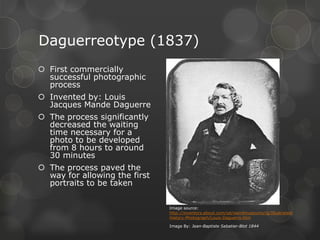
Daguerreotype (1837)
 First commercially
successful photographic
process
 Invented by: Louis
Jacques Mande Daguerre
 The process significantly
decreased the waiting
time necessary for a
photo to be developed
from 8 hours to around
30 minutes
 The process paved the
way for allowing the first
portraits to be taken
Image source:
http://inventors.about.com/od/weirdmuseums/ig/Illustrated-
History-Photograph/Louis-Daguerre.htm
Image By: Jean-Baptiste Sabatier-Blot 1844
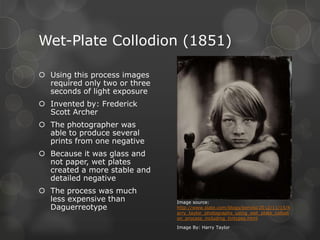
Wet-Plate Collodion (1851)
 Using this process images
required only two or three
seconds of light exposure
 Invented by: Frederick
Scott Archer
 The photographer was
able to produce several
prints from one negative
 Because it was glass and
not paper, wet plates
created a more stable and
detailed negative
 The process was much
less expensive than
Daguerreotype
Image source:
http://www.slate.com/blogs/behold/2012/11/15/h
arry_taylor_photographs_using_wet_plate_collodi
on_process_including_tintypes.html
Image By: Harry Taylor
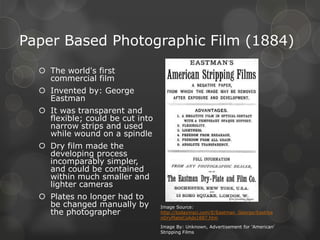
Paper Based Photographic Film (1884)
 The world's first
commercial film
 Invented by: George
Eastman
 It was transparent and
flexible; could be cut into
narrow strips and used
while wound on a spindle
 Dry film made the
developing process
incomparably simpler,
and could be contained
within much smaller and
lighter cameras
 Plates no longer had to
be changed manually by
the photographer
Image Source:
http://todayinsci.com/E/Eastman_George/Eastma
nDryPlateCoAds1887.htm
Image By: Unknown, Advertisement for 'American'
Stripping Films
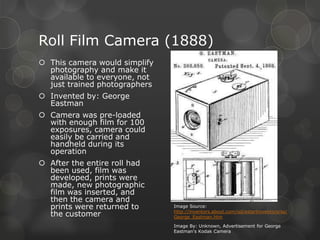
Roll Film Camera (1888)
 This camera would simplify
photography and make it
available to everyone, not
just trained photographers
 Invented by: George
Eastman
 Camera was pre-loaded
with enough film for 100
exposures, camera could
easily be carried and
handheld during its
operation
 After the entire roll had
been used, film was
developed, prints were
made, new photographic
film was inserted, and
then the camera and
prints were returned to
the customer
Image Source:
http://inventors.about.com/od/estartinventors/ss/
George_Eastman.htm
Image By: Unknown, Advertisement for George
Eastman's Kodak Camera
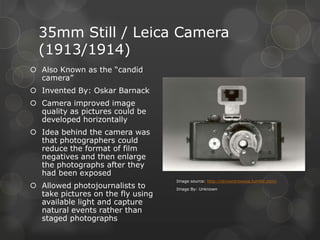
35mm Still / Leica Camera
(1913/1914)
 Also Known as the “candid
camera”
 Invented By: Oskar Barnack
 Camera improved image
quality as pictures could be
developed horizontally
 Idea behind the camera was
that photographers could
reduce the format of film
negatives and then enlarge
the photographs after they
had been exposed
 Allowed photojournalists to
take pictures on the fly using
available light and capture
natural events rather than
staged photographs
Image source: http://striversrowusa.tumblr.com/
Image By: Unknown
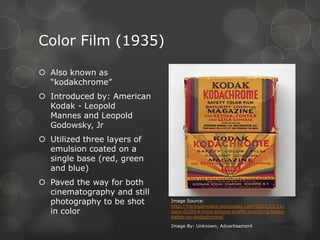
Color Film (1935)
 Also known as
“kodakchrome”
 Introduced by: American
Kodak - Leopold
Mannes and Leopold
Godowsky, Jr
 Utilized three layers of
emulsion coated on a
single base (red, green
and blue)
 Paved the way for both
cinematography and still
photography to be shot
in color
Image Source:
http://frankglencairn.wordpress.com/2012/01/11/
sony-fs100-k-tone-picture-profile-everyting-looks-
better-on-kodachrome/
Image By: Unknown, Advertisement
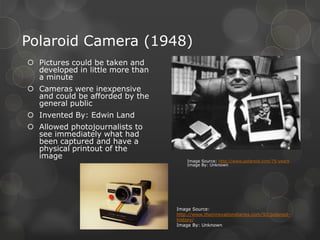
Polaroid Camera (1948)
 Pictures could be taken and
developed in little more than
a minute
 Cameras were inexpensive
and could be afforded by the
general public
 Invented By: Edwin Land
 Allowed photojournalists to
see immediately what had
been captured and have a
physical printout of the
image
Image Source: http://www.polaroid.com/75-years
Image By: Unknown
Image Source:
http://www.theinnovationdiaries.com/92/polaroid-
history/
Image By: Unknown
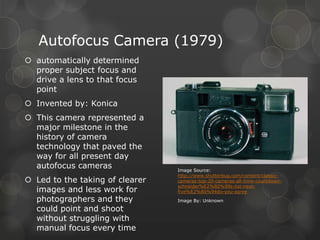
Autofocus Camera (1979)
 automatically determined
proper subject focus and
drive a lens to that focus
point
 Invented by: Konica
 This camera represented a
major milestone in the
history of camera
technology that paved the
way for all present day
autofocus cameras
 Led to the taking of clearer
images and less work for
photographers and they
could point and shoot
without struggling with
manual focus every time
Image Source:
http://www.shutterbug.com/content/classic-
cameras-top-20-cameras-all-time-countdown-
schneider%E2%80%99s-list-next-
five%E2%80%94do-you-agree
Image By: Unknown
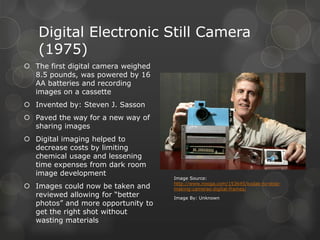
Digital Electronic Still Camera
(1975)
 The first digital camera weighed
8.5 pounds, was powered by 16
AA batteries and recording
images on a cassette
 Invented by: Steven J. Sasson
 Paved the way for a new way of
sharing images
 Digital imaging helped to
decrease costs by limiting
chemical usage and lessening
time expenses from dark room
image development
 Images could now be taken and
reviewed allowing for “better
photos” and more opportunity to
get the right shot without
wasting materials
Image Source:
http://www.nooga.com/153645/kodak-to-stop-
making-cameras-digital-frames/
Image By: Unknown
Additional Resources
 http://inventors.about.com/od/pstartinventions/a/Photogra
phy.htm
 http://inventors.about.com/od/pstartinventions/a/stilphotog
raphy_3.htm
 http://web.mit.edu/invent/iow/eastman.html
 http://todayinsci.com/E/Eastman_George/EastmanDryPlate
CoAds1887.htm
 http://www.kodak.com/ek/US/en/Our_Company/History_of
_Kodak/Milestones_-_chronology/1878-1929.htm
 http://www.polaroid.com.au/history
 http://kmbs.konicaminolta.us/wps/portal/web/home/about/
our-history
 http://ddunleavy.typepad.com/the_big_picture/2005/10/the
_digital_cam.html
 http://bluediamondphotography.blogspot.com/2011_12_01
_archive.html

Technology timeline

  • 1.
    History of Photojournalism TechnologyTimeline Nicole Dufresne
  • 2.
    Daguerreotype (1837)  Firstcommercially successful photographic process  Invented by: Louis Jacques Mande Daguerre  The process significantly decreased the waiting time necessary for a photo to be developed from 8 hours to around 30 minutes  The process paved the way for allowing the first portraits to be taken Image source: http://inventors.about.com/od/weirdmuseums/ig/Illustrated- History-Photograph/Louis-Daguerre.htm Image By: Jean-Baptiste Sabatier-Blot 1844
  • 3.
    Wet-Plate Collodion (1851) Using this process images required only two or three seconds of light exposure  Invented by: Frederick Scott Archer  The photographer was able to produce several prints from one negative  Because it was glass and not paper, wet plates created a more stable and detailed negative  The process was much less expensive than Daguerreotype Image source: http://www.slate.com/blogs/behold/2012/11/15/h arry_taylor_photographs_using_wet_plate_collodi on_process_including_tintypes.html Image By: Harry Taylor
  • 4.
    Paper Based PhotographicFilm (1884)  The world's first commercial film  Invented by: George Eastman  It was transparent and flexible; could be cut into narrow strips and used while wound on a spindle  Dry film made the developing process incomparably simpler, and could be contained within much smaller and lighter cameras  Plates no longer had to be changed manually by the photographer Image Source: http://todayinsci.com/E/Eastman_George/Eastma nDryPlateCoAds1887.htm Image By: Unknown, Advertisement for 'American' Stripping Films
  • 5.
    Roll Film Camera(1888)  This camera would simplify photography and make it available to everyone, not just trained photographers  Invented by: George Eastman  Camera was pre-loaded with enough film for 100 exposures, camera could easily be carried and handheld during its operation  After the entire roll had been used, film was developed, prints were made, new photographic film was inserted, and then the camera and prints were returned to the customer Image Source: http://inventors.about.com/od/estartinventors/ss/ George_Eastman.htm Image By: Unknown, Advertisement for George Eastman's Kodak Camera
  • 6.
    35mm Still /Leica Camera (1913/1914)  Also Known as the “candid camera”  Invented By: Oskar Barnack  Camera improved image quality as pictures could be developed horizontally  Idea behind the camera was that photographers could reduce the format of film negatives and then enlarge the photographs after they had been exposed  Allowed photojournalists to take pictures on the fly using available light and capture natural events rather than staged photographs Image source: http://striversrowusa.tumblr.com/ Image By: Unknown
  • 7.
    Color Film (1935) Also known as “kodakchrome”  Introduced by: American Kodak - Leopold Mannes and Leopold Godowsky, Jr  Utilized three layers of emulsion coated on a single base (red, green and blue)  Paved the way for both cinematography and still photography to be shot in color Image Source: http://frankglencairn.wordpress.com/2012/01/11/ sony-fs100-k-tone-picture-profile-everyting-looks- better-on-kodachrome/ Image By: Unknown, Advertisement
  • 8.
    Polaroid Camera (1948) Pictures could be taken and developed in little more than a minute  Cameras were inexpensive and could be afforded by the general public  Invented By: Edwin Land  Allowed photojournalists to see immediately what had been captured and have a physical printout of the image Image Source: http://www.polaroid.com/75-years Image By: Unknown Image Source: http://www.theinnovationdiaries.com/92/polaroid- history/ Image By: Unknown
  • 9.
    Autofocus Camera (1979) automatically determined proper subject focus and drive a lens to that focus point  Invented by: Konica  This camera represented a major milestone in the history of camera technology that paved the way for all present day autofocus cameras  Led to the taking of clearer images and less work for photographers and they could point and shoot without struggling with manual focus every time Image Source: http://www.shutterbug.com/content/classic- cameras-top-20-cameras-all-time-countdown- schneider%E2%80%99s-list-next- five%E2%80%94do-you-agree Image By: Unknown
  • 10.
    Digital Electronic StillCamera (1975)  The first digital camera weighed 8.5 pounds, was powered by 16 AA batteries and recording images on a cassette  Invented by: Steven J. Sasson  Paved the way for a new way of sharing images  Digital imaging helped to decrease costs by limiting chemical usage and lessening time expenses from dark room image development  Images could now be taken and reviewed allowing for “better photos” and more opportunity to get the right shot without wasting materials Image Source: http://www.nooga.com/153645/kodak-to-stop- making-cameras-digital-frames/ Image By: Unknown
  • 11.
    Additional Resources  http://inventors.about.com/od/pstartinventions/a/Photogra phy.htm http://inventors.about.com/od/pstartinventions/a/stilphotog raphy_3.htm  http://web.mit.edu/invent/iow/eastman.html  http://todayinsci.com/E/Eastman_George/EastmanDryPlate CoAds1887.htm  http://www.kodak.com/ek/US/en/Our_Company/History_of _Kodak/Milestones_-_chronology/1878-1929.htm  http://www.polaroid.com.au/history  http://kmbs.konicaminolta.us/wps/portal/web/home/about/ our-history  http://ddunleavy.typepad.com/the_big_picture/2005/10/the _digital_cam.html  http://bluediamondphotography.blogspot.com/2011_12_01 _archive.html