Technology Project #1Instructional Materials 5720-09 Carolyn Hilyard
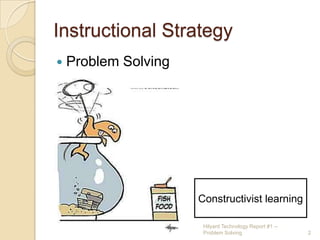
Instructional StrategyProblem SolvingConstructivist learning 2Hilyard Technology Report #1 -- Problem Solving
DefinitionProblem solving involves placing students in the active role of solving a real-world problem.3Hilyard Technology Report #1 -- Problem Solving
Students are presented with two types of problems to solve.Well-structured problems Specific issues where students use specific knowledge or skills.Ill-structured problemsComplex issues containing many components.4Hilyard Technology Report #1 -- Problem Solving
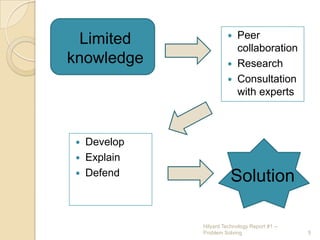
Peer collaborationResearchConsultation with expertsLimited knowledgeDevelopExplainDefendSolution5Hilyard Technology Report #1 -- Problem Solving
AdvantagesEngagingContext for learningLevels of complexity6Hilyard Technology Report #1 -- Problem Solving
DisadvantagesDifficult to createAge appropriatenessTime consumingRequires debriefing7Hilyard Technology Report #1 -- Problem Solving
IntegrationProblems can be from a variety of content areas:  math, science, social studies, and art.8Hilyard Technology Report #1 -- Problem Solving
Remember the two types of problems?Well-structured problems Ill-structured problemsEasier to developStudent is clear on appropriate responseExamples:Math word problemsWeb questMore difficult to arrangeMore than one way to solve Example:Ecology issue in the community9Hilyard Technology Report #1 -- Problem Solving
Outcomes and other usesStudents control the technology and control how and when it provides them with information (Smaldino, 2007).Can be used to help twice-exceptional students learn (Yssel, Prater, and Smith, 2010). 10Hilyard Technology Report #1 -- Problem Solving
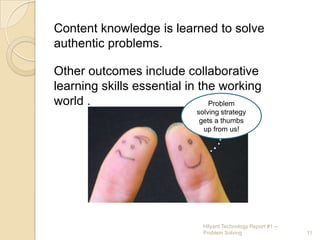
Content knowledge is learned to solve authentic problems.Other outcomes include collaborative learning skills essential in the working world .Problem solving strategy gets a thumbs up from us!11Hilyard Technology Report #1 -- Problem Solving

Technology project #1 - problem solving

  • 1.
    Technology Project #1InstructionalMaterials 5720-09 Carolyn Hilyard
  • 2.
    Instructional StrategyProblem SolvingConstructivistlearning 2Hilyard Technology Report #1 -- Problem Solving
  • 3.
    DefinitionProblem solving involvesplacing students in the active role of solving a real-world problem.3Hilyard Technology Report #1 -- Problem Solving
  • 4.
    Students are presentedwith two types of problems to solve.Well-structured problems Specific issues where students use specific knowledge or skills.Ill-structured problemsComplex issues containing many components.4Hilyard Technology Report #1 -- Problem Solving
  • 5.
    Peer collaborationResearchConsultation withexpertsLimited knowledgeDevelopExplainDefendSolution5Hilyard Technology Report #1 -- Problem Solving
  • 6.
    AdvantagesEngagingContext for learningLevelsof complexity6Hilyard Technology Report #1 -- Problem Solving
  • 7.
    DisadvantagesDifficult to createAgeappropriatenessTime consumingRequires debriefing7Hilyard Technology Report #1 -- Problem Solving
  • 8.
    IntegrationProblems can befrom a variety of content areas: math, science, social studies, and art.8Hilyard Technology Report #1 -- Problem Solving
  • 9.
    Remember the twotypes of problems?Well-structured problems Ill-structured problemsEasier to developStudent is clear on appropriate responseExamples:Math word problemsWeb questMore difficult to arrangeMore than one way to solve Example:Ecology issue in the community9Hilyard Technology Report #1 -- Problem Solving
  • 10.
    Outcomes and otherusesStudents control the technology and control how and when it provides them with information (Smaldino, 2007).Can be used to help twice-exceptional students learn (Yssel, Prater, and Smith, 2010). 10Hilyard Technology Report #1 -- Problem Solving
  • 11.
    Content knowledge islearned to solve authentic problems.Other outcomes include collaborative learning skills essential in the working world .Problem solving strategy gets a thumbs up from us!11Hilyard Technology Report #1 -- Problem Solving