Technical Illustration
The Future
November 7th 2019
11am Eastern Time, USA
Presenters:
Don Larson, CEO
David Manock, VP Sales & Marketing
Welcome to the Webinar
We will begin shortly
www.cgmlarson.com www.svglarson.com
www.cgmlarson.com
Copyright Larson Software Technology (c) 2019
www.cgmlarson.com
Copyright Larson Software Technology (c) 2019
Agenda
• Housekeeping
• Company Profile
• Introduction
• History of Illustration
• Present and Future Overview
• 2D and 3D graphics
• Technology
• Summary
• Q & A
SVG: Scalable Vector Graphics
a modularized language for describing
two-dimensional vector and mixed
vector/raster graphics in XML.
CGM: Computer Graphics Metafile
an ISO (International Organization for
Standardization) standard for vector
and composite vector/raster picture
definition since 1987.
X3D
an ISO-ratified, royalty-free open
standards XML file format and run-time
architecture communicating 3D scenes
and objects.
VRML: Virtual Reality Modeling Language
is a standard file format for
representing 3-dimensional
interactive vector graphics,
designed particularly with the
World Wide Web in mind. It has
been superseded by X3D
Webinar: Housekeeping
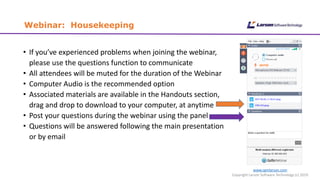
• If you’ve experienced problems when joining the webinar,
please use the questions function to communicate
• All attendees will be muted for the duration of the Webinar
• Computer Audio is the recommended option
• Associated materials are available in the Handouts section,
drag and drop to download to your computer, at anytime
• Post your questions during the webinar using the panel
• Questions will be answered following the main presentation
or by email
www.cgmlarson.com
Copyright Larson Software Technology (c) 2019
www.cgmlarson.com
Copyright Larson Software Technology (c) 2019
Larson Software Technology
• Based in Houston, Texas, USA – New Location
• Founded in 1984, graphic technology experts for 30 years
• We develop powerful, innovative graphics software and toolkits,
based on open standards
• Promoted CGM usage, by providing a free CGM & TIFF viewer,
replaced by a subscription version available online
• The Larson online store is now open, the address:
• www.cgmlarson.com/store
• Developer of the first HTML5 CGM viewer, no plug in!
• Member of the CGM Open Foundation
• Larson technology simplifies the graphics workflow for Technical
Publications Professionals, Engineers, Geologists, and Geophysicists
• www.cgmlarson.com www.svglarson.com
Introduction
www.cgmlarson.com
Copyright Larson Software Technology (c) 2019
• Where did technical illustration begin, history, origins?
• Provide some context for the presentation
• What is the future of technical illustration creation and delivery?
• The facts:
• There is a vast amount of 2D legacy data
• This will be continued to be used and revised
• We still require 2D software to perform the revision task
• The conversion of 3D CAD data to 2D illustrations is a common task when creating new
illustrations
• The use and delivery of 3D data will become more common, as the cost of hardware and
software reduces
• The use of AR (Augmented Reality) will increase, predominantly in the maintenance area
• The webinar will focus on the creation and delivery of 2D & 3D data
www.cgmlarson.com
Copyright Larson Software Technology (c) 2019
The History of Technical Illustration
History Overview – Part 1
www.cgmlarson.com
Copyright Larson Software Technology (c) 2019
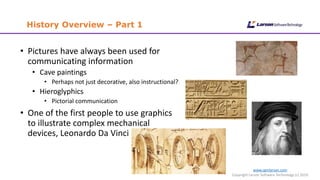
• Pictures have always been used for
communicating information
• Cave paintings
• Perhaps not just decorative, also instructional?
• Hieroglyphics
• Pictorial communication
• One of the first people to use graphics
to illustrate complex mechanical
devices, Leonardo Da Vinci
History Overview – Part 2
www.cgmlarson.com
Copyright Larson Software Technology (c) 2019
• Traditionally illustrations were created on the drawing board
• 3-point perspective, pencil illustration created from engineering drawings
• The Illustration was then traced and inked on translucent film
• The artwork was photographed before insertion into the master artwork
• The first major change was electronic
• The illustration could be scanned for insertion into desktop publishing
(Pagemaker)
• There were also the beginnings of creating the illustration electronically
• Adobe Illustrator and Coreldraw
• The introduction of specialized illustration software was a game
changer
• The first software was very expensive and only available on Unix Workstations
• The introduction of ITEDO IsoDraw on Apple Macintosh changed the market,
certainly from a cost paradigm
Technical Illustration - Examples
www.cgmlarson.com
Copyright Larson Software Technology (c) 2019
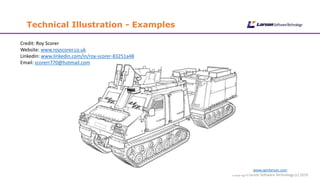
Credit: Roy Scorer
Website: www.royscorer.co.uk
Linkedin: www.linkedin.com/in/roy-scorer-83251a48
Email: scorerr770@hotmail.com
Technical Illustration - Examples
www.cgmlarson.com
Copyright Larson Software Technology (c) 2019
Credit: Roy Scorer
Website: www.royscorer.co.uk
Linkedin: www.linkedin.com/in/roy-scorer-83251a48
Email: scorerr770@hotmail.com
Technical Illustration - Examples
www.cgmlarson.com
Copyright Larson Software Technology (c) 2019
Credit: Roy Scorer
Website: www.royscorer.co.uk
Linkedin: www.linkedin.com/in/roy-scorer-83251a48
Email: scorerr770@hotmail.com
History Overview – Part 3
www.cgmlarson.com
Copyright Larson Software Technology (c) 2019
• Today, technical illustrations are created, revised and delivered
electronically
• Primarily the illustrations will be black and white, using a
simplified perspective projection, isometric
• They could have some technique, thick and thin lines, but if technique
increases the cost it could be sacrificed
• The creation of new illustrations would usually by reusing CAD
data
• Legacy illustrations, if they were scanned from hardcopy are
also edited electronically, image editor
• A hybrid file is possible containing vector and raster information
• Delivery file formats will vary dependent on the industry
• Aerospace, Defense and Automotive will primarily be CGM
www.cgmlarson.com
Copyright Larson Software Technology (c) 2019
2D and 3D Graphics
www.cgmlarson.com
Copyright Larson Software Technology (c) 2019
Poll #1
How does your organization currently display graphics in
your published technical manual?
 2D only
 2D and 3D
 3D only
 2D at the moment but we intend to publish 3D in the future
2D or 3D, that is the question?
www.cgmlarson.com
Copyright Larson Software Technology (c) 2019
• The overriding driver in technical publications will always be cost
• In the near term 2D will continue to dominate, still the most cost
effective and proven solution
• 2D also has the support of trusted open data formats, CGM, SVG,
PDF
• 3D is a more convoluted topic especially with respect to file
formats
• There are so many formats available, proprietary and open
• In standards driven publications (S1000D) is there a requirement
for an open 3D format?
• X3D a contender?
• It has the credentials being based on XML
XML Technical Publications - World View?
www.cgmlarson.com
Copyright Larson Software Technology (c) 2019
• Are we moving towards a technical publications industry
dominated by XML?
• Text and Graphics
• Text is already there after the move from SGML to XML
• Could graphics also now standardize on XML?
• Work required in definition
• 2D = SVG
• 3D = X3D
• The vision is certainly powerful from a data management and
delivery perspective
• Benefits
• Structured - Consistency
• Validation – Schema
• Appearance - Stylesheets
Technical Illustration – As is
www.cgmlarson.com
Copyright Larson Software Technology (c) 2019
• Today we are still in a 2D creation and delivery paradigm
• There is a huge archive of 2D illustrations
• It is unlikely the 2D illustrations will be converted to 3D
• Even when 3D CAD data became more easily accessible, it was converted 2D
• 3D graphics are predominately being used in spare parts catalogs
• There is a definite benefit, however, the creation cost is a factor
• The delivery and display of the 3D data is more problematic
• Currently there is no specified 3D file format for the S1000D and ATA
specifications
• In Aerospace and Defense the CGM format still dominates
• SVG is also being used mainly as a display format
Technical Illustration – To be
www.cgmlarson.com
Copyright Larson Software Technology (c) 2019
• So what does the future of technical illustration look like?
• Is it going to continue as predominantly 2D?
• Or a combination of the 2D and 3D?
• 3D, what are the benefits, dependencies, pitfalls and cost to deliver 3D
data?
• The benefits of 3D:
• Visually, easier to identify parts, view from any angle
• Animate parts in 3D, ideal for removal, repair and maintenance procedures
• Easily reuse CAD data, and update as the model changes
• The dependencies include:
• Does the 3D data exist and is it accessible?
• Is the software available to repurpose the CAD data?
Technical Illustration – To be (2)
www.cgmlarson.com
Copyright Larson Software Technology (c) 2019
• 3D pitfalls:
• Will the information display on the target devices?
• Does the customer still require hard copy information?
• 3D cost:
• Will it take more time to author the data?
• Do I have the correct the software to create the data, if not what is the cost?
• 2D, do we continue down the path of creating and delivering 2D data?
• In the short term it is still likely the majority of data will be 2D illustrations
• However, new illustrations will be originated from 3D data
Technical Illustration – To be (3)
www.cgmlarson.com
Copyright Larson Software Technology (c) 2019
• Legacy 2D illustrations:
• It is very unlikely the 2D legacy illustrations will be updated to 3D
• There are a vast amount of existing 2D illustrations, there will be a significant
cost to convert and validate
• Also the current delivery mechanism will need to be accounted for, either
electronic or hard copy
• There will need to be a compelling business case for a 3D conversion of this scale
to take place
• The probable future is a combination of the two, with 3D becoming
more common
www.cgmlarson.com
Copyright Larson Software Technology (c) 2019
The Formats 2D & 3D
Historical – The 2D formats
www.cgmlarson.com
Copyright Larson Software Technology (c) 2019
• CGM – A 2D graphics format with a long history of publishing quality graphics in
different environments
• The WebCGM profile was developed to deliver Vector Graphics on the Web
• Visit CGM Open for more information www.cgmopen.org
• SVG - Objective to deliver high quality vector graphics for the Web
• The development of SVG was influenced by other submissions to the W3C (World Wide Web
Consortium)
• VML - Vector Markup Language (Microsoft)
• PGML - Precision Graphics Markup Language (Postscript)
• The final decision was to base SVG on XML
• More information on the origins:
• Secret Origin of SVG
www.cgmlarson.com
Copyright Larson Software Technology (c) 2019
Commonality
• 2D Open formats accredited by the W3C (Not Proprietary)
• Suitable for the creation and maintenance of technical illustrations
• The only open graphical files that can be hybrid
• Both formats can contain editable Vector and Raster Data
• They have the potential to be validated
• CGM already has a defined profile, WebCGM adopted by the ATA and S1000D
specifications
• Metadata can be included in both file formats
• Provides the ability for interactive graphics
• SVG has the additional ability for animation and can be data driven
• Display of vector graphics in a web environment with out a plug-in technology
• The SVG support is native
• CGM display can be achieved using the Larson VizEx View HTML5 technology
• No Plugin required
www.cgmlarson.com
Copyright Larson Software Technology (c) 2019
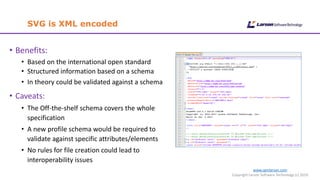
SVG is XML encoded
• Benefits:
• Based on the international open standard
• Structured information based on a schema
• In theory could be validated against a schema
• Caveats:
• The Off-the-shelf schema covers the whole
specification
• A new profile schema would be required to
validate against specific attributes/elements
• No rules for file creation could lead to
interoperability issues
Where is SVG used? – Industry Sector
www.cgmlarson.com
Copyright Larson Software Technology (c) 2019
• Aerospace & Defense and Automotive
• Over the past year, we’ve experienced a significant growth in the use of SVG
• Mainly for the display of vector graphics in a web environment
• GIS (Geographic Information System)
• Maps on the web
• But not Google maps!
• GIS Software Vendor
• https://www.esri.com
• Graphic Arts
• Graphics on the web, when vector will provide benefit
• Data Visualization
• Data driven images, animation, dashboards etc. One benefit of XML
• https://bl.ocks.org/kerryrodden/7090426
• Data Driven Documents
• https://d3js.org/
www.cgmlarson.com
Copyright Larson Software Technology (c) 2019
2D – The Future
• In the specifications driven environment CGM will continue to be the
primary format
• However, SVG will continue to grow as a viable display format
• Will SVG replace CGM in the specifications?
• This can only happen if SVG is supported by a profile
• It will also require the ability to be validated against the profile
• There would also be a requirement to amend the S1000D specification to
include SVG
• This is possible, but it would take some time and effort to achieve
• Is this likely? it is possible especially if the XML element of SVG is attractive
• SVG will not replace CGM, more likely you will have the choice of formats
• The first requirement will be the creation of an SVG profile
www.cgmlarson.com
Copyright Larson Software Technology (c) 2019
Standardization
www.cgmlarson.com
Copyright Larson Software Technology (c) 2019
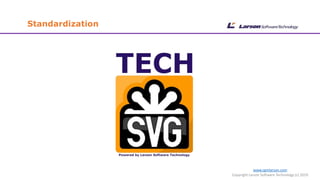
• What is TECH SVG?
• A subset of the Full and Tiny Specification’s
• We’ve documented and published the supported
elements
• How will TECH SVG help?
• Defining a standard method of exporting and importing SVG
elements
• Improve data exchange quality
• What else are we doing?
• Socializing our strategy and encouraging 3rd parties to
participate
• Specifically talking directly to the Aerospace and Defense
communities
• Work in Progress
• Developing our products to be TECH SVG compliant
• Work in Progress
TECH SVG
SVG - Full
SVG - Tiny
www.cgmlarson.com
Copyright Larson Software Technology (c) 2019
SVG - additional steps
• Now we have TECH SVG profile:
• We can create the schema and validate the SVG’s
• This will also provide the ability to roundtrip SVG files
• What else could do we do?
• There is also the potential to create stylesheets
• Perhaps stylesheets applicable to the device being used, or the context
of the illustration
• Resizes, rotates, etc.
• The other possibility is data driven graphics,
where the illustration would change
applicable to certain criteria
• A good example could be instrumentation
www.cgmlarson.com
Copyright Larson Software Technology (c) 2019
2D – In conclusion
• 2D Illustrations will continue to dominate, mainly because of the
volume of legacy data
• In the near term, new illustrations will still be created in 2D
• Where it makes sense 3D will be used, providing it adds value and
the creation is cost effective
• We still require good 2D editing software to maintain the legacy
archive of illustrations
• The use of SVG will continue to grow, but will require effort
to refine
• The SVG format will require work to produce a format you can rely
on for data exchange
www.cgmlarson.com
Copyright Larson Software Technology (c) 2019
Poll #2
What 3D CAD Systems do you work with?
 CATIA
 Creo
 Solidworks
 Inventor
 Other..
www.cgmlarson.com
Copyright Larson Software Technology (c) 2019
3D – As is
• The ability to deliver 3D data is increasing
• The hardware device component, desktop, laptop and mobile are
more capable of 3D data display
• The software and file format options are numerous
• 3D data is readily available from CAD systems:
• CATIA
• CREO
• Solidworks
• Inventor
• Etc.
• The main challenge is choosing the file format and repurposing
the data for an end-user
www.cgmlarson.com
Copyright Larson Software Technology (c) 2019
3D – As is - S1000D Authoring
• The Chapter provides basic guidelines for the use of 3D interactive
graphics
• The production of 3D content must be produced from verified and
authoritative engineering information
• 3D information usage is recommended where procedures are
complex, and users will benefit from the visualization
• The 3D graphics must contain appropriate warning's and cautions
when parts are removed
• 3.9.2.5 – Interactive 3D Content
www.cgmlarson.com
Copyright Larson Software Technology (c) 2019
3D – To be
• The mechanisms for creating and delivering 3D data in technical
publications is already in place
• The use of 3D at this time can be considered limited
• It is inevitable that the use will grow as solutions to create and
deliver are refined
• However, unlike 2D data there is no specified 3D file format
• If the S1000D community were to recommend a 3D format the
use could increase
• Larson would encourage the use of open 3D formats, preferably
based on XML, the core format of the specifications
www.cgmlarson.com
Copyright Larson Software Technology (c) 2019
Poll #3
What 3D file formats do you use for data interchange or
publishing/display?
 STEP
 DWG
 VRML
 3D PDF
 Other..
www.cgmlarson.com
Copyright Larson Software Technology (c) 2019
3D Open - Publishing Formats
• There are many 3D formats, however the proprietary ones
should be excluded
• What formats are available:
• X3D
• X3D is a royalty-free ISO/IEC standard for declaratively representing
3D computer graphics using XML
• PRC
• PRC is a 3D file format that can be used to embed 3D data in a PDF
file. This highly compressed format facilitates the storage of
different representations of a 3D model.
• U3D
• Universal 3D is a compressed file format standard for 3D computer
graphics data.
www.cgmlarson.com
Copyright Larson Software Technology (c) 2019
Why select X3D?
• An open format based on XML
• The ability to create a specific profile for the format
• Same idea as the TECH SVG profile
• An X3D schema will provide the ability validate files
• No plugin required to view in a web browser
• https://examples.x3dom.org/cadViewer/sceneGraphEngine/index.html
• https://examples.x3dom.org/CAD_Explosion/index.html
• Caveat:
• How do author the X3D files?
• Add the interactivity, hotspots
• Connection to parts lists
• Animations, procedural, assembly, disassembly
• Do we use existing software and export to X3D?
• Work will be required to develop a 3D standards compliant solution
www.cgmlarson.com
Copyright Larson Software Technology (c) 2019
Technology
The Solutions - Today and Future
www.cgmlarson.com
Copyright Larson Software Technology (c) 2019
2D – Editing and Conversion - VizEx Edit
• VizEx Edit, native CGM editing
• Import and Export of SVG files, TECH SVG compliant
• Uses the TECH SVG profile for the export SVG files
• CGM, fully complying to international specifications, S1000D, ATA.
• Add hotspot’s manually or automatically
• Hotspots created in VizEx Edit preserved in the SVG
• View the interactive graphic in VizEx View HTML5
• http://www.cgmlarson.com/demos/jsViewer/table_cgm_example/index.html
• Or, view as SVG in a popular web browser
www.cgmlarson.com
Copyright Larson Software Technology (c) 2019
2D - Batch conversion support of CGM & SVG
• Larson develops two batch conversion products
• Enabling the conversion of graphic files to CGM and SVG
• VizEx Transform – Multiple formats
• Convert CGM to Vector – SVG, PDF and EPS
• VizEx Transform
• Supports import and export of files, including SVG
• Enables batch auto-hotspotting
• Supports the TECH SVG profile when exporting an SVG graphic
• CONVERT CGM to Vector
• Batch conversion
• Exports SVG using the TECH SVG profile
www.cgmlarson.com
Copyright Larson Software Technology (c) 2019
New 2D Software - SVG Product Development
• SVG Viewer SDK
• Viewing environment for SVG graphics
• TECH SVG compliant
• Documented API
• Toolbox replicating CGM viewer environment
• SVG Illustration Software
• SVG graphics editing software
• TECH SVG compliant
• Leverage the SVG format using the power of XML
• Open, Data driven, Validation, Styling
www.cgmlarson.com
Copyright Larson Software Technology (c) 2019
New 3D Products – Product Development
• VizEx Edit - 3D to 2D conversion
• VRML to X3D conversion software
• We see this as a requirement to repurpose exiting 3D data
• X3D Viewing Toolkit
• As with SVG we want create an easy way to implement a 3D viewing
environment
• Supporting the X3D format
• Develop X3D Profile
• Develop X3D Schema
www.cgmlarson.com
Copyright Larson Software Technology (c) 2019
Summary
• Larson continues to make significant progress in supporting all graphic
formats
• Conversion, Compatibility and Compliance are the keywords
• Larson will continue develop standards compliant technology
• We employ a lessons learned strategy when supporting our software
• Benefiting the market and our customers
• The Larson product roadmap continues to mature, 2D and 3D
graphics is a significant part of the strategy
• We will be pleased to work with companies or organizations
interested in implementing 2D and 3D graphics solutions
Q&A
www.cgmlarson.com
Copyright Larson Software Technology (c) 2019
www.cgmlarson.com
Copyright Larson Software Technology (c) 2019
Demo

Technical illustration - The Future Webinar

  • 1.
    Technical Illustration The Future November7th 2019 11am Eastern Time, USA Presenters: Don Larson, CEO David Manock, VP Sales & Marketing Welcome to the Webinar We will begin shortly www.cgmlarson.com www.svglarson.com www.cgmlarson.com Copyright Larson Software Technology (c) 2019
  • 2.
    www.cgmlarson.com Copyright Larson SoftwareTechnology (c) 2019 Agenda • Housekeeping • Company Profile • Introduction • History of Illustration • Present and Future Overview • 2D and 3D graphics • Technology • Summary • Q & A SVG: Scalable Vector Graphics a modularized language for describing two-dimensional vector and mixed vector/raster graphics in XML. CGM: Computer Graphics Metafile an ISO (International Organization for Standardization) standard for vector and composite vector/raster picture definition since 1987. X3D an ISO-ratified, royalty-free open standards XML file format and run-time architecture communicating 3D scenes and objects. VRML: Virtual Reality Modeling Language is a standard file format for representing 3-dimensional interactive vector graphics, designed particularly with the World Wide Web in mind. It has been superseded by X3D
  • 3.
    Webinar: Housekeeping • Ifyou’ve experienced problems when joining the webinar, please use the questions function to communicate • All attendees will be muted for the duration of the Webinar • Computer Audio is the recommended option • Associated materials are available in the Handouts section, drag and drop to download to your computer, at anytime • Post your questions during the webinar using the panel • Questions will be answered following the main presentation or by email www.cgmlarson.com Copyright Larson Software Technology (c) 2019
  • 4.
    www.cgmlarson.com Copyright Larson SoftwareTechnology (c) 2019 Larson Software Technology • Based in Houston, Texas, USA – New Location • Founded in 1984, graphic technology experts for 30 years • We develop powerful, innovative graphics software and toolkits, based on open standards • Promoted CGM usage, by providing a free CGM & TIFF viewer, replaced by a subscription version available online • The Larson online store is now open, the address: • www.cgmlarson.com/store • Developer of the first HTML5 CGM viewer, no plug in! • Member of the CGM Open Foundation • Larson technology simplifies the graphics workflow for Technical Publications Professionals, Engineers, Geologists, and Geophysicists • www.cgmlarson.com www.svglarson.com
  • 5.
    Introduction www.cgmlarson.com Copyright Larson SoftwareTechnology (c) 2019 • Where did technical illustration begin, history, origins? • Provide some context for the presentation • What is the future of technical illustration creation and delivery? • The facts: • There is a vast amount of 2D legacy data • This will be continued to be used and revised • We still require 2D software to perform the revision task • The conversion of 3D CAD data to 2D illustrations is a common task when creating new illustrations • The use and delivery of 3D data will become more common, as the cost of hardware and software reduces • The use of AR (Augmented Reality) will increase, predominantly in the maintenance area • The webinar will focus on the creation and delivery of 2D & 3D data
  • 6.
    www.cgmlarson.com Copyright Larson SoftwareTechnology (c) 2019 The History of Technical Illustration
  • 7.
    History Overview –Part 1 www.cgmlarson.com Copyright Larson Software Technology (c) 2019 • Pictures have always been used for communicating information • Cave paintings • Perhaps not just decorative, also instructional? • Hieroglyphics • Pictorial communication • One of the first people to use graphics to illustrate complex mechanical devices, Leonardo Da Vinci
  • 8.
    History Overview –Part 2 www.cgmlarson.com Copyright Larson Software Technology (c) 2019 • Traditionally illustrations were created on the drawing board • 3-point perspective, pencil illustration created from engineering drawings • The Illustration was then traced and inked on translucent film • The artwork was photographed before insertion into the master artwork • The first major change was electronic • The illustration could be scanned for insertion into desktop publishing (Pagemaker) • There were also the beginnings of creating the illustration electronically • Adobe Illustrator and Coreldraw • The introduction of specialized illustration software was a game changer • The first software was very expensive and only available on Unix Workstations • The introduction of ITEDO IsoDraw on Apple Macintosh changed the market, certainly from a cost paradigm
  • 9.
    Technical Illustration -Examples www.cgmlarson.com Copyright Larson Software Technology (c) 2019 Credit: Roy Scorer Website: www.royscorer.co.uk Linkedin: www.linkedin.com/in/roy-scorer-83251a48 Email: scorerr770@hotmail.com
  • 10.
    Technical Illustration -Examples www.cgmlarson.com Copyright Larson Software Technology (c) 2019 Credit: Roy Scorer Website: www.royscorer.co.uk Linkedin: www.linkedin.com/in/roy-scorer-83251a48 Email: scorerr770@hotmail.com
  • 11.
    Technical Illustration -Examples www.cgmlarson.com Copyright Larson Software Technology (c) 2019 Credit: Roy Scorer Website: www.royscorer.co.uk Linkedin: www.linkedin.com/in/roy-scorer-83251a48 Email: scorerr770@hotmail.com
  • 12.
    History Overview –Part 3 www.cgmlarson.com Copyright Larson Software Technology (c) 2019 • Today, technical illustrations are created, revised and delivered electronically • Primarily the illustrations will be black and white, using a simplified perspective projection, isometric • They could have some technique, thick and thin lines, but if technique increases the cost it could be sacrificed • The creation of new illustrations would usually by reusing CAD data • Legacy illustrations, if they were scanned from hardcopy are also edited electronically, image editor • A hybrid file is possible containing vector and raster information • Delivery file formats will vary dependent on the industry • Aerospace, Defense and Automotive will primarily be CGM
  • 13.
    www.cgmlarson.com Copyright Larson SoftwareTechnology (c) 2019 2D and 3D Graphics
  • 14.
    www.cgmlarson.com Copyright Larson SoftwareTechnology (c) 2019 Poll #1 How does your organization currently display graphics in your published technical manual?  2D only  2D and 3D  3D only  2D at the moment but we intend to publish 3D in the future
  • 15.
    2D or 3D,that is the question? www.cgmlarson.com Copyright Larson Software Technology (c) 2019 • The overriding driver in technical publications will always be cost • In the near term 2D will continue to dominate, still the most cost effective and proven solution • 2D also has the support of trusted open data formats, CGM, SVG, PDF • 3D is a more convoluted topic especially with respect to file formats • There are so many formats available, proprietary and open • In standards driven publications (S1000D) is there a requirement for an open 3D format? • X3D a contender? • It has the credentials being based on XML
  • 16.
    XML Technical Publications- World View? www.cgmlarson.com Copyright Larson Software Technology (c) 2019 • Are we moving towards a technical publications industry dominated by XML? • Text and Graphics • Text is already there after the move from SGML to XML • Could graphics also now standardize on XML? • Work required in definition • 2D = SVG • 3D = X3D • The vision is certainly powerful from a data management and delivery perspective • Benefits • Structured - Consistency • Validation – Schema • Appearance - Stylesheets
  • 17.
    Technical Illustration –As is www.cgmlarson.com Copyright Larson Software Technology (c) 2019 • Today we are still in a 2D creation and delivery paradigm • There is a huge archive of 2D illustrations • It is unlikely the 2D illustrations will be converted to 3D • Even when 3D CAD data became more easily accessible, it was converted 2D • 3D graphics are predominately being used in spare parts catalogs • There is a definite benefit, however, the creation cost is a factor • The delivery and display of the 3D data is more problematic • Currently there is no specified 3D file format for the S1000D and ATA specifications • In Aerospace and Defense the CGM format still dominates • SVG is also being used mainly as a display format
  • 18.
    Technical Illustration –To be www.cgmlarson.com Copyright Larson Software Technology (c) 2019 • So what does the future of technical illustration look like? • Is it going to continue as predominantly 2D? • Or a combination of the 2D and 3D? • 3D, what are the benefits, dependencies, pitfalls and cost to deliver 3D data? • The benefits of 3D: • Visually, easier to identify parts, view from any angle • Animate parts in 3D, ideal for removal, repair and maintenance procedures • Easily reuse CAD data, and update as the model changes • The dependencies include: • Does the 3D data exist and is it accessible? • Is the software available to repurpose the CAD data?
  • 19.
    Technical Illustration –To be (2) www.cgmlarson.com Copyright Larson Software Technology (c) 2019 • 3D pitfalls: • Will the information display on the target devices? • Does the customer still require hard copy information? • 3D cost: • Will it take more time to author the data? • Do I have the correct the software to create the data, if not what is the cost? • 2D, do we continue down the path of creating and delivering 2D data? • In the short term it is still likely the majority of data will be 2D illustrations • However, new illustrations will be originated from 3D data
  • 20.
    Technical Illustration –To be (3) www.cgmlarson.com Copyright Larson Software Technology (c) 2019 • Legacy 2D illustrations: • It is very unlikely the 2D legacy illustrations will be updated to 3D • There are a vast amount of existing 2D illustrations, there will be a significant cost to convert and validate • Also the current delivery mechanism will need to be accounted for, either electronic or hard copy • There will need to be a compelling business case for a 3D conversion of this scale to take place • The probable future is a combination of the two, with 3D becoming more common
  • 21.
    www.cgmlarson.com Copyright Larson SoftwareTechnology (c) 2019 The Formats 2D & 3D
  • 22.
    Historical – The2D formats www.cgmlarson.com Copyright Larson Software Technology (c) 2019 • CGM – A 2D graphics format with a long history of publishing quality graphics in different environments • The WebCGM profile was developed to deliver Vector Graphics on the Web • Visit CGM Open for more information www.cgmopen.org • SVG - Objective to deliver high quality vector graphics for the Web • The development of SVG was influenced by other submissions to the W3C (World Wide Web Consortium) • VML - Vector Markup Language (Microsoft) • PGML - Precision Graphics Markup Language (Postscript) • The final decision was to base SVG on XML • More information on the origins: • Secret Origin of SVG
  • 23.
    www.cgmlarson.com Copyright Larson SoftwareTechnology (c) 2019 Commonality • 2D Open formats accredited by the W3C (Not Proprietary) • Suitable for the creation and maintenance of technical illustrations • The only open graphical files that can be hybrid • Both formats can contain editable Vector and Raster Data • They have the potential to be validated • CGM already has a defined profile, WebCGM adopted by the ATA and S1000D specifications • Metadata can be included in both file formats • Provides the ability for interactive graphics • SVG has the additional ability for animation and can be data driven • Display of vector graphics in a web environment with out a plug-in technology • The SVG support is native • CGM display can be achieved using the Larson VizEx View HTML5 technology • No Plugin required
  • 24.
    www.cgmlarson.com Copyright Larson SoftwareTechnology (c) 2019 SVG is XML encoded • Benefits: • Based on the international open standard • Structured information based on a schema • In theory could be validated against a schema • Caveats: • The Off-the-shelf schema covers the whole specification • A new profile schema would be required to validate against specific attributes/elements • No rules for file creation could lead to interoperability issues
  • 25.
    Where is SVGused? – Industry Sector www.cgmlarson.com Copyright Larson Software Technology (c) 2019 • Aerospace & Defense and Automotive • Over the past year, we’ve experienced a significant growth in the use of SVG • Mainly for the display of vector graphics in a web environment • GIS (Geographic Information System) • Maps on the web • But not Google maps! • GIS Software Vendor • https://www.esri.com • Graphic Arts • Graphics on the web, when vector will provide benefit • Data Visualization • Data driven images, animation, dashboards etc. One benefit of XML • https://bl.ocks.org/kerryrodden/7090426 • Data Driven Documents • https://d3js.org/
  • 26.
    www.cgmlarson.com Copyright Larson SoftwareTechnology (c) 2019 2D – The Future • In the specifications driven environment CGM will continue to be the primary format • However, SVG will continue to grow as a viable display format • Will SVG replace CGM in the specifications? • This can only happen if SVG is supported by a profile • It will also require the ability to be validated against the profile • There would also be a requirement to amend the S1000D specification to include SVG • This is possible, but it would take some time and effort to achieve • Is this likely? it is possible especially if the XML element of SVG is attractive • SVG will not replace CGM, more likely you will have the choice of formats • The first requirement will be the creation of an SVG profile
  • 27.
    www.cgmlarson.com Copyright Larson SoftwareTechnology (c) 2019 Standardization
  • 28.
    www.cgmlarson.com Copyright Larson SoftwareTechnology (c) 2019 • What is TECH SVG? • A subset of the Full and Tiny Specification’s • We’ve documented and published the supported elements • How will TECH SVG help? • Defining a standard method of exporting and importing SVG elements • Improve data exchange quality • What else are we doing? • Socializing our strategy and encouraging 3rd parties to participate • Specifically talking directly to the Aerospace and Defense communities • Work in Progress • Developing our products to be TECH SVG compliant • Work in Progress TECH SVG SVG - Full SVG - Tiny
  • 29.
    www.cgmlarson.com Copyright Larson SoftwareTechnology (c) 2019 SVG - additional steps • Now we have TECH SVG profile: • We can create the schema and validate the SVG’s • This will also provide the ability to roundtrip SVG files • What else could do we do? • There is also the potential to create stylesheets • Perhaps stylesheets applicable to the device being used, or the context of the illustration • Resizes, rotates, etc. • The other possibility is data driven graphics, where the illustration would change applicable to certain criteria • A good example could be instrumentation
  • 30.
    www.cgmlarson.com Copyright Larson SoftwareTechnology (c) 2019 2D – In conclusion • 2D Illustrations will continue to dominate, mainly because of the volume of legacy data • In the near term, new illustrations will still be created in 2D • Where it makes sense 3D will be used, providing it adds value and the creation is cost effective • We still require good 2D editing software to maintain the legacy archive of illustrations • The use of SVG will continue to grow, but will require effort to refine • The SVG format will require work to produce a format you can rely on for data exchange
  • 31.
    www.cgmlarson.com Copyright Larson SoftwareTechnology (c) 2019 Poll #2 What 3D CAD Systems do you work with?  CATIA  Creo  Solidworks  Inventor  Other..
  • 32.
    www.cgmlarson.com Copyright Larson SoftwareTechnology (c) 2019 3D – As is • The ability to deliver 3D data is increasing • The hardware device component, desktop, laptop and mobile are more capable of 3D data display • The software and file format options are numerous • 3D data is readily available from CAD systems: • CATIA • CREO • Solidworks • Inventor • Etc. • The main challenge is choosing the file format and repurposing the data for an end-user
  • 33.
    www.cgmlarson.com Copyright Larson SoftwareTechnology (c) 2019 3D – As is - S1000D Authoring • The Chapter provides basic guidelines for the use of 3D interactive graphics • The production of 3D content must be produced from verified and authoritative engineering information • 3D information usage is recommended where procedures are complex, and users will benefit from the visualization • The 3D graphics must contain appropriate warning's and cautions when parts are removed • 3.9.2.5 – Interactive 3D Content
  • 34.
    www.cgmlarson.com Copyright Larson SoftwareTechnology (c) 2019 3D – To be • The mechanisms for creating and delivering 3D data in technical publications is already in place • The use of 3D at this time can be considered limited • It is inevitable that the use will grow as solutions to create and deliver are refined • However, unlike 2D data there is no specified 3D file format • If the S1000D community were to recommend a 3D format the use could increase • Larson would encourage the use of open 3D formats, preferably based on XML, the core format of the specifications
  • 35.
    www.cgmlarson.com Copyright Larson SoftwareTechnology (c) 2019 Poll #3 What 3D file formats do you use for data interchange or publishing/display?  STEP  DWG  VRML  3D PDF  Other..
  • 36.
    www.cgmlarson.com Copyright Larson SoftwareTechnology (c) 2019 3D Open - Publishing Formats • There are many 3D formats, however the proprietary ones should be excluded • What formats are available: • X3D • X3D is a royalty-free ISO/IEC standard for declaratively representing 3D computer graphics using XML • PRC • PRC is a 3D file format that can be used to embed 3D data in a PDF file. This highly compressed format facilitates the storage of different representations of a 3D model. • U3D • Universal 3D is a compressed file format standard for 3D computer graphics data.
  • 37.
    www.cgmlarson.com Copyright Larson SoftwareTechnology (c) 2019 Why select X3D? • An open format based on XML • The ability to create a specific profile for the format • Same idea as the TECH SVG profile • An X3D schema will provide the ability validate files • No plugin required to view in a web browser • https://examples.x3dom.org/cadViewer/sceneGraphEngine/index.html • https://examples.x3dom.org/CAD_Explosion/index.html • Caveat: • How do author the X3D files? • Add the interactivity, hotspots • Connection to parts lists • Animations, procedural, assembly, disassembly • Do we use existing software and export to X3D? • Work will be required to develop a 3D standards compliant solution
  • 38.
    www.cgmlarson.com Copyright Larson SoftwareTechnology (c) 2019 Technology The Solutions - Today and Future
  • 39.
    www.cgmlarson.com Copyright Larson SoftwareTechnology (c) 2019 2D – Editing and Conversion - VizEx Edit • VizEx Edit, native CGM editing • Import and Export of SVG files, TECH SVG compliant • Uses the TECH SVG profile for the export SVG files • CGM, fully complying to international specifications, S1000D, ATA. • Add hotspot’s manually or automatically • Hotspots created in VizEx Edit preserved in the SVG • View the interactive graphic in VizEx View HTML5 • http://www.cgmlarson.com/demos/jsViewer/table_cgm_example/index.html • Or, view as SVG in a popular web browser
  • 40.
    www.cgmlarson.com Copyright Larson SoftwareTechnology (c) 2019 2D - Batch conversion support of CGM & SVG • Larson develops two batch conversion products • Enabling the conversion of graphic files to CGM and SVG • VizEx Transform – Multiple formats • Convert CGM to Vector – SVG, PDF and EPS • VizEx Transform • Supports import and export of files, including SVG • Enables batch auto-hotspotting • Supports the TECH SVG profile when exporting an SVG graphic • CONVERT CGM to Vector • Batch conversion • Exports SVG using the TECH SVG profile
  • 41.
    www.cgmlarson.com Copyright Larson SoftwareTechnology (c) 2019 New 2D Software - SVG Product Development • SVG Viewer SDK • Viewing environment for SVG graphics • TECH SVG compliant • Documented API • Toolbox replicating CGM viewer environment • SVG Illustration Software • SVG graphics editing software • TECH SVG compliant • Leverage the SVG format using the power of XML • Open, Data driven, Validation, Styling
  • 42.
    www.cgmlarson.com Copyright Larson SoftwareTechnology (c) 2019 New 3D Products – Product Development • VizEx Edit - 3D to 2D conversion • VRML to X3D conversion software • We see this as a requirement to repurpose exiting 3D data • X3D Viewing Toolkit • As with SVG we want create an easy way to implement a 3D viewing environment • Supporting the X3D format • Develop X3D Profile • Develop X3D Schema
  • 43.
    www.cgmlarson.com Copyright Larson SoftwareTechnology (c) 2019 Summary • Larson continues to make significant progress in supporting all graphic formats • Conversion, Compatibility and Compliance are the keywords • Larson will continue develop standards compliant technology • We employ a lessons learned strategy when supporting our software • Benefiting the market and our customers • The Larson product roadmap continues to mature, 2D and 3D graphics is a significant part of the strategy • We will be pleased to work with companies or organizations interested in implementing 2D and 3D graphics solutions
  • 44.
  • 45.