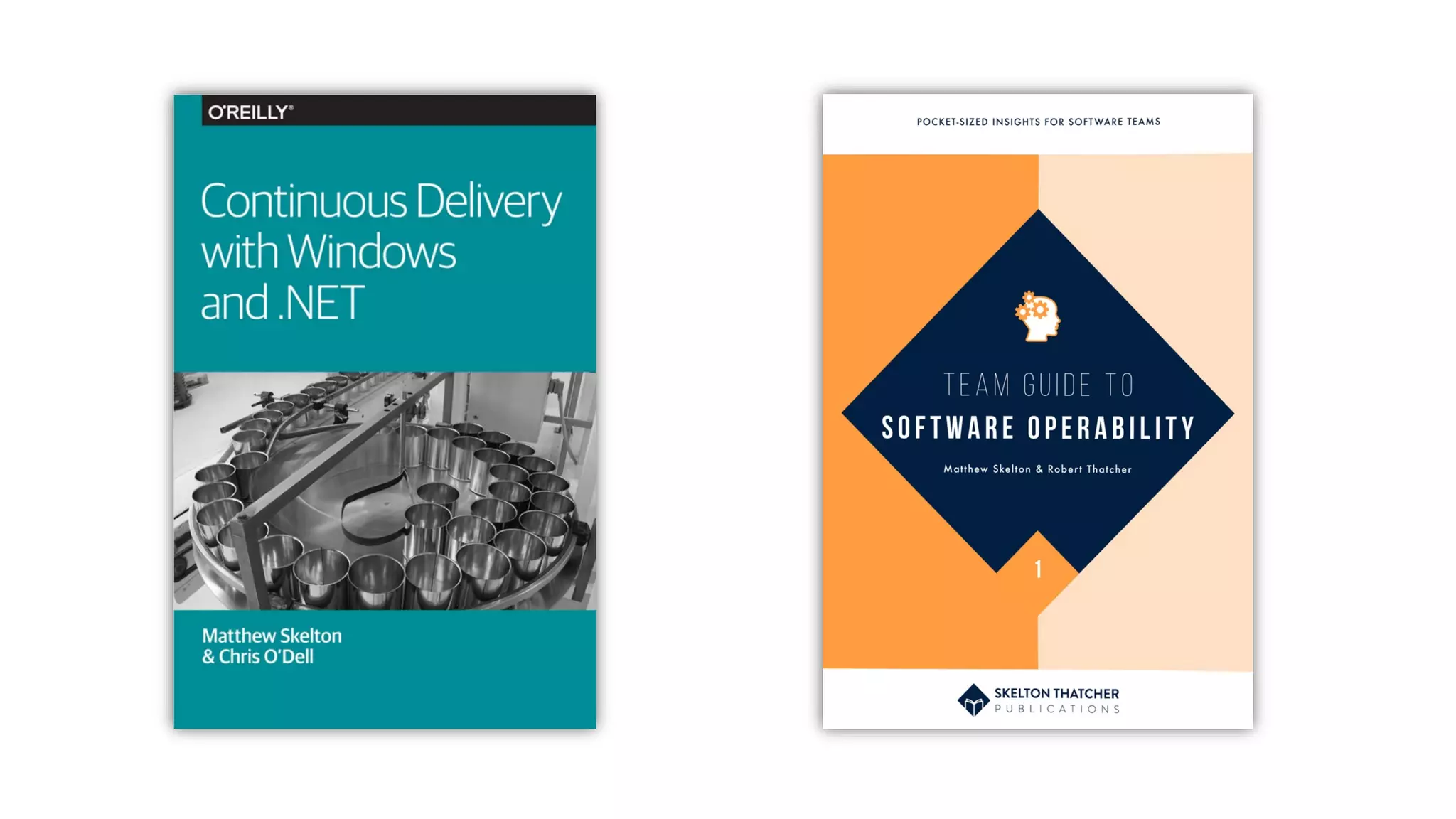
How to break apart a
monolithic system safely
without destroying your team
Matthew Skelton, Skelton Thatcher Consulting
@matthewpskelton
LondonCD meetup: 11 Oct 2016
#londoncd
Today
Cognitive load for teams
‘Monolith’
Code Forensics
Team-first boundaries
Monolith-splitting recipe
For now, let’s forget:
Microservices
CQRS / Event Sourcing
Queues
(Architectural changes)
Continuous Delivery / etc…
30+ organisations
UK, US, EU, India, China
How to break apart a
monolithic system safely
without destroying your
team
Safer, more rapid changes
to software systems
(Business Agility)
A ‘team-first’ approach to
software subsystem
boundaries
TEAM
TEAM
capabilities
appetite & aptitude
understanding
responsibilities
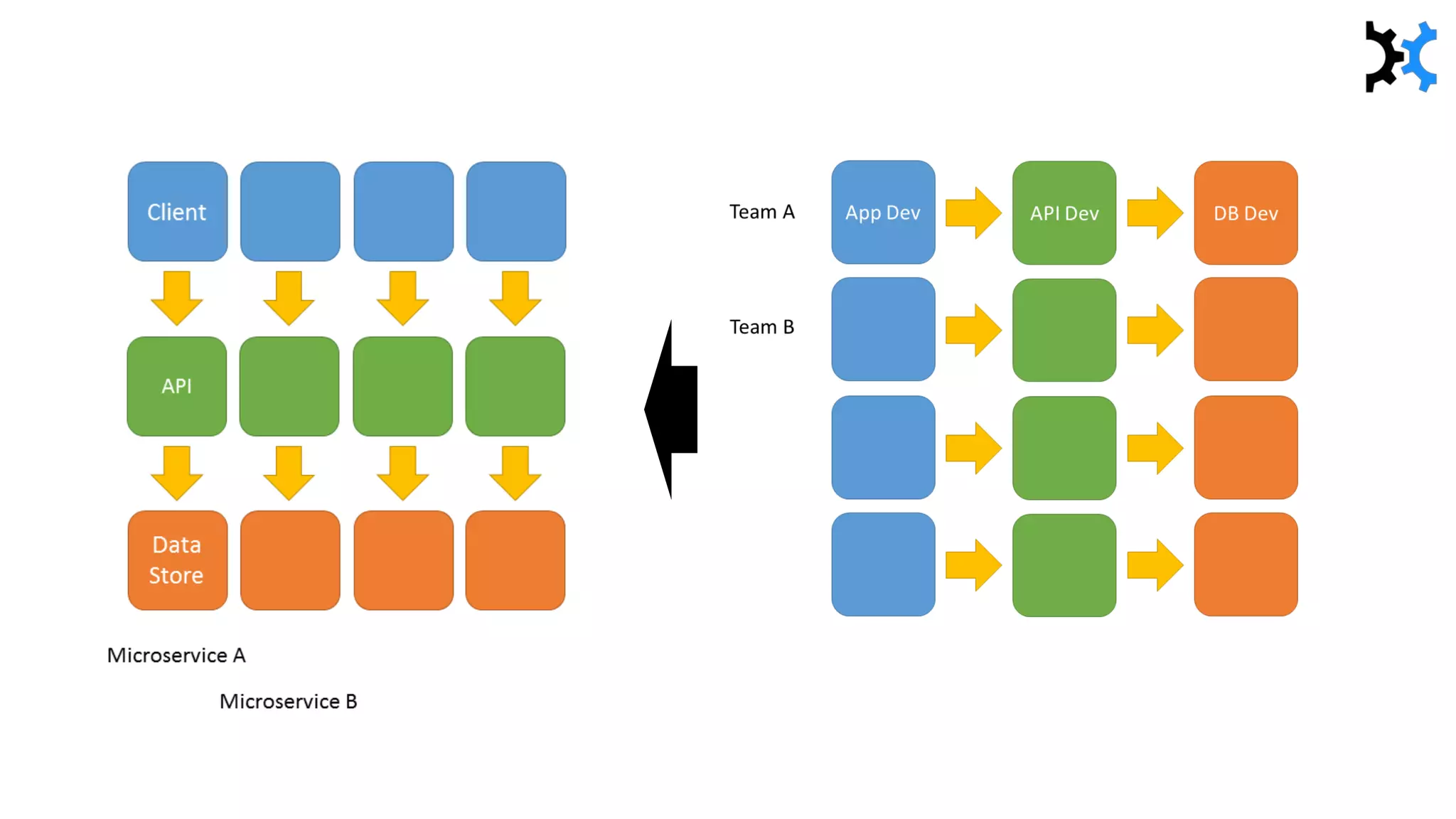
Conway’s Law
‘Reverse Conway’
Tobbe Gyllebring (@drunkcod)
homomorphic force
(#Conway  #Yawnoc)
HT @allankellynet
(same) (shape)
Cognitive load for teams
We have SCIENCE!
Cognitive load for teams
• Driskell et al, 1999 ‘Does Stress Lead to a Loss of Team Perspective?’
Group Dynamics: Theory, Research, and Practice 3, no. 4 (1999): 291.
• Fan et al, 2010 ‘Learning HMM-Based Cognitive Load Models for
Supporting Human-Agent Teamwork’. Cognitive Systems Research 11,
no. 1 (2010): 108–119.
• Ilgen & Hollenbeck, 1993 ‘Effective Team Performance under Stress
and Normal Conditions: An Experimental Paradigm, Theory and Data
for Studying Team Decision Making in Hierarchical Teams with
Distributed Expertise’. DTIC Document, 1993.
• Johnston et al, 2002 ‘Application of Cognitive Load Theory to
Developing a Measure of Team Decision Efficiency’. DTIC Document,
2002.
“stress impacts team
performance … by narrowing
or weakening the team-level
perspective required for
effective team behavior.”
– Driskell et al, 1999
Group Dynamics: Theory, Research, and Practice 1999, Vol. 3, No. 4,291-302
‘Monolith’
“Don’t start with a monolith
when your goal is a
microservices architecture”
– Stefan Tilkov, innoQ
http://martinfowler.com/articles/dont-start-monolith.html
“Start monolithic and extract”
– Tammer Saleh, Pivotal
https://www.infoq.com/presentations/cloud-anti-patterns
A ‘team-first’ approach to
software subsystem
boundaries
Types of software monoliths
•Application monolith
•Joined at the DB
•Monolithic releases (coupled)
•Monolithic thinking (standardisation)
…
Application
monolith
Single block of code
Deployed as a unit
Joined at
the DB
Difficult to change
separately (but not
impossible)
Risk is (probably)
elevated
Chris Collyer, http://www.stone-circles.org.uk/stone/pentreifan.htm
Monolithic
releases
Smaller components
bundled together into a
‘release’
Monolithic
thinking
‘One-size-fits-all’ for
teams
Assumption that
minimising variation is
A Good Thing
Dangers of splitting a
monolith
•Reduced domain consistency (UX,
Architecture, Data)
•Data duplication (unintentional)
•Additional operational complexity due to
distributed system and async messaging
•Degraded UX across the product
Splitting a
monolith
Reiner Flassig - CC BY-SA 2.0 de - Wikipedia
Choose the right
technique for splitting
Understand the nature
of the monolith
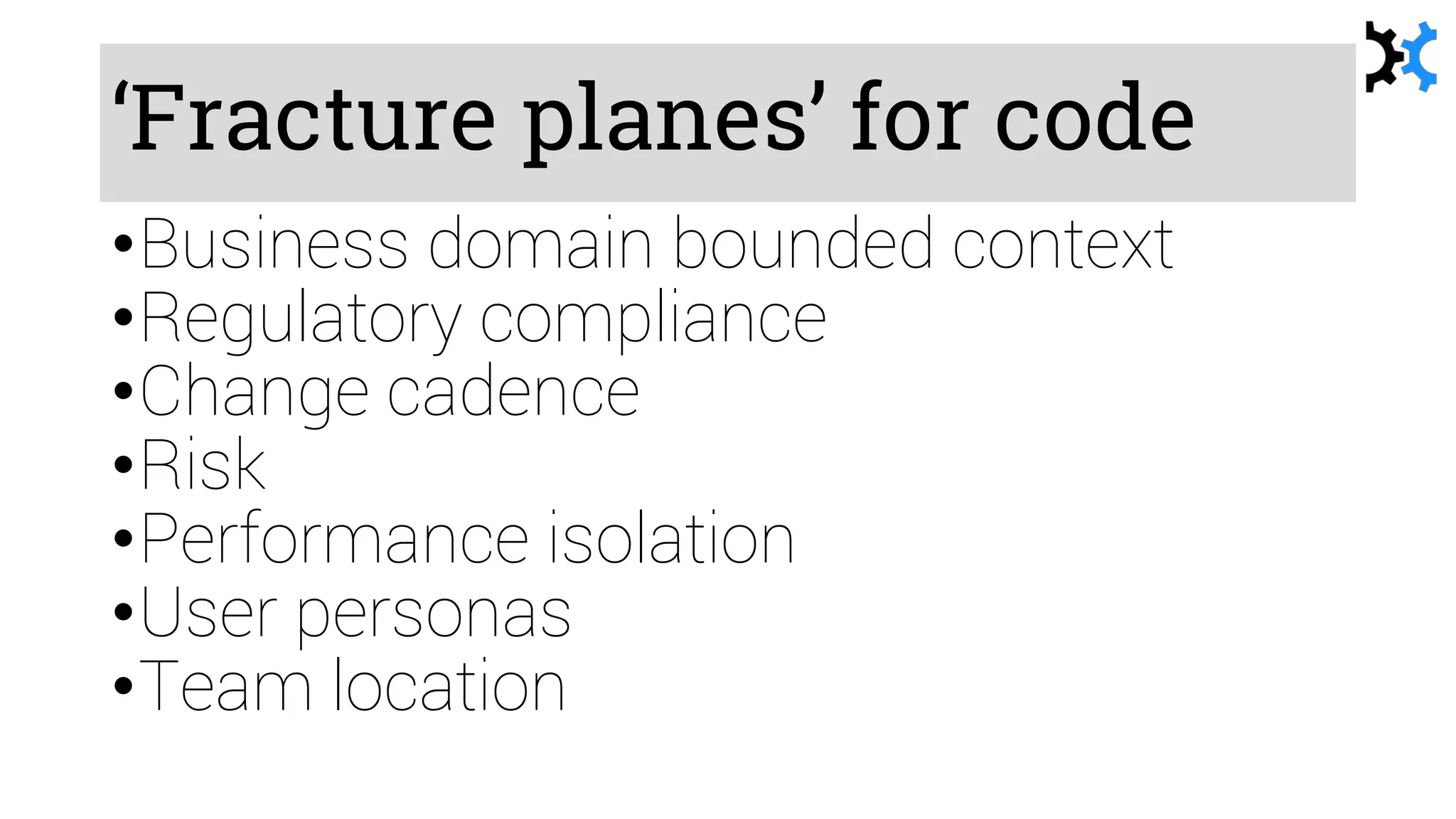
‘Fracture planes’ for code
•Business domain bounded context
•Regulatory compliance
•Change cadence
•Risk
•Performance isolation
•User personas
•Team location
Code Forensics
Forensics
Your Code as a
Crime Scene
Adam Tornhill
Adam Tornhill
Code, Crime, Complexity:
Analyzing software with
forensic psychology
Adam Tornhill
TEDxTrondheim
youtube.com/watch?v=qJ_hplxTYJw
‘Code Maat’ tool
Adam Tornhill, http://www.adamtornhill.com/articles/crimescene/codeascrimescene.htm
Code City plus Code Maat forensics
Beware of badly-named
subsystems
"information-poor abstract
names are magnets for extra
[unwanted] responsibilities"
– Adam Tornhill
p.185, Your Code as a Crime Scene
Team-first boundaries
DevOpsTopologies.com
Team types
Component team
Platform / ’substrate’ team
Supporting / ‘productivity’ team
Product/Feature team
Team types
devopstopologies.com
Component team
Platform / ’substrate’ team
Supporting / ‘productivity’ team
Product/Feature team
Code repositories
Align repositories to subsystem
boundaries
Avoid monolithic-y repos like TFS*
* Don’t get me started on TFS, grrr…
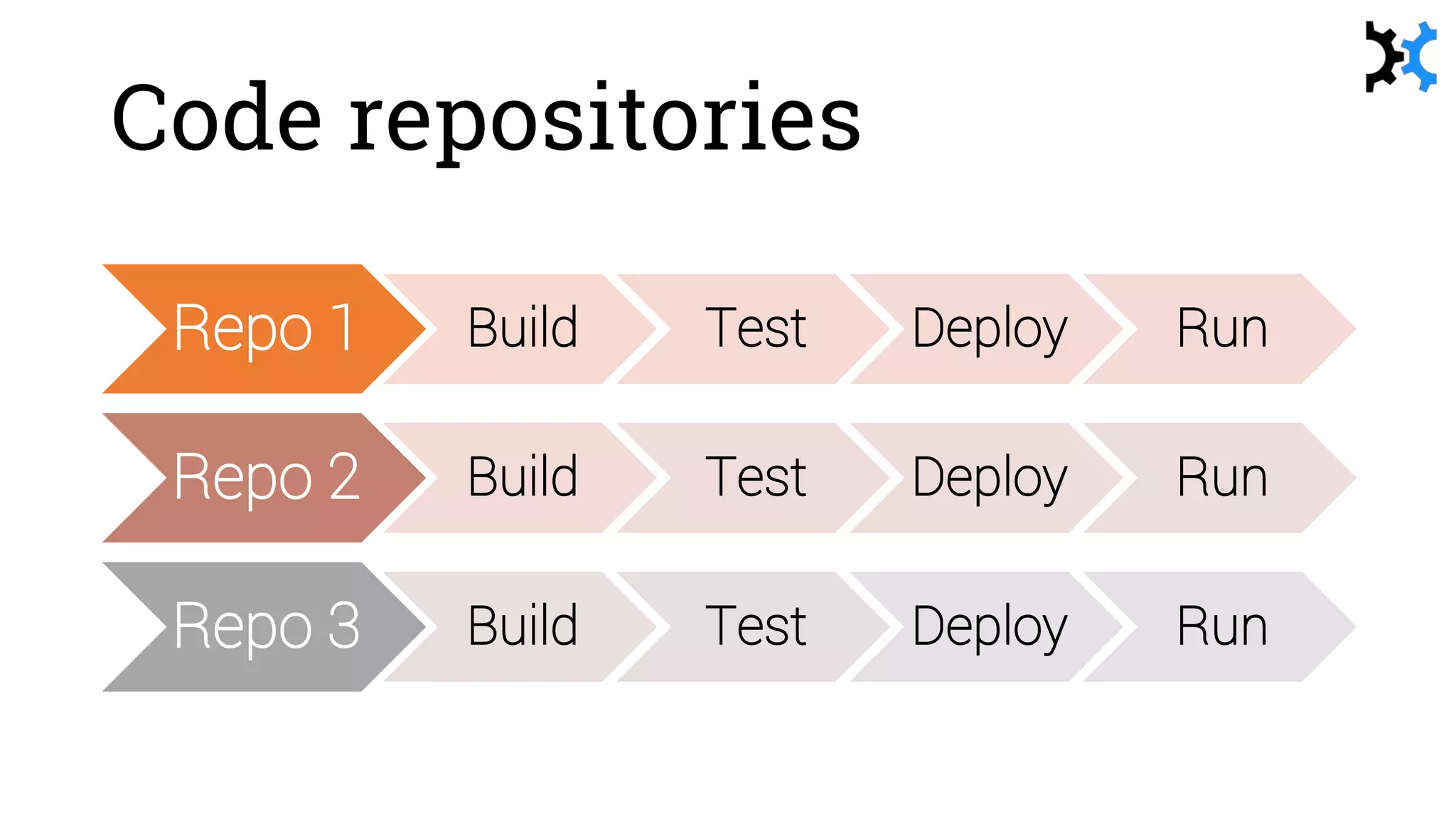
Code repositories
Repo 1 Build Test Deploy Run
Repo 2 Build Test Deploy Run
Repo 3 Build Test Deploy Run
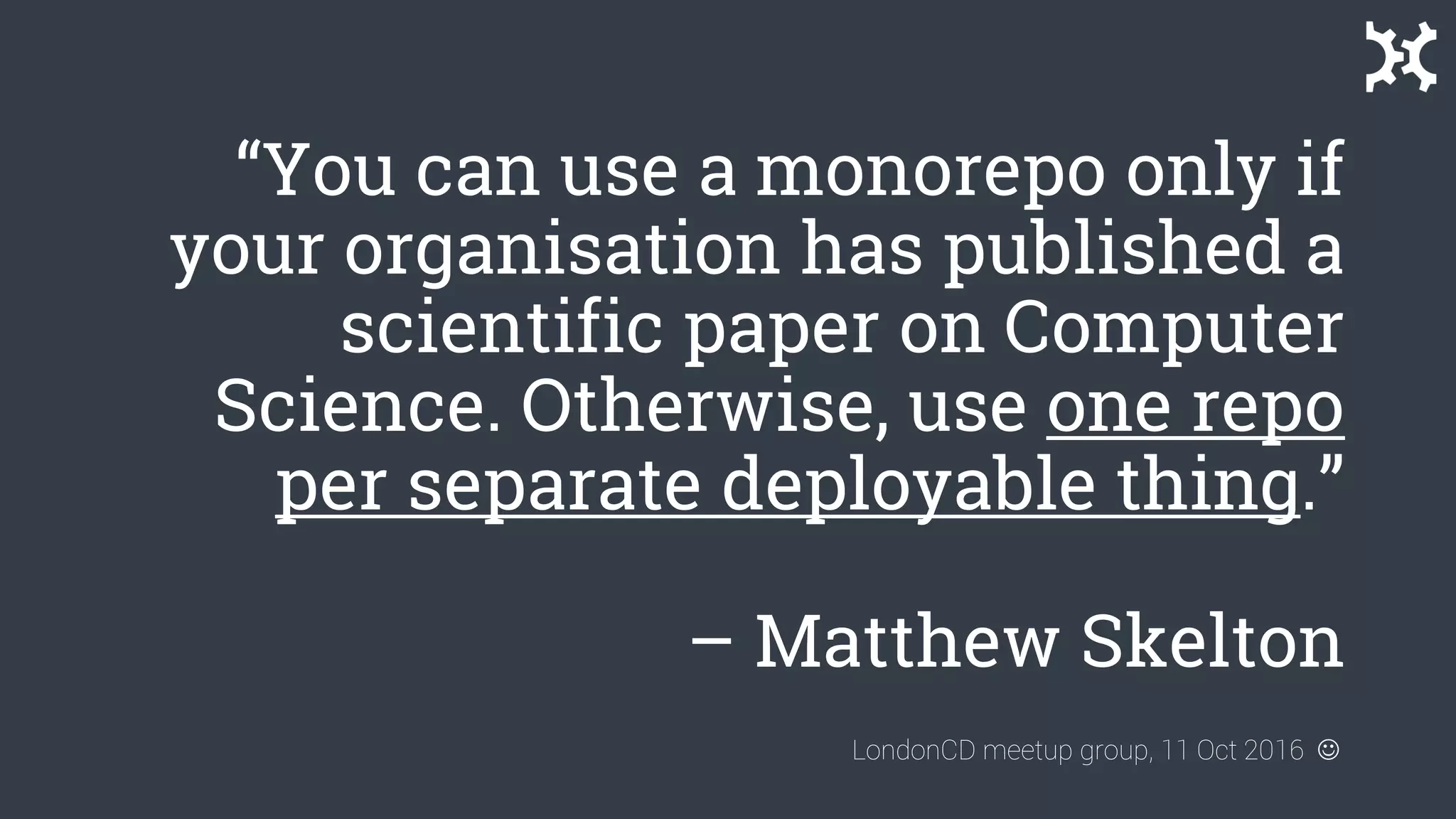
“You can use a monorepo only if
your organisation has published a
scientific paper on Computer
Science. Otherwise, use one repo
per separate deployable thing.”
– Matthew Skelton
LondonCD meetup group, 11 Oct 2016 
Find natural or available
‘fracture planes’ for splitting
a monolith
(with the team in mind)
Monolith-splitting recipe
Tried and tested!
How to break apart a monolith
without destroying your team
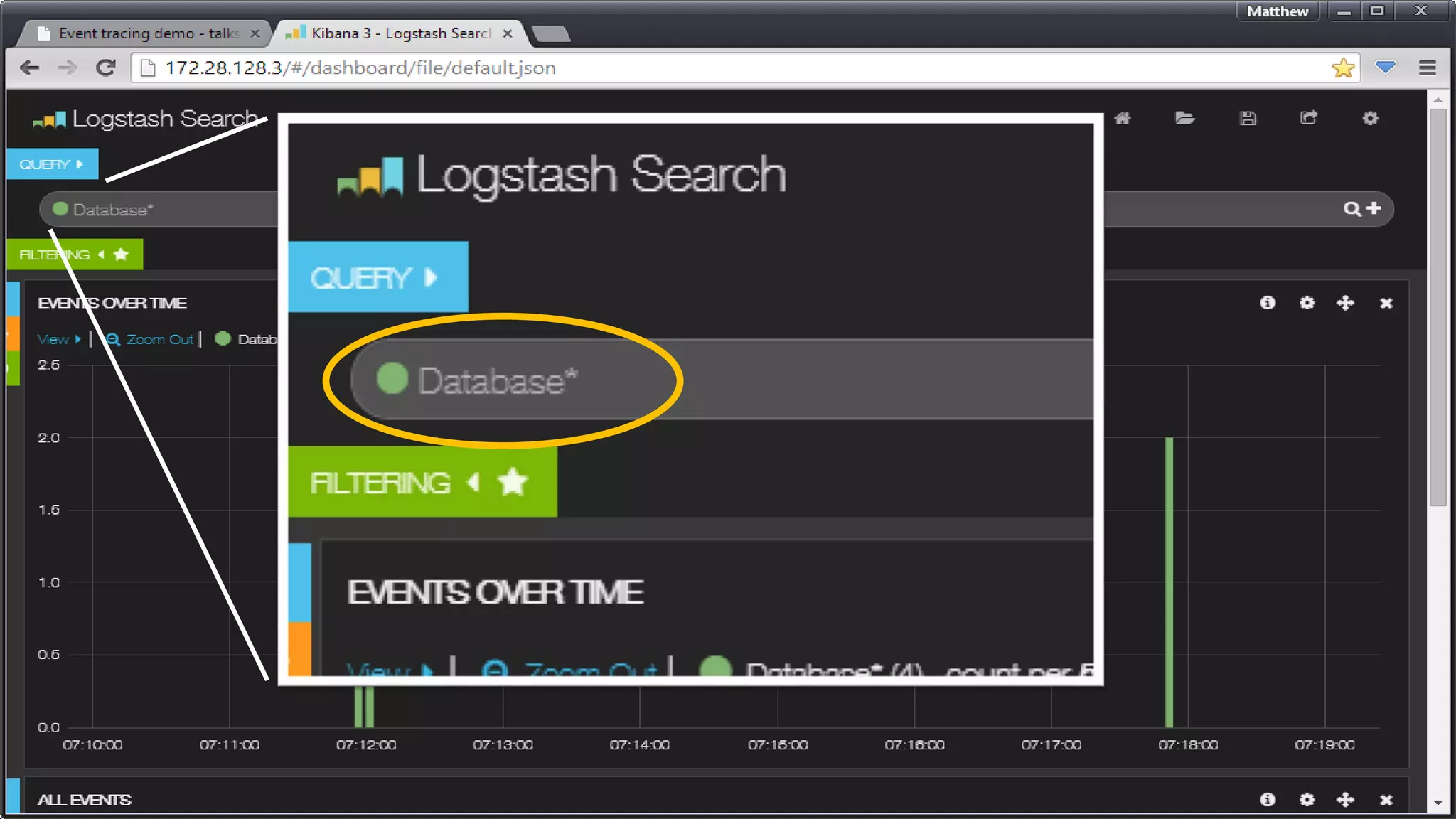
1. Instrument the monolith – logging
2. Grok data flows and fault responses
3. Align teams to available segments
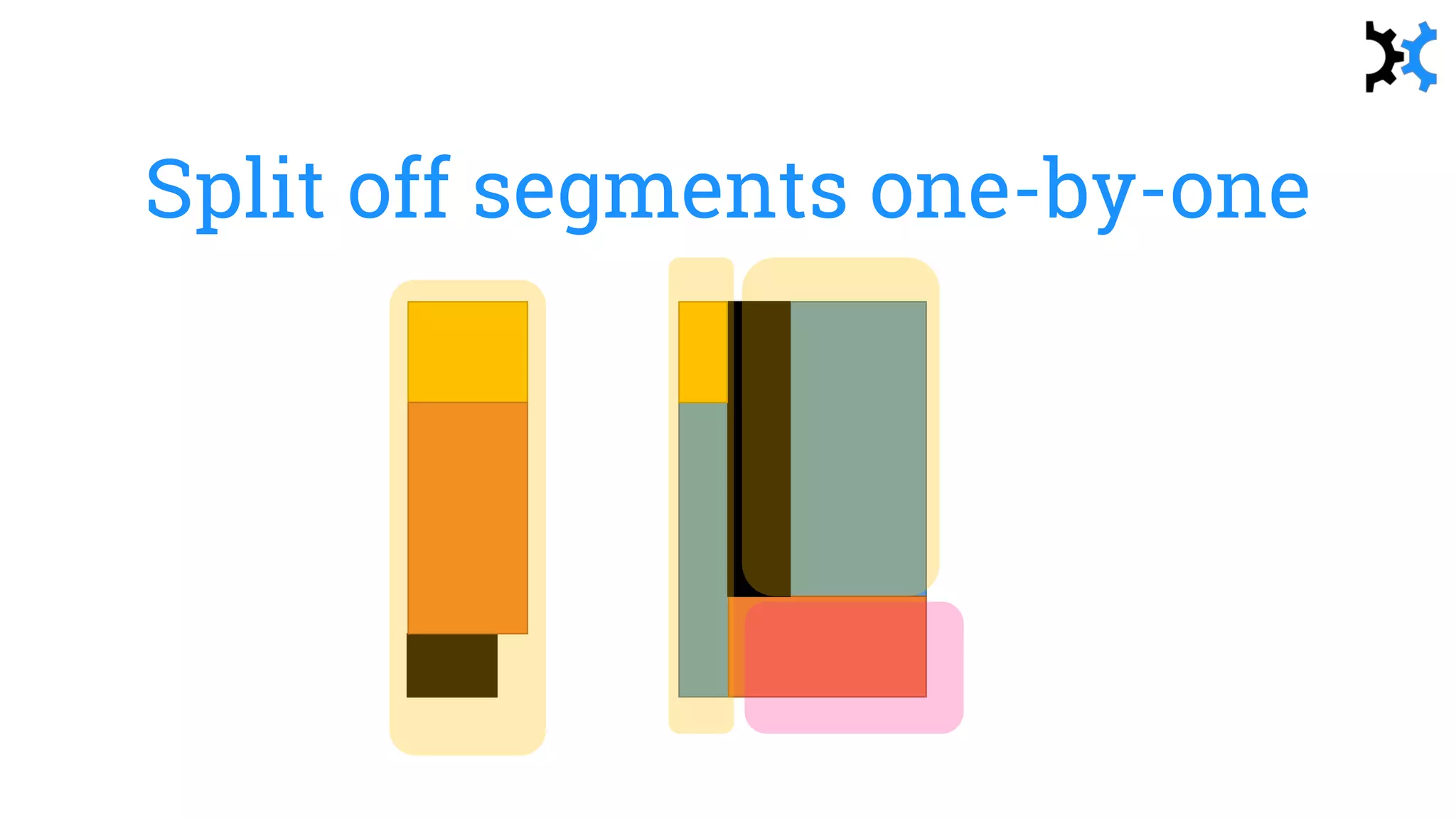
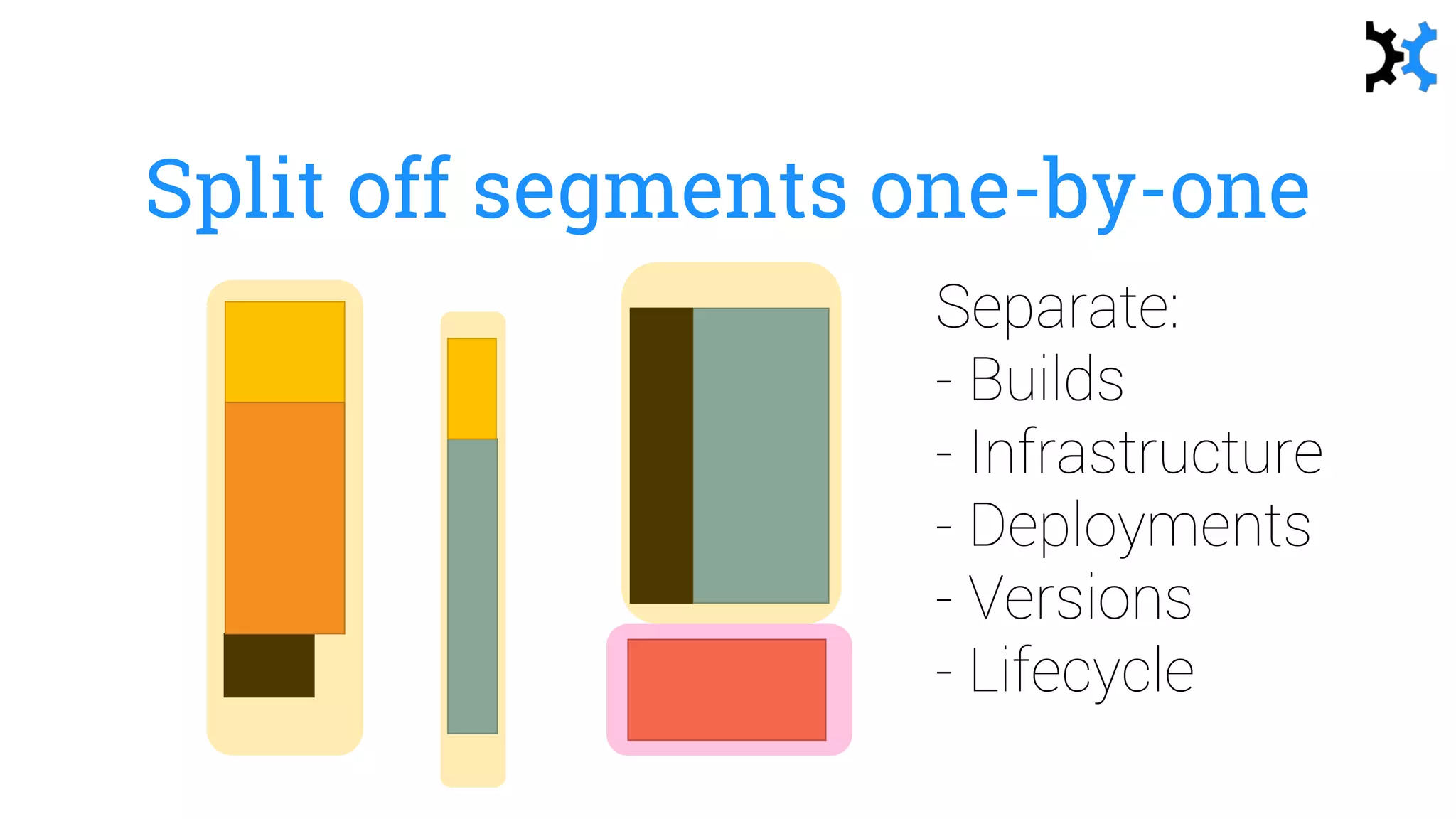
4. Split off segments one-by-one
Instrument the monolith
Correlation ID Logs
Event ID
use logging as a
channel/vector to
make distributed systems
more testable
use logging as a
channel/vector to
make distributed systems
more testable
Grok data flows and fault responses
Correlation ID
Event ID
Unexpected
collaborating
subsystems
Undetected
fault condition
Grok data flows and fault responses
Correlation ID
Event ID
Adjust
subsystem
boundaries
Fix poor fault
responses
runbooktemplate.info
Run Book dialogue sheets
Align teams to available segments
Map to
business
domain
Align teams to available segments
Identify likely
components
or ‘platform’
elements
Split off segments one-by-one
Separate:
- Builds
- Infrastructure
- Deployments
- Versions
- Lifecycle
Team needs / responsibilities /
capabilities come first
How to break apart a monolith
without destroying your team
1. Instrument the monolith – logging
2. Grok data flows and fault responses
3. Align teams to available segments
4. Split off segments one-by-one
How to break apart a monolith
without destroying your team
1. Instrument the monolith – logging
2. Grok data flows and fault responses
3. Align teams to available segments
4. Split off segments one-by-one
* plus a few other things
Further material
Books & articles
• Working Effectively with Legacy Code, by Michael Feathers
• Building Microservices by Sam Newman
• ‘Managing Cognitive Load for Team Learning’ by Jo Pearce
http://12devsofxmas.co.uk/2015/12/day-3-managing-cognitive-
load-for-team-learning/
Training
• From Monolith to Microservices (online training) – Sam Newman,
author of Building Microservices
http://www.oreilly.com/live-training/from-monolith-to-
microservices.html
Talks & slides
• What is cognitive load theory and why should you care?, by Jo
Pearce - http://www.slideshare.net/JoPearce5/what-is-cognitive-
load-theory-5mins
• Building Microservices by Sam Newman
Research papers
• Driskell, James E., Eduardo Salas, and Joan Johnston. ‘Does Stress Lead to a Loss of Team
Perspective?’ Group Dynamics: Theory, Research, and Practice 3, no. 4 (1999): 291.
• Fan, Xiaocong, Po-Chun Chen, and John Yen. ‘Learning HMM-Based Cognitive Load Models
for Supporting Human-Agent Teamwork’. Cognitive Systems Research 11, no. 1 (2010):
108–119.
• Ilgen, Daniel R., and John R. Hollenbeck. ‘Effective Team Performance under Stress and
Normal Conditions: An Experimental Paradigm, Theory and Data for Studying Team Decision
Making in Hierarchical Teams with Distributed Expertise’. DTIC Document, 1993.
http://oai.dtic.mil/oai/oai?verb=getRecord&metadataPrefix=html&identifier=ADA284683.
• Johnston, Joan H., Stephen M. Fiore, Carol Paris, and C. A. Smith. ‘Application of Cognitive
Load Theory to Developing a Measure of Team Decision Efficiency’. DTIC Document, 2002.
http://oai.dtic.mil/oai/oai?verb=getRecord&metadataPrefix=html&identifier=ADA525820.
thank you
Matthew Skelton
@matthewpskelton
skeltonthatcher.com

Teams and monoliths - Matthew Skelton - LondonCD 2016