Team D 1
Team D Modulation Applications
May1, 2015
Aslam Modak
NTC/362
Modulation Applications
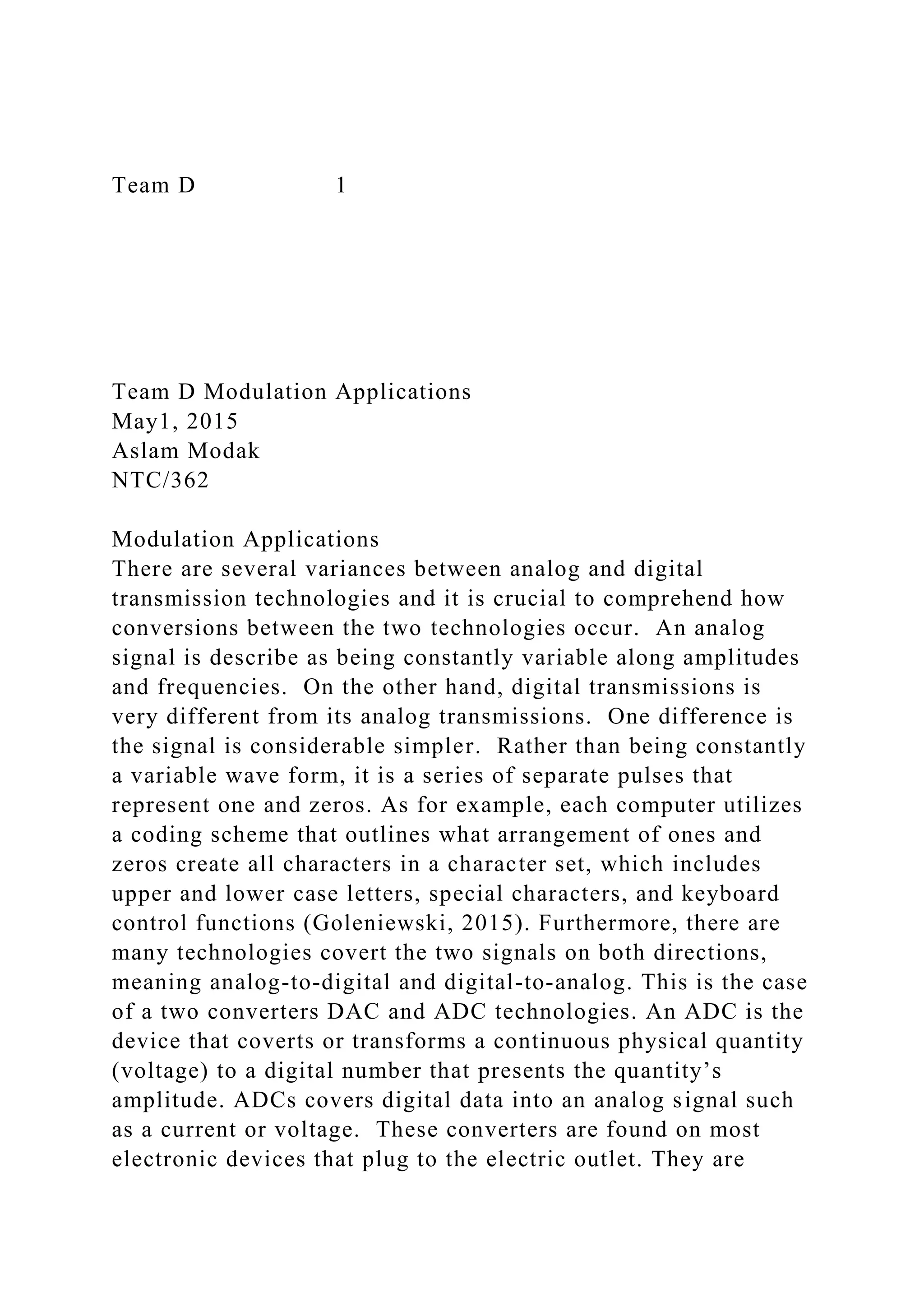
There are several variances between analog and digital
transmission technologies and it is crucial to comprehend how
conversions between the two technologies occur. An analog
signal is describe as being constantly variable along amplitudes
and frequencies. On the other hand, digital transmissions is
very different from its analog transmissions. One difference is
the signal is considerable simpler. Rather than being constantly
a variable wave form, it is a series of separate pulses that
represent one and zeros. As for example, each computer utilizes
a coding scheme that outlines what arrangement of ones and
zeros create all characters in a character set, which includes
upper and lower case letters, special characters, and keyboard
control functions (Goleniewski, 2015). Furthermore, there are
many technologies covert the two signals on both directions,
meaning analog-to-digital and digital-to-analog. This is the case
of a two converters DAC and ADC technologies. An ADC is the
device that coverts or transforms a continuous physical quantity
(voltage) to a digital number that presents the quantity’s
amplitude. ADCs covers digital data into an analog signal such
as a current or voltage. These converters are found on most
electronic devices that plug to the electric outlet. They are
microchips integrated on the circuit board of the electronic
device.
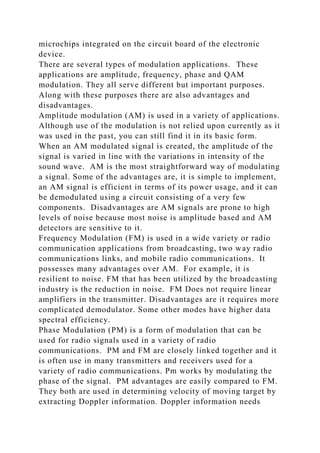
There are several types of modulation applications. These
applications are amplitude, frequency, phase and QAM
modulation. They all serve different but important purposes.
Along with these purposes there are also advantages and
disadvantages.
Amplitude modulation (AM) is used in a variety of applications.
Although use of the modulation is not relied upon currently as it
was used in the past, you can still find it in its basic form.
When an AM modulated signal is created, the amplitude of the
signal is varied in line with the variations in intensity of the
sound wave. AM is the most straightforward way of modulating
a signal. Some of the advantages are, it is simple to implement,
an AM signal is efficient in terms of its power usage, and it can
be demodulated using a circuit consisting of a very few
components. Disadvantages are AM signals are prone to high
levels of noise because most noise is amplitude based and AM
detectors are sensitive to it.
Frequency Modulation (FM) is used in a wide variety or radio
communication applications from broadcasting, two way radio
communications links, and mobile radio communications. It
possesses many advantages over AM. For example, it is
resilient to noise. FM that has been utilized by the broadcasting
industry is the reduction in noise. FM Does not require linear
amplifiers in the transmitter. Disadvantages are it requires more
complicated demodulator. Some other modes have higher data
spectral efficiency.
Phase Modulation (PM) is a form of modulation that can be
used for radio signals used in a variety of radio
communications. PM and FM are closely linked together and it
is often use in many transmitters and receivers used for a
variety of radio communications. Pm works by modulating the
phase of the signal. PM advantages are easily compared to FM.
They both are used in determining velocity of moving target by
extracting Doppler information. Doppler information needs
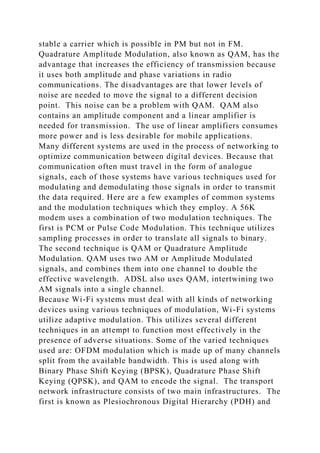
stable a carrier which is possible in PM but not in FM.
Quadrature Amplitude Modulation, also known as QAM, has the
advantage that increases the efficiency of transmission because
it uses both amplitude and phase variations in radio
communications. The disadvantages are that lower levels of
noise are needed to move the signal to a different decision
point. This noise can be a problem with QAM. QAM also
contains an amplitude component and a linear amplifier is
needed for transmission. The use of linear amplifiers consumes
more power and is less desirable for mobile applications.
Many different systems are used in the process of networking to
optimize communication between digital devices. Because that
communication often must travel in the form of analogue
signals, each of those systems have various techniques used for
modulating and demodulating those signals in order to transmit
the data required. Here are a few examples of common systems
and the modulation techniques which they employ. A 56K
modem uses a combination of two modulation techniques. The
first is PCM or Pulse Code Modulation. This technique utilizes
sampling processes in order to translate all signals to binary.
The second technique is QAM or Quadrature Amplitude
Modulation. QAM uses two AM or Amplitude Modulated
signals, and combines them into one channel to double the
effective wavelength. ADSL also uses QAM, intertwining two
AM signals into a single channel.
Because Wi-Fi systems must deal with all kinds of networking
devices using various techniques of modulation, Wi-Fi systems
utilize adaptive modulation. This utilizes several different
techniques in an attempt to function most effectively in the
presence of adverse situations. Some of the varied techniques
used are: OFDM modulation which is made up of many channels
split from the available bandwidth. This is used along with
Binary Phase Shift Keying (BPSK), Quadrature Phase Shift
Keying (QPSK), and QAM to encode the signal. The transport
network infrastructure consists of two main infrastructures. The
first is known as Plesiochronous Digital Hierarchy (PDH) and
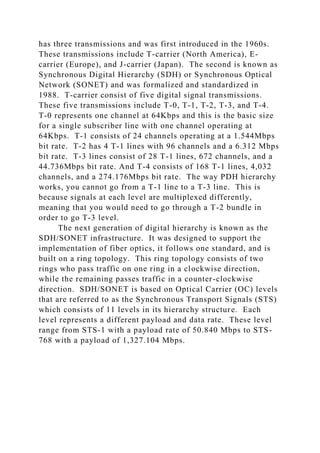
has three transmissions and was first introduced in the 1960s.
These transmissions include T-carrier (North America), E-
carrier (Europe), and J-carrier (Japan). The second is known as
Synchronous Digital Hierarchy (SDH) or Synchronous Optical
Network (SONET) and was formalized and standardized in
1988. T-carrier consist of five digital signal transmissions.
These five transmissions include T-0, T-1, T-2, T-3, and T-4.
T-0 represents one channel at 64Kbps and this is the basic size
for a single subscriber line with one channel operating at
64Kbps. T-1 consists of 24 channels operating at a 1.544Mbps
bit rate. T-2 has 4 T-1 lines with 96 channels and a 6.312 Mbps
bit rate. T-3 lines consist of 28 T-1 lines, 672 channels, and a
44.736Mbps bit rate. And T-4 consists of 168 T-1 lines, 4,032
channels, and a 274.176Mbps bit rate. The way PDH hierarchy
works, you cannot go from a T-1 line to a T-3 line. This is
because signals at each level are multiplexed differently,
meaning that you would need to go through a T-2 bundle in
order to go T-3 level.
The next generation of digital hierarchy is known as the
SDH/SONET infrastructure. It was designed to support the
implementation of fiber optics, it follows one standard, and is
built on a ring topology. This ring topology consists of two
rings who pass traffic on one ring in a clockwise direction,
while the remaining passes traffic in a counter-clockwise
direction. SDH/SONET is based on Optical Carrier (OC) levels
that are referred to as the Synchronous Transport Signals (STS)
which consists of 11 levels in its hierarchy structure. Each
level represents a different payload and data rate. These level
range from STS-1 with a payload rate of 50.840 Mbps to STS-
768 with a payload of 1,327.104 Mbps.
References
Emerson Climate Technologies. (2014). Retrieved from
http://emersonclimate.com
Scribd. (2015). Retrieved from http://www.scribd.com
Gao, F. (1998, December 15). An introduction to the V.90
(56K) modem. Retrieved May 4, 2015, from
http://www.eetimes.com/document.asp?doc_id=1275915
Goleniewski, L. (2015). Telecommunications Technology
Fundamentals. Retrieved from
http://www.informit.com/articles/article.aspx?p=24687&seqNu
m=5
Knagge, G. (200). ADSL and DSL : How it works and what it
does. Retrieved May 4, 2015, from
http://www.geoffknagge.com/uni/elec351/351assign.shtml
TechTarget. (2000). Networking information, news and tips.
Retrieved May 4, 2015, from
http://searchnetworking.techtarget.com/
Tutorials Point. (2015). Wi-fi radio modulation. Retrieved May
4, 2015, from http://www.tutorialspoint.com/wi-
fi/wifi_radio_modulation.htm
Team D: Protocol Paper
Jordan M. Fletcher
NTC 362
May 11, 2015
Aslam Modak
Running head: TEAM D: PROTOCOL PAPER
1
TEAM D: PROTOCOL PAPER
8
Team D: Protocol Paper
1. OSI Protocol Model
The open system interconnection (OSI) model is a conceptual
model that characterizes and standardizes the internal functions
of a communication system by partitioning it into abstraction
layers.
An open system is a set of protocols that allow any two
different systems to communicate regardless of their underlying
structure. The purpose of OSI model is to show how to facilitate
communication between different systems without requiring
changes to the logic of the underlying hardware and software.
The OSI model defines a networking framework to implement
protocols in seven layers. Control is passed from one layer to
the next, starting at the application layer in one station, and
proceeding to the bottom layer, over the channel to the next
station and back up the hierarchy.
· Physical (Layer1) This layer conveys the bit stream electrical
impulse, light or radio signal through the network at the
electrical and mechanical level.
· Data Link (Layer2) Provides error free transfer of data frames
from one node to another over the physical layer, allowing
layers above it to assume error free transmission over the link.
· Network (Layer3) controls the operation of the subnet,
deciding which physical path the data should take based on
network conditions priority of service, and other factors.
· Transport (Layer 4) insures that the messages are delivered
error free, in sequence, and with no losses or duplications.
· Session (Layer 5) this layer allows session establishment
between processes running on different stations.
· Presentation (Layer 6) formats the data to be presented to the
application layer. It can be viewed as the translator for the
network.
· Application (Layer 7) this layer serves as the window for users
and application processes to access network services.
2. Circuit and Packet Switching
A. Circuit Switching
When using circuit switching, the path of data is decided before
the transmission starts. The system decides the route of travel,
based on a complicated algorithm, and transmits according to
the path made. During the whole length of the communication
session the two nodes communicating is dedicated, exclusive
and is only disassembled when the session terminates. Circuit
switching is also old, expensive, but is still in use today with
PSTN, while packet switching is more modern. However, circuit
switching is more reliable than packet-switching. When you
have a dedicated connection then the information will get across
better and more secure.
There are two types of circuit switched networks. The first
circuit switched network type is based on leased lines. The
second type is based on the Integrated Services Digital Network
(ISDN). Leased line network types can be either point-to-point
connections or multipoint leased-line connections. A benefit of
leased-line networks is that the connection is not shared with
anyone else. If you’re paying for a 10Mbps pipe, you’re getting
all 10Mbps. A disadvantage to leased-lines is that they are
expensive. A leased-line circuit is calculated by miles.
Therefore, the further the circuit needs to go, the more costly it
will be.
B. Packet Switching
During the packet switching method, the packets have to find
their own route towards the destination. There is no “set” or
“predetermined” path. After reaching a node it will then decide
on the next path to take towards the next node. By doing this,
the packet finds its way towards the destination by the
information it carries, such as the source and destination IP
address. Packet switching is more modern in today’s world
however it does have some major drawbacks. While a packet is
looking for the destined route, the packet could come across a
congested network which would higher the latency or you could
even lose the packet. Since packet switching uses other
protocols the connections can be more reliable.
There are two main types of packet switched networks.
Connection oriented networks use the X.25, Frame relay, and
ATM protocols. Connectionless networks revolve mainly around
the Internet Protocol (IP). Early IP switches were unable to
handle high traffic requirements. However, equipment such as
SONET, has provided technicians the ability to apply Quality of
Service (QoS) control on their circuits. QoS allows technicians
the ability to control which types of data have priority over the
other data types. Each protocol is described in detail below.
C. X.25
X.25 is a protocol that was developed to provide accurate and
reliable data communications on a public network. X.25 uses
various methods, two of these methods are packet switching and
virtual circuits to obtain a data rate up to 64kbps. X.25 also
provides multiple error checking features which makes an
excellent choice for the older networks. This protocol is widely
accepted throughout the world because of its extensive error
checking capabilities. Since packet switching does not use a
dedicated virtual circuit and it’s actually connectionless in
nature, X.25 establishes these connections. The connection is
established, the data is transferred, and when it’s all said and
over with, the connection is terminated.
D. Frame Relay
The frame relay technology is based on the X.25 packet
switching technology. However, there is no error checking with
frame relay because it uses a fast packet switching technology.
Today’s digital and optical networks generally transfer data
with a very low error rate. The end station or node actually
handles all the errors that were generated. Frame relay does
reduce the amount of overhead associated with the data
transmission, this allows for faster packet-switching. The
bandwidth obtained from frame relay is called Committed
Information Rate which uses a T1 line. Since frame relays can
handle data bursts, the customer might actually use more than
the Committed Information Rate if any is available. Since
customers take advantage of this the phone companies have
consistently increased the customer’s usage rate.
E. Asynchronous Transfer Mode
Asynchronous Transfer Mode takes cells and cuts them into
blocks of information. The cells are a fixed variable and only
contain 5 bytes of header data and 48 bytes of information. This
field carries the data used and the contents inside the header
which allows Asynchronous Transfer Mode to work. Also, the
only way Asynchronous Transfer Mode can work is with a very
high transfer speed, fiber optics is preferred. The hardware
which is performing all the cell switching is what makes this
method a faster data transfer technology. The software
determines the length of the packets which means switching
needs to be done. Asynchronous Transfer Mode is faster than
any existing packet switching network and frame relay.
F. Transfer Control Protocol/ Internet Protocol
TCP/IP (Transfer Control Protocol / Internet Protocol) offer 3
layers of service, application services, transfer services, and
connectionless packet delivery service. IP layering allows you
to replace the service without affecting anyone else. However
packets can be lost, duplicated, or out of order without any
notification. IP software does provide the routing of the
packets. TCP explains the subdivisions of the packet that is
being transmitted to another node, this includes ftp and email.
The TCP segment structure accepts data from a data stream,
breaks it up into chunks, and adds a TCP header. This is when
the packet of information that TCP uses to exchange data with
its peers. The data section is followed by the header. The
contents of the data section are the payload data carried from
the originating node. Inside this TCP segment is also the
instructions on how to get to the other IP address.
3. Circuit and Packet Protocols
One of the major circuit switch protocols is signaling System
no. 7 (SS7) or most frequently known in North America as
Common Channel signaling System 7 (CCSS7). SS7 divides
essential information to arrange and manage telephone calls in
the Public Switched Telephone Network (PSTN) on a separate
packet switched network instead of using the same circuit
switched network where the telephone calls are made. The
technique is also called out-of-band signaling and is different
from in-band techniques. Furthermore, in circuit switching it
accommodates two types of transmissions datagram and data-
stream transmissions, which are used extensively in the
telephone company networks, circuit switching operates much
like a normal telephone call. Integrated Services Digital
Network (ISDN) is an example of a circuit-switched WAN
technology.
References
Duncan, P. (2004). Pablotron: News. Retrieved May 11, 2015,
from http://pablotron.org
The Fiber Optic Association, Inc. (2015). The fiber optic
association. Retrieved May 11, 2015, from
http://www.thefoa.org
Goleniewski, L. (2007). Telecommunications Essentials (2nd
ed.). Upper Saddle River, NJ: Addison-Wesley.
Hardware and Software
Jordan M. Fletcher, Erick Vazquez, Jever Mendoza, Laray
Woods, Sharon Edlund
NTC 362
May 18, 2015
Aslam Modak
Running head: HARDWARE AND SOFTWARE
1
HARDWARE AND SOFTWARE
2
Hardware and Software
1. Radio Frequency Characteristics
Radio frequency (RF) refers to the modification of the
alternating current (AC), manipulated, and input onto an
antenna, which could generate an electromagnetic field
appropriate for wireless communication. Additionally,
frequency describes the number of times a signal cycles per
second, known as Hertz (Hz). Along with frequency, there is the
wavelength, which refers to the distance between repeating
wave pattern. In a sine wave, the wavelength is the space
between any point on a wave and the matching point on the
following wave in what it is called the wave train. Furthermore,
there is an opposite association between frequency and the
wavelength because as the frequency increases, the wavelength
decreases. Goleniewski, L. (2007). Moreover, frequencies have
classes or types with different purposes or key application
ranging from low extremely low to extremely high and
performance distance. For example, low frequencies (<3Hz –
300Hz) travel quicker without dropping power but carry much
less information due to the bandwidth. High frequencies (3Hz –
30 GHz) have a greater bandwidth but significantly affected by
interference from a variety of source. Extremely and very high
frequencies (30GHz – 300GHz and 3GHz – 30 GHz) are greatly
affected by bad weather conditions. Moreover, Wireless
transmission has impairments from path loss, fading,
interference noise, and environmental obstacles.
2. Radio Frequency Bands
Designation
Abbreviation
Frequencies
Wavelength
Very Low Frequency
VLF
9 kHz – 30 kHz
33 km – 10 km
Low Frequency
LF
30 kHz – 300 kHz
10 km – 1 km
Medium Frequency
MF
300 kHz – 3 MHz
1 km – 100 m
High Frequency
HF
3 MHz – 30 MHz
100 m – 10 m
Very High Frequency
VHF
30 MHz – 300 MHz
10 m – 1 m
Ultra High Frequency
UHF
300 MHz – 3 GHz
1 m – 100 mm
Super High Frequency
SHF
3 GHz – 30 GHz
100 mm – 10 mm
Extremely High Frequency
EHF
30 GHz – 300 GHz
10 mm – 1 mm
Radio frequency is a signal created by using alternating current
to create an electromagnetic field. This field is sent and
received through antennae. This field is referred to as a
radiowave or RF field. This field is used by a variety of
communications including cell phones, radio, two- way radios,
microwaves, and satellite systems. The following is a list of
band designation into which the RF spectrum is divided into
(TechTarget, 2015):
3. Wireless Communication Protocols
Wireless communication is the transfer of information from one
point to another. These points are not connected physically by
wiring. The distance can be a vast distant such as radio to space
communication by or a short distance such as a television
remote control device. There are several types of stationary,
portable or mobile devices such as cell phones, PDA, walkie-
talkies, baby monitors and wireless devices. Examples of
wireless devices are a wireless printer, computer, mouse,
keyboard, cordless phone, a GPS, and a garage door opener.
Wireless protocols are essentially a set of rules that need to be
followed in networking devices which allows them to exchange
information by means of airwaves without any wires.
Wireless protocols come in three main classes. These include
long range, medium range, and short range (Goleniewski, 2007).
The difference between each is the range limit, where long
range is in miles, medium range is in tens or hundreds of feet,
and short is in ten feet or less. These three contain different
protocols with their own capabilities but make each dependent.
Long-range Wireless protocols with a long range often will give
up speed to send communications over longer distances. An
example of this would be supplying services to an individual
device like a laptop or smart phone. WiMAX, (Worldwide
Interoperability for Microwave Access), or WiMAX, was first
designed to allow mobile devices access to the Internet. GSM,
(Global System for Mobile Communications), is the most
widely used long distance wireless protocol used in the world.
Its main focus is supplying data communication to a vast
majority of the world's cellular phones. Medium-range WLAN,
(Wireless Local Area Network) known as mid- range wireless
protocols mostly used for Communications between computers
to restore or improve a traditional wired LANs.
The four main protocols, listed below, are part of the Institute
of Electrical & Electronics Engineers, or IEEE, 802.11
standard. 802.11a, and can achieve a speed of 54 megabits per
second most often over a shorter range than its competition.
802.11b has a longer range than 802.11a, but sacrifices speed
with a lower maximum of 11 Mbps (Goleniewski, 2007).
802.11g combines the best of 802.11a and 802.11b by offering
54 Mbps at longer ranges. Short-range WPAN (Wireless
Personal Area Networks), is a short distance protocol with
lower frequencies on devices that are only a few feet apart.
Bluetooth is a short-range protocol Bluetooth is another
wireless standard. Bluetooth networks also operate on the 2.4
Ghz frequency range and are limited to a maximum of eight
connected devices. The device transmits at a very low power the
range is only approximately 30 feet. The maximum transmission
speed is 1 Mbps. A wireless headset connected to a portable
phone is one example. Although there are a number of protocols
currently being used for wireless networking, the most widely
used appears to be 802.11b. The equipment that is used by
802.11b tends to be less expensive and the maximum speed for
communications is 11 mbps. The communication standard for
the 802.11b wireless performs on a 2.4 Ghz frequency range.
This is unfortunate because several other devices such as
cordless telephones and baby monitors often interfere with your
wireless network traffic. The newer 802.11g standard is a
marked improvement to the 802.11b. Although it shares the 2.4
Ghz with other home wireless devices, the 802.11g is capable of
transmission speeds up to 54 mbps. Equipment intended for
802.11g will still share communication with 802.11b equipment
while mixing the two is not suggested. The 802.11a standard
operates on a different frequency range. The 802.11a operates at
a 5 Ghz range and does not have many issues with interference
from the other devices in the home. 802.11a has the ability of
transmission speeds up to 54 mbps the same as the 802.11g
standard but the cost is considerably higher.
4. End-To-End Communication
There are many challenges when trying to use satellites in end-
to-end communication. One challenge is that there is a lot of
interference and noise when using electromagnetic waves.
According to Goleniewski (2007), interference and noise is
caused by environmental factors such as metals, the weather,
and other anomalies. There is constant change in precipitation
in the air around the world and will always affect the waves
produced by satellites and antennas. There are other
impairments such as foliage, path loss, and range and electrical
power (Goleniewski, 2007). Another challenge of using
satellites for end-to-end communication is Antennas.
Goleniewski (2007) stated, “An antenna is a device through
which radio frequency (RF) energy is coupled from the
transmitter to the outside world and, in reverse, to the receiver
from the outside world” (p.11). There are many different types
of antennas used for different reasons. The reasons can be to
pick up different frequencies or to be able to transmit and
different concentration levels. Wireless transmissions are used
for the bandwidth available through them. The problem with
bandwidth is that it is dependent on the size of the waves that
are transmitted. There can only be a certain amount of users in
the spectrum and it needs to be controlled. Among the ways to
control the spectrum is frequency division multiple access
(FDMA) and time division multiple access (TDMA).
References
Goleniewski, L. (2007). Telecommunications essentials. (2nd
ed.) Boston, MA: Pearson
TechTarget. (2015). What is radio frequency?
Retrieved May 17, 2015, from
http://searchnetworking.techtarget.com/definition/radio-
frequency

Team D1Team D Modulation ApplicationsMay1, 2015.docx

  • 1.
    Team D 1 TeamD Modulation Applications May1, 2015 Aslam Modak NTC/362 Modulation Applications There are several variances between analog and digital transmission technologies and it is crucial to comprehend how conversions between the two technologies occur. An analog signal is describe as being constantly variable along amplitudes and frequencies. On the other hand, digital transmissions is very different from its analog transmissions. One difference is the signal is considerable simpler. Rather than being constantly a variable wave form, it is a series of separate pulses that represent one and zeros. As for example, each computer utilizes a coding scheme that outlines what arrangement of ones and zeros create all characters in a character set, which includes upper and lower case letters, special characters, and keyboard control functions (Goleniewski, 2015). Furthermore, there are many technologies covert the two signals on both directions, meaning analog-to-digital and digital-to-analog. This is the case of a two converters DAC and ADC technologies. An ADC is the device that coverts or transforms a continuous physical quantity (voltage) to a digital number that presents the quantity’s amplitude. ADCs covers digital data into an analog signal such as a current or voltage. These converters are found on most electronic devices that plug to the electric outlet. They are
  • 2.
    microchips integrated onthe circuit board of the electronic device. There are several types of modulation applications. These applications are amplitude, frequency, phase and QAM modulation. They all serve different but important purposes. Along with these purposes there are also advantages and disadvantages. Amplitude modulation (AM) is used in a variety of applications. Although use of the modulation is not relied upon currently as it was used in the past, you can still find it in its basic form. When an AM modulated signal is created, the amplitude of the signal is varied in line with the variations in intensity of the sound wave. AM is the most straightforward way of modulating a signal. Some of the advantages are, it is simple to implement, an AM signal is efficient in terms of its power usage, and it can be demodulated using a circuit consisting of a very few components. Disadvantages are AM signals are prone to high levels of noise because most noise is amplitude based and AM detectors are sensitive to it. Frequency Modulation (FM) is used in a wide variety or radio communication applications from broadcasting, two way radio communications links, and mobile radio communications. It possesses many advantages over AM. For example, it is resilient to noise. FM that has been utilized by the broadcasting industry is the reduction in noise. FM Does not require linear amplifiers in the transmitter. Disadvantages are it requires more complicated demodulator. Some other modes have higher data spectral efficiency. Phase Modulation (PM) is a form of modulation that can be used for radio signals used in a variety of radio communications. PM and FM are closely linked together and it is often use in many transmitters and receivers used for a variety of radio communications. Pm works by modulating the phase of the signal. PM advantages are easily compared to FM. They both are used in determining velocity of moving target by extracting Doppler information. Doppler information needs
  • 3.
    stable a carrierwhich is possible in PM but not in FM. Quadrature Amplitude Modulation, also known as QAM, has the advantage that increases the efficiency of transmission because it uses both amplitude and phase variations in radio communications. The disadvantages are that lower levels of noise are needed to move the signal to a different decision point. This noise can be a problem with QAM. QAM also contains an amplitude component and a linear amplifier is needed for transmission. The use of linear amplifiers consumes more power and is less desirable for mobile applications. Many different systems are used in the process of networking to optimize communication between digital devices. Because that communication often must travel in the form of analogue signals, each of those systems have various techniques used for modulating and demodulating those signals in order to transmit the data required. Here are a few examples of common systems and the modulation techniques which they employ. A 56K modem uses a combination of two modulation techniques. The first is PCM or Pulse Code Modulation. This technique utilizes sampling processes in order to translate all signals to binary. The second technique is QAM or Quadrature Amplitude Modulation. QAM uses two AM or Amplitude Modulated signals, and combines them into one channel to double the effective wavelength. ADSL also uses QAM, intertwining two AM signals into a single channel. Because Wi-Fi systems must deal with all kinds of networking devices using various techniques of modulation, Wi-Fi systems utilize adaptive modulation. This utilizes several different techniques in an attempt to function most effectively in the presence of adverse situations. Some of the varied techniques used are: OFDM modulation which is made up of many channels split from the available bandwidth. This is used along with Binary Phase Shift Keying (BPSK), Quadrature Phase Shift Keying (QPSK), and QAM to encode the signal. The transport network infrastructure consists of two main infrastructures. The first is known as Plesiochronous Digital Hierarchy (PDH) and
  • 4.
    has three transmissionsand was first introduced in the 1960s. These transmissions include T-carrier (North America), E- carrier (Europe), and J-carrier (Japan). The second is known as Synchronous Digital Hierarchy (SDH) or Synchronous Optical Network (SONET) and was formalized and standardized in 1988. T-carrier consist of five digital signal transmissions. These five transmissions include T-0, T-1, T-2, T-3, and T-4. T-0 represents one channel at 64Kbps and this is the basic size for a single subscriber line with one channel operating at 64Kbps. T-1 consists of 24 channels operating at a 1.544Mbps bit rate. T-2 has 4 T-1 lines with 96 channels and a 6.312 Mbps bit rate. T-3 lines consist of 28 T-1 lines, 672 channels, and a 44.736Mbps bit rate. And T-4 consists of 168 T-1 lines, 4,032 channels, and a 274.176Mbps bit rate. The way PDH hierarchy works, you cannot go from a T-1 line to a T-3 line. This is because signals at each level are multiplexed differently, meaning that you would need to go through a T-2 bundle in order to go T-3 level. The next generation of digital hierarchy is known as the SDH/SONET infrastructure. It was designed to support the implementation of fiber optics, it follows one standard, and is built on a ring topology. This ring topology consists of two rings who pass traffic on one ring in a clockwise direction, while the remaining passes traffic in a counter-clockwise direction. SDH/SONET is based on Optical Carrier (OC) levels that are referred to as the Synchronous Transport Signals (STS) which consists of 11 levels in its hierarchy structure. Each level represents a different payload and data rate. These level range from STS-1 with a payload rate of 50.840 Mbps to STS- 768 with a payload of 1,327.104 Mbps.
  • 5.
    References Emerson Climate Technologies.(2014). Retrieved from http://emersonclimate.com Scribd. (2015). Retrieved from http://www.scribd.com Gao, F. (1998, December 15). An introduction to the V.90 (56K) modem. Retrieved May 4, 2015, from http://www.eetimes.com/document.asp?doc_id=1275915 Goleniewski, L. (2015). Telecommunications Technology Fundamentals. Retrieved from http://www.informit.com/articles/article.aspx?p=24687&seqNu m=5 Knagge, G. (200). ADSL and DSL : How it works and what it does. Retrieved May 4, 2015, from http://www.geoffknagge.com/uni/elec351/351assign.shtml TechTarget. (2000). Networking information, news and tips. Retrieved May 4, 2015, from http://searchnetworking.techtarget.com/ Tutorials Point. (2015). Wi-fi radio modulation. Retrieved May 4, 2015, from http://www.tutorialspoint.com/wi- fi/wifi_radio_modulation.htm
  • 6.
    Team D: ProtocolPaper Jordan M. Fletcher NTC 362 May 11, 2015 Aslam Modak Running head: TEAM D: PROTOCOL PAPER 1 TEAM D: PROTOCOL PAPER 8 Team D: Protocol Paper 1. OSI Protocol Model The open system interconnection (OSI) model is a conceptual model that characterizes and standardizes the internal functions of a communication system by partitioning it into abstraction layers. An open system is a set of protocols that allow any two different systems to communicate regardless of their underlying structure. The purpose of OSI model is to show how to facilitate communication between different systems without requiring changes to the logic of the underlying hardware and software. The OSI model defines a networking framework to implement protocols in seven layers. Control is passed from one layer to the next, starting at the application layer in one station, and proceeding to the bottom layer, over the channel to the next
  • 7.
    station and backup the hierarchy. · Physical (Layer1) This layer conveys the bit stream electrical impulse, light or radio signal through the network at the electrical and mechanical level. · Data Link (Layer2) Provides error free transfer of data frames from one node to another over the physical layer, allowing layers above it to assume error free transmission over the link. · Network (Layer3) controls the operation of the subnet, deciding which physical path the data should take based on network conditions priority of service, and other factors. · Transport (Layer 4) insures that the messages are delivered error free, in sequence, and with no losses or duplications. · Session (Layer 5) this layer allows session establishment between processes running on different stations. · Presentation (Layer 6) formats the data to be presented to the application layer. It can be viewed as the translator for the network. · Application (Layer 7) this layer serves as the window for users and application processes to access network services. 2. Circuit and Packet Switching A. Circuit Switching When using circuit switching, the path of data is decided before the transmission starts. The system decides the route of travel, based on a complicated algorithm, and transmits according to the path made. During the whole length of the communication session the two nodes communicating is dedicated, exclusive and is only disassembled when the session terminates. Circuit switching is also old, expensive, but is still in use today with PSTN, while packet switching is more modern. However, circuit switching is more reliable than packet-switching. When you have a dedicated connection then the information will get across better and more secure. There are two types of circuit switched networks. The first circuit switched network type is based on leased lines. The second type is based on the Integrated Services Digital Network (ISDN). Leased line network types can be either point-to-point
  • 8.
    connections or multipointleased-line connections. A benefit of leased-line networks is that the connection is not shared with anyone else. If you’re paying for a 10Mbps pipe, you’re getting all 10Mbps. A disadvantage to leased-lines is that they are expensive. A leased-line circuit is calculated by miles. Therefore, the further the circuit needs to go, the more costly it will be. B. Packet Switching During the packet switching method, the packets have to find their own route towards the destination. There is no “set” or “predetermined” path. After reaching a node it will then decide on the next path to take towards the next node. By doing this, the packet finds its way towards the destination by the information it carries, such as the source and destination IP address. Packet switching is more modern in today’s world however it does have some major drawbacks. While a packet is looking for the destined route, the packet could come across a congested network which would higher the latency or you could even lose the packet. Since packet switching uses other protocols the connections can be more reliable. There are two main types of packet switched networks. Connection oriented networks use the X.25, Frame relay, and ATM protocols. Connectionless networks revolve mainly around the Internet Protocol (IP). Early IP switches were unable to handle high traffic requirements. However, equipment such as SONET, has provided technicians the ability to apply Quality of Service (QoS) control on their circuits. QoS allows technicians the ability to control which types of data have priority over the other data types. Each protocol is described in detail below. C. X.25 X.25 is a protocol that was developed to provide accurate and reliable data communications on a public network. X.25 uses various methods, two of these methods are packet switching and virtual circuits to obtain a data rate up to 64kbps. X.25 also provides multiple error checking features which makes an excellent choice for the older networks. This protocol is widely
  • 9.
    accepted throughout theworld because of its extensive error checking capabilities. Since packet switching does not use a dedicated virtual circuit and it’s actually connectionless in nature, X.25 establishes these connections. The connection is established, the data is transferred, and when it’s all said and over with, the connection is terminated. D. Frame Relay The frame relay technology is based on the X.25 packet switching technology. However, there is no error checking with frame relay because it uses a fast packet switching technology. Today’s digital and optical networks generally transfer data with a very low error rate. The end station or node actually handles all the errors that were generated. Frame relay does reduce the amount of overhead associated with the data transmission, this allows for faster packet-switching. The bandwidth obtained from frame relay is called Committed Information Rate which uses a T1 line. Since frame relays can handle data bursts, the customer might actually use more than the Committed Information Rate if any is available. Since customers take advantage of this the phone companies have consistently increased the customer’s usage rate. E. Asynchronous Transfer Mode Asynchronous Transfer Mode takes cells and cuts them into blocks of information. The cells are a fixed variable and only contain 5 bytes of header data and 48 bytes of information. This field carries the data used and the contents inside the header which allows Asynchronous Transfer Mode to work. Also, the only way Asynchronous Transfer Mode can work is with a very high transfer speed, fiber optics is preferred. The hardware which is performing all the cell switching is what makes this method a faster data transfer technology. The software determines the length of the packets which means switching needs to be done. Asynchronous Transfer Mode is faster than any existing packet switching network and frame relay. F. Transfer Control Protocol/ Internet Protocol TCP/IP (Transfer Control Protocol / Internet Protocol) offer 3
  • 10.
    layers of service,application services, transfer services, and connectionless packet delivery service. IP layering allows you to replace the service without affecting anyone else. However packets can be lost, duplicated, or out of order without any notification. IP software does provide the routing of the packets. TCP explains the subdivisions of the packet that is being transmitted to another node, this includes ftp and email. The TCP segment structure accepts data from a data stream, breaks it up into chunks, and adds a TCP header. This is when the packet of information that TCP uses to exchange data with its peers. The data section is followed by the header. The contents of the data section are the payload data carried from the originating node. Inside this TCP segment is also the instructions on how to get to the other IP address. 3. Circuit and Packet Protocols One of the major circuit switch protocols is signaling System no. 7 (SS7) or most frequently known in North America as Common Channel signaling System 7 (CCSS7). SS7 divides essential information to arrange and manage telephone calls in the Public Switched Telephone Network (PSTN) on a separate packet switched network instead of using the same circuit switched network where the telephone calls are made. The technique is also called out-of-band signaling and is different from in-band techniques. Furthermore, in circuit switching it accommodates two types of transmissions datagram and data- stream transmissions, which are used extensively in the telephone company networks, circuit switching operates much like a normal telephone call. Integrated Services Digital Network (ISDN) is an example of a circuit-switched WAN technology.
  • 11.
    References Duncan, P. (2004).Pablotron: News. Retrieved May 11, 2015, from http://pablotron.org The Fiber Optic Association, Inc. (2015). The fiber optic association. Retrieved May 11, 2015, from http://www.thefoa.org Goleniewski, L. (2007). Telecommunications Essentials (2nd ed.). Upper Saddle River, NJ: Addison-Wesley. Hardware and Software Jordan M. Fletcher, Erick Vazquez, Jever Mendoza, Laray Woods, Sharon Edlund NTC 362 May 18, 2015 Aslam Modak
  • 12.
    Running head: HARDWAREAND SOFTWARE 1 HARDWARE AND SOFTWARE 2 Hardware and Software 1. Radio Frequency Characteristics Radio frequency (RF) refers to the modification of the alternating current (AC), manipulated, and input onto an antenna, which could generate an electromagnetic field appropriate for wireless communication. Additionally, frequency describes the number of times a signal cycles per second, known as Hertz (Hz). Along with frequency, there is the wavelength, which refers to the distance between repeating wave pattern. In a sine wave, the wavelength is the space between any point on a wave and the matching point on the following wave in what it is called the wave train. Furthermore, there is an opposite association between frequency and the wavelength because as the frequency increases, the wavelength decreases. Goleniewski, L. (2007). Moreover, frequencies have classes or types with different purposes or key application ranging from low extremely low to extremely high and performance distance. For example, low frequencies (<3Hz – 300Hz) travel quicker without dropping power but carry much less information due to the bandwidth. High frequencies (3Hz – 30 GHz) have a greater bandwidth but significantly affected by interference from a variety of source. Extremely and very high frequencies (30GHz – 300GHz and 3GHz – 30 GHz) are greatly affected by bad weather conditions. Moreover, Wireless transmission has impairments from path loss, fading, interference noise, and environmental obstacles.
  • 13.
    2. Radio FrequencyBands Designation Abbreviation Frequencies Wavelength Very Low Frequency VLF 9 kHz – 30 kHz 33 km – 10 km Low Frequency LF 30 kHz – 300 kHz 10 km – 1 km Medium Frequency MF 300 kHz – 3 MHz 1 km – 100 m High Frequency HF 3 MHz – 30 MHz 100 m – 10 m Very High Frequency VHF 30 MHz – 300 MHz 10 m – 1 m Ultra High Frequency UHF 300 MHz – 3 GHz 1 m – 100 mm Super High Frequency SHF 3 GHz – 30 GHz 100 mm – 10 mm
  • 14.
    Extremely High Frequency EHF 30GHz – 300 GHz 10 mm – 1 mm Radio frequency is a signal created by using alternating current to create an electromagnetic field. This field is sent and received through antennae. This field is referred to as a radiowave or RF field. This field is used by a variety of communications including cell phones, radio, two- way radios, microwaves, and satellite systems. The following is a list of band designation into which the RF spectrum is divided into (TechTarget, 2015): 3. Wireless Communication Protocols Wireless communication is the transfer of information from one point to another. These points are not connected physically by wiring. The distance can be a vast distant such as radio to space communication by or a short distance such as a television remote control device. There are several types of stationary, portable or mobile devices such as cell phones, PDA, walkie- talkies, baby monitors and wireless devices. Examples of wireless devices are a wireless printer, computer, mouse, keyboard, cordless phone, a GPS, and a garage door opener. Wireless protocols are essentially a set of rules that need to be followed in networking devices which allows them to exchange information by means of airwaves without any wires. Wireless protocols come in three main classes. These include long range, medium range, and short range (Goleniewski, 2007). The difference between each is the range limit, where long range is in miles, medium range is in tens or hundreds of feet, and short is in ten feet or less. These three contain different protocols with their own capabilities but make each dependent. Long-range Wireless protocols with a long range often will give
  • 15.
    up speed tosend communications over longer distances. An example of this would be supplying services to an individual device like a laptop or smart phone. WiMAX, (Worldwide Interoperability for Microwave Access), or WiMAX, was first designed to allow mobile devices access to the Internet. GSM, (Global System for Mobile Communications), is the most widely used long distance wireless protocol used in the world. Its main focus is supplying data communication to a vast majority of the world's cellular phones. Medium-range WLAN, (Wireless Local Area Network) known as mid- range wireless protocols mostly used for Communications between computers to restore or improve a traditional wired LANs. The four main protocols, listed below, are part of the Institute of Electrical & Electronics Engineers, or IEEE, 802.11 standard. 802.11a, and can achieve a speed of 54 megabits per second most often over a shorter range than its competition. 802.11b has a longer range than 802.11a, but sacrifices speed with a lower maximum of 11 Mbps (Goleniewski, 2007). 802.11g combines the best of 802.11a and 802.11b by offering 54 Mbps at longer ranges. Short-range WPAN (Wireless Personal Area Networks), is a short distance protocol with lower frequencies on devices that are only a few feet apart. Bluetooth is a short-range protocol Bluetooth is another wireless standard. Bluetooth networks also operate on the 2.4 Ghz frequency range and are limited to a maximum of eight connected devices. The device transmits at a very low power the range is only approximately 30 feet. The maximum transmission speed is 1 Mbps. A wireless headset connected to a portable phone is one example. Although there are a number of protocols currently being used for wireless networking, the most widely used appears to be 802.11b. The equipment that is used by 802.11b tends to be less expensive and the maximum speed for communications is 11 mbps. The communication standard for the 802.11b wireless performs on a 2.4 Ghz frequency range. This is unfortunate because several other devices such as cordless telephones and baby monitors often interfere with your
  • 16.
    wireless network traffic.The newer 802.11g standard is a marked improvement to the 802.11b. Although it shares the 2.4 Ghz with other home wireless devices, the 802.11g is capable of transmission speeds up to 54 mbps. Equipment intended for 802.11g will still share communication with 802.11b equipment while mixing the two is not suggested. The 802.11a standard operates on a different frequency range. The 802.11a operates at a 5 Ghz range and does not have many issues with interference from the other devices in the home. 802.11a has the ability of transmission speeds up to 54 mbps the same as the 802.11g standard but the cost is considerably higher. 4. End-To-End Communication There are many challenges when trying to use satellites in end- to-end communication. One challenge is that there is a lot of interference and noise when using electromagnetic waves. According to Goleniewski (2007), interference and noise is caused by environmental factors such as metals, the weather, and other anomalies. There is constant change in precipitation in the air around the world and will always affect the waves produced by satellites and antennas. There are other impairments such as foliage, path loss, and range and electrical power (Goleniewski, 2007). Another challenge of using satellites for end-to-end communication is Antennas. Goleniewski (2007) stated, “An antenna is a device through which radio frequency (RF) energy is coupled from the transmitter to the outside world and, in reverse, to the receiver from the outside world” (p.11). There are many different types of antennas used for different reasons. The reasons can be to pick up different frequencies or to be able to transmit and different concentration levels. Wireless transmissions are used for the bandwidth available through them. The problem with bandwidth is that it is dependent on the size of the waves that are transmitted. There can only be a certain amount of users in the spectrum and it needs to be controlled. Among the ways to control the spectrum is frequency division multiple access (FDMA) and time division multiple access (TDMA).
  • 17.
    References Goleniewski, L. (2007).Telecommunications essentials. (2nd ed.) Boston, MA: Pearson TechTarget. (2015). What is radio frequency? Retrieved May 17, 2015, from http://searchnetworking.techtarget.com/definition/radio- frequency