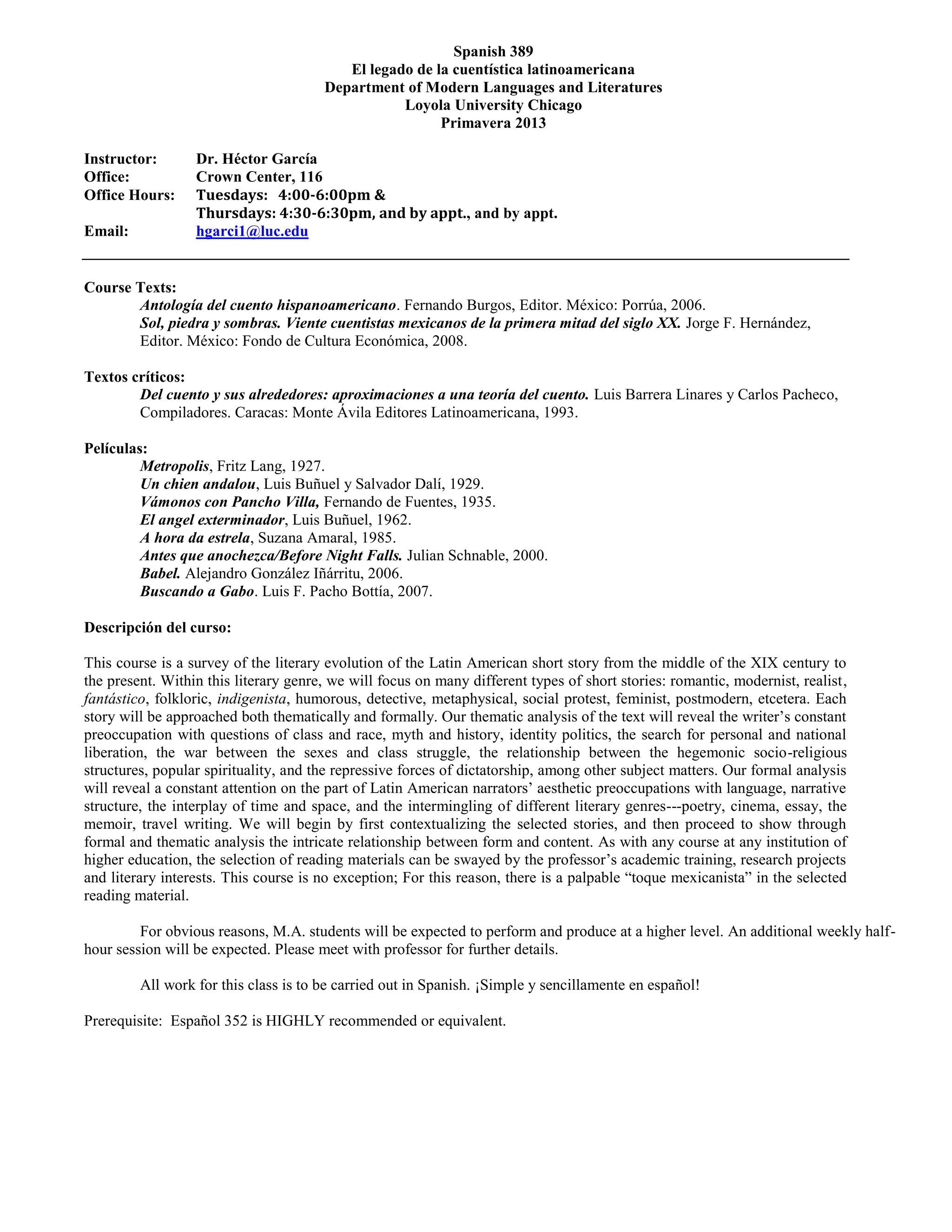
Spanish 389
El legado de la cuentística latinoamericana
Department of Modern Languages and Literatures
Loyola University Chicago
Primavera 2013
Instructor: Dr. Héctor García
Office: Crown Center, 116
Office Hours: Tuesdays: 4:00-6:00pm &
Thursdays: 4:30-6:30pm, and by appt., and by appt.
Email: hgarci1@luc.edu
Course Texts:
Antología del cuento hispanoamericano. Fernando Burgos, Editor. México: Porrúa, 2006.
Sol, piedra y sombras. Viente cuentistas mexicanos de la primera mitad del siglo XX. Jorge F. Hernández,
Editor. México: Fondo de Cultura Económica, 2008.
Textos críticos:
Del cuento y sus alrededores: aproximaciones a una teoría del cuento. Luis Barrera Linares y Carlos Pacheco,
Compiladores. Caracas: Monte Ávila Editores Latinoamericana, 1993.
Películas:
Metropolis, Fritz Lang, 1927.
Un chien andalou, Luis Buñuel y Salvador Dalí, 1929.
Vámonos con Pancho Villa, Fernando de Fuentes, 1935.
El angel exterminador, Luis Buñuel, 1962.
A hora da estrela, Suzana Amaral, 1985.
Antes que anochezca/Before Night Falls. Julian Schnable, 2000.
Babel. Alejandro González Iñárritu, 2006.
Buscando a Gabo. Luis F. Pacho Bottía, 2007.
Descripción del curso:
This course is a survey of the literary evolution of the Latin American short story from the middle of the XIX century to
the present. Within this literary genre, we will focus on many different types of short stories: romantic, modernist, realist,
fantástico, folkloric, indigenista, humorous, detective, metaphysical, social protest, feminist, postmodern, etcetera. Each
story will be approached both thematically and formally. Our thematic analysis of the text will reveal the writer’s constant
preoccupation with questions of class and race, myth and history, identity politics, the search for personal and national
liberation, the war between the sexes and class struggle, the relationship between the hegemonic socio-religious
structures, popular spirituality, and the repressive forces of dictatorship, among other subject matters. Our formal analysis
will reveal a constant attention on the part of Latin American narrators’ aesthetic preoccupations with language, narrative
structure, the interplay of time and space, and the intermingling of different literary genres---poetry, cinema, essay, the
memoir, travel writing. We will begin by first contextualizing the selected stories, and then proceed to show through
formal and thematic analysis the intricate relationship between form and content. As with any course at any institution of
higher education, the selection of reading materials can be swayed by the professor’s academic training, research projects
and literary interests. This course is no exception; For this reason, there is a palpable “toque mexicanista” in the selected
reading material.
For obvious reasons, M.A. students will be expected to perform and produce at a higher level. An additional weekly half-
hour session will be expected. Please meet with professor for further details.
All work for this class is to be carried out in Spanish. ¡Simple y sencillamente en español!
Prerequisite: Español 352 is HIGHLY recommended or equivalent.
Calificación:
The final grade will be computed as follows:
Class attendance, debates, and active participation: 20%
Ensayos: 35% [2 in-class @50, 2 Research Papers -1st@100, 2nd@150]
Oral presentation: 15% [with written critical review]
Pruebitas: 20% [pop quizzes*, análisis literario 4@25, an oral interview @50, 1 take home @50]
Final exam: 10%
Academic Integrity:
Pursuit of truth is a prime activity in a university community. As a member of this community each student
pledges to maintain standards of honesty and integrity in all academic work. Students must rely exclusively upon
their own knowledge for all quizzes and examinations. Failure to do so will result in a failing grade for the
course.
For further information on the paramount importance of academic integrity at Loyola please read:
http://www.luc.edu/academics/catalog/undergrad/reg_academicintegrity.shtml
Course Requirements:
1. Regular and prompt attendance. Note: Your class participation grade will be lowered one letter for every two
unexcused absences.
2. Active participation in class discussions.
3. Thorough preparation for each class.
4. One oral PowerPoint presentation/debate, ten minutes each student. Topics will depend on reading material for
the given day. Your are encouraged to work in pairs or groups of two or three students. Presentations should be
memorized, not read. Only one note card per student will be allowed and use of multimedia is encouraged.
You may use this note card only as a prompt. The group must meet with the professor prior to the date of the
presentation. A class hand-out and collective bibliography must be turned on day of presentation. Also, a
“critical review” will be prepared. More details will be discussed in class and posted on Blackboard.
5. Writing assignments: Two in-class writing assignments and two formal academic papers; one take-home quiz.
No rewrites. Late papers will not be accepted unless prior arrangements have been made with your instructor.
Paper instructions will be detailed by the instructor and posted on Blackboard.
6. Mid-term/oral exam on course readings, discussions, and videos.
7. Several short pop quizzes, two quizzes and final exam [+exit interview] on course readings, class discussions,
and videos.
Chicago is your other classroom for practicing Spanish. You are surrounded by opportunities to read, listen to, and speak
Spanish: Radio, TV, Spanish-language magazines, newspapers, theaters, museums, restaurants, Spanish-speaking people.
Seek them out!
Students with Disabilities:
If you have a documented disability and wish to discuss academic accommodations, please contact me during the first
week of class.
Portfolio:
All majors are asked to complete a portfolio prior to graduation for evaluative purposes. Students are encouraged to
include a variety of representative assignments from their Spanish courses (syllabi, papers, exams, video/audio tapes), as
well as materials from creative projects, foreign travel, study abroad, or internships. Students are also requested to
prepare a brief (1-2 pages) personal statement in Spanish assessing their learning experiences in the major. Students will
be responsible for assembling, updating, revising, and presenting their portfolios.
Note:
Please try to remember to turn off your cell phone and/or electronic devices before class. Also, refrain from eating or
drinking in class. ¡Muchas gracias!
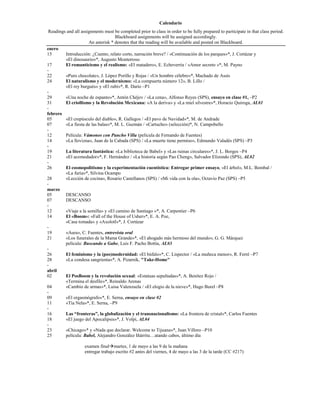
Calendario
Readings and all assignments must be completed prior to class in order to be fully prepared to participate in that class period.
Blackboard assignments will be assigned accordingly.
An asterisk * denotes that the reading will be available and posted on Blackboard.
enero
15 Introducción: ¿Cuento, relato corto, narración breve? / «Continuación de los parques»*, J. Cortázar y
«El dinosaurio»*, Augusto Monterroso
17 El romanticismo y el realismo: «El matadero», E. Echeverría / «Amor secreto »*, M. Payno
-
22 «Puro chocolate», J. López Porillo y Rojas / «Un hombre célebre»*, Machado de Assís
24 El naturalismo y el modernismo: «La compuerta número 12», B. Lillo /
«El rey burgués» y «El rubí»*, R. Darío –P1
-
29 «Una noche de espanto»*, Antón Chéjov / «La cena», Alfonso Reyes (SPS), ensayo en clase #1, –P2
31 El criollismo y la Revolución Mexicana: «A la deriva» y «La miel silvestre»*, Horacio Quiroga, AL#1
-
febrero
05 «El crepúsculo del diablo», R. Gallegos / «El pavo de Navidad»*, M. de Andrade
07 «La fiesta de las balas»*, M. L. Guzmán / «Cartucho» (selección)*, N. Campobello
-
12 Película: Vámonos con Pancho Villa (película de Fernando de Fuentes)
14 «La llovizna», Juan de la Cabada (SPS) / «La muerte tiene permiso», Edmundo Valadés (SPS) –P3
-
19 La literatura fantástica: «La biblioteca de Babel» y «Las ruinas circulares»*, J. L. Borges –P4
21 «El acomodador»*, F. Hernández / «La historia según Pao Cheng», Salvador Elizondo (SPS), AL#2
-
26 El cosmopolitismo y la experimentación cuentística: Entregar primer ensayo, «El árbol», M.L. Bombal /
«La furia»*, Silvina Ocampo
28 «Lección de cocina», Rosario Castellanos (SPS) / «Mi vida con la ola», Octavio Paz (SPS) –P5
-
marzo
05 DESCANSO
07 DESCANSO
-
12 «Viaje a la semilla» y «El camino de Santiago »*, A. Carpentier –P6
14 El «Boom»: «Fall of the House of Usher»*, E. A. Poe,
«Casa tomada» y «Axolotl»*, J. Cortázar
-
19 «Aura», C. Fuentes, entrevista oral
21 «Los funerales de la Mama Grande»*, «El ahogado más hermoso del mundo», G. G. Márquez
película: Buscando a Gabo, Luis F. Pacho Bottía, AL#3
-
26 El feminismo y la (pos)modernidad: «El búfalo»*, C. Lispector / «La muñeca menor», R. Ferré –P7
28 «La condesa sangrienta»*, A. Pizarnik, "Take-Home"
-
abril
02 El PosBoom y la revolución sexual: «Estatuas sepultadas»*, A. Benítez Rojo /
«Termina el desfile»*, Reinaldo Arenas
04 «Cambio de armas»*, Luisa Valenzuela / «El elogio de la nieve»*, Hugo Burel –P8
-
09 «El orgasmógrafo»*, E. Serna, ensayo en clase #2
11 «Tía Nela»*, E. Serna, –P9
-
16 Las “fronteras”, la globalización y el transnacionalismo: «La frontera de cristal»*, Carlos Fuentes
18 «El juego del Apocalipsis»*, J. Volpi, AL#4
-
23 «Chicago»* y «Nada que declarar. Welcome to Tijuana»*, Juan Villoro –P10
25 película: Babel, Alejandro González Iñárritu…atando cabos, último día
examen finalmartes, 1 de mayo a las 9 de la mañana
entregar trabajo escrito #2 antes del viernes, 4 de mayo a las 3 de la tarde (CC #217)

Spanish 389 Syllabus (LUC Spring 2013)

  • 1.
    Spanish 389 El legadode la cuentística latinoamericana Department of Modern Languages and Literatures Loyola University Chicago Primavera 2013 Instructor: Dr. Héctor García Office: Crown Center, 116 Office Hours: Tuesdays: 4:00-6:00pm & Thursdays: 4:30-6:30pm, and by appt., and by appt. Email: hgarci1@luc.edu Course Texts: Antología del cuento hispanoamericano. Fernando Burgos, Editor. México: Porrúa, 2006. Sol, piedra y sombras. Viente cuentistas mexicanos de la primera mitad del siglo XX. Jorge F. Hernández, Editor. México: Fondo de Cultura Económica, 2008. Textos críticos: Del cuento y sus alrededores: aproximaciones a una teoría del cuento. Luis Barrera Linares y Carlos Pacheco, Compiladores. Caracas: Monte Ávila Editores Latinoamericana, 1993. Películas: Metropolis, Fritz Lang, 1927. Un chien andalou, Luis Buñuel y Salvador Dalí, 1929. Vámonos con Pancho Villa, Fernando de Fuentes, 1935. El angel exterminador, Luis Buñuel, 1962. A hora da estrela, Suzana Amaral, 1985. Antes que anochezca/Before Night Falls. Julian Schnable, 2000. Babel. Alejandro González Iñárritu, 2006. Buscando a Gabo. Luis F. Pacho Bottía, 2007. Descripción del curso: This course is a survey of the literary evolution of the Latin American short story from the middle of the XIX century to the present. Within this literary genre, we will focus on many different types of short stories: romantic, modernist, realist, fantástico, folkloric, indigenista, humorous, detective, metaphysical, social protest, feminist, postmodern, etcetera. Each story will be approached both thematically and formally. Our thematic analysis of the text will reveal the writer’s constant preoccupation with questions of class and race, myth and history, identity politics, the search for personal and national liberation, the war between the sexes and class struggle, the relationship between the hegemonic socio-religious structures, popular spirituality, and the repressive forces of dictatorship, among other subject matters. Our formal analysis will reveal a constant attention on the part of Latin American narrators’ aesthetic preoccupations with language, narrative structure, the interplay of time and space, and the intermingling of different literary genres---poetry, cinema, essay, the memoir, travel writing. We will begin by first contextualizing the selected stories, and then proceed to show through formal and thematic analysis the intricate relationship between form and content. As with any course at any institution of higher education, the selection of reading materials can be swayed by the professor’s academic training, research projects and literary interests. This course is no exception; For this reason, there is a palpable “toque mexicanista” in the selected reading material. For obvious reasons, M.A. students will be expected to perform and produce at a higher level. An additional weekly half- hour session will be expected. Please meet with professor for further details. All work for this class is to be carried out in Spanish. ¡Simple y sencillamente en español! Prerequisite: Español 352 is HIGHLY recommended or equivalent.
  • 2.
    Calificación: The final gradewill be computed as follows: Class attendance, debates, and active participation: 20% Ensayos: 35% [2 in-class @50, 2 Research Papers -1st@100, 2nd@150] Oral presentation: 15% [with written critical review] Pruebitas: 20% [pop quizzes*, análisis literario 4@25, an oral interview @50, 1 take home @50] Final exam: 10% Academic Integrity: Pursuit of truth is a prime activity in a university community. As a member of this community each student pledges to maintain standards of honesty and integrity in all academic work. Students must rely exclusively upon their own knowledge for all quizzes and examinations. Failure to do so will result in a failing grade for the course. For further information on the paramount importance of academic integrity at Loyola please read: http://www.luc.edu/academics/catalog/undergrad/reg_academicintegrity.shtml Course Requirements: 1. Regular and prompt attendance. Note: Your class participation grade will be lowered one letter for every two unexcused absences. 2. Active participation in class discussions. 3. Thorough preparation for each class. 4. One oral PowerPoint presentation/debate, ten minutes each student. Topics will depend on reading material for the given day. Your are encouraged to work in pairs or groups of two or three students. Presentations should be memorized, not read. Only one note card per student will be allowed and use of multimedia is encouraged. You may use this note card only as a prompt. The group must meet with the professor prior to the date of the presentation. A class hand-out and collective bibliography must be turned on day of presentation. Also, a “critical review” will be prepared. More details will be discussed in class and posted on Blackboard. 5. Writing assignments: Two in-class writing assignments and two formal academic papers; one take-home quiz. No rewrites. Late papers will not be accepted unless prior arrangements have been made with your instructor. Paper instructions will be detailed by the instructor and posted on Blackboard. 6. Mid-term/oral exam on course readings, discussions, and videos. 7. Several short pop quizzes, two quizzes and final exam [+exit interview] on course readings, class discussions, and videos. Chicago is your other classroom for practicing Spanish. You are surrounded by opportunities to read, listen to, and speak Spanish: Radio, TV, Spanish-language magazines, newspapers, theaters, museums, restaurants, Spanish-speaking people. Seek them out! Students with Disabilities: If you have a documented disability and wish to discuss academic accommodations, please contact me during the first week of class. Portfolio: All majors are asked to complete a portfolio prior to graduation for evaluative purposes. Students are encouraged to include a variety of representative assignments from their Spanish courses (syllabi, papers, exams, video/audio tapes), as well as materials from creative projects, foreign travel, study abroad, or internships. Students are also requested to prepare a brief (1-2 pages) personal statement in Spanish assessing their learning experiences in the major. Students will be responsible for assembling, updating, revising, and presenting their portfolios. Note: Please try to remember to turn off your cell phone and/or electronic devices before class. Also, refrain from eating or drinking in class. ¡Muchas gracias!
  • 3.
    Calendario Readings and allassignments must be completed prior to class in order to be fully prepared to participate in that class period. Blackboard assignments will be assigned accordingly. An asterisk * denotes that the reading will be available and posted on Blackboard. enero 15 Introducción: ¿Cuento, relato corto, narración breve? / «Continuación de los parques»*, J. Cortázar y «El dinosaurio»*, Augusto Monterroso 17 El romanticismo y el realismo: «El matadero», E. Echeverría / «Amor secreto »*, M. Payno - 22 «Puro chocolate», J. López Porillo y Rojas / «Un hombre célebre»*, Machado de Assís 24 El naturalismo y el modernismo: «La compuerta número 12», B. Lillo / «El rey burgués» y «El rubí»*, R. Darío –P1 - 29 «Una noche de espanto»*, Antón Chéjov / «La cena», Alfonso Reyes (SPS), ensayo en clase #1, –P2 31 El criollismo y la Revolución Mexicana: «A la deriva» y «La miel silvestre»*, Horacio Quiroga, AL#1 - febrero 05 «El crepúsculo del diablo», R. Gallegos / «El pavo de Navidad»*, M. de Andrade 07 «La fiesta de las balas»*, M. L. Guzmán / «Cartucho» (selección)*, N. Campobello - 12 Película: Vámonos con Pancho Villa (película de Fernando de Fuentes) 14 «La llovizna», Juan de la Cabada (SPS) / «La muerte tiene permiso», Edmundo Valadés (SPS) –P3 - 19 La literatura fantástica: «La biblioteca de Babel» y «Las ruinas circulares»*, J. L. Borges –P4 21 «El acomodador»*, F. Hernández / «La historia según Pao Cheng», Salvador Elizondo (SPS), AL#2 - 26 El cosmopolitismo y la experimentación cuentística: Entregar primer ensayo, «El árbol», M.L. Bombal / «La furia»*, Silvina Ocampo 28 «Lección de cocina», Rosario Castellanos (SPS) / «Mi vida con la ola», Octavio Paz (SPS) –P5 - marzo 05 DESCANSO 07 DESCANSO - 12 «Viaje a la semilla» y «El camino de Santiago »*, A. Carpentier –P6 14 El «Boom»: «Fall of the House of Usher»*, E. A. Poe, «Casa tomada» y «Axolotl»*, J. Cortázar - 19 «Aura», C. Fuentes, entrevista oral 21 «Los funerales de la Mama Grande»*, «El ahogado más hermoso del mundo», G. G. Márquez película: Buscando a Gabo, Luis F. Pacho Bottía, AL#3 - 26 El feminismo y la (pos)modernidad: «El búfalo»*, C. Lispector / «La muñeca menor», R. Ferré –P7 28 «La condesa sangrienta»*, A. Pizarnik, "Take-Home" - abril 02 El PosBoom y la revolución sexual: «Estatuas sepultadas»*, A. Benítez Rojo / «Termina el desfile»*, Reinaldo Arenas 04 «Cambio de armas»*, Luisa Valenzuela / «El elogio de la nieve»*, Hugo Burel –P8 - 09 «El orgasmógrafo»*, E. Serna, ensayo en clase #2 11 «Tía Nela»*, E. Serna, –P9 - 16 Las “fronteras”, la globalización y el transnacionalismo: «La frontera de cristal»*, Carlos Fuentes 18 «El juego del Apocalipsis»*, J. Volpi, AL#4 - 23 «Chicago»* y «Nada que declarar. Welcome to Tijuana»*, Juan Villoro –P10 25 película: Babel, Alejandro González Iñárritu…atando cabos, último día examen finalmartes, 1 de mayo a las 9 de la mañana entregar trabajo escrito #2 antes del viernes, 4 de mayo a las 3 de la tarde (CC #217)