Teaching Speaking
within a Communicative
Competence Framework
Communicative approaches to L2 language teaching have evolved significantly
over the past two decades. This evolution stems from Hymes' (1971, 1972) concept
of communicative competence, which expanded on Chomsky's (1965) distinction
between competence and performance. Hymes argued for the inclusion of
language use in social contexts and appropriacy norms. Since the 1980s, various
models have been developed to operationalize communicative competence in L2
teaching, emphasizing the crucial role of speaking in facilitating its acquisition.
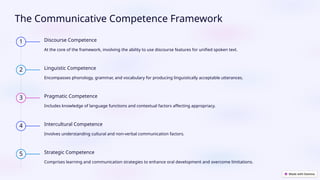
The Communicative Competence Framework
1 Discourse Competence
At the core of the framework, involving the ability to use discourse features for unified spoken text.
2 Linguistic Competence
Encompasses phonology, grammar, and vocabulary for producing linguistically acceptable utterances.
3 Pragmatic Competence
Includes knowledge of language functions and contextual factors affecting appropriacy.
4 Intercultural Competence
Involves understanding cultural and non-verbal communication factors.
5 Strategic Competence
Comprises learning and communication strategies to enhance oral development and overcome limitations.
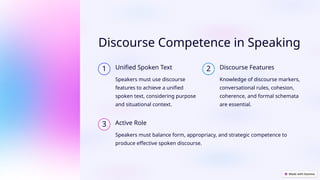
Discourse Competence in Speaking
1 Unified Spoken Text
Speakers must use discourse
features to achieve a unified
spoken text, considering purpose
and situational context.
2 Discourse Features
Knowledge of discourse markers,
conversational rules, cohesion,
coherence, and formal schemata
are essential.
3 Active Role
Speakers must balance form, appropriacy, and strategic competence to
produce effective spoken discourse.
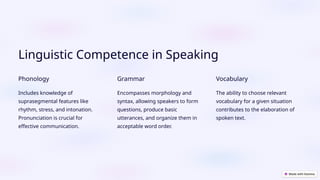
Linguistic Competence in Speaking
Phonology
Includes knowledge of
suprasegmental features like
rhythm, stress, and intonation.
Pronunciation is crucial for
effective communication.
Grammar
Encompasses morphology and
syntax, allowing speakers to form
questions, produce basic
utterances, and organize them in
acceptable word order.
Vocabulary
The ability to choose relevant
vocabulary for a given situation
contributes to the elaboration of
spoken text.
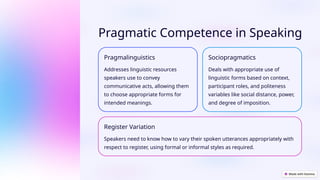
Pragmatic Competence in Speaking
Pragmalinguistics
Addresses linguistic resources
speakers use to convey
communicative acts, allowing them
to choose appropriate forms for
intended meanings.
Sociopragmatics
Deals with appropriate use of
linguistic forms based on context,
participant roles, and politeness
variables like social distance, power,
and degree of imposition.
Register Variation
Speakers need to know how to vary their spoken utterances appropriately with
respect to register, using formal or informal styles as required.
Intercultural Competence in Speaking
Cultural Awareness
Knowledge of cultural rules of behavior to avoid miscommunication, such as understanding
appropriate pause lengths in conversations.
Non-verbal Communication
Understanding body language, facial expressions, and eye contact to communicate effectively across cultures.
Adaptability
Ability to adjust communication style based on cultural context and non-verbal cues from listeners.
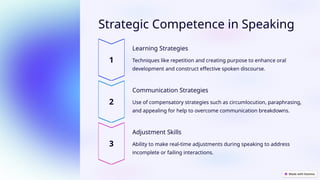
Strategic Competence in Speaking
Learning Strategies
Techniques like repetition and creating purpose to enhance oral
development and construct effective spoken discourse.
Communication Strategies
Use of compensatory strategies such as circumlocution, paraphrasing,
and appealing for help to overcome communication breakdowns.
Adjustment Skills
Ability to make real-time adjustments during speaking to address
incomplete or failing interactions.
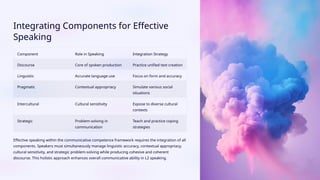
Integrating Components for Effective
Speaking
Component Role in Speaking Integration Strategy
Discourse Core of spoken production Practice unified text creation
Linguistic Accurate language use Focus on form and accuracy
Pragmatic Contextual appropriacy Simulate various social
situations
Intercultural Cultural sensitivity Expose to diverse cultural
contexts
Strategic Problem-solving in
communication
Teach and practice coping
strategies
Effective speaking within the communicative competence framework requires the integration of all
components. Speakers must simultaneously manage linguistic accuracy, contextual appropriacy,
cultural sensitivity, and strategic problem-solving while producing cohesive and coherent
discourse. This holistic approach enhances overall communicative ability in L2 speaking.

Teaching-Speaking-within-a-Communicative-Competence-Framework.pptx

  • 1.
    Teaching Speaking within aCommunicative Competence Framework Communicative approaches to L2 language teaching have evolved significantly over the past two decades. This evolution stems from Hymes' (1971, 1972) concept of communicative competence, which expanded on Chomsky's (1965) distinction between competence and performance. Hymes argued for the inclusion of language use in social contexts and appropriacy norms. Since the 1980s, various models have been developed to operationalize communicative competence in L2 teaching, emphasizing the crucial role of speaking in facilitating its acquisition.
  • 3.
    The Communicative CompetenceFramework 1 Discourse Competence At the core of the framework, involving the ability to use discourse features for unified spoken text. 2 Linguistic Competence Encompasses phonology, grammar, and vocabulary for producing linguistically acceptable utterances. 3 Pragmatic Competence Includes knowledge of language functions and contextual factors affecting appropriacy. 4 Intercultural Competence Involves understanding cultural and non-verbal communication factors. 5 Strategic Competence Comprises learning and communication strategies to enhance oral development and overcome limitations.
  • 4.
    Discourse Competence inSpeaking 1 Unified Spoken Text Speakers must use discourse features to achieve a unified spoken text, considering purpose and situational context. 2 Discourse Features Knowledge of discourse markers, conversational rules, cohesion, coherence, and formal schemata are essential. 3 Active Role Speakers must balance form, appropriacy, and strategic competence to produce effective spoken discourse.
  • 5.
    Linguistic Competence inSpeaking Phonology Includes knowledge of suprasegmental features like rhythm, stress, and intonation. Pronunciation is crucial for effective communication. Grammar Encompasses morphology and syntax, allowing speakers to form questions, produce basic utterances, and organize them in acceptable word order. Vocabulary The ability to choose relevant vocabulary for a given situation contributes to the elaboration of spoken text.
  • 6.
    Pragmatic Competence inSpeaking Pragmalinguistics Addresses linguistic resources speakers use to convey communicative acts, allowing them to choose appropriate forms for intended meanings. Sociopragmatics Deals with appropriate use of linguistic forms based on context, participant roles, and politeness variables like social distance, power, and degree of imposition. Register Variation Speakers need to know how to vary their spoken utterances appropriately with respect to register, using formal or informal styles as required.
  • 7.
    Intercultural Competence inSpeaking Cultural Awareness Knowledge of cultural rules of behavior to avoid miscommunication, such as understanding appropriate pause lengths in conversations. Non-verbal Communication Understanding body language, facial expressions, and eye contact to communicate effectively across cultures. Adaptability Ability to adjust communication style based on cultural context and non-verbal cues from listeners.
  • 8.
    Strategic Competence inSpeaking Learning Strategies Techniques like repetition and creating purpose to enhance oral development and construct effective spoken discourse. Communication Strategies Use of compensatory strategies such as circumlocution, paraphrasing, and appealing for help to overcome communication breakdowns. Adjustment Skills Ability to make real-time adjustments during speaking to address incomplete or failing interactions.
  • 9.
    Integrating Components forEffective Speaking Component Role in Speaking Integration Strategy Discourse Core of spoken production Practice unified text creation Linguistic Accurate language use Focus on form and accuracy Pragmatic Contextual appropriacy Simulate various social situations Intercultural Cultural sensitivity Expose to diverse cultural contexts Strategic Problem-solving in communication Teach and practice coping strategies Effective speaking within the communicative competence framework requires the integration of all components. Speakers must simultaneously manage linguistic accuracy, contextual appropriacy, cultural sensitivity, and strategic problem-solving while producing cohesive and coherent discourse. This holistic approach enhances overall communicative ability in L2 speaking.