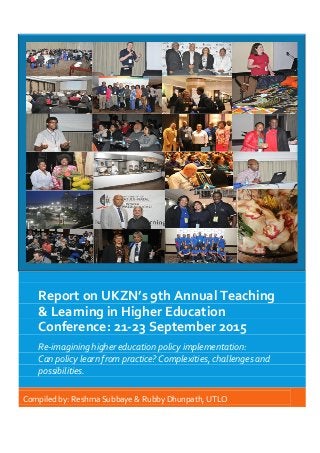
Report on UKZN’s 9th Annual Teaching
& Learning in Higher Education
Conference: 21-23 September 2015
Re-imagining higher education policy implementation:
Can policy learn from practice? Complexities, challenges and
possibilities.
Compiled by: Reshma Subbaye & Rubby Dhunpath, UTLO
TLHEC2015 – Conference report
1
CONTENTS
Introduction......................................................................................................................................2
Conference attendance and participation......................................................................................... 3
Conference presentations................................................................................................................. 4
Welcome and introduction................................................................................................................6
Opening address...............................................................................................................................6
Keynote speakers.............................................................................................................................. 7
Prof Adam Habib – Wits University ............................................................................................... 7
Prof William Tierney – University of Southern California............................................................... 8
Prof Narend Baijnath – Council for Higher Education....................................................................8
Prof Herbert Chimhundu - Chinhoyi University of Technology......................................................9
Workshops...................................................................................................................................... 10
Creating a culture to improve student performance: Increasing access to higher education. ...... 10
The adaptable mind: Education and the dynamic question......................................................... 10
Alternative forms of presenting at conferences: Using visual and arts-based approaches............11
Writing grant proposals............................................................................................................... 12
Aligning health professional education with health systems needs............................................. 12
Special interest groups.....................................................................................................................13
Towards a clearer policy on the role of technology in education ..................................................13
Early career academics: revisited .................................................................................................13
UTLO TV......................................................................................................................................... 14
Conference synopsis ........................................................................................................................15
Conference gala dinner and cocktail evenings................................................................................. 16
Media coverage ...............................................................................................................................17
Conference evaluation.................................................................................................................... 19
Pre-conference proceedings ........................................................................................................... 20
Pre-conference workshops (co-hosted by Higher education Training & Devlopment – HETD)........ 21
Publication opportunity - Conference special issue: AlterNation..................................................... 21
Acknowledgements........................................................................................................................ 22
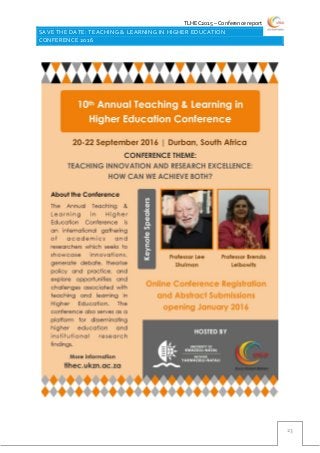
Save the date: Teaching & Learning in Higher Education Conference 2016 .................................... 23
TLHEC2015 – Conference report
2
INTRODUCTION
The Annual Teaching and Learning in Higher Education Conference (TLHEC) is a gathering of
academics, researchers and policymakers to
showcase innovations, discuss issues and
debate challenges relevant to teaching and
learning in Higher Education. In 2015, the
conference theme was RE-IMAGINING
HIGHER EDUCATION POLICY
IMPLEMENTATION: CAN POLICY LEARN
FROM PRACTICE? COMPLEXITIES,
CHALLENGES AND POSSIBILITIES, and
consisted of the following sub-themes:
1. Re-imagining internationalisation in higher
education: Implications for praxis
2. Revisiting differentiation in higher
education. What have we learnt from practice?
3. Collaborative quality enhancement for
systemic change in higher education:
prospects and possibilities
4. Institutional research: Catalyst for policy
formation and institutional development
and/or capitulation to corporatisation?
5. Who is the 21st century university student / academic?
6. Teaching & learning technologies: Possibilities and perils
7. Responsive and innovative pedagogies in higher education
8. Language policy, planning and implementation in higher education: Complexities,
challenges and possibilities
9. Alternative paradigms and emerging directions in the scholarship of teaching and learning in
higher education
10. New directions and advances in health sciences education
Generally, the conference was very well-organised and there were lots of
opportunities for discussion and networking. Conference delegate, evaluation form ID#3
The keynote speakers were very good. Conference delegate, evaluation form ID#12
The plenaries provided broad overviews, nice contrast to the (necessarily) restricted
focus of individual presentations.Conference delegate, evaluation form ID#44
TLHEC2015 – Conference report
3
CONFERENCE ATTENDANCE AND PARTICIPATION
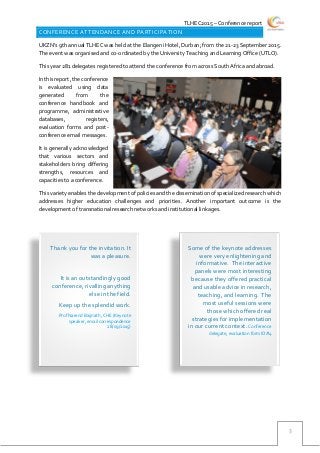
UKZN’s 9th annual TLHEC was held at the Elangeni Hotel, Durban; from the 21-23 September 2015.
The event was organised and co-ordinated by the University Teaching and Learning Office (UTLO).
This year 281 delegates registered to attend the conference from across South Africa and abroad.
In this report, the conference
is evaluated using data
generated from the
conference handbook and
programme, administrative
databases, registers,
evaluation forms and post-
conference email messages.
It is generally acknowledged
that various sectors and
stakeholders bring differing
strengths, resources and
capacities to a conference.
This variety enables the development of policies and the dissemination of specialized research which
addresses higher education challenges and priorities. Another important outcome is the
development of transnational research networks and institutional linkages.
Some of the keynote addresses
were very enlightening and
informative. The interactive
panels were most interesting
because they offered practical
and usable advice in research,
teaching, and learning. The
most useful sessions were
those which offered real
strategies for implementation
in our current context. Conference
delegate, evaluation form ID#4
Thank you for the invitation. It
was a pleasure.
It is an outstandingly good
conference, rivalling anything
else in the field.
Keep up the splendid work.
Prof Narend Baijnath, CHE (Keynote
speaker, email correspondence
28/09/2015)
TLHEC2015 – Conference report
4
CONFERENCE PRESENTATIONS
A total of 206 abstract submissions were received. These abstracts were peer-reviewed by groups of
volunteer academics.In 2015,UTLO adopteda novelwayofconducting the peer-review process.This
involved convening a group meeting of all 22 reviewers on a single day. Reviewers were split into
groups (5-8 academics) according to the conference thematic tracks. Each group comprised an
education&/higher education academic,andacademicsfromother diverse disciplinary backgrounds.
Furthermore, academics were grouped in terms of their level of experience in reviewing. Simply put
the review groups consisted of senior and junior academics from multiple disciplines. Each abstract
was then reviewed by individuals in the group and consensus on the final review and feedback was
reached by the group. Those who participated in the review process reported that it facilitated and
enhanced their learning of peer-reviews, allowed them to gain multidisciplinary perspectives and,
that it created a space for debate and discussion. The table below highlights the number of
presentations by delivery mode.
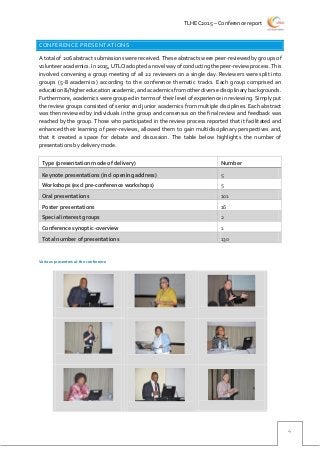
Various presenters at the conference
Type (presentation mode of delivery) Number
Keynote presentations (incl opening address) 5
Workshops (excl pre-conference workshops) 5
Oral presentations 101
Poster presentations 16
Special interest groups 2
Conference synoptic-overview 1
Total number of presentations 130
TLHEC2015 – Conference report
5
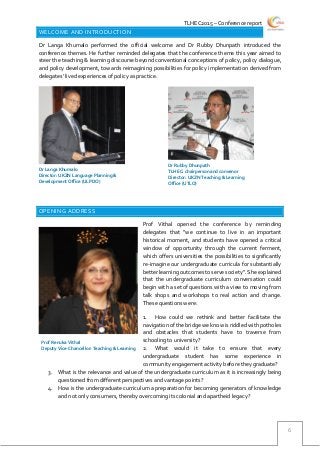
SOME POSTERS ON DISPLAY AT THE CONFERENCE
I am from the private
sector and found it very
interesting to hear about
the challenges and
opportunities that are
common in the public
sector. I think that more
private institutions should
be encouraged to
participate so that they can
learn from the public sector
as well as share their
experience in areas in
which they excel. Conference
delegate, evaluation form ID#7
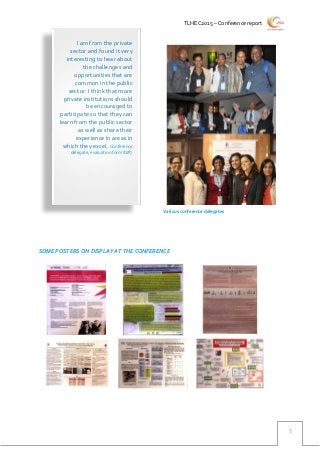
Various conference delegates
TLHEC2015 – Conference report
6
WELCOME AND INTRODUCTION
Dr Langa Khumalo performed the official welcome and Dr Rubby Dhunpath introduced the
conference themes. He further reminded delegates that the conference theme this year aimed to
steer the teaching & learning discourse beyond conventional conceptions of policy, policy dialogue,
and policy development, towards reimagining possibilities for policy implementation derived from
delegates’ lived experiences of policy as practice.
OPENING ADDRESS
Prof Vithal opened the conference by reminding
delegates that “we continue to live in an important
historical moment, and students have opened a critical
window of opportunity through the current ferment,
which offers universities the possibilities to significantly
re-imagine our undergraduate curricula for substantially
better learning outcomes to serve society”. She explained
that the undergraduate curriculum conversation could
begin with a set of questions with a view to moving from
talk shops and workshops to real action and change.
These questions were:
1. How could we rethink and better facilitate the
navigation of the bridge we know is riddled with potholes
and obstacles that students have to traverse from
schooling to university?
2. What would it take to ensure that every
undergraduate student has some experience in
community engagement activity before they graduate?
3. What is the relevance and value of the undergraduate curriculum as it is increasingly being
questioned from different perspectives and vantage points?
4. How is the undergraduate curriculum a preparation for becoming generators of knowledge
and not only consumers, thereby overcoming its colonial and apartheid legacy?
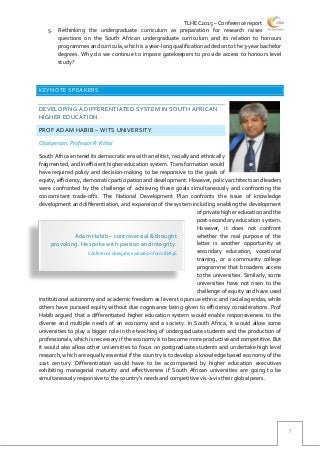
Dr Langa Khumalo
Director: UKZN Language Planning &
Development Office (ULPDO)
Dr Rubby Dhunpath
TLHEC: chairperson and convenor
Director: UKZN Teaching & Learning
Office (UTLO)
Prof Renuka Vithal
Deputy Vice-Chancellor: Teaching & Learning
TLHEC2015 – Conference report
7
5. Rethinking the undergraduate curriculum as preparation for research raises
questions on the South African undergraduate curriculum and its relation to honours
programmes and curricula, which is a year-long qualification added on to the 3-year bachelor
degrees. Why do we continue to impose gatekeepers to provide access to honours level
study?
KEYNOTE SPEAKERS
DEVELOPING A DIFFERENTIATED SYSTEM IN SOUTH AFRICAN
HIGHER EDUCATION
PROF ADAM HABIB – WITS UNIVERSITY
Chairperson: Professor R Vithal
South Africa entered its democratic era with an elitist, racially and ethnically
fragmented, and inefficient higher education system. Transformation would
have required policy and decision-making to be responsive to the goals of
equity, efficiency, democratic participation and development. However, policy architects and leaders
were confronted by the challenge of achieving these goals simultaneously and confronting the
concomitant trade-offs. The National Development Plan confronts the issue of knowledge
development and differentiation, and expansion of the system including enabling the development
of private higher education and the
post-secondary education system.
However, it does not confront
whether the real purpose of the
latter is another opportunity at
secondary education, vocational
training, or a community college
programme that broadens access
to the universities. Similarly, some
universities have not risen to the
challenge of equity and have used
institutional autonomy and academic freedom as levers to pursue ethnic and racial agendas, while
others have pursued equity without due cognisance being given to efficiency considerations. Prof
Habib argued that a differentiated higher education system would enable responsiveness to the
diverse and multiple needs of an economy and a society. In South Africa, it would allow some
universities to play a bigger role in the teaching of undergraduate students and the production of
professionals, which is necessary if the economy is to become more productive and competitive. But
it would also allow other universities to focus on postgraduate students and undertake high level
research, which are equally essential if the country is to develop a knowledge based economy of the
21st century. Differentiation would have to be accompanied by higher education executives
exhibiting managerial maturity and effectiveness if South African universities are going to be
simultaneously responsive to the country’s needs and competitive vis-à-vis their global peers.
Adam Habib – controversial & thought
provoking. He spoke with passion and integrity.
Conference delegate, evaluation form ID#46
TLHEC2015 – Conference report
8
THE CHALLENGE OF ACCESS: PRAXIS AND STRUCTURE IN HIGHER
EDUCATION
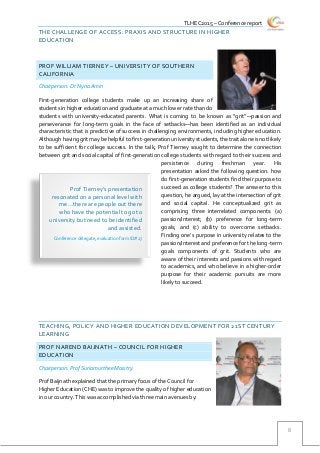
PROF WILLIAM TIERNEY – UNIVERSITY OF SOUTHERN
CALIFORNIA
Chairperson: Dr Nyna Amin
First-generation college students make up an increasing share of
students in higher education and graduate at a much lower rate than do
students with university-educated parents. What is coming to be known as “grit”—passion and
perseverance for long-term goals in the face of setbacks—has been identified as an individual
characteristic that is predictive of success in challenging environments, including higher education.
Although having grit maybe helpfulto first-generation university students,the trait alone isnot likely
to be sufficient for college success. In the talk, Prof Tierney sought to determine the connection
between grit and social capital of first-generation college students with regard to their success and
persistence during freshman year. His
presentation asked the following question: how
do first-generation students find their purpose to
succeed as college students? The answer to this
question, he argued, lay at the intersection of grit
and social capital. He conceptualized grit as
comprising three interrelated components: (a)
passion/interest; (b) preference for long-term
goals; and (c) ability to overcome setbacks.
Finding one’s purpose in university relates to the
passion/interest and preference for the long-term
goals components of grit. Students who are
aware of their interests and passions with regard
to academics, and who believe in a higher-order
purpose for their academic pursuits are more
likely to succeed.
TEACHING, POLICY AND HIGHER EDUCATION DEVELOPMENT FOR 21ST CENTURY
LEARNING
PROF NAREND BAIJNATH – COUNCIL FOR HIGHER
EDUCATION
Chairperson: Prof Suriamurthee Maistry
Prof Baijnath explained that the primary focus of the Council for
Higher Education (CHE) was to improve the quality of higher education
in our country. This was accomplished via three main avenues by:
Prof Tierney’s presentation
resonated on a personal level with
me…there are people out there
who have the potential to go to
university but need to be identified
and assisted.
Conference delegate, evaluation form ID#27
TLHEC2015 – Conference report
9
1. Bringing under regular and constant scrutiny the quality arrangements and
promotions within SA universities, to accredit every programme that is offered in higher
education nationally; public and private
2. Providing policy advice to the minister of higher education and training
3. Fostering a critical discourse on higher
education matters in the country.
Within this ambit, Prof Baijnath discussed systemic
issues related to the:
 increasing numbers of students flowing from
demand and planning led expansion, which
have strained resources and infrastructure
and placed burgeoning pressure on
personnel.
 unprecedented regulation, compliance,
reporting and performance management
requirements at universities
 goals and policies around access to higher
education which have resulted in greater alignment with national demographics at the
student level, but has led to increased diversity – in terms of class, linguistic background,
urban/rural origin, school experiences, material conditions, access and technology and
experimental learning resources.
He concluded by saying that any advancement in higher education had to be linked to institutional
strategy, infrastructure and a deliberate development trajectory (for staff and students).
AFRICAN LANGUAGES, ICTS AND THE ACADEMY: PERSPECTIVES FROM
LEXICOGRAPHY, TERMINOLOGY AND LIVING
HERITAGE
PROF HERBERT CHIMHUNDU - CHINHOYI UNIVERSITY
OF TECHNOLOGY
Chairperson: Dr Langa Khumalo
Prof Chimhundu shared his reflections of 35 years in teaching,
research and language raising through lexicography,
terminology and advocacy, and the limit to what specialists can achieve on their own. The
conventional departments of linguistics or African languages and literature cannot by themselves
demonstrate enough utilitarian value to reverse prevalent negative attitudes and lack of political will
by the ruling elite. He argued that radical interventions by the academy is needed to invoke ICTs,
specifically human language technology (HLT), not only to bring African languages into the
information society, but also to link indigenous knowledge and living heritage [intangible cultural
heritage (ICH)] with other forms of knowledge within mainstream academia. Institutions of higher
learning have the capacity to develop such HLT applicationsin a manner that can incorporate product
development, entrepreneurship and innovation in pedagogy to include digital gadgets, tools and
games that are appealing and can be scaled down to the school level.
Prof Narend Baijnath was
very insightful and he hit on
important points regarding
higher education challenges.
Conference delegate, evaluation form
ID#42
TLHEC2015 – Conference report
10
WORKSHOPS
CREATING A CULTURE TO IMPROVE STUDENT PERFORMANCE: INCREASING
ACCESS TO HIGHER EDUCATION.
Facilitated by Prof William Tierney
Prof Tierney stressed that the legacy of the 20th
century was that there was very little relationship
between high schools and universities. Students graduated from high school and even though they
were often not prepared for university work, there was very little interaction among faculty, staff and
teachers in either the K-12 or university systems. One reason for increased interaction was the
urgency to have more individuals who graduate from high school and attend a postsecondary
institution. Such a need is not only necessary for “manpower” needs but also to increase the
democratic participation of the citizenry. In this workshop the sorts of activities that increase access
to higher education and ensure that students are “college-ready” when they go to university, were
discussed. Prof Tierney discussed the cognitive variables that have an influence on university-
readiness and then went on to consider what is coming to be known as non-cognitive (or “college
knowledge) variables. The workshop situated the discussion at the intersection of K-12 (matric and
first-year) and higher education and examined strategies such as what should be taught, what
parents and families might do, how we might increase the financial literacy of students, and what
might be done to improve academic performance.
THE ADAPTABLE MIND: EDUCATION AND
THE DYNAMIC QUESTION
I enjoyed the workshops by
Prof Tierney and Steven
Harrison because they
brought diverse perspectives
and inspired me.
Conference delegate, evaluation form
ID#37
The interactive panels [workshops] were the most interesting because they offered
practical and usable advice in research, teaching, and learning.
Conference delegate, evaluation form ID#3
Delegates at the workshop
TLHEC2015 – Conference report
11
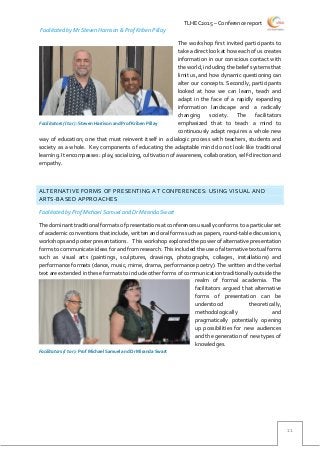
Facilitated by Mr Steven Harrison & Prof Kriben Pillay
The workshop first invited participants to
take a direct look at how each of us creates
information in our conscious contact with
the world, including the belief systems that
limit us, and how dynamic questioning can
alter our concepts. Secondly, participants
looked at how we can learn, teach and
adapt in the face of a rapidly expanding
information landscape and a radically
changing society. The facilitators
emphasized that to teach a mind to
continuously adapt requires a whole new
way of education; one that must reinvent itself in a dialogic process with teachers, students and
society as a whole. Key components of educating the adaptable mind do not look like traditional
learning. It encompasses: play, socializing, cultivation of awareness, collaboration, self-direction and
empathy.
ALTERNATIVE FORMS OF PRESENTING AT CONFERENCES: USING VISUAL AND
ARTS-BASED APPROACHES
Facilitated by Prof Michael Samuel and Dr Miranda Swart
The dominant traditional formats of presentations at conferences usually conforms to a particular set
ofacademicconventionsthat include, written andoralformssuch as papers,round-table discussions,
workshops and poster presentations. This workshop explored the power of alternative presentation
forms to communicate ideas for and from research. This included the use of alternative textual forms
such as visual arts (paintings, sculptures, drawings, photographs, collages, installations) and
performance formats (dance, music, mime, drama, performance poetry). The written and the verbal
text are extended in these formats to include other forms of communication traditionally outside the
realm of formal academia. The
facilitators argued that alternative
forms of presentation can be
understood theoretically,
methodologically and
pragmatically potentially opening
up possibilities for new audiences
and the generation of new types of
knowledges.
Facilitators (l to r): Steven Harrison and Prof Kriben Pillay
Facilitators (l to r): Prof Michael Samuel and Dr Miranda Swart
TLHEC2015 – Conference report
12
WRITING GRANT PROPOSALS
Facilitated by Prof Julia Preece
This hands-on workshop was designed to assist early researchers (and those new to research in
teaching and learning) in higher education. The facilitator took participants through the various
stages of structuring a research proposal, highlighting what grant funderswere looking for in a ‘good’
proposal. Participants had the opportunity to critique an unsuccessful proposal and compare this
critique with a successful proposal.
ALIGNING HEALTH PROFESSIONAL EDUCATION WITH HEALTH SYSTEMS NEEDS
Facilitated by Prof Sabiha Essack et al.
UKZN’s College of Health Sciences undertook a situational analysis on the nature and extent of (1)
primary healthcare as mooted in the National Development Plan and translated in the current
Department of Health Strategic Plan, (2) community-based training (in the primary healthcare
model), (3) social accountability as defined by The Health Equity Network (THENet), generic
competencies with an emphasis on communication, advocacy and leadership and social cohesion as
mooted by the Department of Higher Education and Training. This workshop discussed the results of
the situational
analysis with a view
to curriculum review
(content, pedagogy
an assessment) and
took the format of
plenary presentations
followed by a panel
discussion.
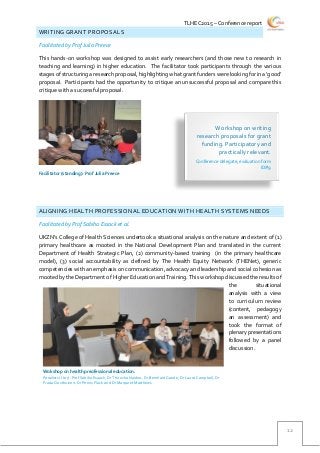
Workshop on writing
research proposals for grant
funding. Participatory and
practically relevant.
Conference delegate, evaluation form
ID#9
Wokshop on health preofessional education.
Panelists (l to r): Prof Sabiha Esaack, Dr Thirusha Naidoo, Dr Bernhard Gaede, Dr Laura Campbell, Dr
Frasia Oosthuizen, Dr Penny Flack and Dr Margaret Matthews
Facilitator (standing): Prof Julia Preece
TLHEC2015 – Conference report
13
SPECIAL INTEREST GROUPS
TOWARDS A CLEARER POLICY ON THE ROLE OF TECHNOLOGY IN EDUCATION
Facilitated by Prof Randhir Rawatlal & Mr Hilary Reynolds
Over the past decade, there has been increased interest in the role of technology in education. The
interest ranges all the way from multi-institution data analytics to the creation and implementation
of games and animated simulations in classrooms. Relatively new concepts in computing such as Big
Data and Cloud Computing also have roles to play, and the potential of social media cannot be
ignored. The introduction of computing hardware into the educational process also raises special
issues including security and accessibility. In this session, the special interest group (SIG) discussed
the following:
 Review of tech-trends and applications to education
 Creation and application of games in education
 Policy development and objectives
EARLY CAREER ACADEMICS: REVISITED
Facilitated by Mr Siya Ntombela & Ms Nolwazi Nzama
In 2014 the Early Career Academics (ECA) study,
commissioned bythe Carnegie Corporation (NY),was
conducted by research teams in 7 universities across
Africa. The preliminary results of that study were
presented at a special interest group launched at the
8th
TLHEC. This year two UTLO research interns
presented their research findings on a follow-up
qualitative study involving developmental lecturers
at UKZN. The SIG discussed the implications of the
study as it related to the professional development of
young academics at UKZN, in particular the role of
mentorship as a support strategy.
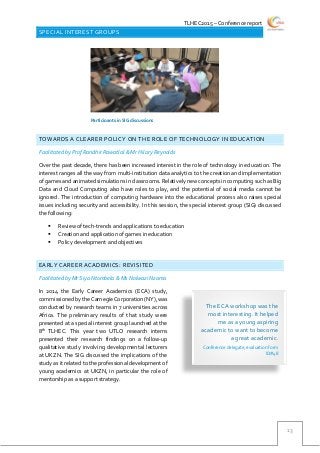
Participants in SIG discussions
The ECA workshop was the
most interesting. It helped
me as a young aspiring
academic to want to become
a great academic.
Conference delegate, evaluation form
ID#48
TLHEC2015 – Conference report
14
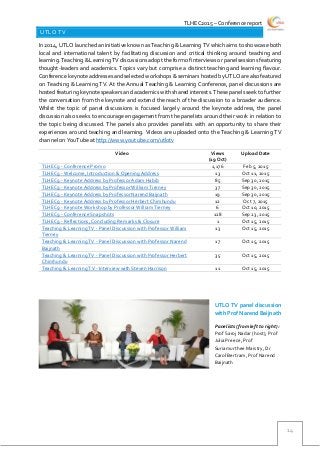
UTLO TV
In 2014, UTLO launched an initiative known as Teaching & Learning TV which aims to showcase both
local and international talent by facilitating discussion and critical thinking around teaching and
learning. Teaching & Learning TV discussions adopt the form ofinterviewsor panelsessionsfeaturing
thought-leaders and academics. Topics vary but comprise a distinct teaching and learning flavour.
Conference keynote addresses andselectedworkshops & seminars hostedbyUTLO are alsofeatured
on Teaching & Learning TV. At the Annual Teaching & Learning Conference, panel discussions are
hosted featuring keynote speakers and academics with shared interests. These panels seek to further
the conversation from the keynote and extend the reach of the discussion to a broader audience.
Whilst the topic of panel discussions is focused largely around the keynote address, the panel
discussion also seeks to encourage engagement from the panelists around their work in relation to
the topic being discussed. The panels also provides panelists with an opportunity to share their
experiences around teaching and learning. Videos are uploaded onto the Teaching & Learning TV
channel on YouTube at http://www.youtube.com/utlotv
Video Views
(19 Oct)
Upload Date
TLHEC9 - Conference Promo 1,176 Feb 5, 2015
TLHEC9 - Welcome, Introduction & Opening Address 13 Oct 11, 2015
TLHEC9 - Keynote Address by Professor Adam Habib 85 Sep 30, 2015
TLHEC9 - Keynote Address by Professor William Tierney 37 Sep 30, 2015
TLHEC9 - Keynote Address by Professor Narend Baijnath 19 Sep 30, 2015
TLHEC9 - Keynote Address by Professor Herbert Chimhundu 12 Oct 7, 2015
TLHEC9 - Keynote Workshop by Professor William Tierney 6 Oct 10, 2015
TLHEC9 - Conference Snapshots 128 Sep 23, 2015
TLHEC9 - Reflections, Concluding Remarks & Closure 1 Oct 15, 2015
Teaching & Learning TV - Panel Discussion with Professor William
Tierney
13 Oct 15, 2015
Teaching & Learning TV - Panel Discussion with Professor Narend
Baijnath
17 Oct 15, 2015
Teaching & Learning TV - Panel Discussion with Professor Herbert
Chimhundu
35 Oct 15, 2015
Teaching & Learning TV - Interview with Steven Harrison 11 Oct 15, 2015
UTLO TV panel discussion
with Prof Narend Baijnath
Panelists (from left to right):
Prof Saroj Nadar (host), Prof
Julia Preece, Prof
Suriamurthee Maistry, Dr
Carol Bertram, Prof Narend
Baijnath
TLHEC2015 – Conference report
15
CONFERENCE SYNOPSIS
For the first time in 2015 the conference concluded with a synoptic-outline, provided by Prof Michael
Samuel (School of Education, UKZN). This session, though short in duration (at 20 minutes), gave
delegates an overview of the presentations at the conference
and the various matters raised in relation to the conference
theme on Higher Education Policy. Prof Samuel provided a
framework of the recurring constructs emerging throughout
the conference (see Figure below) and more importantly
concluded that delegates should “interrogate how we’ve
fetishized concepts such as access, excellence, quality,
innovation, transformation [in relation to policy and
practice]…. He further cautioned that “ there is a hijacking of
whose definition matters, and what we need to be looking at
is opening up the possibilities of imagining new definitions,
and that responsibility is not the management’s, not the
student’s, not the academics’ but all of us collectively
redefining and re-imagining our possibilities”. (Source: Prof
Samuel synopsis, presented 23 Sep 2015).
Prof Michael Samuel
TLHEC2015 – Conference report
16
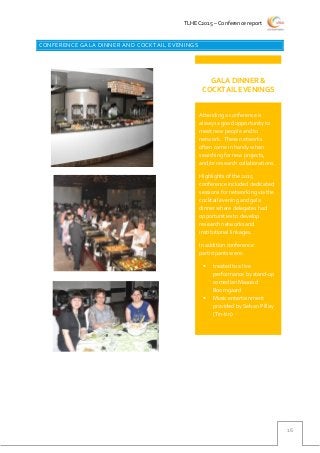
CONFERENCE GALA DINNER AND COCKTAIL EVENINGS
Attending a conference is
always a good opportunity to
meet new people and to
network. These networks
often come in handy when
searching for new projects,
and/or research collaborations.
Highlights of the 2015
conference included dedicated
sessions for networking via the
cocktail evening and gala
dinner where delegates had
opportunities to develop
research networks and
institutional linkages.
In addition conference
participants were:
 treated to a live
performance by stand-up
comedian Masood
Boomgaard
 Music entertainment
provided by Selvan Pillay
(Tin-tin)
GALA DINNER &
COCKTAIL EVENINGS
TLHEC2015 – Conference report
17
MEDIA COVERAGE
ONLINE COVERAGE
Site Link
National Science &
Technology Forum - May
2015 Newsletter
http://www.nstf.org.za/ShowProperty?nodePath=/NSTF%20
Repository/NSTF/files/Home/Newsletter/2015/May2015.pdf
SAIIE https://www.saiie.co.za/cms/content/604-nstf-enewsletter--
-latest-science,-engineering,-technology-(set)-news-and-
important-dates-to-diarise---may-2015
Africa Education.org http://www.africaeducation.org/conferences_in_africa.ht
m
SAERA http://www.saera.co.za/saera-news/9th-teaching-and-
learning-in-higher-education-conference
SAERA Facebook post https://www.facebook.com/SAEducationResearch/posts/7
63436343741026
CHE http://www.che.ac.za/media_and_publications/che-
newsletters/che-newsletter-volume-1-issue-june-2015
International Association
of Universities
http://www.iau-aiu.net/civicrm/event/info?reset=1&id=763
Trends in International
Mathematics and Science
Study SA
http://www.timss-sa.org.za/?tribe_events=9th-annual-ukzn-
teaching-learning-conference
Siyaphumelela http://siyaphumelela.org.za/?p=179
Global Engineering Deans
Council
https://www.gedcouncil.org/events/9th-annual-teaching-
learning-higher-education-conference-durban-south-africa
UWC https://www.uwc.ac.za/elearning/Events/Pages/9th-
Annual-Teaching--Learning-in-Higher-Education-
Conference.aspx
UNISA http://www.unisa.ac.za/contents/facilities/docs/TLHEC_201
5_Poster_Final.pdf
HELTASA http://heltasa.org.za/9th-annual-teaching-learning-in-
higher-education-conference/
South African Association
for Institutional Research
http://www.saair-web.co.za/events/9th-annual-teaching-
learning-in-higher-education-conference/
Wits VC Blog http://blogs.wits.ac.za/vc/2015/10/01/tlhec9-keynote-
address-by-professor-adam-habib/
University World News 6 conference paper were featured on
http://www.universityworldnews.com/ on 24 and 25 Sep 2015
TLHEC2015 – Conference report
18
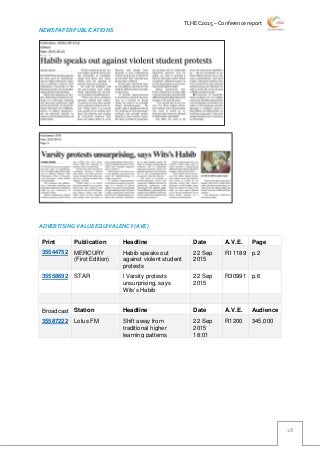
NEWSPAPER PUBLICATIONS
ADVERTISING VALUE EQUIVALENCY (AVE)
Print Publication Headline Date A.V.E. Page
35544752 MERCURY
(First Edition)
Habib speaks out
against violent student
protests
22 Sep
2015
R11189 p.2
35558692 STAR l Varsity protests
unsurprising, says
Wits's Habib
22 Sep
2015
R30991 p.6
Broadcast Station Headline Date A.V.E. Audience
35587222 Lotus FM Shift away from
traditional higher
learning patterns
22 Sep
2015
18:01
R1200 345,000
TLHEC2015 – Conference report
19
CONFERENCE EVALUATION
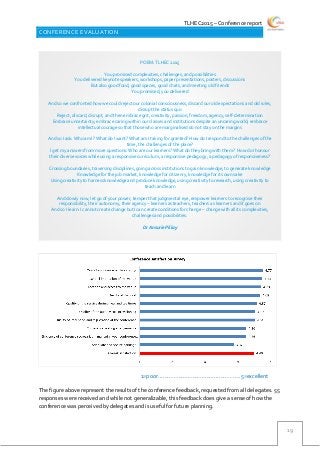
The figure above represent the results of the conference feedback, requested from all delegates. 55
responses were received and while not generalizable, this feedback does give a sense of how the
conference was perceived by delegates and is useful for future planning.
POEM: TLHEC 2015
You promised complexities, challenges, and possibilities
You delivered keynote speakers, workshops, paper presentations, posters, discussions
But also good food, good spaces, good chats, and meeting old friends
You promised, you delivered
And so we confronted how we could reject our colonial consciousness, discard our old expectations and old rules,
disrupt the status quo
Reject, discard, disrupt, and then embrace grit, creativity, passion, freedom, agency, self-determination
Embrace uncertainty; embrace caring within our classes and institutions despite an uncaring world; embrace
intellectual courage so that those who are marginalised do not stay on the margins
And so I ask: Who am I? What do I want? What am I taking for granted? How do I respond to the challenges of the
time, the challenges of the place?
I get my answers from more questions: Who are our learners? What do they bring with them? How do I honour
their diverse voices while using a responsive curriculum, a responsive pedagogy, a pedagogy of responsiveness?
Crossing boundaries, traversing disciplines, going across institutions to gain knowledge, to generate knowledge
Knowledge for the job market, knowledge for citizenry, knowledge for its own sake
Using creativity to harness knowledge and produce knowledge, using creativity to research, using creativity to
teach and learn
And slowly now, let go of your power, temper that judgmental eye, empower learners to recognise their
responsibility, their autonomy, their agency – learners as teachers, teachers as learners and it goes on
And so I learn: I cannot create change but I can create conditions for change – change with all its complexities,
challenges and possibilities.
Dr Ansurie Pillay
1=poor……………………………………………..5=excellent
TLHEC2015 – Conference report
20
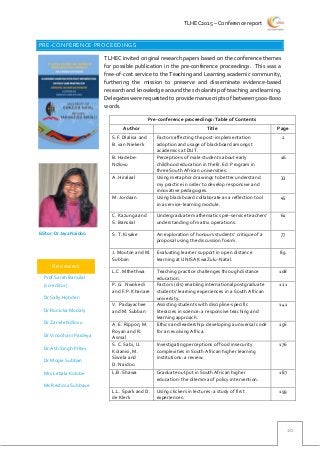
PRE-CONFERENCE PROCEEDINGS
TLHEC invited original research papers based on the conference themes
for possible publication in the pre-conference proceedings. This was a
free-of-cost service to the Teaching and Learning academic community,
furthering the mission to preserve and disseminate evidence-based
research and knowledge around the scholarship of teaching and learning.
Delegates were requested to provide manuscripts of between 5000-8000
words.
Pre-conference proceedings: Table of Contents
Author Title Page
S.F. Dlalisa and
B. van Niekerk
Factors affecting the post-implementation
adoption and usage of blackboard amongst
academics at DUT.
2
B. Hadebe-
Ndlovu
Perceptions of male students about early
childhood education in the B. Ed. Program in
three South African universities.
16
A. Hiralaal Using metaphor drawings to better understand
my practice in order to develop responsive and
innovative pedagogies.
33
M. Jordaan Using blackboard collaborate as a reflection tool
in a service-learning module.
45
C. Kazunga and
S. Bansilal
Undergraduate mathematics pre-service teachers’
understanding of matrix operations.
61
S. T. Kisake An exploration of honours students’ critique of a
proposal using the discussion forum.
77
J. Mouton and M.
Subban
Evaluating learner support in open distance
learning at UNISA KwaZulu-Natal.
89
L.C. Mthethwa Teaching practice challenges through distance
education.
108
P. G. Nwokedi
and F.P. Khanare
Factors (dis) enabling international postgraduate
students’ learning experiences in a South African
university.
121
V. Padayachee
and M. Subban
Assisting students with discipline-specific
literacies in science: a responsive teaching and
learning approach.
141
A. E. Rippon, M.
Royan and R.
Asmal
Ethics and leadership: developing a universal code
for an evolving Africa.
156
S. C. Sabi, U.
Kolanisi, M.
Siwela and
D. Naidoo
Investigating perceptions of food insecurity
complexities in South African higher learning
institutions: a review.
176
L.B. Shawa Graduate output in South African higher
education: the dilemma of policy intervention.
187
L.L. Spark and D.
de Klerk
Using clickers in lectures: a study of first
experiences.
199
Reviewers
Prof Sarah Bansilal
(co-editor)
Dr Sally Hobden
Dr Ronicka Mudaly
Dr Zanele Ndlovu
Dr Vinodhani Paideya
Dr Ash Singh-Pillay
Dr Mogie Subban
Mrs Lebala Kolobe
Ms Reshma Subbaye
Editor: Dr Jaya Naidoo
TLHEC2015 – Conference report
21
PRE-CONFERENCE WORKSHOPS (CO-HOSTED BY HIGHER EDUCATION
TRAINING & DEVLOPMENT – HETD)
In the build-up to the conference, UKZN staff were given opportunities to attend capacity building
workshops in 2015. These are outlined in the Table below.
Workshop title Date No. attendees
Developing an abstract 4 March 2015 35
Designing and presenting a poster 22 May 2015 21
Writing the paper 10 June 2015 26
Making a good presentation 01 July 2015 21
(data source: pre-conference workshop registers)
PUBLICATION OPPORTUNITY - CONFERENCE SPECIAL ISSUE: ALTERNATION
AlterNation is an international journal which publishes
interdisciplinary contributions in the fields of the Arts and
Humanities in Southern Africa.
On 16 oct 2015, a call was sent to all conference delegates to
submit papers on the conference theme: RE IMAGINING HIGHER
EDUCATION POLICY IMPLEMENTATION: CAN POLICY LEARN
FROM PRACTICE?, to be published in a special issue of
AlterNation in 2016.
The guest editors for the special issue of Alternation (ISSN 123
1757) will select papers presented at the conference and will
contact authors to see if they are interested in their papers being
publishedin the journal.The editors willbe looking fororiginaland
insightful papers on teaching and learning in higher education
(and linked to 2014 conference themes).
TLHEC2015 – Conference report
22
ACKNOWLEDGEMENTS
 The Conference Committee for their continued support for the conference over the years, in
particular the Abstract Review Panel
 UTLO staff: Corlia Ogle, Reshma Subbaye, Nondumiso Cele, Silindile Mchunu and Christina
Mulaudzi
 UTLO interns 2015:, Ebrahim Adam, Tracey April, Lungelo Hadebe, Siya Ntombela and
Nolwazi Nzama
 Professor Michael Samuel for his sterling synthesis of the conference and action mapping
 Prof Saroj Nadar for anchoring the UTLOtv panel interviews with our keynote speakers
 Corporate Relations Division and the media: Raylene, Tin Tin and Albert. Karen McGregor
University World News)
 Conference student assistants: Nzuza Sinethemba, Shange Lungisile, Khawula Wandile,
Dlamini Wandile, Ndaba Lindelani, Sibiya Thokozani, Obiora Arinze, Shangase Mphathi,
Mthimkhulu Thanda, Mdokwe Bongumusa, Dlamini Phakamani, Mtolo Phila
 UTLO TV production team
 Ansurie Pillay for poem and editing the conference call
 Jaya Naidoo and Sarah Bansilal for the conference proceedings
 Exhibitors: Khethiwe, Cedric (Adams Books) and Sheryl (HETD)
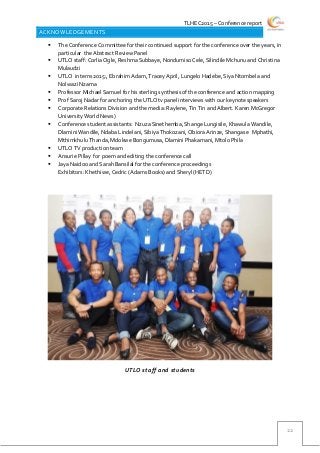
UTLO staff and students
TLHEC2015 – Conference report
23
SAVE THE DATE: TEACHING & LEARNING IN HIGHER EDUCATION
CONFERENCE 2016

Teaching & Learning Conference

  • 1.
    Report on UKZN’s9th Annual Teaching & Learning in Higher Education Conference: 21-23 September 2015 Re-imagining higher education policy implementation: Can policy learn from practice? Complexities, challenges and possibilities. Compiled by: Reshma Subbaye & Rubby Dhunpath, UTLO
  • 2.
    TLHEC2015 – Conferencereport 1 CONTENTS Introduction......................................................................................................................................2 Conference attendance and participation......................................................................................... 3 Conference presentations................................................................................................................. 4 Welcome and introduction................................................................................................................6 Opening address...............................................................................................................................6 Keynote speakers.............................................................................................................................. 7 Prof Adam Habib – Wits University ............................................................................................... 7 Prof William Tierney – University of Southern California............................................................... 8 Prof Narend Baijnath – Council for Higher Education....................................................................8 Prof Herbert Chimhundu - Chinhoyi University of Technology......................................................9 Workshops...................................................................................................................................... 10 Creating a culture to improve student performance: Increasing access to higher education. ...... 10 The adaptable mind: Education and the dynamic question......................................................... 10 Alternative forms of presenting at conferences: Using visual and arts-based approaches............11 Writing grant proposals............................................................................................................... 12 Aligning health professional education with health systems needs............................................. 12 Special interest groups.....................................................................................................................13 Towards a clearer policy on the role of technology in education ..................................................13 Early career academics: revisited .................................................................................................13 UTLO TV......................................................................................................................................... 14 Conference synopsis ........................................................................................................................15 Conference gala dinner and cocktail evenings................................................................................. 16 Media coverage ...............................................................................................................................17 Conference evaluation.................................................................................................................... 19 Pre-conference proceedings ........................................................................................................... 20 Pre-conference workshops (co-hosted by Higher education Training & Devlopment – HETD)........ 21 Publication opportunity - Conference special issue: AlterNation..................................................... 21 Acknowledgements........................................................................................................................ 22 Save the date: Teaching & Learning in Higher Education Conference 2016 .................................... 23
  • 3.
    TLHEC2015 – Conferencereport 2 INTRODUCTION The Annual Teaching and Learning in Higher Education Conference (TLHEC) is a gathering of academics, researchers and policymakers to showcase innovations, discuss issues and debate challenges relevant to teaching and learning in Higher Education. In 2015, the conference theme was RE-IMAGINING HIGHER EDUCATION POLICY IMPLEMENTATION: CAN POLICY LEARN FROM PRACTICE? COMPLEXITIES, CHALLENGES AND POSSIBILITIES, and consisted of the following sub-themes: 1. Re-imagining internationalisation in higher education: Implications for praxis 2. Revisiting differentiation in higher education. What have we learnt from practice? 3. Collaborative quality enhancement for systemic change in higher education: prospects and possibilities 4. Institutional research: Catalyst for policy formation and institutional development and/or capitulation to corporatisation? 5. Who is the 21st century university student / academic? 6. Teaching & learning technologies: Possibilities and perils 7. Responsive and innovative pedagogies in higher education 8. Language policy, planning and implementation in higher education: Complexities, challenges and possibilities 9. Alternative paradigms and emerging directions in the scholarship of teaching and learning in higher education 10. New directions and advances in health sciences education Generally, the conference was very well-organised and there were lots of opportunities for discussion and networking. Conference delegate, evaluation form ID#3 The keynote speakers were very good. Conference delegate, evaluation form ID#12 The plenaries provided broad overviews, nice contrast to the (necessarily) restricted focus of individual presentations.Conference delegate, evaluation form ID#44
  • 4.
    TLHEC2015 – Conferencereport 3 CONFERENCE ATTENDANCE AND PARTICIPATION UKZN’s 9th annual TLHEC was held at the Elangeni Hotel, Durban; from the 21-23 September 2015. The event was organised and co-ordinated by the University Teaching and Learning Office (UTLO). This year 281 delegates registered to attend the conference from across South Africa and abroad. In this report, the conference is evaluated using data generated from the conference handbook and programme, administrative databases, registers, evaluation forms and post- conference email messages. It is generally acknowledged that various sectors and stakeholders bring differing strengths, resources and capacities to a conference. This variety enables the development of policies and the dissemination of specialized research which addresses higher education challenges and priorities. Another important outcome is the development of transnational research networks and institutional linkages. Some of the keynote addresses were very enlightening and informative. The interactive panels were most interesting because they offered practical and usable advice in research, teaching, and learning. The most useful sessions were those which offered real strategies for implementation in our current context. Conference delegate, evaluation form ID#4 Thank you for the invitation. It was a pleasure. It is an outstandingly good conference, rivalling anything else in the field. Keep up the splendid work. Prof Narend Baijnath, CHE (Keynote speaker, email correspondence 28/09/2015)
  • 5.
    TLHEC2015 – Conferencereport 4 CONFERENCE PRESENTATIONS A total of 206 abstract submissions were received. These abstracts were peer-reviewed by groups of volunteer academics.In 2015,UTLO adopteda novelwayofconducting the peer-review process.This involved convening a group meeting of all 22 reviewers on a single day. Reviewers were split into groups (5-8 academics) according to the conference thematic tracks. Each group comprised an education&/higher education academic,andacademicsfromother diverse disciplinary backgrounds. Furthermore, academics were grouped in terms of their level of experience in reviewing. Simply put the review groups consisted of senior and junior academics from multiple disciplines. Each abstract was then reviewed by individuals in the group and consensus on the final review and feedback was reached by the group. Those who participated in the review process reported that it facilitated and enhanced their learning of peer-reviews, allowed them to gain multidisciplinary perspectives and, that it created a space for debate and discussion. The table below highlights the number of presentations by delivery mode. Various presenters at the conference Type (presentation mode of delivery) Number Keynote presentations (incl opening address) 5 Workshops (excl pre-conference workshops) 5 Oral presentations 101 Poster presentations 16 Special interest groups 2 Conference synoptic-overview 1 Total number of presentations 130
  • 6.
    TLHEC2015 – Conferencereport 5 SOME POSTERS ON DISPLAY AT THE CONFERENCE I am from the private sector and found it very interesting to hear about the challenges and opportunities that are common in the public sector. I think that more private institutions should be encouraged to participate so that they can learn from the public sector as well as share their experience in areas in which they excel. Conference delegate, evaluation form ID#7 Various conference delegates
  • 7.
    TLHEC2015 – Conferencereport 6 WELCOME AND INTRODUCTION Dr Langa Khumalo performed the official welcome and Dr Rubby Dhunpath introduced the conference themes. He further reminded delegates that the conference theme this year aimed to steer the teaching & learning discourse beyond conventional conceptions of policy, policy dialogue, and policy development, towards reimagining possibilities for policy implementation derived from delegates’ lived experiences of policy as practice. OPENING ADDRESS Prof Vithal opened the conference by reminding delegates that “we continue to live in an important historical moment, and students have opened a critical window of opportunity through the current ferment, which offers universities the possibilities to significantly re-imagine our undergraduate curricula for substantially better learning outcomes to serve society”. She explained that the undergraduate curriculum conversation could begin with a set of questions with a view to moving from talk shops and workshops to real action and change. These questions were: 1. How could we rethink and better facilitate the navigation of the bridge we know is riddled with potholes and obstacles that students have to traverse from schooling to university? 2. What would it take to ensure that every undergraduate student has some experience in community engagement activity before they graduate? 3. What is the relevance and value of the undergraduate curriculum as it is increasingly being questioned from different perspectives and vantage points? 4. How is the undergraduate curriculum a preparation for becoming generators of knowledge and not only consumers, thereby overcoming its colonial and apartheid legacy? Dr Langa Khumalo Director: UKZN Language Planning & Development Office (ULPDO) Dr Rubby Dhunpath TLHEC: chairperson and convenor Director: UKZN Teaching & Learning Office (UTLO) Prof Renuka Vithal Deputy Vice-Chancellor: Teaching & Learning
  • 8.
    TLHEC2015 – Conferencereport 7 5. Rethinking the undergraduate curriculum as preparation for research raises questions on the South African undergraduate curriculum and its relation to honours programmes and curricula, which is a year-long qualification added on to the 3-year bachelor degrees. Why do we continue to impose gatekeepers to provide access to honours level study? KEYNOTE SPEAKERS DEVELOPING A DIFFERENTIATED SYSTEM IN SOUTH AFRICAN HIGHER EDUCATION PROF ADAM HABIB – WITS UNIVERSITY Chairperson: Professor R Vithal South Africa entered its democratic era with an elitist, racially and ethnically fragmented, and inefficient higher education system. Transformation would have required policy and decision-making to be responsive to the goals of equity, efficiency, democratic participation and development. However, policy architects and leaders were confronted by the challenge of achieving these goals simultaneously and confronting the concomitant trade-offs. The National Development Plan confronts the issue of knowledge development and differentiation, and expansion of the system including enabling the development of private higher education and the post-secondary education system. However, it does not confront whether the real purpose of the latter is another opportunity at secondary education, vocational training, or a community college programme that broadens access to the universities. Similarly, some universities have not risen to the challenge of equity and have used institutional autonomy and academic freedom as levers to pursue ethnic and racial agendas, while others have pursued equity without due cognisance being given to efficiency considerations. Prof Habib argued that a differentiated higher education system would enable responsiveness to the diverse and multiple needs of an economy and a society. In South Africa, it would allow some universities to play a bigger role in the teaching of undergraduate students and the production of professionals, which is necessary if the economy is to become more productive and competitive. But it would also allow other universities to focus on postgraduate students and undertake high level research, which are equally essential if the country is to develop a knowledge based economy of the 21st century. Differentiation would have to be accompanied by higher education executives exhibiting managerial maturity and effectiveness if South African universities are going to be simultaneously responsive to the country’s needs and competitive vis-à-vis their global peers. Adam Habib – controversial & thought provoking. He spoke with passion and integrity. Conference delegate, evaluation form ID#46
  • 9.
    TLHEC2015 – Conferencereport 8 THE CHALLENGE OF ACCESS: PRAXIS AND STRUCTURE IN HIGHER EDUCATION PROF WILLIAM TIERNEY – UNIVERSITY OF SOUTHERN CALIFORNIA Chairperson: Dr Nyna Amin First-generation college students make up an increasing share of students in higher education and graduate at a much lower rate than do students with university-educated parents. What is coming to be known as “grit”—passion and perseverance for long-term goals in the face of setbacks—has been identified as an individual characteristic that is predictive of success in challenging environments, including higher education. Although having grit maybe helpfulto first-generation university students,the trait alone isnot likely to be sufficient for college success. In the talk, Prof Tierney sought to determine the connection between grit and social capital of first-generation college students with regard to their success and persistence during freshman year. His presentation asked the following question: how do first-generation students find their purpose to succeed as college students? The answer to this question, he argued, lay at the intersection of grit and social capital. He conceptualized grit as comprising three interrelated components: (a) passion/interest; (b) preference for long-term goals; and (c) ability to overcome setbacks. Finding one’s purpose in university relates to the passion/interest and preference for the long-term goals components of grit. Students who are aware of their interests and passions with regard to academics, and who believe in a higher-order purpose for their academic pursuits are more likely to succeed. TEACHING, POLICY AND HIGHER EDUCATION DEVELOPMENT FOR 21ST CENTURY LEARNING PROF NAREND BAIJNATH – COUNCIL FOR HIGHER EDUCATION Chairperson: Prof Suriamurthee Maistry Prof Baijnath explained that the primary focus of the Council for Higher Education (CHE) was to improve the quality of higher education in our country. This was accomplished via three main avenues by: Prof Tierney’s presentation resonated on a personal level with me…there are people out there who have the potential to go to university but need to be identified and assisted. Conference delegate, evaluation form ID#27
  • 10.
    TLHEC2015 – Conferencereport 9 1. Bringing under regular and constant scrutiny the quality arrangements and promotions within SA universities, to accredit every programme that is offered in higher education nationally; public and private 2. Providing policy advice to the minister of higher education and training 3. Fostering a critical discourse on higher education matters in the country. Within this ambit, Prof Baijnath discussed systemic issues related to the:  increasing numbers of students flowing from demand and planning led expansion, which have strained resources and infrastructure and placed burgeoning pressure on personnel.  unprecedented regulation, compliance, reporting and performance management requirements at universities  goals and policies around access to higher education which have resulted in greater alignment with national demographics at the student level, but has led to increased diversity – in terms of class, linguistic background, urban/rural origin, school experiences, material conditions, access and technology and experimental learning resources. He concluded by saying that any advancement in higher education had to be linked to institutional strategy, infrastructure and a deliberate development trajectory (for staff and students). AFRICAN LANGUAGES, ICTS AND THE ACADEMY: PERSPECTIVES FROM LEXICOGRAPHY, TERMINOLOGY AND LIVING HERITAGE PROF HERBERT CHIMHUNDU - CHINHOYI UNIVERSITY OF TECHNOLOGY Chairperson: Dr Langa Khumalo Prof Chimhundu shared his reflections of 35 years in teaching, research and language raising through lexicography, terminology and advocacy, and the limit to what specialists can achieve on their own. The conventional departments of linguistics or African languages and literature cannot by themselves demonstrate enough utilitarian value to reverse prevalent negative attitudes and lack of political will by the ruling elite. He argued that radical interventions by the academy is needed to invoke ICTs, specifically human language technology (HLT), not only to bring African languages into the information society, but also to link indigenous knowledge and living heritage [intangible cultural heritage (ICH)] with other forms of knowledge within mainstream academia. Institutions of higher learning have the capacity to develop such HLT applicationsin a manner that can incorporate product development, entrepreneurship and innovation in pedagogy to include digital gadgets, tools and games that are appealing and can be scaled down to the school level. Prof Narend Baijnath was very insightful and he hit on important points regarding higher education challenges. Conference delegate, evaluation form ID#42
  • 11.
    TLHEC2015 – Conferencereport 10 WORKSHOPS CREATING A CULTURE TO IMPROVE STUDENT PERFORMANCE: INCREASING ACCESS TO HIGHER EDUCATION. Facilitated by Prof William Tierney Prof Tierney stressed that the legacy of the 20th century was that there was very little relationship between high schools and universities. Students graduated from high school and even though they were often not prepared for university work, there was very little interaction among faculty, staff and teachers in either the K-12 or university systems. One reason for increased interaction was the urgency to have more individuals who graduate from high school and attend a postsecondary institution. Such a need is not only necessary for “manpower” needs but also to increase the democratic participation of the citizenry. In this workshop the sorts of activities that increase access to higher education and ensure that students are “college-ready” when they go to university, were discussed. Prof Tierney discussed the cognitive variables that have an influence on university- readiness and then went on to consider what is coming to be known as non-cognitive (or “college knowledge) variables. The workshop situated the discussion at the intersection of K-12 (matric and first-year) and higher education and examined strategies such as what should be taught, what parents and families might do, how we might increase the financial literacy of students, and what might be done to improve academic performance. THE ADAPTABLE MIND: EDUCATION AND THE DYNAMIC QUESTION I enjoyed the workshops by Prof Tierney and Steven Harrison because they brought diverse perspectives and inspired me. Conference delegate, evaluation form ID#37 The interactive panels [workshops] were the most interesting because they offered practical and usable advice in research, teaching, and learning. Conference delegate, evaluation form ID#3 Delegates at the workshop
  • 12.
    TLHEC2015 – Conferencereport 11 Facilitated by Mr Steven Harrison & Prof Kriben Pillay The workshop first invited participants to take a direct look at how each of us creates information in our conscious contact with the world, including the belief systems that limit us, and how dynamic questioning can alter our concepts. Secondly, participants looked at how we can learn, teach and adapt in the face of a rapidly expanding information landscape and a radically changing society. The facilitators emphasized that to teach a mind to continuously adapt requires a whole new way of education; one that must reinvent itself in a dialogic process with teachers, students and society as a whole. Key components of educating the adaptable mind do not look like traditional learning. It encompasses: play, socializing, cultivation of awareness, collaboration, self-direction and empathy. ALTERNATIVE FORMS OF PRESENTING AT CONFERENCES: USING VISUAL AND ARTS-BASED APPROACHES Facilitated by Prof Michael Samuel and Dr Miranda Swart The dominant traditional formats of presentations at conferences usually conforms to a particular set ofacademicconventionsthat include, written andoralformssuch as papers,round-table discussions, workshops and poster presentations. This workshop explored the power of alternative presentation forms to communicate ideas for and from research. This included the use of alternative textual forms such as visual arts (paintings, sculptures, drawings, photographs, collages, installations) and performance formats (dance, music, mime, drama, performance poetry). The written and the verbal text are extended in these formats to include other forms of communication traditionally outside the realm of formal academia. The facilitators argued that alternative forms of presentation can be understood theoretically, methodologically and pragmatically potentially opening up possibilities for new audiences and the generation of new types of knowledges. Facilitators (l to r): Steven Harrison and Prof Kriben Pillay Facilitators (l to r): Prof Michael Samuel and Dr Miranda Swart
  • 13.
    TLHEC2015 – Conferencereport 12 WRITING GRANT PROPOSALS Facilitated by Prof Julia Preece This hands-on workshop was designed to assist early researchers (and those new to research in teaching and learning) in higher education. The facilitator took participants through the various stages of structuring a research proposal, highlighting what grant funderswere looking for in a ‘good’ proposal. Participants had the opportunity to critique an unsuccessful proposal and compare this critique with a successful proposal. ALIGNING HEALTH PROFESSIONAL EDUCATION WITH HEALTH SYSTEMS NEEDS Facilitated by Prof Sabiha Essack et al. UKZN’s College of Health Sciences undertook a situational analysis on the nature and extent of (1) primary healthcare as mooted in the National Development Plan and translated in the current Department of Health Strategic Plan, (2) community-based training (in the primary healthcare model), (3) social accountability as defined by The Health Equity Network (THENet), generic competencies with an emphasis on communication, advocacy and leadership and social cohesion as mooted by the Department of Higher Education and Training. This workshop discussed the results of the situational analysis with a view to curriculum review (content, pedagogy an assessment) and took the format of plenary presentations followed by a panel discussion. Workshop on writing research proposals for grant funding. Participatory and practically relevant. Conference delegate, evaluation form ID#9 Wokshop on health preofessional education. Panelists (l to r): Prof Sabiha Esaack, Dr Thirusha Naidoo, Dr Bernhard Gaede, Dr Laura Campbell, Dr Frasia Oosthuizen, Dr Penny Flack and Dr Margaret Matthews Facilitator (standing): Prof Julia Preece
  • 14.
    TLHEC2015 – Conferencereport 13 SPECIAL INTEREST GROUPS TOWARDS A CLEARER POLICY ON THE ROLE OF TECHNOLOGY IN EDUCATION Facilitated by Prof Randhir Rawatlal & Mr Hilary Reynolds Over the past decade, there has been increased interest in the role of technology in education. The interest ranges all the way from multi-institution data analytics to the creation and implementation of games and animated simulations in classrooms. Relatively new concepts in computing such as Big Data and Cloud Computing also have roles to play, and the potential of social media cannot be ignored. The introduction of computing hardware into the educational process also raises special issues including security and accessibility. In this session, the special interest group (SIG) discussed the following:  Review of tech-trends and applications to education  Creation and application of games in education  Policy development and objectives EARLY CAREER ACADEMICS: REVISITED Facilitated by Mr Siya Ntombela & Ms Nolwazi Nzama In 2014 the Early Career Academics (ECA) study, commissioned bythe Carnegie Corporation (NY),was conducted by research teams in 7 universities across Africa. The preliminary results of that study were presented at a special interest group launched at the 8th TLHEC. This year two UTLO research interns presented their research findings on a follow-up qualitative study involving developmental lecturers at UKZN. The SIG discussed the implications of the study as it related to the professional development of young academics at UKZN, in particular the role of mentorship as a support strategy. Participants in SIG discussions The ECA workshop was the most interesting. It helped me as a young aspiring academic to want to become a great academic. Conference delegate, evaluation form ID#48
  • 15.
    TLHEC2015 – Conferencereport 14 UTLO TV In 2014, UTLO launched an initiative known as Teaching & Learning TV which aims to showcase both local and international talent by facilitating discussion and critical thinking around teaching and learning. Teaching & Learning TV discussions adopt the form ofinterviewsor panelsessionsfeaturing thought-leaders and academics. Topics vary but comprise a distinct teaching and learning flavour. Conference keynote addresses andselectedworkshops & seminars hostedbyUTLO are alsofeatured on Teaching & Learning TV. At the Annual Teaching & Learning Conference, panel discussions are hosted featuring keynote speakers and academics with shared interests. These panels seek to further the conversation from the keynote and extend the reach of the discussion to a broader audience. Whilst the topic of panel discussions is focused largely around the keynote address, the panel discussion also seeks to encourage engagement from the panelists around their work in relation to the topic being discussed. The panels also provides panelists with an opportunity to share their experiences around teaching and learning. Videos are uploaded onto the Teaching & Learning TV channel on YouTube at http://www.youtube.com/utlotv Video Views (19 Oct) Upload Date TLHEC9 - Conference Promo 1,176 Feb 5, 2015 TLHEC9 - Welcome, Introduction & Opening Address 13 Oct 11, 2015 TLHEC9 - Keynote Address by Professor Adam Habib 85 Sep 30, 2015 TLHEC9 - Keynote Address by Professor William Tierney 37 Sep 30, 2015 TLHEC9 - Keynote Address by Professor Narend Baijnath 19 Sep 30, 2015 TLHEC9 - Keynote Address by Professor Herbert Chimhundu 12 Oct 7, 2015 TLHEC9 - Keynote Workshop by Professor William Tierney 6 Oct 10, 2015 TLHEC9 - Conference Snapshots 128 Sep 23, 2015 TLHEC9 - Reflections, Concluding Remarks & Closure 1 Oct 15, 2015 Teaching & Learning TV - Panel Discussion with Professor William Tierney 13 Oct 15, 2015 Teaching & Learning TV - Panel Discussion with Professor Narend Baijnath 17 Oct 15, 2015 Teaching & Learning TV - Panel Discussion with Professor Herbert Chimhundu 35 Oct 15, 2015 Teaching & Learning TV - Interview with Steven Harrison 11 Oct 15, 2015 UTLO TV panel discussion with Prof Narend Baijnath Panelists (from left to right): Prof Saroj Nadar (host), Prof Julia Preece, Prof Suriamurthee Maistry, Dr Carol Bertram, Prof Narend Baijnath
  • 16.
    TLHEC2015 – Conferencereport 15 CONFERENCE SYNOPSIS For the first time in 2015 the conference concluded with a synoptic-outline, provided by Prof Michael Samuel (School of Education, UKZN). This session, though short in duration (at 20 minutes), gave delegates an overview of the presentations at the conference and the various matters raised in relation to the conference theme on Higher Education Policy. Prof Samuel provided a framework of the recurring constructs emerging throughout the conference (see Figure below) and more importantly concluded that delegates should “interrogate how we’ve fetishized concepts such as access, excellence, quality, innovation, transformation [in relation to policy and practice]…. He further cautioned that “ there is a hijacking of whose definition matters, and what we need to be looking at is opening up the possibilities of imagining new definitions, and that responsibility is not the management’s, not the student’s, not the academics’ but all of us collectively redefining and re-imagining our possibilities”. (Source: Prof Samuel synopsis, presented 23 Sep 2015). Prof Michael Samuel
  • 17.
    TLHEC2015 – Conferencereport 16 CONFERENCE GALA DINNER AND COCKTAIL EVENINGS Attending a conference is always a good opportunity to meet new people and to network. These networks often come in handy when searching for new projects, and/or research collaborations. Highlights of the 2015 conference included dedicated sessions for networking via the cocktail evening and gala dinner where delegates had opportunities to develop research networks and institutional linkages. In addition conference participants were:  treated to a live performance by stand-up comedian Masood Boomgaard  Music entertainment provided by Selvan Pillay (Tin-tin) GALA DINNER & COCKTAIL EVENINGS
  • 18.
    TLHEC2015 – Conferencereport 17 MEDIA COVERAGE ONLINE COVERAGE Site Link National Science & Technology Forum - May 2015 Newsletter http://www.nstf.org.za/ShowProperty?nodePath=/NSTF%20 Repository/NSTF/files/Home/Newsletter/2015/May2015.pdf SAIIE https://www.saiie.co.za/cms/content/604-nstf-enewsletter-- -latest-science,-engineering,-technology-(set)-news-and- important-dates-to-diarise---may-2015 Africa Education.org http://www.africaeducation.org/conferences_in_africa.ht m SAERA http://www.saera.co.za/saera-news/9th-teaching-and- learning-in-higher-education-conference SAERA Facebook post https://www.facebook.com/SAEducationResearch/posts/7 63436343741026 CHE http://www.che.ac.za/media_and_publications/che- newsletters/che-newsletter-volume-1-issue-june-2015 International Association of Universities http://www.iau-aiu.net/civicrm/event/info?reset=1&id=763 Trends in International Mathematics and Science Study SA http://www.timss-sa.org.za/?tribe_events=9th-annual-ukzn- teaching-learning-conference Siyaphumelela http://siyaphumelela.org.za/?p=179 Global Engineering Deans Council https://www.gedcouncil.org/events/9th-annual-teaching- learning-higher-education-conference-durban-south-africa UWC https://www.uwc.ac.za/elearning/Events/Pages/9th- Annual-Teaching--Learning-in-Higher-Education- Conference.aspx UNISA http://www.unisa.ac.za/contents/facilities/docs/TLHEC_201 5_Poster_Final.pdf HELTASA http://heltasa.org.za/9th-annual-teaching-learning-in- higher-education-conference/ South African Association for Institutional Research http://www.saair-web.co.za/events/9th-annual-teaching- learning-in-higher-education-conference/ Wits VC Blog http://blogs.wits.ac.za/vc/2015/10/01/tlhec9-keynote- address-by-professor-adam-habib/ University World News 6 conference paper were featured on http://www.universityworldnews.com/ on 24 and 25 Sep 2015
  • 19.
    TLHEC2015 – Conferencereport 18 NEWSPAPER PUBLICATIONS ADVERTISING VALUE EQUIVALENCY (AVE) Print Publication Headline Date A.V.E. Page 35544752 MERCURY (First Edition) Habib speaks out against violent student protests 22 Sep 2015 R11189 p.2 35558692 STAR l Varsity protests unsurprising, says Wits's Habib 22 Sep 2015 R30991 p.6 Broadcast Station Headline Date A.V.E. Audience 35587222 Lotus FM Shift away from traditional higher learning patterns 22 Sep 2015 18:01 R1200 345,000
  • 20.
    TLHEC2015 – Conferencereport 19 CONFERENCE EVALUATION The figure above represent the results of the conference feedback, requested from all delegates. 55 responses were received and while not generalizable, this feedback does give a sense of how the conference was perceived by delegates and is useful for future planning. POEM: TLHEC 2015 You promised complexities, challenges, and possibilities You delivered keynote speakers, workshops, paper presentations, posters, discussions But also good food, good spaces, good chats, and meeting old friends You promised, you delivered And so we confronted how we could reject our colonial consciousness, discard our old expectations and old rules, disrupt the status quo Reject, discard, disrupt, and then embrace grit, creativity, passion, freedom, agency, self-determination Embrace uncertainty; embrace caring within our classes and institutions despite an uncaring world; embrace intellectual courage so that those who are marginalised do not stay on the margins And so I ask: Who am I? What do I want? What am I taking for granted? How do I respond to the challenges of the time, the challenges of the place? I get my answers from more questions: Who are our learners? What do they bring with them? How do I honour their diverse voices while using a responsive curriculum, a responsive pedagogy, a pedagogy of responsiveness? Crossing boundaries, traversing disciplines, going across institutions to gain knowledge, to generate knowledge Knowledge for the job market, knowledge for citizenry, knowledge for its own sake Using creativity to harness knowledge and produce knowledge, using creativity to research, using creativity to teach and learn And slowly now, let go of your power, temper that judgmental eye, empower learners to recognise their responsibility, their autonomy, their agency – learners as teachers, teachers as learners and it goes on And so I learn: I cannot create change but I can create conditions for change – change with all its complexities, challenges and possibilities. Dr Ansurie Pillay 1=poor……………………………………………..5=excellent
  • 21.
    TLHEC2015 – Conferencereport 20 PRE-CONFERENCE PROCEEDINGS TLHEC invited original research papers based on the conference themes for possible publication in the pre-conference proceedings. This was a free-of-cost service to the Teaching and Learning academic community, furthering the mission to preserve and disseminate evidence-based research and knowledge around the scholarship of teaching and learning. Delegates were requested to provide manuscripts of between 5000-8000 words. Pre-conference proceedings: Table of Contents Author Title Page S.F. Dlalisa and B. van Niekerk Factors affecting the post-implementation adoption and usage of blackboard amongst academics at DUT. 2 B. Hadebe- Ndlovu Perceptions of male students about early childhood education in the B. Ed. Program in three South African universities. 16 A. Hiralaal Using metaphor drawings to better understand my practice in order to develop responsive and innovative pedagogies. 33 M. Jordaan Using blackboard collaborate as a reflection tool in a service-learning module. 45 C. Kazunga and S. Bansilal Undergraduate mathematics pre-service teachers’ understanding of matrix operations. 61 S. T. Kisake An exploration of honours students’ critique of a proposal using the discussion forum. 77 J. Mouton and M. Subban Evaluating learner support in open distance learning at UNISA KwaZulu-Natal. 89 L.C. Mthethwa Teaching practice challenges through distance education. 108 P. G. Nwokedi and F.P. Khanare Factors (dis) enabling international postgraduate students’ learning experiences in a South African university. 121 V. Padayachee and M. Subban Assisting students with discipline-specific literacies in science: a responsive teaching and learning approach. 141 A. E. Rippon, M. Royan and R. Asmal Ethics and leadership: developing a universal code for an evolving Africa. 156 S. C. Sabi, U. Kolanisi, M. Siwela and D. Naidoo Investigating perceptions of food insecurity complexities in South African higher learning institutions: a review. 176 L.B. Shawa Graduate output in South African higher education: the dilemma of policy intervention. 187 L.L. Spark and D. de Klerk Using clickers in lectures: a study of first experiences. 199 Reviewers Prof Sarah Bansilal (co-editor) Dr Sally Hobden Dr Ronicka Mudaly Dr Zanele Ndlovu Dr Vinodhani Paideya Dr Ash Singh-Pillay Dr Mogie Subban Mrs Lebala Kolobe Ms Reshma Subbaye Editor: Dr Jaya Naidoo
  • 22.
    TLHEC2015 – Conferencereport 21 PRE-CONFERENCE WORKSHOPS (CO-HOSTED BY HIGHER EDUCATION TRAINING & DEVLOPMENT – HETD) In the build-up to the conference, UKZN staff were given opportunities to attend capacity building workshops in 2015. These are outlined in the Table below. Workshop title Date No. attendees Developing an abstract 4 March 2015 35 Designing and presenting a poster 22 May 2015 21 Writing the paper 10 June 2015 26 Making a good presentation 01 July 2015 21 (data source: pre-conference workshop registers) PUBLICATION OPPORTUNITY - CONFERENCE SPECIAL ISSUE: ALTERNATION AlterNation is an international journal which publishes interdisciplinary contributions in the fields of the Arts and Humanities in Southern Africa. On 16 oct 2015, a call was sent to all conference delegates to submit papers on the conference theme: RE IMAGINING HIGHER EDUCATION POLICY IMPLEMENTATION: CAN POLICY LEARN FROM PRACTICE?, to be published in a special issue of AlterNation in 2016. The guest editors for the special issue of Alternation (ISSN 123 1757) will select papers presented at the conference and will contact authors to see if they are interested in their papers being publishedin the journal.The editors willbe looking fororiginaland insightful papers on teaching and learning in higher education (and linked to 2014 conference themes).
  • 23.
    TLHEC2015 – Conferencereport 22 ACKNOWLEDGEMENTS  The Conference Committee for their continued support for the conference over the years, in particular the Abstract Review Panel  UTLO staff: Corlia Ogle, Reshma Subbaye, Nondumiso Cele, Silindile Mchunu and Christina Mulaudzi  UTLO interns 2015:, Ebrahim Adam, Tracey April, Lungelo Hadebe, Siya Ntombela and Nolwazi Nzama  Professor Michael Samuel for his sterling synthesis of the conference and action mapping  Prof Saroj Nadar for anchoring the UTLOtv panel interviews with our keynote speakers  Corporate Relations Division and the media: Raylene, Tin Tin and Albert. Karen McGregor University World News)  Conference student assistants: Nzuza Sinethemba, Shange Lungisile, Khawula Wandile, Dlamini Wandile, Ndaba Lindelani, Sibiya Thokozani, Obiora Arinze, Shangase Mphathi, Mthimkhulu Thanda, Mdokwe Bongumusa, Dlamini Phakamani, Mtolo Phila  UTLO TV production team  Ansurie Pillay for poem and editing the conference call  Jaya Naidoo and Sarah Bansilal for the conference proceedings  Exhibitors: Khethiwe, Cedric (Adams Books) and Sheryl (HETD) UTLO staff and students
  • 24.
    TLHEC2015 – Conferencereport 23 SAVE THE DATE: TEACHING & LEARNING IN HIGHER EDUCATION CONFERENCE 2016