English
Teachers Book
For Lao Government Officials
Module 1
TeachersBook|MODULE1
Research Institute for Educational Sciences/Laos Australia Institute
Setthathirath Road, XiengnheunVillage,
Chanthaboury District,
Vientiane, Laos
Tel & Fax: +856 21 213161
www.moe.gov.la/ries/
ertneCecruoseRsegaugnaLngieroFehtybdepolevedsaweludomsihT
and the Laos Australia Institute for the Ministry of Education and Sports
English for Lao Government Officials is supported by the Australian Government
English
For
Lao Government Officials
Module 1
Teachers Book
Contents
Unit 1 Introductions ....................................................................... 1
Unit 2 Personal information............................................................ 7
Unit 3 Classroom language.......................................................... 15
Unit 4 Classroom language.......................................................... 20
Unit 5 Occupations and Workplaces ............................................ 30
Unit 6 Time and Daily Routines.................................................... 38
Unit 7 Months and Dates ............................................................. 45
Unit 8 Weekly Routines ............................................................... 55
Unit 9 Countries nationalities and languages ............................... 65
Unit 10 Work information ............................................................... 74
Unit 11 Work responsibilities.......................................................... 85
Unit 12 Around town...................................................................... 94
Unit 13 Plans............................................................................... 101
Unit 14 The Past ......................................................................... 109
Unit 15 Laos.................................................................................116
English for Lao Government Officials Module 1 1
Unit 1: Introductions
1 English for Lao Government Officials Module 1
Unit 1 Introductions
Speaking: Greetings
Dialogue
a) Listen and repeat.
Teacher- give students a few minutes to read the dialogue by themselves first before
listening.
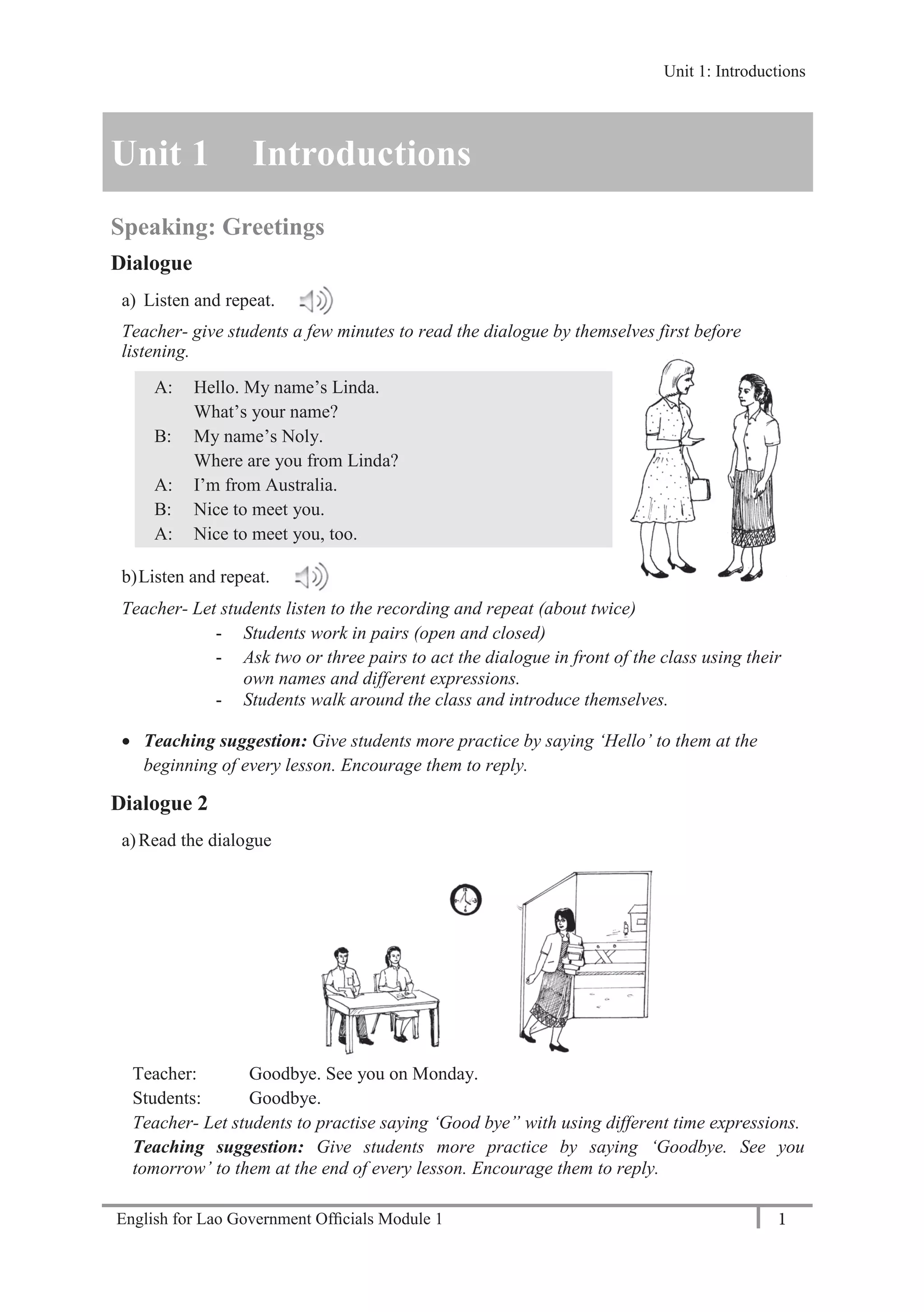
A: Hello. My name’s Linda.
What’s your name?
B: My name’s Noly.
Where are you from Linda?
A: I’m from Australia.
B: Nice to meet you.
A: Nice to meet you, too.
b)Listen and repeat.
Teacher- Let students listen to the recording and repeat (about twice)
- Students work in pairs (open and closed)
- Ask two or three pairs to act the dialogue in front of the class using their
own names and different expressions.
- Students walk around the class and introduce themselves.
 Teaching suggestion: Give students more practice by saying ‘Hello’ to them at the
beginning of every lesson. Encourage them to reply.
Dialogue 2
a)Read the dialogue
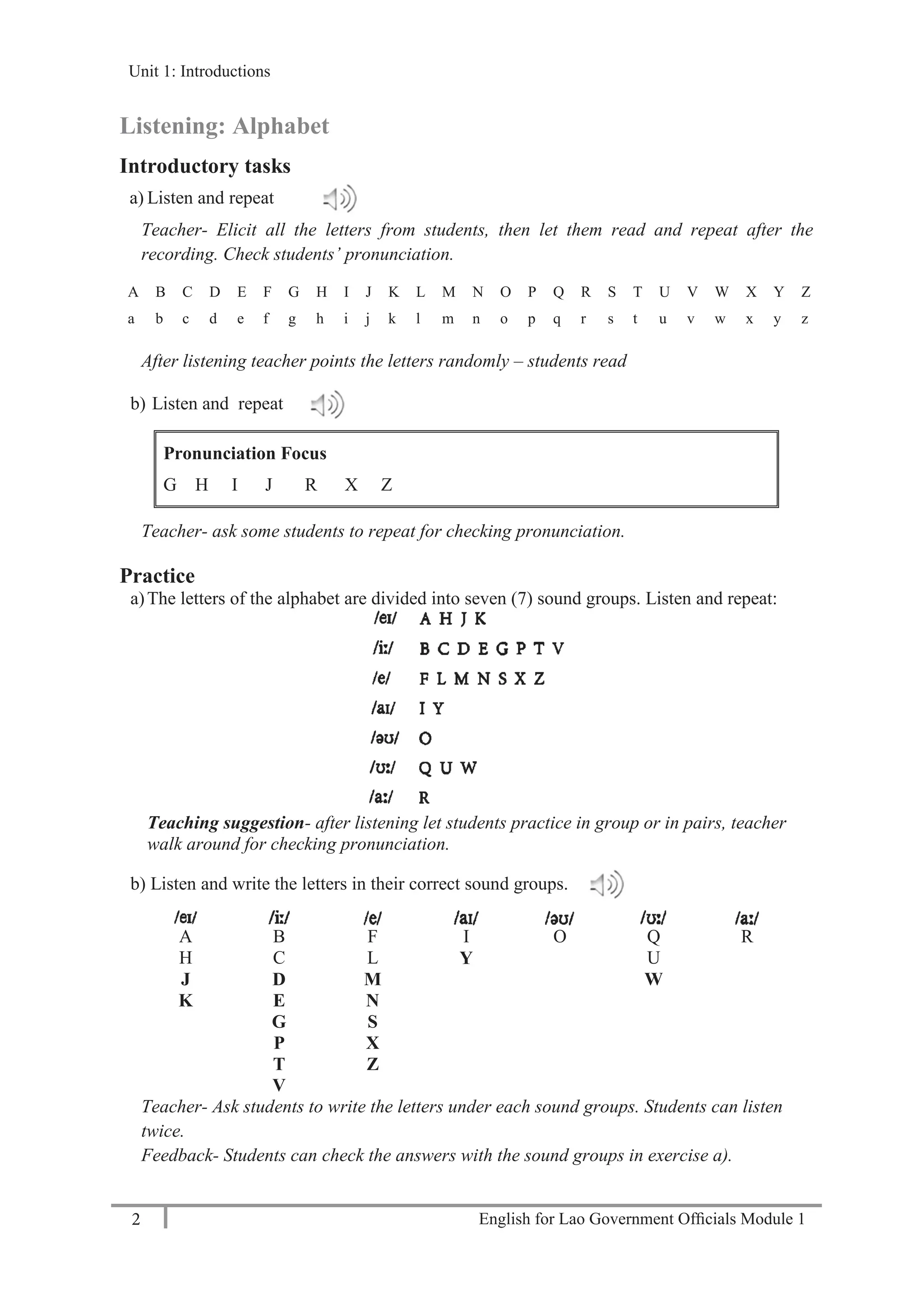
Teacher: Goodbye. See you on Monday.
Students: Goodbye.
Teacher- Let students to practise saying ‘Good bye” with using different time expressions.
Teaching suggestion: Give students more practice by saying ‘Goodbye. See you
tomorrow’ to them at the end of every lesson. Encourage them to reply.
Unit 1: Introductions
English for Lao Government Officials Module 12
Unit 1: Introductions
2 English for Lao Government Officials Module 1
Listening: Alphabet
Introductory tasks
a) Listen and repeat
Teacher- Elicit all the letters from students, then let them read and repeat after the
recording. Check students’ pronunciation.
A B C D E F G H I J K L M N O P Q R S T U V W X Y Z
a b c d e f g h i j k l m n o p q r s t u v w x y z
After listening teacher points the letters randomly – students read
b) Listen and repeat
Pronunciation Focus
G H I J R X Z
Teacher- ask some students to repeat for checking pronunciation.
Practice
a)The letters of the alphabet are divided into seven (7) sound groups. Listen and repeat:
Teaching suggestion- after listening let students practice in group or in pairs, teacher
walk around for checking pronunciation.
b) Listen and write the letters in their correct sound groups.
A B F I O Q R
H C L Y U
J D M W
K E
G
N
S
P X
T Z
V
Teacher- Ask students to write the letters under each sound groups. Students can listen
twice.
Feedback- Students can check the answers with the sound groups in exercise a).
Unit 1: Introductions
English for Lao Government Officials Module 1 3
Unit 1: Introductions
3 English for Lao Government Officials Module 1
Follow-up tasks
a)Listen to the cassette and circle the letter you hear.
Teacher- Let students listen to the recording twice.
1. J K 6. T I G
2. H S W X 7. U W Q V
3. L F Z 8. M X Z
4. B K 9. R N
5. C Z P 10. I E A O
Feedback- Teacher plays the tape but pause after each one.
Teacher – write the numbers 1-10 on the board. Ask students to write and say the letters.
b)Listen and write the letters you hear.
Teacher- Let students listen to the recording twice.
1. NGO 6. UXO
2. UNDP 7. IMF
3. ADB 8. GTZ
4. WHO 9. FAO
Feedback- Teacher plays the tape but pause after each one.
Teacher – write the numbers 1-9 on the board. Ask students to write and say the letters.
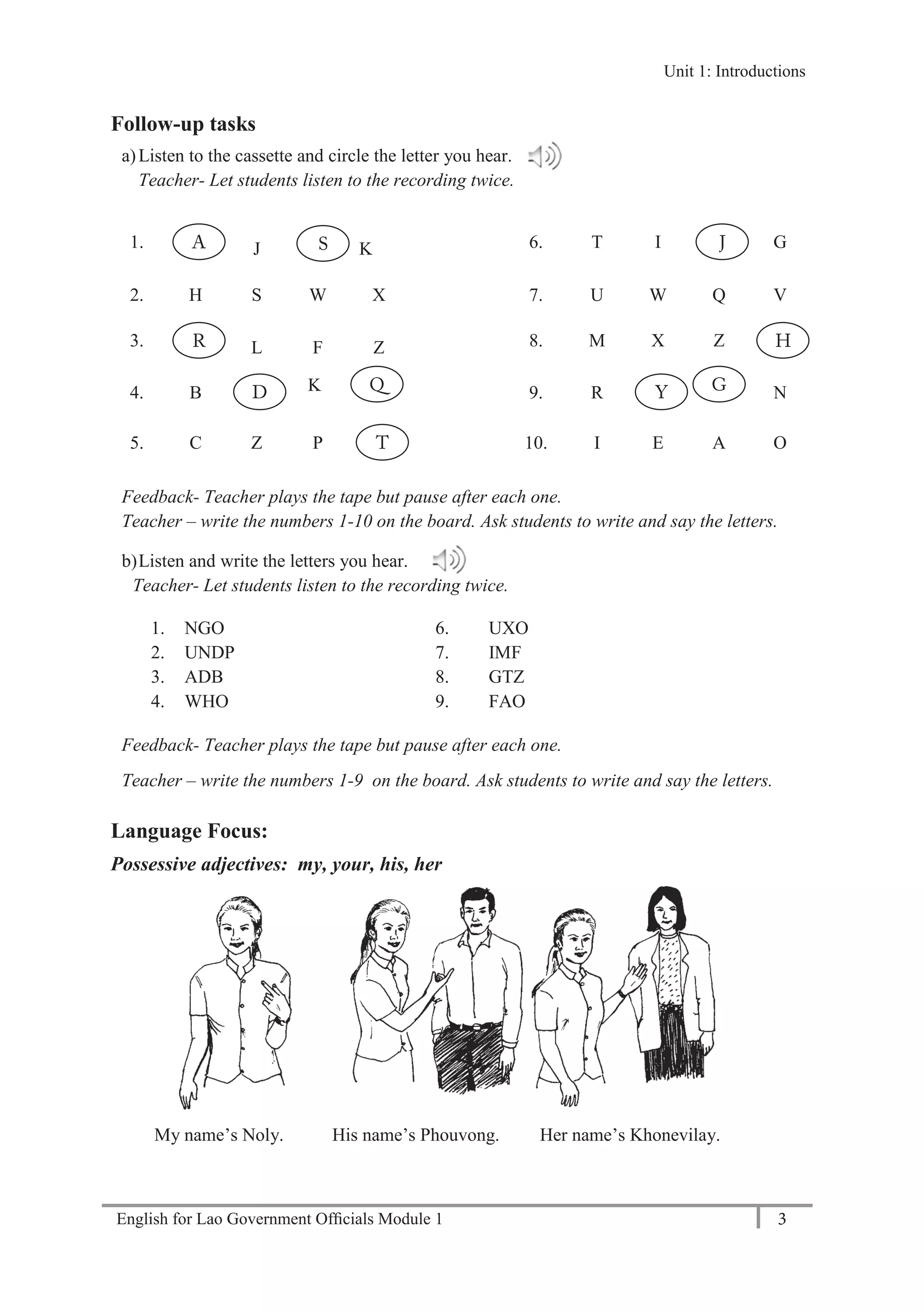
Language Focus:
Possessive adjectives: my, your, his, her
My name’s Noly. His name’s Phouvong. Her name’s Khonevilay.
Unit 1: Introductions
English for Lao Government Officials Module 14
Unit 1: Introductions
4 English for Lao Government Officials Module 1
Spoken Written
What’s What is
My name’s My name is
Her name’s Her name is
His name’s His name is
 Ask students to use things around them for practising expressions with all possessive
adjectives.
Reading: Family
Introductory tasks
a) Match the Lao and English words.
Example: 1-g
1.brother a. a. ແມ່
2. father b. ພ່
3. mother c. ເມຍ
4. husband d. ຜົວ
5. daughter e. ລູກສາວ
6. sister f. ລູກຊາຍ
7. son g. ອ້າຍ/ນ້ອງຊາຍ
8. wife h. ເອ້ອຍ/ນ້ອງສາວ
9. grandfather i. ລຸງ/ນ້າບ່າວ/ອາວ
10. grandmother j. ປ້າ/ນ້າສາວ/ອາ
11. grandson k. ພ່ ເຖ້າ/ພ່ ຕູ້/ປູ່
12. granddaughter l. ພ່ ນ້ອງ
13. uncle m. ແມ່ເຖ້າ/ແມ່ຕູ້/ຍ່າ
14. aunt n. ຫຼານຊາຍ
15. cousin o. ຫຼານສາວ
Answer: 1-g; 2-b; 3-a; 4-d; 5-e; 6-h; 7-f; 8-c; 9-k; 10-m; 11-n; 12-o;
13- i; 14-j; 15-l
The terms ‘ ຫຼານຊາຍ/ຫຼານສາວ’ have specific words in English:
Ex: grandparent-grandson/granddaughter, uncle/aunt- niece/nephew
We also can add ‘in-law’ for ‘ໃພ້/ເຂຍ’:
Unit 1: Introductions
English for Lao Government Officials Module 1 5
Unit 1: Introductions
5 English for Lao Government Officials Module 1
Ex: son in-law /daughter in-law/uncle in-law/mother in-law/father in-law/sister in-law
Teaching suggestion 1: Model the activity for the students –
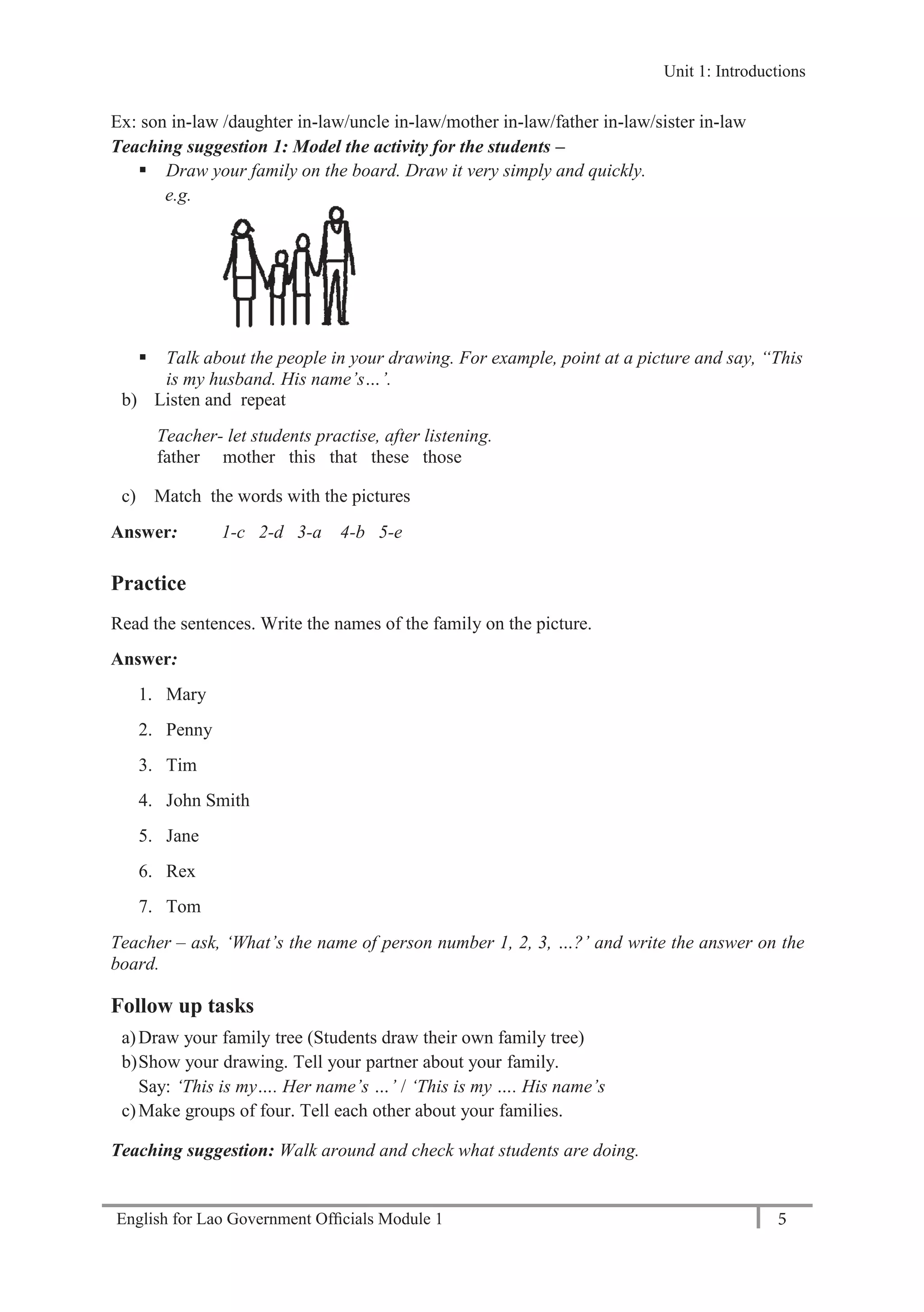
 Draw your family on the board. Draw it very simply and quickly.
e.g.
 Talk about the people in your drawing. For example, point at a picture and say, “This
is my husband. His name’s…’.
b) Listen and repeat
Teacher- let students practise, after listening.
father mother this that these those
c) Match the words with the pictures
Answer: 1-c 2-d 3-a 4-b 5-e
Practice
Read the sentences. Write the names of the family on the picture.
Answer:
1. Mary
2. Penny
3. Tim
4. John Smith
5. Jane
6. Rex
7. Tom
Teacher – ask, ‘What’s the name of person number 1, 2, 3, …?’ and write the answer on the
board.
Follow up tasks
a)Draw your family tree (Students draw their own family tree)
b)Show your drawing. Tell your partner about your family.
Say: ‘This is my…. Her name’s …’ / ‘This is my …. His name’s
c)Make groups of four. Tell each other about your families.
Teaching suggestion: Walk around and check what students are doing.
Unit 1: Introductions
English for Lao Government Officials Module 16
Unit 1: Introductions
6 English for Lao Government Officials Module 1
Are all students drawing? If not, why not? Some students are shy about drawing. Explain
that it doesn’t have to be a beautiful drawing but they need a picture of their family for the
next activity
Teachers also check:
 Do all students understand the tasks? Do you need to explain again?
 Are all students participating? If not, why not?
 How can you help them to participate?
 How is their grammar and pronunciation?
 Do they need more drill?
Writing: My family
Introductory tasks
a) Write the capital letters under the small letters.
a b c d e f g h i j k l m n o p q r s t u v w x y z
A B C D E F G H I J K L M N O P Q R S T U V W X Y Z
Teacher- call students to the answer on the board and read together again.
Language Focus
Teacher- Ask students to give their examples.
a) Correct these sentences.
Teacher – write the sentences on the board. Ask students to correct them.
My name is John Smith.
This is my wife.
Her name is Mary.
This is my son.
His name is Tom.
b) Look again at your drawing of your family. Write sentences about your family next to
the drawing.
Check:
 the Present Simple Tense of “be”
 spelling
 a/an
 capital letters
 full stops
Teacher – when students are writing, go around to check their sentences. Don’t forget to
check the capital letters and full stops.
Unit 1: Introductions
English for Lao Government Officials Module 1 7
Unit 2: Personal Information
7 English for Lao Government Officials Module 1
Unit 2 Personal information
Speaking: Can you spell it please
Dialogue
a) Listen and read the dialogue.
Teacher- give students a few minutes to read the dialogue by themselves first before
listening.
Teacher- Let students listen and repeat twice
-Divide students into two halves: one half is A, another half is B.
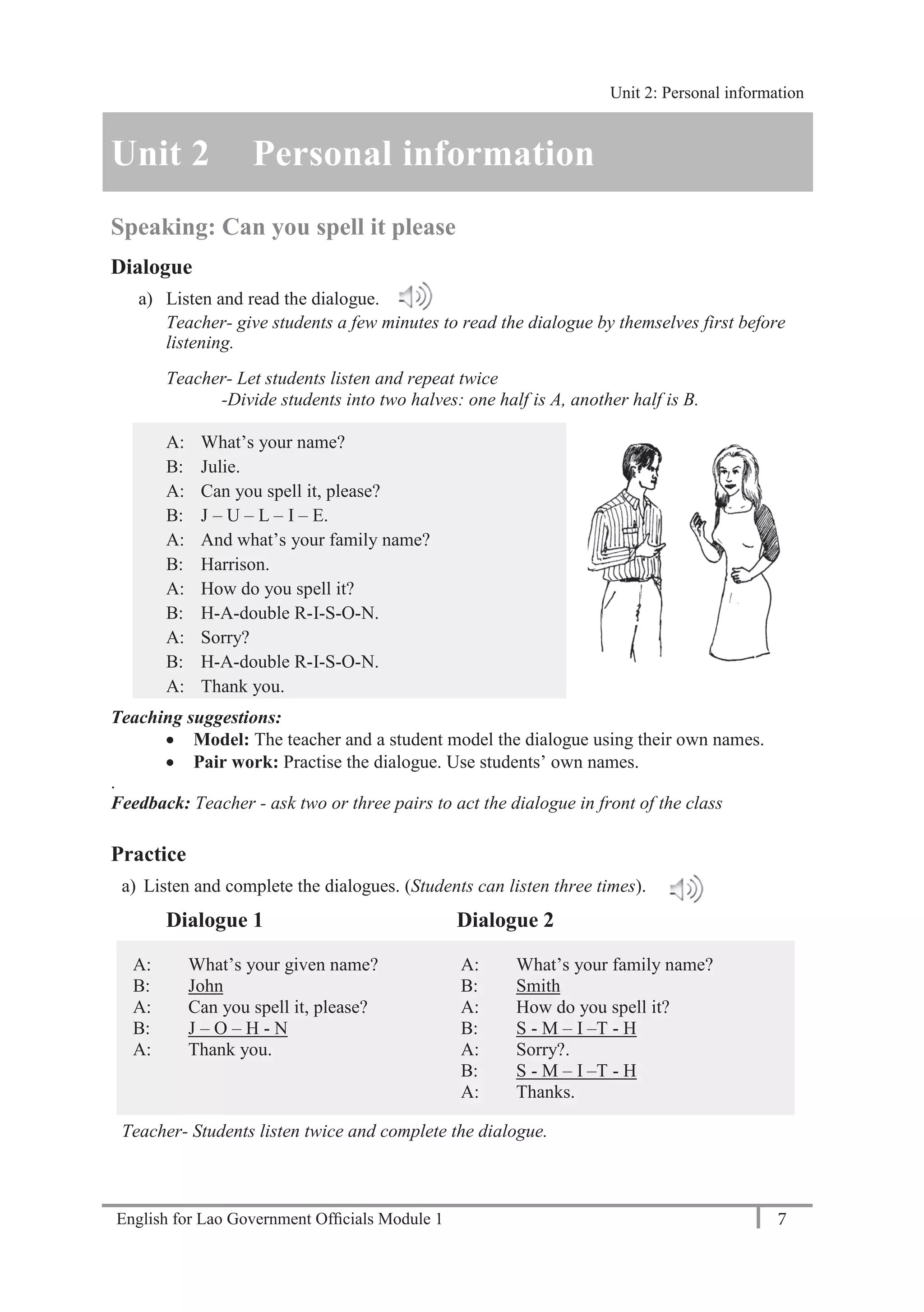
A: What’s your name?
B: Julie.
A: Can you spell it, please?
B: J – U – L – I – E.
A: And what’s your family name?
B: Harrison.
A: How do you spell it?
B: H-A-double R-I-S-O-N.
A: Sorry?
B: H-A-double R-I-S-O-N.
A: Thank you.
Teaching suggestions:
 Model: The teacher and a student model the dialogue using their own names.
 Pair work: Practise the dialogue. Use students’ own names.
.
Feedback: Teacher - ask two or three pairs to act the dialogue in front of the class
Practice
a) Listen and complete the dialogues. (Students can listen three times).
Dialogue 1 Dialogue 2
A: What’s your given name? A: What’s your family name?
B: John B: Smith
A: Can you spell it, please? A: How do you spell it?
B: J – O – H - N B: S - M – I –T - H
A: Thank you. A: Sorry?.
B: S - M – I –T - H
A: Thanks.
Teacher- Students listen twice and complete the dialogue.
Unit 2: Personal information
English for Lao Government Officials Module 18
Unit 2: Personal Information
8 English for Lao Government Officials Module 1
Teacher – play the tape again but pause after each sentence. Ask 3 or 4 students to say the
names they heard and spell them. Write them on the board. Tell students which is the correct
answer.
b) Complete the table and report back to your group.
Possible questions:
 What’s your first name?
 How do you spell it? (Sorry?)
 What’s your family name?
 Can you spell it, please? (Sorry?)
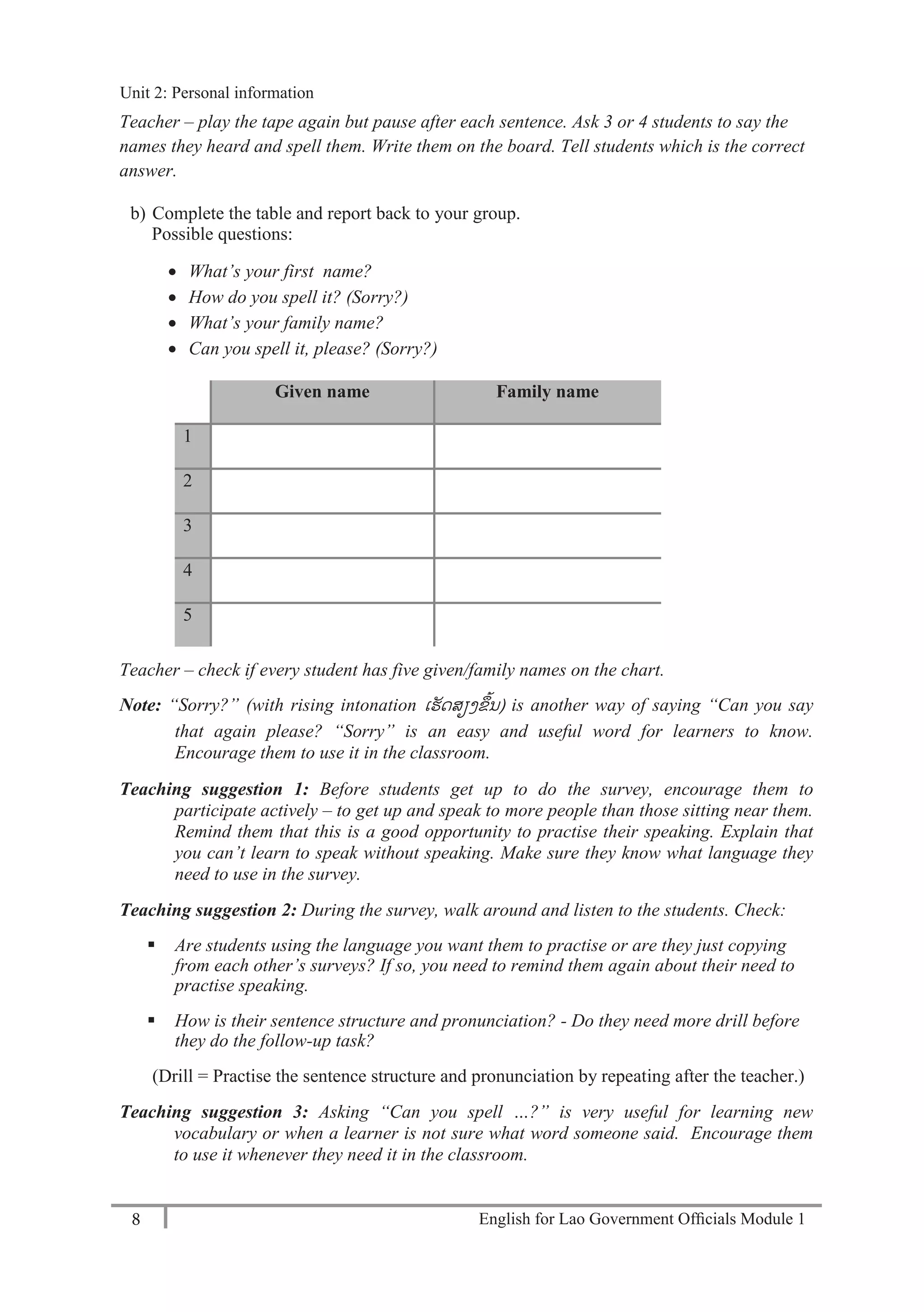
Given name Family name
1
2
3
4
5
Teacher – check if every student has five given/family names on the chart.
Note: “Sorry?” (with rising intonation ເຮັດສຽງຂ້ນ) is another way of saying “Can you say
that again please? “Sorry” is an easy and useful word for learners to know.
Encourage them to use it in the classroom.
Teaching suggestion 1: Before students get up to do the survey, encourage them to
participate actively – to get up and speak to more people than those sitting near them.
Remind them that this is a good opportunity to practise their speaking. Explain that
you can’t learn to speak without speaking. Make sure they know what language they
need to use in the survey.
Teaching suggestion 2: During the survey, walk around and listen to the students. Check:
 Are students using the language you want them to practise or are they just copying
from each other’s surveys? If so, you need to remind them again about their need to
practise speaking.
 How is their sentence structure and pronunciation? - Do they need more drill before
they do the follow-up task?
(Drill = Practise the sentence structure and pronunciation by repeating after the teacher.)
Teaching suggestion 3: Asking “Can you spell …?” is very useful for learning new
vocabulary or when a learner is not sure what word someone said. Encourage them
to use it whenever they need it in the classroom.
Unit 2: Personal information
English for Lao Government Officials Module 1 9
Unit 2: Personal Information
9 English for Lao Government Officials Module 1
Listening: Numbers 1-10
Introductory task
a. Listen and repeat.
0 1 2 3 4 5 6 7 8 9 10
Teacher- ask some students to repeat
Practice
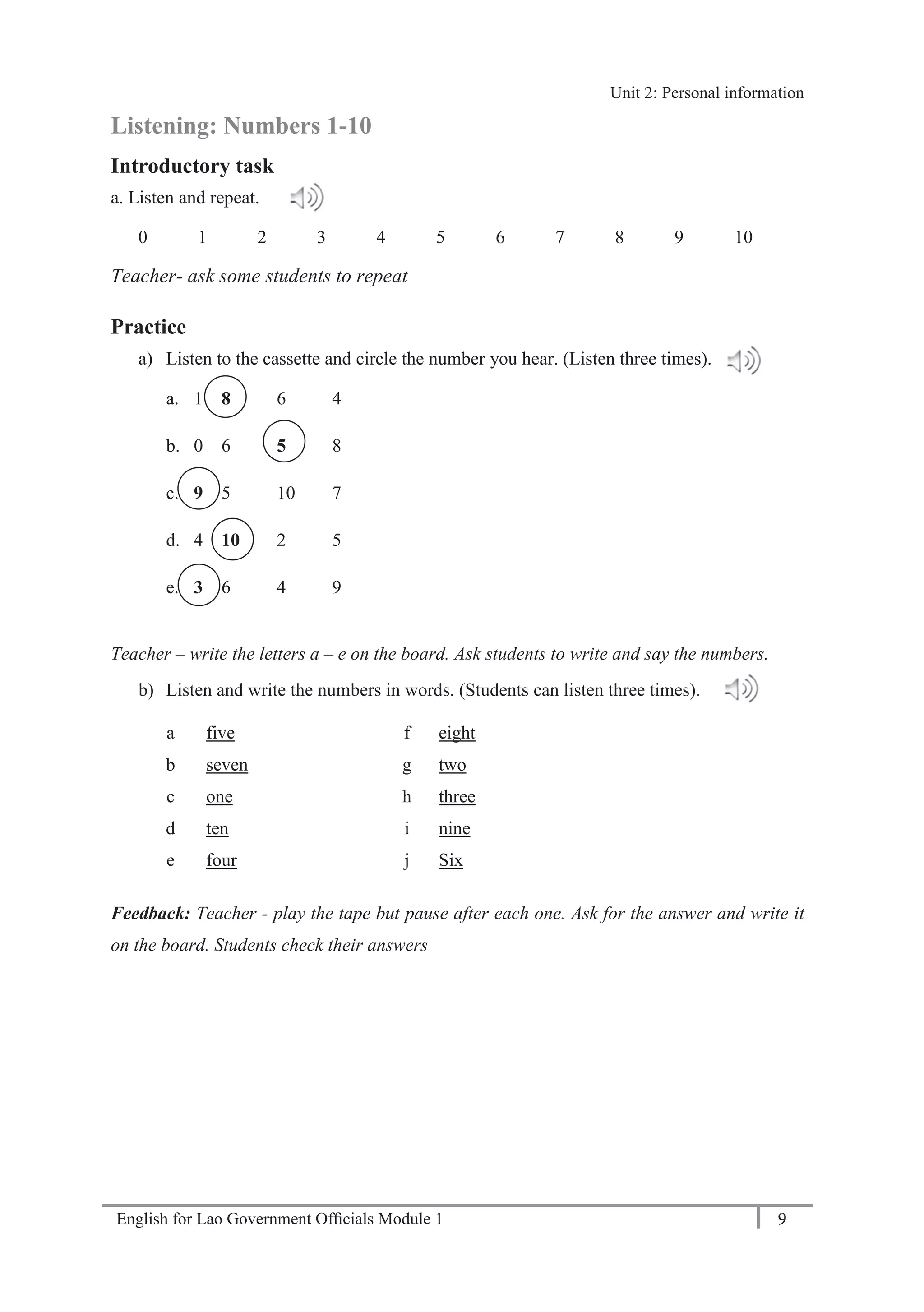
a) Listen to the cassette and circle the number you hear. (Listen three times).
a. 1 8 6 4
b. 0 6 5 8
c. 9 5 10 7
d. 4 10 2 5
e. 3 6 4 9
Teacher – write the letters a – e on the board. Ask students to write and say the numbers.
b) Listen and write the numbers in words. (Students can listen three times).
a five f eight
b seven g two
c one h three
d ten i nine
e four j Six
Feedback: Teacher - play the tape but pause after each one. Ask for the answer and write it
on the board. Students check their answers
Unit 2: Personal information
English for Lao Government Officials Module 110
Unit 2: Personal Information
10 English for Lao Government Officials Module 1
Follow-up tasks
a) Listen and write the phone numbers.
a. A: What’s your phone number, Santi?
B: It’s 041 5847.
A: Thanks.
b. A: What’s your phone number?
B: 25 0774.
c. A: What’s your telephone number, Jane?
B: It’s 21 6450.
A: Sorry?
B: 21 6450.
A: What’s your phone number, please?
B: 31 6789.
A: And what’s your phone number, David?
B: It’s 21 8435.
A: Sorry?
B: 21 8435.
A: What’s your phone number, please?
B: 56 965343
Feedback: Teacher – write the letters a – f on the board..
Teacher - play the cassette but pause after each one. Ask for the answer and write it on the
board. Students check their answers. Ask students to write and say the phone numbers.
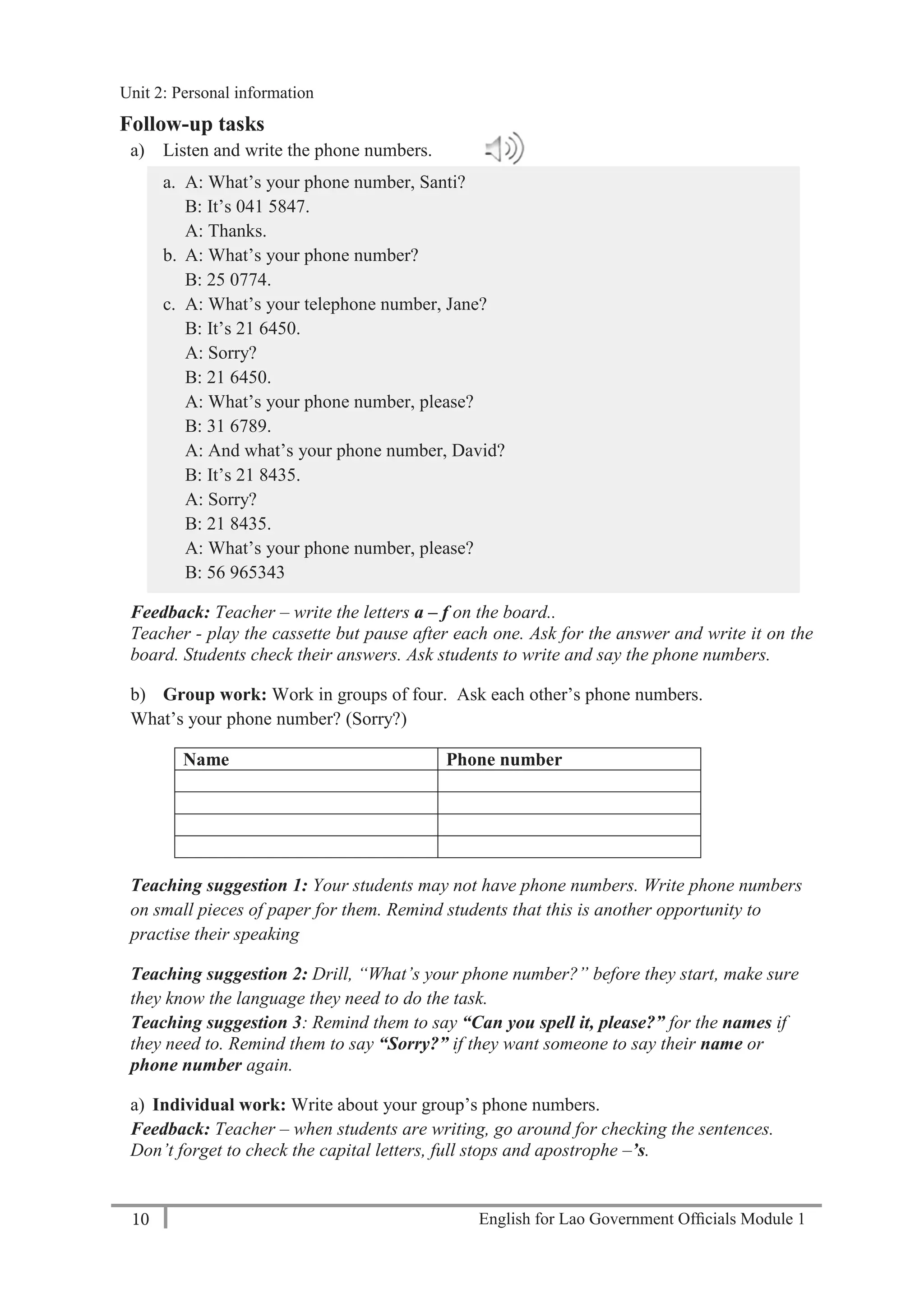
b) Group work: Work in groups of four. Ask each other’s phone numbers.
What’s your phone number? (Sorry?)
Name Phone number
Teaching suggestion 1: Your students may not have phone numbers. Write phone numbers
on small pieces of paper for them. Remind students that this is another opportunity to
practise their speaking
Teaching suggestion 2: Drill, “What’s your phone number?” before they start, make sure
they know the language they need to do the task.
Teaching suggestion 3: Remind them to say “Can you spell it, please?” for the names if
they need to. Remind them to say “Sorry?” if they want someone to say their name or
phone number again.
a) Individual work: Write about your group’s phone numbers.
Feedback: Teacher – when students are writing, go around for checking the sentences.
Don’t forget to check the capital letters, full stops and apostrophe –’s.
Unit 2: Personal information
English for Lao Government Officials Module 1 11
Unit 2: Personal Information
11 English for Lao Government Officials Module 1
Reading: Occupations
Introductory tasks
a) Match English and Lao words.
1. teacher a. ພະນັກງານລັດ
2. doctor b-. b. ຊາວນາ
3. student c. ຕາຫຼວດຊາຍ
4. farmer d. d. ທະຫານ
5. soldier e. ກາມະກອນໂຮງງານ
6. policeman f. ຄນຂາຍເຄ່ອງ
7. businessman g. ຄູສອນ
8. shop keeper h. ນັກສກສາ
9. factory worker i. ທ່ານໝ
10. government official j. ນັກທຸລະກິດຊາຍ
11. businesswoman k. ຕາຫຼວດຍິງ
12. policewoman l. ນັກທຸລະກິດຍິງ
Answer: 1-g 2-i 3-h 4-b 5-d 6-c 7-j 8-f ...9-e 10-a 11-l 12-k
Feedback: Teacher – say a word in Lao and ask students for the English. Check the
pronunciation
Language Focus
Verb ‘to be’
Teaching suggestions:
 Teacher- explain the function of verb to ‘be’ and give the sample of positive/negative
statements, yes/no questions, wh/question with ‘be’.
 Ask students to give their examples.
Follow up tasks
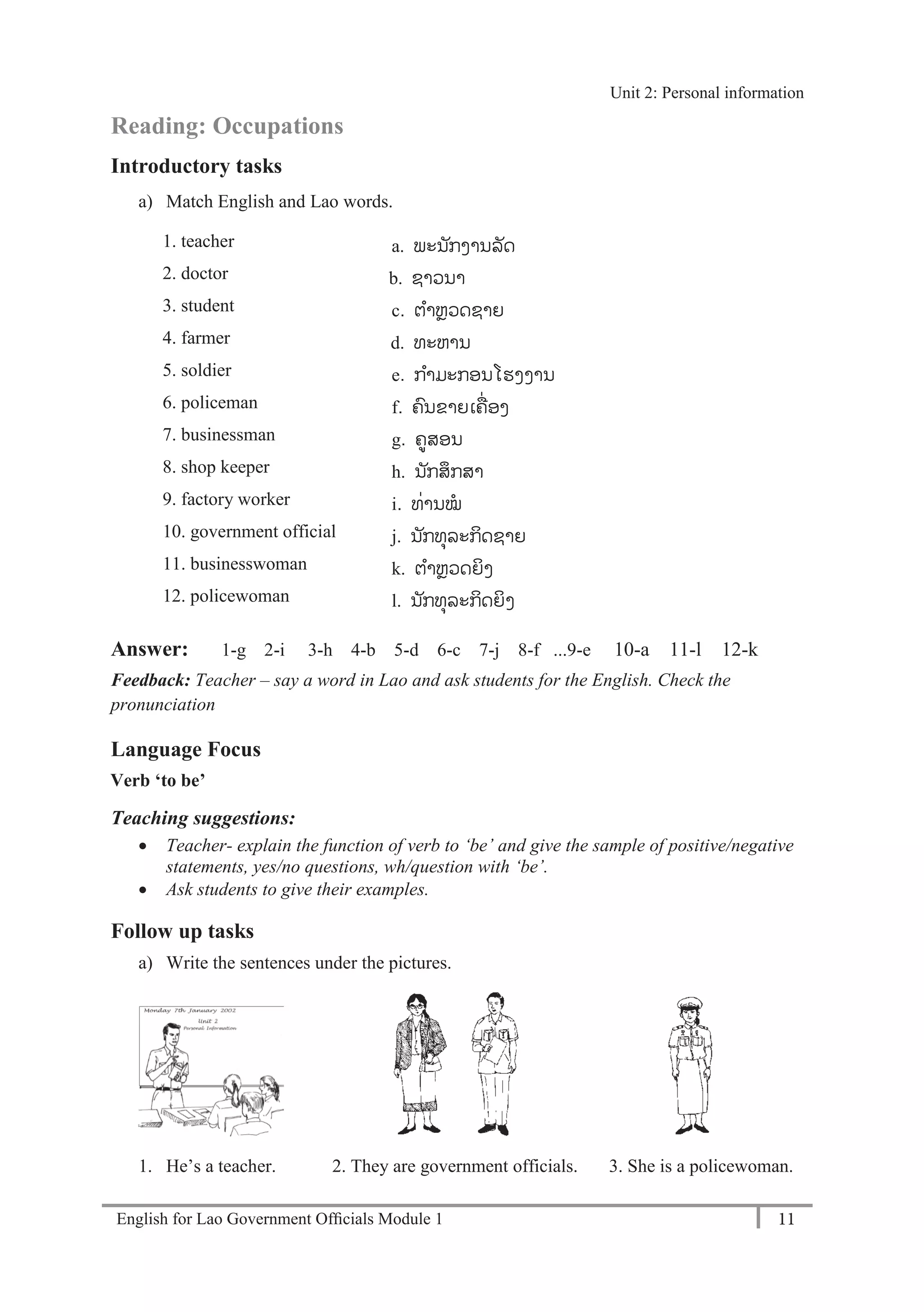
a) Write the sentences under the pictures.
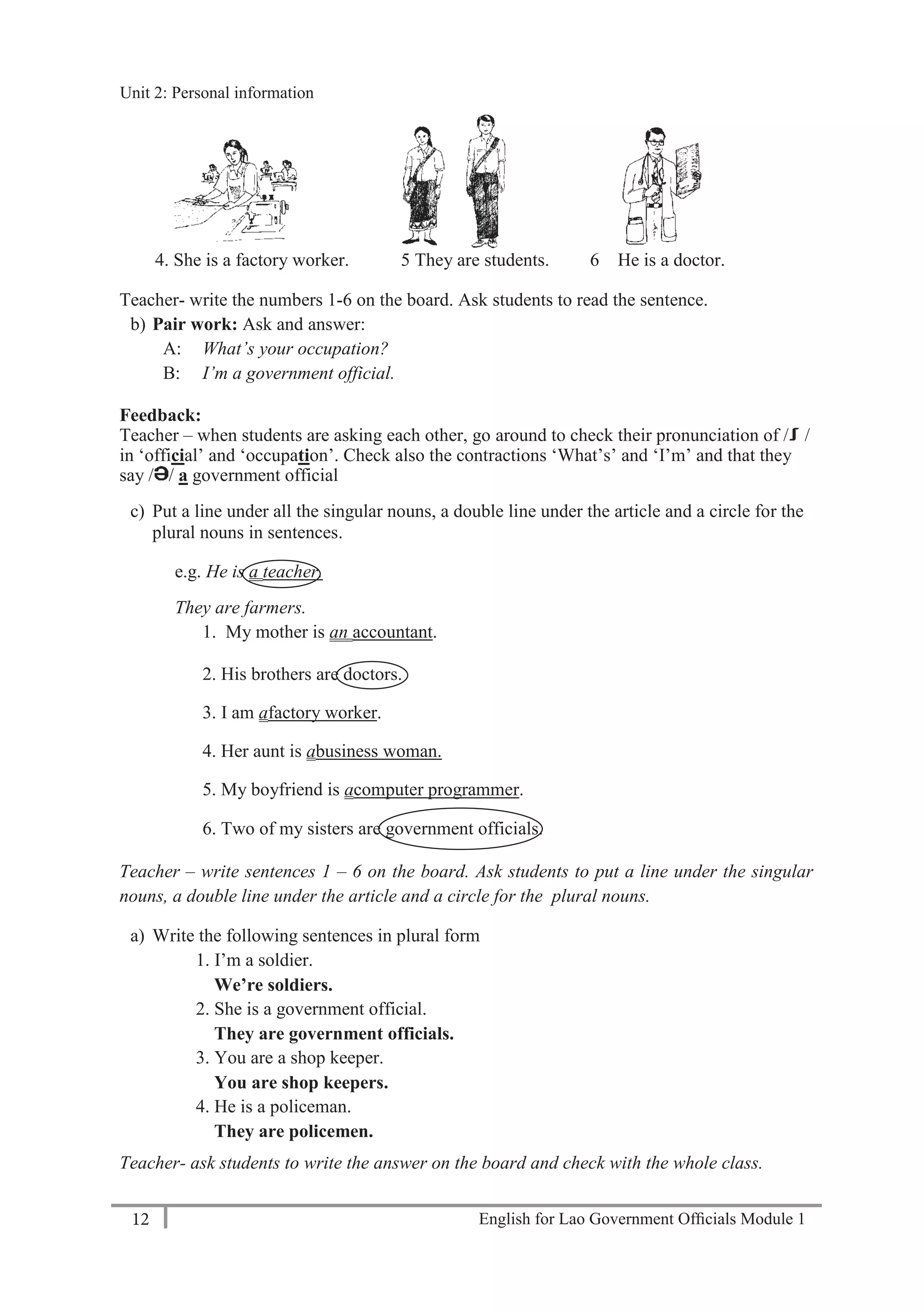
1. He’s a teacher. 2. They are government officials. 3. She is a policewoman.
Unit 2: Personal information
English for Lao Government Officials Module 112
Unit 2: Personal Information
12 English for Lao Government Officials Module 1
4. She is a factory worker. 5 They are students. 6 He is a doctor.
Teacher- write the numbers 1-6 on the board. Ask students to read the sentence.
b) Pair work: Ask and answer:
A: What’s your occupation?
B: I’m a government official.
Feedback:
Teacher – when students are asking each other, go around to check their pronunciation of / /
in ‘official’ and ‘occupation’. Check also the contractions ‘What’s’ and ‘I’m’ and that they
say / / a government official
c) Put a line under all the singular nouns, a double line under the article and a circle for the
plural nouns in sentences.
e.g. He is a teacher.
They are farmers.
1. My mother is an accountant.
2. His brothers are doctors.
3. I am afactory worker.
4. Her aunt is abusiness woman.
5. My boyfriend is acomputer programmer.
6. Two of my sisters are government officials.
Teacher – write sentences 1 – 6 on the board. Ask students to put a line under the singular
nouns, a double line under the article and a circle for the plural nouns.
a) Write the following sentences in plural form
1. I’m a soldier.
We’re soldiers.
2. She is a government official.
They are government officials.
3. You are a shop keeper.
You are shop keepers.
4. He is a policeman.
They are policemen.
Teacher- ask students to write the answer on the board and check with the whole class.
Unit 2: Personal information
English for Lao Government Officials Module 1 13
Unit 2: Personal Information
13 English for Lao Government Officials Module 1
Practice
a) Write am, is or are in the sentences below.
1. My name is Jenny.
2. Your father is a businessman.
3. Manoly is a teacher.
4. I am a student. My sister is a policewoman.
5. You are government officials.
Feedback Teacher – ask students for the answers, then write the correct answers on
the board.
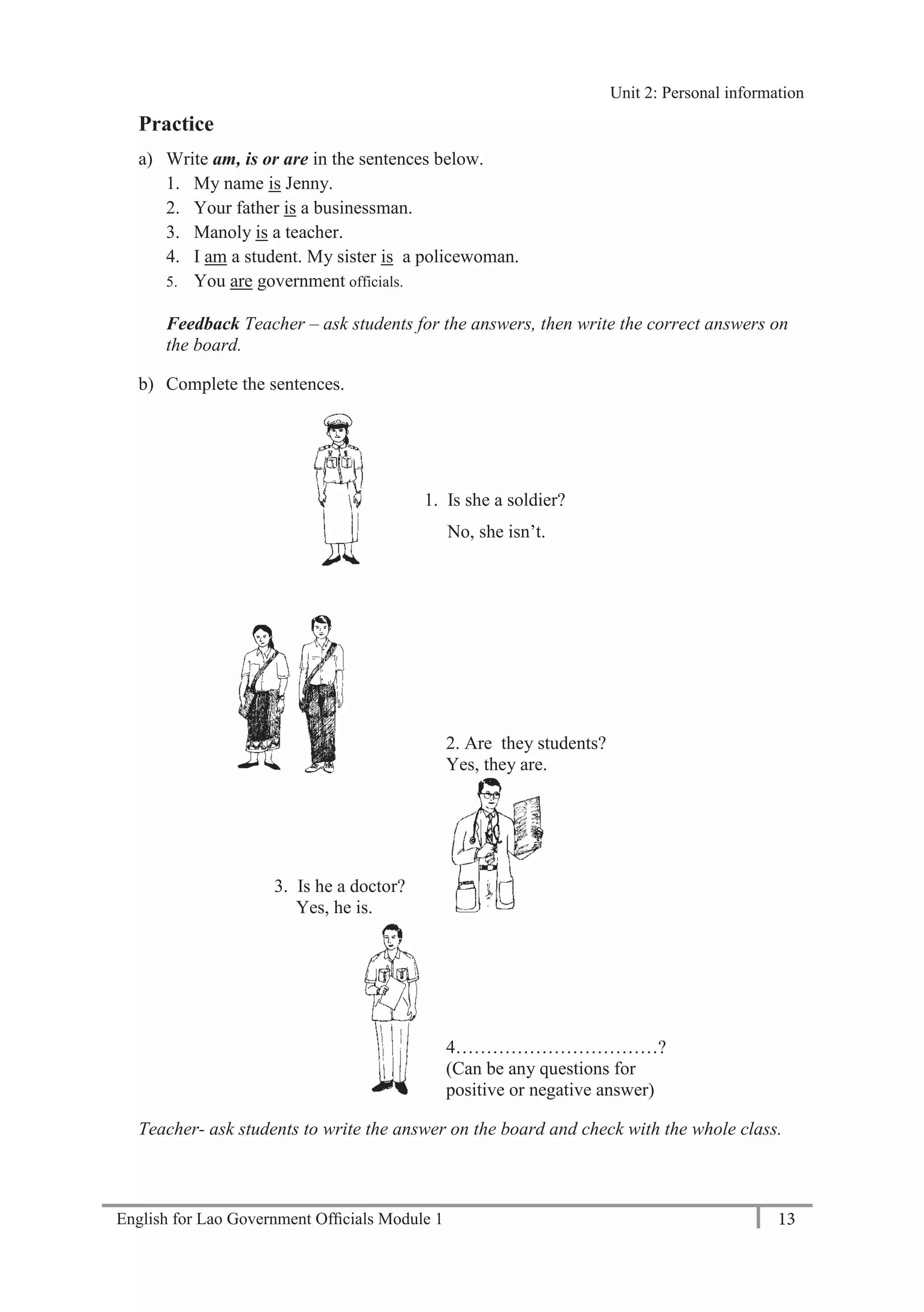
b) Complete the sentences.
1. Is she a soldier?
No, she isn’t.
2. Are they students?
Yes, they are.
3. Is he a doctor?
Yes, he is.
4……………………………?
(Can be any questions for
positive or negative answer)
Teacher- ask students to write the answer on the board and check with the whole class.
Unit 2: Personal information
English for Lao Government Officials Module 114
Unit 2: Personal Information
14 English for Lao Government Officials Module 1
Writing: Family and occupations
Introductory task
a) Write the words in the sentences.
Bounta’s family
My name is Mr. Bounta. I am a teacher.
I’m married. My wife’s name is Chanh. She is a doctor.
My son’s name is Sack. He is a student.
My daughter’s name is Boua. She is also a student.
Teacher- tell students to observe what should include in one sentence, example: capital letter
at the beginning and full stop at the end of the sentence.
Follow-up tasks
b) Look at the text of Bounta’s family. Write sentences about your family and their
occupations.
Check:
 the Present Simple Tense of “be”
 spelling
 a/an
 capital letters
 full stops
Teacher – when students are writing, go around to check the sentences. Don’t forget to check
the apostrophe –’s, capital letters and full stops.
Students put their sentences on the wall. Walk around and read each other’s writing.
Unit 2: Personal information
English for Lao Government Officials Module 1 15
Unit 3: Classroom language
15 English for Lao Government Officials Module 1
Unit 3 Classroom language
Speaking: What’s this in English?
Teacher- Before listening to the dialogue, ask students about the things in the classroom for
brainstorming.
Dialogue
Teacher- give students a few minutes to read the dialogue by themselves first before listening.
a) Listenand read the dialogue.(Students can listen 2 times)
A:Is this your pen Sack?
B:No. It isn’t. It’s Kham’s (pen).
A:Kham, can I borrow your pen, please?
C: Of course.
A:Thank you.
C: You’re welcome
Teaching suggestion 1:
 Teacher- let students listen to the recording and repeat
 Class work: Half the class is A. Half the class is B. Practise the dialogue again
 Pair work: Practise the dialogue. Use your own pens and pencils. Practise it until you
can say it without looking at your book.
 Feedback: Teacher – ask some groups to act the dialogue in front of the class.
Teaching suggestion 2: Before the groups start, drill the questions again.
Teaching suggestion 3: Monitoring. Walk around and listen to the groups. Check:
 Do all students understand the task? Do you need to explain again?
 Are all students participating? If not, why not? How can you help them to
participate?
 How is their sentence structure and pronunciation? Do you need to drill it again?
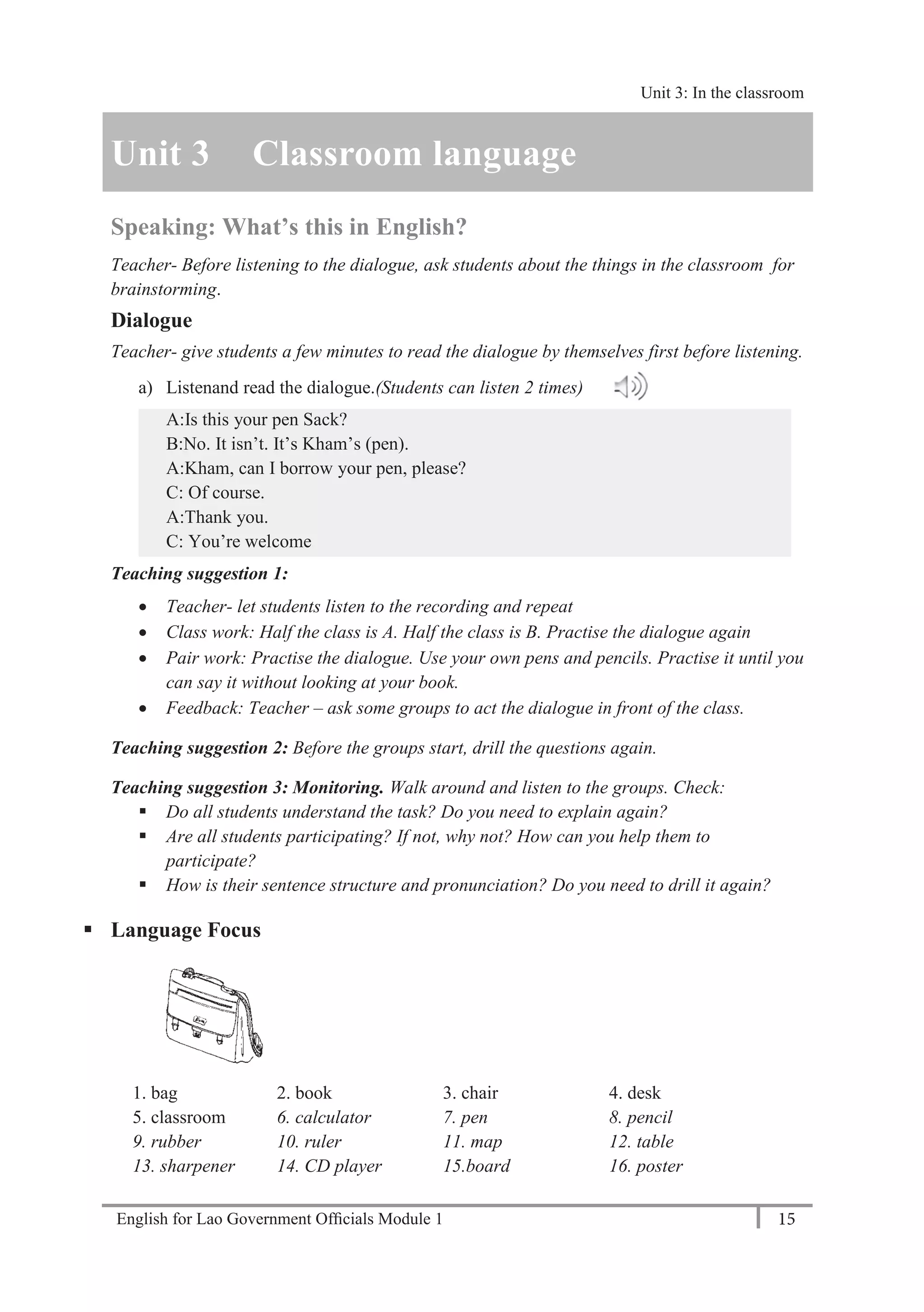
 Language Focus
1. bag 2. book 3. chair 4. desk
5. classroom 6. calculator 7. pen 8. pencil
9. rubber 10. ruler 11. map 12. table
13. sharpener 14. CD player 15.board 16. poster
Unit 3: In the classroom
English for Lao Government Officials Module 116
Unit 3: Classroom language
16 English for Lao Government Officials Module 1
Teaching suggestion: Write the answer on the board and ask students to read the words.
b) Listen and repeat.
Teacher- Read the words, students repeat
c) Point at things in the classroom. Ask and answer:
Teaching suggestion: Ask students to take turn to point at things in the room and ask each
other: ‘What’s this in English?’ or ‘What are these in English?’
Remind them to say ‘Sorry?’ (from Unit 2) if they want you to repeat a word or a spelling.
Follow up task
Introduction
a) Listen and repeat
Teacher- Let students practise saying words about different colours, then ask the students to
tell about the colour of things around them.
b) Game ‘Is this your _________?’
Game Instructions:
 Each student puts one thing belonging to him/her on the teacher’s desk.
 Teacher picks up one thing (e.g. a pen) and asks (for example):
Teacher: Is this your pen, Noly?
Noly: No, it isn’t.
Teacher What colour is your pen?
Noly: It’s black.
 Teacher gives the pen to Noly
 Teacher asks students to continue as the sample.
 Continue until all things are returned to their owners.
Listening: Numbers 11-20
Introductory tasks
a) Listen and repeat.(Students can listen 3 times).
11 12 13 14 15 16 17 18 19 20
Unit 3: In the classroom
English for Lao Government Officials Module 1 17
Unit 3: Classroom language
17 English for Lao Government Officials Module 1
Follow up tasks
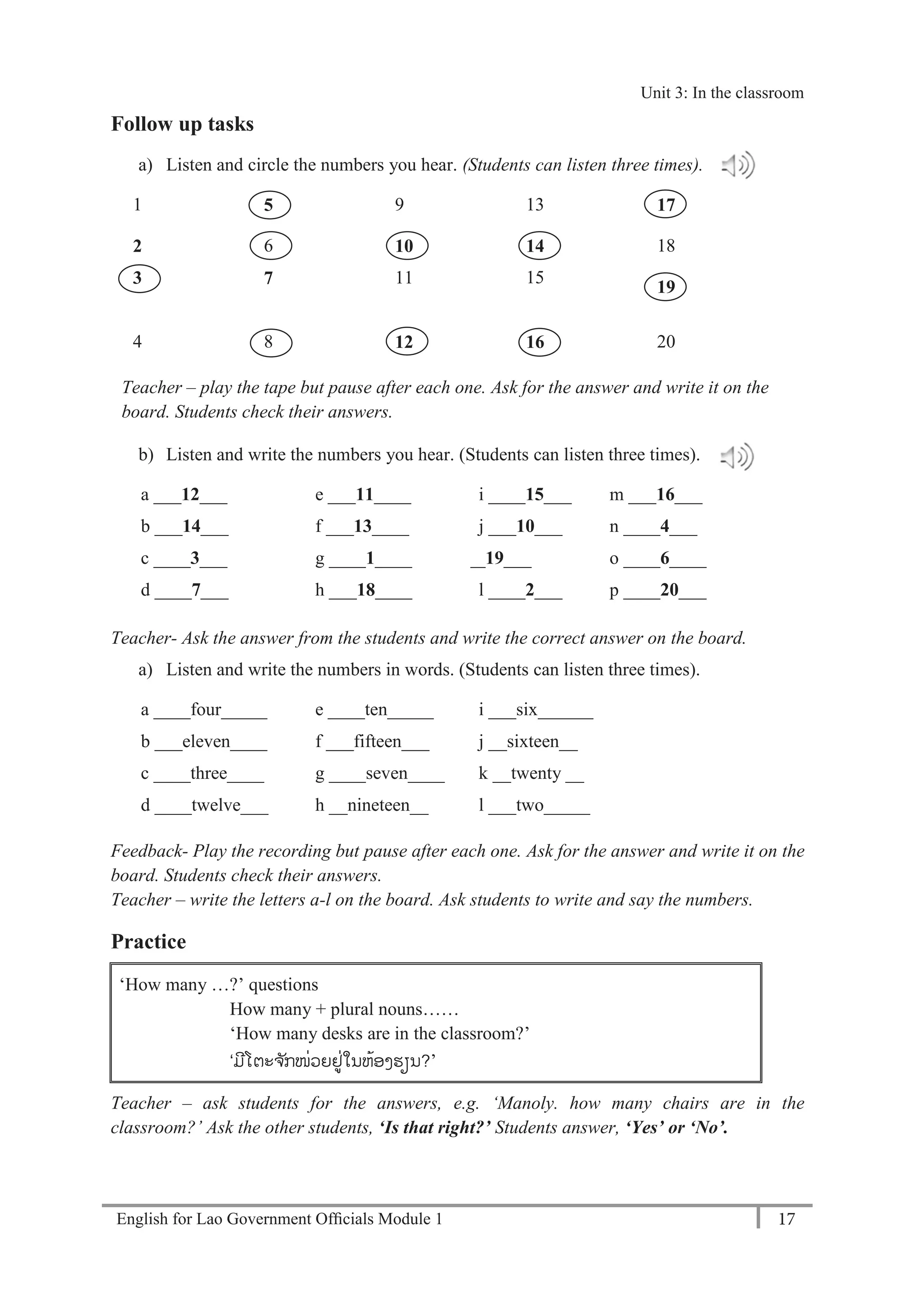
a) Listen and circle the numbers you hear. (Students can listen three times).
1 5 9 13 17
2 6 10 14 18
3 7 11 15
19
4 8 12 16 20
Teacher – play the tape but pause after each one. Ask for the answer and write it on the
board. Students check their answers.
b) Listen and write the numbers you hear. (Students can listen three times).
a ___12___ e ___11____ i ____15___ m ___16___
b ___14___ f ___13____ j ___10___ n ____4___
c ____3___ g ____1____ k ___19___ o ____6____
d ____7___ h ___18____ l ____2___ p ____20___
Teacher- Ask the answer from the students and write the correct answer on the board.
a) Listen and write the numbers in words. (Students can listen three times).
a ____four_____ e ____ten_____ i ___six______
b ___eleven____ f ___fifteen___ j __sixteen__
c ____three____ g ____seven____ k __twenty __
d ____twelve___ h __nineteen__ l ___two_____
Feedback- Play the recording but pause after each one. Ask for the answer and write it on the
board. Students check their answers.
Teacher – write the letters a-l on the board. Ask students to write and say the numbers.
Practice
‘How many …?’ questions
How many + plural nouns……
‘How many desks are in the classroom?’
‘ມໂຕະຈ ັກໜ່ວຍຢູ່ໃນຫ້ອງຮຽນ?’
Teacher – ask students for the answers, e.g. ‘Manoly. how many chairs are in the
classroom?’ Ask the other students, ‘Is that right?’ Students answer, ‘Yes’ or ‘No’.
Unit 3: In the classroom
English for Lao Government Officials Module 118
Unit 3: Classroom language
18 English for Lao Government Officials Module 1
Reading: Where’s the pen?
Introductory tasks
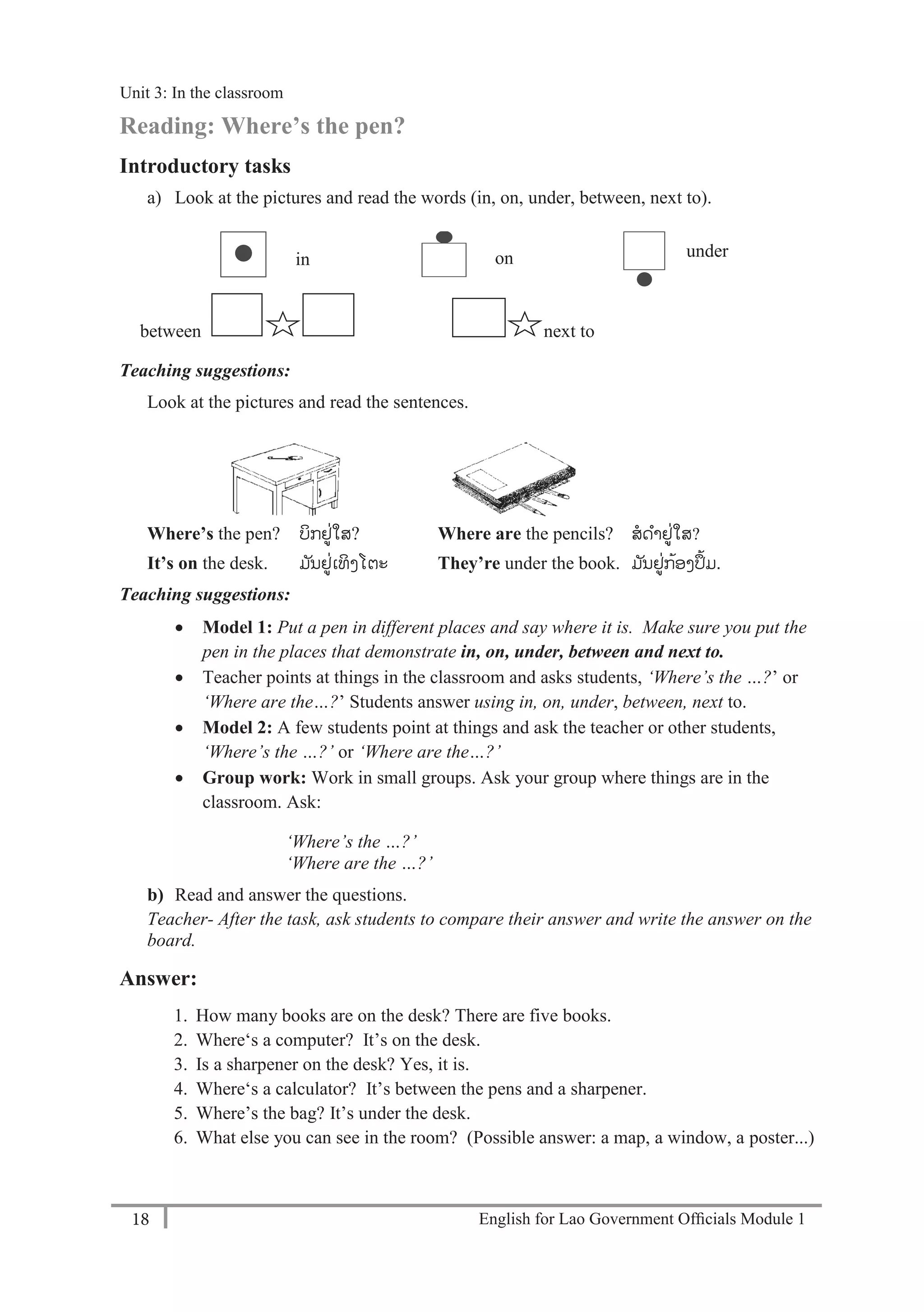
a) Look at the pictures and read the words (in, on, under, between, next to).
between next to
Teaching suggestions:
Look at the pictures and read the sentences.
Where’s the pen? ບິກຢູ່ໃສ? Where are the pencils? ສດາຢູ່ໃສ?
It’s on the desk. ມ ັນຢູ່ເທິງໂຕະ They’re under the book. ມ ັນຢູ່ກ້ອງປ້ມ.
Teaching suggestions:
 Model 1: Put a pen in different places and say where it is. Make sure you put the
pen in the places that demonstrate in, on, under, between and next to.
 Teacher points at things in the classroom and asks students, ‘Where’s the …?’ or
‘Where are the…?’ Students answer using in, on, under, between, next to.
 Model 2: A few students point at things and ask the teacher or other students,
‘Where’s the …?’ or ‘Where are the…?’
 Group work: Work in small groups. Ask your group where things are in the
classroom. Ask:
‘Where’s the …?’
‘Where are the …?’
b) Read and answer the questions.
Teacher- After the task, ask students to compare their answer and write the answer on the
board.
Answer:
1. How many books are on the desk? There are five books.
2. Where‘s a computer? It’s on the desk.
3. Is a sharpener on the desk? Yes, it is.
4. Where‘s a calculator? It’s between the pens and a sharpener.
5. Where’s the bag? It’s under the desk.
6. What else you can see in the room? (Possible answer: a map, a window, a poster...)
in on under
Unit 3: In the classroom
English for Lao Government Officials Module 1 19
Unit 3: Classroom language
19 English for Lao Government Officials Module 1
Writing task
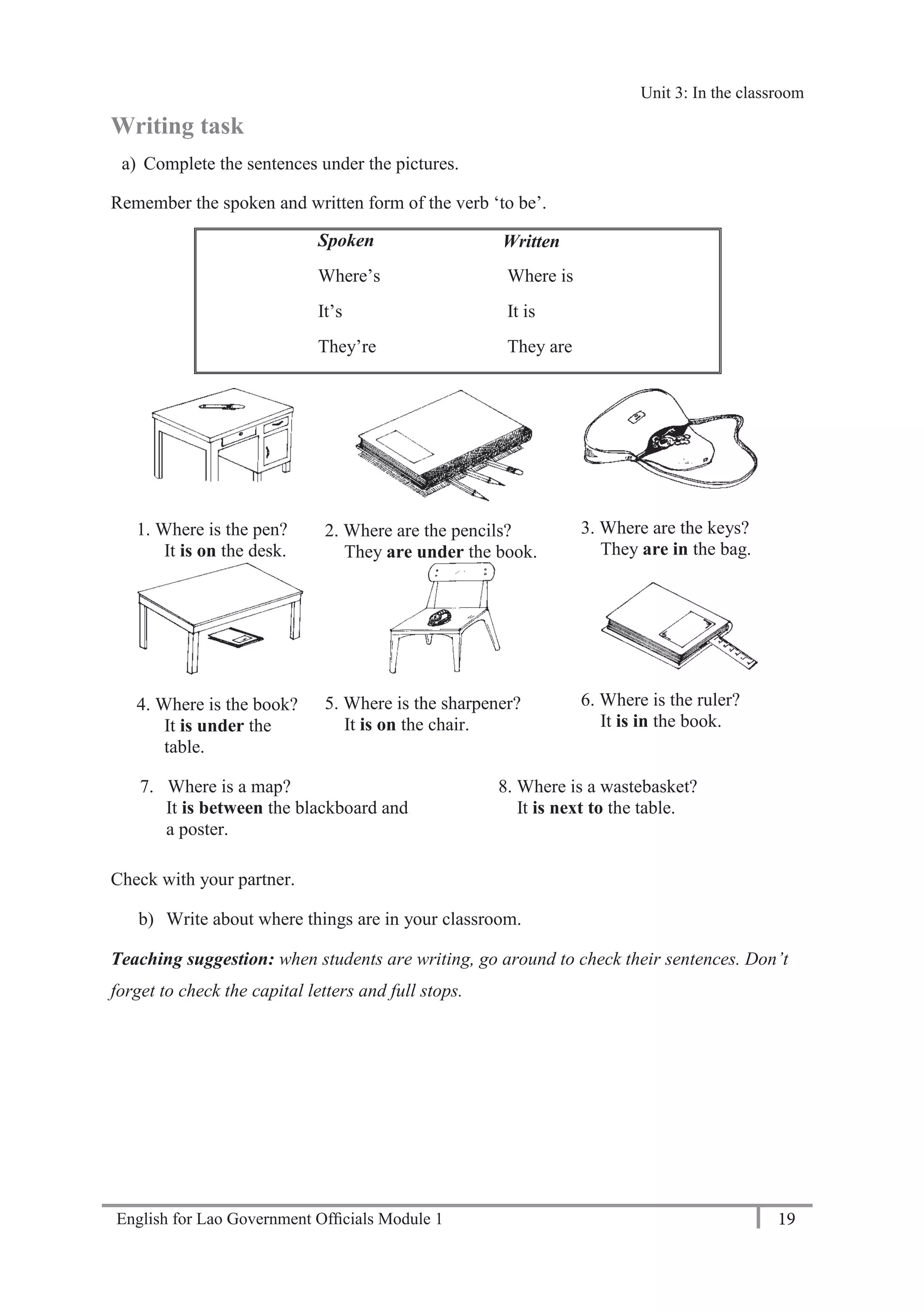
a) Complete the sentences under the pictures.
Remember the spoken and written form of the verb ‘to be’.
Spoken Written
Where’s
It’s
They’re
Where is
It is
They are
1. Where is the pen?
It is on the desk.
2. Where are the pencils?
They are under the book.
3. Where are the keys?
They are in the bag.
4. Where is the book?
It is under the
table.
5. Where is the sharpener?
It is on the chair.
6. Where is the ruler?
It is in the book.
7. Where is a map? 8. Where is a wastebasket?
It is between the blackboard and It is next to the table.
a poster.
Check with your partner.
b) Write about where things are in your classroom.
Teaching suggestion: when students are writing, go around to check their sentences. Don’t
forget to check the capital letters and full stops.
Unit 3: In the classroom
English for Lao Government Officials Module 120
Unit 4: Classroom language
20 English for Lao Government Officials Module 1
Unit 4 Classroom language
Speaking: Where are they?
Introductory tasks
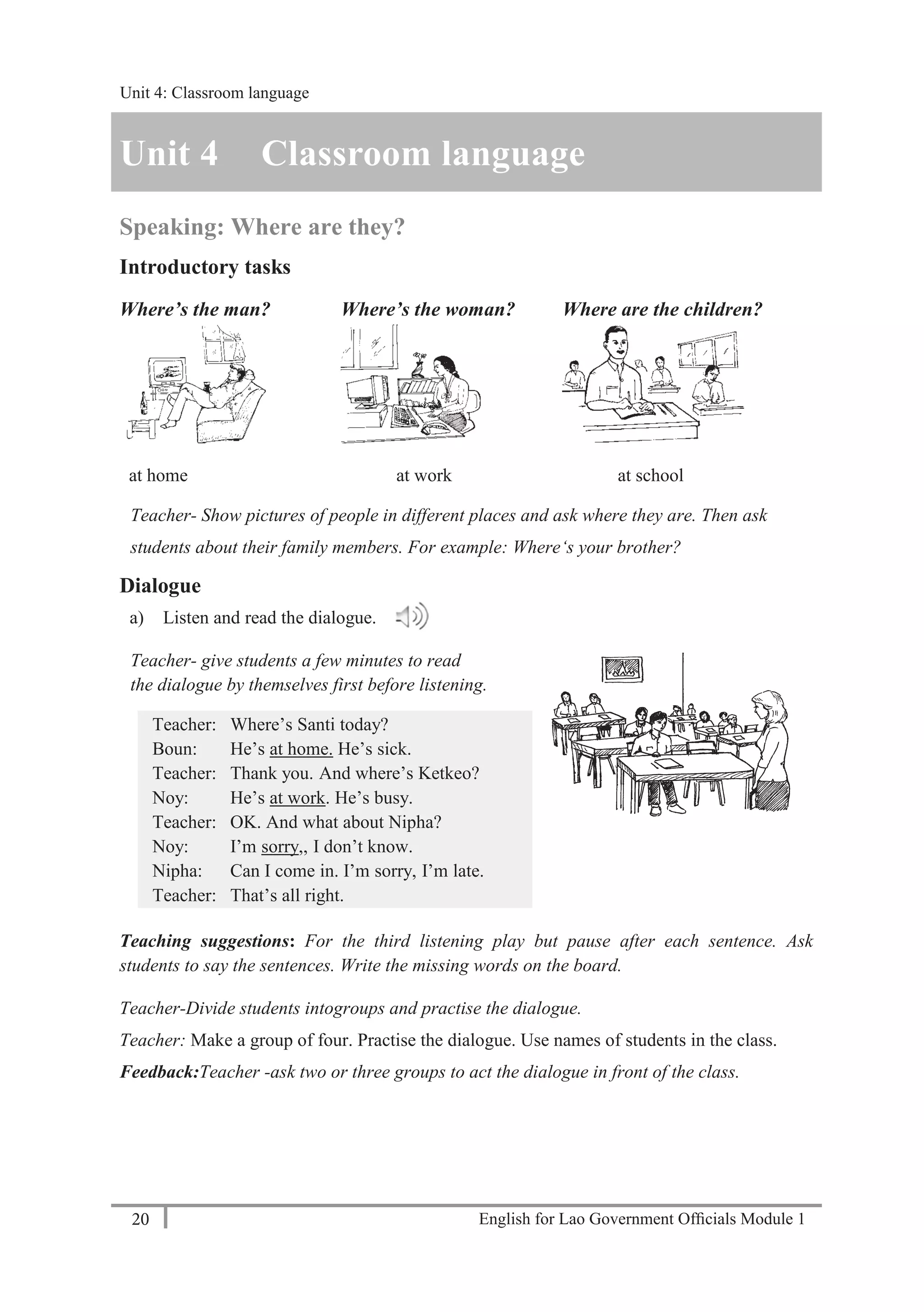
Where’s the man? Where’s the woman? Where are the children?
at home at work at school
Teacher- Show pictures of people in different places and ask where they are. Then ask
students about their family members. For example: Where‘s your brother?
Dialogue
a) Listen and read the dialogue.
Teacher- give students a few minutes to read
the dialogue by themselves first before listening.
Teacher: Where’s Santi today?
Boun: He’s at home. He’s sick.
Teacher: Thank you. And where’s Ketkeo?
Noy: He’s at work. He’s busy.
Teacher: OK. And what about Nipha?
Noy: I’m sorry,, I don’t know.
Nipha: Can I come in. I’m sorry, I’m late.
Teacher: That’s all right.
Teaching suggestions: For the third listening play but pause after each sentence. Ask
students to say the sentences. Write the missing words on the board.
Teacher-Divide students intogroups and practise the dialogue.
Teacher: Make a group of four. Practise the dialogue. Use names of students in the class.
Feedback:Teacher -ask two or three groups to act the dialogue in front of the class.
Unit 4: Classroom language
English for Lao Government Officials Module 1 21
Unit 4: Classroom language
21 English for Lao Government Officials Module 1
Listening: 20-100
Introductory tasks
b) Listen and repeat.
20 21 22 23 24 25 26 27 28 29 30
Teaching suggestions: after a second listening, teacher- point randomly to the numbers-
students say.
Pair work: Students take turn to point to the numbers and say.
Listening: Numbers 20-100
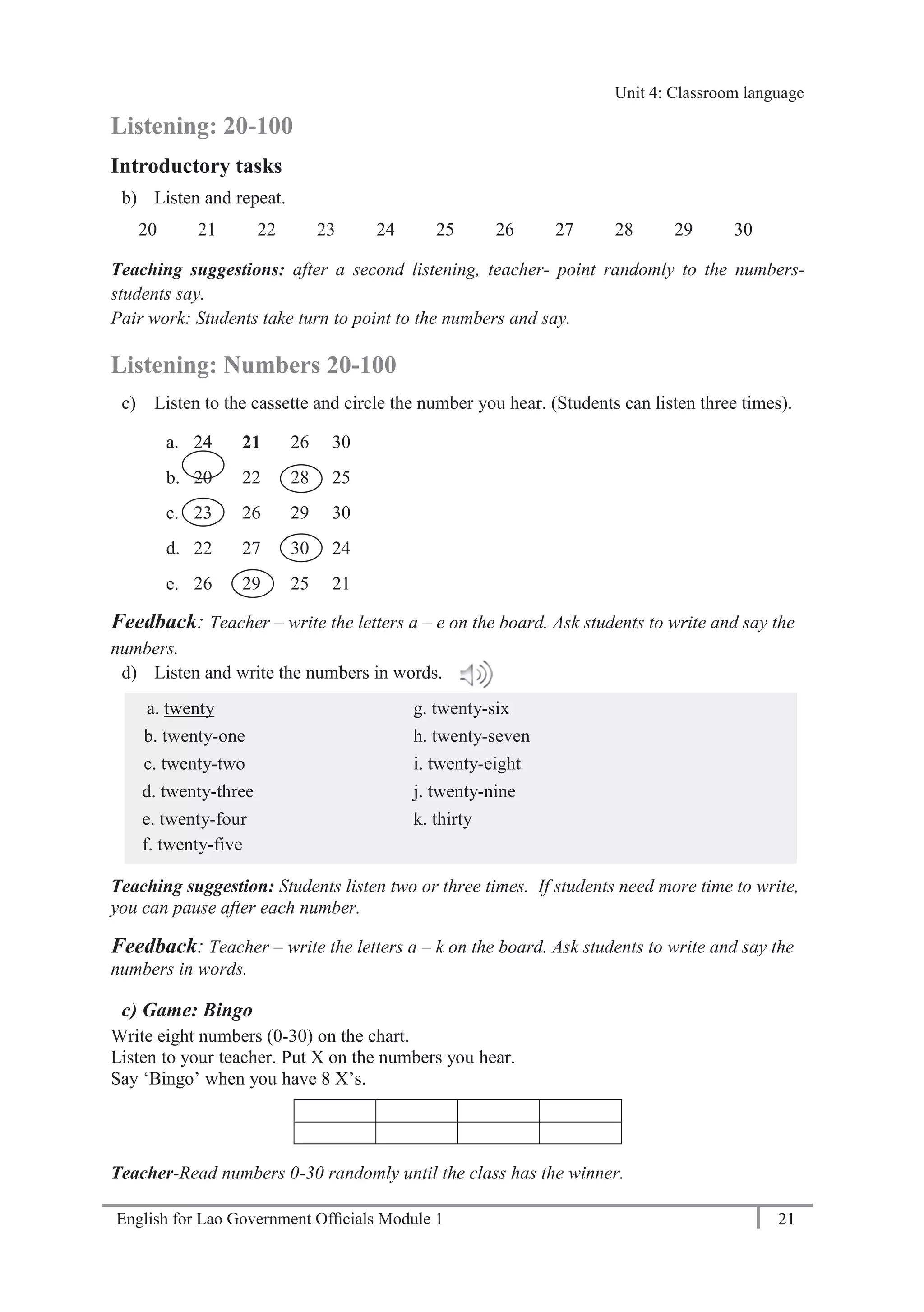
c) Listen to the cassette and circle the number you hear. (Students can listen three times).
a. 24 21 26 30
b. 20 22 28 25
c. 23 26 29 30
d. 22 27 30 24
e. 26 29 25 21
Feedback: Teacher – write the letters a – e on the board. Ask students to write and say the
numbers.
d) Listen and write the numbers in words.
a. twenty g. twenty-six
b. twenty-one h. twenty-seven
c. twenty-two i. twenty-eight
d. twenty-three j. twenty-nine
e. twenty-four k. thirty
f. twenty-five
Teaching suggestion: Students listen two or three times. If students need more time to write,
you can pause after each number.
Feedback: Teacher – write the letters a – k on the board. Ask students to write and say the
numbers in words.
c) Game: Bingo
Write eight numbers (0-30) on the chart.
Listen to your teacher. Put X on the numbers you hear.
Say ‘Bingo’ when you have 8 X’s.
Teacher-Read numbers 0-30 randomly until the class has the winner.
Unit 4: Classroom language
English for Lao Government Officials Module 122
Unit 4: Classroom language
22 English for Lao Government Officials Module 1
Feedback: Teacher – the student who said ‘Bingo’ must tell you the numbers on his/her
chart so you can check he/ she has correctly heard the numbers you said.
a) Listen and repeat.
20 30 40 50 60 70 80 90 100
Teaching suggestions: after a second listening, teacher- point randomly to the numbers-
students say.
Pair work: Students take turn to point to the numbers and say.
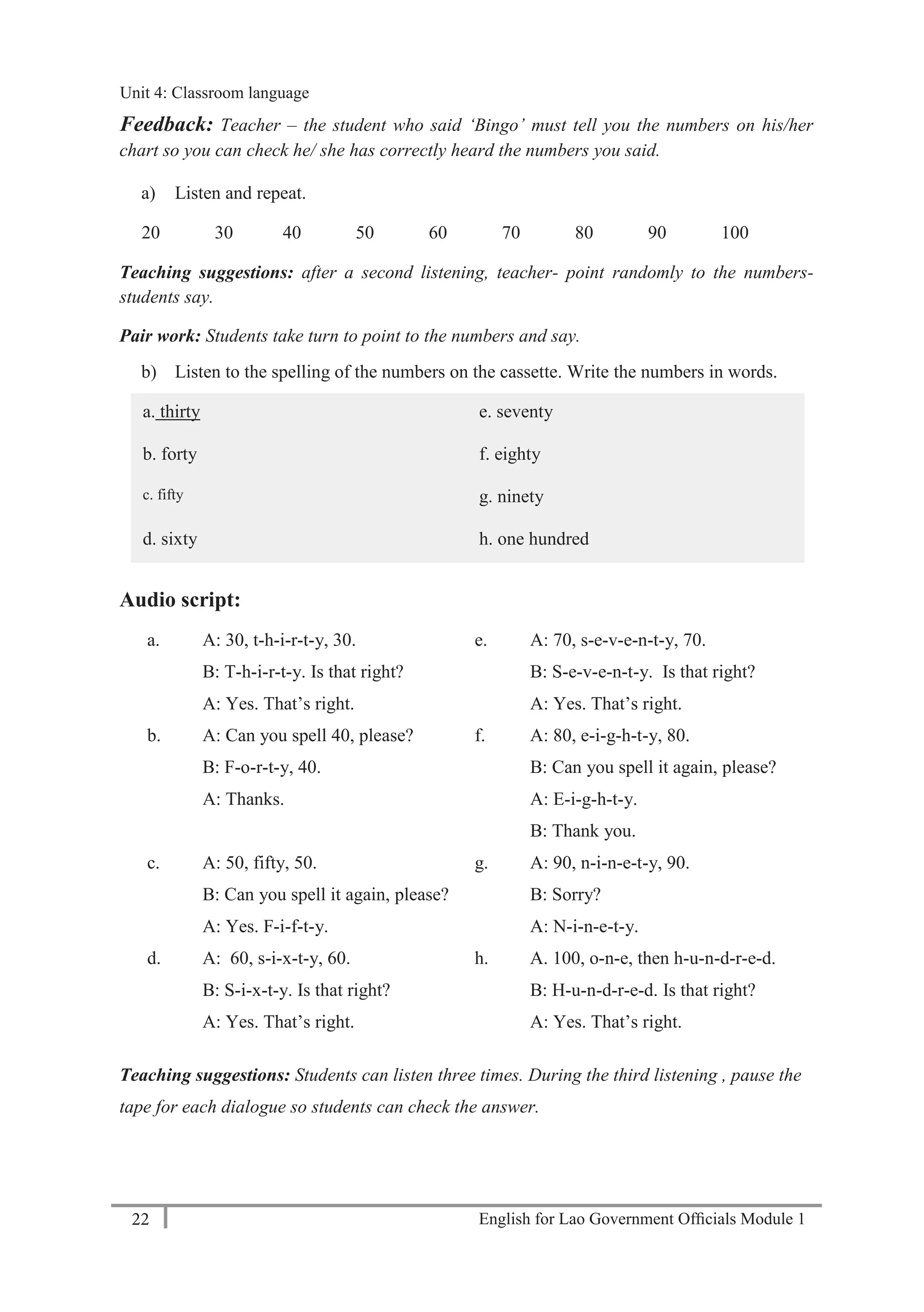
b) Listen to the spelling of the numbers on the cassette. Write the numbers in words.
a. thirty e. seventy
b. forty f. eighty
c. fifty g. ninety
d. sixty h. one hundred
Audio script:
a. A: 30, t-h-i-r-t-y, 30.
B: T-h-i-r-t-y. Is that right?
A: Yes. That’s right.
e. A: 70, s-e-v-e-n-t-y, 70.
B: S-e-v-e-n-t-y. Is that right?
A: Yes. That’s right.
b. A: Can you spell 40, please?
B: F-o-r-t-y, 40.
A: Thanks.
f. A: 80, e-i-g-h-t-y, 80.
B: Can you spell it again, please?
A: E-i-g-h-t-y.
B: Thank you.
c. A: 50, fifty, 50.
B: Can you spell it again, please?
A: Yes. F-i-f-t-y.
g. A: 90, n-i-n-e-t-y, 90.
B: Sorry?
A: N-i-n-e-t-y.
d. A: 60, s-i-x-t-y, 60.
B: S-i-x-t-y. Is that right?
A: Yes. That’s right.
h. A. 100, o-n-e, then h-u-n-d-r-e-d.
B: H-u-n-d-r-e-d. Is that right?
A: Yes. That’s right.
Teaching suggestions: Students can listen three times. During the third listening , pause the
tape for each dialogue so students can check the answer.
Unit 4: Classroom language
English for Lao Government Officials Module 1 23
Unit 4: Classroom language
23 English for Lao Government Officials Module 1
Feedback: Teacher – write the letters a – h on the board. Ask students to write and spell the
numbers.
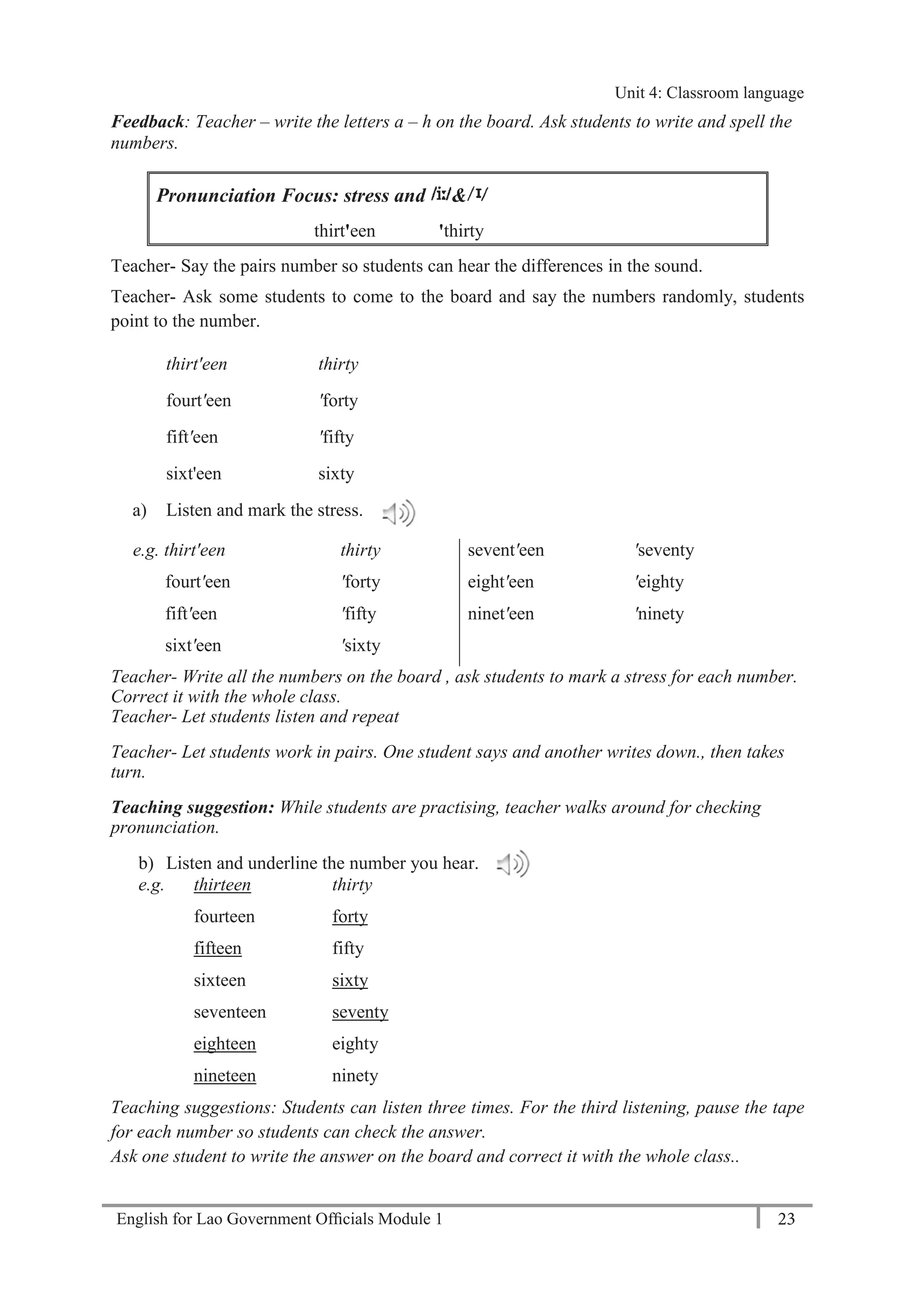
Pronunciation Focus: stress and &
thirt'een 'thirty
Teacher- Say the pairs number so students can hear the differences in the sound.
Teacher- Ask some students to come to the board and say the numbers randomly, students
point to the number.
thirt'een thirty
fourt'een 'forty
fift'een 'fifty
sixt'een sixty
a) Listen and mark the stress.
e.g. thirt'een thirty
fourt'een 'forty
fift'een 'fifty
sixt'een 'sixty
sevent'een 'seventy
eight'een 'eighty
ninet'een 'ninety
Teacher- Write all the numbers on the board , ask students to mark a stress for each number.
Correct it with the whole class.
Teacher- Let students listen and repeat
Teacher- Let students work in pairs. One student says and another writes down., then takes
turn.
Teaching suggestion: While students are practising, teacher walks around for checking
pronunciation.
b) Listen and underline the number you hear.
e.g. thirteen thirty
fourteen forty
fifteen fifty
sixteen sixty
seventeen seventy
eighteen eighty
nineteen ninety
Teaching suggestions: Students can listen three times. For the third listening, pause the tape
for each number so students can check the answer.
Ask one student to write the answer on the board and correct it with the whole class..
Unit 4: Classroom language
English for Lao Government Officials Module 124
Unit 4: Classroom language
24 English for Lao Government Officials Module 1
Practice
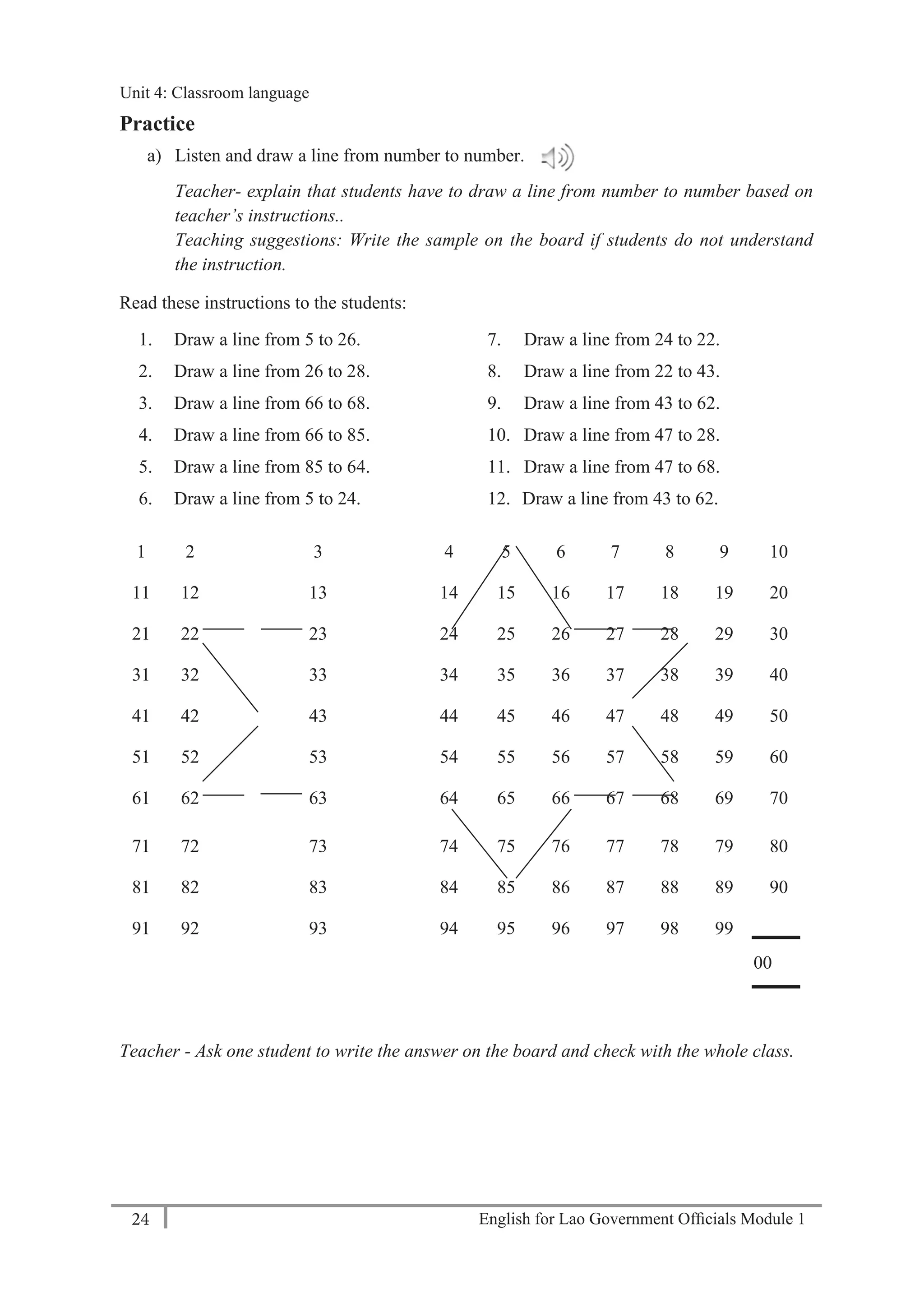
a) Listen and draw a line from number to number.
Teacher- explain that students have to draw a line from number to number based on
teacher’s instructions..
Teaching suggestions: Write the sample on the board if students do not understand
the instruction.
Read these instructions to the students:
1. Draw a line from 5 to 26.
2. Draw a line from 26 to 28.
3. Draw a line from 66 to 68.
4. Draw a line from 66 to 85.
5. Draw a line from 85 to 64.
6. Draw a line from 5 to 24.
7. Draw a line from 24 to 22.
8. Draw a line from 22 to 43.
9. Draw a line from 43 to 62.
10. Draw a line from 47 to 28.
11. Draw a line from 47 to 68.
12. Draw a line from 43 to 62.
1 2 3 4 5 6 7 8 9 10
11 12 13 14 15 16 17 18 19 20
21 22 23 24 25 26 27 28 29 30
31 32 33 34 35 36 37 38 39 40
41 42 43 44 45 46 47 48 49 50
51 52 53 54 55 56 57 58 59 60
61 62 63 64 65 66 67 68 69 70
71 72 73 74 75 76 77 78 79 80
81 82 83 84 85 86 87 88 89 90
91 92 93 94 95 96 97 98 99
100
Teacher - Ask one student to write the answer on the board and check with the whole class.
Unit 4: Classroom language
English for Lao Government Officials Module 1 25
Unit 4: Classroom language
25 English for Lao Government Officials Module 1
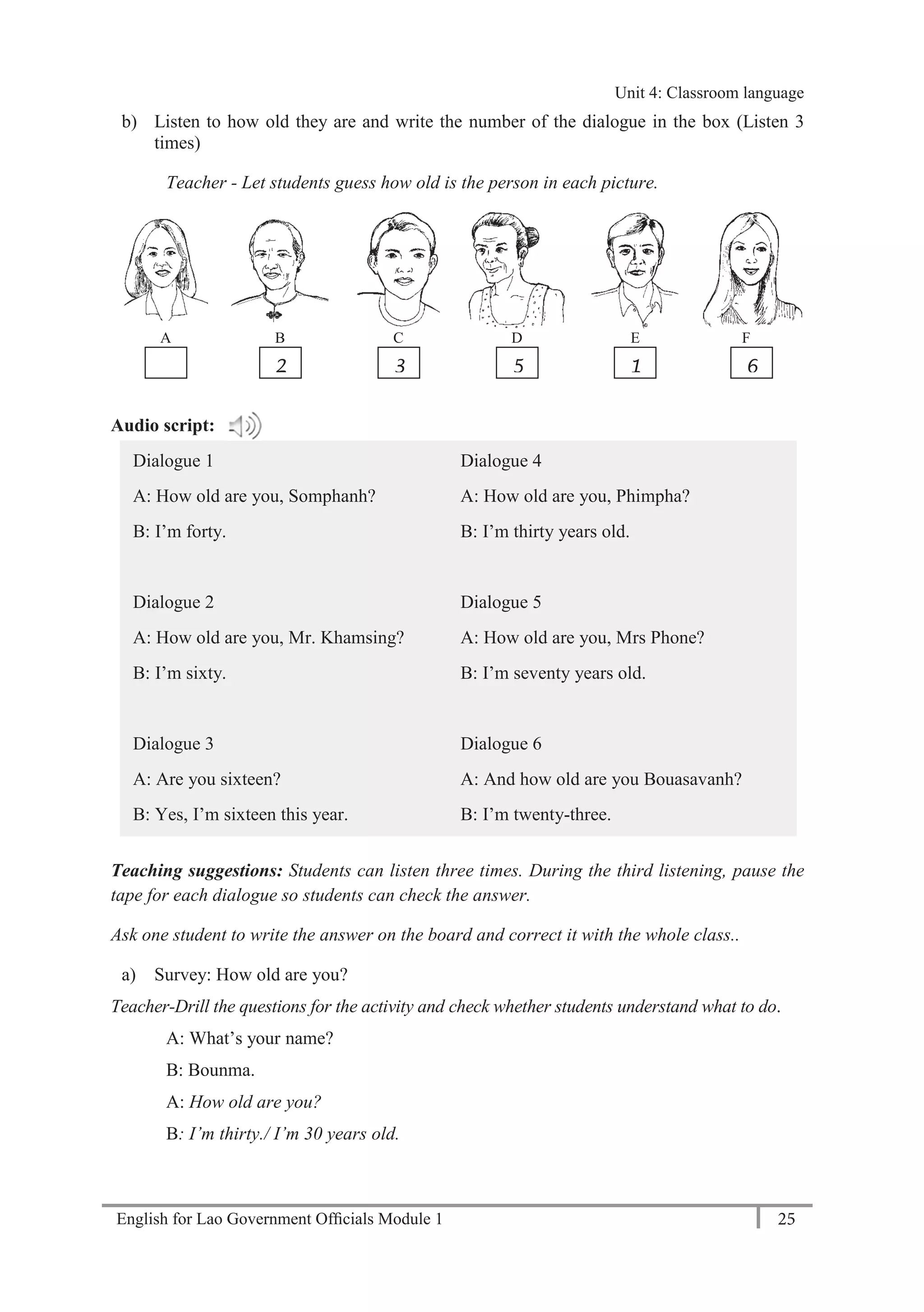
b) Listen to how old they are and write the number of the dialogue in the box (Listen 3
times)
Teacher - Let students guess how old is the person in each picture.
A B C D E F
Audio script:
Dialogue 1
A: How old are you, Somphanh?
B: I’m forty.
Dialogue 2
A: How old are you, Mr. Khamsing?
B: I’m sixty.
Dialogue 3
A: Are you sixteen?
B: Yes, I’m sixteen this year.
Dialogue 4
A: How old are you, Phimpha?
B: I’m thirty years old.
Dialogue 5
A: How old are you, Mrs Phone?
B: I’m seventy years old.
Dialogue 6
A: And how old are you Bouasavanh?
B: I’m twenty-three.
Teaching suggestions: Students can listen three times. During the third listening, pause the
tape for each dialogue so students can check the answer.
Ask one student to write the answer on the board and correct it with the whole class..
a) Survey: How old are you?
Teacher-Drill the questions for the activity and check whether students understand what to do.
A: What’s your name?
B: Bounma.
A: How old are you?
B: I’m thirty./ I’m 30 years old.
4 2 3 5 1 6
Unit 4: Classroom language
English for Lao Government Officials Module 126
Unit 4: Classroom language
26 English for Lao Government Officials Module 1
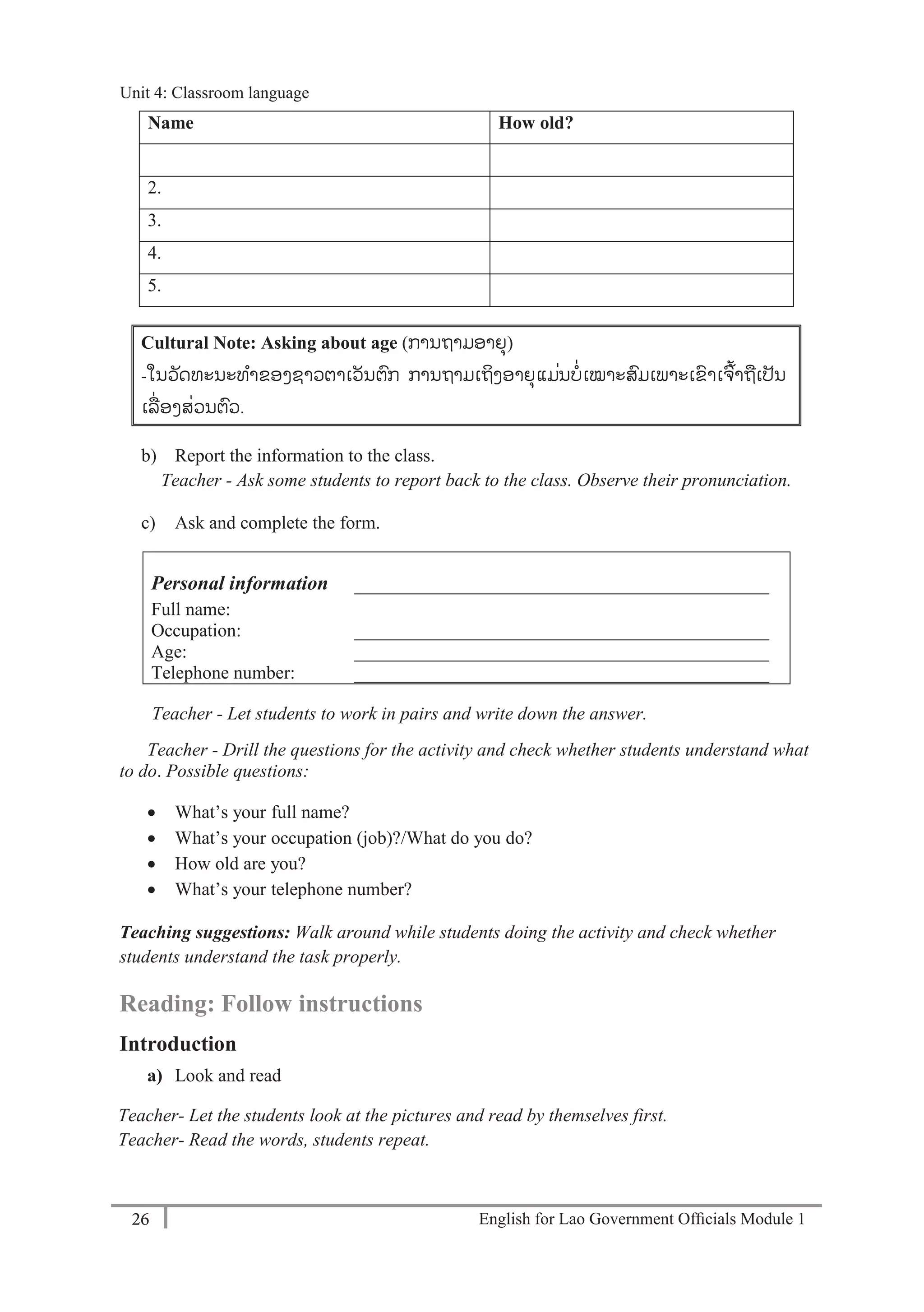
Name How old?
1.
2.
3.
4.
5.
Cultural Note: Asking about age (ການຖາມອາຍຸ)
-ໃນວັດທະນະທາຂອງຊາວຕາເວັນຕກ ການຖາມເຖິງອາຍຸແມ່ນບ່ເໝາະສມເພາະເຂາເຈ້້າຖເປັນ
ເລ່ ອງສ່ວນຕວ.
b) Report the information to the class.
Teacher - Ask some students to report back to the class. Observe their pronunciation.
c) Ask and complete the form.
Personal information
Full name:
_____________________________________________
Occupation: _____________________________________________
Age: _____________________________________________
Telephone number: _____________________________________________
Teacher - Let students to work in pairs and write down the answer.
Teacher - Drill the questions for the activity and check whether students understand what
to do. Possible questions:
 What’s your full name?
 What’s your occupation (job)?/What do you do?
 How old are you?
 What’s your telephone number?
Teaching suggestions: Walk around while students doing the activity and check whether
students understand the task properly.
Reading: Follow instructions
Introduction
a) Look and read
Teacher- Let the students look at the pictures and read by themselves first.
Teacher- Read the words, students repeat.
Unit 4: Classroom language
English for Lao Government Officials Module 1 27
Unit 4: Classroom language
27 English for Lao Government Officials Module 1
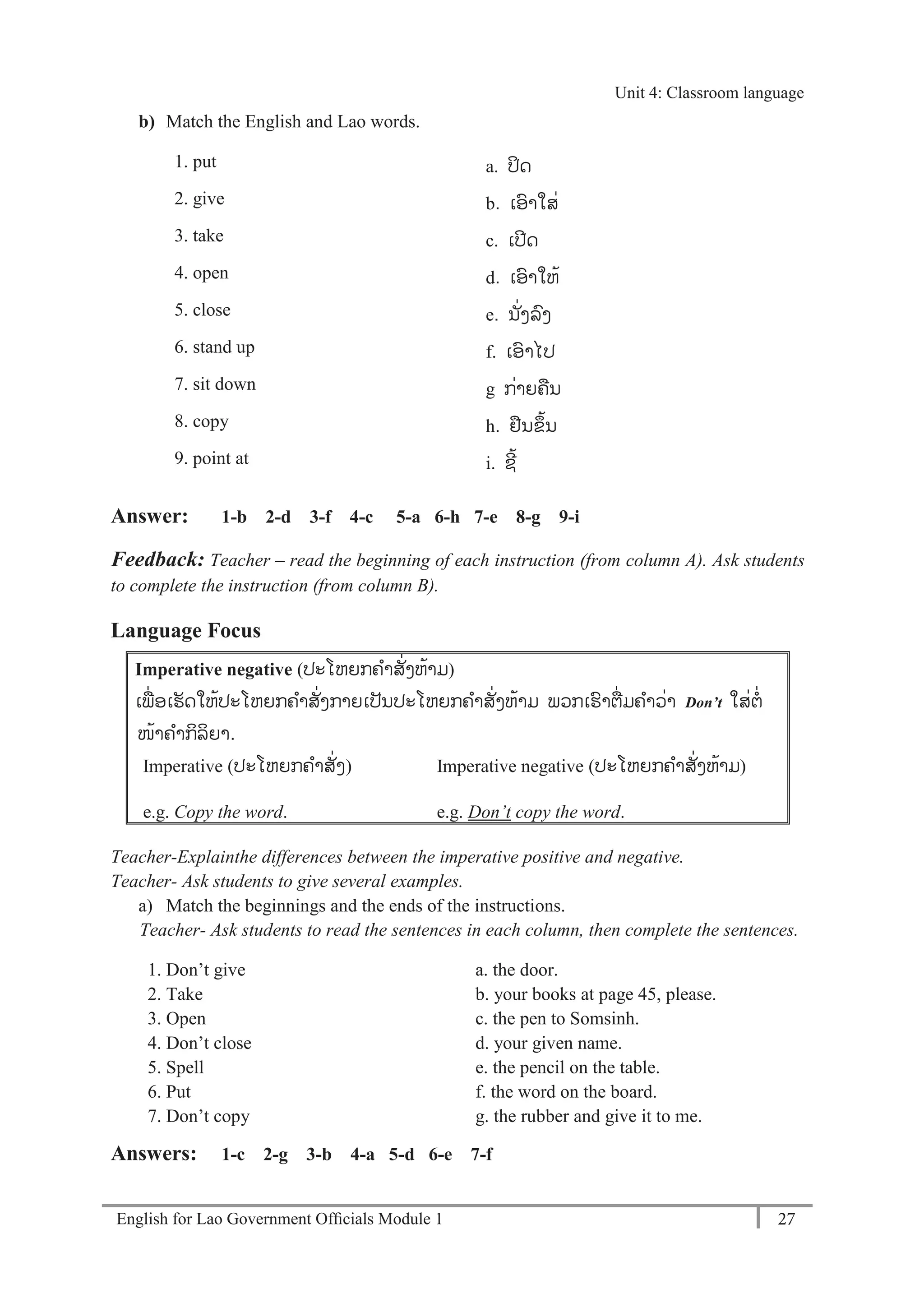
b) Match the English and Lao words.
1. put a. ປິດ
2. give b. ເອາໃສ່
3. take c. ເປດ
4. open d. ເອາໃຫ້
5. close e. ນັ່ງລງ
6. stand up f. ເອາໄປ
7. sit down g ກ່າຍຄນ
8. copy h. ຢນຂ້ນ
9. point at i. ຊ້
Answer: 1-b 2-d 3-f 4-c 5-a 6-h 7-e 8-g 9-i
Feedback: Teacher – read the beginning of each instruction (from column A). Ask students
to complete the instruction (from column B).
Language Focus
Imperative negative (ປະໂຫຍກຄາສັ່ງຫ້າມ)
ເພ່ ອເຮັດໃຫ້ປະໂຫຍກຄາສັ່ງກາຍເປັນປະໂຫຍກຄາສັ່ງຫ້າມ ພວກເຮາຕ່ມຄາວ່າ Don’t ໃສ່ຕ່
ໜ້າຄາກິລິຍາ.
Imperative (ປະໂຫຍກຄາສັ່ງ) Imperative negative (ປະໂຫຍກຄາສັ່ງຫ້າມ)
e.g. Copy the word. e.g. Don’t copy the word.
Teacher-Explainthe differences between the imperative positive and negative.
Teacher- Ask students to give several examples.
a) Match the beginnings and the ends of the instructions.
Teacher- Ask students to read the sentences in each column, then complete the sentences.
1. Don’t give a. the door.
2. Take b. your books at page 45, please.
3. Open c. the pen to Somsinh.
4. Don’t close d. your given name.
5. Spell e. the pencil on the table.
6. Put f. the word on the board.
7. Don’t copy g. the rubber and give it to me.
Answers: 1-c 2-g 3-b 4-a 5-d 6-e 7-f
Unit 4: Classroom language
English for Lao Government Officials Module 128
Unit 4: Classroom language
28 English for Lao Government Officials Module 1
b) Listen and follow teacher’s instructions.
1. Put your pens on the table.
2. Close your book. Don’t open it.
3. (To one student) Take three books and give them to student X.
4. Student X, put the books under the table.
5. (To all the students) Stand up.
6. Stand in a circle.
7. (To one student) Ask a question, please.
8. (To all the students) Repeat the question, please.
9. (To one student) Answer the question, please.
10. Sit down.
11. Look at the board. Don’t look at the teacher.
12. (To one student) Write the number 45 on the board.
13. Give the pen/chalk to student X.
14. Student X, copy the number on the board.
15. Student X, put the pen in your bag.
16. Student Y, take the pen and give it to me.
17. Point at the window. Don’t point at the door.
18. (To one student) Open/Close the door.
19. (To one student) Spell your family name. Don’t spell your given name.
20. (To all the students) Say the numbers 20-30.
21. Open your book at page X.
Teaching suggestion: After reading each instruction, watch students’ movements (ການເຄ່ອນ
ໄຫວ) to check if they can follow the instruction.
Teaching suggestion: Always use English when you give these simple instructions in the
classroom. This will give students a lot of listening practice. Remember that following
classroom instructions is one of the course competencies – one of the things we want students
to be able to do in English by the end of the course.
c) Read and follow the instructions.
Write your full name on the line.
Circle your family name. Don’t circle your given name.
Copy a word from the board and write it in the box.
Write your age under the circle.
Draw a dog in the circle.
Spell the word ‘calculator’ under the line.
Complete the sentences:
Today is ...................................
Tomorrow is ............................
Yesterday was .........................
Unit 4: Classroom language
English for Lao Government Officials Module 1 29
Unit 4: Classroom language
29 English for Lao Government Officials Module 1
Teacher- Explain to the students what to do.
Feedback: Teacher – ask a student to draw the box, circle and line on the board. Read the
instructions one by one for the student to follow. After he / she has followed each instruction,
ask the other students, ‘Is that right?’
d) Group work: Write five instructions. Do not forget capital letters and full stops.
Make groups of four. Take turns to read an instruction. The other students in the group
listen and follow the instruction.
Feedback: Teacher - Ask a student from each group to take turns to read their instructions to
the class. The other students in the class listen and follow the instructions.
Writing: My family
a) Write about 4 people of your family’s member: Who are they? What are their names?
How old are they? What do they do?
Example: My father’s name is Mr. Keo. He is a policeman. He is 53 years old.
Check:
 the Present Simple
Tense
 spelling
 a/an
 capital letters
 full stops
Feedback: Teacher – when students are writing, go around to check their sentences.
Write the most common mistake sentences on the board and check with the whole class.
Unit 4: Classroom language
English for Lao Government Officials Module 130
Unit 5: Occupations and Workplaces
30 English for Lao Government Officials Module 1
Unit 5 Occupations and Workplaces
Speaking: What’s your…?
Introductory tasks
a) Listen and repeat
Teacher- Ask students about their occupations (What’s your occupation (job)?
/What do you do?)
Teacher- Ask students to read the words for a few minutes by themselves.
- Let students listen and repeat twice.
Ask some students to read the words to the class/check for pronunciations.
Teaching suggestion: This section is a revision of ‘What’ questions. Write them on the board
as the students think of them.
Dialogue
a) Listen and complete the dialogue.
Teacher- give students a few minutes to read the dialogue by themselves first before listening.
Tom: Hello, Susan. How are you?
Susan: I’mfine, thanks. And you?
Tom: Very well, thanks.
Susan: This is my friend, Khamsy. Khamsy, thisis Tom.
Khamsy: Pleased to meet you.
Tom: Pleased to meet you, too. What do you do, Khamsy?
Khamsy: I’m an accountant.
Tom: Where do you work?
Khamsy: I work for the Ministry of Home Affairs.
Teacher- Students listen 2 times and complete the dialogue.
Teaching suggestions: For the third listening play the tape but pause after each sentence.
Ask students to say the sentences. Write the missing words on the board.
b) Listen and repeat.
Teacher- Let students listen to the dialogue again and repeat.
a) Group work
Teacher-Divide students into three groups and practise the dialogue.
Teacher: Make a group of three. Practise the dialogue. Use names of students in the class.
Feedback: Teacher -ask two or three groups to act the dialogue in front of the class.
Unit 5: Occupations and Workplaces
English for Lao Government Officials Module 1 31
Unit 5: Occupations and Workplaces
31 English for Lao Government Officials Module 1
Listening: occupations
a)Listen and number the pictures.
Teacher- Ask students to look at the pictures and guess what are their occupations.
— Students listen to the dialogue twice and number the pictures.
Audio scripts
Dialogue 1
A: What do you do Phone?
B: I’m an electrician.
Dialogue 3
A: What’s your occupation?
B: I’m a lawyer.
Dialogue 5
A: Are you an engineer?
B: Yes, I am.
Dialogue 2
A: What do you do, Manisone?
B: I’m an accountant.
Dialogue 4
A: Are you a doctor, Somphanh?
B: No. I’m a dentist.
Dialogue 6
A: What’s your occupation, Mr Chanh?
B: I’m the manager of a garment factory.
Teaching suggestions:
For the third listening play but pause after each dialogue. Ask students to say the number.
Write the numbers on the board.
3 4 5
2 1 6
Unit 5: Occupations and Workplaces
English for Lao Government Officials Module 132
Unit 5: Occupations and Workplaces
32 English for Lao Government Officials Module 1
Follow-up task
Grammar Focus: Articles - a/an
In English we use:
‘a’ before a noun beginning with a consonant, e.g. a manager,
asecretary, adirector.
‘a’ ໃຊ້ຕ່ໜ້າຄານາມທ່ ຂ້ນຕ້ນດ້ວຍພະຍັນຊະນະ.
‘an’ before a noun beginning with a vowel (a/e/i/o/u), e.g. anengineer,
anorange, anactor, anumbrella
‘an’ ໃຊ້ຕ່ໜ້າຄານາມທ່ ຂ້ນຕ້ນດ້ວຍສະຫລະ
Note: auniversity/auniform because ‘u’ has a consonant sound.
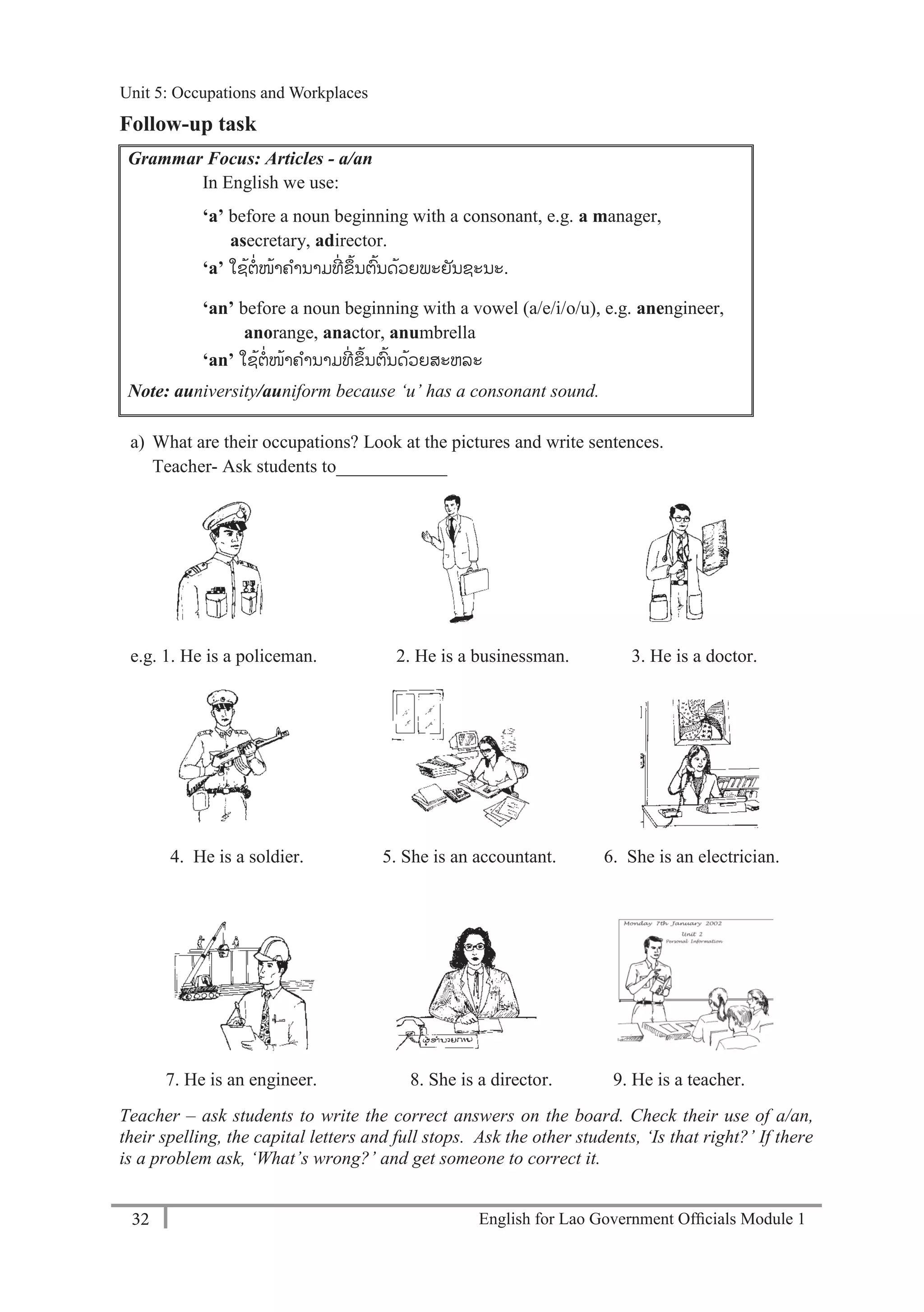
a) What are their occupations? Look at the pictures and write sentences.
Teacher- Ask students to____________
e.g. 1. He is a policeman. 2. He is a businessman. 3. He is a doctor.
4. He is a soldier. 5. She is an accountant. 6. She is an electrician.
7. He is an engineer. 8. She is a director. 9. He is a teacher.
Teacher – ask students to write the correct answers on the board. Check their use of a/an,
their spelling, the capital letters and full stops. Ask the other students, ‘Is that right?’ If there
is a problem ask, ‘What’s wrong?’ and get someone to correct it.
Unit 5: Occupations and Workplaces
English for Lao Government Officials Module 1 33
Unit 5: Occupations and Workplaces
33 English for Lao Government Officials Module 1
b) Work in group of 3 to play a role of different occupations. Take turn to ask each
other.
A: What’s your occupation?
B: I’m a lawyer. What do you do?
A. I’m an engineer.
C: A is a lawyer, B is an engineer.
Teacher-Model the activity with one student first.
Teacher- Walk around to observe students’ activity and checking their pronunciation.
Reading: Where do you work?
Introductory tasks
a) Match Lao and English workplaces. You can use the list of workplaces at the back of
your book to help you.
Teacher- Ask students to read the words in English and match with their Lao translation.
Students can work in pairs or in groups.
Answer: 1-g 2-e 3-k 4-i 5-b 6-h 7-j 8-l 9-d 10-m 11-a 12-f 13-c
Practice
a) Listen and number the ministries.
___3_____ Ministry of Agriculture and Forestry (MAF)
___5_____ Ministry of Home Affairs (MoHA)
___1_____ Ministry of Foreign Affairs (MFA)
___7_____ Ministry of Information , Culture and Tourism (MICT)
___9_____ Ministry of Industry and Trade (MIT)
___10____ Ministry of Labour and Social Welfare (MLSW)
___12____ Ministry of National Defence (MND)
___11____ Ministry of Education and Sports ( MoES)
___13____ Ministry of Finance (MoF)
___2_____ Ministry of Public Security (MoPS)
___8_____ Ministry of Justice (MoJ)
___4_____ Ministry of Public Health (MPH)
___6_____ Ministry of Energy and Mining (MoEM)
Unit 5: Occupations and Workplaces
English for Lao Government Officials Module 134
Unit 5: Occupations and Workplaces
34 English for Lao Government Officials Module 1
Audio scripts:
Dialogue 1
A. Where do you work, Mr Thongchanh?
B. At the Ministry of Foreign Affairs.
A. Oh, really!
Dialogue 3
A. Do you work at the Ministry of
Information , Culture and Tourism?
B. No. I work at the Ministry of
Agriculture and Forestry.
Dialogue 5
A. Where do you work, Bounmy?
B. I work at the Ministry of Home
Affairs.
Dialogue 7
A. Do you work at the Ministry of
Information , Culture and Tourism?
B. Yes, I do. I’m in administration.
Dialogue 9
A. Where do you work?
B. I work at the Ministry of Industry and
Trade.
Dialogue 11
A. Where do you work?
B. I work at the Ministry of Education
and Sports.
A. Are you a teacher?
B. No, I’m a driver.
Dialogue 13
A. Do you work at the Ministry of
National Defence, Sonexay?
B. No, I work at the Ministry of Finance.
A. Oh. What do you do?
Dialogue 2
A. Where do you work, Xaysana?
B. I work at the Ministry of Public
Security.
A. Oh. Where’s that?
Dialogue 4
A. Do you work at the Ministry of
Justice, Soumaly?
B. No. I work at the Ministry of Public
Health.
Dialogue 6
A. Do you work at the Ministry of
Agriculture and Forestry?
B. No. I work at the Ministry of Energy
and Mining.
Dialogue 8
A. Where do you work, Chanthamaly?
B. I work at the Ministry of Justice.
Dialogue 10
A. Do you work at the Ministry of
Labour and Social Welfare?
B. Yes. I’m an accountant there.
Dialogue 12
A. Where do you work?
B. I work at the Ministry of National
Defence.
A. Are you a soldier?
B. Yes, I am.
Students listen twice.
Feedback: Teacher - play the recording again but pause after each conversation. For each
one, ask, ‘Where does he work?’ or, ‘Where does she work?’
Unit 5: Occupations and Workplaces
English for Lao Government Officials Module 1 35
Unit 5: Occupations and Workplaces
35 English for Lao Government Officials Module 1
a)Read and complete the dialogue.
Teacher- Ask students to read and complete the dialogue using their own workplace.
Feedback: Students write their answer on the board and check with the whole class..
Teaching suggestions: Explain the meaning of ‘work for’ and ‘work at’.
Use ‘work at’ if you work at that particular place.
Use ‘work for’ if you work at another place, but being a part of that workplace.
Example: I work at the Research Institute of Educational Sciences, for the Ministry of
Education and Sports.
Language Focus
Present Simple
Teacher- Focus students on the third person singular- He/She`It.
-Give several examples to the students.
-Ask students to give their own examples.
a) Complete the sentences. Use the words in the box.
answer write live
listen work ask
1. She reads a book. 4. He lives in That Luang village.
2. We __work__for the Ministry of the
Home Affaires.
5. The teacher writes on the board.
3. She listens to the song. 6. They answer the questions.
Unit 5: Occupations and Workplaces
English for Lao Government Officials Module 136
Unit 5: Occupations and Workplaces
36 English for Lao Government Officials Module 1
Practice
a) Complete the text. Use the words in the box .
works a his
lives an village
She Ministry name
Mr Khamsy Soulivong is 38 years old. He is a vet. He works at the Ministry of
Agriculture and Forestry. He is married. He lives in Dongpalan village with his wife
and two children. His wife’s name is Khamseng. She is a teacher. She works for the
Ministry of Education and Sports at Vientiane Secondary School.
b) Read the text again and answer the questions:
1. What does Khamsy do? He is a vet.
2. How old is Khamsy? He is 38 years old.
3. Is he single? No. He is married.
4. What is Khamseng’s occupation? She is a teacher.
5. Where does she work? She works at Vientiane High School.
6. How many children do they have? They have two children.
Writing: Personal Information
Introduction
a) Ask five people and write their answers on the chart and report back to the class.
Example: His full name is Mr Khampheng Sengsoulivong and he’s forty years old. He’s an
accountant and he works for the Ministry of Education and Sports.
Full name? Age? Occupation? Workplace?
1. Mr. Khampheng
Sengsoulivong
40 accountant Ministry of Education and Sports
2.
3.
4.
5.
Teaching suggestion 1:Teacher-Model the task before students do the survey.
Teaching suggestion 2: When students are doing the survey, go around and listen to them.
How well can they ask and answer these questions? Do they need more practice? Are all
students participating? How can you encourage them to participate more?
Unit 5: Occupations and Workplaces
English for Lao Government Officials Module 1 37
Unit 5: Occupations and Workplaces
37 English for Lao Government Officials Module 1
Feedback: Teacher – ask some students to talk to the class about their survey, e.g. His full
name is Mr Khampheng Sengsoulivong and he’s forty years old. He’s an accountant and he
works for the Ministry of Education and Sports..
b) Complete the form. Remember to use capital letters for names and ministries.
Mr  Ms  Mrs  Miss  [Please tick ()]
Given name: ________________ Surname: ____________________
Age: ______________________ Married  Single  [Please tick ()]
Occupation: ________________ Ministry: _______________________
Teaching suggestion: This is an idea for feedback after the students have completed their
forms:
1. Draw 2 forms on the board. On Form 1, write your own personal information. Talk
about it as you write, e.g. “My given name’s …(write it) and my family name’s
…(write it). I’m …years old (write it) and I’m single (tick the box) …
2. Ask a student to complete Form 2 and talk about it.
c) Write about yourself. Use the text about Khamsy as a model.
e.g. My name is _____________________. I am _________________
______________________ and _____________________. ______
d) Read and check your partner’s writing. Can you understand it?
Check:
 the Present Simple
Tense
 spelling
 a/an
 capital letters
 full stops
Teaching suggestion:Walk around and monitor the students’ writing. Remind people about
capital letters etc. if necessary.
Unit 5: Occupations and Workplaces
English for Lao Government Officials Module 138
Unit 6: Time and Daily Routines
38 English for Lao Government Officials Module 1
Unit 6 Time and Daily Routines
Speaking: What’s the time?
Introduction
a) Listen and repeat
Teacher- Write the question: ‘What’s the time? What time is it now?’ on the board and ask
students to repeat the question.
Teacher- Let students look at the clocks and say the time in Lao.
- Students listen and repeat
Teacher- Focus on the expression ‘to and past’.
Teacher- Write time on the board, students read.
Teacher- Ask students to work in pairs. One student says the time in Lao, another says in
English. Then take turn.
Dialogue
a) Listen to the recording and read the dialogue.
b) Listen and repeat.
c) Practise the dialogue in pairs.
d) Practise the dialogue in pairs again using the different time phrases.
T- Ask students to use the time phrases from the box
Feedback: Teacher -ask two or three pairs to act the dialogue in front of the class.
Follow up tasks
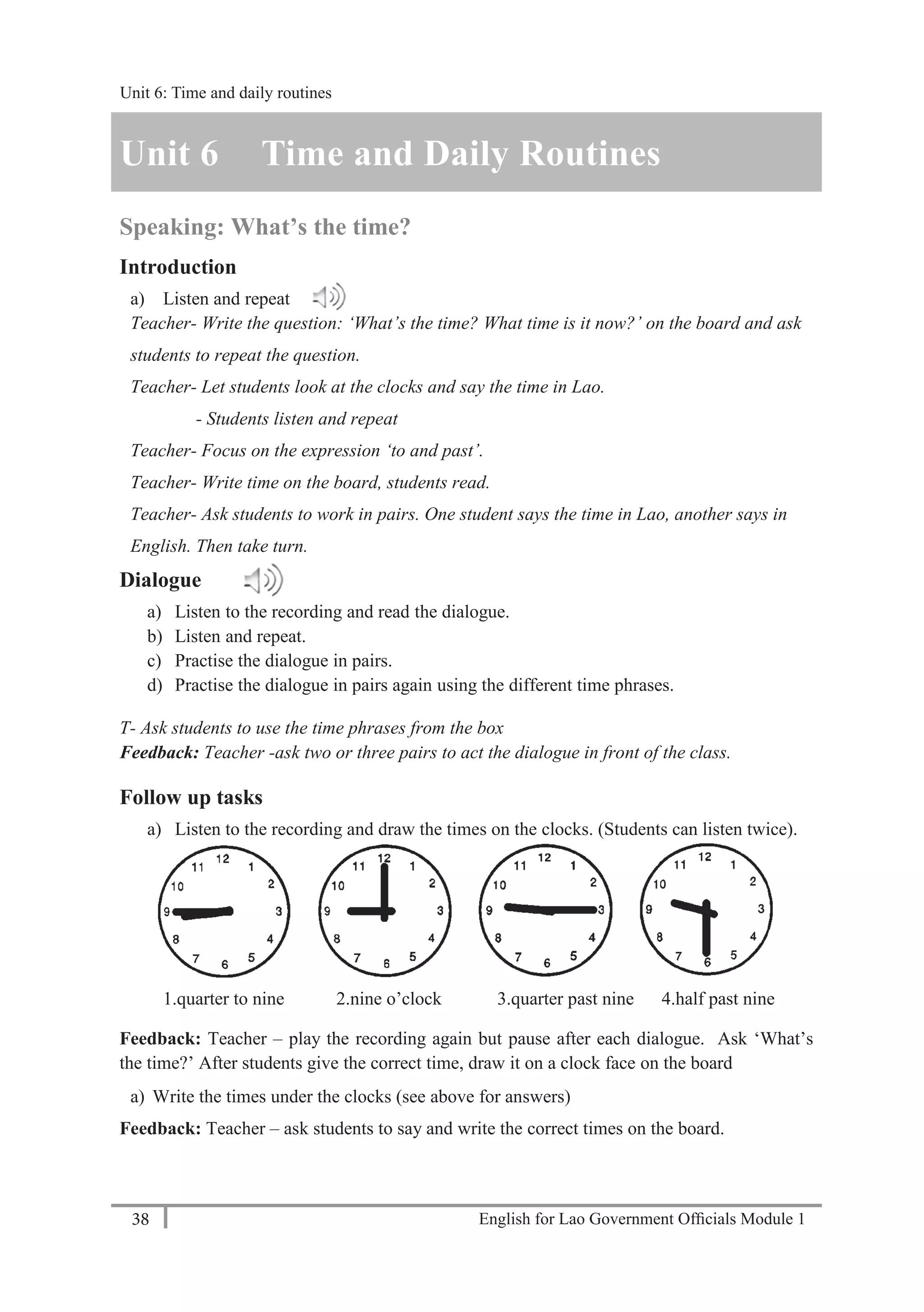
a) Listen to the recording and draw the times on the clocks. (Students can listen twice).
1.quarter to nine 2.nine o’clock 3.quarter past nine 4.half past nine
Feedback: Teacher – play the recording again but pause after each dialogue. Ask ‘What’s
the time?’ After students give the correct time, draw it on a clock face on the board
a) Write the times under the clocks (see above for answers)
Feedback: Teacher – ask students to say and write the correct times on the board.
Unit 6: Time and daily routines
English for Lao Government Officials Module 1 39
Unit 6: Time and Daily Routines
39 English for Lao Government Officials Module 1
Tape scripts
1. A: What’s the time?
B: It’s quarter to nine.
3. A: What’s the time?
B: It’s quarter past nine.
2. A: What’s the time?
B: It’s nine o’clock.
4. A: What’s the time?
B: It’s half past nine.
b) Write these times
e.g. 10.15 quarter past ten
11.15 quarter past eleven
12.30 half past twelve
7.45 quarter to eight
9.30 half past nine
10.45 quarter to eleven
Feedback: Teacher – ask for the answers from the students and then write the correct
answers on the board.
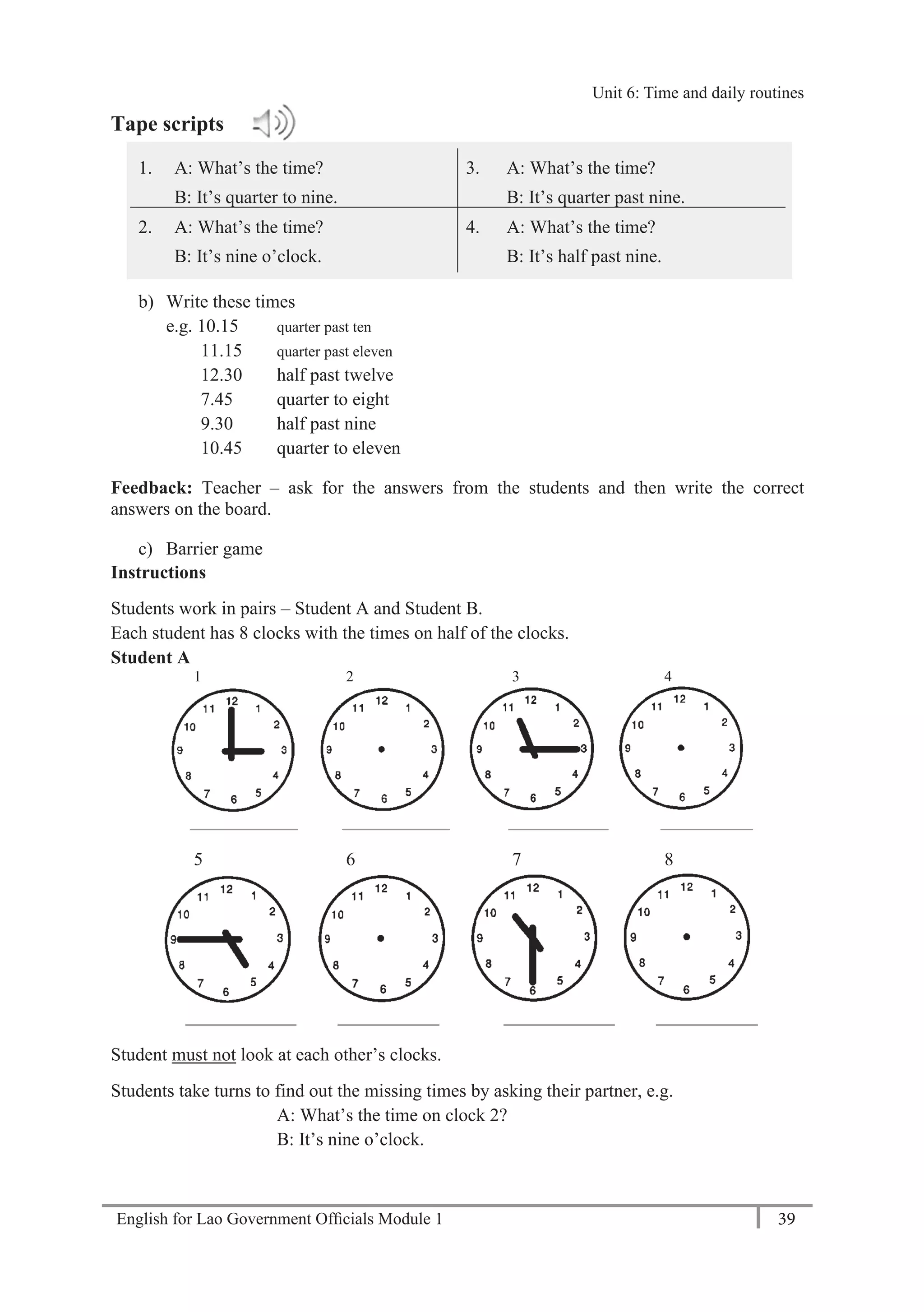
c) Barrier game
Instructions
Students work in pairs – Student A and Student B.
Each student has 8 clocks with the times on half of the clocks.
Student A
1 2 3 4
______________ ______________ _____________ ____________
5 6 7 8
____________ ___________ ____________ ___________
Student must not look at each other’s clocks.
Students take turns to find out the missing times by asking their partner, e.g.
A: What’s the time on clock 2?
B: It’s nine o’clock.
Unit 6: Time and daily routines
English for Lao Government Officials Module 140
Unit 6: Time and Daily Routines
40 English for Lao Government Officials Module 1
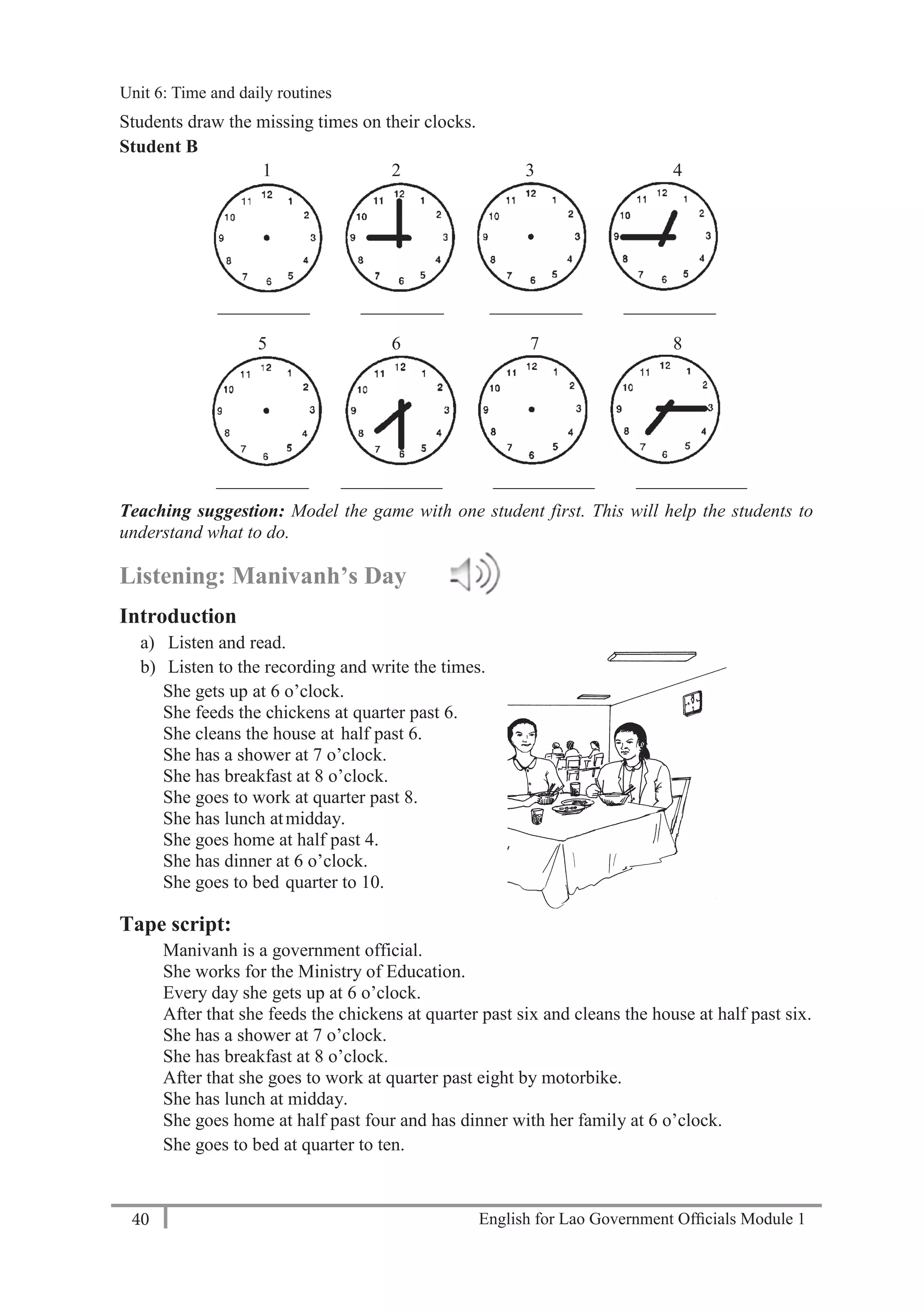
Students draw the missing times on their clocks.
Student B
1 2 3 4
__________ _________ __________ __________
5 6 7 8
__________ ___________ ___________ ____________
Teaching suggestion: Model the game with one student first. This will help the students to
understand what to do.
Listening: Manivanh’s Day
Introduction
a) Listen and read.
b) Listen to the recording and write the times.
She gets up at 6 o’clock.
She feeds the chickens at quarter past 6.
She cleans the house at half past 6.
She has a shower at 7 o’clock.
She has breakfast at 8 o’clock.
She goes to work at quarter past 8.
She has lunch atmidday.
She goes home at half past 4.
She has dinner at 6 o’clock.
She goes to bed quarter to 10.
Tape script:
Manivanh is a government official.
She works for the Ministry of Education.
Every day she gets up at 6 o’clock.
After that she feeds the chickens at quarter past six and cleans the house at half past six.
She has a shower at 7 o’clock.
She has breakfast at 8 o’clock.
After that she goes to work at quarter past eight by motorbike.
She has lunch at midday.
She goes home at half past four and has dinner with her family at 6 o’clock.
She goes to bed at quarter to ten.
Unit 6: Time and daily routines
English for Lao Government Officials Module 1 41
Unit 6: Time and Daily Routines
41 English for Lao Government Officials Module 1
Language Focus
a) Complete these sentences.
She has breakfast at 8.30 a.m.
What time do you have breakfast?
They go to work in the morning.
He goes to work by motorbike
I have dinner at 6 p.m.
Wehave lunch at 12.30.
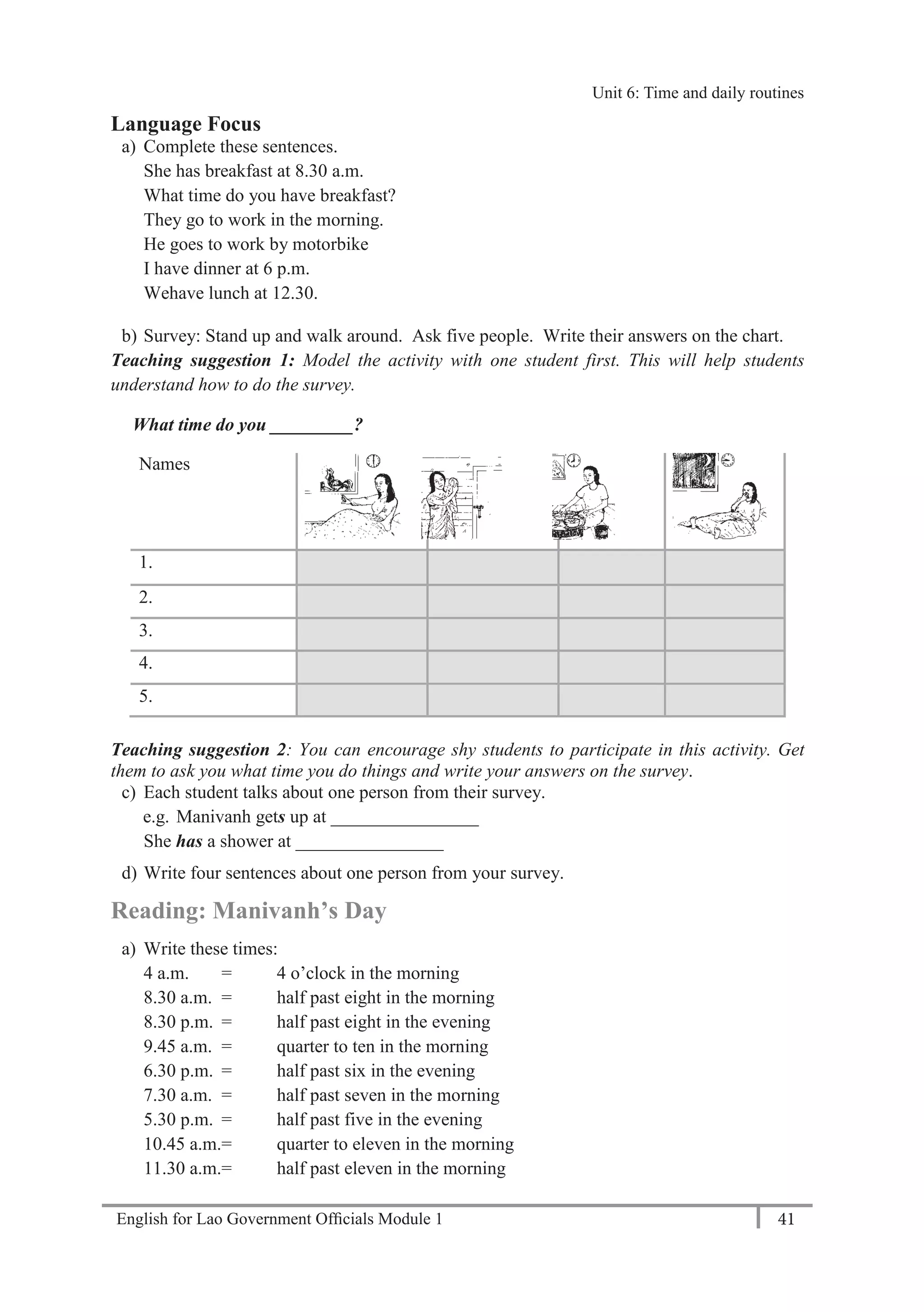
b) Survey: Stand up and walk around. Ask five people. Write their answers on the chart.
Teaching suggestion 1: Model the activity with one student first. This will help students
understand how to do the survey.
What time do you _________?
Names
1.
2.
3.
4.
5.
Teaching suggestion 2: You can encourage shy students to participate in this activity. Get
them to ask you what time you do things and write your answers on the survey.
c) Each student talks about one person from their survey.
e.g. Manivanh gets up at ________________
She has a shower at ________________
d) Write four sentences about one person from your survey.
Reading: Manivanh’s Day
a) Write these times:
4 a.m. = 4 o’clock in the morning
8.30 a.m. = half past eight in the morning
8.30 p.m. = half past eight in the evening
9.45 a.m. = quarter to ten in the morning
6.30 p.m. = half past six in the evening
7.30 a.m. = half past seven in the morning
5.30 p.m. = half past five in the evening
10.45 a.m.= quarter to eleven in the morning
11.30 a.m.= half past eleven in the morning
Unit 6: Time and daily routines
English for Lao Government Officials Module 142
Unit 6: Time and Daily Routines
42 English for Lao Government Officials Module 1
Follow up tasks
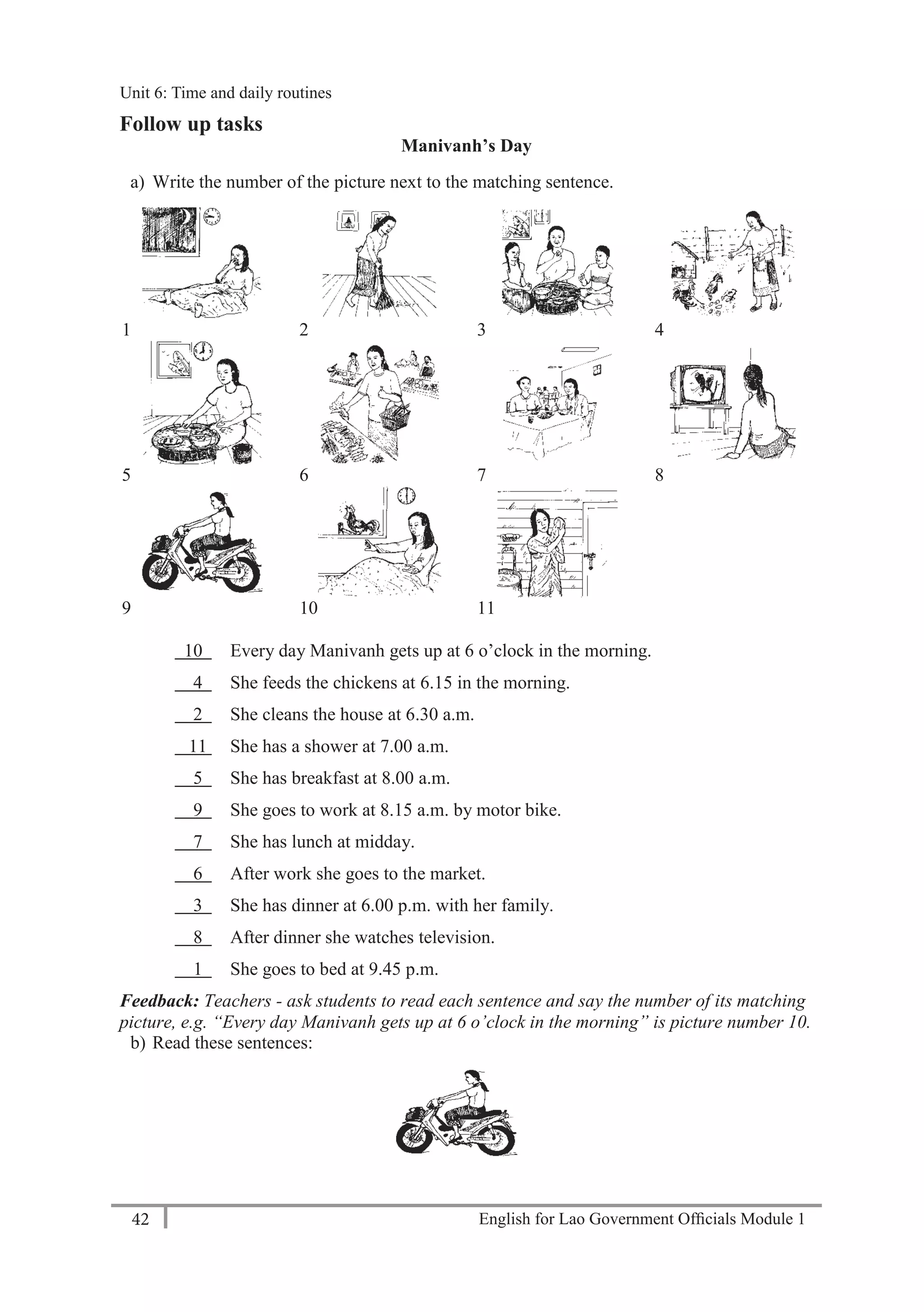
Manivanh’s Day
a) Write the number of the picture next to the matching sentence.
1 2 3 4
5 6 7 8
9 10 11
10 Every day Manivanh gets up at 6 o’clock in the morning.
4 She feeds the chickens at 6.15 in the morning.
2 She cleans the house at 6.30 a.m.
11 She has a shower at 7.00 a.m.
5 She has breakfast at 8.00 a.m.
9 She goes to work at 8.15 a.m. by motor bike.
7 She has lunch at midday.
6 After work she goes to the market.
3 She has dinner at 6.00 p.m. with her family.
8 After dinner she watches television.
1 She goes to bed at 9.45 p.m.
Feedback: Teachers - ask students to read each sentence and say the number of its matching
picture, e.g. “Every day Manivanh gets up at 6 o’clock in the morning” is picture number 10.
b) Read these sentences:
Unit 6: Time and daily routines
English for Lao Government Officials Module 1 43
Unit 6: Time and Daily Routines
43 English for Lao Government Officials Module 1
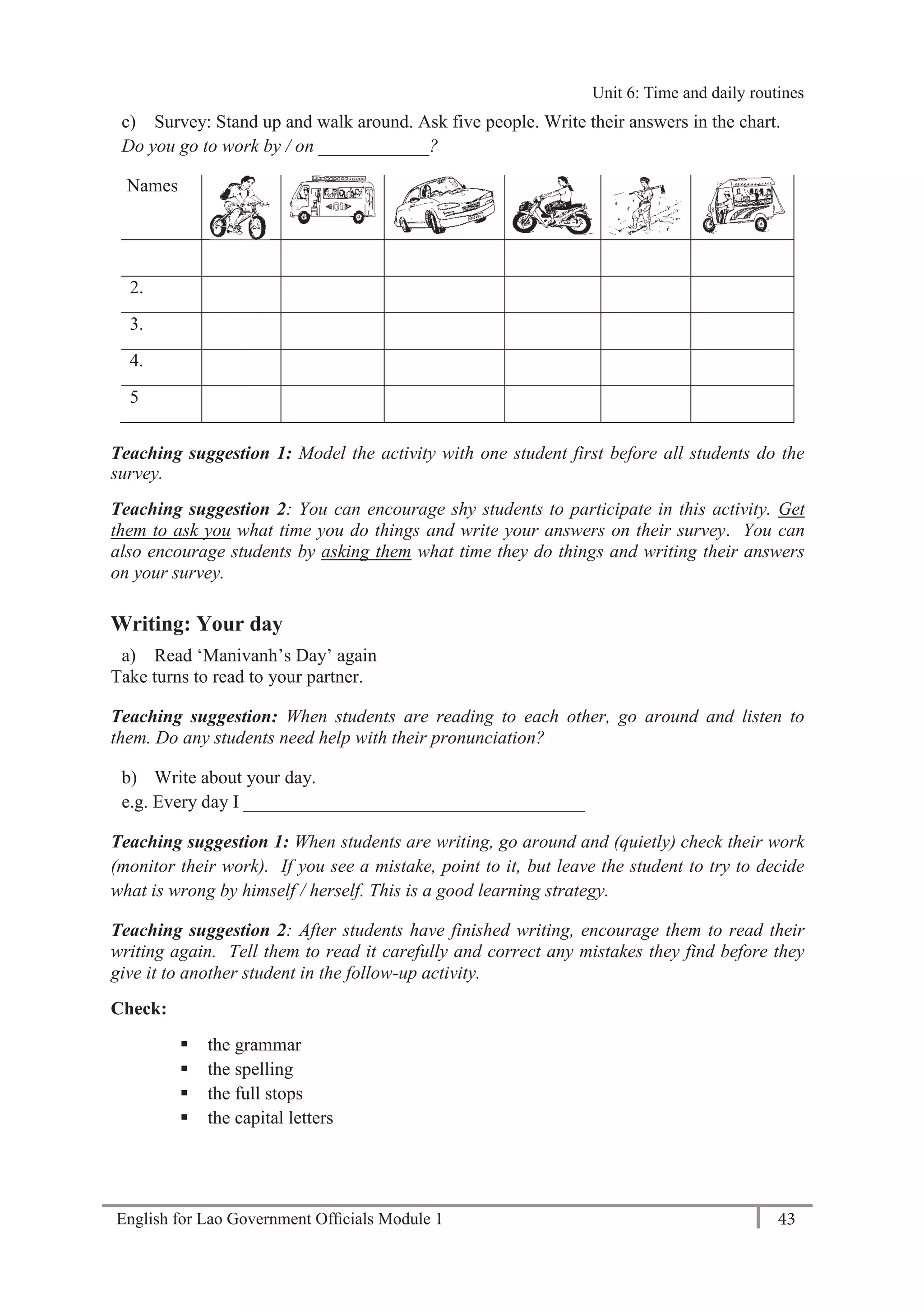
c) Survey: Stand up and walk around. Ask five people. Write their answers in the chart.
Do you go to work by / on ____________?
Names
1.
2.
3.
4.
5
Teaching suggestion 1: Model the activity with one student first before all students do the
survey.
Teaching suggestion 2: You can encourage shy students to participate in this activity. Get
them to ask you what time you do things and write your answers on their survey. You can
also encourage students by asking them what time they do things and writing their answers
on your survey.
Writing: Your day
a) Read ‘Manivanh’s Day’ again
Take turns to read to your partner.
Teaching suggestion: When students are reading to each other, go around and listen to
them. Do any students need help with their pronunciation?
b) Write about your day.
e.g. Every day I _____________________________________
Teaching suggestion 1: When students are writing, go around and (quietly) check their work
(monitor their work). If you see a mistake, point to it, but leave the student to try to decide
what is wrong by himself / herself. This is a good learning strategy.
Teaching suggestion 2: After students have finished writing, encourage them to read their
writing again. Tell them to read it carefully and correct any mistakes they find before they
give it to another student in the follow-up activity.
Check:
 the grammar
 the spelling
 the full stops
 the capital letters
Unit 6: Time and daily routines
English for Lao Government Officials Module 144
Unit 6: Time and Daily Routines
44 English for Lao Government Officials Module 1
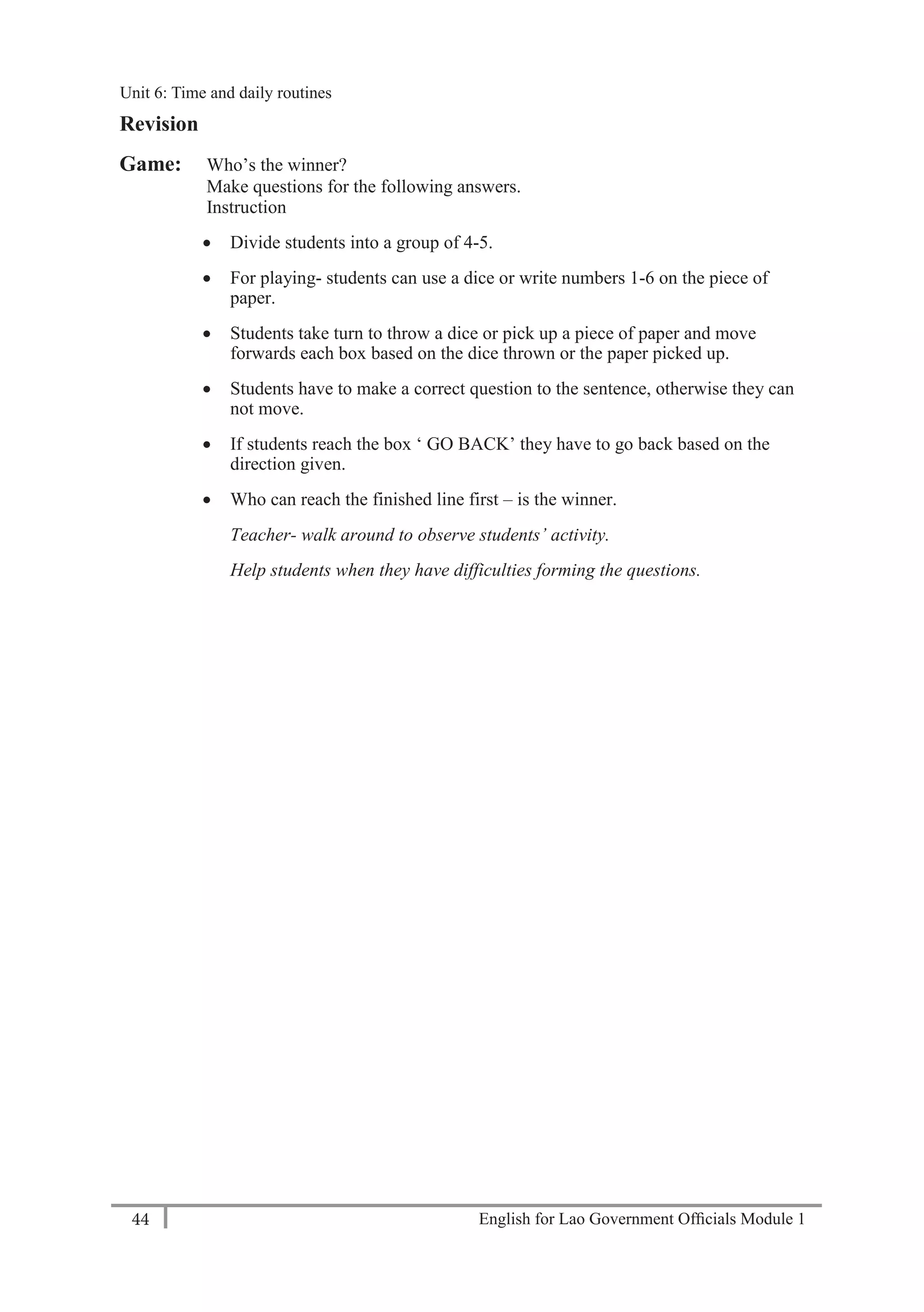
Revision
Game: Who’s the winner?
Make questions for the following answers.
Instruction
 Divide students into a group of 4-5.
 For playing- students can use a dice or write numbers 1-6 on the piece of
paper.
 Students take turn to throw a dice or pick up a piece of paper and move
forwards each box based on the dice thrown or the paper picked up.
 Students have to make a correct question to the sentence, otherwise they can
not move.
 If students reach the box ‘ GO BACK’ they have to go back based on the
direction given.
 Who can reach the finished line first – is the winner.
Teacher- walk around to observe students’ activity.
Help students when they have difficulties forming the questions.
Unit 6: Time and daily routines
English for Lao Government Officials Module 1 45
Unit 8: Weekly Routines
45 English for Lao Government Officials Module 1
Unit 7 Months and Dates
Speaking: Months
Introductory tasks
 Brain Storming Activity:
Teacher – introduce the topic of the lesson by eliciting what the student already
know about months of the year.
a) Listen and read the months.
January February March April May June
July August September October November December
 Note: Capital letters
Teacher – explain that when writing months in English, it is important to start the word
with capital letter.
e.g: My date of birth is on the 16th
of January, 1975.
b) Listen and mark the stress on the months.
'January 'February 'March 'April 'May 'June
Ju'ly 'August Sep'tember Oc'tober No'vember De'cember
Teaching suggestions: It is a good idea to get into the habit of highlighting and marking
up on the board the main stress of new words, and having students copy this down, e.g.
'January.
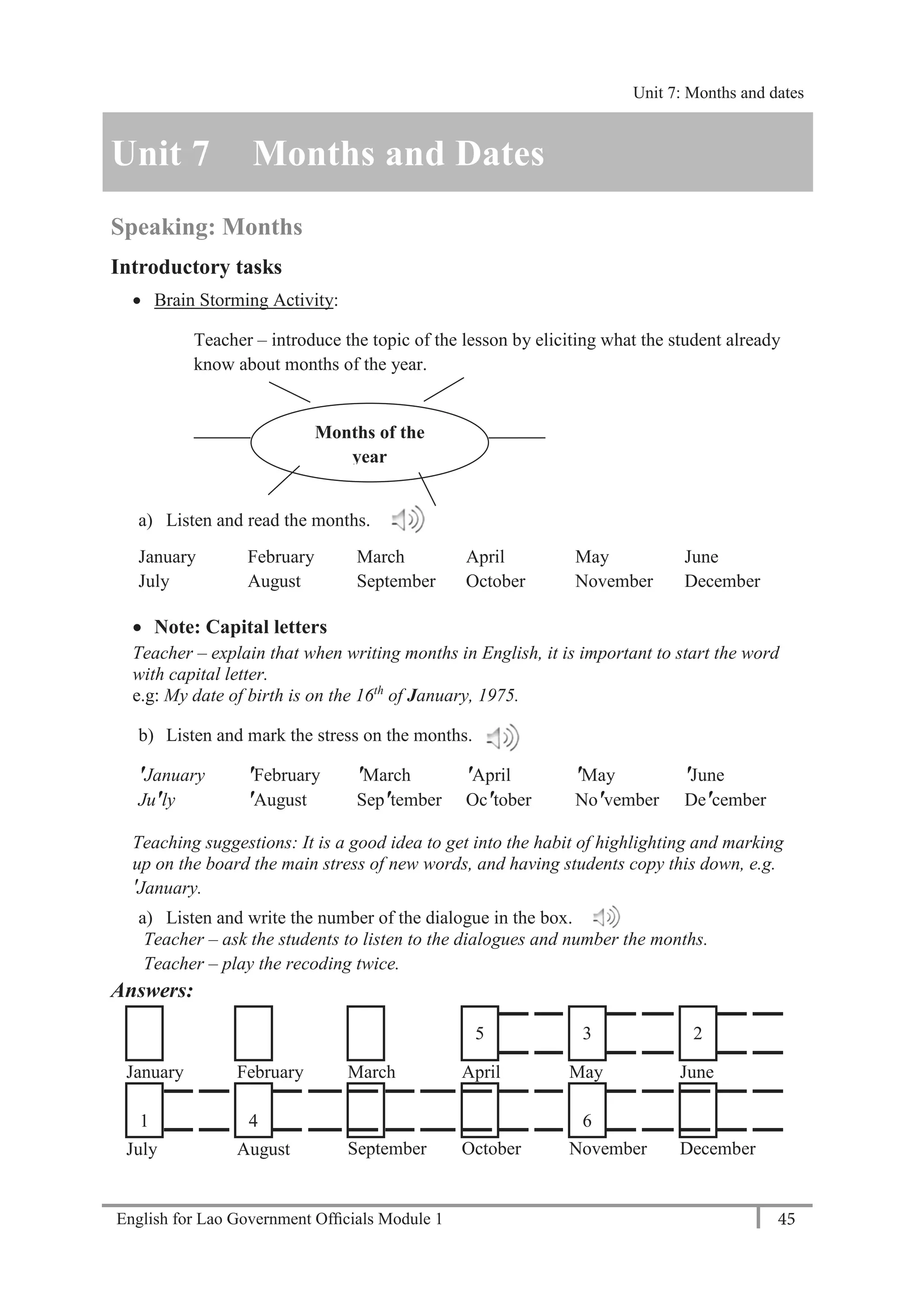
a) Listen and write the number of the dialogue in the box.
Teacher – ask the students to listen to the dialogues and number the months.
Teacher – play the recoding twice.
Answers:
5 3 2
January February March April May June
1 4 6
July August September October November December
Months of the
year
Unit 7: Months and dates
English for Lao Government Officials Module 146
Unit 8: Weekly Routines
46 English for Lao Government Officials Module 1
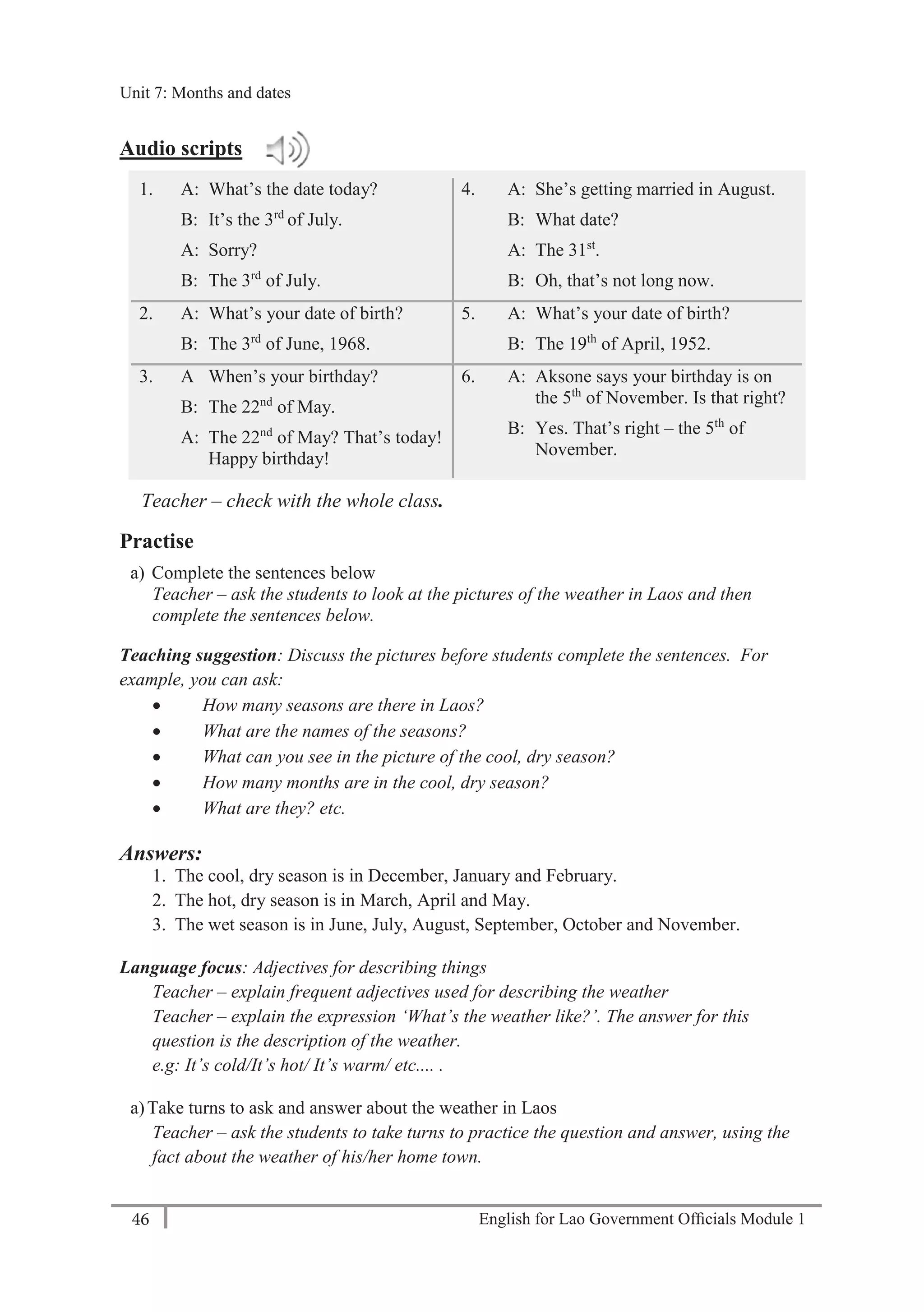
Audio scripts
1. A: What’s the date today?
B: It’s the 3rd
of July.
A: Sorry?
B: The 3rd
of July.
4. A: She’s getting married in August.
B: What date?
A: The 31st
.
B: Oh, that’s not long now.
2. A: What’s your date of birth?
B: The 3rd
of June, 1968.
5. A: What’s your date of birth?
B: The 19th
of April, 1952.
3. A When’s your birthday?
B: The 22nd
of May.
A: The 22nd
of May? That’s today!
Happy birthday!
6. A: Aksone says your birthday is on
the 5th
of November. Is that right?
B: Yes. That’s right – the 5th
of
November.
Teacher – check with the whole class.
Practise
a) Complete the sentences below
Teacher – ask the students to look at the pictures of the weather in Laos and then
complete the sentences below.
Teaching suggestion: Discuss the pictures before students complete the sentences. For
example, you can ask:
 How many seasons are there in Laos?
 What are the names of the seasons?
 What can you see in the picture of the cool, dry season?
 How many months are in the cool, dry season?
 What are they? etc.
Answers:
1. The cool, dry season is in December, January and February.
2. The hot, dry season is in March, April and May.
3. The wet season is in June, July, August, September, October and November.
Language focus: Adjectives for describing things
Teacher – explain frequent adjectives used for describing the weather
Teacher – explain the expression ‘What’s the weather like?’. The answer for this
question is the description of the weather.
e.g: It’s cold/It’s hot/ It’s warm/ etc.... .
a)Take turns to ask and answer about the weather in Laos
Teacher – ask the students to take turns to practice the question and answer, using the
fact about the weather of his/her home town.
Unit 7: Months and dates
English for Lao Government Officials Module 1 47
Unit 8: Weekly Routines
47 English for Lao Government Officials Module 1
Speaking: Ordinal numbers and dates
Introductory tasks
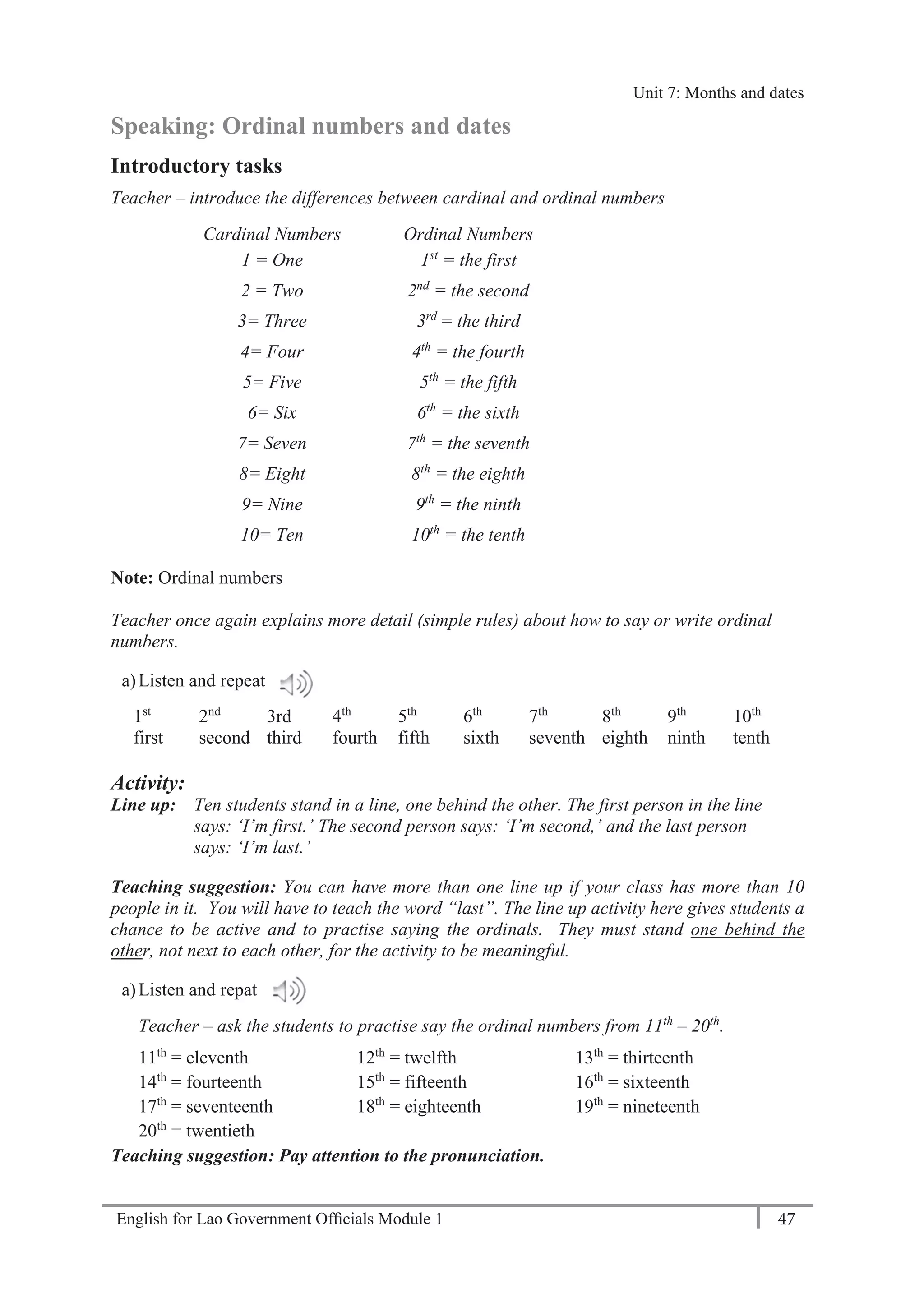
Teacher – introduce the differences between cardinal and ordinal numbers
Cardinal Numbers Ordinal Numbers
1 = One 1st
= the first
2 = Two 2nd
= the second
3= Three 3rd
= the third
4= Four 4th
= the fourth
5= Five 5th
= the fifth
6= Six 6th
= the sixth
7= Seven 7th
= the seventh
8= Eight 8th
= the eighth
9= Nine 9th
= the ninth
10= Ten 10th
= the tenth
Note: Ordinal numbers
Teacher once again explains more detail (simple rules) about how to say or write ordinal
numbers.
a)Listen and repeat
1st
2nd
3rd 4th
5th
6th
7th
8th
9th
10th
first second third fourth fifth sixth seventh eighth ninth tenth
Activity:
Line up: Ten students stand in a line, one behind the other. The first person in the line
says: ‘I’m first.’ The second person says: ‘I’m second,’ and the last person
says: ‘I’m last.’
Teaching suggestion: You can have more than one line up if your class has more than 10
people in it. You will have to teach the word “last”. The line up activity here gives students a
chance to be active and to practise saying the ordinals. They must stand one behind the
other, not next to each other, for the activity to be meaningful.
a)Listen and repat
Teacher – ask the students to practise say the ordinal numbers from 11th
– 20th
.
11th
= eleventh 12th
= twelfth 13th
= thirteenth
14th
= fourteenth 15th
= fifteenth 16th
= sixteenth
17th
= seventeenth 18th
= eighteenth 19th
= nineteenth
20th
= twentieth
Teaching suggestion: Pay attention to the pronunciation.
Unit 7: Months and dates
English for Lao Government Officials Module 148
Unit 8: Weekly Routines
48 English for Lao Government Officials Module 1
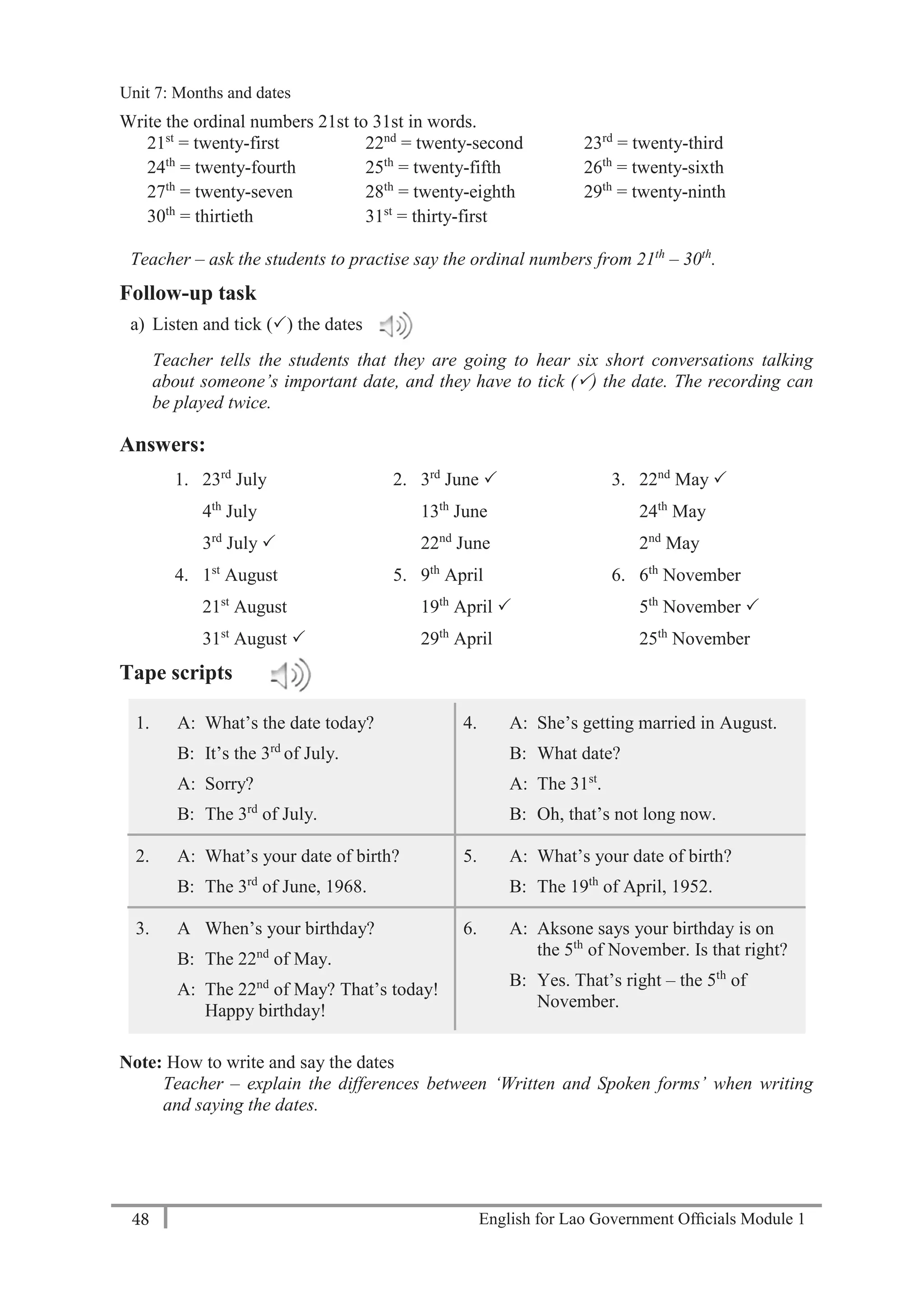
Write the ordinal numbers 21st to 31st in words.
21st
= twenty-first 22nd
= twenty-second 23rd
= twenty-third
24th
= twenty-fourth 25th
= twenty-fifth 26th
= twenty-sixth
27th
= twenty-seven 28th
= twenty-eighth 29th
= twenty-ninth
30th
= thirtieth 31st
= thirty-first
Teacher – ask the students to practise say the ordinal numbers from 21th
– 30th
.
Follow-up task
a) Listen and tick () the dates
Teacher tells the students that they are going to hear six short conversations talking
about someone’s important date, and they have to tick () the date. The recording can
be played twice.
Answers:
1. 23rd
July
4th
July
3rd
July 
2. 3rd
June 
13th
June
22nd
June
3. 22nd
May 
24th
May
2nd
May
4. 1st
August
21st
August
31st
August 
5. 9th
April
19th
April 
29th
April
6. 6th
November
5th
November 
25th
November
Tape scripts
1. A: What’s the date today?
B: It’s the 3rd
of July.
A: Sorry?
B: The 3rd
of July.
4. A: She’s getting married in August.
B: What date?
A: The 31st
.
B: Oh, that’s not long now.
2. A: What’s your date of birth?
B: The 3rd
of June, 1968.
5. A: What’s your date of birth?
B: The 19th
of April, 1952.
3. A When’s your birthday?
B: The 22nd
of May.
A: The 22nd
of May? That’s today!
Happy birthday!
6. A: Aksone says your birthday is on
the 5th
of November. Is that right?
B: Yes. That’s right – the 5th
of
November.
Note: How to write and say the dates
Teacher – explain the differences between ‘Written and Spoken forms’ when writing
and saying the dates.
Unit 7: Months and dates
English for Lao Government Officials Module 1 49
Unit 8: Weekly Routines
49 English for Lao Government Officials Module 1
b) Listen and complete.
Teacher – ask the students to listen to the recording and complete the dialogue.
Teacher – check with the whole class.
Answers:
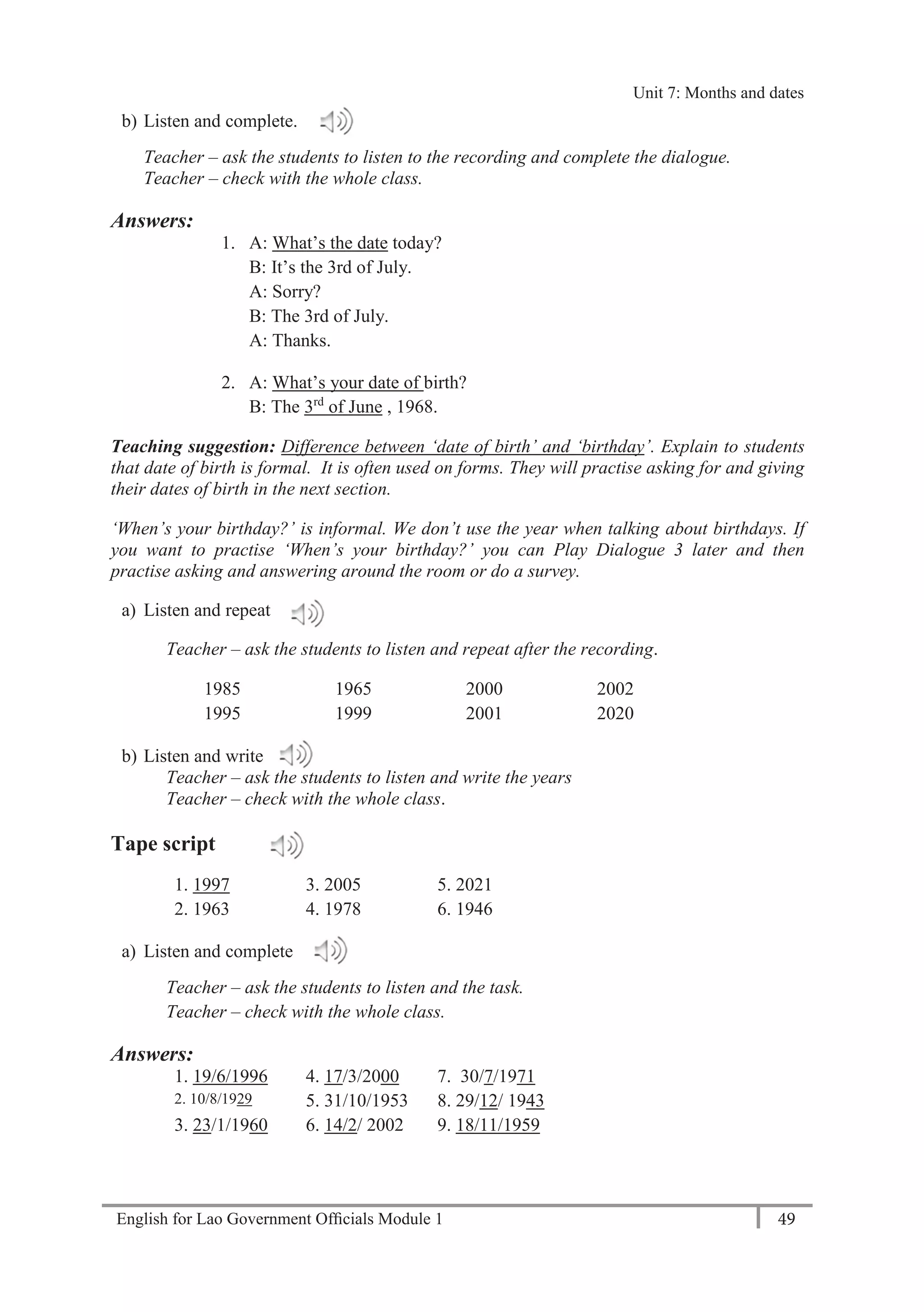
1. A: What’s the date today?
B: It’s the 3rd of July.
A: Sorry?
B: The 3rd of July.
A: Thanks.
2. A: What’s your date of birth?
B: The 3rd
of June , 1968.
Teaching suggestion: Difference between ‘date of birth’ and ‘birthday’. Explain to students
that date of birth is formal. It is often used on forms. They will practise asking for and giving
their dates of birth in the next section.
‘When’s your birthday?’ is informal. We don’t use the year when talking about birthdays. If
you want to practise ‘When’s your birthday?’ you can Play Dialogue 3 later and then
practise asking and answering around the room or do a survey.
a) Listen and repeat
Teacher – ask the students to listen and repeat after the recording.
1985 1965 2000 2002
1995 1999 2001 2020
b) Listen and write
Teacher – ask the students to listen and write the years
Teacher – check with the whole class.
Tape script
1. 1997 3. 2005 5. 2021
2. 1963 4. 1978 6. 1946
a) Listen and complete
Teacher – ask the students to listen and the task.
Teacher – check with the whole class.
Answers:
1. 19/6/1996 4. 17/3/2000 7. 30/7/1971
2. 10/8/1929 5. 31/10/1953 8. 29/12/ 1943
3. 23/1/1960 6. 14/2/ 2002 9. 18/11/1959
Unit 7: Months and dates
English for Lao Government Officials Module 150
Unit 8: Weekly Routines
50 English for Lao Government Officials Module 1
Tape scripts
1. A: What’s your date of birth?
B: The 19th
of June, 1996.
6. A: What’s your son’s date of birth?
B: The 14th
of February, 2002.
2. A: What’s her date of birth?
B: The 10th
of August, 1929.
7. A: What’s your date of birth, John?
B: Date of birth? The 30th
of July, 1971.
3. A: Your date of birth?
B: The 23rd
of January, 1960.
8. A: When were you born?
B: The 29th
of December, 1943.
4. A: What’s your daughter’s date of birth?
B: The 17th
of March, 2000.
9. A: What’s your father’s date of birth?
B: The 18th
of November, 1959.
5. A: When were you born?
B: Born? The 31st
of October, 1953.
Practise
a) Barrier game
Instructions
Students work in pairs – Student A and Student B.
Each student has a chart half completed with ordinal numbers.
Students must ask each other for the missing dates and write them on their chart.
Students must not look at each other’s chart.
Teaching suggestion 1: Make sure students cannot see each other’s chart. Divide the
students into A and B before you start. Tell Student A to cover Student B’s chart in the book
and tell student B to cover student A’s chart. Walk around to check they have done this.
Teaching suggestion 2: Model the Barrier Game with one student before the pairs start
asking and answering their questions. The activity also reminds students to say ‘Sorry?’ if
they need the answer repeated. You should model this too.
e.g. A: What’s the date in A1?
B: It’s the 3rd
.
A: Sorry?
B: The 3rd
. (A writes 3rd
on his chart in A1.)
Student A:What’s the date in …?
A B C D E F
1 9th
18th
30th
2 4th
2nd
3 15th
11th
24th
4 1st
22nd
19th
Unit 7: Months and dates
English for Lao Government Officials Module 1 51
Unit 8: Weekly Routines
51 English for Lao Government Officials Module 1
Student B:What’s the date in …?
A B C D E F
1 3rd
23rd
13th
2 21st
27th
20th
6th
3 8th
5th
16th
4 10th
7th
12th
a) Ask 10 people about their date of birth. Write their name and date of birth on the chart.
e.g. A: What’s your date of birth?
B: The 21st
of June, 1970.
Names Dates of birth
1. Manivone 21st
of June, 1970
2.
3.
Teaching suggestion: Model the survey task before students do the survey.
a) Write five sentences about people you talked to.
e.g. Somsinh’s date of birth is the 1st
of January, 1968.
Teaching suggestion 1: When students are writing, go around and (quietly) check their work
(monitor their work). If you see a mistake, point to it, but leave the student to try to decide
what is wrong by himself / herself. This is a good learning strategy.
Reading: Months
Introductory task
a) Write the words and numbers of the months in the box
Teacher – ask the students to work individually to write the months and the number of
the months. Reminds them about ‘Capital letter’
Unit 7: Months and dates
English for Lao Government Officials Module 152
Unit 8: Weekly Routines
52 English for Lao Government Officials Module 1
Answers:
a. l u j y July 7
b. r a y u j a n January
1
c. l a i p r April
4
d. d e m e b e r c December
12
e. r c o b o e t October
10
f. y b r f r e a u February
2
g. b e m e p e s t r September
9
h. n u e j June
6
i. t u u a s g August
8
j. a h m c r March
3
k. e r b n e o m v November
11
l. y a m May
5
a) Look at the calendar. Read and answer the questions.
Teacher – ask the students to work in a group of three or four to study the calendar and
discuss the answers with their classmates.
Teacher – check the answers as a whole class
Unit 7: Months and dates
English for Lao Government Officials Module 1 53
Unit 8: Weekly Routines
53 English for Lao Government Officials Module 1
1. What’s the first month of the year? January
2. What’s the last month? December
3. What day is the first of July? Monday
4. What day is the last day in June? Sunday
5. What month comes before (ກ່ອນໜ້າ) November? October
6. What month comes after (ຫຼັງຈາກ) October? November
7. How many days are there in January? 31 days
8. How many months have 31 days? 7 months
9. How many Fridays are there in January? 4
10. What date is the first Friday in January? 4th
11. What date is the second Friday in January? 11th
12. What day is the last day of the year? Tuesday
Practise
a)Write answers to these questions.
Teacher – ask the students to work in pairs answering the questions
Teacher – check the answers with the whole class.
Teaching suggestion 1: Discuss the pictures with the students before they write the
answers.Remind the students with capitalizing for each festival.
Teaching suggestion 2: The names of festivals have capital letters. You could write the
questions on the board without capital letters and get students to correct them before they
start writing the answers.
Answers:
1. What month is Lao New Year in?
Lao New Year is in April.
2. When is the Rocket Festival?
The Rocket Festival is in May or June.
3. When is the Boat Racing Festival?
The Boat Racing Festival is in September or October.
4. When is theThat Luang Festival?
The That Luang Festival is in October or November.
Task 2: In pairs, the students discuss about the dates of festivals and other important
dates in the Lao calendar.
Optional: The students can also discuss about any traditional festivals or other important
dates celebrated in their hometown.
Unit 7: Months and dates
English for Lao Government Officials Module 154
Unit 8: Weekly Routines
54 English for Lao Government Officials Module 1
Writing: Important dates
a) List about 5 of important dates in your life
Teacher – ask the students think about of the important dates in their life, and then share
with others.
Revision
a) Ask your classmate and complete the form
Teacher – ask the students to work in pairs asking and completing the form.
Teaching suggestion 1: This is revision of previous units. Spend as much or as little time as
necessary, i.e. If students seem to be sure of these questions and answers, them only spend a
short time. If they have forgotten, spend longer. Some students will need more practice than
others.
Mr / Miss / Mrs / Ms [please circle]
Name: …………………………………………………………………………………
(Given name) (Family name)
Occupation: …………………………………………………………………………..
Workplace: …………………………………………………………………………….
Telephone: …………………………………………………………………………….
Date of birth: ………………………………………………………………………….
Married  Single [please tick ()]
Number of Children: …………………………………………………………………
Teaching suggestion 1: Remind the students not to fill in the forms with full sentences.
Remind them about capital letters.
Teaching suggestion 2: When students are filling in the form, walk around and check their
writing. Help anyone who needs it.
Task 2: Report back to the class
— The teacher asks each student to report his/her partner’s information to the whole class
e.g. Her name is Ms Pansy Sanoubane. She …
Teaching suggestion 1: When students are writing, go around and (quietly) check their work
(monitor their work). If you see a mistake, point to it, but leave the student to try to decide
what is wrong by himself / herself. This is a good learning strategy.
Teaching suggestion 2: After students have finished writing, encourage them to read their
writing again. Tell them to read it carefully and correct any mistakes they find before they do
the follow-up activity.
Teaching suggestion 3: After the follow-up task, collect the students’ writing. Write
comments on the writing to give students feedback on their progress. Use the form called
‘Feedback on Progress in Writing’ which is in the Teacher’s Book on page 6.
Task 3: Give your form to someone else to read. Read another student’s form. Write about
that student.
Remember, you can say, ‘Sorry?’ or ‘Say it again, please’ if you want to hear the instruction
again.
Unit 7: Months and dates
English for Lao Government Officials Module 1 55
Unit 8: Weekly Routines
55 English for Lao Government Officials Module 1
Unit 8 Weekly Routines
Speaking: Early or late?
Introductory tasks
a) Look and Read
Teacher - ask the students to read the dialogue.
Teacher -put the students in pairs practising the dialogue.
Dialogue
a)Listen and complete the dialogue.
Teacher -ask the students to go through the dialogue to check if they have any difficult
words that need to be clarified.
Teacher -play the recording and ask the students to listen and complete the dialogue.
Teacher -check the answers as a whole class
Audio script:
Linda: Do you get up early, Mrs Somdy?
Somdy: Yes, I do. I get up at twenty to five.
Before work I feed the ducks and clean the house. Then I cook rice for breakfast.
Linda: And does your husband get up early?
Somdy: Yes. He works in the vegetable garden before he goes to work.
Linda: And does he go to bed early?
Somdy: Yes, he does. After dinner he reads the newspaper then he goes to bed at 9.30.
What about you, Linda? Do you go to bed early?
Linda: No, I don’t. I go to bed late and I get up late.
b)Listen and repeat
Teacher -play the recording and ask the students to repeat the dialogue.
c)Practice the dialogue in pairs
Teacher- ask students to practise the dialogue and let some of them demonstrate in front of
the class.
d)Practise the dialogue using your own names
Teacher- ask students to practise the dialogue using their own information and let
some of them demonstrate in front of the class.
Unit 8: Weekly routines
English for Lao Government Officials Module 156
Unit 8: Weekly Routines
56 English for Lao Government Officials Module 1
Practise
a) Read the dialogue and answer the questions.
Teacher - ask the students to read the dialogue again and answer the questions
individually.
Teacher - go through the answers with the whole class.
1.What does Mrs Manivanh do early in the morning? She feeds the ducks and cleans
the house. Then she cooks rice for breakfast.
2. What does her husband do early in the evening? He reads the newspaper then he
goes to bed.
3. What does Mrs Manivanh cook for breakfast? She cooks rice for breakfast.
4. Does her husband go to bed early? Yes, he does.
5. Does he get up late? No, he doesn’t.
Language focus
Teacher–brainstorm/ask the students what they already know about irregular verbs
Teacher-write all the verbs provided by the students on the board.
Teacher-present the rule of ‘Irregular Verb’, and give some examples on the board.
Optional: Teacher could try to find more exercise from grammar book to use as
supplementary maters to help students understand the use of irregular verbs.
a) Correct sentences
Teacher - allow students to work on their own correcting the sentences
Teacher - check the answers as a whole class.
Answers:
1. His son do the washing by himself.
His son does the washing by himself.
2. Are you go to work early?
Do you go to work early?
3. My father clean the yard every morning.
My father cleans the yard every morning.
4. She is doctors.
She is a doctor.
5. Boua wash the dishes.
Boua washes the dishes.
6. Do he work for the Ministry of Foreign Affairs?
Does he work for th Ministry of Foreign Affairs?
7. Does Kham has two children?
Does Kham have two children?
Unit 8: Weekly routines
English for Lao Government Officials Module 1 57
Unit 8: Weekly Routines
57 English for Lao Government Officials Module 1
Listening: Khamphanh’s week
Introductory tasks
a)Look at the pictures and read
Teacher - prepare flash cards showing different activities.
Teacher - introduce the new vocabulary using the flash cards.
Teacher - ask the students to repeat the words.
Optional: Miming game
— Ask a few students to come up and mime the activities, and the rest of the class try to
guess what the activities are.
Practise
Listen and number the pictures
Teacher - tell the students that they are going to hear what Khamphanh’s daily
activities. The recording can be played twice
Teacher – ask the students to listen and number the pictures.
Teacher – check as a whole class.
Answers:
Audio script
Every day at 5 a.m. Khamphanh works in the garden.
He usually listens to the radio before work.
He sometimes drinks coffee with friends in the morning.
He reads the paper every evening after work.
He studies English every Tuesday evening.
Every Wednesday night, he plays the guitar with friends.
He sometimes drinks beer after work.
He usually goes fishing on the weekend.
4
7
2
1
3 5
8 6
Unit 8: Weekly routines
English for Lao Government Officials Module 158
Unit 8: Weekly Routines
58 English for Lao Government Officials Module 1
a) What about you? Answer the questions
Teacher – ask students to work individually and answer the questions about
himself/herself using short answers
b) Class survey
Teacher – ask students to talk around the class and ask at least five people about their
daily activities, and write down their answers in the chart.
Do you …
Names
c) Report about one person from your survey
Teacher – ask students to work in pairs and report about one person from his/her survey.
Follow up tasks
Teacher – explain the use of connectors ‘and/but’ and give some examples
Teacher – ask the students to try to form sentences with the use of connectors ‘and/but.
Teacher – help with any difficulties
Note: Connectors (ຄາເຊ່ອມ) ‘and / but’
In either written or spoken language we normally use ‘and’ when we need to add something
to what we have already mentioned.
e.g. Linda goes to bed late and gets up late.
In either written or spoken language we normally use ‘but’ when we need to show
something opposite to what we have already mentioned.
e.g Ms Manivanh goes to bed late but gets up early.
Unit 8: Weekly routines
English for Lao Government Officials Module 1 59
Unit 8: Weekly Routines
59 English for Lao Government Officials Module 1
a)Look at the chart and write sentences using and/but.
Teacher – ask the students to work with other students to write sentences using the
information given in the chart.
Teacher – check with the whole class.
and/but drink coffee drink beer sing
play the
guitar
play
football
play
badminton
Somsinh      
Soumaly      
Phosy      
Manivone      
e.g. Somsinh drinks beer but he doesn’t drink coffee. He sings and plays the guitar. He plays
football but he doesn’t play badminton.
Soumaly drinks coffee but she doesn’t drink beer. She sings but she doesn’t play the guitar.
She plays badminton but she doesn’t play football.
Phosy: doesn’t drink coffee but he drinks beer. He sings but he doesn’t plays the guitar. He
plays football and badminton.
Manivone: dinks beer but she doesn’t drink coffee. She plays the guitar but she doesn’t sing.
She plays badminton but she doesn’t play football.
Language focus
Teacher – explain the use of ‘Adverbs of frequency’, and give more examples for the students
Notes:always ເລ້ອຍ Å, usually ປກກະຕິ, sometimes ບາງເທ່ ອ, never ບ່ເຄຍຈ ັກເທ່ ອ.
always 100% e.g. I always watch television in the evening.
usually 90% I usually go to work at 8:30.
sometimes 50% I sometimes play football on the weekend.
never 0% I never go to bed late.
e.g. (always 100%, usually 90%, sometimes 50%, never 0%)
Unit 8: Weekly routines
English for Lao Government Officials Module 160
Unit 8: Weekly Routines
60 English for Lao Government Officials Module 1
Ask your partner
Teacher – put the students in pairs asking and answering questions using her/his own facts.
a)Survey: Stand up and walk around. Ask five people. Write their answers in the chart.
Teacher – ask the students to stand up and walk around the class, let them ask five people
and write the answers in the chart.
e.g. A: Do you …?
B: Yes, sometimes/always/usually.
No, never.
Names
Do you … Khamphanh
read the newspaper in the
morning?
always
drink beer? sometimes
go to bed late? never
go fishing at the weekend? usually
drink coffee in the morning? sometimes
watch television in the
evening?
usually
listen to the radio in the
evening?
never
Teaching suggestion1: Explain to students that they are going to find out what languages
people in the class speak. It is a good idea for the teacher to model this activity with one or
two students before the class starts the activity.
Teaching suggestion 2: When students are talking, go around to make sure everyone is busy.
You can also participate in the activity. If a student is not participating well, you can ask him
(or her) some questions and encourage him to ask you. Then you can find someone else to
ask him.
a) Write four sentences about your survey
Teacher – ask the students to write four sentences using their survey results.
Teacher – ask the students to read out their sentences to the whole class.
b) Complete the sentences with the correct endings.
Teacher – ask the students to work individually to complete the sentences with the
correct endings.
Teacher – go through the answers with the whole class.
Unit 8: Weekly routines
English for Lao Government Officials Module 1 61
Unit 8: Weekly Routines
61 English for Lao Government Officials Module 1
Answers:
1. Thong often drinks tea but he never drinks coffee.
2. Phet usually reads the newspaper at night but he sometimes watches television.
3. Somphet sometimes drinks beer but he never smokes cigarettes.
4. Khamla always gets up early on week days but he usually gets up late on the
weekend.
5. Manivone usually eats rice for lunch but sometimes she eats bread.
Reading 1: Khamphanh’s week
Introductory task
Task 1:
Write the number of a picture in front of each sentence.
Teacher – ask the students to work individually to match the number of the pictures with the
correct sentences.
Teacher – check with the whole class.
1 2 3 4
5 6 7 8
Answers:
6 Everyday at 5 a.m. Khamphanh works in the garden.
1 He usually listens to the radio before work.
3 He sometimes drinks coffee with friends in the morning.
7 He reads the paper every evening after work.
5 He studies English every Tuesday evening.
2 Every Wednesday night, he plays the guitar with friends.
8 He sometimes drinks beer after work.
4 He usually goes fishing on the weekend.
Unit 8: Weekly routines
English for Lao Government Officials Module 162
Unit 8: Weekly Routines
62 English for Lao Government Officials Module 1
Language focus
Teacher – explain the rule about how to form a question with ‘When’, and demonstrate some
examples.
Questions with ‘When’
To form a question with ‘When’, it is required the auxiliary verb ‘do’
ການໃຊ້ຄາຖາມທ່ ຂ້ນຕ້ນດ້ວຍ ‘When’ ຈະຕ້ອງໃຊ້ຄາກິລິຍາ‘do’ຊ່ວຍໃນການສ້າງຄາຖາມ.
e.g. When do you listen to the radio?
When does Khamphanh work in the garden?
a) Read the sentences about about Khamphanh’s week again. When does he do these
things? Tick () the boxes
Teacher – ask the students to read the sentences about Khamphanh’s week again, and
find out when he does these things? Tick () the boxes.
in the morning in the
afternoon
in the
evening
at night on the weekend
work in the
garden

listen to the
radio

drink
coffee

read the
paper

study
English

play the
guitar with
friends

drink beer

go fishing

b) Complete the sentences with ‘always, usually, sometimes, never’
Teacher – ask the students to individually complete the sentences with ‘always, usually,
sometimes, never’ using their own information.
Teacher – check with the whole class.
Unit 8: Weekly routines
English for Lao Government Officials Module 1 63
Unit 8: Weekly Routines
63 English for Lao Government Officials Module 1
c) Class Survey:
Teacher – ask the students to stand up and walk around. Ask five people and write their
answers in the chart.
What do you do at _______________?
Names
Time
6.00 a.m.
8.00 a.m.
10.00 a.m.
12. 00 midday
2.00 p.m.
4.00 p.m.
6.00 p.m.
8.00 p.m.
Teaching suggestion1: Explain to students that they are going to find out what languages
people in the class speak. It is a good idea for the teacher to model this activity with one or
two students before the class starts the activity.
Teaching suggestion 2: When students are talking, go around to make sure everyone is busy.
You can also participate in the activity. If a student is not participating well, you can ask him
(or her) some questions and encourage him to ask you. Then you can find someone else to
ask him.
Practice
a) Khamphan’s week at the office
Teacher – ask the students to individually read about Khamphanh’s week at the office
and answer the questions.
Teacher – go through the answers as the whole class.
Unit 8: Weekly routines
English for Lao Government Officials Module 164
Unit 8: Weekly Routines
64 English for Lao Government Officials Module 1
Khamphanh’s week at the office
Khamphanh is a government official. He works for the Ministry of Education. He works
at the English Language Resource Centre in Vientiane. He is the vice director.
Every day Khamphanh gets up at six o’clock. He always reads the newspaper before
work. He has breakfast at seven o’clock. He goes to work by motorcycle at 7.30 a.m. He
arrives at work at about a quarter to eight. He usually has a meeting with his staff on
Monday morning at 8.30 but sometimes his staff are late. Khamphanh works in his office
all morning. He doesn’t go home for lunch. He has lunch at the office canteen.
Every day he is very busy in his office. He usually finishes work at 4 o’clock but
sometimes he works late. After work he usually goes home but sometimes on Friday he
drinks beer with his friends. He smokes cigarettes after work but he never smokes at the
office.
1. Who does Khamphanh work for? He works for the Ministry of Education.
2. Where does he work? He works at the English Language Resource Centre in
Vientiane.
3. What is his position (ຕາແໜ່ງ)? He is the vice director.
4. What time does he get up every day? Every day he gets up at six o’clock.
5. What does he do before work? He always reads the newspaper before work.
6. How does he go to work? He goes to work by motorcycle.
7. When does he arrive at work? He arrives at work at about a quarter to eight.
8. What time does he have a meeting? He usually has a meeting at 8.30.
9. Who does he have a meeting with? He usually has a meeting with his staff.
10. When does he usually finish work? He usually finishes his work at 4 o’clock.
11. Where does he usually go after work? After work he usually goes home but
sometimes on Friday he drinks beer with his friends
.
12. Does he smoke cigarettes in the office? No. He never smokes in the office.
Writing: Your week
a) Write about your weekly routines
Teacher – ask the students to write about their own weekly routines using
Khamphanh’s as a model.
Check:
 the grammar
 the spelling
 the full stops
 the capital letters
Optional: Teacher can give this as homework.
Unit 8: Weekly routines
English for Lao Government Officials Module 1 65
Unit 9: Countries, nationalities and languages
65 English for Lao Government Officials Module 1
Unit 9 Countries nationalities and languages
Speaking: Where are you from?
Introductory tasks
a)Southeast Asia map
Teacher – prepare a map of Southeast Asia and shows it to the students.
Teacher – ask the whole class to try if they can place the countries on the map.
e.g: What’s the name of the country for number 1?
It’s Laos.
b)Listen and repeat
Teacher – play the recording and ask the students to listen and repeat the words.
c) Listen and mark the stress on the country names, e.g 'Laos
Teacher – ask the students to listen to the recording again and try to mark the correct
stress.
Teacher – check with the whole class.
Answers:
'Laos 'Singapore Indo'nesia 'Thailand 'China
'Myanmar Cam'bodia Ma'laysia 'Brunei 'Vietna
The 'Philippines
Teaching suggestion: Play the cassette two or three times. If students need more time to
mark the stress, you can pause after each country.
d) Look at the map of Southeast Asia. Ask and answer questions about the names of the
countries.
Teacher – ask the students to work in pairs ask and answer questions about the name of the
countries using the Southeast Asia Map.
Dialogue tasks
a)Listen and complete.
Teacher – ask the students to look at the picture of three women, and let them predict what
they are doing, where they are from, etc...
Teacher – play the tape and ask students to listen and complete the dialogue
Teacher – go through the dialogue with the whole class
Unit 9: Countries, nationalities and languages
English for Lao Government Officials Module 166
Unit 9: Countries, Nationalities and Languages
66 English for Lao Government Officials Module 1
Audio script:
Manivan: Good morning, Ms Hien. How are you?
Hien: I’m fine, thanks. And you?
Manivan: Fine, thank you.
This is Ms Alias. She’s from Malaysia.
Ms Alias, this is Ms Hien. She’s from Vietnam.
(Ms Hien and Ms Alias shake hands).
Hien: Pleased to meet you.
Alias: Pleased to meet you, too.
Hien: What do you do, Ms Alias?
Alias: I’m the Director of the Language Centre.
What about you?
Hien: I’m …
b)Role play
Teacher – put students into a group of three, and let them practise the dialogue.
Teacher – explain the use of ‘How do you do?’
Note: How do you do?
When greeting someone officially, we normally use ‘Please to meet you’. Moreover, we can
also use ‘How do you do?’
Follow-up tasks
a)What about you? Ask and answer
Teacher – ask the students to stand up and walk around, greet and introduce each other.
b) Ask and answer about these people
Teacher – ask the students to work in a group and discuss about the people in the pictures.
Language Focus
Teacher – explain the use of ‘To be’ in Past Simple Tense.
a)Complete the sentences.
Teacher – ask the students to work together with his/her partner and complete the sentences
with the correct form of verb ‘to be’.
Unit 9: Countries, nationalities and languages
English for Lao Government Officials Module 1 67
Unit 9: Countries, nationalities and languages
67 English for Lao Government Officials Module 1
Answers:
1. Kaisone Phomvihane was the President of Laos.
2. I was born in 1968.
3. Today is Wednesday.
4. Yesterday was Tuesday.
5. Last year we were in Malaysia.
6. In 1978, I was in Vietnam.
7. Today they are at work.
8. Yesterday evening he was at home.
9. In January they were in Luang Nam Tha.
10. Where were you last month?
b) Ask people where they were.
Teacher – ask the students to work in pair and ask each other about where they were at a
particular time.
Listening: What’s your nationality?
Introductory tasks
a)Match the nationalities with the countries.
Teacher – go through the list of nationalities, and asks students to try matching the
nationalities with the countries.
Teacher – check the answers with the whole class.
Answers:
Country Nationality
Laos 'Lao
Vietnam Vietna'mese
Indonesia Indo'nesian
Thailand 'Thai
China Chi'nese
Brunei Bru'neian
Myanmar 'Myanmar
The Philippines Fili 'pino
Malaysia Ma'laysian
Singapore Singa'porean
Cambodia Cam'bodian / Kh'mer
Timor Leste Timorese
Unit 9: Countries, nationalities and languages
English for Lao Government Officials Module 168
Unit 9: Countries, Nationalities and Languages
68 English for Lao Government Officials Module 1
b)Listen and mark the stress on the nationalities, e.g. 'Lao
Teacher – play the recording and asks students to mark the stress on the nationalities.
Teacher – try helping students with marking correct stress, and check with the whole class.
Teaching suggestion 1: Play the cassette two or three times. If students need more time to
mark the stress, you can pause after each nationality.
Teaching suggestion 2: It is a good idea to get into the habit of writing new words on the
board and marking the stress, e.g. Ma'laysian. Drill the pronunciation
c)Listen and repeat
Teacher – ask the students to listen to the words again and then repeat after the tape.
d)Take turns to ask and answer about country’s names and its nationality
Teacher – put the students to do pair work, let them work together to ask and answer about a
country’s name and its nationality.
Follow up task
a)Listen to the dialogues. Write the nationality of the person in each dialogue.
Teacher – explain that the students will hear six dialogues, and they have to listen and write
down the person’s nationality in each dialogue.
Teacher – check with the whole class.
1. Thai 4. Filipino
2. Cambodian 5. Malaysian
3. Chinese 6. Singaporean
Teaching suggestion 1: Play the cassette two or three times. If students need more time to
write, you can pause after each dialogue. More importantly, pronunciation should be
focused.
Audio script
1. A: What’s your nationality?
B: I’m Thai.
2. A: Are you Vietnamese?
B: No, I’m not. I’m Cambodian.
3. A: Are you from China?
B: Yes, I am.
4. A: What’s Anna’s nationality?
B: She’s Filipino.
5. A: We’re from Malaysia.
B: Oh, so you’re Malaysian?
A: Yes, that’s right.
6. A: Is Mr. Lee from China?
B: No, he’s not. He’s from Singapore.
Unit 9: Countries, nationalities and languages
English for Lao Government Officials Module 1 69
Unit 9: Countries, nationalities and languages
69 English for Lao Government Officials Module 1
Note: Pronunciation
Notice the / / sound for ‘ti’ and the stress in ‘natio'nality’.
Practise the pronunciation of ‘natio'nality’.
b)Role play
Teacher – ask the students to work in pair, ask and answer ‘What’s your nationality?’
Example:
A: Are youVietnamese?
B: No, I’m not. I’m Cambodian.
Speaking: What languages do you speak?
Introductory tasks
a)Complete the table with the nationalities and languages in the box.
Teacher – ask the students to work with each other and complete the table.
Teacher – check with the whole class.
b)Listen and mark the stress
Teacher - play the recording (twice) and asks students to mark the correct stress
Teacher – check with the whole class.
Answers:
Country Nationality Language
Laos Lao 'Lao
Vietnam Vietnamese Vietna'mese
Indonesia Indonesian Indo'nesian
Thailand Thai 'Thai
China Chinese Chi'nese
Brunei Bruneian Ma'lay
Myanmar Burmese 'Burmese
The Philippines Filipino 'Tagalog
Malaysia Malaysian Ma'lay
Singapore Singaporean 'English
Cambodia Cambodian 'Khmer
Teaching suggestion: Play the cassette two or three times. If students need more time to
mark the stress, you can pause after each language.
c) Listen and repeat the dialogue.
Teacher – play the recording and asks students to repeat the dialogue
d) Practise the dialogue
Teacher – put the students in pairs and let them practise the dialogue
Teacher – ask a few pairs to come up and practise the dialogue in front of the class.
Unit 9: Countries, nationalities and languages
English for Lao Government Officials Module 170
Unit 9: Countries, Nationalities and Languages
70 English for Lao Government Officials Module 1
Dialogue:
Tom: Do you speak Vietnamese?
Khamsy: No, I don’t.
Tom: What languages do you speak?
Khamsy: Lao, Thai, and a little English.
Language Focus
Teacher – explain the use of ‘and/ or’ and give more examples.
and / or
When we need to add something to what we have mentioned or written earlier we can
use ‘and’
e.g. David speaks English and French.
Phonephet speaks English, French and Vietnamese.
In the same case, for English negative statement we use ‘or.’
e.g. Somsinh doesn’t speak English or French.
Niphaphone doesn’t speak English, French or Vietnamese.
Please note the sentence structure when adding three or more things in the sentence.
e.g. Phonephet speaks English, French and Vietnamese.
Niphaphone doesn’t speak English, French or Vietnamese.
We use comma between things mentioned or written earlier. We use ‘and/ or’ before
the last thing.
a)Write about these people. Use and / or / but.
Teacher – ask the students to work individually to write sentences using formation provided
in the table.
After finishing writing sentences, let students compare theirs with other students
Teacher – check with the whole class.
Name English French Vietnamese
Ms. Phonephet   
Mr. Somsack   
Mr. Chanthai   
Ms. Niphaphone   
Mr. Sonesay   
Ms. Khamsay   
1. Ms Phonephet speaks English, French and Vietnamese.
2. Mr Somsack speaks English and French but he doesn’t speak Vietnamese.
3. Mr Chanthai speaks English, French and Vietnamese.
4. Ms Niphaphone doesn’t speak English, French or Vietnamese.
5. Mr Sonesay speaks English and Vietnamese but he doesn’t speak French.
6. Ms Khamsay doesn’t speak English, French or Vietnamese.
Unit 9: Countries, nationalities and languages
English for Lao Government Officials Module 1 71
Unit 9: Countries, nationalities and languages
71 English for Lao Government Officials Module 1
b)Find someone who.....
Teacher – ask the students to stand up and walk around the class, and find someone who
speaks these languages.
Find someone who speaks …
Name
Thai _________________________________
Vietnamese _________________________________
English _________________________________
French _________________________________
Russian _________________________________
Malay _________________________________
Khmer _________________________________
Chinese _________________________________
Teaching suggestion1: Explain to students that they are going to find out what languages
people in the class speak. It is a good idea for teacher to model this activity with one or two
students before the class starts the activity.
Teaching suggestion 2: When students are talking, go around to make sure everyone is busy.
You can also participate in the activity. If a student is not participating well, you can ask him
(or her) some questions and encourage him to ask you. Then you can find someone else to
ask him.
Teaching suggestion: Make sure all students are listening actively to each other. After one
student has answered, you can ask another student “What did he / she say?” This will
encourage them to pay attention.
c) Write sentences about the languages people in your class speak
Teacher- ask the students to individually write sentences about the people who they spoke to.
Teacher – ask some of the students to report their findings to the class.
Reading: Ethnic Language?
Introductory tasks
a) Discuss these questions
Teacher – discuss each question with the students.
Unit 9: Countries, nationalities and languages
English for Lao Government Officials Module 172
Unit 9: Countries, Nationalities and Languages
72 English for Lao Government Officials Module 1
Practice
a)Read the newspaper article.
Teacher – introduce the topic ‘Ethnic language study’, so they have some ideas what they
are going to read in the article.
Teacher – go through the text and explain any difficulties the students might have.
Ethnic language study
Many government officials in Vietnam study English
but in some provinces government officials study
ethnic languages. Many ethnic minority groups live in
these provinces. It is important for the government
officials to speak their languages. The government
officials study Hmong, Khmu, Yao and Tai. They
study these languages for eight months.
Vietnam Times Nov 23, 2001
b)Circle T for true (ຖກ) or F for false (ຜິດ) for each sentence.
Teacher – ask the students to work in pairs, and try to answer the questions
Teacher – check with the whole class.
Answers:
1. The government officials live in Vietnam. (T)
2. The government officials in Vietnam do not study English. (F)
3. Government officials in Vietnam study ethnic minority languages. (T)
4. Hmong, Khmu, Yao and Tai ethnic groups live in Vietnam. (T)
5. The ethnic minority language course is for 32 weeks (T)
Teaching suggestion: It is a good idea to ask students correct the false sentence.
Writing: I speak Thai, English and a little French.
Introductory task
Teacher – give a brief review about using/writing capital letters when mentioning about
countries, nationalities and languages.
Note: Capital letters (ຕວພິມໃຫ່ຍ)
ການຂຽນຄາສັບຂອງປະເທດ, ສັນຊາດ ແລະພາສາໃນພາສາອັງກິດ, ຕວໜັງສທາອິດຂອງຄາ
ສັບຂອງຄາສັບນັ້ນຕ້ອງການຂຽນດ້ວຍຕວພິມໃຫ່ຍສະເໝ.
ຕວຢ່າງ: Sothea is from Cambodia. He is Cambodian. He speaks Khmer. He
doesn’t speak Lao, Thai or Vietnamese.
Unit 9: Countries, nationalities and languages
English for Lao Government Officials Module 1 73
Unit 9: Countries, nationalities and languages
73 English for Lao Government Officials Module 1
a) Rewrite these sentences.
Teacher – ask the students to work in pair and rewrite the sentences with correct capital
letters. Teacher – check with the whole class
Her name is Akiko. She is from Japan. She is Japanese. She speaks Japanese. She
speaks Lao but she doesn’t write it. She speaks Thai, Lao and Chinese. She speaks a
little English. Mr. Wang Lee is from Singapore. He is a businessman. He goes to many
countries for his work. He usually goes to Indonesia, Malaysia and Thailand for work.
He speaks English and Chinese. He does not speak Malay, Thai or Lao.
Teaching suggestion: It is a good idea to revise the use of capital letters in previous units.
b) Write sentences about the people in your class or your family as the sample from a).
Teacher – ask the students to individually prepare some sentences about the people in the
class or in his/her family using the sample from a).
- Optional: It can be assigned as homework
Unit 9: Countries, nationalities and languages
English for Lao Government Officials Module 174
Unit 11: Work responsibilities
74 English for Lao Government Officials Module 1
Unit 10 Work information
Speaking: Here’s my card
Introduction task
a)Ask and answer the questions
Teacher – prepare/show a name card to students and ask if people exchange name cards
in Laos?. Also, what information is normally included in the name card?
Dialogue
a)Listen and complete the dialogue.
Teacher – ask students to read through the dialogue
Teacher – play the recording (twice) and asks students to complete the dialogue
Teacher – check with the whole class.
Audio Script:
David: This is Souvanh. He’s from Saravanprovince. He works for the Provincial
Cabinet.
Debbie: Pleased to meet you, Souvanh. My name’s Debbie.
Souvanh: Pleased to meet you, Debbie. Are you American?
Debbie: No, I’m Australian.
Souvanh: And do you work in Laos?
Debbie: Yes, I’m an adviser. Here’s my name card.
Souvanh: Thank you.
b)Listen and repeat
Teacher – play the recording and pause so students repeat after each speaker.
Teacher – focus on any problems with pronunciation.
c)Practise the dialogue in pairs
Teacher – ask the students to work in pairs and practise the conversation
Teacher – walk around the class and offer any help needed.
Teacher – ask some students to come up and demonstrate their conversation
Practise
a) Look and read the card
Teacher – ask the students to study the card carefully.
Teacher – clearly explain each part appeared in the card.
Unit 10: Work information
English for Lao Government Officials Module 1 75
Unit 11: Work responsibilities
75 English for Lao Government Officials Module 1
b) Look and repeat
Teacher – read the words and focus on the word stress
Teacher – ask the students to repeat with attention on the correct stress after the teacher
Teacher – explain about how to pronounce when giving someone e-mail addresses..
In e-mail addresses, @ is pronounced ‘at’. A full stop (.) is pronounced ‘dot’.
For example:
Write: yoshi@laotel.com
Say: ‘Yoshi at laotel dot com’
c) Questions and answers
Teacher – ask the students to work in pairs and take turns to ask the questions.
Teacher – go through the answers with the whole class.
Whose card is it? Yoshitomo Suzuki’s
Is it a man’s card or a woman’s card? a man’s
What is the person’s family name? Suzuki
What is the person’s given name? Yoshitomo
Where does the person work? Teacher Training Department, Ministry
of Education
What organization does the person work for? Japan International Cooperation Agency
(JICA)
What is the person’s position? Adviser
What is the person’s phone number? (856-21) 250933
What is the person’s fax number? (856-21) 250933
What is the person’s e-mail address? yoshi@laotel.com
What is the person’s office address? JICA Laos Office
Naxay Village
P.O. Box 3933
Vientiane, Lao P.D.R.
Follow up tasks
a) Read and complete
Teacher – ask the students to work in pairs and try to complete the cards.
Teacher – check the answers with the whole class.
Unit 10: Work information
English for Lao Government Officials Module 176
Unit 11: Work responsibilities
76 English for Lao Government Officials Module 1
Save the children
Australia
Carol Perks
Health Adviser
Vientiane Office
P.O. Box 2783 Vientiane, Lao PDR
Telephone 856(21) 313837
856(21) 416937
Facsimile 856(21) 415432
E- mail: scaus@laotel.com
Answers:
Family name: Sa Im
Given name: Ton
Workplace: Pedagogical Research Department
Organisation: Ministry ofEducation Youth and Sports
Position: Director
Phone number: 012 869 458
Fax number: 023 211 409
E-mail address: prd@camnet.com.kh
Office address: St. 280 inside Chao Ponhea Hok School
Sangkat Boeung Keng Kang 1
Khan Chamcamon, Phnom Penh
Family name: Perks
Given name: Carol
Workplace: Save the ChildrenAustralia
Organisation: Save the ChildrenAustralia
Position: Health Adviser
Phone number: (856 21) 313837 or (856 21) 416937
Fax number: (856-21) 415432
E-mail address: scaus@laotel.com
Office address P.O Box 2783
Vientiane, Lao P.D.R.
Teaching suggestions: Teacher should remind the students not to write full sentences for the
answers on the form.
Pedagogical Research
Department
Ministry of Education
Youth and Sports
TON SA IM
Director
St.280 inside Chao PonheaHok School Phone : 012 869 458
SangkatBoeungKeng Kang 1 Fax : 023 211 409
Khan Chamcamon, Phnom Penh E-mail :prd@camnet.com.kh
Unit 10: Work information
English for Lao Government Officials Module 1 77
Unit 11: Work responsibilities
77 English for Lao Government Officials Module 1
b) Write questions
Teacher – ask the students to form questions individually.
Teacher – walk around the class and help with any difficulties
Teacher – check the answers with the whole class.
Answers:
Family name: What’s your family name?
Given name: What’s your given name?
Workplace: Where do you work?
Organisation: What organisation do you work for?
Position: What’s your position?
Phone number: What’s your phone number?
Fax number: What’s your fax number?
E-mail address: What’s your e-mail address?
Office address: What’s your office address?
c) Take turns to ask your partner questions. Complete the form about your partner.
Teacher – ask the students to work with a person who sits next to him/her, ask each other
and complete the form
Then, teacher – ask the students to share their friends’ information to the whole class.
e.g. A: What’s your family name?
B: Sanoubane.
A: Can you spell it, please?
B: V-I-L-A-V-A-N-H
(Student A writes ‘Vilavanh’ on the form)
Mr / Miss / Mrs / Ms [please circle]
Name: ………………………………………………………………………………..
(Given name) (Family name)
Workplace: ……………………………………………………………………………
Organisation: …………………………………………………………………………
Position: ………………………………………………………………………………
Phone number: ……………………………………………………………………….
Fax number: ……………………………. E-mail address: ………………………...
Office address: ……………………………………………………………………….
Teaching suggestion: Walk around and monitor students’ writing. Remind them about
capital letters etc. if necessary. Teacher should also remind the students not to fill in the form
with full sentences.
a) Group work
Teacher – ask the students to work in a group of four, and take turns to report about the form
he/she has.
Teacher – walk around and correct any mistakes made by the students.
Unit 10: Work information
English for Lao Government Officials Module 178
Unit 11: Work responsibilities
78 English for Lao Government Officials Module 1
Listening: Workplaces
Introductory tasks
a) Match Lao and English workplaces.
Teacher – ask the students to try matching Lao and English workplaces
Teacher – go through the answers with the whole class.
Teaching suggestion: Remind the students that they can use the list of workplaces at the back
of the book to help them
Answers:
Provincial Cabinet ຫ້ອງວ່າການແຂວງ
Provincial Education Service ພະແນກສກສາແຂວງ
District Administration Office ຫ້ອງການປກຄອງເມອງ
Lao Women’s Union ສະຫະພັນແມ່ຍິງລາວ
Provincial Governor’s Office ຫ້ອງການປກຄອງແຂວງ
Lao Federation of Trade Unions ສະຫະພັນກາມະບານລາວ
Provincial Hospital ໂຮງໜແຂວງ
Lao Youth Union ສູນກາງຊາວໝຸ່ມ
National University of Laos ມະຫາວິທະຍາໄລແຫ່ງຊາດ
The National Assembly ສະພາແຫ່ງຊາດ
b) Listen and repeat
Teacher – play the recording, asks students to listen and repeat after the recording.
c) Listen to the dialogue. Write the workplace of the person in each dialogue.
Teacher – tell the students that they are going to hear six different dialogues, and they
have to write the workplace of the person in each dialogue.
Teacher – check the answers with the whole class.
1. Provincial Cabinet 4. The National Assembly
2. The National University of Laos 5. District Administration Office
3. Provincial Hospital 6. The Lao Women’s Union.
Teaching suggestion: Play the cassette two or three times. If students need more time to
write the answers, you can pause after each dialogue.
Unit 10: Work information
English for Lao Government Officials Module 1 79
Unit 11: Work responsibilities
79 English for Lao Government Officials Module 1
Audio scripts
1. A: Do you work at the Provincial Governor’s Office?
B: No, I don’t. I work at the Provincial Cabinet.
2. A: Where do you work, Sonesay?
B: I work at the National University of Laos.
3. A: Phimphone, do you work at the Provincial Hospital?
B: Yes, that’s right.
4. A: Hello, I’m Kelly Wilson. I am a new Australian AID advisor at the National
Assembly.
B: Pleased to meet you, Ms Wilson.
5. A: Where do you work now?
B: I work at the District Administration Office.
A: That’s interesting. My brother works there, too.
6. A: Your workplace?
B: The Lao Women’s Union.
d) Practise saying the name of the workplace
Teacher – ask the students to practise saying the name of the workplace
Teacher – check and asks individual students to say the word.
Teaching suggestion: students need to be able to say the name of their workplace in English.
If their workplace is not at the back of the book you may need to tell them. Give students time
to practise saying their workplaces. Check their pronunciation.
Practise
a) Look at the card below
Teacher – ask the students to look at the card in their book
Teacher – let the students to try to understand about the card, and ask if they have
any questions
Teacher – help with any difficulties
b) Read the sentences. Circle T for true and F for false for each sentence
Teacher – ask the students to read through the sentences and circle T for true and F
for false for each sentence.
Teacher – check the answers with the whole class.
Answers:
1. His name is in the middle of the card. T
2. His workplace is on the left of the card. T
3. His address is in the top left corner of the card. F
4. His phone number is in the bottom right corner of the card. T
5. His organisation is at the top of the card. T
Unit 10: Work information
English for Lao Government Officials Module 180
Unit 11: Work responsibilities
80 English for Lao Government Officials Module 1
Follow up tasks
a) Listen to the teacher. Follow his/her instructions to make your name card.
Teacher – explain clearly what the students have to do, and get ready with their pens
Teacher – give the instructions slowly (twice for each instruction
Instructions
1. Write your name in the middle of the card.
2. Write your position under your name.
3. Write your organisation in the top left corner of the card.
4. Write your workplace in the top right corner of the card.
5. Write your office phone number in the bottom right corner of the card.
6. Write your fax number under the phone number.
7. Write your office address in the bottom left corner of the card.
Teaching suggestion: Tell students to take a piece of paper to make their own cards, instead
of writing in the book.
Make sure that students understand that they must do what you say. For example, if you say
‘Write your name in the middle of the card,’ then they must write their name in the middle of
the card. You can demonstrate this. Tell students you will watch after each instruction to see
them do what you have said.
b) Whose card is this?
Teacher – tell the students to put their cards on the teacher’s desk. The teacher will take a
card and read the information on the card to you but he/she will not read the name.
Teaching suggestion: Talk about a card like this, ‘This person works at the governor’s
office. He is a head of an administrative office. His phone number is 215486. He doesn’t
have an e-mail address…’
top
rightleft
bottom
middle
Unit 10: Work information
English for Lao Government Officials Module 1 81
Unit 11: Work responsibilities
81 English for Lao Government Officials Module 1
Reading: In the office
Introductory tasks
a)Match the pictures with the words from the box.
Teacher – ask the students to try matching the words and the pictures.
Teacher – check the answers with the whole class.
Answers:
photocopier fax telephone computer filing cabinet
shelves typewriter calendar board calculator
1.photocopier 2. computer 3.shelves 4.filing cabinet
5.fax 6.calculator 7.telephone
8. typewriter 9. board 10. calendar
Practise
a)Survey
Teacher – put the students into two different groups, and gives each group with two
different surveys.
Teacher – walk around and helps with any problems
Teacher – get some of the students to orally report their survey findings
e.g. A: Do you have a computer in your office?
B: Yes, I do/No, I don’t.
Unit 10: Work information
English for Lao Government Officials Module 182
Unit 11: Work responsibilities
82 English for Lao Government Officials Module 1
Survey A
Do you have a … in your office?
Name
1.
2.
3.
4.
5.
Survey B
Do you have a … in your office?
Name
1.
2.
3.
4.
5.
Teaching suggestion: Model the activity with a student before students do the survey.
b) Write about people from your survey
Teacher – ask the students to write a few sentences about their survey.
c) Write about yourself
Teacher – ask the students to work individually to write about himself/herself using the
structure given.
Teacher – ask a few students to share their sentences with the whole class.
Unit 10: Work information
English for Lao Government Officials Module 1 83
Unit 11: Work responsibilities
83 English for Lao Government Officials Module 1
Language Focus:
Prepositions of place
Teacher – introduce ‘Prepositions of place’, translate into Lao language.
a) Read and repeat the prepositions
Teacher – read the words and asks student to repeat
Follow up task
a) Look at the picture of Somphanh’s office. What can you see in the picture? Where are
the things in Somphanh’s office?
Teacher – ask the students to look at the picture and try to elicit what they can see in
the picture.
b) Use prepositions of place to complete the sentences. Some prepositions are used more
once.
Teacher – ask the students to work in a group of three completing the text.
Teacher – check the answers with the whole class.
Answers: Somphanh’s office
opposite between in the corner of under
next to on on the right in the middle of
Somphanh’s office
In Somphanh’s office he has a filing cabinet, a desk, a photocopier and a board. The
filing cabinet is inthecornerof the room. A new computer is on the desk. An old
typewriter is on the shelf. The shelf is under the window. The clock is between the
window and the calendar. The white board is on the wall opposite the door. The keys are
on the wall nextto the board ontheright. The briefcase is on the chair. The calculator is on
the desk between the computer and the telephone. The printer is on the table nextto the
desk on the left. The photocopier is opposite the desk. There is nothing inthemiddleof the
room.
c) Read the text and form questions
Teacher – ask the students to individually read the text again and form 3 questions to as
other students.
Grammar Focus: Prepositions of place
Read and repeat the prepositions after the teacher.
Unit 10: Work information
English for Lao Government Officials Module 184
Unit 11: Work responsibilities
84 English for Lao Government Officials Module 1
Writing: My office
a) Describe your office. Use Somphanh’s office.
Teacher – assign the students to write a paragraph describing his/her office
Teaching suggestion: This can be assigned as homework.
Unit 10: Work information
English for Lao Government Officials Module 1 85
Unit 11: Work responsibilities
85 English for Lao Government Officials Module 1
Unit 11 Work responsibilities
Speaking: What are they doing?
Introductory task
a) Look and answer
Teacher – ask the students to look the picture and
answer the questions.
Dialogue tasks
a) Listen and repeat
Teacher – explain that the students are going to hear a conversation between two people,
and then tell them to listen and repeat the conversation
Teacher – play the recording and pause after each sentence, ask the students to repeat
after each pause. The recording can be played twice.
Audio script
Susan: Are you busy, Hongkham?
Hongkham: Yes. I’m writing a report.
Susan: What’s Khammy doing?
Hongkham: I think he’s talking to the director.
Susan: And what’s Manivone doing?
Hongkham: She’s organising a workshop. What are you doing now?
Susan: Nothing.
Practise the dialogue in pairs
Teacher – put the students in pairs and then ask them to practise the conversation.
Then, teacher – ask some of them come up to the class and practise their conversation.
Language focus
Teacher – elicit to see if the students know anything about present continuous tense.
Teacher then – explain about the usage of Present continuous tense and give some
examples (both from teacher and students.
Unit 11: Work responsibilities
English for Lao Government Officials Module 186
Unit 11: Work responsibilities
86 English for Lao Government Officials Module 1
Grammar focus: Present Continuous Tense
‘What are you doing now?’
We use Present Continuous to talk about actions that are happening now at the time
of speaking.
Present Continuous is the present tense of the verb ‘to be’ + verb + ing
ພວກເຮາໃຊ້ Present Continuous ເພ່ ອບອກເຖິງການກະທາໃດໜ່ ງທ່ ເກດຂ້ນໃນເວລາທ່ ກາ
ລັງເວ້າ
e.g. I am working.
(verb to be) (verb+ing)
Spoken Written
I’m working. I am working.
You’re working. You are working.
He/She’s working. He/She is working.
We’re working. We are working.
You’re working. You are working.
They’re working. They are working.
Yes/No questions
Are you working now? Yes, I’m./No, I’m not.
Is Susan working now? Yes, she is./No, she isn’t.
Wh/question: Where are working?
Note:
Verb+ing, e.g. work/working
Verbs ending in ‘e’drop the ‘e’ before ‘ing’, e.g. write/writing
use/using
file/filing
have/having
type/typing
Teaching suggestions: Explain the rules of how to spelling the verb when forming present
continuous tense, and give more examples and exercises.
a)Write a sentence under each picture.
Teacher – put the students in pairs, let them discuss and write sentences about each
picture.
Teacher – correct sentences with the whole class.
Unit 11: Work responsibilities
English for Lao Government Officials Module 1 87
Unit 11: Work responsibilities
87 English for Lao Government Officials Module 1
Answers:
1. She’s watching TV. 2. He’s reading. 3. He’s listening
a newspaper. to the radio.
4 He’s drinking beer. 5. He’s playing 6. He’s studying
badminton. English.
b) Miming: What am I doing? Work as a class. One student mimes doing something and
asks, ‘What am I doing?’ The others guess.
Teaching suggestions: Ask one student to act in front of the class. It could be some actions
like reading reports, signing documents, watching TV, drinking beer, playing badminton, or
studying English.
Listening: What are they doing?
Introductory tasks
a)Listen and repeat.
Teacher – play the recording and pause after each sentence, let the students repeat the
sentence as a whole class.
1. talking on the phone 2. writing a report 3. reading a document
Unit 11: Work responsibilities
English for Lao Government Officials Module 188
Unit 11: Work responsibilities
88 English for Lao Government Officials Module 1
4. using a computer 5. sending a fax 6. filing documents
7. using 8. typing 9. having a meeting 10. signing
a photocopier documents
Follow up task
a) Listen to the dialogues and number the pictures.
Teacher – ask the students to look the pictures and number the pictures while
listening to the dialogue.
Teacher – play the recording twice.
Teacher – go through the answers with the whole class.
Answers:
4 2 1
5 3
Unit 11: Work responsibilities
English for Lao Government Officials Module 1 89
Unit 11: Work responsibilities
89 English for Lao Government Officials Module 1
Audio scripts
1. A: Is Somsinh busy now?
B: No, I don’t think so. He’s talking to a friend on the phone.
2. A: What’s Phonemany doing?
B: She’s sending a fax.
3. A: What’s Mala doing? Is she talking on the phone?
B: No. I think she’s writing a report.
4. A: Are Oudone and Manivanh busy now?
B: Yes. They’re having a meeting.
5. A: Is Somsanouk having a meeting?
B: No, I don’t think so. I think she’s filing documents.
Reading: Hongkham’s work responsibilities
Introductory tasks
a) Look at these adverbs of frequency
Teacher – explain about the use and meaning of verbs of frequency and give examples to
help the students understanding more clearly.
Notes: always ເລ້ອຍໆ, often ຂ້ອນຂ້າງເລ້ອຍໆ, usually ຕາມປກກະຕິ
sometimes ບາງເທ່ ອ never ບ່ເຄຍຈ ັກເທ່ ອ
always 100% e.g. I always watch television in the evening.
often, usually 90% I often go to meetings.
I usually go to work at 8:30.
sometimes 50% I sometimes play football on the weekend.
never 0% I never go to bed late.
e.g. (always 100%, often/usually 90%, sometimes 50%, never 0%)
Teaching suggestions: Teacher explain the use of question for ‘usually’ and ‘often’
Unit 11: Work responsibilities
English for Lao Government Officials Module 190
Unit 11: Work responsibilities
90 English for Lao Government Officials Module 1
Note: ‘usually’ and ‘often’
ຄາຖາມ‘How often do you…?’ ສາມາດຕອບໄດ້ດ້ວຍວະລ (time phrases)-ເຫຼ່ ານ້:
e.g.  every day
 once a day/week/month/year
 twice a week
 three times a week
 four times a…
 never
 on Tuesdays
ການນາໃຊ້ຄາກິລິຍາວິເສດ‘often’ ແມ່ນໃຊ້ເພ່ ອບອກເຖິງການກະທາທ່ ເຮັດຂ້ອນຂ້າງເລ້ອຍໆ
ແຕ່ບ່ຈາເປັນຈະເປັນປກກະຕິ. ດັ່ງປະໂຫຍກທ່ ວ່າ:‘I often go to meetings.’ ມ ັນບ່ໄດ້ບອກ
ເຖິງການກະທານັ້ນ ຫຼາຍຄັ້ງປານໃດ/ປກກະຕິປານໃດ.
b) Look at the chart below. Talk about Manivone does at work using always/ often/
usually/ sometimes/ never.
c) Teacher – ask the students to work in pairs talk about what Manivone does at work
using different adverbs of frequency.
d) e.g. Manivone sometimes talks on the phone at work.
always often usually sometimes never
talk on the phone at work 
write reports 
read documents 
use a computer 
send faxes 
file documents 
sign documents 
have meetings 
type letters 
use a photocopier 
Teaching suggestion: Remind students about the third person singular ‘s’ e.g. ‘talks’
Write about what Manivone does at work.
Teacher – ask the students to form sentences individually about what Manivone does at
work.
Teacher – go through the sentences with the whole class.
Unit 11: Work responsibilities
English for Lao Government Officials Module 1 91
Unit 11: Work responsibilities
91 English for Lao Government Officials Module 1
Answers:
e.g. Manivone sometimes talks on the phone at work.
Manivone often writes reports.
She usually reads documents.
She always uses a computer.
She sometimes sends faxes.
She sometimes files documents.
She never signs documents.
She often has meetings.
She never types letters.
She sometimes uses a photocopier.
Teaching suggestion: Before students start writing. remind them again about the third
person singular ‘s’ on the verbs. When they are writing, walk around and check their work.
Survey:
Teacher – ask the students walk around the class and try to ask five people about what
they do at work.
Teacher – ask them to write the answers.
e.g. A: How often do you.....?
B: Always/often/usually/sometimes/never.
Name
talk on the phone at work
write reports
read documents
use a computer
send faxes
file documents
sign documents
have meetings
type letters
use a photocopier
a) Talk about people from your survey.
Teacher – ask the students to report their survey results.
Unit 11: Work responsibilities
English for Lao Government Officials Module 192
Unit 11: Work responsibilities
92 English for Lao Government Officials Module 1
Follow up tasks
a) Read the text
Teacher – ask the students to go through the reading text to see if they have any
difficulties with vocabulary.
Teacher – let the students work with their partner and try to understand the text.
b) Complete the chart below
Teacher – ask the students to work in a group of three and complete the chart with the
information needed.
Answers:
What Hongkham does at work. How often?
reads reports
signs documents
go to meeting
go to inspect projects
organise a big meeting
have meeting with foreign advisers
go abroad
every morning
every morning
twice a week
sometimes
once a year
once a month
three times a year
Follow-up tasks
a)Survey
Teacher – ask the students to stand and walk around to ask three people with the
question ‘ How often do you ..................’. Then let the students to record their answers in
the chart.
b)Report back to the class.
Teacher – ask a few students to report their information to the class.
Teaching suggestions:
 Tell them to write ‘every day, once a day, twice a week, three times a week, four times
a …’ in the chart according to students’ answers.
 Model the survey with one student.
Practise
Teacher – explain about ‘Why/because’, and give some more examples
a) Read the dialogue below
Teacher – ask the students to work in pair and practise the dialogue.
b) Read the dialogue below
Teacher – ask the students to work in pair and practise the dialogue.
c) Take turn to ask each other about your own jobs
Teacher – ask the students to work in pair and practise the dialogue.
Unit 11: Work responsibilities
English for Lao Government Officials Module 1 93
Unit 11: Work responsibilities
93 English for Lao Government Officials Module 1
Writing: At work
a) Write about your work responsibilities
Check:
 the grammar from this unit
 correct spelling
 full stops
 capital letters
Revision
a) Asking and answering questions
Teacher – ask the students to work in pair, interview own partner
Teacher – walk around and help with any difficulties.
Unit 11: Work responsibilities
English for Lao Government Officials Module 194
Unit 12 Around town
94 English for Lao Government Officials Module 1
Unit 12 Around town
Speaking: Places around town
Introductory tasks
a) Look and answer
Teacher – introduce prepositions ‘on, in, behind, next to, under, in front of, between,
in the middle of’ to the class
Teacher – can use real objects in the class, and form questions like ‘Where is the ......’
b) Complete the sentences with ‘on, in, behind, next to, under, in front of, between, in
the middle of’
Teacher – ask the students to work in pairs, and go through the pictures.
Teacher – check with the whole class.
Answers:
Where is the dog?
1. It is on the car. 2. It is in the car. 3. It is behind the car.
4. It is next to the car. 5. It is under the car. 6. It is in front of the car.
7. It is between the cars. 8. It is in the middle of the road.
c) Listen and repeat.
Teacher – play the recording and pause after each picture to let the students torepeat
the words.The recording can be played twice.
1. market 2. post office 3. restaurant
4. hospital 5. hotel 6. guesthouse
7. airport 8. temple 9. bank
10. district administration office 11. grocery shop 12. school
Unit 12: Around town
English for Lao Government Officials Module 1 95
Unit 12 Around town
95 English for Lao Government Officials Module 1
Dialogues
a) Listen and complete.
Teacher – introduce the dialogue to the students
and tell them that they are going to hear a
conversation about asking and giving directions.
Teacher – play the recording and ask the students
to complete the gaps.
Teacher – go through the answers with the whole class.
Audio script:
A: Excuse me. Where’s the market?
B: It’s in Fifth Street opposite the bank.
It’s a big building.
A: Is it near here?
B: Yes. It’s not far.
A: Thank you very much.
B: You’re welcome.
Teaching suggestion: Play the cassette two or three times. If students need more time to
mark the stress, you can pause after each sentence.
b) Listen and repeat.
Teacher – play the recording again and ask the students to repeat after sentence by
sentence.
c) Practise the dialogue in pairs.
Teacher – put the students in pair and then ask them to practise the dialogue in pair.
Teacher – monitor the class and make sure that the students do swap the role.
Language focus
Teacher – explain different types of adjectives for describing things, and provide some
more examples.
More adjectives for describing things
We use adjectives for describing things. These adjectives describe:
Size (ຂະໜາດ): big (-ໃຫ່ຍ) small (ນ້ອຍ)
e.g. It is a big building on your left.
It is a small shop in town.
Age (ສະແດງພາວະ): old (ເກ່າ-) new (-ໃໝ່)
e.g. Brian’s car is old, but my car is new.
Location (ທ່ ຕັ້ງ): near (-ໃຫ້) far from (-ໄກຈາກ)
e.g. My house is near the market, but it is far from the office.
Unit 12: Around town
English for Lao Government Officials Module 196
Unit 12 Around town
96 English for Lao Government Officials Module 1
Note: Streets, Roads and Avenues
A street and a road are the same. An avenue is a wide road - usually with trees
on both sides. The short way to write these are:
StreetSt. Road Rd. Avenue Ave.
Teaching suggestion: It is important to differentiate between ‘Street, Road and Avenue.
a) Take turn to ask and answer about places in your town.
Teacher – put the students to work in pairs and practice the dialogue.
Teacher – ask some students to demonstrate the dialogue in front of the class.
Listening: Places around town
Introductory task
Teacher – introduce the important on the intonation on ‘or’ questions
Pronunciation Focus: Intonation on ‘or’ questions
ການຂ້ນການສຽງ ແລະ ລງສຽງໃນຄາຖາມທມ ‘or’
ການຂ້ນສຽງ ແລະ ວງສຽງໃນຄາທ່ ມ ‘or’ ແມ່ນຄກັນກັບປະໂຫຍກທາທ່ ມສອງ ຫຼ ຫລາຍ
ກວ່າສອງວະລຂ້ນໄປໃນເວລາຂ້ນສຽງໃຫ້ທ່ານຮັກສາລະດັບຂອງສຽງສະເໜກ່ອນໜ້າຄາເຊ່ອມ-
‘or’ ແລ້ວລງແລ້ວສຽງເມ່ອສຸດຄາຖາມ
ຕວຢ່າງ Is it big or small?
a) Listen and write the places, their locations and their descriptions.
Teacher – tell the students that they are going to hear short dialogues, and they have to
fill in the chart. The recording can be played three times.
Answers:
Place Where Description
1. bank In Second Street opposite the hotel big
2. market
On the corner of First Street and Second Street next to
the post office
old
3. hospital In Second Street behind the bank. old
4. restaurant In Third Street between the guest house and the shop small
Unit 12: Around town
English for Lao Government Officials Module 1 97
Unit 12 Around town
97 English for Lao Government Officials Module 1
Audio scripts
1. A: Excuse me. Where’s the bank?
B: It’s in Second Street, opposite the hotel. It’s on the left.
A: Is it big or small?
B: It’s big.
A: Thank you very much.
B: You’re welcome.
2. A: Excuse me. Is the market near here?
B: Yes. It’s on the corner of First Street and Second Street, next to the post
office.
A: Is it old or new?
B: It’s an old building.
A: Thanks.
B: No problem.
3. A: Where’s the hospital, please?
B: It’s in Second Street, behind the bank.
A: Is it on the left?
B: No, it’s an old building on the right.
A: Thanks a lot.
B: You’re welcome.
4. A: Excuse me. Is there a Vietnamese restaurant near here?
B: Yes. It’s in Third Street, between the guesthouse and the shop.
A: Is it big or small?
B: It’s a small restaurant on the right.
A: Thank you.
B: You’re welcome.
a) Listen and complete.
Teacher – play the recording again and ask the students to complete the dialogue.
b) Where’s the bank? Draw it on the map.
Teacher – ask the students to work with a partner looking back at the dialogue and try to
mark where the bank is.
Teacher – check with the whole class
c) Practise the dialogue in pairs
Teacher – ask the students to work with a partner practise the dialogue.
Teacher – monitor the class, and then ask a few pairs to practise the dialogue in front
of the class.
Practise
a) Look at the map and find these places on the map
Teacher – ask the students to look at map and try to find where the places are on the map
Teacher – go through the map with the whole class.
b) Read the sentence. Circle T for true and F for false for each sentence.
Teacher – ask the students to read through the sentence and circle sentences with
True or False.
Teacher – go through the answers with the whole class
Unit 12: Around town
English for Lao Government Officials Module 198
Unit 12 Around town
98 English for Lao Government Officials Module 1
Answers:
1. The school is in Second Street. (T)
2. The temple is in Second Street, between First Street and Third Street. (T)
3. The Provincial Cabinet is on the corner of First Street and Third Street. (F)
4. The market is opposite the Provincial Cabinet. (F)
Follow up task
a) Find these places on the map
Teacher – ask the students to work in pairs, look at the map and try to find places
given on the map.
Teacher – check to see if the students follow the task properly.
b) Look at the map and complete the sentences.
Teacher – ask the students to work individually and complete the sentences based on
the information on the map.
Teacher – check with the whole class.
Answers:
1. Vientiane High School is oppositeThatphun temple on the left.
2. The Ministry of Information and Culture is next to the Ministry of Education on the
left.
3. The bus station is behindthe Morning Market on the right.
4. The Medical school 2 is next to the French Embassy on the right.
5. The NSAM is betweenthe ELRC and Sisaket temple.
6. The Victory Gate is inLane Xang Avenue at the roundabout.
7. Mahosot hospital is on the corner ofMahosot Road and Setthathirath Road.
Teaching suggestion: It is a good idea to discuss the map before completing this task.
c) Look at the map. One student describes where a place is.
Teacher – ask the students to work in pairs: one student says ‘It’s in Lane Xang
Avenue opposite Vientiane High School’ and another student says ‘It’s Thatphun
temple’
Teacher – monitor the class and ensure that the students are with the task.
Reading: At the restaurant
Introductory tasks
a) Do you know the names of these foods in Lao?
Teacher – read the names of the foods and ask the students to repeat
grilled chicken papaya salad beef laap fried pork sticky rice
spicy fish soup grilled fish Lao sausages steamed vegetables
Teaching suggestion: Discuss Lao foods and the meanings of the adjectives. For example,
what other foods are spicy, steamed, grilled? What other kinds of laap can you have? This is
a good way of revising foods learned in earlier units as well as checking that students
understand the new vocabulary.
Unit 12: Around town
English for Lao Government Officials Module 1 99
Unit 12 Around town
99 English for Lao Government Officials Module 1
Practise
a) Read the dialogue
Teacher – ask the students to read
the dialogue.
Teacher – ask the students to
Practise the dialogue in pairs.
b) Write True or False next to the sentences.
Teacher – ask the students to decide if the sentence is true or false.
1. Brian likes Lao food. T
2. He likes grilled chicken and beef lap. F
3. He doesn’t like papaya salad. T
c) Practise the dialogue using other kinds of foods.
Teacher – ask the students to practise the dialogue using their own preferred foods.
Teacher – ask some of them to come up and demonstrate the dialogue.
Follow-up tasks
a) Survey: Stand up, walk around the class. Ask five people: ‘Do you like …?’ If they
answer ‘Yes’ put a tick () under each type of food. If they answer ‘No’ put a cross ()
under each type of food.
e.g. A: Do you like grilled chicken?
B: Yes, I do/No, I don’t.
Do you like …?
Name grilled
chicken
papaya salad fish soup fried pork beef laap
Vichit     
1.
2.
3.
4.
5.
Teaching suggestion: Model the activity with a student before others do the survey.
b)Report about 2 students from your finding.
Teacher – ask a few students to report some of the findings they have found.
Unit 12: Around town
English for Lao Government Officials Module 1100
Unit 12 Around town
100 English for Lao Government Officials Module 1
Language focus
Teacher – explain about the use of Past Simple Tense with verbs ‘go’ and ‘have’.
a) Ask students to work in groups of six. Sit in a circle to play a game.
Teacher – organize the class by putting the students in a group of six, and let them sit in a
circle.
Teacher – explain about how to play the game.
Game: ‘I went to the restaurant and I had … ’
 The first person says ‘I went to the restaurant and I had grilled chicken’.
 The next person repeats the first sentence and adds one more type of food.
e.g. I went to the restaurant and I had grilled chicken and papaya salad.
 The third person repeats the second sentence and adds one more type of food.
e.g. I went to the restaurant and I had grilled chicken, papaya salad and beef laap.
 The fourth …
Note: The last person in each group stands up and repeats the last sentence to the class.
Teaching suggestion: Remind students that each sentence has only one ‘and’. It comes
before the last noun in the sentence - before the last thing they bought.
Writing: My house
Introductory tasks
a) Barrier Game: One person is Student A and the other person is Student B. Don’t look at
your partner’s map. Take turns to ask for the missing places. Write the missing places on
your map. Remember you can ask “Sorry?” or “Can you say it again, please?”
e.g. A: Where’s the post office?
B: It’s opposite the market.
A: Sorry?
B: Opposite the market. (Student A writes the post office on his/her map)
Student A: Where’s…
1. the guesthouse?
3. the hotel?
5. the bank?
7. the Provincial Education Service?
Student B: Where’s …
2. the hospital?
4. the grocery shop?
6. the restaurant?
8. the post office?
Practise
a) Draw a map of your favourite place or a map of your house.
Teacher – ask the students to individually draw a map of his or her favourite place.
b) Write 5 sentences to describe your map.
Teacher – ask each of them to write 5 sentences to describe their own map.
Unit 12: Around town
English for Lao Government Officials Module 1 101
Unit 13 Plans
101 English for Lao Government Officials Module 1
Unit 13 Plans
Speaking: Diary
Introductory tasks
a)Look at Phonemany’s diary.
Teacher – ask the students to try guessing about Phonemany’s plan on Monday,
Tuesday and Wednesday.
Teacher – write the ideas on the board
Dialogue
a) Listen and complete.
Teacher – explain to the students that they are going to hear a dialogue between David
and Phonemany, then they have to try to complete the dialogue.
Audio script:
David: What are you doing at work next week Phonemany?
Phonemany: I’m going to read reports on Monday morning. In the afternoon, I’m going
to have a meeting with the Australian AID project staff.
David: What about Tuesday?
Phonemany: I’m not going to work on Tuesday. I’m going to take my mother to the
hospital.
David: And what are you going to do on Wednesday?
Phonemany: In the morning, I’m going to write a report. In the afternoon, I’m going to
a workshop.
David: Oh, you’re very busy.
b) Practise the dialogue in pairs
Teacher – put the students in pairs and practise the dialogue.
Teacher – monitor that class. Then the teacher ask volunteers to come up and practise
the dialogue in front of the class.
c) Take turn to talk about your own plan for work next week.
Teacher – let the students to discuss with his/her partner about their plan for work
next week.
Teacher – ask the students to share their plans with the whole class.
Unit 13: Plans
English for Lao Government Officials Module 1102
Unit 13 Plans
102 English for Lao Government Officials Module 1
Language focus
Teacher–elicit to see if the students know something about ‘be going to’
Teacher–explain about the use of ‘be going to’, and introduce them structure of ‘be going to’.
‘going to’
When we talk about future plans we often use ‘going to’.
-ການນາໃຊ້ ‘going to’-ແມ່ນເພ່ ອເວ້າເຖິງການກະທາໃດໜ່ ງທ່ ແນ່ນອນໃນອະນາຄດ.
e.g. What are you going to do next Monday?
I’m going to have a meeting with all the staff in the office.
When we use the verb ‘to go’ we do not need to say ‘going to go.’ We can say, for
example, ‘I’m going to a workshop on Wednesday’.
a)Look at David’s diary. What is he going to do next week? Write sentences.
Teacher – ask the students look at David’s diary and write sentences about his plans.
Teacher – ask the students to share their sentences with someone who sits next to him/her.
Note: English has many exceptions to the rules.
These can only be learnt by heart.
We usually say: going to a restaurant
going to a meeting
going to a workshop
But these are exceptions: going shopping
going fishing
going home
going on a picnic
e.g. He’s going to have a meeting on Monday.
He ‘s going to read documents on Tuesday.
He’s going to write reports on Wednesday.
He’s going to inspect the project on Thursday and Friday.
He’s going shopping and fishing on Saturday.
He’s going on a picnic on Sunday.
b) Stand up, walk around the class and find someone who is going to do these things at the
weekend.
Teacher – ask the students to walk around the class and find someone who is
going to do the activities at the weekend.
c) Write five sentences about your survey.
Teacher – ask the students to write five sentences about they have found in their
survey.
Unit 13: Plans
English for Lao Government Officials Module 1 103
Unit 13 Plans
103 English for Lao Government Officials Module 1
Practise
a) Barrier Game
Pair work: One person is Student A and the other person is Student B. Don’t look at your
partner’s diary (cover it with a piece of paper). Take turns to ask about Phonemany’s plans
for the week. Write your partner’s answers on your diary. Remember, you can ask “Sorry?”
or “Can you say it again, please?”
e.g. A: What’s Phonemany going to do on Monday?
B: She’s going to…
A: Sorry?
B: She’s going to…
Student A: Phonemany’s diary A
Mon: have a meeting
Tues: hospital
Wed: write reports attend a workshop
Thurs: file documents
Fri: inspect the project
Sat: go shopping
Sun: go fishing
Student B: Phonemany’s diary B
Mon: have a meeting
Tues: hospital
Wed: write reports Attend a workshop
Thurs: file documents
Fri: inspect the project
Sat: go shopping
Sun: go fishing
Teaching suggestion: Model the activity with one student first. This will help the students to
understand what to do.
b) Compare the completed diaries.
Teacher – let the students to share their completed diaries.
Teacher – check with the whole class.
c) What is Phonemany going to do next week? Write sentences
Teacher – ask the students to prepare sentences about Phonemany’s plans
for next week.
Teacher – then check with the whole class.
e.g. She’s going to have a meeting on Monday.
She’s going to the hospital on Tuesday.
She’s going to write reports and attend a workshop on Wednesday.
She’s going to file documents on Thursday.
She’s going to inspect the project on Friday.
She’s going shopping on Saturday.
She’s going fishing on Sunday.
Unit 13: Plans
English for Lao Government Officials Module 1104
Unit 13 Plans
104 English for Lao Government Officials Module 1
Listening: Holiday travel plans
Introductory task
a) Discussion
Teacher – ask the students to work in a group and look at the picture and discuss.
Base on the questions, write your ideas from the discussion on the board.
Questions:
What nationality do you think are they?
Where do you think the plane is going?
Where is the bus going?
What do you think they are talking about?
Where can you visit caves?
Where can you visit waterfalls?
Teaching suggestions: In this activity all ideas are acceptable. They are predictions about
what students will hear on the cassette. Later, students will listen to the cassette and check
their predictions.
b) Listen and complete the chart.
Teacher – inform the students that they are going hear a dialogue between Sonexay and
John. And then ask them to complete the chart.
Teacher – check the answer with the whole class.
Where? Do?
Transport?
(how get
there)
Who with? How long
Sonexay Vang Vieng visit the caves by bus
with his
family
for three days
John Pakse
visit Wat Phou
and Khonephapheng
waterfall
by plane
with his
wife
five days
Audio script:
Sonexay: Where are you going for your holiday, John?
John: My wife and I are going to Pakse. What about you, Sonexay?
Sonexay: Well, I’m going to take my family to Vang Vieng because it’s beautiful there
and my children want to visit the caves. We’re going to stay for three days.
John: Oh, that will be nice. How are you going to get there?
Sonexay: We’re going there by bus. It’s not far. What about you, John? How are you
going to get to Pakse?
John: We’re going to fly there because it’s a long way. We’re going to stay there for
five days because there are many things to do there.
Sonexay: Are you going to visit Wat Phou?
John: Yes. And we want to see Khonephapheng waterfall, too.
Sonxay: Oh, the waterfall is beautiful! Have a nice holiday, John.
John: Thanks, Sonexay. You too.
Unit 13: Plans
English for Lao Government Officials Module 1 105
Unit 13 Plans
105 English for Lao Government Officials Module 1
c) Ask and answer these questions about Sonexay and John’s holiday.
Teacher – ask the students to work individually on the questions and prepare the
answers.
Teacher – ask the students to check their answers with the one who sits next to them.
Teacher – go through the answers with the whole class.
Answers:
Where are Sonexay and John going for their holidays?
John is going to Pakse, and Sonexay is going to Vangvieng
How are they going to get there?
John is going by plan, and Sonexay is going by bus.
How long are they going to stay there?
John and his wife are going to stay for five days, and Sonexay is going to stay for
three days
Who are they going there with?
They are going with their family
What are they going to do there?
They are going to do sight-seeing.
d) Barrier Game: Malee and Daraphone’s holidays
Teacher – explain clearly how play the game
Teacher – ask the students to compare their chart.
Student A
Name Malee Daraphone
Where? Luang Prabang Bangkok
Transport? by plane by train
How long? 4 days 3 days
Who with her sister her mother
Do? visit temples, go to the waterfall
visit the Buddha cave
go shopping
eat in restaurants
see a film
Student B
Name Malee Daraphone
Where? Luang Prabang Bangkok
Transport? by plane by train
How long 4 days 3 days
Who with? her sister her mother
Do? visit temples, go to the waterfall
visit the Buddha cave
go shopping
eat in restaurants
see a film
Teaching suggestion: Model the activity with one student first. This will help the students to
understand what to do
Unit 13: Plans
English for Lao Government Officials Module 1106
Unit 13 Plans
106 English for Lao Government Officials Module 1
Reading: Vanna’s trip to Australia
Introductory tasks
a) Look at the pictures. What is Vanna going to do before he goes to Australia?
Teacher – ask the students to look at the picture and discuss about things that Vanna is
going to do before he goes to Australia.
Teacher – share the information with the whole class.
b)Number the pictures from 1-5
Teacher – ask the students to work in pair and discuss about each activity and order
them in the right order.
Teaching suggestions: In this activity, all ideas are acceptable. Students can compare their
predictions and discuss why.
Answers:
c)Complete these sentences
Teacher – ask the students to work on their own to complete the sentences
Teacher – check with the whole class.
Possible answers:
First, he’s going to fill in a visa form.
Then, he’s going to buy new clothes.
After that, he’s going to have a baci.
Next, he’s going to pack a suitcase.
Finally, he’s going to get on the plane.
2 3 1
5 4
Unit 13: Plans
English for Lao Government Officials Module 1 107
Unit 13 Plans
107 English for Lao Government Officials Module 1
Practise
a) Read the text and complete Vanna’s diary.
Teacher – ask the students to work in a group and read the text and complete the diary.
Teacher – help with any difficulties with vocabulary that the students might have.
Teacher – goes through the answer with the whole class.
Answers:
Mon: pack suitcase
Tues: have baci
Wed: fly to Vientiane
get plane ticket and visa in Australian Embassy
Thurs: buy some new clothes
visit some friends
go to a restaurant
Fri: go to the airport
Sat: arrive in Melbourne
Sun: relax
Vanna’s trip to Australia
Vanna lives and works in Pakse. He works for the Ministry of Public Health in Pakse
Hospital. He is a doctor. He is the Deputy Head of the Public Health Section. Next week
Vanna is going to Australia because he is going to study in Melbourne for six months.
He is very busy now because he has many things to do before he goes to Australia. On
Monday he is going to pack his suitcase. He is going to check he has everything he
needs.
On Tuesday, he is going to work. His boss and colleagues are going to have a baci for
him because they want to wish him good luck. On Wednesday morning, he is going to
fly to Vientiane. On Wednesday afternoon, he is going to the Australian Embassy to get
his plane ticket and visa.
On Thursday morning, he is going to buy some new clothes at the market. He’s going to
buy warm clothes because it is cold in Melbourne. On Thursday afternoon, he’s going to
visit some friends to say goodbye.
On Thursday evening, he is going to a restaurant for dinner with a group of friends.
On Friday morning, he is going to the airport. First, he is going to fly to Bangkok at
9.30 a.m. Then, he is going to fly from Bangkok to Melbourne.
He is going to arrive in Melbourne on Saturday afternoon. On Saturday night and
Sunday, he is going to relax
Unit 13: Plans
English for Lao Government Officials Module 1108
Unit 13 Plans
108 English for Lao Government Officials Module 1
b) Read the text and answer the questions.
Teacher – ask the students to work individually to answer the questions.
Teacher – suggest the students to check their answers with their classmates
Teacher – go through the answers with the whole class.
Answers:
Where does Vanna work? Pakse
What ministry does Vanna work for? Ministry of Public Health
Why is Vanna going to Melbourne? Because he’s going to study there
What is he going to do on Monday? Pack his suitcase. And check he has everything
he needs
Why are his boss and his colleagues going to have baci for him? Because they want to
wish him good luck
Where is Vanna going to get his visa? Australian Embassy
What is he going to do first on Thursday? Buy some new clothes
Where is he going before he flies to Australia? Bangkok
When is Vanna going to arrive in Melbourne, Australia? On Saturday afternoon
What is he going to do after he arrives in Melbourne? Relax
Note about short answers.
We only need short answers here because we want to check the students’ reading
comprehension, not their sentence structure. We check their sentences in other activities.
Writing: Work travel plans
Introductory tasks
Discussion:
Teacher – guide the discussion on the questions ‘Do you travel for work?
Where do you go? What for?
a) Imagine you are going to travel for work. Write notes about your plans in the chart.
Teacher – ask the students to work on their own and think about their plans.
b) Group work
Teacher – put the students in a group of four, and then take turn to talk about his/her
travel plans for work.
Teacher – ask the other students to try questioning and complete the chart.
c) Write about your travel plans for work
Teacher – set the writing task as their homework.
Unit 13: Plans
English for Lao Government Officials Module 1 109
Unit 14 The Past
109 English for Lao Government Officials Module 1
Unit 14 The Past
Speaking: How was your holiday?
Introductory tasks (page ......)
Teacher – brainstorm some ideas based on the questions given.
Teacher – write all the ideas on the board.
Dialogue
a) Listen and read the dialogue.
Teacher – help the students to go through the dialogue and check whether they have any
problems with the language.
Teacher – can the students to try guessing the words that are missing.
Teacher – play the recording and pause after each sentence to give some time to the
students to complete the sentences. The recording can be played for three times
Teacher – goes through the answer with the whole class.
Answers:
Sonexay: Hello, John. Did you have a good holiday?
John: Yes, yes. It was lovely.
Sonexay: Really? What did you do?
John: Well. We visited Wat Phou and we went to Khonephapheng waterfall. It’s
very beautiful. And we saw dolphins.
Sonexay: Mmm, it sounds interesting. Where did you stay?
John: Er, we stayed at a guesthouse near the market.
Sonexay: Ah, did you buy anything?
John: Yes. I bought some coffee and my wife bought some beautiful sinhs from
Saphai village. And how was your holiday, Sonexay?
Sonexay: Well, ……………….
b)Listen and repeat
Teacher – play the recording again and ask the students to repeat after each of the
sentences.
c)Practise the dialogue in pairs
Teacher – ask the students to work with a partner and try practising the dialogue in pairs.
Teacher – ask a few pairs to demonstrate the dialogue in front of the class.
Unit 14: The Past
English for Lao Government Officials Module 1110
Unit 14The Past
110 English for Lao Government Officials Module 1
Language focus
Teacher – review about the use of Past Simple, and give more examples
Past Simple Tense
ພວກເຮາໃຊ້ Past Simple Tense ເມ່ອເວ້າເຖິງເຫດການ ຫຼ ການກະທາທ່ ເກດຂ້ນໃນອະດດ
Past Simple Tense ໃນພາສາອັງກິດແບ່ງອອກເປັນສອງໝວດຄ: ໝວດປກກະຕິ (regular
verbs) ແລະ ໝວດບ່ປກກະຕິ (irregular verbs). ໝວດປກກະຕິເມ່ອເວລາປ່ຽນ Past Simple
Tense ພວກເຮາຕ່ມ ‘ed’ ໃສ່ທ້າຍຂອງຄາກິລິຍາ ສ່ວນໝວດບ່ປກກະຕິນັ້ນຕ້ອງໄດ້ປ່ຽນຮູບ
ແບບຂອງຄາກິລິຍາ.
e.g. I go to Champasack province every year. (Present tense)
I went to Champasack province last week. (Past tense)
a) Complete the chart below with the Past Simple Tense forms of the verbs from the
dialogue.
Teacher – ask the students to work individually to read the dialogue again and complete
the chart with the Past Simple Tense forms of the verb used in the dialogue.
Teacher – check the answers with the whole class.
Answers:
Regular verbs Irregular verbs
Present Past Present Past
visit
stay
visited
stayed
do
go
see
buy
be
did
went
saw
bought
was/were
b) Rewrite the following sentences using the past simple tense.
1. I am in the office today.
I was in the office yesterday
2. We usually go shopping every Saturday.
We went shopping last Saturday
3. My grandfather drinks tea in the morning.
My grandfather drank tea this morning
4. Our cousins visit us on Sunday.
Our cousins visited us last Sunday
5. Sandra read a book before going to bed.
Sandra read a book before going to bed last night
6. My mother buys milk every day.
My mother bought milk yesterday
Note: A list of irregular verbs is at the back of the book.
Unit 14: The Past
English for Lao Government Officials Module 1 111
Unit 14 The Past
111 English for Lao Government Officials Module 1
Listening: Jane’s trip to Xiengkhuang
Introductory task
a) Look at the pictures. What did Jane do in Xiengkhouang.
Teacher – ask the students to look at the pictures and try to guess about what Jane did in
Xiengkhuang
Teacher – help with the language, and write the ideas on the board.
b) Number the pictures from 1-7
Teacher – help guide the students by asking questions in the book.
Teacher – check with the whole class.
Practise
a) Listen to Jane describing her trip to Xiengkhouan. Number the pictures from 1-7.
Teacher – play the recording and ask the students to number the pictures.
Teacher – check with the whole class
Audio script
My name’s Jane. I’m a new Australian AID adviser on an Education Project. Last
month I went to work in Xiengkhouang for three days. It was an interesting trip. I
arrived at Xiengkhouang airport at 8.30 in the morning. On the first day I went to the
Provincial Education Service. I met the director to talk about my visit. After that I went
to the Teacher Training College and planned a one-day workshop. On the second day,
my colleagues and I conducted the workshop for about thirty teachers. It was about
education in the year 2002. In the evening we had dinner at Mouang Phouan
Restaurant. On the last day, the teachers took me to the Plain of Jars. In the afternoon,
at about two thirty, I flew back to Vientiane.
. b) Listen again. Tick () the verbs you hear.
Teacher – play the recording and ask the students to tick the verbs they hear.
Teacher – check with the whole class.
Answers:
went  was  arrived  conducted  saw took 
visited  came Did drove planned  packed
stayed met  flew  had  checked worked
bought stopped enjoyed talked read wrote
Teaching suggestion: Play the cassette two or three times. If students need more you can
pause after each verb.
6 4 2 7
1 5 3
Unit 14: The Past
English for Lao Government Officials Module 1112
Unit 14The Past
112 English for Lao Government Officials Module 1
Pronunciation Focus: Past Simple Tense of regular verbs
-ຄາກິລິຍາທ່ ປກກະຕິ (Regular verbs) ສ່ວນຫຼາຍຈະອອກສຽງ /t/ -ຫຼ /d/.
ຄາກິລິຍາທ່ ລງທ້າຍດ້ວຍຕວ ‘ch’, ‘sh’, ‘s’, ‘f’, ‘k’, ‘p’ ທ່ ຈະອອກສຽງ /t/.
ຄາກິລິຍາທ່ ລງທ້າຍດ້ວຍຕວ ‘n’, ‘m’, ‘v’, ‘z’,’y’,’l’ທ່ ຈະອອກສຽງ /d/.
-ແຕ່ຄາກິລິຍາທ່ ລງທ້າຍດ້ວຍຕວ ‘t’ ຫຼ ‘d’. ຈະອອກສຽງ /id/
ສັງເກດວິທການອອກສຽງຄາກິລິຍາທ່ ປກກະຕິ (Regular verbs).
c) Listen to these verbs and write the verbs you hear in the lists below.
Teacher – play the recording and ask the students to write the verbs in the correct
column.
Teacher – check with the whole class.
Answers:
/t/ /d/ /id/
missed stayed started
asked planned wanted
stopped listened needed
checked organised conducted
finished opened invited
Audio script
missed finished stopped
stayed wanted organised
asked conducted planned
listened started invited
needed opened checked
d)Listen and repeat the verbs in each list.
Teacher – play the recording again and ask the students to repeat the verbs in each list.
Audio script
/t/ /d/ /id/
missed stayed started
asked planned wanted
stopped listened needed
checked organised conducted
finished opened invited
e)Look again at the pictures of Jane’s trip again. Write one sentence for each picture.
Teacher – ask the students to look at the pictures again and try to form sentences.
Teacher – check with the whole class.
e.g. Jane arrived at the airport.
Teaching suggestion: While students are working, walk around to monitor. Check if they
used the correct forms of the Simple Past Tense and vocabulary.
Unit 14: The Past
English for Lao Government Officials Module 1 113
Unit 14 The Past
113 English for Lao Government Officials Module 1
Reading: A work trip
Introductory tasks
a) Discuss the questions below.
Teacher – ask the students to work in a group of three and discuss the questions.
Teacher – go through each questions with the whole class.
b) Group work: Divide into four groups: A, B, C and D.
- Group A reads and fills in the chart about Text A.
- Group B reads and fills in the chart about Text B.
- Group C reads and fills in the chart about Text C.
- Group D reads and fills in the chart about Text D.
Do not read each other’s texts.
Teaching suggestion: It is a good idea to ask students to say A, B, C, D. Then, group them
according to their letter.
Text A: Somchai’s trip
I went to Luang Prabang last week for a meeting about development. I went with two people
from my office. We flew there on Wednesday and came back on Saturday. We stayed at
Visonh’s Guest House. It cost 30,000 kip a night. We came back on Saturday.
Who? Somchai
Where? Luang Prabang
When? Last week
Why? For a meeting
Who/with? Two people from the office
How/travel? By plane
How/long? Four days
Where/stay? Visonh’s Guest House
Total cost 120,000 kip per person
Text B: Khamsing’s trip
I went to Luang Namtha last week. I flew there with my adviser to do a survey at the
provincial hospital. We talked to many nurses and doctors. We stayed in a guest house for
two days. It was not very expensive. We paid only 30,000 kip a night. We came back on
Sunday.
Who? Khamsing
Where? Luang Namtha
When? Last week
Why? To do a survey at the hospital
Who/with? An advisor
How/travel? By plane
How/long? Two days
Where/ stay? Guest house
Total cost 60,000 kip per person
Unit 14: The Past
English for Lao Government Officials Module 1114
Unit 14The Past
114 English for Lao Government Officials Module 1
Text C: Ketkeo’s trip
Yesterday, I went to a village in Vientiane province to inspect a project. I went with some
people from my office. We went by car. The project is very good. The people in the village
are raising pigs. I visited three families. They had a lot of pigs. We helped the families. We
talked to them about good ways to raise pigs. We stayed overnight at the village. We came
back to Vientiane Municipality this morning.
Who? Ketkeo
Where? Vientiane province
When? Yesterday
Why? To inspect a project
Who/with? Some people from the office
How/travel? By car
How/long? One day
Where/stay? At the village
Total cost Free / nothing
Text D: Phouvong’s trip
Five days ago I went to Savannakhet province to attend a Health Education Training
workshop. I went with my colleagues. We went there by bus. It took us about six hours from
Vientiane to get there. The workshop was very interesting. We stayed at the Provincial Health
Service Guest House for three nights. It was not very expensive. We paid only 30,000 kip per
night. We came back on Friday evening.
Who? Phouvong
Where? Savannahket
When? Five days ago
Why? To attend a Health Education Training workshop
Who/with? Colleagues
How/travel? By bus
How/long? Three nights
Where/stay? Guest house
Total cost 90,000 kip per person
Teaching suggestion: It is a good idea to encourage students to write short answers, not a
full sentence.
Practise
a) Group work:
Teacher – ask the students to work in groups of four. Make sure the group has one person
from Group A, B, C and D. Take turns. Use own notes to talk about your text. Do not read the
text to the group. Listeners complete the chart below. Listeners can also ask questions.
Unit 14: The Past
English for Lao Government Officials Module 1 115
Unit 14 The Past
115 English for Lao Government Officials Module 1
Follow up tasks
a)Group work:
Teacher – ask the students to work in groups of six, and sit in a circle to play a game.
Teacher – then explain clearly about how to play the game.
Game: ‘Last year I went to many meetings…’
The first person says ‘Last year I went many meetings’.
The next person repeats the first sentence and adds something else.
e.g. ‘Last year I went to many meetings and wrote many reports’.
The third repeats the second sentence and adds something else.
b)Report:
Teacher – assign the last person in each group stands up and says the last sentence to the
class.
Teaching suggestion: Remind students that each sentence has only one ‘and’. It comes
before the last noun in the sentence - before the last thing they added.
Writing: A work trip
Introductory tasks
a)Discussion
Teacher – ask the students to work in a group and discuss about their work trip to
somewhere. And make notes in the chart.
Teacher – ask some volunteers to come up in front of the class and share their information.
b)Write a report
Teacher – ask the students to write a short report about his/her work trip.
Teacher – monitor the class and help with any difficulties.
Revision: Game – Who’s the winner
a)Form questions for the following answers.
Teacher – explain about how to play the game: the student must form the questions in each
box they are at.
Unit 14: The Past
English for Lao Government Officials Module 1116
Unit 15: Laos
116 English for Lao Government Officials Module 1
Unit 15 Laos
Speaking: Provinces
Introductory tasks
a) Ask and answer the questions
Teacher – discuss with the whole class using the three questions.
Teacher – write down the answers on the board.
Dialogue
a) Listen and complete
Teacher – tell the students that they are going to listen to a dialogue between Susan and
Linda. They try to listen and fill in the gaps.
Teacher – play the recording at least three times.
Teacher – check the answers with the whole class.
Answers:
Susan: Oh. Hello, Linda. Good to see you again!
Linda: Oh, what a surprise! How are you?
Susan: Fine, thanks. A bit tired. Yesterday I came back from Luang Nam Tha. It’s in
the north, in the mountains.
Linda: Oh. How did you get there?
Susan: Well, first I flew to Luang Prabang. I stayed there for three days and then
went by bus to Luang Nam Tha.
Linda: Mmm. How was the bus trip?
Susan: Oh, it was quite long because Luang Nam Tha’s on the border with Myanmar
and China, but the views were very beautiful.
Linda: Oh, sounds good! And what about Luang Prabang? What did you do there?
Susan: Well,…
Feedback: How many provinces did you hear? What are they?
2 Provinces. Luang Prabang and Luang Nam Tha
a) Listen and repeat.
Teacher – play the recording again, and ask the whole class to repeat the dialogue.
b) Practise the dialogue in pairs
Teacher – put the students in pair, and let them practise the dialogue.
Teacher – walk around the class and help with any difficulties.
Unit 15: Laos
English for Lao Government Officials Module 1 117
Unit 15: Laos
117 English for Lao Government Officials Module 1
Practise
Introductory tasks
a) Look at the map and complete the sentence.
Teacher – ask the students to study the map and try to complete the sentences
Answers:
1. Xiengkhouang is in the east of Laos. It’s on the border with Vietnam.
2. Sayaboury is in the west of Laos. It’s on the border with Thailand.
3. Vientiane Capital is in the centre of Laos. It’s on the border with Thailand.
4. Champasack is in the south of Laos. It’s on the border with Thailand and Cambodia.
b) Read the names of the provinces.
Teacher – ask the students to try reading the names of the province with the correct
pronunciation.
Teaching suggestion: If you have a big map of Laos, you can use it for this activity or you
could draw a map on the board.
Capital
Unit 15: Laos
English for Lao Government Officials Module 1118
Unit 15: Laos
118 English for Lao Government Officials Module 1
c) Write the names of the provinces under the correct headings on the chart
Teacher – ask the students to work individually to name each province under the correct
headings on the chart.
Teacher – go through the answers with the whole class.
North South East West Centre
 Phongsaly
 Luang Namtha
 Oudomsay
 Luang Prabang
 Saravan
 Sekong
 Champasack
Attapeu
 Houaphan
 Xiengkhouang
 Bokeo
 Sayaboury
Vientiane
Capital
Vientiane
Province
Saysomboune
Borikhamsay
Khammouane
Savannakhet
Teaching suggestion: If you are using a big map, ask students to point to the provinces in
each answer. For example, a student can point and say, ‘Phongsaly is here in the north’.
Follow up tasks
a) What are the well-know tourist destinations in Vientiane Capital?
Teacher – elicit some ideas from the students about well-known tourist destinations in
Vientiane Capital.
Teacher – write all the ideas on the board.
b) Listen and answer
.Teacher – ask the students to listen to the recording and try to answer the questions.
The recording can be played three times
Teacher – check with the whole class.
Answers:
1. How many well-known tourist destinations are there in Vientiane Capital?
__________8___________
2. How many well-known tourist destinations are there in Xiengkhoung?
__________5__________
3. How many well-known tourist destinations are there in Luang Prabang?
__________6________
4. How many well-known tourist destinations are there in Savannakhet?
__________5_________
5. How many well-known tourist destinations are there in Champasack?
__________5_________
Scripts
Unit 15: Laos
English for Lao Government Officials Module 1 119
Unit 15: Laos
119 English for Lao Government Officials Module 1
Vientiane Capital
Hello, everyone! Welcome to Laos! Today I’m going to give you an overview of
different places to visit in Vientiane Capital. In town, you can visit some important
museums such as Lao International Museum, Souphanouvong Museum and Kaysone
Phomvihane Museum. Also, you can see some the well-known sites like That Luang
Stupa, Patuxai Monument, Ho Phrakeo, Sisakhet Temple and Xieng Khoun Temple.
Xieng Khouang
Welcome to Xieng Khouang Province! Here, one the places that you cannot miss seeing is
called the Plain of Jars. And there are also many different interesting sites to visit throughout
your stay, for example That Found, That Chomphet. In Khoun District, you can also visit Piawat
Temple or you can enjoy yourself at Hot Spring Water Pond.
Luang Prabang
Hello, my name is Khamsy. I am here to introduce you to some of the famous places to
visit in Lung Prabang. Some of the main attractions in town are Wat Xieng Thong,
Mount Phou Si, Wat Visounnarath. Also, just outside of the main town are Tad Kwang
Si Waterfall, Tham Ting Caves, and Tad Sae Waterfall.
Savannakhet
Savannakhet is another province where you can enjoy your holiday. The Dinosaur
Museum is a great place to visit. Also, other places to go and see are That Ing Hang,
Wat Sayaphoum, That Phonh, Heun Hin – Stone House. Enjoy your holiday!
Champasack
Hello, everyone! Let me introduce you to some of the places that you can tour in
Champasack Province. To the south of Pakse, the provincial capital is the Wat Phou
Temple. You can also spend your time at Done Daeng known for its traditional
livelihoods and forested trails. In the southern region of the province is Done Khong
and Si Phanh Done. A really beautiful place is Khone Pha Pheng; it’s a lovely waterfall
Listening: Districts, Villages and Households
Introductory tasks (Page .....)
a) Read these numbers in English.
Teacher – ask the students to try say the numbers in English.
Teacher – read the numbers again, and the students repeat after the teacher.
b) Pair work
Teacher – ask the students to work in pairs, and take turns to write down five large
numbers. Then, one person reads his/her numbers and the other person writes the
numbers. Finally, check the numbers he/she wrote with own partner
Unit 15: Laos
English for Lao Government Officials Module 1120
Unit 15: Laos
120 English for Lao Government Officials Module 1
Practise
a)Listen and circle.
Teacher – ask the students to listen and circle the number from the recording.
Instruction: Teacher – say these numbers.
835 – eight hundred and thirty-five
287 – two hundred and eighty-seven
1,708 – one thousand, seven hundred and eight
3,090 – three thousand and ninety
63,800 – sixty-three thousand, eight hundred
35,815 – thirty-five thousand, eight hundred and fifteen
51,030 – fifty-one thousand and thirty
700,000 – seven hundred thousand
a. 825 835  e. 63,800  63,900
b. 278 287  f. 35,815  35,850
c. 1,780 1,708  g. 51,030  51,300
d. 3,009 3,090  h. 700,000  170,000
Check with a partner.
Feedback: Teacher – ask students to write the answers on the board.
Read the numbers after your teacher.
b) Listen and answer
Teacher – ask the students to listen to the recording and try to answer the questions.
Teacher – check together with the whole class.
c) Barrier Game
Teacher – explain how to play the game. And give some examples
Teacher – monitor the class.
Pair work: One person is Student A and the other person is Student B. Don’t look at your
partner’s chart (cover it with a piece of paper). Take turns to ask for the information. Write
the missing information on your chart. Remember, you can ask “Sorry?” or “Can you say it
again, please?”
e.g. A: How many districts are there in Savannakhet province?
B: There are ______________.
Unit 15: Laos
English for Lao Government Officials Module 1 121
Unit 15: Laos
121 English for Lao Government Officials Module 1
Student A: How many …?
Provinces Districts Villages People Households
Savannakhet 703,000
Bokeo 373 21,974
Oudomxay 7 210,000
Sekong 4 249 10,585
Sayaboury 290,600
Student B: How many …?
Provinces Districts Villages People Households
Savannakhet 15 1543 114, 400
Bokeo 6 118,200
Oudomxay 777 35,815
Sekong 4 63,836
Sayaboury 554 51,300
Check with your partner.
Feedback: Teacher – ask for the missing information from students
d) Write about each province using the information from your chart
Teacher – ask the students to work individually to form sentences using the information
from the chart.
Teacher – check together with the whole class.
e.g: In Savannakhet, there are 15 districts, 1,543 villages,
700, 000 people and 114,000 households.
Answers:
1 In Bokeo, there are 6 districts, 373 villages, 703,000 people and 114,400 households.
2 In Oudomxay, there are 7 districts, 777 villages, 210,000 people and 35,815 households.
3 In Sekong, there are 4 districts, 249 villages, 63,836 people and 10,585 households.
4 In Sayabury, there are 10 districts, 554 villages, 290,600 people, 51,300 households.
Feedback: Teacher – Ask students to read their sentences and write them on the board.
Unit 15: Laos
English for Lao Government Officials Module 1122
Unit 15: Laos
122 English for Lao Government Officials Module 1
Reading: A Province
Introductory tasks
a) Match the adjectives with their opposite meaning
Teacher – ask the students to work individually match the adjectives with their opposite
meaning.
Teacher – check the answers with the whole class.
Answers:
e.g. big small
far near
old new
wet dry
different same
cold warm
cool hot
boring interesting
expensive cheap
ugly beautiful
big small
short long
Feedback: Teacher – read adjectives on the left, students say the opposites on the right.
b) Repeat the adjectives
Teacher – read the adjectives and ask the students to repeat after the teacher.
Teacher – make sure that the students repeat the adjectives with the correct
pronunciation.
c) Use the adjectives above to describe these places.
d) Teacher – ask the students to work in pairs and use the above adjectives to describe
the places.
e.g. Pakse bridge is very long and … . It’s …
Unit 15: Laos
English for Lao Government Officials Module 1 123
Unit 15: Laos
123 English for Lao Government Officials Module 1
Feedback: Teacher – ask students to share their descriptions with the class.
Practise
a) Read the text and answer the questions
Teacher – elicit some information about Luang Prabang.
Teacher – write down all the ideas on the board.
Brainstorm: What do you know about Luang Prabang.
Teacher – ask the students to work in a group of three, read the text and try to answer the
questions. Teacher – check the answers with the whole class.
Read the text and answer the questions.
Luang Prabang is a big province in the north. It is on the border with Vietnam, but there
is no border checkpoint. It has borders with six provinces. The capital of Luang Prabang
province is Luang Prabang city. Twelve different ethnic groups live in the province and it
has about 360,000 people. There are 11 districts, 1,176 villages and 63,582 households in
the province.
This city is the old capital of Laos. It is on the Mekong and Khan rivers. Many people say
it is very beautiful because it has many old and beautiful temples. Tourists like to visit the
temples and the old Royal Palace Museum. They also like to travel up river by boat to
visit the Buddha caves.
People can go to Luang Prabang by air, by boat or by road. From Vientiane, people can
travel by car or bus on Road Number 13. They can also go by boat up the Mekong river
or fly from there to Chiengmai in the north of Thailand.
Luang Prabang
Unit 15: Laos
English for Lao Government Officials Module 1124
Unit 15: Laos
124 English for Lao Government Officials Module 1
1 Where is Luang Prabang province? In the north
2 What country does Luang Prabang have a border with? Vietnam
3 How many provinces does Luang Prabang have borders with? Six provinces
4 How many people live in Luang Prabang? 3600,000 people
5 How many ethnic groups live there? 12
6 What is the name of the old capital city of Laos? Luang Prabang city
7 What are two things tourists like to do in Luang Prabang? visit the temples and the old
Royal Palace Museum
8 How can people travel to Luang Prabang? by air, by boat or by road
9 What country can people fly to from the international airport? Chiengmai, Thailand
Writing: A province
Introductory task
a) Write about one of the provinces.
Teacher – ask the students to think of a province and make notes on the chart.
Teacher – ask the students to share their information with the one who sits next to
him/her.
Practise
a) Write about one of the province in Lao PDR.
Teacher – can either ask the students to prepare their writing in the class or set as
their homework.
b) Sharing information
Teacher – ask each student to put their finished writing on the wall, then they all
stand up, walk around and read each other writing.
Teacher – remind the students that they have to fill in the information in the chart
using their friends’ writing.
Teacher – walk around the class and offer any helps needed.
Unit 15: Laos

Teacher textbook - Module 1

  • 1.
    English Teachers Book For LaoGovernment Officials Module 1 TeachersBook|MODULE1 Research Institute for Educational Sciences/Laos Australia Institute Setthathirath Road, XiengnheunVillage, Chanthaboury District, Vientiane, Laos Tel & Fax: +856 21 213161 www.moe.gov.la/ries/ ertneCecruoseRsegaugnaLngieroFehtybdepolevedsaweludomsihT and the Laos Australia Institute for the Ministry of Education and Sports English for Lao Government Officials is supported by the Australian Government
  • 2.
  • 3.
    Contents Unit 1 Introductions....................................................................... 1 Unit 2 Personal information............................................................ 7 Unit 3 Classroom language.......................................................... 15 Unit 4 Classroom language.......................................................... 20 Unit 5 Occupations and Workplaces ............................................ 30 Unit 6 Time and Daily Routines.................................................... 38 Unit 7 Months and Dates ............................................................. 45 Unit 8 Weekly Routines ............................................................... 55 Unit 9 Countries nationalities and languages ............................... 65 Unit 10 Work information ............................................................... 74 Unit 11 Work responsibilities.......................................................... 85 Unit 12 Around town...................................................................... 94 Unit 13 Plans............................................................................... 101 Unit 14 The Past ......................................................................... 109 Unit 15 Laos.................................................................................116
  • 4.
    English for LaoGovernment Officials Module 1 1 Unit 1: Introductions 1 English for Lao Government Officials Module 1 Unit 1 Introductions Speaking: Greetings Dialogue a) Listen and repeat. Teacher- give students a few minutes to read the dialogue by themselves first before listening. A: Hello. My name’s Linda. What’s your name? B: My name’s Noly. Where are you from Linda? A: I’m from Australia. B: Nice to meet you. A: Nice to meet you, too. b)Listen and repeat. Teacher- Let students listen to the recording and repeat (about twice) - Students work in pairs (open and closed) - Ask two or three pairs to act the dialogue in front of the class using their own names and different expressions. - Students walk around the class and introduce themselves.  Teaching suggestion: Give students more practice by saying ‘Hello’ to them at the beginning of every lesson. Encourage them to reply. Dialogue 2 a)Read the dialogue Teacher: Goodbye. See you on Monday. Students: Goodbye. Teacher- Let students to practise saying ‘Good bye” with using different time expressions. Teaching suggestion: Give students more practice by saying ‘Goodbye. See you tomorrow’ to them at the end of every lesson. Encourage them to reply. Unit 1: Introductions
  • 5.
    English for LaoGovernment Officials Module 12 Unit 1: Introductions 2 English for Lao Government Officials Module 1 Listening: Alphabet Introductory tasks a) Listen and repeat Teacher- Elicit all the letters from students, then let them read and repeat after the recording. Check students’ pronunciation. A B C D E F G H I J K L M N O P Q R S T U V W X Y Z a b c d e f g h i j k l m n o p q r s t u v w x y z After listening teacher points the letters randomly – students read b) Listen and repeat Pronunciation Focus G H I J R X Z Teacher- ask some students to repeat for checking pronunciation. Practice a)The letters of the alphabet are divided into seven (7) sound groups. Listen and repeat: Teaching suggestion- after listening let students practice in group or in pairs, teacher walk around for checking pronunciation. b) Listen and write the letters in their correct sound groups. A B F I O Q R H C L Y U J D M W K E G N S P X T Z V Teacher- Ask students to write the letters under each sound groups. Students can listen twice. Feedback- Students can check the answers with the sound groups in exercise a). Unit 1: Introductions
  • 6.
    English for LaoGovernment Officials Module 1 3 Unit 1: Introductions 3 English for Lao Government Officials Module 1 Follow-up tasks a)Listen to the cassette and circle the letter you hear. Teacher- Let students listen to the recording twice. 1. J K 6. T I G 2. H S W X 7. U W Q V 3. L F Z 8. M X Z 4. B K 9. R N 5. C Z P 10. I E A O Feedback- Teacher plays the tape but pause after each one. Teacher – write the numbers 1-10 on the board. Ask students to write and say the letters. b)Listen and write the letters you hear. Teacher- Let students listen to the recording twice. 1. NGO 6. UXO 2. UNDP 7. IMF 3. ADB 8. GTZ 4. WHO 9. FAO Feedback- Teacher plays the tape but pause after each one. Teacher – write the numbers 1-9 on the board. Ask students to write and say the letters. Language Focus: Possessive adjectives: my, your, his, her My name’s Noly. His name’s Phouvong. Her name’s Khonevilay. Unit 1: Introductions
  • 7.
    English for LaoGovernment Officials Module 14 Unit 1: Introductions 4 English for Lao Government Officials Module 1 Spoken Written What’s What is My name’s My name is Her name’s Her name is His name’s His name is  Ask students to use things around them for practising expressions with all possessive adjectives. Reading: Family Introductory tasks a) Match the Lao and English words. Example: 1-g 1.brother a. a. ແມ່ 2. father b. ພ່ 3. mother c. ເມຍ 4. husband d. ຜົວ 5. daughter e. ລູກສາວ 6. sister f. ລູກຊາຍ 7. son g. ອ້າຍ/ນ້ອງຊາຍ 8. wife h. ເອ້ອຍ/ນ້ອງສາວ 9. grandfather i. ລຸງ/ນ້າບ່າວ/ອາວ 10. grandmother j. ປ້າ/ນ້າສາວ/ອາ 11. grandson k. ພ່ ເຖ້າ/ພ່ ຕູ້/ປູ່ 12. granddaughter l. ພ່ ນ້ອງ 13. uncle m. ແມ່ເຖ້າ/ແມ່ຕູ້/ຍ່າ 14. aunt n. ຫຼານຊາຍ 15. cousin o. ຫຼານສາວ Answer: 1-g; 2-b; 3-a; 4-d; 5-e; 6-h; 7-f; 8-c; 9-k; 10-m; 11-n; 12-o; 13- i; 14-j; 15-l The terms ‘ ຫຼານຊາຍ/ຫຼານສາວ’ have specific words in English: Ex: grandparent-grandson/granddaughter, uncle/aunt- niece/nephew We also can add ‘in-law’ for ‘ໃພ້/ເຂຍ’: Unit 1: Introductions
  • 8.
    English for LaoGovernment Officials Module 1 5 Unit 1: Introductions 5 English for Lao Government Officials Module 1 Ex: son in-law /daughter in-law/uncle in-law/mother in-law/father in-law/sister in-law Teaching suggestion 1: Model the activity for the students –  Draw your family on the board. Draw it very simply and quickly. e.g.  Talk about the people in your drawing. For example, point at a picture and say, “This is my husband. His name’s…’. b) Listen and repeat Teacher- let students practise, after listening. father mother this that these those c) Match the words with the pictures Answer: 1-c 2-d 3-a 4-b 5-e Practice Read the sentences. Write the names of the family on the picture. Answer: 1. Mary 2. Penny 3. Tim 4. John Smith 5. Jane 6. Rex 7. Tom Teacher – ask, ‘What’s the name of person number 1, 2, 3, …?’ and write the answer on the board. Follow up tasks a)Draw your family tree (Students draw their own family tree) b)Show your drawing. Tell your partner about your family. Say: ‘This is my…. Her name’s …’ / ‘This is my …. His name’s c)Make groups of four. Tell each other about your families. Teaching suggestion: Walk around and check what students are doing. Unit 1: Introductions
  • 9.
    English for LaoGovernment Officials Module 16 Unit 1: Introductions 6 English for Lao Government Officials Module 1 Are all students drawing? If not, why not? Some students are shy about drawing. Explain that it doesn’t have to be a beautiful drawing but they need a picture of their family for the next activity Teachers also check:  Do all students understand the tasks? Do you need to explain again?  Are all students participating? If not, why not?  How can you help them to participate?  How is their grammar and pronunciation?  Do they need more drill? Writing: My family Introductory tasks a) Write the capital letters under the small letters. a b c d e f g h i j k l m n o p q r s t u v w x y z A B C D E F G H I J K L M N O P Q R S T U V W X Y Z Teacher- call students to the answer on the board and read together again. Language Focus Teacher- Ask students to give their examples. a) Correct these sentences. Teacher – write the sentences on the board. Ask students to correct them. My name is John Smith. This is my wife. Her name is Mary. This is my son. His name is Tom. b) Look again at your drawing of your family. Write sentences about your family next to the drawing. Check:  the Present Simple Tense of “be”  spelling  a/an  capital letters  full stops Teacher – when students are writing, go around to check their sentences. Don’t forget to check the capital letters and full stops. Unit 1: Introductions
  • 10.
    English for LaoGovernment Officials Module 1 7 Unit 2: Personal Information 7 English for Lao Government Officials Module 1 Unit 2 Personal information Speaking: Can you spell it please Dialogue a) Listen and read the dialogue. Teacher- give students a few minutes to read the dialogue by themselves first before listening. Teacher- Let students listen and repeat twice -Divide students into two halves: one half is A, another half is B. A: What’s your name? B: Julie. A: Can you spell it, please? B: J – U – L – I – E. A: And what’s your family name? B: Harrison. A: How do you spell it? B: H-A-double R-I-S-O-N. A: Sorry? B: H-A-double R-I-S-O-N. A: Thank you. Teaching suggestions:  Model: The teacher and a student model the dialogue using their own names.  Pair work: Practise the dialogue. Use students’ own names. . Feedback: Teacher - ask two or three pairs to act the dialogue in front of the class Practice a) Listen and complete the dialogues. (Students can listen three times). Dialogue 1 Dialogue 2 A: What’s your given name? A: What’s your family name? B: John B: Smith A: Can you spell it, please? A: How do you spell it? B: J – O – H - N B: S - M – I –T - H A: Thank you. A: Sorry?. B: S - M – I –T - H A: Thanks. Teacher- Students listen twice and complete the dialogue. Unit 2: Personal information
  • 11.
    English for LaoGovernment Officials Module 18 Unit 2: Personal Information 8 English for Lao Government Officials Module 1 Teacher – play the tape again but pause after each sentence. Ask 3 or 4 students to say the names they heard and spell them. Write them on the board. Tell students which is the correct answer. b) Complete the table and report back to your group. Possible questions:  What’s your first name?  How do you spell it? (Sorry?)  What’s your family name?  Can you spell it, please? (Sorry?) Given name Family name 1 2 3 4 5 Teacher – check if every student has five given/family names on the chart. Note: “Sorry?” (with rising intonation ເຮັດສຽງຂ້ນ) is another way of saying “Can you say that again please? “Sorry” is an easy and useful word for learners to know. Encourage them to use it in the classroom. Teaching suggestion 1: Before students get up to do the survey, encourage them to participate actively – to get up and speak to more people than those sitting near them. Remind them that this is a good opportunity to practise their speaking. Explain that you can’t learn to speak without speaking. Make sure they know what language they need to use in the survey. Teaching suggestion 2: During the survey, walk around and listen to the students. Check:  Are students using the language you want them to practise or are they just copying from each other’s surveys? If so, you need to remind them again about their need to practise speaking.  How is their sentence structure and pronunciation? - Do they need more drill before they do the follow-up task? (Drill = Practise the sentence structure and pronunciation by repeating after the teacher.) Teaching suggestion 3: Asking “Can you spell …?” is very useful for learning new vocabulary or when a learner is not sure what word someone said. Encourage them to use it whenever they need it in the classroom. Unit 2: Personal information
  • 12.
    English for LaoGovernment Officials Module 1 9 Unit 2: Personal Information 9 English for Lao Government Officials Module 1 Listening: Numbers 1-10 Introductory task a. Listen and repeat. 0 1 2 3 4 5 6 7 8 9 10 Teacher- ask some students to repeat Practice a) Listen to the cassette and circle the number you hear. (Listen three times). a. 1 8 6 4 b. 0 6 5 8 c. 9 5 10 7 d. 4 10 2 5 e. 3 6 4 9 Teacher – write the letters a – e on the board. Ask students to write and say the numbers. b) Listen and write the numbers in words. (Students can listen three times). a five f eight b seven g two c one h three d ten i nine e four j Six Feedback: Teacher - play the tape but pause after each one. Ask for the answer and write it on the board. Students check their answers Unit 2: Personal information
  • 13.
    English for LaoGovernment Officials Module 110 Unit 2: Personal Information 10 English for Lao Government Officials Module 1 Follow-up tasks a) Listen and write the phone numbers. a. A: What’s your phone number, Santi? B: It’s 041 5847. A: Thanks. b. A: What’s your phone number? B: 25 0774. c. A: What’s your telephone number, Jane? B: It’s 21 6450. A: Sorry? B: 21 6450. A: What’s your phone number, please? B: 31 6789. A: And what’s your phone number, David? B: It’s 21 8435. A: Sorry? B: 21 8435. A: What’s your phone number, please? B: 56 965343 Feedback: Teacher – write the letters a – f on the board.. Teacher - play the cassette but pause after each one. Ask for the answer and write it on the board. Students check their answers. Ask students to write and say the phone numbers. b) Group work: Work in groups of four. Ask each other’s phone numbers. What’s your phone number? (Sorry?) Name Phone number Teaching suggestion 1: Your students may not have phone numbers. Write phone numbers on small pieces of paper for them. Remind students that this is another opportunity to practise their speaking Teaching suggestion 2: Drill, “What’s your phone number?” before they start, make sure they know the language they need to do the task. Teaching suggestion 3: Remind them to say “Can you spell it, please?” for the names if they need to. Remind them to say “Sorry?” if they want someone to say their name or phone number again. a) Individual work: Write about your group’s phone numbers. Feedback: Teacher – when students are writing, go around for checking the sentences. Don’t forget to check the capital letters, full stops and apostrophe –’s. Unit 2: Personal information
  • 14.
    English for LaoGovernment Officials Module 1 11 Unit 2: Personal Information 11 English for Lao Government Officials Module 1 Reading: Occupations Introductory tasks a) Match English and Lao words. 1. teacher a. ພະນັກງານລັດ 2. doctor b-. b. ຊາວນາ 3. student c. ຕາຫຼວດຊາຍ 4. farmer d. d. ທະຫານ 5. soldier e. ກາມະກອນໂຮງງານ 6. policeman f. ຄນຂາຍເຄ່ອງ 7. businessman g. ຄູສອນ 8. shop keeper h. ນັກສກສາ 9. factory worker i. ທ່ານໝ 10. government official j. ນັກທຸລະກິດຊາຍ 11. businesswoman k. ຕາຫຼວດຍິງ 12. policewoman l. ນັກທຸລະກິດຍິງ Answer: 1-g 2-i 3-h 4-b 5-d 6-c 7-j 8-f ...9-e 10-a 11-l 12-k Feedback: Teacher – say a word in Lao and ask students for the English. Check the pronunciation Language Focus Verb ‘to be’ Teaching suggestions:  Teacher- explain the function of verb to ‘be’ and give the sample of positive/negative statements, yes/no questions, wh/question with ‘be’.  Ask students to give their examples. Follow up tasks a) Write the sentences under the pictures. 1. He’s a teacher. 2. They are government officials. 3. She is a policewoman. Unit 2: Personal information
  • 15.
    English for LaoGovernment Officials Module 112 Unit 2: Personal Information 12 English for Lao Government Officials Module 1 4. She is a factory worker. 5 They are students. 6 He is a doctor. Teacher- write the numbers 1-6 on the board. Ask students to read the sentence. b) Pair work: Ask and answer: A: What’s your occupation? B: I’m a government official. Feedback: Teacher – when students are asking each other, go around to check their pronunciation of / / in ‘official’ and ‘occupation’. Check also the contractions ‘What’s’ and ‘I’m’ and that they say / / a government official c) Put a line under all the singular nouns, a double line under the article and a circle for the plural nouns in sentences. e.g. He is a teacher. They are farmers. 1. My mother is an accountant. 2. His brothers are doctors. 3. I am afactory worker. 4. Her aunt is abusiness woman. 5. My boyfriend is acomputer programmer. 6. Two of my sisters are government officials. Teacher – write sentences 1 – 6 on the board. Ask students to put a line under the singular nouns, a double line under the article and a circle for the plural nouns. a) Write the following sentences in plural form 1. I’m a soldier. We’re soldiers. 2. She is a government official. They are government officials. 3. You are a shop keeper. You are shop keepers. 4. He is a policeman. They are policemen. Teacher- ask students to write the answer on the board and check with the whole class. Unit 2: Personal information
  • 16.
    English for LaoGovernment Officials Module 1 13 Unit 2: Personal Information 13 English for Lao Government Officials Module 1 Practice a) Write am, is or are in the sentences below. 1. My name is Jenny. 2. Your father is a businessman. 3. Manoly is a teacher. 4. I am a student. My sister is a policewoman. 5. You are government officials. Feedback Teacher – ask students for the answers, then write the correct answers on the board. b) Complete the sentences. 1. Is she a soldier? No, she isn’t. 2. Are they students? Yes, they are. 3. Is he a doctor? Yes, he is. 4……………………………? (Can be any questions for positive or negative answer) Teacher- ask students to write the answer on the board and check with the whole class. Unit 2: Personal information
  • 17.
    English for LaoGovernment Officials Module 114 Unit 2: Personal Information 14 English for Lao Government Officials Module 1 Writing: Family and occupations Introductory task a) Write the words in the sentences. Bounta’s family My name is Mr. Bounta. I am a teacher. I’m married. My wife’s name is Chanh. She is a doctor. My son’s name is Sack. He is a student. My daughter’s name is Boua. She is also a student. Teacher- tell students to observe what should include in one sentence, example: capital letter at the beginning and full stop at the end of the sentence. Follow-up tasks b) Look at the text of Bounta’s family. Write sentences about your family and their occupations. Check:  the Present Simple Tense of “be”  spelling  a/an  capital letters  full stops Teacher – when students are writing, go around to check the sentences. Don’t forget to check the apostrophe –’s, capital letters and full stops. Students put their sentences on the wall. Walk around and read each other’s writing. Unit 2: Personal information
  • 18.
    English for LaoGovernment Officials Module 1 15 Unit 3: Classroom language 15 English for Lao Government Officials Module 1 Unit 3 Classroom language Speaking: What’s this in English? Teacher- Before listening to the dialogue, ask students about the things in the classroom for brainstorming. Dialogue Teacher- give students a few minutes to read the dialogue by themselves first before listening. a) Listenand read the dialogue.(Students can listen 2 times) A:Is this your pen Sack? B:No. It isn’t. It’s Kham’s (pen). A:Kham, can I borrow your pen, please? C: Of course. A:Thank you. C: You’re welcome Teaching suggestion 1:  Teacher- let students listen to the recording and repeat  Class work: Half the class is A. Half the class is B. Practise the dialogue again  Pair work: Practise the dialogue. Use your own pens and pencils. Practise it until you can say it without looking at your book.  Feedback: Teacher – ask some groups to act the dialogue in front of the class. Teaching suggestion 2: Before the groups start, drill the questions again. Teaching suggestion 3: Monitoring. Walk around and listen to the groups. Check:  Do all students understand the task? Do you need to explain again?  Are all students participating? If not, why not? How can you help them to participate?  How is their sentence structure and pronunciation? Do you need to drill it again?  Language Focus 1. bag 2. book 3. chair 4. desk 5. classroom 6. calculator 7. pen 8. pencil 9. rubber 10. ruler 11. map 12. table 13. sharpener 14. CD player 15.board 16. poster Unit 3: In the classroom
  • 19.
    English for LaoGovernment Officials Module 116 Unit 3: Classroom language 16 English for Lao Government Officials Module 1 Teaching suggestion: Write the answer on the board and ask students to read the words. b) Listen and repeat. Teacher- Read the words, students repeat c) Point at things in the classroom. Ask and answer: Teaching suggestion: Ask students to take turn to point at things in the room and ask each other: ‘What’s this in English?’ or ‘What are these in English?’ Remind them to say ‘Sorry?’ (from Unit 2) if they want you to repeat a word or a spelling. Follow up task Introduction a) Listen and repeat Teacher- Let students practise saying words about different colours, then ask the students to tell about the colour of things around them. b) Game ‘Is this your _________?’ Game Instructions:  Each student puts one thing belonging to him/her on the teacher’s desk.  Teacher picks up one thing (e.g. a pen) and asks (for example): Teacher: Is this your pen, Noly? Noly: No, it isn’t. Teacher What colour is your pen? Noly: It’s black.  Teacher gives the pen to Noly  Teacher asks students to continue as the sample.  Continue until all things are returned to their owners. Listening: Numbers 11-20 Introductory tasks a) Listen and repeat.(Students can listen 3 times). 11 12 13 14 15 16 17 18 19 20 Unit 3: In the classroom
  • 20.
    English for LaoGovernment Officials Module 1 17 Unit 3: Classroom language 17 English for Lao Government Officials Module 1 Follow up tasks a) Listen and circle the numbers you hear. (Students can listen three times). 1 5 9 13 17 2 6 10 14 18 3 7 11 15 19 4 8 12 16 20 Teacher – play the tape but pause after each one. Ask for the answer and write it on the board. Students check their answers. b) Listen and write the numbers you hear. (Students can listen three times). a ___12___ e ___11____ i ____15___ m ___16___ b ___14___ f ___13____ j ___10___ n ____4___ c ____3___ g ____1____ k ___19___ o ____6____ d ____7___ h ___18____ l ____2___ p ____20___ Teacher- Ask the answer from the students and write the correct answer on the board. a) Listen and write the numbers in words. (Students can listen three times). a ____four_____ e ____ten_____ i ___six______ b ___eleven____ f ___fifteen___ j __sixteen__ c ____three____ g ____seven____ k __twenty __ d ____twelve___ h __nineteen__ l ___two_____ Feedback- Play the recording but pause after each one. Ask for the answer and write it on the board. Students check their answers. Teacher – write the letters a-l on the board. Ask students to write and say the numbers. Practice ‘How many …?’ questions How many + plural nouns…… ‘How many desks are in the classroom?’ ‘ມໂຕະຈ ັກໜ່ວຍຢູ່ໃນຫ້ອງຮຽນ?’ Teacher – ask students for the answers, e.g. ‘Manoly. how many chairs are in the classroom?’ Ask the other students, ‘Is that right?’ Students answer, ‘Yes’ or ‘No’. Unit 3: In the classroom
  • 21.
    English for LaoGovernment Officials Module 118 Unit 3: Classroom language 18 English for Lao Government Officials Module 1 Reading: Where’s the pen? Introductory tasks a) Look at the pictures and read the words (in, on, under, between, next to). between next to Teaching suggestions: Look at the pictures and read the sentences. Where’s the pen? ບິກຢູ່ໃສ? Where are the pencils? ສດາຢູ່ໃສ? It’s on the desk. ມ ັນຢູ່ເທິງໂຕະ They’re under the book. ມ ັນຢູ່ກ້ອງປ້ມ. Teaching suggestions:  Model 1: Put a pen in different places and say where it is. Make sure you put the pen in the places that demonstrate in, on, under, between and next to.  Teacher points at things in the classroom and asks students, ‘Where’s the …?’ or ‘Where are the…?’ Students answer using in, on, under, between, next to.  Model 2: A few students point at things and ask the teacher or other students, ‘Where’s the …?’ or ‘Where are the…?’  Group work: Work in small groups. Ask your group where things are in the classroom. Ask: ‘Where’s the …?’ ‘Where are the …?’ b) Read and answer the questions. Teacher- After the task, ask students to compare their answer and write the answer on the board. Answer: 1. How many books are on the desk? There are five books. 2. Where‘s a computer? It’s on the desk. 3. Is a sharpener on the desk? Yes, it is. 4. Where‘s a calculator? It’s between the pens and a sharpener. 5. Where’s the bag? It’s under the desk. 6. What else you can see in the room? (Possible answer: a map, a window, a poster...) in on under Unit 3: In the classroom
  • 22.
    English for LaoGovernment Officials Module 1 19 Unit 3: Classroom language 19 English for Lao Government Officials Module 1 Writing task a) Complete the sentences under the pictures. Remember the spoken and written form of the verb ‘to be’. Spoken Written Where’s It’s They’re Where is It is They are 1. Where is the pen? It is on the desk. 2. Where are the pencils? They are under the book. 3. Where are the keys? They are in the bag. 4. Where is the book? It is under the table. 5. Where is the sharpener? It is on the chair. 6. Where is the ruler? It is in the book. 7. Where is a map? 8. Where is a wastebasket? It is between the blackboard and It is next to the table. a poster. Check with your partner. b) Write about where things are in your classroom. Teaching suggestion: when students are writing, go around to check their sentences. Don’t forget to check the capital letters and full stops. Unit 3: In the classroom
  • 23.
    English for LaoGovernment Officials Module 120 Unit 4: Classroom language 20 English for Lao Government Officials Module 1 Unit 4 Classroom language Speaking: Where are they? Introductory tasks Where’s the man? Where’s the woman? Where are the children? at home at work at school Teacher- Show pictures of people in different places and ask where they are. Then ask students about their family members. For example: Where‘s your brother? Dialogue a) Listen and read the dialogue. Teacher- give students a few minutes to read the dialogue by themselves first before listening. Teacher: Where’s Santi today? Boun: He’s at home. He’s sick. Teacher: Thank you. And where’s Ketkeo? Noy: He’s at work. He’s busy. Teacher: OK. And what about Nipha? Noy: I’m sorry,, I don’t know. Nipha: Can I come in. I’m sorry, I’m late. Teacher: That’s all right. Teaching suggestions: For the third listening play but pause after each sentence. Ask students to say the sentences. Write the missing words on the board. Teacher-Divide students intogroups and practise the dialogue. Teacher: Make a group of four. Practise the dialogue. Use names of students in the class. Feedback:Teacher -ask two or three groups to act the dialogue in front of the class. Unit 4: Classroom language
  • 24.
    English for LaoGovernment Officials Module 1 21 Unit 4: Classroom language 21 English for Lao Government Officials Module 1 Listening: 20-100 Introductory tasks b) Listen and repeat. 20 21 22 23 24 25 26 27 28 29 30 Teaching suggestions: after a second listening, teacher- point randomly to the numbers- students say. Pair work: Students take turn to point to the numbers and say. Listening: Numbers 20-100 c) Listen to the cassette and circle the number you hear. (Students can listen three times). a. 24 21 26 30 b. 20 22 28 25 c. 23 26 29 30 d. 22 27 30 24 e. 26 29 25 21 Feedback: Teacher – write the letters a – e on the board. Ask students to write and say the numbers. d) Listen and write the numbers in words. a. twenty g. twenty-six b. twenty-one h. twenty-seven c. twenty-two i. twenty-eight d. twenty-three j. twenty-nine e. twenty-four k. thirty f. twenty-five Teaching suggestion: Students listen two or three times. If students need more time to write, you can pause after each number. Feedback: Teacher – write the letters a – k on the board. Ask students to write and say the numbers in words. c) Game: Bingo Write eight numbers (0-30) on the chart. Listen to your teacher. Put X on the numbers you hear. Say ‘Bingo’ when you have 8 X’s. Teacher-Read numbers 0-30 randomly until the class has the winner. Unit 4: Classroom language
  • 25.
    English for LaoGovernment Officials Module 122 Unit 4: Classroom language 22 English for Lao Government Officials Module 1 Feedback: Teacher – the student who said ‘Bingo’ must tell you the numbers on his/her chart so you can check he/ she has correctly heard the numbers you said. a) Listen and repeat. 20 30 40 50 60 70 80 90 100 Teaching suggestions: after a second listening, teacher- point randomly to the numbers- students say. Pair work: Students take turn to point to the numbers and say. b) Listen to the spelling of the numbers on the cassette. Write the numbers in words. a. thirty e. seventy b. forty f. eighty c. fifty g. ninety d. sixty h. one hundred Audio script: a. A: 30, t-h-i-r-t-y, 30. B: T-h-i-r-t-y. Is that right? A: Yes. That’s right. e. A: 70, s-e-v-e-n-t-y, 70. B: S-e-v-e-n-t-y. Is that right? A: Yes. That’s right. b. A: Can you spell 40, please? B: F-o-r-t-y, 40. A: Thanks. f. A: 80, e-i-g-h-t-y, 80. B: Can you spell it again, please? A: E-i-g-h-t-y. B: Thank you. c. A: 50, fifty, 50. B: Can you spell it again, please? A: Yes. F-i-f-t-y. g. A: 90, n-i-n-e-t-y, 90. B: Sorry? A: N-i-n-e-t-y. d. A: 60, s-i-x-t-y, 60. B: S-i-x-t-y. Is that right? A: Yes. That’s right. h. A. 100, o-n-e, then h-u-n-d-r-e-d. B: H-u-n-d-r-e-d. Is that right? A: Yes. That’s right. Teaching suggestions: Students can listen three times. During the third listening , pause the tape for each dialogue so students can check the answer. Unit 4: Classroom language
  • 26.
    English for LaoGovernment Officials Module 1 23 Unit 4: Classroom language 23 English for Lao Government Officials Module 1 Feedback: Teacher – write the letters a – h on the board. Ask students to write and spell the numbers. Pronunciation Focus: stress and & thirt'een 'thirty Teacher- Say the pairs number so students can hear the differences in the sound. Teacher- Ask some students to come to the board and say the numbers randomly, students point to the number. thirt'een thirty fourt'een 'forty fift'een 'fifty sixt'een sixty a) Listen and mark the stress. e.g. thirt'een thirty fourt'een 'forty fift'een 'fifty sixt'een 'sixty sevent'een 'seventy eight'een 'eighty ninet'een 'ninety Teacher- Write all the numbers on the board , ask students to mark a stress for each number. Correct it with the whole class. Teacher- Let students listen and repeat Teacher- Let students work in pairs. One student says and another writes down., then takes turn. Teaching suggestion: While students are practising, teacher walks around for checking pronunciation. b) Listen and underline the number you hear. e.g. thirteen thirty fourteen forty fifteen fifty sixteen sixty seventeen seventy eighteen eighty nineteen ninety Teaching suggestions: Students can listen three times. For the third listening, pause the tape for each number so students can check the answer. Ask one student to write the answer on the board and correct it with the whole class.. Unit 4: Classroom language
  • 27.
    English for LaoGovernment Officials Module 124 Unit 4: Classroom language 24 English for Lao Government Officials Module 1 Practice a) Listen and draw a line from number to number. Teacher- explain that students have to draw a line from number to number based on teacher’s instructions.. Teaching suggestions: Write the sample on the board if students do not understand the instruction. Read these instructions to the students: 1. Draw a line from 5 to 26. 2. Draw a line from 26 to 28. 3. Draw a line from 66 to 68. 4. Draw a line from 66 to 85. 5. Draw a line from 85 to 64. 6. Draw a line from 5 to 24. 7. Draw a line from 24 to 22. 8. Draw a line from 22 to 43. 9. Draw a line from 43 to 62. 10. Draw a line from 47 to 28. 11. Draw a line from 47 to 68. 12. Draw a line from 43 to 62. 1 2 3 4 5 6 7 8 9 10 11 12 13 14 15 16 17 18 19 20 21 22 23 24 25 26 27 28 29 30 31 32 33 34 35 36 37 38 39 40 41 42 43 44 45 46 47 48 49 50 51 52 53 54 55 56 57 58 59 60 61 62 63 64 65 66 67 68 69 70 71 72 73 74 75 76 77 78 79 80 81 82 83 84 85 86 87 88 89 90 91 92 93 94 95 96 97 98 99 100 Teacher - Ask one student to write the answer on the board and check with the whole class. Unit 4: Classroom language
  • 28.
    English for LaoGovernment Officials Module 1 25 Unit 4: Classroom language 25 English for Lao Government Officials Module 1 b) Listen to how old they are and write the number of the dialogue in the box (Listen 3 times) Teacher - Let students guess how old is the person in each picture. A B C D E F Audio script: Dialogue 1 A: How old are you, Somphanh? B: I’m forty. Dialogue 2 A: How old are you, Mr. Khamsing? B: I’m sixty. Dialogue 3 A: Are you sixteen? B: Yes, I’m sixteen this year. Dialogue 4 A: How old are you, Phimpha? B: I’m thirty years old. Dialogue 5 A: How old are you, Mrs Phone? B: I’m seventy years old. Dialogue 6 A: And how old are you Bouasavanh? B: I’m twenty-three. Teaching suggestions: Students can listen three times. During the third listening, pause the tape for each dialogue so students can check the answer. Ask one student to write the answer on the board and correct it with the whole class.. a) Survey: How old are you? Teacher-Drill the questions for the activity and check whether students understand what to do. A: What’s your name? B: Bounma. A: How old are you? B: I’m thirty./ I’m 30 years old. 4 2 3 5 1 6 Unit 4: Classroom language
  • 29.
    English for LaoGovernment Officials Module 126 Unit 4: Classroom language 26 English for Lao Government Officials Module 1 Name How old? 1. 2. 3. 4. 5. Cultural Note: Asking about age (ການຖາມອາຍຸ) -ໃນວັດທະນະທາຂອງຊາວຕາເວັນຕກ ການຖາມເຖິງອາຍຸແມ່ນບ່ເໝາະສມເພາະເຂາເຈ້້າຖເປັນ ເລ່ ອງສ່ວນຕວ. b) Report the information to the class. Teacher - Ask some students to report back to the class. Observe their pronunciation. c) Ask and complete the form. Personal information Full name: _____________________________________________ Occupation: _____________________________________________ Age: _____________________________________________ Telephone number: _____________________________________________ Teacher - Let students to work in pairs and write down the answer. Teacher - Drill the questions for the activity and check whether students understand what to do. Possible questions:  What’s your full name?  What’s your occupation (job)?/What do you do?  How old are you?  What’s your telephone number? Teaching suggestions: Walk around while students doing the activity and check whether students understand the task properly. Reading: Follow instructions Introduction a) Look and read Teacher- Let the students look at the pictures and read by themselves first. Teacher- Read the words, students repeat. Unit 4: Classroom language
  • 30.
    English for LaoGovernment Officials Module 1 27 Unit 4: Classroom language 27 English for Lao Government Officials Module 1 b) Match the English and Lao words. 1. put a. ປິດ 2. give b. ເອາໃສ່ 3. take c. ເປດ 4. open d. ເອາໃຫ້ 5. close e. ນັ່ງລງ 6. stand up f. ເອາໄປ 7. sit down g ກ່າຍຄນ 8. copy h. ຢນຂ້ນ 9. point at i. ຊ້ Answer: 1-b 2-d 3-f 4-c 5-a 6-h 7-e 8-g 9-i Feedback: Teacher – read the beginning of each instruction (from column A). Ask students to complete the instruction (from column B). Language Focus Imperative negative (ປະໂຫຍກຄາສັ່ງຫ້າມ) ເພ່ ອເຮັດໃຫ້ປະໂຫຍກຄາສັ່ງກາຍເປັນປະໂຫຍກຄາສັ່ງຫ້າມ ພວກເຮາຕ່ມຄາວ່າ Don’t ໃສ່ຕ່ ໜ້າຄາກິລິຍາ. Imperative (ປະໂຫຍກຄາສັ່ງ) Imperative negative (ປະໂຫຍກຄາສັ່ງຫ້າມ) e.g. Copy the word. e.g. Don’t copy the word. Teacher-Explainthe differences between the imperative positive and negative. Teacher- Ask students to give several examples. a) Match the beginnings and the ends of the instructions. Teacher- Ask students to read the sentences in each column, then complete the sentences. 1. Don’t give a. the door. 2. Take b. your books at page 45, please. 3. Open c. the pen to Somsinh. 4. Don’t close d. your given name. 5. Spell e. the pencil on the table. 6. Put f. the word on the board. 7. Don’t copy g. the rubber and give it to me. Answers: 1-c 2-g 3-b 4-a 5-d 6-e 7-f Unit 4: Classroom language
  • 31.
    English for LaoGovernment Officials Module 128 Unit 4: Classroom language 28 English for Lao Government Officials Module 1 b) Listen and follow teacher’s instructions. 1. Put your pens on the table. 2. Close your book. Don’t open it. 3. (To one student) Take three books and give them to student X. 4. Student X, put the books under the table. 5. (To all the students) Stand up. 6. Stand in a circle. 7. (To one student) Ask a question, please. 8. (To all the students) Repeat the question, please. 9. (To one student) Answer the question, please. 10. Sit down. 11. Look at the board. Don’t look at the teacher. 12. (To one student) Write the number 45 on the board. 13. Give the pen/chalk to student X. 14. Student X, copy the number on the board. 15. Student X, put the pen in your bag. 16. Student Y, take the pen and give it to me. 17. Point at the window. Don’t point at the door. 18. (To one student) Open/Close the door. 19. (To one student) Spell your family name. Don’t spell your given name. 20. (To all the students) Say the numbers 20-30. 21. Open your book at page X. Teaching suggestion: After reading each instruction, watch students’ movements (ການເຄ່ອນ ໄຫວ) to check if they can follow the instruction. Teaching suggestion: Always use English when you give these simple instructions in the classroom. This will give students a lot of listening practice. Remember that following classroom instructions is one of the course competencies – one of the things we want students to be able to do in English by the end of the course. c) Read and follow the instructions. Write your full name on the line. Circle your family name. Don’t circle your given name. Copy a word from the board and write it in the box. Write your age under the circle. Draw a dog in the circle. Spell the word ‘calculator’ under the line. Complete the sentences: Today is ................................... Tomorrow is ............................ Yesterday was ......................... Unit 4: Classroom language
  • 32.
    English for LaoGovernment Officials Module 1 29 Unit 4: Classroom language 29 English for Lao Government Officials Module 1 Teacher- Explain to the students what to do. Feedback: Teacher – ask a student to draw the box, circle and line on the board. Read the instructions one by one for the student to follow. After he / she has followed each instruction, ask the other students, ‘Is that right?’ d) Group work: Write five instructions. Do not forget capital letters and full stops. Make groups of four. Take turns to read an instruction. The other students in the group listen and follow the instruction. Feedback: Teacher - Ask a student from each group to take turns to read their instructions to the class. The other students in the class listen and follow the instructions. Writing: My family a) Write about 4 people of your family’s member: Who are they? What are their names? How old are they? What do they do? Example: My father’s name is Mr. Keo. He is a policeman. He is 53 years old. Check:  the Present Simple Tense  spelling  a/an  capital letters  full stops Feedback: Teacher – when students are writing, go around to check their sentences. Write the most common mistake sentences on the board and check with the whole class. Unit 4: Classroom language
  • 33.
    English for LaoGovernment Officials Module 130 Unit 5: Occupations and Workplaces 30 English for Lao Government Officials Module 1 Unit 5 Occupations and Workplaces Speaking: What’s your…? Introductory tasks a) Listen and repeat Teacher- Ask students about their occupations (What’s your occupation (job)? /What do you do?) Teacher- Ask students to read the words for a few minutes by themselves. - Let students listen and repeat twice. Ask some students to read the words to the class/check for pronunciations. Teaching suggestion: This section is a revision of ‘What’ questions. Write them on the board as the students think of them. Dialogue a) Listen and complete the dialogue. Teacher- give students a few minutes to read the dialogue by themselves first before listening. Tom: Hello, Susan. How are you? Susan: I’mfine, thanks. And you? Tom: Very well, thanks. Susan: This is my friend, Khamsy. Khamsy, thisis Tom. Khamsy: Pleased to meet you. Tom: Pleased to meet you, too. What do you do, Khamsy? Khamsy: I’m an accountant. Tom: Where do you work? Khamsy: I work for the Ministry of Home Affairs. Teacher- Students listen 2 times and complete the dialogue. Teaching suggestions: For the third listening play the tape but pause after each sentence. Ask students to say the sentences. Write the missing words on the board. b) Listen and repeat. Teacher- Let students listen to the dialogue again and repeat. a) Group work Teacher-Divide students into three groups and practise the dialogue. Teacher: Make a group of three. Practise the dialogue. Use names of students in the class. Feedback: Teacher -ask two or three groups to act the dialogue in front of the class. Unit 5: Occupations and Workplaces
  • 34.
    English for LaoGovernment Officials Module 1 31 Unit 5: Occupations and Workplaces 31 English for Lao Government Officials Module 1 Listening: occupations a)Listen and number the pictures. Teacher- Ask students to look at the pictures and guess what are their occupations. — Students listen to the dialogue twice and number the pictures. Audio scripts Dialogue 1 A: What do you do Phone? B: I’m an electrician. Dialogue 3 A: What’s your occupation? B: I’m a lawyer. Dialogue 5 A: Are you an engineer? B: Yes, I am. Dialogue 2 A: What do you do, Manisone? B: I’m an accountant. Dialogue 4 A: Are you a doctor, Somphanh? B: No. I’m a dentist. Dialogue 6 A: What’s your occupation, Mr Chanh? B: I’m the manager of a garment factory. Teaching suggestions: For the third listening play but pause after each dialogue. Ask students to say the number. Write the numbers on the board. 3 4 5 2 1 6 Unit 5: Occupations and Workplaces
  • 35.
    English for LaoGovernment Officials Module 132 Unit 5: Occupations and Workplaces 32 English for Lao Government Officials Module 1 Follow-up task Grammar Focus: Articles - a/an In English we use: ‘a’ before a noun beginning with a consonant, e.g. a manager, asecretary, adirector. ‘a’ ໃຊ້ຕ່ໜ້າຄານາມທ່ ຂ້ນຕ້ນດ້ວຍພະຍັນຊະນະ. ‘an’ before a noun beginning with a vowel (a/e/i/o/u), e.g. anengineer, anorange, anactor, anumbrella ‘an’ ໃຊ້ຕ່ໜ້າຄານາມທ່ ຂ້ນຕ້ນດ້ວຍສະຫລະ Note: auniversity/auniform because ‘u’ has a consonant sound. a) What are their occupations? Look at the pictures and write sentences. Teacher- Ask students to____________ e.g. 1. He is a policeman. 2. He is a businessman. 3. He is a doctor. 4. He is a soldier. 5. She is an accountant. 6. She is an electrician. 7. He is an engineer. 8. She is a director. 9. He is a teacher. Teacher – ask students to write the correct answers on the board. Check their use of a/an, their spelling, the capital letters and full stops. Ask the other students, ‘Is that right?’ If there is a problem ask, ‘What’s wrong?’ and get someone to correct it. Unit 5: Occupations and Workplaces
  • 36.
    English for LaoGovernment Officials Module 1 33 Unit 5: Occupations and Workplaces 33 English for Lao Government Officials Module 1 b) Work in group of 3 to play a role of different occupations. Take turn to ask each other. A: What’s your occupation? B: I’m a lawyer. What do you do? A. I’m an engineer. C: A is a lawyer, B is an engineer. Teacher-Model the activity with one student first. Teacher- Walk around to observe students’ activity and checking their pronunciation. Reading: Where do you work? Introductory tasks a) Match Lao and English workplaces. You can use the list of workplaces at the back of your book to help you. Teacher- Ask students to read the words in English and match with their Lao translation. Students can work in pairs or in groups. Answer: 1-g 2-e 3-k 4-i 5-b 6-h 7-j 8-l 9-d 10-m 11-a 12-f 13-c Practice a) Listen and number the ministries. ___3_____ Ministry of Agriculture and Forestry (MAF) ___5_____ Ministry of Home Affairs (MoHA) ___1_____ Ministry of Foreign Affairs (MFA) ___7_____ Ministry of Information , Culture and Tourism (MICT) ___9_____ Ministry of Industry and Trade (MIT) ___10____ Ministry of Labour and Social Welfare (MLSW) ___12____ Ministry of National Defence (MND) ___11____ Ministry of Education and Sports ( MoES) ___13____ Ministry of Finance (MoF) ___2_____ Ministry of Public Security (MoPS) ___8_____ Ministry of Justice (MoJ) ___4_____ Ministry of Public Health (MPH) ___6_____ Ministry of Energy and Mining (MoEM) Unit 5: Occupations and Workplaces
  • 37.
    English for LaoGovernment Officials Module 134 Unit 5: Occupations and Workplaces 34 English for Lao Government Officials Module 1 Audio scripts: Dialogue 1 A. Where do you work, Mr Thongchanh? B. At the Ministry of Foreign Affairs. A. Oh, really! Dialogue 3 A. Do you work at the Ministry of Information , Culture and Tourism? B. No. I work at the Ministry of Agriculture and Forestry. Dialogue 5 A. Where do you work, Bounmy? B. I work at the Ministry of Home Affairs. Dialogue 7 A. Do you work at the Ministry of Information , Culture and Tourism? B. Yes, I do. I’m in administration. Dialogue 9 A. Where do you work? B. I work at the Ministry of Industry and Trade. Dialogue 11 A. Where do you work? B. I work at the Ministry of Education and Sports. A. Are you a teacher? B. No, I’m a driver. Dialogue 13 A. Do you work at the Ministry of National Defence, Sonexay? B. No, I work at the Ministry of Finance. A. Oh. What do you do? Dialogue 2 A. Where do you work, Xaysana? B. I work at the Ministry of Public Security. A. Oh. Where’s that? Dialogue 4 A. Do you work at the Ministry of Justice, Soumaly? B. No. I work at the Ministry of Public Health. Dialogue 6 A. Do you work at the Ministry of Agriculture and Forestry? B. No. I work at the Ministry of Energy and Mining. Dialogue 8 A. Where do you work, Chanthamaly? B. I work at the Ministry of Justice. Dialogue 10 A. Do you work at the Ministry of Labour and Social Welfare? B. Yes. I’m an accountant there. Dialogue 12 A. Where do you work? B. I work at the Ministry of National Defence. A. Are you a soldier? B. Yes, I am. Students listen twice. Feedback: Teacher - play the recording again but pause after each conversation. For each one, ask, ‘Where does he work?’ or, ‘Where does she work?’ Unit 5: Occupations and Workplaces
  • 38.
    English for LaoGovernment Officials Module 1 35 Unit 5: Occupations and Workplaces 35 English for Lao Government Officials Module 1 a)Read and complete the dialogue. Teacher- Ask students to read and complete the dialogue using their own workplace. Feedback: Students write their answer on the board and check with the whole class.. Teaching suggestions: Explain the meaning of ‘work for’ and ‘work at’. Use ‘work at’ if you work at that particular place. Use ‘work for’ if you work at another place, but being a part of that workplace. Example: I work at the Research Institute of Educational Sciences, for the Ministry of Education and Sports. Language Focus Present Simple Teacher- Focus students on the third person singular- He/She`It. -Give several examples to the students. -Ask students to give their own examples. a) Complete the sentences. Use the words in the box. answer write live listen work ask 1. She reads a book. 4. He lives in That Luang village. 2. We __work__for the Ministry of the Home Affaires. 5. The teacher writes on the board. 3. She listens to the song. 6. They answer the questions. Unit 5: Occupations and Workplaces
  • 39.
    English for LaoGovernment Officials Module 136 Unit 5: Occupations and Workplaces 36 English for Lao Government Officials Module 1 Practice a) Complete the text. Use the words in the box . works a his lives an village She Ministry name Mr Khamsy Soulivong is 38 years old. He is a vet. He works at the Ministry of Agriculture and Forestry. He is married. He lives in Dongpalan village with his wife and two children. His wife’s name is Khamseng. She is a teacher. She works for the Ministry of Education and Sports at Vientiane Secondary School. b) Read the text again and answer the questions: 1. What does Khamsy do? He is a vet. 2. How old is Khamsy? He is 38 years old. 3. Is he single? No. He is married. 4. What is Khamseng’s occupation? She is a teacher. 5. Where does she work? She works at Vientiane High School. 6. How many children do they have? They have two children. Writing: Personal Information Introduction a) Ask five people and write their answers on the chart and report back to the class. Example: His full name is Mr Khampheng Sengsoulivong and he’s forty years old. He’s an accountant and he works for the Ministry of Education and Sports. Full name? Age? Occupation? Workplace? 1. Mr. Khampheng Sengsoulivong 40 accountant Ministry of Education and Sports 2. 3. 4. 5. Teaching suggestion 1:Teacher-Model the task before students do the survey. Teaching suggestion 2: When students are doing the survey, go around and listen to them. How well can they ask and answer these questions? Do they need more practice? Are all students participating? How can you encourage them to participate more? Unit 5: Occupations and Workplaces
  • 40.
    English for LaoGovernment Officials Module 1 37 Unit 5: Occupations and Workplaces 37 English for Lao Government Officials Module 1 Feedback: Teacher – ask some students to talk to the class about their survey, e.g. His full name is Mr Khampheng Sengsoulivong and he’s forty years old. He’s an accountant and he works for the Ministry of Education and Sports.. b) Complete the form. Remember to use capital letters for names and ministries. Mr  Ms  Mrs  Miss  [Please tick ()] Given name: ________________ Surname: ____________________ Age: ______________________ Married  Single  [Please tick ()] Occupation: ________________ Ministry: _______________________ Teaching suggestion: This is an idea for feedback after the students have completed their forms: 1. Draw 2 forms on the board. On Form 1, write your own personal information. Talk about it as you write, e.g. “My given name’s …(write it) and my family name’s …(write it). I’m …years old (write it) and I’m single (tick the box) … 2. Ask a student to complete Form 2 and talk about it. c) Write about yourself. Use the text about Khamsy as a model. e.g. My name is _____________________. I am _________________ ______________________ and _____________________. ______ d) Read and check your partner’s writing. Can you understand it? Check:  the Present Simple Tense  spelling  a/an  capital letters  full stops Teaching suggestion:Walk around and monitor the students’ writing. Remind people about capital letters etc. if necessary. Unit 5: Occupations and Workplaces
  • 41.
    English for LaoGovernment Officials Module 138 Unit 6: Time and Daily Routines 38 English for Lao Government Officials Module 1 Unit 6 Time and Daily Routines Speaking: What’s the time? Introduction a) Listen and repeat Teacher- Write the question: ‘What’s the time? What time is it now?’ on the board and ask students to repeat the question. Teacher- Let students look at the clocks and say the time in Lao. - Students listen and repeat Teacher- Focus on the expression ‘to and past’. Teacher- Write time on the board, students read. Teacher- Ask students to work in pairs. One student says the time in Lao, another says in English. Then take turn. Dialogue a) Listen to the recording and read the dialogue. b) Listen and repeat. c) Practise the dialogue in pairs. d) Practise the dialogue in pairs again using the different time phrases. T- Ask students to use the time phrases from the box Feedback: Teacher -ask two or three pairs to act the dialogue in front of the class. Follow up tasks a) Listen to the recording and draw the times on the clocks. (Students can listen twice). 1.quarter to nine 2.nine o’clock 3.quarter past nine 4.half past nine Feedback: Teacher – play the recording again but pause after each dialogue. Ask ‘What’s the time?’ After students give the correct time, draw it on a clock face on the board a) Write the times under the clocks (see above for answers) Feedback: Teacher – ask students to say and write the correct times on the board. Unit 6: Time and daily routines
  • 42.
    English for LaoGovernment Officials Module 1 39 Unit 6: Time and Daily Routines 39 English for Lao Government Officials Module 1 Tape scripts 1. A: What’s the time? B: It’s quarter to nine. 3. A: What’s the time? B: It’s quarter past nine. 2. A: What’s the time? B: It’s nine o’clock. 4. A: What’s the time? B: It’s half past nine. b) Write these times e.g. 10.15 quarter past ten 11.15 quarter past eleven 12.30 half past twelve 7.45 quarter to eight 9.30 half past nine 10.45 quarter to eleven Feedback: Teacher – ask for the answers from the students and then write the correct answers on the board. c) Barrier game Instructions Students work in pairs – Student A and Student B. Each student has 8 clocks with the times on half of the clocks. Student A 1 2 3 4 ______________ ______________ _____________ ____________ 5 6 7 8 ____________ ___________ ____________ ___________ Student must not look at each other’s clocks. Students take turns to find out the missing times by asking their partner, e.g. A: What’s the time on clock 2? B: It’s nine o’clock. Unit 6: Time and daily routines
  • 43.
    English for LaoGovernment Officials Module 140 Unit 6: Time and Daily Routines 40 English for Lao Government Officials Module 1 Students draw the missing times on their clocks. Student B 1 2 3 4 __________ _________ __________ __________ 5 6 7 8 __________ ___________ ___________ ____________ Teaching suggestion: Model the game with one student first. This will help the students to understand what to do. Listening: Manivanh’s Day Introduction a) Listen and read. b) Listen to the recording and write the times. She gets up at 6 o’clock. She feeds the chickens at quarter past 6. She cleans the house at half past 6. She has a shower at 7 o’clock. She has breakfast at 8 o’clock. She goes to work at quarter past 8. She has lunch atmidday. She goes home at half past 4. She has dinner at 6 o’clock. She goes to bed quarter to 10. Tape script: Manivanh is a government official. She works for the Ministry of Education. Every day she gets up at 6 o’clock. After that she feeds the chickens at quarter past six and cleans the house at half past six. She has a shower at 7 o’clock. She has breakfast at 8 o’clock. After that she goes to work at quarter past eight by motorbike. She has lunch at midday. She goes home at half past four and has dinner with her family at 6 o’clock. She goes to bed at quarter to ten. Unit 6: Time and daily routines
  • 44.
    English for LaoGovernment Officials Module 1 41 Unit 6: Time and Daily Routines 41 English for Lao Government Officials Module 1 Language Focus a) Complete these sentences. She has breakfast at 8.30 a.m. What time do you have breakfast? They go to work in the morning. He goes to work by motorbike I have dinner at 6 p.m. Wehave lunch at 12.30. b) Survey: Stand up and walk around. Ask five people. Write their answers on the chart. Teaching suggestion 1: Model the activity with one student first. This will help students understand how to do the survey. What time do you _________? Names 1. 2. 3. 4. 5. Teaching suggestion 2: You can encourage shy students to participate in this activity. Get them to ask you what time you do things and write your answers on the survey. c) Each student talks about one person from their survey. e.g. Manivanh gets up at ________________ She has a shower at ________________ d) Write four sentences about one person from your survey. Reading: Manivanh’s Day a) Write these times: 4 a.m. = 4 o’clock in the morning 8.30 a.m. = half past eight in the morning 8.30 p.m. = half past eight in the evening 9.45 a.m. = quarter to ten in the morning 6.30 p.m. = half past six in the evening 7.30 a.m. = half past seven in the morning 5.30 p.m. = half past five in the evening 10.45 a.m.= quarter to eleven in the morning 11.30 a.m.= half past eleven in the morning Unit 6: Time and daily routines
  • 45.
    English for LaoGovernment Officials Module 142 Unit 6: Time and Daily Routines 42 English for Lao Government Officials Module 1 Follow up tasks Manivanh’s Day a) Write the number of the picture next to the matching sentence. 1 2 3 4 5 6 7 8 9 10 11 10 Every day Manivanh gets up at 6 o’clock in the morning. 4 She feeds the chickens at 6.15 in the morning. 2 She cleans the house at 6.30 a.m. 11 She has a shower at 7.00 a.m. 5 She has breakfast at 8.00 a.m. 9 She goes to work at 8.15 a.m. by motor bike. 7 She has lunch at midday. 6 After work she goes to the market. 3 She has dinner at 6.00 p.m. with her family. 8 After dinner she watches television. 1 She goes to bed at 9.45 p.m. Feedback: Teachers - ask students to read each sentence and say the number of its matching picture, e.g. “Every day Manivanh gets up at 6 o’clock in the morning” is picture number 10. b) Read these sentences: Unit 6: Time and daily routines
  • 46.
    English for LaoGovernment Officials Module 1 43 Unit 6: Time and Daily Routines 43 English for Lao Government Officials Module 1 c) Survey: Stand up and walk around. Ask five people. Write their answers in the chart. Do you go to work by / on ____________? Names 1. 2. 3. 4. 5 Teaching suggestion 1: Model the activity with one student first before all students do the survey. Teaching suggestion 2: You can encourage shy students to participate in this activity. Get them to ask you what time you do things and write your answers on their survey. You can also encourage students by asking them what time they do things and writing their answers on your survey. Writing: Your day a) Read ‘Manivanh’s Day’ again Take turns to read to your partner. Teaching suggestion: When students are reading to each other, go around and listen to them. Do any students need help with their pronunciation? b) Write about your day. e.g. Every day I _____________________________________ Teaching suggestion 1: When students are writing, go around and (quietly) check their work (monitor their work). If you see a mistake, point to it, but leave the student to try to decide what is wrong by himself / herself. This is a good learning strategy. Teaching suggestion 2: After students have finished writing, encourage them to read their writing again. Tell them to read it carefully and correct any mistakes they find before they give it to another student in the follow-up activity. Check:  the grammar  the spelling  the full stops  the capital letters Unit 6: Time and daily routines
  • 47.
    English for LaoGovernment Officials Module 144 Unit 6: Time and Daily Routines 44 English for Lao Government Officials Module 1 Revision Game: Who’s the winner? Make questions for the following answers. Instruction  Divide students into a group of 4-5.  For playing- students can use a dice or write numbers 1-6 on the piece of paper.  Students take turn to throw a dice or pick up a piece of paper and move forwards each box based on the dice thrown or the paper picked up.  Students have to make a correct question to the sentence, otherwise they can not move.  If students reach the box ‘ GO BACK’ they have to go back based on the direction given.  Who can reach the finished line first – is the winner. Teacher- walk around to observe students’ activity. Help students when they have difficulties forming the questions. Unit 6: Time and daily routines
  • 48.
    English for LaoGovernment Officials Module 1 45 Unit 8: Weekly Routines 45 English for Lao Government Officials Module 1 Unit 7 Months and Dates Speaking: Months Introductory tasks  Brain Storming Activity: Teacher – introduce the topic of the lesson by eliciting what the student already know about months of the year. a) Listen and read the months. January February March April May June July August September October November December  Note: Capital letters Teacher – explain that when writing months in English, it is important to start the word with capital letter. e.g: My date of birth is on the 16th of January, 1975. b) Listen and mark the stress on the months. 'January 'February 'March 'April 'May 'June Ju'ly 'August Sep'tember Oc'tober No'vember De'cember Teaching suggestions: It is a good idea to get into the habit of highlighting and marking up on the board the main stress of new words, and having students copy this down, e.g. 'January. a) Listen and write the number of the dialogue in the box. Teacher – ask the students to listen to the dialogues and number the months. Teacher – play the recoding twice. Answers: 5 3 2 January February March April May June 1 4 6 July August September October November December Months of the year Unit 7: Months and dates
  • 49.
    English for LaoGovernment Officials Module 146 Unit 8: Weekly Routines 46 English for Lao Government Officials Module 1 Audio scripts 1. A: What’s the date today? B: It’s the 3rd of July. A: Sorry? B: The 3rd of July. 4. A: She’s getting married in August. B: What date? A: The 31st . B: Oh, that’s not long now. 2. A: What’s your date of birth? B: The 3rd of June, 1968. 5. A: What’s your date of birth? B: The 19th of April, 1952. 3. A When’s your birthday? B: The 22nd of May. A: The 22nd of May? That’s today! Happy birthday! 6. A: Aksone says your birthday is on the 5th of November. Is that right? B: Yes. That’s right – the 5th of November. Teacher – check with the whole class. Practise a) Complete the sentences below Teacher – ask the students to look at the pictures of the weather in Laos and then complete the sentences below. Teaching suggestion: Discuss the pictures before students complete the sentences. For example, you can ask:  How many seasons are there in Laos?  What are the names of the seasons?  What can you see in the picture of the cool, dry season?  How many months are in the cool, dry season?  What are they? etc. Answers: 1. The cool, dry season is in December, January and February. 2. The hot, dry season is in March, April and May. 3. The wet season is in June, July, August, September, October and November. Language focus: Adjectives for describing things Teacher – explain frequent adjectives used for describing the weather Teacher – explain the expression ‘What’s the weather like?’. The answer for this question is the description of the weather. e.g: It’s cold/It’s hot/ It’s warm/ etc.... . a)Take turns to ask and answer about the weather in Laos Teacher – ask the students to take turns to practice the question and answer, using the fact about the weather of his/her home town. Unit 7: Months and dates
  • 50.
    English for LaoGovernment Officials Module 1 47 Unit 8: Weekly Routines 47 English for Lao Government Officials Module 1 Speaking: Ordinal numbers and dates Introductory tasks Teacher – introduce the differences between cardinal and ordinal numbers Cardinal Numbers Ordinal Numbers 1 = One 1st = the first 2 = Two 2nd = the second 3= Three 3rd = the third 4= Four 4th = the fourth 5= Five 5th = the fifth 6= Six 6th = the sixth 7= Seven 7th = the seventh 8= Eight 8th = the eighth 9= Nine 9th = the ninth 10= Ten 10th = the tenth Note: Ordinal numbers Teacher once again explains more detail (simple rules) about how to say or write ordinal numbers. a)Listen and repeat 1st 2nd 3rd 4th 5th 6th 7th 8th 9th 10th first second third fourth fifth sixth seventh eighth ninth tenth Activity: Line up: Ten students stand in a line, one behind the other. The first person in the line says: ‘I’m first.’ The second person says: ‘I’m second,’ and the last person says: ‘I’m last.’ Teaching suggestion: You can have more than one line up if your class has more than 10 people in it. You will have to teach the word “last”. The line up activity here gives students a chance to be active and to practise saying the ordinals. They must stand one behind the other, not next to each other, for the activity to be meaningful. a)Listen and repat Teacher – ask the students to practise say the ordinal numbers from 11th – 20th . 11th = eleventh 12th = twelfth 13th = thirteenth 14th = fourteenth 15th = fifteenth 16th = sixteenth 17th = seventeenth 18th = eighteenth 19th = nineteenth 20th = twentieth Teaching suggestion: Pay attention to the pronunciation. Unit 7: Months and dates
  • 51.
    English for LaoGovernment Officials Module 148 Unit 8: Weekly Routines 48 English for Lao Government Officials Module 1 Write the ordinal numbers 21st to 31st in words. 21st = twenty-first 22nd = twenty-second 23rd = twenty-third 24th = twenty-fourth 25th = twenty-fifth 26th = twenty-sixth 27th = twenty-seven 28th = twenty-eighth 29th = twenty-ninth 30th = thirtieth 31st = thirty-first Teacher – ask the students to practise say the ordinal numbers from 21th – 30th . Follow-up task a) Listen and tick () the dates Teacher tells the students that they are going to hear six short conversations talking about someone’s important date, and they have to tick () the date. The recording can be played twice. Answers: 1. 23rd July 4th July 3rd July  2. 3rd June  13th June 22nd June 3. 22nd May  24th May 2nd May 4. 1st August 21st August 31st August  5. 9th April 19th April  29th April 6. 6th November 5th November  25th November Tape scripts 1. A: What’s the date today? B: It’s the 3rd of July. A: Sorry? B: The 3rd of July. 4. A: She’s getting married in August. B: What date? A: The 31st . B: Oh, that’s not long now. 2. A: What’s your date of birth? B: The 3rd of June, 1968. 5. A: What’s your date of birth? B: The 19th of April, 1952. 3. A When’s your birthday? B: The 22nd of May. A: The 22nd of May? That’s today! Happy birthday! 6. A: Aksone says your birthday is on the 5th of November. Is that right? B: Yes. That’s right – the 5th of November. Note: How to write and say the dates Teacher – explain the differences between ‘Written and Spoken forms’ when writing and saying the dates. Unit 7: Months and dates
  • 52.
    English for LaoGovernment Officials Module 1 49 Unit 8: Weekly Routines 49 English for Lao Government Officials Module 1 b) Listen and complete. Teacher – ask the students to listen to the recording and complete the dialogue. Teacher – check with the whole class. Answers: 1. A: What’s the date today? B: It’s the 3rd of July. A: Sorry? B: The 3rd of July. A: Thanks. 2. A: What’s your date of birth? B: The 3rd of June , 1968. Teaching suggestion: Difference between ‘date of birth’ and ‘birthday’. Explain to students that date of birth is formal. It is often used on forms. They will practise asking for and giving their dates of birth in the next section. ‘When’s your birthday?’ is informal. We don’t use the year when talking about birthdays. If you want to practise ‘When’s your birthday?’ you can Play Dialogue 3 later and then practise asking and answering around the room or do a survey. a) Listen and repeat Teacher – ask the students to listen and repeat after the recording. 1985 1965 2000 2002 1995 1999 2001 2020 b) Listen and write Teacher – ask the students to listen and write the years Teacher – check with the whole class. Tape script 1. 1997 3. 2005 5. 2021 2. 1963 4. 1978 6. 1946 a) Listen and complete Teacher – ask the students to listen and the task. Teacher – check with the whole class. Answers: 1. 19/6/1996 4. 17/3/2000 7. 30/7/1971 2. 10/8/1929 5. 31/10/1953 8. 29/12/ 1943 3. 23/1/1960 6. 14/2/ 2002 9. 18/11/1959 Unit 7: Months and dates
  • 53.
    English for LaoGovernment Officials Module 150 Unit 8: Weekly Routines 50 English for Lao Government Officials Module 1 Tape scripts 1. A: What’s your date of birth? B: The 19th of June, 1996. 6. A: What’s your son’s date of birth? B: The 14th of February, 2002. 2. A: What’s her date of birth? B: The 10th of August, 1929. 7. A: What’s your date of birth, John? B: Date of birth? The 30th of July, 1971. 3. A: Your date of birth? B: The 23rd of January, 1960. 8. A: When were you born? B: The 29th of December, 1943. 4. A: What’s your daughter’s date of birth? B: The 17th of March, 2000. 9. A: What’s your father’s date of birth? B: The 18th of November, 1959. 5. A: When were you born? B: Born? The 31st of October, 1953. Practise a) Barrier game Instructions Students work in pairs – Student A and Student B. Each student has a chart half completed with ordinal numbers. Students must ask each other for the missing dates and write them on their chart. Students must not look at each other’s chart. Teaching suggestion 1: Make sure students cannot see each other’s chart. Divide the students into A and B before you start. Tell Student A to cover Student B’s chart in the book and tell student B to cover student A’s chart. Walk around to check they have done this. Teaching suggestion 2: Model the Barrier Game with one student before the pairs start asking and answering their questions. The activity also reminds students to say ‘Sorry?’ if they need the answer repeated. You should model this too. e.g. A: What’s the date in A1? B: It’s the 3rd . A: Sorry? B: The 3rd . (A writes 3rd on his chart in A1.) Student A:What’s the date in …? A B C D E F 1 9th 18th 30th 2 4th 2nd 3 15th 11th 24th 4 1st 22nd 19th Unit 7: Months and dates
  • 54.
    English for LaoGovernment Officials Module 1 51 Unit 8: Weekly Routines 51 English for Lao Government Officials Module 1 Student B:What’s the date in …? A B C D E F 1 3rd 23rd 13th 2 21st 27th 20th 6th 3 8th 5th 16th 4 10th 7th 12th a) Ask 10 people about their date of birth. Write their name and date of birth on the chart. e.g. A: What’s your date of birth? B: The 21st of June, 1970. Names Dates of birth 1. Manivone 21st of June, 1970 2. 3. Teaching suggestion: Model the survey task before students do the survey. a) Write five sentences about people you talked to. e.g. Somsinh’s date of birth is the 1st of January, 1968. Teaching suggestion 1: When students are writing, go around and (quietly) check their work (monitor their work). If you see a mistake, point to it, but leave the student to try to decide what is wrong by himself / herself. This is a good learning strategy. Reading: Months Introductory task a) Write the words and numbers of the months in the box Teacher – ask the students to work individually to write the months and the number of the months. Reminds them about ‘Capital letter’ Unit 7: Months and dates
  • 55.
    English for LaoGovernment Officials Module 152 Unit 8: Weekly Routines 52 English for Lao Government Officials Module 1 Answers: a. l u j y July 7 b. r a y u j a n January 1 c. l a i p r April 4 d. d e m e b e r c December 12 e. r c o b o e t October 10 f. y b r f r e a u February 2 g. b e m e p e s t r September 9 h. n u e j June 6 i. t u u a s g August 8 j. a h m c r March 3 k. e r b n e o m v November 11 l. y a m May 5 a) Look at the calendar. Read and answer the questions. Teacher – ask the students to work in a group of three or four to study the calendar and discuss the answers with their classmates. Teacher – check the answers as a whole class Unit 7: Months and dates
  • 56.
    English for LaoGovernment Officials Module 1 53 Unit 8: Weekly Routines 53 English for Lao Government Officials Module 1 1. What’s the first month of the year? January 2. What’s the last month? December 3. What day is the first of July? Monday 4. What day is the last day in June? Sunday 5. What month comes before (ກ່ອນໜ້າ) November? October 6. What month comes after (ຫຼັງຈາກ) October? November 7. How many days are there in January? 31 days 8. How many months have 31 days? 7 months 9. How many Fridays are there in January? 4 10. What date is the first Friday in January? 4th 11. What date is the second Friday in January? 11th 12. What day is the last day of the year? Tuesday Practise a)Write answers to these questions. Teacher – ask the students to work in pairs answering the questions Teacher – check the answers with the whole class. Teaching suggestion 1: Discuss the pictures with the students before they write the answers.Remind the students with capitalizing for each festival. Teaching suggestion 2: The names of festivals have capital letters. You could write the questions on the board without capital letters and get students to correct them before they start writing the answers. Answers: 1. What month is Lao New Year in? Lao New Year is in April. 2. When is the Rocket Festival? The Rocket Festival is in May or June. 3. When is the Boat Racing Festival? The Boat Racing Festival is in September or October. 4. When is theThat Luang Festival? The That Luang Festival is in October or November. Task 2: In pairs, the students discuss about the dates of festivals and other important dates in the Lao calendar. Optional: The students can also discuss about any traditional festivals or other important dates celebrated in their hometown. Unit 7: Months and dates
  • 57.
    English for LaoGovernment Officials Module 154 Unit 8: Weekly Routines 54 English for Lao Government Officials Module 1 Writing: Important dates a) List about 5 of important dates in your life Teacher – ask the students think about of the important dates in their life, and then share with others. Revision a) Ask your classmate and complete the form Teacher – ask the students to work in pairs asking and completing the form. Teaching suggestion 1: This is revision of previous units. Spend as much or as little time as necessary, i.e. If students seem to be sure of these questions and answers, them only spend a short time. If they have forgotten, spend longer. Some students will need more practice than others. Mr / Miss / Mrs / Ms [please circle] Name: ………………………………………………………………………………… (Given name) (Family name) Occupation: ………………………………………………………………………….. Workplace: ……………………………………………………………………………. Telephone: ……………………………………………………………………………. Date of birth: …………………………………………………………………………. Married  Single [please tick ()] Number of Children: ………………………………………………………………… Teaching suggestion 1: Remind the students not to fill in the forms with full sentences. Remind them about capital letters. Teaching suggestion 2: When students are filling in the form, walk around and check their writing. Help anyone who needs it. Task 2: Report back to the class — The teacher asks each student to report his/her partner’s information to the whole class e.g. Her name is Ms Pansy Sanoubane. She … Teaching suggestion 1: When students are writing, go around and (quietly) check their work (monitor their work). If you see a mistake, point to it, but leave the student to try to decide what is wrong by himself / herself. This is a good learning strategy. Teaching suggestion 2: After students have finished writing, encourage them to read their writing again. Tell them to read it carefully and correct any mistakes they find before they do the follow-up activity. Teaching suggestion 3: After the follow-up task, collect the students’ writing. Write comments on the writing to give students feedback on their progress. Use the form called ‘Feedback on Progress in Writing’ which is in the Teacher’s Book on page 6. Task 3: Give your form to someone else to read. Read another student’s form. Write about that student. Remember, you can say, ‘Sorry?’ or ‘Say it again, please’ if you want to hear the instruction again. Unit 7: Months and dates
  • 58.
    English for LaoGovernment Officials Module 1 55 Unit 8: Weekly Routines 55 English for Lao Government Officials Module 1 Unit 8 Weekly Routines Speaking: Early or late? Introductory tasks a) Look and Read Teacher - ask the students to read the dialogue. Teacher -put the students in pairs practising the dialogue. Dialogue a)Listen and complete the dialogue. Teacher -ask the students to go through the dialogue to check if they have any difficult words that need to be clarified. Teacher -play the recording and ask the students to listen and complete the dialogue. Teacher -check the answers as a whole class Audio script: Linda: Do you get up early, Mrs Somdy? Somdy: Yes, I do. I get up at twenty to five. Before work I feed the ducks and clean the house. Then I cook rice for breakfast. Linda: And does your husband get up early? Somdy: Yes. He works in the vegetable garden before he goes to work. Linda: And does he go to bed early? Somdy: Yes, he does. After dinner he reads the newspaper then he goes to bed at 9.30. What about you, Linda? Do you go to bed early? Linda: No, I don’t. I go to bed late and I get up late. b)Listen and repeat Teacher -play the recording and ask the students to repeat the dialogue. c)Practice the dialogue in pairs Teacher- ask students to practise the dialogue and let some of them demonstrate in front of the class. d)Practise the dialogue using your own names Teacher- ask students to practise the dialogue using their own information and let some of them demonstrate in front of the class. Unit 8: Weekly routines
  • 59.
    English for LaoGovernment Officials Module 156 Unit 8: Weekly Routines 56 English for Lao Government Officials Module 1 Practise a) Read the dialogue and answer the questions. Teacher - ask the students to read the dialogue again and answer the questions individually. Teacher - go through the answers with the whole class. 1.What does Mrs Manivanh do early in the morning? She feeds the ducks and cleans the house. Then she cooks rice for breakfast. 2. What does her husband do early in the evening? He reads the newspaper then he goes to bed. 3. What does Mrs Manivanh cook for breakfast? She cooks rice for breakfast. 4. Does her husband go to bed early? Yes, he does. 5. Does he get up late? No, he doesn’t. Language focus Teacher–brainstorm/ask the students what they already know about irregular verbs Teacher-write all the verbs provided by the students on the board. Teacher-present the rule of ‘Irregular Verb’, and give some examples on the board. Optional: Teacher could try to find more exercise from grammar book to use as supplementary maters to help students understand the use of irregular verbs. a) Correct sentences Teacher - allow students to work on their own correcting the sentences Teacher - check the answers as a whole class. Answers: 1. His son do the washing by himself. His son does the washing by himself. 2. Are you go to work early? Do you go to work early? 3. My father clean the yard every morning. My father cleans the yard every morning. 4. She is doctors. She is a doctor. 5. Boua wash the dishes. Boua washes the dishes. 6. Do he work for the Ministry of Foreign Affairs? Does he work for th Ministry of Foreign Affairs? 7. Does Kham has two children? Does Kham have two children? Unit 8: Weekly routines
  • 60.
    English for LaoGovernment Officials Module 1 57 Unit 8: Weekly Routines 57 English for Lao Government Officials Module 1 Listening: Khamphanh’s week Introductory tasks a)Look at the pictures and read Teacher - prepare flash cards showing different activities. Teacher - introduce the new vocabulary using the flash cards. Teacher - ask the students to repeat the words. Optional: Miming game — Ask a few students to come up and mime the activities, and the rest of the class try to guess what the activities are. Practise Listen and number the pictures Teacher - tell the students that they are going to hear what Khamphanh’s daily activities. The recording can be played twice Teacher – ask the students to listen and number the pictures. Teacher – check as a whole class. Answers: Audio script Every day at 5 a.m. Khamphanh works in the garden. He usually listens to the radio before work. He sometimes drinks coffee with friends in the morning. He reads the paper every evening after work. He studies English every Tuesday evening. Every Wednesday night, he plays the guitar with friends. He sometimes drinks beer after work. He usually goes fishing on the weekend. 4 7 2 1 3 5 8 6 Unit 8: Weekly routines
  • 61.
    English for LaoGovernment Officials Module 158 Unit 8: Weekly Routines 58 English for Lao Government Officials Module 1 a) What about you? Answer the questions Teacher – ask students to work individually and answer the questions about himself/herself using short answers b) Class survey Teacher – ask students to talk around the class and ask at least five people about their daily activities, and write down their answers in the chart. Do you … Names c) Report about one person from your survey Teacher – ask students to work in pairs and report about one person from his/her survey. Follow up tasks Teacher – explain the use of connectors ‘and/but’ and give some examples Teacher – ask the students to try to form sentences with the use of connectors ‘and/but. Teacher – help with any difficulties Note: Connectors (ຄາເຊ່ອມ) ‘and / but’ In either written or spoken language we normally use ‘and’ when we need to add something to what we have already mentioned. e.g. Linda goes to bed late and gets up late. In either written or spoken language we normally use ‘but’ when we need to show something opposite to what we have already mentioned. e.g Ms Manivanh goes to bed late but gets up early. Unit 8: Weekly routines
  • 62.
    English for LaoGovernment Officials Module 1 59 Unit 8: Weekly Routines 59 English for Lao Government Officials Module 1 a)Look at the chart and write sentences using and/but. Teacher – ask the students to work with other students to write sentences using the information given in the chart. Teacher – check with the whole class. and/but drink coffee drink beer sing play the guitar play football play badminton Somsinh       Soumaly       Phosy       Manivone       e.g. Somsinh drinks beer but he doesn’t drink coffee. He sings and plays the guitar. He plays football but he doesn’t play badminton. Soumaly drinks coffee but she doesn’t drink beer. She sings but she doesn’t play the guitar. She plays badminton but she doesn’t play football. Phosy: doesn’t drink coffee but he drinks beer. He sings but he doesn’t plays the guitar. He plays football and badminton. Manivone: dinks beer but she doesn’t drink coffee. She plays the guitar but she doesn’t sing. She plays badminton but she doesn’t play football. Language focus Teacher – explain the use of ‘Adverbs of frequency’, and give more examples for the students Notes:always ເລ້ອຍ Å, usually ປກກະຕິ, sometimes ບາງເທ່ ອ, never ບ່ເຄຍຈ ັກເທ່ ອ. always 100% e.g. I always watch television in the evening. usually 90% I usually go to work at 8:30. sometimes 50% I sometimes play football on the weekend. never 0% I never go to bed late. e.g. (always 100%, usually 90%, sometimes 50%, never 0%) Unit 8: Weekly routines
  • 63.
    English for LaoGovernment Officials Module 160 Unit 8: Weekly Routines 60 English for Lao Government Officials Module 1 Ask your partner Teacher – put the students in pairs asking and answering questions using her/his own facts. a)Survey: Stand up and walk around. Ask five people. Write their answers in the chart. Teacher – ask the students to stand up and walk around the class, let them ask five people and write the answers in the chart. e.g. A: Do you …? B: Yes, sometimes/always/usually. No, never. Names Do you … Khamphanh read the newspaper in the morning? always drink beer? sometimes go to bed late? never go fishing at the weekend? usually drink coffee in the morning? sometimes watch television in the evening? usually listen to the radio in the evening? never Teaching suggestion1: Explain to students that they are going to find out what languages people in the class speak. It is a good idea for the teacher to model this activity with one or two students before the class starts the activity. Teaching suggestion 2: When students are talking, go around to make sure everyone is busy. You can also participate in the activity. If a student is not participating well, you can ask him (or her) some questions and encourage him to ask you. Then you can find someone else to ask him. a) Write four sentences about your survey Teacher – ask the students to write four sentences using their survey results. Teacher – ask the students to read out their sentences to the whole class. b) Complete the sentences with the correct endings. Teacher – ask the students to work individually to complete the sentences with the correct endings. Teacher – go through the answers with the whole class. Unit 8: Weekly routines
  • 64.
    English for LaoGovernment Officials Module 1 61 Unit 8: Weekly Routines 61 English for Lao Government Officials Module 1 Answers: 1. Thong often drinks tea but he never drinks coffee. 2. Phet usually reads the newspaper at night but he sometimes watches television. 3. Somphet sometimes drinks beer but he never smokes cigarettes. 4. Khamla always gets up early on week days but he usually gets up late on the weekend. 5. Manivone usually eats rice for lunch but sometimes she eats bread. Reading 1: Khamphanh’s week Introductory task Task 1: Write the number of a picture in front of each sentence. Teacher – ask the students to work individually to match the number of the pictures with the correct sentences. Teacher – check with the whole class. 1 2 3 4 5 6 7 8 Answers: 6 Everyday at 5 a.m. Khamphanh works in the garden. 1 He usually listens to the radio before work. 3 He sometimes drinks coffee with friends in the morning. 7 He reads the paper every evening after work. 5 He studies English every Tuesday evening. 2 Every Wednesday night, he plays the guitar with friends. 8 He sometimes drinks beer after work. 4 He usually goes fishing on the weekend. Unit 8: Weekly routines
  • 65.
    English for LaoGovernment Officials Module 162 Unit 8: Weekly Routines 62 English for Lao Government Officials Module 1 Language focus Teacher – explain the rule about how to form a question with ‘When’, and demonstrate some examples. Questions with ‘When’ To form a question with ‘When’, it is required the auxiliary verb ‘do’ ການໃຊ້ຄາຖາມທ່ ຂ້ນຕ້ນດ້ວຍ ‘When’ ຈະຕ້ອງໃຊ້ຄາກິລິຍາ‘do’ຊ່ວຍໃນການສ້າງຄາຖາມ. e.g. When do you listen to the radio? When does Khamphanh work in the garden? a) Read the sentences about about Khamphanh’s week again. When does he do these things? Tick () the boxes Teacher – ask the students to read the sentences about Khamphanh’s week again, and find out when he does these things? Tick () the boxes. in the morning in the afternoon in the evening at night on the weekend work in the garden  listen to the radio  drink coffee  read the paper  study English  play the guitar with friends  drink beer  go fishing  b) Complete the sentences with ‘always, usually, sometimes, never’ Teacher – ask the students to individually complete the sentences with ‘always, usually, sometimes, never’ using their own information. Teacher – check with the whole class. Unit 8: Weekly routines
  • 66.
    English for LaoGovernment Officials Module 1 63 Unit 8: Weekly Routines 63 English for Lao Government Officials Module 1 c) Class Survey: Teacher – ask the students to stand up and walk around. Ask five people and write their answers in the chart. What do you do at _______________? Names Time 6.00 a.m. 8.00 a.m. 10.00 a.m. 12. 00 midday 2.00 p.m. 4.00 p.m. 6.00 p.m. 8.00 p.m. Teaching suggestion1: Explain to students that they are going to find out what languages people in the class speak. It is a good idea for the teacher to model this activity with one or two students before the class starts the activity. Teaching suggestion 2: When students are talking, go around to make sure everyone is busy. You can also participate in the activity. If a student is not participating well, you can ask him (or her) some questions and encourage him to ask you. Then you can find someone else to ask him. Practice a) Khamphan’s week at the office Teacher – ask the students to individually read about Khamphanh’s week at the office and answer the questions. Teacher – go through the answers as the whole class. Unit 8: Weekly routines
  • 67.
    English for LaoGovernment Officials Module 164 Unit 8: Weekly Routines 64 English for Lao Government Officials Module 1 Khamphanh’s week at the office Khamphanh is a government official. He works for the Ministry of Education. He works at the English Language Resource Centre in Vientiane. He is the vice director. Every day Khamphanh gets up at six o’clock. He always reads the newspaper before work. He has breakfast at seven o’clock. He goes to work by motorcycle at 7.30 a.m. He arrives at work at about a quarter to eight. He usually has a meeting with his staff on Monday morning at 8.30 but sometimes his staff are late. Khamphanh works in his office all morning. He doesn’t go home for lunch. He has lunch at the office canteen. Every day he is very busy in his office. He usually finishes work at 4 o’clock but sometimes he works late. After work he usually goes home but sometimes on Friday he drinks beer with his friends. He smokes cigarettes after work but he never smokes at the office. 1. Who does Khamphanh work for? He works for the Ministry of Education. 2. Where does he work? He works at the English Language Resource Centre in Vientiane. 3. What is his position (ຕາແໜ່ງ)? He is the vice director. 4. What time does he get up every day? Every day he gets up at six o’clock. 5. What does he do before work? He always reads the newspaper before work. 6. How does he go to work? He goes to work by motorcycle. 7. When does he arrive at work? He arrives at work at about a quarter to eight. 8. What time does he have a meeting? He usually has a meeting at 8.30. 9. Who does he have a meeting with? He usually has a meeting with his staff. 10. When does he usually finish work? He usually finishes his work at 4 o’clock. 11. Where does he usually go after work? After work he usually goes home but sometimes on Friday he drinks beer with his friends . 12. Does he smoke cigarettes in the office? No. He never smokes in the office. Writing: Your week a) Write about your weekly routines Teacher – ask the students to write about their own weekly routines using Khamphanh’s as a model. Check:  the grammar  the spelling  the full stops  the capital letters Optional: Teacher can give this as homework. Unit 8: Weekly routines
  • 68.
    English for LaoGovernment Officials Module 1 65 Unit 9: Countries, nationalities and languages 65 English for Lao Government Officials Module 1 Unit 9 Countries nationalities and languages Speaking: Where are you from? Introductory tasks a)Southeast Asia map Teacher – prepare a map of Southeast Asia and shows it to the students. Teacher – ask the whole class to try if they can place the countries on the map. e.g: What’s the name of the country for number 1? It’s Laos. b)Listen and repeat Teacher – play the recording and ask the students to listen and repeat the words. c) Listen and mark the stress on the country names, e.g 'Laos Teacher – ask the students to listen to the recording again and try to mark the correct stress. Teacher – check with the whole class. Answers: 'Laos 'Singapore Indo'nesia 'Thailand 'China 'Myanmar Cam'bodia Ma'laysia 'Brunei 'Vietna The 'Philippines Teaching suggestion: Play the cassette two or three times. If students need more time to mark the stress, you can pause after each country. d) Look at the map of Southeast Asia. Ask and answer questions about the names of the countries. Teacher – ask the students to work in pairs ask and answer questions about the name of the countries using the Southeast Asia Map. Dialogue tasks a)Listen and complete. Teacher – ask the students to look at the picture of three women, and let them predict what they are doing, where they are from, etc... Teacher – play the tape and ask students to listen and complete the dialogue Teacher – go through the dialogue with the whole class Unit 9: Countries, nationalities and languages
  • 69.
    English for LaoGovernment Officials Module 166 Unit 9: Countries, Nationalities and Languages 66 English for Lao Government Officials Module 1 Audio script: Manivan: Good morning, Ms Hien. How are you? Hien: I’m fine, thanks. And you? Manivan: Fine, thank you. This is Ms Alias. She’s from Malaysia. Ms Alias, this is Ms Hien. She’s from Vietnam. (Ms Hien and Ms Alias shake hands). Hien: Pleased to meet you. Alias: Pleased to meet you, too. Hien: What do you do, Ms Alias? Alias: I’m the Director of the Language Centre. What about you? Hien: I’m … b)Role play Teacher – put students into a group of three, and let them practise the dialogue. Teacher – explain the use of ‘How do you do?’ Note: How do you do? When greeting someone officially, we normally use ‘Please to meet you’. Moreover, we can also use ‘How do you do?’ Follow-up tasks a)What about you? Ask and answer Teacher – ask the students to stand up and walk around, greet and introduce each other. b) Ask and answer about these people Teacher – ask the students to work in a group and discuss about the people in the pictures. Language Focus Teacher – explain the use of ‘To be’ in Past Simple Tense. a)Complete the sentences. Teacher – ask the students to work together with his/her partner and complete the sentences with the correct form of verb ‘to be’. Unit 9: Countries, nationalities and languages
  • 70.
    English for LaoGovernment Officials Module 1 67 Unit 9: Countries, nationalities and languages 67 English for Lao Government Officials Module 1 Answers: 1. Kaisone Phomvihane was the President of Laos. 2. I was born in 1968. 3. Today is Wednesday. 4. Yesterday was Tuesday. 5. Last year we were in Malaysia. 6. In 1978, I was in Vietnam. 7. Today they are at work. 8. Yesterday evening he was at home. 9. In January they were in Luang Nam Tha. 10. Where were you last month? b) Ask people where they were. Teacher – ask the students to work in pair and ask each other about where they were at a particular time. Listening: What’s your nationality? Introductory tasks a)Match the nationalities with the countries. Teacher – go through the list of nationalities, and asks students to try matching the nationalities with the countries. Teacher – check the answers with the whole class. Answers: Country Nationality Laos 'Lao Vietnam Vietna'mese Indonesia Indo'nesian Thailand 'Thai China Chi'nese Brunei Bru'neian Myanmar 'Myanmar The Philippines Fili 'pino Malaysia Ma'laysian Singapore Singa'porean Cambodia Cam'bodian / Kh'mer Timor Leste Timorese Unit 9: Countries, nationalities and languages
  • 71.
    English for LaoGovernment Officials Module 168 Unit 9: Countries, Nationalities and Languages 68 English for Lao Government Officials Module 1 b)Listen and mark the stress on the nationalities, e.g. 'Lao Teacher – play the recording and asks students to mark the stress on the nationalities. Teacher – try helping students with marking correct stress, and check with the whole class. Teaching suggestion 1: Play the cassette two or three times. If students need more time to mark the stress, you can pause after each nationality. Teaching suggestion 2: It is a good idea to get into the habit of writing new words on the board and marking the stress, e.g. Ma'laysian. Drill the pronunciation c)Listen and repeat Teacher – ask the students to listen to the words again and then repeat after the tape. d)Take turns to ask and answer about country’s names and its nationality Teacher – put the students to do pair work, let them work together to ask and answer about a country’s name and its nationality. Follow up task a)Listen to the dialogues. Write the nationality of the person in each dialogue. Teacher – explain that the students will hear six dialogues, and they have to listen and write down the person’s nationality in each dialogue. Teacher – check with the whole class. 1. Thai 4. Filipino 2. Cambodian 5. Malaysian 3. Chinese 6. Singaporean Teaching suggestion 1: Play the cassette two or three times. If students need more time to write, you can pause after each dialogue. More importantly, pronunciation should be focused. Audio script 1. A: What’s your nationality? B: I’m Thai. 2. A: Are you Vietnamese? B: No, I’m not. I’m Cambodian. 3. A: Are you from China? B: Yes, I am. 4. A: What’s Anna’s nationality? B: She’s Filipino. 5. A: We’re from Malaysia. B: Oh, so you’re Malaysian? A: Yes, that’s right. 6. A: Is Mr. Lee from China? B: No, he’s not. He’s from Singapore. Unit 9: Countries, nationalities and languages
  • 72.
    English for LaoGovernment Officials Module 1 69 Unit 9: Countries, nationalities and languages 69 English for Lao Government Officials Module 1 Note: Pronunciation Notice the / / sound for ‘ti’ and the stress in ‘natio'nality’. Practise the pronunciation of ‘natio'nality’. b)Role play Teacher – ask the students to work in pair, ask and answer ‘What’s your nationality?’ Example: A: Are youVietnamese? B: No, I’m not. I’m Cambodian. Speaking: What languages do you speak? Introductory tasks a)Complete the table with the nationalities and languages in the box. Teacher – ask the students to work with each other and complete the table. Teacher – check with the whole class. b)Listen and mark the stress Teacher - play the recording (twice) and asks students to mark the correct stress Teacher – check with the whole class. Answers: Country Nationality Language Laos Lao 'Lao Vietnam Vietnamese Vietna'mese Indonesia Indonesian Indo'nesian Thailand Thai 'Thai China Chinese Chi'nese Brunei Bruneian Ma'lay Myanmar Burmese 'Burmese The Philippines Filipino 'Tagalog Malaysia Malaysian Ma'lay Singapore Singaporean 'English Cambodia Cambodian 'Khmer Teaching suggestion: Play the cassette two or three times. If students need more time to mark the stress, you can pause after each language. c) Listen and repeat the dialogue. Teacher – play the recording and asks students to repeat the dialogue d) Practise the dialogue Teacher – put the students in pairs and let them practise the dialogue Teacher – ask a few pairs to come up and practise the dialogue in front of the class. Unit 9: Countries, nationalities and languages
  • 73.
    English for LaoGovernment Officials Module 170 Unit 9: Countries, Nationalities and Languages 70 English for Lao Government Officials Module 1 Dialogue: Tom: Do you speak Vietnamese? Khamsy: No, I don’t. Tom: What languages do you speak? Khamsy: Lao, Thai, and a little English. Language Focus Teacher – explain the use of ‘and/ or’ and give more examples. and / or When we need to add something to what we have mentioned or written earlier we can use ‘and’ e.g. David speaks English and French. Phonephet speaks English, French and Vietnamese. In the same case, for English negative statement we use ‘or.’ e.g. Somsinh doesn’t speak English or French. Niphaphone doesn’t speak English, French or Vietnamese. Please note the sentence structure when adding three or more things in the sentence. e.g. Phonephet speaks English, French and Vietnamese. Niphaphone doesn’t speak English, French or Vietnamese. We use comma between things mentioned or written earlier. We use ‘and/ or’ before the last thing. a)Write about these people. Use and / or / but. Teacher – ask the students to work individually to write sentences using formation provided in the table. After finishing writing sentences, let students compare theirs with other students Teacher – check with the whole class. Name English French Vietnamese Ms. Phonephet    Mr. Somsack    Mr. Chanthai    Ms. Niphaphone    Mr. Sonesay    Ms. Khamsay    1. Ms Phonephet speaks English, French and Vietnamese. 2. Mr Somsack speaks English and French but he doesn’t speak Vietnamese. 3. Mr Chanthai speaks English, French and Vietnamese. 4. Ms Niphaphone doesn’t speak English, French or Vietnamese. 5. Mr Sonesay speaks English and Vietnamese but he doesn’t speak French. 6. Ms Khamsay doesn’t speak English, French or Vietnamese. Unit 9: Countries, nationalities and languages
  • 74.
    English for LaoGovernment Officials Module 1 71 Unit 9: Countries, nationalities and languages 71 English for Lao Government Officials Module 1 b)Find someone who..... Teacher – ask the students to stand up and walk around the class, and find someone who speaks these languages. Find someone who speaks … Name Thai _________________________________ Vietnamese _________________________________ English _________________________________ French _________________________________ Russian _________________________________ Malay _________________________________ Khmer _________________________________ Chinese _________________________________ Teaching suggestion1: Explain to students that they are going to find out what languages people in the class speak. It is a good idea for teacher to model this activity with one or two students before the class starts the activity. Teaching suggestion 2: When students are talking, go around to make sure everyone is busy. You can also participate in the activity. If a student is not participating well, you can ask him (or her) some questions and encourage him to ask you. Then you can find someone else to ask him. Teaching suggestion: Make sure all students are listening actively to each other. After one student has answered, you can ask another student “What did he / she say?” This will encourage them to pay attention. c) Write sentences about the languages people in your class speak Teacher- ask the students to individually write sentences about the people who they spoke to. Teacher – ask some of the students to report their findings to the class. Reading: Ethnic Language? Introductory tasks a) Discuss these questions Teacher – discuss each question with the students. Unit 9: Countries, nationalities and languages
  • 75.
    English for LaoGovernment Officials Module 172 Unit 9: Countries, Nationalities and Languages 72 English for Lao Government Officials Module 1 Practice a)Read the newspaper article. Teacher – introduce the topic ‘Ethnic language study’, so they have some ideas what they are going to read in the article. Teacher – go through the text and explain any difficulties the students might have. Ethnic language study Many government officials in Vietnam study English but in some provinces government officials study ethnic languages. Many ethnic minority groups live in these provinces. It is important for the government officials to speak their languages. The government officials study Hmong, Khmu, Yao and Tai. They study these languages for eight months. Vietnam Times Nov 23, 2001 b)Circle T for true (ຖກ) or F for false (ຜິດ) for each sentence. Teacher – ask the students to work in pairs, and try to answer the questions Teacher – check with the whole class. Answers: 1. The government officials live in Vietnam. (T) 2. The government officials in Vietnam do not study English. (F) 3. Government officials in Vietnam study ethnic minority languages. (T) 4. Hmong, Khmu, Yao and Tai ethnic groups live in Vietnam. (T) 5. The ethnic minority language course is for 32 weeks (T) Teaching suggestion: It is a good idea to ask students correct the false sentence. Writing: I speak Thai, English and a little French. Introductory task Teacher – give a brief review about using/writing capital letters when mentioning about countries, nationalities and languages. Note: Capital letters (ຕວພິມໃຫ່ຍ) ການຂຽນຄາສັບຂອງປະເທດ, ສັນຊາດ ແລະພາສາໃນພາສາອັງກິດ, ຕວໜັງສທາອິດຂອງຄາ ສັບຂອງຄາສັບນັ້ນຕ້ອງການຂຽນດ້ວຍຕວພິມໃຫ່ຍສະເໝ. ຕວຢ່າງ: Sothea is from Cambodia. He is Cambodian. He speaks Khmer. He doesn’t speak Lao, Thai or Vietnamese. Unit 9: Countries, nationalities and languages
  • 76.
    English for LaoGovernment Officials Module 1 73 Unit 9: Countries, nationalities and languages 73 English for Lao Government Officials Module 1 a) Rewrite these sentences. Teacher – ask the students to work in pair and rewrite the sentences with correct capital letters. Teacher – check with the whole class Her name is Akiko. She is from Japan. She is Japanese. She speaks Japanese. She speaks Lao but she doesn’t write it. She speaks Thai, Lao and Chinese. She speaks a little English. Mr. Wang Lee is from Singapore. He is a businessman. He goes to many countries for his work. He usually goes to Indonesia, Malaysia and Thailand for work. He speaks English and Chinese. He does not speak Malay, Thai or Lao. Teaching suggestion: It is a good idea to revise the use of capital letters in previous units. b) Write sentences about the people in your class or your family as the sample from a). Teacher – ask the students to individually prepare some sentences about the people in the class or in his/her family using the sample from a). - Optional: It can be assigned as homework Unit 9: Countries, nationalities and languages
  • 77.
    English for LaoGovernment Officials Module 174 Unit 11: Work responsibilities 74 English for Lao Government Officials Module 1 Unit 10 Work information Speaking: Here’s my card Introduction task a)Ask and answer the questions Teacher – prepare/show a name card to students and ask if people exchange name cards in Laos?. Also, what information is normally included in the name card? Dialogue a)Listen and complete the dialogue. Teacher – ask students to read through the dialogue Teacher – play the recording (twice) and asks students to complete the dialogue Teacher – check with the whole class. Audio Script: David: This is Souvanh. He’s from Saravanprovince. He works for the Provincial Cabinet. Debbie: Pleased to meet you, Souvanh. My name’s Debbie. Souvanh: Pleased to meet you, Debbie. Are you American? Debbie: No, I’m Australian. Souvanh: And do you work in Laos? Debbie: Yes, I’m an adviser. Here’s my name card. Souvanh: Thank you. b)Listen and repeat Teacher – play the recording and pause so students repeat after each speaker. Teacher – focus on any problems with pronunciation. c)Practise the dialogue in pairs Teacher – ask the students to work in pairs and practise the conversation Teacher – walk around the class and offer any help needed. Teacher – ask some students to come up and demonstrate their conversation Practise a) Look and read the card Teacher – ask the students to study the card carefully. Teacher – clearly explain each part appeared in the card. Unit 10: Work information
  • 78.
    English for LaoGovernment Officials Module 1 75 Unit 11: Work responsibilities 75 English for Lao Government Officials Module 1 b) Look and repeat Teacher – read the words and focus on the word stress Teacher – ask the students to repeat with attention on the correct stress after the teacher Teacher – explain about how to pronounce when giving someone e-mail addresses.. In e-mail addresses, @ is pronounced ‘at’. A full stop (.) is pronounced ‘dot’. For example: Write: yoshi@laotel.com Say: ‘Yoshi at laotel dot com’ c) Questions and answers Teacher – ask the students to work in pairs and take turns to ask the questions. Teacher – go through the answers with the whole class. Whose card is it? Yoshitomo Suzuki’s Is it a man’s card or a woman’s card? a man’s What is the person’s family name? Suzuki What is the person’s given name? Yoshitomo Where does the person work? Teacher Training Department, Ministry of Education What organization does the person work for? Japan International Cooperation Agency (JICA) What is the person’s position? Adviser What is the person’s phone number? (856-21) 250933 What is the person’s fax number? (856-21) 250933 What is the person’s e-mail address? yoshi@laotel.com What is the person’s office address? JICA Laos Office Naxay Village P.O. Box 3933 Vientiane, Lao P.D.R. Follow up tasks a) Read and complete Teacher – ask the students to work in pairs and try to complete the cards. Teacher – check the answers with the whole class. Unit 10: Work information
  • 79.
    English for LaoGovernment Officials Module 176 Unit 11: Work responsibilities 76 English for Lao Government Officials Module 1 Save the children Australia Carol Perks Health Adviser Vientiane Office P.O. Box 2783 Vientiane, Lao PDR Telephone 856(21) 313837 856(21) 416937 Facsimile 856(21) 415432 E- mail: scaus@laotel.com Answers: Family name: Sa Im Given name: Ton Workplace: Pedagogical Research Department Organisation: Ministry ofEducation Youth and Sports Position: Director Phone number: 012 869 458 Fax number: 023 211 409 E-mail address: prd@camnet.com.kh Office address: St. 280 inside Chao Ponhea Hok School Sangkat Boeung Keng Kang 1 Khan Chamcamon, Phnom Penh Family name: Perks Given name: Carol Workplace: Save the ChildrenAustralia Organisation: Save the ChildrenAustralia Position: Health Adviser Phone number: (856 21) 313837 or (856 21) 416937 Fax number: (856-21) 415432 E-mail address: scaus@laotel.com Office address P.O Box 2783 Vientiane, Lao P.D.R. Teaching suggestions: Teacher should remind the students not to write full sentences for the answers on the form. Pedagogical Research Department Ministry of Education Youth and Sports TON SA IM Director St.280 inside Chao PonheaHok School Phone : 012 869 458 SangkatBoeungKeng Kang 1 Fax : 023 211 409 Khan Chamcamon, Phnom Penh E-mail :prd@camnet.com.kh Unit 10: Work information
  • 80.
    English for LaoGovernment Officials Module 1 77 Unit 11: Work responsibilities 77 English for Lao Government Officials Module 1 b) Write questions Teacher – ask the students to form questions individually. Teacher – walk around the class and help with any difficulties Teacher – check the answers with the whole class. Answers: Family name: What’s your family name? Given name: What’s your given name? Workplace: Where do you work? Organisation: What organisation do you work for? Position: What’s your position? Phone number: What’s your phone number? Fax number: What’s your fax number? E-mail address: What’s your e-mail address? Office address: What’s your office address? c) Take turns to ask your partner questions. Complete the form about your partner. Teacher – ask the students to work with a person who sits next to him/her, ask each other and complete the form Then, teacher – ask the students to share their friends’ information to the whole class. e.g. A: What’s your family name? B: Sanoubane. A: Can you spell it, please? B: V-I-L-A-V-A-N-H (Student A writes ‘Vilavanh’ on the form) Mr / Miss / Mrs / Ms [please circle] Name: ……………………………………………………………………………….. (Given name) (Family name) Workplace: …………………………………………………………………………… Organisation: ………………………………………………………………………… Position: ……………………………………………………………………………… Phone number: ………………………………………………………………………. Fax number: ……………………………. E-mail address: ………………………... Office address: ………………………………………………………………………. Teaching suggestion: Walk around and monitor students’ writing. Remind them about capital letters etc. if necessary. Teacher should also remind the students not to fill in the form with full sentences. a) Group work Teacher – ask the students to work in a group of four, and take turns to report about the form he/she has. Teacher – walk around and correct any mistakes made by the students. Unit 10: Work information
  • 81.
    English for LaoGovernment Officials Module 178 Unit 11: Work responsibilities 78 English for Lao Government Officials Module 1 Listening: Workplaces Introductory tasks a) Match Lao and English workplaces. Teacher – ask the students to try matching Lao and English workplaces Teacher – go through the answers with the whole class. Teaching suggestion: Remind the students that they can use the list of workplaces at the back of the book to help them Answers: Provincial Cabinet ຫ້ອງວ່າການແຂວງ Provincial Education Service ພະແນກສກສາແຂວງ District Administration Office ຫ້ອງການປກຄອງເມອງ Lao Women’s Union ສະຫະພັນແມ່ຍິງລາວ Provincial Governor’s Office ຫ້ອງການປກຄອງແຂວງ Lao Federation of Trade Unions ສະຫະພັນກາມະບານລາວ Provincial Hospital ໂຮງໜແຂວງ Lao Youth Union ສູນກາງຊາວໝຸ່ມ National University of Laos ມະຫາວິທະຍາໄລແຫ່ງຊາດ The National Assembly ສະພາແຫ່ງຊາດ b) Listen and repeat Teacher – play the recording, asks students to listen and repeat after the recording. c) Listen to the dialogue. Write the workplace of the person in each dialogue. Teacher – tell the students that they are going to hear six different dialogues, and they have to write the workplace of the person in each dialogue. Teacher – check the answers with the whole class. 1. Provincial Cabinet 4. The National Assembly 2. The National University of Laos 5. District Administration Office 3. Provincial Hospital 6. The Lao Women’s Union. Teaching suggestion: Play the cassette two or three times. If students need more time to write the answers, you can pause after each dialogue. Unit 10: Work information
  • 82.
    English for LaoGovernment Officials Module 1 79 Unit 11: Work responsibilities 79 English for Lao Government Officials Module 1 Audio scripts 1. A: Do you work at the Provincial Governor’s Office? B: No, I don’t. I work at the Provincial Cabinet. 2. A: Where do you work, Sonesay? B: I work at the National University of Laos. 3. A: Phimphone, do you work at the Provincial Hospital? B: Yes, that’s right. 4. A: Hello, I’m Kelly Wilson. I am a new Australian AID advisor at the National Assembly. B: Pleased to meet you, Ms Wilson. 5. A: Where do you work now? B: I work at the District Administration Office. A: That’s interesting. My brother works there, too. 6. A: Your workplace? B: The Lao Women’s Union. d) Practise saying the name of the workplace Teacher – ask the students to practise saying the name of the workplace Teacher – check and asks individual students to say the word. Teaching suggestion: students need to be able to say the name of their workplace in English. If their workplace is not at the back of the book you may need to tell them. Give students time to practise saying their workplaces. Check their pronunciation. Practise a) Look at the card below Teacher – ask the students to look at the card in their book Teacher – let the students to try to understand about the card, and ask if they have any questions Teacher – help with any difficulties b) Read the sentences. Circle T for true and F for false for each sentence Teacher – ask the students to read through the sentences and circle T for true and F for false for each sentence. Teacher – check the answers with the whole class. Answers: 1. His name is in the middle of the card. T 2. His workplace is on the left of the card. T 3. His address is in the top left corner of the card. F 4. His phone number is in the bottom right corner of the card. T 5. His organisation is at the top of the card. T Unit 10: Work information
  • 83.
    English for LaoGovernment Officials Module 180 Unit 11: Work responsibilities 80 English for Lao Government Officials Module 1 Follow up tasks a) Listen to the teacher. Follow his/her instructions to make your name card. Teacher – explain clearly what the students have to do, and get ready with their pens Teacher – give the instructions slowly (twice for each instruction Instructions 1. Write your name in the middle of the card. 2. Write your position under your name. 3. Write your organisation in the top left corner of the card. 4. Write your workplace in the top right corner of the card. 5. Write your office phone number in the bottom right corner of the card. 6. Write your fax number under the phone number. 7. Write your office address in the bottom left corner of the card. Teaching suggestion: Tell students to take a piece of paper to make their own cards, instead of writing in the book. Make sure that students understand that they must do what you say. For example, if you say ‘Write your name in the middle of the card,’ then they must write their name in the middle of the card. You can demonstrate this. Tell students you will watch after each instruction to see them do what you have said. b) Whose card is this? Teacher – tell the students to put their cards on the teacher’s desk. The teacher will take a card and read the information on the card to you but he/she will not read the name. Teaching suggestion: Talk about a card like this, ‘This person works at the governor’s office. He is a head of an administrative office. His phone number is 215486. He doesn’t have an e-mail address…’ top rightleft bottom middle Unit 10: Work information
  • 84.
    English for LaoGovernment Officials Module 1 81 Unit 11: Work responsibilities 81 English for Lao Government Officials Module 1 Reading: In the office Introductory tasks a)Match the pictures with the words from the box. Teacher – ask the students to try matching the words and the pictures. Teacher – check the answers with the whole class. Answers: photocopier fax telephone computer filing cabinet shelves typewriter calendar board calculator 1.photocopier 2. computer 3.shelves 4.filing cabinet 5.fax 6.calculator 7.telephone 8. typewriter 9. board 10. calendar Practise a)Survey Teacher – put the students into two different groups, and gives each group with two different surveys. Teacher – walk around and helps with any problems Teacher – get some of the students to orally report their survey findings e.g. A: Do you have a computer in your office? B: Yes, I do/No, I don’t. Unit 10: Work information
  • 85.
    English for LaoGovernment Officials Module 182 Unit 11: Work responsibilities 82 English for Lao Government Officials Module 1 Survey A Do you have a … in your office? Name 1. 2. 3. 4. 5. Survey B Do you have a … in your office? Name 1. 2. 3. 4. 5. Teaching suggestion: Model the activity with a student before students do the survey. b) Write about people from your survey Teacher – ask the students to write a few sentences about their survey. c) Write about yourself Teacher – ask the students to work individually to write about himself/herself using the structure given. Teacher – ask a few students to share their sentences with the whole class. Unit 10: Work information
  • 86.
    English for LaoGovernment Officials Module 1 83 Unit 11: Work responsibilities 83 English for Lao Government Officials Module 1 Language Focus: Prepositions of place Teacher – introduce ‘Prepositions of place’, translate into Lao language. a) Read and repeat the prepositions Teacher – read the words and asks student to repeat Follow up task a) Look at the picture of Somphanh’s office. What can you see in the picture? Where are the things in Somphanh’s office? Teacher – ask the students to look at the picture and try to elicit what they can see in the picture. b) Use prepositions of place to complete the sentences. Some prepositions are used more once. Teacher – ask the students to work in a group of three completing the text. Teacher – check the answers with the whole class. Answers: Somphanh’s office opposite between in the corner of under next to on on the right in the middle of Somphanh’s office In Somphanh’s office he has a filing cabinet, a desk, a photocopier and a board. The filing cabinet is inthecornerof the room. A new computer is on the desk. An old typewriter is on the shelf. The shelf is under the window. The clock is between the window and the calendar. The white board is on the wall opposite the door. The keys are on the wall nextto the board ontheright. The briefcase is on the chair. The calculator is on the desk between the computer and the telephone. The printer is on the table nextto the desk on the left. The photocopier is opposite the desk. There is nothing inthemiddleof the room. c) Read the text and form questions Teacher – ask the students to individually read the text again and form 3 questions to as other students. Grammar Focus: Prepositions of place Read and repeat the prepositions after the teacher. Unit 10: Work information
  • 87.
    English for LaoGovernment Officials Module 184 Unit 11: Work responsibilities 84 English for Lao Government Officials Module 1 Writing: My office a) Describe your office. Use Somphanh’s office. Teacher – assign the students to write a paragraph describing his/her office Teaching suggestion: This can be assigned as homework. Unit 10: Work information
  • 88.
    English for LaoGovernment Officials Module 1 85 Unit 11: Work responsibilities 85 English for Lao Government Officials Module 1 Unit 11 Work responsibilities Speaking: What are they doing? Introductory task a) Look and answer Teacher – ask the students to look the picture and answer the questions. Dialogue tasks a) Listen and repeat Teacher – explain that the students are going to hear a conversation between two people, and then tell them to listen and repeat the conversation Teacher – play the recording and pause after each sentence, ask the students to repeat after each pause. The recording can be played twice. Audio script Susan: Are you busy, Hongkham? Hongkham: Yes. I’m writing a report. Susan: What’s Khammy doing? Hongkham: I think he’s talking to the director. Susan: And what’s Manivone doing? Hongkham: She’s organising a workshop. What are you doing now? Susan: Nothing. Practise the dialogue in pairs Teacher – put the students in pairs and then ask them to practise the conversation. Then, teacher – ask some of them come up to the class and practise their conversation. Language focus Teacher – elicit to see if the students know anything about present continuous tense. Teacher then – explain about the usage of Present continuous tense and give some examples (both from teacher and students. Unit 11: Work responsibilities
  • 89.
    English for LaoGovernment Officials Module 186 Unit 11: Work responsibilities 86 English for Lao Government Officials Module 1 Grammar focus: Present Continuous Tense ‘What are you doing now?’ We use Present Continuous to talk about actions that are happening now at the time of speaking. Present Continuous is the present tense of the verb ‘to be’ + verb + ing ພວກເຮາໃຊ້ Present Continuous ເພ່ ອບອກເຖິງການກະທາໃດໜ່ ງທ່ ເກດຂ້ນໃນເວລາທ່ ກາ ລັງເວ້າ e.g. I am working. (verb to be) (verb+ing) Spoken Written I’m working. I am working. You’re working. You are working. He/She’s working. He/She is working. We’re working. We are working. You’re working. You are working. They’re working. They are working. Yes/No questions Are you working now? Yes, I’m./No, I’m not. Is Susan working now? Yes, she is./No, she isn’t. Wh/question: Where are working? Note: Verb+ing, e.g. work/working Verbs ending in ‘e’drop the ‘e’ before ‘ing’, e.g. write/writing use/using file/filing have/having type/typing Teaching suggestions: Explain the rules of how to spelling the verb when forming present continuous tense, and give more examples and exercises. a)Write a sentence under each picture. Teacher – put the students in pairs, let them discuss and write sentences about each picture. Teacher – correct sentences with the whole class. Unit 11: Work responsibilities
  • 90.
    English for LaoGovernment Officials Module 1 87 Unit 11: Work responsibilities 87 English for Lao Government Officials Module 1 Answers: 1. She’s watching TV. 2. He’s reading. 3. He’s listening a newspaper. to the radio. 4 He’s drinking beer. 5. He’s playing 6. He’s studying badminton. English. b) Miming: What am I doing? Work as a class. One student mimes doing something and asks, ‘What am I doing?’ The others guess. Teaching suggestions: Ask one student to act in front of the class. It could be some actions like reading reports, signing documents, watching TV, drinking beer, playing badminton, or studying English. Listening: What are they doing? Introductory tasks a)Listen and repeat. Teacher – play the recording and pause after each sentence, let the students repeat the sentence as a whole class. 1. talking on the phone 2. writing a report 3. reading a document Unit 11: Work responsibilities
  • 91.
    English for LaoGovernment Officials Module 188 Unit 11: Work responsibilities 88 English for Lao Government Officials Module 1 4. using a computer 5. sending a fax 6. filing documents 7. using 8. typing 9. having a meeting 10. signing a photocopier documents Follow up task a) Listen to the dialogues and number the pictures. Teacher – ask the students to look the pictures and number the pictures while listening to the dialogue. Teacher – play the recording twice. Teacher – go through the answers with the whole class. Answers: 4 2 1 5 3 Unit 11: Work responsibilities
  • 92.
    English for LaoGovernment Officials Module 1 89 Unit 11: Work responsibilities 89 English for Lao Government Officials Module 1 Audio scripts 1. A: Is Somsinh busy now? B: No, I don’t think so. He’s talking to a friend on the phone. 2. A: What’s Phonemany doing? B: She’s sending a fax. 3. A: What’s Mala doing? Is she talking on the phone? B: No. I think she’s writing a report. 4. A: Are Oudone and Manivanh busy now? B: Yes. They’re having a meeting. 5. A: Is Somsanouk having a meeting? B: No, I don’t think so. I think she’s filing documents. Reading: Hongkham’s work responsibilities Introductory tasks a) Look at these adverbs of frequency Teacher – explain about the use and meaning of verbs of frequency and give examples to help the students understanding more clearly. Notes: always ເລ້ອຍໆ, often ຂ້ອນຂ້າງເລ້ອຍໆ, usually ຕາມປກກະຕິ sometimes ບາງເທ່ ອ never ບ່ເຄຍຈ ັກເທ່ ອ always 100% e.g. I always watch television in the evening. often, usually 90% I often go to meetings. I usually go to work at 8:30. sometimes 50% I sometimes play football on the weekend. never 0% I never go to bed late. e.g. (always 100%, often/usually 90%, sometimes 50%, never 0%) Teaching suggestions: Teacher explain the use of question for ‘usually’ and ‘often’ Unit 11: Work responsibilities
  • 93.
    English for LaoGovernment Officials Module 190 Unit 11: Work responsibilities 90 English for Lao Government Officials Module 1 Note: ‘usually’ and ‘often’ ຄາຖາມ‘How often do you…?’ ສາມາດຕອບໄດ້ດ້ວຍວະລ (time phrases)-ເຫຼ່ ານ້: e.g.  every day  once a day/week/month/year  twice a week  three times a week  four times a…  never  on Tuesdays ການນາໃຊ້ຄາກິລິຍາວິເສດ‘often’ ແມ່ນໃຊ້ເພ່ ອບອກເຖິງການກະທາທ່ ເຮັດຂ້ອນຂ້າງເລ້ອຍໆ ແຕ່ບ່ຈາເປັນຈະເປັນປກກະຕິ. ດັ່ງປະໂຫຍກທ່ ວ່າ:‘I often go to meetings.’ ມ ັນບ່ໄດ້ບອກ ເຖິງການກະທານັ້ນ ຫຼາຍຄັ້ງປານໃດ/ປກກະຕິປານໃດ. b) Look at the chart below. Talk about Manivone does at work using always/ often/ usually/ sometimes/ never. c) Teacher – ask the students to work in pairs talk about what Manivone does at work using different adverbs of frequency. d) e.g. Manivone sometimes talks on the phone at work. always often usually sometimes never talk on the phone at work  write reports  read documents  use a computer  send faxes  file documents  sign documents  have meetings  type letters  use a photocopier  Teaching suggestion: Remind students about the third person singular ‘s’ e.g. ‘talks’ Write about what Manivone does at work. Teacher – ask the students to form sentences individually about what Manivone does at work. Teacher – go through the sentences with the whole class. Unit 11: Work responsibilities
  • 94.
    English for LaoGovernment Officials Module 1 91 Unit 11: Work responsibilities 91 English for Lao Government Officials Module 1 Answers: e.g. Manivone sometimes talks on the phone at work. Manivone often writes reports. She usually reads documents. She always uses a computer. She sometimes sends faxes. She sometimes files documents. She never signs documents. She often has meetings. She never types letters. She sometimes uses a photocopier. Teaching suggestion: Before students start writing. remind them again about the third person singular ‘s’ on the verbs. When they are writing, walk around and check their work. Survey: Teacher – ask the students walk around the class and try to ask five people about what they do at work. Teacher – ask them to write the answers. e.g. A: How often do you.....? B: Always/often/usually/sometimes/never. Name talk on the phone at work write reports read documents use a computer send faxes file documents sign documents have meetings type letters use a photocopier a) Talk about people from your survey. Teacher – ask the students to report their survey results. Unit 11: Work responsibilities
  • 95.
    English for LaoGovernment Officials Module 192 Unit 11: Work responsibilities 92 English for Lao Government Officials Module 1 Follow up tasks a) Read the text Teacher – ask the students to go through the reading text to see if they have any difficulties with vocabulary. Teacher – let the students work with their partner and try to understand the text. b) Complete the chart below Teacher – ask the students to work in a group of three and complete the chart with the information needed. Answers: What Hongkham does at work. How often? reads reports signs documents go to meeting go to inspect projects organise a big meeting have meeting with foreign advisers go abroad every morning every morning twice a week sometimes once a year once a month three times a year Follow-up tasks a)Survey Teacher – ask the students to stand and walk around to ask three people with the question ‘ How often do you ..................’. Then let the students to record their answers in the chart. b)Report back to the class. Teacher – ask a few students to report their information to the class. Teaching suggestions:  Tell them to write ‘every day, once a day, twice a week, three times a week, four times a …’ in the chart according to students’ answers.  Model the survey with one student. Practise Teacher – explain about ‘Why/because’, and give some more examples a) Read the dialogue below Teacher – ask the students to work in pair and practise the dialogue. b) Read the dialogue below Teacher – ask the students to work in pair and practise the dialogue. c) Take turn to ask each other about your own jobs Teacher – ask the students to work in pair and practise the dialogue. Unit 11: Work responsibilities
  • 96.
    English for LaoGovernment Officials Module 1 93 Unit 11: Work responsibilities 93 English for Lao Government Officials Module 1 Writing: At work a) Write about your work responsibilities Check:  the grammar from this unit  correct spelling  full stops  capital letters Revision a) Asking and answering questions Teacher – ask the students to work in pair, interview own partner Teacher – walk around and help with any difficulties. Unit 11: Work responsibilities
  • 97.
    English for LaoGovernment Officials Module 194 Unit 12 Around town 94 English for Lao Government Officials Module 1 Unit 12 Around town Speaking: Places around town Introductory tasks a) Look and answer Teacher – introduce prepositions ‘on, in, behind, next to, under, in front of, between, in the middle of’ to the class Teacher – can use real objects in the class, and form questions like ‘Where is the ......’ b) Complete the sentences with ‘on, in, behind, next to, under, in front of, between, in the middle of’ Teacher – ask the students to work in pairs, and go through the pictures. Teacher – check with the whole class. Answers: Where is the dog? 1. It is on the car. 2. It is in the car. 3. It is behind the car. 4. It is next to the car. 5. It is under the car. 6. It is in front of the car. 7. It is between the cars. 8. It is in the middle of the road. c) Listen and repeat. Teacher – play the recording and pause after each picture to let the students torepeat the words.The recording can be played twice. 1. market 2. post office 3. restaurant 4. hospital 5. hotel 6. guesthouse 7. airport 8. temple 9. bank 10. district administration office 11. grocery shop 12. school Unit 12: Around town
  • 98.
    English for LaoGovernment Officials Module 1 95 Unit 12 Around town 95 English for Lao Government Officials Module 1 Dialogues a) Listen and complete. Teacher – introduce the dialogue to the students and tell them that they are going to hear a conversation about asking and giving directions. Teacher – play the recording and ask the students to complete the gaps. Teacher – go through the answers with the whole class. Audio script: A: Excuse me. Where’s the market? B: It’s in Fifth Street opposite the bank. It’s a big building. A: Is it near here? B: Yes. It’s not far. A: Thank you very much. B: You’re welcome. Teaching suggestion: Play the cassette two or three times. If students need more time to mark the stress, you can pause after each sentence. b) Listen and repeat. Teacher – play the recording again and ask the students to repeat after sentence by sentence. c) Practise the dialogue in pairs. Teacher – put the students in pair and then ask them to practise the dialogue in pair. Teacher – monitor the class and make sure that the students do swap the role. Language focus Teacher – explain different types of adjectives for describing things, and provide some more examples. More adjectives for describing things We use adjectives for describing things. These adjectives describe: Size (ຂະໜາດ): big (-ໃຫ່ຍ) small (ນ້ອຍ) e.g. It is a big building on your left. It is a small shop in town. Age (ສະແດງພາວະ): old (ເກ່າ-) new (-ໃໝ່) e.g. Brian’s car is old, but my car is new. Location (ທ່ ຕັ້ງ): near (-ໃຫ້) far from (-ໄກຈາກ) e.g. My house is near the market, but it is far from the office. Unit 12: Around town
  • 99.
    English for LaoGovernment Officials Module 196 Unit 12 Around town 96 English for Lao Government Officials Module 1 Note: Streets, Roads and Avenues A street and a road are the same. An avenue is a wide road - usually with trees on both sides. The short way to write these are: StreetSt. Road Rd. Avenue Ave. Teaching suggestion: It is important to differentiate between ‘Street, Road and Avenue. a) Take turn to ask and answer about places in your town. Teacher – put the students to work in pairs and practice the dialogue. Teacher – ask some students to demonstrate the dialogue in front of the class. Listening: Places around town Introductory task Teacher – introduce the important on the intonation on ‘or’ questions Pronunciation Focus: Intonation on ‘or’ questions ການຂ້ນການສຽງ ແລະ ລງສຽງໃນຄາຖາມທມ ‘or’ ການຂ້ນສຽງ ແລະ ວງສຽງໃນຄາທ່ ມ ‘or’ ແມ່ນຄກັນກັບປະໂຫຍກທາທ່ ມສອງ ຫຼ ຫລາຍ ກວ່າສອງວະລຂ້ນໄປໃນເວລາຂ້ນສຽງໃຫ້ທ່ານຮັກສາລະດັບຂອງສຽງສະເໜກ່ອນໜ້າຄາເຊ່ອມ- ‘or’ ແລ້ວລງແລ້ວສຽງເມ່ອສຸດຄາຖາມ ຕວຢ່າງ Is it big or small? a) Listen and write the places, their locations and their descriptions. Teacher – tell the students that they are going to hear short dialogues, and they have to fill in the chart. The recording can be played three times. Answers: Place Where Description 1. bank In Second Street opposite the hotel big 2. market On the corner of First Street and Second Street next to the post office old 3. hospital In Second Street behind the bank. old 4. restaurant In Third Street between the guest house and the shop small Unit 12: Around town
  • 100.
    English for LaoGovernment Officials Module 1 97 Unit 12 Around town 97 English for Lao Government Officials Module 1 Audio scripts 1. A: Excuse me. Where’s the bank? B: It’s in Second Street, opposite the hotel. It’s on the left. A: Is it big or small? B: It’s big. A: Thank you very much. B: You’re welcome. 2. A: Excuse me. Is the market near here? B: Yes. It’s on the corner of First Street and Second Street, next to the post office. A: Is it old or new? B: It’s an old building. A: Thanks. B: No problem. 3. A: Where’s the hospital, please? B: It’s in Second Street, behind the bank. A: Is it on the left? B: No, it’s an old building on the right. A: Thanks a lot. B: You’re welcome. 4. A: Excuse me. Is there a Vietnamese restaurant near here? B: Yes. It’s in Third Street, between the guesthouse and the shop. A: Is it big or small? B: It’s a small restaurant on the right. A: Thank you. B: You’re welcome. a) Listen and complete. Teacher – play the recording again and ask the students to complete the dialogue. b) Where’s the bank? Draw it on the map. Teacher – ask the students to work with a partner looking back at the dialogue and try to mark where the bank is. Teacher – check with the whole class c) Practise the dialogue in pairs Teacher – ask the students to work with a partner practise the dialogue. Teacher – monitor the class, and then ask a few pairs to practise the dialogue in front of the class. Practise a) Look at the map and find these places on the map Teacher – ask the students to look at map and try to find where the places are on the map Teacher – go through the map with the whole class. b) Read the sentence. Circle T for true and F for false for each sentence. Teacher – ask the students to read through the sentence and circle sentences with True or False. Teacher – go through the answers with the whole class Unit 12: Around town
  • 101.
    English for LaoGovernment Officials Module 198 Unit 12 Around town 98 English for Lao Government Officials Module 1 Answers: 1. The school is in Second Street. (T) 2. The temple is in Second Street, between First Street and Third Street. (T) 3. The Provincial Cabinet is on the corner of First Street and Third Street. (F) 4. The market is opposite the Provincial Cabinet. (F) Follow up task a) Find these places on the map Teacher – ask the students to work in pairs, look at the map and try to find places given on the map. Teacher – check to see if the students follow the task properly. b) Look at the map and complete the sentences. Teacher – ask the students to work individually and complete the sentences based on the information on the map. Teacher – check with the whole class. Answers: 1. Vientiane High School is oppositeThatphun temple on the left. 2. The Ministry of Information and Culture is next to the Ministry of Education on the left. 3. The bus station is behindthe Morning Market on the right. 4. The Medical school 2 is next to the French Embassy on the right. 5. The NSAM is betweenthe ELRC and Sisaket temple. 6. The Victory Gate is inLane Xang Avenue at the roundabout. 7. Mahosot hospital is on the corner ofMahosot Road and Setthathirath Road. Teaching suggestion: It is a good idea to discuss the map before completing this task. c) Look at the map. One student describes where a place is. Teacher – ask the students to work in pairs: one student says ‘It’s in Lane Xang Avenue opposite Vientiane High School’ and another student says ‘It’s Thatphun temple’ Teacher – monitor the class and ensure that the students are with the task. Reading: At the restaurant Introductory tasks a) Do you know the names of these foods in Lao? Teacher – read the names of the foods and ask the students to repeat grilled chicken papaya salad beef laap fried pork sticky rice spicy fish soup grilled fish Lao sausages steamed vegetables Teaching suggestion: Discuss Lao foods and the meanings of the adjectives. For example, what other foods are spicy, steamed, grilled? What other kinds of laap can you have? This is a good way of revising foods learned in earlier units as well as checking that students understand the new vocabulary. Unit 12: Around town
  • 102.
    English for LaoGovernment Officials Module 1 99 Unit 12 Around town 99 English for Lao Government Officials Module 1 Practise a) Read the dialogue Teacher – ask the students to read the dialogue. Teacher – ask the students to Practise the dialogue in pairs. b) Write True or False next to the sentences. Teacher – ask the students to decide if the sentence is true or false. 1. Brian likes Lao food. T 2. He likes grilled chicken and beef lap. F 3. He doesn’t like papaya salad. T c) Practise the dialogue using other kinds of foods. Teacher – ask the students to practise the dialogue using their own preferred foods. Teacher – ask some of them to come up and demonstrate the dialogue. Follow-up tasks a) Survey: Stand up, walk around the class. Ask five people: ‘Do you like …?’ If they answer ‘Yes’ put a tick () under each type of food. If they answer ‘No’ put a cross () under each type of food. e.g. A: Do you like grilled chicken? B: Yes, I do/No, I don’t. Do you like …? Name grilled chicken papaya salad fish soup fried pork beef laap Vichit      1. 2. 3. 4. 5. Teaching suggestion: Model the activity with a student before others do the survey. b)Report about 2 students from your finding. Teacher – ask a few students to report some of the findings they have found. Unit 12: Around town
  • 103.
    English for LaoGovernment Officials Module 1100 Unit 12 Around town 100 English for Lao Government Officials Module 1 Language focus Teacher – explain about the use of Past Simple Tense with verbs ‘go’ and ‘have’. a) Ask students to work in groups of six. Sit in a circle to play a game. Teacher – organize the class by putting the students in a group of six, and let them sit in a circle. Teacher – explain about how to play the game. Game: ‘I went to the restaurant and I had … ’  The first person says ‘I went to the restaurant and I had grilled chicken’.  The next person repeats the first sentence and adds one more type of food. e.g. I went to the restaurant and I had grilled chicken and papaya salad.  The third person repeats the second sentence and adds one more type of food. e.g. I went to the restaurant and I had grilled chicken, papaya salad and beef laap.  The fourth … Note: The last person in each group stands up and repeats the last sentence to the class. Teaching suggestion: Remind students that each sentence has only one ‘and’. It comes before the last noun in the sentence - before the last thing they bought. Writing: My house Introductory tasks a) Barrier Game: One person is Student A and the other person is Student B. Don’t look at your partner’s map. Take turns to ask for the missing places. Write the missing places on your map. Remember you can ask “Sorry?” or “Can you say it again, please?” e.g. A: Where’s the post office? B: It’s opposite the market. A: Sorry? B: Opposite the market. (Student A writes the post office on his/her map) Student A: Where’s… 1. the guesthouse? 3. the hotel? 5. the bank? 7. the Provincial Education Service? Student B: Where’s … 2. the hospital? 4. the grocery shop? 6. the restaurant? 8. the post office? Practise a) Draw a map of your favourite place or a map of your house. Teacher – ask the students to individually draw a map of his or her favourite place. b) Write 5 sentences to describe your map. Teacher – ask each of them to write 5 sentences to describe their own map. Unit 12: Around town
  • 104.
    English for LaoGovernment Officials Module 1 101 Unit 13 Plans 101 English for Lao Government Officials Module 1 Unit 13 Plans Speaking: Diary Introductory tasks a)Look at Phonemany’s diary. Teacher – ask the students to try guessing about Phonemany’s plan on Monday, Tuesday and Wednesday. Teacher – write the ideas on the board Dialogue a) Listen and complete. Teacher – explain to the students that they are going to hear a dialogue between David and Phonemany, then they have to try to complete the dialogue. Audio script: David: What are you doing at work next week Phonemany? Phonemany: I’m going to read reports on Monday morning. In the afternoon, I’m going to have a meeting with the Australian AID project staff. David: What about Tuesday? Phonemany: I’m not going to work on Tuesday. I’m going to take my mother to the hospital. David: And what are you going to do on Wednesday? Phonemany: In the morning, I’m going to write a report. In the afternoon, I’m going to a workshop. David: Oh, you’re very busy. b) Practise the dialogue in pairs Teacher – put the students in pairs and practise the dialogue. Teacher – monitor that class. Then the teacher ask volunteers to come up and practise the dialogue in front of the class. c) Take turn to talk about your own plan for work next week. Teacher – let the students to discuss with his/her partner about their plan for work next week. Teacher – ask the students to share their plans with the whole class. Unit 13: Plans
  • 105.
    English for LaoGovernment Officials Module 1102 Unit 13 Plans 102 English for Lao Government Officials Module 1 Language focus Teacher–elicit to see if the students know something about ‘be going to’ Teacher–explain about the use of ‘be going to’, and introduce them structure of ‘be going to’. ‘going to’ When we talk about future plans we often use ‘going to’. -ການນາໃຊ້ ‘going to’-ແມ່ນເພ່ ອເວ້າເຖິງການກະທາໃດໜ່ ງທ່ ແນ່ນອນໃນອະນາຄດ. e.g. What are you going to do next Monday? I’m going to have a meeting with all the staff in the office. When we use the verb ‘to go’ we do not need to say ‘going to go.’ We can say, for example, ‘I’m going to a workshop on Wednesday’. a)Look at David’s diary. What is he going to do next week? Write sentences. Teacher – ask the students look at David’s diary and write sentences about his plans. Teacher – ask the students to share their sentences with someone who sits next to him/her. Note: English has many exceptions to the rules. These can only be learnt by heart. We usually say: going to a restaurant going to a meeting going to a workshop But these are exceptions: going shopping going fishing going home going on a picnic e.g. He’s going to have a meeting on Monday. He ‘s going to read documents on Tuesday. He’s going to write reports on Wednesday. He’s going to inspect the project on Thursday and Friday. He’s going shopping and fishing on Saturday. He’s going on a picnic on Sunday. b) Stand up, walk around the class and find someone who is going to do these things at the weekend. Teacher – ask the students to walk around the class and find someone who is going to do the activities at the weekend. c) Write five sentences about your survey. Teacher – ask the students to write five sentences about they have found in their survey. Unit 13: Plans
  • 106.
    English for LaoGovernment Officials Module 1 103 Unit 13 Plans 103 English for Lao Government Officials Module 1 Practise a) Barrier Game Pair work: One person is Student A and the other person is Student B. Don’t look at your partner’s diary (cover it with a piece of paper). Take turns to ask about Phonemany’s plans for the week. Write your partner’s answers on your diary. Remember, you can ask “Sorry?” or “Can you say it again, please?” e.g. A: What’s Phonemany going to do on Monday? B: She’s going to… A: Sorry? B: She’s going to… Student A: Phonemany’s diary A Mon: have a meeting Tues: hospital Wed: write reports attend a workshop Thurs: file documents Fri: inspect the project Sat: go shopping Sun: go fishing Student B: Phonemany’s diary B Mon: have a meeting Tues: hospital Wed: write reports Attend a workshop Thurs: file documents Fri: inspect the project Sat: go shopping Sun: go fishing Teaching suggestion: Model the activity with one student first. This will help the students to understand what to do. b) Compare the completed diaries. Teacher – let the students to share their completed diaries. Teacher – check with the whole class. c) What is Phonemany going to do next week? Write sentences Teacher – ask the students to prepare sentences about Phonemany’s plans for next week. Teacher – then check with the whole class. e.g. She’s going to have a meeting on Monday. She’s going to the hospital on Tuesday. She’s going to write reports and attend a workshop on Wednesday. She’s going to file documents on Thursday. She’s going to inspect the project on Friday. She’s going shopping on Saturday. She’s going fishing on Sunday. Unit 13: Plans
  • 107.
    English for LaoGovernment Officials Module 1104 Unit 13 Plans 104 English for Lao Government Officials Module 1 Listening: Holiday travel plans Introductory task a) Discussion Teacher – ask the students to work in a group and look at the picture and discuss. Base on the questions, write your ideas from the discussion on the board. Questions: What nationality do you think are they? Where do you think the plane is going? Where is the bus going? What do you think they are talking about? Where can you visit caves? Where can you visit waterfalls? Teaching suggestions: In this activity all ideas are acceptable. They are predictions about what students will hear on the cassette. Later, students will listen to the cassette and check their predictions. b) Listen and complete the chart. Teacher – inform the students that they are going hear a dialogue between Sonexay and John. And then ask them to complete the chart. Teacher – check the answer with the whole class. Where? Do? Transport? (how get there) Who with? How long Sonexay Vang Vieng visit the caves by bus with his family for three days John Pakse visit Wat Phou and Khonephapheng waterfall by plane with his wife five days Audio script: Sonexay: Where are you going for your holiday, John? John: My wife and I are going to Pakse. What about you, Sonexay? Sonexay: Well, I’m going to take my family to Vang Vieng because it’s beautiful there and my children want to visit the caves. We’re going to stay for three days. John: Oh, that will be nice. How are you going to get there? Sonexay: We’re going there by bus. It’s not far. What about you, John? How are you going to get to Pakse? John: We’re going to fly there because it’s a long way. We’re going to stay there for five days because there are many things to do there. Sonexay: Are you going to visit Wat Phou? John: Yes. And we want to see Khonephapheng waterfall, too. Sonxay: Oh, the waterfall is beautiful! Have a nice holiday, John. John: Thanks, Sonexay. You too. Unit 13: Plans
  • 108.
    English for LaoGovernment Officials Module 1 105 Unit 13 Plans 105 English for Lao Government Officials Module 1 c) Ask and answer these questions about Sonexay and John’s holiday. Teacher – ask the students to work individually on the questions and prepare the answers. Teacher – ask the students to check their answers with the one who sits next to them. Teacher – go through the answers with the whole class. Answers: Where are Sonexay and John going for their holidays? John is going to Pakse, and Sonexay is going to Vangvieng How are they going to get there? John is going by plan, and Sonexay is going by bus. How long are they going to stay there? John and his wife are going to stay for five days, and Sonexay is going to stay for three days Who are they going there with? They are going with their family What are they going to do there? They are going to do sight-seeing. d) Barrier Game: Malee and Daraphone’s holidays Teacher – explain clearly how play the game Teacher – ask the students to compare their chart. Student A Name Malee Daraphone Where? Luang Prabang Bangkok Transport? by plane by train How long? 4 days 3 days Who with her sister her mother Do? visit temples, go to the waterfall visit the Buddha cave go shopping eat in restaurants see a film Student B Name Malee Daraphone Where? Luang Prabang Bangkok Transport? by plane by train How long 4 days 3 days Who with? her sister her mother Do? visit temples, go to the waterfall visit the Buddha cave go shopping eat in restaurants see a film Teaching suggestion: Model the activity with one student first. This will help the students to understand what to do Unit 13: Plans
  • 109.
    English for LaoGovernment Officials Module 1106 Unit 13 Plans 106 English for Lao Government Officials Module 1 Reading: Vanna’s trip to Australia Introductory tasks a) Look at the pictures. What is Vanna going to do before he goes to Australia? Teacher – ask the students to look at the picture and discuss about things that Vanna is going to do before he goes to Australia. Teacher – share the information with the whole class. b)Number the pictures from 1-5 Teacher – ask the students to work in pair and discuss about each activity and order them in the right order. Teaching suggestions: In this activity, all ideas are acceptable. Students can compare their predictions and discuss why. Answers: c)Complete these sentences Teacher – ask the students to work on their own to complete the sentences Teacher – check with the whole class. Possible answers: First, he’s going to fill in a visa form. Then, he’s going to buy new clothes. After that, he’s going to have a baci. Next, he’s going to pack a suitcase. Finally, he’s going to get on the plane. 2 3 1 5 4 Unit 13: Plans
  • 110.
    English for LaoGovernment Officials Module 1 107 Unit 13 Plans 107 English for Lao Government Officials Module 1 Practise a) Read the text and complete Vanna’s diary. Teacher – ask the students to work in a group and read the text and complete the diary. Teacher – help with any difficulties with vocabulary that the students might have. Teacher – goes through the answer with the whole class. Answers: Mon: pack suitcase Tues: have baci Wed: fly to Vientiane get plane ticket and visa in Australian Embassy Thurs: buy some new clothes visit some friends go to a restaurant Fri: go to the airport Sat: arrive in Melbourne Sun: relax Vanna’s trip to Australia Vanna lives and works in Pakse. He works for the Ministry of Public Health in Pakse Hospital. He is a doctor. He is the Deputy Head of the Public Health Section. Next week Vanna is going to Australia because he is going to study in Melbourne for six months. He is very busy now because he has many things to do before he goes to Australia. On Monday he is going to pack his suitcase. He is going to check he has everything he needs. On Tuesday, he is going to work. His boss and colleagues are going to have a baci for him because they want to wish him good luck. On Wednesday morning, he is going to fly to Vientiane. On Wednesday afternoon, he is going to the Australian Embassy to get his plane ticket and visa. On Thursday morning, he is going to buy some new clothes at the market. He’s going to buy warm clothes because it is cold in Melbourne. On Thursday afternoon, he’s going to visit some friends to say goodbye. On Thursday evening, he is going to a restaurant for dinner with a group of friends. On Friday morning, he is going to the airport. First, he is going to fly to Bangkok at 9.30 a.m. Then, he is going to fly from Bangkok to Melbourne. He is going to arrive in Melbourne on Saturday afternoon. On Saturday night and Sunday, he is going to relax Unit 13: Plans
  • 111.
    English for LaoGovernment Officials Module 1108 Unit 13 Plans 108 English for Lao Government Officials Module 1 b) Read the text and answer the questions. Teacher – ask the students to work individually to answer the questions. Teacher – suggest the students to check their answers with their classmates Teacher – go through the answers with the whole class. Answers: Where does Vanna work? Pakse What ministry does Vanna work for? Ministry of Public Health Why is Vanna going to Melbourne? Because he’s going to study there What is he going to do on Monday? Pack his suitcase. And check he has everything he needs Why are his boss and his colleagues going to have baci for him? Because they want to wish him good luck Where is Vanna going to get his visa? Australian Embassy What is he going to do first on Thursday? Buy some new clothes Where is he going before he flies to Australia? Bangkok When is Vanna going to arrive in Melbourne, Australia? On Saturday afternoon What is he going to do after he arrives in Melbourne? Relax Note about short answers. We only need short answers here because we want to check the students’ reading comprehension, not their sentence structure. We check their sentences in other activities. Writing: Work travel plans Introductory tasks Discussion: Teacher – guide the discussion on the questions ‘Do you travel for work? Where do you go? What for? a) Imagine you are going to travel for work. Write notes about your plans in the chart. Teacher – ask the students to work on their own and think about their plans. b) Group work Teacher – put the students in a group of four, and then take turn to talk about his/her travel plans for work. Teacher – ask the other students to try questioning and complete the chart. c) Write about your travel plans for work Teacher – set the writing task as their homework. Unit 13: Plans
  • 112.
    English for LaoGovernment Officials Module 1 109 Unit 14 The Past 109 English for Lao Government Officials Module 1 Unit 14 The Past Speaking: How was your holiday? Introductory tasks (page ......) Teacher – brainstorm some ideas based on the questions given. Teacher – write all the ideas on the board. Dialogue a) Listen and read the dialogue. Teacher – help the students to go through the dialogue and check whether they have any problems with the language. Teacher – can the students to try guessing the words that are missing. Teacher – play the recording and pause after each sentence to give some time to the students to complete the sentences. The recording can be played for three times Teacher – goes through the answer with the whole class. Answers: Sonexay: Hello, John. Did you have a good holiday? John: Yes, yes. It was lovely. Sonexay: Really? What did you do? John: Well. We visited Wat Phou and we went to Khonephapheng waterfall. It’s very beautiful. And we saw dolphins. Sonexay: Mmm, it sounds interesting. Where did you stay? John: Er, we stayed at a guesthouse near the market. Sonexay: Ah, did you buy anything? John: Yes. I bought some coffee and my wife bought some beautiful sinhs from Saphai village. And how was your holiday, Sonexay? Sonexay: Well, ………………. b)Listen and repeat Teacher – play the recording again and ask the students to repeat after each of the sentences. c)Practise the dialogue in pairs Teacher – ask the students to work with a partner and try practising the dialogue in pairs. Teacher – ask a few pairs to demonstrate the dialogue in front of the class. Unit 14: The Past
  • 113.
    English for LaoGovernment Officials Module 1110 Unit 14The Past 110 English for Lao Government Officials Module 1 Language focus Teacher – review about the use of Past Simple, and give more examples Past Simple Tense ພວກເຮາໃຊ້ Past Simple Tense ເມ່ອເວ້າເຖິງເຫດການ ຫຼ ການກະທາທ່ ເກດຂ້ນໃນອະດດ Past Simple Tense ໃນພາສາອັງກິດແບ່ງອອກເປັນສອງໝວດຄ: ໝວດປກກະຕິ (regular verbs) ແລະ ໝວດບ່ປກກະຕິ (irregular verbs). ໝວດປກກະຕິເມ່ອເວລາປ່ຽນ Past Simple Tense ພວກເຮາຕ່ມ ‘ed’ ໃສ່ທ້າຍຂອງຄາກິລິຍາ ສ່ວນໝວດບ່ປກກະຕິນັ້ນຕ້ອງໄດ້ປ່ຽນຮູບ ແບບຂອງຄາກິລິຍາ. e.g. I go to Champasack province every year. (Present tense) I went to Champasack province last week. (Past tense) a) Complete the chart below with the Past Simple Tense forms of the verbs from the dialogue. Teacher – ask the students to work individually to read the dialogue again and complete the chart with the Past Simple Tense forms of the verb used in the dialogue. Teacher – check the answers with the whole class. Answers: Regular verbs Irregular verbs Present Past Present Past visit stay visited stayed do go see buy be did went saw bought was/were b) Rewrite the following sentences using the past simple tense. 1. I am in the office today. I was in the office yesterday 2. We usually go shopping every Saturday. We went shopping last Saturday 3. My grandfather drinks tea in the morning. My grandfather drank tea this morning 4. Our cousins visit us on Sunday. Our cousins visited us last Sunday 5. Sandra read a book before going to bed. Sandra read a book before going to bed last night 6. My mother buys milk every day. My mother bought milk yesterday Note: A list of irregular verbs is at the back of the book. Unit 14: The Past
  • 114.
    English for LaoGovernment Officials Module 1 111 Unit 14 The Past 111 English for Lao Government Officials Module 1 Listening: Jane’s trip to Xiengkhuang Introductory task a) Look at the pictures. What did Jane do in Xiengkhouang. Teacher – ask the students to look at the pictures and try to guess about what Jane did in Xiengkhuang Teacher – help with the language, and write the ideas on the board. b) Number the pictures from 1-7 Teacher – help guide the students by asking questions in the book. Teacher – check with the whole class. Practise a) Listen to Jane describing her trip to Xiengkhouan. Number the pictures from 1-7. Teacher – play the recording and ask the students to number the pictures. Teacher – check with the whole class Audio script My name’s Jane. I’m a new Australian AID adviser on an Education Project. Last month I went to work in Xiengkhouang for three days. It was an interesting trip. I arrived at Xiengkhouang airport at 8.30 in the morning. On the first day I went to the Provincial Education Service. I met the director to talk about my visit. After that I went to the Teacher Training College and planned a one-day workshop. On the second day, my colleagues and I conducted the workshop for about thirty teachers. It was about education in the year 2002. In the evening we had dinner at Mouang Phouan Restaurant. On the last day, the teachers took me to the Plain of Jars. In the afternoon, at about two thirty, I flew back to Vientiane. . b) Listen again. Tick () the verbs you hear. Teacher – play the recording and ask the students to tick the verbs they hear. Teacher – check with the whole class. Answers: went  was  arrived  conducted  saw took  visited  came Did drove planned  packed stayed met  flew  had  checked worked bought stopped enjoyed talked read wrote Teaching suggestion: Play the cassette two or three times. If students need more you can pause after each verb. 6 4 2 7 1 5 3 Unit 14: The Past
  • 115.
    English for LaoGovernment Officials Module 1112 Unit 14The Past 112 English for Lao Government Officials Module 1 Pronunciation Focus: Past Simple Tense of regular verbs -ຄາກິລິຍາທ່ ປກກະຕິ (Regular verbs) ສ່ວນຫຼາຍຈະອອກສຽງ /t/ -ຫຼ /d/. ຄາກິລິຍາທ່ ລງທ້າຍດ້ວຍຕວ ‘ch’, ‘sh’, ‘s’, ‘f’, ‘k’, ‘p’ ທ່ ຈະອອກສຽງ /t/. ຄາກິລິຍາທ່ ລງທ້າຍດ້ວຍຕວ ‘n’, ‘m’, ‘v’, ‘z’,’y’,’l’ທ່ ຈະອອກສຽງ /d/. -ແຕ່ຄາກິລິຍາທ່ ລງທ້າຍດ້ວຍຕວ ‘t’ ຫຼ ‘d’. ຈະອອກສຽງ /id/ ສັງເກດວິທການອອກສຽງຄາກິລິຍາທ່ ປກກະຕິ (Regular verbs). c) Listen to these verbs and write the verbs you hear in the lists below. Teacher – play the recording and ask the students to write the verbs in the correct column. Teacher – check with the whole class. Answers: /t/ /d/ /id/ missed stayed started asked planned wanted stopped listened needed checked organised conducted finished opened invited Audio script missed finished stopped stayed wanted organised asked conducted planned listened started invited needed opened checked d)Listen and repeat the verbs in each list. Teacher – play the recording again and ask the students to repeat the verbs in each list. Audio script /t/ /d/ /id/ missed stayed started asked planned wanted stopped listened needed checked organised conducted finished opened invited e)Look again at the pictures of Jane’s trip again. Write one sentence for each picture. Teacher – ask the students to look at the pictures again and try to form sentences. Teacher – check with the whole class. e.g. Jane arrived at the airport. Teaching suggestion: While students are working, walk around to monitor. Check if they used the correct forms of the Simple Past Tense and vocabulary. Unit 14: The Past
  • 116.
    English for LaoGovernment Officials Module 1 113 Unit 14 The Past 113 English for Lao Government Officials Module 1 Reading: A work trip Introductory tasks a) Discuss the questions below. Teacher – ask the students to work in a group of three and discuss the questions. Teacher – go through each questions with the whole class. b) Group work: Divide into four groups: A, B, C and D. - Group A reads and fills in the chart about Text A. - Group B reads and fills in the chart about Text B. - Group C reads and fills in the chart about Text C. - Group D reads and fills in the chart about Text D. Do not read each other’s texts. Teaching suggestion: It is a good idea to ask students to say A, B, C, D. Then, group them according to their letter. Text A: Somchai’s trip I went to Luang Prabang last week for a meeting about development. I went with two people from my office. We flew there on Wednesday and came back on Saturday. We stayed at Visonh’s Guest House. It cost 30,000 kip a night. We came back on Saturday. Who? Somchai Where? Luang Prabang When? Last week Why? For a meeting Who/with? Two people from the office How/travel? By plane How/long? Four days Where/stay? Visonh’s Guest House Total cost 120,000 kip per person Text B: Khamsing’s trip I went to Luang Namtha last week. I flew there with my adviser to do a survey at the provincial hospital. We talked to many nurses and doctors. We stayed in a guest house for two days. It was not very expensive. We paid only 30,000 kip a night. We came back on Sunday. Who? Khamsing Where? Luang Namtha When? Last week Why? To do a survey at the hospital Who/with? An advisor How/travel? By plane How/long? Two days Where/ stay? Guest house Total cost 60,000 kip per person Unit 14: The Past
  • 117.
    English for LaoGovernment Officials Module 1114 Unit 14The Past 114 English for Lao Government Officials Module 1 Text C: Ketkeo’s trip Yesterday, I went to a village in Vientiane province to inspect a project. I went with some people from my office. We went by car. The project is very good. The people in the village are raising pigs. I visited three families. They had a lot of pigs. We helped the families. We talked to them about good ways to raise pigs. We stayed overnight at the village. We came back to Vientiane Municipality this morning. Who? Ketkeo Where? Vientiane province When? Yesterday Why? To inspect a project Who/with? Some people from the office How/travel? By car How/long? One day Where/stay? At the village Total cost Free / nothing Text D: Phouvong’s trip Five days ago I went to Savannakhet province to attend a Health Education Training workshop. I went with my colleagues. We went there by bus. It took us about six hours from Vientiane to get there. The workshop was very interesting. We stayed at the Provincial Health Service Guest House for three nights. It was not very expensive. We paid only 30,000 kip per night. We came back on Friday evening. Who? Phouvong Where? Savannahket When? Five days ago Why? To attend a Health Education Training workshop Who/with? Colleagues How/travel? By bus How/long? Three nights Where/stay? Guest house Total cost 90,000 kip per person Teaching suggestion: It is a good idea to encourage students to write short answers, not a full sentence. Practise a) Group work: Teacher – ask the students to work in groups of four. Make sure the group has one person from Group A, B, C and D. Take turns. Use own notes to talk about your text. Do not read the text to the group. Listeners complete the chart below. Listeners can also ask questions. Unit 14: The Past
  • 118.
    English for LaoGovernment Officials Module 1 115 Unit 14 The Past 115 English for Lao Government Officials Module 1 Follow up tasks a)Group work: Teacher – ask the students to work in groups of six, and sit in a circle to play a game. Teacher – then explain clearly about how to play the game. Game: ‘Last year I went to many meetings…’ The first person says ‘Last year I went many meetings’. The next person repeats the first sentence and adds something else. e.g. ‘Last year I went to many meetings and wrote many reports’. The third repeats the second sentence and adds something else. b)Report: Teacher – assign the last person in each group stands up and says the last sentence to the class. Teaching suggestion: Remind students that each sentence has only one ‘and’. It comes before the last noun in the sentence - before the last thing they added. Writing: A work trip Introductory tasks a)Discussion Teacher – ask the students to work in a group and discuss about their work trip to somewhere. And make notes in the chart. Teacher – ask some volunteers to come up in front of the class and share their information. b)Write a report Teacher – ask the students to write a short report about his/her work trip. Teacher – monitor the class and help with any difficulties. Revision: Game – Who’s the winner a)Form questions for the following answers. Teacher – explain about how to play the game: the student must form the questions in each box they are at. Unit 14: The Past
  • 119.
    English for LaoGovernment Officials Module 1116 Unit 15: Laos 116 English for Lao Government Officials Module 1 Unit 15 Laos Speaking: Provinces Introductory tasks a) Ask and answer the questions Teacher – discuss with the whole class using the three questions. Teacher – write down the answers on the board. Dialogue a) Listen and complete Teacher – tell the students that they are going to listen to a dialogue between Susan and Linda. They try to listen and fill in the gaps. Teacher – play the recording at least three times. Teacher – check the answers with the whole class. Answers: Susan: Oh. Hello, Linda. Good to see you again! Linda: Oh, what a surprise! How are you? Susan: Fine, thanks. A bit tired. Yesterday I came back from Luang Nam Tha. It’s in the north, in the mountains. Linda: Oh. How did you get there? Susan: Well, first I flew to Luang Prabang. I stayed there for three days and then went by bus to Luang Nam Tha. Linda: Mmm. How was the bus trip? Susan: Oh, it was quite long because Luang Nam Tha’s on the border with Myanmar and China, but the views were very beautiful. Linda: Oh, sounds good! And what about Luang Prabang? What did you do there? Susan: Well,… Feedback: How many provinces did you hear? What are they? 2 Provinces. Luang Prabang and Luang Nam Tha a) Listen and repeat. Teacher – play the recording again, and ask the whole class to repeat the dialogue. b) Practise the dialogue in pairs Teacher – put the students in pair, and let them practise the dialogue. Teacher – walk around the class and help with any difficulties. Unit 15: Laos
  • 120.
    English for LaoGovernment Officials Module 1 117 Unit 15: Laos 117 English for Lao Government Officials Module 1 Practise Introductory tasks a) Look at the map and complete the sentence. Teacher – ask the students to study the map and try to complete the sentences Answers: 1. Xiengkhouang is in the east of Laos. It’s on the border with Vietnam. 2. Sayaboury is in the west of Laos. It’s on the border with Thailand. 3. Vientiane Capital is in the centre of Laos. It’s on the border with Thailand. 4. Champasack is in the south of Laos. It’s on the border with Thailand and Cambodia. b) Read the names of the provinces. Teacher – ask the students to try reading the names of the province with the correct pronunciation. Teaching suggestion: If you have a big map of Laos, you can use it for this activity or you could draw a map on the board. Capital Unit 15: Laos
  • 121.
    English for LaoGovernment Officials Module 1118 Unit 15: Laos 118 English for Lao Government Officials Module 1 c) Write the names of the provinces under the correct headings on the chart Teacher – ask the students to work individually to name each province under the correct headings on the chart. Teacher – go through the answers with the whole class. North South East West Centre  Phongsaly  Luang Namtha  Oudomsay  Luang Prabang  Saravan  Sekong  Champasack Attapeu  Houaphan  Xiengkhouang  Bokeo  Sayaboury Vientiane Capital Vientiane Province Saysomboune Borikhamsay Khammouane Savannakhet Teaching suggestion: If you are using a big map, ask students to point to the provinces in each answer. For example, a student can point and say, ‘Phongsaly is here in the north’. Follow up tasks a) What are the well-know tourist destinations in Vientiane Capital? Teacher – elicit some ideas from the students about well-known tourist destinations in Vientiane Capital. Teacher – write all the ideas on the board. b) Listen and answer .Teacher – ask the students to listen to the recording and try to answer the questions. The recording can be played three times Teacher – check with the whole class. Answers: 1. How many well-known tourist destinations are there in Vientiane Capital? __________8___________ 2. How many well-known tourist destinations are there in Xiengkhoung? __________5__________ 3. How many well-known tourist destinations are there in Luang Prabang? __________6________ 4. How many well-known tourist destinations are there in Savannakhet? __________5_________ 5. How many well-known tourist destinations are there in Champasack? __________5_________ Scripts Unit 15: Laos
  • 122.
    English for LaoGovernment Officials Module 1 119 Unit 15: Laos 119 English for Lao Government Officials Module 1 Vientiane Capital Hello, everyone! Welcome to Laos! Today I’m going to give you an overview of different places to visit in Vientiane Capital. In town, you can visit some important museums such as Lao International Museum, Souphanouvong Museum and Kaysone Phomvihane Museum. Also, you can see some the well-known sites like That Luang Stupa, Patuxai Monument, Ho Phrakeo, Sisakhet Temple and Xieng Khoun Temple. Xieng Khouang Welcome to Xieng Khouang Province! Here, one the places that you cannot miss seeing is called the Plain of Jars. And there are also many different interesting sites to visit throughout your stay, for example That Found, That Chomphet. In Khoun District, you can also visit Piawat Temple or you can enjoy yourself at Hot Spring Water Pond. Luang Prabang Hello, my name is Khamsy. I am here to introduce you to some of the famous places to visit in Lung Prabang. Some of the main attractions in town are Wat Xieng Thong, Mount Phou Si, Wat Visounnarath. Also, just outside of the main town are Tad Kwang Si Waterfall, Tham Ting Caves, and Tad Sae Waterfall. Savannakhet Savannakhet is another province where you can enjoy your holiday. The Dinosaur Museum is a great place to visit. Also, other places to go and see are That Ing Hang, Wat Sayaphoum, That Phonh, Heun Hin – Stone House. Enjoy your holiday! Champasack Hello, everyone! Let me introduce you to some of the places that you can tour in Champasack Province. To the south of Pakse, the provincial capital is the Wat Phou Temple. You can also spend your time at Done Daeng known for its traditional livelihoods and forested trails. In the southern region of the province is Done Khong and Si Phanh Done. A really beautiful place is Khone Pha Pheng; it’s a lovely waterfall Listening: Districts, Villages and Households Introductory tasks (Page .....) a) Read these numbers in English. Teacher – ask the students to try say the numbers in English. Teacher – read the numbers again, and the students repeat after the teacher. b) Pair work Teacher – ask the students to work in pairs, and take turns to write down five large numbers. Then, one person reads his/her numbers and the other person writes the numbers. Finally, check the numbers he/she wrote with own partner Unit 15: Laos
  • 123.
    English for LaoGovernment Officials Module 1120 Unit 15: Laos 120 English for Lao Government Officials Module 1 Practise a)Listen and circle. Teacher – ask the students to listen and circle the number from the recording. Instruction: Teacher – say these numbers. 835 – eight hundred and thirty-five 287 – two hundred and eighty-seven 1,708 – one thousand, seven hundred and eight 3,090 – three thousand and ninety 63,800 – sixty-three thousand, eight hundred 35,815 – thirty-five thousand, eight hundred and fifteen 51,030 – fifty-one thousand and thirty 700,000 – seven hundred thousand a. 825 835  e. 63,800  63,900 b. 278 287  f. 35,815  35,850 c. 1,780 1,708  g. 51,030  51,300 d. 3,009 3,090  h. 700,000  170,000 Check with a partner. Feedback: Teacher – ask students to write the answers on the board. Read the numbers after your teacher. b) Listen and answer Teacher – ask the students to listen to the recording and try to answer the questions. Teacher – check together with the whole class. c) Barrier Game Teacher – explain how to play the game. And give some examples Teacher – monitor the class. Pair work: One person is Student A and the other person is Student B. Don’t look at your partner’s chart (cover it with a piece of paper). Take turns to ask for the information. Write the missing information on your chart. Remember, you can ask “Sorry?” or “Can you say it again, please?” e.g. A: How many districts are there in Savannakhet province? B: There are ______________. Unit 15: Laos
  • 124.
    English for LaoGovernment Officials Module 1 121 Unit 15: Laos 121 English for Lao Government Officials Module 1 Student A: How many …? Provinces Districts Villages People Households Savannakhet 703,000 Bokeo 373 21,974 Oudomxay 7 210,000 Sekong 4 249 10,585 Sayaboury 290,600 Student B: How many …? Provinces Districts Villages People Households Savannakhet 15 1543 114, 400 Bokeo 6 118,200 Oudomxay 777 35,815 Sekong 4 63,836 Sayaboury 554 51,300 Check with your partner. Feedback: Teacher – ask for the missing information from students d) Write about each province using the information from your chart Teacher – ask the students to work individually to form sentences using the information from the chart. Teacher – check together with the whole class. e.g: In Savannakhet, there are 15 districts, 1,543 villages, 700, 000 people and 114,000 households. Answers: 1 In Bokeo, there are 6 districts, 373 villages, 703,000 people and 114,400 households. 2 In Oudomxay, there are 7 districts, 777 villages, 210,000 people and 35,815 households. 3 In Sekong, there are 4 districts, 249 villages, 63,836 people and 10,585 households. 4 In Sayabury, there are 10 districts, 554 villages, 290,600 people, 51,300 households. Feedback: Teacher – Ask students to read their sentences and write them on the board. Unit 15: Laos
  • 125.
    English for LaoGovernment Officials Module 1122 Unit 15: Laos 122 English for Lao Government Officials Module 1 Reading: A Province Introductory tasks a) Match the adjectives with their opposite meaning Teacher – ask the students to work individually match the adjectives with their opposite meaning. Teacher – check the answers with the whole class. Answers: e.g. big small far near old new wet dry different same cold warm cool hot boring interesting expensive cheap ugly beautiful big small short long Feedback: Teacher – read adjectives on the left, students say the opposites on the right. b) Repeat the adjectives Teacher – read the adjectives and ask the students to repeat after the teacher. Teacher – make sure that the students repeat the adjectives with the correct pronunciation. c) Use the adjectives above to describe these places. d) Teacher – ask the students to work in pairs and use the above adjectives to describe the places. e.g. Pakse bridge is very long and … . It’s … Unit 15: Laos
  • 126.
    English for LaoGovernment Officials Module 1 123 Unit 15: Laos 123 English for Lao Government Officials Module 1 Feedback: Teacher – ask students to share their descriptions with the class. Practise a) Read the text and answer the questions Teacher – elicit some information about Luang Prabang. Teacher – write down all the ideas on the board. Brainstorm: What do you know about Luang Prabang. Teacher – ask the students to work in a group of three, read the text and try to answer the questions. Teacher – check the answers with the whole class. Read the text and answer the questions. Luang Prabang is a big province in the north. It is on the border with Vietnam, but there is no border checkpoint. It has borders with six provinces. The capital of Luang Prabang province is Luang Prabang city. Twelve different ethnic groups live in the province and it has about 360,000 people. There are 11 districts, 1,176 villages and 63,582 households in the province. This city is the old capital of Laos. It is on the Mekong and Khan rivers. Many people say it is very beautiful because it has many old and beautiful temples. Tourists like to visit the temples and the old Royal Palace Museum. They also like to travel up river by boat to visit the Buddha caves. People can go to Luang Prabang by air, by boat or by road. From Vientiane, people can travel by car or bus on Road Number 13. They can also go by boat up the Mekong river or fly from there to Chiengmai in the north of Thailand. Luang Prabang Unit 15: Laos
  • 127.
    English for LaoGovernment Officials Module 1124 Unit 15: Laos 124 English for Lao Government Officials Module 1 1 Where is Luang Prabang province? In the north 2 What country does Luang Prabang have a border with? Vietnam 3 How many provinces does Luang Prabang have borders with? Six provinces 4 How many people live in Luang Prabang? 3600,000 people 5 How many ethnic groups live there? 12 6 What is the name of the old capital city of Laos? Luang Prabang city 7 What are two things tourists like to do in Luang Prabang? visit the temples and the old Royal Palace Museum 8 How can people travel to Luang Prabang? by air, by boat or by road 9 What country can people fly to from the international airport? Chiengmai, Thailand Writing: A province Introductory task a) Write about one of the provinces. Teacher – ask the students to think of a province and make notes on the chart. Teacher – ask the students to share their information with the one who sits next to him/her. Practise a) Write about one of the province in Lao PDR. Teacher – can either ask the students to prepare their writing in the class or set as their homework. b) Sharing information Teacher – ask each student to put their finished writing on the wall, then they all stand up, walk around and read each other writing. Teacher – remind the students that they have to fill in the information in the chart using their friends’ writing. Teacher – walk around the class and offer any helps needed. Unit 15: Laos