Strategic Business Intelligence (SBI) Draft – For Discussion Purposes Only Prepared and Presented By: Susan  Romeo-Gilbert Practice Director Web Applications and Solutions Operations Group TELUS Communications Inc. TDWI Vancouver Chapter July 2009 Developing A Corporate Strategic Intelligence Framework (SIF)  and Roadmap (Short Form)
Business Intelligence (BI) Defined A Strategic BI FRAMEWORK: Supports Decision Making at the Senior Executive level Provides 360 o , Highly Integrated Views, of the Business Designs for Efficiencies and Effectiveness Adapts Technology to the Business Needs Aides with Anticipation & Prediction of Events Increases Corporate Agility Facilitates Knowledge Capture, Exchange and Management Associates Individuals  with required skills  Provisions Education & Training to the Business Draft – For Discussion Purposes Only “ The processes, technologies and tools needed to turn data into information, information into knowledge and knowledge into plans that drive profitable business actions. BI encompasses data warehousing, business analytic tools and content knowledge management” (David Loshin,  Business Intelligence: The Savvy Manager’s Guide , Addison Wesley, 2004)
SBI Key Themes SBI Key Themes: SBI viewed as a Corporate Asset Identification of the VALUE of information to the business  SBI initiatives driven by Corporate KPIs needs Provision of Analytic Services for Predictive, Prescriptive and Descriptive Analytics and Insight:  ability to uncover threats/opportunities, root-cause analysis complete customer views Allow executives the means to measure success and report against their Service and Strategic Plans Draft – For Discussion Purposes Only Each Layer represents a grouping of tools, technologies and processes that cohesively provide a subset of functionality The fundamental purpose for the establishment of a SBI Framework is to allow the Business to work smarter and provide the ability to anticipate events, so that on a daily basis, there is  proactive  rather than  reactive  reasoning and action.
SBI = Continuous Improvement Most Organizations have the technological foundation. (Cost of Ownership)  What then is next for the Business? (Business Benefits) Draft – For Discussion Purposes Only Moving toward  SBI Maturity - From what Organizations have, to where they want to be, has been brought about by: increasing system complexity, rising business expectations, cost-consciousness, and recent advances in technology.  Today’s Questions usually raised by the by the Business are:   What does SBI mean to me? What can SBI do for me?  What is the problem? Why do we care? We have the data, so why can we not get the results today?  Why are some complex questions difficult to answer today and What are we as an corporation doing about it? Can you re-create the query in a timely manner?  What about lost-time dimension?
What Strategic Business Intelligence IS and IS NOT A SBI SYSTEM IS: Support for Decision Making Designed for Efficiencies Adapts to the Business Anticipates & Predicts Events Optimizes Query & Response Increases Corporate Agility SBI DATA (From a Data Warehouse) IS: Historical Agreed-to Period Snapshots Highly Integrated: 360 o  Views  Subject or Needs Oriented Detailed AND Summarized AND Derived A SBI SYSTEM IS NOT : A Daily Transactional System An Automated or Batched Systems Designed for Efficiency To Impose Structure to the Business To React to Events Optimized For Transactions SBI DATA (from a Data Warehouse) IS NOT : Real Time Current Continuously updated Source Specific Application Oriented Detailed Only Draft – For Discussion Purposes Only The fundamental purpose for the establishment of a Strategic BI (SBI) Framework is to allow the Business to work smarter , gain a competitive advantage and provide the ability to anticipate events, so that on a daily basis, there is proactive rather than reactive reasoning and action.
Executive Requirements Gathering Approach Discuss : What needs are being met What needs are not currently being met. Vision/future needs . position for future state Identify: Goals and Objectives Most important issues Priorities, as they are to be set with respect to:  Short term strategies in view of business change drivers – 3 months to 1 year Long term strategies in view of business change drivers – 1 to 2 Years Strategic Operation Control (SOC) - Daily View Management Reports - Weekly, Monthly View Trend/Strategic/Forecasting View – Months, Years Draft – For Discussion Purposes Only Facilitated Individual Interview Sessions Steering Committee   Approval Business Area  Heads Business Cases Multi-Phase, Multi-Year Strategy & Roadmap Analysis & Outcomes Needs Analysis Starts  Here
SBI Strategy Development  Project Scope & Objectives Draft – For Discussion Purposes Only Alignment of the Strategic Business Intelligence Framework The introduction of a large corporate System usually acts as the main catalyst to the establishment of a dedicated SBI Framework.  The framework will create an umbrella for effective integration of various projects to allow extraction of pertinent information for executive level decision making, reporting and support. SBI has four PILLARS for  Success:  Seamless Integration of Technology Simplified Data Delivery  On-Demand Use Closed Loop Feedback
Proposed Approach Draft – For Discussion Purposes Only Step 1 Current Inventory Step 2 Value  Definition Step 3 Deployment map Step 4 Measurement  Criteria Step 5 Enhancement  Targets Follow Forrester’s Best Practices and interrelated 5-step approach to creating a Business Intelligence Strategic Plan  To provide the details about what SBI solutions exists today, how used, where located, how many business areas use these solutions. It is intended to demonstrate the complexity of the current data environment, as well as articulate the challenges that analysts have with providing integrated Strategic Business Intelligence.   End-user assessment of and agreement on, the value related  to specific functions associated with BI Solutions. To be used in calculations on ROI to access the Total Economic Impact (TEI) of the BI Solution  To link BI functionality to corporate user usage mix (constituencies), rather than by individual departments, to determine overlaps and redundancies. Quantify the success of individual BI Solutions: It will form the starting point for determining the viability of current BI Solutions.  These criteria will be subject to constant refinement.  Comprehensive Look at BI Components: To outline the go-forward Project Management Plan with timelines for next-phase projects, technology, consolidation and new BI initiatives for the next 18 to 36 months. NOTE:  Steps 1,2 & 3 will represent snapshots in time, whereas steps 4 & 5 will represent the roadmap and project plan for all aspects of SBI at the corporate level
Pulling it all together Develop A Cohesive SBI Strategy:  Phase 1 :  Development of the SBI Strategy (6 months) Roadmap, staging and prioritizing of the implementation of the BI Framework Identification of how to efficiently consolidate access databases & spreadsheet silos created by operational level spin-offs and drifts Identification of Follow-on Projects, Project Quick Hits & Prototypes Governance Model Definition Phase 2:  Building the Supporting Structure (3- 6 Months) Governance Business Processes Detailed Corporate KPI’s Creation & Maintenance Processes Identification Standards, Policy &  Procedures Definition Phase 3 :  Delivery of Services  ( 9-12 Months) Expanded Operational Data Warehouse SBI Tools – Integration Engines Business Users Communication & Education, Building Understanding and Feedback Loops Critical Analytical Services Groups Well Defined Draft – For Discussion Purposes Only
Key Principles of the SBI Roadmap Solid Foundation First build a solid Governance, Education & Communication foundation and incrementally build business capabilities on top of that foundation Build on existing main information system/application Do not reduce or compromise existing capabilities during the implementation timeframe Over time, the Business Benefits increases as Costs and Delivery Times decrease . Draft – For Discussion Purposes Only Cost Benefits Delivery Time Information Management Cost of Ownership WAVE 1 –  Foundation Build: BI Governance, Education & Communication Models WAVE 2 – Solution Design, Build & Implementation WAVE 3 – Solutions & Services Expansion NOTE: Building the foundation will take the most time and cost Increasingly powerful business capabilities are built onto this foundation at a significantly lower cost The potential for benefits, significantly increases, as business capabilities continue to be built and layered on the foundation
Tomorrow’s SBI Vision Draft – For Discussion Purposes Only Vision Get the C-Suite and Sponsors on Board  Better Strategies & Plans   Better Tactics & Decisions More Efficient Processes Greater Customer Satisfaction Greater Employee Satisfaction Greater Stakeholder Value

Tdwi bif-short form

  • 1.
    Strategic Business Intelligence(SBI) Draft – For Discussion Purposes Only Prepared and Presented By: Susan Romeo-Gilbert Practice Director Web Applications and Solutions Operations Group TELUS Communications Inc. TDWI Vancouver Chapter July 2009 Developing A Corporate Strategic Intelligence Framework (SIF) and Roadmap (Short Form)
  • 2.
    Business Intelligence (BI)Defined A Strategic BI FRAMEWORK: Supports Decision Making at the Senior Executive level Provides 360 o , Highly Integrated Views, of the Business Designs for Efficiencies and Effectiveness Adapts Technology to the Business Needs Aides with Anticipation & Prediction of Events Increases Corporate Agility Facilitates Knowledge Capture, Exchange and Management Associates Individuals with required skills Provisions Education & Training to the Business Draft – For Discussion Purposes Only “ The processes, technologies and tools needed to turn data into information, information into knowledge and knowledge into plans that drive profitable business actions. BI encompasses data warehousing, business analytic tools and content knowledge management” (David Loshin, Business Intelligence: The Savvy Manager’s Guide , Addison Wesley, 2004)
  • 3.
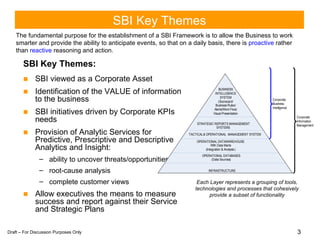
    SBI Key ThemesSBI Key Themes: SBI viewed as a Corporate Asset Identification of the VALUE of information to the business SBI initiatives driven by Corporate KPIs needs Provision of Analytic Services for Predictive, Prescriptive and Descriptive Analytics and Insight: ability to uncover threats/opportunities, root-cause analysis complete customer views Allow executives the means to measure success and report against their Service and Strategic Plans Draft – For Discussion Purposes Only Each Layer represents a grouping of tools, technologies and processes that cohesively provide a subset of functionality The fundamental purpose for the establishment of a SBI Framework is to allow the Business to work smarter and provide the ability to anticipate events, so that on a daily basis, there is proactive rather than reactive reasoning and action.
  • 4.
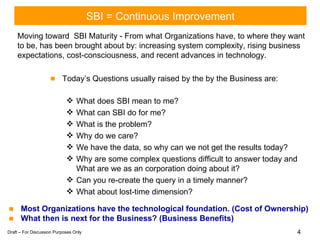
    SBI = ContinuousImprovement Most Organizations have the technological foundation. (Cost of Ownership) What then is next for the Business? (Business Benefits) Draft – For Discussion Purposes Only Moving toward SBI Maturity - From what Organizations have, to where they want to be, has been brought about by: increasing system complexity, rising business expectations, cost-consciousness, and recent advances in technology. Today’s Questions usually raised by the by the Business are: What does SBI mean to me? What can SBI do for me? What is the problem? Why do we care? We have the data, so why can we not get the results today? Why are some complex questions difficult to answer today and What are we as an corporation doing about it? Can you re-create the query in a timely manner? What about lost-time dimension?
  • 5.
    What Strategic BusinessIntelligence IS and IS NOT A SBI SYSTEM IS: Support for Decision Making Designed for Efficiencies Adapts to the Business Anticipates & Predicts Events Optimizes Query & Response Increases Corporate Agility SBI DATA (From a Data Warehouse) IS: Historical Agreed-to Period Snapshots Highly Integrated: 360 o Views Subject or Needs Oriented Detailed AND Summarized AND Derived A SBI SYSTEM IS NOT : A Daily Transactional System An Automated or Batched Systems Designed for Efficiency To Impose Structure to the Business To React to Events Optimized For Transactions SBI DATA (from a Data Warehouse) IS NOT : Real Time Current Continuously updated Source Specific Application Oriented Detailed Only Draft – For Discussion Purposes Only The fundamental purpose for the establishment of a Strategic BI (SBI) Framework is to allow the Business to work smarter , gain a competitive advantage and provide the ability to anticipate events, so that on a daily basis, there is proactive rather than reactive reasoning and action.
  • 6.
    Executive Requirements GatheringApproach Discuss : What needs are being met What needs are not currently being met. Vision/future needs . position for future state Identify: Goals and Objectives Most important issues Priorities, as they are to be set with respect to: Short term strategies in view of business change drivers – 3 months to 1 year Long term strategies in view of business change drivers – 1 to 2 Years Strategic Operation Control (SOC) - Daily View Management Reports - Weekly, Monthly View Trend/Strategic/Forecasting View – Months, Years Draft – For Discussion Purposes Only Facilitated Individual Interview Sessions Steering Committee Approval Business Area Heads Business Cases Multi-Phase, Multi-Year Strategy & Roadmap Analysis & Outcomes Needs Analysis Starts Here
  • 7.
    SBI Strategy Development Project Scope & Objectives Draft – For Discussion Purposes Only Alignment of the Strategic Business Intelligence Framework The introduction of a large corporate System usually acts as the main catalyst to the establishment of a dedicated SBI Framework. The framework will create an umbrella for effective integration of various projects to allow extraction of pertinent information for executive level decision making, reporting and support. SBI has four PILLARS for Success: Seamless Integration of Technology Simplified Data Delivery On-Demand Use Closed Loop Feedback
  • 8.
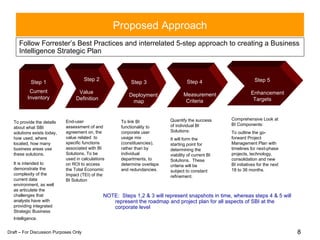
    Proposed Approach Draft– For Discussion Purposes Only Step 1 Current Inventory Step 2 Value Definition Step 3 Deployment map Step 4 Measurement Criteria Step 5 Enhancement Targets Follow Forrester’s Best Practices and interrelated 5-step approach to creating a Business Intelligence Strategic Plan To provide the details about what SBI solutions exists today, how used, where located, how many business areas use these solutions. It is intended to demonstrate the complexity of the current data environment, as well as articulate the challenges that analysts have with providing integrated Strategic Business Intelligence. End-user assessment of and agreement on, the value related to specific functions associated with BI Solutions. To be used in calculations on ROI to access the Total Economic Impact (TEI) of the BI Solution To link BI functionality to corporate user usage mix (constituencies), rather than by individual departments, to determine overlaps and redundancies. Quantify the success of individual BI Solutions: It will form the starting point for determining the viability of current BI Solutions. These criteria will be subject to constant refinement. Comprehensive Look at BI Components: To outline the go-forward Project Management Plan with timelines for next-phase projects, technology, consolidation and new BI initiatives for the next 18 to 36 months. NOTE: Steps 1,2 & 3 will represent snapshots in time, whereas steps 4 & 5 will represent the roadmap and project plan for all aspects of SBI at the corporate level
  • 9.
    Pulling it alltogether Develop A Cohesive SBI Strategy: Phase 1 : Development of the SBI Strategy (6 months) Roadmap, staging and prioritizing of the implementation of the BI Framework Identification of how to efficiently consolidate access databases & spreadsheet silos created by operational level spin-offs and drifts Identification of Follow-on Projects, Project Quick Hits & Prototypes Governance Model Definition Phase 2: Building the Supporting Structure (3- 6 Months) Governance Business Processes Detailed Corporate KPI’s Creation & Maintenance Processes Identification Standards, Policy & Procedures Definition Phase 3 : Delivery of Services ( 9-12 Months) Expanded Operational Data Warehouse SBI Tools – Integration Engines Business Users Communication & Education, Building Understanding and Feedback Loops Critical Analytical Services Groups Well Defined Draft – For Discussion Purposes Only
  • 10.
    Key Principles ofthe SBI Roadmap Solid Foundation First build a solid Governance, Education & Communication foundation and incrementally build business capabilities on top of that foundation Build on existing main information system/application Do not reduce or compromise existing capabilities during the implementation timeframe Over time, the Business Benefits increases as Costs and Delivery Times decrease . Draft – For Discussion Purposes Only Cost Benefits Delivery Time Information Management Cost of Ownership WAVE 1 – Foundation Build: BI Governance, Education & Communication Models WAVE 2 – Solution Design, Build & Implementation WAVE 3 – Solutions & Services Expansion NOTE: Building the foundation will take the most time and cost Increasingly powerful business capabilities are built onto this foundation at a significantly lower cost The potential for benefits, significantly increases, as business capabilities continue to be built and layered on the foundation
  • 11.
    Tomorrow’s SBI VisionDraft – For Discussion Purposes Only Vision Get the C-Suite and Sponsors on Board Better Strategies & Plans Better Tactics & Decisions More Efficient Processes Greater Customer Satisfaction Greater Employee Satisfaction Greater Stakeholder Value

Editor's Notes

  • #2 February 16, 2001
  • #3 February 16, 2001 BI viewed as a corporate asset to empower executives with timely and objective information for decision making Provision of predictive and descriptive analytics and insight, through reporting, data mining, text mining, and geographic/location information systems
  • #4 February 16, 2001 BI viewed as a corporate asset to empower executives with timely and objective information for decision making Provision of predictive and descriptive analytics and insight, through reporting, data mining, text mining, and geographic/location information systems
  • #5 February 16, 2001
  • #6 February 16, 2001
  • #7 February 16, 2001 Participate in high-level requirements definition Revise prototype of Augmented Profile Provide expertise on Business Area strategy, goals and current state Make decisions and resolve Business Area issues Validate and prioritize requirements against Business Area strategy Review and approve deliverables Business Lead for Release 2 delivery
  • #8 February 16, 2001 Corporate Service Delivery – enablers for Information Flow to the business
  • #9 February 16, 2001
  • #10 February 16, 2001 Possible Options for Proceeding Option 1 : Proposed Resources – 2.5 Full Time Step 1 will take us to Dec. 2006 Option 2 : Shortened Time Frame – Will require Additional Resources & subsequently, funding Step 1 could take us to Mid-Oct. 2006; Step 2 could take us from Mid-Oct. to Dec. 2006)
  • #11 February 16, 2001
  • #12 February 16, 2001