

Test Driven Development 
DOTAN PATRICH
What is TDD 
Test First Approach 
Leads to think about ‘How to use a component’ first and then about ‘How to implement’. 
As much about design technique as testing technique. 
As much about documentation as testing technique.
Principles of TDD 
Red 
Refactor Green
Principles of TDD - RED 
RED – Write Test Code 
◦ Guarantees that every functional code is testable 
◦ Provides a specification for the functional code 
◦ Helps think about design 
◦ Ensure the functional code is reachable 
Red 
Refactor Green
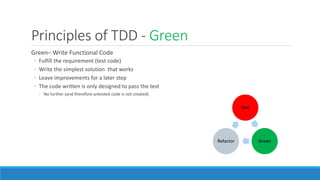
Principles of TDD - Green 
Green– Write Functional Code 
◦ Fulfill the requirement (test code) 
◦ Write the simplest solution that works 
◦ Leave improvements for a later step 
◦ The code written is only designed to pass the test 
◦ No further (and therefore untested code is not created) 
Red 
Refactor Green
Principles of TDD - Refactor 
Refactor – 
◦ Clean-up the code (test and functional) 
◦ Make sure the code express intent 
◦ Remove code smells 
◦ Re-think about design 
◦ Delete unnecessary code 
Red 
Refactor Green
How to do it? 
◦ Think about the functionality the unit need to support 
◦ Think of conceptual method signature for the unit 
◦ Write some test to validate the desired behavior 
◦ Reads like a story 
◦ One test method per concept 
◦ Naming convention for test method prefer behavior description rather underlying method name 
◦ This will often lead into refactoring 
◦ Write some code to implement the tested behavior 
◦ Refactor the code and unit test to avoid duplication & simplify dependencies
Take me to the code! 
TDD for order class: 
◦ Visualize the Order unit and behavior 
◦ Will result in some class diagram and stub implementation 
◦ Just declare methods and dependencies – do not implement them
Take me to the code! 
TDD for order class: 
◦ Visualize the Order unit and behavior 
◦ Will result in some class diagram and stub implementation 
◦ Just declare methods and dependencies – do not implement them 
Write some unit test: 
◦ One method per behavior 
◦ Notice naming convention is not aligned Java coding style
Take me to the code! 
TDD for order class: 
◦ Visualize the Order unit and behavior 
◦ Will result in some class diagram and stub implementation 
◦ Just declare methods and dependencies – do not implement them 
Write some unit test: 
◦ One method per behavior 
Refactor: 
◦ Mock Inventory – requires refactoring
Tools of the trade 
Interfaces 
Unit Test Framework 
◦ JUnit 4/NGUnit 
◦ Hamcrest Matchers – recommended for improved readability and expressiveness 
Dependency Injection 
◦ Spring 
◦ Guice 
Mocking Framework 
◦ Mockito
Guidelines for Testable Design 
Choose composition over inheritance 
Avoid static and the hard coded Singleton 
Isolate Dependencies 
Inject Dependencies
But how much longer will it take? 
Studies 
◦ Take 15-30% longer 
◦ 45-90% fewer bugs 
◦ Takes X10 as long to fix a bug in later phases 
Study by Microsoft and IBM - 
http://research.microsoft.com/en-us/ 
groups/ese/nagappan_tdd.pdf 
“If it doesn’t have to work, I can get it done a lot faster” – Kent Beck
Why TDD? 
No dead code 
Simple design 
Have full-coverage test code so maintenance and refactoring are easy 
Executable documentation 
No (or minimal) debugging 
Confidence in change

TDD

  • 1.
  • 2.
    What is TDD Test First Approach Leads to think about ‘How to use a component’ first and then about ‘How to implement’. As much about design technique as testing technique. As much about documentation as testing technique.
  • 3.
    Principles of TDD Red Refactor Green
  • 4.
    Principles of TDD- RED RED – Write Test Code ◦ Guarantees that every functional code is testable ◦ Provides a specification for the functional code ◦ Helps think about design ◦ Ensure the functional code is reachable Red Refactor Green
  • 5.
    Principles of TDD- Green Green– Write Functional Code ◦ Fulfill the requirement (test code) ◦ Write the simplest solution that works ◦ Leave improvements for a later step ◦ The code written is only designed to pass the test ◦ No further (and therefore untested code is not created) Red Refactor Green
  • 6.
    Principles of TDD- Refactor Refactor – ◦ Clean-up the code (test and functional) ◦ Make sure the code express intent ◦ Remove code smells ◦ Re-think about design ◦ Delete unnecessary code Red Refactor Green
  • 7.
    How to doit? ◦ Think about the functionality the unit need to support ◦ Think of conceptual method signature for the unit ◦ Write some test to validate the desired behavior ◦ Reads like a story ◦ One test method per concept ◦ Naming convention for test method prefer behavior description rather underlying method name ◦ This will often lead into refactoring ◦ Write some code to implement the tested behavior ◦ Refactor the code and unit test to avoid duplication & simplify dependencies
  • 8.
    Take me tothe code! TDD for order class: ◦ Visualize the Order unit and behavior ◦ Will result in some class diagram and stub implementation ◦ Just declare methods and dependencies – do not implement them
  • 9.
    Take me tothe code! TDD for order class: ◦ Visualize the Order unit and behavior ◦ Will result in some class diagram and stub implementation ◦ Just declare methods and dependencies – do not implement them Write some unit test: ◦ One method per behavior ◦ Notice naming convention is not aligned Java coding style
  • 10.
    Take me tothe code! TDD for order class: ◦ Visualize the Order unit and behavior ◦ Will result in some class diagram and stub implementation ◦ Just declare methods and dependencies – do not implement them Write some unit test: ◦ One method per behavior Refactor: ◦ Mock Inventory – requires refactoring
  • 11.
    Tools of thetrade Interfaces Unit Test Framework ◦ JUnit 4/NGUnit ◦ Hamcrest Matchers – recommended for improved readability and expressiveness Dependency Injection ◦ Spring ◦ Guice Mocking Framework ◦ Mockito
  • 12.
    Guidelines for TestableDesign Choose composition over inheritance Avoid static and the hard coded Singleton Isolate Dependencies Inject Dependencies
  • 13.
    But how muchlonger will it take? Studies ◦ Take 15-30% longer ◦ 45-90% fewer bugs ◦ Takes X10 as long to fix a bug in later phases Study by Microsoft and IBM - http://research.microsoft.com/en-us/ groups/ese/nagappan_tdd.pdf “If it doesn’t have to work, I can get it done a lot faster” – Kent Beck
  • 14.
    Why TDD? Nodead code Simple design Have full-coverage test code so maintenance and refactoring are easy Executable documentation No (or minimal) debugging Confidence in change