3rd Draft 10/11/2010
Can Tai Chi Classes be Offered by Exercise
Referral Schemes?
The Effects of a Tai Chi Class on Subjective Exercise Experiences
Dr Stan Baltsezak1
, Dr Greg Dilliway2
1
Specialist Registrar in Sport and Exercise Medicine, A&E Department, Salford Royal NHS Foundation Trust, Stott Lane,
Salford, M6 8HD, UK. 2
Consultant in Public Health, NHS North Lancashire PCT, Lancaster, UK.
This study examines short terms effects of a
Tai Chi (TC) class on subjective well being of
people referred to exercise referral scheme
(ERS).
Since the early 1990’s over 800 ERS were
developed in the UK, majority being leisure
centre based1
.
ERS are aimed at local residents who can
benefit from more active lifestyle.
General Practitioners and Practice Nurses refer
patients to ERS for a period of supervised
exercise with the view to improving their
mental and/or physical health.
Subjective psychological states that occur
during and after exercise are likely predictors
of whether individuals are willing to adopt
and maintain lifestyles that include physical
activity2
.
Therefore if TC class improves psychological
affect it could be included in the range
of physical activities offered to the ERS
participants.
This is the first study in the UK exploring
psychological effects of Tai Chi on people
taking part in exercise referral scheme.
Even though physical activity can be
stressful, it has been demonstrated that
it reduces the harmful effects of other
stressors, anxiety and depression when
performed at moderate intensity7
.
The results showed immediate psychological
benefits after participating in a single TC
class. It is not clear whether observed effects
were due to specifics of TC exercise or various
other factors since positive psychological
experience can occur when we engage in
activities we find interesting and satisfying.
An important finding was that a single TC
class had positive effect on class participants
therefore TC could be a form of activity
some people would do on a regular basis.
TC can be included in the range of physical
activities offered by ERS.
1. 	LRD Labour Research Group (2004) Exercise on Prescription: a report for the chartered society
of physiotherapy (2004 Sept.12)
2. 	RejeskiW, Gauvin L, Hobson M et al. Effects of baseline responses, in-task feelings, and
duration of activity on exercise-induced feelings states in women. HealthPsychology,1995,Vol
14(4),350-359
3. 	McAuley E, Courneya K. The subjective exercise experience scale: development and
preliminary validation. JSportExercPsychol1994;16:163-177.
4. 	Marshall A, Smith B, Bauman A et al. Reliability and validity of brief physical activity
assessment for use by family doctors. BrJSportsMed2005:39:294-297.
5. 	Borg, Gunnar A. Psychological bases of perceived exertion. MedSciSpotsExercise1982;
14(5):377-381.
6.	 Li JX, HongY, Chan KM. Tai chi: physiological characteristics and beneficial effects on health.
BrJSportsMed2001;35:148-156.
7.	Sundlund E and NorlanderT. The effects ofTai Chi Chuan relaxation and exercise on stress
responses and well being: an overview of research. IntlJofStressManagement,2000;Vol7
(2):139-149.
We would like to thank Donna Swarbrick
and Lancaster Active Health Team for their
assistance with recruiting study volunteers.
Brief Physical Activity Assessment:
Subjective Exercise Experience Scale:
Table 1
Rate of Perceived Exertion
Tai Chi class consisted of:
1. Warm up - 15 min
2. Learning TC movements - 25 min
3. Performing Yang style 8 steps form - 7 min
4. Cool down - 3 min
Balance exercises (above) were found by the
study participants as one of the most
challenging elements of TC class.
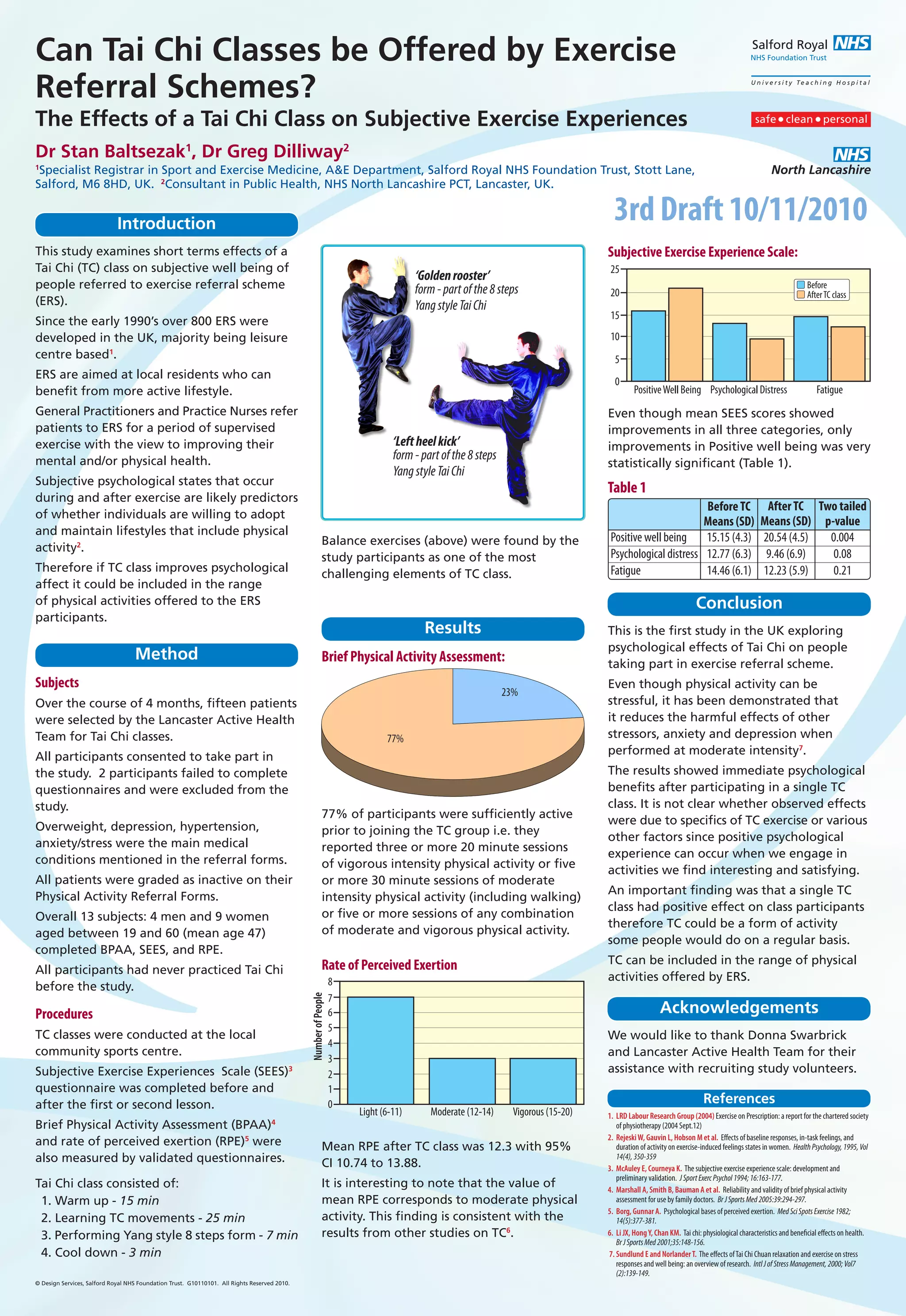
77% of participants were sufficiently active
prior to joining the TC group i.e. they
reported three or more 20 minute sessions
of vigorous intensity physical activity or five
or more 30 minute sessions of moderate
intensity physical activity (including walking)
or five or more sessions of any combination
of moderate and vigorous physical activity.
Even though mean SEES scores showed
improvements in all three categories, only
improvements in Positive well being was very
statistically significant (Table 1).
Mean RPE after TC class was 12.3 with 95%
CI 10.74 to 13.88.
It is interesting to note that the value of
mean RPE corresponds to moderate physical
activity. This finding is consistent with the
results from other studies on TC6
.
‘Goldenrooster’
form-partofthe8steps
YangstyleTaiChi
Subjects
Over the course of 4 months, fifteen patients
were selected by the Lancaster Active Health
Team for Tai Chi classes.
All participants consented to take part in
the study. 2 participants failed to complete
questionnaires and were excluded from the
study.
Overweight, depression, hypertension,
anxiety/stress were the main medical
conditions mentioned in the referral forms.
All patients were graded as inactive on their
Physical Activity Referral Forms.
Overall 13 subjects: 4 men and 9 women
aged between 19 and 60 (mean age 47)
completed BPAA, SEES, and RPE.
All participants had never practiced Tai Chi
before the study.
Procedures
TC classes were conducted at the local
community sports centre.
Subjective Exercise Experiences Scale (SEES)3
questionnaire was completed before and
after the first or second lesson.
Brief Physical Activity Assessment (BPAA)4
and rate of perceived exertion (RPE)5
were
also measured by validated questionnaires.
Introduction
Conclusion
References
Acknowledgements
Results
Method
© Design Services, Salford Royal NHS Foundation Trust. G10110101. All Rights Reserved 2010.
NumberofPeople
Positive well being
Psychological distress
Fatigue
0.004
0.08
0.21
Two tailed
p-value
20.54 (4.5)
9.46 (6.9)
12.23 (5.9)
AfterTC
Means (SD)
15.15 (4.3)
12.77 (6.3)
14.46 (6.1)
BeforeTC
Means (SD)
8
25
7
6
20
5
15
4
0
0
1
Light (6-11)
PositiveWell Being
Moderate (12-14)
PsychologicalDistress
Vigorous (15-20)
Fatigue
2
5
3
10
Before
AfterTC class
23%
77%
‘Leftheelkick’
form-partofthe8steps
YangstyleTaiChi

TC_poster

  • 1.
    3rd Draft 10/11/2010 CanTai Chi Classes be Offered by Exercise Referral Schemes? The Effects of a Tai Chi Class on Subjective Exercise Experiences Dr Stan Baltsezak1 , Dr Greg Dilliway2 1 Specialist Registrar in Sport and Exercise Medicine, A&E Department, Salford Royal NHS Foundation Trust, Stott Lane, Salford, M6 8HD, UK. 2 Consultant in Public Health, NHS North Lancashire PCT, Lancaster, UK. This study examines short terms effects of a Tai Chi (TC) class on subjective well being of people referred to exercise referral scheme (ERS). Since the early 1990’s over 800 ERS were developed in the UK, majority being leisure centre based1 . ERS are aimed at local residents who can benefit from more active lifestyle. General Practitioners and Practice Nurses refer patients to ERS for a period of supervised exercise with the view to improving their mental and/or physical health. Subjective psychological states that occur during and after exercise are likely predictors of whether individuals are willing to adopt and maintain lifestyles that include physical activity2 . Therefore if TC class improves psychological affect it could be included in the range of physical activities offered to the ERS participants. This is the first study in the UK exploring psychological effects of Tai Chi on people taking part in exercise referral scheme. Even though physical activity can be stressful, it has been demonstrated that it reduces the harmful effects of other stressors, anxiety and depression when performed at moderate intensity7 . The results showed immediate psychological benefits after participating in a single TC class. It is not clear whether observed effects were due to specifics of TC exercise or various other factors since positive psychological experience can occur when we engage in activities we find interesting and satisfying. An important finding was that a single TC class had positive effect on class participants therefore TC could be a form of activity some people would do on a regular basis. TC can be included in the range of physical activities offered by ERS. 1. LRD Labour Research Group (2004) Exercise on Prescription: a report for the chartered society of physiotherapy (2004 Sept.12) 2. RejeskiW, Gauvin L, Hobson M et al. Effects of baseline responses, in-task feelings, and duration of activity on exercise-induced feelings states in women. HealthPsychology,1995,Vol 14(4),350-359 3. McAuley E, Courneya K. The subjective exercise experience scale: development and preliminary validation. JSportExercPsychol1994;16:163-177. 4. Marshall A, Smith B, Bauman A et al. Reliability and validity of brief physical activity assessment for use by family doctors. BrJSportsMed2005:39:294-297. 5. Borg, Gunnar A. Psychological bases of perceived exertion. MedSciSpotsExercise1982; 14(5):377-381. 6. Li JX, HongY, Chan KM. Tai chi: physiological characteristics and beneficial effects on health. BrJSportsMed2001;35:148-156. 7. Sundlund E and NorlanderT. The effects ofTai Chi Chuan relaxation and exercise on stress responses and well being: an overview of research. IntlJofStressManagement,2000;Vol7 (2):139-149. We would like to thank Donna Swarbrick and Lancaster Active Health Team for their assistance with recruiting study volunteers. Brief Physical Activity Assessment: Subjective Exercise Experience Scale: Table 1 Rate of Perceived Exertion Tai Chi class consisted of: 1. Warm up - 15 min 2. Learning TC movements - 25 min 3. Performing Yang style 8 steps form - 7 min 4. Cool down - 3 min Balance exercises (above) were found by the study participants as one of the most challenging elements of TC class. 77% of participants were sufficiently active prior to joining the TC group i.e. they reported three or more 20 minute sessions of vigorous intensity physical activity or five or more 30 minute sessions of moderate intensity physical activity (including walking) or five or more sessions of any combination of moderate and vigorous physical activity. Even though mean SEES scores showed improvements in all three categories, only improvements in Positive well being was very statistically significant (Table 1). Mean RPE after TC class was 12.3 with 95% CI 10.74 to 13.88. It is interesting to note that the value of mean RPE corresponds to moderate physical activity. This finding is consistent with the results from other studies on TC6 . ‘Goldenrooster’ form-partofthe8steps YangstyleTaiChi Subjects Over the course of 4 months, fifteen patients were selected by the Lancaster Active Health Team for Tai Chi classes. All participants consented to take part in the study. 2 participants failed to complete questionnaires and were excluded from the study. Overweight, depression, hypertension, anxiety/stress were the main medical conditions mentioned in the referral forms. All patients were graded as inactive on their Physical Activity Referral Forms. Overall 13 subjects: 4 men and 9 women aged between 19 and 60 (mean age 47) completed BPAA, SEES, and RPE. All participants had never practiced Tai Chi before the study. Procedures TC classes were conducted at the local community sports centre. Subjective Exercise Experiences Scale (SEES)3 questionnaire was completed before and after the first or second lesson. Brief Physical Activity Assessment (BPAA)4 and rate of perceived exertion (RPE)5 were also measured by validated questionnaires. Introduction Conclusion References Acknowledgements Results Method © Design Services, Salford Royal NHS Foundation Trust. G10110101. All Rights Reserved 2010. NumberofPeople Positive well being Psychological distress Fatigue 0.004 0.08 0.21 Two tailed p-value 20.54 (4.5) 9.46 (6.9) 12.23 (5.9) AfterTC Means (SD) 15.15 (4.3) 12.77 (6.3) 14.46 (6.1) BeforeTC Means (SD) 8 25 7 6 20 5 15 4 0 0 1 Light (6-11) PositiveWell Being Moderate (12-14) PsychologicalDistress Vigorous (15-20) Fatigue 2 5 3 10 Before AfterTC class 23% 77% ‘Leftheelkick’ form-partofthe8steps YangstyleTaiChi