JoDaviess
Carroll
Whiteside
Green
Rock
Stephenson
Ogle
Lee
Jones
Cedar
Jackson
Clinton
DubuqueDelaware
Winnebago Boone
Henry
Bureau
Scott
Rock Island
Lafayette
Grant
Iowa
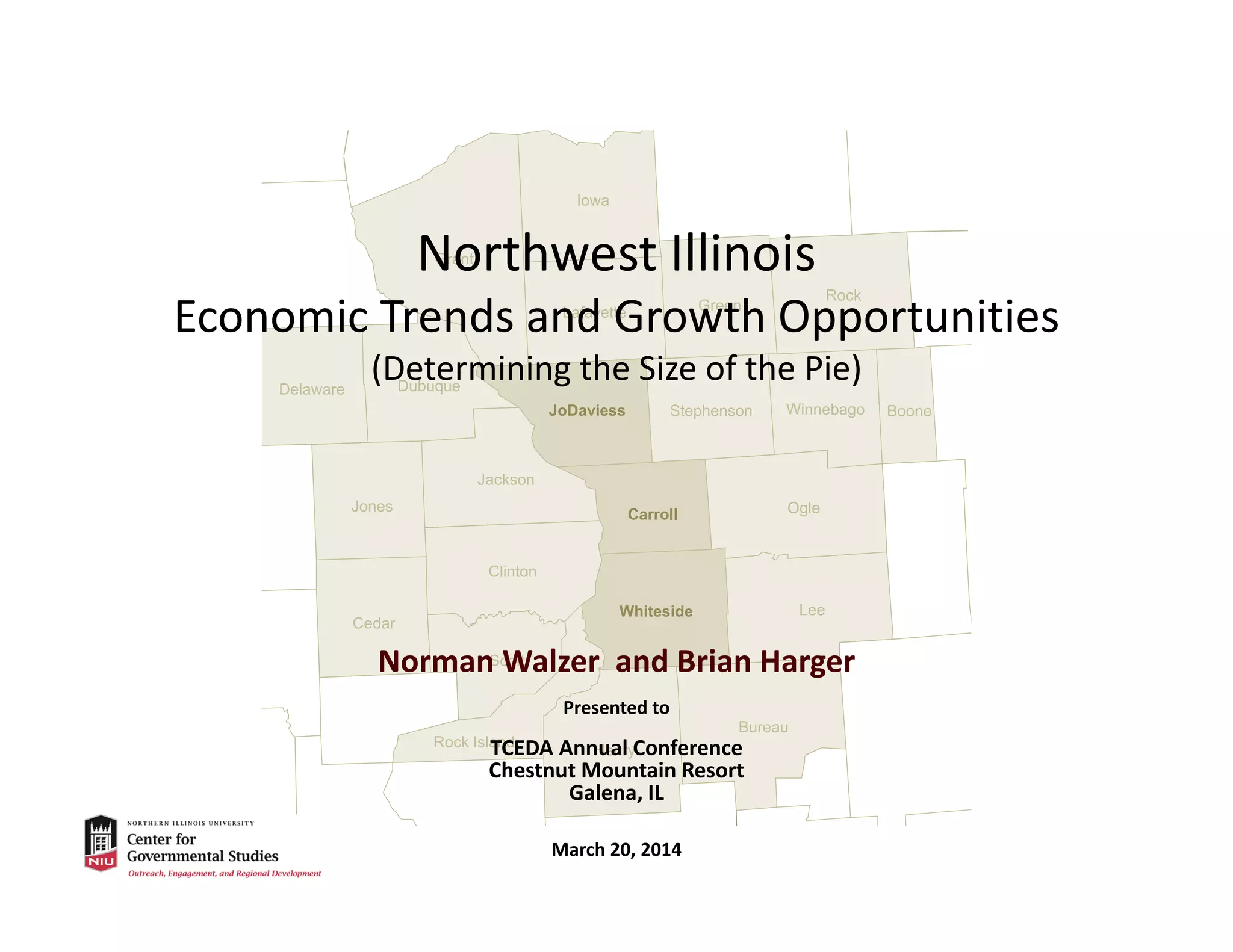
Northwest Illinois
Economic Trends and Growth Opportunities
(Determining the Size of the Pie)
Norman Walzer and Brian Harger
Presented to
TCEDA Annual Conference
Chestnut Mountain Resort
Galena, IL
March 20, 2014
Presentation Overview
• Population and Economic Trends
• Composition of TCEDA Economy
• Business Starts and Entrepreneurship Opportunities
• Possible Areas for Growth
• Where Can We Go Next?
2
‐0.5% ‐0.4%
‐4.3%
‐0.3% ‐7.3%
‐4.0% ‐4.5%
7.0%
‐4.7%
‐15.2%
‐21.8% ‐22.2%
0.5%
22.3%
38.3%
50.0%
24.8%
6.0%
‐35%
‐20%
‐5%
10%
25%
40%
55%
70%
Percent Change 2013‐2025
Population Age Cohort
Source:  Woods & Poole Economics, Inc., 2013
Decrease 
less than 100
Decrease by 600
Decrease
less than 100 Decrease by 2,800 Increase by 1,500
Increase by
2,600
Generation 
Alpha
Generation Z Millennial
Baby Bust
(Generation X)
Baby Boom
Silent 
Generation
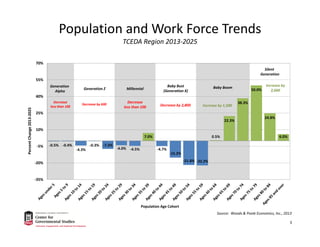
Population and Work Force Trends
TCEDA Region 2013‐2025
3
Economic Trends
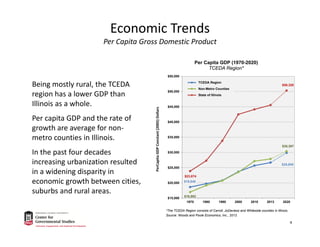
Per Capita Gross Domestic Product
Being mostly rural, the TCEDA 
region has a lower GDP than 
Illinois as a whole.
Per capita GDP and the rate of 
growth are average for non‐
metro counties in Illinois.
In the past four decades 
increasing urbanization resulted 
in a widening disparity in 
economic growth between cities, 
suburbs and rural areas.
4
*The TCEDA Region consists of Carroll, JoDaviess and Whiteside counties in Illinois.
Source: Woods and Poole Economics, Inc., 2013.
$18,640
$29,855
$16,992
$30,397
$23,874
$50,320
$15,000
$20,000
$25,000
$30,000
$35,000
$40,000
$45,000
$50,000
$55,000
1970 1980 1990 2000 2010 2013 2020
PerCapita GDP Constant (2005) Dollars
Per Capita GDP (1970-2020)
TCEDA Region*
TCEDA Region
Non-Metro Counties
State of Illinois
Income Trends
Earning Per Worker by Industry
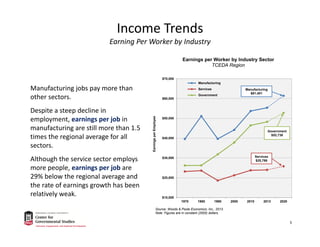
Manufacturing jobs pay more than 
other sectors.
Despite a steep decline in 
employment, earnings per job in 
manufacturing are still more than 1.5 
times the regional average for all 
sectors.
Although the service sector employs 
more people, earnings per job are 
29% below the regional average and 
the rate of earnings growth has been 
relatively weak. $10,000
$20,000
$30,000
$40,000
$50,000
$60,000
$70,000
1970 1980 1990 2000 2010 2013 2020
EarningsperEmployee
Earnings per Worker by Industry Sector
TCEDA Region
Manufacturing
Services
Government
Government
$52,738
Services
$25,786
Manufacturing
$61,401
Source: Woods & Poole Economics, Inc., 2013.
Note: Figures are in constant (2005) dollars.
5
Employment Trends
Employment by Industry
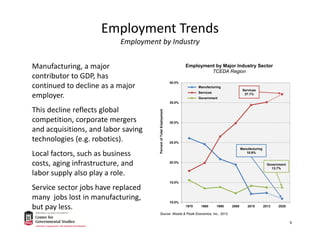
Manufacturing, a major 
contributor to GDP, has 
continued to decline as a major 
employer. 
This decline reflects global 
competition, corporate mergers 
and acquisitions, and labor saving 
technologies (e.g. robotics).
Local factors, such as business 
costs, aging infrastructure, and 
labor supply also play a role.
Service sector jobs have replaced 
many  jobs lost in manufacturing, 
but pay less.
10.0%
15.0%
20.0%
25.0%
30.0%
35.0%
40.0%
1970 1980 1990 2000 2010 2013 2020
PercentofTotalEmployment
Employment by Major Industry Sector
TCEDA Region
Manufacturing
Services
Government
Source: Woods & Poole Economics, Inc., 2013.
Services
37.1%
Manufacturing
10.9%
Government
13.7%
6
7.6%
JoDaviess
8.7%
8.9%
Carroll
4.8%
9.5%
Whiteside
2.6%
6.0%
Green
0.2%
8.1%
Rock
0.2%
10.1%
Stephenson
9.6%
10.7%
Ogle
7.0%
9.2%
Lee
5.2%
5.5%
Jones
0.3%
4.1%
Cedar
0.6%
5.4%
Jackson
1.7%
5.4%
Clinton
4.5%
4.5%
Dubuque
7.9%
4.0%
Delaware
3.1%
11.6%
Winnebago
1.3%
11.5%
Boone
1.1%
7.8%
Henry
3.0%
9.6%
Bureau
7.7%
6.0%
Scott
3.0%
7.9%
Rock Island
4.2%
5.6%
Lafayette
1.0%
5.8%
Grant
2.2%
6.2%
Iowa
0.1%
Employment Trends
Tri‐State Region
LEGEND
Illinois = 9.2%
0.4%
Iowa = 4.8%
0.6%
Wisconsin = 6.7%
0.2%
U.S. = 7.4%
6.1%
Source: U.S. Bureau of Labor
Statistics.
Data are not seasonally adjusted.
Top Figure:
2013 Unemployment Rate
Bottom Figure:
Percent Change in
Non-Farm Employment
July, 2009 – January, 2014
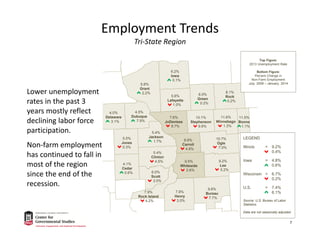
Lower unemployment 
rates in the past 3 
years mostly reflect 
declining labor force 
participation. 
Non‐farm employment  
has continued to fall in 
most of the region 
since the end of the 
recession. 
7
Agriculture, 
Mining & 
Related
6.5%
Construction
3.1%
Manufacturing
22.0%
Wholesale & 
Retail Trade
10.9%Transportation, 
Information, 
Warehousing & 
Utilities
10.9%
Finance, 
Insurance & Real 
Estate
17.9%
Professional, 
Scientific & 
Technical 
Services
6.4%
Education, 
Healthcare & 
Social Services
3.6%
Other Services
7.8%
Public 
Administration
11.0%
TCEDA Region
Economic Composition
Gross Domestic Product by Industry, 2012
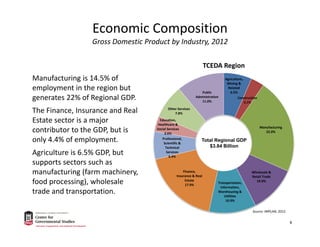
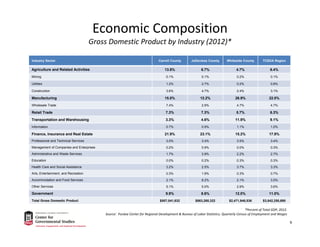
Manufacturing is 14.5% of 
employment in the region but 
generates 22% of Regional GDP.
The Finance, Insurance and Real 
Estate sector is a major 
contributor to the GDP, but is 
only 4.4% of employment.
Agriculture is 6.5% GDP, but 
supports sectors such as 
manufacturing (farm machinery, 
food processing), wholesale 
trade and transportation.
Total Regional GDP
$3.84 Billion
8
Source: IMPLAN, 2012.
Economic Composition
Gross Domestic Product by Industry (2012)*
Industry Sector Carroll County JoDaviess County Whiteside County TCEDA Region
Agriculture and Related Activities 13.8% 6.7% 4.7% 6.4%
Mining 0.1% 0.1% 0.2% 0.1%
Utilities 1.2% 2.7% 0.2% 0.8%
Construction 3.6% 4.7% 2.4% 3.1%
Manufacturing 15.0% 12.2% 26.9% 22.0%
Wholesale Trade 7.4% 2.9% 4.7% 4.7%
Retail Trade 7.3% 7.3% 5.7% 6.3%
Transportation and Warehousing 3.3% 4.6% 11.9% 9.1%
Information 0.7% 0.9% 1.1% 1.0%
Finance, Insurance and Real Estate 21.9% 23.1% 15.2% 17.9%
Professional and Technical Services 3.0% 3.4% 3.5% 3.4%
Management of Companies and Enterprises 0.2% 0.9% 0.0% 0.3%
Administrative and Waste Services 1.7% 3.9% 2.2% 2.7%
Education 0.0% 0.2% 0.3% 0.3%
Health Care and Social Assistance 3.2% 2.5% 3.7% 3.3%
Arts, Entertainment, and Recreation 0.3% 1.9% 0.3% 0.7%
Accommodation and Food Services 2.1% 8.2% 2.1% 3.5%
Other Services 5.1% 5.0% 2.9% 3.6%
Government 9.9% 8.6% 12.0% 11.0%
Total Gross Domestic Product $507,041,832 $863,260,322 $2,471,948,536 $3,842,250,690
.
*Percent of Total GDP, 2012.
Source:  Purdue Center for Regional Development & Bureau of Labor Statistics, Quarterly Census of Employment and Wages
9
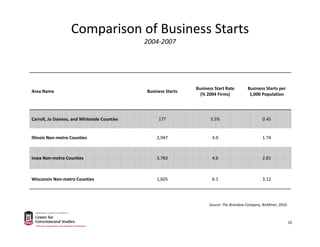
Area Name Business Starts
Business Start Rate 
(% 2004 Firms)
Business Starts per 
1,000 Population
Carroll, Jo Daviess, and Whiteside Counties 177 3.5% 0.45
Illinois Non‐metro Counties 2,947 4.0 1.74
Iowa Non‐metro Counties 3,783 4.6 2.81
Wisconsin Non‐metro Counties 1,605 6.1 3.12
Comparison of Business Starts
2004‐2007
Source: The Brandow Company, BizMiner, 2010.
10
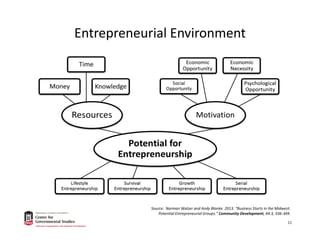
Entrepreneurial Environment
Source:  Norman Walzer and Andy Blanke. 2013. “Business Starts in the Midwest: 
Potential Entrepreneurial Groups.” Community Development, 44:3, 336‐349.
11
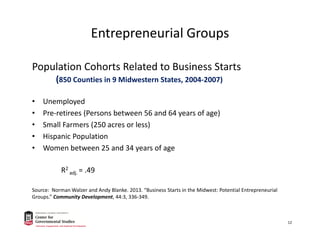
Entrepreneurial Groups
Population Cohorts Related to Business Starts
(850 Counties in 9 Midwestern States, 2004‐2007)
• Unemployed
• Pre‐retirees (Persons between 56 and 64 years of age)
• Small Farmers (250 acres or less)
• Hispanic Population
• Women between 25 and 34 years of age
R2 
adj. = .49
Source:  Norman Walzer and Andy Blanke. 2013. “Business Starts in the Midwest: Potential Entrepreneurial 
Groups.” Community Development, 44:3, 336‐349.
12
Opportunities for Growth
TCEDA Region
• Proximity To Urban Growth Centers (E.G. Dubuque, Quad‐cities & Chicago)
• Former Savanna Army Depot With Additional Investments in Infrastructure
• Federal Prison Facility In Thomson Offers Business Opportunities for 
Suppliers plus Increased Housing and Retail Markets
• “Re‐shoring” of Manufacturing Activities has Job Creation Potential
• Local Food Movement Increases Markets for Agri‐business Firms 
• Proximity to Iowa And Wisconsin Provides Access to Broad Markets 
• Looming Demand for Workers to Replace Retiring “Baby Boomers” will be 
the Main Job Openings in the Next Decade 
• Higher Level of Training and Skills will be Required to Work with Complex 
Technologies (Robotics, 3D Printing And Nano‐manufacturing). 
13
Where Can We Go From Here?
• Promote and Support Business Startups and Expand 2nd Stage  Companies.
• Focus on More Skilled and High‐paying Job Opportunities.
• Expand Training Opportunities to Replace Retiring Workers (“Boomers”).
• Meet The Demands for Healthcare and Other Services for the Elderly      
(Especially Housing, Travel And Recreation).
• Promote And Market High Quality Of Life And Regional Assets.
• Use Quality Jobs To Attract And Retain Residents (Especially Youth).
• Leverage Growth Opportunities In Tri‐state Area (e.g. I.T. in Dubuque; Farm 
Machinery Mfg. and Food Processing in Clinton and Quad Cities; Aerospace, 
Construction Machinery Mfg. and Auto Mfg. in Rockford & Peoria).
14
Additional Resources
• B. Harger, M. Henriksen, N. Walzer, and A.  Blanke. 2013. Promoting 
Prosperity in Northwest Illinois. DeKalb, IL:  Center for Governmental 
Studies. 
• B. Harger, M. Henriksen, and N. Walzer. 2011. West Whiteside County, IL: 
Assessing Economic Opportunities. DeKalb, IL: Center for Governmental 
Studies.
• N. Walzer and B. Harger. 2011. “Tri‐State Alliance Economy: Past Trends 
and Implications for the Future”. Presentation to Annual Meeting of Tri‐
State Alliance, Rockford, IL.
• G.F. Hamm and N. Walzer. 2009. Stimulating Entrepreneurship in Carroll 
County. Macomb, IL: Illinois Institute for Rural Affairs.
15
For More Information, Contact
Norman Walzer
Senior Research Scholar
(nwalzer@niu.edu)
Center for Governmental Studies
Northern Illinois University
DeKalb, Illinois  60115
“CGS Builds Stronger Regions Through Innovation and Collaboration”
16

Northwest Illinois Economic Trends and Growth Opportunities