Urban Renaissance through Science, Technology and InnovationTBED21Technology-based Economic Development for the 21st Century
Executive Management TeamChad Womack, PhD, PresidentDr. Womack is the Founder and currently serves as the President and Chair of TBED21, and is the founding Executive Director of the Philadelphia Biotechnology and Life Sciences Institute - a non-profit initiative and project of TBED21.  Dr. Womack has recently served as Vice President for Educational and Training Initiatives at the University City Science Center in Philadelphia. Dr. Womack is also a Co-Founder of 3Gen Vaccines Inc.. a nanobiotechnology company and has served as its Chief Scientific Officer since its inception.Lawrence J. Agulnick, Executive Vice PresidentLawrence Agulnick is the co-Founder, Executive Vice President and Corporate Secretary of TBED21.  He is an experienced leader in operations and governance relating to technology based economic development having worked extensively in the United States and in an advisory capacity to the Ministry of Economy Trade and Industry (METI in Japan) and the Incheon Free Economic Zone (IFEZ in Korea). Ken Tolson, Principal TBED21 Urban Policy GroupKen Tolson is a 21st century knowledge worker with an unyielding commitment to deliver service and technology innovation to the public and private sectors. Ken has served the former Clinton and Bush Administrations by bringing accountability, governance and transparency initiatives to help transform the federal government to focus resources on the citizen. Ken has been successful in the IT industry at the international, federal, state and local level managing large multi-billion dollar technology programs, and has been recognized for having established innovative ways to align technology resources and technology commercialization with ever changing requirements within the National Capital Region.
Partial List of Our PartnersNationalThe National Urban LeagueCongressional Black Caucus (Science & Technology Committee)National Association of Blacks in BioNational Conference of Black MayorsWashington, DCDC Public SchoolsHoward UniversityCenter for Minority Achievement in Science and Technology (CMAST)Carnegie Institution for ScienceOffice of the State Superintendent for EducationWashington, D.C. STEM PartnershipOffice of the Deputy Mayor for EducationOffice of the Deputy Mayor for Planning and Economic DevelopmentPhiladelphia, PAThe School District of PhiladelphiaThe Philadelphia STEM AllianceThe Franklin InstituteAccess Science, University of PennsylvaniaUniversal CompaniesPA Legislative Black CaucusCherokee PharmaceuticalsCephalon
The Challenge:The global economy has become increasingly technology-focused and promises to generate trillions of dollars in commerce from the development of new technologies such as nanotechnology, biotechnology and clean energy or ‘green’ technology
Regions or places that can provide the necessary ingredients for the emerging tech-economy and implement tech-based economic development (TBED) strategies will remain competitive and economically relevant in the 21st century.
In the U.S., metropolitan regions and their urban centers have the necessary ingredients to develop and successfully implement effective 21st century TBED strategies.However, urban centers and underserved communities continue to be disconnected from the promise and the economic opportunities the global tech-economy will bring in the 21st century.The Opportunity:Through a next generation approach towards tech-based economic development or TBED 2.0, we have an historic opportunity to realize the full economic potential of our urban centers and underserved communities.  TBED21, Inc. is assisting metropolitan regions, urban centers and empowering underserved communities to fully realize and unleash their economic potential as engines of economic growth.  We believe that implementing next generation TBED strategies will ensure the economic future of our underserved communities, the vitality of urban centers and our nation’s competitiveness.
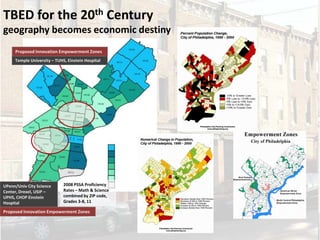
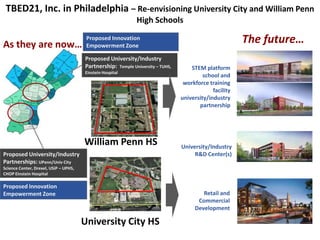
TBED for the 20th Centurygeography becomes economic destiny Proposed Innovation Empowerment ZonesTemple University – TUHS, Einstein Hospital2008 PSSA Proficiency Rates – Math & Science combined by ZIP code, Grades 3-8, 11UPenn/Univ City Science Center, Drexel, USiP – UPHS, CHOP Einstein HospitalProposed Innovation Empowerment Zones
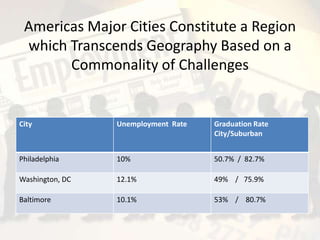
Americas Major Cities Constitute a Region which Transcends Geography Based on a Commonality of Challenges
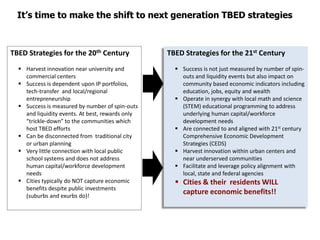
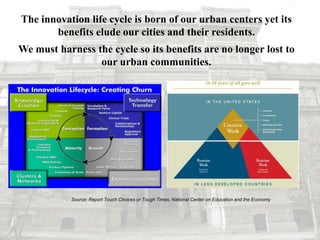
It’s time to make the shift to next generation TBED strategiesTBED Strategies for the 20th CenturyHarvest innovation near university and commercial centers
Success is dependent upon IP portfolios, tech-transfer  and local/regional entrepreneurship
Success is measured by number of spin-outs and liquidity events. At best, rewards only “trickle-down” to the communities which host TBED efforts
Can be disconnected from  traditional city or urban planning
Very little connection with local public school systems and does not address human capital/workforce development needs
Cities typically do NOT capture economic benefits despite public investments (suburbs and exurbs do)!TBED Strategies for the 21st CenturySuccess is not just measured by number of spin-outs and liquidity events but also impact on community based economic indicators including education, jobs, equity and wealth
Operate in synergy with local math and science (STEM) educational programming to address underlying human capital/workforce development needs

Tbed21 An Overview

  • 1.
    Urban Renaissance throughScience, Technology and InnovationTBED21Technology-based Economic Development for the 21st Century
  • 2.
    Executive Management TeamChadWomack, PhD, PresidentDr. Womack is the Founder and currently serves as the President and Chair of TBED21, and is the founding Executive Director of the Philadelphia Biotechnology and Life Sciences Institute - a non-profit initiative and project of TBED21.  Dr. Womack has recently served as Vice President for Educational and Training Initiatives at the University City Science Center in Philadelphia. Dr. Womack is also a Co-Founder of 3Gen Vaccines Inc.. a nanobiotechnology company and has served as its Chief Scientific Officer since its inception.Lawrence J. Agulnick, Executive Vice PresidentLawrence Agulnick is the co-Founder, Executive Vice President and Corporate Secretary of TBED21. He is an experienced leader in operations and governance relating to technology based economic development having worked extensively in the United States and in an advisory capacity to the Ministry of Economy Trade and Industry (METI in Japan) and the Incheon Free Economic Zone (IFEZ in Korea). Ken Tolson, Principal TBED21 Urban Policy GroupKen Tolson is a 21st century knowledge worker with an unyielding commitment to deliver service and technology innovation to the public and private sectors. Ken has served the former Clinton and Bush Administrations by bringing accountability, governance and transparency initiatives to help transform the federal government to focus resources on the citizen. Ken has been successful in the IT industry at the international, federal, state and local level managing large multi-billion dollar technology programs, and has been recognized for having established innovative ways to align technology resources and technology commercialization with ever changing requirements within the National Capital Region.
  • 3.
    Partial List ofOur PartnersNationalThe National Urban LeagueCongressional Black Caucus (Science & Technology Committee)National Association of Blacks in BioNational Conference of Black MayorsWashington, DCDC Public SchoolsHoward UniversityCenter for Minority Achievement in Science and Technology (CMAST)Carnegie Institution for ScienceOffice of the State Superintendent for EducationWashington, D.C. STEM PartnershipOffice of the Deputy Mayor for EducationOffice of the Deputy Mayor for Planning and Economic DevelopmentPhiladelphia, PAThe School District of PhiladelphiaThe Philadelphia STEM AllianceThe Franklin InstituteAccess Science, University of PennsylvaniaUniversal CompaniesPA Legislative Black CaucusCherokee PharmaceuticalsCephalon
  • 4.
    The Challenge:The globaleconomy has become increasingly technology-focused and promises to generate trillions of dollars in commerce from the development of new technologies such as nanotechnology, biotechnology and clean energy or ‘green’ technology
  • 5.
    Regions or placesthat can provide the necessary ingredients for the emerging tech-economy and implement tech-based economic development (TBED) strategies will remain competitive and economically relevant in the 21st century.
  • 6.
    In the U.S.,metropolitan regions and their urban centers have the necessary ingredients to develop and successfully implement effective 21st century TBED strategies.However, urban centers and underserved communities continue to be disconnected from the promise and the economic opportunities the global tech-economy will bring in the 21st century.The Opportunity:Through a next generation approach towards tech-based economic development or TBED 2.0, we have an historic opportunity to realize the full economic potential of our urban centers and underserved communities. TBED21, Inc. is assisting metropolitan regions, urban centers and empowering underserved communities to fully realize and unleash their economic potential as engines of economic growth. We believe that implementing next generation TBED strategies will ensure the economic future of our underserved communities, the vitality of urban centers and our nation’s competitiveness.
  • 7.
    TBED for the20th Centurygeography becomes economic destiny Proposed Innovation Empowerment ZonesTemple University – TUHS, Einstein Hospital2008 PSSA Proficiency Rates – Math & Science combined by ZIP code, Grades 3-8, 11UPenn/Univ City Science Center, Drexel, USiP – UPHS, CHOP Einstein HospitalProposed Innovation Empowerment Zones
  • 8.
    Americas Major CitiesConstitute a Region which Transcends Geography Based on a Commonality of Challenges
  • 9.
    It’s time tomake the shift to next generation TBED strategiesTBED Strategies for the 20th CenturyHarvest innovation near university and commercial centers
  • 10.
    Success is dependentupon IP portfolios, tech-transfer and local/regional entrepreneurship
  • 11.
    Success is measuredby number of spin-outs and liquidity events. At best, rewards only “trickle-down” to the communities which host TBED efforts
  • 12.
    Can be disconnectedfrom traditional city or urban planning
  • 13.
    Very little connectionwith local public school systems and does not address human capital/workforce development needs
  • 14.
    Cities typically doNOT capture economic benefits despite public investments (suburbs and exurbs do)!TBED Strategies for the 21st CenturySuccess is not just measured by number of spin-outs and liquidity events but also impact on community based economic indicators including education, jobs, equity and wealth
  • 15.
    Operate in synergywith local math and science (STEM) educational programming to address underlying human capital/workforce development needs