The World Beyond the Classroom
Oleh: Raymond & Rohman HA.
Exponential growth in information and knowledge
A key trend that characterizes the
environment beyond the classroom is the
exponential
Knowledge is not the same as information
but, like information, knowledge is expanding
exponentially. According to one estimate
(Resta and Patru, 2010), more than 7,000
scientific and technical articles are published
each day. Chemists estimate that the number
of known substances has grown steadily from
a few hundred in 1800 to about 25 million
today
Information and knowledge
Information and knowledge are the
new forms of wealth and are the
driving force for development. The
extraordinary expansion of
knowledge is brought about by ICT,
which make it possible to generate,
store, transmit, retrieve and process
information at vastly increased
speeds.
Web services
Information and knowledge are the
new forms of wealth and are the
driving force for development. The
extraordinary expansion of
knowledge is brought about by ICT,
which make it possible to generate,
store, transmit, retrieve and process
information at vastly increased
speeds.
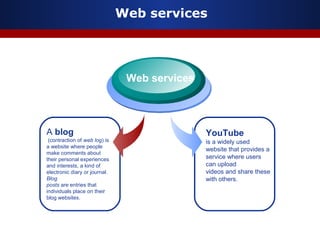
A blog
(contraction of web log) is
a website where people
make comments about
their personal experiences
and interests, a kind of
electronic diary or journal.
Blog
posts are entries that
individuals place on their
blog websites.
Web services
YouTube
is a widely used
website that provides a
service where users
can upload
videos and share these
with others.
Web services
The digital divide
 The term digital divide refers to the gap between the “haves”
and the “have nots” in society: between those who have
access to ICT and those whose access is limited or non-
existent
 The digital divide may occur between countries in the Asia-
Pacific region because certain nations are less developed
economically, or because they have less developed
infrastructures. The digital divide may occur within a country
because of differences in resources between metropolitan and
rural areas, or within cities between affluent and less affluent
schools. The digital divide may occur within schools because
some families have internet access at home while other
families do not, and this can affect school policy on homework
expectations. The digital divide may also occur between boys
and girls because at home parents often favour boys when it
comes to accessing ICT, or it may occur at school because
boys tend to dominate when ICT access is limited. And the
digital divide may occur between age groups where, for
instance, senior citizens have no previous experience with ICT.
ICT and the world of work
 ICT have brought about dramatic changes in the world of work.
New jobs have been created, for example, in selling, installing
and servicing the new technologies; and in managing and
maintaining computer systems and networks. Careers that did
not exist before ICT have opened up for programmers and
systems analysts; for web designers and others who maintain
websites; and in communication technology fields, service and
manufacturing industries.
 At the same time, many old jobs have been lost or changed.
Computer or microprocessor controlled machinery in
manufacturing industries has directly replaced many workers;
and as computerisation has made jobs more efficient, fewer staff
are needed. Unskilled workers, particularly, are vulnerable as
repetitive tasks are replaced by machines.
Governmental response to work changes
 In more developed economies, governments were quick to
respond to the impacts of ICT in the workplace and in other
aspects of daily life and, as a consequence, encouraged the
early introduction of ICT in education institutions. In less
developed economies, there was an understandable time-lag.
Malaysia Govermance
“Elsewhere, the Malaysian Government reiterates its belief in ICT as a
transforming agent in revolutionising education and learning:”
Malaysia recognises that the transformation of its education system is fundamental to
achieving its objectives. The Ministry of Education, with the participation of nongovernmental
agencies, is focusing on the development of new media for use as educational,
organisational and partnership-building tools, and as a means for bridging the country’s
digital divide and empowering learners. Due to its belief that ICT can nrevolutionise
education and learning, the Ministry plans to integrate ICT into education on a fundamental
level, incorporating systems to facilitate management, information gathering, access, and
various forms of communication. (ICT for Development, 2002, p. 1)
Students need new skills
 The new kind of skills required is driven in large part
by the exponential growth of information in
repositories around the world, of which we see
examples above. As a consequence, students need
to develop information literacy and other related
skills to search for information from these seemingly
unlimited sources on the internet, to evaluate this
information and to select wisely from it.
 At the same time, advances in ICT grow apace. To
illustrate, there is a phenomenal uptake in the use of
mobile phones in the region and across the world.
The International Telecommunications Union (ITU)
estimates there were 4.6 billion mobile cellular
subscriptions worldwide at the end of 2009, which
growth it describes as “the mobile miracle” (ITU,
2010). Newer mobile or smartphones, as they are
called, are now used not only to chat and send text
messages including images and video but also to
deliver everything from internet searches, to sending
and receiving mail, street maps and the weather. If
newer advances in ICT such as these are to
be harnessed educationally, students need
new skills.
So critical is it for
education institutions to
prepare students to
work and live in the
emerging digital world
that the next chapter
takes up more
comprehensively the
range of
skills needed to function
in the 21st century.
Factors impacting on the uptake of ICT
Many factors affect the responses of national
governments to ICT and their capacity to
develop national ICT policies, adopt education
plans for ICT, and modify the curriculum in
order to cater for the new kinds of skills now
demanded in the workplace. In this section,
we examine the regional context for the
implementation of ICT by considering a
number of geographic factors and socio-
economic characteristics as well as certain
education, demographic and ICT indicators.
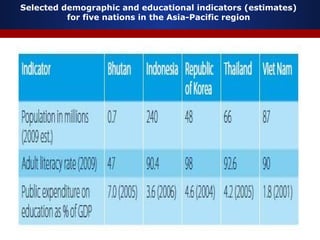
Selected demographic and educational indicators (estimates)
for five nations in the Asia-Pacific region
Conclusion
“ The compelling conclusion is that students need new skills to
equip them for today’s life challenges. The educational hurdles
to be faced are further exemplified in the various disparities
within the region that arereported above. High-speed internet is
another disparity or gap that is widening between rich and
poorcountries, according to UN Under-Secretary-General for
Communications and PublicI nformation, Kiyo Akasaka. He cites
Australia, a country with 21 million people, as having more
broadband subscribers than the whole of Africa, a continent with
nearly 900 million inhabitants (UNESCO, 2009). In contrast,
China is now ahead of the United States in having the largest
number of internet users in the world (a statistic, of course, that
is due to its population size because it also has the largest
number of non-internet users in the world). These factors are
part of the context in implementing ICT and gauging the degree
to which ICT adoption and use are integrated in regular
classroom learning activities.”
Ppt ict

Ppt ict

  • 1.
    The World Beyondthe Classroom Oleh: Raymond & Rohman HA.
  • 2.
    Exponential growth ininformation and knowledge A key trend that characterizes the environment beyond the classroom is the exponential Knowledge is not the same as information but, like information, knowledge is expanding exponentially. According to one estimate (Resta and Patru, 2010), more than 7,000 scientific and technical articles are published each day. Chemists estimate that the number of known substances has grown steadily from a few hundred in 1800 to about 25 million today
  • 3.
    Information and knowledge Informationand knowledge are the new forms of wealth and are the driving force for development. The extraordinary expansion of knowledge is brought about by ICT, which make it possible to generate, store, transmit, retrieve and process information at vastly increased speeds.
  • 4.
    Web services Information andknowledge are the new forms of wealth and are the driving force for development. The extraordinary expansion of knowledge is brought about by ICT, which make it possible to generate, store, transmit, retrieve and process information at vastly increased speeds.
  • 5.
    A blog (contraction ofweb log) is a website where people make comments about their personal experiences and interests, a kind of electronic diary or journal. Blog posts are entries that individuals place on their blog websites. Web services YouTube is a widely used website that provides a service where users can upload videos and share these with others. Web services
  • 6.
    The digital divide The term digital divide refers to the gap between the “haves” and the “have nots” in society: between those who have access to ICT and those whose access is limited or non- existent  The digital divide may occur between countries in the Asia- Pacific region because certain nations are less developed economically, or because they have less developed infrastructures. The digital divide may occur within a country because of differences in resources between metropolitan and rural areas, or within cities between affluent and less affluent schools. The digital divide may occur within schools because some families have internet access at home while other families do not, and this can affect school policy on homework expectations. The digital divide may also occur between boys and girls because at home parents often favour boys when it comes to accessing ICT, or it may occur at school because boys tend to dominate when ICT access is limited. And the digital divide may occur between age groups where, for instance, senior citizens have no previous experience with ICT.
  • 7.
    ICT and theworld of work  ICT have brought about dramatic changes in the world of work. New jobs have been created, for example, in selling, installing and servicing the new technologies; and in managing and maintaining computer systems and networks. Careers that did not exist before ICT have opened up for programmers and systems analysts; for web designers and others who maintain websites; and in communication technology fields, service and manufacturing industries.  At the same time, many old jobs have been lost or changed. Computer or microprocessor controlled machinery in manufacturing industries has directly replaced many workers; and as computerisation has made jobs more efficient, fewer staff are needed. Unskilled workers, particularly, are vulnerable as repetitive tasks are replaced by machines.
  • 8.
    Governmental response towork changes  In more developed economies, governments were quick to respond to the impacts of ICT in the workplace and in other aspects of daily life and, as a consequence, encouraged the early introduction of ICT in education institutions. In less developed economies, there was an understandable time-lag. Malaysia Govermance “Elsewhere, the Malaysian Government reiterates its belief in ICT as a transforming agent in revolutionising education and learning:” Malaysia recognises that the transformation of its education system is fundamental to achieving its objectives. The Ministry of Education, with the participation of nongovernmental agencies, is focusing on the development of new media for use as educational, organisational and partnership-building tools, and as a means for bridging the country’s digital divide and empowering learners. Due to its belief that ICT can nrevolutionise education and learning, the Ministry plans to integrate ICT into education on a fundamental level, incorporating systems to facilitate management, information gathering, access, and various forms of communication. (ICT for Development, 2002, p. 1)
  • 9.
    Students need newskills  The new kind of skills required is driven in large part by the exponential growth of information in repositories around the world, of which we see examples above. As a consequence, students need to develop information literacy and other related skills to search for information from these seemingly unlimited sources on the internet, to evaluate this information and to select wisely from it.  At the same time, advances in ICT grow apace. To illustrate, there is a phenomenal uptake in the use of mobile phones in the region and across the world. The International Telecommunications Union (ITU) estimates there were 4.6 billion mobile cellular subscriptions worldwide at the end of 2009, which growth it describes as “the mobile miracle” (ITU, 2010). Newer mobile or smartphones, as they are called, are now used not only to chat and send text messages including images and video but also to deliver everything from internet searches, to sending and receiving mail, street maps and the weather. If newer advances in ICT such as these are to be harnessed educationally, students need new skills. So critical is it for education institutions to prepare students to work and live in the emerging digital world that the next chapter takes up more comprehensively the range of skills needed to function in the 21st century.
  • 10.
    Factors impacting onthe uptake of ICT Many factors affect the responses of national governments to ICT and their capacity to develop national ICT policies, adopt education plans for ICT, and modify the curriculum in order to cater for the new kinds of skills now demanded in the workplace. In this section, we examine the regional context for the implementation of ICT by considering a number of geographic factors and socio- economic characteristics as well as certain education, demographic and ICT indicators.
  • 11.
    Selected demographic andeducational indicators (estimates) for five nations in the Asia-Pacific region
  • 12.
    Conclusion “ The compellingconclusion is that students need new skills to equip them for today’s life challenges. The educational hurdles to be faced are further exemplified in the various disparities within the region that arereported above. High-speed internet is another disparity or gap that is widening between rich and poorcountries, according to UN Under-Secretary-General for Communications and PublicI nformation, Kiyo Akasaka. He cites Australia, a country with 21 million people, as having more broadband subscribers than the whole of Africa, a continent with nearly 900 million inhabitants (UNESCO, 2009). In contrast, China is now ahead of the United States in having the largest number of internet users in the world (a statistic, of course, that is due to its population size because it also has the largest number of non-internet users in the world). These factors are part of the context in implementing ICT and gauging the degree to which ICT adoption and use are integrated in regular classroom learning activities.”