As per the Provisions of Income-Tax Act
1961
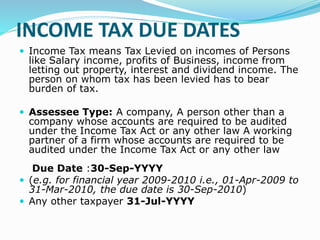
INCOME TAX DUE DATES
 Income Tax means Tax Levied on incomes of Persons
like Salary income, profits of Business, income from
letting out property, interest and dividend income. The
person on whom tax has been levied has to bear
burden of tax.
 Assessee Type: A company, A person other than a
company whose accounts are required to be audited
under the Income Tax Act or any other law A working
partner of a firm whose accounts are required to be
audited under the Income Tax Act or any other law
Due Date :30-Sep-YYYY
 (e.g. for financial year 2009-2010 i.e., 01-Apr-2009 to
31-Mar-2010, the due date is 30-Sep-2010)
 Any other taxpayer 31-Jul-YYYY
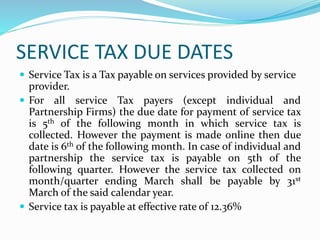
SERVICE TAX DUE DATES
 Service Tax is a Tax payable on services provided by service
provider.
 For all service Tax payers (except individual and
Partnership Firms) the due date for payment of service tax
is 5th of the following month in which service tax is
collected. However the payment is made online then due
date is 6th of the following month. In case of individual and
partnership the service tax is payable on 5th of the
following quarter. However the service tax collected on
month/quarter ending March shall be payable by 31st
March of the said calendar year.
 Service tax is payable at effective rate of 12.36%
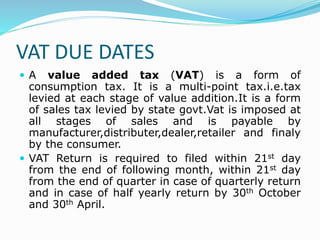
VAT DUE DATES
 A value added tax (VAT) is a form of
consumption tax. It is a multi-point tax.i.e.tax
levied at each stage of value addition.It is a form
of sales tax levied by state govt.Vat is imposed at
all stages of sales and is payable by
manufacturer,distributer,dealer,retailer and finaly
by the consumer.
 VAT Return is required to filed within 21st day
from the end of following month, within 21st day
from the end of quarter in case of quarterly return
and in case of half yearly return by 30th October
and 30th April.
ADVANCE TAX DUE DATE
 If the income tax Liability of any assessee is more than
Rs. 10,000 in a financial year then he is liable to pay
such tax in installments during the year itself rather
than paying at the end of the year.
ADVANCE TAX DUE DATES
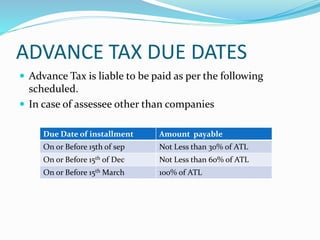
 Advance Tax is liable to be paid as per the following
scheduled.
 In case of assessee other than companies
Due Date of installment Amount payable
On or Before 15th of sep Not Less than 30% of ATL
On or Before 15th of Dec Not Less than 60% of ATL
On or Before 15th March 100% of ATL
ADVANCE TAX DUE DATE
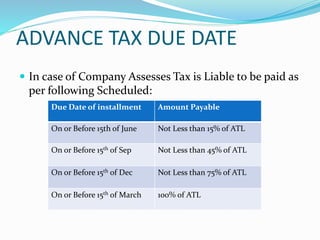
 In case of Company Assesses Tax is Liable to be paid as
per following Scheduled:
Due Date of installment Amount Payable
On or Before 15th of June Not Less than 15% of ATL
On or Before 15th of Sep Not Less than 45% of ATL
On or Before 15th of Dec Not Less than 75% of ATL
On or Before 15th of March 100% of ATL
TAX DEDUCTED AT SOURCE
 TDS or best known Tax Deducted at Source is one of
the modes of collecting Income-tax from the assessees
in India. It is to be noted that liability of the deductor
does not ends with the deduction of tax at source but
at the same time liability to file return of TDS arises
which deductor needs to file on different due dates.
 In case of Salaried employees the TDS is to be
deducted by employer at the time of payment of
salaries to employees. However in case of all assessees
earning income from any source other than salary
then he has to pay the tax in installments.
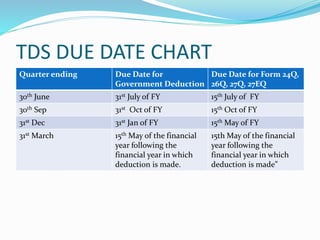
TDS DUE DATE CHART
Quarter ending Due Date for
Government Deduction
Due Date for Form 24Q,
26Q, 27Q, 27EQ
30th June 31st July of FY 15th July of FY
30th Sep 31st Oct of FY 15th Oct of FY
31st Dec 31st Jan of FY 15th May of FY
31st March 15th May of the financial
year following the
financial year in which
deduction is made.
15th May of the financial
year following the
financial year in which
deduction is made”
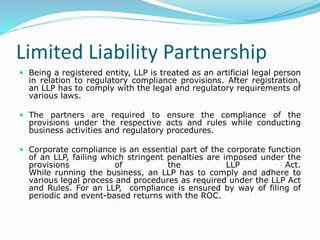
Limited Liability Partnership
 Being a registered entity, LLP is treated as an artificial legal person
in relation to regulatory compliance provisions. After registration,
an LLP has to comply with the legal and regulatory requirements of
various laws.
 The partners are required to ensure the compliance of the
provisions under the respective acts and rules while conducting
business activities and regulatory procedures.
 Corporate compliance is an essential part of the corporate function
of an LLP, failing which stringent penalties are imposed under the
provisions of the LLP Act.
While running the business, an LLP has to comply and adhere to
various legal process and procedures as required under the LLP Act
and Rules. For an LLP, compliance is ensured by way of filing of
periodic and event-based returns with the ROC.
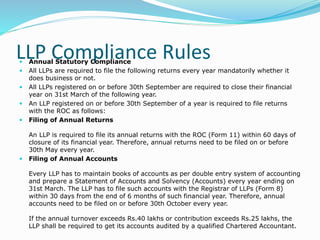
LLP Compliance Rules Annual Statutory Compliance
 All LLPs are required to file the following returns every year mandatorily whether it
does business or not.
 All LLPs registered on or before 30th September are required to close their financial
year on 31st March of the following year.
 An LLP registered on or before 30th September of a year is required to file returns
with the ROC as follows:
 Filing of Annual Returns
An LLP is required to file its annual returns with the ROC (Form 11) within 60 days of
closure of its financial year. Therefore, annual returns need to be filed on or before
30th May every year.
 Filing of Annual Accounts
Every LLP has to maintain books of accounts as per double entry system of accounting
and prepare a Statement of Accounts and Solvency (Accounts) every year ending on
31st March. The LLP has to file such accounts with the Registrar of LLPs (Form 8)
within 30 days from the end of 6 months of such financial year. Therefore, annual
accounts need to be filed on or before 30th October every year.
If the annual turnover exceeds Rs.40 lakhs or contribution exceeds Rs.25 lakhs, the
LLP shall be required to get its accounts audited by a qualified Chartered Accountant.
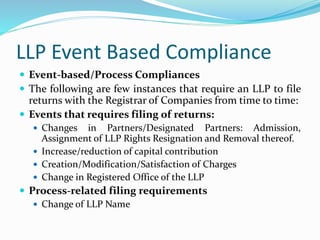
LLP Event Based Compliance
 Event-based/Process Compliances
 The following are few instances that require an LLP to file
returns with the Registrar of Companies from time to time:
 Events that requires filing of returns:
 Changes in Partners/Designated Partners: Admission,
Assignment of LLP Rights Resignation and Removal thereof.
 Increase/reduction of capital contribution
 Creation/Modification/Satisfaction of Charges
 Change in Registered Office of the LLP
 Process-related filing requirements
 Change of LLP Name
Tax due date compliance calendar

Tax due date compliance calendar

  • 1.
    As per theProvisions of Income-Tax Act 1961
  • 2.
    INCOME TAX DUEDATES  Income Tax means Tax Levied on incomes of Persons like Salary income, profits of Business, income from letting out property, interest and dividend income. The person on whom tax has been levied has to bear burden of tax.  Assessee Type: A company, A person other than a company whose accounts are required to be audited under the Income Tax Act or any other law A working partner of a firm whose accounts are required to be audited under the Income Tax Act or any other law Due Date :30-Sep-YYYY  (e.g. for financial year 2009-2010 i.e., 01-Apr-2009 to 31-Mar-2010, the due date is 30-Sep-2010)  Any other taxpayer 31-Jul-YYYY
  • 3.
    SERVICE TAX DUEDATES  Service Tax is a Tax payable on services provided by service provider.  For all service Tax payers (except individual and Partnership Firms) the due date for payment of service tax is 5th of the following month in which service tax is collected. However the payment is made online then due date is 6th of the following month. In case of individual and partnership the service tax is payable on 5th of the following quarter. However the service tax collected on month/quarter ending March shall be payable by 31st March of the said calendar year.  Service tax is payable at effective rate of 12.36%
  • 4.
    VAT DUE DATES A value added tax (VAT) is a form of consumption tax. It is a multi-point tax.i.e.tax levied at each stage of value addition.It is a form of sales tax levied by state govt.Vat is imposed at all stages of sales and is payable by manufacturer,distributer,dealer,retailer and finaly by the consumer.  VAT Return is required to filed within 21st day from the end of following month, within 21st day from the end of quarter in case of quarterly return and in case of half yearly return by 30th October and 30th April.
  • 5.
    ADVANCE TAX DUEDATE  If the income tax Liability of any assessee is more than Rs. 10,000 in a financial year then he is liable to pay such tax in installments during the year itself rather than paying at the end of the year.
  • 6.
    ADVANCE TAX DUEDATES  Advance Tax is liable to be paid as per the following scheduled.  In case of assessee other than companies Due Date of installment Amount payable On or Before 15th of sep Not Less than 30% of ATL On or Before 15th of Dec Not Less than 60% of ATL On or Before 15th March 100% of ATL
  • 7.
    ADVANCE TAX DUEDATE  In case of Company Assesses Tax is Liable to be paid as per following Scheduled: Due Date of installment Amount Payable On or Before 15th of June Not Less than 15% of ATL On or Before 15th of Sep Not Less than 45% of ATL On or Before 15th of Dec Not Less than 75% of ATL On or Before 15th of March 100% of ATL
  • 8.
    TAX DEDUCTED ATSOURCE  TDS or best known Tax Deducted at Source is one of the modes of collecting Income-tax from the assessees in India. It is to be noted that liability of the deductor does not ends with the deduction of tax at source but at the same time liability to file return of TDS arises which deductor needs to file on different due dates.  In case of Salaried employees the TDS is to be deducted by employer at the time of payment of salaries to employees. However in case of all assessees earning income from any source other than salary then he has to pay the tax in installments.
  • 9.
    TDS DUE DATECHART Quarter ending Due Date for Government Deduction Due Date for Form 24Q, 26Q, 27Q, 27EQ 30th June 31st July of FY 15th July of FY 30th Sep 31st Oct of FY 15th Oct of FY 31st Dec 31st Jan of FY 15th May of FY 31st March 15th May of the financial year following the financial year in which deduction is made. 15th May of the financial year following the financial year in which deduction is made”
  • 10.
    Limited Liability Partnership Being a registered entity, LLP is treated as an artificial legal person in relation to regulatory compliance provisions. After registration, an LLP has to comply with the legal and regulatory requirements of various laws.  The partners are required to ensure the compliance of the provisions under the respective acts and rules while conducting business activities and regulatory procedures.  Corporate compliance is an essential part of the corporate function of an LLP, failing which stringent penalties are imposed under the provisions of the LLP Act. While running the business, an LLP has to comply and adhere to various legal process and procedures as required under the LLP Act and Rules. For an LLP, compliance is ensured by way of filing of periodic and event-based returns with the ROC.
  • 11.
    LLP Compliance RulesAnnual Statutory Compliance  All LLPs are required to file the following returns every year mandatorily whether it does business or not.  All LLPs registered on or before 30th September are required to close their financial year on 31st March of the following year.  An LLP registered on or before 30th September of a year is required to file returns with the ROC as follows:  Filing of Annual Returns An LLP is required to file its annual returns with the ROC (Form 11) within 60 days of closure of its financial year. Therefore, annual returns need to be filed on or before 30th May every year.  Filing of Annual Accounts Every LLP has to maintain books of accounts as per double entry system of accounting and prepare a Statement of Accounts and Solvency (Accounts) every year ending on 31st March. The LLP has to file such accounts with the Registrar of LLPs (Form 8) within 30 days from the end of 6 months of such financial year. Therefore, annual accounts need to be filed on or before 30th October every year. If the annual turnover exceeds Rs.40 lakhs or contribution exceeds Rs.25 lakhs, the LLP shall be required to get its accounts audited by a qualified Chartered Accountant.
  • 12.
    LLP Event BasedCompliance  Event-based/Process Compliances  The following are few instances that require an LLP to file returns with the Registrar of Companies from time to time:  Events that requires filing of returns:  Changes in Partners/Designated Partners: Admission, Assignment of LLP Rights Resignation and Removal thereof.  Increase/reduction of capital contribution  Creation/Modification/Satisfaction of Charges  Change in Registered Office of the LLP  Process-related filing requirements  Change of LLP Name