KENDRIYA VIDYALAYA
BUSINESS
DEVELOPED BY:
SHIVSHARAN SINGH
UNDER THE GUIDANCE OF:
SHRI R.NAGARAJAN
PROJECT REPORT SUBMITTED TO:
KENDRIYA VIDYALAYA NO.1 Jalahalli (W) for the
fulfillment of ‘XII’ Class CBSE BOARD EXAMINATION for the subject
Business For the academic year 2013-2014.
ACKNOWLEDGEMENT
I would like to sincerely and profusely thank
SHRI R.NAGARAJAN [PGT
COMMERCE] for his valuable guidance,
advice and for giving useful suggestions and
relevant ideas that facilitated easy and early
completion of this project.
I would also like to thank my school
Management authority for providing the
domain knowledge.
KENDRIYA VIDYALAYA NO.1 JALAHALLI (W)
BANGALORE – 15
CERTIFICATE
This is to certify that ……………………………….... bearing the
CBSE Roll No ………………………. has successfully
completed the project entitled ‘STUDENT RECORD KEEPING
SYSTEM’ in requirement of the fulfillment of the ‘XII’ CBSE
Board Examination for the subject Business during the
academics Year 2013-14
Under the guidance of:
Shri R.Nagarajan EXTERNAL
INVIGILATOR:
PGT (commerce)
…………………………………..
Jalahalli West
INDEX
SALT FACTS
HISTORY OF TATA SALT
MANUFACTURING CAPABILITIES
PRODUCT PROFILE
SALT MARKET AND COMPETITION
TATA SALT MARKATING STRATEGYS
ADVERTISEMENT STRATEGY
SWOT ANALYSIS
AWARDS AND RECOGNIZATION
Salt every kitchen, every home and almost every dish. Few of
us know, however, that this fine white powder has a long, interesting
history that has played a crucial role in the development and
progress of civilizations and the world as we know it today is one of
the most ubiquitous cooking ingredients — found in almost
Did you know?
Salt is the oldest food flavoring. The first written reference to
salt is found in the Book of Job, recorded about 2,250 BC.
In the Middle Ages, salt was so expensive it was sometimes
referred to as 'white gold'.
The French throw a little spilled salt behind them in order to
hit the devil in the eye, to temporarily prevent further
mischief.
Iodine is an essential micro-nutrient which helps in proper
mental development of children and prevents iodine-
deficiency disorder in adults.
Tata Salt Plus is one of the most cost-effective means of
increasing iron intake in daily diet. It can fulfill up to 50 per
cent of the family's iron requirement at Rs 17 per month
(MRP of 1Kg). Unlike other natural sources of iron, salt also
has other advantages of being self regulatory, convenient to
use and can be consumed by everybody.
A brand worth its salt
The history of iodized, vacuum evaporated,
packaged salt in India pioneered by Tata Salt in
august 1983. Tata chemicals, the company behind
the brand take the first credit to converting the
commodity salt into high quality branded product.
To millions of Indian housewives offered a welcome
move away from the loose, unbranded salt of
questionable quality to the assurance of clean, pure
salt, certified by India’s highly trusted business
house. Tata salt delineated the standard and
attributes that consumers now demand in a product-
hygiene production, purity, nutrition, and iodine
content. Thus was born a new category in the food
addictive segment.
Over the years, Tata salt’s business has grown from
strength to strength. It has became a household
name with top-of-the-mind brand recall and has
garnered 41% share of India’s branded salt, as
against 23% as its nearest competitor. And thanks to
the purity and reliability of the brand. The
preference for it span in all segment of the market:
housewives; restaurant; industry; manufacturer of
packaged snacks, colas and namkeens; and even the
Indian government.
The Tata salt brand has many accolades to its credit,
which stem from association with trust, reliability,
honesty and credibility, qualities inherent to the
Tata creed to business. Its jingle ‘Namak ho Tata ka,
Tata namak’ an audio mnemonic for the brand,
speaks volumes of its headship in the salt market.
Over the last two decades, Tata Salt has lived up to
its claim of being 'Desh Ka Namak'. According to
Nielsen Retail Audit, March 2011, each month more
than 50,000 metric tons of Tata Salt is sold through
over 12 lakh retail outlets reaching 50 million
households across the country. The brand has
managed to achieve these robust figures by
consistently delivering health-aware products. The
key to the brand's success lies in the superior
product quality of Tata Salt.
 Tata Salt is manufactured using vacuum
evaporation technology, which makes it
hygienic and free from impurities. Also it has
the requisite and consistent amount of iodine
and saltiness, thus making any recipe that much
tastier.
Today, Tata Salt is the market leader,
commanding a share of over 62 per cent of the
national branded salt category. It has also
consistently been named one of India's most
trusted food brands since 2003 by The Economic
Times Brand Equity 'Most Trusted Brands'
survey conducted by AC Nielsen each year.
While competitors have come and gone,
innovative brand building over the years has
helped build and maintain the trust consumers
have placed in Tata Salt. The initial 'Namak ho
Tata ka — Tata Namak' and path breaking 'Desh
ka Namak' and most recent 'Gulmil ke' ad
campaigns creatively tapped into this emotional
connect, reinforcing Tata Salt's leadership
position in the marketplace as well as in the
consumer's mind.
As the brand continues to grow, an important
aspect is identifying future market needs and
innovatively addressing them. In this effort Tata
Salt has launched a bouquet of products
designed to cater to specific segments of
consumers, offering them a choice of products
that come with the trust of Tata Salt. Tata Salt
Lite (low-sodium salt), Tata Salt Plus (iron-
fortified salt) and Sprinklers have been launched
in recent years further assaying the brand's
commitment to its customers.
Tata Salt is manufactured by Tata Chemicals at Mithapur, located
along the Arabian Sea in the western state of Gujarat.
The company's manufactuing process employs vacuum
evaporation technology that ensures the end product is
untouched by hand. The process begins at Tata Chemicals'
Charkala Saltworks, located 45 km away from the main salt
plant. Here seawater is pumped into solar pans and
concentrated by the process of natural evaporation. This
brine is then carried by pipeline to the Mithapur plant where
sand and other extraneous material is removed. The
concentrate is then fed into steam-heated vacuum
evaporators from which a solid-liquid mix is obtained.
The next step involves the mix being routed through
decanters for the first level of separation. The settled solids
are then pumped into a centrifuge to separate the moist salt.
The salt is then dried and iodized — the final step before
packaging. Once the salt is ready for use, it is packed in 50-kg
bags and dispatched to 27 HACCP-certified centres where it is
packed into 1-kg retail packs ready for sale.
When production began in 1983, the plant's manufacturing
capacity was a modest 5,512 tonnes per annum. Over the
years, as demand has grown, Tata Chemicals has expanded
its capacity substantially. Today, the plant produces 450,000
tonnes every year with a manufacturing capacity of 2.5
million tonnes at its solar saltworks spread across 37,000
acres of land.
Tata Salt is amongst the few vacuum evaporated brands on the market. The
brand is currently packaged in 500g, 1 kg and 2 kg sizes with the 1 kg size being
the most popular. The 1 kg pack retails for Rs.22 MRP.
Produced on the western tip of India in the town of Mithapur, Tata Salt
reaches around 3.75 Crore Households in India according to the IMRB
Household Panel. Economic Times Brand Equity ranked Tata Salt as the "Most
Trusted Food Brand" and seventh "Most Trusted Brand" overall in its 2009
"Most Trusted Brands" survey. Tata Salt has been ranked the most trusted
food brand five times since 2004.
The Product Pass through Following Process
Iodized salt
It is table salt mixed with a minute amount of various salts of the
element iodine. The ingestion of iodide prevents iodine deficiency. Worldwide,
iodine deficiency affects about two billion people and is the leading
preventable cause of intellectual and developmental disabilities
Crystalline salt
Samunder Crystal Salt is a refined, iodized, clean, white crystal salt. It offers
customers a purer and cleaner alternative to the loose, unbranded crystalline
salt widely available in Indian markets.
Vacuum salt
Vacuum salt is edible common salt, manufactured by evaporating sea brine in
steam-heated vacuum evaporators. It can be dissolved very quickly due to its
fine crystalline structure and is more freely available in salting-out processes.
TCL's vacuum salt is almost free from extraneous matter.
Pure salt
Pure salt is almost pure sodium chloride and has all its inherent properties.
Although it is in a highly purified state, it still contains traces of magnesium,
which can absorb moisture from the atmosphere and render the salt lumpy.
The Indian salt market
The market for packaged iodized salt in India is estimated to be
worth Rs. 21.7 billion, with Tata Salt commanding a sales share
49.7% of the market. Domestic competitors include Annapurna,
Captain Cook, i-shakti, Nirma Shudh and Aashirvaad.
Competition in salt market
Tata Salt has got a market share of around 49.7 per cent while its
closest competitor, i-shakti from Tata Chemical Ltd which is also a
another brand of with a market share of around 14.6 per cent, a
recent ORG-MARG retail audit has revealed.
The audit shows the 15-lakh-tonne domestic branded salt market will
witness a stiff competition in the coming days as brands such as
Dandi, Surya and Nature Fresh are trying to grab a comfortable share
with intensive marketing strategies and advertisement campaigns.
ORG-MARG figures suggest that during the financial year ended 31
March 2012, on an average basis, Tata Salt grabbed a market share
of 49.7 per cent while i-shakti’s share touched 14.6 per cent. DCW
Home Products Ltd.’s Captain Cook (now with HLL) had 2.4 per cent
market share, Annapuran, Nirma Shudh and Aashirvaad had market
shares of 10.3 per cent, 16.4 per cent and 6.4 per cent respectively
and other had 2% market share. March 2012, the market share of
Tata Salt touched 49.7 per cent while Nirma Shudh’s share during the
same period was around 16.4 per cent.
In this article we have explained a brief overview of
Tata Salt marketing strategy. India’s first packaged
iodized salt brand was launched by Tata Chemicals in
the 1983. The production of salt was by sheer luck. In
1983, the Tata Chemicals needed fresh water for its
boilers that produced soda ash at its Mithapur plant in
Gujarat. Fresh water being scarce in the area, they
started processing sea water. In the process, salt of
high quality was produced as a by-product.
Tata Salt was the first of its kind to be manufactured in
India by using vacuum evaporation technology. It
helped Tata to create a successful niche for itself.
Today it continues to occupy a leadership position in
the packaged salt segment. Tata Salt marketing
strategy has helped the brand to feature consistently in
list of “The Most Trusted Brands” since 2004. Today, it
commands the sales share of Rs. 3.74 billion or almost
49.7% of the market share in India.
Tata Salt marketing strategy has focused on core values
of Tata Group. It has launched successful campaigns
consistently and also launched different variants to
meet new challenges.
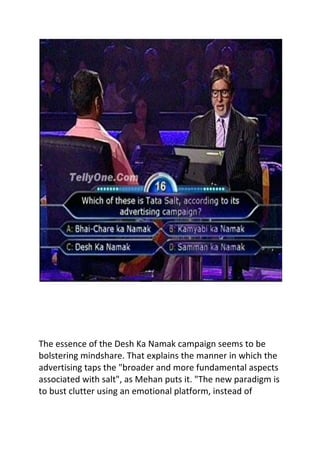
Desh Ka Namak campaign
Maine desh ka namak khaaya hai. Even in this day and age of
mercenary materialism and unmitigated cynicism, these
simple words have an earthy appeal that goes straight to the
heart. For cached in this phrase lie all those old-world
sentiments of honesty, integrity and loyalty — not to
mention patriotism — that stir the soul. And it is this aspect
of patriotism that salt brand Tata Salt has relevantly touched
upon in its latest advertising campaign (created in sync with
the brand's new positioning line of Desh Ka Namak by Bates
India), unveiled in mass media to coincide with Independence
Day.
What is heartening about the Tata Salt campaign is that in
terms of execution, it has steered clear of the 'drum-roll and
tricolour' trap. Instead of doing the predictable wearing-your-
patriotism-on-your-sleeve routine, the campaign celebrates
the 'everyday' nature of patriotism, highlighting small deeds
of selflessness that reflect a respect for the greater good. In
the process, the campaign rises from being solely about
Indianness to being about good citizens.
A brief look at the campaign — which consists of one
'montage film' and six 'extract films' — will explain the point.
The ads essentially draw from the integrity of the man-in-the-
street to showcase noble acts of duty that easily get taken for
granted. So, for instance, there is this lady doctor who, at the
end of a tiring day, decides to see that 'one more patient' —
even though it's well past her consultation time. Then the
railway linesman who, sheltering under an umbrella to keep
out the torrential rains, methodically checks every nut, bolt
and plate on a railway track (he even turns down an
invitation to warmth and tea from a colleague, as he goes
about his job). Or the elderly taxi driver who graciously turns
down a 'reward' from a passenger who, while alighting from
the cab, had left her cellphone behind (which the driver has
subsequently returned). Or the traffic policeman who sternly
declines a bribe from the driver of a car he has pulled up for
some offence. One telling shot has a passerby taking the
extra effort to shut a 'leaky' roadside tap…
The interesting thing about the campaign is that at no point
does the advertising explicitly say that the Rs 160-crore brand
is the desh ka namak — that is only implied. For instance,
even the voiceover at the end of the commercials merely
says: Aisa kharaa namak jiska kharaapan desh ke karodon
logon mein chhalakta hai.
The essence of the Desh Ka Namak campaign seems to be
bolstering mindshare. That explains the manner in which the
advertising taps the "broader and more fundamental aspects
associated with salt", as Mehan puts it. "The new paradigm is
to bust clutter using an emotional platform, instead of
focusing purely on the functional properties of salt, which
has been the traditional approach of marketers."
In the past, Tata Salt too had played upon the rational 'purity'
aspect of its offering — purity which it linked to the 'vacuum
evaporated technique' of packaging and the 'saltiest salt'
claim of the brand. However, it's not as if with the new
campaign, the brand has severed all ties with the purity
proposition. It has simply 'grown' purity to fit both the
rational and emotional manifestations of the word. "This
campaign is all about purity of thought and action, and is
juxtaposed to the purity of the brand," says Rajeev Raja,
executive creative director, Bates India.
The campaign idea itself stemmed from a consumer insight
linked to the idiomatic usage of the word salt. "If you look at
it, salt has great significance across languages," points out
(JS) Mani, senior vice-president and general manager, Bates
India. "You say someone is 'worth his salt', you call someone
a namak halaal. Salt represents character in human beings.
We saw an inherent romance in salt that could become a
campaignable idea.
"The creative idea was actually fairly simple," Raja takes up.
"Salt is a very basic necessity — a little bit can change the
complexion of food. Now what we did was draw a parallel to
small acts of integrity and loyalty that, collectively, change
the nation. And we linked it to desh ka namak khaana —
something like giving a part of yourself to the nation as a
form of repayment. And desh ka namak tied in with Tata
Salt."
SWOT Analysis
Strength
 1. The company holds a monopoly in some key
products, such as iodized salt and water purifier.
 2. Strong R&D set up and patented products in
both India (Tata Chemicals Innovation Center) and
Africa.
 3. The brand name of Tata signifies trust and
customer loyalty.
 4. Export sales in diverse regions of Europe, East
Africa, South East Asia, and the Middle East
 5. String brand equity and top brand recall in the
industry
 6. Has a strong workforce of around 5000
employees
Weakness
 1.Operations limited to India and Africa, limited
global penetration
 2. The facilities in India near Mithapur, Gujarat
have witnessed several renovations due to
earthquakes, labor strikes, social upheavals, etc.
Opportunity
 Low penetration of agricultural products in order
to minimize transmission and distribution in the
market.
 Implementation of Accelerated Power
Development & Reforms Program (APDRP) to
prevent losses occurring due to power theft,
pilferages and improper billing
 Africa is a big prospect for future growth and initial
setups in The dark continent can bring revenue
flows in the future, especially from the consumer
goods segment.
 Acquisitions of Brunner Mond of UK, General
Chemical Industrial Products Inc. of USA and the
ammonia-urea fertilizer complex in Gabon have
resulted in increased capacities
 Seed research and development is in full swing
with the Joint venture between Tata Chemicals
and Singapore’s Temasek Life Sciences Laboratory.
Threats
 Contractors’ and labor strikes, especially in Eastern
India at Haldia have resulted in shutdowns and
major reshuffling of the management.
 African communities focused on preventing the
industrialization of their environment have
launched small-scale uprisings on the construction
of soda ash plants in Tanzania.
 Anti—dumping and trade regulations are
becoming increasingly stringent and prohibitory.
Awards And Recognition
2010
 Hall of Fame award at the Economic Times Brand
Equity Survey 2010.
2009
 Named 'Most Trusted Food Brand' by Brand
Equity Survey 2009, conducted by AC Nielsen.
 Gujarat Safety Council Award for TCL, Mithapur.
Named Superbrand by Superbrands India.
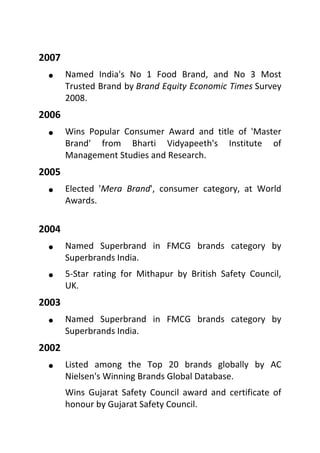
2007
 Named India's No 1 Food Brand, and No 3 Most
Trusted Brand by Brand Equity Economic Times Survey
2008.
2006
 Wins Popular Consumer Award and title of 'Master
Brand' from Bharti Vidyapeeth's Institute of
Management Studies and Research.
2005
 Elected 'Mera Brand', consumer category, at World
Awards.
2004
 Named Superbrand in FMCG brands category by
Superbrands India.
 5-Star rating for Mithapur by British Safety Council,
UK.
2003
 Named Superbrand in FMCG brands category by
Superbrands India.
2002
 Listed among the Top 20 brands globally by AC
Nielsen's Winning Brands Global Database.
Wins Gujarat Safety Council award and certificate of
honour by Gujarat Safety Council.
Tata salt ppt

Tata salt ppt

  • 1.
    KENDRIYA VIDYALAYA BUSINESS DEVELOPED BY: SHIVSHARANSINGH UNDER THE GUIDANCE OF: SHRI R.NAGARAJAN PROJECT REPORT SUBMITTED TO: KENDRIYA VIDYALAYA NO.1 Jalahalli (W) for the fulfillment of ‘XII’ Class CBSE BOARD EXAMINATION for the subject Business For the academic year 2013-2014.
  • 2.
    ACKNOWLEDGEMENT I would liketo sincerely and profusely thank SHRI R.NAGARAJAN [PGT COMMERCE] for his valuable guidance, advice and for giving useful suggestions and relevant ideas that facilitated easy and early completion of this project. I would also like to thank my school Management authority for providing the domain knowledge.
  • 3.
    KENDRIYA VIDYALAYA NO.1JALAHALLI (W) BANGALORE – 15 CERTIFICATE This is to certify that ……………………………….... bearing the CBSE Roll No ………………………. has successfully completed the project entitled ‘STUDENT RECORD KEEPING SYSTEM’ in requirement of the fulfillment of the ‘XII’ CBSE Board Examination for the subject Business during the academics Year 2013-14 Under the guidance of: Shri R.Nagarajan EXTERNAL INVIGILATOR: PGT (commerce) ………………………………….. Jalahalli West
  • 5.
    INDEX SALT FACTS HISTORY OFTATA SALT MANUFACTURING CAPABILITIES PRODUCT PROFILE SALT MARKET AND COMPETITION TATA SALT MARKATING STRATEGYS ADVERTISEMENT STRATEGY SWOT ANALYSIS AWARDS AND RECOGNIZATION
  • 6.
    Salt every kitchen,every home and almost every dish. Few of us know, however, that this fine white powder has a long, interesting history that has played a crucial role in the development and progress of civilizations and the world as we know it today is one of the most ubiquitous cooking ingredients — found in almost Did you know? Salt is the oldest food flavoring. The first written reference to salt is found in the Book of Job, recorded about 2,250 BC. In the Middle Ages, salt was so expensive it was sometimes referred to as 'white gold'. The French throw a little spilled salt behind them in order to hit the devil in the eye, to temporarily prevent further mischief. Iodine is an essential micro-nutrient which helps in proper mental development of children and prevents iodine- deficiency disorder in adults. Tata Salt Plus is one of the most cost-effective means of increasing iron intake in daily diet. It can fulfill up to 50 per cent of the family's iron requirement at Rs 17 per month (MRP of 1Kg). Unlike other natural sources of iron, salt also has other advantages of being self regulatory, convenient to use and can be consumed by everybody.
  • 7.
    A brand worthits salt The history of iodized, vacuum evaporated, packaged salt in India pioneered by Tata Salt in august 1983. Tata chemicals, the company behind the brand take the first credit to converting the commodity salt into high quality branded product. To millions of Indian housewives offered a welcome move away from the loose, unbranded salt of questionable quality to the assurance of clean, pure salt, certified by India’s highly trusted business house. Tata salt delineated the standard and attributes that consumers now demand in a product- hygiene production, purity, nutrition, and iodine content. Thus was born a new category in the food addictive segment. Over the years, Tata salt’s business has grown from strength to strength. It has became a household name with top-of-the-mind brand recall and has garnered 41% share of India’s branded salt, as
  • 8.
    against 23% asits nearest competitor. And thanks to the purity and reliability of the brand. The preference for it span in all segment of the market: housewives; restaurant; industry; manufacturer of packaged snacks, colas and namkeens; and even the Indian government. The Tata salt brand has many accolades to its credit, which stem from association with trust, reliability, honesty and credibility, qualities inherent to the Tata creed to business. Its jingle ‘Namak ho Tata ka, Tata namak’ an audio mnemonic for the brand, speaks volumes of its headship in the salt market. Over the last two decades, Tata Salt has lived up to its claim of being 'Desh Ka Namak'. According to Nielsen Retail Audit, March 2011, each month more than 50,000 metric tons of Tata Salt is sold through over 12 lakh retail outlets reaching 50 million households across the country. The brand has managed to achieve these robust figures by consistently delivering health-aware products. The key to the brand's success lies in the superior product quality of Tata Salt.
  • 9.
     Tata Saltis manufactured using vacuum evaporation technology, which makes it hygienic and free from impurities. Also it has the requisite and consistent amount of iodine and saltiness, thus making any recipe that much tastier. Today, Tata Salt is the market leader, commanding a share of over 62 per cent of the national branded salt category. It has also consistently been named one of India's most trusted food brands since 2003 by The Economic Times Brand Equity 'Most Trusted Brands' survey conducted by AC Nielsen each year. While competitors have come and gone, innovative brand building over the years has helped build and maintain the trust consumers have placed in Tata Salt. The initial 'Namak ho Tata ka — Tata Namak' and path breaking 'Desh ka Namak' and most recent 'Gulmil ke' ad campaigns creatively tapped into this emotional connect, reinforcing Tata Salt's leadership position in the marketplace as well as in the consumer's mind. As the brand continues to grow, an important aspect is identifying future market needs and innovatively addressing them. In this effort Tata Salt has launched a bouquet of products
  • 10.
    designed to caterto specific segments of consumers, offering them a choice of products that come with the trust of Tata Salt. Tata Salt Lite (low-sodium salt), Tata Salt Plus (iron- fortified salt) and Sprinklers have been launched in recent years further assaying the brand's commitment to its customers. Tata Salt is manufactured by Tata Chemicals at Mithapur, located along the Arabian Sea in the western state of Gujarat.
  • 11.
    The company's manufactuingprocess employs vacuum evaporation technology that ensures the end product is untouched by hand. The process begins at Tata Chemicals' Charkala Saltworks, located 45 km away from the main salt plant. Here seawater is pumped into solar pans and concentrated by the process of natural evaporation. This brine is then carried by pipeline to the Mithapur plant where sand and other extraneous material is removed. The concentrate is then fed into steam-heated vacuum evaporators from which a solid-liquid mix is obtained. The next step involves the mix being routed through decanters for the first level of separation. The settled solids are then pumped into a centrifuge to separate the moist salt. The salt is then dried and iodized — the final step before packaging. Once the salt is ready for use, it is packed in 50-kg bags and dispatched to 27 HACCP-certified centres where it is packed into 1-kg retail packs ready for sale. When production began in 1983, the plant's manufacturing capacity was a modest 5,512 tonnes per annum. Over the years, as demand has grown, Tata Chemicals has expanded its capacity substantially. Today, the plant produces 450,000 tonnes every year with a manufacturing capacity of 2.5 million tonnes at its solar saltworks spread across 37,000 acres of land.
  • 12.
    Tata Salt isamongst the few vacuum evaporated brands on the market. The brand is currently packaged in 500g, 1 kg and 2 kg sizes with the 1 kg size being the most popular. The 1 kg pack retails for Rs.22 MRP. Produced on the western tip of India in the town of Mithapur, Tata Salt reaches around 3.75 Crore Households in India according to the IMRB Household Panel. Economic Times Brand Equity ranked Tata Salt as the "Most Trusted Food Brand" and seventh "Most Trusted Brand" overall in its 2009 "Most Trusted Brands" survey. Tata Salt has been ranked the most trusted food brand five times since 2004. The Product Pass through Following Process Iodized salt It is table salt mixed with a minute amount of various salts of the element iodine. The ingestion of iodide prevents iodine deficiency. Worldwide, iodine deficiency affects about two billion people and is the leading preventable cause of intellectual and developmental disabilities Crystalline salt Samunder Crystal Salt is a refined, iodized, clean, white crystal salt. It offers customers a purer and cleaner alternative to the loose, unbranded crystalline salt widely available in Indian markets. Vacuum salt Vacuum salt is edible common salt, manufactured by evaporating sea brine in steam-heated vacuum evaporators. It can be dissolved very quickly due to its fine crystalline structure and is more freely available in salting-out processes. TCL's vacuum salt is almost free from extraneous matter. Pure salt Pure salt is almost pure sodium chloride and has all its inherent properties. Although it is in a highly purified state, it still contains traces of magnesium, which can absorb moisture from the atmosphere and render the salt lumpy.
  • 13.
    The Indian saltmarket The market for packaged iodized salt in India is estimated to be worth Rs. 21.7 billion, with Tata Salt commanding a sales share 49.7% of the market. Domestic competitors include Annapurna, Captain Cook, i-shakti, Nirma Shudh and Aashirvaad. Competition in salt market Tata Salt has got a market share of around 49.7 per cent while its closest competitor, i-shakti from Tata Chemical Ltd which is also a another brand of with a market share of around 14.6 per cent, a recent ORG-MARG retail audit has revealed. The audit shows the 15-lakh-tonne domestic branded salt market will witness a stiff competition in the coming days as brands such as Dandi, Surya and Nature Fresh are trying to grab a comfortable share with intensive marketing strategies and advertisement campaigns. ORG-MARG figures suggest that during the financial year ended 31 March 2012, on an average basis, Tata Salt grabbed a market share of 49.7 per cent while i-shakti’s share touched 14.6 per cent. DCW Home Products Ltd.’s Captain Cook (now with HLL) had 2.4 per cent market share, Annapuran, Nirma Shudh and Aashirvaad had market shares of 10.3 per cent, 16.4 per cent and 6.4 per cent respectively and other had 2% market share. March 2012, the market share of Tata Salt touched 49.7 per cent while Nirma Shudh’s share during the same period was around 16.4 per cent.
  • 15.
    In this articlewe have explained a brief overview of Tata Salt marketing strategy. India’s first packaged iodized salt brand was launched by Tata Chemicals in the 1983. The production of salt was by sheer luck. In 1983, the Tata Chemicals needed fresh water for its boilers that produced soda ash at its Mithapur plant in Gujarat. Fresh water being scarce in the area, they started processing sea water. In the process, salt of high quality was produced as a by-product. Tata Salt was the first of its kind to be manufactured in India by using vacuum evaporation technology. It helped Tata to create a successful niche for itself. Today it continues to occupy a leadership position in the packaged salt segment. Tata Salt marketing strategy has helped the brand to feature consistently in list of “The Most Trusted Brands” since 2004. Today, it commands the sales share of Rs. 3.74 billion or almost 49.7% of the market share in India. Tata Salt marketing strategy has focused on core values of Tata Group. It has launched successful campaigns consistently and also launched different variants to meet new challenges.
  • 16.
    Desh Ka Namakcampaign Maine desh ka namak khaaya hai. Even in this day and age of mercenary materialism and unmitigated cynicism, these simple words have an earthy appeal that goes straight to the heart. For cached in this phrase lie all those old-world sentiments of honesty, integrity and loyalty — not to mention patriotism — that stir the soul. And it is this aspect of patriotism that salt brand Tata Salt has relevantly touched upon in its latest advertising campaign (created in sync with the brand's new positioning line of Desh Ka Namak by Bates India), unveiled in mass media to coincide with Independence Day. What is heartening about the Tata Salt campaign is that in terms of execution, it has steered clear of the 'drum-roll and tricolour' trap. Instead of doing the predictable wearing-your- patriotism-on-your-sleeve routine, the campaign celebrates the 'everyday' nature of patriotism, highlighting small deeds of selflessness that reflect a respect for the greater good. In the process, the campaign rises from being solely about Indianness to being about good citizens.
  • 17.
    A brief lookat the campaign — which consists of one 'montage film' and six 'extract films' — will explain the point. The ads essentially draw from the integrity of the man-in-the- street to showcase noble acts of duty that easily get taken for granted. So, for instance, there is this lady doctor who, at the end of a tiring day, decides to see that 'one more patient' — even though it's well past her consultation time. Then the railway linesman who, sheltering under an umbrella to keep out the torrential rains, methodically checks every nut, bolt and plate on a railway track (he even turns down an invitation to warmth and tea from a colleague, as he goes about his job). Or the elderly taxi driver who graciously turns down a 'reward' from a passenger who, while alighting from the cab, had left her cellphone behind (which the driver has subsequently returned). Or the traffic policeman who sternly declines a bribe from the driver of a car he has pulled up for some offence. One telling shot has a passerby taking the extra effort to shut a 'leaky' roadside tap… The interesting thing about the campaign is that at no point does the advertising explicitly say that the Rs 160-crore brand is the desh ka namak — that is only implied. For instance, even the voiceover at the end of the commercials merely says: Aisa kharaa namak jiska kharaapan desh ke karodon logon mein chhalakta hai.
  • 18.
    The essence ofthe Desh Ka Namak campaign seems to be bolstering mindshare. That explains the manner in which the advertising taps the "broader and more fundamental aspects associated with salt", as Mehan puts it. "The new paradigm is to bust clutter using an emotional platform, instead of
  • 19.
    focusing purely onthe functional properties of salt, which has been the traditional approach of marketers." In the past, Tata Salt too had played upon the rational 'purity' aspect of its offering — purity which it linked to the 'vacuum evaporated technique' of packaging and the 'saltiest salt' claim of the brand. However, it's not as if with the new campaign, the brand has severed all ties with the purity proposition. It has simply 'grown' purity to fit both the rational and emotional manifestations of the word. "This campaign is all about purity of thought and action, and is juxtaposed to the purity of the brand," says Rajeev Raja, executive creative director, Bates India. The campaign idea itself stemmed from a consumer insight linked to the idiomatic usage of the word salt. "If you look at it, salt has great significance across languages," points out (JS) Mani, senior vice-president and general manager, Bates India. "You say someone is 'worth his salt', you call someone a namak halaal. Salt represents character in human beings. We saw an inherent romance in salt that could become a campaignable idea. "The creative idea was actually fairly simple," Raja takes up. "Salt is a very basic necessity — a little bit can change the complexion of food. Now what we did was draw a parallel to small acts of integrity and loyalty that, collectively, change the nation. And we linked it to desh ka namak khaana — something like giving a part of yourself to the nation as a form of repayment. And desh ka namak tied in with Tata Salt."
  • 21.
    SWOT Analysis Strength  1.The company holds a monopoly in some key products, such as iodized salt and water purifier.  2. Strong R&D set up and patented products in both India (Tata Chemicals Innovation Center) and Africa.  3. The brand name of Tata signifies trust and customer loyalty.  4. Export sales in diverse regions of Europe, East Africa, South East Asia, and the Middle East  5. String brand equity and top brand recall in the industry  6. Has a strong workforce of around 5000 employees
  • 22.
    Weakness  1.Operations limitedto India and Africa, limited global penetration  2. The facilities in India near Mithapur, Gujarat have witnessed several renovations due to earthquakes, labor strikes, social upheavals, etc. Opportunity  Low penetration of agricultural products in order to minimize transmission and distribution in the market.  Implementation of Accelerated Power Development & Reforms Program (APDRP) to prevent losses occurring due to power theft, pilferages and improper billing  Africa is a big prospect for future growth and initial setups in The dark continent can bring revenue flows in the future, especially from the consumer goods segment.
  • 23.
     Acquisitions ofBrunner Mond of UK, General Chemical Industrial Products Inc. of USA and the ammonia-urea fertilizer complex in Gabon have resulted in increased capacities  Seed research and development is in full swing with the Joint venture between Tata Chemicals and Singapore’s Temasek Life Sciences Laboratory. Threats  Contractors’ and labor strikes, especially in Eastern India at Haldia have resulted in shutdowns and major reshuffling of the management.  African communities focused on preventing the industrialization of their environment have launched small-scale uprisings on the construction of soda ash plants in Tanzania.  Anti—dumping and trade regulations are becoming increasingly stringent and prohibitory.
  • 24.
    Awards And Recognition 2010 Hall of Fame award at the Economic Times Brand Equity Survey 2010. 2009  Named 'Most Trusted Food Brand' by Brand Equity Survey 2009, conducted by AC Nielsen.  Gujarat Safety Council Award for TCL, Mithapur. Named Superbrand by Superbrands India.
  • 25.
    2007  Named India'sNo 1 Food Brand, and No 3 Most Trusted Brand by Brand Equity Economic Times Survey 2008. 2006  Wins Popular Consumer Award and title of 'Master Brand' from Bharti Vidyapeeth's Institute of Management Studies and Research. 2005  Elected 'Mera Brand', consumer category, at World Awards. 2004  Named Superbrand in FMCG brands category by Superbrands India.  5-Star rating for Mithapur by British Safety Council, UK. 2003  Named Superbrand in FMCG brands category by Superbrands India. 2002  Listed among the Top 20 brands globally by AC Nielsen's Winning Brands Global Database. Wins Gujarat Safety Council award and certificate of honour by Gujarat Safety Council.