TRANSLATION TECHNIQUES
ANREA PATRICIA PEREZ
COD: 40670356
GROP: 551037-12
TUTOR
DINA ESPERANZA BONILLA
NATIONAL UNIVERSITY OPEN AND
DISTANCE (UNAD)
BACHELOR'S DEGREE IN ENGLISH AS A
FOREIGN LANGUAGE
CEAD- ACACIAS
OCT- 2017
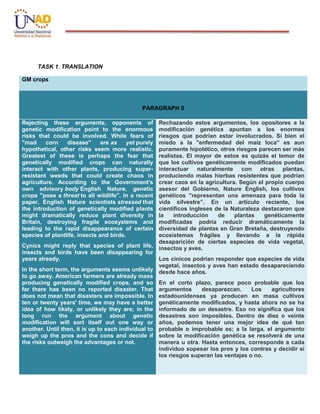
TASK 1. TRANSLATION
GM crops
PARAGRAPH 5
Rejecting these arguments, opponents of
genetic modification point to the enormous
risks that could be involved. While fears of
"mad corn disease" are as yet purely
hypothetical, other risks seem more realistic.
Greatest of these is perhaps the fear that
genetically modified crops can naturally
interact with other plants, producing super-
resistant weeds that could create chaos in
agriculture. According to the Government's
own advisory body English Nature, genetic
crops "pose a threat to all wildlife". In a recent
paper, English Nature scientists stressed that
the introduction of genetically modified plants
might dramatically reduce plant diversity in
Britain, destroying fragile ecosystems and
leading to the rapid disappearance of certain
species of plantlife, insects and birds.
Cynics might reply that species of plant life,
insects and birds have been disappearing for
years already.
In the short term, the arguments seems unlikely
to go away. American farmers are already mass
producing genetically modified crops, and so
far there has been no reported disaster. That
does not mean that disasters are impossible. In
ten or twenty years' time, we may have a better
idea of how likely, or unlikely they are; in the
long run the argument about genetic
modification will sort itself out one way or
another. Until then, it is up to each individual to
weigh up the pros and the cons and decide if
the risks outweigh the advantages or not.
Rechazando estos argumentos, los opositores a la
modificación genética apuntan a los enormes
riesgos que podrían estar involucrados. Si bien el
miedo a la "enfermedad del maíz loca" es aun
puramente hipotético, otros riesgos parecen ser más
realistas. El mayor de estos es quizás el temor de
que los cultivos genéticamente modificados puedan
interactuar naturalmente con otras plantas,
produciendo malas hierbas resistentes que podrían
crear caos en la agricultura. Según el propio cuerpo
asesor del Gobierno, Nature English, los cultivos
genéticos "representan una amenaza para toda la
vida silvestre”. En un artículo reciente, los
científicos ingleses de la Naturaleza destacaron que
la introducción de plantas genéticamente
modificadas podría reducir dramáticamente la
diversidad de plantas en Gran Bretaña, destruyendo
ecosistemas frágiles y llevando a la rápida
desaparición de ciertas especies de vida vegetal,
insectos y aves.
Los cínicos podrían responder que especies de vida
vegetal, insectos y aves han estado desapareciendo
desde hace años.
En el corto plazo, parece poco probable que los
argumentos desaparezcan. Los agricultores
estadounidenses ya producen en masa cultivos
genéticamente modificados, y hasta ahora no se ha
informado de un desastre. Eso no significa que los
desastres son imposibles. Dentro de diez o veinte
años, podemos tener una mejor idea de qué tan
probable o improbable es; a la larga, el argumento
sobre la modificación genética se resolverá de una
manera u otra. Hasta entonces, corresponde a cada
individuo sopesar los pros y los contras y decidir si
los riesgos superan las ventajas o no.
TASK 2. REFLECTION
After making a complete reading of the PARAGRAPH 5 and in order to obtain a general idea of
the work, the first thing to do is to document about the genetically modified crops with the
intention of having a certain degree of knowledge about the subject and to relate it with the
concepts and word to translate in this text, in every translation it is always important that there is
a coherence to give more clarity in what you want to convey for this reason cannot always be
accurate for what makes it necessary sometimes omit or adjust words to give one give precision
and clarity to the reader in the translation; At the moment of translation I find many difficulties for
what I take the Modulation Techniques since a reformulation is done both lexical and structural
to achieve a more correct phrase in the LM.
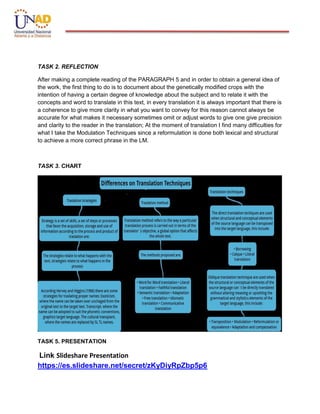
TASK 3. CHART
TASK 5. PRESENTATION
Link Slideshare Presentation
https://es.slideshare.net/secret/zKyDiyRpZbp5p6
Referencies
Bosco, G. (n.d.). Translation Techniques. Retrieved Oct 05, 2017,
from http://www.interproinc.com/es/blog/translation-techniques
Preciado, P. D., & Silva, M. (2007). English Translation Techniques [Ebook]. Retrieved Oct 05,
2017,
fromhttps://books.google.com.co/books?id=5MG8xLyZOYkC&lpg=PP1&dq=petra%20translatio
ns%20techniques&pg=PP1#v=onepage&q=petra%20translations%20techniques&f=false
Umbral Digital

Task3 collaborative andrea -perez_group-12

  • 1.
    TRANSLATION TECHNIQUES ANREA PATRICIAPEREZ COD: 40670356 GROP: 551037-12 TUTOR DINA ESPERANZA BONILLA NATIONAL UNIVERSITY OPEN AND DISTANCE (UNAD) BACHELOR'S DEGREE IN ENGLISH AS A FOREIGN LANGUAGE CEAD- ACACIAS OCT- 2017
  • 2.
    TASK 1. TRANSLATION GMcrops PARAGRAPH 5 Rejecting these arguments, opponents of genetic modification point to the enormous risks that could be involved. While fears of "mad corn disease" are as yet purely hypothetical, other risks seem more realistic. Greatest of these is perhaps the fear that genetically modified crops can naturally interact with other plants, producing super- resistant weeds that could create chaos in agriculture. According to the Government's own advisory body English Nature, genetic crops "pose a threat to all wildlife". In a recent paper, English Nature scientists stressed that the introduction of genetically modified plants might dramatically reduce plant diversity in Britain, destroying fragile ecosystems and leading to the rapid disappearance of certain species of plantlife, insects and birds. Cynics might reply that species of plant life, insects and birds have been disappearing for years already. In the short term, the arguments seems unlikely to go away. American farmers are already mass producing genetically modified crops, and so far there has been no reported disaster. That does not mean that disasters are impossible. In ten or twenty years' time, we may have a better idea of how likely, or unlikely they are; in the long run the argument about genetic modification will sort itself out one way or another. Until then, it is up to each individual to weigh up the pros and the cons and decide if the risks outweigh the advantages or not. Rechazando estos argumentos, los opositores a la modificación genética apuntan a los enormes riesgos que podrían estar involucrados. Si bien el miedo a la "enfermedad del maíz loca" es aun puramente hipotético, otros riesgos parecen ser más realistas. El mayor de estos es quizás el temor de que los cultivos genéticamente modificados puedan interactuar naturalmente con otras plantas, produciendo malas hierbas resistentes que podrían crear caos en la agricultura. Según el propio cuerpo asesor del Gobierno, Nature English, los cultivos genéticos "representan una amenaza para toda la vida silvestre”. En un artículo reciente, los científicos ingleses de la Naturaleza destacaron que la introducción de plantas genéticamente modificadas podría reducir dramáticamente la diversidad de plantas en Gran Bretaña, destruyendo ecosistemas frágiles y llevando a la rápida desaparición de ciertas especies de vida vegetal, insectos y aves. Los cínicos podrían responder que especies de vida vegetal, insectos y aves han estado desapareciendo desde hace años. En el corto plazo, parece poco probable que los argumentos desaparezcan. Los agricultores estadounidenses ya producen en masa cultivos genéticamente modificados, y hasta ahora no se ha informado de un desastre. Eso no significa que los desastres son imposibles. Dentro de diez o veinte años, podemos tener una mejor idea de qué tan probable o improbable es; a la larga, el argumento sobre la modificación genética se resolverá de una manera u otra. Hasta entonces, corresponde a cada individuo sopesar los pros y los contras y decidir si los riesgos superan las ventajas o no.
  • 3.
    TASK 2. REFLECTION Aftermaking a complete reading of the PARAGRAPH 5 and in order to obtain a general idea of the work, the first thing to do is to document about the genetically modified crops with the intention of having a certain degree of knowledge about the subject and to relate it with the concepts and word to translate in this text, in every translation it is always important that there is a coherence to give more clarity in what you want to convey for this reason cannot always be accurate for what makes it necessary sometimes omit or adjust words to give one give precision and clarity to the reader in the translation; At the moment of translation I find many difficulties for what I take the Modulation Techniques since a reformulation is done both lexical and structural to achieve a more correct phrase in the LM. TASK 3. CHART TASK 5. PRESENTATION Link Slideshare Presentation https://es.slideshare.net/secret/zKyDiyRpZbp5p6
  • 4.
    Referencies Bosco, G. (n.d.).Translation Techniques. Retrieved Oct 05, 2017, from http://www.interproinc.com/es/blog/translation-techniques Preciado, P. D., & Silva, M. (2007). English Translation Techniques [Ebook]. Retrieved Oct 05, 2017, fromhttps://books.google.com.co/books?id=5MG8xLyZOYkC&lpg=PP1&dq=petra%20translatio ns%20techniques&pg=PP1#v=onepage&q=petra%20translations%20techniques&f=false Umbral Digital